

Crypto World
Nakamoto’s $107M BTC Inc, UTXO deal reshapes Bitcoin media



Nakamoto inks $107.3M all-stock deal for BTC Inc, UTXO to scale Bitcoin media and treasury platform.
Summary
- Nakamoto will issue 363.6m shares at $1.12 to fund the $107.3M all-stock acquisition.
- Deal consolidates Bitcoin Magazine, The Bitcoin Conference, and UTXO’s hedge fund advisory under one Nasdaq-listed BTC treasury firm.
- Management frames recurring media and advisory revenues as fuel for further BTC accumulation and M&A expansion.
Nakamoto, a bitcoin treasury firm founded by entrepreneur David Bailey, announced the acquisition of BTC Inc. and UTXO Management in an all-stock transaction valued at over $107 million, according to a company statement.
The deal includes BTC Inc., which operates Bitcoin Magazine and The Bitcoin Conference, as well as UTXO Management, an investment firm that backs bitcoin treasury companies. Shareholders will receive 363,589,816 shares on a fully diluted basis, the company said.
Bailey stated the acquisitions align with Nakamoto’s strategy to operate a portfolio spanning media, asset management, and advisory services. The transactions exercised prior call options, allowing Nakamoto to acquire BTC Inc. while BTC Inc. concurrently acquired UTXO Management, according to the announcement.
The acquisitions provide recurring revenue for Nakamoto, diversifying the company’s operations beyond capital markets activities. Other bitcoin treasury companies in the sector include Strategy, led by Michael Saylor, and Twenty One Capital.
Bailey indicated that Nakamoto has no plans to sell its bitcoin holdings except under extreme prolonged price declines, signaling a continued accumulation strategy.
Industry analysts have noted a consolidation trend among bitcoin treasury companies, with firms combining media, advisory, and investment services to strengthen recurring revenue streams. Through the acquisitions of BTC Inc.’s established brands and UTXO’s investment operations, Nakamoto aims to expand its institutional presence and operational scale, according to market observers.

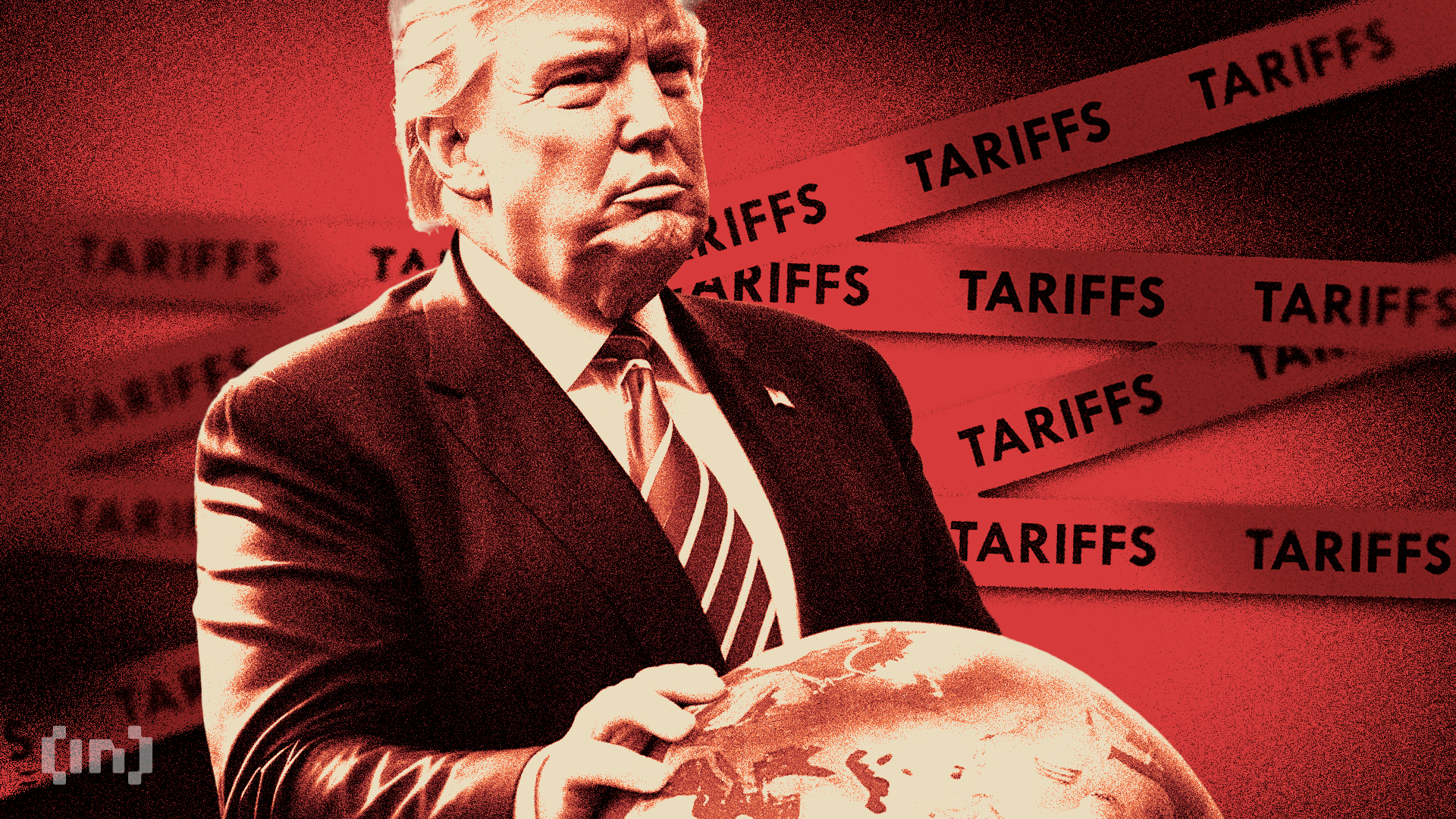
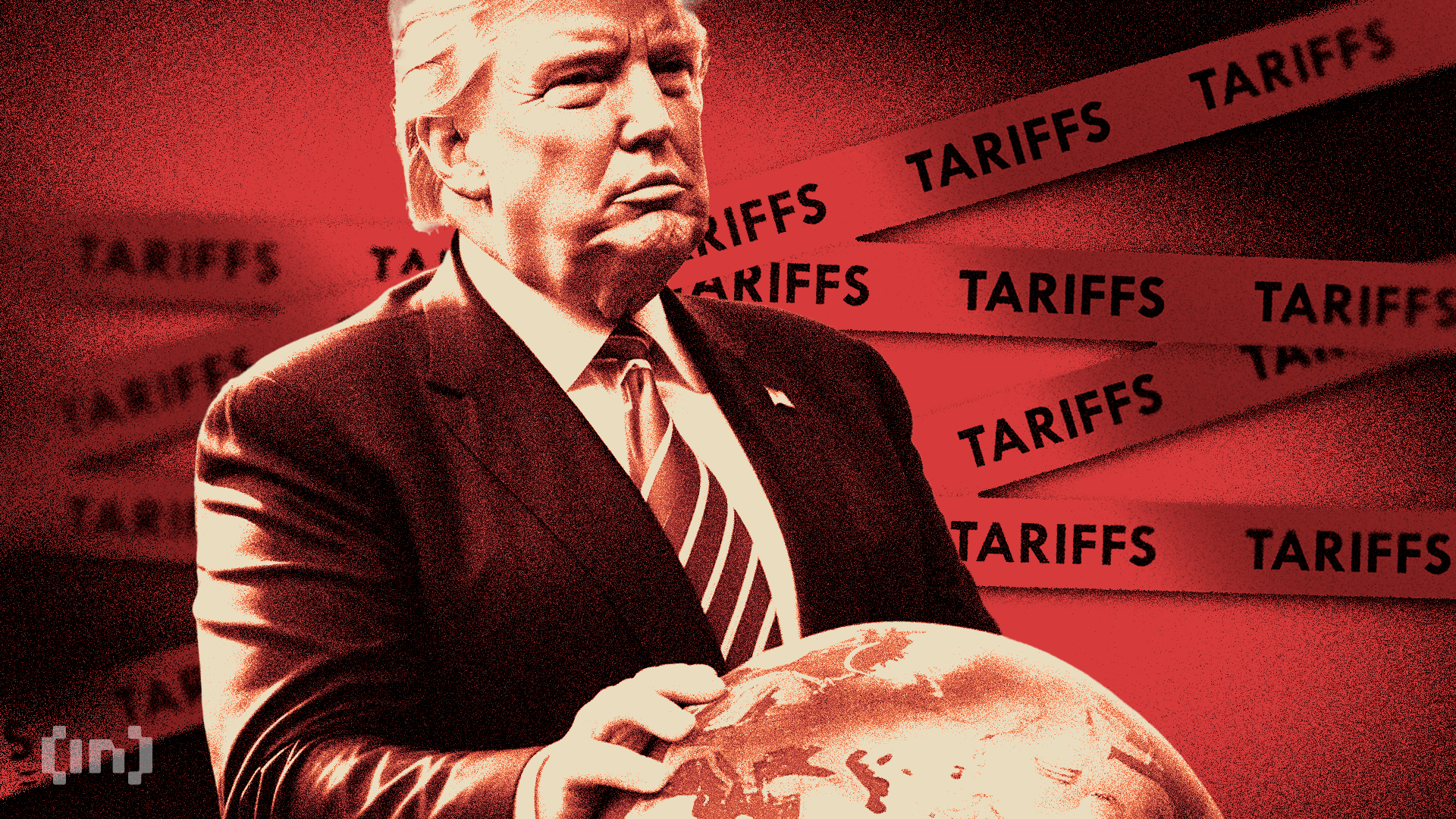
The US President Donald Trump delivered a nearly two-hour State of the Union address on Tuesday — the longest in US history — touting economic gains, warning Iran against pursuing nuclear weapons, and defending his tariff agenda after a Supreme Court setback.
Yet in a speech that touched on taxes, AI, housing, and healthcare, digital assets were entirely absent.
All the Trumps Were There, but Not Crypto
The omission is striking. All of Trump’s children were in attendance, including sons Donald Jr. and Eric, who have been deeply involved in crypto ventures such as World Liberty Financial and various token launches.
The president himself has repeatedly pledged to make the US “the crypto capital of the planet.” None of that made it into the address.
Tariff Chaos and Sticky Inflation Keep the Fed on Hold
For crypto markets, the most consequential signals were macro, not legislative.
Trump called the Supreme Court’s ruling striking down his emergency tariffs “very unfortunate” and vowed to maintain them under alternative legal authorities, insisting “congressional action will not be necessary.”
But the rollout quickly turned chaotic. Trump first announced a 10% replacement rate, then revised it to 15% days later. Yet official documents show the lower rate took effect Tuesday with no directive to raise it. The EU suspended ratification of its summer trade deal on Monday; India deferred scheduled talks.
Trump repeated his claim that tariffs could “substantially replace” income taxes. Economists call this implausible. The federal government collected $2.4 trillion in income taxes in 2024 but took in only about $300 billion from tariffs — and must now refund roughly half of that under the court ruling. Also, US importers pay the tariffs, not foreign governments.
On inflation, Trump claimed core inflation fell to 1.7% in late 2025. The reality is more complicated. The Fed’s preferred gauge — core PCE — accelerated to 3% in December, well above the 2% target.
With inflation sticky and tariff policy unresolved, the Fed is widely expected to hold rates steady for the foreseeable future. The three-quarter-point cuts delivered late last year appear to be the last for some time. For risk assets, including crypto, the higher-rate environment persists.
AI Gets Attention, Crypto Does Not
While crypto went unmentioned, AI earned a dedicated segment. Trump announced a “ratepayer protection pledge” requiring tech companies to build their own power plants for data centers, acknowledging the grid “could never handle” surging demand.
First Lady Melania Trump‘s AI legislation work was also highlighted — a sign that AI policy occupies a far more prominent place in the administration’s agenda than digital asset regulation.
The Bottom Line
Trump’s record-length address was a midterm election pitch built on economic optimism. But for crypto participants, the takeaways are clear: no legislative momentum for digital assets despite the president’s family being neck-deep in the industry, unresolved tariff turmoil injecting macro uncertainty, and a Fed locked in place by sticky inflation. The conditions weighing on risk assets aren’t likely to change anytime soon.


Bitcoin is exhibiting textbook bottom formation characteristics across multiple indicators, trading at levels that historically precede significant recoveries, according to onchain analyst James Check. Time — not price — is, however, likely to be the bigger test for bitcoin bulls.
“Every mean reversion model, from technical to onchain, is trading within bottom formation levels, typically seen after the price capitulation event (which December 2018 and June 2022 were examples of),” wrote Check on Tuesday morning as bitcoin plunged through $63,000, seemingly on its way to testing the Feb. 5 panic low of $60,000.
“Either Bitcoin is dead, will no longer mean revert, and all your models are broken,” Check continued. “Or you should be ignoring the bears … and quietly [be] dollar cost averaging [and] stacking sats from here on.”
Check — who correctly urged caution in 2025 about investing in any of BTC treasury companies formed to try and replicate the success of Michael Saylor’s Strategy — acknowledged today that it’s possible or even likely that the price of bitcoin could fall even further from here. Time, though, will be the more important factor. He reminded of the brutal 2022 bear market. Folks remember the price low around $15,600 in December of that year, but bitcoin essentially bottomed six months earlier at about $17,600. The rest was just waiting, and then a final liquidity flush (surrounding the FTX collapse).
“This is literally what a de-risked setup looks like for bitcoin,” concluded Check. “If you’re not actively accumulating bitcoin at this stage, then when?”
Artificial intelligence firm Anthropic has accused three AI firms of illicitly using its large language model Claude to improve their own models in a technique known as a “distillation” attack.
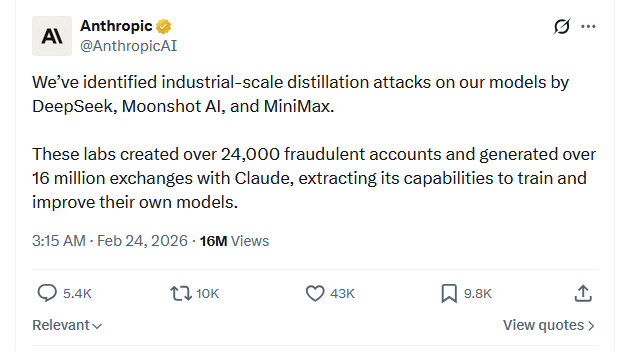
In a blog post on Sunday, Anthropic said that it had identified these “attacks” by DeepSeek, Moonshot, and MiniMax, which involve training a less capable model on the outputs of a stronger one.
Anthropic accused the trio of generating “over 16 million exchanges” combined with the firm’s Claude AI across “approximately 24,000 fraudulent accounts.”
“Distillation is a widely used and legitimate training method. For example, frontier AI labs routinely distill their own models to create smaller, cheaper versions for their customers,” Anthropic wrote, adding:
“But distillation can also be used for illicit purposes: competitors can use it to acquire powerful capabilities from other labs in a fraction of the time, and at a fraction of the cost, that it would take to develop them independently.”
Anthropic said that the attacks focused on scraping Claude for a wide range of purposes, including agentic reasoning, coding and data analysis, rubric-based grading tasks, and computer vision.
“Each campaign targeted Claude’s most differentiated capabilities: agentic reasoning, tool use, and coding,” the multi-billion-dollar AI firm said.

Anthropic says it was able to identify the trio via an “IP address correlation, request metadata, infrastructure indicators, and in some cases corroboration from industry partners who observed the same actors and behaviors on their platforms.”
DeepSeek, Moonshot, and Minimax are all AI companies based in China. All three have estimated valuations in the multi-billion dollar range, with DeepSeek being the most widely internationally recognized out of the three.
Beyond the intellectual property implications, Anthropic argued that distillation campaigns from foreign competitors present genuine geopolitical risks.
“Foreign labs that distill American models can then feed these unprotected capabilities into military, intelligence, and surveillance systems—enabling authoritarian governments to deploy frontier AI for offensive cyber operations, disinformation campaigns, and mass surveillance,” the firm said.
Moving forward, Anthropic said it would protect itself by enhancing detection systems to help spot dubious traffic, sharing threat intelligence, and tightening access controls, among other things.
Related: Citrini’s AI doom report sees software, payment stocks tumble
The firm also called for more collaboration from domestic industry participants and lawmakers to help stop foreign AI companies from attacking US firms.
“No company can solve this alone. As we noted above, distillation attacks at this scale require a coordinated response across the AI industry, cloud providers, and policymakers. We are publishing this to make the evidence available to everyone with a stake in the outcome.”
Magazine: Crypto loves Clawdbot/Moltbot, Uber ratings for AI agents: AI Eye

The Blockchain Association urged Congress to exempt low-dollar crypto transactions and tax mining and staking rewards upon sale.
A US crypto lobby group has shared with Congress its tax proposals for crypto and has met with House lawmakers working on a crypto tax bill to shape one of the industry’s top policy priorities.
The Blockchain Association released its crypto tax policy positions on Tuesday, which called for stablecoins to be treated as cash for ordinary purchases and for a de minimis tax exemption on “low-dollar” crypto transactions.
It argued that tax reporting for “negligible gains or losses from routine transactions imposes disproportionate costs on individuals and overwhelms tax administration without meaningful revenue upside.”
The group also said it supports extending wash-sale rules to digital assets, which would limit investors’ ability to claim losses if they repurchase the same asset within a specified period.
The Blockchain Association’s efforts come as lawmakers debate how to tax crypto.
Republican Senator Cynthia Lummis introduced a bill in July to tax-exempt some crypto transactions, which was met with opposition from Democratic Senator Elizabeth Warren.

The Blockchain Association argued that tax reporting for digital assets should safeguard taxpayer privacy while still enabling effective enforcement against illicit crypto activities.
It also argued that mining and staking rewards should be treated as self-created property and taxed when sold or otherwise disposed of, rather than when they are received.
Related: Dutch House of Representatives advances controversial 36% tax law
The organization met with White House officials earlier this month to advance market structure legislation that includes favorable stablecoin rewards provisions.
Warren opposes proposed crypto tax laws
Lummis’ crypto tax bill included several provisions that the Blockchain Association advocated for, but that faced strong opposition from Warren in October.
Warren argued that the de minimis exception proposal would cost the US $5.8 billion and slammed a proposal that would allow crypto investors to avoid reporting income from crypto transactions under $300.
“If someone bought $300 worth of gold, or $300 worth of Apple stock, would they be required to report any income they made from those transactions?” she argued.
Magazine: DAT panic dumps 73,000 ETH, India’s crypto tax stays: Asia Express
Bitcoin’s (BTC) bleed slowed on Tuesday as US markets recovered from Monday’s AI and software-stocks-driven selloff. At the US market closing bell, the Dow locked in a 370-point gain, while the S&P 500 held on to a 0.77% rally. The swift recovery of US equity markets appears to have played a role in easing negative pressure on crypto investors looking to cut risk asset exposure.
Bitcoin analysts continue to stress the importance of the former $65,000 support being reclaimed and the $60,000 level holding, with many suggesting that a dip below the latter figure would swiftly usher in new lows in the low $50,000 range.
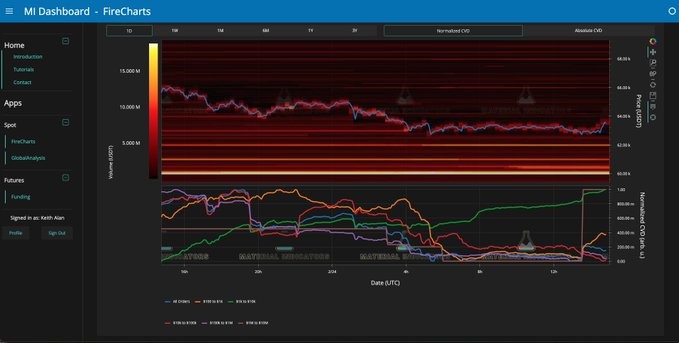
While Bitcoin now trades 49% away from its all-time high, BTC market resource Material Indicators flagged a $4.5 million spot purchase by “mega whales” on Tuesday morning. In the post, Material Indicators noted that while the figure is insignificant, “it’s significantly larger than the typical $1M – $2M market order we see from that order class.”

They added:
“We typically see them do this when they are buying directly into liquidity to help break walls.”
Time for a Bitcoin turnaround?
Currently, few signals point to a reversal of the prolonged bear trend, but analysts are quick to note how deeply oversold Bitcoin is, citing several data points that marked turning points in sentiment and positioning when extreme thresholds were breached.
As reported by Cointelegraph, Bitcoin’s weekly RSI has fallen to 25.71, lows not seen since July, 2022. As shown in the chart below, RSI readings below 28 have previously been a discounted buying opportunity and an early signal that the market is finding a bottom.

Galaxy head of firmwide research Alex Thorn said Bitcoin is “nearing all-time oversold territory,” explaining that the:
“Weekly RSI is lower than any time except the darkest of bears.”
Related: Bitcoin ‘fair value’ gap sets $45K target as AI woes haunt stocks, gold
Bitcoin is also within 9% of its 200-week exponential moving average at $58,855, a level some traders have pointed to as the start of the bottoming process in previous market cycles. Crypto analyst Rekt Capital, on the other hand, painted a less optimistic picture.
According to the analyst, the now confirmed daily close below the 200-EMA “could turn it into resistance on any upcoming recovery.” Rekt Capital suggested that future retests of the moving average would instead “prompt additional bearish acceleration to the downside.”

Even if Bitcoin is on its way to a bottom, the process could take many months. According to Bitcoin analyst Brian Brookshire, “grinding out a bottom” could take time, but some steps in the right direction would be equalization of the BTC supply in the profit-loss metric and “Bitcoin bouncing off mining cost.”
Brookshire also alluded to future US Federal Reserve rate cuts, either by Chairman Jerome Powell or the potential future chair, Kevin Warsh, as having an impact on BTC price.

This article does not contain investment advice or recommendations. Every investment and trading move involves risk, and readers should conduct their own research when making a decision. While we strive to provide accurate and timely information, Cointelegraph does not guarantee the accuracy, completeness, or reliability of any information in this article. This article may contain forward-looking statements that are subject to risks and uncertainties. Cointelegraph will not be liable for any loss or damage arising from your reliance on this information.
Crypto World
Leading stablecoin Tether shrinks again as market cap looks set for second straight monthly drop


Tether , the world’s largest stablecoin by market value, continues to shrink and looks set for a second straight monthly contraction, signaling challenging conditions for a sustainable broader market recovery.
Tether’s market capitalization has dropped by 0.8% to $183.61 billion this month, extending January’s 1% slide from a record $186.84 billion, according to data source CoinDesk. This hasn’t happened since TerraForm Labs’ collapse in 2022, which wiped out billions in investor wealth and shook investor confidence in stablecoins.
“Stablecoins are the fuel that powers crypto markets. When the fuel drains, everything slows down, and that is exactly what we are watching unfold,” Rachael Lucas, crypto analyst at BTC Markets, said in a post on LinkedIn.
Stablecoins are digital tokens whose value is pegged to an external reference, such as the U.S. dollar or other fiat currencies. They are often touted as tokenized versions of fiat currencies and help users bypass price volatility risks associated with other tokens, such as bitcoin.
That’s why, over the years, they have evolved into funding currencies for crypto trading and a mode of moving capital across borders, including day-to-day payments in some regions.
The ongoing contraction in tether indicates capital outflows from the crypto market. This, coupled with tepid demand for U.S.-listed spot ETFs, casts doubt on the sustainability of potential recovery rallies in bitcoin and the wider crypto market.
Bitcoin , the leading cryptocurrency by market value, has failed to build momentum since its downtrend paused near $60,000 on Feb. 6. Prices briefly bounced above $70,000 days later but have since pulled back to trade around $65,000, CoinDesk data show.
Note that the growth of other prominent stablecoins, such as the U.S.-regulated USDCoin (USDC), has stalled as well, though it’s been more resilient than tether.
While USDC’s market cap has recovered to nearly $75 billion from its January dip to $70 billion, it remains flat year to date.


A South Korean man has been indicted on attempted murder charges after allegedly poisoning his business partner with pesticide-laced coffee amid a dispute over more than $816,000 in crypto losses, according to local reports.
The Seoul Eastern District Prosecutors’ Office has accused a man in his 30s of adding the pesticide methomyl to his business partner’s drink during a meeting at a café in November, local news outlets Chosun and Asia Business Daily reported on Monday.
After drinking the coffee, the victim lost consciousness and collapsed. He was rushed to the hospital and regained consciousness three days later, according to reports.
Dispute over $800,000 in crypto losses
Starting in 2022, the two men reportedly operated an investment business managing Bitcoin (BTC) investment programs.
However, a dispute arose when the accused man allegedly lost over 1.17 billion Korean won ($816,000), including company funds he had personally invested, leading the alleged victim to assume control of the company’s finances.
The alleged victim, who was not named, told Asia Business Daily that at the time he claims he was poisoned, “I was about to get married, and my wife was in the early stages of pregnancy. My family was almost completely destroyed. I’ve recovered a lot now, but I still go to the hospital.”
Related: Bank of Korea renews call for bank-led won stablecoins as bill stalls
A trial date is scheduled for March 10 at the Seoul Eastern District Court, where the accused is facing charges of attempted murder and violation of the Pesticide Control Act.
The case comes amid a friendlier environment for crypto in South Korea since the election of President Lee Jae-myung in June, who has pushed forward with various crypto-related laws, including a bill to legalize stablecoins.
That’s led the local market to boom, with the number of crypto exchange users in South Korea surpassing 16 million last year, more than 30% of the population, as the crypto market hit new highs.
However, the wider crypto market saw a downturn late in 2025, as Bitcoin rapidly fell from its October peak of over $125,000 to trade under $90,000 by late December. It’s continued to fall and is now trading at around $65,500.
Magazine: South Koreans dump Tesla for Ethereum treasury BitMine: Asia Express
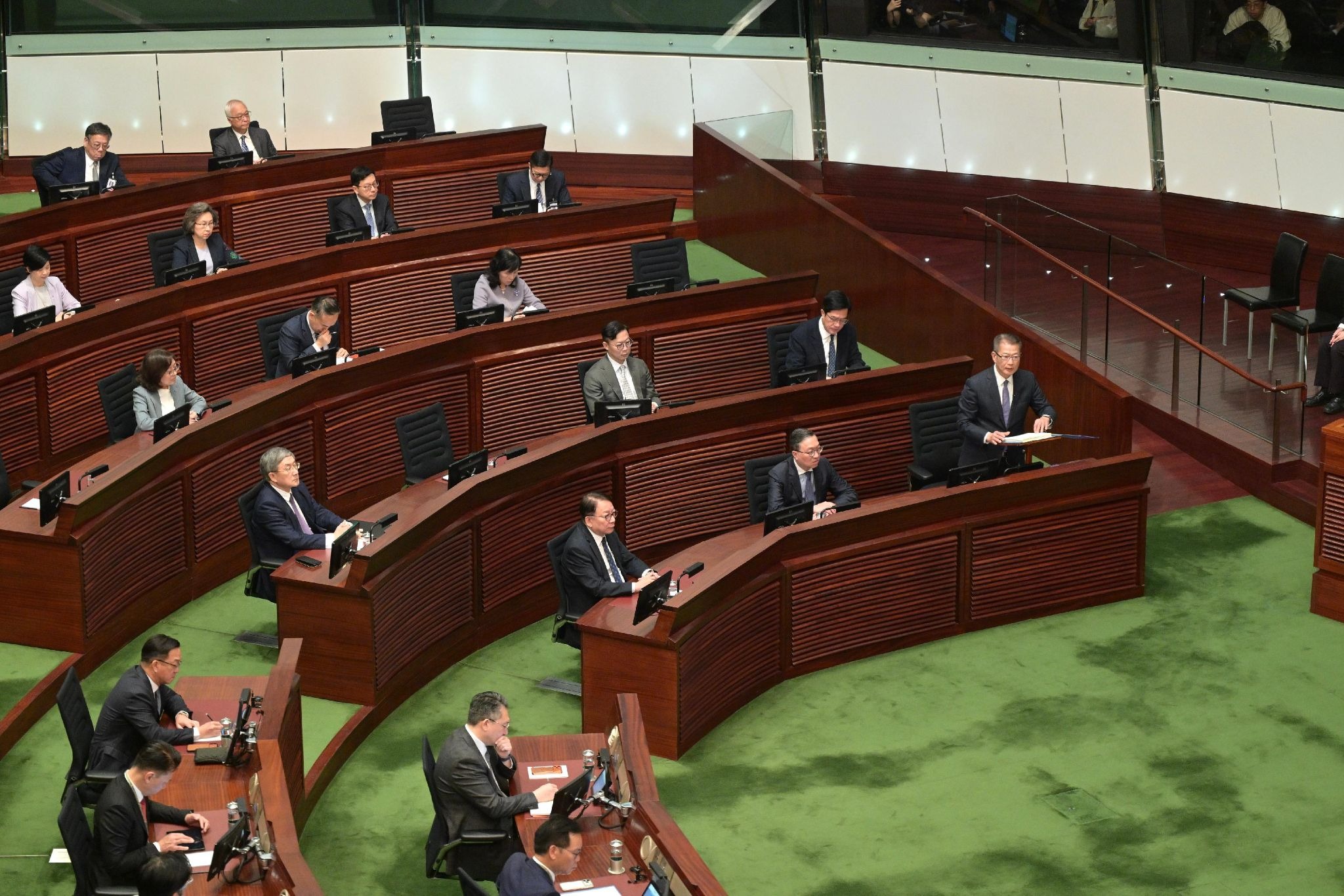
Hong Kong will set up a new digital asset platform this year to support the issuance and settlement of tokenized bonds, as the city pushes to move tokenization from pilot deals into core market infrastructure.
In his 2026-27 Budget speech delivered on Wednesday, Financial Secretary Paul Chan said CMU OmniClear Holdings, a subsidiary of the Hong Kong Monetary Authority (HKMA), will build the platform and extend it to other digital assets.
The system will also be linked with regional tokenization platforms. Chan said the platform would be “gradually extended to other digital assets and linked with other tokenisation platforms in the region,” adding that the move would consolidate Hong Kong’s role in digital asset development.
The announcement places tokenized bond settlement within the HKMA’s post-trade infrastructure, moving beyond pilot issuances toward integrated market systems.
Hong Kong has already tokenized several rounds of tokenized government bonds. Chan said the government issued its third batch of tokenized bonds in the fourth quarter of 2025, totaling 10 billion Hong Kong dollars ($1.28 billion). He added that the government would continue issuing tokenized bonds on a regular basis.

Stablecoin licensing and broader rules
Chan has also said Hong Kong plans to issue its first batch of fiat-referenced stablecoin licenses in March, with initial approvals expected to be limited.
He said the government will continue to facilitate licensed issuers in exploring use cases “in a compliant and risk-controlled manner.”
On Feb. 2, HKMA Chief Executive Eddie Yue announced that the regulator is preparing to grant its first stablecoin issuer licenses in March, with initial approvals expected to be limited.
Yue said reviews are focused on use cases, risk management, Anti-Money Laundering (AML) controls and asset backing.
Chan’s speech also stated that the government will introduce a bill to establish licensing regimes for digital asset dealing and custodian service providers.
He added that the Inland Revenue Ordinance will also be amended to implement the Organisation for Economic Co-operation and Development’s Crypto-Asset Reporting Framework, aligning Hong Kong with global tax transparency standards.
Related: Hong Kong regulator adds Victory Fintech to list of approved trading platforms
Liquidity push builds on earlier digital asset efforts
The infrastructure push comes alongside other recent efforts to expand Hong Kong’s regulated digital asset market.
On Feb. 11, the Securities and Futures Commission allowed licensed brokers to offer digital asset margin financing and outlined a framework for crypto perpetual contracts limited to professional investors.
Regulators said the measures aim to deepen liquidity while maintaining risk controls.
The measures outlined in the 2026–27 Budget extend that approach by integrating tokenized bond issuance and settlement into the city’s core financial infrastructure.
Magazine: Hong Kong stablecoins in Q1, BitConnect kidnapping arrests: Asia Express


Bitcoin prices continue to weaken and are approaching pain levels for long-term holders, according to analysts.
As Bitcoin markets fail to improve, analysts have been looking into the behavior of the different investor cohorts in the market.
“One of the cornerstone cohorts in this framework is long-term holders (LTH), known to be less sensitive to short-term price fluctuations,” said CryptoQuant analyst ‘Darkfost’ on Tuesday.
Currently, long-term holders are sitting on an average profit of roughly 74%, but this profit margin continues to decline as the price moves closer to the LTH cost basis, currently estimated at around $38,900, they said.
Bear Market Breaks Below Cost Basis
The analyst looked at historical cycles, noting that each bear market has been characterized by price breaking below this cost basis, “triggering a final capitulation phase marked by realized losses of around 20%.”
Only when this happens, and markets begin to recover and enter a bull phase, the analyst noted.
BTC Drifting Toward the LTH Pain Point
“Looking at historical precedent, each bear market has been characterized by price breaking below this cost basis, triggering a final capitulation phase marked by realized losses of ~20%.” – By @Darkfost_Coc pic.twitter.com/c50CHSzEBU
— CryptoQuant.com (@cryptoquant_com) February 24, 2026
Glassnode reported on Tuesday that the 90-day moving average of the Realized Profit/Loss Ratio has now fallen below 1, “confirming a full transition into an excess loss-realization regime.” The analysis echoes that of Darkfost: historically, these bearish conditions persist for at least 6 months before liquidity returns to markets.
Meanwhile, analyst James Check said that Bitcoin has almost printed five consecutive red monthly candles, “following the largest volatility spike of the cycle.”
You may also like:
He also observed that 1-week realised volatility spiked above 150%, “a level typically seen around capitulation events,” weekly RSI is at one of the “most oversold readings in Bitcoin’s history,” and around $70 billion of BTC has migrated to new hands in the $60,000 to $70,000 range this year.
Bitcoin supply in loss just hit 10 million coins, the fourth-highest reading ever, observed analyst James Van Straten, who added that the circulating supply hits 20 million BTC next week, and 50% is in loss.
“History suggests that’s enough capital destruction for a bear market bottom,” he said.
Bitcoin Sees Small Rebound
There was a minor rebound during early trading in Asia on Wednesday morning, with BTC adding $2,000 to reclaim $66,000. However, the move does not appear to be natural, and bearish sentiment remains dominant.
Moreover, the move has formed another lower high with $60,000 still serving as support for lower lows.
Binance Free $600 (CryptoPotato Exclusive): Use this link to register a new account and receive $600 exclusive welcome offer on Binance (full details).
LIMITED OFFER for CryptoPotato readers at Bybit: Use this link to register and open a $500 FREE position on any coin!


Bitcoin reclaimed $65,400 early Wednesday as a weaker U.S. dollar and a risk-on tone across Asian equities gave crypto markets their first clean bounce in weeks.
The broader crypto market cap had slipped to $2.19 trillion earlier this week, practically retesting the lows hit during the Feb. 5 crash. That proximity is what makes the current move interesting.
If the level holds, the market is looking at a textbook “double bottom” with roughly 10% upside, according to Alex Kuptsikevich, chief market analyst at FxPro. If it doesn’t, he warned, “a failure to rebound will signal the end of the recovery, opening the potential for a further 25% decline.”
A double bottom is a classic bullish chart pattern that signals a potential trend reversal after a downtrend. Imagine the price dropping to a low, then bouncing up a bit, forming resistance and then falling back to test that same low point. This creates a W-shaped structure with two “bottoms.” Once price breaks above the middle peak, a bullish reversal is confirmed.
The focus, therefore, is on whether the ongoing recovery rally extends beyond the brief bounce to $2.47 trillion market cap seen roughly 10 days ago.
Altcoins rise as dollar dips
In the meantime, major tokens are tracking bitcoin higher. Ether rose 4.2% over the past day, solana gained 7%, and XRP added 3%. The moves came as MSCI’s gauge for Asian equities climbed 1.4% to a record, led by South Korea and Taiwan, where AI-linked chipmakers hit all-time highs ahead of Nvidia’s earnings report later Wednesday.
The dollar provided a tailwind for risk assets. The Bloomberg Dollar Spot Index edged lower after President Trump’s State of the Union address, in which he doubled down on tariff plans despite the Supreme Court striking down his global import taxes.
He further suggested tariffs could eventually replace the income tax system entirely.
A weaker dollar has historically been constructive for bitcoin, though the relationship has been inconsistent during this drawdown cycle.
But conviction remains thin despite the bounce notwithstanding. Bloomberg reported that analysts it surveyed described a “crisis of confidence” in bitcoin after its nearly 50% decline from all-time highs, with no obvious new catalysts for growth.
FxPro’s Kuptsikevich went further, saying the market likely hasn’t bottomed yet and that “real capitulation is still ahead.”

Onesmoothoperator targets 2026 Blamey Stakes in Flemington return

Contexto Hints & Answers for Today: February 25

North Yorkshire farm shop and deli among UK’s best for 2026


-

 Video5 days ago
XRP News: XRP Just Entered a New Phase (Almost Nobody Noticed)
-

 Fashion5 days ago
Weekend Open Thread: Boden – Corporette.com
-

 Politics3 days ago
Baftas 2026: Awards Nominations, Presenters And Performers
-

 Entertainment7 days ago
Kunal Nayyar’s Secret Acts Of Kindness Sparks Online Discussion
-

 Sports2 days ago
Women’s college basketball rankings: Iowa reenters top 10, Auriemma makes history
-

 Politics2 days ago
Nick Reiner Enters Plea In Deaths Of Parents Rob And Michele
-

 Tech7 days ago
Retro Rover: LT6502 Laptop Packs 8-Bit Power On The Go
-
 Sports6 days ago
Clearing the boundary, crossing into history: J&K end 67-year wait, enter maiden Ranji Trophy final | Cricket News
-

 Business3 days ago
Mattel’s American Girl brand turns 40, dolls enter a new era
-

 Crypto World1 day ago
XRP price enters “dead zone” as Binance leverage hits lows
-

 Business3 days ago
Law enforcement kills armed man seeking to enter Trump’s Mar-a-Lago resort, officials say
-

 Entertainment6 days ago
Dolores Catania Blasts Rob Rausch For Turning On ‘Housewives’ On ‘Traitors’
-

 Tech3 days ago
Anthropic-Backed Group Enters NY-12 AI PAC Fight
-
 NewsBeat2 days ago
‘Hourly’ method from gastroenterologist ‘helps reduce air travel bloating’
-

 NewsBeat3 days ago
Armed man killed after entering secure perimeter of Mar-a-Lago, Secret Service says
-

 Politics3 days ago
Maine has a long track record of electing moderates. Enter Graham Platner.
-

 Crypto World7 days ago
WLFI Crypto Surges Toward $0.12 as Whale Buys $2.75M Before Trump-Linked Forum
-

 Tech15 hours ago
Unsurprisingly, Apple's board gets what it wants in 2026 shareholder meeting
-
 NewsBeat10 hours ago
Police latest as search for missing woman enters day nine
-

 Crypto World5 days ago
83% of Altcoins Enter Bear Trend as Liquidity Crunch Tightens Grip on Crypto Market