

Crypto World
Canton’s Industry Working Group Advances Cross-Border Collateral Mobility With Tokenised Gilts


TLDR:
- Canton’s working group completed its fourth transaction round, introducing tokenised Gilts as repo collateral for the first time.
- The round featured the first cross-currency intraday repo using tokenised Gilts against non-GBP tokenised deposits on Canton.
- Archax joined as a new participant, using its tokenisation engine to create regulated digital representations of traditional Gilts.
- The working group plans to expand cross-border collateral mobility across European and global markets throughout all of 2026.
Canton’s industry working group has taken another step forward in advancing cross-border collateral mobility on Canton.
Digital Asset, alongside a consortium of leading financial institutions, completed a fourth set of transactions on the Canton Network on February 24, 2026.
The latest round builds on prior milestones by introducing tokenised Gilts and cross-currency repo activity. Together, these achievements move the industry closer to a scalable, always-on capital markets infrastructure that operates across borders and asset classes.
Working Group Builds on Previous Transaction Rounds
The industry working group has steadily expanded its scope across each successive round of transactions. Following the third set completed in December 2025, which covered multiple asset classes and currencies using tokenised deposits, this fourth round introduced new instruments and cross-currency structures. Each iteration has added complexity while maintaining institutional-grade standards across the board.
This latest round featured the first cross-border intraday repo transaction conducted using tokenised Gilts. It also marked the first cross-currency intraday repo using tokenised Gilts against non-GBP tokenised deposits.
These additions reflect the group’s commitment to broadening the range of assets that can move seamlessly across borders within the Canton ecosystem.
@digitalasset, in collaboration with @CantonNetwork participants, announced the completion of a fourth set of transactions showcasing continued momentum in cross-border intraday repurchase activity.
The group’s approach is methodical, advancing one transaction type at a time while ensuring each new layer meets real market requirements. This measured progression is what gives the working group its credibility across participating institutions.
Expanded Membership Strengthens the Consortium’s Reach
A key feature of this transaction round was the growth in active participation across the working group. Archax, a regulated digital asset exchange, broker, and custodian, joined as a new participant.
Existing members including LSEG, Euroclear, Citadel Securities, TreasurySpring, and IntellectEU also deepened their roles in this round.
Archax supported the transaction by leveraging its broker and custody permissions to hold traditional Gilts on behalf of clients.
It then used its tokenisation engine to create regulated digital representations of those assets. Graham Rodford, CEO and co-founder of Archax, described this function as central to the firm’s broader vision and participation strategy.
The growing membership across custodians, trading venues, clearinghouses, and technology providers adds structural depth to the working group. Participants now span the full transaction lifecycle, from execution to settlement and custody.
This breadth makes the group well-positioned to address production-scale challenges as the initiative moves beyond the pilot stage.
Cross-Border Collateral Mobility Takes Shape Across Currencies
The working group’s focus on cross-border collateral mobility is becoming more concrete with each round. TreasurySpring validated cross-currency intraday repo and reverse repo against UK Gilts, with haircuts and repo interest embedded directly into smart contracts.
Co-Founder Matthew Longhurst stated these transactions reflect real economic and risk terms across an institutional governance framework.
Euroclear UK & International played a central role as the UK’s central securities depository in tokenising Gilts for the transaction.
CEO Chris Elms noted that enabling real-time, cross-border collateral mobility helps unlock new liquidity sources for clients. EUI’s involvement brings regulated post-trade infrastructure directly into the Canton framework.
LSEG’s DiSH network served as the cash leg for the transactions, enabling instantaneous beneficial ownership transfer of commercial bank money across multiple currencies and jurisdictions.
Bud Novin, Head of Payment Systems at LSEG, confirmed that DiSH Cash supported the first tokenised intraday Gilt repo on Canton Network.
He added that LSEG DiSH is positioned as a trusted third-party solution for mobilising networks in tokenised markets.
Industry Players Align Around Scalable On-Chain Market Infrastructure
Beyond the transactions themselves, participants are increasingly focused on what comes next for the working group.
IntellectEU’s Anastasiia Vitmer pointed to how quickly the scope is expanding across assets, infrastructure, and active participants.
Her firm’s Catalyst Suite is being built to support any institutional use case on Canton Network as on-chain markets continue to mature.
DTCC’s Brian Steele reinforced that collaboration across the industry is essential to setting standards and accelerating digital asset adoption.
He added that this cross-border intraday repo use case confirms growing demand for seamless, scalable financial infrastructure. DTCC’s role reflects how traditional market infrastructure providers are engaging directly with on-chain models.
Digital Asset’s Kelly Mathieson stated that greater asset diversity and broader participation are paving the way for more efficient and liquid capital markets.
The working group plans to continue groundbreaking on-chain financing initiatives throughout 2026, with European markets and other key regions in focus.
Cumberland DRW’s Chris Zuehlke added that Canton continues to show how tokenisation can unlock real efficiency gains across an increasingly diverse set of assets and currencies.

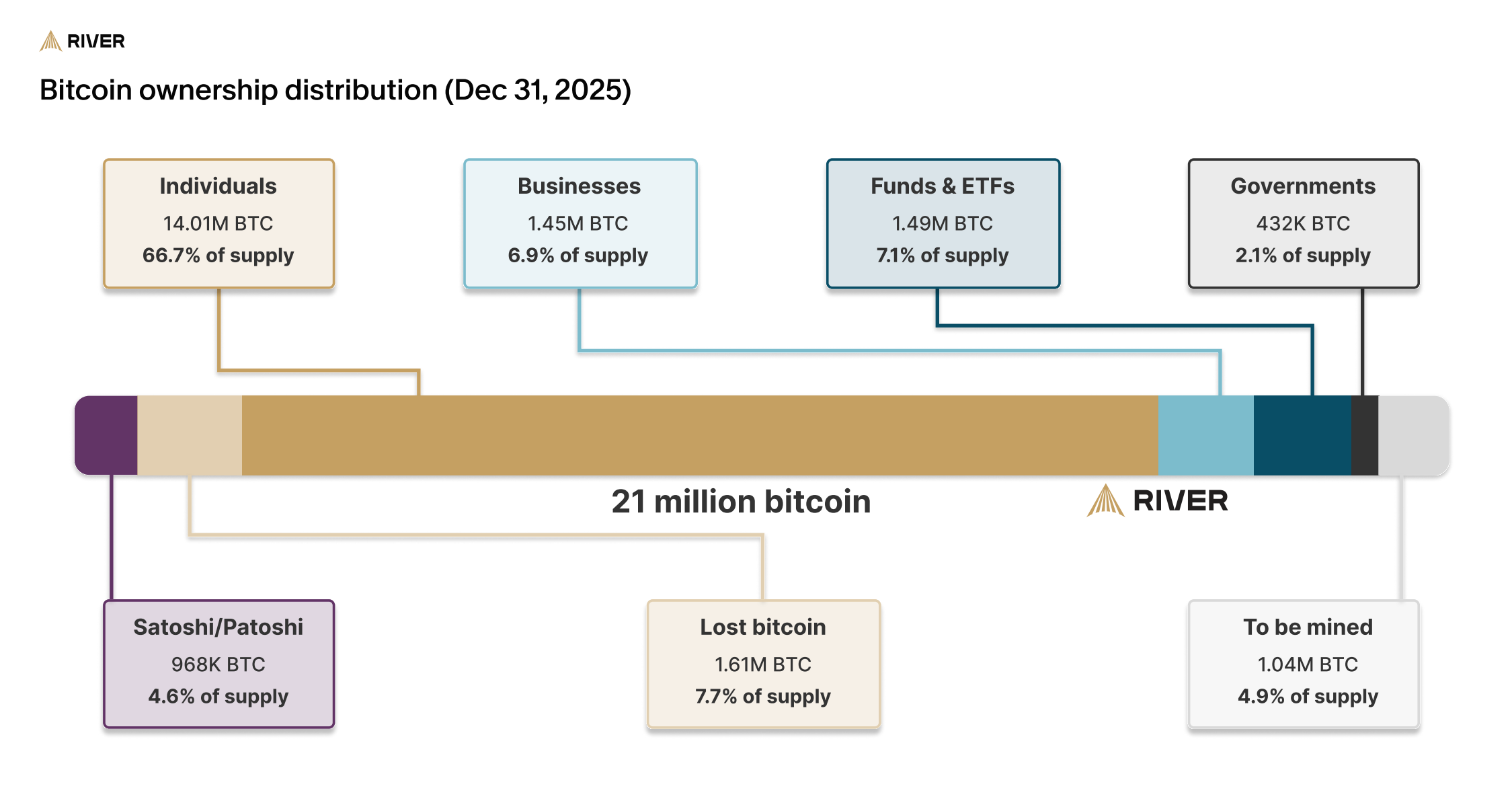
Bitcoin (BTC) continued its downward trajectory in February, trading at $64,492, nearly 50% below its early October all-time high (ATH) price.
Yet, price action tells only part of the story. According to River, Bitcoin adoption accelerated last year, with institutions, banks, merchants, public companies, and even nation-states increasing their exposure.
Is Bitcoin’s 50% Decline Masking a Structural Bullish Trend?
BeInCrypto recently reported that the crypto market has slipped into extreme fear, with retail investors growing increasingly pessimistic about Bitcoin’s price. This sentiment is reflected in a surge of “Bitcoin going to zero” searches, which recently reached an all-time high.
The price drawdown has also weighed on institutional participants. Crypto hedge funds have pulled back from the market.
“With Bitcoin and ETH continuing to slide, crypto hedge funds have retreated to cash. Their average cash levels are currently 15.32%, the highest in almost a year,” Nic Puckrin, co-founder of Coin Bureau, told BeInCrypto.
Moreover, recent disclosures show that in Q4 2025, institutional investors also trimmed their Bitcoin exchange-traded fund (ETF) exposure.
However, when viewed from a broader perspective, the long-term adoption trajectory remains constructive. In a recent market report, River highlighted that the largest cryptocurrency’s adoption surged in 2025.
“There is no bear market in bitcoin adoption. Bitcoin is down 50% from all-time highs, but adoption is compounding in ways that aren’t affecting the price, yet,” the post read.
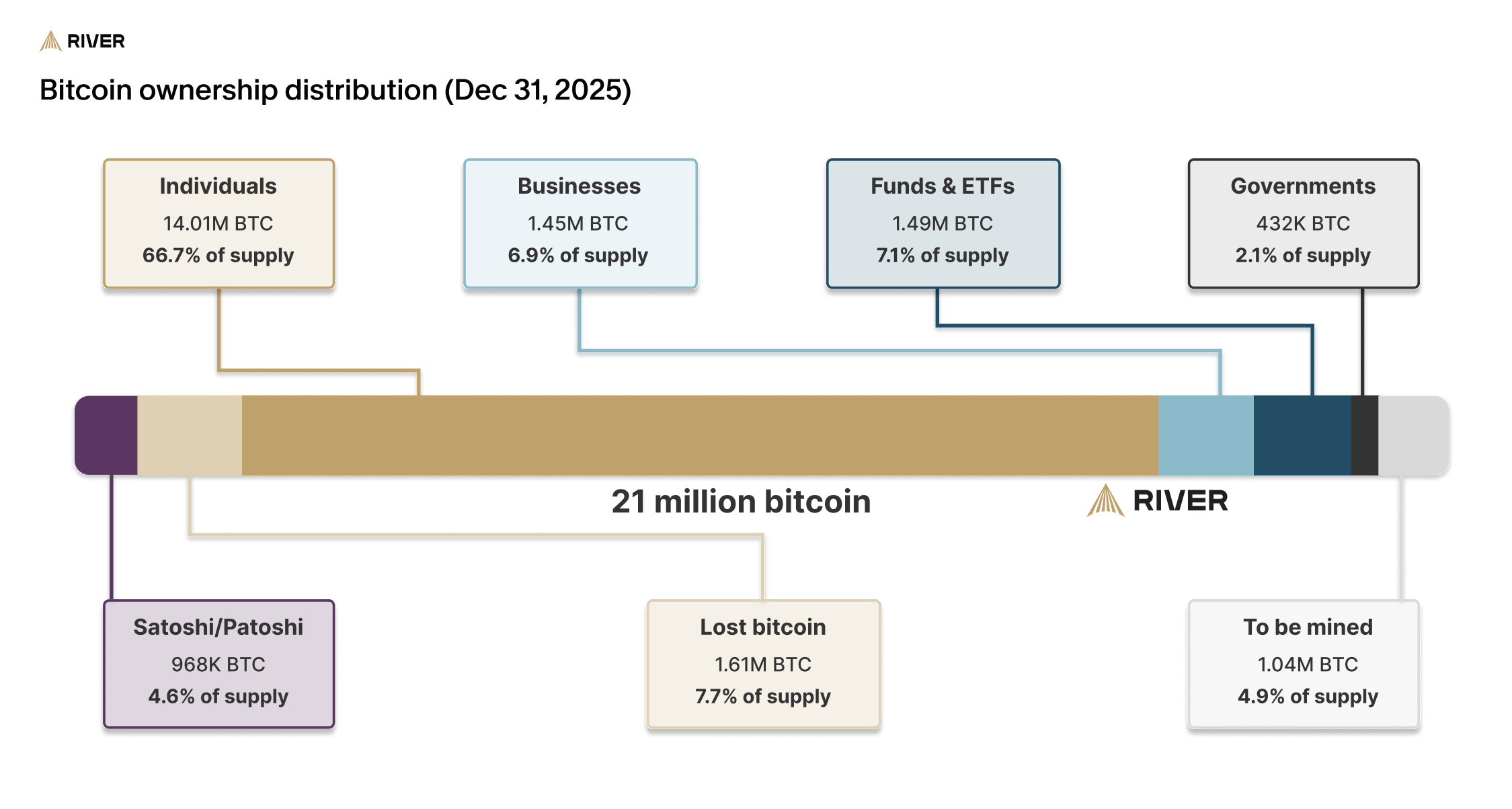
According to River, institutions collectively added approximately 829,000 BTC in 2025. This figure includes purchases from businesses, governments, funds, and ETFs.
Registered investment advisors allocated close to $1.5 billion per quarter into Bitcoin ETFs over the past two years. Notably, none of those quarters recorded net outflows.
Although exposure among RIAs is widespread, with 29 of the 30 largest US firms holding positions, portfolio allocations remain minimal, averaging 0.008%.
Businesses emerged as the largest buyers in 2025. They added $54 billion worth of Bitcoin to their balance sheets during the year.
Bitcoin treasury companies account for the majority of corporate holdings, collectively controlling 866,000 BTC. At the same time, the number of publicly listed firms with Bitcoin holdings rose to 194.
At the sovereign level, five nations became new Bitcoin holders in 2025, including purchases linked to two sovereign wealth funds, Luxembourg and Saudi Arabia, as well as the Czech Republic’s central bank. In total, 23 nation-states now hold Bitcoin.
“Trust in bitcoin has grown faster than that of any asset in history. What began as an experiment is now a globally recognized store-of-value, with adoption patterns that rival the internet,” River wrote.
US Businesses Embrace Bitcoin Payments
Beyond direct accumulation, payment adoption expanded materially. The number of US merchants accepting Bitcoin payments tripled during the year. Furthermore, global usage increased by 74%.
Meanwhile, development activity within traditional finance continues. Approximately 60% of the 25 largest US banks are building Bitcoin products, indicating ongoing institutional integration.
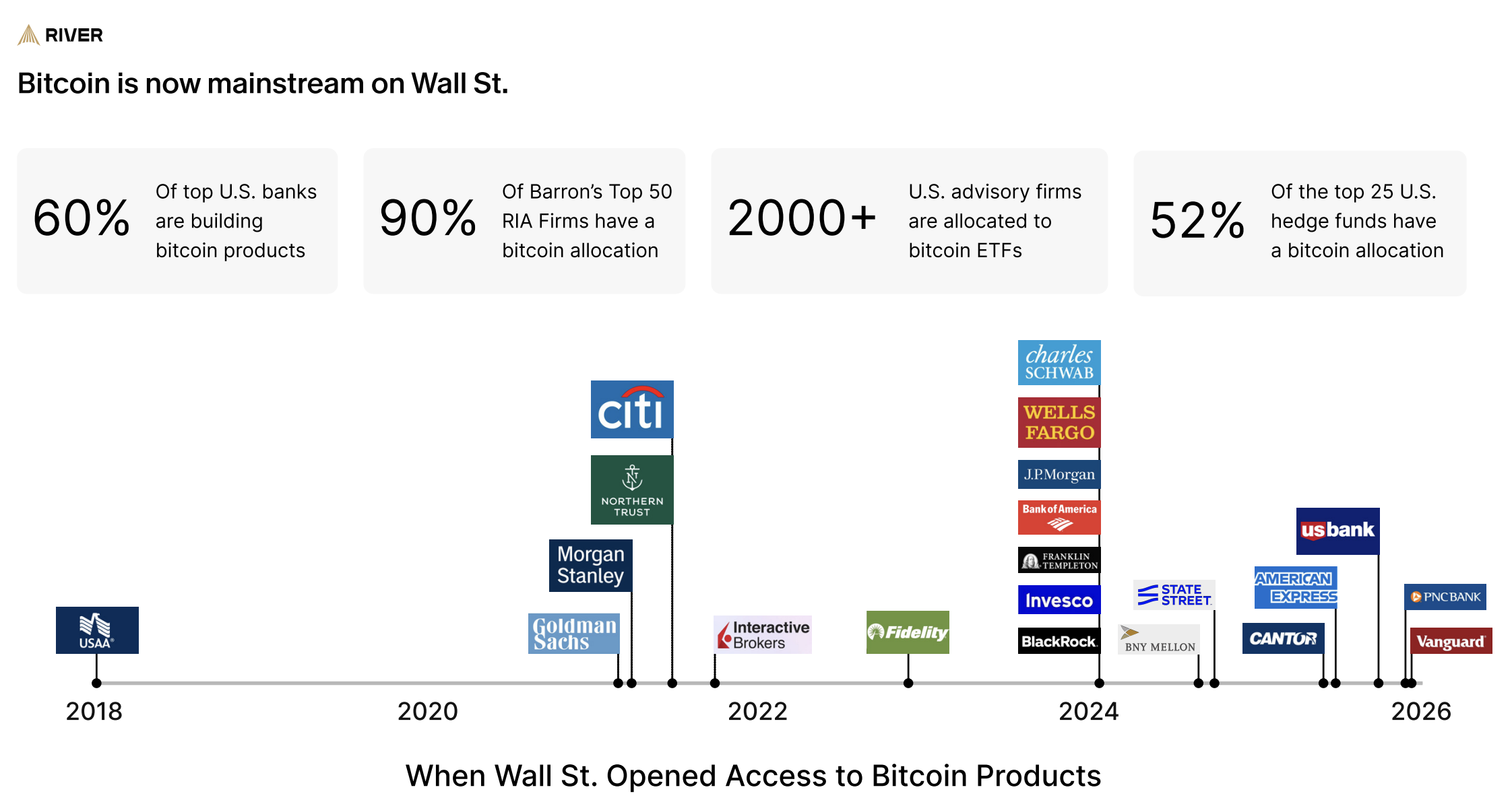
River stated that the current wave of adoption is unlikely to trigger an immediate 10-fold price surge for Bitcoin. However, the firm argued that this type of steady integration may carry greater significance.
Looking ahead, River said it expects adoption to accelerate meaningfully over the coming years as broader participation deepens.


Meta targets H2 2026 for stablecoin creator payouts, enabled by Stripe’s Bridge under new U.S. rules.
Summary
- Meta plans to integrate third-party stablecoins for creator payouts across Facebook, Instagram and WhatsApp, focusing on ~$100 cross-border transfers.
- Stripe’s Bridge, acquired for ~$1.1b in 2024, just secured conditional OCC trust bank approval, enabling regulated stablecoin issuance and custody.
- The GENIUS Act, signed in 2025, created a federal framework for fully reserved payment stablecoins, giving Meta and Bridge clearer compliance rails.
Meta Platforms Inc. is preparing to integrate stablecoin payments across its social media platforms in the second half of 2026 through a third-party provider, CoinDesk reported, citing three people familiar with the plans.
The company has issued requests for proposals to external infrastructure firms, with Stripe emerging as the likely partner, according to the report. Stripe CEO Patrick Collison joined Meta’s board in April 2025.
The initiative marks a shift from Meta’s previous stablecoin effort. The company’s 2019 Libra project, later rebranded as Diem, faced intense regulatory opposition and was ultimately abandoned. Libra was designed as a global currency backed by a basket of assets, which regulators viewed as an attempt by a private company to build sovereign-scale monetary infrastructure.
According to Fortune reporting from May 2025, Meta CEO Mark Zuckerberg told Stripe’s John Collison that the Diem project was dead.
The current approach differs significantly from the earlier effort. Meta will not mint its own stablecoin but will instead integrate existing stablecoin infrastructure, positioning itself as a distribution channel rather than an issuer, according to a source who told CoinDesk the company wants to pursue the initiative “at arm’s length.”
The likely integration partner is Stripe’s Bridge platform, which received conditional approval from the Office of the Comptroller of the Currency for a national trust bank charter in February 2026.
The timeline of developments includes Stripe’s acquisition of Bridge for approximately $1.1 billion in October 2024, Collison’s appointment to Meta’s board in April 2025, and Bridge’s OCC conditional approval in February 2026, the same month Meta sent out requests for proposals.
In its 2025 annual letter, Stripe reported that Bridge’s transaction volume quadrupled as stablecoin adoption expanded beyond cryptocurrency market cycles. “Stablecoin payments are advancing quietly and inexorably as real-world uptake continues apace,” the company stated.
Meta’s focus centers on reducing costs for international creator payouts, particularly small transfers around $100 that currently face high wire transfer and foreign exchange fees. The company’s platforms, including Facebook, Instagram, and WhatsApp, serve approximately 3 billion users globally.
Stablecoin integration could reduce costs for cross-border settlements and accelerate payout speeds compared to traditional banking systems, according to the CoinDesk report. The move would also position Meta competitively against X and Telegram in developing super app functionality.
The regulatory environment has shifted since Meta’s earlier stablecoin attempt. The GENIUS Act, signed by President Donald Trump in July 2025, established the first federal legal framework for U.S. stablecoin issuers, contrasting with the regulatory opposition that existed between 2019 and 2022.
Bridge’s pursuit of an OCC charter reflects the new regulatory approach, operating within a federal framework rather than outside it.
Several implementation details remain unclear, including which specific stablecoins Meta will support, whether transactions will be on-chain or abstracted from blockchain infrastructure, how the company will handle wallet custody and compliance requirements, and whether non-U.S. markets will serve as initial testing grounds.
Meta declined to comment on the reported plans. Stripe did not immediately respond to requests for comment.
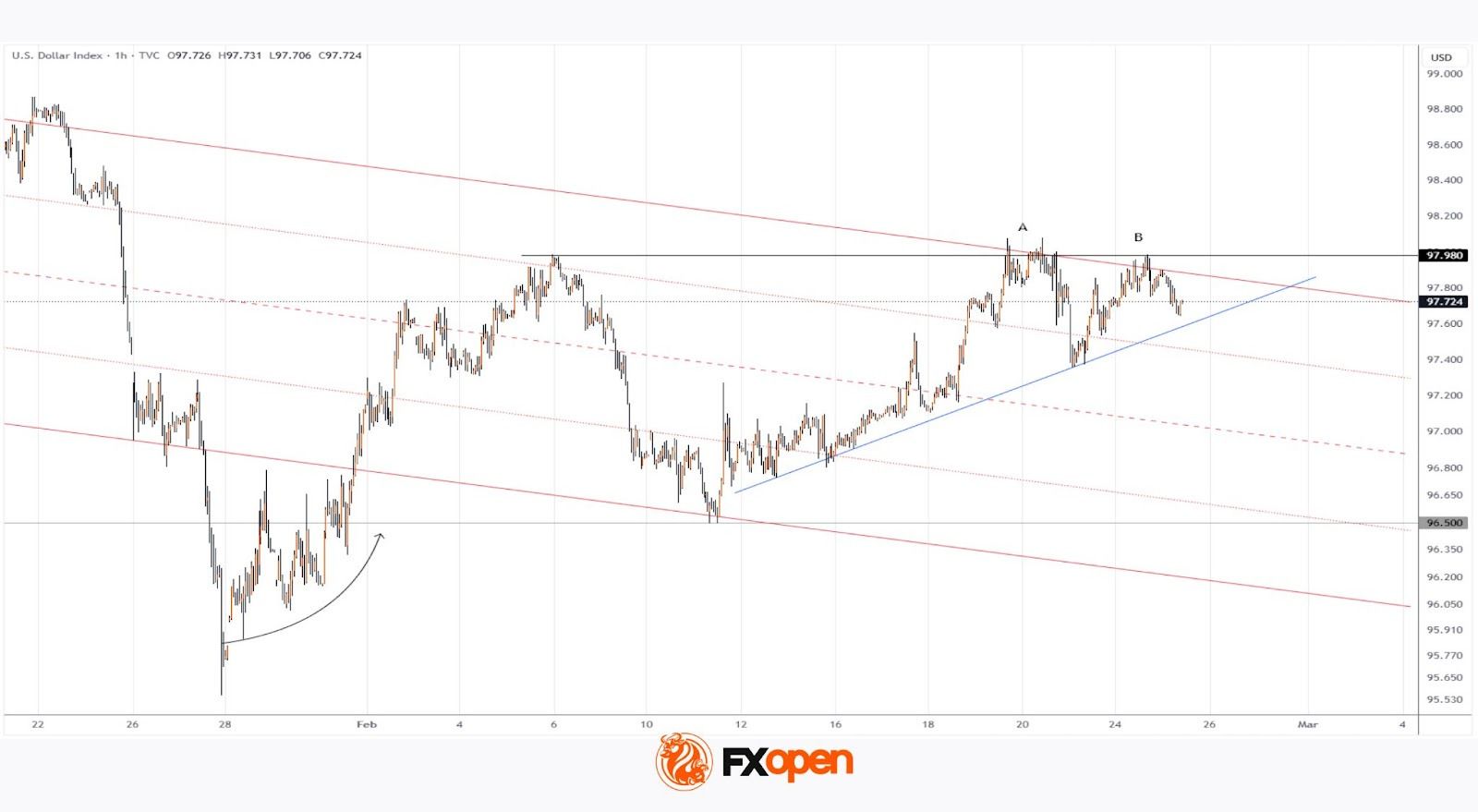
The second half of February has seen the dollar index strengthen, driven by a combination of bullish factors:
→ A hawkish Fed stance. Minutes from the latest FOMC meeting revealed differing views on rate cuts. With inflation remaining resilient, some members even left the door open to further tightening.
→ Rising tensions between the US and Iran, along with uncertainty surrounding trade tariffs, have boosted demand for the dollar as a safe-haven asset.
→ Recent data pointing to solid industrial output and labour market resilience have reinforced confidence in the strength of the US economy.
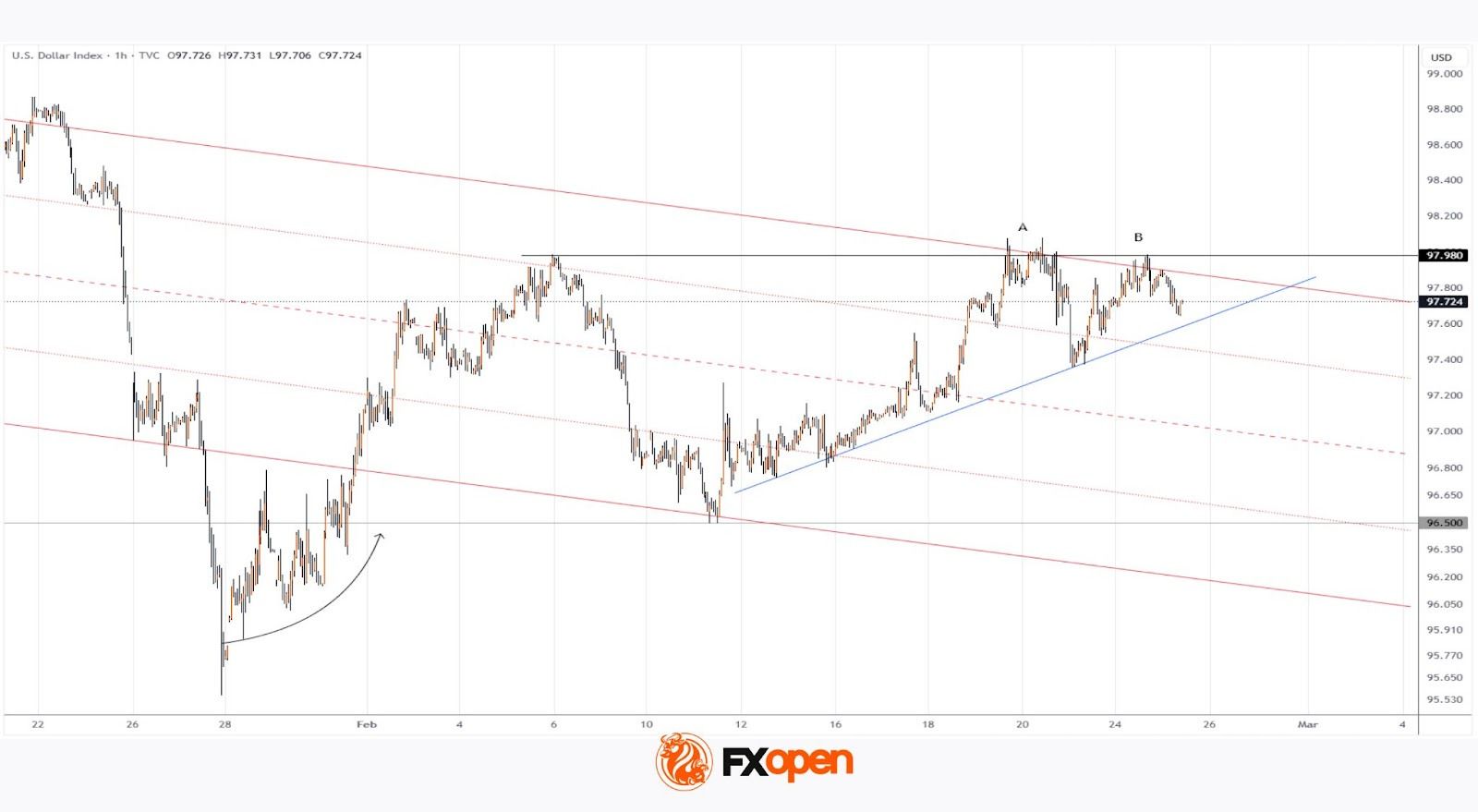
As a result, an upward trend line (shown in blue) has formed on the DXY chart, increasing the likelihood that the index will finish February in positive territory after three consecutive months of decline.
Technical Analysis of the DXY Chart
On 16 February, when analysing the dollar index (DXY), we:
→ Updated the descending channel (marked in red), originating in November 2025.
→ Highlighted strong demand, reflected in the confident upward trajectory (shown by the arrow) following the brief break below the multi-month low of 96.50 in late January.
Lower highs at points A and B suggest that the upper boundary of the channel continues to act as resistance, while the hesitant price action after breaking the 5 February high indicates waning bullish momentum. This raises the possibility that the blue uptrend line could soon come under pressure from renewed bearish attempts.
On the other hand, there are clear signs of active demand near the key 96.50 level. Therefore, in the longer term, bulls may regain strength and attempt to overturn the broader downtrend.
Trade global index CFDs with zero commission and tight spreads (additional fees may apply). Open your FXOpen account now or learn more about trading index CFDs with FXOpen.
This article represents the opinion of the Companies operating under the FXOpen brand only. It is not to be construed as an offer, solicitation, or recommendation with respect to products and services provided by the Companies operating under the FXOpen brand, nor is it to be considered financial advice.
Aerodrome Finance price climbed 12% over the past 24 hours, drawing renewed attention from traders. Despite the sharp uptick, AERO remains locked in a broader sideways structure.
This consolidation phase reflects cautious optimism rather than confirmed breakout strength. While short-term momentum improved, sustained upside requires stronger follow-through.
AERO Holders Exhibit Optimism
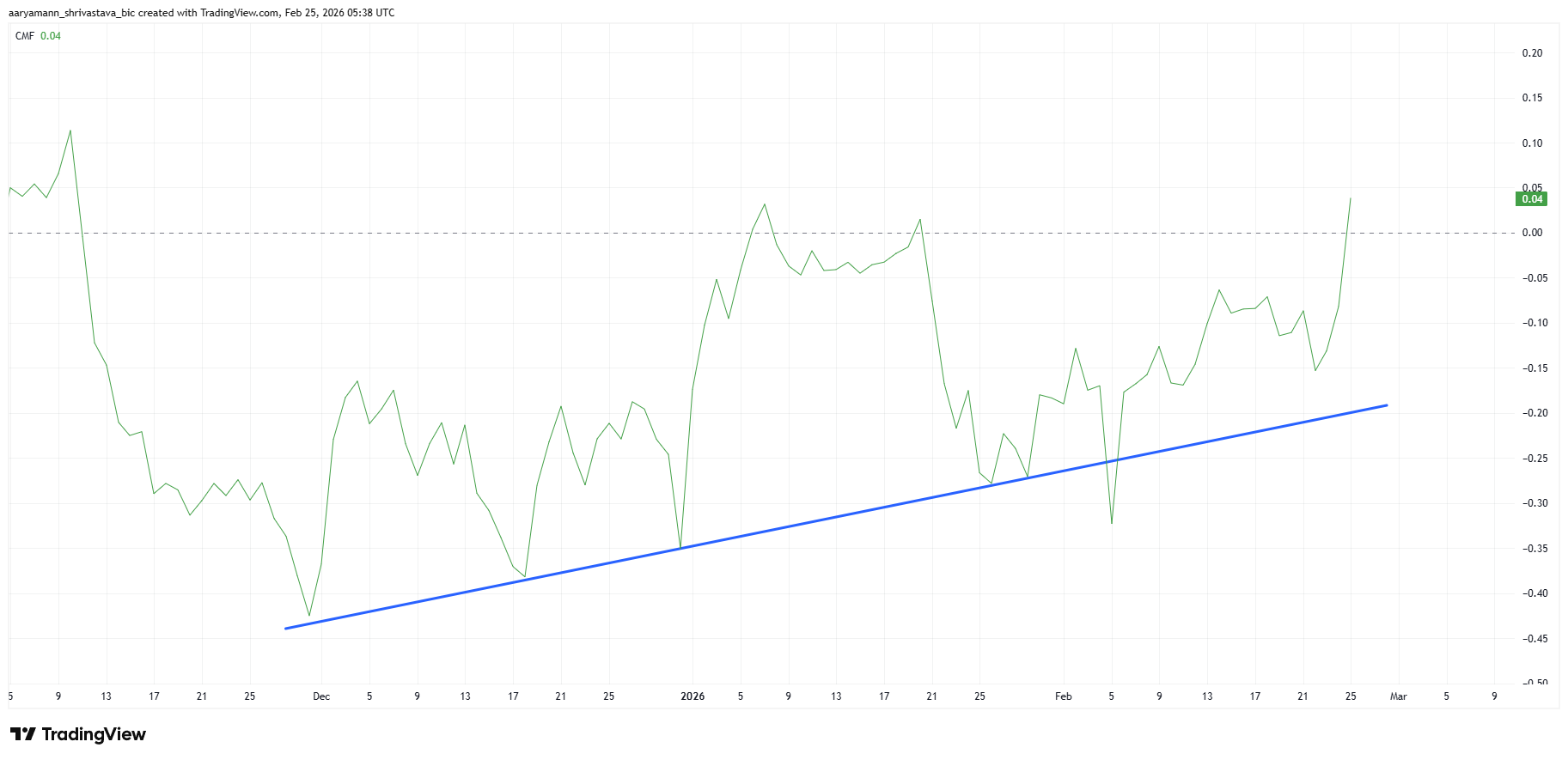
The Chaikin Money Flow indicator signals improving macro sentiment for Aerodrome Finance. Outflows that peaked around early December 2025 have steadily declined. Inflows now dominate, suggesting capital is returning to AERO. This shift indicates investors are gradually rebuilding exposure.
CMF currently sits at a three-and-a-half-month high. Elevated readings often reflect sustained buying pressure rather than short-lived speculation. Strengthening inflows point to growing confidence among participants. This macro bullishness may provide structural support for further price appreciation.
Want more token insights like this? Sign up for Editor Harsh Notariya’s Daily Crypto Newsletter here.
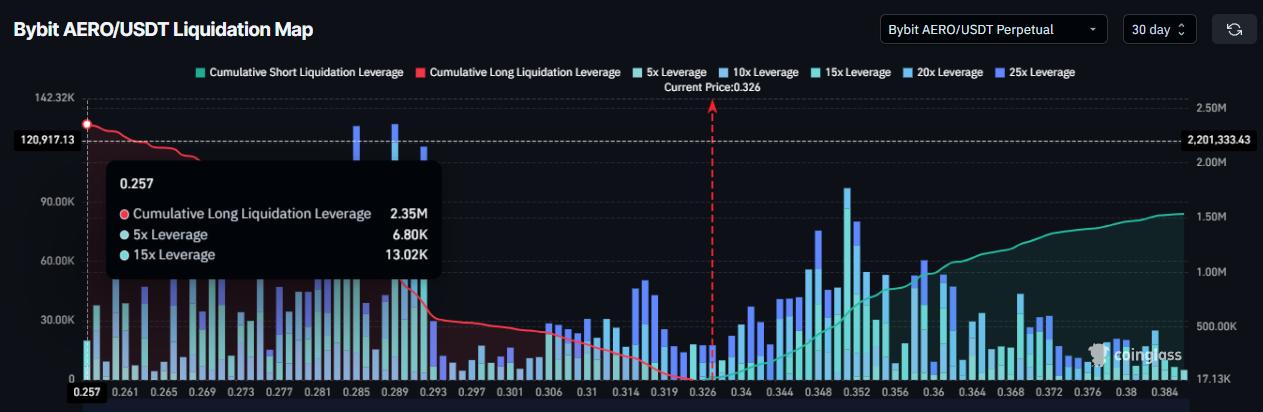
Futures market data reinforces the constructive outlook. AERO contracts are currently skewed toward long positions. Traders are positioning for potential upside continuation. Long exposure stands at approximately $2.35 million, reflecting notable bullish interest.
The $0.351 resistance level remains a critical barrier. A move above this threshold would trigger a significant short liquidation cluster worth roughly $623,560. Forced short covering can accelerate upward momentum. Such dynamics often amplify breakouts in volatile crypto markets.
AERO Price Is Awaiting a Breakout
AERO is trading at $0.327 at the time of writing after posting a 12% daily gain. Despite the surge, the token remains within its consolidation range. Current technical and derivatives signals present a cautiously bullish outlook. However, confirmation depends on overcoming immediate resistance.
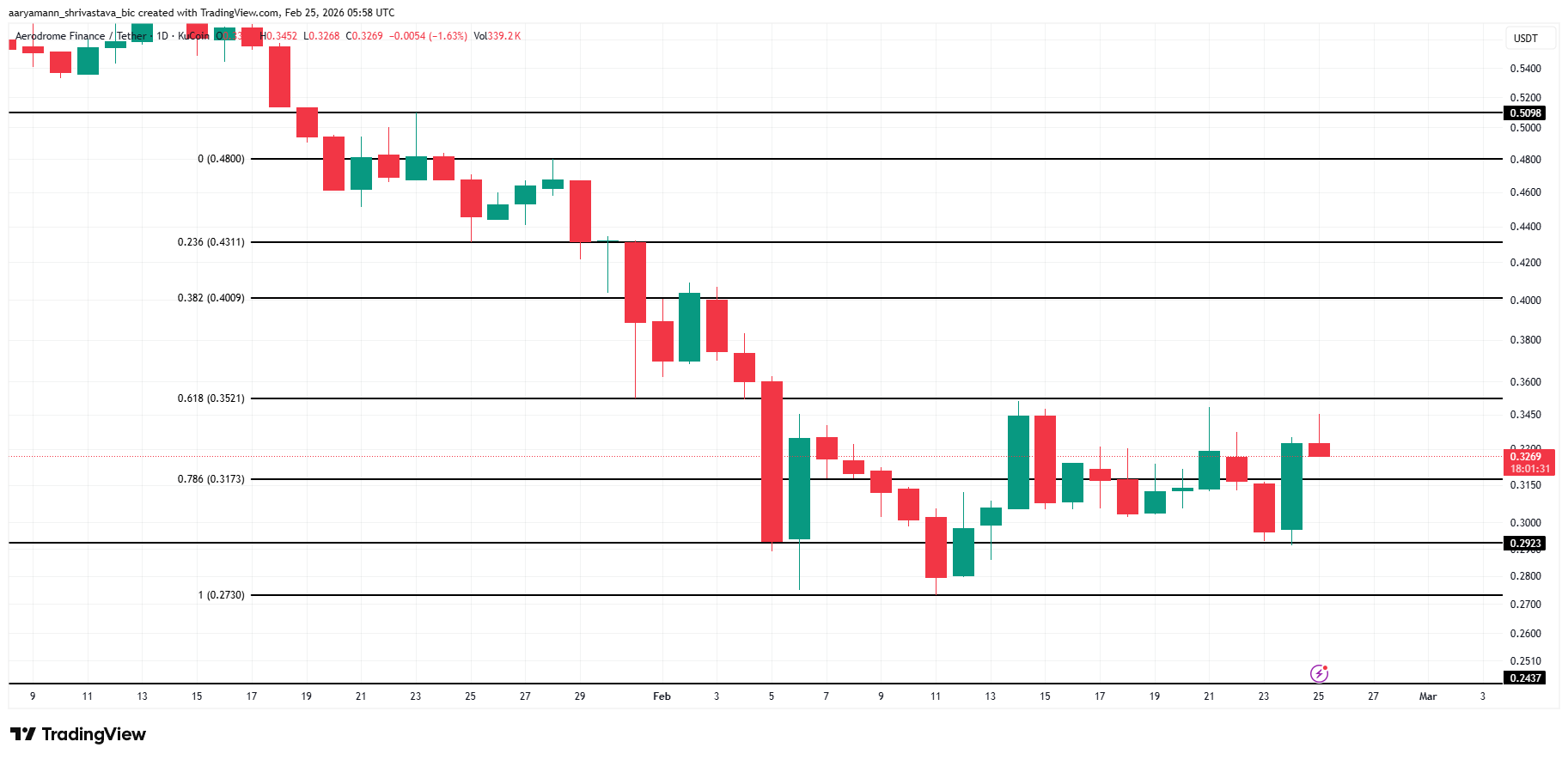
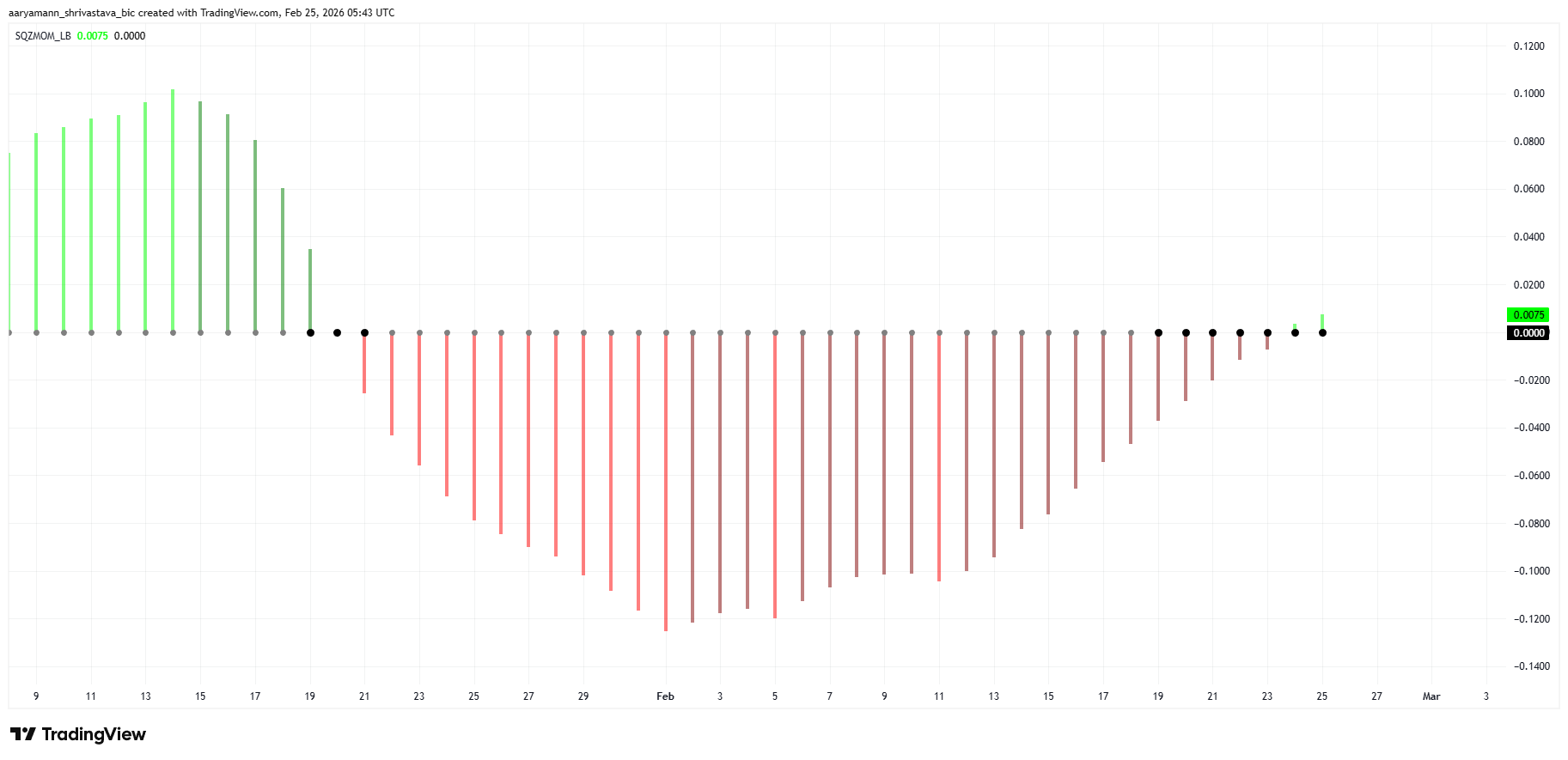
Breaching the $0.352 barrier is essential for a sustained breakout. Clearing this level would likely trigger short liquidations and strengthen bullish momentum. The Squeeze Momentum indicator shows compression building, while the histogram reflects underlying strength. A squeeze release could propel AERO toward $0.400.
Downside risks persist if buyers fail to maintain control. Continued consolidation between $0.352 and $0.292 would signal hesitation. A breakdown below $0.292 would weaken the bullish structure. Further losses could push AERO toward $0.273 or even $0.243, invalidating the current recovery thesis.


BTC is down ~28% this month; Glassnode’s sub‑1 realized P/L ratio signals 5–6 more months of downside pressure.
Summary
- BTC trades near ~$63k after a sharp February selloff, about 47% below its ~$126k ATH from October 2025.
- Glassnode’s 90D realized profit/loss ratio has fallen below 1, historically preceding at least 5–6 months where realized losses dominate realized profits.
- In prior cycles, BTC dropped ~25% over six months in 2022 and >50% over five months in 2018 after this metric flipped sub‑1, implying risk of further drawdown if patterns repeat.
Bitcoin has approached previous highs following a sharp decline in February, though blockchain analytics firm Glassnode has indicated further downward pressure may persist for several months, according to the company’s recent analysis.
Glassnode reported that Bitcoin’s realized profit/loss ratio, measured as a 90-day moving average, has fallen below 1. The firm stated this metric suggests the decline could continue for an additional five to six months.
In a post on social media platform X, Glassnode cited historical data showing that drops in the Realized Profit/Loss Ratio below 1 have preceded decline periods lasting at least six months. The firm noted that a return above 1 generally indicates a decrease in selling pressure.
The analytics company referenced the 2022 and 2018 bear markets as comparative examples. During the 2022 bear market, Bitcoin declined 25% in value six months after its profit/loss ratio fell below 1, according to Glassnode. Under similar conditions in 2018, Bitcoin experienced a drop exceeding 50% over five months.
Glassnode stated that if historical patterns repeat, the cryptocurrency’s price could continue its downward trend for five months or longer.
The Realized Profit/Loss Ratio measures the ratio of profits to losses realized on the Bitcoin network, providing insight into market sentiment and selling pressure among holders.


BTC is down ~50% from ATH, with 74% LTH profit shrinking as supply in loss hits 50% amid multi‑month selling.
Summary
- Long-term BTC holders still sit on ~74% average profit, but that margin is compressing as price grinds toward the LTH cost basis near ~$39k.
- BTC has printed almost five straight red monthly candles after a volatility spike above 150%, while weekly RSI hits one of its most oversold levels ever around the $60k-$65k zone.
- BTC supply in loss has hit ~10m coins, roughly 50% of the 20m circulating, a capital destruction level that has historically coincided with bear market bottoms.
Bitcoin long-term holders currently hold an average profit of approximately 74%, though that margin continues to decline as the cryptocurrency’s price moves closer to their cost basis, according to CryptoQuant analyst Darkfost.
The analyst noted that historical bear market cycles have been characterized by prices breaking below the long-term holder cost basis, triggering capitulation phases marked by realized losses of around 20%. Long-term holders are defined as investors known to be less sensitive to short-term price fluctuations, Darkfost stated.
Market recovery and bull phase entry have historically occurred only after such capitulation events, according to the analysis.
Glassnode reported that the 90-day moving average of the Realized Profit/Loss Ratio has fallen below 1, confirming a transition into an excess loss-realization regime. The blockchain analytics firm stated that these bearish conditions have historically persisted for at least six months before liquidity returns to markets.
Analyst James Check reported that Bitcoin has recorded nearly five consecutive red monthly candles following the largest volatility spike of the current cycle. Check observed that one-week realized volatility spiked above 150%, a level typically associated with capitulation events, and that weekly RSI has reached one of the most oversold readings in Bitcoin’s history. A significant amount of Bitcoin has migrated to new holders in a high price range this year, according to Check’s analysis.
Bitcoin supply in loss reached 10 million coins, the fourth-highest reading on record, analyst James Van Straten reported. Van Straten noted that circulating supply will reach 20 million Bitcoin next week, with 50% held at a loss. Historical patterns suggest such capital destruction levels are sufficient for a bear market bottom, according to Van Straten.
Bitcoin experienced a minor price rebound during early Asian trading hours, though bearish sentiment remains dominant in the market. The price movement formed another lower high while a key support level continues to hold, according to technical analysis.
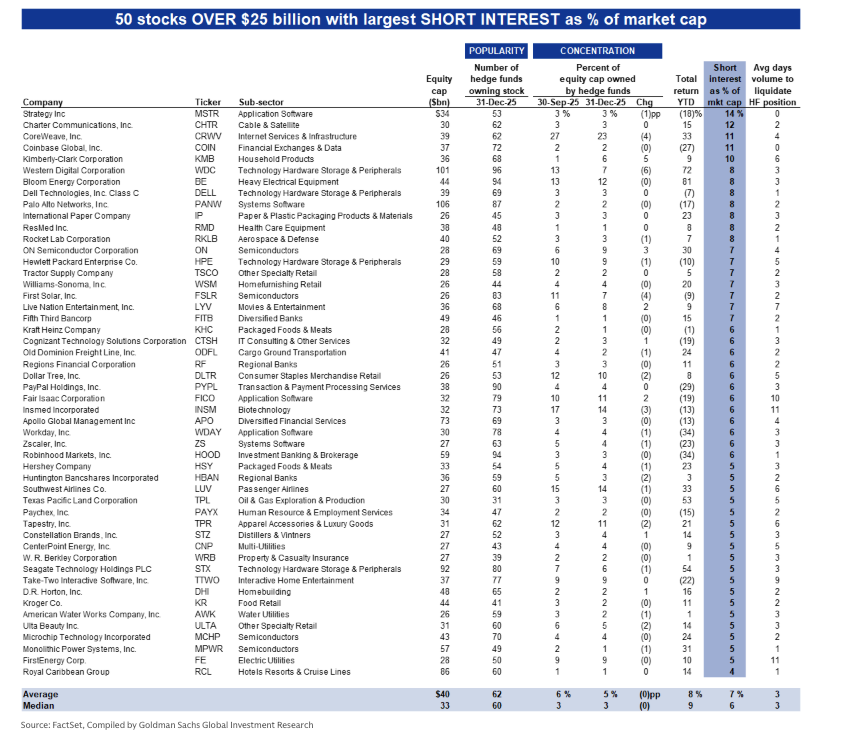
Crypto bank Anchorage Digital said it now holds Strategy’s perpetual preferred security STRC on its balance sheet, adding an institutional backer to Michael Saylor’s Bitcoin treasury company at a time when Wall Street traders are increasingly betting against it.
In a Wednesday post on X, Anchorage co-founder and CEO Nathan McCauley said the purchase shows alignment between two companies built around Bitcoin (BTC) infrastructure and corporate treasury adoption. “Conviction compounds. Institutions don’t just talk about Bitcoin, they structure around it,” McCauley wrote.
“When the company that operationalizes Bitcoin infrastructure puts capital alongside the company that operationalized the Bitcoin treasury strategy…that’s a signal,” he added. Anchorage did not reveal the size or timing of the position.
According to Strategy’s website, STRC is a Nasdaq-listed perpetual preferred security marketed as a short-duration, high-yield instrument. The shares pay an 11.25% annual dividend distributed monthly in cash. Capital raised through the instrument has historically financed the firm’s continued Bitcoin accumulation.
Related: Michael Saylor says quantum threat to Bitcoin is more than 10 years away
Strategy becomes Wall Street’s most-shorted stock
Anchorage’s purchase comes as Strategy has climbed to the top of Goldman Sachs’ list of most-shorted large-cap US equities by short interest as a percentage of market capitalization. A year ago, it did not rank among the top 50. The company began rising on the list in late 2025 as its share price weakened even before Bitcoin peaked in October.

Short selling involves borrowing shares and selling them with the expectation of repurchasing later at a lower price. Losses can grow if the stock rises.
Strategy functions as a leveraged public-equity proxy for Bitcoin. It issues securities and deploys the proceeds into BTC. Gains can amplify during rallies, while downturns magnify pressure on the share price.
The company currently holds 717,722 Bitcoin worth about $46.68 billion at current market prices. On Monday, it announced another purchase, acquiring 592 BTC for $39.8 million. The coins were acquired at an average cost of roughly $76,020, leaving the company sitting on an estimated $7 billion unrealized loss with Bitcoin trading near $66,000.
Related: Michael Saylor hints at Strategy’s 100th Bitcoin buy
Strategy plans debt-to-equity shift
Last week, Strategy founder Michael Saylor said the company intends to convert roughly $6 billion in convertible bond debt into equity, replacing repayment obligations with newly issued shares. The change would lower leverage on the balance sheet by turning bondholders into shareholders, though it could dilute existing investors.
The firm added that its Bitcoin treasury would still cover its liabilities even in an extreme downturn. According to the company, Bitcoin would need to fall close to $8,000, an estimated 88% drop, before its holdings and debt reached parity.
Magazine: Bitcoin may take 7 years to upgrade to post-quantum — BIP-360 co-author
KITE has entered the top 100 alts after a massive 20% surge daily, and a 135% pump monthly.
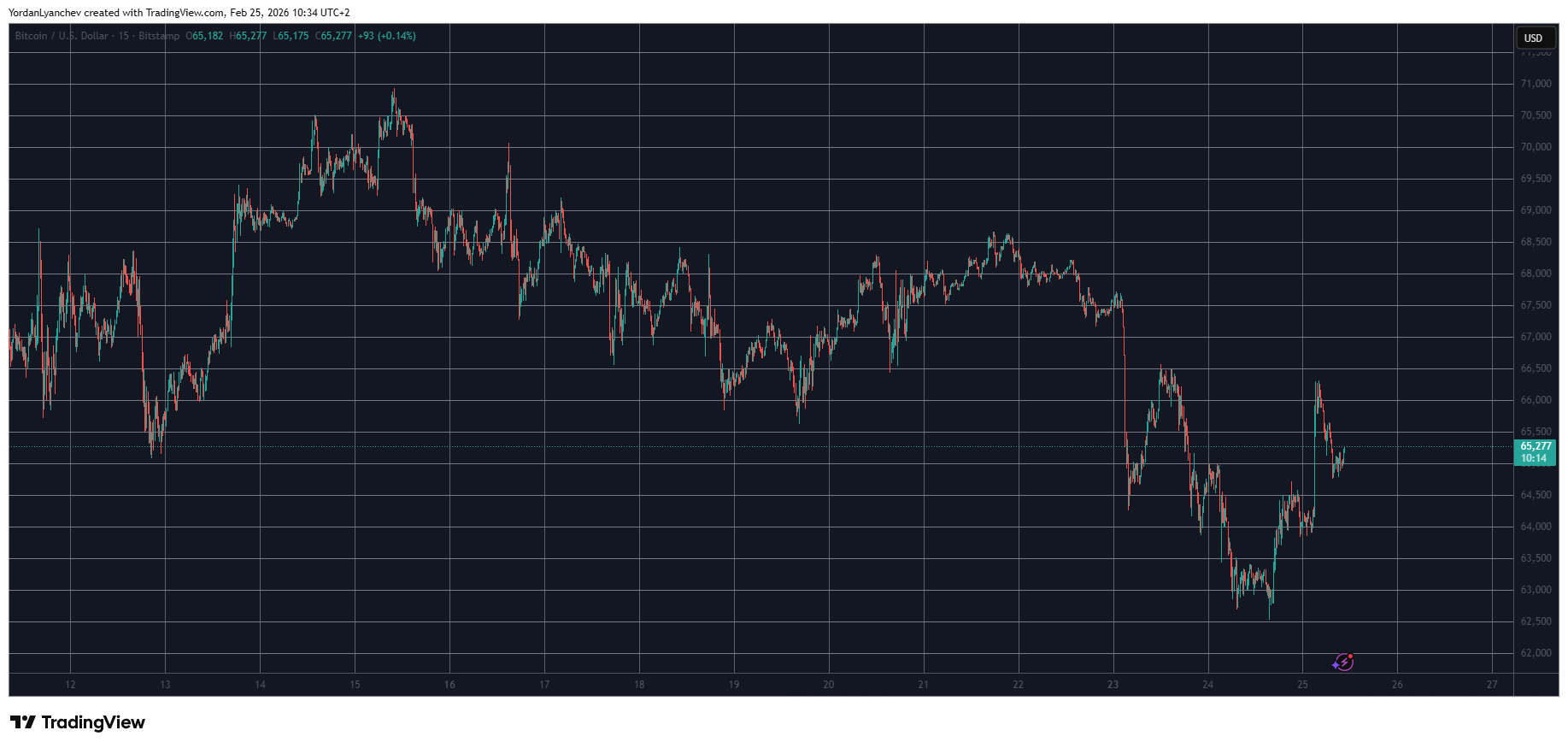
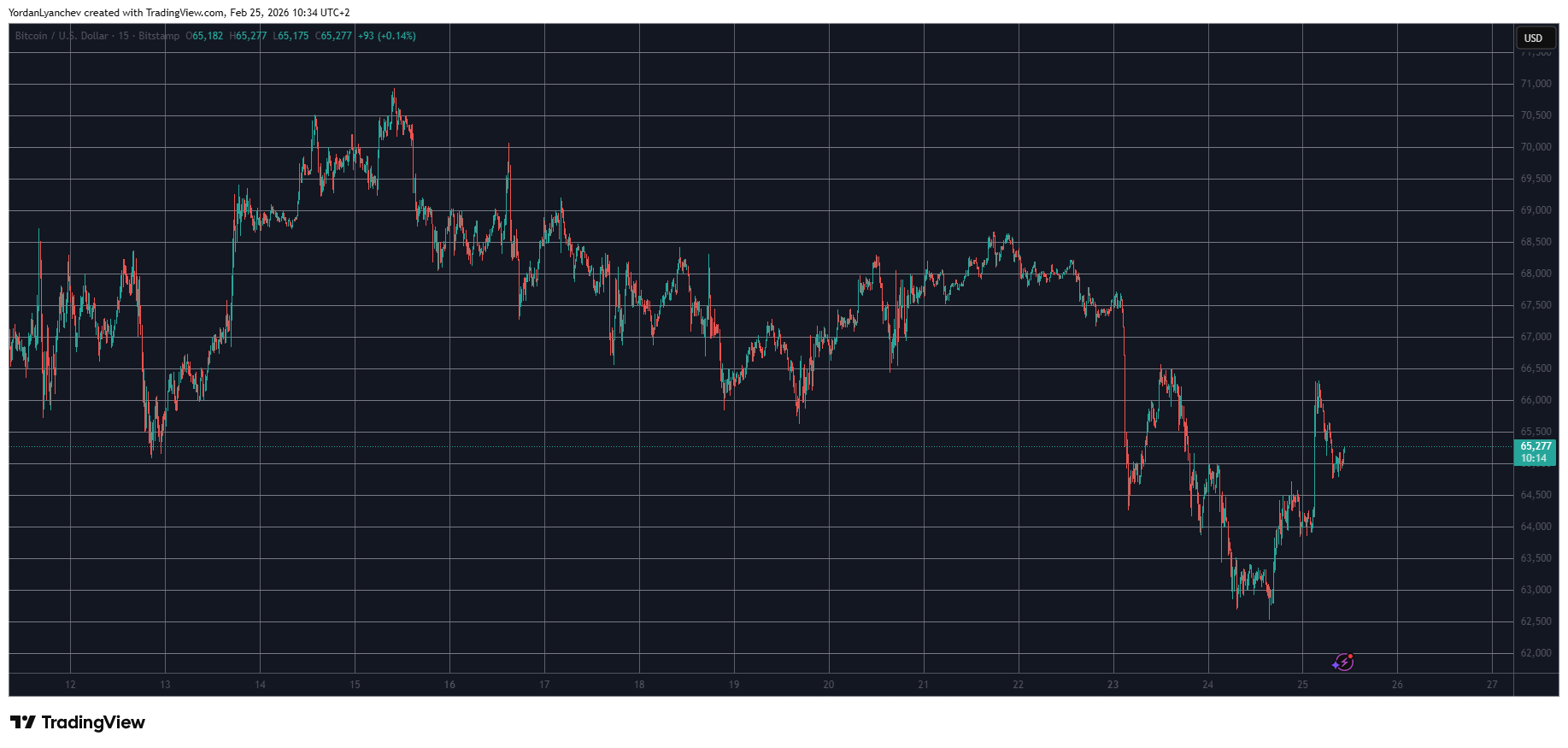
After a few consecutive days of charting new local lows to $62,500, bitcoin’s price has finally rebounded, and the asset even neared $66,500 earlier today, where it was stopped.
Most altcoins are in the green as well today, with ETH nearing $1,900, and XRP reclaiming the $1.36 support. SOL and XMR have surged the most from the larger caps.
BTC Bounces to $65K
Bitcoin was violently rejected on both occasions at the beginning of the previous business week to reclaim the $70,000 level, and the subsequent corrections pushed it south to $66,000 by Wednesday. It rebounded in the following days and went above $68,000 during the weekend.
However, more macro uncertainty ensued after the latest tariff developments, including another global taxation of 10% to 15% from Trump. BTC remained still at first, but nosedived on Sunday evening/Monday morning when the futures markets opened. In just over an hour, the cryptocurrency plummeted to under $64,500.
After a dead-cat bounce, the bears were back in control on Tuesday and initiated another leg down – this time, bitcoin slumped to a new three-week low of $62,500. The bulls finally woke up at this point and drove the asset north by roughly $4,000. It was stopped there and now sits above $65,000, but it’s still 3% up on the day.
Its market cap has reclaimed the $1.3 trillion level, while its dominance over the alts has climbed above 56%.
Alts Try to Rebound
Most altcoins were hit hard over the past few days as well. Ethereum dipped to $1,800, but now stands $100 higher at $1,900. XRP is back at a crucial support at $1.36, while BNB has neared $600. TRX, DOGE, BCH, ADA, and HYPE are also in the green daily.
SOL and XMR have surged the most from the larger caps. 7% gains have pushed the former to $82, while the latter is above $335.
KITE has entered the top 100 alts with a massive 20% daily surge. MORPHO follows suit, while LEO and WLFI are next.
The total crypto market cap has recovered around $80 billion daily and is up to $2.330 trillion on CG.

Binance Free $600 (CryptoPotato Exclusive): Use this link to register a new account and receive $600 exclusive welcome offer on Binance (full details).
LIMITED OFFER for CryptoPotato readers at Bybit: Use this link to register and open a $500 FREE position on any coin!
Disclaimer: Information found on CryptoPotato is those of writers quoted. It does not represent the opinions of CryptoPotato on whether to buy, sell, or hold any investments. You are advised to conduct your own research before making any investment decisions. Use provided information at your own risk. See Disclaimer for more information.
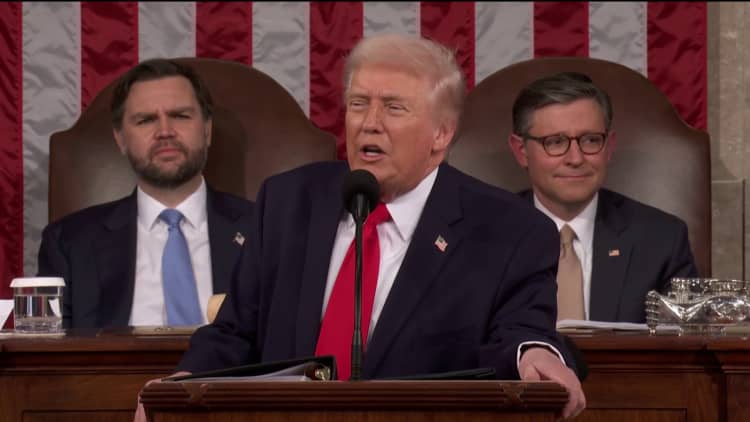
U.S. President Donald Trump shakes hands with members of Congress as he departs following his State of the Union address in the House Chamber of the US Capitol in Washington, DC, on Feb. 24, 2026.
Andrew Caballero-Reynolds | AFP | Getty Images
BEIJING — U.S. President Donald Trump avoided directly naming China in his State of the Union address Tuesday, just weeks before his scheduled trip to Beijing.
In what was the longest State of the Union (SOTU) speech by any U.S. president, Trump covered a range of topics from inflation and tariffs to stock market records.
But notably, he did not directly mention China, other than a reference to “Russian and Chinese military technology” that guarded Venezuelan President Nicolas Maduro during the operation that led to the capture of the foreign leader.
During Trump’s first term from 2017 to 2021, he made direct references to the Chinese nation in all three of his State of the Union addresses. The remarks had largely highlighted the threat from Beijing to the U.S.
“Trump doesn’t want to pick a fight with China in an election year,” said Gabriel Wildau, managing director, Teneo, referring to the coming U.S. midterm elections in November.
“Stability in U.S.-China relations is a priority for the president at least this year and potentially for the rest of his term,” Wildau said.
In order to maintain that relationship, Trump plans to visit Beijing from March 31 to April 2, the first trip by a U.S. president since 2017.
But China’s foreign ministry has yet to confirm exact dates for the visit, pointed out George Chen, partner at The Asia Group. “That makes Trump look more desperate to visit China more than how much [Chinese president Xi Jinping] wants to host him.”
“The lack of mentions about China in Trump’s speech is another example to show how Trump stays cautious now about U.S.-China relations,” Chen said.

China and the U.S. ratcheted up tariffs on each others’ goods last spring to well over 100%, before reaching a trade truce in October to bring tariffs below 50% for the next year. Beijing also tightened its restrictions on rare earths exports worldwide. The Asian country dominates the global supply chain for rare earths, critical minerals used in a swath of technologies.
“The state of the union showed Trump thinks glorifying U.S. military triumphs over weak states like Venezuela makes better election year politics than fighting with China over rare earths,” Wildau said.
Uncertainty around tariffs picked up over the weekend after the U.S. Supreme Court last week struck down tariffs that Trump had imposed on a swath of countries last year. Trump then quickly pointed to an alternative basis for raising the global tariff rate.
In social media posts on Weibo, two Chinese state media outlets highlighted opposition within Congress to Trump’s speech. Local attention in China to Trump’s address was otherwise muted.
Trump’s limited mention of China also reflects how unpredictable his policy on Beijing can be, said Yue Su, principal economist at the Economist Intelligence Unit (EIU).
“By contrast, [Democrat U.S. President Joe] Biden consistently referred to China in his speeches, which underscored a degree of continuity and predictability in his China policy,” she said, referring to Trump’s predecessor.
The Democratic Party’s rebuttal to Trump’s State of the Union Tuesday focused directly on Beijing.
“But as the president spoke of his perceived successes tonight, he continues to cede economic power and technological strength to Russia, bow down to China, bow down to a Russian dictator and make plans for war with Iran,” said Virginia Governor Abigail Spanberger, who gave the rebuttal.
A big deal coming?
For a U.S. president who has called out Xi by name in public speeches, the absence of mentioning the world’s second-largest economy in the SOTU speech marks a strategic move.
If Trump seals a deal during his Beijing trip, “he could easily frame it as a major achievement for his base,” said EIU’s Su. “And if negotiations do not go well, a retaliatory or hardline approach could be presented in a similarly positive light domestically.”

Subscribe now
Steven Okun, founder and CEO of Singapore-based APAC Advisors, said that this year, the speech was understandably more focused on topics that impact the midterm elections, which don’t include China.
But he pointed out that if Trump really wanted to address U.S. consumer affordability, lowering tariffs on China would “show up much quicker in people’s pocketbooks.”
“So, we may see a deal on tariffs with China end of March or early April,” Okun said Wednesday on CNBC’s “Access Middle East.”
Many U.S. company executives are expected to accompany Trump on his trip to China in a few weeks. Meetings with Chinese counterparts can be an opportunity to support deals, including Chinese purchases of U.S. agricultural products.
When asked about Trump’s limited discussion of China, Marko Papic, a chief strategist at global investment research firm BCA Research, simply said: “A big deal is coming!”
—CNBC’s Sydney Goh contributed to this report.


Federal prosecutors in the Eastern District of North Carolina announced the seizure of more than $61 million worth of Tether (USDT) in one of the largest cryptocurrency asset forfeiture actions tied to a romance-style investment fraud known as a “pig butchering” scheme.
Summary
- Over $61 million in USDT was seized by federal agents in North Carolina, linked to wallets used in a “pig butchering” romance investment scam.
- Homeland Security Investigations traced victims’ stolen funds through a chain of crypto wallets, leading to forfeiture of the remaining balances.
- U.S. authorities, with assistance from Tether, highlighted the operation as part of an ongoing crackdown on cryptocurrency fraud and money-laundering schemes.
North Carolina Feds seize $61M in crypto
The operation shows growing U.S. efforts to trace and reclaim digital assets used in complex fraud and money-laundering networks.
The U.S. Department of Justice said the seized funds were traced to multiple cryptocurrency wallets controlled by criminal actors who lured victims into fraudulent crypto trading platforms after building trust through purported romantic relationships.
Once victims deposited money into these fake platforms, operators allegedly prevented withdrawals or demanded bogus “fees” and “taxes” to extract more funds. Investigators from Homeland Security Investigations in Raleigh, North Carolina, followed the flow of the stolen proceeds through a network of wallets and identified accounts still holding significant balances subject to seizure and forfeiture.
“The seizure of a staggering $61 million … shows that, in the Eastern District of North Carolina, cheaters never win,” said U.S. Attorney Ellis Boyle, highlighting the district’s asset forfeiture team’s work with HSI to disrupt the fraud network.
The DOJ also acknowledged assistance from Tether in facilitating the transfer of the assets once targeted wallets were identified.
Pig butchering scams, a hybrid of romance fraud and investment deception, have become an escalating threat globally, with victims often recruited on social media or dating apps before being directed to professional-looking, yet fake, cryptocurrency investment portals. Once funds are sent, victims find themselves unable to withdraw, leaving law enforcement to trace and recover the proceeds.
The $61 million seizure adds to a broader trend of high-profile crypto forfeitures by U.S. authorities in recent years.

Meta ‘AI safety’ head loses control of AI as it ignores her commands
Bryson DeChambeau and LA Golf have split. Here’s why it didn’t work out

IBM’s $40B stock wipeout is built on a misconception: Translating COBOL isn’t the same as modernizing it


-

 Video5 days ago
XRP News: XRP Just Entered a New Phase (Almost Nobody Noticed)
-

 Fashion5 days ago
Weekend Open Thread: Boden – Corporette.com
-

 Politics3 days ago
Baftas 2026: Awards Nominations, Presenters And Performers
-

 Entertainment7 days ago
Kunal Nayyar’s Secret Acts Of Kindness Sparks Online Discussion
-

 Sports2 days ago
Women’s college basketball rankings: Iowa reenters top 10, Auriemma makes history
-

 Politics2 days ago
Nick Reiner Enters Plea In Deaths Of Parents Rob And Michele
-
 Sports6 days ago
Clearing the boundary, crossing into history: J&K end 67-year wait, enter maiden Ranji Trophy final | Cricket News
-

 Business3 days ago
Mattel’s American Girl brand turns 40, dolls enter a new era
-

 Crypto World1 day ago
XRP price enters “dead zone” as Binance leverage hits lows
-

 Business3 days ago
Law enforcement kills armed man seeking to enter Trump’s Mar-a-Lago resort, officials say
-

 Entertainment6 days ago
Dolores Catania Blasts Rob Rausch For Turning On ‘Housewives’ On ‘Traitors’
-

 Tech3 days ago
Anthropic-Backed Group Enters NY-12 AI PAC Fight
-
 NewsBeat2 days ago
‘Hourly’ method from gastroenterologist ‘helps reduce air travel bloating’
-

 NewsBeat3 days ago
Armed man killed after entering secure perimeter of Mar-a-Lago, Secret Service says
-

 Politics3 days ago
Maine has a long track record of electing moderates. Enter Graham Platner.
-

 Crypto World7 days ago
WLFI Crypto Surges Toward $0.12 as Whale Buys $2.75M Before Trump-Linked Forum
-

 Tech16 hours ago
Unsurprisingly, Apple's board gets what it wants in 2026 shareholder meeting
-
 NewsBeat11 hours ago
Police latest as search for missing woman enters day nine
-

 Crypto World6 days ago
83% of Altcoins Enter Bear Trend as Liquidity Crunch Tightens Grip on Crypto Market
-
 Sports2 days ago
2026 NFL mock draft: WRs fly off the board in first round entering combine week