








Connect with us

Business

From AI Agents to Space Tech and Robotics

Published

on

Lorikeet

Australia’s startup ecosystem continues its strong momentum into 2026, with early-stage and growth companies attracting significant investor interest amid a rebound in venture capital flows. Total equity funding in Australia reached $503 million across 25 rounds in the first two months of 2026—up 27% from the same period in 2025—driven by AI, climate tech, fintech, and deep tech sectors.

While established unicorns like Canva and Airwallex dominate headlines, a new wave of rising startups is gaining traction through innovative solutions, rapid scaling, and high-profile partnerships. These emerging players, many backed by accelerators like Startmate and investors such as Blackbird Ventures, are addressing real-world challenges in healthcare, customer service, space exploration, and more.

Here are 10 rising Australian startups poised for breakthroughs in 2026, based on recent funding, product momentum, and industry buzz as of February 2026.

Lorikeet
Lorikeet

1. **Lorikeet** (Sydney, AI customer service)
Lorikeet has emerged as one of the fastest-rising AI startups in Australia, securing $35 million in funding in under a year. The platform deploys autonomous AI agents that handle complex customer support interactions, reducing reliance on human teams. With strong traction in e-commerce and SaaS, Lorikeet is expanding globally in 2026, positioning itself as a leader in agentic AI for enterprises.

2. **Andromeda** (Melbourne, robotics and aged care)
Founded by Grace Brown, Andromeda develops Abi—a companion robot designed to combat loneliness in aged care facilities while supporting staff shortages. The hardware-software solution has defied skepticism around high-cost robotics startups by focusing on emotional intelligence and practical integration. With pilot programs scaling in 2026, Andromeda is drawing attention for its social impact and potential international expansion.

Advertisement

3. **Kapture** (Sydney, AI-driven productivity)
Kapture is building AI tools that automate repetitive knowledge work, targeting professionals in legal, finance, and consulting. Early 2026 traction includes enterprise pilots and positive feedback on its ability to handle nuanced tasks. Backed by prominent local investors, the startup is expected to announce major partnerships this year as it competes in the growing AI automation space.

4. **Gilmour Space Technologies** (Queensland, space launch)
Gilmour Space is on the cusp of a major milestone in 2026: its first orbital launch attempt with the Eris rocket. The company has secured government contracts and private funding for hybrid rocket technology aimed at small satellite deployment. After years of development, a successful test flight could catapult Gilmour into the global space economy, attracting further investment and partnerships.

5. **Understanding Zoe** (location not specified, healthtech/AI diagnostics)
This startup uses AI to improve diagnostic accuracy in healthcare, focusing on early detection of conditions through data analysis. With growing clinical validation and partnerships in 2026, Understanding Zoe is positioned to address Australia’s aging population and healthcare access challenges, drawing interest from health funds and hospitals.

6. **Fleet Space Technologies** (Adelaide, satellite communications)
Fleet continues to scale its satellite constellation for global IoT connectivity. Recent contracts for remote monitoring in mining and agriculture highlight its edge in low-power, wide-area networks. With additional launches planned for 2026, Fleet is a key player in Australia’s space sector push.

Advertisement

7. **Q-CTRL** (Sydney, quantum control software)
Q-CTRL provides error-suppression tools for quantum computers, addressing one of the field’s biggest hurdles. Backed by significant funding and partnerships with global tech firms, the company is expanding applications in defense and finance, with 2026 expected to bring major milestones in quantum hardware integration.

8. **Harrison.ai** (Sydney, AI healthcare diagnostics)
Specializing in AI for medical imaging and pathology, Harrison.ai has seen rapid adoption in hospitals. Its tools improve diagnostic speed and accuracy, with ongoing trials and regulatory progress positioning it for broader rollout in 2026 across Australia and international markets.

9. **Relevance AI** (Sydney, AI workflow automation)
Relevance AI enables no-code creation of AI agents for business processes. With strong growth in SaaS adoption, the platform is attracting users in marketing, sales, and operations, and is expected to announce enterprise expansions in 2026.

10. **Sapia.ai** (Melbourne, AI recruitment)
Sapia uses conversational AI for bias-reduced hiring assessments. Its chat-based interviews have gained traction with large employers, and 2026 plans include deeper integration with HR systems and global scaling.

Advertisement

These startups reflect Australia’s strengths in AI, deep tech, and sustainable innovation. Funding trends show optimism, with investors betting on vertical AI solutions and hardware-software combinations. Challenges remain, including talent shortages and global competition, but 2026 could see several of these companies achieve unicorn status or major exits.

Australia’s ecosystem benefits from supportive policies, including R&D tax incentives and grants like the Female Founders Co-Investment Fund. As the year unfolds, these rising players are set to drive economic growth and position the country as a global tech contender.

Continue Reading
Click to comment

Leave a Reply

Your email address will not be published. Required fields are marked *

Business

Bodo/Glimt Make Champions League History as Norwegian Underdogs Upset Inter Milan

Published

on

Bodo/Glimt Make Champions League History as Norwegian Underdogs Upset Inter

Norwegian champions Bodo/Glimt produced one of the most remarkable results in recent Champions League history, eliminating Inter Milan with a commanding 5–2 aggregate score.

Despite facing a three-time European champion at the iconic San Siro, the Arctic-based side displayed composure and tactical discipline to secure a 2–1 victory on the night in Milan.

Jens Petter Hauge Leads Historic Victory

According to the BBC, forward Jens Petter Hauge was once again the decisive figure. Hauge scored his sixth goal of the campaign and provided a pinpoint assist for Håkon Evjen’s sublime finish, sealing a performance full of confidence and maturity.

Hauge’s return to Milan carried added significance after a prior stint with AC Milan, but this time he departed as the hero of Norwegian football.

Advertisement

Manager Kjetil Knutsen hailed the result as “historic,” celebrating both the club and Norway’s presence on the European stage. Bodo/Glimt became the first Norwegian team to advance past a Champions League knockout tie, marking a landmark moment for the nation’s football legacy.

Arctic Roots Fuel European Success

Based inside the Arctic Circle, Bodo/Glimt have leveraged harsh weather and artificial turf to build a competitive edge. Their fearless identity has helped them overcome elite clubs across Europe, proving that tactical discipline and bold ambition can challenge football’s established giants.

Last 16 Aspirations

The Norwegian side now awaits the draw to face either Manchester City or Sporting CP in the Champions League last 16.

Regardless of the opponent, Bodo/Glimt’s historic run shows how belief, preparation, and tenacity can bridge gaps between Arctic underdogs and Europe’s elite. It’s a David vs. Goliath game, but the Norwegians were able to defy the odds towards one of the most elusive wins of the Champions League season.

Advertisement

Originally published on sportsworldnews.com

Continue Reading

Business

Lowe’s (LOW) Q4 2025 earnings

Published

on

Lowe's (LOW) Q4 2025 earnings

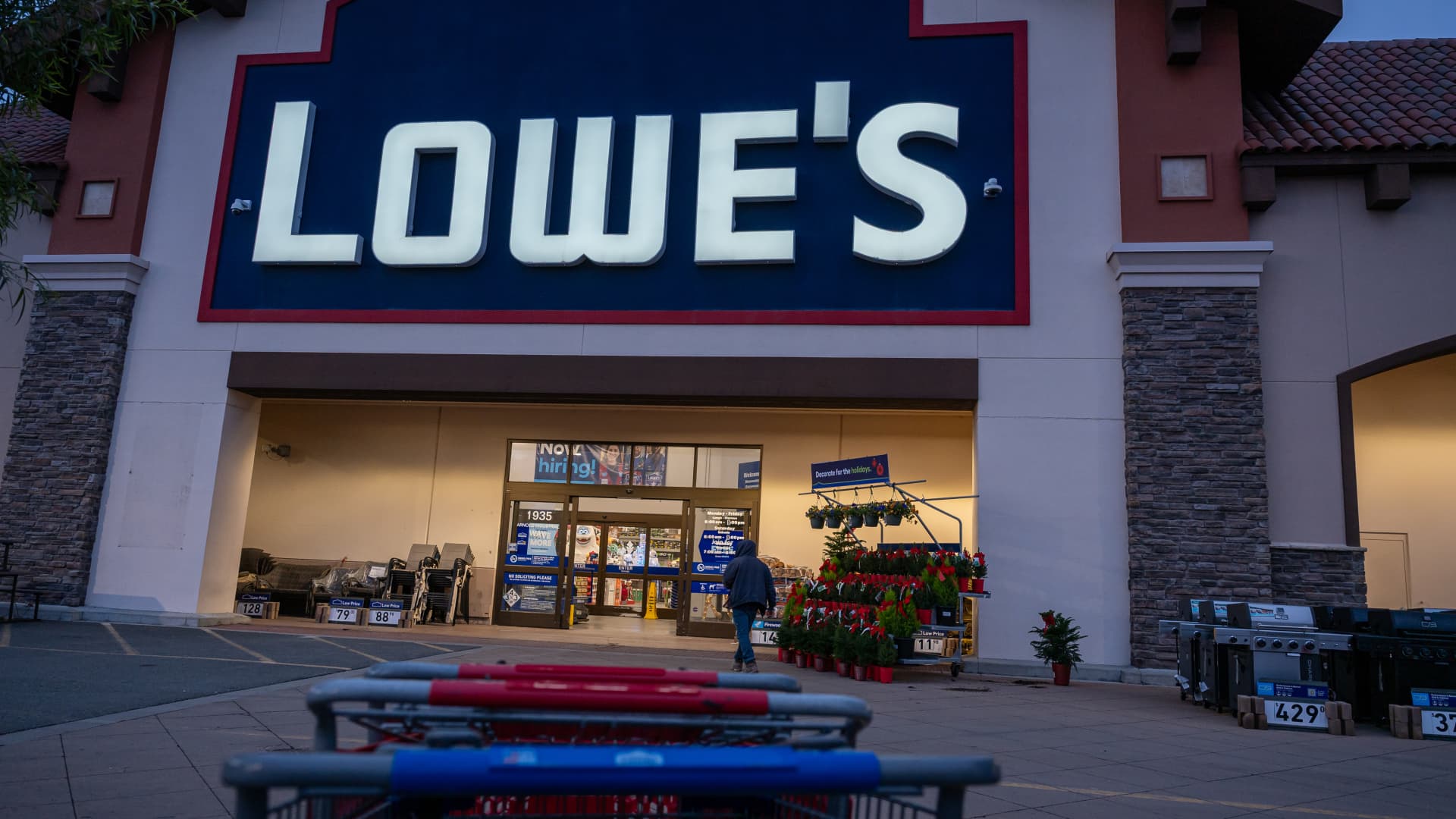
A Lowe’s store in Concord, California, US, on Monday, Nov. 17, 2025.

David Paul Morris | Bloomberg | Getty Images

Lowe’s topped Wall Street’s quarterly revenue and earnings expectations on Wednesday, as the retailer’s quarterly sales grew more than 10% year over year.

Advertisement

The home improvement company said it expects total sales for the full current fiscal year to range between $92 billion and $94 billion, which would be a roughly 7% to 9% increase over the prior year. It said it expects adjusted earnings per share to be between $12.25 and $12.75 for the full year. Lowe’s said it expects comparable sales, a metric that takes out one-time factors, to be approximately flat to up 2%.

In a news release, CEO Marvin Ellison said the company’s strategy is resonating with its do-it-yourself customers and home professionals, even as the home improvement market remains tepid.

“While the housing macro remains pressured, we are focused on directing what is within our control, which includes our ongoing productivity initiatives,” he said. “We remain confident that we are well-positioned to take share regardless of the macro environment.”

Here’s what Lowe’s reported for the fiscal fourth quarter compared with Wall Street’s estimates, according to a survey of analysts by LSEG:

Advertisement
  • Earnings per share: $1.98 adjusted vs. $1.94 expected
  • Revenue: $20.58 billion vs. $20.34 billion expected

Lowe’s net income for the three-month period that ended Jan. 30 dropped to $999 million, or $1.78 per share, from $1.13 billion, or $1.99 per share, in the year-ago quarter.

Revenue rose from $18.55 billion in the year-ago period.

Its competitor, Home Depot, on Tuesday beat Wall Street’s earnings and revenue expectations, but stuck by conservative full-year guidance. Its quarterly results reflected that home improvement demand remains tepid, as U.S. consumers continue to put off big projects because of high borrowing costs and housing prices as well as economic concerns.

As of Tuesday’s close, Lowe’s shares are up nearly 16% year-to-date, surpassing the S&P 500’s roughly 1% gains during the same period. Its stock is up about 15% over the past year, almost matching the S&P 500’s approximately 16% gains over that time.

Advertisement
Continue Reading

Business

(VIDEO) Two American Heroes Awarded Medal of Honor During Trump’s 2026 State of the Union Address

Published

on

Sarah Ferguson

In a dramatic break from tradition during his 2026 State of the Union address on February 24, President Donald Trump presented the nation’s highest military decoration, the Medal of Honor, to two American service members—one for recent heroism in a covert operation in Venezuela and the other to a 100-year-old Korean War veteran whose valor remained classified for decades.

US President Donald Trump delivers a speech during the Gaza Peace Summit in Sharm El-Sheikh, Egypt
US President Donald Trump
AFP

The awards to Army Chief Warrant Officer 5 Eric Slover and retired Navy Capt. E. Royce Williams marked the first time a president has bestowed the Medal of Honor during a State of the Union speech, drawing bipartisan applause in the House chamber and highlighting themes of military valor amid a lengthy address focused on domestic achievements and foreign policy.

Slover, an active-duty helicopter pilot, received the medal for extraordinary actions during a January 2026 special operations mission that resulted in the capture of former Venezuelan President Nicolás Maduro. Wounded in the operation, Slover continued to fly his aircraft under heavy fire, ensuring the safe extraction of his team and the successful abduction of the Venezuelan leader. Lt. Gen. Jonathan Braga, commander of U.S. Special Operations Command, placed the medal around Slover’s neck—a departure from the usual presidential presentation—after Trump described the pilot’s courage as “above and beyond the call of duty.”

Williams, now 100 years old and a San Diego resident, was honored for his heroism on November 18, 1952, during the Korean War. Flying an F9F Panther from the USS Oriskany, Williams single-handedly engaged seven Soviet MiG-15s in a dogfight over the Sea of Japan. Despite being outnumbered and sustaining damage to his aircraft, he shot down four enemy planes before safely returning to his carrier. The mission remained classified for nearly 50 years due to Cold War sensitivities involving Soviet involvement. First Lady Melania Trump presented the medal to Williams, who stood to receive a prolonged standing ovation from both sides of the aisle.

Trump praised both men as exemplars of American bravery. “These are true American heroes,” he said, noting Williams’ long wait for recognition. “Tonight, at 100 years old, this brave Navy captain is finally getting the recognition he deserves. He was a legend long before this evening.” The president added a lighthearted remark about the award: “I’ve always wanted the Congressional Medal of Honor, but I was informed I’m not allowed to give it to myself. That’s a big thing.”

Advertisement

The ceremony came amid a broader sequence of honors during the nearly two-hour speech—the longest State of the Union in recent history. Trump also presented Purple Hearts to National Guardsman Andrew Wolfe, who survived a gunshot wound in a 2025 Washington, D.C., attack, and posthumously to Spc. Sarah Beckstrom, who died in the same incident. He awarded the Legion of Merit to a Coast Guard rescue swimmer for flood operations and announced that U.S. men’s hockey goaltender Connor Hellebuyck would receive the Presidential Medal of Freedom for his performance in the recent Olympic gold medal win.

The Medal of Honor recognitions provided rare moments of unity in an otherwise partisan address. Democrats and Republicans alike rose in applause, particularly for the centenarian Williams, whose story bridged generations of service. Williams, who also served in World War II and Vietnam, acknowledged the crowd with a salute, drawing extended cheers.

The awards underscore the administration’s emphasis on military strength and recognition of service members. Slover’s citation highlights ongoing U.S. involvement in Venezuela following Maduro’s ouster, while Williams’ long-delayed honor reflects efforts to declassify and acknowledge Cold War-era actions.

The Medal of Honor, awarded in the name of Congress, is given for conspicuous gallantry at the risk of life above and beyond the call of duty. Fewer than 4,000 have been bestowed since its creation during the Civil War.

Advertisement

As reactions poured in February 25, veterans’ groups and military leaders praised the spotlight on heroism. The Navy highlighted Williams as embodying “the fighting spirit and enduring legacy of the United States Navy.” Slover’s unit and Special Operations community expressed pride in the recognition of recent valor.

The dual presentations added emotional weight to Trump’s address, which also covered economic gains, immigration enforcement, and international developments. While critics noted the speech’s length and award-show style, the Medal of Honor moments stood out as bipartisan tributes to sacrifice and courage.

The recognition of Slover and Williams serves as a reminder of the enduring cost of service and the nation’s commitment to honoring those who go beyond the call of duty—whether in the skies over Korea seven decades ago or in a high-stakes mission last month.

Advertisement
Continue Reading

Business

Microsoft Bypasses OpenAI Feud, Partners with Starlink for Connectivity Project

Published

on

Microsoft Slashes Jobs Across Teams, Aims to Streamline Management

Microsoft on Tuesday announced a new partnership with Starlink, the satellite internet arm of SpaceX, to expand global connectivity—signaling it is willing to work with Elon Musk’s businesses even as he battles Microsoft’s close partner, OpenAI.

The collaboration will focus on connecting hundreds of community hubs in Kenya through a joint effort between Microsoft, Starlink and a local internet service provider.

In a blog post, Microsoft said the project aims to bring reliable internet access to underserved areas using low-Earth orbit satellite technology.

“Through our collaboration with Starlink, Microsoft is combining low-Earth orbit satellite connectivity with community-based deployment models and local ecosystem partnerships,” said Melanie Nakagawa, Microsoft’s chief sustainability officer, CNBC reported

Advertisement

“This is intended to expand the set of tools available to deliver digital access while remaining firmly embedded in a holistic, partnership-driven approach.”

Microsoft Connects 299 Million People Worldwide

The move comes at a time when Musk is locked in a heated legal fight with OpenAI and its CEO, Sam Altman.

According to the NY Post, Musk, who co-founded OpenAI in 2015, is seeking as much as $134 billion in damages, arguing that the company shifted away from its original nonprofit mission.

Court filings show he wants compensation for what he calls “wrongful gains” tied to his early backing of the startup.

Advertisement

Despite the legal tension, Microsoft appears focused on expanding access to technology. The company has said it previously set a goal to bring internet access to more than 250 million people by the end of 2025.

According to Nakagawa, Microsoft has already extended connectivity to more than 299 million people worldwide.

The partnership also adds to growing demand for SpaceX’s satellite network, which already holds contracts with US government agencies such as NASA and the Department of Defense.

Musk recently announced that SpaceX would merge with his artificial intelligence startup, xAI, which develops the Grok chatbot.

Advertisement

Meanwhile, Microsoft continues to support a wide range of AI tools through its cloud platform. Last year, the company said its Foundry software added support for Grok models.

Originally published on vcpost.com

Continue Reading

Business

Panera Bread releases first-ever value menu with ‘Mix & Match’ deals

Published

on

Panera Bread releases first-ever value menu with 'Mix & Match' deals

A steak sandwich and French onion soup from Panera Bread Co. arranged in the Queens borough of New York, US, on Tuesday, Dec. 12, 2023. 

Bing Guan | Bloomberg | Getty Images

Panera Bread is entering the so-called value wars with its new “Mix & Match” deals in a bid to win back price-conscious diners.

Advertisement

The chain, known for its soups, salads and sandwiches, is in the early stages of a turnaround, with a focus on reinvesting in its business and reversing years of traffic declines. Once the top fast-casual brand in the U.S., Panera has fallen to No. 3, ceding the top spots to Chipotle Mexican Grill and Panda Express.

In 2024, Panera’s sales fell 5% to $6.1 billion, according to Technomic estimates.

A key part of Panera’s comeback strategy is focusing on value.

Across the restaurant industry, executives have reported weaker spending among consumers, who are trying to save money by trading down to fast food or dining out less frequently. Chains like McDonald’s and Taco Bell have leaned into value offerings to try to win back customers.

Advertisement

About 3 out of every 4 diners said that daily specials, discounts or value promotions matter when choosing where to dine or order takeout, according to the National Restaurant Association’s annual State of the Restaurant Industry report.

“[Consumers] are seeking value, and they’re also seeking quality,” Panera CEO Paul Carbone told CNBC. “That’s so, so important.”

Starting Wednesday, Panera customers can choose halved portions of sandwiches and salads, as well as cups of soup, from the “Mix & Match” menu. Each of the 10 items is priced at $4.99, and diners have to buy at least two items. Seasonal menu items will also rotate through the “Mix & Match” options.

Each order also comes with the choice of a baguette, chips or an apple.

Advertisement

Panera explored other value offerings, but the “Mix & Match” menu tested successfully, Carbone said.

“The guest has really, really reacted well to it,” he said, adding the menu is expected to drive incremental visits to the restaurant.

And while Panera is introducing the deal, its popular “You Pick Two” offering is sticking around.

Carbone said that customer research showed that diners view the option to buy two entrees from the menu as an opportunity for variety, rather than a chance to save money. Like “Mix & Match,” the offer allows customers to choose a half salad, half sandwich or cup of soup or mac and cheese. However, “You Pick Two” spans the menu, rather than being restricted to just 10 items.

Advertisement
Continue Reading

Business

Farm owner fined over shearer death in the Wheatbelt

Published

on

Farm owner fined over shearer death in the Wheatbelt

A Western Australian farm owner has been fined $22,000 over the death of a shearer who was caught in a decades-old wool press.

Continue Reading

Business

We shouldn’t get hung up on firms being Welsh-owned but those with potential for growth

Published

on

Business Live

Frank Holmes says the real dividing line is not between nationalism and globalism. It is between capability and complacency

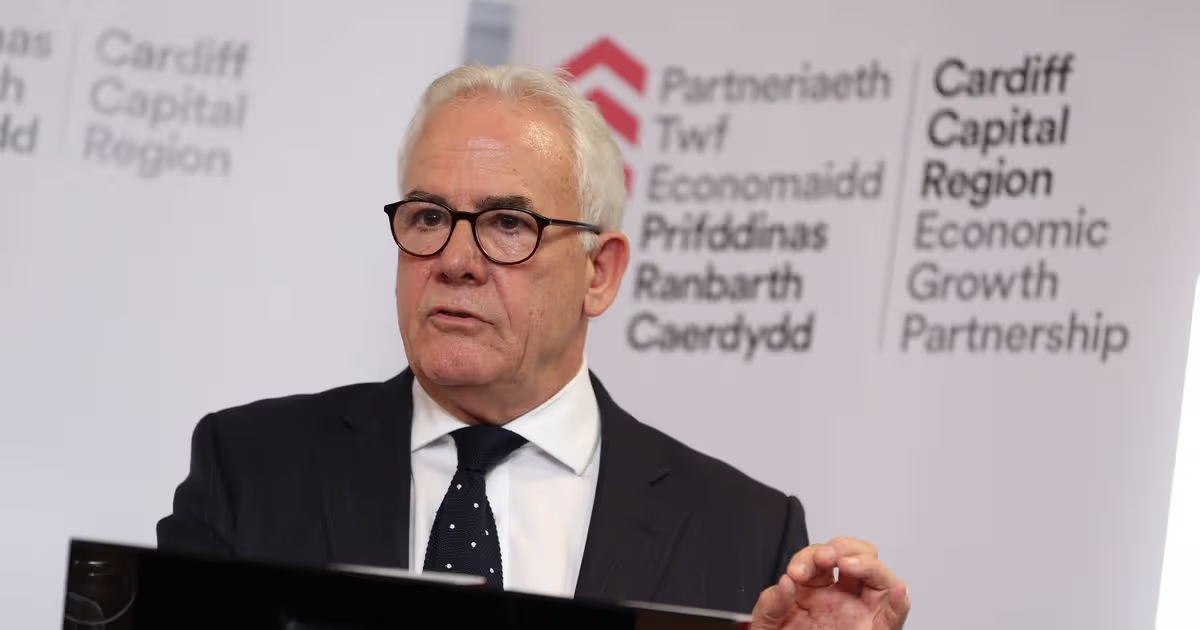
Frank Holmes.

Wales is not a large economy pretending to be small. It is structurally small. The overwhelming majority of Welsh firms are micro enterprises, many of them lifestyle businesses, subcontractors or locally oriented service providers.

Advertisement

Medium-sized companies, the real engines of productivity, export intensity and durable wage growth, are comparatively scarce. That imbalance explains much of Wales’ GVA (gross valued added) gap and its persistent productivity under performance.

It also explains why every political cycle returns to the same question: how do we build scale?

Plaid Cymru’s Senedd Election manifesto places ownership at the centre of the answer. The diagnosis is the “ownership gap”, the claim that Wales loses too much value because successful firms are sold externally and profits flow out. The proposed remedy is a stronger state-backed institutional architecture, including a National Development Agency, a more assertive Development Bank of Wales and a procurement system designed to retain wealth locally. The intention is clear. The consequences are more complex.

READ MORE: Next Welsh Government needs to help realise huge potential of renewablesREAD MORE: Construction work starts on two new campuses for Cardiff and Vale College

Advertisement

Growing micro-firms into small companies, and small firms into medium-sized enterprises, requires more than stable local demand. It requires management depth, access to capital, export ambition, product differentiation and competitive pressure.

Public procurement reform may provide revenue stability, and patient capital may bridge funding gaps, but neither automatically produces internationally competitive firms. If policy softens competitive tension too far, firms can survive without truly scaling. The danger is institutionalising smallness rather than overcoming it. Protection can preserve, but it does not necessarily propel.

The comparison with Germany’s Mittelstand is frequently invoked, and rightly so. Germany’s economy is also SME-dominated, yet its mid-sized industrial champions command global niches with remarkable precision. However, the Mittelstand is not simply about local ownership. It is about specialisation, export penetration and long-term governance discipline.

These companies are often family-controlled, but they are globally integrated. They do not fear scale or external markets. They dominate them. The lesson for Wales is not merely to retain ownership but to cultivate firms capable of owning markets. Without export depth and technical specialisation, ownership becomes symbolic rather than strategic.

Advertisement

On inward investment and mergers and acquisitions, the evidence from Wales itself complicates the narrative. Trade sales have historically been the dominant exit route for Welsh businesses, and a large majority of those companies have remained operating in Wales after acquisition.

Ownership change has not equated to economic disappearance. Strategic acquirers frequently bring systems, working capital, distribution channels and professional governance that domestic firms alone may struggle to build. If Wales signals scepticism toward external capital, even indirectly, the likely effect is not an abrupt withdrawal of investment but a repricing. Fewer bidders. Lower valuations. Greater caution. Capital does not debate ideology. It reallocates.

Succession planning illustrates this tension clearly. Most SME owners are not driven by political philosophy but by retirement security, legacy, and compensation for risk taking, job creation and delivering economic impact. They want clarity on valuation, tax treatment, timing and continuity. If policy narrows perceived exit routes, some will accelerate sales, restructure holdings or incorporate elsewhere to preserve flexibility.

Conversely, if a reformed development bank can credibly finance management buy-outs or structured internal successions on competitive terms, domestic retention becomes commercially viable rather than politically aspirational. Employee ownership models have a place, but where vendor financing constrains cash flow and investment capacity, resilience can weaken rather than strengthen. Ideology does not replace financial reality.

Advertisement

For corporate investors considering Wales as a relocation base for services or manufacturing, the evaluation criteria remain unchanged. Skills depth, grid capacity, digital infrastructure, transport connectivity, planning speed and policy stability determine decisions.

The Cardiff Capital Region narrative of cluster strength in semiconductors, energy systems, digital industries and creative production is compelling when matched by execution. Investors seek predictability and technical competence. They do not seek protection from competition. If Wales demonstrates institutional maturity and regulatory clarity, capital will engage. If it projects uncertainty around ownership or capital mobility, investors will hedge their exposure.

The proposal for a stronger National Development Agency sits at the centre of this debate. Properly governed, such an institution can provide patient equity, bridge succession finance gaps and crowd in private capital into strategic sectors. It can smooth cycles and anchor long-term industrial bets.

Poorly governed, it can crowd out commercial lenders, politicise allocation decisions and concentrate valuation risk on the public balance sheet. The difference lies in governance discipline, transparency and a clear commercial mandate. If the institution becomes a co-investor with global capital, Wales strengthens its credibility. If it becomes a gatekeeper of capital flows, Wales narrows its own opportunity set.

Advertisement

The broader impact of economic nationalism on GVA and productivity depends on how it is implemented. Retaining more profits locally can improve multiplier effects and community resilience. Aligning skills provision with industrial needs can raise labour productivity and we must double down on adopting AI too. Supporting domestic succession can preserve employment continuity. Yet if the framework discourages competitive exits, reduces the diversity of capital sources or prioritises ownership retention over operational excellence, productivity growth will slow. Sustainable economic growth requires both rootedness and openness.

External investors can and do bring other benefits, not least experienced management and board members, networks within their portfolio companies, international reach and discipline on planned delivery and governance. This extends to Stock Exchange listed companies, of which there are too few in Wales, with only one FTSE 100 company, Admiral Group, whose shareholders are international.

The real dividing line is not between nationalism and globalism. It is between capability and complacency. Ownership matters when it supports strategic continuity and reinvestment. It becomes irrelevant when firms lack competitive edge. Wales does not need to shield itself from global capital. It needs to negotiate from a position of strength. That strength will come from skills, infrastructure, cluster coherence and disciplined institutions.

The opportunity is genuine. So is the risk. The future of Wales’ economy will not be determined by who owns its companies. Competitiveness and reach beyond Wales is the outcome that ultimately matters.

Advertisement

Frank Holmes is a partner with Gambit Corporate Finance and chair of the Cardiff Capital Region’s Economic Growth Partnership.


Continue Reading

Business

Top 5 mid cap mutual funds to invest in February 2026

Published

on

The Economic Times

ETMutualFunds has shortlisted the top midcap mutual funds based on mean rolling returns, consistency over the last three years, downside risk, outperformance and asset size. The threshold is Rs 50 crore.

Continue Reading

Business

Lamborghini CEO Says EV Market for Luxury Cars Is ‘Close to Zero’

Published

on

Lamborghini CEO Says EV Market for Luxury Cars Is ‘Close

Lamborghini has canceled plans to launch its first fully electric vehicle, saying demand from wealthy buyers is almost nonexistent.

Chief Executive Stephan Winkelmann said the market for high-end electric supercars is “close to zero,” leading the brand to shelve its all-electric Lanzador project.

In an interview with The Sunday Times, Winkelmann explained that the company studied customer feedback, dealer input, and global data for more than a year before making the decision.

The Lanzador, first revealed in 2023 as a powerful “Ultra GT,” had been expected later this decade with a price near $300,000. That plan is now off the table, Fortune reported.

Advertisement

“The decision was made after over a year of continuous internal discussion, engaging with customers, dealers, market analysis, and global data,” Winkelmann said.

He added that the “acceptance curve” for electric vehicles among Lamborghini’s target clients was “close to zero” and flattening.

Investing heavily in a full battery-electric model, he warned, risked becoming an “expensive hobby” and would be financially irresponsible.

Lamborghini Shifts Focus to Plug-In Hybrids

Instead, Lamborghini will focus on plug-in hybrid electric vehicles, known as PHEVs.

Advertisement

“Plug-in hybrids offer the best of both worlds, combining the agility and low-rev boost of electric battery technology with the emotion and power output of an internal combustion engine,” Winkelmann said.

For now, the company plans to keep building traditional combustion-engine cars “for as long as possible.”

According to FoxBusiness, he said Lamborghini buyers want an emotional driving experience, something he believes electric cars currently struggle to provide. “EVs, in their current form, struggle to deliver this specific emotional connection,” he noted.

Lamborghini is owned by Volkswagen AG through its subsidiary Audi. It is not alone in rethinking electric strategies. Stellantis recently took a $26.5 billion charge after scaling back EV production.

Advertisement

General Motors recorded a $7 billion hit tied to changes in its EV plans. Ford Motor Company also announced major write-downs as it pivots toward hybrids and more affordable models.

Originally published on vcpost.com

Continue Reading

Business

Decoded: The viral doomsday AI memo that roiled Wall Street

Published

on

Decoded: The viral doomsday AI memo that roiled Wall Street
Stock market investors are used to shocks from central banks, Trump and geopolitics – not Substack. Yet a 7,000-word essay by James van Geelen appears to have rattled markets all the same.

The founder of Citrini Research published “The 2028 Global Intelligence Crisis” on Sunday, outlining a hypothetical scenario in which accelerating AI adoption leads to widespread white-collar job losses, weaker consumption and mounting financial strain.

The essay describes a “deflationary cascade” in which AI doesn’t just augment workers, it replaces them so efficiently that it destabilises the broader economy.

In a market already jittery about rapid AI developments and heavily concentrated in tech stocks, the scenario struck a nerve. By Monday morning, the post had gone viral across trading desks.

Advertisement

What does the post say?

Citrini’s thesis imagines a near future in which rapidly improving AI agents hollow out software companies,displace white-collar workers, destabilise credit and housing markets, and inadvertently bankrupt the middle class.


It stresses that the scenario is a “thought exercise, not a prediction.” Still, its chain-reaction logic alarmed investors.
The post is written as a retrospective from 2028. In its version of events, AI first drives a surge in productivity and profits before job losses start to weigh on spending and credit.

Here are the key triggers from the post that spooked the market:

1) Death of the middleman

At the heart of Citrini’s thesis is a sharp leap in AI capability. It points to increasingly autonomous tools such as Anthropic’s Claude Code and OpenAI’s Codex as early signs of systems able to execute complex business tasks with minimal human input.

Advertisement

The impact would extend beyond software to travel booking, insurance, real estate commissions, and other industries built on transaction “friction.”
If such agents scale, they could undercut demand for platforms such as Monday.com, Zapier and Asana by allowing companies to manage workflows internally at lower cost. That, in turn, could push vendors like Oracle into sharper price competition.

Nor would it stop there. In Citrini’s framework, personal AI agents transact directly for consumers, bypassing intermediaries such as Uber and DoorDash. Payment networks, including Visa and Mastercard, could face pressure if transactions shift to lower-cost crypto rails.

The common thread: when machines optimise every transaction for efficiency, habitual app loyalty—a cornerstone of many digital business models–begins to erode.

Advertisement

2) Mass white-collar unemployment

Historically, technologies have created more jobs than they destroyed. Citrini argues AI could prove to be the exception.

“AI is now a general intelligence that improves at the very tasks humans would redeploy to. Displaced coders cannot simply move to ‘AI management’ because AI is already capable of that,” the report states.

In this scenario, layoffs in software and other white-collar sectors accelerate, and workers cannot easily transition into higher-value roles. Many shift into lower-paying or less stable jobs, putting pressure on wages and weakening consumer spending.

That softer demand then feeds back into corporate decisions. Instead of hiring, companies double down on automation to cut costs, reinforcing what Citrini describes as a cycle with no natural brake.

Advertisement

3) Financial spillovers

The report extends the shock into the private credit and housing sectors.

Many software firms have been financed by private-credit lenders based on assumptions of steady long-term revenue. If AI undermines those assumptions, defaults could surge. Asset managers such as Hellman & Friedman and Permira, cited in the report, could face pressure if software-backed loans sour.

At the same time, laid-off white-collar workers struggle to service mortgages, triggering housing stress. Combined credit tightening and falling consumer confidence could amplify the downturn.

Advertisement

Citrini ultimately sketches a late-2027 crash that wipes out 57% of the S&P 500.

4) The paradox of “ghost GDP”

Citrini flags what it sees as a growing imbalance: the economy looks healthy on paper, but many households are under strain.

In one scenario, large AI companies continue to post strong profits and productivity gains. Given their heavyweight in stock indices and overall output, headline GDP and market indicators remain resilient.

Advertisement

The problem, the firm argues, is that machines don’t spend. They don’t buy homes, cars or everyday services.

The result is what Citrini calls “ghost GDP” – economic output that shows up in the data but doesn’t filter through to the wider population.

That gap between rising corporate profits and squeezed household finances, the firm warns, could heighten social and political tensions, with anger directed less at Wall Street and more at Silicon Valley.

Advertisement

How did markets react?

Investors were already uneasy about AI disruption. The Substack post sharpened those fears.

US software stocks led the slide. Shares of Datadog, CrowdStrike and Zscaler fell sharply, while International Business Machines suffered its worst one-day drop in decades. Private-equity groups KKR and Blackstone, both cited in the report, also declined.

The broader selloff, which coincided with renewed trade-policy uncertainty in Washington, pushed the Dow Jones Industrial Average down 1.7%, or 822 points, on Monday.

Shares of DoorDash fell about 7% after the note called it a “poster child” for businesses that monetise friction between buyers and sellers. In the scenario, AI agents enable customers and drivers to transact more directly, squeezing margins. On social media, co-founder Andy Fang said the rise of “agentic commerce” would force the company to adapt. “The ground is shifting underneath our feet,” he wrote.

Advertisement

“So far this year, the stock market has been discounting a scenario in which AI is our Frankenstein monster,” said Ed Yardeni of Yardeni Research. His base case is less dire: “We continue to believe that AI is augmenting workers’ productivity rather than making them extinct.”

Also read: IT stock crash wipes out Rs 1.2 lakh crore for LIC & mutual funds in bloodbath not seen since 2008

After the selloff, van Geelen said the report was a scenario, not a forecast. Speaking to Bloomberg, he described it as an attempt to “start a conversation” about a world in which human intelligence is no longer the scarcest resource.

Whether that future materialises is unclear. But the episode shows how quickly AI enthusiasm can turn into market anxiety.

(Disclaimer: Recommendations, suggestions, views and opinions given by the experts are their own. These do not represent the views of The Economic Times)

Advertisement
Continue Reading

Trending

Copyright © 2025