

Crypto World
5 red months, 74% LTH profit rapidly eroding



BTC is down ~50% from ATH, with 74% LTH profit shrinking as supply in loss hits 50% amid multi‑month selling.
Summary
- Long-term BTC holders still sit on ~74% average profit, but that margin is compressing as price grinds toward the LTH cost basis near ~$39k.
- BTC has printed almost five straight red monthly candles after a volatility spike above 150%, while weekly RSI hits one of its most oversold levels ever around the $60k-$65k zone.
- BTC supply in loss has hit ~10m coins, roughly 50% of the 20m circulating, a capital destruction level that has historically coincided with bear market bottoms.
Bitcoin long-term holders currently hold an average profit of approximately 74%, though that margin continues to decline as the cryptocurrency’s price moves closer to their cost basis, according to CryptoQuant analyst Darkfost.
The analyst noted that historical bear market cycles have been characterized by prices breaking below the long-term holder cost basis, triggering capitulation phases marked by realized losses of around 20%. Long-term holders are defined as investors known to be less sensitive to short-term price fluctuations, Darkfost stated.
Market recovery and bull phase entry have historically occurred only after such capitulation events, according to the analysis.
Glassnode reported that the 90-day moving average of the Realized Profit/Loss Ratio has fallen below 1, confirming a transition into an excess loss-realization regime. The blockchain analytics firm stated that these bearish conditions have historically persisted for at least six months before liquidity returns to markets.
Analyst James Check reported that Bitcoin has recorded nearly five consecutive red monthly candles following the largest volatility spike of the current cycle. Check observed that one-week realized volatility spiked above 150%, a level typically associated with capitulation events, and that weekly RSI has reached one of the most oversold readings in Bitcoin’s history. A significant amount of Bitcoin has migrated to new holders in a high price range this year, according to Check’s analysis.
Bitcoin supply in loss reached 10 million coins, the fourth-highest reading on record, analyst James Van Straten reported. Van Straten noted that circulating supply will reach 20 million Bitcoin next week, with 50% held at a loss. Historical patterns suggest such capital destruction levels are sufficient for a bear market bottom, according to Van Straten.
Bitcoin experienced a minor price rebound during early Asian trading hours, though bearish sentiment remains dominant in the market. The price movement formed another lower high while a key support level continues to hold, according to technical analysis.

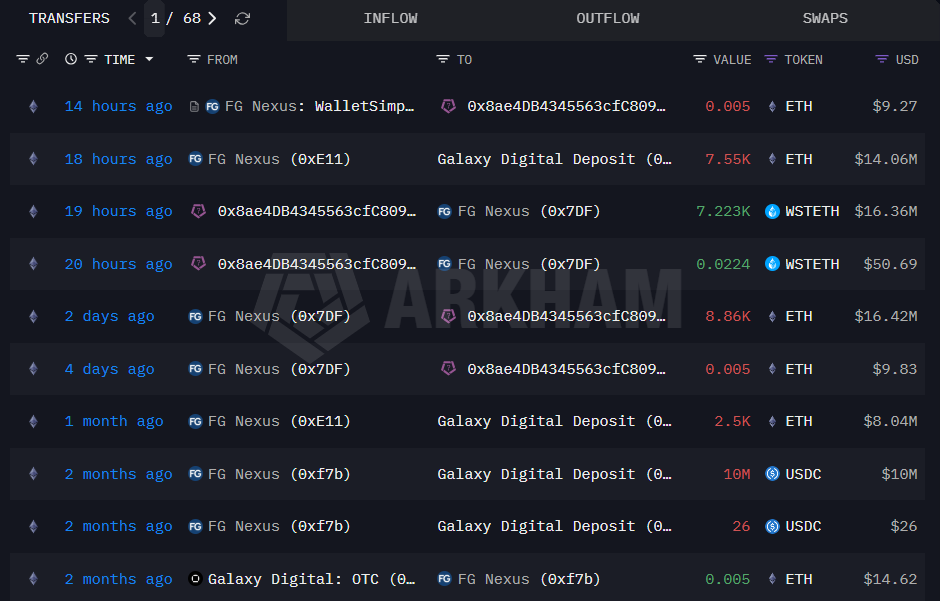
FG Nexus, a publicly listed Ethereum treasury and infrastructure company, liquidated another chunk of its Ether treasury on Tuesday, offloading 7,550 ETH worth roughly $14 million.
The latest sale adds to a series of disposals that have locked in more than $80 million in losses on a position built near Ether (ETH) 2025 highs.
Onchain data from Arkham shows that the firm accumulated 50,770 ETH worth around $196 million between August and September 2025 at an average price of $3,860 per coin.
On Oct. 22, the company doubled down on its ETH accumulation strategy, announcing its intention to sell its Quebec property to accumulate more ETH.

As the market turned and the ETH price fell from its October highs of over $4,600 per coin to around $2,700 in November, the company began selling.
FG Nexus has offloaded just over 21,000 ETH for about $55 million, and netted a loss of over $80 million.
The company has also seen its share price for FGNX drop roughly 52% over the past month.

FG Nexus remains one of the largest publicly traded owners of ETH, with holdings of 37,594 ETH, according to Arkham.
ETH treasury companies under fire
FG Nexus isn’t alone in feeling the pain from an Ether downturn that has left many large corporate treasuries deeply underwater.
Bitmine Immersion Technologies, by far the largest listed ETH holder with 4,422,659 ETH on its books, is sitting on paper losses estimated at around $8.8 billion as Ether trades well below its average acquisition price, even as the company continues to add to its stash.
Related: ETHZilla liquidates $74.5M in Ether to redeem convertible debt
Peter Thiel’s Founders Fund exited its stake in Ethereum treasury firm ETHZilla entirely last week, with ETHZilla’s stock now down about 97% from its all‑time high, as equity markets punish aggressive Ether‑heavy strategies, with other companies actively unwinding.
Trend Research spent February slashing its Ether position on Binance, selling 651,757 ETH for about $1.34 billion on Feb. 8, and locking in an estimated realized loss of around $747 million.
Bitcoin treasury plays feel the heat
The strain on crypto treasury plays is not limited to Ethereum. On Feb. 20, Bitcoin (BTC) treasury company Metaplanet came under fire from shareholders, accusing the company of hiding losses and key details of its Bitcoin bets.
Despite continued BTC purchases throughout February, on Wednesday, the largest listed owner of BTC, Strategy, became the most-shorted large-cap US stock according to data from Goldman Sachs, as hedge funds turned bearish on Saylor’s highly leveraged, Bitcoin‑centric balance sheet model.
Magazine: Bitcoin’s ‘biggest bull catalyst’ would be Saylor’s liquidation — Santiment founder


- Curve DAO Token (CRV) price has posted notable gains as the price jumps to $0.24.
- Bulls could target resistance at $0.40 as Bitcoin eyes fresh momentum.
- However, on-chain metrics and broader sentiment could cap upside potential.
The Curve DAO Token (CRV) was among the top intraday performers in the cryptocurrency market, rising more than 10% over the past 24 hours.
The token climbed above $0.24 during early Asian trading hours, supported by a brief market rebound following a bounce in Bitcoin, which helped lift sentiment across altcoins.
Some market participants are now looking at potential further gains toward the $0.40 level.
However, with Bitcoin continuing to struggle below $70,000, downside risks remain. This has kept broader market sentiment cautious, limiting the upside potential for tokens such as CRV.
Why Curve DAO Token faces selling pressure
Curve DAO Token (CRV) has rebounded from recent lows near $0.21, but, like most altcoins, remains well below the highs recorded in 2025.
The broader downtrend remains intact, keeping the token under sustained downward pressure.
While some buyers may look to extend gains, weakening on-chain activity and negative market sentiment suggest that downside risks remain elevated in the short term.
Despite the price increase over the past 24 hours, social media sentiment around CRV has stayed largely cautious, raising the possibility of further price erosion.
Perpetual futures data also points to continued trader scepticism, with funding rates remaining in negative territory.
In recent sessions, short positions have been paying longs, highlighting persistent selling pressure and increasing the risk of a retest of recent lows.
At the same time, macroeconomic and geopolitical uncertainties continue to weigh on investor confidence across risk assets.
Bitcoin trading below $70,000 has added to the cautious tone, overshadowing positive fundamentals such as network growth.
Without a meaningful improvement in macro conditions, sentiment is likely to limit CRV’s recovery.
There is also a risk that short-term gains may prompt some investors to take profits, potentially leading to a brief and fragile rebound.
CRV price technical setup
Overall, CRV’s price outlook offers mixed technical indicators.
Despite climbing 10% intraday to hover near $0.24, the token remains pinned beneath its 50-day and 100-day exponential moving averages (EMAs).
The moving averages are sloping from above $0.30 and provide a formidable overhead barrier, with a horizontal hurdle at the $0.40-$0.45 zone.
However, the daily chart shows the Relative Strength Index (RSI) has ticked up from oversold territory to around 40.
This suggests bulls need momentum for a sustained reversal.
Curve Token’s daily chart also has the MACD indicator holding onto its bullish signals.
But the histogram is showing contracting bars, hinting at near-term consolidation rather than an outright breakout.

Buyers must get a decisive close above $0.24 to allow for a probe of the initial resistance at $0.26, followed by the 50-day EMA currently at $0.29.
Yet, broader market headwinds and bearish derivatives data temper such optimism.
If prices follow current downside trends, immediate support aligns at $0.22, coinciding with the demand reload zone from November 2025.
A drop below this could accelerate toward $0.20, where stronger volume clusters might intervene.
Circle (CRCL) shares jumped over 15% in pre-market trading after the stablecoin issuer’s fourth-quarter earnings per share (EPS) beat analysts’ forecasts.
The issuer of the USDC stablecoin reported EPS of $0.43, compared with a consensus estimate of $0.16, according to FactSet data.
The New York-city based firm also posted earnings before interest, taxes, depreciation and amortization (Ebitda) of $167 million, a surge of some 412% from the year-earlier quarter.
CRCL shares traded at $71.17 in pre-market trading, just under 16% above Tuesday’s close.


ETH pivots DeFi support to permissionless, secure, privacy-first protocols, enforcing a walkaway test for long-term resilience.
Summary
- ETH DeFi focus shifts to permissionless, open-source, security-first protocols that minimize trusted third parties and central chokepoints.
- New EF bar is the walkaway test: protocols must keep functioning if teams disappear or turn hostile, with oracle infrastructure flagged as a systemic risk.
- Roadmap prioritizes privacy-preserving CDPs, AI-assisted formal verification, wallet safeguards, and stronger oracle decentralization for sustainable DeFi growth.
Ethereum (ETH) co-founder Vitalik Buterin has outlined a renewed vision for decentralized finance on the Ethereum network, emphasizing permissionless access, privacy, and security as core priorities, according to statements released by the Ethereum Foundation.
The Ethereum Foundation announced it will support projects that align with these principles, focusing on user control, open systems, and reduced reliance on centralized actors.
Buterin stated that decentralized finance represents a core component of Ethereum’s value proposition. DeFi platforms offer savings, risk management, and wealth-building tools without permission requirements, operating globally without central gatekeepers, according to the announcement.
“Financial empowerment is a central part of what it means to have agency and freedom in our current world,” Buterin stated. “Finance is far from the only thing that Ethereum is good for, but it is an important thing.”
The Ethereum Foundation does not plan to support all blockchain-based finance projects, according to Buterin. Instead, the organization will back protocols that are open-source and prioritize security, maximizing user control while reducing reliance on trusted third parties.
Buterin introduced what he termed the “walkaway test” for DeFi protocols, stating that a protocol should continue functioning if the original development team disappears and remain operational even if founders become compromised or hostile.
Security remains a central concern for the Ethereum Foundation, according to the announcement. Buterin identified audits, shared standards, and wallet safeguards as key tools, while also highlighting AI-assisted formal verification as an emerging method to improve smart contract safety.
Oracle security requires urgent attention, Buterin stated, noting that oracles connect blockchains to external data sources and weak oracle systems can expose DeFi platforms to manipulation and financial loss. The co-founder called for stronger decentralization in oracle design, describing secure infrastructure as essential for sustainable DeFi growth.
Privacy represents another major focus in Ethereum’s DeFi roadmap, according to Buterin. Both payment systems and complex financial tools require stronger privacy features, with collateralized debt positions cited as one example requiring privacy-preserving solutions.
Buterin noted that enhanced privacy features could reduce liquidation risks but require advanced technical solutions. The co-founder encouraged deeper innovation in decentralized finance, urging developers to move beyond improving existing stablecoins and rethink core financial problems such as hedging future expenses.
Ethereum remains a permissionless network where anyone can deploy applications, according to the Foundation. However, the Ethereum Foundation will prioritize projects that support user agency and open access, with the stated goal of building a global financial system that is secure, private, and resilient.
In an era where payment infrastructure is the battleground for customer experience and margin expansion, A2A payments have evolved from a niche innovation to a strategic imperative. For serious investors evaluating white-label neo banking and Banking-as-a-Service (BaaS) opportunities, A2A is a value multiplier rather than a feature. A2A eliminates costly intermediaries, improves merchant unit economics, reduces customer friction, and enables richer data flows that drive new products and revenue lines. As real-time rails, open banking APIs, and instant-payment schemes gain global traction, a neo bank that does not prioritize native A2A capability risks losing market share, margin, and strategic flexibility to better-equipped competitors. We present a market-based, technically precise, investor-focused analysis that explains why A2A is critical to any white-label neo bank play, how it is implemented in a crypto-enabled context, and how a full-service engineering partner can provide end-to-end growth and regulatory resilience.
Key Stats:
- Global A2A transaction value is set to grow from $1.7T in 2024 to $5.7T by 2029.
- Annual transactions are expected to jump from 60 billion to 186 billion by 2029.
- By 2030, total A2A payment value could reach $195T, fueled by real-time payment systems.
- The consumer A2A market is projected to grow 209% between 2024 and 2029.
- A2A already powers $525B in global e-commerce transactions.
- It is the leading online payment method in markets like Finland, Malaysia, the Netherlands, Nigeria, Thailand, and Poland.
- Growth is driven by lower fees, instant settlement, and stronger bank-level security.
Current Market Trends in A2A Payments
A2A is rising on multiple fronts. Large-scale instant-payment infrastructures and open banking adoption are shifting transaction volumes away from expensive card rails toward low-cost direct transfers. Industry research and major payment reviews indicate that non-card direct payment types are growing across APAC, Europe, and Latin America, and global payments revenue dynamics are changing as a result of this structural shift.
Region-specific rails are already evidence of the shift. India’s Unified Payments Interface has demonstrated explosive scale with tens of billions of monthly transactions, showing that when a cheap, instant A2A mechanism is available, consumer behavior changes quickly and permanently. This level of adoption validates the merchant economics and user experience proposition that A2A delivers.
Market forecasts point to steep A2A volume growth over the next five years, with projections expecting transaction volumes to multiply as merchants and platforms embrace direct settlement and as open-banking payment initiation services expand. For investors, this means addressable volume and low-variable-cost revenue streams are likely to increase materially over a standard investment horizon. Let us scroll through the blog to see how account-to-account payments actually help enterprises planning for white label neo bank app development.
How a White-Label Neo Bank App with A2A Payment Integration Looks Like?
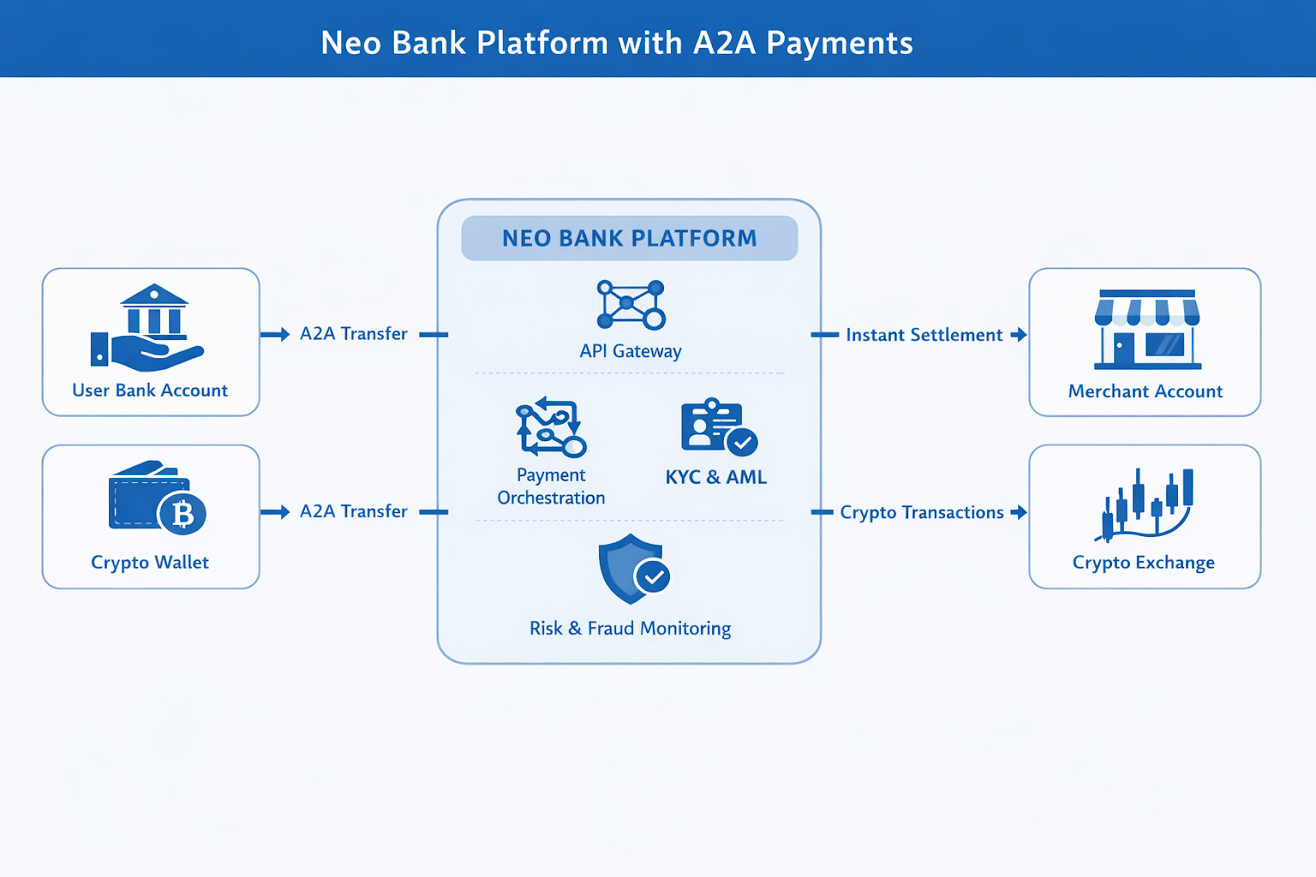
From the outside, A2A makes the crypto-friendly neo banking platform’s UX faster, cheaper, and cleaner. From the inside, it requires integration across several technical and compliance layers. A practical architecture includes:
- API gateway layer for secure client interactions and webhook handling.
- Payment orchestration engine to handle routing logic, retry, reconciliation, and fallback to alternative rails.
- Connectors to payment initiation providers and instant rails, plus adapters for country-specific schemes (for example, UPI in India, Pix in Brazil, SEPA Instant in Europe).
- Real-time settlement and ledger module that supports both fiat and tokenized balances for crypto-enabled features.
- Reconciliation and rich metadata capture to support merchant settlement, invoicing, and data-led product features such as accounting automation.
- Risk and fraud scoring layer operating in real time with adaptive thresholds and behavioral signals.
Advantages of a White-Label BaaS Platform With A2A Payments
For investors, converting product-level features into portfolio outcomes matters. A2A, when integrated into a customized BaaS platform, offers several investor-relevant advantages:
- Revenue quality and margin expansion- A2A reduces per-transaction cost relative to card rails and proprietary networks, which improves unit economics for merchant acquiring and P2P transfer products. Lower variable cost drives sustainable take rates on payment volumes.
- Customer acquisition and retention- A2A provides a stickier onboarding experience. Fast settlement and lower fees increase merchant willingness to route more volume through your platform, increasing lifetime value.
- New product and data monetization channels- Because A2A preserves richer transactional metadata and can be orchestrated through your platform’s APIs, you can bundle value-add services such as reconciliation-as-a-service, embedded lending, and treasury optimization. Those services drive higher ARPU.
- Regulatory and operational resilience- Owning A2A capability, or tightly integrating with compliant payment initiation providers, reduces dependency on third-party processors and gives better control over risk, KYC/AML flows, and dispute handling.
- Faster path to scale in local markets- When a white-label solution supports local A2A rails, market entry is accelerated. Local merchants prefer payment flows that match their customers’ expectations and cost sensitivities; integrated A2A unlocks faster merchant acquisition.
How Does A2A Work Inside A Crypto-Enabled Neo Bank?
In a white-label crypto neo bank, fiat and crypto worlds must coexist seamlessly. Here is a clear technical narrative:
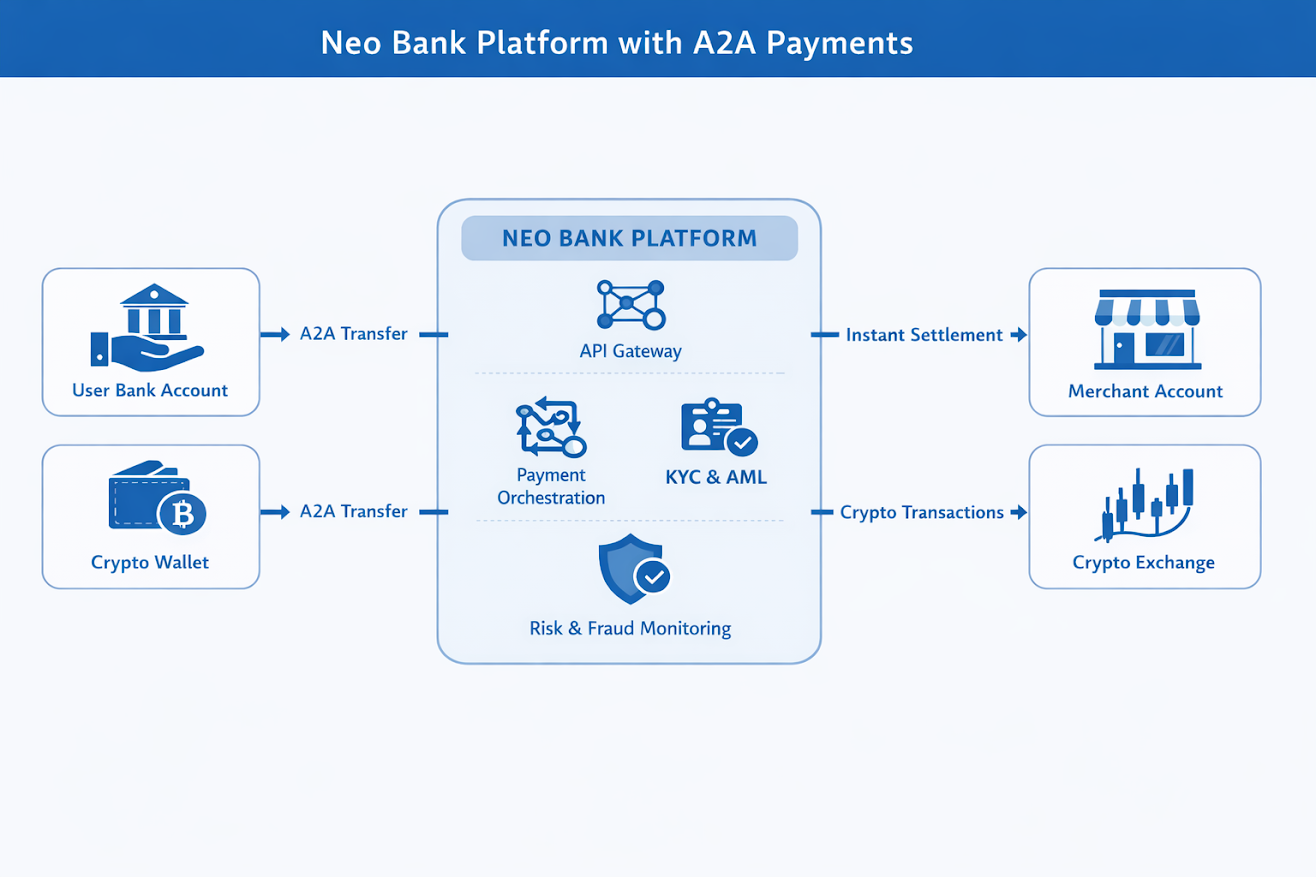
- On-ramp and off-ramp orchestration- The neo bank provides tight orchestration between fiat A2A rails and on-chain wallets. Users can initiate an A2A transfer from their bank account into the neo bank’s fiat custody. The system either credits a fiat ledger balance immediately upon confirmation or, if the user intends to mint tokenized assets, it triggers a controlled conversion workflow that uses a compliant brokerage or internal AMM to swap fiat for the desired token.
- Dual-ledger architecture- Maintain a fiat ledger and a tokenized ledger. The fiat ledger reconciles with external rails and instant payments. The token ledger mirrors user balances on-chain or in controlled custody. Movement between ledgers is handled by deterministic business logic, ensuring atomicity (credit to the token ledger only after settlement confirmation or via escrow techniques).
- Settlement and reconciliation- The payment orchestration layer handles instant confirmations, settlement timing differences, and reconciliation. For example, a UPI payment confirmation can trigger immediate ledger credit, while cross-border A2A may require multi-step settlement and liquidity management.
- Custody, AML, and KYC- For crypto rails, custody models vary: self-custody with wallet integrations, custodial crypto wallets, or hybrid ones. AML and KYC flows must be synchronized to the fiat rails so that on-chain flows do not create regulatory gaps. Real-time transaction monitoring must incorporate both on-chain heuristics and off-chain bank signals.
- Programmable rails and smart routing- Smart routing sends payments across the most cost-effective and compliant rail. For domestic instant rails, it prefers direct A2A. For cross-border transfers, it may leverage partner pools, local settlement entities, or tokenized stablecoins held in regulated custody.
This hybrid design allows a neo banking app platform to offer low-cost merchant acceptance, instant payouts to users, and seamless fiat-crypto rails, a compelling set of capabilities for modern web3-native products. For context, well-designed A2A integration is what enables competitive offerings like instant merchant settlements, embedded payroll, and real-time treasury for business customers.
When national rails achieve mass scale, they change behavior. For example, India’s UPI shows how an A2A-first economy dramatically shifts consumer and merchant preferences. Integrating such rails is not optional for market leaders.
Antier’s A-Z Capabilities for a White-Label Neo Banking Solution with A2A payments
Do you want to get more clarity on what a full-stack platform looks like? Well-designed by a white-label BaaS partner, it supports an investor’s road to scale. Below we list the investor-facing capabilities that matter most. Note that when we mention Antier once, we use that as the brand anchor for the consolidated capability set.
- Strategy and market entry: product-market fit studies, merchant economics modeling, and revenue playbooks tailored to local rails and verticals.
- End-to-end architecture: API-first platform design, payment orchestration engine, and dual-ledger support for fiat and tokenized assets.
- Rail integrations: connectors for instant payment networks and payment initiation providers, plus custom adapters for country rails and QR systems.
- Compliance-by-design: built-in KYC/AML flows, transaction monitoring, and support for regulatory reporting across jurisdictions.
- Custody and treasury: secure custody integrations, liquidity management, and bank-grade settlement reconciliation modules.
- Risk and fraud engineering: ML-powered scoring, adaptive rulesets, and real-time monitoring for both fiat and crypto flows.
- UX and developer experience: white-label banking apps, merchant portals, and developer APIs for embedding payments into platforms.
- Operations and SRE: 24/7 support, incident management, and SLAs for settlement integrity and uptime.
- Go-to-market enablement: merchant onboarding automation, pricing strategy, and performance dashboards to measure acquisition and take-rate.
- Ongoing product evolution: roadmap management, feature A/B testing, and telemetry to evolve product-market fit.
Make sure that you are hiring a genuine and reliable white label crypto neo bank development company that holds a good reputation in the market. has a vast team of certified blockchain experts, and delivers customized banking solutions.
Implementation Checklist For Investors
When you evaluate a white-label neo bank with A2A claims, confirm these capabilities:
- Native connectors to relevant national rails and a modular orchestration layer.
- Real-time reconciliation and rich metadata capture for merchant settlement.
- Robust AML/KYC that binds fiat and crypto flows.
- A clear custody model and liquidity plan for fiat-crypto settlement.
- Proven operational SLAs, incident playbooks, and test harness for payments.
- Productized APIs and SDKs to enable partner integration and network effects.
Conclusion
A2A payments is a strategic enabler for any white-label neo bank that seeks durable growth and defensible margins. For investors, it is the mechanism that shifts payment economics, increases customer stickiness, and unlocks monetizable product layers. Market evidence shows large-scale adoption in regions where instant rails and open banking are present, and projections indicate continued A2A volume growth over the coming years.
We, the team of Antier brings deep engineering, payments, and regulatory experience to help portfolios turn A2A capability into predictable revenue. Our approach covers policy-aware integration, hardened custody and treasury, and continuous operational support to manage settlement, disputes, and compliance. With the right architecture and a partner that understands both rails and tokens, investors can capture the margin gains and product optionality that A2A unlocks.
If you would like, we can produce a due-diligence checklist tailored to a specific market or assemble a short roadmap estimating engineering scope and go-to-market milestones for a white-label neo bank in your target jurisdiction.
Frequently Asked Questions
01. What are A2A payments and why are they important for neo banks?
A2A payments, or Account-to-Account payments, eliminate costly intermediaries, improve merchant unit economics, reduce customer friction, and enable richer data flows, making them a strategic imperative for neo banks to enhance customer experience and maintain competitive advantage.
02. How is the A2A payment market expected to grow in the coming years?
The global A2A transaction value is projected to increase from $1.7 trillion in 2024 to $5.7 trillion by 2029, with annual transactions expected to rise from 60 billion to 186 billion during the same period.
03. What factors are driving the growth of A2A payments?
Growth in A2A payments is driven by lower fees, instant settlement, stronger bank-level security, and the adoption of large-scale instant-payment infrastructures and open banking, which are shifting transaction volumes away from traditional card payments.
Crypto World
FG Nexus Sells Another 7,550 ETH Worth $14.06 Million as Total Reported Losses Reach $82.8 Million

TLDR:
- Lookonchain reported FG Nexus sold 7,550 ETH today, valued at approximately $14.06 million on the open market.
- FG Nexus originally bought 50,770 ETH for $196 million at an average entry price of $3,860 per token in 2025.
- The firm has offloaded 21,025 ETH at roughly $2,649 average, well below its original cost basis of $3,860 per token.
- FG Nexus still holds 30,094 ETH worth about $57.5 million, with total reported losses now standing at around $82.8 million.
According to Lookonchain, Ethereum treasury firm FG Nexus sold another 7,550 ETH today, worth approximately $14.06 million. The sale adds to a growing pattern of divestment that has drawn wide attention across the crypto market.
FG Nexus originally purchased 50,770 ETH between August and September 2025 for approximately $196 million. That position was acquired at an average price of $3,860 per token.
The firm currently holds 30,094 ETH valued at roughly $57.5 million, with total reported losses now at approximately $82.8 million.
Lookonchain Flags FG Nexus Latest ETH Sale of 7,550 Tokens
Lookonchain, a widely followed on-chain analytics platform, reported the latest FG Nexus transaction on its official channels.
The firm sold 7,550 ETH for approximately $14.06 million, continuing a trend that began in late 2025. Lookonchain has been tracking the firm’s movements closely, offering a transparent look at how its Ethereum position has deteriorated over time.
The on-chain data reveals that FG Nexus built its initial position across August and September 2025. During that window, the firm accumulated 50,770 ETH at an average cost of $3,860 per token.
The total outlay for that position came to approximately $196 million, reflecting a large institutional bet on Ethereum at the time.
However, as Ethereum prices declined, FG Nexus began moving in the opposite direction from its original strategy.
Rather than continuing to accumulate, the firm started reducing its holdings. That shift marked a notable reversal and set the stage for the losses now being tracked by Lookonchain.
FG Nexus Selling Activity Points to a Growing Realized and Unrealized Loss
Before today’s sale, FG Nexus had already sold 21,025 ETH at an average price of approximately $2,649 per token. That average exit price sits roughly $1,211 below the firm’s original average entry price of $3,860. The gap between those two figures captures how much value the firm surrendered on each token sold.
Today’s additional sale of 7,550 ETH at approximately $14.06 million further extends that loss gap. Lookonchain’s tracking shows the cumulative exit prices remain well below the original cost basis.
Combined, the sold ETH represents a substantial portion of what the firm once held across its peak position.
FG Nexus currently holds 30,094 ETH, valued at approximately $57.5 million according to Lookonchain data. Measured against the original $196 million purchase, the firm’s total reported loss stands at around $82.8 million.
That figure covers both realized losses from completed sales and the unrealized loss on the remaining position. A meaningful recovery in Ethereum prices would be necessary for that gap to narrow from this point forward.
Crypto World
Sen. Blumenthal probes Binance over alleged $1.7 billion in crypto Iran-linked transactions


U.S. Senator Richard Blumenthal, a top Democrat on the Senate Homeland Security Committee, on Tuesday opened a probe into alleged sanctions violations at crypto exchange Binance, the New York Times reported on Wednesday.
Blumenthal, who represents Connecticut, sent Binance a letter asking about the $1.7 billion allegedly transferred from accounts on the platform to Iran-linked organizations, including Yemen’s Houthi militants. The violations were identified by internal Binance investigators who were subsequently dismissed, according to several news reports. The world’s largest crypto exchange denied the allegations in an email to CoinDesk.
“The New York Times’ prior reporting is wrong. Binance has strict KYC (know-your-customer) and compliance procedures in place, and there are no Iranian users on the platform,” a Binance spokesperson said in the email. The spokesperson also reiterated the exchange’s stance “against false claims in these reports”, referring to articles by the New York Times, Wall Street Journal and Fortune about the alleged dismissal of the four investigators involved.
Blumenthal sent a letter to Binance’s co-chief executive Richard Teng asking for records of the company’s dealings with two Hong Kong entities identified by the investigators as the origin of the transfers to Iran, the New York Times said.
One of the accounts was registered to Blessed Trust, a Hong Kong company that served as a Binance vendor. According to the newspaper, a Binance representative said the exchange canceled the accounts and stopped working with Blessed Trust in January.
“Binance appears to have ignored warnings and recommendations to prevent Iranian money laundering schemes on its cryptocurrency exchange,” Blumenthal wrote. The lawmaker also asked Teng to hand over records about “the suspension and dismissal of compliance staff and investigators” who flagged the alleged violations.
Binance’s founder and former CEO, Changpeng Zhao pleaded guilty in November 2023 to violating anti-money-laundering laws and allowing customers in countries under sanctions, including Iran, to transact on the platform. The company agreed to pay $4.3 billion in penalties and leave the U.S. market. Zhao served four months in prison for his role before being pardoned by President Donald Trump.
Binance said in a blog post on Sunday that its “sanctions-related exposure is minimal.” Rachel Conlan, another spokesperson, told the Times, there is an ongoing internal investigation at the exchange and that a full report would be sent to the U.S. Justice Department on Feb. 25.
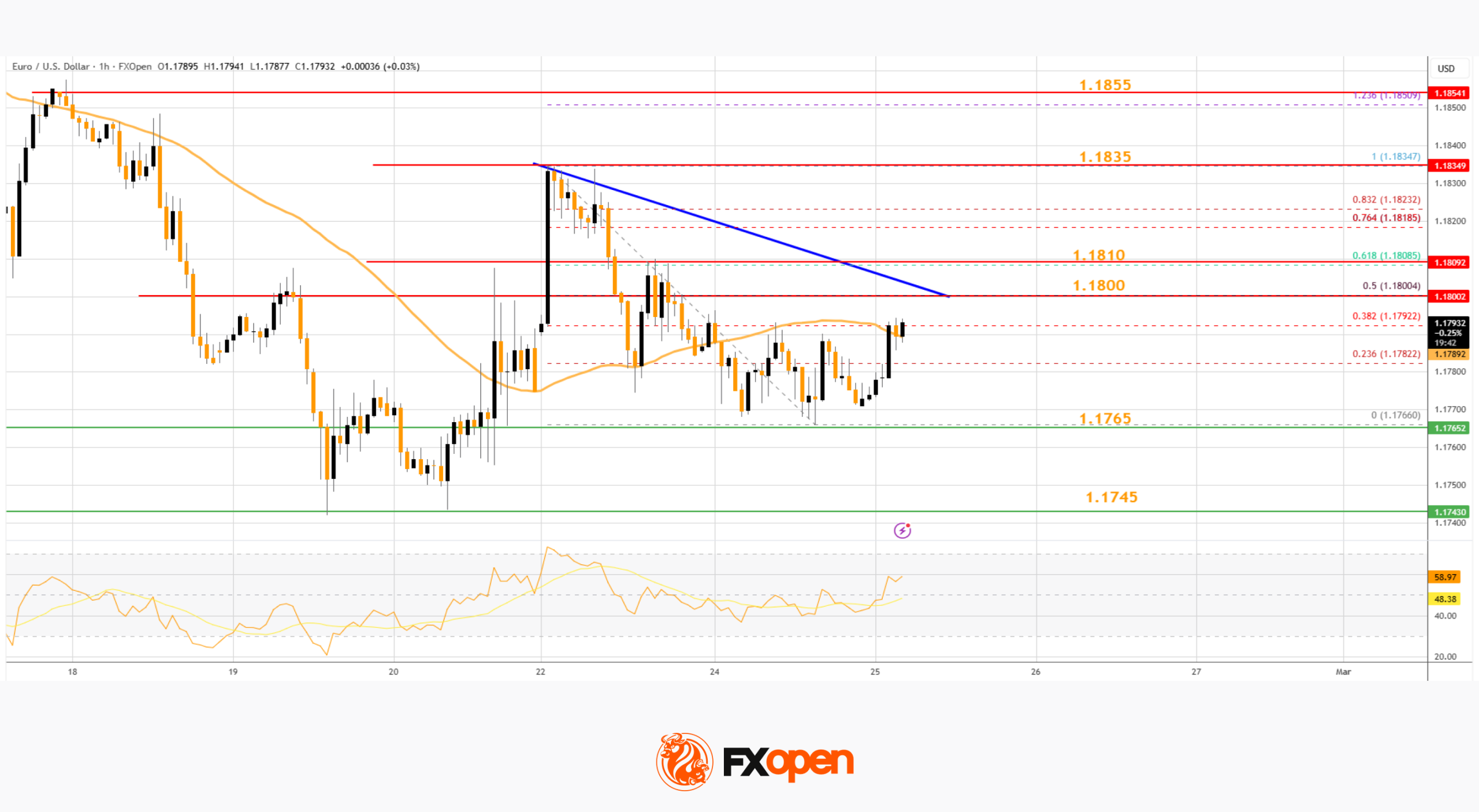
EUR/USD started a fresh increase above 1.1780. USD/CHF declined from 0.7770 and is now struggling to stay above 0.7925.
Important Takeaways for EUR/USD and USD/CHF Analysis Today
· The Euro started a decent upward move from 1.1750 against the US Dollar.
· There is a key bearish trend line forming with resistance at 1.1800 on the hourly chart of EUR/USD at FXOpen.
· USD/CHF declined below the 0.7725 and 0.7710 support levels.
· There is a major contracting triangle forming with resistance near 0.7765 on the hourly chart at FXOpen.
EUR/USD Technical Analysis
On the hourly chart of EUR/USD at FXOpen, the pair started a fresh increase from 1.1745. The Euro cleared 1.1765 to decrease bearish pressure and move into a bullish zone against the US Dollar.
The bulls pushed the pair above the 50-hour simple moving average and 1.1780. It opened the doors for a move toward the 50% Fib retracement level of the downward move from the 1.1834 swing high to the 1.1766 low.
The first key hurdle on the EUR/USD chart is near a bearish trend line at 1.1800. The next barrier for a fresh increase sits near the 61.8% Fib retracement at 1.1810. An upside break above 1.1810 might send the pair toward 1.1835.
The next major area of interest for the bears might be 1.1855. Any more gains might open the doors for a move toward 1.1880. Immediate support on the downside is near the 50-hour simple moving average and 1.1785.
A close below 1.1785 could spark more bearish moves and send the pair toward 1.1765. The next major hurdle for the bears might be 1.1745. Any more losses might send the pair into a bearish zone toward 1.1720.
USD/CHF Technical Analysis
On the hourly chart of USD/CHF at FXOpen, the pair started a fresh decline after it failed to stay above 0.7765. The US Dollar dropped below 0.7755 to move into a negative zone against the Swiss Franc.
There was a move below the 50% Fib retracement level of the upward move from the 0.7710 swing low to the 0.7768 high. The bears pushed the pair below the 50-hour simple moving average and 0.7945.
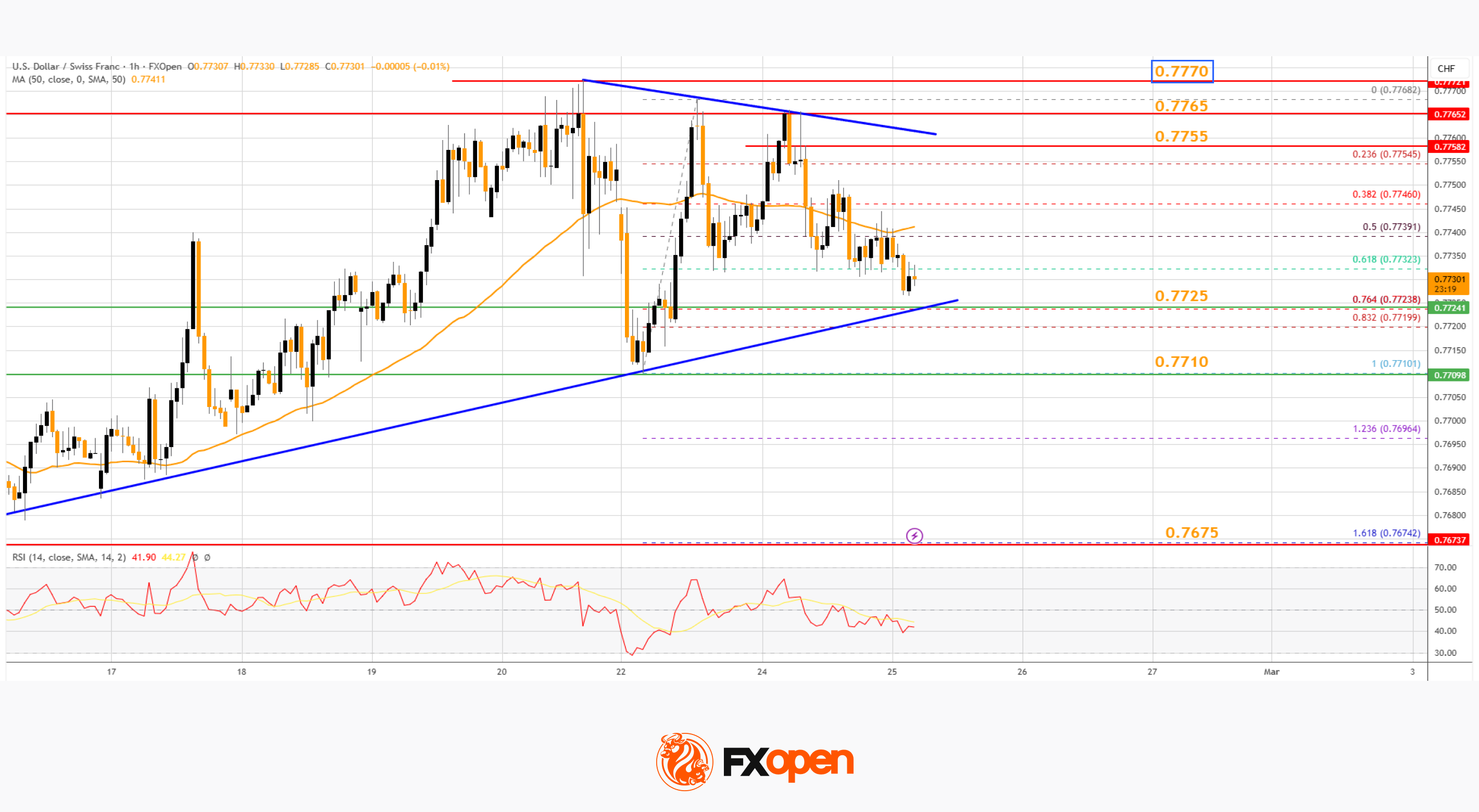
On the downside, immediate support on the USD/CHF chart is 0.7725 and the 76.4% Fib retracement. The first major area of interest could be 0.7710. Any more losses may possibly open the path for a move toward the 0.7675 level in the coming sessions.
On the upside, the pair is facing resistance near the 50-hour simple moving average at 0.7940. A clear move above 0.7740 could send the pair to 0.7755 and a major contracting triangle.
The next major barrier for the bulls might be 0.7765, above which the pair could test the 0.7770 level. If there is a clear break above 0.7770, the pair could start another increase. In the stated case, it could even surpass 0.7820.
Trade over 50 forex markets 24 hours a day with FXOpen. Take advantage of low commissions, deep liquidity, and spreads from 0.0 pips (additional fees may apply). Open your FXOpen account now or learn more about trading forex with FXOpen.
This article represents the opinion of the Companies operating under the FXOpen brand only. It is not to be construed as an offer, solicitation, or recommendation with respect to products and services provided by the Companies operating under the FXOpen brand, nor is it to be considered financial advice.

Bitcoin (CRYPTO: BTC) traded toward the $66,000 level as US equities regained ground, signaling renewed risk appetite after a softer spell for crypto markets. The move followed a broad market rally led by technology and AI names, with the Nasdaq posting modest gains and the S&P 500 edging higher. Observers said the resilience reflects a combination of regained liquidity, regulated access via spot BTC ETFs, and a return of domestic buyers. Data points include Tuesday’s net inflows of roughly $258 million into spot BTC funds and a positive swing in the Bitcoin Coinbase Premium Index, a sign that US demand is re-emerging after weeks of caution. Longer-term narratives around BTC’s role as a hedge and its place within diversified portfolios continue to persist even as near-term price moves respond to liquidity shifts.
Key takeaways
- Bitcoin climbed toward the $66,000 mark as US stock markets recovered, signaling renewed demand for BTC alongside broad market strength.
- The Bitcoin Coinbase Premium Index flipped to positive territory, aligning with notable ETF inflows into spot BTC products.
- BTC’s correlation with stocks and gold has weakened to levels not seen since 2022, though analysts expect reversion during risk-on cycles.
- Crypto-linked equities rose modestly, with Coinbase (NASDAQ: COIN) and MicroStrategy (NASDAQ: MSTR) posting gains as liquidity returned.
- On-chain and liquidity narratives point to BTC remaining a long-run inflation hedge and collateral narrative, even as near-term flows swing with risk appetite.
Tickers mentioned: $BTC, $COIN, $MSTR
Sentiment: Bullish
Price impact: Positive. The combination of BTC’s price uptick, ETF inflows and renewed US demand supports a constructive near-term bias.
Trading idea (Not Financial Advice): Hold. With market liquidity improving but macro risks still present, maintain balanced exposure and avoid aggressive positioning on a single catalyst.
Market context: The latest move ties BTC to broader market liquidity and risk sentiment, with renewed appetite for regulated access to crypto exposure through ETFs and a visible return of US buyers. The dynamic comes as traders reassess macro risk, liquidity conditions and the evolving landscape for crypto products in traditional financial channels.
Why it matters
The recent price action underscores a maturation in the crypto market’s relationship with traditional asset classes. After a period of decoupling or weaker cross-asset correlations, BTC has shown episodes of co-movement with equities when liquidity and risk appetite rise, while still maintaining a distinct narrative as a potential inflation hedge and a form of collateral. The inflows into spot BTC ETFs and the renewed US demand flagged by the Coinbase Premium Index together suggest that investors are seeking regulated, transparent routes to gain exposure to Bitcoin’s upside while managing counterparty risk.
Analysts framing the longer-term picture argue that the current dislocation between stocks, gold and BTC could revert to historical patterns during moments of liquidity expansion. Santiment recently highlighted that when BTC diverges significantly from stocks and gold, the longer-term bias tends to tilt toward upside for Bitcoin and altcoins once liquidity returns. While such reversion is not guaranteed, the historical tendency is to see BTC catch up with equities during growth phases, a view echoed by market observers who see liquidity as the primary driver of BTC’s near-term trajectory.
Additionally, industry voices emphasize that the present dynamics are less about Bitcoin’s price alone and more about market structure and availability of capital for crypto exposure. Darius Sit, founder and CIO of QCP Capital, has argued that the BTC-versus-gold narrative can obscure the true driver: liquidity. He notes that Bitcoin’s longer-term narrative as a hedge persists even as near-term price action can be influenced by hedging costs, leverage unwinds and shifts in risk tolerance. In this light, BTC’s resilience and the appetite for regulated access could reinforce its status as a mature asset class for institutional and strategic investors alike.
For investors tracking adoption, the trend remains one of broad institutional participation. Bitcoin’s maturation—spurred by greater adoption among financial institutions, banks, merchants and even some public-sector actors—continues to support a structural case for BTC beyond speculative trading. Cointelegraph has documented how adoption expanded in 2025, reinforcing the narrative of Bitcoin as a credible, long-term asset rather than a purely cyclical play. This backdrop helps explain why even as prices fluctuate, structural demand remains a persistent force behind BTC’s trajectory.
The near-term implications hinge on continued liquidity and the durability of US demand. If ETF inflows persist and the Coinbase Premium Index sustains its positive tilt, BTC could consolidate above key levels and test new resistance zones as market participants reassess risk. Conversely, any rolling back of liquidity or a shift back toward risk-off posture could curtail the immediate upside. Still, the framework described by market observers points to a scenario where BTC’s trajectory is increasingly tethered to market-wide liquidity dynamics rather than isolated crypto-specific catalysts.
“Historically, when an asset that is usually correlated breaks away in this dramatic fashion, it typically does not stay disconnected forever. In the long term, this unusual separation actually argues for significant upside for Bitcoin and altcoins.”
The ongoing discussion around BTC’s price discovery and its role within asset allocations remains central for traders and institutions alike. As adoption accelerates and regulated access grows, the market is likely to price in both the structural case for Bitcoin as a reserve-like asset and the cyclical demand tied to macro liquidity conditions. In this environment, a decisive shift in risk appetite or regulatory clarity could tilt BTC back toward a more pronounced correlation with risk-on cycles, potentially delivering meaningful upside if fundamentals align with liquidity conditions.
What to watch next
- Continued ETF inflows into spot BTC products—monitor next week’s data for signs of sustained demand.
- BTC trading near the $66k level and testing for persistence above the level as liquidity conditions evolve.
- Updates to the Bitcoin Coinbase Premium Index and other on-chain indicators for signs of durable US buying interest.
- Liquidity dynamics and leverage flows in risk assets that could influence BTC’s near-term trajectory.
- Regulatory or product-launch developments that could improve or constrain access to BTC exposure via regulated vehicles.
Sources & verification
- ETF inflows: Spot Bitcoin ETFs drew about $258 million in net inflows on Tuesday. (Source material references a Cointelegraph report on ETFs.)
- Coinbase Premium Index: Data showing the index turning positive, indicating renewed US demand. (Source: CoinGlass data referenced in the original article.)
- Correlation and on-chain analysis: Santiment’s notes on BTC’s correlation with stocks and gold. (Source: Santiment’s posts cited in the article.)
- Liquidity and market structure comments: Darius Sit of QCP Capital discussing liquidity as a primary driver for BTC movement. (Source: QCP Capital insights.)
- Adoption narrative: BTC adoption growth among institutions and broad market participants. (Source: Cointelegraph’s reporting on Bitcoin adoption.)
Bitcoin price action and institutional demand: toward 66k, ETF inflows revive risk appetite
Bitcoin (CRYPTO: BTC) moved back toward the $66,000 threshold as a renewed bid for risk assets underpinned the move, aligning BTC with the day’s broader market strength in U.S. equities. The rally followed a period of softness earlier in the week and came as investors rotated into higher-yielding assets and defensive hedges alike, suggesting a cautious but constructive stance among market participants. The move above $66k is notable given the backdrop of mixed macro signals and ongoing debates about liquidity, making BTC a focal point for traders watching how crypto assets interact with traditional markets.
Institutional demand appeared to re-emerge, with spot BTC exchange-traded products and related vehicles drawing renewed attention. Reports indicated around $258 million in net inflows flowed into spot BTC ETFs on Tuesday, signaling that regulated pathways for price exposure are gaining traction again as investors seek transparent access to Bitcoin’s upside potential. The inflows also support a broader comeback in regulated crypto products that had faced headwinds in the prior quarters.
Meanwhile, the Coinbase Premium Index, a gauge of price gaps between major exchanges, shifted into positive territory for the first time since Jan. 15, implying that buyers in the United States were returning to the market. Market observers cautioned that the premium’s durability matters; a sustained positive reading would indicate ongoing demand, whereas a quick reversal could signal exhaustion and prompt a retreat. The index’s turn to positive aligns with the broader risk-on posture and with spot-btc inflows, but it does not guarantee a sustained rally on its own.
In equities, tech-focused names continued to lead, with the Nasdaq rising around 1% on the day and the S&P 500 gaining roughly 0.7%. The general market bid helped ease risk-off pressure on crypto, enabling BTC to recover some of the losses incurred during prior sessions. Crypto-related equities also benefited, with Coinbase (NASDAQ: COIN) edging higher and MicroStrategy (NASDAQ: MSTR) posting modest gains as investors recalibrated exposure to the broader technology and financial services ecosystem. The cross-asset bid reinforced the view that liquidity and risk appetite largely drive BTC’s near-term trajectory rather than a pure crypto-specific dynamic.
From a broader perspective, BTC’s recent decoupling from the stock and gold markets has drawn attention from researchers and traders. Data from on-chain analytics provider Santiment shows the daily correlation between BTC and the S&P 500 slipping toward its weakest levels since the FTX era’s upheavals, while correlation with gold has also cooled. The firm’s analysts observed that when such a dramatic separation occurs, the longer-term bias tends to tilt toward upside for Bitcoin and altcoins once liquidity returns. In practical terms, this could mean more upside for BTC if liquidity conditions permit, even if macro headwinds persist in the near term. Cointelegraph has documented Bitcoin adoption as a booming trend, reinforcing the narrative of a maturing asset class with broader institutional resonance.
The ongoing discussion around BTC’s price discovery and its role within asset allocations remains central for traders and institutions alike. As adoption accelerates and regulated access grows, the market is likely to price in both the structural case for Bitcoin as a reserve-like asset and the cyclical demand tied to macro liquidity conditions. In this environment, a decisive shift in risk appetite or regulatory clarity could tilt BTC back toward a more pronounced correlation with risk-on cycles, potentially delivering meaningful upside if fundamentals align with liquidity conditions.
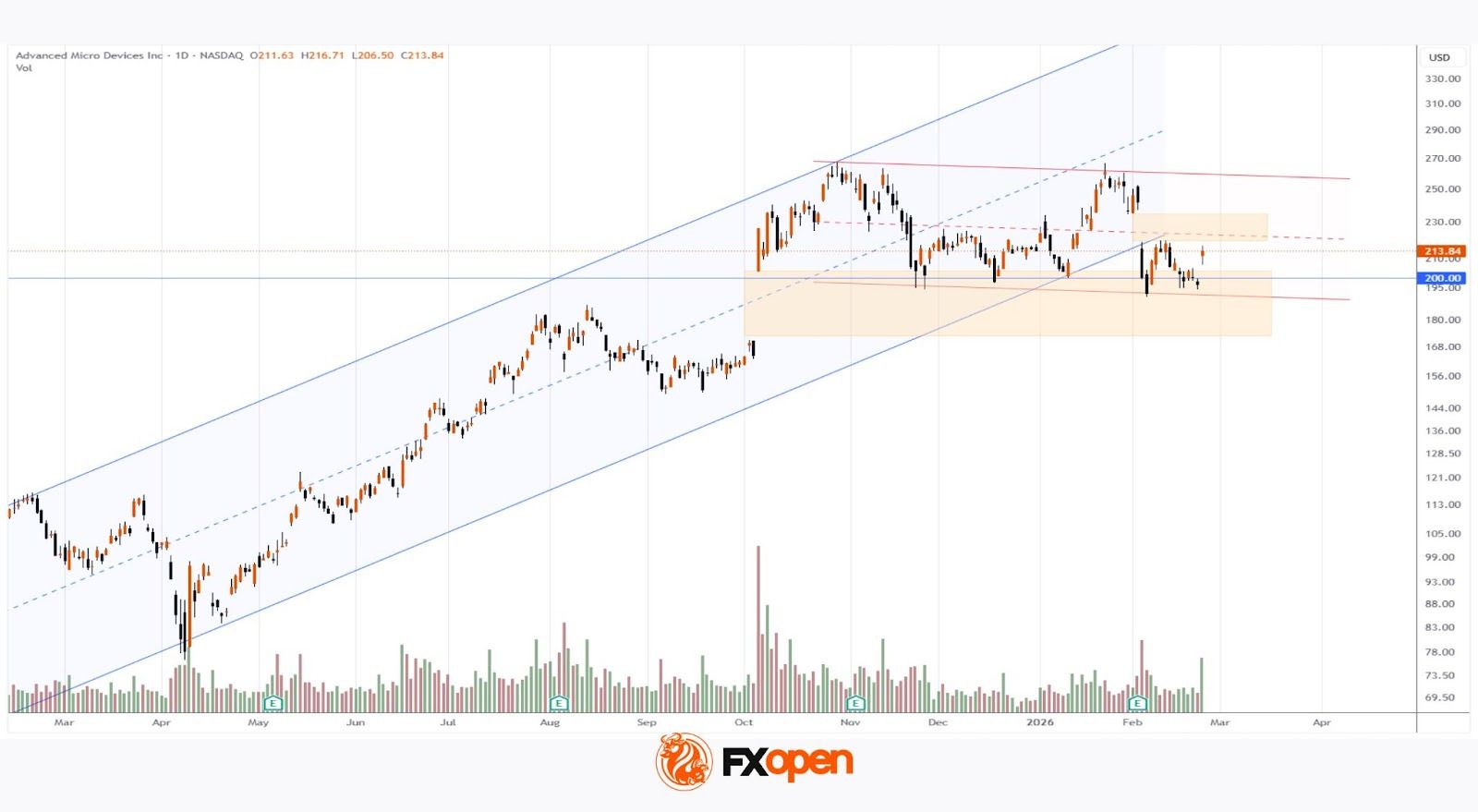
Yesterday, it was reported that Advanced Micro Devices (AMD) has expanded its collaboration with Meta Platforms. The companies struck an agreement under which:
→ Meta will purchase AMD equipment with a total capacity of 6 gigawatts for its AI infrastructure. Deliveries are scheduled to begin in the second half of 2026.
→ AMD’s portfolio could include around 160 million META shares, representing roughly 10% of the company.
The market interpreted the news as a signal that AMD is successfully establishing itself as the second major chip supplier to tech giants, challenging Nvidia’s monopoly (incidentally, the market leader is due to release its quarterly report today).
Following yesterday’s trading, AMD shares jumped more than 8%, closing near the highs on rising volume—a bullish sign. This partially offset the decline seen after the early-February earnings report, which was influenced by falling margins, supply chain issues, concerns over deliveries to China, and other factors.
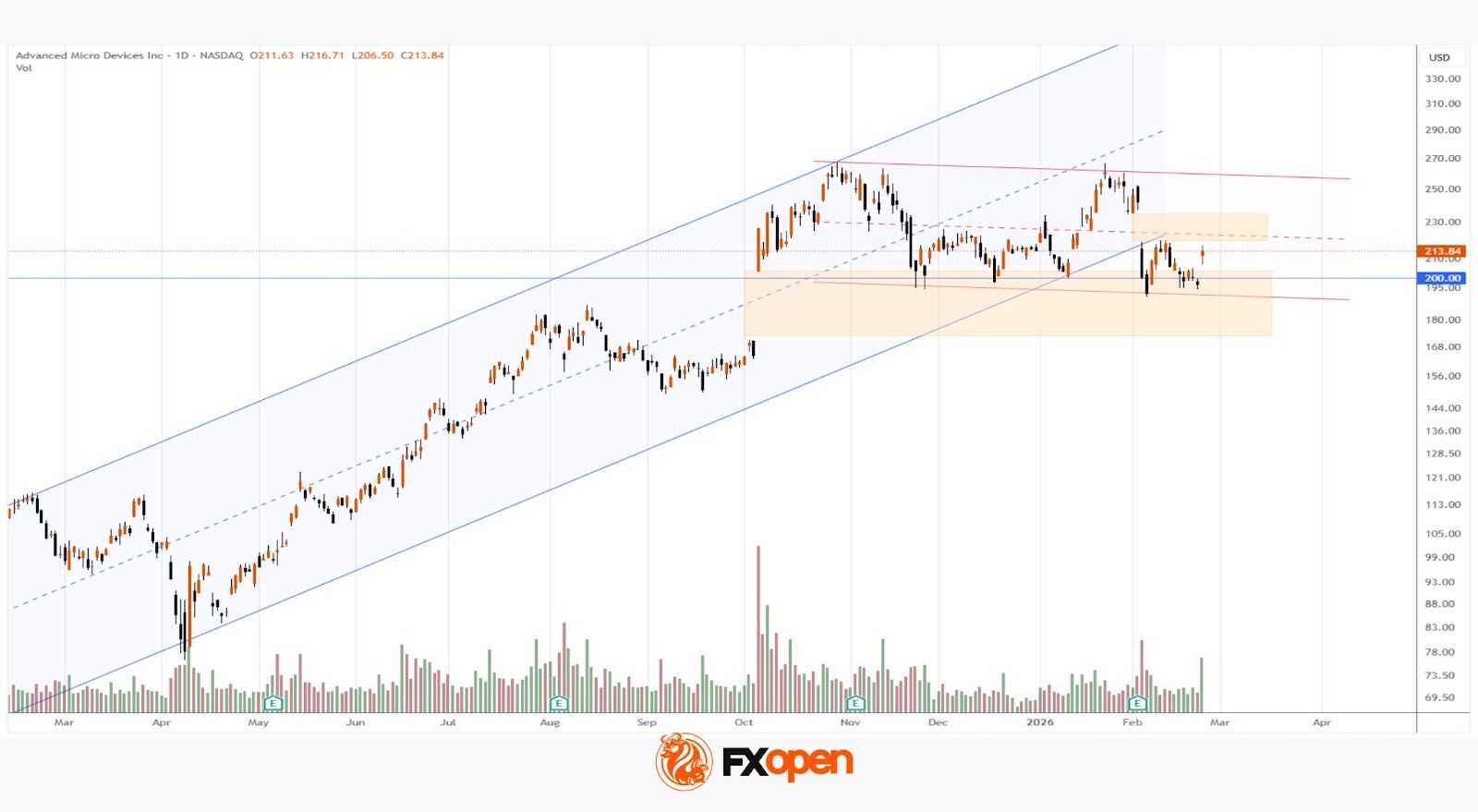
Technical Analysis of AMD Shares
Analysis of AMD’s chart indicates that the ascending channel (shown in blue), which guided price growth throughout 2025, is losing relevance.
Currently, AMD’s shares are trapped between two gaps:
→ Support is provided by the bullish gap from 6 October, which includes the psychological $200 level, offering additional support for buyers.
→ Resistance comes from the bearish gap of 4 February, which aligns with the median of the descending channel (shown in red).
It is reasonable to suggest that yesterday’s positive news offset the earlier negative sentiment, and in the short term, AMD shares may stabilise between the areas of the identified gaps.
Buy and sell stocks of the world’s biggest publicly-listed companies with CFDs on FXOpen’s trading platform. Open your FXOpen account now or learn more about trading share CFDs with FXOpen.
This article represents the opinion of the Companies operating under the FXOpen brand only. It is not to be construed as an offer, solicitation, or recommendation with respect to products and services provided by the Companies operating under the FXOpen brand, nor is it to be considered financial advice.

Student loans aren’t the only thing that grads have been missold

10 NFL Combine Sleepers Ready to Boost Their Draft Stock

Astronomers Uncover a Gigamaser, the Strongest Known Microwave Laser in the Universe


-

 Video5 days ago
XRP News: XRP Just Entered a New Phase (Almost Nobody Noticed)
-

 Fashion5 days ago
Weekend Open Thread: Boden – Corporette.com
-

 Politics3 days ago
Baftas 2026: Awards Nominations, Presenters And Performers
-

 Entertainment7 days ago
Kunal Nayyar’s Secret Acts Of Kindness Sparks Online Discussion
-

 Sports2 days ago
Women’s college basketball rankings: Iowa reenters top 10, Auriemma makes history
-

 Politics2 days ago
Nick Reiner Enters Plea In Deaths Of Parents Rob And Michele
-
 Sports6 days ago
Clearing the boundary, crossing into history: J&K end 67-year wait, enter maiden Ranji Trophy final | Cricket News
-

 Crypto World1 day ago
XRP price enters “dead zone” as Binance leverage hits lows
-

 Business3 days ago
Mattel’s American Girl brand turns 40, dolls enter a new era
-

 Business3 days ago
Law enforcement kills armed man seeking to enter Trump’s Mar-a-Lago resort, officials say
-

 Entertainment7 days ago
Dolores Catania Blasts Rob Rausch For Turning On ‘Housewives’ On ‘Traitors’
-

 Tech3 days ago
Anthropic-Backed Group Enters NY-12 AI PAC Fight
-
 NewsBeat2 days ago
‘Hourly’ method from gastroenterologist ‘helps reduce air travel bloating’
-

 NewsBeat3 days ago
Armed man killed after entering secure perimeter of Mar-a-Lago, Secret Service says
-

 Tech19 hours ago
Unsurprisingly, Apple's board gets what it wants in 2026 shareholder meeting
-

 Politics3 days ago
Maine has a long track record of electing moderates. Enter Graham Platner.
-

 Crypto World7 days ago
WLFI Crypto Surges Toward $0.12 as Whale Buys $2.75M Before Trump-Linked Forum
-
 NewsBeat14 hours ago
Police latest as search for missing woman enters day nine
-

 Crypto World6 days ago
83% of Altcoins Enter Bear Trend as Liquidity Crunch Tightens Grip on Crypto Market
-
 Sports2 days ago
2026 NFL mock draft: WRs fly off the board in first round entering combine week