Connect with us

NewsBeat

22 Kids and Counting star admits ‘it’s unbearable’ amid wait for major news

Published

on

Manchester Evening News

The Radford family faced an anxious wait as 16-year-old Max prepares for a milestone in the upcoming episode of the Channel 5 show

The Radfords face an “unbearable” wait as Max prepares to receive his GCSE results in the upcoming episode of TV favourite 22 Kids and Counting. Mum and dad Noel and Sue share their lives and the lives of their 22 children in the hit Channel 5 show, and the instalment set to air on Sunday (March 1) will document a huge milestone as 16-year-old son Max waits to see if he has passed his exams.

A teaser clip has been posted on Instagram showed the family’s anxious wait. With no idea how it is going to go, the Radfords prepare for a possible celebration, reports the Mirror.

Noel admits: “Maths and science, I think he’ll do OK, it’s just the English. If I’m honest, I’m not convinced he’s going to pass his English. He did put some effort in towards the end, but he’s had a lot of struggles along the way. The odds are properly stacked against him.”

Advertisement

Max is said to be “on tenterhooks” as he waits to hear how he’s done. “You always want the best for your kids, but sometimes some things really tie you in knots,” said Sue.

“And the thing is, if Max doesn’t get his English resƒult that he needs, I don’t know what he’s going to do,” said Noel. “This is unbearable,” Sue added, as Noel agreed: “I don’t know who it’s worse for, Max or us.”

Max is then seen announcing that he has received the email containing his results. He then goes off to read his message privately before sharing the news with his parents and siblings.

Advertisement

As time passes and Max still fails to appear, they start to look worried and Sue grows concerned that it’s “not looking good.” The family even discuss whether they ought to take the decorations down.

Noel says: “If he hasn’t, I think we all need to be there for him. I think there’s a bit of support, because it obviously means a lot.”

However, the teenager then strides into the room and announces: “I passed!” He reveals that he achieved impressive marks, with particularly strong results in science and maths.

Advertisement

“As parents, we are extremely proud of Max,” said mum Sue, who declared it was “absolutely amazing” news. “Now it’s the sky’s the limit,” agreed dad Noel.

22 Kids and Counting airs at 8pm on Channel 5 on Sunday, March 1

For the latest showbiz, TV, movie and streaming news, go to the new **Everything Gossip** website.

Ensure our latest headlines always appear at the top of your Google Search by making us a Preferred Source.** Click here to activate**** or add us as your Preferred Source in your Google search settings.**


Advertisement

Source link

Continue Reading
Click to comment

Leave a Reply

Your email address will not be published. Required fields are marked *

NewsBeat

What will urban living look like in the future?

Published

on

What will urban living look like in the future?

A new vision for urban living is taking shape, driven by an urgent need to make our cities more liveable, sustainable and resilient. Here’s what the metropolitan areas of tomorrow will look like

Wooden towers rise above the tree canopy, their facades alive with plants and shimmering solar cladding. The hum of traffic is gone. Instead, a quiet feet of autonomous robovans glides along dedicated lanes, linking neighbourhoods in smooth, predictable loops.

It’s a warm summer afternoon in 2037, and shoppers wander under covered walkways inspired by the porticoes of Bologna. Woodland weaves through housing districts, workplaces and civic squares. Streets smell of pine after rain. The skyline is timber and green rather than glass and glare.

Advertisement

Every building generates its own energy through integrated solar and micro wind systems, and collects and recycles water. Lighting, heating and ventilation respond automatically to occupancy and weather, guided by embedded IoT (Internet of Things) sensors. Temperature, humidity, air quality and movement are monitored constantly, optimising everything without residents lifting a finger.

Solutions every Saturday
Uplift your inbox with our weekly newsletter. Positive News editors select the week’s top stories of progress, bringing you the essential briefing about what’s going right.
Sign up

For the one million residents who have called Forest City 1 home since it opened in 2032, this is normal life. The young professionals priced out of the housing market and bored of identikit commuter estates found opportunities and something fresh in this trailblazing city. A Community Land Trust model ensured affordability, separating land ownership from property ownership, giving local residents control over how their community’s assets are managed. The 350,000 homes that have been built here softened prices nationally, pulling the average UK house price down by 4%.

New energy systems built around solar, small modular reactors and advanced district loops give households energy security. Waste, utilities and much of the transport infrastructure run below ground – all planned and buried before the first flagstone was laid. AI quietly manages water, traffic and energy flows, balancing them across this smart city.

Advertisement

This may sound like science fiction, but Forest City 1 is not a pipedream. It could be built in years not decades. The concept comes from Joe Reeve, founder of the non-partisan political movement Looking for Growth (LFG), and former journalist Shiv Malik. Their vision is anchored in a real site: avast plot on the Cambridgeshire-Suffolk border near Newmarket and Haverhill. The project is gathering support from investors, central government and even local residents.

Artist impression of what Forest City 1 might look like. Image: Forest City 1

Advertisement

Cambridge has the highest density of talent inEurope, and its proximity to London and to Stansted airport makes it an ideal location for the UK’s first new city in more than half a century. “We want a brand new city that is a place that people want to live in, not just commute to and from,” Reeve tells Positive News, from his home in London.

“Cambridge is criminally constrained from growing due to the green belt, and businesses are crying out for more lab space and places for workers to live. We chose this location because half the land is owned by three Lords and a Sheik.”

Private landowners without generational attachments, he explains, are more open to large-scale change. The population density is extremely low. Just 8,000 people live across the site’s 45,000 acres, much of it currently used as farmland.

Advertisement

The model sees new energy systems built around solar, small modular reactors and advanced district loops giving households energy security. Image: Forest City 1

Reeve describes the UK planning system as one that “sucks”. In his view, the current pattern produces ugly new build estates around beautiful villages, without the supporting infrastructure. “Trains and roads get busier but nothing gets upgraded,” he says.

That angers existing residents, disappoints new ones and harms wildlife and local ecology. Meanwhile, local businesses see little benefit because commuters continue to shop and socialise in London. And small-scale development does nothing meaningful for national affordability.

Advertisement

Forest City 1 allocates 12,000 acres – more than a quarter of its total site – to forest alone. Biodiversity would leap thanks to monocultural farmland being replaced with a natural environment that includes plans to create one of the largest redwood forests in the world. But above all, Reeve says, it would create a place where people genuinely want to live.

AI manages water, traffic and energy flows across the smart city

Momentum is real. Investors are circling, government interest is rising, and Reeve is bullish. “We want shovels in the ground before the end of this government,” he says.

But critics such as Jon Reeds, of the campaign group Smart Growth UK, argues that the location of it is wrong. “If they could find a large brownfield site close to major conurbations, so it had good public transport and could make use of existing infrastructure it could be a possibility,” he says. But building on agricultural land, when the UK only produces 60% of what it consumes domestically, is not the right answer, he suggests. Reeds explains that food and water security during times of climate change and global insecurity means we should be expanding our domestic food production land rather than building on it.

“It is fascinating that their proposal uses ‘green’ arguments for building on green land,” says Prof Tony Travers, an expert in local government at the London School of Economics. However, he says “the need for new homes is such that any idea is well worth considering”.

Advertisement

NEOM’s The Line has been put on hold indefinitely. Image: NEOM, The Line

New cities are seductive, but they bring their own complications. NEOM’s The Line in Saudi Arabia is the most extreme example: a 100-mile long, glass-fronted, car-free city initially intended to house 9m people sounded like something out of a sci-fi movie. Although construction began in 2021 promising a fully sustainable, fully digital, fully smart city, the project has been cancelled.

Advertisement

Building a hyper-dense megacity in one of the planet’s hottest, driest regions proved to be extraordinarily complex. Water must be brought in from the Red Sea through colossal desalination plants. Vertical farms must be powered to grow food where nothing grows naturally. The ventilation, cooling and waste systems required for millions of people pressed into a narrow corridor are vast. Now, with delays and budget overruns stacking up, the project has been shelved.

Smartly repurposing existing urban spaces

For most of the world, the future will not be built from scratch. It will emerge from transforming the cities we already inhabit. The shift is already underway.

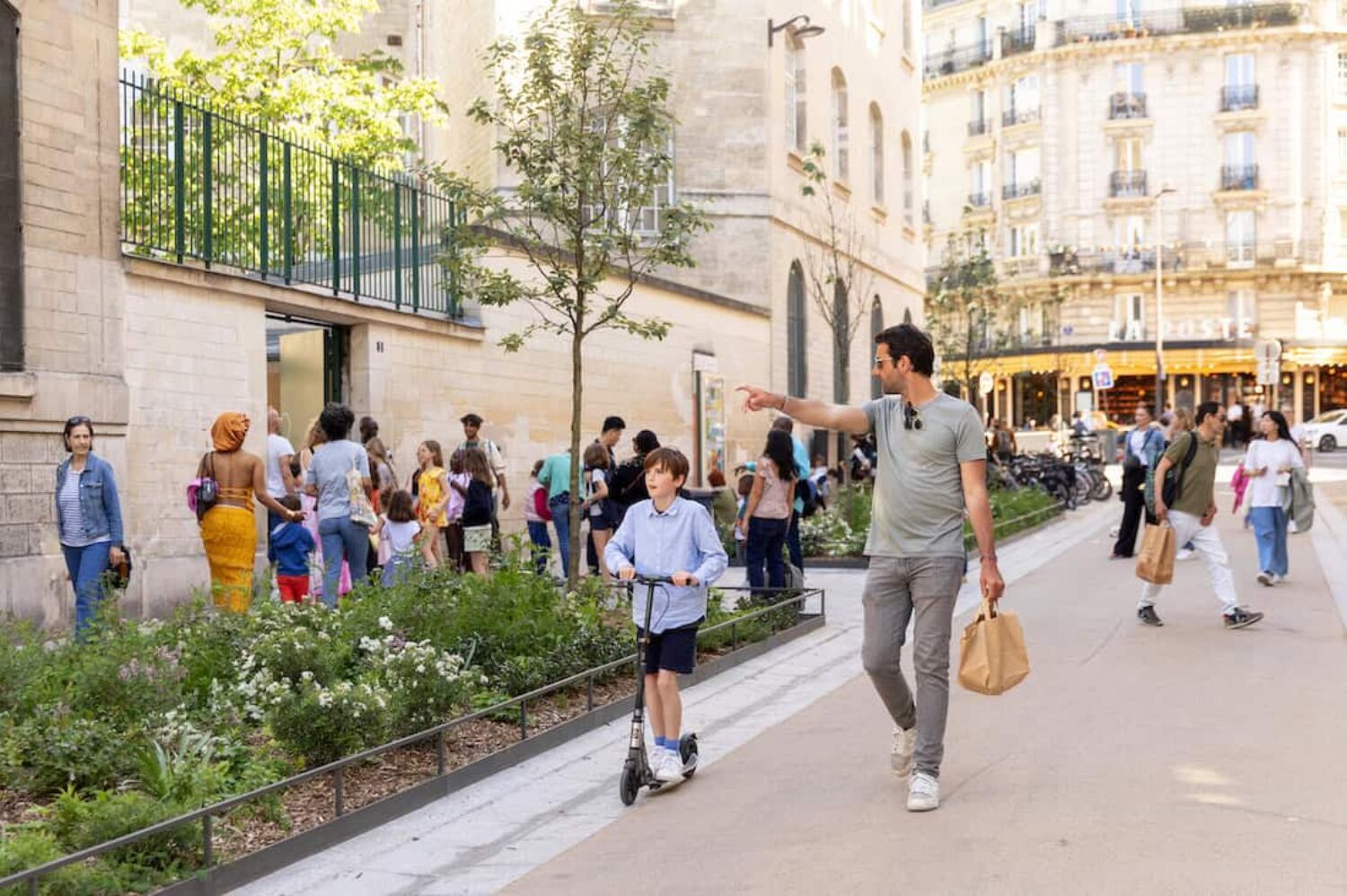
On Rue de l’Arbalete in Paris, the first thing you notice is the quiet. Gone are the horns and fumes that once defined this narrow street. Now birdsong echoes between buildings, children cycle through planters and benches, and parents chat in dappled shade. A few years ago, this was a choked through-road. Today, it feels like a village square.

Advertisement

Paris has been a global leader in cleaning up and reclaiming its urban spaces. Not only has the Seine become swimmable again thanks to a major clean-up, but more than 300 ‘school streets’ have been pedestrianised and planted since 2020. The results – cleaner air, safer routes, more exercise for children – have landed well with residents. “School streets are a unique way to reclaim public space, and the health and environmental effects are well established,” Mathieu Chassignet, an engineer in sustainable mobility at the French environmental agency ADEME, tells Positive News.

School streets mean cleaner air, safer routes and more exercise for children

Voters agreed. In 2024 they backed the expansion of the model to another 500 streets. Other cities have taken note. “Paris shows how transformative it can be when cities prioritise youth,” says Sabina Sethi Unni, an urban planner at Open Plans, an advocacy group promoting the implementation of ‘school streets’ in New York.

Vienna now has around 140 parklets, low-cost communal areas turning parking bays into mini public squares. Stockholm doubled its summer pedestrian streets in 2018, opening space to cafes, public seating and art. Oslo and Copenhagen have pulled cars out of their centres too. Whilst initially business owners fear removing cars from city centres will dent profits the opposite proves to be true time and again. London, prompted by Covid, witnessed the transformation of nightlife area Soho into an open-air district. Although Soho didn’t remain pedestrianised it inspired many other parts of the capital to become low-traffic neighbourhoods– no longer prioritising cars – and the city’s famous Oxford Street will become fully pedestrianised after overwhelming public and business support.

Advertisement

More than 300 school streets have been created in Paris, removing cars, planting trees and reclaiming public spaces outside schools. Image: Joséphine Brueder/Ville de Paris

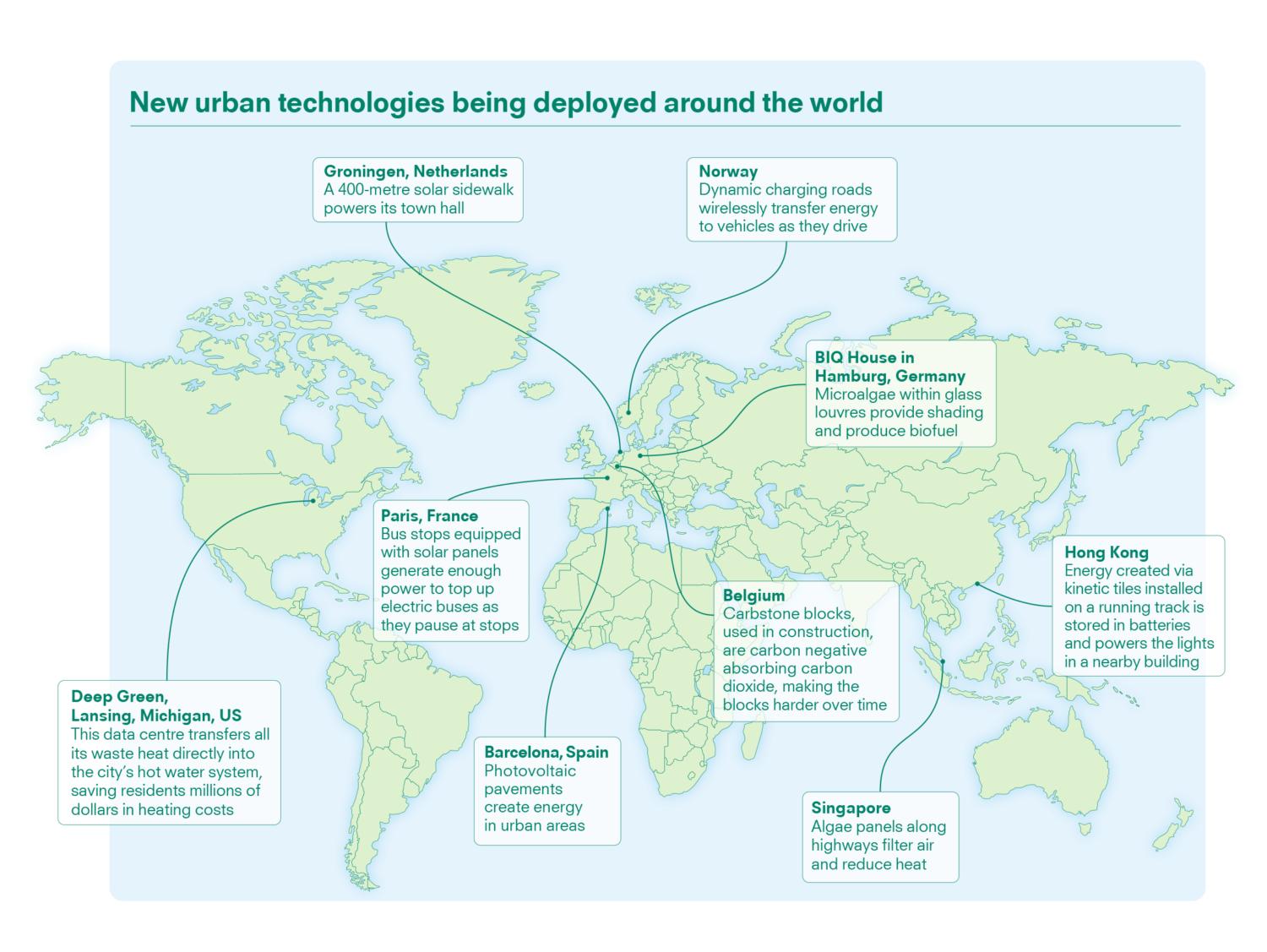
City evolution is not only about surface-level change. It is about the systems that keep everything running. Heat that once spewed wastefully from energy-hungry data centres is now captured and channelled into district heating. Public transport systems are electrifying at pace with dynamic charging roads, which wirelessly transfer energy to vehicles as they drive.

Solar-embedded infrastructure is moving from experiment to norm as the buildings of the future will not simply consume fewer resources they will generate and recycle them. Carbon-eating concrete and living-algae walls remove carbon from the air, while vertical forests and vertical farms clean air, regulate temperatures and, most importantly, produce much needed food.

Advertisement

Get spongy

None of this matters if cities cannot cope with water. By 2050, the number of properties in England exposed to fooding is projected to rise from 6.3m to 8m. Flash foods could increase by up to 66%. A climate-driven surge in short, violent rainstorms, combined with decades of paving over natural ground, has turned many cities into hard-shelled drainage machines. That model is failing. A new one is emerging in its place.

“Climate change brings us more extreme weather, and in this case, more extreme rain events within a very short period of time,” says Dutch architect Dirk van Peijpe of De Urbanisten. “We need to be ready for that kind of cloudburst that isn’t just increasing the capacity of our technical infrastructures, as so many cities have.”

Instead of pouring more money into deeper pipes and bigger sewers that will still be overwhelmed, van Peijpe argues for a shift in mindset. “Spend the same sums on creating a public space that can temporarily hold that rainwater,” he says. Because the water never mixes with sewage, it remains clean and usable.

Advertisement

It is combining water management in an urban environment with improving public spaces

“The rain water that we harvest from roofs and parking places and streets and squares around them… can be temporarily stored in this public space, and then, after 24 hours, the water square is emptied into the natural aquifers, in the soil infiltration, and you can actively use it again for other purposes,” he says.

Rotterdam has taken this thinking further than almost anywhere. The old port city, long accustomed to living with water rather than fighting it, has been getting spongier year by year. Across its neighbourhoods, hundreds of new water-absorbing parks, basins and nature-based defences have been completed or are underway. They look like everyday public spaces: skate bowls, sunken lawns, stepped amphitheatres, bright playgrounds. But they have a double life. In a cloudburst, they quietly swallow thousands of cubic metres of water. Some of the largest can hold around 1,700 cubic metres before slowly releasing it back into the ground, boosting groundwater rather than flushing it out to sea.

Van Peijpe has been central to this reimagining of the city. One of De Urbanisten’s flagship projects sits a short walk from the emerging Hofbogen park. “The water square is the first in the world that combined water storage with designing a fine public space,” he says. “It is combining water management in an urban environment with improving public spaces.”

In Rotterdam, the rain captured in the square is filtered, dropped into a closed aquifer system beneath the park, then used to feed vegetation and power fountains and streams. The city gets a public realm feature on dry days and a protective basin on wet ones.

Advertisement

That experimentation continues above street level. The disused Hofplein railway line is becoming an elevated linear park reminiscent of New York’s High Line. Here too, the water cycles through the network. Rain gathered on the roof level is cleaned and channelled back down into an aquifer to create a closed system for Hofbogen park. “The water system feeds the vegetation in the park with rainwater so we don’t need to waste drinking water for the plants,” van Peijpe says.

China – the pioneer in creating sponge cities– has rolled out projects nationwide, integrating wetlands, permeable pavements and green corridors. And New York is also taking note. The Department of Environmental Protection has begun installing seven miles of permeable pavement along curbs in the city’s Borough Park district, to allow water to seep rather than surge during storms.

Cities are evolving fast and are being forced to respond to the same pressures: climate, population, inequality, affordability and the need for healthier lives. It may well be that all new cities are built among forests with timber skylines and streets shaded by trees. Where food is grown vertically, and transport is silent and clean.

Advertisement

Whether it’s retrofitting the medieval cities of Europe with integrated smart tech or building a new city from the ground up, the future city is not a fantasy. It is already under construction. The only question is how quickly we choose to build it.

Additional reporting Alice Kantor and Gavin Haines

Illustration by Andrea Manzati

Advertisement

Be part of the solution

At Positive News, we’re not chasing clicks or profits for media moguls – we’re here to serve you and have a positive social impact. We can’t do this unless enough people like you choose to support our journalism.

Give once from just £1, or join 1,800+ others who contribute an average of £3 or more per month. Together, we can build a healthier form of media – one that focuses on solutions, progress and possibilities, and empowers people to create positive change.

Support Positive News

Advertisement

Source link

Continue Reading

NewsBeat

First upgraded Voyager train returns to CrossCountry

Published

on

First upgraded Voyager train returns to CrossCountry

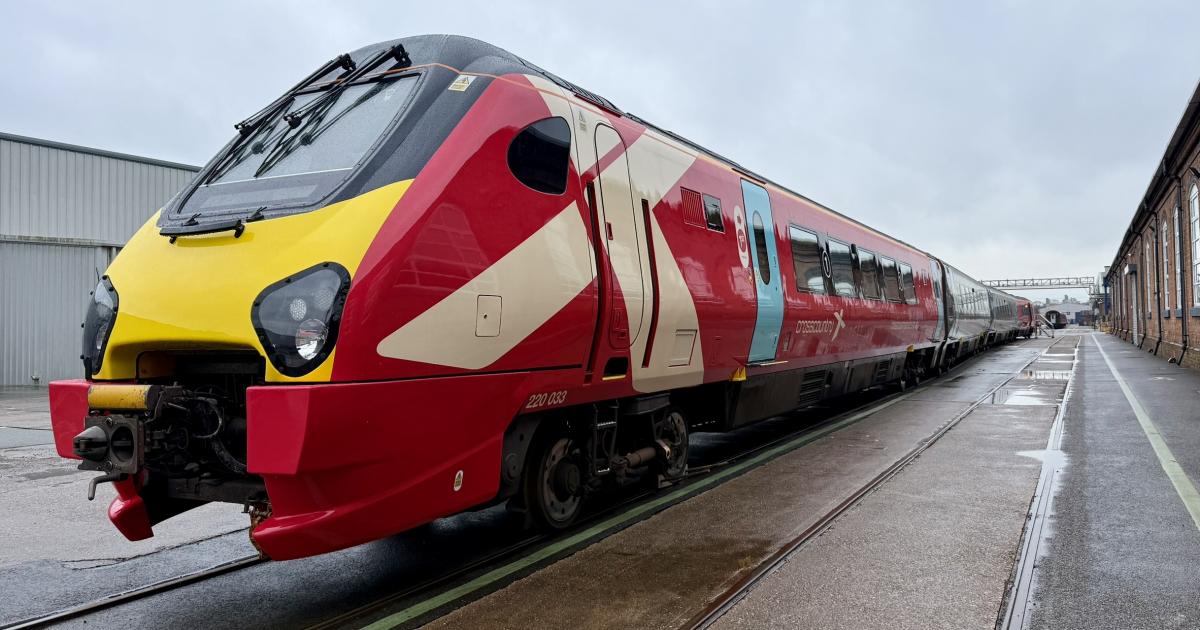
Long-distance train operator CrossCountry has welcomed passengers onboard its first refurbished Voyager train – the first in a £75 million investment programme to modernise the fleet.

The first refurbished unit ran between Birmingham and Newcastle, while the new‑look trains will appear on routes serving York as the roll‑out continues over the next two years.


Recommended reads:


After running to Birmingham New Street, the service will be open to passengers travelling on the 14:28 from Birmingham to Newcastle and the 18:33 from Newcastle to Birmingham.

Advertisement

Alongside the improvements to its Voyager fleet, CrossCountry’s Class 170 Turbostar fleet is continuing another refresh.

Several new-look trains are now serving routes between Birmingham, Leicester and Stansted Airport, and Cardiff, Birmingham and Nottingham.

The relaunch marks a major milestone in the programme, and the upgraded trains are now entering service every few weeks.

The upgrade programme includes new seating with more legroom, improved storage, power at every seat, refurbished toilets, new carpets and artwork, LED lighting and enhanced CCTV and passenger‑counting systems.

Advertisement

CrossCountry’s managing director, Shiona Rolfe, said the Voyager fleet had been “a backbone of Britain’s long‑distance rail network for more than two decades”.

“Giving them this new lease of life will ensure they deliver a complete transformation in journey experience for our passengers,” she said.

The Voyagers were first introduced in 2000 and helped double passenger numbers on the network during the following decade. The new programme aims to extend their lifespan while raising standards for comfort and accessibility.

The newly-refurbished Voyager train will enter normal passenger service on CrossCountry’s long-distance routes from Birmingham towards Manchester, Bristol and the South West, Reading and Bournemouth, and Yorkshire, the North East and Scotland.

Advertisement

Source link

Continue Reading

NewsBeat

Council that runs ‘tight ship’ freezes council tax for 13th year

Published

on

Cambridgeshire Live

The council tax will be the same as it was in 2013 and 2014

A council is freezing its council tax for a 13th year in a row. It’s getting to the time of year where councils discuss council tax rates for the upcoming financial year.

Advertisement

East Cambridgeshire District Council has announced it is freezing its council tax in 2026/27, which will be for the 13th year running. For residents, this means council tax they pay will remain at £142.14 for an average band D property, the same as it was in 2013/14.

Leader of the council, Councillor Anna Bailey said: “We put our success down to an innovative and prudent approach to financing. We run a tight ship at the district council.

“Working with our subsidiary companies – East Cambs Street Scene and East Cambs Trading company – we are able to provide internal borrowing for schemes such as the leisure centre, waste and recycling services and affordable housing.

“This means we are able to avoid external borrowing costs which afflict many other councils.” The council tax has been frozen because the council’s budget is balanced.

Advertisement

As well as the freeze, the council’s budget takes into account an allocation of £50,000. This is set aside as match funding to support parish councils for neighbourhood plans, as agreed at full council in October 2025.

Cllr Bailey added: “This balanced budget places us in an enviable position of our peers, allowing us to continue to provide high quality services to our residents. But significant change is coming, which in future is likely to impact how much residents pay for their council tax.

“Under local government reorganisation existing district and county councils are being replaced with simpler and more efficient unitary authorities. Four proposals have been put forward to national government by different councils across the region.

“In East Cambridgeshire, the district council, together with Cambridge City and South Cambridgeshire councils, is supporting option B, which would see East Cambridgeshire become part of a new unitary council with Huntingdonshire, Fenland and Peterborough.

Advertisement

“I encourage you to find out more on the council website and have your say by completing the government’s consultation which runs until March 26. A final decision will be made by the central government this summer, with the new councils running from April 2028. Whatever option it chooses, we’ll ensure we continue to stand up for residents and deliver excellent services.”

Source link

Continue Reading

NewsBeat

Investigation after suspected theft at Boots in Bolton

Published

on

Investigation after suspected theft at Boots in Bolton

Police say they believe as much as £836 worth of skincare products was taken from the branch of Boots at Trinity Street retail park in the town centre.

Officers have now released an image of two people, a man and a woman, that they want to speak to in connection with their investigation.

A Greater Manchester Police spokesperson said: “We are appealing for information following reports of a theft from Boots on Trinity Street in Bolton.

These two were caught on CCTV (Image: GMP)

“The incident occurred on Friday 13 February at around 3pm.

Advertisement

“It is believed that approximately £826 worth of skincare products were taken from the store.

Officers would like to speak with these people as they believe they may be able to help with their enquiries.”

The image shared by police appears to show a man and a woman inside the branch of Boots, both with faces uncovered and wearing mostly dark coloured clothing.

Anyone with any further information about the suspected theft can call police on 101 quoting log 1763 of 14/02/26.

Advertisement

Alternatively, members of the public can call independent charity Crimestoppers anonymously on 0800 555 111.

Source link

Advertisement
Continue Reading

NewsBeat

‘Disgraceful’ M&S exit leaves city angry and sad but not surprised

Published

on

Wales Online

The store has been a mainstay of Swansea city centre for decades, but M&S has confirmed it will close later this year with 92 jobs now at risk

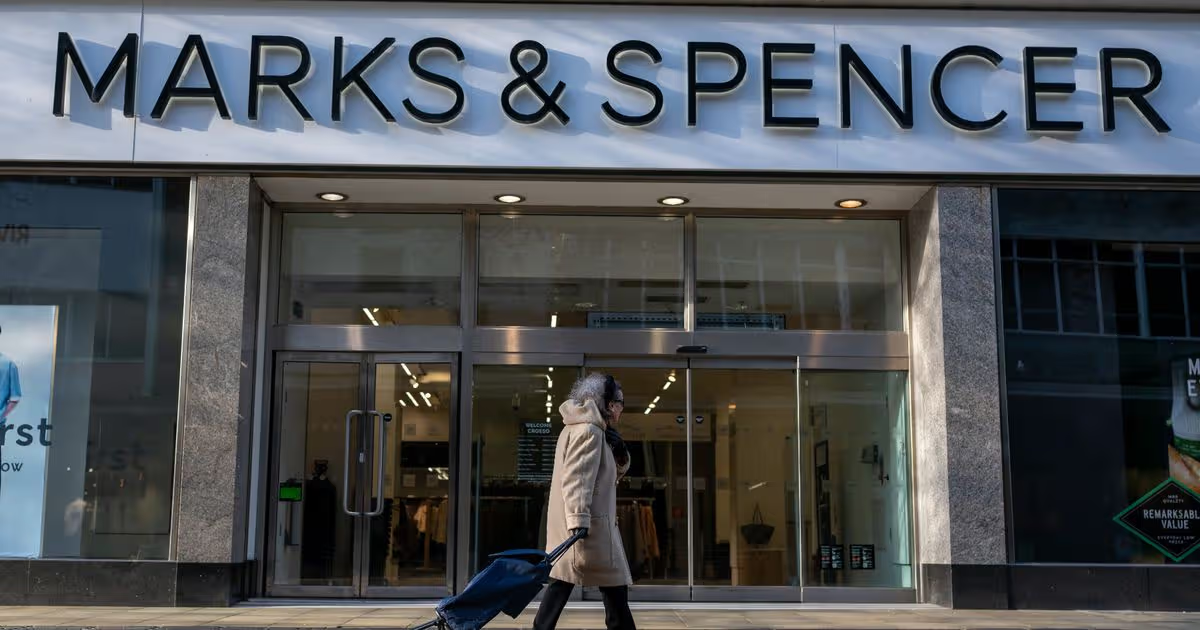
People have been horrified to hear Swansea is set to lose one of its best known stores after M&S confirmed it will close its Oxford Street branch next year.

The Marks and Spencer store, a long standing fixture in the heart of the city centre, has struggled financially and will shut following what the company has described as sustained underperformance. Around 92 staff were told of the decision on Tuesday, February 24.

Advertisement

A consultation is now underway to explore possible roles at other M&S locations, with no confirmation yet on redundancies. The exact closing date has not been set but is expected in 2026. Ensure our latest news and sport headlines always appear at the top of your Google Search by making us a Preferred Source. Click here to activate or add us as Preferred Source in your Google search settings

Richard Owen, M&S regional manager, said changing shopping habits and a nationwide store rotation programme were behind the move.

He added that the building faced operational challenges requiring significant investment and that the business needed to focus on long term growth. While acknowledging the store’s decades long presence in Swansea, he said it was no longer viable in its current form.

M&S has not ruled out opening a new full line store elsewhere in the city and said it would continue serving customers through nearby branches and online while it searched for a suitable site. Never miss a Swansea story by signing up to our newsletter here

Advertisement

Swansea Council described the news as extremely disappointing for staff and shoppers. A spokesperson said the authority had spent years trying to keep M&S in its current location and would continue working to secure a new site in the city centre.

It stressed that the decision formed part of M&S’s wider national strategy, which had seen around 90 historic stores close, and was not a reflection on Swansea as a retail destination.

The closure is likely to reignite concerns about the health of Swansea’s high street, given the size and prominence of the M&S site in the city’s main shopping area.

Commenter Wjohnthomas1 said: “This is the final demise of Swansea City Centre – Debenhams gone, Mark & Spencer going. Swansea used to be the place to go shopping, not any more, it has to be Cardiff from now on.”

Advertisement

Jazza replied: “Retailers, like any business, have to look hard at the numbers. Rising operating costs, including recent tax increases, inevitably shape long term decisions, not just for this year but years ahead. M&S is a major company and will have analysed the data carefully. If clothing and homeware were underperforming while groceries were stronger in Neath, the decision speaks for itself. From a business perspective, it is simply following demand.”

Jonah17 thought: “This is sad news and will affect footfall in Swansea city centre. However, not really unexpected as the majority of shoppers, of a certain age, are now not travelling into Swansea to shop.”

Micky5 suggested: “The retail section has been looking run down in this store for years. The food hall is always busy so maybe M and S should consider opening a larger more upscale version of this somewhere in the city?”

Kiribati replied: “Sad to see it go. M&S and Next seem to have a preference for relocating to out-of-town retail parks these days where they can provide customers with large free parking areas and have longer opening hours. Next has taken the prime spot at Morfa Park. M&S had a clothes store in Fforestfach, but it closed. So the chances of M & S opening a full store again in Swansea are very slim.”

Advertisement

Swanseye commented: “What Swansea needs is more shops, not the loss of another flagship store. There seems to be more focus on student flats than on attracting shoppers back into the city centre, and it is starting to feel increasingly empty. We have a fantastic foreshore and a historic market that sits at the heart of the community, but if we continue to lose long established stores, we risk hollowing out the city altogether.”

Toast77 wrote: “This is a disgraceful decision by M&S. For many of us it is the go to store, and Swansea city centre is unique. It is not ringed by retail parks and industrial estates but by homes. People, including a large student population, live nearby and walk or cycle in, which is the greenest way to shop. As Wales’ second largest city, Swansea deserves better. M&S should reverse this and keep a full range store in the city centre, not move to a retail park.

“M&S claim the store has underperformed, but a glance at the women’s section recently might explain why. It was dominated by dull beiges, greys and winter whites. A year ago my husband tried to buy a suit there and was told none were in stock. It feels as though the store has been allowed to decline to justify this strategy. This store is worth fighting for. I hope Rob and the council do everything possible to secure another city centre site for M&S.”

Mumblesman agreed: “Perhaps if M&S had invested a little in its Swansea store in recent years making it rather more appealing to the everyday shopper, more customers might have passed through its doors. As it is, it’s looked and felt like a bit of an afterthought to be Mark’s main offering. Dowdy at best, third rate at worst.”

Advertisement

Can Swansea afford to lose another major name from Oxford Street? Have your say in our comments section.

Source link

Continue Reading

NewsBeat

Farm family’s rescues inspire Great North Air Ambulance fund

Published

on

Farm family’s rescues inspire Great North Air Ambulance fund

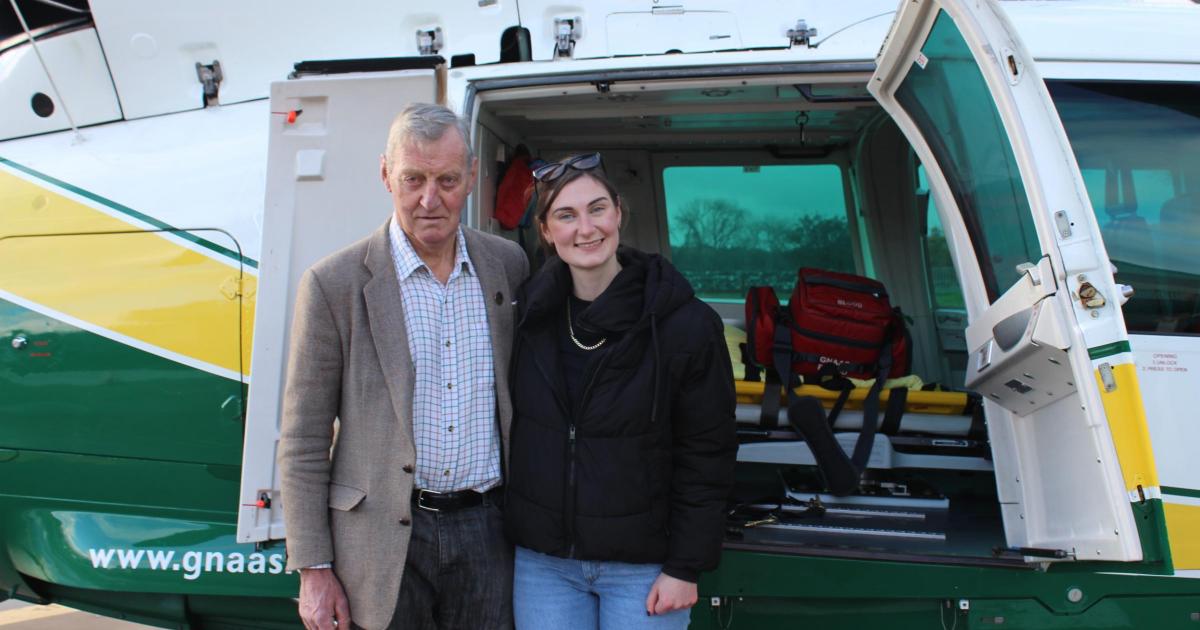
Hannah Kennedy, 25, from Gilsland, in Northumberland, decided to raise funds for the (GNAAS) by running the Great North Run and organising a breakfast event in her community.

Her support was sparked by two separate emergencies at her family’s remote farm, located near Hadrian’s Wall, where the air ambulance played a crucial role.

Her father, Leslie Kennedy, 75, was seriously injured in February 2023 when a trailer attached to a quad bike slid down a hill and trapped his leg.

The helicopter on scene in Gilsland Feb 2023 (Image: GNAAS)

He said: “I knew my son, who works with us, would be here soon and he eventually came.

Advertisement

“They got the trailer off me and it was obvious that my leg was in a position that it shouldn’t be.

“When he assessed the situation, he said they would need to request the air ambulance because they couldn’t get a land vehicle to me.

“The next thing I knew I was waking up in a helicopter and being taken to the RVI.

“I cannot praise the NHS, the paramedics, the air ambulance, and mountain rescue enough.”

Advertisement

Hannah Kennedy at the Great North Run 2025 (Image: GNAAS)

A paramedic attended the scene after emergency services were called, and Hannah helped transport her father using another quad bike.

Two GNAAS paramedics and a doctor arrived and found Mr Kennedy had suffered an open tibia and fibula fracture.

They gave him advanced pain relief and realigned his leg, which was positioned at a 180-degree angle.

With help from the local mountain rescue team, Mr Kennedy was carried to the helicopter and flown to the Royal Victoria Infirmary (RVI) in Newcastle in around 15 minutes.

Advertisement

He underwent surgery to insert a 30-centimetre steel plate and four screws, and later received 30 stitches.

After ten days in hospital and further treatment for an infection, his leg has since healed.

The family’s connection to GNAAS goes back even further.

Hannah’s brother John, now 28, was also airlifted to hospital when he was younger following a serious quad bike incident that left him unconscious and with a damaged kidney.

Advertisement

Inspired by these experiences and others within her community, Hannah decided to raise funds for the service.

In addition to running the Great North Run, she organised a bucket collection at a local show and helped set up a breakfast brunch, with proceeds split between GNAAS and a ward at the RVI.

She said: “From 10 in the morning until two in the afternoon the big breakfast event was full non-stop.

“There were parents, friends, and people I didn’t even know, all coming together to enjoy a cooked breakfast.

Advertisement

“Gilsland and the surrounding areas are such a strong community, and we were overwhelmed by the amount of people that turned up and gave donations, as well as those who couldn’t make it but still donated.”

The event was supported by local businesses, members of the public, and the Kennedy and Main families, who donated food, time, and even the venue.

She said: “The support we received from our family and local businesses was unreal and it was a lovely thing to be a part of.

“GNAAS are heroes and we think everyone who gave money to our event are also heroes.”

Advertisement

Mr Kennedy agreed, and praised the wider public for their support.

He said: “The public deserve huge praise for supporting services like GNAAS and the RVI.”

Hannah and her father have since visited the GNAAS base in Langwathby, where they presented a cheque and met members of the critical care team.

She said: “We see the air ambulance all the time responding to farmers and walkers and understand how much of a difference they make in rural communities like ours.

Advertisement

“It was nice to meet the crew and see the helicopter and know that this money is going to such an amazing service.”

GNAAS have launched an appeal called Operation SOS: Secure Our Service and need to raise £2.5 million to secure the deposit for a third new helicopter. Find out more on their website.

Source link

Advertisement
Continue Reading

NewsBeat

Attract birds to any garden with RSPCA’s ‘easy’ method for spring

Published

on

Wales Online

The animal welfare charity has shared advice for people looking to encourage feathered visitors to their garden

For homeowners preparing their gardens ahead of spring, few sights are more rewarding than seeing wildlife return. People eager to attract birds to their properties might be interested in an RSPCA-approved tip.

The animal welfare organisation suggests that installing nesting sites in your garden is an excellent way to encourage visitors. Taking to Facebook, the RSPCA offered guidance for anyone wanting to transform their outdoor space into a haven for birds. The post said: “Want to give your garden visitors a place to nest and rest?

Advertisement

“Habitat loss means fewer natural nesting spots, but a bird box in your garden can be a fabulous way to welcome feathered friends. Sizes determine which birds you attract, and placement is key!”

On the RSPCA website, the charity explained that different birds favour different-sized nesting holes. The advice read: “Which birds will use which type of box? That depends on the type of box and the size of the nesting hole”. As a rule:

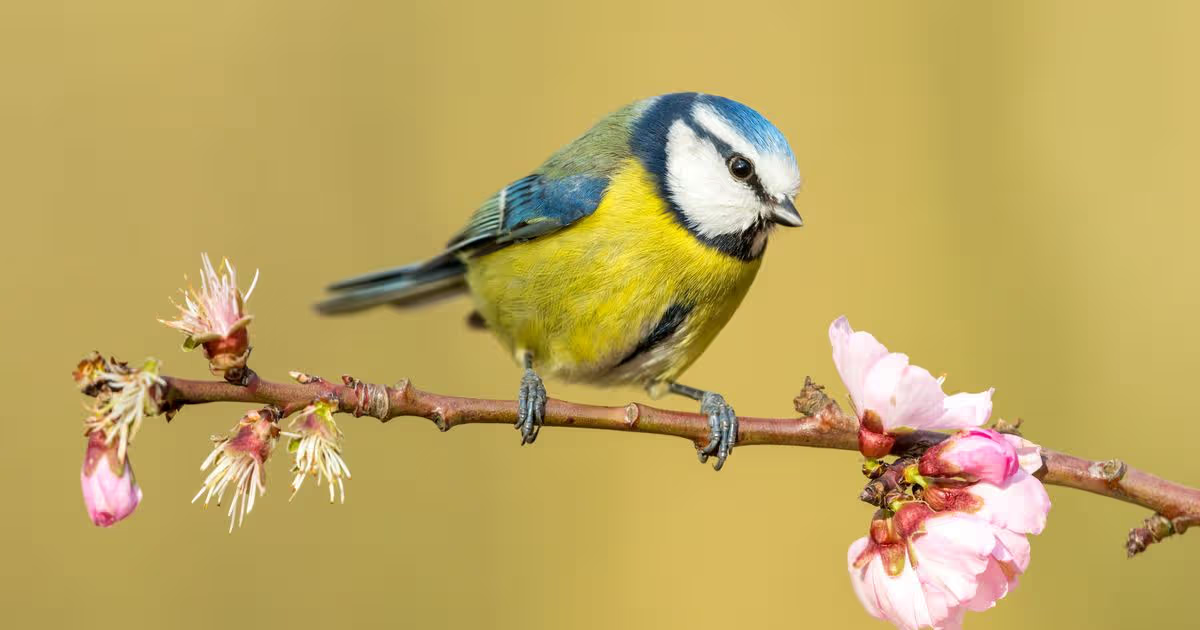
  • A 25mm hole attracts smaller birds like blue tits and coal tits.
  • A 32mm hole attracts birds like great tits and sparrows.
  • A 45mm hole attracts bigger birds such as starlings and woodpeckers.
  • Open-fronted boxes attract robins, wrens and pied wagtails.
  • Specially shaped boxes attract swifts, swallows and house martins.

The RSPCA said to check there’s a suitable spot in the garden before installing a box, reports the Daily Record. The charity explained: “Protect birds from predators as well as sunlight, strong winds and driving rain – find a sheltered spot facing north or east.

“Fix to a tree or the wall of your home – make sure there are bushes, trees or climbing plants nearby to provide cover. Keep boxes away from cats and dogs by putting them two to four metres off the ground.

“Open-fronted nest boxes need to be lower – around 1.5m. Hide them in vegetation like hedges, shrubs or thick creepers, to keep them safer from predators. For woodpeckers, a box in a tree, three to five metres high, is ideal. Make sure there’s a clear flight path to all nest boxes (except open-fronted ones).”

Advertisement

The RSPCA said it’s best to put up a box in autumn or early winter. By doing this, a bird may roost in the box during the colder months and return there in the spring. Spring gardening fans looking to upgrade their gardens ahead of the warmer weather might like to take this opportunity to make their garden bird-friendly.

For homeowners looking for another way to help, the RSPCA also shares instructions for families looking to make their own eco bird feeder, which helps birds year-round. Homeowners can attract birds such as robins, finches, tits, and house sparrows by providing fruit and seeds.

Source link

Advertisement
Continue Reading

NewsBeat

Two teenagers killed in Donegal crash as third left seriously injured in hospital

Published

on

Daily Record

Two teenage boys died following a devastating car and lorry collision in Co Donegal, with the third victim in a serious condition

Two teenage boys have tragically died following a horrific road collision, whilst a third remains in a serious condition in hospital.

The crash, which involved a car and a lorry, took place in the St Johnston area of Co Donegal at around 11.15pm on Tuesday (February 24). Gardaí and emergency services attended the scene immediately.

Advertisement

One casualty was pronounced dead at the location, with his body later transported to the mortuary at Letterkenny University Hospital. The second casualty was initially taken to Altnagelvin Hospital, where he sadly died shortly after arrival.

The driver was also conveyed to Altnagelvin Hospital for treatment of serious injuries before being moved to the Royal Victoria Hospital in Belfast. The lorry driver is understood to have escaped injury, reports the Irish Mirror, reports Belfast Live.

Ensure our latest stories always appear at the top of your Google Search by making us a Preferred Source. Click here to activate or add us as your Preferred Source in your Google search settings.

Gardaí have confirmed the R236 road remained closed as of Wednesday morning, with a technical examination by Garda Forensic Collision Investigators due to take place.

Advertisement

In a formal statement, the force said: “Gardaí are appealing to anyone who may have witnessed the collision to come forward.

“Road users who may have camera footage (including dash-cam) and were travelling in the area between 10.45pm and 11.45pm on Tuesday 24th February 2026 are asked to make this footage available to investigating Gardaí.

“Anyone with information is asked to contact Letterkenny Garda Station on (074) 9167100, the Garda Confidential Line on 1800 666 111, or any Garda Station.”

Source link

Advertisement
Continue Reading

NewsBeat

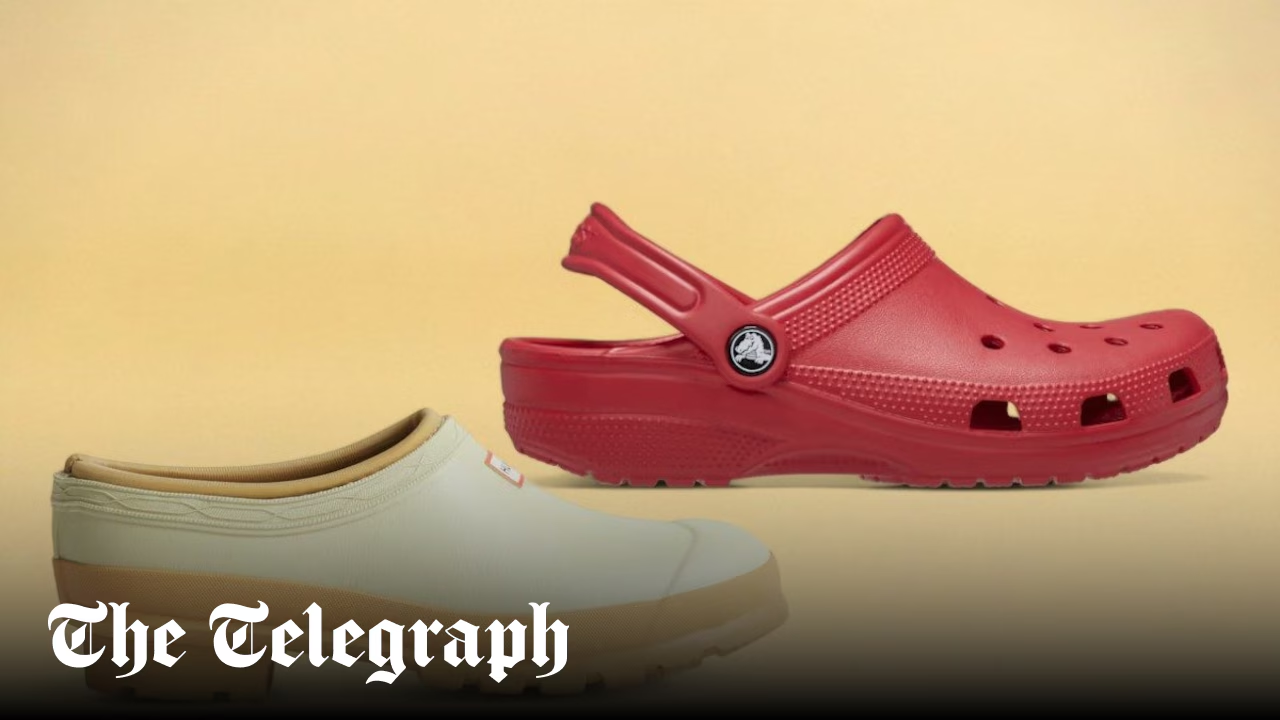
The 10 best gardening shoes, tested by a gardener

Published

on

The 10 best gardening shoes, tested by a gardener

I looked for shoes that were safe, easy to clean and comfortable to walk or garden in.

I walked a mile in every pair of shoes I tested, from clogs to small wellies, using them on my regular dog walk. The route includes grass, mud, a gravel path, steps and pavements. I wore lighter clogs in warmer weather and more enclosed shoes when it was cooler. Back home, I headed to the allotment for a bit of weeding and light digging.

Next, I cleaned the shoes using a hose and scrubbing brush. Some pairs were not designed for muddy grounds, so I rubbed them in some dirt first to test how easy they were to clean without also needing to wash my feet.

Advertisement

I wanted each pair to perform for its intended purpose, or prove itself a good all-rounder. As with the best pair of gardening gloves, fit matters. I asked two friends to try them on: one with narrow feet and one with wider feet. This helped me judge how they perform across different foot shapes.

Although I tested women’s gardening shoes, most are unisex. You will find links for both men’s and women’s versions throughout the guide.


Why you can trust Telegraph Recommended

Our thorough, real-world tests will always help you find the best gardening product. No manufacturer ever sees Telegraph Recommended reviews before publication and we don’t accept payment in exchange for favourable reviews, nor do we allow brands to pay for placement in our articles.

All opinions are based on independent expert opinion and our hands-on testing. Visit our Who We Are page to learn more.

Advertisement


Source link

Continue Reading

NewsBeat

Perry Groves warns Arsenal stars will be sold because of ‘unbelievable’ talent | Football

Published

on

Perry Groves warns Arsenal stars will be sold because of 'unbelievable' talent | Football
Ethan Nwaneri and Myles Lewis-Skelly have both struggled for game time at Arsenal this season (Picture: Getty)

Perry Groves believes the emergence of Max Dowman will prompt the departures of several big-name Arsenal players in the summer transfer window.

The intense competition for places in Arsenal’s midfield and forward line has already prompted Mikel Arteta to sanction Ethan Nwaneri’s loan to Marseille.

Captain Martin Odegaard’s place in the team is far from secure give his questionable form allied to Eberechi Eze’s brace in last weekend’s north London derby.

Dowman, meanwhile, became the youngest player in the club’s history earlier this season when he made his debut against Leeds United but an ankle injury has ruled the teenager out of action for the past few months.

Advertisement

Whether the 16-year-old, who returned to training earlier this month, will play a part in the run-in remains to be seen but Groves is confident his undeniable talent will eventually force other players out of the club.

‘The thing is though, you won’t have to fit them all in,’ Groves told talkSPORT when contemplating the selection headaches Mikel Arteta is facing on a weekly basis.

‘Because there will be a few that will be gone at the end of the season.

Your football fix

Metro‘s Head of Sport James Goldman delivers punchy analysis, transfer talk and his take on the week’s biggest stories direct to your inbox every week.

Advertisement

Sign up here, it’s an open goal.

‘The squad is that strong, and there will be new faces that come in, so there will be a few that will be surplus to requirements.’

Advertisement

Groves continued: ‘They all want to go and play.

‘Like you mentioned, Nwaneri, if you’re talking about the inside where he wants to play…

‘You’ve got Eze, Odegaard, then Max Dowman who is unbelievable, trust me.

‘So then Nwaneri quite rightly will be thinking, ‘I want to go and play.”

Advertisement
Soccer Football - Ligue 1 - Olympique de Marseille v RC Lens - Orange Velodrome, Marseille, France - January 24, 2026 Olympique de Marseille's Ethan Nwaneri celebrates scoring their second goal REUTERS/Manon Cruz
Ethan Nwaneri is currently on loan at Marseille (Picture: Reuters)

Viktor Gyokeres, meanwhile, believes Arsenal’s statement derby win against Tottenham was the ‘perfect response’ to silence the club’s critics.

Gyokeres and Eberechi Eze both scored twice to secure a 4-1 triumph over Spurs just four days after Arsenal were rocked by a 2-2 draw at Wolves.

The dropped points at Molineux led to questions about Arsenal’s title mentality. However, their performance against Tottenham – which took them five points clear of Manchester City at the top of the Premier League – went some way to silencing the doubters.

Tottenham Hotspur v Arsenal - Premier League
Viktor Gyokeres scored twice in Arsenal’s 4-1 win over Tottenham (Picture: Getty)

And Gyokeres, who extended his league tally to the season for 10, said: ‘It’s always going to be difficult when you get a result like we had at Wolves, but it’s how you handle that, and how you respond to it, and today we showed that it in a good way.

‘To get this result and this performance, it was the perfect way to respond. So, it’s a good sign.

‘The thing is, that we have to keep showing it in the next game and the game after that.

Advertisement

‘There’s a lot of games to go. But if we perform like this, it’s going to be good, for sure.’

Advertisement
Advertisement

Source link

Continue Reading

Trending

Copyright © 2025