

Crypto World
Bitcoin Stays Below $65,000, but Big Money Is Moving Quietly

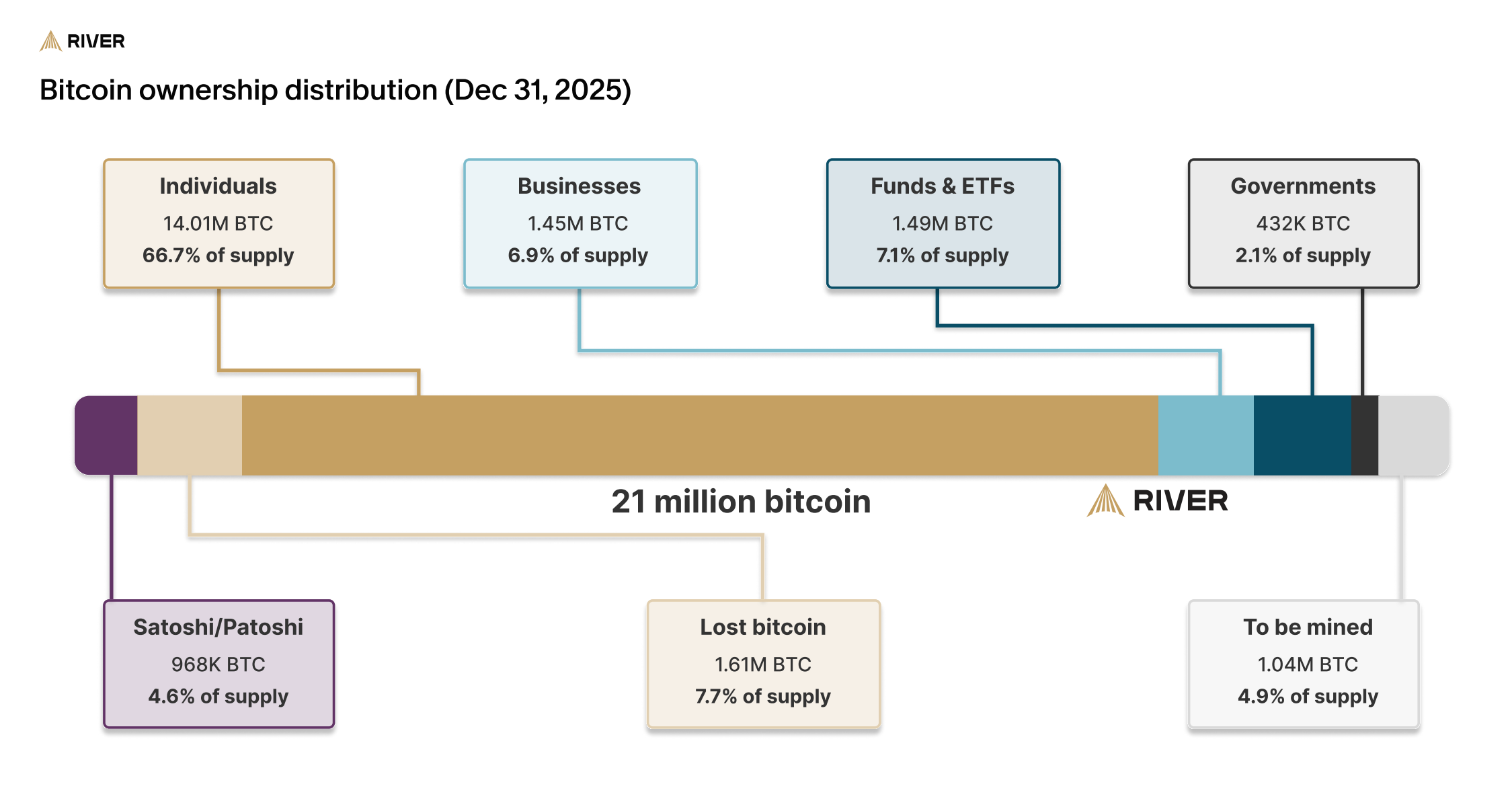
Bitcoin (BTC) continued its downward trajectory in February, trading at $64,492, nearly 50% below its early October all-time high (ATH) price.
Yet, price action tells only part of the story. According to River, Bitcoin adoption accelerated last year, with institutions, banks, merchants, public companies, and even nation-states increasing their exposure.
Is Bitcoin’s 50% Decline Masking a Structural Bullish Trend?
BeInCrypto recently reported that the crypto market has slipped into extreme fear, with retail investors growing increasingly pessimistic about Bitcoin’s price. This sentiment is reflected in a surge of “Bitcoin going to zero” searches, which recently reached an all-time high.
The price drawdown has also weighed on institutional participants. Crypto hedge funds have pulled back from the market.
“With Bitcoin and ETH continuing to slide, crypto hedge funds have retreated to cash. Their average cash levels are currently 15.32%, the highest in almost a year,” Nic Puckrin, co-founder of Coin Bureau, told BeInCrypto.
Moreover, recent disclosures show that in Q4 2025, institutional investors also trimmed their Bitcoin exchange-traded fund (ETF) exposure.
However, when viewed from a broader perspective, the long-term adoption trajectory remains constructive. In a recent market report, River highlighted that the largest cryptocurrency’s adoption surged in 2025.
“There is no bear market in bitcoin adoption. Bitcoin is down 50% from all-time highs, but adoption is compounding in ways that aren’t affecting the price, yet,” the post read.
According to River, institutions collectively added approximately 829,000 BTC in 2025. This figure includes purchases from businesses, governments, funds, and ETFs.
Registered investment advisors allocated close to $1.5 billion per quarter into Bitcoin ETFs over the past two years. Notably, none of those quarters recorded net outflows.
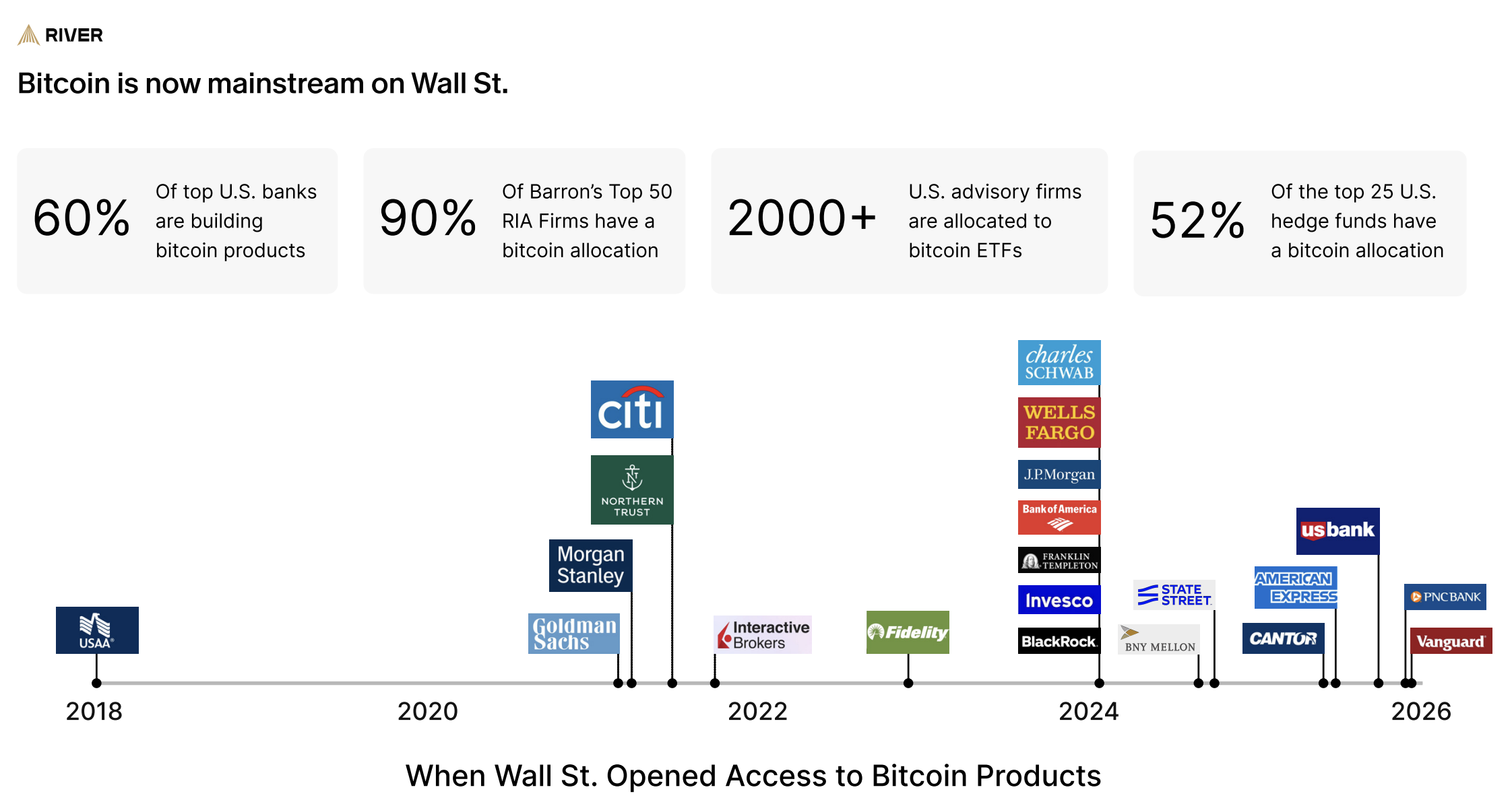
Although exposure among RIAs is widespread, with 29 of the 30 largest US firms holding positions, portfolio allocations remain minimal, averaging 0.008%.
Businesses emerged as the largest buyers in 2025. They added $54 billion worth of Bitcoin to their balance sheets during the year.
Bitcoin treasury companies account for the majority of corporate holdings, collectively controlling 866,000 BTC. At the same time, the number of publicly listed firms with Bitcoin holdings rose to 194.
At the sovereign level, five nations became new Bitcoin holders in 2025, including purchases linked to two sovereign wealth funds, Luxembourg and Saudi Arabia, as well as the Czech Republic’s central bank. In total, 23 nation-states now hold Bitcoin.
“Trust in bitcoin has grown faster than that of any asset in history. What began as an experiment is now a globally recognized store-of-value, with adoption patterns that rival the internet,” River wrote.
US Businesses Embrace Bitcoin Payments
Beyond direct accumulation, payment adoption expanded materially. The number of US merchants accepting Bitcoin payments tripled during the year. Furthermore, global usage increased by 74%.
Meanwhile, development activity within traditional finance continues. Approximately 60% of the 25 largest US banks are building Bitcoin products, indicating ongoing institutional integration.
River stated that the current wave of adoption is unlikely to trigger an immediate 10-fold price surge for Bitcoin. However, the firm argued that this type of steady integration may carry greater significance.
Looking ahead, River said it expects adoption to accelerate meaningfully over the coming years as broader participation deepens.


Artificial intelligence spending is accelerating globally. Boards are approving larger budgets. Innovation teams are experimenting aggressively. Yet across North America, Europe, and Asia-Pacific, enterprise leaders are facing the same uncomfortable reality: AI investments are not translating into measurable enterprise value. The problem is not model accuracy. It is structural misalignment. When AI initiatives operate independently without a unified enterprise AI strategy, ROI erosion becomes inevitable. Disconnected deployments create fragmented data ecosystems, unclear financial attribution, governance exposure, and diluted competitive advantage.
This is precisely why leading enterprises are turning toward structured AI strategy and consulting services to transform scattered AI experimentation into disciplined, value-driven enterprise transformation.
The Structural Problem: AI Without Enterprise Architecture
Many organizations adopt AI in pockets:
- Marketing launches personalization engines
- Finance deploys forecasting models
- Operations experiments with automation
- HR introduces AI-driven talent tools
Individually, these initiatives appear progressive. But collectively, they lack coordination. Without oversight from an experienced AI strategy consulting Company, enterprises unknowingly create:
- Redundant infrastructure investments
- Conflicting data standards
- Vendor sprawl
- Inconsistent governance protocols
- Limited enterprise-wide impact visibility
This fragmentation does not just reduce ROI. It destroys scalability.
Why ROI Collapses in Disconnected AI Environments
AI does not fail because it lacks intelligence. It fails because it lacks integration. When artificial intelligence is deployed without financial discipline, strategic sequencing, and governance alignment, ROI erosion becomes inevitable. The collapse is not dramatic; it is structural.
Industry Evidence: AI ROI Underperforms Without Enterprise Alignment
The risks of fragmented AI investment are not theoretical – they are substantiated by recent enterprise research.
A 2026 study from the IBM Institute for Business Value reports that while executives remain highly optimistic about AI’s long-term revenue contribution, many organizations acknowledge significant integration challenges across operating models, data architecture, and financial planning. The research highlights a clear execution gap between AI ambition and enterprise-wide value realization.
Complementing this, Gartner’s 2025 survey on AI strategy adoption found that only a small minority of organizations, for example, just 23% of supply chain leaders, reported having a formal AI strategy in place. This indicates a broader enterprise trend: most AI spending occurs without a structured strategy or governance, which in turn makes measurable ROI harder to achieve.
Taken together, these findings reinforce a critical point: AI performance is not determined by model sophistication alone. It is determined by architectural alignment across financial, operational, and governance dimensions.
1. Financial Detachment
AI initiatives frequently lack alignment with capital allocation models. When projects are not embedded into structured financial planning, leadership cannot measure EBITDA contribution, cost compression, or margin expansion.
A mature AI strategy consulting for enterprises approach ensures every initiative is linked directly to financial performance indicators.
2. Absence of Enterprise Sequencing
Disconnected AI projects often launch simultaneously without prioritization logic. This overwhelms data teams, strains infrastructure, and slows adoption.
A structured AI roadmap development framework ensures that investments are sequenced according to clear strategic priorities. Rather than launching parallel initiatives without coordination, organizations align AI programs based on:
- Strategic leverage across the value chain
- Scalability across business units
- Measurable financial impact
- Regulatory and governance complexity
When sequencing is absent, AI initiatives compete for resources, dilute focus, and create operational noise instead of enterprise value.
3. Governance Risk Amplification
Global regulatory scrutiny is intensifying. From evolving AI regulatory frameworks across the EU and other major markets to risk-based governance expectations across international markets, enterprises must embed accountability into AI architecture.
Without expert AI Strategic Advisory, organizations face:
- Model bias risks
- Compliance violations
- Reputational damage
- Legal exposure
Disconnected governance models are no longer sustainable.
4. Value Attribution Failure
One of the most common executive frustrations is the inability to quantify AI returns. This is where structured AI value engineering services become essential. Instead of asking whether an algorithm works, leadership evaluates:
- Revenue uplift contribution
- Cost avoidance metrics
- Productivity amplification
- Risk-adjusted return
A disciplined AI value engineering framework transforms AI from experimental expenditure into a measurable performance driver.
The Enterprise Solution: From Fragmentation to Financial Engineering
To fix disconnected AI, enterprises must move beyond tool deployment toward architectural transformation. Here is the structured approach that leading organizations follow:
Step 1: Enterprise AI Portfolio Audit
An experienced AI Consulting Services team evaluates:
- Existing AI initiatives
- Vendor landscape
- Data infrastructure maturity
- Governance gaps
- Financial alignment
This diagnostic phase uncovers duplication, inefficiencies, and unrealized value.
Step 2: Define a Unified Enterprise AI Strategy
A robust enterprise AI strategy defines:
- Where AI drives margin expansion
- Which workflows become autonomous
- How predictive intelligence compresses decision cycles
- How compliance architecture mitigates regulatory exposure
- How workforce capability evolves
This ensures AI investments align with long-term strategic differentiation.
Step 3: Implement AI Strategy and Value Engineering Services
Through integrated AI strategy and value engineering services, enterprises establish:
- Capital allocation models for AI
- Risk-adjusted ROI forecasting
- Performance attribution dashboards
- Continuous optimization loops
This is the foundation of sustainable AI business value optimization.
Step 4: Redesign Operating Models
Advanced AI Business Strategy Services embed intelligence directly into
- Market expansion planning
- Supply chain resilience modeling
- Capital allocation simulations
- Risk forecasting systems
AI should not optimize yesterday’s process. It must redefine tomorrow’s competitive structure.
What Differentiates Elite AI Strategy Consulting
Not all AI providers are created equal. A truly leading AI strategy consulting Company operates at the intersection of business insight, technical expertise, and enterprise-scale transformation. What differentiates top-tier firms is their ability to move beyond deploying isolated tools and instead create systemic, organization-wide value.
1. Financial Engineering Expertise
Enterprise-focused providers integrate AI initiatives directly into capital planning and financial strategy. They quantify potential ROI, optimize investment allocation, and ensure AI contributes to margin expansion, cost reduction, and risk-adjusted performance. Every project is evaluated not as a technical experiment, but as a strategic capital allocation decision that drives measurable business outcomes.
2. Governance Architecture Mastery
Top-tier consulting firms design robust governance frameworks that enforce accountability, compliance, and operational resilience. They embed regulatory foresight, data stewardship, and ethical AI practices into enterprise architecture, ensuring AI scales safely across departments and global markets without regulatory or reputational exposure.
3. Cross-Industry Implementation Depth
Leading AI consultants bring experience from multiple industries, enabling them to apply proven frameworks, accelerate deployment, and anticipate domain-specific challenges. Whether in finance, manufacturing, supply chain, or marketing, they translate AI potential into actionable enterprise strategies, avoiding common pitfalls that siloed initiatives encounter.
4. Enterprise Transformation Leadership
Experienced advisors don’t just implement technology; they transform organizations. They guide leadership in redesigning workflows, integrating predictive intelligence into operations, and aligning workforce capabilities with AI-driven decision-making. The focus is on creating an intelligence infrastructure that becomes a durable competitive advantage, not a collection of disconnected pilots.
The difference is clear: Tools alone don’t drive results. Leading AI strategy consulting Companies architect intelligence ecosystems that convert AI initiatives into measurable business impact and sustainable advantage.
The Global Competitive Reality
Across global markets, AI maturity is no longer experimental; it is a competitive differentiator. Enterprises that integrate AI into their core operating architecture are not just improving efficiency; they are building structural advantages that compound over time:
- Proprietary data flywheels that continuously strengthen decision accuracy
- Autonomous operational systems that reduce latency and human dependency
- Predictive capital allocation engines that optimize investments in real time
- Accelerated innovation cycles powered by continuous intelligence feedback
These organizations are embedding intelligence into the foundation of how they compete. In contrast, companies running scattered AI pilots experience the opposite effect. Instead of compounding advantage, they accumulate technical debt, governance risk, and operational complexity.
The result is a widening intelligence divide. AI leaders are scaling clarity, speed, and precision. Others are scaling experimentation without integration. In a market where decision velocity and predictive foresight determine competitive position, that gap does not remain static; it expands.
If AI isn’t aligned to capital strategy, it isn’t aligned at all.
Disconnected AI does not fail because the technology is weak. It fails because the architecture is missing. Enterprises that operate without a unified enterprise AI strategy will continue to see fragmented impact, unclear ROI, and rising governance complexity.
The path forward is disciplined integration through structured AI strategy and consulting services, measurable AI value engineering services, and executive-level AI Strategic Advisory that aligns intelligence with capital strategy and competitive positioning.
If AI investment has not translated into a measurable financial impact, the issue is not technology. It is architecture. Antier delivers enterprise AI strategy consulting that aligns intelligence with capital, governance, and competitive advantage.


The exchange’s institutional desk highlights negative gamma exposure between $60,000 and $70,000, a setup that can amplify volatility.
Bitcoin’s brief rebound above $66,000 following U.S. President Donald Trump’s State of the Union address has done little to shift the underlying market structure, with fresh analysis from Coinbase Institutional pointing to a critical support zone near $60,000 that, if broken, could trigger accelerated selling.
The combination of options market dynamics and on-chain data suggests the path of least resistance remains lower, with any sustained recovery likely requiring a reclaim of $82,000, a level that currently stands as the first major hurdle to renewed upside momentum.
Options Market Points to Accelerated Downside Risk
Coinbase Institutional’s latest Bitcoin playbook introduced gamma exposure (GEX) as a lens for understanding how options dealers influence price action. According to the firm, when dealers hold positive gamma, their hedging tends to stabilize prices, selling into strength and buying into weakness. Negative gamma has the opposite effect, forcing dealers to buy as prices rise and sell as they fall, amplifying trends.
The current configuration shows a pronounced negative gamma band concentrated in the $60,000 to $70,000 region, with positive gamma pockets forming higher up near $85,000 and $90,000. This structure, per Coinbase, carries a specific implication: downside momentum into the $60,000 area could accelerate rapidly, while any advance toward $90,000 would likely grind and consolidate rather than break out cleanly.
Dense support sits near $60,000 based on historical market structure and volume profiles, while $82,000 represents the first significant resistance band. According to Coinbase’s market watchers, if Bitcoin fails to hold above $82,000 on approach, the lack of stabilizing gamma in that region suggests resistance may hold. By contrast, a break below $60,000 would occur in a negative gamma environment, meaning selling could feed on itself as dealers hedge in the direction of the move.
On-Chain Data Confirms Defensive Regime
Coinbase’s options-derived outlook matches up with deteriorating on-chain fundamentals. Yesterday, analyst Axel Adler Jr. noted that Realized Cap has declined for a second consecutive month, falling roughly $33 billion from its peak of $1.127 trillion in November 2025 to around $1.094 trillion. Furthermore, the 30-day Realized Cap Net Position Change is still negative, signaling ongoing capital outflows.
Separate data from Glassnode showed the 90-day moving average of the Realized Profit/Loss Ratio falling below 1, meaning more BTC is being sold at a loss than at a profit. According to the analytics platform, such regimes have historically persisted for months before liquidity conditions improved.
You may also like:
Meanwhile, sentiment tracker Santiment said on Wednesday that bullish commentary across X, Reddit, and Telegram has reached a four-week high following Trump’s State of the Union speech. However, the firm cautioned that elevated retail optimism and talk of a “bear cycle” ending have, in the past, coincided with stalled rallies.
Binance Free $600 (CryptoPotato Exclusive): Use this link to register a new account and receive $600 exclusive welcome offer on Binance (full details).
LIMITED OFFER for CryptoPotato readers at Bybit: Use this link to register and open a $500 FREE position on any coin!

Regulated US crypto bank Anchorage Digital has officially confirmed it holds Strategy’s STRC perpetual preferred stock on its balance sheet.
Conviction compounds. — Nathan McCauley
Institutions don’t just talk about Bitcoin, they structure around it.
Today, @Anchorage Digital has announced it holds $STRC, @Strategy’s perpetual preferred stock, on our balance sheet.
When the company that operationalizes Bitcoin infrastructure puts…
 (@nathanmccauley) February 25, 2026
CEO Nathan McCauley disclosed the position on X today, framing it as a major strategic alignment between the sector’s largest digital asset treasury and its critical banking infrastructure.
This move validates the use of high yield Bitcoin proxies even as ETF outflows and price retests shake out weaker hands.
McCauley highlighted the synergy on X, noting that Anchorage plans to “build the future of BTC” alongside the Bitcoin treasury giant, Strategy.
While the exact size of the position remains undisclosed, the purchase signals that institutional custodians are now comfortable utilizing complex derivatives to gain exposure to crypto.
Key Takeaways
- Disclosure Filed: Anchorage Digital confirmed it holds Strategy’s Nasdaq-listed STRC stock.
- Position Scope: The move targets STRC’s 11.25% annual dividend yield, providing income-focused Bitcoin exposure.
- Strategic Signal: The partnership bridges operational custody with corporate treasury accumulation.
What the Anchorage Digital Disclosure Actually Signals
STRC is not a standard equity play. It is a Nasdaq listed perpetual preferred security designed as a high yield instrument that pays an 11.25% annual dividend in cash.
By holding STRC, Anchorage captures significant yield while funding Strategy’s aggressive Bitcoin purchasing engine.
“When the company that operationalizes Bitcoin infrastructure puts capital alongside the company that operationalized the Bitcoin treasury strategy … that’s a signal,” McCauley tweeted.
This structure allows institutions to bypass direct spot volatility while maintaining exposure to the ecosystem.
Proceeds from STRC issuances historically fund Strategy’s direct Bitcoin buys, creating a flywheel effect. As of Monday, Strategy held 717,722 BTC, valued at approximately $47 billion.
Discover: The best meme coins on Solana
A Divergence in Corporate Bitcoin Strategies
This disclosure highlights a sharp split in corporate behavior regarding crypto assets. While some operational entities liquidate positions to cover costs, (a major Bitcoin mining company just sold all its BTC), Anchorage and Strategy are doubling down on Bitcoin’s longer term prospects.
Michael Saylor, Strategy’s executive chairman, also responded to Anchorage Digital’s news by noting that “conviction is contagious.” That sentiment appears to be spreading beyond just crypto-native banks.
Strategy recently revealed that Prevalon Energy, a subsidiary of Mitsubishi Power Americas, also holds STRC on its balance sheet. This corporate adoption mirrors a growing public sector trend, as lawmakers in states like Missouri advance Bitcoin reserve bills to secure state funds against inflation.
The timing is critical. Anchorage concurrently secured a $100 million investment from Tether, valuing the firm at $4.2 billion. Allocating a portion of that balance sheet to high-yield Bitcoin proxies indicates a shift from improved custody to supporting active treasury management.
Furthermore, with overnight market liquidations defending the $60k level, these corporate treasury strategies will face their next major stress test.
Until Anchorage discloses the size of the position, the market is treating this as a qualitative vote of confidence rather than a proven liquidity event.
Discover: The best crypto to buy today
The post Anchorage Digital Discloses Holding in Strategy’s STRC, Signals Long Term Conviction appeared first on Cryptonews.

South Korea is reportedly preparing new rules that would force social-media personalities promoting cryptocurrencies and stocks to reveal what they own and whether they are being paid.
Democratic Party lawmaker Kim Seung-won, a member of the National Assembly’s Political Affairs Committee, is drafting amendments to the Capital Market and Financial Investment Business Act and the Act on the Protection of Virtual Asset Users, according to a report from Korean-language business news website Herald Business.
Under the proposal, individuals who repeatedly offer advice or receive compensation to encourage the public to buy or sell financial products or virtual assets must disclose the compensation received and the type and quantity of assets they hold. The requirement would apply to advice delivered through publications, online communications and broadcasts, with detailed criteria to be set by presidential decree.
Violations may carry penalties similar in severity to those for market manipulation or insider trading, per the report.
Related: Victim of a crypto scam? Here’s what to do next
Lawmaker warns on “finfluencer” investor risks
The initiative is aimed at reducing conflicts of interest and improving transparency in online investment promotion. “So-called fin-influencers are emerging, offering investment advice to unspecified individuals without compensation from positions of significant public influence,” Kim reportedly said.
“These individuals are providing inappropriate information and creating conflicts of interest. However, their opinions have significant influence on the public, causing unpredictable losses to investors,” he added.

The move comes as Financial Supervisory Service data shows reports involving quasi-investment advisors (QIAB), entities in Korea that provide general investment advice to people via media, jumped from 132 in 2018 to 1,724 in 2024, according to the report.
Cointelegraph reached out to Kim Seung-won for comment, but had not received a response by publication.
Related: Influencers shilling memecoin scams face severe legal consequences
Global regulators tighten rules on finfluencers
Regulators abroad have also taken similar initiatives. The United Kingdom’s Financial Conduct Authority allows financial promotions only with prior approval, while the US Securities and Exchange Commission (SEC) and Financial Industry Regulatory Authority (FINRA) have issued fines and reprimands tied to undisclosed promotions.
Last month, Italy’s market watchdog Commissione Nazionale per le Societa e la Borsa (CONSOB) also circulated new guidance from the European Securities and Markets Authority (ESMA) warning that EU investment and advertising rules fully apply to social-media “finfluencers,” including those promoting crypto and high-risk products.
Magazine: How crypto laws changed in 2025 — and how they’ll change in 2026
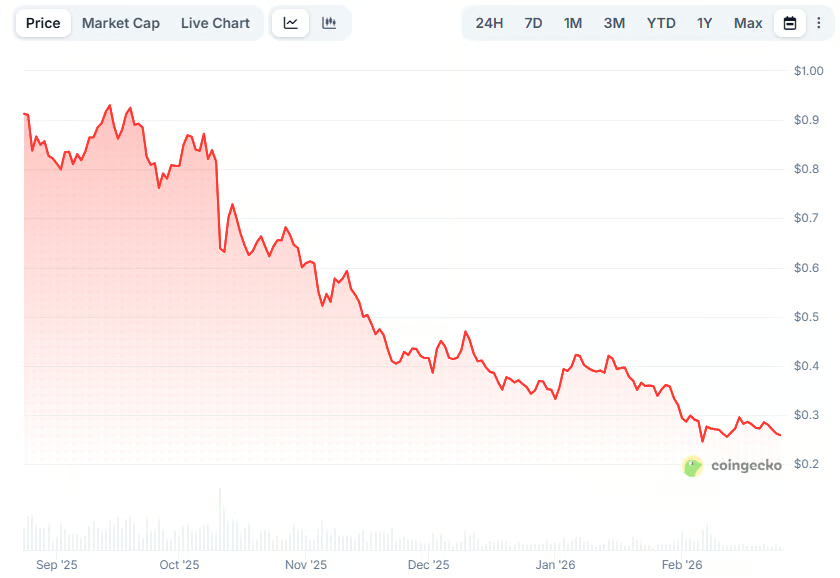
Whales and sharks have acquired more than $220 million worth of ADA over the last 180 days.
Cardano’s native token has experienced a prolonged downturn over the past several months, reflecting sustained weakness across the broader crypto market.
However, the accumulation efforts of large investors suggest a rebound may be approaching.
Buying During the Decline
The crypto analytics platform Santiment revealed that Cardano investors holding between 100K and 100 million ADA have purchased almost 820 million coins over the last six months. At current rates, the acquired stash exceeds $220 million. The collective holdings of these whales and sharks have risen to 25.36 billion tokens, representing nearly 70% of ADA’s circulating supply.
The accumulation comes at a time when Cardano’s native token has been struggling, shedding a significant portion of its value. Towards the end of August, ADA traded around $0.90, whereas it is currently worth roughly $0.27 (per CoinGecko’s data), representing a 70% decline.
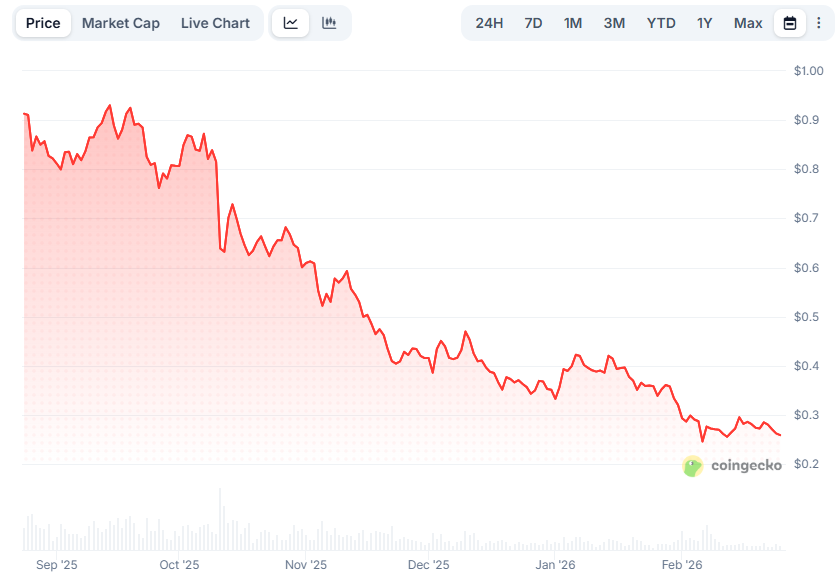
Stacking coins during downturns is a common approach among whales, as they often view lower prices as great buying opportunities. This development reduces ADA’s circulating supply, which can be followed by a rally (assuming demand remains stable or heads north). Last but not least, large investors are viewed as experienced market players who may have access to deeper insights, so their actions are rarely considered irrational.
Some technical indicators lean toward a bullish outlook. ADA’s Relative Strength Index (RSI) has plunged below 30 on a weekly scale, signaling that the token has entered oversold territory and could be due for a resurgence. The metric runs from 0 to 100 and helps traders identify potential reversal points by measuring the speed and magnitude of price changes. Ratios under 30 are considered buying opportunities, while anything above 70 is a bearish zone.

ADA’s recent exchange netflow is the next factor in focus. Over the past several weeks, outflows have dominated inflows, signaling that investors have been abandoning centralized platforms and shifting to self-custody. This, in turn, reduces the immediate selling pressure.
You may also like:

Price Predictions
Some market observers are optimistic that Cardano’s native token might indeed be gearing up for a jump. X user Bitcoinsensus hinted at a potential shift in the monthly structure, predicting a recovery in the coming months and an ascent to a new all-time high by the end of 2026.
“Historically, major expansions followed prolonged compression phases – structure now at a key transition zone,” they added.
Crypto Tony stands on the opposite corner. The trader argued that ADA “looks weak at the range low,” asking their 550,000+ followers when a crash to zero might arrive.
Binance Free $600 (CryptoPotato Exclusive): Use this link to register a new account and receive $600 exclusive welcome offer on Binance (full details).
LIMITED OFFER for CryptoPotato readers at Bybit: Use this link to register and open a $500 FREE position on any coin!
Disclaimer: Information found on CryptoPotato is those of writers quoted. It does not represent the opinions of CryptoPotato on whether to buy, sell, or hold any investments. You are advised to conduct your own research before making any investment decisions. Use provided information at your own risk. See Disclaimer for more information.

Editor’s note: Metaplex has introduced a new self-service application designed to simplify how tokens are launched on Solana. The Metaplex App aims to replace gated launchpads, custom-built infrastructure, and volatile bonding curve models with a standardized, permissionless interface for Token Generation Events. By lowering technical and structural barriers, the platform targets a broader range of issuers, including Web2 companies, institutions, and emerging AI-driven projects. The move reflects a broader shift in onchain capital formation, as tokenization continues to expand beyond crypto-native startups into more traditional and hybrid digital business models.
Key points
- Metaplex launches a self-service app enabling permissionless token creation without coding expertise.
- Projects can choose between structured “project tokens” and short-window “memecoin” launch formats.
- Launch pools replace bonding curves, with anti-sniper protections to reduce bot and insider advantages.
- At least 20% of sale proceeds are automatically allocated to locked liquidity pools.
- The app includes a discovery and trading dashboard for participating in and tracking new launches.
Why this matters
As tokenization expands into new sectors, infrastructure that reduces complexity and perceived unfairness becomes critical. By standardizing launch mechanics and embedding liquidity and anti-bot protections, Metaplex is positioning itself as a foundational layer for capital formation on Solana. For builders and institutions exploring onchain fundraising, simplified tooling may lower entry barriers and accelerate adoption.
What to watch next
- Adoption levels among Web2 companies and institutional projects launching tokens via the app.
- Early performance and liquidity outcomes of tokens created through launch pools.
- Integration of the app within the broader Solana ecosystem and SVM-based applications.
- User activity within the discovery and trading hub as new launches go live.
Disclosure: The content below is a press release provided by the company/PR representative. It is published for informational purposes.
SAN FRANCISCO – February 24, 2026 – Metaplex, the protocol behind over 99% of all tokens and NFTs on Solana, today announced the launch of the Metaplex App, a new platform providing a full-stack, self-service solution for token launches. The application provides an alternative to gated ICOs and chaotic bonding curves, reducing friction for businesses, platforms, and asset classes to leverage the reliable, battle-tested Metaplex launch protocol for global capital formation.
For years, onchain capital formation has been broken. Creators have been forced to choose between three flawed paths: investing heavy technical resources into custom infrastructure, applying for acceptance into exclusive, gated launchpads, or risking a launch on a bonding curve that often lacks control and favors insiders. The Metaplex App eliminates these barriers, offering a streamlined interface where anyone can create and launch tokens without coding knowledge. Metaplex allows any project, from Web2 companies and institutions to AI agents, to execute a professional Token Generation Event (TGE) permissionlessly.
“The next generation of breakout technology businesses and platforms will launch onchain, using tokens for capital formation and DeFi to deliver their products at scale.,” said Stephen Hess (@meta_hess), the founder of Metaplex and director at the Metaplex Foundation. “ Since 2021, Metaplex has powered 99% of asset creation on Solana, but accessing that infrastructure required deep technical expertise. By moving away from the application only model of traditional launchpads and removing the technical barriers to entry, we are providing every project, from Web2 institutions to AI agents, the ability to formulate capital onchain.”
The Metaplex App is designed to serve as the foundational entry point for the next wave of global capital. Metaplex is clearing the path for Web2 companies, traditional financial institutions, and emerging AI agents to form capital onchain. This expansion moves the industry beyond speculation and enables a vast array of new asset classes to leverage tokens as a transparent, efficient vehicle for growth. For the first time, projects have a reliable alternative to the friction of traditional funding or the roadblocks native to existing onchain methods, allowing them to focus on building value rather than navigating infrastructure.
Key features of the Metaplex App include:
- Self-Service Token Creation: Projects can manage their own launch parameters with no technical skills required. The platform allows projects to choose between two distinct streams designed to scale with their project’s specific needs: project tokens or memecoins. Project tokens are optimized for long-term capital formation and feature higher minimum caps and extended launch pool windows, while memecoins leverage 1-hour launch pools and a lower minimum cap.
- Anti-Sniper Protection: By utilizing launch pools, the app removes the vulnerabilities of bonding curves and the traditional “first-come, first-served” advantages of presales, the platform prevents bots and front-runners from hijacking the initial supply.
- Automated Liquidity: To ensure immediate tradability and long-term health, a minimum of 20% of sale proceeds are automatically locked into liquidity pools.
- Discovery & Trading Hub: A central dashboard for users to discover upcoming launches, participate in active pools, and trade tokens launched on Metaplex.
With over 22 million fungible tokens and nearly 1 billion total assets created to date, Metaplex is reshaping onchain capital formation on Solana. For more information, visit Metaplex.com.
ABOUT METAPLEX
Metaplex is the standard for asset creation on one of the largest blockchain ecosystems in the world. The Metaplex App allows users to discover, trade and launch tokens, while Metaplex asset standards power the largest stablecoins, RWAs, DEXes, launchpads, wallets and other apps on Solana and the Solana Virtual Machine (SVM).
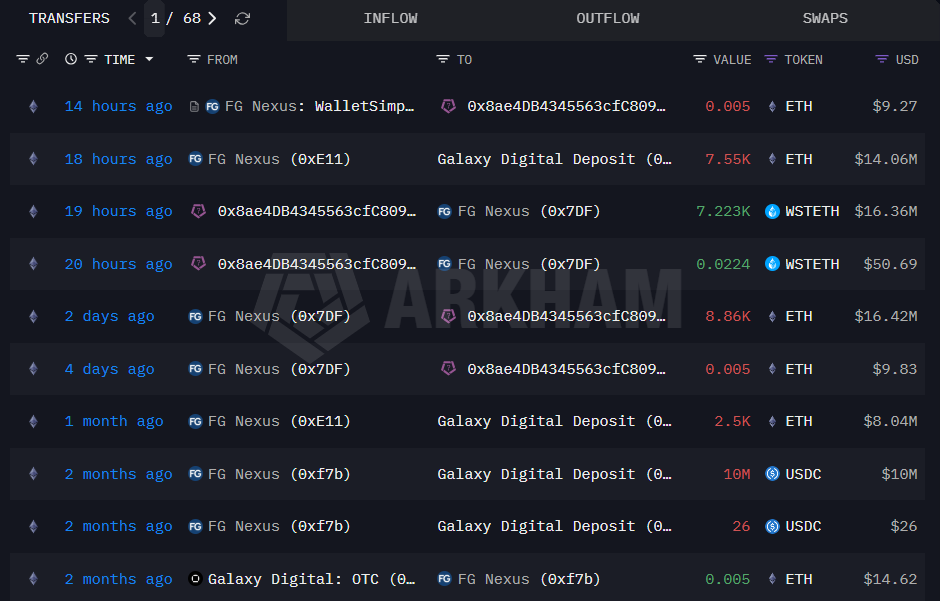
FG Nexus, a publicly listed Ethereum treasury and infrastructure company, liquidated another chunk of its Ether treasury on Tuesday, offloading 7,550 ETH worth roughly $14 million.
The latest sale adds to a series of disposals that have locked in more than $80 million in losses on a position built near Ether (ETH) 2025 highs.
Onchain data from Arkham shows that the firm accumulated 50,770 ETH worth around $196 million between August and September 2025 at an average price of $3,860 per coin.
On Oct. 22, the company doubled down on its ETH accumulation strategy, announcing its intention to sell its Quebec property to accumulate more ETH.

As the market turned and the ETH price fell from its October highs of over $4,600 per coin to around $2,700 in November, the company began selling.
FG Nexus has offloaded just over 21,000 ETH for about $55 million, and netted a loss of over $80 million.
The company has also seen its share price for FGNX drop roughly 52% over the past month.

FG Nexus remains one of the largest publicly traded owners of ETH, with holdings of 37,594 ETH, according to Arkham.
ETH treasury companies under fire
FG Nexus isn’t alone in feeling the pain from an Ether downturn that has left many large corporate treasuries deeply underwater.
Bitmine Immersion Technologies, by far the largest listed ETH holder with 4,422,659 ETH on its books, is sitting on paper losses estimated at around $8.8 billion as Ether trades well below its average acquisition price, even as the company continues to add to its stash.
Related: ETHZilla liquidates $74.5M in Ether to redeem convertible debt
Peter Thiel’s Founders Fund exited its stake in Ethereum treasury firm ETHZilla entirely last week, with ETHZilla’s stock now down about 97% from its all‑time high, as equity markets punish aggressive Ether‑heavy strategies, with other companies actively unwinding.
Trend Research spent February slashing its Ether position on Binance, selling 651,757 ETH for about $1.34 billion on Feb. 8, and locking in an estimated realized loss of around $747 million.
Bitcoin treasury plays feel the heat
The strain on crypto treasury plays is not limited to Ethereum. On Feb. 20, Bitcoin (BTC) treasury company Metaplanet came under fire from shareholders, accusing the company of hiding losses and key details of its Bitcoin bets.
Despite continued BTC purchases throughout February, on Wednesday, the largest listed owner of BTC, Strategy, became the most-shorted large-cap US stock according to data from Goldman Sachs, as hedge funds turned bearish on Saylor’s highly leveraged, Bitcoin‑centric balance sheet model.
Magazine: Bitcoin’s ‘biggest bull catalyst’ would be Saylor’s liquidation — Santiment founder


- Curve DAO Token (CRV) price has posted notable gains as the price jumps to $0.24.
- Bulls could target resistance at $0.40 as Bitcoin eyes fresh momentum.
- However, on-chain metrics and broader sentiment could cap upside potential.
The Curve DAO Token (CRV) was among the top intraday performers in the cryptocurrency market, rising more than 10% over the past 24 hours.
The token climbed above $0.24 during early Asian trading hours, supported by a brief market rebound following a bounce in Bitcoin, which helped lift sentiment across altcoins.
Some market participants are now looking at potential further gains toward the $0.40 level.
However, with Bitcoin continuing to struggle below $70,000, downside risks remain. This has kept broader market sentiment cautious, limiting the upside potential for tokens such as CRV.
Why Curve DAO Token faces selling pressure
Curve DAO Token (CRV) has rebounded from recent lows near $0.21, but, like most altcoins, remains well below the highs recorded in 2025.
The broader downtrend remains intact, keeping the token under sustained downward pressure.
While some buyers may look to extend gains, weakening on-chain activity and negative market sentiment suggest that downside risks remain elevated in the short term.
Despite the price increase over the past 24 hours, social media sentiment around CRV has stayed largely cautious, raising the possibility of further price erosion.
Perpetual futures data also points to continued trader scepticism, with funding rates remaining in negative territory.
In recent sessions, short positions have been paying longs, highlighting persistent selling pressure and increasing the risk of a retest of recent lows.
At the same time, macroeconomic and geopolitical uncertainties continue to weigh on investor confidence across risk assets.
Bitcoin trading below $70,000 has added to the cautious tone, overshadowing positive fundamentals such as network growth.
Without a meaningful improvement in macro conditions, sentiment is likely to limit CRV’s recovery.
There is also a risk that short-term gains may prompt some investors to take profits, potentially leading to a brief and fragile rebound.
CRV price technical setup
Overall, CRV’s price outlook offers mixed technical indicators.
Despite climbing 10% intraday to hover near $0.24, the token remains pinned beneath its 50-day and 100-day exponential moving averages (EMAs).
The moving averages are sloping from above $0.30 and provide a formidable overhead barrier, with a horizontal hurdle at the $0.40-$0.45 zone.
However, the daily chart shows the Relative Strength Index (RSI) has ticked up from oversold territory to around 40.
This suggests bulls need momentum for a sustained reversal.
Curve Token’s daily chart also has the MACD indicator holding onto its bullish signals.
But the histogram is showing contracting bars, hinting at near-term consolidation rather than an outright breakout.

Buyers must get a decisive close above $0.24 to allow for a probe of the initial resistance at $0.26, followed by the 50-day EMA currently at $0.29.
Yet, broader market headwinds and bearish derivatives data temper such optimism.
If prices follow current downside trends, immediate support aligns at $0.22, coinciding with the demand reload zone from November 2025.
A drop below this could accelerate toward $0.20, where stronger volume clusters might intervene.
Circle (CRCL) shares jumped over 15% in pre-market trading after the stablecoin issuer’s fourth-quarter earnings per share (EPS) beat analysts’ forecasts.
The issuer of the USDC stablecoin reported EPS of $0.43, compared with a consensus estimate of $0.16, according to FactSet data.
The New York-city based firm also posted earnings before interest, taxes, depreciation and amortization (Ebitda) of $167 million, a surge of some 412% from the year-earlier quarter.
CRCL shares traded at $71.17 in pre-market trading, just under 16% above Tuesday’s close.


ETH pivots DeFi support to permissionless, secure, privacy-first protocols, enforcing a walkaway test for long-term resilience.
Summary
- ETH DeFi focus shifts to permissionless, open-source, security-first protocols that minimize trusted third parties and central chokepoints.
- New EF bar is the walkaway test: protocols must keep functioning if teams disappear or turn hostile, with oracle infrastructure flagged as a systemic risk.
- Roadmap prioritizes privacy-preserving CDPs, AI-assisted formal verification, wallet safeguards, and stronger oracle decentralization for sustainable DeFi growth.
Ethereum (ETH) co-founder Vitalik Buterin has outlined a renewed vision for decentralized finance on the Ethereum network, emphasizing permissionless access, privacy, and security as core priorities, according to statements released by the Ethereum Foundation.
The Ethereum Foundation announced it will support projects that align with these principles, focusing on user control, open systems, and reduced reliance on centralized actors.
Buterin stated that decentralized finance represents a core component of Ethereum’s value proposition. DeFi platforms offer savings, risk management, and wealth-building tools without permission requirements, operating globally without central gatekeepers, according to the announcement.
“Financial empowerment is a central part of what it means to have agency and freedom in our current world,” Buterin stated. “Finance is far from the only thing that Ethereum is good for, but it is an important thing.”
The Ethereum Foundation does not plan to support all blockchain-based finance projects, according to Buterin. Instead, the organization will back protocols that are open-source and prioritize security, maximizing user control while reducing reliance on trusted third parties.
Buterin introduced what he termed the “walkaway test” for DeFi protocols, stating that a protocol should continue functioning if the original development team disappears and remain operational even if founders become compromised or hostile.
Security remains a central concern for the Ethereum Foundation, according to the announcement. Buterin identified audits, shared standards, and wallet safeguards as key tools, while also highlighting AI-assisted formal verification as an emerging method to improve smart contract safety.
Oracle security requires urgent attention, Buterin stated, noting that oracles connect blockchains to external data sources and weak oracle systems can expose DeFi platforms to manipulation and financial loss. The co-founder called for stronger decentralization in oracle design, describing secure infrastructure as essential for sustainable DeFi growth.
Privacy represents another major focus in Ethereum’s DeFi roadmap, according to Buterin. Both payment systems and complex financial tools require stronger privacy features, with collateralized debt positions cited as one example requiring privacy-preserving solutions.
Buterin noted that enhanced privacy features could reduce liquidation risks but require advanced technical solutions. The co-founder encouraged deeper innovation in decentralized finance, urging developers to move beyond improving existing stablecoins and rethink core financial problems such as hedging future expenses.
Ethereum remains a permissionless network where anyone can deploy applications, according to the Foundation. However, the Ethereum Foundation will prioritize projects that support user agency and open access, with the stated goal of building a global financial system that is secure, private, and resilient.

Dystopian Amazon Prime drama called ‘best show ever made’ is coming to Netflix

Caterpillar Stock Is Rolling. It Just Got Another Price Target Hike.

Enterprise AI Strategy Consulting to Fix ROI Collapse


-

 Video5 days ago
XRP News: XRP Just Entered a New Phase (Almost Nobody Noticed)
-

 Politics3 days ago
Baftas 2026: Awards Nominations, Presenters And Performers
-

 Fashion5 days ago
Weekend Open Thread: Boden – Corporette.com
-

 Entertainment7 days ago
Kunal Nayyar’s Secret Acts Of Kindness Sparks Online Discussion
-

 Sports2 days ago
Women’s college basketball rankings: Iowa reenters top 10, Auriemma makes history
-

 Politics2 days ago
Nick Reiner Enters Plea In Deaths Of Parents Rob And Michele
-
 Sports6 days ago
Clearing the boundary, crossing into history: J&K end 67-year wait, enter maiden Ranji Trophy final | Cricket News
-

 Crypto World1 day ago
XRP price enters “dead zone” as Binance leverage hits lows
-

 Business3 days ago
Mattel’s American Girl brand turns 40, dolls enter a new era
-

 Business3 days ago
Law enforcement kills armed man seeking to enter Trump’s Mar-a-Lago resort, officials say
-

 Entertainment7 days ago
Dolores Catania Blasts Rob Rausch For Turning On ‘Housewives’ On ‘Traitors’
-

 Tech3 days ago
Anthropic-Backed Group Enters NY-12 AI PAC Fight
-
 NewsBeat2 days ago
‘Hourly’ method from gastroenterologist ‘helps reduce air travel bloating’
-

 NewsBeat3 days ago
Armed man killed after entering secure perimeter of Mar-a-Lago, Secret Service says
-

 Tech19 hours ago
Unsurprisingly, Apple's board gets what it wants in 2026 shareholder meeting
-

 Politics3 days ago
Maine has a long track record of electing moderates. Enter Graham Platner.
-

 Crypto World7 days ago
WLFI Crypto Surges Toward $0.12 as Whale Buys $2.75M Before Trump-Linked Forum
-
 NewsBeat15 hours ago
Police latest as search for missing woman enters day nine
-

 Crypto World6 days ago
83% of Altcoins Enter Bear Trend as Liquidity Crunch Tightens Grip on Crypto Market
-
 Sports2 days ago
2026 NFL mock draft: WRs fly off the board in first round entering combine week