

Crypto World
Bitcoin Surges 3% as Gold Divergence Signals Major Upside


Bitcoin (CRYPTO: BTC) traded toward the $66,000 level as US equities regained ground, signaling renewed risk appetite after a softer spell for crypto markets. The move followed a broad market rally led by technology and AI names, with the Nasdaq posting modest gains and the S&P 500 edging higher. Observers said the resilience reflects a combination of regained liquidity, regulated access via spot BTC ETFs, and a return of domestic buyers. Data points include Tuesday’s net inflows of roughly $258 million into spot BTC funds and a positive swing in the Bitcoin Coinbase Premium Index, a sign that US demand is re-emerging after weeks of caution. Longer-term narratives around BTC’s role as a hedge and its place within diversified portfolios continue to persist even as near-term price moves respond to liquidity shifts.
Key takeaways
- Bitcoin climbed toward the $66,000 mark as US stock markets recovered, signaling renewed demand for BTC alongside broad market strength.
- The Bitcoin Coinbase Premium Index flipped to positive territory, aligning with notable ETF inflows into spot BTC products.
- BTC’s correlation with stocks and gold has weakened to levels not seen since 2022, though analysts expect reversion during risk-on cycles.
- Crypto-linked equities rose modestly, with Coinbase (NASDAQ: COIN) and MicroStrategy (NASDAQ: MSTR) posting gains as liquidity returned.
- On-chain and liquidity narratives point to BTC remaining a long-run inflation hedge and collateral narrative, even as near-term flows swing with risk appetite.
Tickers mentioned: $BTC, $COIN, $MSTR
Sentiment: Bullish
Price impact: Positive. The combination of BTC’s price uptick, ETF inflows and renewed US demand supports a constructive near-term bias.
Trading idea (Not Financial Advice): Hold. With market liquidity improving but macro risks still present, maintain balanced exposure and avoid aggressive positioning on a single catalyst.
Market context: The latest move ties BTC to broader market liquidity and risk sentiment, with renewed appetite for regulated access to crypto exposure through ETFs and a visible return of US buyers. The dynamic comes as traders reassess macro risk, liquidity conditions and the evolving landscape for crypto products in traditional financial channels.
Why it matters
The recent price action underscores a maturation in the crypto market’s relationship with traditional asset classes. After a period of decoupling or weaker cross-asset correlations, BTC has shown episodes of co-movement with equities when liquidity and risk appetite rise, while still maintaining a distinct narrative as a potential inflation hedge and a form of collateral. The inflows into spot BTC ETFs and the renewed US demand flagged by the Coinbase Premium Index together suggest that investors are seeking regulated, transparent routes to gain exposure to Bitcoin’s upside while managing counterparty risk.
Analysts framing the longer-term picture argue that the current dislocation between stocks, gold and BTC could revert to historical patterns during moments of liquidity expansion. Santiment recently highlighted that when BTC diverges significantly from stocks and gold, the longer-term bias tends to tilt toward upside for Bitcoin and altcoins once liquidity returns. While such reversion is not guaranteed, the historical tendency is to see BTC catch up with equities during growth phases, a view echoed by market observers who see liquidity as the primary driver of BTC’s near-term trajectory.
Additionally, industry voices emphasize that the present dynamics are less about Bitcoin’s price alone and more about market structure and availability of capital for crypto exposure. Darius Sit, founder and CIO of QCP Capital, has argued that the BTC-versus-gold narrative can obscure the true driver: liquidity. He notes that Bitcoin’s longer-term narrative as a hedge persists even as near-term price action can be influenced by hedging costs, leverage unwinds and shifts in risk tolerance. In this light, BTC’s resilience and the appetite for regulated access could reinforce its status as a mature asset class for institutional and strategic investors alike.
For investors tracking adoption, the trend remains one of broad institutional participation. Bitcoin’s maturation—spurred by greater adoption among financial institutions, banks, merchants and even some public-sector actors—continues to support a structural case for BTC beyond speculative trading. Cointelegraph has documented how adoption expanded in 2025, reinforcing the narrative of Bitcoin as a credible, long-term asset rather than a purely cyclical play. This backdrop helps explain why even as prices fluctuate, structural demand remains a persistent force behind BTC’s trajectory.
The near-term implications hinge on continued liquidity and the durability of US demand. If ETF inflows persist and the Coinbase Premium Index sustains its positive tilt, BTC could consolidate above key levels and test new resistance zones as market participants reassess risk. Conversely, any rolling back of liquidity or a shift back toward risk-off posture could curtail the immediate upside. Still, the framework described by market observers points to a scenario where BTC’s trajectory is increasingly tethered to market-wide liquidity dynamics rather than isolated crypto-specific catalysts.
“Historically, when an asset that is usually correlated breaks away in this dramatic fashion, it typically does not stay disconnected forever. In the long term, this unusual separation actually argues for significant upside for Bitcoin and altcoins.”
The ongoing discussion around BTC’s price discovery and its role within asset allocations remains central for traders and institutions alike. As adoption accelerates and regulated access grows, the market is likely to price in both the structural case for Bitcoin as a reserve-like asset and the cyclical demand tied to macro liquidity conditions. In this environment, a decisive shift in risk appetite or regulatory clarity could tilt BTC back toward a more pronounced correlation with risk-on cycles, potentially delivering meaningful upside if fundamentals align with liquidity conditions.
What to watch next
- Continued ETF inflows into spot BTC products—monitor next week’s data for signs of sustained demand.
- BTC trading near the $66k level and testing for persistence above the level as liquidity conditions evolve.
- Updates to the Bitcoin Coinbase Premium Index and other on-chain indicators for signs of durable US buying interest.
- Liquidity dynamics and leverage flows in risk assets that could influence BTC’s near-term trajectory.
- Regulatory or product-launch developments that could improve or constrain access to BTC exposure via regulated vehicles.
Sources & verification
- ETF inflows: Spot Bitcoin ETFs drew about $258 million in net inflows on Tuesday. (Source material references a Cointelegraph report on ETFs.)
- Coinbase Premium Index: Data showing the index turning positive, indicating renewed US demand. (Source: CoinGlass data referenced in the original article.)
- Correlation and on-chain analysis: Santiment’s notes on BTC’s correlation with stocks and gold. (Source: Santiment’s posts cited in the article.)
- Liquidity and market structure comments: Darius Sit of QCP Capital discussing liquidity as a primary driver for BTC movement. (Source: QCP Capital insights.)
- Adoption narrative: BTC adoption growth among institutions and broad market participants. (Source: Cointelegraph’s reporting on Bitcoin adoption.)
Bitcoin price action and institutional demand: toward 66k, ETF inflows revive risk appetite
Bitcoin (CRYPTO: BTC) moved back toward the $66,000 threshold as a renewed bid for risk assets underpinned the move, aligning BTC with the day’s broader market strength in U.S. equities. The rally followed a period of softness earlier in the week and came as investors rotated into higher-yielding assets and defensive hedges alike, suggesting a cautious but constructive stance among market participants. The move above $66k is notable given the backdrop of mixed macro signals and ongoing debates about liquidity, making BTC a focal point for traders watching how crypto assets interact with traditional markets.
Institutional demand appeared to re-emerge, with spot BTC exchange-traded products and related vehicles drawing renewed attention. Reports indicated around $258 million in net inflows flowed into spot BTC ETFs on Tuesday, signaling that regulated pathways for price exposure are gaining traction again as investors seek transparent access to Bitcoin’s upside potential. The inflows also support a broader comeback in regulated crypto products that had faced headwinds in the prior quarters.
Meanwhile, the Coinbase Premium Index, a gauge of price gaps between major exchanges, shifted into positive territory for the first time since Jan. 15, implying that buyers in the United States were returning to the market. Market observers cautioned that the premium’s durability matters; a sustained positive reading would indicate ongoing demand, whereas a quick reversal could signal exhaustion and prompt a retreat. The index’s turn to positive aligns with the broader risk-on posture and with spot-btc inflows, but it does not guarantee a sustained rally on its own.
In equities, tech-focused names continued to lead, with the Nasdaq rising around 1% on the day and the S&P 500 gaining roughly 0.7%. The general market bid helped ease risk-off pressure on crypto, enabling BTC to recover some of the losses incurred during prior sessions. Crypto-related equities also benefited, with Coinbase (NASDAQ: COIN) edging higher and MicroStrategy (NASDAQ: MSTR) posting modest gains as investors recalibrated exposure to the broader technology and financial services ecosystem. The cross-asset bid reinforced the view that liquidity and risk appetite largely drive BTC’s near-term trajectory rather than a pure crypto-specific dynamic.
From a broader perspective, BTC’s recent decoupling from the stock and gold markets has drawn attention from researchers and traders. Data from on-chain analytics provider Santiment shows the daily correlation between BTC and the S&P 500 slipping toward its weakest levels since the FTX era’s upheavals, while correlation with gold has also cooled. The firm’s analysts observed that when such a dramatic separation occurs, the longer-term bias tends to tilt toward upside for Bitcoin and altcoins once liquidity returns. In practical terms, this could mean more upside for BTC if liquidity conditions permit, even if macro headwinds persist in the near term. Cointelegraph has documented Bitcoin adoption as a booming trend, reinforcing the narrative of a maturing asset class with broader institutional resonance.
The ongoing discussion around BTC’s price discovery and its role within asset allocations remains central for traders and institutions alike. As adoption accelerates and regulated access grows, the market is likely to price in both the structural case for Bitcoin as a reserve-like asset and the cyclical demand tied to macro liquidity conditions. In this environment, a decisive shift in risk appetite or regulatory clarity could tilt BTC back toward a more pronounced correlation with risk-on cycles, potentially delivering meaningful upside if fundamentals align with liquidity conditions.


TLDR:
- MoneyGram will operate a founding federated node on Midnight mainnet ahead of launch.
- Midnight mainnet uses zero-knowledge cryptography to enable confidential smart contracts.
- The federated model ensures coordinated governance during the Kūkolu roadmap phase.
- Enterprise operators aim to support stable, compliance-ready blockchain infrastructure.
MoneyGram joins Midnight Network as a founding federated node operator, reinforcing the blockchain’s privacy-first architecture ahead of its planned March mainnet launch.
The Midnight Foundation confirmed the development as part of the Kūkolu phase of its roadmap. By integrating an established global payments provider into its launch infrastructure, Midnight mainnet strengthens its operational framework while advancing confidential, compliance-aware blockchain deployment from day one.
MoneyGram Anchors Founding Federated Infrastructure
MoneyGram will operate a founding federated node on Midnight mainnet. The company serves customers in more than 200 countries and territories. Its addition embeds real-world payments infrastructure directly into Midnight’s early operational layer.
In an official statement released by the Midnight Foundation, Luke Tuttle, Chief Product and Technology Officer at MoneyGram, explained the company’s position.
He stated that MoneyGram has delivered practical crypto solutions for years. He added that running blockchain nodes aligns naturally with that strategy.
Tuttle further noted that participation allows MoneyGram to help ensure privacy, compliance, and reliability are built into the network from the outset.
His remarks framed the collaboration as an operational step rather than a symbolic partnership. The statement was circulated through Midnight’s communication channels following recent announcements at Consensus Hong Kong.
Zero-Knowledge Design Supports Compliance and Privacy
Midnight mainnet is engineered around zero-knowledge cryptography and confidential smart contracts. The architecture enables transaction verification without disclosing sensitive user information. This structure is intended to support regulated industries entering on-chain environments.
Addressing this approach, Omri Ross, Chief Blockchain Officer at eToro, commented on Midnight’s programmable data protection model.
In a statement shared by the foundation, Ross said eToro was encouraged by the network’s selective disclosure capabilities.
He emphasized that granular control over data visibility is foundational for blockchain infrastructure serving global markets.
Ross also stated that confidential smart contracts with built-in verifiability align with eToro’s long-term view of asset tokenization.
His remarks connected privacy-enhancing technology with regulated financial expansion. The comments accompanied confirmation that eToro will serve as a federated node operator.
Broader Industry Participation in Federated Operations
Midnight mainnet’s federated model includes operators from payments, fintech, and telecommunications. Pairpoint, backed by Vodafone and Sumitomo Corporation, will also run a node. Pairpoint focuses on enabling autonomous economic activity within connected device ecosystems.
David Palmer, Chief Innovation Officer at Pairpoint, addressed the partnership in a formal statement. He said Midnight’s zero-knowledge architecture is essential for trusted IoT device identity and authentication. Palmer connected privacy infrastructure with scaling across global networks in the emerging IoT AI economy.
Fahmi Syed, President of the Midnight Foundation, commented on the collective participation of MoneyGram, Pairpoint, and eToro.
In a statement accompanying the announcement, he said the presence of a global payments network, a Fortune 500-backed technology venture, and a publicly traded fintech operating nodes signals the direction of blockchain infrastructure. He described the consortium as an early foundation for a broader privacy-focused ecosystem.
Midnight mainnet is preparing for its March launch under explicit coordination rules for federated operators. The foundation stated that additional updates will be published as the rollout approaches.
Developers are expected to begin building privacy-enhancing applications from the network’s initial operational phase.
Crypto World
Endowments eye crypto allocations amid tougher return outlook for traditional investments


MIAMI BEACH — Endowments are rethinking where they invest as they brace for weaker returns from traditional assets.
At the iConnections conference on Tuesday, several chief investment officers said the playbook that drove gains over the past decade may not work as well in the next one. Equity valuations remain high, credit spreads are near historic lows, and private markets are crowded, leaving little room for error.
“I think in general, our expectations are that for all of the traditional asset classes that we’ve invested in, we sort of believe this is both return compression and probably Alpha compression,” said Kim Lew, CEO and president of Columbia Investment Management Company.
Lower expected returns create a math problem. Private foundations, for example, must pay out about 5% of assets each year. Add operating costs, and the hurdle rate climbs. “If you don’t earn returns of 8% the model doesn’t work,” said Carlos Rangel of the W.K. Kellogg Foundation, one of the largest U.S. philanthropic foundations in the U.S.
That pressure is pushing investment teams to search further afield. Lew said generating outperformance may require going “a little bit further on the risk curve” and exploring strategies they have not used before.
That search has, in some cases, led endowments into cryptocurrency markets, which were once viewed as too volatile or operationally complex for traditional institutions. Early university investors such as Yale and Harvard backed crypto-focused venture funds years ago, gaining indirect exposure to digital assets through private vehicles. More recently, the approval of spot bitcoin and ether (ETH) exchange-traded funds in the U.S. has offered a simpler route.
Harvard University and Brown University, for example, have disclosed positions in both bitcoin and ether ETFs in their latest 13F filings. While the allocations appear small relative to their overall portfolios, the disclosures show how digital assets have moved from the fringe of institutional finance into the mainstream toolkit.
For endowments facing lower expected returns from stocks and bonds, crypto ETFs can serve as a high-risk, high-volatility satellite position.
Still, panelists made clear that the broader challenge extends beyond any single asset class. Many institutions are tempering expectations after years of strong market performance. Equity risk premiums look thin, private markets hold record amounts of unsold assets and macro uncertainty remains elevated.
“I think it’s a really hard setup for outstanding returns,” Lew said.


Disclosure: This article does not represent investment advice. The content and materials featured on this page are for educational purposes only.
As crypto markets linger in a prolonged downturn, LeanHash shows investors how idle BTC, ETH, and XRP can be transformed into a $17,000 profit through smart hashrate allocation.
Summary
- LeanHash’s multi-asset hashrate strategy converts stagnant crypto holdings into passive income, delivering daily yields of 1.5–1.8% even in flat markets.
- XRP-linked high-frequency hashrate products and daily reinvestment allow profits to compound rapidly, reaching $17,000 within 45–60 days.
- Transparent operations, zero technical burden, and a free $15 trial bonus make LeanHash a trusted and user-friendly solution for generating crypto cash flow during market downturns.
As the cryptocurrency market enters a prolonged bottoming-out phase, the traditional Hold-on-Demand (HODL) strategy is causing many investors to lose value. However, smart money is shifting towards a more defensive and high-return model.
Recently, data released by LeanHash, a globally renowned hashrate platform, shows that through its innovative multi-asset hashrate allocation scheme, smart investors have successfully achieved a net profit of over $17,000 during the downturn.
The “sunk cost” trap during market downturns
For long-term holders of BTC, ETH, and XRP, the biggest enemy right now is not price declines, but “sleeping assets.” During periods of low volatility and sideways movement, assets fail to generate cash flow.
“You can’t just sit there and wait for the bull market to return,” said LeanHash’s Chief Strategy Officer at the recent Dubai Web3 Summit. “The real winners are those who create passive income by leveraging the underlying value of assets when the market is stagnant. Our new solution is designed to transform these ‘silent assets’ into ‘hashrate engines.’
Unveiling the $17,000 profit path: The power of scientific allocation
LeanHash’s solution isn’t based on numbers generated out of thin air; it’s grounded in a precise hashrate arbitrage model. This solution primarily consists of three core dimensions:
1.The “ballast” effect of BTC and ETH:
Utilizing LeanHash’s globally deployed high-performance ASIC mining clusters, users can convert their BTC or ETH holdings into hashrate contracts. Compared to direct buying and selling, this method ensures a fixed daily output of 1.5% – 1.8% even when the price is flat.
2.XRP’s “Accelerating Momentum”:
In response to the recent legal clarification and return of liquidity for XRP, LeanHash launched a proprietary XRP hashrate-linked product. This product allows users to leverage XRP’s high liquidity to participate in short-term, high-frequency hashrate settlements, with a 24-hour yield reaching up to 1.78%, becoming a key driver in achieving the $17,000 target.
3.Compound Interest Snowballing:
The core of this scheme is “daily settlement, immediate reinvestment.” By reinvesting daily profits into more efficient next-generation hashrate packages, the $17,000 target can typically be achieved exponentially within a 45-60 day period.
Why is LeanHash trustworthy?
In the crypto industry, trust is more valuable than gold. LeanHash stands out based on three pillars:
- Transparent hardware support: Unlike many fake cloud mining schemes, LeanHash allows users to view the operations of physical mining farms located in Iceland and Kazakhstan via real-time monitoring cameras.
- Low barrier to entry and high incentives: The platform is extremely user-friendly for new users, offering a free $15 trial bonus upon registration. This means users can test the system’s real output without investing any capital.
- Zero technical burden: LeanHash automates the complex processes of hardware maintenance, electricity costs, and mining pool configuration. Users simply select contracts via the mobile app, and the rest is handled by LeanHash’s AI scheduling system.
Get started now
In the history of cryptocurrency, wealth has always been redistributed during downturns. While most people are selling in fear, professional investors are building their own “digital cash flow hubs” through platforms like LeanHash.
How to get started?
1.Visit LeanHash.com and complete the quick registration.
2.Claim the $15 registration bonus and experience the first computing power earnings.
Conclusion
Market downturns are not scary; what’s scary is having assets idle during a downturn. Locking in $17,000 in profits could stem from a single tool choice users make today.
About LeanHash
LeanHash is a leading global cloud computing service provider headquartered in the UK, currently serving over 3 million users in more than 180 countries worldwide. Its mission is to enable everyone globally to equally share in the benefits of blockchain technology.
For more details, please visit the official website: leanhash.com or download the iOS and Android mobile apps to track real-time earnings anytime, anywhere.
Disclosure: This content is provided by a third party. Neither crypto.news nor the author of this article endorses any product mentioned on this page. Users should conduct their own research before taking any action related to the company.

Hong Kong is integrating its debt market into the blockchain and crypto era, announcing a new digital asset platform in the second half of the year that will support the issuance and settlement of tokenized bonds.
Financial Secretary Paul Chan confirmed Wednesday during his 2026/2027 budget speech that the Hong Kong Monetary Authority’s (HKMA) CMU OmniClear Holdings will build the infrastructure, with explicit plans to link it with regional tokenization hubs.
The move shifts Hong Kong from pilot programs to permanent market architecture, consolidating liquidity across Asian markets.
By connecting with external platforms, the initiative aims to prevent the “digital island” effect that has plagued early tokenization efforts.
Key Takeaways
- Platform Launch: CMU OmniClear will develop a central infrastructure to settle tokenized bonds and eventually other digital assets.
- Regional Connectivity: The system is designed to link with other tokenization platforms across the Asia-Pacific region to boost cross-border liquidity.
- Stablecoin Integration: New fiat-referenced stablecoin licenses will issue in March to support settlement and exploring commercial use cases.
Why Hong Kong Monetary Authority (HKMA) Is Shifting From Pilots to Core Infrastructure
The platform represents the HKMA’s transition from experimental “Project Ensemble” sandboxes (which helped asset manager titan Franklin Templeton issue tokenized assets) to a live production environment.
Following the successful issuance of green bonds totaling $10 billion in late 2025 throughout the secondary market, the regulator is now addressing the post-trade friction.
This isn’t just about government debt. The infrastructure is built to scale beyond sovereign issuance. Just as retail platforms like Bitpanda expand access to tokenized metals and commodities, Hong Kong’s new hub aims to capture the institutional side of RWA issuance.
Hong Kong will issue its first stablecoin issuer licenses next month, Finance Secretary Paul Chan said today in his 2026–27 budget. — Timmy Shen (@timmyhmshen) February 25, 2026

Chan’s budget also confirmed that Hong Kong will introduce a bill this year to license digital asset dealers and custodians.
full story 
By placing settlement within the Central Moneymarkets Unit (CMU), Hong Kong provides the legal certainty institutions require.
The system will support settlement for various digital assets, moving beyond the $1.28 billion third batch of tokenized bonds issued last quarter.
Crucially, the government has committed to continuing regular tokenized issuances to prime the liquidity pump.
Institutional Demand and Cross-Border Liquidity
This infrastructure play aligns with surging institutional demand for on-chain yields and settlement efficiency.
Standard Chartered analysts recently highlighted how stablecoins are driving a trillion-dollar demand for tokenized U.S. Treasury bills. By linking regional hubs, Hong Kong attempts to capture similar flows for Asian debt markets.
The efficiency gains are measurable, but the revenue potential for infrastructure providers is the larger story. Bloomberg Intelligence projects that institutional stablecoin revenue could scale significantly as these settlement layers mature.
Secretary Chan noted in his speech that fiat-referenced stablecoin licenses, key to the settlement leg of these trades, will begin rolling out in March, confirming earlier reports by HKMA Chief Executive Eddie Yue, which said the same thing.
These licenses will initially be limited, focusing on issuers with robust asset backing and anti-money laundering controls.
Yue confirmed that reviews are prioritizing use cases that demonstrate real commercial utility rather than speculative trading and expects only a “very small number” of licenses to be given in March.
Discover: Next Crypto to Explode in 2026
Hong Kong and Crypto are Facing an Interoperability Challenge
The technological hurdle remains interoperability. While the HKMA plans to link with “regional platforms,” distinct regulatory standards in Singapore and Japan create friction.
However, without unified standards, liquidity remains trapped in domestic silos, reducing the utility of tokenized assets.
Market observers are also watching the implementation of the OECD’s Crypto-Asset Reporting Framework, which Hong Kong is advancing alongside the platform build. These tax transparency measures are a prerequisite for institutional capital that requires full compliance.
If the CMU OmniClear platform successfully integrates with mainland China’s settlement systems and Singapore’s Project Guardian, Hong Kong secures its status as the crypto-financial gateway to Asia.
If it operates in isolation, volume will struggle to match the $10 billion pilot hype. The market will look to the first compliant commercial issuance on the new platform in H2 2026 for confirmation.
Discover: The best pre-launch crypto sales today
The post Hong Kong to Link New Digital Bond Platform With Regional Crypto Tokenization Hubs appeared first on Cryptonews.
Cross-border B2B payments in 2026 still pose problems that everyone agrees on. Yet the day-to-day barely changes.
Cut-off times, intermediaries, manual reconciliation, surprise fees. It’s still all too common for a simple international transfer to turn into a days-long exercise in waiting, chasing, and explaining variance on the ledger.
As a matter of fact, the ECB has pointed out that in 2024, one-third of retail cross-border payments took more than one business day to settle, and for nearly one-quarter of global corridors, costs exceeded 3%.
Even the G20 roadmap telegraphs how big the gap is. By end-2027, the target is for 75% of cross-border wholesale payments to be credited within one hour. That’s the ambition.
This is part of the reason stablecoins keep coming back into the conversation. Settlement in seconds, 24/7/365, anywhere in the world, and fees you won’t even notice. Let’s dive deeper.
It’s Time for Programmable Money
Stablecoins make the most sense when you think about them in the context of payments, instead of crypto. In a B2B context, they function like digital cash. Always-on settlement, global reach, and the ability to plug straight into workflows via APIs.
Where it gets interesting is that stablecoins are programmable. Once you treat dollars as programmable objects, you can start building treasury logic around them.
- Automated sweeps. For example, automatically moving excess stablecoin balances from operational wallets into a treasury wallet at the end of each day, or rebalancing liquidity across regions without manual intervention.
- Conditional payments. Releasing funds only once predefined conditions are met, such as confirming goods have been delivered, a milestone has been completed, or compliance checks have cleared.
- Real-time reporting hooks. Integrating wallet activity directly into internal dashboards or ERP systems, so treasury teams can see balances and flows update instantly instead of waiting for bank statements.
- On-chain cash segmentation. Separating funds by function (payroll, vendor payments, reserves, tax liabilities) across distinct wallets or smart contracts, creating clean internal accounting boundaries.
- On-chain yield as a policy decision. Allocating a portion of idle stablecoin balances into tokenized T-bills or structured on-chain lending markets as part of a formal treasury strategy, rather than treating yield as opportunistic trading.
Norman Wooding, Founder & CEO of SCRYPT, builds on that final point:
“”DeFi yields respond to real-time supply and demand – structurally different from traditional fixed income. Leading CFOs already know: as rate compression continues, stablecoins offer sources of diversification and yield without crypto price exposure, or 1:1 correlation with traditional solutions. SCRYPT provides institutional access, with risk management built into the architecture.”
Indeed, stablecoins can act like settlement cash, while opening optionality for treasury returns that don’t depend on being long crypto.
Exploring Volumes and Separating ‘Settlement’ From ‘Payments’
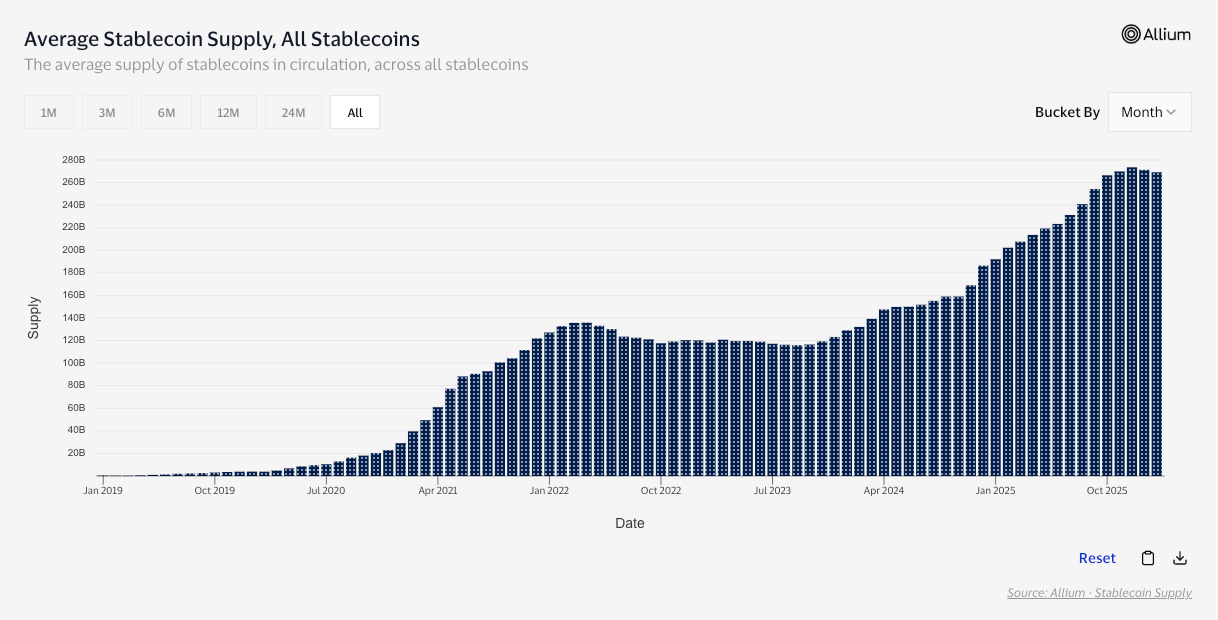
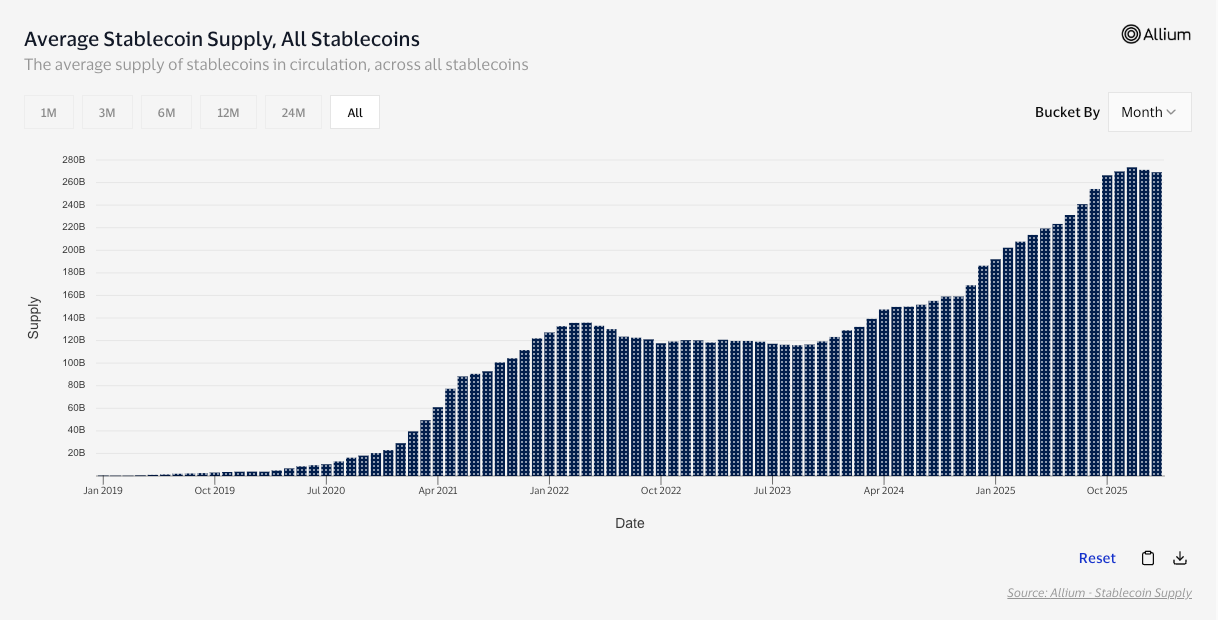
On raw transaction value, total stablecoin volume hit $35 trillion in 2025, according to media reports, citing McKinsey and Artemis Analytics.
But big on-chain volume doesn’t necessarily mean big payments. A lot of stablecoin flow is exchange rebalancing, arbitrage, and DeFi routing – activity that’s economically meaningful, but not the same as a business paying a supplier. This is why adjusted lenses matter. Visa’s on-chain stablecoin work points to $10.2T in adjusted transaction volume over the last 12 months, aiming to filter out non-payment static.
When you home in on real-economy usage, the signal sharpens further. According to the Stablecoin Payments from the Ground Up report, B2B stablecoin volumes have surged from under $100 million monthly in early 2023 to over $3 billion by mid-2025, roughly a 30-fold increase.
So, stablecoins are moving serious value. Let’s move deeper into the ‘why’.
Why B2B Keeps Choosing Stablecoins
Talk to anyone actually moving money cross-border for a living, and you’ll hear the same complaints regarding traditional systems: cut-off times, intermediaries, fee leakage, and manual reconciliation.
Stablecoins are an obvious win. They lack intermediaries, work constantly, offer low fees and even lower rejection rates. Moreover, they open up new audiences for the merchant, positioning them as forward-thinking and adding a competitive advantage.
It’s not like the legacy world isn’t trying to respond. Swift itself has started pushing new rules aimed at predictable retail cross-border payments, cutting out hidden fees, focusing on full value transfers, and faster settlement where domestic infrastructure allows.
But global coordination is hard, and even the G20’s programme to make cross-border payments cheaper and faster is now widely expected to miss its 2027 targets.
Federico Variola, CEO of Phemex, speaks to the adoption curve:
“For younger generations, sending value internationally via stablecoins already makes more sense than using SWIFT. Traditional bank transfers are slow, cumbersome, and expensive, while stablecoins are immediate and easier to operate. As regulation becomes clearer and reporting more straightforward, there’s little structural friction left. From a pure money-transfer perspective, stablecoins are well positioned to overtake traditional banking systems. What’s required now is broader adoption of the mindset.”
While little friction remains, some still exists. Let’s expand on that.
The Real Blockers: Compliance, Redemptions, and Career Risk
Redemption has to be reliable, liquidity has to hold under stress, controls have to be auditable, and the “what happens if…” scenarios need strong answers.
Even the IMF’s pro-innovation framing comes with a warning. Stablecoins can make payments faster and cheaper, but the upside gets undermined fast if the market fragments into non-interoperable coins and networks that can’t cleanly connect.
Central banks are even harsher. The BIS argues stablecoins fall short on core money properties (particularly singleness and integrity) which is a polite way of saying they don’t automatically earn “no questions asked” trust.
Regulation is trying to close that gap. In the EU, MiCA bakes in specific protections for e-money tokens, including issuance and redemption rules at par value, and the EBA is already publishing guidance on redemption plans, liquidity stress testing, and recovery planning. FSB recommendations push in the same direction globally: consistent oversight, governance, and risk management standards.
Then, there’s the softer limiter: reputational comfort (something Variola framed earlier). What’s needed now might be a more constructive public narrative so skeptical users feel comfortable engaging. For CFOs, this ‘reputational comfort’ translates to a low career risk.
Final Thoughts
Stablecoins move value fast, at any hour, across borders, without the usual chain of intermediaries and delays.
The programmable money layer is what thickens the plot. Once dollars can be moved, segmented, and reported on like software, you start to get treasury use cases that aren’t really possible on banking legacy infrastructure. Automated sweeps, conditional releases, real-time visibility, and, in some cases, policy-driven yield.
At the same time, the remaining friction is real. CFOs care about redemption certainty, liquidity under stress, auditability, and whether the compliance posture is defensible. Until those boxes are consistently ticked, stablecoins will keep growing as a practical option rather than becoming the default everywhere.
But directionally, it’s hard to miss what’s happening. The volumes are rising, the B2B highways are being laid, and the mindset is spreading. The only question left is how quickly the compliance and trust layer catches up.
When bitcoin (BTC) was above $84,000, Strategy (formerly MicroStrategy) founder Michael Saylor said, “sell a kidney if you must, but keep the bitcoin.” Yesterday, BTC hit $63,000.
Since his February 27, 2025 advice, BTC has crashed by $19,000, and his company has lost $20 billion in market capitalization.
Strategy’s February 2025 holdings (499,096 BTC) have declined in value by 22% and incinerated $9 billion of his shareholders’ wealth.
Another $11 billion in market capitalization evaporated as Strategy raised more capital for acquisitions, and investors paid less premium for MSTR relative to its BTC holdings: 1.5x then to under 0.9x today.
Incredibly, Saylor’s loss of $9 billion by deciding “keep the BTC” is a better number than the company’s actual market cap losses of $20 billion over the same time period.
Read more: How would Michael Saylor refinance Strategy’s $8.2B debt?
Saylor was wrong to have kidney-selling conviction
Rather than refrain from adding leverage to his already risky enterprise when BTC was at $84,000, Saylor insisted on purchasing more BTC.
BTC has responded by relentlessly declining.
Strategy now owns 717,722 BTC for which it paid over $76,000 apiece. Its entire treasury and the Rube Goldberg machine of convertible debt, preferred stock, and common stock offerings has lost at least $7.9 billion dollars for investors.
Those investing losses are in addition to the cost of operating the Rube Goldberg machine itself.
In fact, the loss for Strategy investors is substantially higher after adjusting for the compensation of executives, bankers, lawyers, consultants, contractors, event planners, compliance officers, operations personnel, media liaisons, assistants, and everyone who helps Strategy capitalize itself.
For example, Strategy has to pay $896 million every year just to service its interest and dividend payments.
It also pays tens of millions of dollars for executive compensation, and has paid for the rest of its loss-generating, BTC-focused enterprise at additional losses for over five years.
Specifically, it’s lost $7.9 billion dollars buying all of its BTC and shedding $20 billion in market cap as investor confidence has waned.
Got a tip? Send us an email securely via Protos Leaks. For more informed news, follow us on X, Bluesky, and Google News, or subscribe to our YouTube channel.
TLDR:
- FCA selects four firms to test stablecoin issuance under proposed UK rules.
- Sandbox trials begin Q1 2026 to assess payments, settlement, and trading use cases.
- Findings will shape final UK stablecoin rules ahead of October 2027 regime.
- Firms receive guidance from FCA specialists to ensure safe and compliant testing.
UK FCA stablecoin Regulatory Sandbox is set to launch in Q1 2026, selecting four firms to test stablecoin issuance under proposed rules.
Monee, ReStabilise, Revolut, and VVTX will participate in the controlled trials, chosen from a pool of 20 applicants.
The Sandbox aims to evaluate how stablecoin services operate in real-world conditions while shaping the UK’s final regulatory framework. Findings will inform rules ahead of the wider crypto regime scheduled for October 2027.
Firms Selected for Stablecoin Testing
The FCA’s Sandbox allows firms to trial stablecoin issuance safely with oversight from regulators. The selected participants cover diverse use cases including payments, wholesale settlement, and crypto trading.
Each company will receive guidance from FCA specialists throughout the testing period to ensure regulatory alignment.
Monee and ReStabilise will focus on payment-related stablecoins, exploring operational models under the proposed safeguards.
Revolut and VVTX will test solutions linked to settlement and trading infrastructures. The trials aim to provide practical insights into how stablecoins function under draft rules.
The Sandbox framework ensures that firms can operate in live conditions with appropriate consumer protections. The FCA will monitor risk management, compliance, and governance practices while reviewing operational performance. Feedback from these exercises will inform adjustments to policy before finalisation.
Matthew Long, director of payments and digital assets at the FCA, stated that the initiative supports trusted stablecoin use for payments, settlement, and trading.
The regulator emphasized that testing contributes to the UK’s National Payments Vision and broader financial innovation strategy.
Timeline and Regulatory Preparations
The FCA confirmed that consultations on stablecoin issuance, cryptoasset custody, and related conduct standards are now largely complete.
Policy Statements defining the future regime are expected later in 2026. This timeline aligns with the launch of the full crypto regulatory framework in October 2027.
Past consultation papers covered prudential requirements, market abuse controls, and the application of FCA Handbook rules.
These documents guide the operational and legal standards for firms participating in the Sandbox. Firms are expected to demonstrate compliance with these frameworks during testing.
All UK firms offering crypto activities must apply for authorisation once the regime goes live. The FCA will open the application gateway in September 2026, giving companies time to prepare.
Authorisation-focused webinars are also being hosted, including sessions on anti-money laundering requirements.
The Prudential Regulation Authority released guidance on deposit, e-money, and regulated stablecoin innovations.
Together, these measures support responsible testing while preparing the market for the broader regulatory environment.
The FCA stablecoin Regulatory Sandbox provides a structured pathway for innovation under careful supervision.


- Morpho price jumped 15% to intraday highs of $1.83 to lead altcoin gainers.
- Morpho’s token has risen since touching lows of $1.02 on February 5, 2026.
- However, overbought RSI levels above 70 indicate a possible consolidation or pullback.
Morpho (MORPHO) price has surged 15% in the past 24 hours, reaching a high of $1.83.
The move sees the real-world assets-focused crypto platform solidify its latest bullish flip, with bulls extending control above a pivotal technical threshold.
MORPHO is trending higher despite broader market weakness.
Morpho’s price surges, up 64% year-to-date
Morpho’s token has risen since touching lows of $1.02 on February 5, 2026, during the recent sharp downturn in the cryptocurrency market.
While most altcoins have remained under pressure, Morpho has moved into a new upward trend.
The token has rebounded about 15% to around $1.83, translating into a weekly gain of roughly 22% and a year-to-date increase of about 64.
Much of this performance has been linked to growing demand for its vault products.
The latest rally follows earlier bullish signals driven by Morpho’s expanding presence in the real-world asset (RWA) ecosystem.
As Wall Street firms and other institutional investors increase their engagement with blockchain-based infrastructure, Morpho has emerged as a key platform in this segment.
Deposits on the lending network have risen sharply, supported by the growing adoption of on-chain payments, tokenized assets, and lending activity.
An extremely large set of RWAs is now on @Morpho‘s platform. https://t.co/Vmx0pjdsl2
— Paul Frambot 🦋 (@PaulFrambot) February 24, 2026
Price momentum in recent weeks also comes as the token attracts attention, with Apollo Global pledging to acquire up to 90 million tokens over the next 48 months.
The latest bounce may also relate to Morpho Markets and vaults going live on Celo.
Intraday volumes have increased sharply to over $45 million.
MORPHO price analysis
The uptick from lows of $1.02 has MORPHO trading above a multi-month descending trendline that links to the highs of $2.80 reached in August 2025.
Bulls are showing conviction as price holds above the 50-day and 200-day exponential moving averages (EMAs).
Notably, oscillators are hovering neutral-buy and moving averages have flipped to “strong buy.”
As such, trading well clear of the 200 EMA at roughly $1.51 cements the uptrend potential.
Bulls are also looking at a hint of a golden cross, with buy-side bias from key technical indicators such as the Relative Strength Index (RSI) and Moving Average Convergence Divergence (MACD).

A sustained close above $1.76, which aligns with prior resistance from May 2025, could propel MORPHO toward $2.15-$2.35.
Next resistance levels lie around $2.80-$3.20.
However, the RSI is in overbought territory above 70, and while not overextended, it suggests a reversal may halt the uptick.
Downside protection could be at $1.50, backed by the 200 and 50-day EMA cluster.
The area around $1.10 and $1.02 offers a strong buy zone.


U.S. Securities and Exchange Commission Chairman Atkins is a top speaker at the Digital Chamber’s DC Blockchain Summit next month, and the event’s chief sponsor — Unicoin — is in a legal fight with the agency, claiming the SEC’s chairman is being misled into perpetuating a legacy war on crypto.
The chief executive for Unicoin, which is the summit’s “platinum” sponsor, says his company is not allowed to speak with the SEC’s leaders due to the agency’s ongoing legal action against the crypto platform. In May last year, the SEC sued the company and its executives, including CEO Alexander Konanykhin, accusing them of raising $100 million for tokens that weren’t backed by real estate in the way the firm represented.
Konanykhin said that the legal clash is pursued by rogue agency enforcers (the “henchmen” of former SEC Chair Gary Gensler) that have misled current SEC Chairman Paul Atkins. (The case may have begun under Gensler’s tenure, but the resulting lawsuit was filed last year under then-Acting Chair Mark Uyeda.)
“We are prohibited from talking to Atkins or other commissioners, so they have no way of knowing that they have been defrauded by ‘dirty cops,’ holdovers from Gensler’s War on Crypto,” Konanykhin wrote in a message to CoinDesk.
Unicoin executives may not be able to speak with Atkins, but the company is helping pay for the event at which Atkins and Commissioner Hester Peirce are the first two speakers highlighted on the summit’s website, in a list that also includes Konanykhin.
When asked about the confluence of Unicoin and its agency adversary at the upcoming summit, the organizers responded with a statement, saying, “Companies come to the Digital Chamber’s DC Summit because it is an opportunity to educate and build bridges.”
An SEC spokesman declined to comment on the situation.
Konanykhin’s company has further sought to educate the SEC with a campaign involving trucks circulating around the center of Washington and past the agency, decorated with pointed messages that included the sentiment, “The War on Crypto is NOT over.”
The CEO has been threading a needle in his sharp criticism of the SEC. He praised Atkins for “steadily repairing the damage on the crypto industry inflicted by his predecessor,” but he insisted that the agency’s enforcement staff is sabotaging Atkins by maintaining Gensler’s legal fight with the digital assets sector, despite the fact the SEC dismissed or delayed the other major crypto enforcement cases pursued under Gensler.
Also, the current securities-fraud charges against Unicoin were made last year, when Republican Commissioner Uyeda was the stand-in chairman. The lawsuit was approved by a commission that then included two Republicans and a Democrat, with no dissenting statements issued. But Konanykhin says the enforcement lawyers got the approval rubber-stamped, arguing that “rejection of a staff recommendation is the exception rather than the rule.”
The policy summit, among the most prominent annual crypto events in Washington, features a code of conduct that calls for “a safe and welcoming environment that fosters open dialogue and the free expression of ideas.” While Konanykhin might want to tell Atkins that his enforcement crew “crudely fabricated absurd charges against Unicoin and its executives,” the legal constraints against him won’t permit that open dialogue.
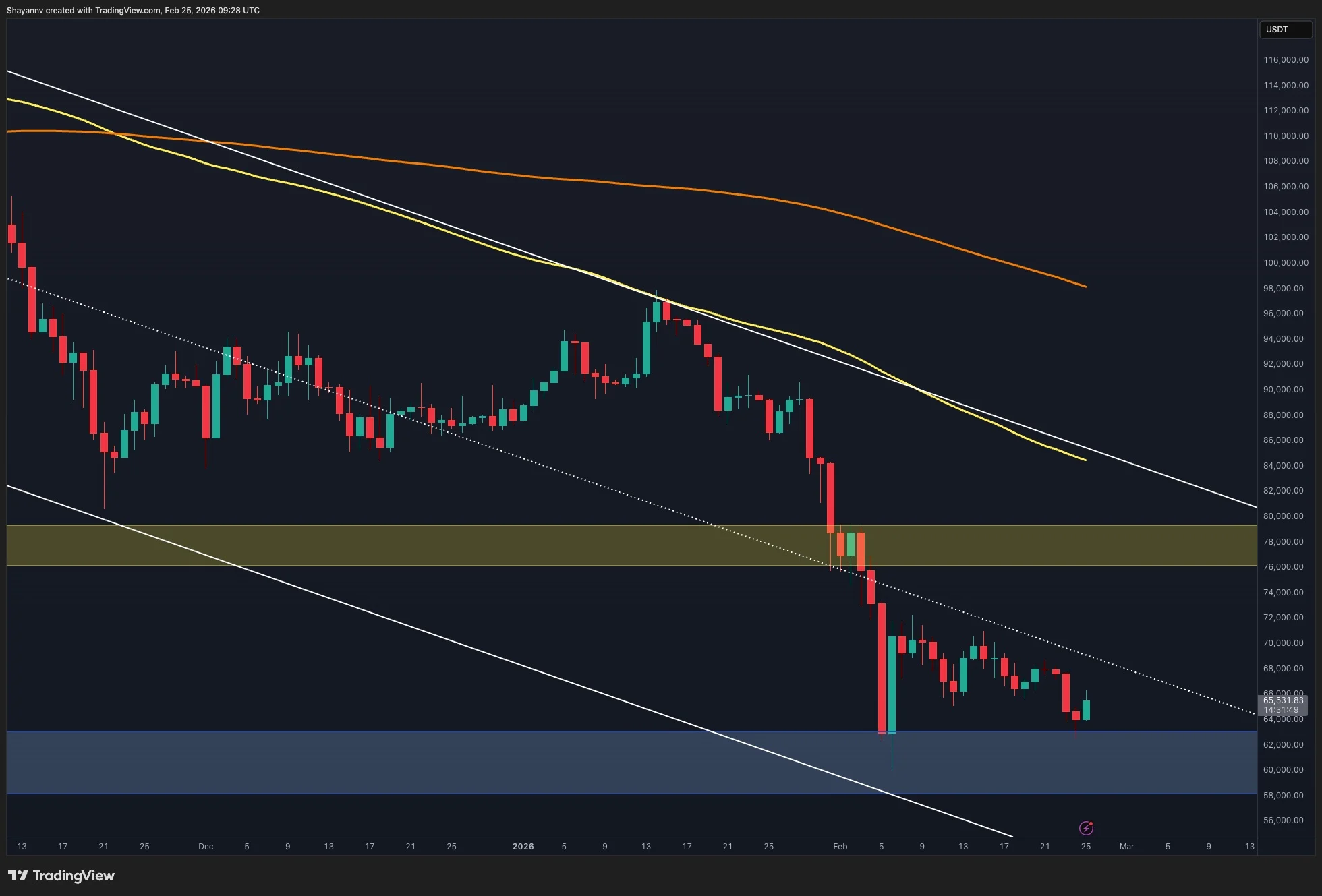
Bitcoin has recently experienced volatility, pushing the price back toward a critical demand zone. Although a short-term reaction has emerged, the market has yet to show convincing signs of trend reversal, keeping the focus on consolidation and corrective movements.
Bitcoin Price Analysis: The Daily Chart
On the daily timeframe, BTC is still struggling to reclaim the channel’s mid-trendline at $68K, which continues to act as a firm dynamic resistance. Multiple attempts to push above this boundary have failed, reinforcing the presence of sellers and confirming that the broader bearish structure remains intact.
The recent sharp sell-off drove prices toward the $60K region, where buyers stepped in and triggered a modest bounce. However, this rebound has so far lacked strong follow-through, and the price continues to consolidate below the channel’s midline. As long as Bitcoin remains capped beneath this dynamic resistance, upside movements are likely corrective in nature.
Given the current structure, short-term consolidation between the $60K demand zone and the channel’s middle boundary appears likely until a decisive breakout occurs.
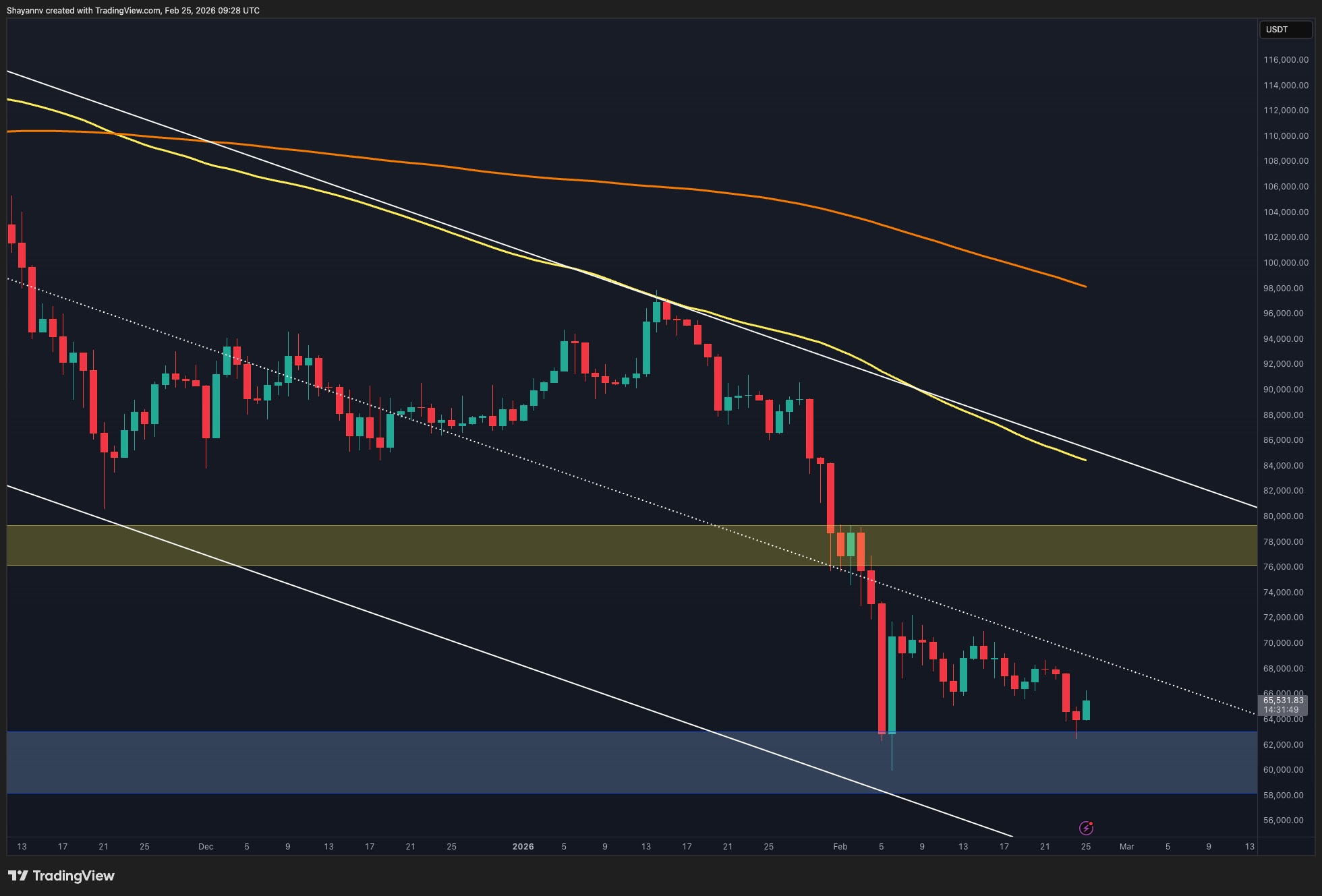
BTC/USDT 4-Hour Chart
On the 4-hour timeframe, Bitcoin recently broke below a symmetrical triangle pattern, signaling short-term seller dominance. The breakdown invalidated the prior compression structure and accelerated downside momentum, confirming that bears remain in control at lower highs.
The asset has since found support near the $62K zone, where demand has temporarily stabilized the decline. A minor rebound is underway, and there is potential for a short-term pullback toward the underside of the broken triangle trendline. Such a move would likely act as a technical retest of prior support-turned-resistance.
Unless Bitcoin decisively reclaims the broken trendline and builds structure above it, any recovery toward that area should be viewed as corrective. Sustained weakness below the trendline keeps the short-term bias tilted to the downside, with the $60K–$62K region remaining the key support cluster.

Sentiment Analysis
Funding rates across exchanges have recently turned negative following the latest sell-off, reflecting increased short positioning and a shift in market sentiment toward caution. The spike in negative funding during the sharp drop suggests aggressive short exposure entering the market as the price approached the $60K region.
Historically, sustained negative funding can create conditions for short squeezes if the price stabilizes and begins to recover. However, at present, funding appears moderately negative rather than extreme, indicating that while bearish sentiment has increased, the market is not yet at capitulation levels.
The combination of price holding near support and funding remaining below neutral suggests a fragile equilibrium. If Bitcoin maintains stability above $60K, the elevated short positioning could fuel a corrective bounce. Conversely, renewed downside pressure could push funding deeper into negative territory, reinforcing bearish continuation.
Overall, Bitcoin is consolidating beneath major resistance, holding above critical support, and experiencing rising short bias in derivatives markets. The interaction between price structure and funding dynamics will likely dictate the next significant move.

Binance Free $600 (CryptoPotato Exclusive): Use this link to register a new account and receive $600 exclusive welcome offer on Binance (full details).
LIMITED OFFER for CryptoPotato readers at Bybit: Use this link to register and open a $500 FREE position on any coin!
Disclaimer: Information found on CryptoPotato is those of writers quoted. It does not represent the opinions of CryptoPotato on whether to buy, sell, or hold any investments. You are advised to conduct your own research before making any investment decisions. Use provided information at your own risk. See Disclaimer for more information.

Historical NFL Vertical Jump Results for Players from West

Xiaomi 17 Series & Pad 8 Confirmed to Launch in India on February 28

Donald Trump’s State of the Union address proved you have to fight dirty | News US


-

 Video6 days ago
XRP News: XRP Just Entered a New Phase (Almost Nobody Noticed)
-

 Politics3 days ago
Baftas 2026: Awards Nominations, Presenters And Performers
-

 Fashion5 days ago
Weekend Open Thread: Boden – Corporette.com
-

 Sports2 days ago
Women’s college basketball rankings: Iowa reenters top 10, Auriemma makes history
-

 Politics2 days ago
Nick Reiner Enters Plea In Deaths Of Parents Rob And Michele
-
 Sports6 days ago
Clearing the boundary, crossing into history: J&K end 67-year wait, enter maiden Ranji Trophy final | Cricket News
-

 Crypto World1 day ago
XRP price enters “dead zone” as Binance leverage hits lows
-

 Business3 days ago
Mattel’s American Girl brand turns 40, dolls enter a new era
-

 Business3 days ago
Law enforcement kills armed man seeking to enter Trump’s Mar-a-Lago resort, officials say
-

 Entertainment7 days ago
Dolores Catania Blasts Rob Rausch For Turning On ‘Housewives’ On ‘Traitors’
-

 Tech3 days ago
Anthropic-Backed Group Enters NY-12 AI PAC Fight
-
 NewsBeat2 days ago
‘Hourly’ method from gastroenterologist ‘helps reduce air travel bloating’
-

 NewsBeat3 days ago
Armed man killed after entering secure perimeter of Mar-a-Lago, Secret Service says
-

 Tech21 hours ago
Unsurprisingly, Apple's board gets what it wants in 2026 shareholder meeting
-

 Politics3 days ago
Maine has a long track record of electing moderates. Enter Graham Platner.
-

 Crypto World7 days ago
WLFI Crypto Surges Toward $0.12 as Whale Buys $2.75M Before Trump-Linked Forum
-
 NewsBeat16 hours ago
Police latest as search for missing woman enters day nine
-

 Crypto World6 days ago
83% of Altcoins Enter Bear Trend as Liquidity Crunch Tightens Grip on Crypto Market
-
 Sports2 days ago
2026 NFL mock draft: WRs fly off the board in first round entering combine week
-

 Crypto World16 hours ago
Entering new markets without increasing payment costs