

Business
Thomson Reuters Announces New US$600 Million Share Repurchase Program and US$605 Million Return of Capital and Share Consolidation Transactions

Up to
Amended Normal Course Issuer Bid
Shares will be repurchased for the new
Under the amended NCIB, shares may be repurchased on the TSX, the Nasdaq Global Select Market (Nasdaq) and/or other exchanges and alternative trading systems or by such other means as may be permitted by the TSX and/or the Nasdaq or under applicable law. Based on the average daily trading volume on the TSX of 364,105 for the six months preceding the Effective Date (net of repurchases made by TR during that time period), daily purchases are limited to 91,026 common shares, other than block purchase exceptions. Any shares that are repurchased will be cancelled.
Prior to its next regularly scheduled quarterly blackout period,
Decisions regarding any future share repurchases will depend on certain factors, such as market conditions, share price and other opportunities to invest capital for growth.
Return of Capital
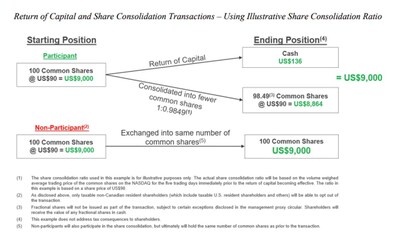
The proposed return of capital is intended to distribute cash on a basis that is generally expected to be tax-free for Canadian tax purposes. Taxable non-Canadian resident shareholders (which include taxable
Shareholders will be asked to approve the proposed return of capital and share consolidation transactions at a special meeting of shareholders of
Full details of the proposed return of capital and share consolidation transactions will be described in the company’s management proxy circular and other related materials. Those documents are expected to be mailed or otherwise distributed to shareholders, filed with applicable Canadian securities regulatory authorities and made available without charge on SEDAR+ at www.sedarplus.ca and made available without charge on EDGAR at www.sec.gov, and posted on the company’s website at tr.com, in mid-March.
SPECIAL NOTE REGARDING FORWARD-LOOKING STATEMENTS
Certain statements in this news release are forward-looking statements within the meaning of Canadian and
CONTACTS
 View original content to download multimedia:https://www.prnewswire.com/news-releases/thomson-reuters-announces-new-us600-million-share-repurchase-program-and-us605-million-return-of-capital-and-share-consolidation-transactions-302696958.html
SOURCE Thomson Reuters

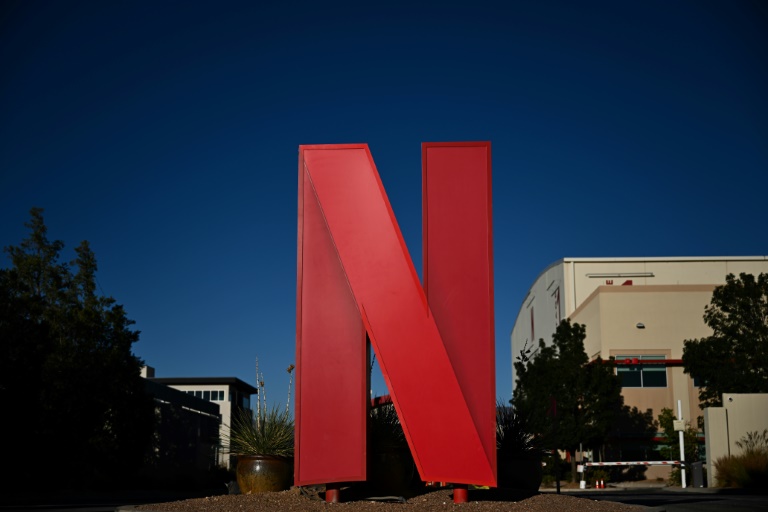
Netflix Inc.’s stock reached a new all-time high in late February 2026, closing at $1,048.72 on February 24 after gaining 1.82%, as the streaming giant posted blockbuster fourth-quarter and full-year 2025 results that showcased accelerating paid subscriber additions, explosive growth in its advertising-supported tier, and sustained profitability improvements.
AFP
As of February 24, 2026, Netflix (NASDAQ: NFLX) traded in a session range of $1,030.15 to $1,055.40 with volume of approximately 4.2 million shares. The shares have surged more than 65% year-to-date in 2026 following a strong 2025 close, pushing market capitalization above $450 billion for the first time. The 52-week range spans $610.20 to $1,055.40, reflecting investor confidence in Netflix’s transition to a mature, high-margin business.
The rally followed Netflix’s fourth-quarter earnings report released January 21, 2026, which delivered multiple records. The company added 18.9 million paid net subscribers in Q4—the largest quarterly gain in its history—bringing total paid memberships to 301.6 million, up 16% year-over-year. Full-year 2025 net additions reached a record 51.4 million, surpassing prior guidance and marking the strongest growth since the streaming wars began.
Revenue climbed 15.7% year-over-year to $10.25 billion in Q4, beating analyst expectations of $10.13 billion. Full-year revenue hit $39.00 billion, up 15%. Operating margin expanded to 29% in Q4 from 22% the prior year, with operating income reaching $2.97 billion. Net income rose to $2.48 billion, or $5.73 per diluted share, compared with $1.48 billion and $3.33 per share in Q4 2024.
The advertising tier drove outsized gains, with ad-supported memberships growing more than 65% sequentially in Q4 and representing a significant portion of new sign-ups in launch markets. Netflix reported that ad revenue more than doubled year-over-year in Q4, with average revenue per user in the ad tier approaching levels seen in the standard plan in some regions. Management guided for continued rapid ad-tier expansion in 2026, with plans to roll out the tier in additional countries and enhance targeting through improved data and partnerships.
CEO Ted Sarandos and co-CEO Greg Peters emphasized the success of password-sharing restrictions, now implemented in nearly every market, which contributed to both subscriber adds and revenue growth. The company also highlighted strong content performance, with hits like “Squid Game” Season 2, “Stranger Things” final season, and live events—including NFL games and WWE Raw—driving engagement. Live programming, including the upcoming Jake Paul-Mike Tyson boxing match rescheduled to early 2026, is expected to further boost viewership.
Netflix provided optimistic 2026 guidance, projecting revenue growth of 14-15% and operating margin expansion to 29-30%. The company anticipates another year of significant paid net subscriber additions, though at a moderated pace compared with 2025’s record. Free cash flow is forecast to exceed $8 billion in 2026, up from $6.9 billion in 2025, supporting continued content investment and potential share repurchases or dividends.
Wall Street responded enthusiastically. Consensus among 35-40 analysts rates NFLX a Moderate Buy to Buy, with average 12-month price targets around $1,100 to $1,150—implying 5-10% upside from current levels. High targets reach $1,300 from firms like Wedbush and Morgan Stanley, citing the advertising business’s long runway and global market penetration potential. Some analysts noted Netflix’s valuation at roughly 35 times forward earnings appears reasonable given margin expansion and cash flow strength.
Challenges include intensifying competition from Disney+, Amazon Prime Video, and emerging players, as well as content cost pressures and potential saturation in mature markets. International growth remains a focus, with Latin America, Asia-Pacific, and Europe, Middle East and Africa showing robust additions. Password-sharing crackdowns continue to yield benefits but face occasional pushback.
The next major update arrives with first-quarter 2026 earnings, expected in late April. Investors will watch subscriber trends, ad-tier penetration, content slate performance, and any refinements to full-year guidance.
Netflix has evolved from a DVD-by-mail pioneer into the dominant global streaming service, with a differentiated strategy blending originals, licensed content, live events, gaming, and advertising. Record subscriber gains, margin expansion, and a maturing ad business position it for continued outperformance in 2026, even as the streaming landscape grows more competitive. With shares at fresh highs, Netflix remains a bellwether for digital media and a core holding for growth-oriented investors.

WA high-performance computing company DUG will fight a hefty legal bill lobbed at it by a Texas court, after it was found to have breached a supplier contract with a Shell subsidiary.
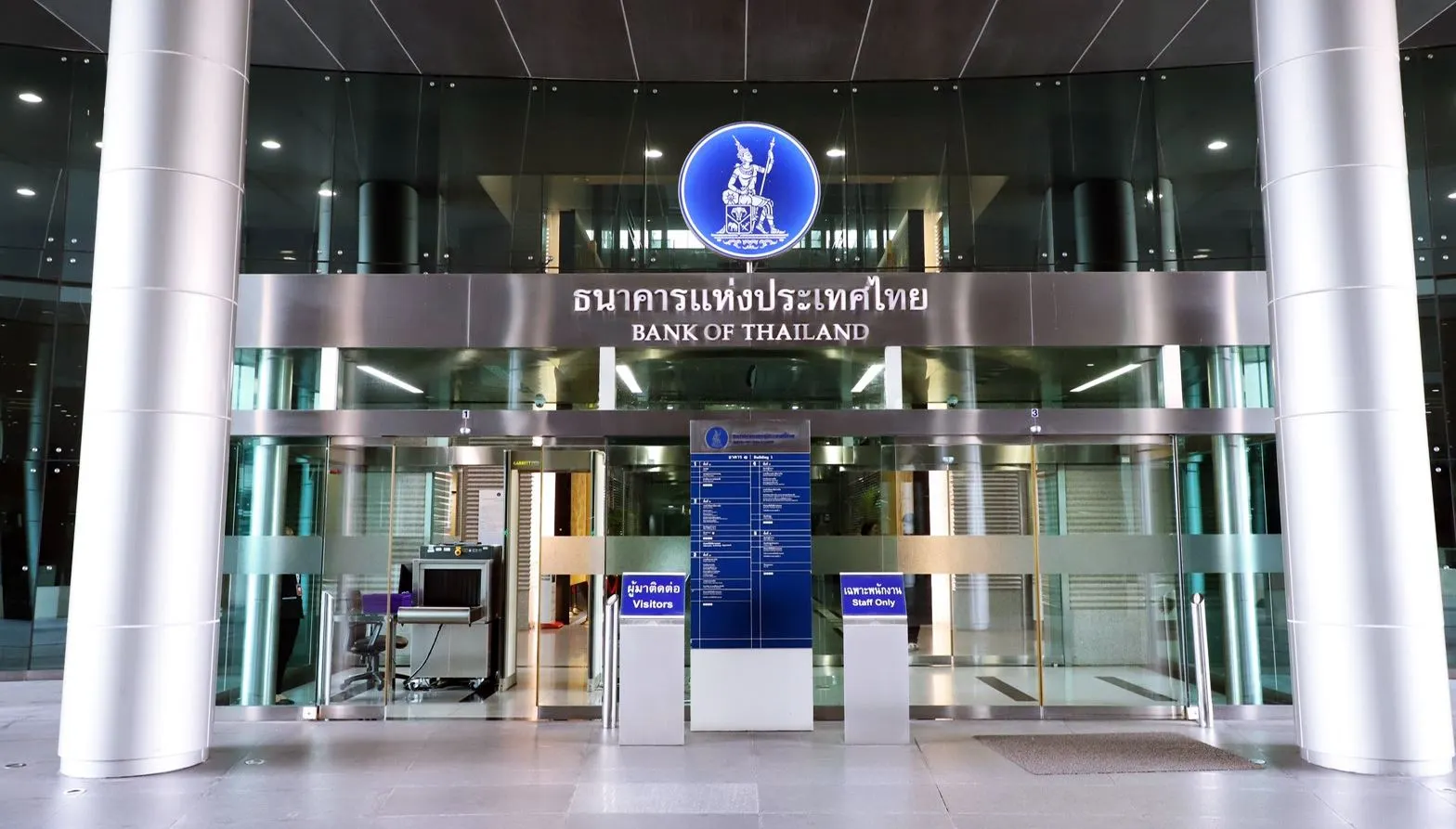
The Bank of Thailand’s Monetary Policy Committee unexpectedly lowered its key interest rate by 25 basis points to 1.00% during its first review of 2026.
The decision comes as a surprise to analysts who had widely anticipated no change in the rate. The move aims to support economic growth amid global uncertainties and sluggish domestic demand.
Key Points
- The Monetary Policy Committee voted 4 to 2 to reduce the one-day repurchase rate to 1.00%.
- The move caught the market by surprise, as only six of 27 economists surveyed by Reuters had predicted a rate cut.
- This reduction marks the sixth rate cut since October 2024, bringing the total reduction over that period to 150 basis points.
- The central bank cited the need to mitigate risks from a strong baht and global trade uncertainties, particularly regarding US trade policy.
- Despite the rate cut, the Bank of Thailand raised its 2026 GDP growth projection to 1.9%, up from a previous estimate of 1.5%, following a stronger-than-expected economic performance in the fourth quarter of the prior year.
The Bank of Thailand’s Monetary Policy Committee (MPC) unexpectedly voted 4 to 2 to cut the one-day repurchase rate by 25 basis points to 1.00% during its first review of 2026. This move caught the majority of economists by surprise, as most had predicted no change following stronger-than-expected economic performance in late 2025.
This decision aims to support economic recovery, alleviate the debt burden for SMEs and households, and anchor inflation expectations amid heightened downside risks. While the economy showed stronger-than-expected momentum in late 2025, the committee anticipates that future growth will remain below potential due to structural impediments, necessitating a more accommodative policy stance to counter a strengthening currency and slowing private consumption.
Key Factors
- Economic growth is projected to stay below potential in 2026 and 2027, constrained by intensified competition and structural issues that limit the value added by exports and investment.
- Headline inflation risks have increased on the downside due to falling energy prices and weak demand-side pressures, with a return to the target range now delayed until the second half of 2027.
- The Thai baht has appreciated against the U.S. dollar, leading to concerns regarding exchange rate misalignment and its negative impact on exporter competitiveness.
- Overall credit continues to contract as financial institutions maintain a cautious lending stance, particularly toward SMEs and high-risk borrowers.
- Two dissenting members voted to maintain the rate at 1.25%, arguing that existing policy transmission is still ongoing and that preserving limited monetary policy space is critical.
- The MPC emphasized that monetary policy alone cannot resolve structural growth problems and called for integrated policies to improve national productivity and competitiveness.
Primary Macroeconomic Factors
The decision was driven by the need to buffer the Thai economy against specific external and domestic challenges:
- US Tariff Uncertainty: The central bank cited concerns regarding the unpredictable nature of US trade tariffs and the potential impact they could have on the Thai economy.
- Strengthening Currency: The “strengthening baht” was identified as a key challenge that the rate cut seeks to address, as a strong currency can impact export competitiveness.
- External Risks: The move serves as a proactive measure to protect the economy against broader external risks that may threaten stability.
Economic Stimulation and Support
Beyond immediate risks, the rate cut was part of a broader strategy to support the national economy:
- Sparking Growth: The reduction is intended to “spark” Southeast Asia’s second-largest economy, which has seen authorities trying to stimulate momentum through a series of cuts.
- Continued Monetary Support: This was the sixth rate cut since October 2024 (totaling a 150-basis-point reduction), indicating an ongoing effort to provide a supportive monetary environment despite recent improvements in the economy.
Context of the “Unexpected” Decision
The move was considered unexpected by the majority of economists (21 out of 27 polled by Reuters) because several positive indicators suggested no change was necessary:
- Stronger-than-expected GDP growth in the fourth quarter of the previous year.
- An optimistic outlook from the central bank, which raised its 2026 GDP growth projection from 1.5% to 1.9%.
- An improving political outlook within the country.
Although the domestic growth outlook was improving, the MPC focused on defensive measures to counter currency strength and global trade uncertainties, such as US tariffs, to ensure sustained economic stability. While domestic indicators showed signs of recovery, the MPC remained cautious, prioritizing strategies to mitigate risks associated with external pressures. These included addressing potential volatility from fluctuating exchange rates and navigating the challenges posed by shifting global trade policies. By maintaining a balanced approach, the committee aimed to safeguard long-term economic resilience and foster a stable growth environment.
Other People are Reading

Wayve says it’s confident all cars will one day be autonomous, as it announced more than a £1bn in additional investment.

Fenix Resources’ profit has jumped more than 400 per cent as the Mid West iron ore miner gets its projects operating at full capacity.

BioNTech: The Market Is Pricing Low Oncology Success


Now available on your favorite food delivery app: restaurant reservations.
The still-simmering reservation wars of the last decade could fully reignite this year, as a shifting tech landscape pits some of the biggest players against each other to capture businesses and users alike. Reservation incumbents, delivery app newcomers and premium credit card partnerships are all ramping up the fight for a shrinking pool of diners.
Delivery giant DoorDash announced in June its $1.2 billion acquisition of SevenRooms, a reservation platform focused on direct bookings through a restaurant’s own website. Several months earlier, UberEats and Booking Holdings’ OpenTable announced a partnership to integrate reservations on Uber’s app. And in 2024, American Express, already the owner of Resy, bought Tock, a reservation platform focused on upscale restaurants, for $400 million.
“It’s three very large, very ambitious, very well-resourced companies all vying for the same exact piece of real estate, which is high-demand restaurants,” Resy and Eater founder Ben Leventhal told CNBC.
Leventhal still acts as an advisor to Resy, which was bought by AmEx in 2019, although today he focuses on Blackbird Labs, a loyalty program for independent restaurants that he founded in 2022.
Bringing restaurants online
The reservation wars initially kicked off more than 10 years ago. Leventhal’s Resy burst onto the scene in 2014 and won market share, undercutting OpenTable’s legacy business, by charging eateries a simple monthly fee.
At the time, OpenTable, which was founded in 1998, charged restaurants both a monthly fee and a cover for each diner who booked through the platform. These days, the company still sometimes charges a variable cover fee for seated diners, depending on the establishment.
Thomas Barwick | Digitalvision | Getty Images
Despite Resy’s rise and buzzy partnerships with high-profile restaurants, OpenTable still significantly outstrips its rival by restaurant count.
Starting this summer, Resy will integrate the 5,000 eateries, bars and wineries that have listed on Tock onto its own platform, bringing its total number of venues to about 25,000. That’s still less than half of OpenTable’s roughly 60,000 restaurants.
But where OpenTable has scale, Resy has a “cool factor” and strong positioning in major cities, like New York, where dining out is big business.
And each companies’ relationships with credit card companies has added a new layer to the war, too.
Supercharging the platforms
Platinum American Express cardholders get special access to restaurant reservations at sought-after establishments, plus a $400 dining credit per year to use at Resy restaurants.
“We know that American Express card members spend close to $90 billion a year … on dining, and it’s a passion area for them,” Resy CEO Pablo Rivero told CNBC. “And we know that they also spend more. People with a Resy credit on an American Express card spend over 25% more on dining transactions.”
Likewise, eligible Visa and Chase cardholders get exclusive OpenTable reservations.
Those partnerships have also helped the legacy player woo some big-name restaurants away from Resy through cash incentives made possible by the credit card companies.
Recapturing top-tier restaurants with Michelin stars or James Beard awards has been a priority for OpenTable over the last five years, said OpenTable CEO Debby Soo.
“Credit card companies are looking for a perk to differentiate their cards, especially for their premium cardholders,” Soo said. “Especially after Covid, the experiential has become even more important.”
Delivery’s here
Now, DoorDash is entering the fray with its SevenRooms acquisition.
The company is used to fighting for market share in a competitive industry. Before the pandemic, DoorDash was up against UberEats and Grubhub for market dominance of online third-party food delivery.
As of 2025, DoorDash was the biggest player in the U.S. market, with about 67% share, according to digital restaurant operations firm Deliverect. UberEats trails with a 23% share.
Eric Baradat | AFP | Getty Images
As it enters the bookings game, DoorDash is looking to capture the range of dining possibilities, whether it’s delivery, takeout or table.
In the early months of its reservations integration, the platform was offering users DoorDash cash per booking to use on future delivery orders. And in select cities, it offers exclusive tables at trendy spots for members of DashPass, its subscription service.
Above all, the integration with SevenRooms gives DoorDash and its restaurants access to more data about diners.
“Delivery and dine-in have typically been siloed data sets,” SevenRooms co-founder Joel Montaniel said. “So if a customer has ordered six times, and they’re coming into the restaurant for the first time, are they a first-time customer or a seventh-time customer?”
Following a diner across touchpoints means a better experience, and more tailored marketing, he said.
“We’re seeing the flywheel happening and the excitement about the DoorDash reservation marketplace happening, but it’s still early days,” said Parisa Sadrzadeh, vice president of strategy and operations for DoorDash. “We’ve got a lot of room to continue to grow.”

AppLovin: Time To Load Up Again (Rating Upgrade)

About 600 jobs will go at the luxury car maker, which in part blames US tariffs for its troubles.
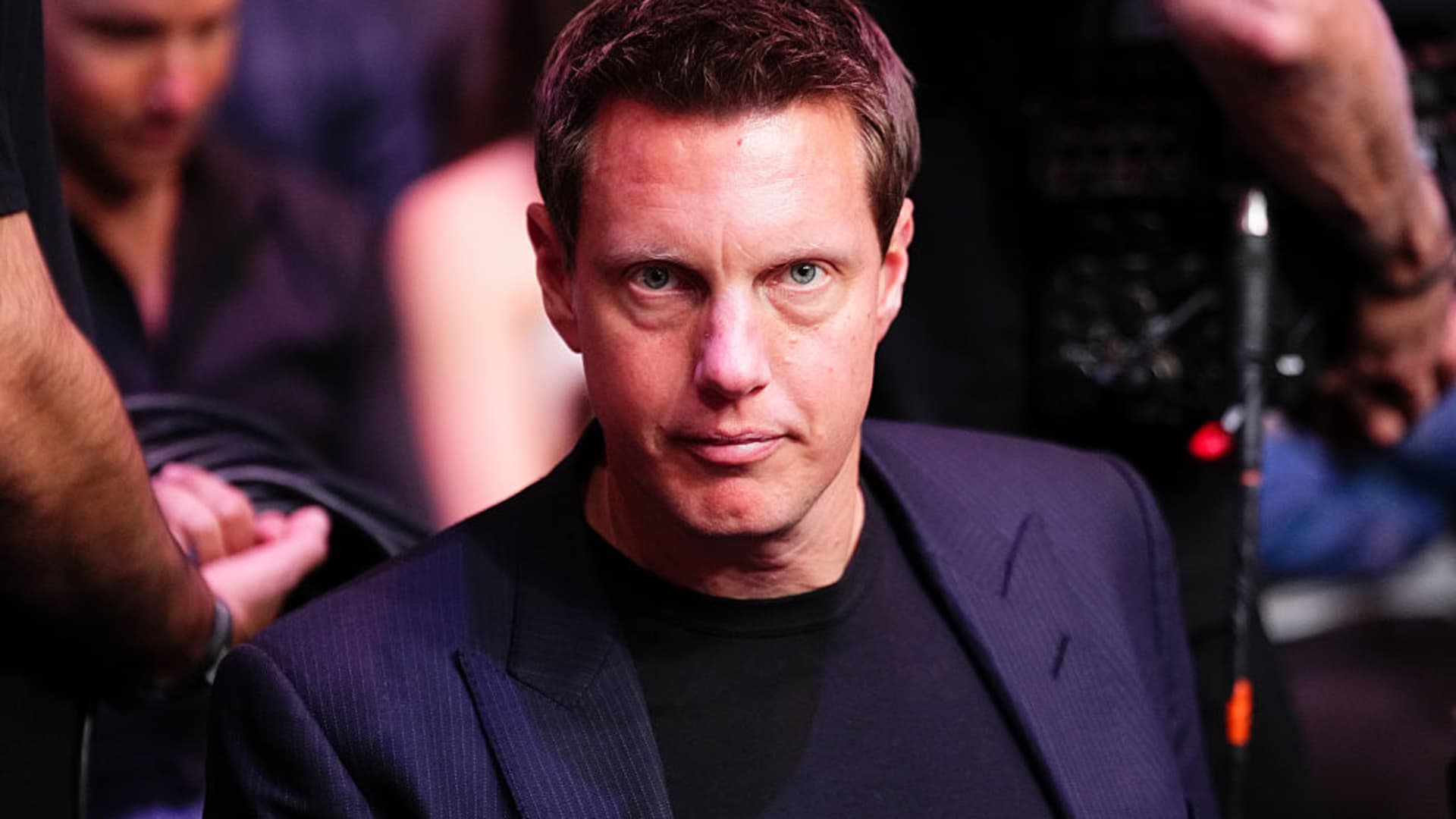
Chairman & CEO Paramount David Ellison attends the UFC 324 event at T-Mobile Arena on January 24, 2026 in Las Vegas, Nevada.
Jeff Bottari | Ufc | Getty Images
If there’s one thing that Paramount Skydance CEO David Ellison knows well, it’s an impossible mission.
Ellison, producer of five of the “Mission: Impossible” films, has been trying to buy Warner Bros. Discovery for nearly six months. In September, he sent an initial, unsolicited offer to WBD, prompting the rival media company to explore a sale process that resulted in an agreement with Netflix to sell the famed Warner Bros. film studio and WBD’s prestige streaming assets.
Ellison launched a hostile tender offer and, separately, was welcomed back to the negotiating table with WBD under a seven-day waiver from Netflix. This week, Paramount upped its offer for the entirety of WBD.
The Warner Bros. movie studio is a big part of why Ellison has been so committed to winning over WBD’s board and its shareholders.
Last year, Warner Bros. was the second-highest grossing studio at the domestic box office. Paramount was fourth.
A longtime Hollywood executive, Ellison has produced some massive hits at the box office, but his track record has been far from consistent.
Where Netflix has a fraught relationship with theatrical releases — disrupting the traditional business and opting for years to prioritize streaming films for its subscribers — Ellison’s production company, Skydance, has followed the tried-and-true theatrical playbook.
Taking ownership of Warner Bros. would be a gamechanger for either company.
“If a merger were to be approved, the entity that then grabs up Warner Bros. would add tremendous horsepower both in terms of brand identity and revenue generating potential to their portfolio,” said Paul Dergarabedian, head of marketplace trends at Comscore. “So, it is understandable why the competition is fierce among the potential suitors vying for their chance to acquire the studio.”
A history of Skydance at the box office
Skydance released its first theatrical feature in 2006, a World War I drama featuring James Franco as a U.S. fighter pilot. Over the last two decades, the studio has launched nearly 30 films, the majority of which were in partnership with Paramount, according to data from Comscore.
Paramount and Skydance completed their merger, engineered by Ellison, in August.
Skydance’s biggest successes have come from one source in particular — Tom Cruise. The studio’s six highest-grossing films globally all star Cruise, including five “Mission: Impossible” films and the breakout 2022 hit “Top Gun: Maverick.”
Highest-grossing Skydance films globally
- “Top Gun: Maverick” (2022) — $1.4 billion
- “Mission: Impossible — Fallout” (2018) — $791 million
- “Mission: Impossible — Ghost Protocol” (2011) — $694 million
- “Mission: Impossible — Rogue Nation” (2015) — $682 million
- “Mission: Impossible — The Final Reckoning” (2025) — $599 million
- “Mission: Impossible — Dead Reckoning: Part One” (2023) — $571 million
- “World War Z” (2013) — $540 million
- “Star Trek Into Darkness” (2013) — $467 million
- “Transformers: Rise of the Beasts” (2023) — $441 million
- “Terminator Genisys” (2015) — $440 million
Source: Comscore
Having a billion-dollar film under your belt is no small feat, especially in the wake of the pandemic.
The theatrical business has been in flux in recent years as consumer habits have shifted, studios grapple with how long movies should play in cinemas before hitting the home market, and streaming siphons away potential releases.
For comparison, Disney has released six billion-dollar films since 2021: “Avatar: The Way of Water,” “Inside Out 2,” “Deadpool & Wolverine,” “Moana 2,” “Zootopia 2” and “Avatar: Fire and Ash.”
Warner Bros. had 2023’s “Barbie,” Universal had “The Super Mario Bros. Movie” that same year, and Sony had “Spider-Man: No Way Home” in 2021, according to Comscore data.
Tom Cruise in “Top Gun: Maverick”
Source: Paramount
However, “Top Gun: Maverick” is a bit of an outlier for Skydance. In addition to being the studio’s only billion-dollar film, it’s also the only film in its library to exceed $230 million domestically.
In fact, only five of Skydance’s features to date have generated more than $200 million in the U.S. and Canada.
Skydance’s highest-grossing domestic films
- “Top Gun: Maverick” (2022) — $718 million
- “Star Trek Into Darkness” (2013) — $228 million
- “Mission: Impossible — Fallout” (2018) — $220 million
- “Mission: Impossible — Ghost Protocol” (2011) — $209 million
- “World War Z” (2013) — $209 million
Source: Comscore
Globally, the production company has seen seven of its films generate more than $500 million in ticket sales, which would be a bigger feat — if budgets for many of these films weren’t so high.
“The challenge for Ellison and Skydance, as it is for every studio, production company, and distributor, is to keep budgets in line particularly for latter installments of major franchises as these tend to have diminishing returns as compared the earlier releases to justify the continued investment in these movie franchises,” said Dergarabedian.
Of course, Skydance split production costs with its studio partners, so it’s unclear exactly how much the company put toward each film it produced. Still, many of its franchise films saw budgets balloon with each new installment.
Look at the most recent “Mission: Impossible” film. “Mission Impossible: The Final Reckoning” generated $599 million at the global box office, the fourth-best showing for a film in the franchise. However, the film had a reported budget of $400 million. That’s before marketing costs, which usually run at about half of the production budget.
General views of the TCL Chinese Theatre promoting the new Tom Cruise film ‘Mission: Impossible The Final Reckoning’ in IMAX on May 23, 2025 in Hollywood, California.
Aaronp/bauer-griffin | Gc Images | Getty Images
So, Skydance in conjunction with Paramount would have spent an estimated $600 million ahead of the “The Final Reckoning’s” release in theaters. And that $599 million brought in from ticket sales gets split.
Studios share box office proceeds with theater operators, typically in a 50-50 split by the end of a film’s run in theaters.
The result is often a movie that performed well at the box office, but ultimately was not profitable for the studios that produced it. And unlike some franchises — think Marvel, Star Wars or Harry Potter — Mission: Impossible doesn’t have a robust merchandising arm or as much demand from fans for things like toys, apparel or collectibles.
A mountain of content
In merging with Paramount, Ellison’s Skydance now has more properties that fall under the production company’s designation. That includes the lucrative Sonic the Hedgehog franchise and upcoming films like “Scream 7,” “Paw Patrol 3,” “Street Fighter,” “Scary Movie 6” and “Focker-in-Law,” the latest installment in the Robert De Niro-led Meet the Parents franchise.
However, Paramount’s slate of franchises still aren’t quite the heavy hitters that WBD carries on its roster.
Still from Paramount’s “Sonic the Hedgehog 2.”
Paramount
“Warner Bros. is one of the crown jewels of the theatrical distribution,” said Dergarabedian. “Their slate of films, filmmaker relationships, brand recognition, and reputation as one of the premier and iconic movie studios makes them a coveted asset by any player in the entertainment space.”
WBD has in its library DC’s superheroes, Harry Potter, Lord of the Rings, Game of Thrones, Looney Tunes and Scooby-Doo. It is also the distributor of Legendary’s Dune and Godzilla and King Kong franchises.
“In Paramount’s specific case, the studio’s box office market share has often been challenged to keep pace with competitors and its own peak performance in the years leading up to 2015,” said Shawn Robbins, director of analytics at Fandango and founder of Box Office Theory. “While occasional hits such as the Sonic, A Quiet Place, and Scream franchises have provided bright spots, plus ‘Top Gun: Maverick’ catching lightning in a bottle four years ago, some of the studio’s most bankable IP has seen diminishing returns among modern moviegoers.”
Paramount Skydance needs consistency at the box office and well-known and beloved franchises are one way to do that. Of course, just having a big name doesn’t guarantee box office success, but it lowers the barrier to entry.
“Paramount is looking to mine every opportunity it can following the recent conclusion of Tom Cruise’s Mission: Impossible series, the regression of Transformers from its biggest blockbuster dollar days, and the cinematic dormancy of Star Trek as that brand has been re-focused toward multiple streaming series targeted at its predominately older audience,” Robbins said.
Disclosure: Versant is the parent company of CNBC and Fandango.

Labour Pauses Chagos Handover Deal For More Talks With US After Trump Outburst
What the Vikings Revealed at the Start of the NFL Combine

Rising memory & battery costs complicate Apple's lower-cost MacBook


-

 Video6 days ago
XRP News: XRP Just Entered a New Phase (Almost Nobody Noticed)
-

 Politics3 days ago
Baftas 2026: Awards Nominations, Presenters And Performers
-

 Fashion5 days ago
Weekend Open Thread: Boden – Corporette.com
-

 Sports2 days ago
Women’s college basketball rankings: Iowa reenters top 10, Auriemma makes history
-

 Politics2 days ago
Nick Reiner Enters Plea In Deaths Of Parents Rob And Michele
-
 Sports6 days ago
Clearing the boundary, crossing into history: J&K end 67-year wait, enter maiden Ranji Trophy final | Cricket News
-

 Crypto World1 day ago
XRP price enters “dead zone” as Binance leverage hits lows
-

 Business3 days ago
Mattel’s American Girl brand turns 40, dolls enter a new era
-

 Business3 days ago
Law enforcement kills armed man seeking to enter Trump’s Mar-a-Lago resort, officials say
-

 Entertainment7 days ago
Dolores Catania Blasts Rob Rausch For Turning On ‘Housewives’ On ‘Traitors’
-
 NewsBeat2 days ago
‘Hourly’ method from gastroenterologist ‘helps reduce air travel bloating’
-

 Tech3 days ago
Anthropic-Backed Group Enters NY-12 AI PAC Fight
-

 NewsBeat3 days ago
Armed man killed after entering secure perimeter of Mar-a-Lago, Secret Service says
-

 Tech22 hours ago
Unsurprisingly, Apple's board gets what it wants in 2026 shareholder meeting
-

 Politics3 days ago
Maine has a long track record of electing moderates. Enter Graham Platner.
-

 Crypto World7 days ago
WLFI Crypto Surges Toward $0.12 as Whale Buys $2.75M Before Trump-Linked Forum
-
 NewsBeat17 hours ago
Police latest as search for missing woman enters day nine
-

 Crypto World6 days ago
83% of Altcoins Enter Bear Trend as Liquidity Crunch Tightens Grip on Crypto Market
-
 Sports2 days ago
2026 NFL mock draft: WRs fly off the board in first round entering combine week
-

 Crypto World17 hours ago
Entering new markets without increasing payment costs