Connect with us

Tech

What One-Winged Squids Can Teach The Airship Renaissance

Published

on

It’s a blustery January day outside Lakehurst, New Jersey. The East Coast of North America is experiencing its worst weather in decades, and all civilian aircraft have been grounded the past four days, from Florida to Maine. For the past two days, that order has included military aircraft, including those certified “all weather” – with one notable exception. A few miles offshore, rocking and bucking in the gales, a U.S. Navy airship braves the storm. Sleet pelts the plexiglass windscreen and ice sloughs off the gasbag in great sheets as the storm rages on, and churning airscrews keep the airship on station.

If you know history you might be a bit confused: the rigid airship USS Arkon was lost off the coast of New Jersey, but in April, not January. Before jumping into the comments with your corrections, note the story I’ve begun is set not in 1933, but in 1957, a full generation later.

The airship caught in the storm is no experimental Zeppelin, but an N-class blimp, the workhorse of the cold-war fleet. Yes, there was a cold war fleet of airships; we’ll get to why further on. The most important distinction is that unlike the last flight of the Arkon, this story doesn’t end in tragedy, but in triumph. Tasked to demonstrate their readiness, five blimps from Lakehurst’s Airship Airborne Early-Warning Squadron 1 remained on station with no gaps in coverage for the ten days from January 15th to 24th. The blimps were able to swap places, watch-on-watch, and provide continuous coverage, in spite of weather conditions that included 60 knot winds and grounded literally every other aircraft in existence at that time.

Rigid? Count (Zeppelin) Me Out

Airships come in multiple types: rigid, non-rigid, and semi-rigid. Most people — my past self included — assume that the rigid type is more advanced. Unlike rigid airships, which are stabilized by an aluminum skeleton (or a wooden one, in the case of the Schütte-Lanz ships of the Great War), a blimp’s shape is maintained by gas pressure alone. Just a balloon with motors, if we’re being uncharitable. This limits the maximum speed, as the aerodynamic pressure of moving through the atmosphere increases with the square of the airspeed, and must always be lower than the internal pressure of the gas bag. You can’t even pressurize the gas bag much to compensate, because then the density of the lift gas gets too high to actually, well, lift.

Advertisement
Putting a skeleton inside your airship– like this one in USS Arkon– seems like such a good idea, but history suggests otherwise. Image: US Navy

Put a skeleton in there, and your airship can be much, much larger. It can go much faster. It can become a flying aircraft carrier, like the ill-fated USS Arkon, and its ill-fated sister ship, USS Macon. The U.S. Navy has only ever fielded five rigid airships; only one survived long enough to be decommissioned. It is with no disrespect to the brave men and women who served– and lost their lives– aboard those silver giants that we dismiss them from our narrative here. They were a worthy experiment, but a failed one. By contrast, the U.S. Navy fielded 166 blimps in the Second World War, and only a handful were lost, mostly during ground handling, and one to enemy action.

So, how was an N-class blimp, also known as a ZPG-2, in the designation system of the day, or SZ-1A after 1962, able to ride out a storm much worse than the one that sank its rigid-framed predecessors? It’s probably precisely because it lacked that rigid frame. The non-rigid envelope of the blimps could bend, buckle, twist, and alter their shape in response to strains that would break the keel of a Zeppelin. Non-rigid airships can quite literally flex on their rigid cousins when it comes to airworthiness.

The flexing skin of a blimp turns the entire gas-bag into one giant de-icing boot to boot, keeping yet another weather hazard at bay. Icing is a great danger to aircraft: when conditions are just wrong, like during the January storm described above, it’s easy for the weight of ice to build up and bring down any aircraft without an effective de-icing system. De-icing boots are one such system: rubber membranes, typically on the leading edge of the wing and tail surfaces of an airplane, that are inflated to flake off ice. On airplanes, they’re addons, but it’s a built-in bonus to flying a blimp.

Of course another key advantage of non-rigid airships is that they’re just plain cheaper. Being smaller, they require less crew, less ground crew, and smaller hangers, but a small rigid would have the same advantage. More importantly, especially during wartime, is that a Zeppelin requires everything you’d use to build the equivalent blimp, plus all the Duraluminum (or other material) going into its rigid frame. Logistically speaking, blimps were a no-brainer if the US wanted to field a lot of airships, and at one point they certainly did.

This hangar was designed for two Zeppelins, but fit a lot more blimps during the war.
Image: US Navy

But Why?

Unlike a certain (in)famous penguin, the US Navy knew exactly what it was doing when it ordered the N-class airships after World War Two. As stated, they had over a hundred blimps in service during that conflict, and racked up more Lighter-Than-Air (LTA) flight time than any other organization has before or since: 550,000 hours split over 55,900 sorties in both the Atlantic and Pacific theaters. While the institutional knowledge is long gone, it’s safe to say that in those days nobody knew airships like the U.S. Navy knew airships.

A blimp overflying the sinking MT Persephone
The one ship escorted by blimp was torpedoed by U-boat. That’s a pretty good record.
Image: US Navy

The vast majority of the wartime fleet — some 135 examples — were of the K-class. These ships were designed with a specific mission in mind: antisubmarine warfare. Blimps vs subs wasn’t a new idea; the Americans had worked with the Royal Navy’s u-boat hunting blimps in the First World War. Though the Royal Navy gave up on the idea after the conflict, interest remained on the other side of the Atlantic, and history shows the Yanks were right to persist with it. Of roughly 89,000 ships in blimp-escorted convoys, only one, the tanker Persephone, was sunk, ironically off the coast of New Jersey, not terribly far from the Lakehurst home of LTA.

The sub-hunting blimps were perhaps making it up as they went along. On paper, though, the airship is ideal for the role: without needing to burn fuel to stay airborne, it can have absurdly long loiter times. Its low speed is of no issue when shadowing convoys that have to move at the speed of the slowest merchant vessel– even the HX series “fast convoys” didn’t exceed 13 knots (24 km/h). Blimps of the K-class could cruise at 50 kn (92 km/h), and dash at up to 68 kn (125 km/h), which proved more than sufficient to keep up.

Advertisement

When the class was designed in 1937, its ability to cruise low and slow was ideal for hunting submarines with the Mk.I eyeball, but by the time the K-class was fielded in numbers in 1942, they were also equipped with first-generation radar, magnetic detection coils, and even primitive sonoboys after 1943. The class proved flexible and continued to be upgraded with the latest equipment until the last “K-ship” was retired from active duty in 1959.

Mocked up in yellow, the sonoboys and bombs are easy to spot on this surviving gondola at the National Museum of Naval Aviation.
Image: “Blimp” by Pedro Vera, CC-BY-2.0

At 251 ft 8 in (76.73 m) long, with a gas-bag diameter of 57 ft 10 in (17.63 m), the K-ships could lift a crew of 9 in relative comfort, with fuel to feed their twin Pratt & Whitney R-1340 radials for 38 hours of normal operation. Idling the engines and making use of air currents could extend that number by quite a lot compared to cruising steadily, of course. As stated above, in wartime the K-ships carried magnetic detectors, sonobouys and radars for U-boat detection, along with four depth bombs and a .50 cal machine gun for weapons.

If four bombs doesn’t sound like much, well, that’s probably why no U-boats were recorded killed by Navy airships. On the other hand, the main mission of the blimps was to protect convoys, not to sink subs. “Damaged and driven off” was good enough, especially when the blimp could track the wounded u-boat from above and direct other assets like destroyers to make the kill, as often happened. There was a larger M-class designed during the war that was half again the size of the K-ships and could thus carry eight depth charges, but only four were built before the conflict ended.

K-ship "Puritan" all decked out in lights. The sign reads "BULLETIN"
While it had perhaps not the most dignified post-war career, Puritan’s control car survives at the New England Air Museum.
Image: Akron Beacon Journal, via The Lighter than Air Society.

Post-war, one K-ship by the name Puritan was sold back to Goodyear and equipped with 1,820 incandescent light bulbs to serve as a floating ad ticker, which perhaps shows the versatility of the design. Alas, ad revenues did not cover the cost of keeping the 425,000 ft³ (12,035 m³) envelope filled with precious helium. Civilian blimps since have been of more modest size.

The LTAs that Aren’t

Speaking of precious helium, in order to conserve that lift gas, the Navy actually operated their blimps as Lighter-Than-Air craft as little as they possibly could, both during and after the war. An annoying thing about airships is that they get lighter the longer they fly as they run down their gas tanks. It is possible to run an engine on a hydrocarbon gas with a density similar to air, like the “blau gas” used by the Graf Zeppelin in the 1920s, but this has one major drawback: it’s a major logistical headache to require a special fuel for a relatively small number of units. Though there was one prototype with a blau gas style fuel in the 30s, the US Navy put logistics first. For the war and several years afterwards, everything that the Navy flew would burn AvGas, at least until the jet age made things annoyingly complicated for quartermasters.

Landings– like this one on CVE-120–were a lot easier when you weren’t fighting the full lift potential of that big gas bag.
Image: US Navy

Without special fuel, the issue of excess lift can be mitigated by condensing water from the exhaust, but that doesn’t quite balance out, so the problem still remains on long flights. Eventually one must either vent helium to reduce lift, which is wasteful, or take on ballast to make up for lost mass, which can disrupt operations. The alternative the US Navy preferred was to fly “heavy”.

Yeah, it turns out hybrid airships– craft that combine lift gas with aerodynamic lift–aren’t a new idea. You might not think of the teardrop-shaped gas bag of a classic blimp as an airfoil, but with a little airspeed just a modest nose-up attitude– what a pilot would call ‘angle of attack’–the blimp can get considerable dynamic lift. By accepting the tradeoff of requiring a takeoff run, the blimps could get into the air with enough dynamic lift to account for the expected fuel burn, and come back to base with only so much lift capacity that could be cancelled out by trimming the ship downwards.

Advertisement

The Cold War Era

Photo of a crashed blimp with a mushroom cloud in the backround.
Even in death, they served. This K-ship proved that 5 miles was too close to 5 kT in the Plumbob-Stokes test.
Photo courtesy of National Nuclear Security Administration / Nevada Field Office

After the war, most of the K-ships were crated-up and decommissioned, and their air and ground crews were amongst the first to be demobilized. “Most” does not mean “all”, and once the thrill of peace turned into the uneasy truce of the Cold War, Uncle Sam was glad to have those airships. The Soviets had submarines, too, after all.

Rather than continue with building more of the M-class, the decision was made to update the existing stocks and produce improved K-class ships for the immediate post-war period. The wartime ships that were not decommissioned were updated with better electronics and a 20% larger gas bag, getting the designation ZPK2 and then a further upgrade to ZPK3 standard. Fifteen new K ships were built by Goodyear after the war and delivered starting in 1953 under the designation ZPK-4. The last revision of that design, ZPK-5, was built with an inverted “Y” tail instead of the standard cruciform to allow for greater nose-up attitude during the ‘heavy’ takeoffs mentioned above. Twelve ZPK-5s were built by Goodyear and delivered from 1955.

While the K-class was being modernized with better sensors and weapons, the US Navy’s LTA program recognized that it could not simply coast on legacy wartime engineering.They therefore commissioned Goodyear for a clean-sheet design that would be another 50% larger than even the four M-ships, which were kept in service until 1956. These new airships would become the N-class whose all-weather adventures this article opened with.
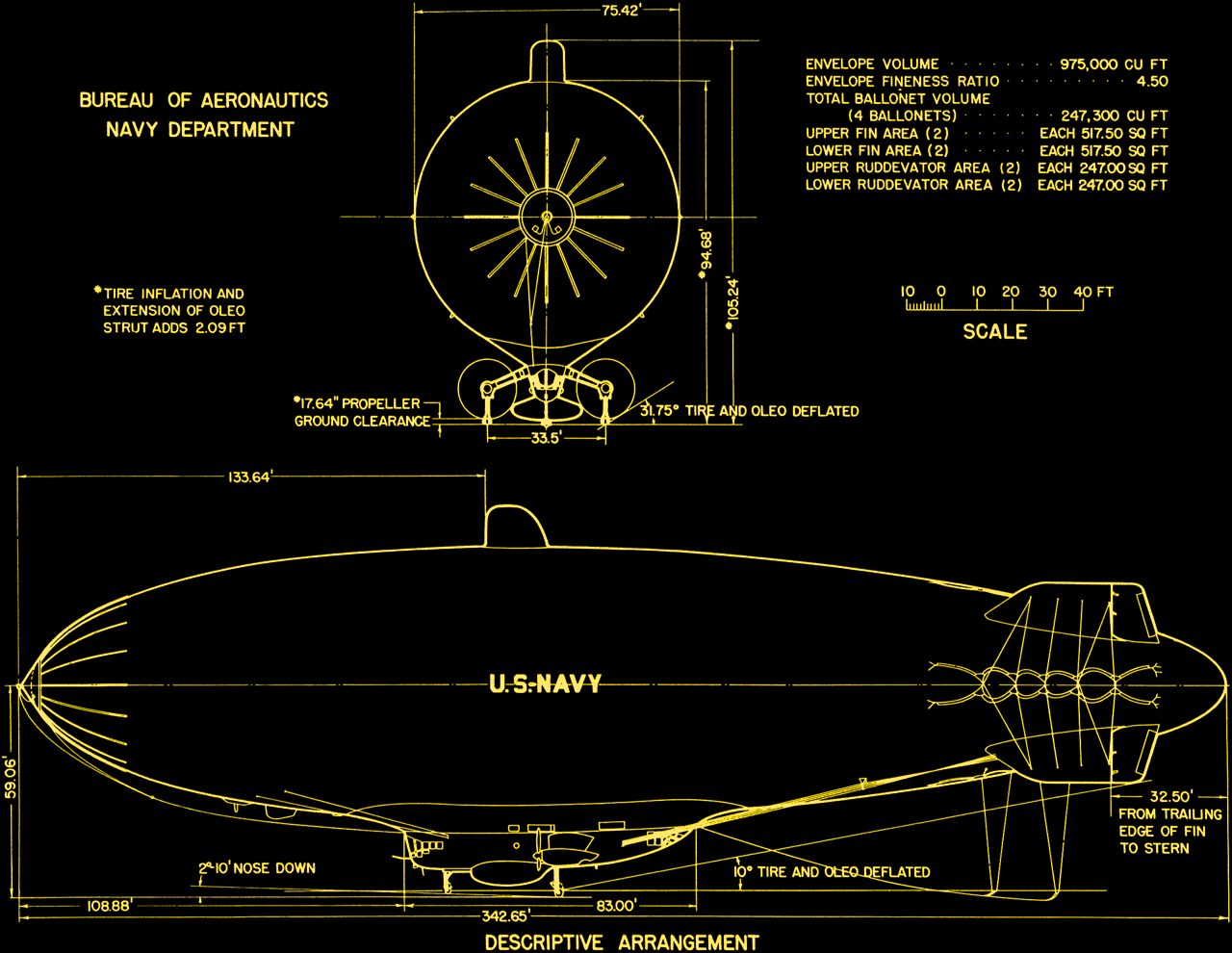
Diagram of a ZPG-2W N-class blimp. The antisubmarine ZPG-2 lacked the height-finding radar on top of the gas bag, but had the same dimensions otherwise. Image: US Navy

While the ZPG-2W whose triumph we described above were built to serve the airborne early warning role, most– twelve out of seventeen–of the “Nan ships”, as the class was called, were initially designed as bigger, badder sub-killers in case war broke out with the Soviets.

They had better down-looking radars– the AN-20, the best available at the time–much improved sonobouys, more sensitive magnetic anomaly sensors, and homing torpedoes. In war games against US and allied diesel-electric subs, like the GUPPY class, they proved very effective indeed, as did the improved K-ships. Against the new, nuclear-powered USS Nautilus, they were much less successful, but so were fixed-wing and helicopter assets. Doctrine that relied on spotting subs while recharging at snorkel or on surface was ill-suited to deal with a ship that could run submerged for months.

Improving on the control arrangement of the ZPK-5s, the Nan ships were built with an X-shaped tail to allow for even greater pitch angles during takeoff without tailstrikes. The ruddervators on the X-tail could also be controlled by one pilot, compared to earlier blimps which needed separate operators for elevator and rudder. The largest difference in design was perhaps the buried engines: unlike previous Navy blimps, which used radial engines hung from the gondola, the ZPG-2 Nan ships kept their two 800 HP Wright Cyclones indoors. This was supposed to allow for maintenance during flight, and it allowed the engines to be coupled together via a clutch, allowing single-engine cruising. As the air-early-warning blimps proved in 1957, these were all-weather craft.

Advertisement

The Anti-Submarine Warfare (ASW) squadrons gave a similar demonstration in 1960 with “Operation Whole Gale” during which the Nan ships provided 24/7 coverage for two full months, again in the teeth of winter’s worst weather. In spite of their best efforts to make use of wind and storms, no submarine got past the blimps during the operation.

ZPG-2 “Snow Bird”, departing NAS South Weymouth, Mass. on its record-setting flight in March 1957. Image: US Navy

The post-war record of the US Navy’s blimps is full of such impressive moments. The service was very much looking to prove itself, and so jumped at opportunities to demonstrate the blimps’ capabilities. Arctic expeditions? A Nan-ship proved its worth on 24-hour patrols between Churchill, Manitoba and Resolute, Baffin Island– the last airship to cross the Arctic Circle. Another stunt in 1957 set a record for unrefueled flight: a circumnavigation of the Atlantic basin from Massachusetts to Portugual, North Africa, and finally ending in Florida that took 264 hours and spanned 9,448 nautical miles (17,500 km). Guinness will tell you that Graf Zepplin’s 71-hour 6,384.5 km trip from Fedrickshaven to Lakehurst holds the record for airship flight, but that’s seriously out-of-date. For a rigid, sure, that’s the record, but for any LTA? Blimps win. Blimps actually win all the airship records save for speed and size, and none of those records stand from the “golden age” of the 1930s.

Takeways

That’s maybe the lesson here. Blimps win. I consider myself something of an aviation geek, and have multiple books on airships. All of them tell the same story: blimps were a sideshow, Zeppelins were the pinnacle of airship engineering, and it all ended with the Hindenburg. That’s the story everyone knows, just like everyone knows that airships are useless in any kind of bad weather.

What everyone knows is wrong. The problem with the story we all know is that it ends 24 years early, and leaves out more flights than it includes. Add in those 24 extra years of innovation, and the blimps come off looking a lot better in comparison.

The last flight of a US Navy dirigible with a US Navy crew was in August 1961. The ZPG-2 Nan ships were followed by a larger ZPG-3: bigger again, with a larger, more capable AN-70 radar hiding in the gasbag, the ZPG-3 was the largest blimp ever fielded. Its capability didn’t matter– there was no money for blimps. Imagine a line of Admirals standing before the US Congress, hats in hand, and one asks for money for nuclear-powered submarines to smite the enemies of Uncle Sam with Intercontinental Ballistic Missiles wielding atomic fire, and the next man in line wants money for blimps. Airships seemed positively old-fashioned in comparison, and money was tight. The blimps were cut.

Advertisement
A giant ZPG-3W  sits at its mooring mast, while a ZPG-2W takes off and a K-ship hovers in the background. Only two ZPG-3s were ever built. Image: US Navy

Yes, they provided an all-weather ASW and AEW capability nothing else could match… but other assets, ships and airplanes and helicopters, could do 90% of the job without requiring the expensive, dedicated infrastructure the blimps did. Airships were cut from the U.S. Navy the same year as seaplanes and the Regulus cruise missile program. You might say they’re the only things ever destroyed by the Polaris missile subs, but that’s arguably a good thing.

All the hot venture capital money is being sucked up by the AI bubble right now, and even if it wasn’t, the trendy thing in aviation is electric vertical takeoff and landing. That doesn’t mean there isn’t an airship renaissance just around the cornerthere is always an airship renaissance just around the corner. That it never results in anything but prototypes is irrelevant. LTA is just too enticing a technology to ever give up. If we ever are to get that renaissance to bear fruit, though, we’re going to have to have better stories.

If you’re focused on the Hindenburg going down in flames, or the Akron and Macon breaking up over water, airships seem like a bad bet. If you remember the Nan ships bouncing and wiggling their way through January snowstorms when everyone else was grounded, then LTA starts to sound more reasonable.


Source link

Advertisement
Continue Reading
Click to comment

Leave a Reply

Your email address will not be published. Required fields are marked *

Tech

OpenClaw Users Are Allegedly Bypassing Anti-Bot Systems

Published

on

In San Francisco, it feels like OpenClaw is everywhere. Even, potentially, some places it’s not designed to be. According to posts on social media, people appear to be using the viral AI tool to scrape websites and access information, even when those sites have taken explicit anti-bot measures.

One of the ways they are allegedly doing this is through an open source tool called Scrapling, which is designed to bypass anti-bot systems like Cloudflare Turnstile. While Scrapling, which was built with Python, works with multiple types of AI agents, OpenClaw users appear to be particularly fond of the software. On Monday, viral posts promoting Scrapling as a tool for OpenClaw users started to spread on X. Since its release, Scrapling has been downloaded over 200,000 times.

“No bot detection. No selector maintenance. No Cloudflare nightmares,” reads one viral post this week about the open source tool. “OpenClaw tells Scrapling what to extract. Scrapling handles the stealth.”

Cloudflare is not enthused. The company already blocked previous versions of Scrapling, since users of the open source software kept trying to get around anti-scraping protections. This week, the company was working on a patch for Scrapling’s most recent iteration. “We make changes, and then they make changes,” says Dane Knecht, chief technology officer at Cloudflare. He says the company’s trove of website data and its ability to track trends has given it the upper hand.

Advertisement

“We already had a signal that they’re starting to get a higher ability to get around us,” says Knecht. “The team of security operations engineers had already been working on a new set of mediations.”

Large language models were trained on the corpus of the internet—and the process involved a lot of scraping. In some sense, Scrapling users are following in the footsteps of the original model builders, but on a more individualized scale.

Over the past few years, website owners have attempted to put up additional anti-bot protections, either to block software like Scrapling or to find a way to make money off of the bots trying to access their sites. In turn, Cloudflare has been working overtime to keep blocking increasingly powerful bots attempting to get around these protections.

In July 2024, Cloudflare started to offer its customers additional tools that block AI crawlers, unless the bots pay for access. In less than the span of a year, the company claims to have blocked 416 billion unsolicited scraping attempts.

Advertisement

“I Didn’t Know What I was Getting Into”

As Scrapling gained traction in recent days, crypto enthusiasts capitalized on the attention by launching a $Scrapling memecoin. Karim Shoair, who claims to be the sole developer of Scrapling, posted about the memecoin on X (those posts have since been deleted). After the price skyrocketed for around five hours, $Scrapling quickly fell off a cliff as users sold off their stakes. “Bunch of fucking scammers,” reads one comment on the Pump.Fun site that hosts the coin.

“I didn’t know what I was getting into when people made that coin and I endorsed it,” says Shoair, in a direct message with WIRED. “But once I knew, I didn’t want any association with it and the money I withdrew before will go to charity, I won’t benefit from it in anyway. Or maybe just leave it to be wasted.”

In the fallout of this event, the unofficial GitHub Projects Community account, which has over 300,000 followers on X, deleted its posts from this week highlighting Scrapling’s open source software, and appeared to distance itself from the project. “We do not support, promote, or engage in crypto assets, token offerings, trading activity, or crypto-based fundraising,” it said in a post late Monday night.

Putting the crypto forays aside, most software leaders continue to see agents and autonomous AI tools as the future of the web. Even Knecht from Cloudflare, whose work includes blocking bots from nonconsensual scraping, wants to build toward a world where humans and agents benefit from online data and the wishes of website owners are respected. “I see a path forward for an internet that is both friendly to agents and humans,” he says.

Advertisement

This is an edition of Will Knight’s AI Lab newsletter. Read previous newsletters here.

Source link

Continue Reading

Tech

Compromises for affordability ahead: Code leak spills details on new MacBook

Published

on

Nobody claimed it was going to be equivalent to a MacBook Pro or even a MacBook Air. A code leak details the budget MacBook having an A18 Pro chip, limits on charging, no True Tone, and more.

Seven slim Apple laptops arranged diagonally, partially open, showing keyboards and glowing logos, in vibrant colors: green, yellow, pink, silver, purple, gold, and blue on a white background
Multicolored MacBooks are on the way

Apple is preparing a new low-cost MacBook model for launch, switching out Apple Silicon’s M-series chips for an A-series from the iPhone. While the rumor mill has settled on some core specifications, other measures will help bring the cost of production down for the company.
In a technical analysis of an internal test build of macOS shared with AppleInsider, there will be quite a few smaller changes in the smaller MacBook compared to the MacBook Air and MacBook Pro.
Continue Reading on AppleInsider | Discuss on our Forums

Source link

Continue Reading

Tech

What programming languages do you need for a career in robotics?

Published

on

If you want to excel in the robotics field, these programming languages can get you there.

Click here to access the entire catalogue of Automation Focus.

Coding skills are a valuable and often crucial skill for professionals in the STEM space, even in the wake of ‘vibe-coding’ and AI advancements. For those who want to work in the area of robotics, an in-depth knowledge of the uses of programming and an education in more than one language can give a professional an edge.

But more often than not, there are far too many to get through before you find the ones that best suit your ambitions. With that in mind, what are some of the programming languages that tend to go hand-in-hand with a career in robotics.

For beginners

We all start somewhere, so whether you are an enthusiast, a beginner or an established professional, you should have a knowledge of a standard or starter language that can help you get to the next phase.

Advertisement

Python is one such language. Considered accessible, easy to learn, versatile and with a wealth of online resources available, pretty much anyone who wants to learn this language can – if they put in the time. Education platform Coursera notes that in robotics, Python is particularly useful in scripting robot behaviours, quickly building prototypes and in elements requiring artificial intelligence, such as systems that integrate predictive analytics or use machine learning algorithms.

There is no reason that your chosen programming language, to aid a robotics career, can’t be funky as well as functional. If you want a language a little off the beaten track that offers a more unique learning experience, consider Scratch. It is aimed at younger learners and complete beginners, so if you are only at the start of your educational journey, it can be of real help in developing early and foundational skills. This graphical programming language developed by the MIT Media Lab, offers a simple interface, where students can create digital stories, games and animations, improve their conceptual and computational thinking and develop their problem-solving abilities.

High performance

For the professionals or enthusiasts looking for a coding language that packs some punch, there are a number of programs considered to be high performers.

C++ is in this category. An object-oriented language, C++ is regarded as a strong foundation for robotics engineers and those who work in the hardware ecosystem and can be useful to those interested in competitive robotics or embedded systems. Advantages include strong cross-platform support, high execution efficiency, and concise and flexible low-level control.

Advertisement

Another high performer is the less commonly-used Rust. This systems-level language emphasises memory safety and performance, two highly critical aspects of working with robotics software. It has been compared to C++ in CPU-intensive tasks and is an ideal language for those wanting a bit of a challenge in the name of progress and reliability. 

Another high-level language to consider is MATLAB, which is typically used for numerical computation, for example, in work involving linear algebra, data analysis and algorithm development. MATLAB is commonly used by academics, researchers and developers and can be used to create detailed robotic models. Anyone who wants to learn MATLAB can, but it is primarily suited to academic researchers, control systems engineers and those working in labs or companies using MATLAB for rapid iteration. 

Features

So, what makes up a ‘good robotics language’? In truth, that is like asking, ‘how long is a piece of string’? The answer really depends on your own professional needs and ambitions. That being said, there are a number of features and characteristics that often jump out as being important for a programming language used primarily in the robotics space. 

Performance is one such element that is critical in robotics. Experts tend to use a high volume of data and have to make quick decisions, so high performance is important. Ease of use, especially for those just starting off, is also important, as students and professionals often depend on a simple interface and a large community of peers. The robotics space is ever-evolving so flexibility is a key feature, as is easy access to support and resources when needed. 

Advertisement

Anyone looking to boost their coding skills should make sure to check out local groups and organisations, attend industry events, engage with online learning opportunities and if a more in-depth approach is required, consider in-person courses at relevant third-level institutions. 

Don’t miss out on the knowledge you need to succeed. Sign up for the Daily Brief, Silicon Republic’s digest of need-to-know sci-tech news.

Source link

Advertisement
Continue Reading

Tech

Panasonic Exits TV Manufacturing, Hands Production to Skyworth as 2026 TV Shakeup Continues

Published

on

The global TV business just tilted again. Weeks after Sony sent shockwaves through the industry by negotiating a manufacturing partnership with TCL, Panasonic has made its own decisive move. The company announced a “strategic partnership” with China-based Skyworth aimed at strengthening and accelerating sustainable growth in its U.S. TV business. The agreement takes effect April 1, 2026.

Let’s not pretend these are routine supply-chain tweaks. When two of Japan’s most recognizable TV brands shift production relationships toward Chinese manufacturing giants within weeks of each other, that signals something bigger than cost optimization. It reflects a structural reset in how premium TV brands compete in 2026 — where scale, panel access, pricing pressure, and speed to market matter as much as brand heritage.

Sony’s move was significant. Panasonic’s is equally telling. The balance of power in the TV industry continues to migrate east, and legacy brands are adapting in real time.

North America remains a key strategic region for Panasonic, with consumers consistently recognizing the exceptional quality and value of our products,” said Akira Toyoshima, CEO of Panasonic Entertainment & Communications Company (PEAC). “The new business model change will leverage the power of Panasonic’s core technical excellence in AV processing, quality, and service standards with the global scale economy of Skyworth’s manufacturing volume and speed to provide a winning formula for the customer value proposition.”

Advertisement

What It Means for the U.S. TV Market in 2026

Here’s what we know so far.

Skyworth USA Corporation will serve as the principal operating partner in the U.S., handling sales, marketing, and logistics. Panasonic, meanwhile, retains responsibility for development expertise and quality assurance to ensure its established performance standards are maintained.

In plain terms: Skyworth will manufacture Panasonic-branded TVs for the U.S. market.

Panasonic has also confirmed it will continue to support all TVs sold through April 2026, as well as models produced under the new agreement. Customer service and warranty coverage are not being handed off and forgotten.

Advertisement
2025 Panasonic Z95B OLED TV
Panasonic Z95B OLED TV (2025 model)

The real question that TV reviewers and industry analysts are already circling, is what this means for Panasonic’s product development going forward, particularly its highly regarded OLED lineup. Over the past several years, Panasonic has delivered OLED models with some of the strongest video processing and image accuracy in the category.

If manufacturing shifts, does the performance DNA remain intact? That’s the part that will determine whether this is simply a business realignment or something more consequential.

Skyworth is hardly new to OLED. The company already produces OLED TVs under its own brand using LG Display panels; the same panel supplier Panasonic relies on. On paper, that creates technical overlap. In practice, the U.S. market is where things get complicated.

Advertisement. Scroll to continue reading.

Panasonic has struggled to regain meaningful traction in the United States. Once the undisputed king of plasma, the company exited that business in 2014, which led to a 10-year absence from the U.S. TV market. Although Panasonic did continue TV operations internationally, their return to the crowded U.S. TV market in 2024 failed to capture shoppers attention, despite generally high praise among reviewers.

Advertisement

So what happens now?

The likely framework is straightforward: Skyworth manufactures Panasonic-branded TVs at a cost structure designed to win back market share. That requires profitability for both companies. This isn’t charity. It’s math.

Panasonic will define the product, whether OLED or LCD based on its performance standards, processing expertise, and brand expectations. Skyworth’s role will be to engineer and source the components at scale to meet those targets.

The pressure point comes if Panasonic’s traditional quality benchmarks push costs beyond what the U.S. market will bear. At that stage, both sides face a decision: preserve every performance advantage and accept limited volume, or adjust specifications to hit competitive price tiers.

Advertisement

That balance between maintaining Panasonic’s performance DNA and achieving aggressive pricing, will determine whether this partnership strengthens the brand or quietly reshapes it.

2025 Panasonic TVs

In other words, if you’re shopping for a high-end Panasonic TV built entirely under the company’s current structure, now might be the moment to act. Once the Skyworth agreement takes effect and newly manufactured models begin arriving in the U.S., the formula, even if only slightly, could change.

That’s not a knock on Skyworth. It’s a reality of scale manufacturing in a brutally competitive market. If a TV can’t be produced at a price that resonates with a broad enough audience, it won’t survive long no matter how good it looks in a calibration lab. Performance definitely matters, but sales volume keeps the lights on.

Who Is Skyworth? 

skyworth-logo

Skyworth may not have the brand recognition in the U.S. of fellow Chinese heavyweights Hisense and TCL, but globally, it is a major force. The company ships roughly 36 million TVs annually and ranks among the top five worldwide in TV revenue, reportedly moving ahead of Sony in overall TV sales revenue. That’s not a minor player, which is why this move by Panasonic is rather significant.

Under the broader Skyworth Group umbrella, the company manufactures far more than televisions. Its portfolio includes consumer electronics, display devices, digital set-top boxes, security systems, networking and communications equipment, semiconductors, refrigerators, washing machines, smartphones, and LED lighting. Skyworth sells products under its own brand while also operating as an OEM for other companies — a role that makes this Panasonic agreement less surprising.

Advertisement
Skyworth 100CE1 Canvas Elite Art 100-inch TV Lifestyle
Skyworth 100CE1 Canvas Elite Art 100-inch TV

In the U.S., recent Skyworth-branded introductions include the Canvas Elite Art TV and the Clarus S1 Outdoor TV — niche-focused models aimed at lifestyle and specialty segments rather than direct mainstream domination.

In addition to the Panasonic-Skyworth agreement, the company has also outlined a broader corporate shift. Effective April 1, 2026, Panasonic confirmed that PEAC (Panasonic Entertainment & Communication) will be reintegrated into the main Panasonic Corporation structure. The stated objective is to strengthen the long-term positioning of Panasonic’s consumer business globally including in the United States.

Advertisement. Scroll to continue reading.

The Bottom Line 

The TV business isn’t just competitive in 2026. What we are witnessing is a monumental shift in power that is going to change what we buy and from brands that many of us might not have considered a few years ago. But is that bad news for the consumer?

Advertisement

On one side, display technology keeps advancing at a relentless pace: brighter OLED panels, better processing, smarter platforms. On the other, brand stability is anything but secure. Former giants are fighting to stay relevant, and consolidation across both TV and audio continues to thin the herd. Legacy names aren’t disappearing quietly; they’re restructuring, and partnering with rivals in China to make themselves more competitive. That tension was on full display at CES 2026.

While walking the halls of the Venetian during the show, I noticed a suite marked Skyworth. Inside were several televisions clearly wearing the Panasonic badge. Not concept sketches. Not mockups. Finished sets. I took a few photos. That didn’t last long.

panasonic-tv-skyworth-ces-2026
Panasonic TV spotted in Skyworth’s booth at CES 2026

I was quickly informed that photography wasn’t permitted and that what I was seeing was not something I could report on. At the time, it was obvious something was brewing. The question wasn’t whether Skyworth was involved with Panasonic, it was how deep the relationship would go.

Now we know.

Advertisement

With Panasonic’s official announcement confirming a strategic partnership and manufacturing shift, what felt like a quiet industry rumor on a CES show floor has become a formal restructuring of one of Japan’s most storied TV brands.

In the case of both Sony and Panasonic, it will likely take another year before the real impact of their manufacturing partnerships with major China-based TV companies becomes clear, as new product cycles roll out and revised models reach the U.S. market. 2026 will be a transition year, and 2027 should provide a more accurate picture of how these strategic shifts affect performance, pricing, and brand positioning.

Find out more about skyworthusa.com.

Advertisement

Source link

Continue Reading

Tech

Qobuz Connect Lands on Cambridge Audio StreamMagic Gen 2 and Gen 3 in Upgrade for Legacy Product Owners

Published

on

In an era where “new model” usually means “time to replace the old one,” Cambridge Audio just did something refreshingly unglamorous and important. The company has rolled out Qobuz Connect to its legacy StreamMagic Gen 2 and Gen 3 platforms, extending modern streaming control to products that have been sitting in racks and on shelves for years.

That means owners of the StreamMagic 6 V2, CXN, CXR, Azur 851N, CXN V2, and Edge NQ can now control playback directly from the Qobuz app via an OTA update; no new hardware, no forced upgrade cycle. Qobuz still works through the StreamMagic app as before, but Connect adds a more direct, native control path that many subscribers prefer.

It’s good to see a brand remember that its customer base didn’t magically appear in the last 24 months. Supporting Gen 2 and Gen 3 after rolling out Qobuz Connect to Gen 4 isn’t flashy, but it sends a clear message: what you bought still matters. Your streamer didn’t just age out because a new box showed up with a higher number on it.

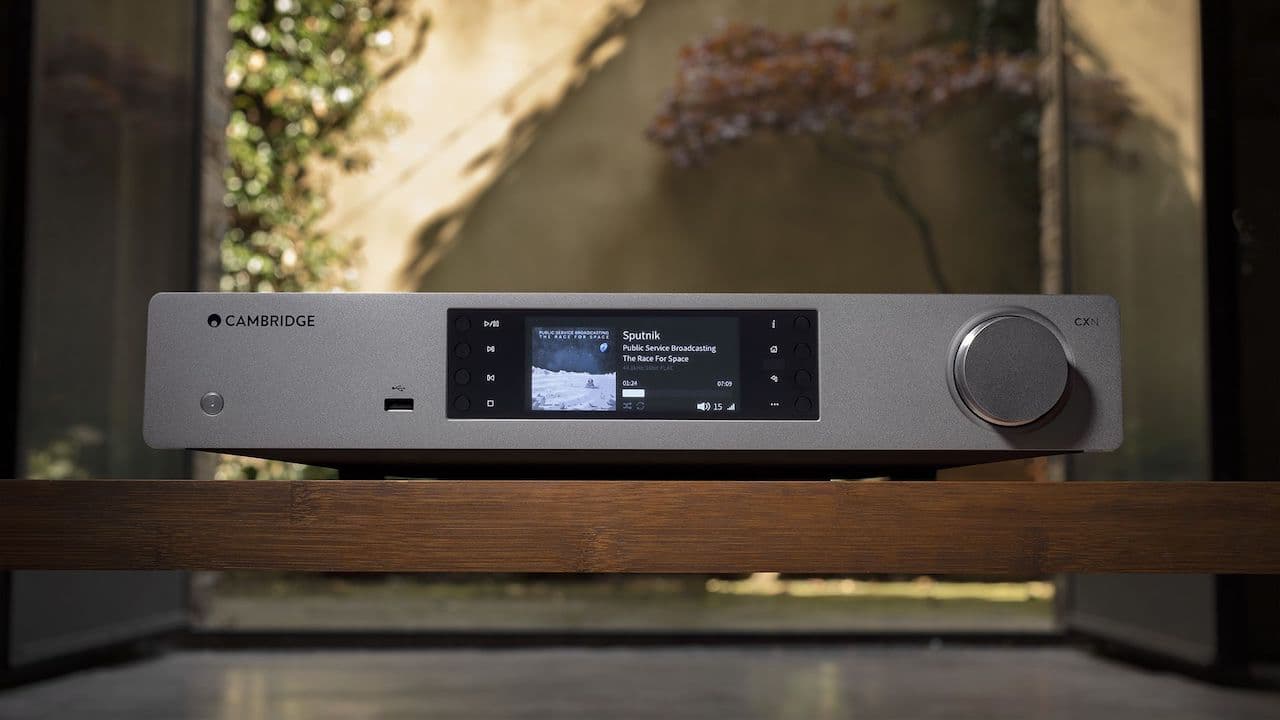
Cambridge Audio CXN V2 Network Audio Streamer
Cambridge Audio CXN V2 Music Streamer

It also proves something else; customers aren’t shouting into the void. The questions, feature requests, and yes, the complaints that show up on Instagram, Facebook, Audiogon, and the forums? They do get seen. Sometimes they even lead to action. That kind of accountability shouldn’t be rare in the hi-fi category, but too often it is.

Advertisement

There are plenty of alternatives out there. Some cost less. Some arguably do more. In a crowded field, long-term support isn’t just goodwill on the part of the manufacturer but smart business strategy. It’s also hard not to wonder whether Cambridge’s recent decision to appoint Fidelity Imports as its new U.S. distributor played a role here. Distribution shifts aren’t just about logistics and dealer networks, they’re about market responsiveness. If you’re trying to rebuild momentum and reinforce trust in a crowded category, showing existing owners that their gear still has a future is a smart place to start.

This update follows Cambridge’s recent additions of Spotify Lossless, Amazon Music, and QPlay to the StreamMagic platform. Rather than introducing new hardware, the company has continued expanding service support across existing models.

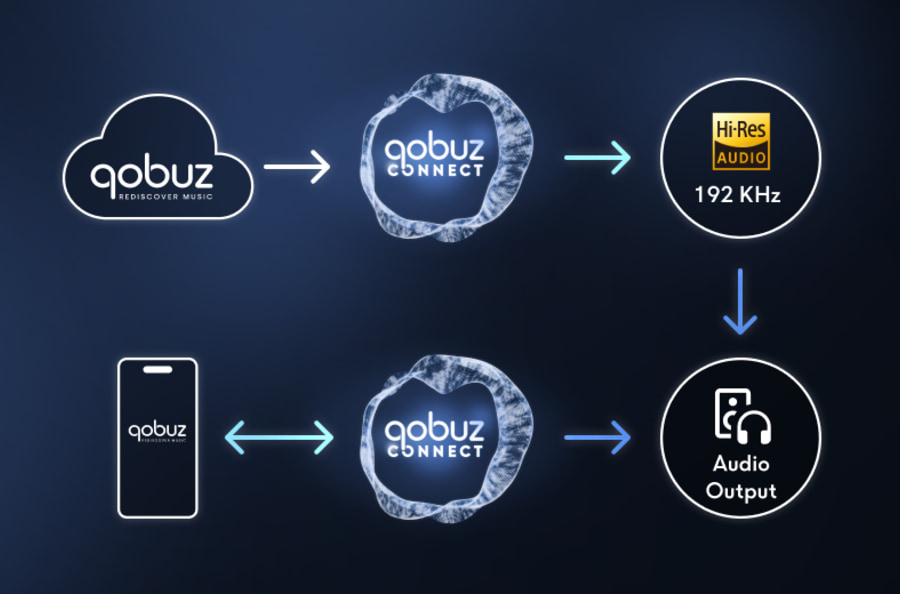
qobuz-connect-diagram

What Is Qobuz Connect and Why Should Cambridge Audio Owners Care?

Qobuz Connect lets subscribers stream directly from the Qobuz app to compatible devices over Wi-Fi or Ethernet, turning the app into the primary control interface. Your Cambridge streamer (or other supported hardware) becomes the playback endpoint, while your phone or tablet functions as the remote. The result is native control with full lossless and high-resolution streaming up to 24-bit/192 kHz. So no Bluetooth, no compressed handoffs, and no need to route playback through a secondary app.

Launched on May 15, 2025, Qobuz Connect has expanded quickly. In less than a year, support has grown to more than 100 hardware partners, covering A/V receivers, network streamers, powered speakers, and integrated amplifiers. That broader compatibility keeps control centralized inside the Qobuz app while giving subscribers more flexibility across systems and brands.

Advertisement

The Bottom Line

The biggest winner here is the existing Cambridge Audio owner. Adding Qobuz Connect to StreamMagic Gen 2 and Gen 3 extends the useful life of hardware that, in many cases, is still performing at a very high level. It removes friction, adds native app control, and keeps those products aligned with how people actually stream music in 2026. No new box required. No forced upgrade cycle.

In 2026, StreamMagic isn’t just a control app, it’s Cambridge’s full streaming ecosystem. It supports major services including Qobuz, TIDAL, Spotify (including Lossless where available), Amazon Music, QPlay, AirPlay 2, Chromecast built-in, Roon Ready integration, and local UPnP playback.

With Qobuz Connect now folded into that framework across multiple generations, Cambridge has strengthened the platform’s long-term relevance. In a crowded streaming market where alternatives are plentiful and often cheaper, sustained software support is what separates a product you replace from one you keep.

Advertisement. Scroll to continue reading.
Advertisement

Source link

Continue Reading

Tech

Kalshi Suspended a California Politician and a YouTuber for Insider Trading

Published

on

A former candidate in the 2026 race for governor of California and a popular YouTuber have been kicked off Kalshi’s platform for alleged violations related to insider trading, the popular prediction market revealed Wednesday.

In a blog post detailing the cases, Kalshi’s head of enforcement, Robert DeNault, noted that the company’s surveillance system had flagged suspicious behavior in both instances.

In the case of the political candidate, Kalshi cited a video posted online “that appeared to show him trading on his own candidacy.” Kalshi froze the candidate’s accounts and reported the activity to the Commodity Futures Trading Commission, the government agency that oversees prediction markets. It instituted a five-year ban and is fining the account a penalty 10 times the size of the initial trade, which Kalshi says it intends to donate to charity.

While Kalshi does not mention the candidate by name, DeNault notes that they have recently dropped out of the race and shifted to running for Congress. This fits the description of only one person involved in the race: Kyle Langford, a far-right Republican candidate best known for inflammatory antisemitic comments praising Nazis. Langford has since dropped out and launched a campaign styled as a progressive Democrat in California’s 26th district.

Advertisement

In May 2025, Langford posted a video to X showing a screen recording of a trade order placed on Kalshi for an event in the governor’s race. Shortly after the incident, Kalshi confirmed that it was looking into Langford’s activities. In his description of the investigation into the candidate, DeNault notes that Kalshi began its investigation that May.

“Tensions between the USA and Iran are at an all-time high, and the media has chosen to cover a $200 campaign gimmick (aka betting on I, myself) from last year,” Langford said in a statement to WIRED. “Is this really the state of our political discourse?”

This is not the only suspension tied to the California governor race; as Politico reported on Tuesday, Democratic megadonor Stephen Cloobeck, who was briefly a candidate before dropping out to endorse representative Eric Swalwell, has also been blocked by the platform for attempting to trade on the race. “In the event we ever see a candidate trading on their own candidacy, it triggers disciplinary action on the exchange. Their trade gets frozen. They may be permanently suspended from having an account,” DeNault said in a statement. Cloobeck confirmed the bets to Politico and said he is still able to trade on other events.

This crackdown underscores how expansive definitions of “insider trading” can be on prediction markets; while traditional insider trading cases hinge on subjects profiting from “material nonpublic information”—confidential data or intelligence that can impact stock prices—here, even placing bets while working on an election or running for office can violate the rules.

Advertisement

In the case of the YouTube streamer, Kalshi reports that its surveillance systems flagged the account based on “statistically anomalous” trading success. It also received concurrent tips from Kalshi users, who had flagged the unusual activities. “We investigated and found that the trader was employed as an editor for the streamer’s show and likely had access to material nonpublic information connected to his trading,” DeNault writes in the report. The account was frozen before it could withdraw funds; it is now suspended for two years, and it has also received a financial penalty. Kalshi did not disclose the identity of the YouTube streamer.

As prediction markets have exploded in popularity, there has been a series of high-profile incidents of suspected insider trading, including major trades made just prior to geopolitical events like the US capture of Venezuelan leader Nicolás Maduro. In Israel, two Polymarket traders were recently arrested for leaking classified information in connection to trades made on military activity. Following the Maduro incident, Congress introduced a bill to ban government officials from insider trading on prediction markets—but there have not been any enforcement actions made public.

Source link

Advertisement
Continue Reading

Tech

A White House Staffer Appears to Run Massive Pro-Trump X Account

Published

on

Hours after an ICE agent shot and killed Renee Good in Minneapolis, the Trump administration was already working to shape the narrative. Official White House accounts flooded social media with clips of burning flags and clashes between locals and federal immigration agents, casting protesters—not the killing—as the story.

Among the accounts amplifying that message was Johnny MAGA, a pro-Trump X account with nearly 300,000 followers. “They’re burning the American flag right now in Minneapolis,” the anonymous account claimed, sharing a clip from the White House’s official rapid response feed. “And they really expect you to believe that ICE shot an innocent civilian.”

To its audience, Johnny MAGA looked like an independent voice, another outraged supporter in the MAGA media ecosystem. The account regularly boosts Trump’s Truth Social posts and goes to bat for the administration, attacking Democrats like California governor Gavin Newsom.

But this isn’t just a regular account. Johnny MAGA appears to actually be a White House staffer named Garrett Wade who works for the Trump administration as a rapid response manager, helping to run the very same White House account his anonymous MAGA account amplifies. A phone number associated with Wade is linked to Johnny MAGA, according to a WIRED review of publicly available records, and the connection was confirmed by a source close to the White House.

Advertisement

Wade and the White House did not respond to requests for comment.

The Johnny MAGA account was created in September 2021, according to its X profile. (It originally used a different handle, which referenced Wade’s birth year, according to records reviewed by WIRED.) While the account’s earliest available posts focused on NFTs, it has been a consistent pro-Trump presence since at least 2022.

The operator of the Johnny MAGA account has not disclosed an official relationship with the White House while operating the Johnny MAGA X account. Multiple media outlets, including Mother Jones, TownHall, and the New York Post, have all linked out to posts on the Johnny MAGA account seemingly as organic reflections of public sentiment on political issues.

Since Trump took office last year, the Johnny MAGA account has supported administration priorities like immigration enforcement, and allies like Turning Point USA. After Trump posted a racist AI-generated video depicting Barack and Michelle Obama as apes earlier this month, the Johnny MAGA account boosted the White House’s claim that the president didn’t watch the entire video, posting, “the most obvious tell that Trump’s Truth Social post wasn’t intentional is that he would’ve posted the entire thing if he had seen it. It’s a masterpiece.”

Advertisement

While the Trump administration has long cultivated a growing cast of conservative creators to spread its messaging online, a White House staffer moonlighting as an anonymous MAGA influencer would blur the already hazy line further, making it nearly impossible to distinguish between official government messaging and what appears to be organic digital support. This lack of disclosure risks undermining public trust, disinformation researchers suggest.

“People have a right to know who is trying to manipulate public opinion, and they have a right to know whether or not they’re experiencing astroturf politics,” says Samuel Woolley, a University of Pittsburgh professor who studies disinformation and media ethics. “This lack of transparency and the conflict of interest surrounding this account and the lack of disclosure all amount to a breach of public trust.”

There is very little public information online about Wade, but Federal Election Commission records link him to former White House senior communications leadership. Donations from 2023 through WinRed made by a Garrett Wade from suburban Philadelphia—where Wade graduated high school—list his employer as “tech school” in March 2023 and in December that year as Opinion Architects, a digital consultancy group. The donations also list Wade as residing in the Bucks County area of Pennsylvania, where he previously lived, according to public records. The phone number associated with Wade and with Johnny MAGA—who in the past has listed his location as Philadelphia—is also geolocated to the Bucks County area.

Source link

Advertisement
Continue Reading

Tech

Google’s latest AI tool wants you to think you’re a music producer

Published

on

Google is making it very easy to feel like a music producer, whether you have the skills or not. The company has announced that ProducerAI, an AI-powered music-making platform, is joining Google Labs, bringing together sound generation, visuals, and video into one experimental creative tool.

ProducerAI is powered by a preview version of Lyria 3, Google’s newest music-generation model. You can describe what you want, and the AI helps you build it, whether that means crafting beats, shaping melodies, or experimenting with entirely new sounds.

ProducerAI first launched in July 2025 to let users collaborate with an AI agent to generate music, workshop lyrics, and remix tracks from text prompts. Until now, it relied on its own underlying models. Joining Google Labs gives it access to a much larger AI toolkit.

Inside Google’s AI-powered music studio

As a part of Google Labs, ProducerAI will pull from several of Google’s models. Lyria 3 handles music generation, while Gemini powers the conversational interface that guides users through ideas and edits.

Nano Banana will generate album art, and Veo will be used to create AI-generated music videos, turning a song idea into a complete audio and visual project. Google says it will also embed SynthID watermarks into ProducerAI outputs.

Advertisement

This flags AI-generated audio, images, video, and text, adding transparency as AI music becomes harder to distinguish from human work. But companies like Sony have already developed a tool to detect original songs used in AI-generated tracks.

The ProducerAI team has already worked with artists like The Chainsmokers, Lecrae, and Anjulie to shape the platform. Google positions ProducerAI as an experiment, not a replacement for musicians. However, this collaboration arrives at a time when AI-generated songs are topping Billboard charts, drawing scrutiny from artists and listeners alike.

Source link

Advertisement
Continue Reading

Tech

Visual imitation learning: Guidde trains AI agents on human ‘expert video’ instead of documentation

Published

on

For years, the “last mile” of digital transformation has been littered with forgotten PDFs and ignored training manuals. 

Organizations spend millions on sophisticated software like SAP or Salesforce, only for employees to struggle with basic navigation. Now, as the era of agentic AI arrives, companies face a double-edged sword: they must teach human employees to collaborate with AI, while simultaneously teaching AI agents to navigate the labyrinthine interfaces of the modern enterprise.

One idea that seems to be gaining momentum among AI-forward businesses: using screen recordings and tutorials/walkthroughs of someone performing an enterprise task — be it creating a new ticket or processing an invoice — and training AI to replicate the flow based on the screen capture. Just this week, a startup called Standard Intelligence went viral on X showing an early demo of open-ended version of this for the physical and digital world.

But the truth is, there are already players tackling this problem for the enterprise itself square-on: case-in-point, Guidde, an Israel startup born during the video-centric years of the COVID-19 pandemic, today announced an oversubscribed $50 million Series B funding round led by PSG Equity to address this exact knowledge infrastructure crisis. 

Advertisement

Instead of feeding an agent a static PDF manual, Guidde provides high-fidelity “Video Ground Truth”—a rich stream of data captured from real human experts as they navigate complex software.

The investment signals a shift in how the tech industry views documentation—not as a static byproduct of work, but as the critical telemetry needed to train the next generation of autonomous digital agents.

Technology: from video capture to world models

At its core, Guidde is an AI Digital Adoption Platform (ADAP). However, its technological breakthrough lies in what happens behind the scenes during a recording.

Guidde isn’t just recording pixels; it is capturing every click, scroll, and latent interaction with the HTML page—the subtle pauses, the specific scroll depths, and the corrections a human makes when a system lags. This telemetry transforms raw video into a Vision-Language-Action (VLA) training set.

Advertisement

Meanwhile, the platform’s Magic Redaction automatically obscures sensitive data like passwords or credit card numbers during capture, ensuring materials remain secure and HIPAA-aligned.

“Every time you click a button, you drag-and-drop, you scroll, you type, we gather the interaction… all of it, we do cleanse it—there’s no private information,” explained Guidde co-founder and CEO Yoav Einav in an exclusive interview with VentureBeat.

Under the hood, the platform captures the underlying metadata and DOM (Document Object Model) changes synchronized with the video frames. The differentiator is the telemetry hidden beneath the surface.

This rich metadata creates a “digital world model” of enterprise software. And because each enterprise uses its own unique mix of apps and processes, Guidde is creating a data moat that allows enterprise agents to reason through legacy UIs with the same spatial awareness as a human, ensuring that automation actually works in a production environment rather than just a lab demo.

Advertisement

For a human, it’s a tutorial. For an AI agent, it is a high-fidelity map of the interface. This allows agents to “see” and reason through complex UIs the way humans do, solving the “last mile” of automation where agents previously failed due to lack of specific enterprise and in-situ usage context.

In a sense, Guidde is building a “self-driving car” like a Waymo for computer usage.

Product: three pillars of Guidd-ance

The platform has evolved into three distinct products designed to scale with an organization’s maturity:

  1. Guidde Create: The engine for subject matter experts to turn workflows into documentation in minutes.

  2. Guidde Broadcast: A personalized recommendation engine—often compared to Netflix—that delivers answers inside the tools people actually use. It knows who the user is and what department they are in to surface relevant content exactly when needed.

  3. Guidde Discover: The newly launched “agentic” pillar. Like Waze mapping roads by observing drivers, Discover maps software routes by tracking how employees work. It understands the workflow, creates the content, and updates it automatically when the UI changes.

Training humans how to use AI — and AI using humans

The most non-obvious aspect of Guidde’s growth is its dual-purpose mission. “We’re the only platform that trains both humans and agents,” Einav stated.

Advertisement

As companies roll out AI tools like Microsoft 365 Copilot or ServiceNow agents, they hit a proficiency gap. One of Guidde’s largest customers revealed they were paying over $1 million a year for a sophisticated AI tool, yet “nobody knows how to use them because they did like a 30-minute training session, and then that’s it.” Guidde closes this gap by providing “bite-sized” video tutorials in the flow of work.

Simultaneously, these videos train the AI agents themselves. Foundation models like Gemini or GPT-4 often hallucinate when tasked with specific enterprise workflows because they weren’t trained on the highly specific, internal “vanilla workflows” found in private enterprise systems. Guidde provides the “starting point,” the “metadata,” and the “x, y coordinates of the button” that an agent needs to complete an action without getting stuck.

The multimodal advantage

To maintain this level of accuracy, Guidde employs a multimodal infrastructure. The system doesn’t rely on a single model; instead, it uses a “fleet” of models that evaluate one another.

  • Google Gemini: Generally used for visual tasks like analyzing PDFs or PowerPoints.

  • Anthropic Claude: Leveraged for writing the storyline and narrative scripts.

  • Feedback Loops: When a user edits a video, that data is fed back into the model to prevent the same mistakes from occurring in future captures.

This approach allows Guidde to replace a legacy stack of six or seven disconnected tools—Loom for capture, Adobe Premiere for editing, 11Labs for text-to-speech, and Synthesia for avatars—with a single, AI-native platform. “We basically pack everything for you,” Einav says, “and automate the entire process based on your brand guidelines.”

Advertisement

Video-first origin story

The genesis of Guidde lies in a frustration familiar to any product leader. Before founding the company, Einav and co-founder Dan Sahar spent years mastering video traffic at Qwilt, a company they started in 2010 to analyze how people watched Netflix and Disney+. 

When COVID-19 hit, they saw a massive opportunity to apply that video expertise to the workplace. They observed that short video explainers could increase free-to-paid account conversions by 30%, but the friction of creating them was unsustainable.

In an interview, Einav recalled the “tedious work” of the old world: “My team in Israel were creating the content, someone in the US with a US accent was doing the narration, someone in the marketing team would write the script… and someone in the enablement team would do the edit.” This fragmented workflow meant a single video took two to three weeks to produce. “And then two weeks later, the product changes, and you need to redo it from scratch,” Einav added.

Guidde was built to collapse this cycle into seconds. By automating the “Magic Capture” of a workflow, the platform generates a structured narrative script and professional AI voiceover instantly. This removes the editing bottleneck, transforming subject matter experts into “training powerhouses.”

Advertisement

Licensing and market impact

Guidde’s pricing structure reflects its transition from a utility to a core piece of enterprise infrastructure:

  • Free: $0 (Up to 25 videos, web-app support).

  • Pro: $18/creator/month (Unlimited videos, brand kits).

  • Business: $39/creator/month (Unlimited text-to-voice, analytics).

  • Enterprise: Custom pricing (Multi-language translation, SSO, Magic Redaction).

The platform’s impact is already visible in the numbers: a 41% reduction in video creation time and 34% fewer inbound support tickets

For customers like Emerson, this translates to 40–60% quicker guide creation. Support teams, in particular, are finding they can offload 80% of their ticket volume with agents—but only if those agents have the content to be useful. 

“The agent without the content is useless,” Einav warns, noting that most enterprise documentation is either years out of date or entirely undocumented.

Advertisement

Community and industry early reception

Guidde already claims 4,500 enterprise customers and seeks to expand this number with its new round of funding. Support and operations leaders have been vocal about the platform’s ease of use. Christopher Cummings, VP of Client Experience at DocNetwork, highlighted its ability to provide “quick, personalized video responses to customer questions.”

 Meanwhile, Wren Cotrone, a Director of Customer Support, noted that “Once you set the branding the way you want, you can really zoom through this stuff.”

Ronen Nir, Managing Director at PSG, summarized the investment thesis: “Guidde is solving one of the biggest blockers to successful AI adoption: the knowledge infrastructure.”

Why this matters now

The paradigm shift from text-only LLMs to agentic video intelligence is the defining trend of 2026. Guidde’s Series B signals that the “ground truth” for enterprise agents will come from raw video observation, not static documentation.

Advertisement

By capturing how work gets done across 10s of millions of workflows, Guidde is building a dataset that few others possess. 

As Einav put it: “It starts with humans in the loop, and over time moves toward full autonomy.” For the modern enterprise, the map is no longer a static document—it’s a living, breathing video intelligence layer that guides both the workforce and the agents that support them.

Source link

Advertisement
Continue Reading

Tech

Pick Alexa’s personality: Amazon lets users choose ‘Brief,’ ‘Chill,’ or ‘Sweet’ conversation styles

Published

on

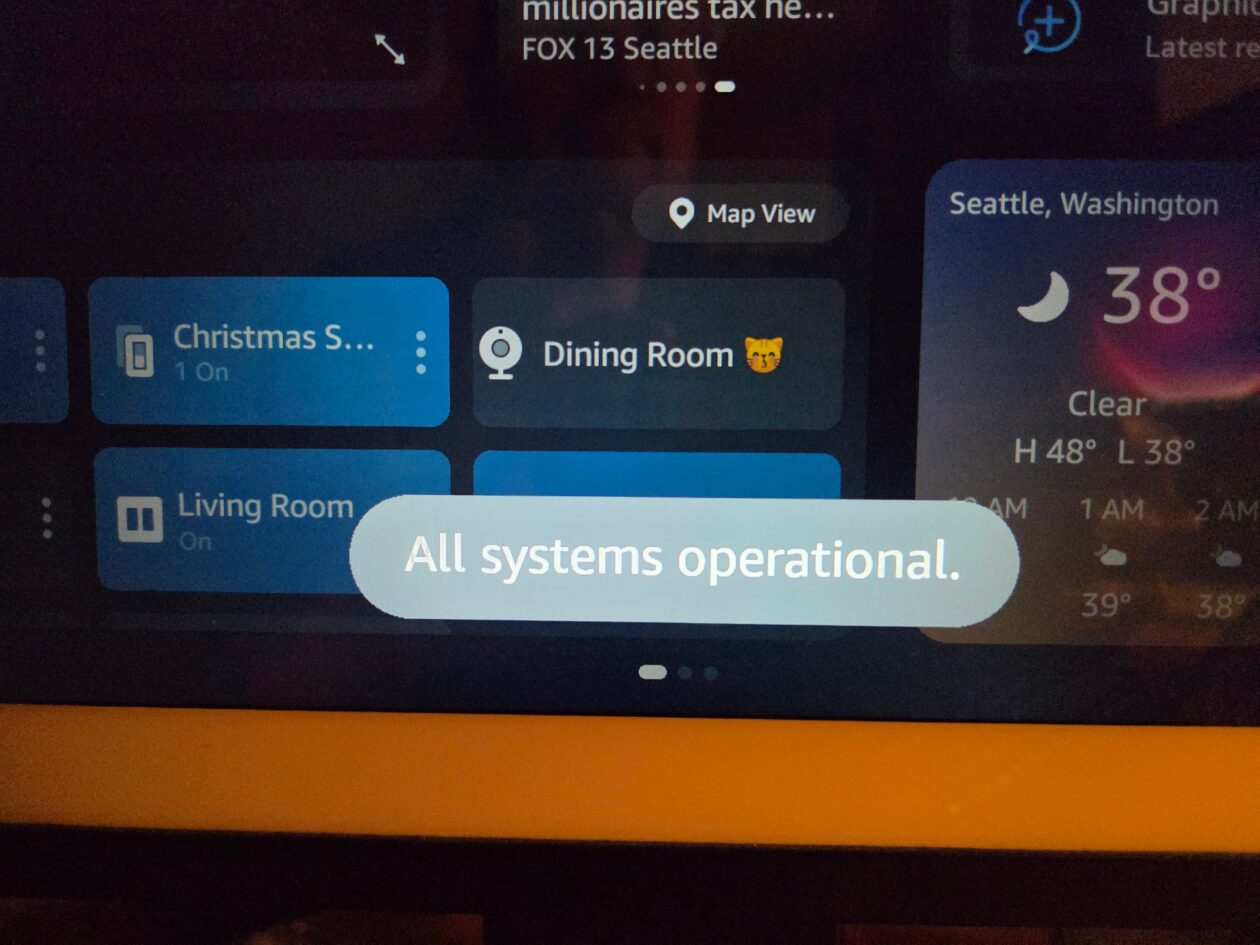
Alexa responds with “All systems operational” in the new Brief personality mode on an Echo Show. (GeekWire Photo / Todd Bishop)

Tired of Alexa’s constant chatter? Wish Amazon’s voice assistant would just get to the point without all the extra stuff? Maybe I’m just speaking for myself? Anyway, relief is finally here.

Amazon is rolling out a new option to keep Alexa’s responses blessedly perfunctory in a new “Brief” mode for Alexa+, along with options for “Chill” and “Sweet” conversation styles that adjust the AI assistant’s tone and delivery across Alexa+ devices.

Ask Alexa how it’s going in Brief mode, for example, and the response might be a curt “All systems operational.” Switch to Chill and it’s a zen “all systems are in harmony.” Go with Sweet and you’ll get something like an exuberant “radiating pure joy!” (Responses differ each time.)

It’s a first for the voice assistant, available now for Alexa+ users. Users can switch by saying “Alexa, change your personality style” or through the Alexa app under device settings. Personality styles can also be paired with any of Alexa’s eight voice options, which include different genders and regional dialects.

Alexa’s default personality also remains an option, and can be restored at any time.

Advertisement

Amazon has previously offered voice customization for Alexa, including celebrity add-ons like Samuel L. Jackson and Melissa McCarthy, but those were paid extras that altered phrasing on a limited set of responses rather than system-wide personality adjustments.

The new option is part of Amazon’s broader Alexa+ overhaul, which has made the voice assistant more conversational, with the ability to take actions such as ordering takeout and booking dinner reservations. The company made the AI-powered upgrade available to all U.S. customers earlier this month, nearly a year after it was unveiled.

The personality feature reflects a trend in consumer AI. For example, ChatGPT lets users customize its tone and behavior through custom instructions, and Google’s Gemini offers different response styles. Microsoft has been testing a “Personality Studio” for Copilot and introduced a “Real Talk” mode that mirrors the user’s conversational style.

Source link

Advertisement
Continue Reading

Trending

Copyright © 2025