

Crypto World
Standard Chartered: Stablecoin Growth Could Unlock $1 Trillion in Treasury Bill Demand by 2028


TLDR:
- Standard Chartered forecasts stablecoin market cap will grow from $304 billion to $2 trillion by 2028.
- Stablecoin reserve practices could generate between $800 billion and $1 trillion in new T-bill demand.
- Growth is driven by macroeconomic trends, meaning it persists even if Bitcoin and Ethereum trade sideways.
- Rising Treasury exposure gives stablecoin issuers growing political leverage against potential regulatory crackdowns.
Standard Chartered has released a forecast that is drawing attention across traditional finance and crypto markets alike. The bank predicts stablecoin market capitalization will climb from $304 billion today to $2 trillion by 2028.
According to the bank, this growth will be driven by macroeconomic trends rather than crypto-native adoption.
As stablecoin issuers continue parking reserves in US Treasury bills, the demand for short-term government debt could rise sharply. The forecast is reshaping how institutions approach the stablecoin conversation.
Standard Chartered Links Stablecoin Growth to Treasury Demand
Standard Chartered’s forecast draws a direct line between stablecoin expansion and US Treasury markets. Stablecoin issuers like Tether and Circle back their tokens by holding reserves in short-term Treasury bills.
This practice already channels hundreds of billions into T-bill markets at current circulation levels. The bank estimates that scaling to $2 trillion could produce $800 billion to $1 trillion in new T-bill demand.
That level of structural buying is a notable development for sovereign debt markets. Unlike speculative capital flows, this demand is tied directly to stablecoin issuance volume.
It persists regardless of broader crypto market conditions. Financial news account Walter Bloomberg flagged the bank’s estimate, noting the growth is “driven by macroeconomic trends rather than structural issues.”
Crypto outlet Milk Road further contextualized Standard Chartered’s numbers for retail audiences. The outlet noted that stablecoin issuers have “quietly become one of the largest holders of US Treasury bills.”
With $304 billion already in circulation, hundreds of billions in T-bill exposure already exist today. Standard Chartered’s projection simply extends that existing pattern forward.
The bank’s forecast also carries weight because of its source. Standard Chartered is a globally recognized institution, not a crypto-native research firm.
Its entry into stablecoin market analysis signals growing mainstream financial interest. That shift alone adds credibility to the $2 trillion growth projection.
Standard Chartered’s Outlook Points to Broader Market Consequences
Beyond Treasury demand, Standard Chartered’s forecast touches on political and regulatory dynamics. Milk Road pointed out that stablecoin issuers absorbing nearly a trillion in government debt will “grow their political leverage.”
Governments find it increasingly difficult to restrict entities buying large volumes of national debt. This creates a natural shield against aggressive regulatory action.
Standard Chartered’s prediction also suggests stablecoins are becoming too systemically important to ignore. That shift could accelerate regulatory clarity in major jurisdictions around the world.
Clearer frameworks would, in turn, support further stablecoin market expansion. The bank’s forecast, therefore, sets up a self-reinforcing growth cycle.
Milk Road also noted that the projected growth happens “even if BTC and ETH trade sideways.” This separates Standard Chartered’s outlook from typical crypto bull-market narratives.
The bank frames stablecoin growth as a macroeconomic story, not a speculative one. That distinction matters greatly to institutional investors evaluating the sector.
Standard Chartered’s $1 trillion Treasury demand prediction is arriving at a critical time. Deficit spending continues with no clear slowdown, creating persistent need for reliable T-bill buyers.
Stablecoin issuers, under this forecast, step into that role at scale. The bank’s analysis positions stablecoins as a structural pillar of short-term US debt markets going forward.

Hut 8 (HUT) reported a fourth-quarter net loss Wednesday of $279.7 million, from income of $152.2 million a year earlier.
Revenue for the quarter ended Dec. 31 was $88.5 million, compared with $31.7 million in the same period a year earlier.
In its earnings report released Wednesday, Hut 8 said compute revenue for the three-month period totaled $81.9 million, up from $19.2 million a year earlier. The company did not disclose quarterly Bitcoin (BTC) production or sales figures.
Operating results were affected by a $401.9 million loss on digital assets in the quarter, compared with a $308.2 million increase a year earlier.
Hut 8 said it ended the year with about $1.4 billion in cash and Bitcoin reserves and up to $400 million in revolving credit capacity.
During the quarter, the company signed a 15-year lease for 245 megawatts of AI data center capacity at its River Bend campus valued at $7 billion. The agreement includes payments financially backstopped by Google and builds on Hut 8’s broader expansion into AI and high-performance computing infrastructure.
The company also completed the sale of a 310 MW natural gas portfolio in February and said it launched American Bitcoin Corp. as a separately listed vehicle focused on Bitcoin accumulation.
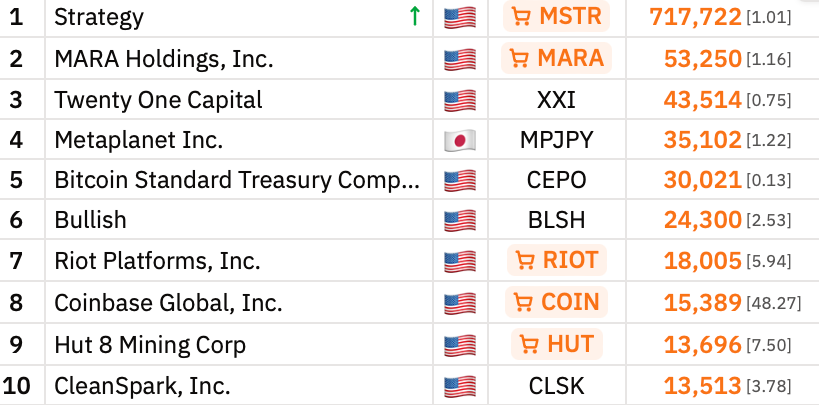
According to BitcoinTreasuries.NET data, Hut 8 holds 13,696 BTC, ranking it among the larger public Bitcoin holders. Shares were down about 4.5% at last look in Wednesday morning trading. Industry tracker CoinShares Bitcoin Mining ETF (WGMI) was up less than 1%.

Related: Solo Bitcoin miner bags over $200K block reward using rented hashrate
AI and infrastructure initiatives stoke mining stocks gains
Even as Bitcoin has fallen to about $68,150 from about $87,500 at the start of the year, per CoinGecko data, shares of most of the biggest publicly traded Bitcoin miners by market capitalization have posted year-to-date gains.
TeraWulf is up more than 50% this year, while Riot Platforms and Hut 8 have advanced about 30% and 29%, respectively, according to data from BitcoinMiningStock.io.

The divergence suggests investors may be valuing miners not solely on Bitcoin price exposure, but increasingly on their energy infrastructure and data center strategies.
In August, TeraWulf signed 10-year colocation leases with AI infrastructure provider Fluidstack valued at $3.7 billion. Google is backing about $1.8 billion of the lease obligations and providing debt financing, receiving warrants for about 41 million WULF shares, or about 8% of the company.
Last week, activist investor Starboard Value urged Riot Platforms to speed up its push into high-performance computing and AI data centers, saying Texas-based development could unlock $9 billion to $21 billion in equity value. Starboard holds about 12.7 million Riot shares.
Other miners are also repositioning toward AI-linked infrastructure. CleanSpark, Core Scientific, HIVE Digital and MARA Holdings have repurposed portions of their infrastructure or outlined similar AI and high-performance computing initiatives.
Cango said it sold $305 million worth of Bitcoin on Feb. 9, in part to finance its planned expansion into AI and HPC.
Magazine: Clarity Act risks repeat of Europe’s mistakes, crypto lawyer warns
From windmills to auto parts, small to medium-sized are leading the way with stablecoin adoption, per a new report from Stablecon and Artemis.
Business-to-business (B2B) stablecoin payments ballooned over 730% year-over-year in 2025, according to a new report by Artemis and Stablecon.

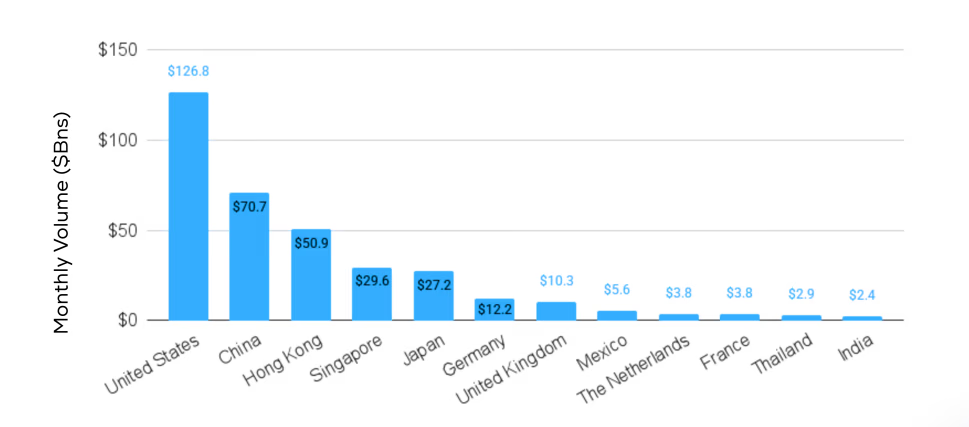
For cross-border payments, the United States received the largest stablecoin flows into the country, with nearly $127 billion monthly. China emerged as the second-largest country for receiving stablecoin payments from international senders, processing nearly $71 billion per month on average, followed by Hong Kong with almost $51 billion.

The report estimates that total annual stablecoin payments soared to $390 billion, more than double 2024 levels, with B2B transactions accounting for roughly 60% of the total.
Though they represent a relatively small slice of stablecoin payment types, card-linked stablecoin transactions saw massive growth last year as well, surging 840% year-over-year.
Speaking with The Defiant, Andrew Van Aken, data scientist at Artemis, clarified that, contrary to popular belief, the top countries for stablecoin usage tend to be those with the highest payment volumes, and developed economies are also increasingly adopting new payment methods.
“I think the most important angle is that the top stablecoin countries tend to be the countries with the highest payment volumes. While the narrative is often that stablecoins are used in emerging countries, developed countries are also looking for new and innovative payment methods,” Van Aken said.
Van Aken also specified that on the B2B side, adoption is concentrated among small and medium-sized businesses — from windmills to scarf makers to auto part companies — seeking to decrease payment times.
“We can’t explicitly shed light on specifics, but it tends to be a lot of small to medium-sized businesses, often tech forward businesses that are looking to decrease payment times,” he added.
As the report itself also notes, the rise in stablecoin use may be linked to their ability to speed up cross-border payments and reduce the extra steps of traditional banking.


- Uniswap price jumped to above $4 on Wednesday as Bitcoin retested $68,000.
- The UNI token could eye $5 amid an oversold bounce across crypto.
- If bulls fail to rally, key support lies around $3.48 and $3.00.
Uniswap (UNI) price has surged nearly 20% in recent trading, climbing to intraday highs above $4.00 as top altcoins retest critical resistance levels.
This rebound aligns with Bitcoin’s spike in the past 24 hours, which sees BTC trade above $68,000 and altcoins, including Ethereum, XRP, and BNB, target oversold bounces above $2,000, $1.50, and $620, respectively.
As with these top altcoins, on-chain data shows Uniswap price ticking up from oversold conditions. Morpho was among the coins to see sharp gains on the day.
Uniswap price pumps to above $4
The sharp decline on February 5, 2026, saw UNI price dump to $3.00, and a subsequent attempt to break higher failed as prices hovered in a range capped at around $3.60.
Overall, weakness in digital assets amid macro headwinds contributed to this outlook.
However, despite risk assets remaining largely bearish, UNI’s uptick to $4.00 amid a 62% spike in daily volume reflects fresh optimism.
Uniswap’s gains in the past 24 hours build on the positive movement that followed BlackRock’s recent strategic purchase of UNI.
The global asset management giant plans to use the tokens to facilitate trading of its BUIDL tokenized Treasury fund via Uniswap.
Data on the market platform Coinglass highlights the improvement in on-chain metrics for UNI.
Open interest is picking up, and funding rates are positive. This suggests recent weakness has provided entry opportunities for buyers.
Bitcoin’s push above $68,000 and Ethereum’s breach of $2,000 may catalyze further gains for small-cap tokens.
What next for UNI price?
Although Uniswap’s price is up by double digits on the day, it remains in the red over the past week, month, and year-to-date.

Technical indicators also suggest that UNI at $4.00 is below key moving averages, including the 50-day, 100-day, and 200-day SMAs.
Daily RSI at 56, however, signals an extended bounce from oversold territory, and significantly, has room for another leg up before bulls hit overbought extremes.
Meanwhile, the MACD histogram hints at fresh bullish momentum with $3.20 having formed a potential bottom.
Bollinger Bands position UNI above the upper band, which is currently at $3.81.
If prices break above the 50-day SMA, bulls will have eyes on the 100 SMA ($5.09).
This hurdle aligns with a horizontal resistance line that also acted as support in November and December 2025.
However, near-term bearish targets are alive. The lower Bollinger band at $3.48 offers the first major demand reload zone. Below this, bulls could rely on support at $3.00.


Since late August, Bitcoin has broken from equities in what appears to be its weakest stock correlation since the chaos of 2022.
Bitcoin’s recent performance differs from its long-standing pattern of moving with stocks. Over the past six months, it has lagged while equities stayed stable and gold rose.
The trend created an unusually weak correlation and recalled rare periods when crypto briefly moved independently from broader financial markets.
Rare Market Divergence
For many years, Bitcoin has frequently moved in the same direction as traditional equity markets, especially the S&P 500. During periods of low interest rates and strong economic growth, such as in 2021 and again in parts of 2024, BTC and many altcoins performed well alongside rising stocks.
On the other hand, during periods of increased fear and tightening monetary policy, including aggressive Federal Reserve rate hikes, crypto markets tended to decline in tandem with equities, as seen in 2018 and 2022.
A clear example occurred in November 2022, when rising interest rates combined with the collapse of FTX pushed Bitcoin down to approximately $15,700. This is one of the most extreme cases of crypto markets falling far more sharply than equities.
Over the past six months, however, Bitcoin has started to move very differently from stocks. Since late August, gold has risen by 51%, the S&P 500 has gained 7%, while Bitcoin has fallen 43%, creating the weakest correlation between BTC and stocks since the market chaos of late 2022.
Rather than moving in step with equities, Bitcoin has significantly underperformed as traditional markets have remained relatively stable and gold has seen strong gains. According to Santiment, such dramatic deviations from long-standing correlations do not typically continue indefinitely.
You may also like:
Previous instances clearly show that markets rotate as sentiment and macroeconomic conditions evolve, which results in changing capital flows over time. Within this context, Santiment added that if BTC eventually returns to its historical tendency of tracking equities during economic expansions, particularly in a scenario involving three interest rate cuts in the second half of 2025, there could be significant room for Bitcoin and altcoins to catch up.
Bearish Pressure
Bitcoin saw a modest rebound on Wednesday as it briefly climbed above the $66,000 level before giving back part of its gains and stabilizing above $65,000.
But data suggests bearish pressure in the BTC futures market, as funding rates remained largely negative across the $62,000-$68,000 range. Additionally, CryptoQuant stated that Bitcoin may not have formed a true bottom yet. Short-term holders have been consistently selling at a loss for nearly 30 days, and multiple large sell spikes have been absorbed without triggering a sustained rebound.
Despite brief price pumps, selling pressure has remained dominant. These rallies are acting as exit liquidity, and a meaningful trend reversal is unlikely until short-term holder profits turn positive and remain there, the report added.
Binance Free $600 (CryptoPotato Exclusive): Use this link to register a new account and receive $600 exclusive welcome offer on Binance (full details).
LIMITED OFFER for CryptoPotato readers at Bybit: Use this link to register and open a $500 FREE position on any coin!


David Schwartz says the XRP Ledger was deliberately designed to prevent Ripple or any single actor from controlling the chain.
Ripple CTO David Schwartz has said that the XRP Ledger (XRPL) was deliberately designed so that neither the company nor any single entity could control it.
His remarks came hours after Cyber Capital founder Justin Bons argued that XRPL is effectively permissioned and centralized, with the exchange cutting to a long-running debate in crypto over what decentralization actually means and whether validator lists amount to hidden control.
Clash Over Control and the Unique Node List
Bons wrote in a February 24 thread on X that networks such as Ripple, Stellar, Hedera, Canton, and Algorand rely on permissioned elements. He claimed XRPL’s Unique Node List, or UNL, gives Ripple and its foundation “absolute power and control over the chain,” arguing that divergence from the published list could cause a fork.
However, Schwartz rejected that characterization, calling it “objectively nonsensical.” He said XRPL nodes individually decide which validators to trust and will not agree to double-spends or censorship unless their operators explicitly choose to.
If a validator attempts to censor or double-spend, “an honest node would just count it as one validator that it did not agree with,” he wrote.
However, Schwartz acknowledged that validators could conspire to halt the chain from the perspective of honest nodes but said they could not force double-spends. In such a case, node operators could switch to a different UNL, which he compared to changing the mining algorithm in Bitcoin after a majority attack.
The XRPL co-architect also addressed regulatory pressure, noting that Ripple must comply with U.S. court orders and cannot refuse them. For that reason, he argued, XRPL was intentionally built so that Ripple itself could not censor transactions.
You may also like:
“The best way to be able to say ‘no’ is to have to say ‘no’ because you cannot do the thing asked,” Schwartz wrote.
Regulatory Pressures and Network Resilience
The exchange comes as XRPL activity metrics have shown significant declines, with analyst Arthur reporting on February 23 that active users fell to roughly 38,000 from more than 200,000, while payment volume dropped to about 80 million XRP from over 2.5 billion.
However, the on-chain observer attributed the drop to the February 18 activation of XLS-81, a permissioned decentralized exchange system that moves institutional transactions off public dashboards.
Questions about validator power also surfaced late last year, when Schwartz proposed a two-tier staking model intended to add rewards without concentrating influence in Ripple’s hands. The idea involved a separate governance token to manage validator lists, with the option to fork if governance failed.
For now, the February 25 exchange highlights a familiar divide. Critics argue that publishing validator lists creates soft control, even if anyone can technically run a node. However, Schwartz maintains that XRPL’s consensus model was built to limit the power of validators and companies alike, even if that means Ripple itself cannot intervene when pressured.
Binance Free $600 (CryptoPotato Exclusive): Use this link to register a new account and receive $600 exclusive welcome offer on Binance (full details).
LIMITED OFFER for CryptoPotato readers at Bybit: Use this link to register and open a $500 FREE position on any coin!


MIAMI BEACH — Bitcoin’s recent slide has frustrated investors who expected a smoother ride after a wave of institutional milestones, but Adam Back, one of the early cypherpunks cited in bitcoin’s 2008 white paper, said the volatility should not surprise long-time observers.
“Bitcoin is generally volatile,” Back said at the iConnections conference in Miami Beach on Tuesday. “There’s a lot of positive news […] and in the previous four year market cycles, this has been about a time in a cycle where price runs lower.”
He suggested that some market participants may be trading around that historical pattern rather than reacting to fundamentals. “There was some expectation or possibility that, because there are different types of investors, the market can be different. So I think some people are thinking the price may come back later in the year.”
Bitcoin entered the year with a tailwind. A more crypto-friendly administration in Washington and long-awaited regulatory clarity around spot exchange-traded funds (ETFs) were expected to unlock deeper institutional participation.
For many investors, this was also meant to be a proving ground. Bitcoin’s core pitch has long centered on scarcity and independence from government monetary policy and to be a digital store of value designed to hedge against currency debasement. At a time when U.S. fiscal deficits remain large and questions about the dollar’s long-term purchasing power persist, the backdrop appeared aligned with that thesis.
Yet the market has not followed the script. Bitcoin is down roughly 26% over the past year, even as the policy environment turned more supportive and institutional access improved. Instead of decoupling from macro uncertainty, the asset has at times traded in line with broader risk markets.
Meanwhile, traditional safe havens have rallied. Gold has climbed to fresh all-time highs, with silver also reaching multi-year peaks. Capital seeking shelter from inflation concerns and geopolitical risk appears to have flowed, at least in part, into metals rather than digital assets.
Back, who is now the CEO of Blockstream as well as the Bitcoin Standard Treasury Company (BSTR), also pointed to structural dynamics in who holds bitcoin.
“The ETF holders […] are more sticky investors than the retail bitcoin exchange traders,” he said. Retail participants often deploy most of their capital during rallies, leaving little dry powder during downturns. Institutions, by contrast, can rebalance across portfolios.
Still, Back cautioned that institutional adoption remains early. “I think there isn’t that much institutional capital yet.”
In his view, large pools of capital have not yet fully entered the market, even though major regulatory hurdles have been resolved and clearer rules could pave the way for more institutional inflows.
Over time, he expects broader adoption to reduce volatility. He compared bitcoin’s current phase to early high-growth equities. “You can look at analogies of, say, early Amazon (AMZN) stock, which had wild swings in price, basically because the market was uncertain.”
“The kind of rapid adoption curve inherently brings with it volatility,” he said. As adoption matures and more institutions, companies and sovereigns gain exposure, Back said bitcoin’s price swings should moderate. He does not expect volatility to disappear, but said he believes it could begin to resemble gold, which trades with less dramatic moves than a younger asset.
Back also said he measures bitcoin’s long-term potential against gold’s total market value. He argued that comparing the two market capitalizations offers a rough benchmark for adoption, and in his view bitcoin remains roughly 10 to 15 times smaller than gold today, suggesting room for further growth if it continues to capture share as a store of value.
Despite short-term price swings, Back argued bitcoin’s long-term investment case remains intact. “Bitcoin as an asset class has stood out from everything, every other asset class for the last decade generally, in having the highest annualized return,” he said.
For Back, volatility is not a contradiction of bitcoin’s thesis but a feature of its adoption phase. “Volatility […] is part of the picture,” he said.
Real-world asset tokens have continued to bleed through February 2026, with several major RWA tokens to watch sitting over 80% below their recent highs. The sell-off has been broad and unforgiving.
But heading into March, technical reversal signals are beginning to form across multiple charts, supported by declining exchange inflows and steady ETF demand. Here are 3 tokenized asset projects where the setup is starting to shift.
Stellar (XLM)
Stellar’s real-world asset footprint is growing even as its token struggles. Data from RWA.xyz shows the network’s distributed asset value has climbed to $1.27 billion, up 25% over the past 30 days. On the institutional side, CME Group launched Stellar futures on February 9, 2026. Both standard and micro-sized contracts are now live, giving institutions a regulated on-ramp to XLM for the first time.
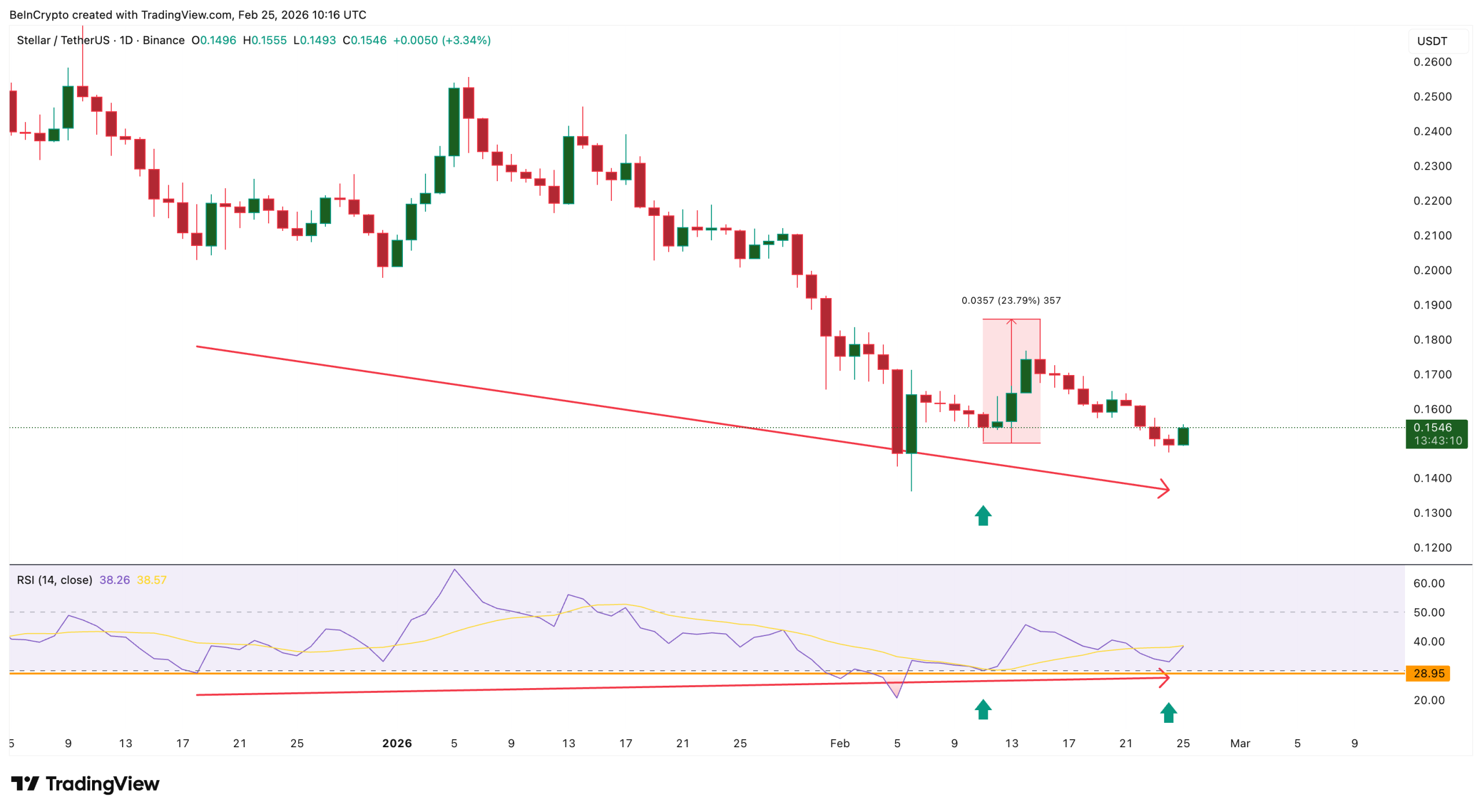
Despite that, the XLM price remains under pressure. Stellar is down roughly 40% over the past three months and trades near $0.154. But the charts are starting to tell a different story.
Between December 18 and February 24, XLM printed a lower low while the Relative Strength Index (RSI), a momentum indicator, formed a higher low, a standard bullish divergence. This is a textbook reversal signal, and it has a recent precedent. A similar setup appeared around February 11, after which Stellar rallied approximately 23% before correcting.
Want more token insights like this? Sign up for Editor Harsh Notariya’s Daily Crypto Newsletter here.
If the current divergence plays out heading into March, the first hurdle sits at $0.164, a level that has flipped between support and resistance multiple times. Clearing it opens the path toward $0.185 (where the last rally stopped) and then $0.210, which aligns with the 0.618 Fibonacci retracement and would mark the first real structural shift in months. A move beyond that puts $0.230 in play.
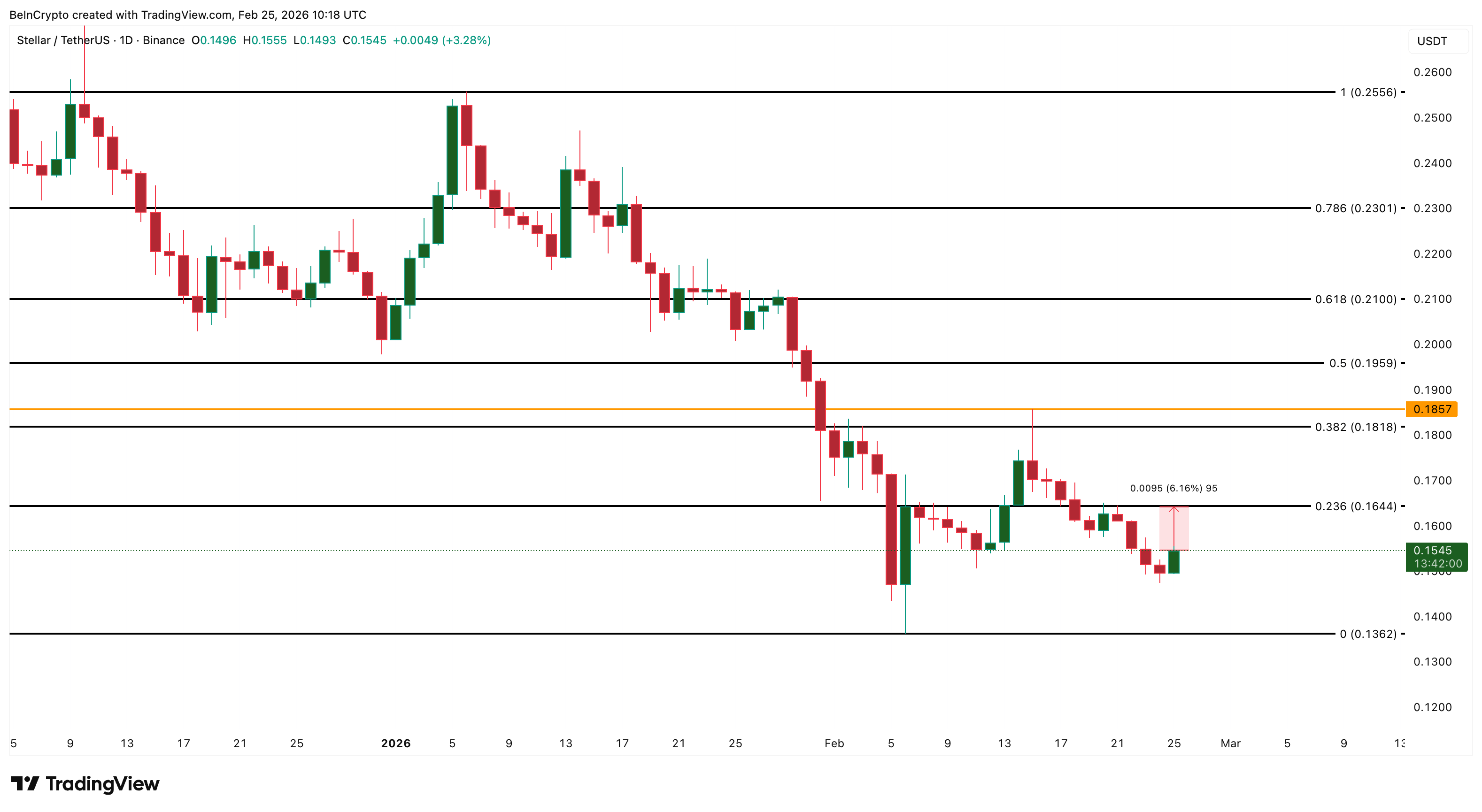
On the downside, failure to reclaim $0.164 keeps Stellar range-bound. A break below $0.136 invalidates the reversal thesis.
With RWA adoption accelerating and institutional infrastructure now live, Stellar (XLM) stands out as a real-world asset token to watch in March. The fundamentals are building. The divergence suggests the price may be getting ready to catch up.
Chainlink (LINK)
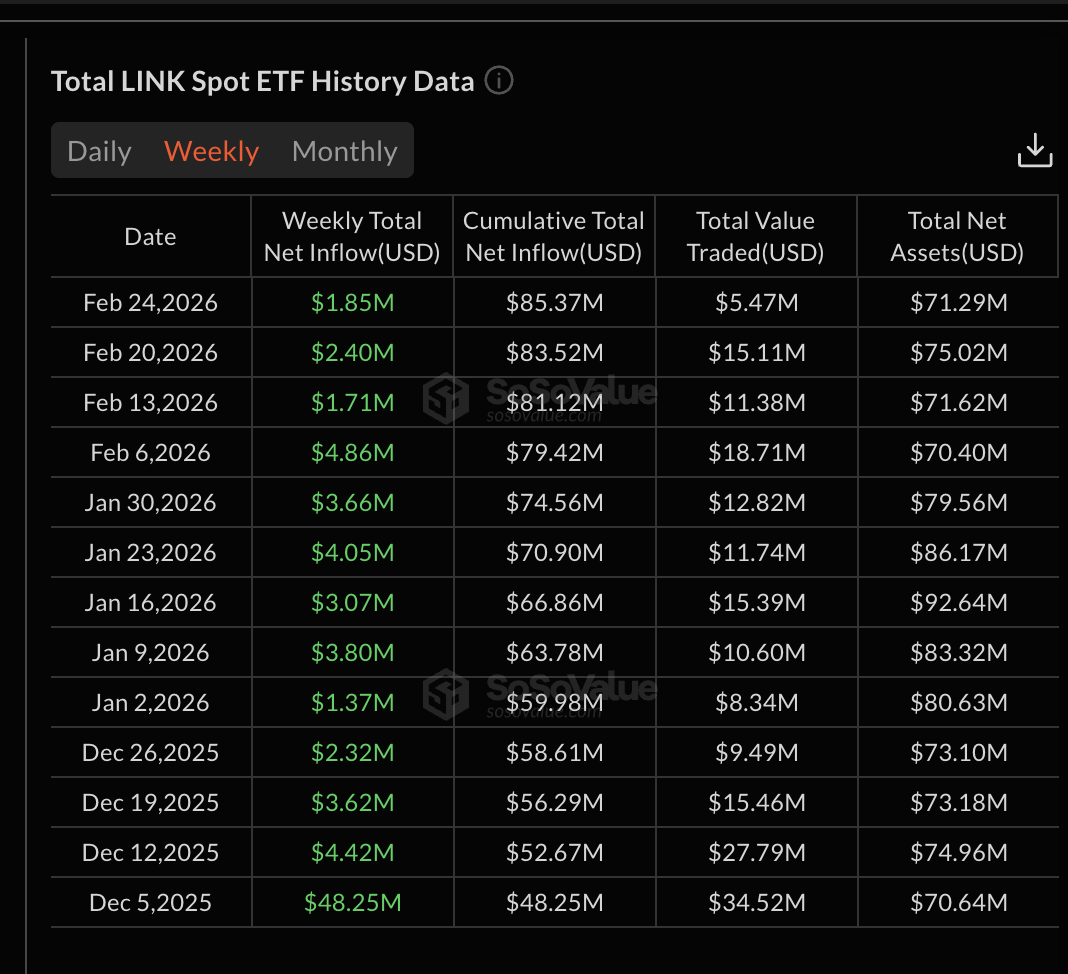
Chainlink continues to lead as oracle infrastructure for the tokenized asset economy, and its spot ETF performance is reinforcing that positioning. While Bitcoin ETFs have suffered through nearly six consecutive weeks of net outflows, Chainlink has not recorded a single red week since its ETFs launched.
That kind of consistency in a risk-off environment is rare across the RWA sector and signals steady institutional-grade demand even as broader crypto sentiment deteriorates.
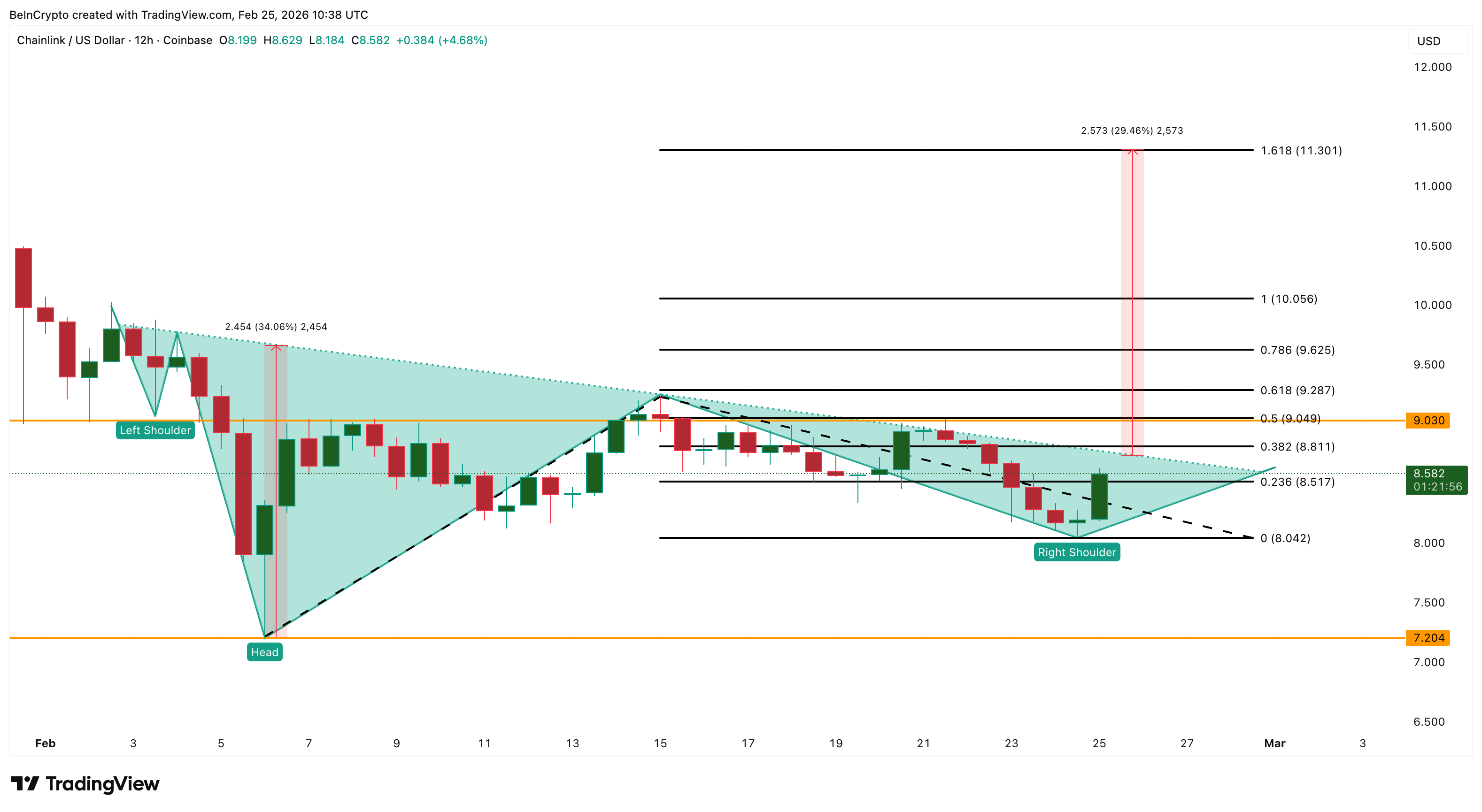
On the charts, LINK is forming an inverse head and shoulders pattern on the 12-hour timeframe, a structure that carries roughly 35% breakout potential if the neckline breaks.
However, the neckline slopes downward, which means a clean 12-hour break above $9.00 is needed to trigger the move. Chainlink already tested this level between February 19 and 21 while rebounding from the right shoulder, but it failed at $9.00 and pulled back. That rejection makes the neckline even more significant. A confirmed daily close above it would be a strong signal, both technically and in terms of sentiment.
If LINK reclaims $9.00, the breakout path opens toward $11.30, which aligns with the measured move from the pattern. A key resistance could still halt the probable rally at $10.00.
On the downside, losing $8.00 weakens the structure. A decisive break below $7.20 fully invalidates the inverse head and shoulders and shifts the bias bearish.
With on-chain adoption expanding across tokenized securities and cross-chain interoperability, and ETF flows showing no signs of fading, Chainlink remains one of the stronger RWA tokens to watch heading into March. The failed neckline test makes the next attempt critical. If $9.00 breaks, the setup could deliver one of the cleaner moves in the real-world asset space this quarter.
Ondo Finance (ONDO)
Ondo Finance remains one of the largest tokenized asset platforms in the real-world asset sector, with more than $2.5 billion in total value locked. Despite that growth, the ONDO token has not kept pace. Since reaching its all-time high of $2.14 in December 2024, ONDO has declined more than 80% and now trades at $0.25. That disconnect makes it one of the most heavily discounted real-world asset tokens relative to its underlying platform expansion.
A potential shift is now appearing on the technical side. Between January 25 and February 24, ONDO formed a lower low while the Relative Strength Index printed a higher low. This creates a standard bullish divergence, a classic early-reversal signal, the same as XLM discussed earlier.
On-chain data reinforces that signal. Exchange inflows dropped sharply after February 24, falling from 42.91 million ONDO to just 4.54 million. That represents an approximately 89% decline in tokens moving to exchanges, possibly for selling.
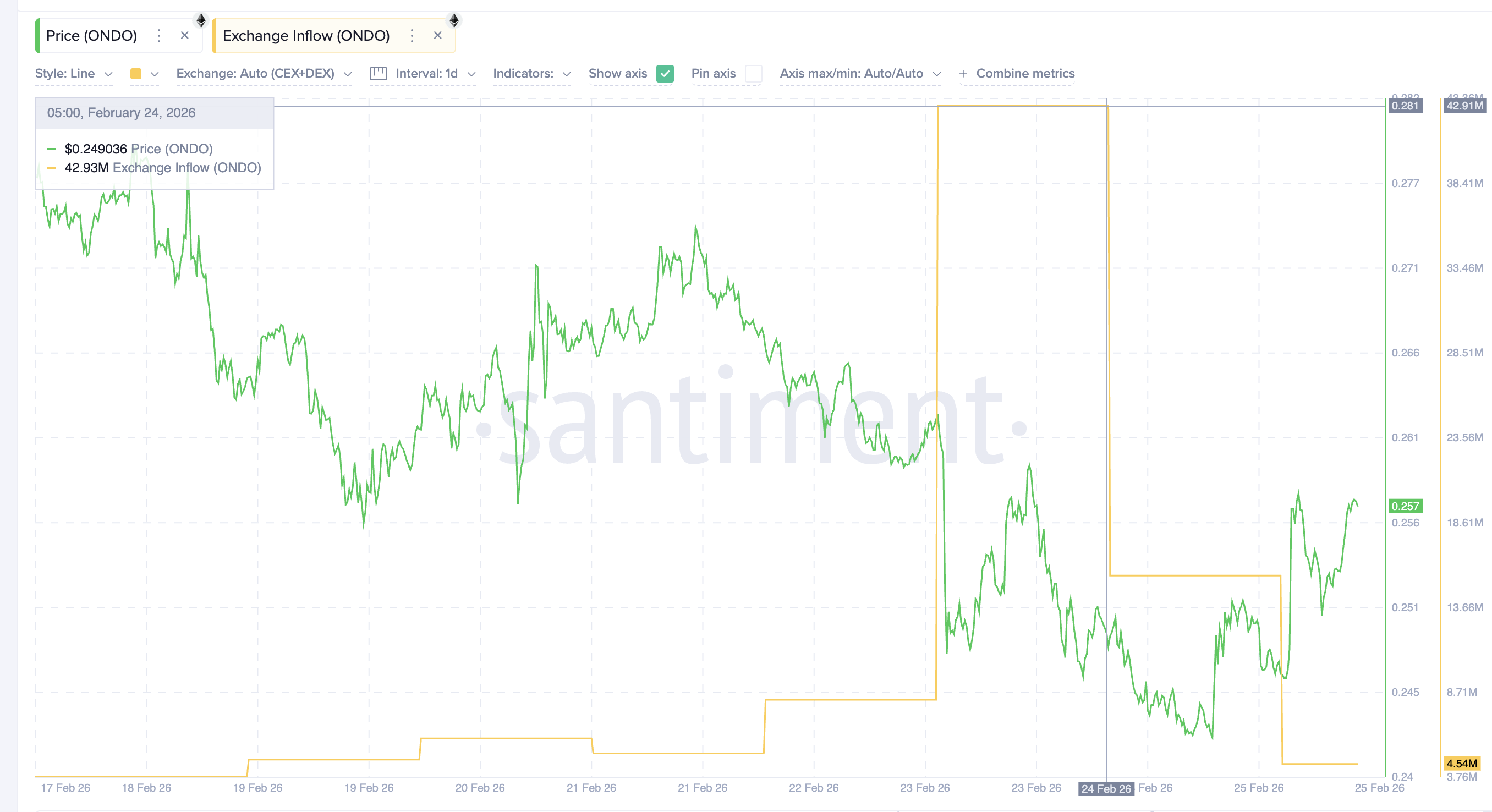
When exchange inflows collapse right as a divergence signal forms, it suggests that selling pressure behind the downtrend is fading.
Looking ahead, the first key level sits at $0.26. Holding and breaking above this level would confirm short-term strength and open the path toward $0.30, which has acted as repeated resistance in recent weeks.
A successful reclaim of $0.30 would strengthen the reversal structure and allow for a move toward $0.36. A move to $0.30 would represent roughly 19% upside from current prices.
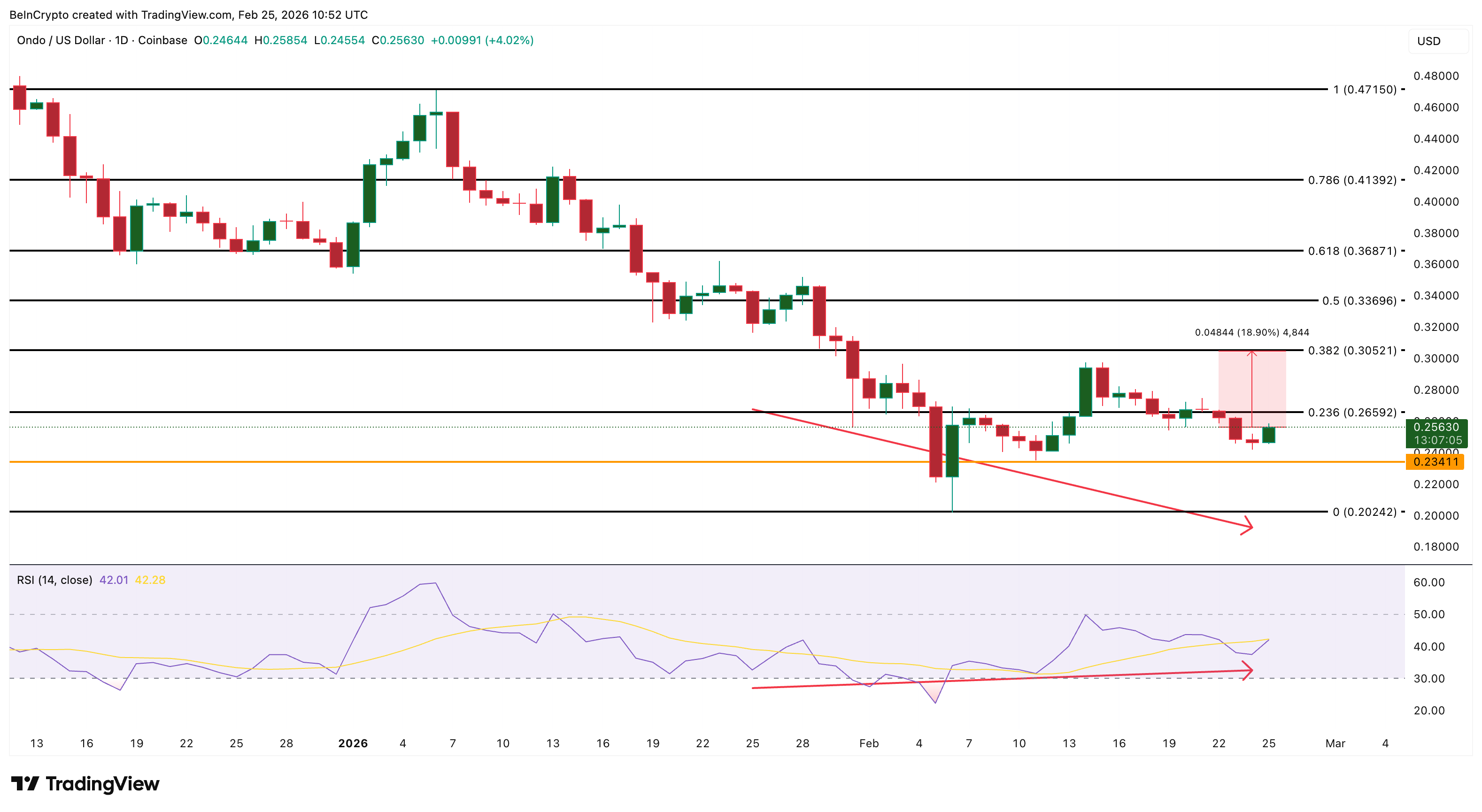
On the downside, support rests at $0.23. Losing that level would increase the risk of another leg lower toward $0.20. This level remains the most important structural floor. A break below $0.20 would weaken the early reversal thesis and confirm that the longer-term downtrend is still in control.
TLDR:
- US agents seized over $61M in Tether linked to a large-scale crypto pig butchering romance scam.
- Scammers built fake romantic relationships to direct victims toward fraudulent crypto trading platforms.
- HSI agents traced stolen USDT through multiple wallets before recovering funds still held in them.
- Tether cooperated with federal authorities, assisting in the transfer of the seized USDT assets.
US agents seize $61M USDT in a major federal operation targeting cryptocurrency romance fraud. The U.S. Attorney’s Office for the Eastern District of North Carolina confirmed the recovery of over $61 million in Tether.
Homeland Security Investigations traced the funds to wallets connected to a large-scale pig butchering scheme. The case began after a fraud victim filed a report through the HSI Tip Line in Raleigh, North Carolina.
Romance Tactics Used to Lure Crypto Victims
Scammers behind the operation first approached victims under the guise of romantic interest. They built trust over time before introducing the topic of cryptocurrency investment opportunities. Once victims felt secure in the relationship, the fraud began to take shape.
The criminals then claimed to have special techniques for generating high returns through crypto trading. They directed victims to fake platforms that closely resembled legitimate cryptocurrency exchanges. Those platforms were designed to look credible in both name and appearance.
Fabricated investment dashboards showed unusually high portfolio gains to keep victims engaged. The false returns were intended to convince victims to deposit more and more money. Nothing shown on those platforms reflected any real trading activity.
When victims attempted to withdraw funds, they were blocked at every turn. Scammers cited reasons such as unpaid “taxes” or “fees” as conditions for releasing money. Those demands were simply further attempts to drain victims of additional funds.
How HSI Tracked and Seized the USDT
After receiving the tip, HSI agents and analysts in Raleigh launched a blockchain tracing operation. They followed the stolen funds as they moved through a series of cryptocurrency wallets.
The movement of funds was a deliberate effort to obscure the origin and ownership of the money.
Despite the layering tactics used, investigators successfully traced the path of the funds. Several wallets at the end of that chain still held large amounts of victim money. Those wallets became the target of federal seizure and forfeiture action.
HSI Charlotte Acting Special Agent in Charge Kyle D. Burns addressed the nature of the threat:
“HSI special agents work diligently to trace the illicit proceeds of crime across the globe to disrupt and dismantle the transnational criminal organizations that seek to defraud hardworking Americans.”
Tether played a cooperative role in the final stage of the recovery process. The company assisted federal authorities in transferring the seized USDT assets. The Department of Justice formally acknowledged Tether’s support in completing the operation.
U.S. Attorney Ellis Boyle reinforced the message behind the seizure:
“Our asset forfeiture team worked along with HSI to take the profit out of crime.”
The case proves that crypto transactions, while complex, leave traceable trails. Federal coordination with stablecoin issuers is becoming a sharper tool against large-scale fraud.
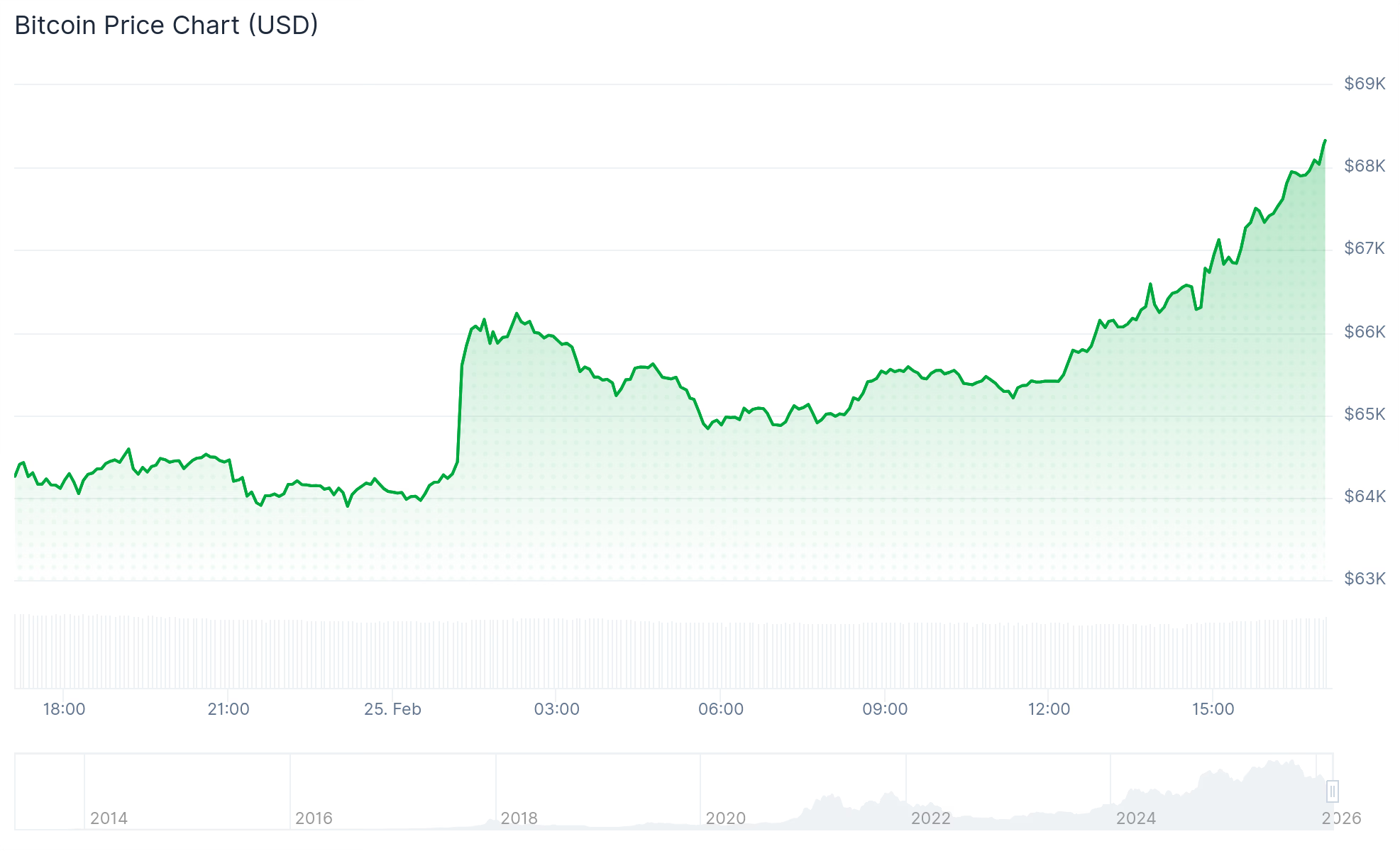
A broad-based rally lifted cryptocurrencies this morning, with BTC and ETH pushing back above key psychological levels, helped by strong spot Bitcoin ETF inflows.
Crypto markets saw a moderate bounce on Wednesday as buyers returned across major tokens, reversing some recent losses. Today, Feb. 25, total crypto market cap climbed about 6% to roughly $2.42 trillion.
Bitcoin (BTC) rose from around $62,900 late Tuesday to about $68,200 at publishing time, posting a 6.2% daily gain and pushing its weekly change just slightly into the green.

Ethereum (ETH) outperformed BTC, jumping over 10% to trade back over $2,060, and up a solid 4.6% on the week. Across the rest of the top-10 crypto assets — all trading higher — Solana (SOL) posted the biggest daily gain, up over 12%.
Unstable Footing
Despite the rebound, some on-chain indicators suggest stress hasn’t fully cleared. Analysts at glassnode said in an X post that Bitcoin’s Realized Profit/Loss Ratio (90-day SMA) has fallen below 1, signaling a shift into an excess loss-realization regime.
“Historically, breaks below 1 have persisted for 6+ months before reclaiming it, a recovery that typically signals a constructive return of liquidity to the market,” the analysts wrote.

Market sentiment is still shaky. The Crypto Fear and Greed Index ticked up to 11 from 8 a day earlier, pointing to a slight easing in fear, but it remains deep in “extreme fear” territory.
Big Movers and Liquidations
Looking at the top-100 assets by market cap, Filecoin (FIL) led gains, surging over 22%, followed by Polkadot (DOT), up almost 22% as well on the day, and Uniswap’s UNI, up 17%.
On the downside, losses were limited: MemeCore (M) slipped 2.8%, while Midnight (NIGHT) lost half a percent.
According to CoinGlass data, roughly 97,300 traders were liquidated over the past 24 hours, with total losses of $316.2 million. Short positions accounted for the bulk at $258.7 million, while BTC liquidations totaled $8.6 million, ETH slightly above $6 million, and SOL $1.6 million.
ETFs and Macro Conditions
On Tuesday, Feb. 24, spot Bitcoin exchange-traded funds recorded over $257 million in net inflows, pushing total net assets to about $81.3 billion. Spot Ethereum ETFs also saw net inflows yesterday of $9.23 million.
On the macro side, U.S. Treasury yields ticked a bit higher as investors digested Trump’s State of the Union, where he leaned hard on the economy and floated ideas ranging from a government-backed retirement plan to limits on institutional home buying, CNBC reported.
Attention now turns to upcoming U.S. economic data releases, including weekly initial jobless claims due Thursday and the producer price index (PPI) report scheduled for Friday, while traders continue to monitor geopolitical developments involving the U.S. and Iran.


A crypto rally is happening today, with Bitcoin and most altcoins being in the green.
Bitcoin (BTC) price jumped to $68,000, while the market capitalization of all coins rose by 6% to over $2.34 trillion.
Filecoin (FIL) rose by over 25% to $1.10, while Polkadot (DOT) jumped by 21%. Other tokens like Aptos (APT), Morpho (MORPHO), Uniswap (UNI), and Avalanche (AVAX) soared by over 15%.
Bitcoin and these altcoins jumped as investors embraced a risk-on sentiment across the board. For example, American stocks, including the Dow Jones, Nasdaq 100, and S&P 500, rose by 250, 260, and 35 points, respectively.
The risk-on sentiment happened as investors bought the dip as they waited for the Nvidia earnings, which will come out after the US market closes. NVIDIA is the most influential American company because of its size and role in the artificial intelligence industry.
Additionally, the tokens jumped as the futures open interest rebounded cautiously, a sign that demand is rising. Open interest rose by over 6% in the last 24 hours to $99.4 billion, much higher than this week’s low of $93 billion.
Filecoin’s open interest rose to $154 million, while Morpho soared to over $34 million. The futures open interest of other tokens like Aptos and Polkadot continued soaring.
Still, it is too early to determine whether this is the start of a new crypto bull run or whether it is just a dead-cat bounce. In the past, most crypto market rallieshave turned out to be dead-cat bounces.
A dead-cat bounce is a situation where an asset in a free-fall rebounds temporarily and then resumes the downtrend.

Whitecaps extend D Tristan Blackmon, M Andres Cubas

OpenClaw Users Are Allegedly Bypassing Anti-Bot Systems

WATCH LIVE | Budget Speech 2026, delivered by Finance Minister Enoch Godongwana


-

 Video6 days ago
XRP News: XRP Just Entered a New Phase (Almost Nobody Noticed)
-

 Politics3 days ago
Baftas 2026: Awards Nominations, Presenters And Performers
-

 Fashion5 days ago
Weekend Open Thread: Boden – Corporette.com
-

 Sports2 days ago
Women’s college basketball rankings: Iowa reenters top 10, Auriemma makes history
-

 Politics2 days ago
Nick Reiner Enters Plea In Deaths Of Parents Rob And Michele
-
 Sports7 days ago
Clearing the boundary, crossing into history: J&K end 67-year wait, enter maiden Ranji Trophy final | Cricket News
-

 Crypto World1 day ago
XRP price enters “dead zone” as Binance leverage hits lows
-

 Business3 days ago
Mattel’s American Girl brand turns 40, dolls enter a new era
-

 Business3 days ago
Law enforcement kills armed man seeking to enter Trump’s Mar-a-Lago resort, officials say
-

 Entertainment7 days ago
Dolores Catania Blasts Rob Rausch For Turning On ‘Housewives’ On ‘Traitors’
-
 NewsBeat2 days ago
‘Hourly’ method from gastroenterologist ‘helps reduce air travel bloating’
-

 Tech3 days ago
Anthropic-Backed Group Enters NY-12 AI PAC Fight
-

 NewsBeat3 days ago
Armed man killed after entering secure perimeter of Mar-a-Lago, Secret Service says
-

 Tech1 day ago
Unsurprisingly, Apple's board gets what it wants in 2026 shareholder meeting
-

 Politics3 days ago
Maine has a long track record of electing moderates. Enter Graham Platner.
-

 Crypto World7 days ago
WLFI Crypto Surges Toward $0.12 as Whale Buys $2.75M Before Trump-Linked Forum
-
 NewsBeat20 hours ago
Police latest as search for missing woman enters day nine
-

 Crypto World20 hours ago
Entering new markets without increasing payment costs
-
 Sports2 days ago
2026 NFL mock draft: WRs fly off the board in first round entering combine week
-

 Crypto World6 days ago
83% of Altcoins Enter Bear Trend as Liquidity Crunch Tightens Grip on Crypto Market