Backers aim to create ‘high-quality’ hub for ‘local grassroots sport’

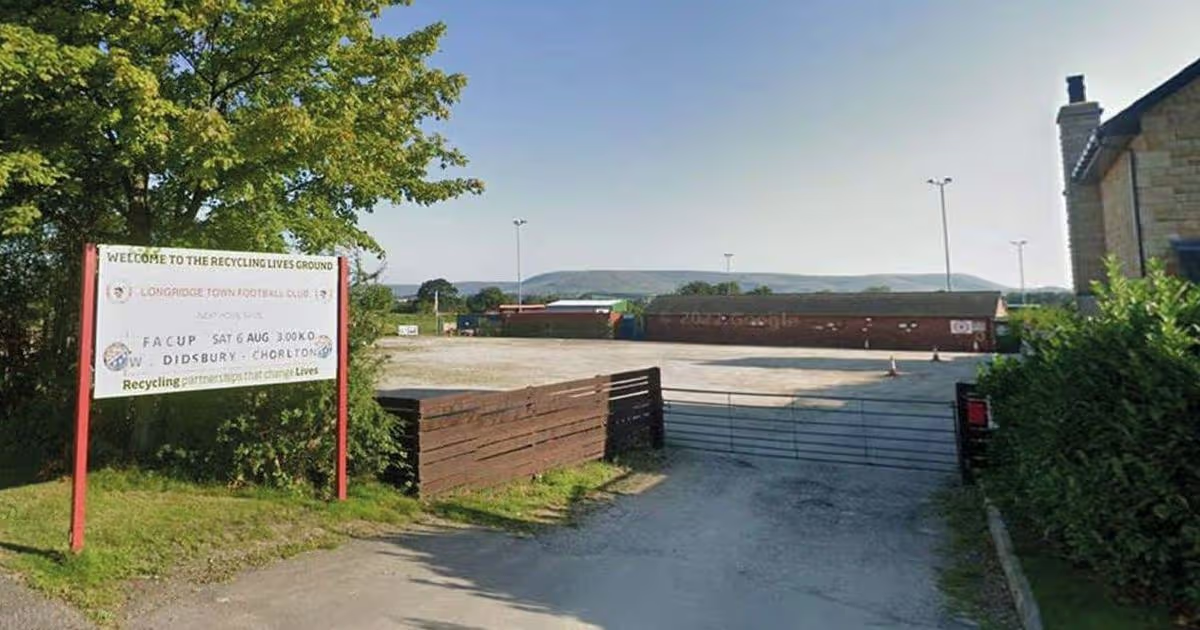
Longridge Town FC’s ground(Image: Levitt Bernstein, via Preston City Council planning portal)
More than 200 homes and a raft of new and upgraded sports facilities could be created on the outskirts of Preston as part of a major residential and leisure development.
The proposed Longridge Sports Village scheme would provide a “high-quality” hub for “local grassroots sport”, according to the organisations behind it.
Provision for football, gymnastics, padel and informal runs would sit alongside up to 220 new dwellings, all which would fall into the discounted ‘affordable homes’ category. More than 40 of the proposed properties are flats designed specifically for older people.
A 12-hectare site to the north west of the town has been earmarked for the project, adjacent to Longridge Town Football Club and Longridge Cricket Club.
Plans for the site – bounded by Inglewhite Road and Chipping Lane – first emerged last year when a public consultation was carried out into an initial blueprint.
Now, Longridge-based Steel Work Construction and Preston social housing provider Community Gateway Association have submitted an outline proposal to Preston City Council, seeking planning permission for the project – which they say will plug “a recognised deficit in local sports provision”.
Their joint application sets out the specifics of the sporting plans, which include the creation of a seven-a-side 3G football pitch to serve the needs of Longridge Town’s junior club and the 300 players that make up its 20 teams. The facility would, it is claimed, put an end to the weather-related cancellations that beset the junior fixtures during winter – and would also be used by the senior team for training.
The existing grass pitch for the first team would be retained, with the clubhouse extended and improvements made for spectators.
Elsewhere, four covered padel courts are planned – for which there was “strong local support” expressed in last year’s public consultation, the application states.
Meanwhile a permanent, purpose-built base is proposed for Longridge Gymnastics Club, which is currently forced to operate from rented facilities four miles out of town in Ribbleton.
A 1.5km “recreational running and walking route” also forms part of the plans – a facility that would be “integrated into the site’s network of green spaces for the benefit of the whole community”.
The plot sits in the open countryside, making it a location that would not usually be deemed suitable for significant development. However, the planning statement accompanying the sports village proposal stresses that it is not a “remote, isolated landscape”.
It adds that the surrounding area has become “an established focus for the town’s recent residential growth”, with planning permissions granted for new housing along Halfpenny Lane, Inglewhite Road, and Chipping Lane – making the sports village site “a logical and sustainable extension of the built-up area, rather than an intrusion into undeveloped countryside”.
Meanwhile, an odour assessment undertaken on behalf of the applicants concluded there was only a “slight and not significant” risk of smells from the nearby pig farming operation at Belmont Farm affecting future residents and leisure users.
The proximity of the piggery was highlighted by the city council last year when it considered – and decided against – requiring an environmental impact assessment as part of the planning application for the sports village.
The assessment found that the southernmost parts of the site would be most affected by odours – and so that zone will not be used for residential development.