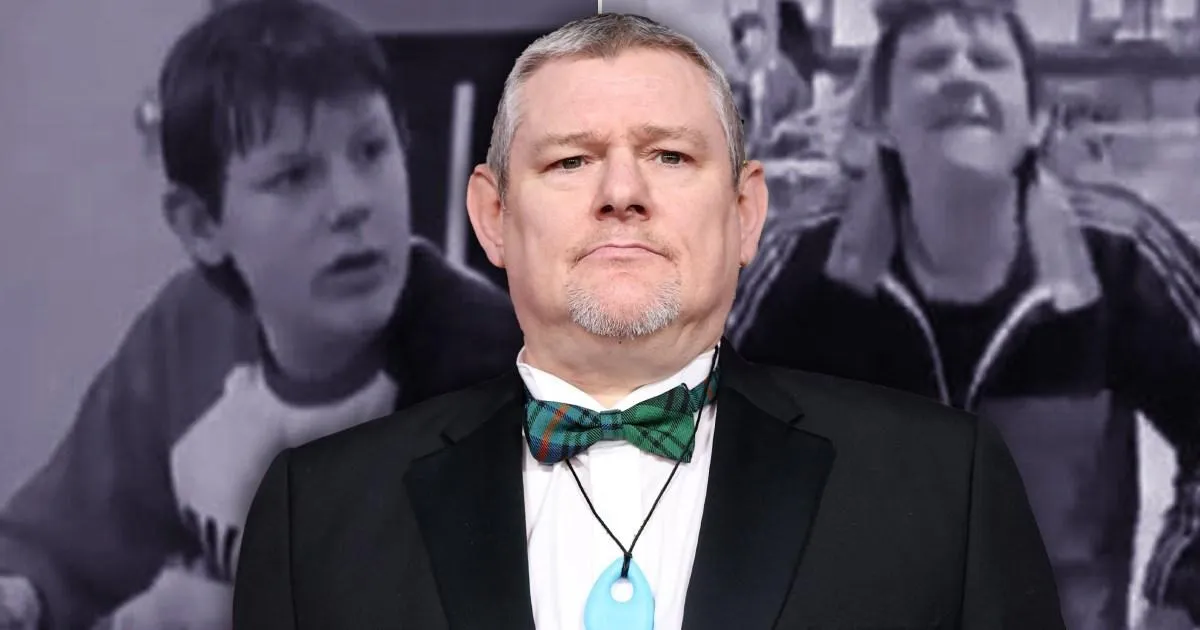
The 1989 documentary John’s Not Mad adds important context to John Davidson’s Bafta outburst (Picture: Getty / BBC)
John Davidson’s life was changed for the better when, at 16-years-old, the BBC first pointed a camera at him for the half-hour documentary John’s Not Mad, which explored his life living with severe Tourette’s syndrome in a small Scottish town.
More than three decades of relentless advocacy work later, at this year’s Baftas, the country looked again — and this time, the spotlight offered a harsh glare.
Davidson was attending the ceremony where biographical drama, I Swear, about his life and diagnosis had been nominated for six awards, including Best Actor, which Robert Aramayo won for his portrayal of Davidson.
During the evening, John experienced a series of tics, including coprolalia, echolalia and sudden physical movements. Among them was the N-word, shouted while Michael B. Jordan and Delroy Lindo were on stage presenting.
Advertisement
The BBC did not cut the language from the broadcast, despite the show being pre-recorded.
The fallout was immediate, with many arguing that the outburst reflects John’s beliefs, while others blamed the broadcaster for failing in their duty of care.
Advertisement
Davidson apologised the next day, saying he was ‘deeply mortified if anyone considers my involuntary tics to be intentional or to carry any meaning.’
He described a ‘wave of shame’ and stressed that the most offensive word he uttered was one he would ‘never use’ and would ‘completely condemn’ if he did not have Tourette’s. ‘It’s the last thing in the world I believe,’ he said, emphasising that his tics are ‘not an intention, not a choice and not a reflection of my values’.
Lindo later said he and Jordan ‘did what we had to do’ on stage, but added that he wished ‘someone from Bafta spoke to us afterward’.
Advertisement
Bafta has since issued an ‘unreserved apology’ for the ‘very offensive language’ broadcast, acknowledging the trauma such words carry and accepting responsibility for putting guests in a difficult position.
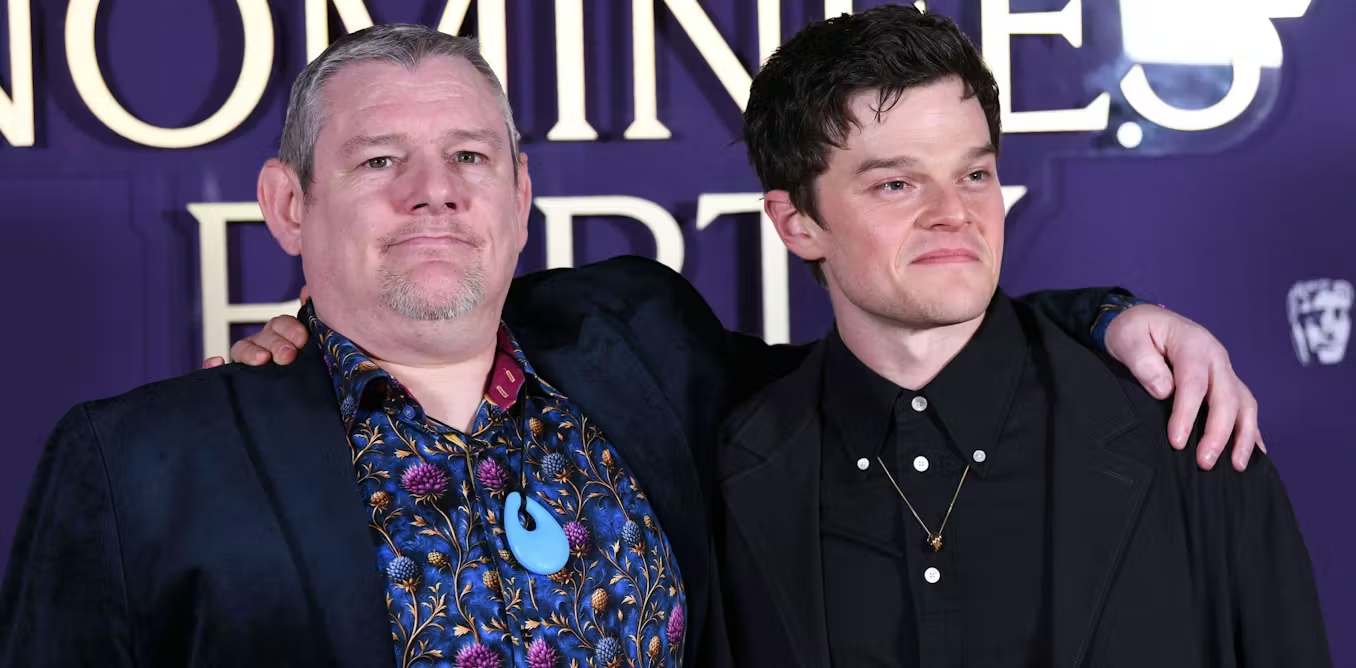
Robert Aramayo plays John Davidson in the biopic of his life, I Swear (Picture: Karwai Tang/WireImage)
There are no easy answers to an incident like this, and it goes without saying that no presenter should have to hear a racial slur directed from the auditorium and no viewer should be blindsided by it at home.
But there is also the question Davidson has posed himself: why, given his well-documented symptoms, was he seated near an active microphone, and why, in a pre-recorded ceremony, was the footage not edited? Could the ceremony have done more to ensure the comfort and safety of all involved?
These are all meaningful questions, but regardless of the conclusions, watching the 1989 documentary John’s Not Mad makes it clear that the Bafta’s moment is painfully cyclical.
Advertisement
When it aired in 1989 as part of the BBC’s Q.E.D. strand, it introduced viewers to a teenager from Galashiels whose Tourette’s syndrome was so severe he was often too frightened to leave the house.
The programme opened by noting that the condition had once been mistaken for a kind of madness. Spend time with John, it promised, and you would see that John was not mad.
What they saw was a boy in visible torment. ‘Sometimes it’s so bad I just want to kill myself,’ he says early in the film. ‘It’s like someone’s forcing it out of me.’
In one of the most distressing sequences, he presses his hands tightly over his mouth in an attempt to stop the obscenities escaping. The narrator explains that he ‘buttons his lip, almost literally, in an attempt to keep the offending words private instead of public’. The effort is exhausting to watch.
Advertisement
The documentary reveals what its like for John to live as a teenager with Tourettes (Picture: John’s Not Mad)
John apologised profusely for his outburst at the Baftas (Picture: Matt Baron/BEI/Shutterstock)
The film makes clear that while the jerks and shouts are clearly involuntary to passerby, the content of his vocal outbursts often appears linked to whatever is happening around him, in a way that makes people question if its truly out of John’s control.
As an adolescent, much of it is sexual; in one scene he struggles not to call his mother a slut. Later, he reacts to a teacher’s mistake with an insult he cannot hold back, and he is essentially unable to be around young girls without using distressing language.
But as the documentary makes clear, the taboo nature of the outbursts is symptomatic of the disorder, and is by no means a reflection on John’s character.
An eminent neurologist, Oliver Sacks, observes that Davidson’s manifestation of Tourette’s is particularly socially disruptive, which distresses John, thereby making the tics worse because the disorder feeds on sufferers’ agitation.
The documentary reveals the toll the condition took on John’s family (Picture: John’s Not Mad)
The film also documents the collateral damage of living around so much ignorance about the disorder. He is teased at school, locked in a cupboard by a teacher for disrupting class, and sometimes left to eat lunch alone.
‘Sometimes it feels like everyone hates you because you got this,’ he says quietly in one moment. ‘You feel like everyone hates you.’
Advertisement
The documentary reveals that John’s father refuses to sit at a dinner table with his son. His mother absorbs the strain as relatives suggest that maybe demonic possession is to blame.
In one truly haunting sequence, John’s mother, a stoic, soft-spoken woman who is a professional nurse, says of John’s disorder’s effect on her marriage: ‘It put a great strain on us to the point where we were ready to break up because of my husband’s attitude to it.
‘He tended to go and drink instead of deal with this. And I don’t blame him if I could have done something like that, you know, to escape it.’
In 1989, that hour of television transformed John’s life. According to a BBC News article from 2009, neighbours who had shunned him began congratulating him on his bravery, and he later said it felt as if he had proved he ‘wasn’t mad’ and ‘wasn’t a freak’, but someone with a medical condition. Overnight, he became a spokesman for Tourette’s – effectively its public face in the UK.
Advertisement
In recent years, however, he has expressed concern that the documentary also helped entrench a misconception: that Tourette’s is primarily about swearing, when coprolalia affects only a minority.
Advertisement
The Baftas controversy cruelly reinforces that anxiety. After decades spent widening understanding of a complex neurological disorder, he is again reduced to the most taboo word his brain could produce.
None of this erases the harm of racist or homophobic language, nor the right of presenters and guests to feel protected from hearing it. Bafta has issued an unreserved apology for the ‘very offensive language’ broadcast, but the damage is already done.
Indeed, it’s impossible not to wonder why the broadcaster felt it was necessary to edit the director of My Father’s Shadow, Akinola Davies Jr, acceptance speech, in which he said ‘Free Palestine,’ but not necessary to edit out the shouted slur.
But regardless of which failures led to this controversy, the Baftas incident is particularly tragic because it lands on old fault lines outlined in John’s Not Mad.
Advertisement
The shame John lives with every day is on full display in John’s Not Mad (Picture: BBC)
Davidson has explained that his tics are often triggered by what he sees or hears, meaning they can latch onto whatever is most charged in the environment, and explained to Variety that at the ceremony, he uttered ‘perhaps 10 different offensive words’.
The most taboo word in the room – the one carrying the greatest historical weight – is, neurologically, precisely the kind of word Tourette’s may seize upon.
For decades, Davidson has tried to separate himself from the content of his tics. ‘It’s like someone’s forcing it out of me,’ he said as a teenager. This week, he said his tics have ‘absolutely nothing to do with what I think, feel or believe’. The throughline is consistent.
What has changed is the scale of amplification. In 1989, the BBC used a camera to help Britain see that Tourette’s was a neurological disorder, not a moral failing. In 2026, the BBC broadcast his most offensive tic, unedited, to millions – effectively reigniting the very conflation he has spent his life resisting: that the word equals the man.
The tragedy is not only that presenters were placed in an unacceptable position, nor only that viewers heard language that should have been caught.
Advertisement
It is that a man who once held his own mouth shut in desperation is, once again, defined by words he has spent a lifetime insisting are not who he is.
Got a story?
If you’ve got a celebrity story, video or pictures get in touch with the Metro.co.uk entertainment team by emailing us celebtips@metro.co.uk, calling 020 3615 2145 or by visiting our Submit Stuff page – we’d love to hear from you.
The Hawking family have defended the late physicist after a photograph from the Epstein files
Benedict Tetzlaff-Deas News Reporter and Benjamin Blosse
20:43, 25 Feb 2026
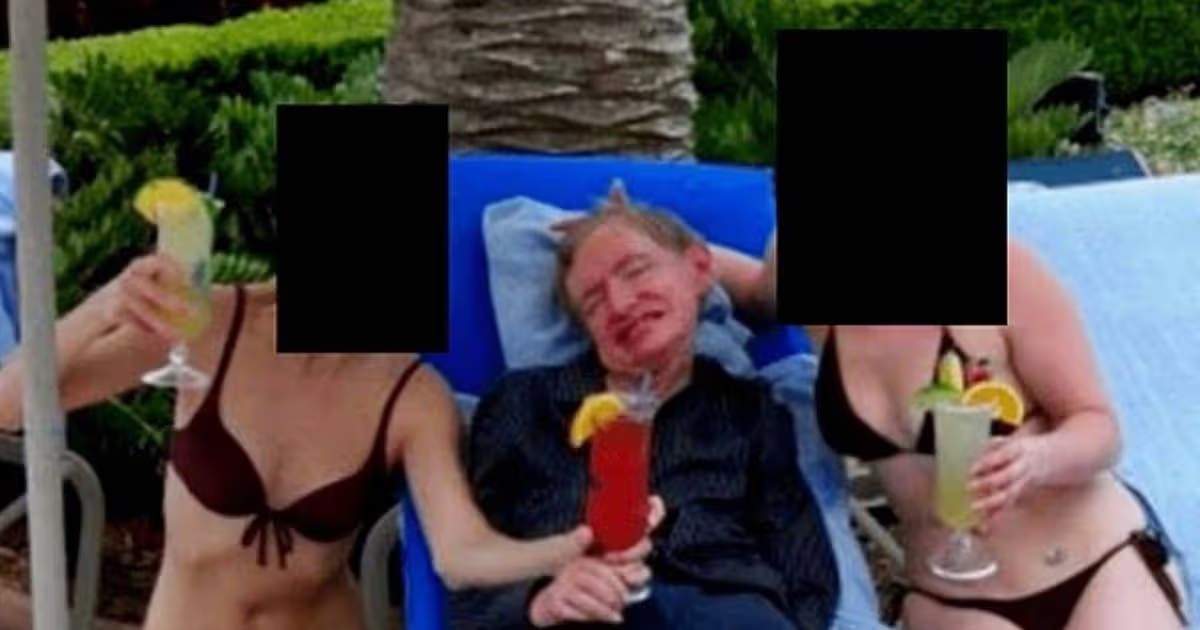
The family of the late British astrophysicist Professor Stephen Hawking have responded to ‘insinuations of inappropriate conduct’ following the emergence of a photograph from the Epstein files showing him alongside two women in bikinis.
A spokesperson for the Hawking Family told the Mirror: “Professor Hawking made some of the greatest contributions to physics in the 20th century whilst at the same time being the longest-known survivor of motor neurone disease, a debilitating condition which left him reliant on a ventilator, voice synthesiser, wheelchair and round-the-clock medical care.
Advertisement
“Any insinuation of inappropriate conduct on his part is wrong and far-fetched in the extreme.”
The two women pictured with Professor Hawking in the photograph are understood to have been his long-standing carers, with the image now confirmed to have been captured at the Ritz Carlton Hotel in the US Virgin Islands in 2006, where Professor Hawking delivered a lecture on quantum cosmology.
Professor Hawking was amongst 21 distinguished scientists who participated in a conference organised by Epstein on his Little St James island and the neighbouring St Thomas in 2006, reports the Mirror.
Prior to the summit, Professor Hawking appeared in two photographs – one depicting him at a barbecue with several other attendees, and another showing him being given a tour of the island’s seabed from within a submarine. Epstein had reportedly adapted the underwater vessel to accommodate Hawking, who was wheelchair-bound due to his motor neurone disease.
Advertisement
There are no known photographs of Professor Hawking and Epstein together.
The esteemed Cambridge professor is mentioned at least 250 times in the multitude of emails and documents released by the US Department of Justice as part of their investigation into Jeffrey Epstein. However, being referenced in these files does not imply any wrongdoing, and Professor Hawking has never been accused of any criminal activity.
In a poorly composed 2015 email sent by Epstein to his associate, Ghislaine Maxwell, the financier proposed a monetary reward for anyone close to Virginia Giuffre who could help refute an allegation that Hawking had participated in an “underage orgy” in the Virgin Islands.
Epstein wrote: “You can issue a reward to any of virginias friends acquaionts [sic] family that come forward and help prove her allegations are false. The strongest is the clinton dinner, and the new version in the virgin isalnds that stven hawking particpated in an underage orgy.”
Ms Giuffre did not publicly accuse Professor Hawking of such actions before her death last year, and Epstein’s email is the sole recorded mention of such a claim.
An unverified tip received by FBI officials in 2019 and subsequently released by the US Department of Justice suggested that Epstein and Hawking attended an “all-male” club together in 2011.
Real Housewives of Salt Lake City star Mary Cosby and her son Robert Jr shared an emotional conversation on the programme before he died at the age of 23
20:36, 25 Feb 2026Updated 20:39, 25 Feb 2026
Real Housewives of Salt Lake City star Mary Cosby had a heartbreaking conversation with son Robert Jr on screen prior to his death. Her son was confirmed to have died aged just 23 after police attended his Utah property.
Years earlier, Mary opened up on her difficulties with her son as the pair sat down to confront his drug addiction. In 2024, the reality TV star and her son had a rare moment as cameras rolled.
Mary opened up to Robert about her concerns and told him she had noticed changes in his behaviour. Speaking in a confessional on the show, Mary said: “Robert was like, the perfect child.
“He was very good in school. He got straight A’s all the way up until he graduated. When he set his mind to do something, he did it. He was like our prize, very smart, very advanced. That’s the Robert I know, and that’s the Robert I’m trying to reach.”
Advertisement
The cameras then showed her entering her son’s room. Telling him she had be honest, she told her son: “You’ve gotta be real. You’ve gotta talk to me.” He confided in his mum the he had taken Xanax and had been awake all night.
Ensure our latest headlines always appear at the top of your Google Search by making us a Preferred Source.Click here to activateor add us as your Preferred Source in your Google search settings.
She then asked him: “So were you just gonna sleep through the day? Just sleep your whole day away?”But he said he “just took half to just chill me out”. “And then I took an Adderall to balance out the Xanax,” he admitted.
Mary looked tearful as she asked her son if he thought he had a problem and quizzed him on whether he was unhappy. He told her: “Sometimes, I feel like, I don’t know, just life is like this chicken without seasoning. But when I get high, it’s like seasoning.”
Advertisement
He began to open up to his mum, saying he first took Xanax when he was 16. He admitted a friend gave him it at a party.
Robert went on: “Then I was like, ‘I like this’. I started buying it. Then I started doing Xanax with acid, and then Molly with Xanax, because I really like Xanax, so I mixed it with everything, Xanax and cocaine.”
“You know, the regular 30-milligram Oxys I noticed, like, this is a turning point for me. I was taking 10 at once, and I couldn’t even feel it. I couldn’t feel it at all.”
Mary pleaded with her son to let her help him before she got upset as she told cameras she felt like she had let her son down. “I’m very aware,” she said. “And I do know that Robert did smoke weed.
Advertisement
“I do know he would eat edibles, but yet I just trusted him in my mind, thinking that’s where he would stop. And I was clearly wrong. I mean, clearly wrong. I missed the mark.”
And in a haunting comment after telling her son he was wasting each day by getting high, Mary said: “You will die.” Robert’s words then hurt Mary as he said: “I wanted to die at the time.”
“You know how that would kill me?” Mary then said before her son admitted she was the only reason he hadn’t killed himself.
Crying, Mary then told her son: “You have to know I love you more than anything. More than anything in this world. I think I love you more than dad, like, don’t ever tell dad I said that, but you’re my friend, you’re my son, you’re my gift. God gave you to me. You’re the only thing that ever made me happy. Before I had you, I was never happy. You came and you were so real. It was everything I hoped for in a person.”
Advertisement
As Robert was also seen tearful, Mary pleaded with her son to change before he told her he loved her. On Wednesday, the reality TV star told TMZ: “Our beloved son Robert Jr. has been called home to the Lord. Though our hearts ache, we take comfort in God’s promise and in knowing he is finally at peace. We are grateful for your prayers and trust in the Lord to carry us through this time of sorrow.”
*Frank offers confidential advice about drugs and addiction (email frank@talktofrank.com, message 82111 or call 0300 123 6600) or the NHS has information about getting help.
The economist and former Treasury Secretary under the Clinton administration has also resigned from his role as co-director of the Mossava-Rahmani Center for Business and Government, according to a Harvard spokesperson.
Jason Newton, the spokesperson, confirmed to the Times that Summers’ resignation comes “in connection with the ongoing review by the University of documents related to Jeffrey Epstein that were recently released by the government.”
Advertisement
The news of Summers’ resignation was first reported in The Harvard Crimson, the school’s newspaper.
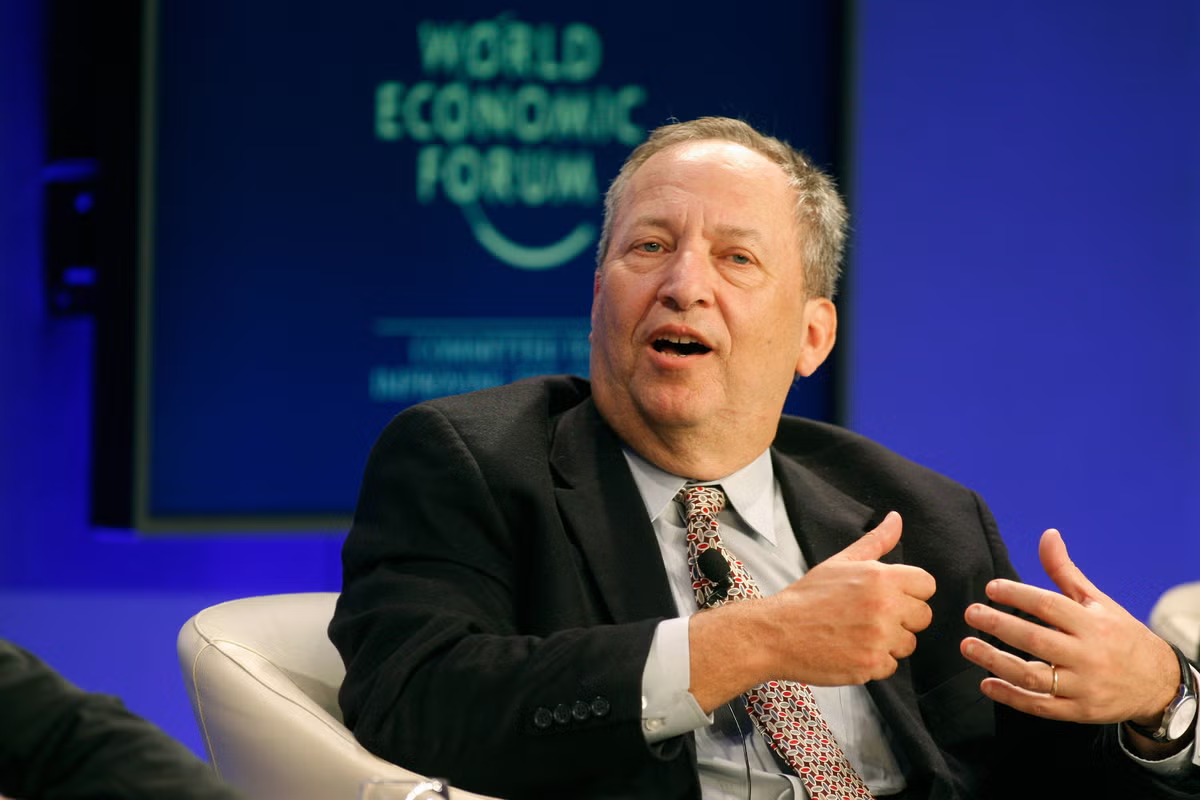
Economist and educator Larry Summers is resigning from his teaching role at Harvard University just months after his relationship with Jeffrey Epstein was revealed in a document release (Copyright 2011 The Associated Press. All rights reserved)
Summers issued a statement saying he has made the “difficult decision” to retire, adding that he will “always be grateful to the thousands of students and colleagues I have been privileged to reach and work with since coming to Harvard as a graduate student 50 years ago.”
He said that he will now look forward to “engaging in research, analysis and commentary on a range of global economic issues.”
Advertisement
Summers’ links to Epstein weren’t unknown, but his closeness to accused child sex trafficker only became clear after the federal government released a trance of Epstein’s emails in November.
Summers has not been accused of any wrongdoing related to his friendship with Epstein.
The documents capture private moments between the men, including friendly banter about a Summer’s alleged romantic interest in a woman who was not his wife. Elsewhere, Epstein described himself as Summers’ “wingman.”
In a 2019 email, Summers complained to Epstein that a woman he was interested in was involved with another man.
Advertisement
“I said what are you up to. She said ‘I’m busy,’” he wrote. “I said awfully coy u are.”
Epstein responded, saying “shes smart. making you pay for past errors. ignore the daddy im going to go out with the motorcycle guy, you reacted well.”
Summers also appeared to use a racist term in one exchange to refer to his attraction to an Asian woman.
“I’d be happy to have a rational affair w yellow peril,” he wrote in the message. Moments before that message, he wrote that he was “way smitten with her so woukd sacrifuce (sic) lots for being w her.”
Advertisement
The men were having conversations as recently as 2019, more than a decade after Epstein pleaded guilty to soliciting sex from a child. Summers’ and Epstein’s correspondence continued until July 5, 2019, just a day before Epstein was arrested and charged with child sex trafficking, NBC News reports.
Summers has previously said that he takes “full responsibility for my misguided decision to continue communicating with Mr. Epstein.” (Getty Images)
After the November document dump, Summers issued a statement acknowledging the emails and expressing regret for his association with Epstein. He said he was “deeply ashamed” and would take “full responsibility for my misguided decision to continue communicating with Mr. Epstein.”
Shortly after the messages were made public, Summers retreated from public life and stepped down from the board of directors of the OpenAI Foundation. OpenAI is the company that developed ChatGPT.
Advertisement
“In line with my announcement to step away from my public commitments, I have also decided to resign from the board of OpenAI,” he said in a statement at the time. “I am grateful for the opportunity to have served, excited about the potential of the company, and look forward to following their progress.”
In December, Summers was banned for life from the American Economic Association due to his ties to Epstein. The group said late last year that it accepted Summers’ voluntary resignation.
“Effective immediately, the AEA has imposed a lifetime prohibition on Mr. Summers’ attending, speaking at, or otherwise participating in AEA-sponsored events or activities, including serving in any editorial or refereeing capacity for AEA journals,” it said in a statement at the time.
The Independent has requested comment from Summers.
Advertisement
Harvard has launched an investigation into its own ties to Epstein, including a review of both donors and employees who might have been close to the disgraced financier.
The university launched a similar probe in 2020, which reportedly turned up only one explicit reference to Mr Summers. The report found that Summers had helped start a program pitched by Epstein.
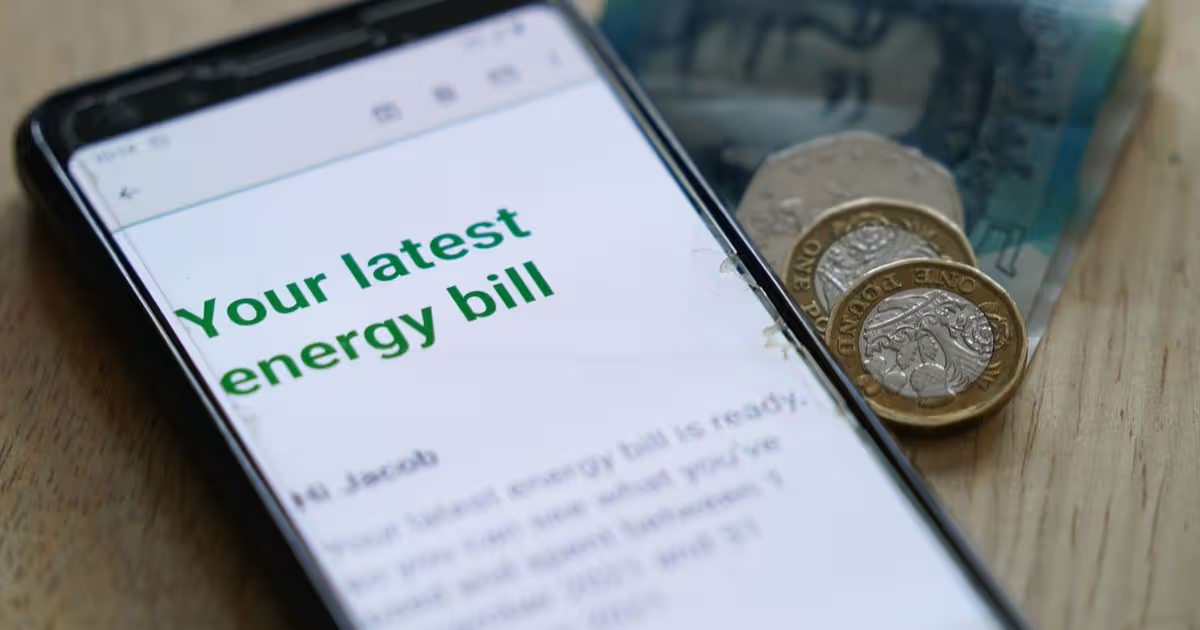
You can use your current bills to calculate what your future bills will be
The cost of energy is set to fall from April after Ofgem announced its new energy price cap. The typical dual fuel household will now pay £1,641 a year for their energy from April 1, 2026. That’s down from £1,758 based on the cap set on January 1, 2026.
Advertisement
That’s the typical household, however. You can use your current bills to estimate how much your bills will change by using our interactive calculator.
The price cap sets the maximum you can be charged for unit rates and standing charges – so your bill can be higher or lower than the price cap figure.
The average unit rate for gas is falling from 5.93p per kilowatt hour (kWh) to 5.74p per kWh, while the standing charge is decreasing from 35.09p a day to 29.09p. The average unit rate for electricity is falling from 27.69p per kWh to 24.67p per kWh. The standing charge is rising from 54.75p a day to 57.21p a day.
Tim Jarvis, Director General, Markets, at Ofgem, said: “Today’s announcement will be welcome news for many households. Wholesale energy prices have fallen in recent months, and we’re investing in our network to safeguard the future energy system. The main driver of today’s reduction is the change to policy costs announced by the Chancellor in the budget.
Advertisement
“Our focus at Ofgem remains on bearing down on the costs within our control, and unlocking the investment needed to support the transition to a more stable energy system over the longer term.
“We’re also seeing encouraging signs of greater engagement and competition, with switching increasing by almost 20% year on year. More households are choosing time‑of‑use tariffs that offer cheaper off‑peak rates, and suppliers are offering a wider range of products, including deals with savings at evenings or weekends.
“The price cap protects households from overpaying for energy, but it’s a safety net. Last year, consumers on fixed deals paid around £115 less than the cap on average, so we’d encourage people to speak to their supplier about the options available and consider whether a different tariff or payment method could help bring their bills down further.”
At the 2026 Bafta awards, big wins for independent British film I Swear and American horror film Sinners were overshadowed by a regrettable moment. Activist John Davidson said the N-word – arguably the most offensive slur in the English language due to the centuries of violence and oppression it carries – while Sinners’ stars Michael B. Jordan and Delroy Lindo were presenting an award.
Davidson, on whom the film I Swear is based, has Tourette syndrome – including coprolalia which causes the involuntary use of obscene and socially inappropriate words and phrases.
Jordon and Lindo looked shaken and have since expressed their discomfort and disappointment with Baftas’ handling of the situation. In an apology letter to Bafta members, the academy said it was launching a “comprehensive review” into the incident.
Since the incident, Davidson has received extensive online abuse, including accusations that he is a racist – an accusation that fails to consider that this was an involuntary audible compulsion. Davidson has stressed there was no intention behind the word, stating he was “deeply mortified if anyone considers my involuntary tics to be intentional or to carry any meaning”.
Advertisement
Two things can be true at the same time. While this incident was involuntary, that does not lessen the hurt or offence that Jordan, Lindo and members of the viewing public felt. No one could have prevented Davidson’s involuntary compulsion in the moment.
However, it could have been edited out of the delayed broadcast. In fact, a second slur was removed, but this one was missed. Doing so would have spared viewers from hearing the slur and helped protect Davidson and others with Tourette’s from the abuse that followed. It also could have reduced the spread of misinformation about the condition, which directly undermines the mission of I Swear to teach empathy and kindness towards people with Tourette syndrome.
By broadcasting the Baftas on a two-hour delay in a condensed format, the BBC assumes greater editorial responsibility than with live transmission. It must therefore meet higher standards and be able to justify its editing choices. The BBC failed to do that in this instance, causing undue harm to both black and disabled people.
Advertisement
There are two main reasons why the Baftas are broadcast at a delay. The first is engagement. The award ceremony lasts three hours, so to help make it less tedious, the broadcast is edited down to two hours.
The second is political. The BBC’s editorial guidelines require them to prevent harm and offence to viewers. Award shows are considered high-risk because they are live and broadcasters cannot control what winners say.
This is often called “the tyranny of live”. As media and communications scholar Paddy Scannell wrote, in live broadcasting “if something goes wrong, the best you can do is damage limitation, for once the words are out of your mouth they are in the public domain and they cannot be unsaid”.
Yet, by broadcasting at a delay to mitigate “the tyranny of live”, broadcasters open up a new can of editorial worms – “the tyranny of the edit”.
Advertisement
In live broadcasting, when things go wrong, they can often be blamed on live conditions. While this does not necessarily reduce any harm caused, it can reduce culpability. Once a programme has been edited, this no longer applies, raising the editorial standards and making broadcasters accountable for every word spoken and removed.
In other words, broadcasters must be able to justify every editorial choice to their audience, especially when those choices cause harm or censor a political perspective.
Reaction and lessons for the BBC
The BBC has apologised for broadcasting the slur and re-edited the programme for BBC iPlayer. Producers overseeing the coverage told the Guardian that they did not hear the N-word from the broadcast truck due to a technical issue. That would hardly be a reassuring defence of their actions.
Davidson later said that he was assured by Bafta that any swearing would be edited out of the broadcast, and that he felt “a wave of shame” over the incident. He also questioned the decision to seat him so close to a microphone.
Advertisement
The BBC has also offered no explanation for the post-production removal of sections of My Father’s Shadow director Akinola Davies Jr’s acceptance speech, including a statement of solidarity with “the economic migrant, the conflict migrant, those under occupation, dictatorship, persecution and those experiencing genocide” and the remark “free Palestine”.
Labour MP Dawn Butler has written to the BBC seeking a full explanation for these decisions.
Beyond the immediate fallout, this episode carries wider lessons for the BBC about learning from past errors. Last summer, the BBC was found to have broken harm and offence standards after airing “death, death to the IDF” chants in Bob Vylan’s Glastonbury set. After this incident, they promised to review their protocols around the livestreaming of “high-risk” events. Yet a similar misjudgement happened again.
To maintain public trust and support, the BBC must be more responsive in explaining their editorial choices – and more forthcoming when they get things wrong.
Cuba claims its military fired on a US speedboat that entered territorial waters, killing four people and injuring six in a confrontation on Friday
Antonio Scancariello and Laura Hill
20:05, 25 Feb 2026Updated 20:06, 25 Feb 2026
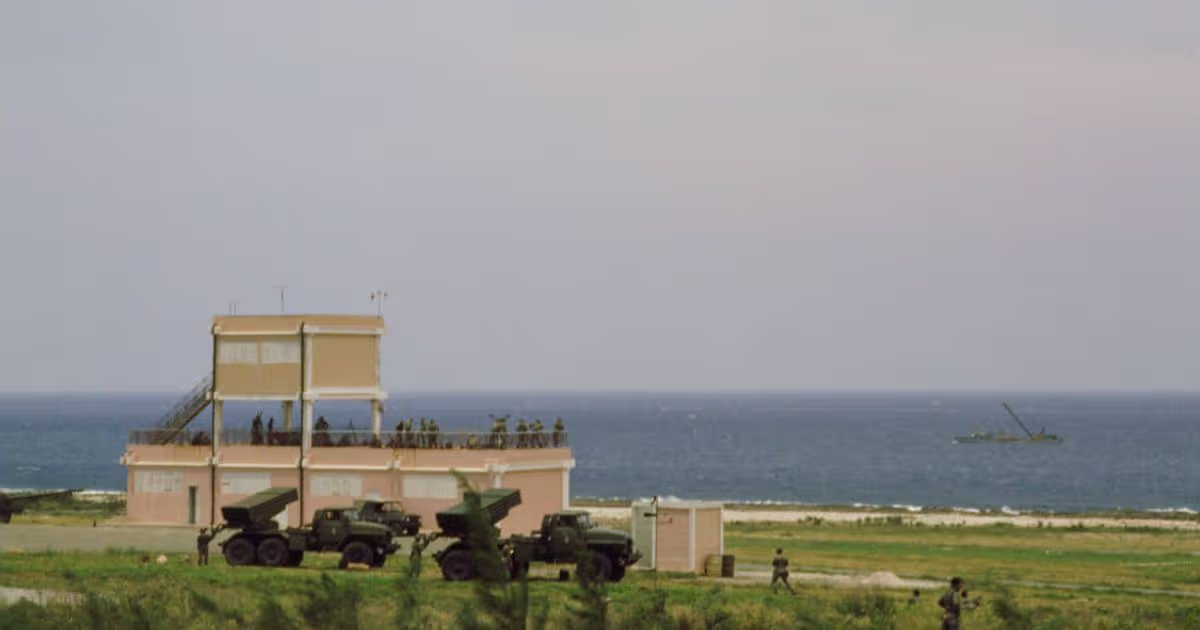
Cuban military forces have shot at an American boat, resulting in four fatalities and six casualties, according to emerging reports.
Cuba’s Ministry of Interior (MININT) announced today (February 25) that a US speedboat bearing the Florida registration FL7726SH was spotted approximately one nautical mile northeast of the El Pino Channel, near Cayo Falcones in Corralillo Municipality, Villa Clara.
Advertisement
According to the Home Office’s official account, hostilities erupted when the “violating” craft opened fire on Cuban border personnel, wounding the commander, after Border Guard Troops moved in to identify the vessel.
The statement confirmed the “offending boat opened fire against the Cuban personnel, causing the commander of Cuban vessel to be injured. As a result of the confrontation, at the time of this report, on the foreign side, four aggressors were killed and six were injured, who were evacuated and received medical assistance”.
Cuba’s Home Office further declared: “Cuba reaffirms its commitment to protecting its territorial waters, based on the principle that national defence is a fundamental pillar for the Cuban State in order to protect its sovereignty and stability in the region. Investigations are continuing by the competent authorities to fully clarify the facts.”, reports the Express.
The exchange of gunfire occurs against a backdrop of escalating tensions between the United States and the communist nation, separated by merely 100 miles (160 kilometres) of the Florida Straits, AFP reported. This development follows Washington’s decision to ease the near-total oil embargo on the island, initially imposed by President Donald Trump in January following the U.S. removal of Cuba’s key ally, Nicolas Maduro of Venezuela.
Advertisement
The agency further reported that prior to Maduro’s apprehension by U.S. forces on January 3, Cuba had depended on Venezuela for approximately half its fuel requirements.
In response to concerns from Caribbean leaders, who feared that depriving Cuba of oil would rapidly lead to economic collapse, Washington announced it would permit shipments of Venezuelan oil for “commercial and humanitarian use,” according to AFP.
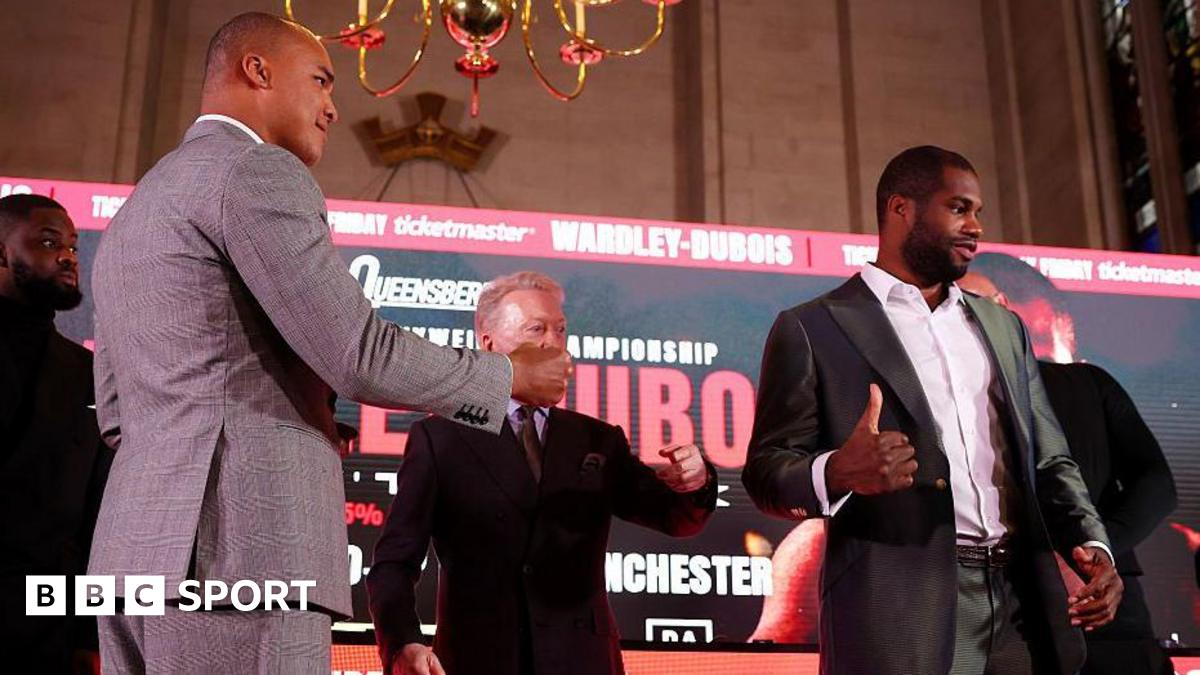
Daniel Dubois refused a fist bump from world champion Fabio Wardley as the pair came face-to-face at a lively news conference in London.
The world title fight between two of Britain’s biggest punchers takes place at Manchester’s Co-op Live Arena on 9 May.
After some long-winded bickering between the two camps, the fighters – relatively restrained until that point – finally sparked into life.
Wardley said he would “flatten” the challenger. “My power is proven. If there’s time left on the clock, I’m taking you out of the fight,” he added.
Advertisement
The 31-year-old – with 19 stoppages in 20 wins – will make the first defence of his WBO crown, having claimed the ‘interim’ title against Joseph Parker before being upgraded to full champion when Oleksandr Usyk vacated the belt.
Former IBF champion Dubois, 28, is coming off a devastating knockout loss to generational great Usyk last summer.
“If you look back, when it gets dicey, he’s not up for it,” Wardley said of Dubois, who has faced accusations of folding too easily in his three stoppage defeats.
Wednesday’s news conference took place at Dutch Hall, a converted 16th-century church tucked away in the heart of the city.
Advertisement
Dubois – never one for lengthy monologues – kept his answers short and matter of fact.
But the Londoner was clear in his intention. “Victory by knockout, by any means necessary,” he said.
When the fighters eventually stepped forward for the obligatory face-off, Dubois looked away first as Wardley smirked.
Moments later Wardley extended his fist in a gesture of respect, but Dubois shook his head and refused to engage.
The former glamour model visited an aesthetics clinic on Tuesday with her husband Lee Andrews, where she splashed the cash on course of beauty treatments
20:04, 25 Feb 2026Updated 20:05, 25 Feb 2026
Katie Price has showed off her new face after booking in for a series of tweakments in Dubai. The former glamour model visited an aesthetics clinic on Tuesday with her husband Lee Andrews, where she splashed the cash on course of beauty treatments.
On Wednesday evening she posed for a glamorous selfie in front of the Burj Al Arab, telling fans she had enjoyed a “gorgeous dinner with a gorgeous view”. Katie wore her hair up and showed off her tan in a white dress, accessorising with some gold jewellery.
Ensure our latest headlines always appear at the top of your Google Search by making us a Preferred Source. Click here to activate or add us as your Preferred Source in your Google search settings.
The newlyweds both underwent aesthetic tweakments, with the clinic claiming on Instagramthat they have set out a “treatment plan” for Katie “over time” – suggesting she isn’t planning on coming back from her honeymoon any time soon.
Advertisement
Sharing a snap with Katie and Lee on Instagram, aesthetic practitioner Max McNiel wrote: “It was lovely to see you today @katieprice. It was great to have you both in clinic today & was lovely to meet you both!
“Thank you for trusting me to carry out your treatments & I look forward to seeing you both again soon. A full treatment plan for Katie has been set out to achieve best results overtime.”
It’s not yet known what the Pricey has done to herself, however the clinic says it specialises in ‘lip contouring’.
The mum-of-five, 47, promised fans she would come back to Blighty last week with her new husband, Lee, 43, who hasn’t stepped foot in the country since their bombshell wedding in Dubai.
Advertisement
After the shock nuptials, the former glamour model returned home to the UK on her own just days later – as her new husband explained she needed to see her children .
She then flew back out to Dubai for their ‘honeymoon’ after the businessman claimed he would come to the UK several times. However, the couple have now been in Dubai for several weeks.
Advertisement
Last night, the Pricey admitted she’d put on half a stone in weight since meeting Lee, who she teased was a “feeder”. Taking to her Instagram Stories on Tuesday evening, Katie told fans: “I have a confession to make. He is a feeder. I’ve been to the doctors and everything, asked them why… everyone’s saying how I’ve lost weight.”
“I’ve got to sort you out, I’m sorry,” Lee replied. “I’ve actually put on half a stone,” Katie continued. “You’ll be pleased to know I’ve put on half a stone because I can’t stop eating. And you’re eating for one, that’s the truth,” Lee said, referencing recent speculation that Katie was pregnant. She has since confirmed she isn’t. “I’m just comfy,” Katie concluded as the couple enjoyed their meal in Dubai.
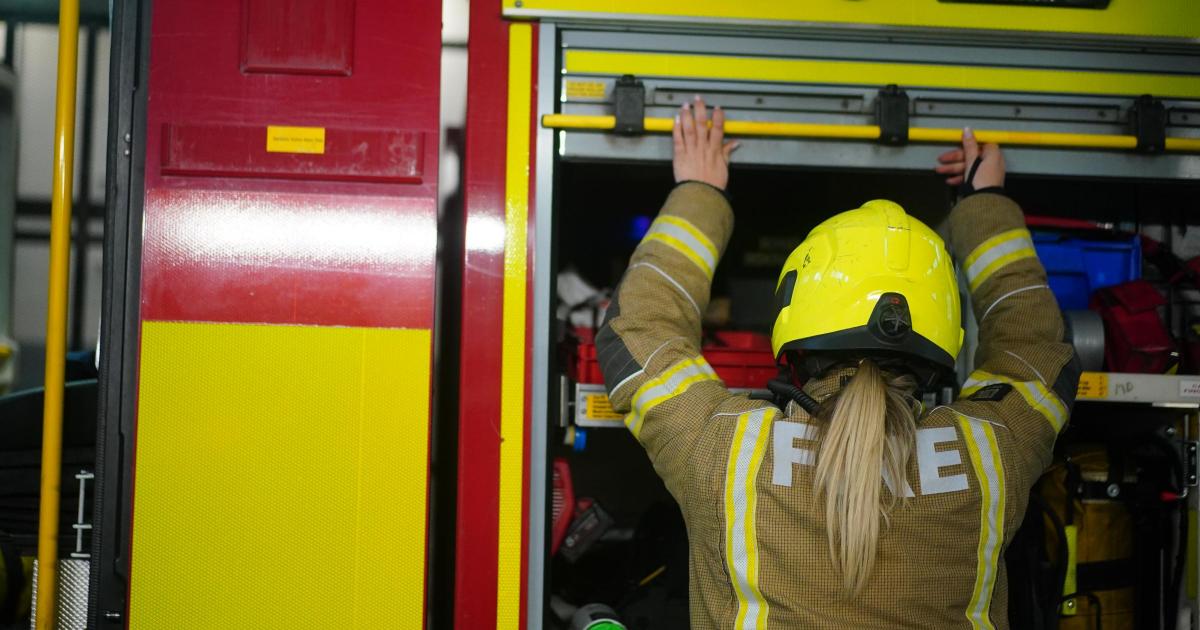
Firefighters were called to the property in Church Lane, Thornton le Dale, at 12.45pm on Wednesday (February 25).
North Yorkshire Fire and Rescue Service said the crew from Pickering pumped the water out of the property and helped a Yorkshire Water engineer to isolate the burst main.
A service spokesperson said: “Crews used main pump, hard suction and a delivery pump to get water out of the property as well as a salvage sheet and small tools to assist a Yorkshire water engineer isolate the water.
Advertisement
“Once the water had stopped progressing into the property, crews left the incident.”