

Crypto World
3 AI Stocks That Can Outperform Nvidia in March

NVIDIA dominates the AI chip market. But dominance doesn’t always mean the best risk-reward. With institutional money flow turning cautious, tariff headwinds on Taiwan-made chips, and a valuation demanding 60%+ sustained growth — smart money is looking at other AI stocks.
Here are three AI stocks that could offer a sharper setup, both technical and fundamental, heading into March 2026. And watch out for a high risk, honorary pick, right at the end.
How is Nvidia (NVDA) Looking?
NVIDIA, the largest holding in the Technology sector (XLK) at 15.79% weightage at press time, reports its Q4 FY2026 earnings on February 25, post-market close.
Wall Street expects high numbers, but recent history shows that hasn’t been enough. After Q3’s $57 billion beat, the stock barely moved and has traded sideways since.
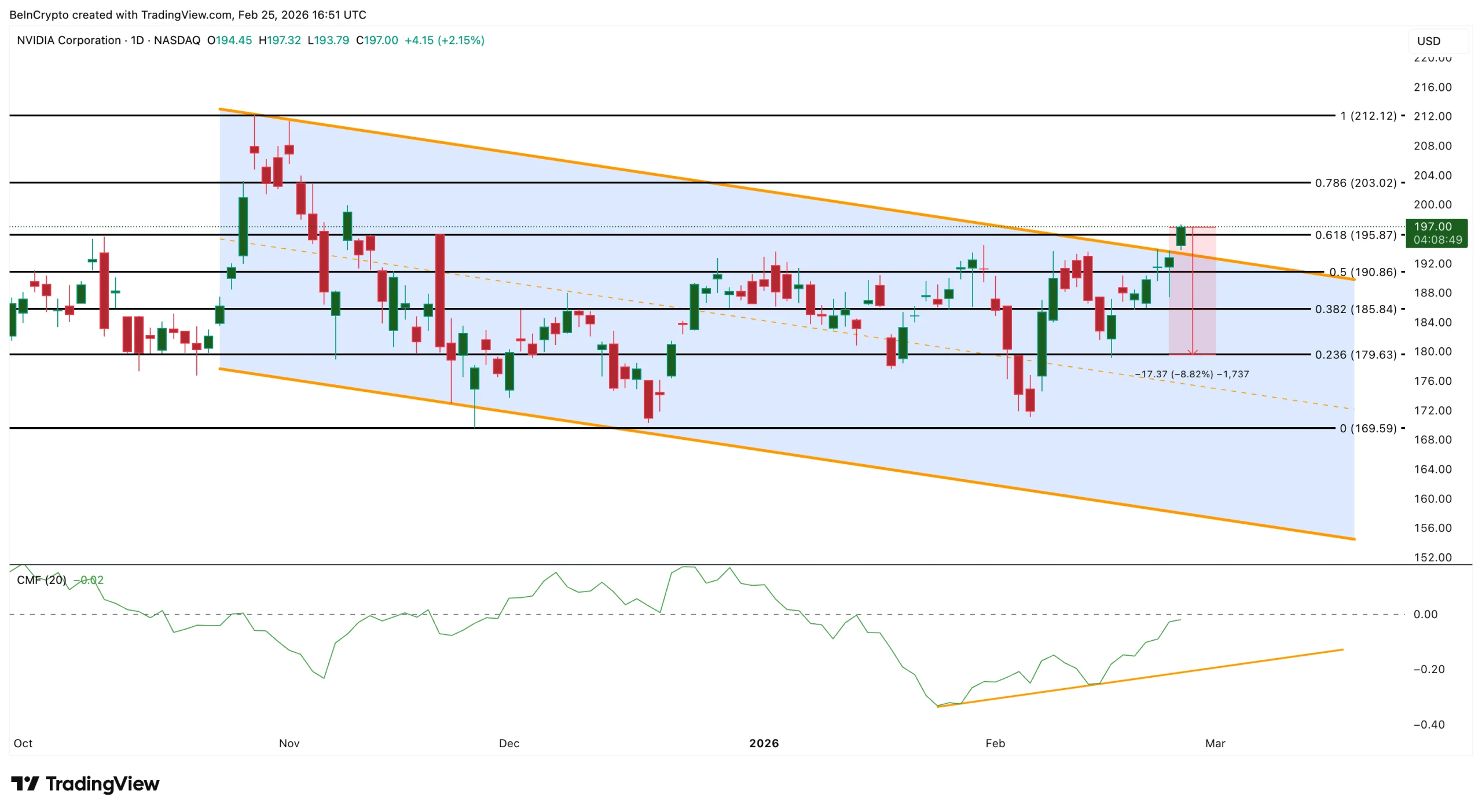
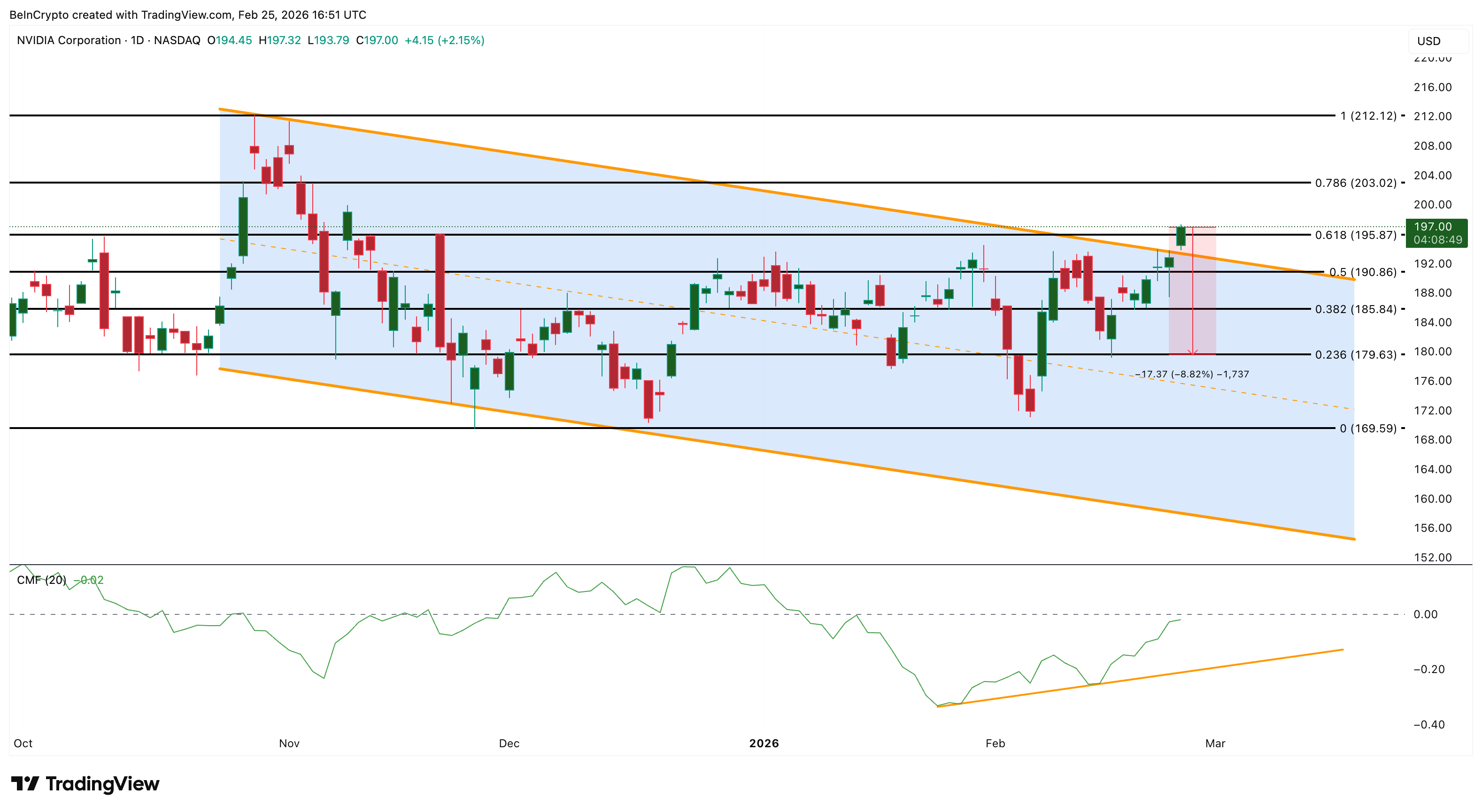
Despite being up over 50% year-on-year, NVIDIA’s chart has been trading inside a descending channel since late October. At press time, the price appears to be breaking out of this channel — but the breakout needs confirmation.
A sustained hold above $195, followed by a move through $203 and $212, would flip the structure bullish.
However, if the breakout fails, the $190 and $179 zones have acted as near-term support, with deeper downside risk below that.
The Chaikin Money Flow (CMF) — which tracks whether institutional money is flowing into or out of a stock — remains a concern.
The Chaikin Money Flow (CMF) indicator has remained below the zero line since mid-January, indicating net money continues to leave despite the price recovery.
If CMF fails to flip positive (like mid-January), the price recovery loses its institutional backing, and the descending channel could reassert itself.
On the fundamental side, NVIDIA manufactures 100% of its GPUs through TSMC in Taiwan. This fully exposes it to Section 232 semiconductor import tariffs, raising chip costs.
China’s revenue has collapsed under US export restrictions, cutting off the world’s second-largest AI market.
And at 35x EV/EBITDA (a measure of how expensive a stock is relative to its earnings power), NVIDIA needs 60%+ sustained growth just to justify its current price. With these risks in play, three other AI stocks may offer a sharper setup into March.
Taiwan Semiconductor (TSM)
TSMC (TSM), the first stock on the list, is up nearly 100% year-on-year. That outpaces even NVIDIA’s 50% gain and the reason is straightforward. TSMC manufactures over 90% of the world’s most advanced chips.
Every NVIDIA GPU, Broadcom ASIC, and AMD processor runs on TSMC fabrication. It doesn’t matter who wins the AI chip race. TSMC builds for all of them.
Here’s what most investors miss. TSMC controls NVIDIA’s cost structure. It raised prices 10-20% on advanced chips recently. Customers paid without hesitation as no alternative exists.
Intel is generations behind, and Samsung has yield problems. When TSMC raises prices, its margins expand. When NVIDIA pays those prices, its margins shrink.
And unlike NVIDIA, TSMC doesn’t pay import tariffs. Tariffs hit the importer, not the exporter. TSMC exports. NVIDIA imports. Plus, TSMC’s new Arizona fabs produce US-made chips — completely tariff-free.
At 18x EV/EBITDA — a measure of price relative to core earnings — TSMC costs nearly half of NVIDIA’s 35x. Last quarter, 1,945 institutions opened new positions, worth $49 billion, one of the highest inflows among AI stocks.
On the chart, TSM trades inside an ascending channel since mid-December. A breakout, which is almost there, could target $470 — over 20% upside, starting in March itself.
CMF reads 0.21, above zero, confirming steady institutional inflow. A push past 0.28 would strengthen the breakout signal.
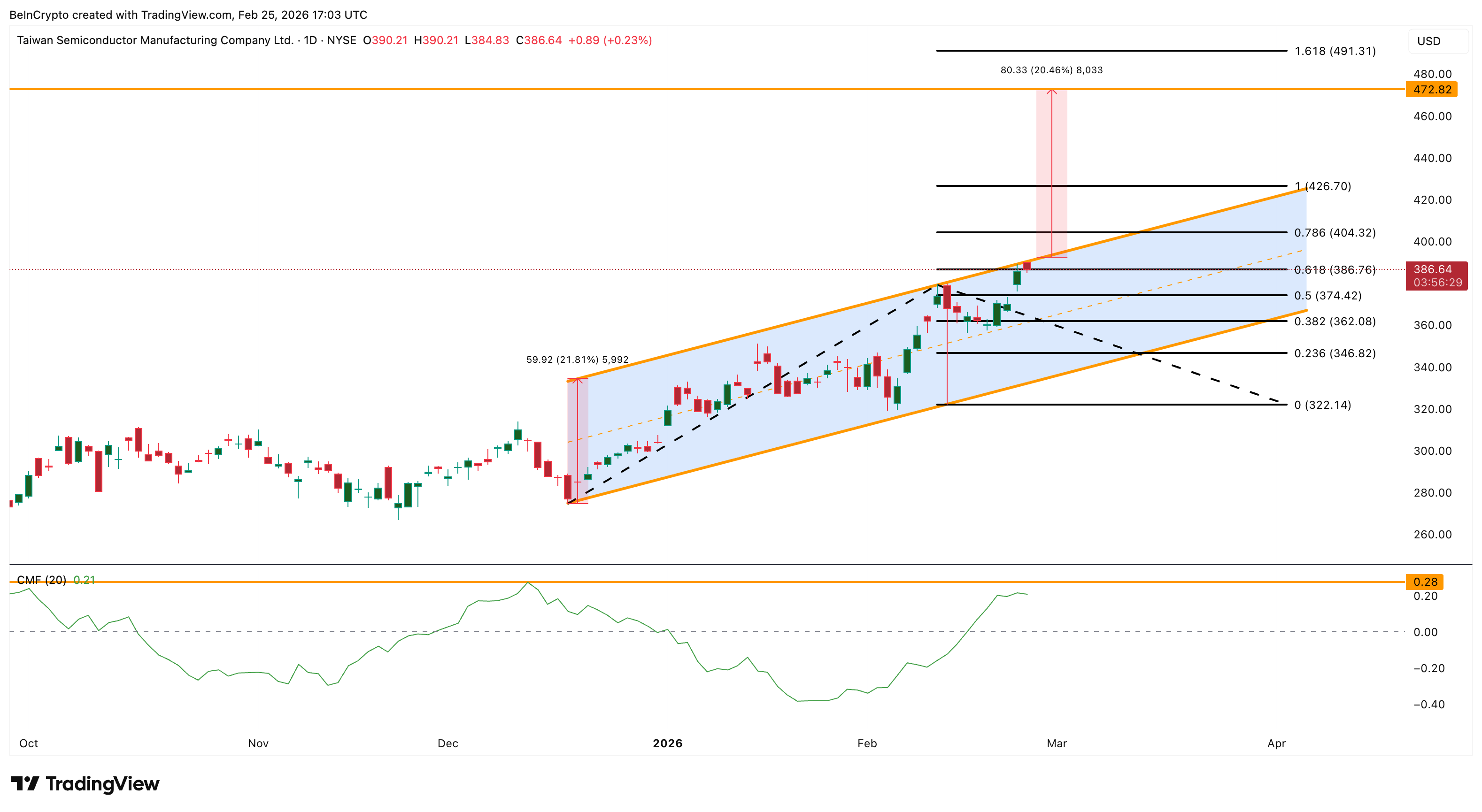
On the downside, $386 is critical support. A correction, likely triggered by the Taiwan-specific geopolitical tensions, could test $362 or $346. Only a sustained break below $346 turns the structure neutral.
Alphabet (GOOGL)
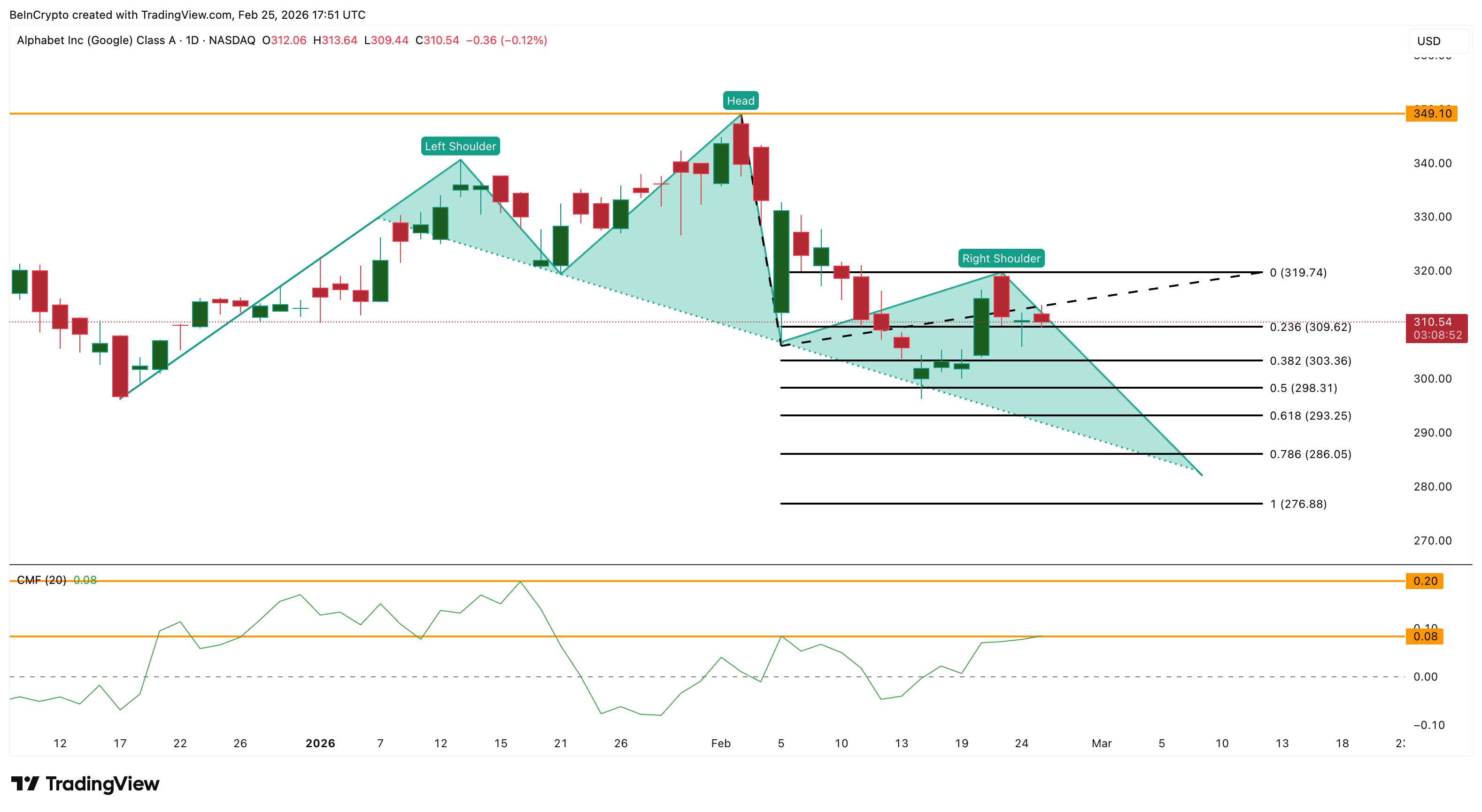
This AI stock might throw a surprise. On the daily chart, Alphabet looks weak. It’s mostly flat year-to-date. Down 7% over the past month. The price is forming a head and shoulders pattern with a downward sloping neckline. But here’s the interesting part.
Since hitting the right shoulder on February 23, the price has tried to rebound. It now sits near the right shoulder level. A break above $319 would weaken the bearish pattern. It turns the structure neutral.
Above $349, the short-term bearish thesis gets completely invalidated.
The CMF tells a different story than the price. While NVIDIA’s CMF remains negative — showing institutional money leaving — Alphabet’s CMF has turned positive at 0.09.
Similar to TSM, money is flowing in despite the weak price action. A sustained move above 0.19 would confirm institutional accumulation is carrying into Q1 2026.
Even in the last quarter, 520 institutions opened new positions averaging $74 million each.
The fundamental edge is unique. Google doesn’t just use AI — it sells cheaper AI infrastructure to NVIDIA’s own customers. Its Ironwood TPUs cost roughly $15,000. NVIDIA’s GPUs cost $30,000-$40,000.
Google Cloud grew 48% last quarter. Operating margin jumped from 17.5% to 30.1% in one year.
And as a software and services company, Alphabet has zero tariff exposure — unlike NVIDIA’s 100%.
If the price breaks below $286, the bearish pattern confirms. That could push prices toward $276 and lower levels — likely triggered by broader tech selling or disappointing Cloud growth guidance.
But the CMF divergence and institutional flows suggest smart money is positioning for a reversal, not a breakdown.
Last on the list but not the least. This AI stock is up 64% year-on-year but flat over the last seven days.
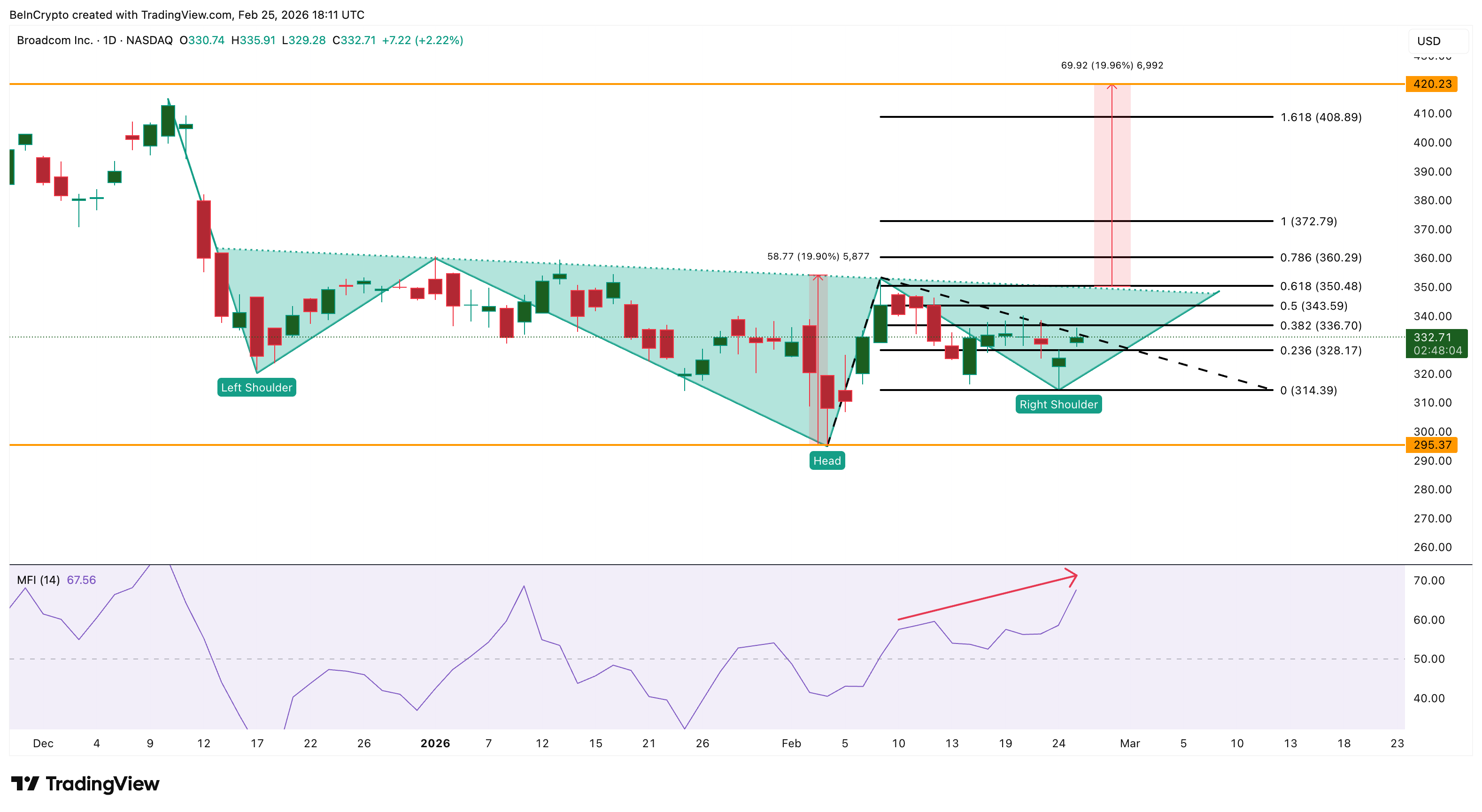
An inverse head and shoulders pattern is forming now. This is a classic reversal structure, which can change the short-term weakness. The AVGO price is now moving toward the neckline at $350.
A breakout above that level opens the path for a near 20% move — potentially pushing AVGO close to $420. That breakout window aligns with early March, right around its Q1 FY2026 earnings on March 4. A beat-and-raise on March 4 could be the trigger that cracks the neckline of the bullish pattern.
Here’s what makes Broadcom a direct NVIDIA challenger. AI is shifting from the training phase to inference — running models at scale for millions of users. NVIDIA GPUs dominate training. But for inference, custom ASICs are 3-5x more energy-efficient and cost way less.
Broadcom designs these ASICs for Google, Meta, ByteDance, and now OpenAI. As inference scales, Broadcom is positioned for the bigger phase ahead, courtesy of this AI shift.
The Money Flow Index (MFI) — which measures buying and selling pressure using both price and volume — confirms accumulation on dips.
Since February 10, while prices trended lower, MFI has trended higher. And that’s a bullish divergence. MFI currently sits around 67, still below the overheated 80 threshold. Room to run. This means, possibly retail is picking up AVGO shares at a clip.
On the downside, $314 is critical. A break below would weaken the bullish setup. Under $295, the inverse head and shoulders invalidates entirely. A broader AI spending slowdown or weaker-than-expected March 4 guidance could trigger that scenario.
Honorable Mention: Palantir Technologies (PLTR) — The Risky Bet
Palantir didn’t make the main list of AI stocks, courtesy of the high valuation risk.
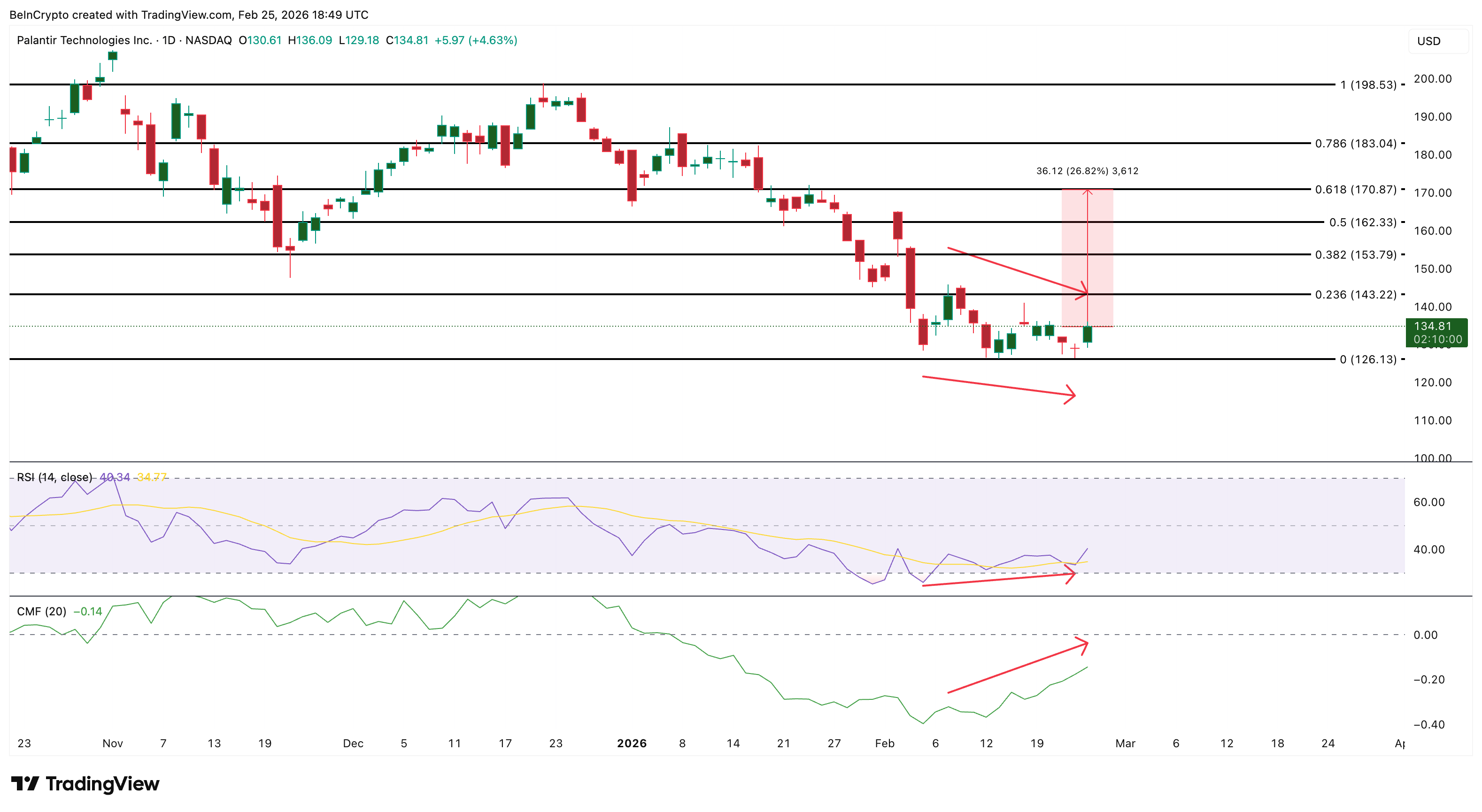
But the chart is flashing reversal signals worth watching. Between February 5 and 24, the price made a lower low, yet the relative strength index (RSI), a momentum indicator, made a higher low. That’s a classic bullish divergence.
The CMF confirms it. Between February 9 and 25, prices trended down while CMF trended up. Two separate indicators pointing toward bullishness.
If $126 holds as a base, the first target is $143. Beyond that, $170 — a strong resistance from early January — becomes the key level.
Fundamentally, Palantir is one of the few AI companies turning AI into real revenue. Last quarter delivered $1.41 billion — up 70% year-on-year. It carries zero debt, $4 billion in cash, and like the three main picks, zero tariff exposure. Pure software.
Here’s the catch. PLTR trades at over 200x P/E — meaning investors are paying $200 for every $1 the company earns. That’s a price tag that assumes everything goes perfectly.
Any stumble in growth, and the stock could fall hard. Moreover, losing $126 invalidates the entire setup.

The price of Bitcoin reclaimed the $66,000 mark earlier today UTC, creating positive crypto markets following positive remarks by President Trump in his State of the Union address.
Retail may be a little unsure of crypto but institutions are quietly buying the dip.
So, more positive developments from US regulators could help drive a bull market. In that case, XRP, Solana, and Bitcoin potentially gain the most. Here’s why.
Discover: The best meme coins in the world right now.
XRP (XRP): Ripple’s Stablecoin and RWA Tokenization Crypto Solution Targets $5 Price
XRP ($XRP) currently boasts a market capitalization of $87 billion, underscoring its status as the leading cryptocurrency for global payments.
Ripple developed the XRP Ledger (XRPL) to modernize cross border payments, offering near instant settlement times and ultra low fees through a blockchain alternative to SWIFT.
The company recently confirmed its intention to further build on XRPL as a foundational layer for stablecoins and tokenized real-world assets, while reinforcing XRP’s role as the primary liquidity asset within the ecosystem.
Additionally, both the United Nations Capital Development Fund and the White House have highlighted XRP’s potential role in upgrading international payment infrastructure.
The recent regulatory approval of spot XRP exchange-traded funds (ETFs) in the United States opens the door to broader institutional and retail participation.
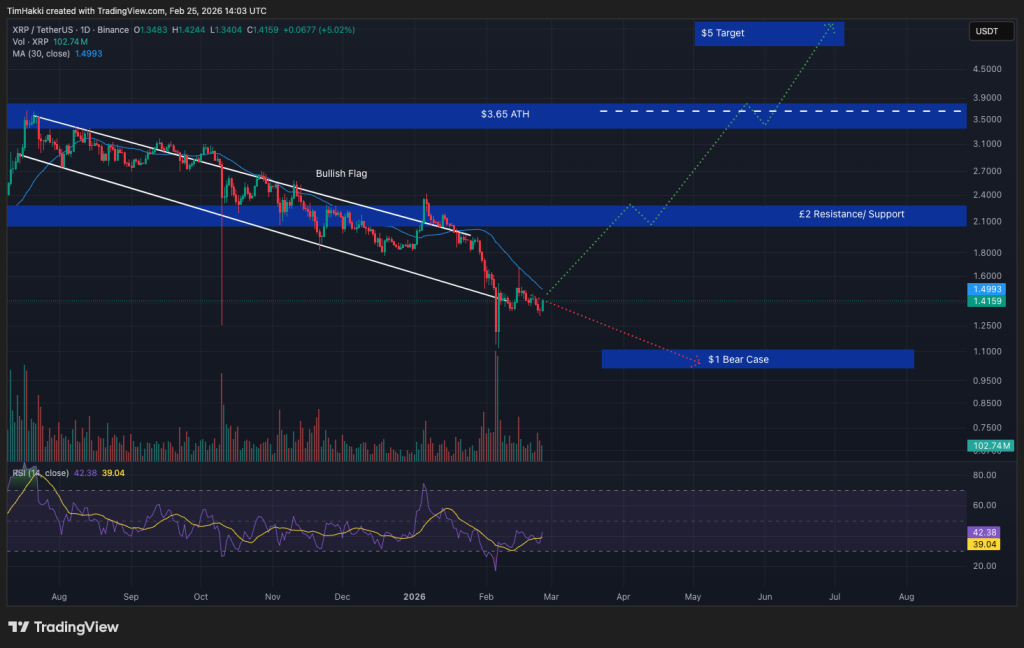
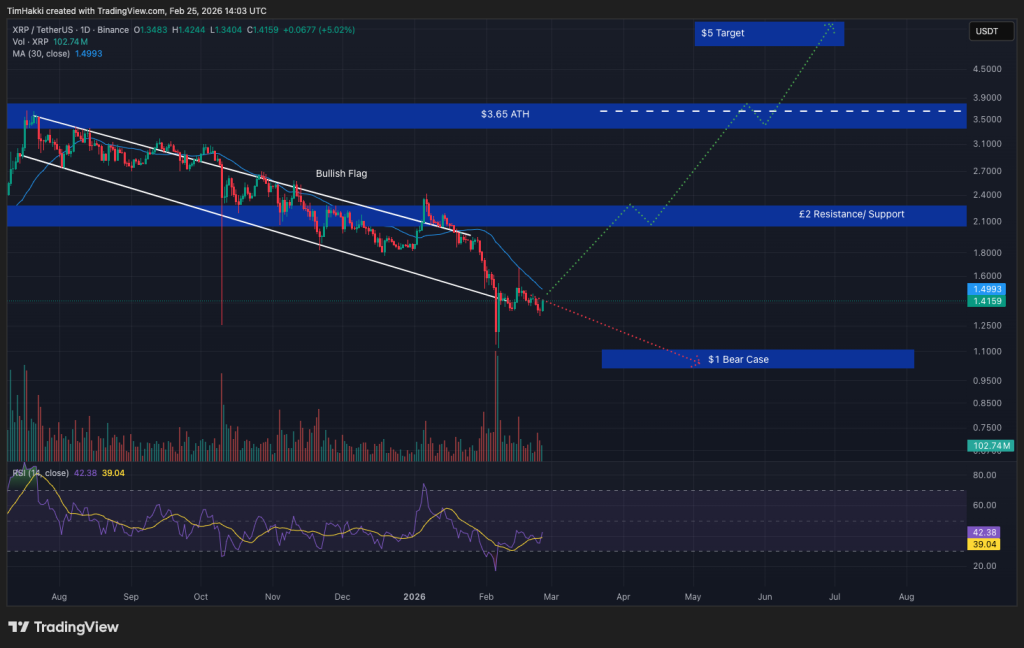
A bullish flag pattern formed across recent support and resistance lines hints at a breakout that could lift XRP to $5 by Q2.
Solana (SOL): Is Ethereum’s Top Challenger Preparing for a Bounce?
Solana ($SOL) remains the largest smart contract blockchain outside of Ethereum. The network secures around $6.4 billion in total value locked (TVL), while SOL capitalizes $48 billion.
At roughly $84, SOL continues to trade well below its 30-day moving average after completing a bearish head and shoulders formation earlier in the year.
The relative strength index (RSI) is sitting near 41 and rising, indicating growing buying momentum.
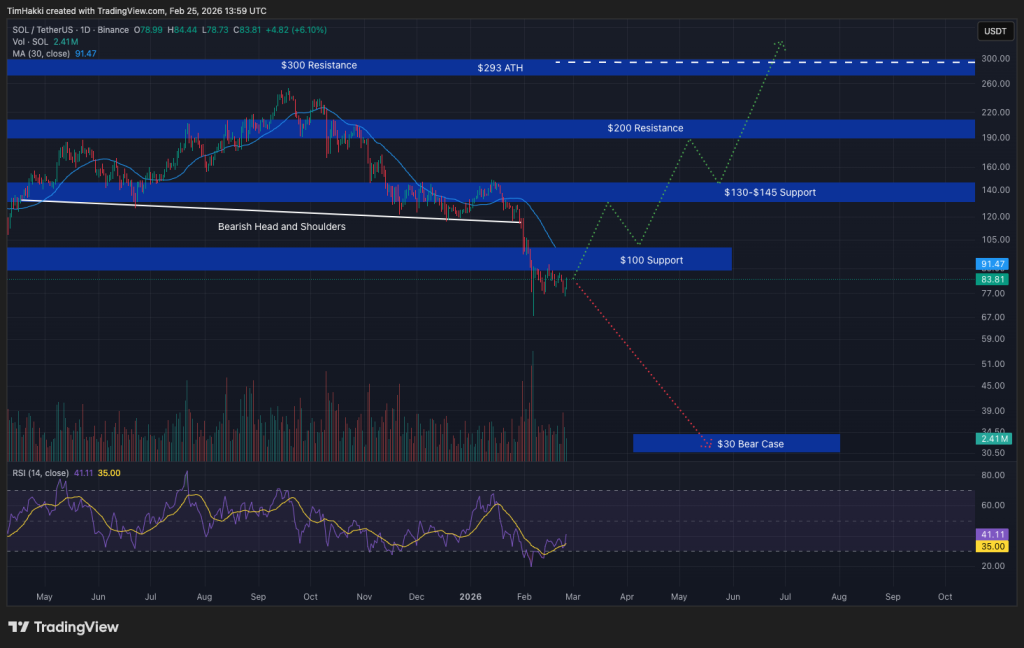
A sustained move above key resistance zones around $200 and $275 could open the door to a retest of Solana’s ATH of $293.31, potentially setting a new one by Q2.
Additionally, global asset managers including BlackRock and Franklin Templeton have chosen Solana as the underlying network for tokenized investment products, giving it an early advantage in a fast growing segment of digital finance.
Bitcoin (BTC): Could The Original Crypto Hit a New Record Price This Summer?
Bitcoin ($BTC), the largest cryptocurrency by market capitalization, previously rallied to an ATH of $126,080 on October 6.
Heightened volatility later followed, driven by geopolitical concerns around potential U.S. military involvement in Iran and Greenland. This uncertainty sparked a prolonged correction of around 50%, briefly pushing BTC below $63,000 yesterday.
Bitcoin’s long-standing “digital gold” narrative continues to attract both institutional and retail investors seeking a hedge against inflation, currency debasement and broader macroeconomic risk.
Rising institutional adoption, reduced selling pressure after the most recent halving, and expectations of imminent U.S. regulatory guidance could help reignite upside momentum and fuel multiple new highs later this year.
In addition, if Donald Trump proceeds with an Executive Order to establish a U.S. Strategic Bitcoin Reserve, it could further reinforce Bitcoin’s position at the top of the crypto market.
Bitcoin Hyper Brings Solana‘s Speed and Utility to Bitcoin
While XRP, Solana and Bitcoin may still have meaningful upside ahead, past bull markets show that the largest gains often come from newer projects introducing genuine technological advances.
Bitcoin Hyper ($HYPER) extends Bitcoin’s capabilities by offering Solana style performance through a Layer 2 scaling solution. The protocol significantly lowers transaction fees while preserving Bitcoin’s core security model.
Users can stake assets, earn yield, trade tokens and interact with smart contracts without moving funds off the Bitcoin network.
With $31.5 million already raised in its ongoing presale, and growing attention from large investors and exchange platforms, $HYPER is one of the most closely followed crypto launches of the year so far.
Those looking to purchase $HYPER at its fixed presale price can visit the official Bitcoin Hyper website and connect a supported wallet such as Best Wallet.
Tokens can also be purchased using a bank card.
Visit the Official Website Here
The post Crypto Price Prediction Today 25 February: XRP, Solana, Bitcoin appeared first on Cryptonews.
The market remains gripped by extreme fear. Many Bitcoin investors focus only on short-term price fluctuations and fixate on negative factors. As a result, they overlook strong underlying fundamentals.
Although the price may be correcting, the following data reinforces the case for a recovery.
Lightning Network Growth Despite a Sharp Bitcoin Price Decline
Bitcoin’s price has fallen sharply. However, its use as a payment network has reached an all-time high, as reflected in breakthrough data from the Lightning Network.
The Lightning Network is a Layer 2 protocol built on top of Bitcoin. It enables scalable, low-cost, and near-instant transactions, making it ideal for everyday payments.
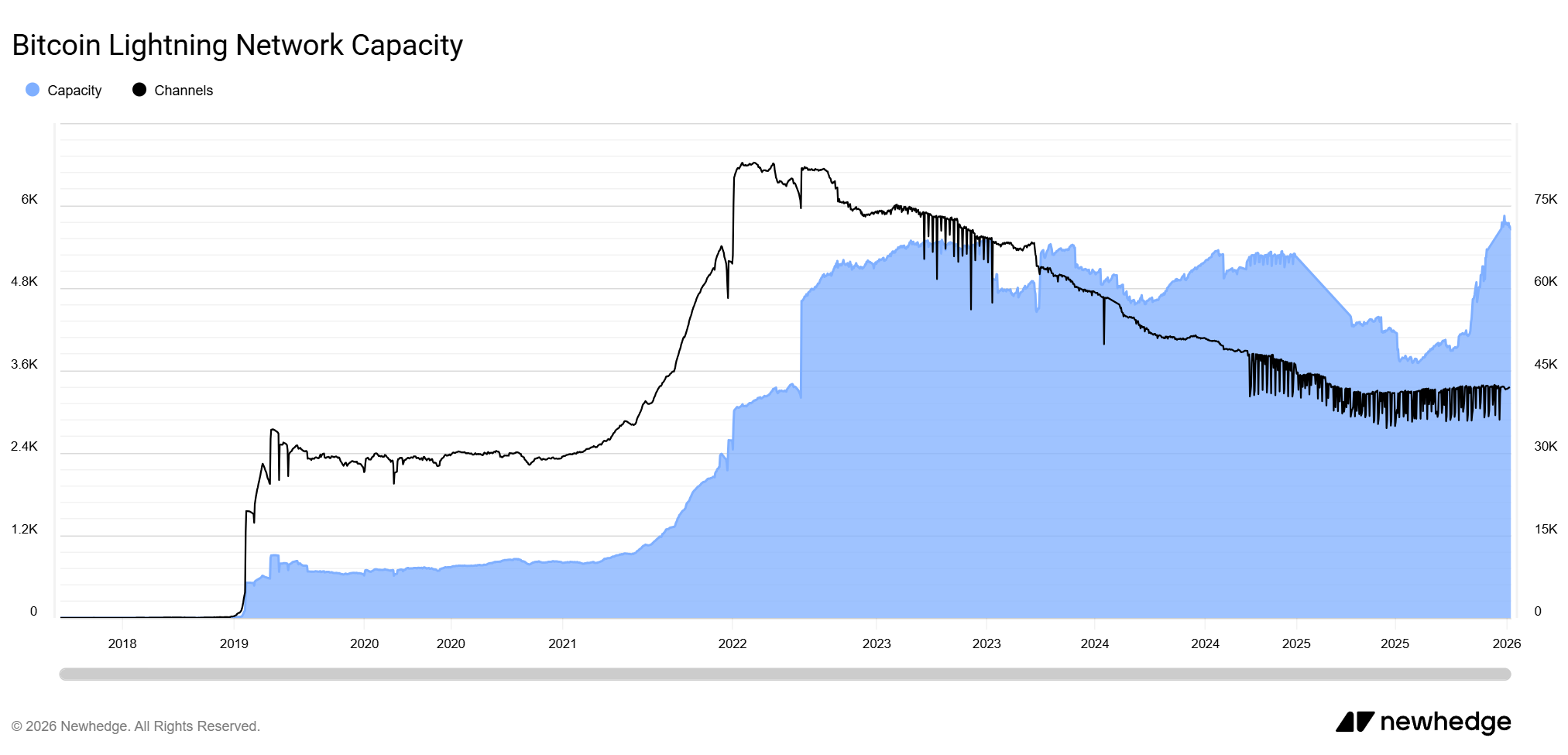
Data from Newhedge shows that Bitcoin Lightning Network capacity rose to a record high of 5,800 BTC in December. It remained above 5,600 BTC in early 2026.
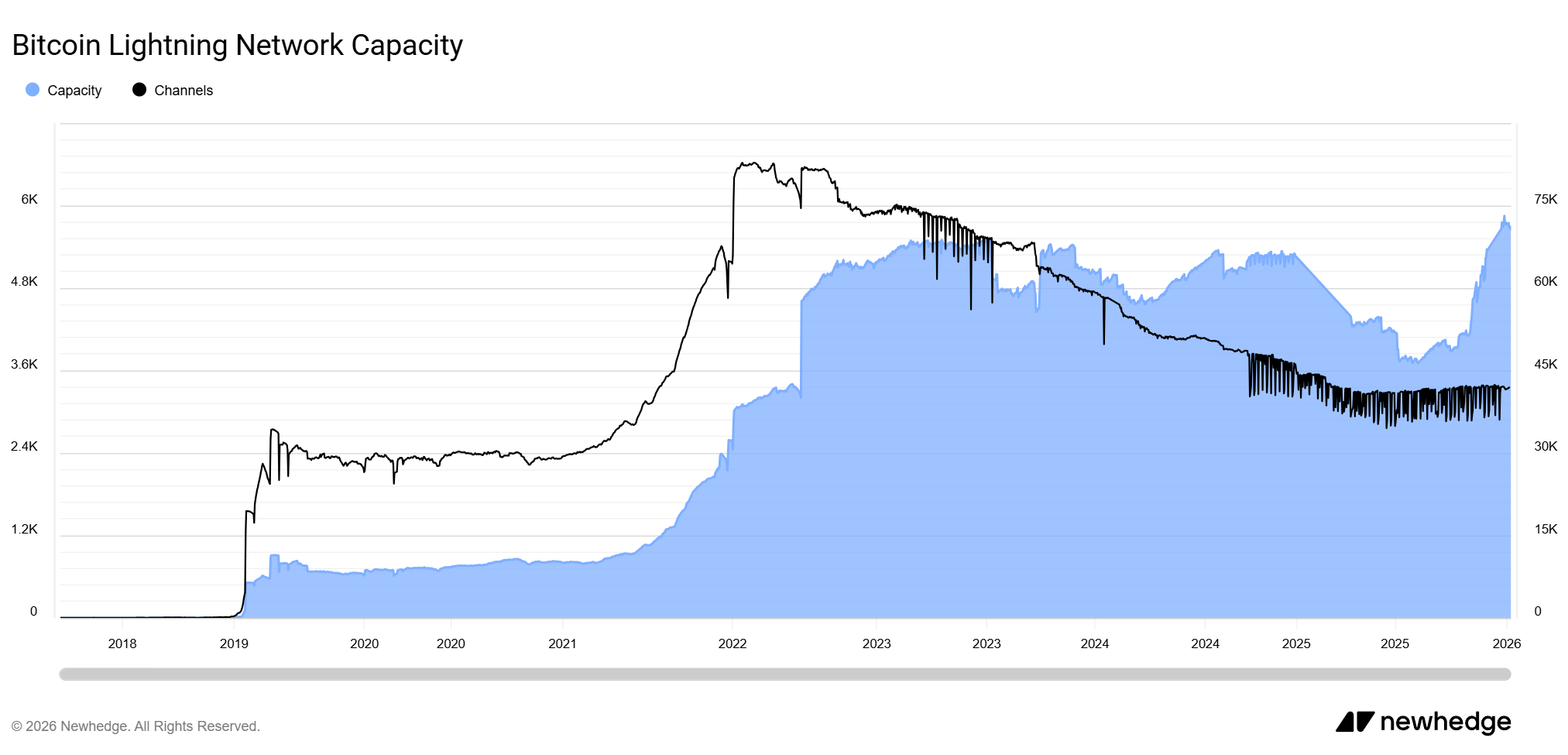
Capacity (blue) represents the total amount of Bitcoin locked in Lightning Network payment channels. For the Lightning Network to function, participants must commit BTC to channels in advance. This committed BTC forms the network’s capacity.
Therefore, capacity determines the total value that can be transacted through the Lightning Network at any given time. An increase signals improvements in scalability, reliability, and user adoption.
In addition, a recent report from River revealed that the Lightning Network surpassed $1 billion in monthly transaction volume for the first time. It processed 5.22 million transactions. This growth indicates that businesses and exchanges are using Lightning to move real funds.
“While everyone is focused on Bitcoin dropping to $63K, something happened last week that nobody talked about. The Lightning Network crossed $1 billion in monthly transaction volume for the first time ever… Businesses are using it,” said Fernando Nikolić, a developer at Perception.
Sam Wouters, Director of Marketing at River, explained that most transactions involve transfers between exchanges, often with large amounts. He predicted that in the future, the emergence of AI agents could reduce the average transaction size when executing many small transactions.
Hashrate Recovery Reflects Renewed Miner Confidence
Second, Bitcoin’s hashrate—an important metric that measures the network’s total computational power—has recovered to levels equivalent to September last year, when BTC traded above $100,000.
The strong V-shaped recovery in February shows that miners have returned with renewed confidence. It also strengthens the network’s security and resilience.
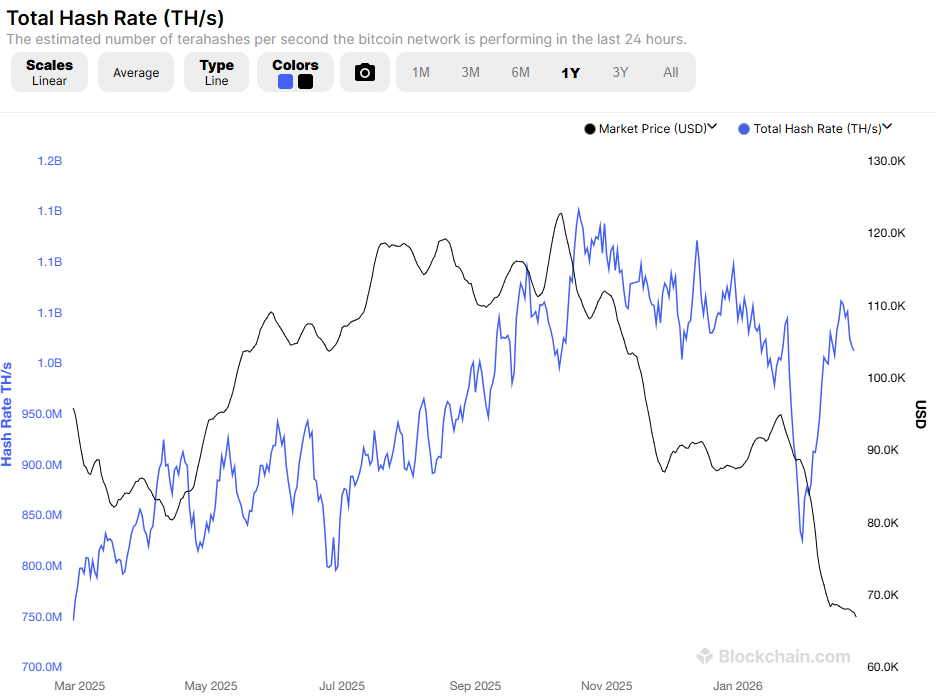
Miners appear to have moved past extreme negative sentiment. They have restarted operations after severe weather disruptions earlier in the year.
Historically, hashrate tends to rise alongside Bitcoin’s price. This pattern often signals a potential recovery in BTC.
The Sign of Strengthening Demand From US Investors
Third, the Coinbase Premium Index turned positive again in the final week of the month after remaining negative for a full month.
The Coinbase Premium Index measures the price difference between Bitcoin on Coinbase and on Binance. A return to positive territory reflects that US investors are willing to buy BTC at higher prices.
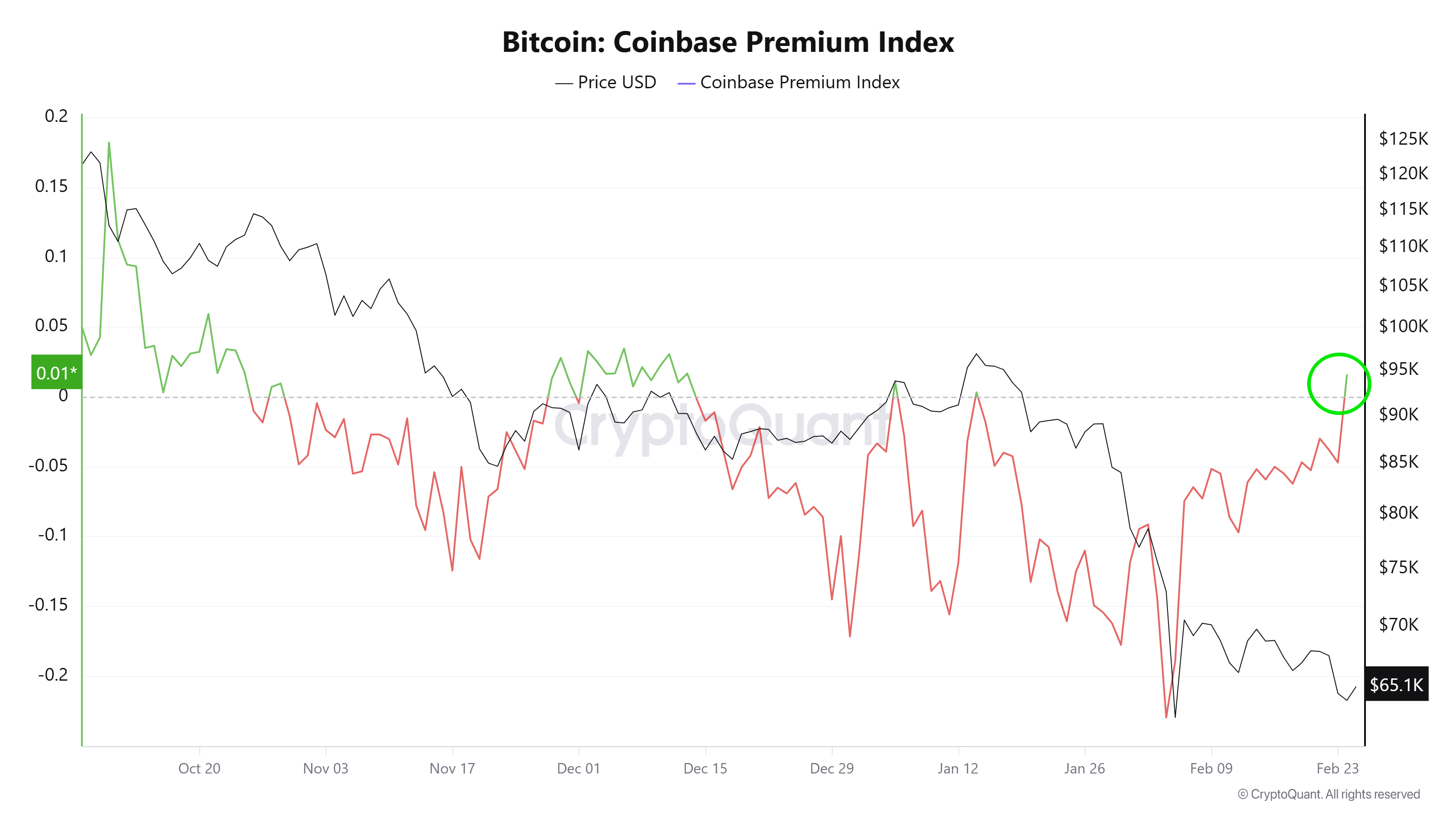
“This return to positive territory suggests a gradual improvement in demand from professional and institutional participants, particularly those based in the United States. This signal remains tentative and reflects ongoing investor caution. However, current price levels appear to be gradually becoming attractive again for professional participants,” commented Darkfost, an analyst at CryptoQuant.
These positive signals may appear faint amid prevailing pessimism. However, they could act as catalysts for a recovery.
Recent analysis from BeInCrypto emphasized that a breakout above the $67,394 resistance level would improve the negative short-term price structure. Such a move would lay the foundation for further upside.

Bitcoin (CRYPTO: BTC) has paused after a modest rally, carving an eight-day high while building a double bottom near $62,500. Despite the bounce, the token remains roughly 21% below its level from a month ago, underscoring the uphill path for bulls entering Friday’s massive options expiry. The $10.5 billion BTC options series looms large, with traders weighing whether a late bid can flip momentum or if selling pressure resumes as settlement approaches. Deribit continues to lead the space, accounting for about 76% of turnover, while OKX and CME register smaller but meaningful shares. In this environment, price action, tech-equity sentiment and macro developments converge to shape outcomes as traders position for what could be a pivotal weekend for BTC.
Key takeaways
- Bulls face a required roughly 9% rally from around $68,800 to tilt the balance in Friday’s $10.5 billion options expiry, underscoring how a single session can redefine near-term momentum.
- The asset’s price dynamics remain tightly linked to tech sentiment, with Bitcoin showing a 90% correlation to the Nasdaq 100 Index, signaling that AI-driven earnings and risk appetite in equities can spill into crypto flows.
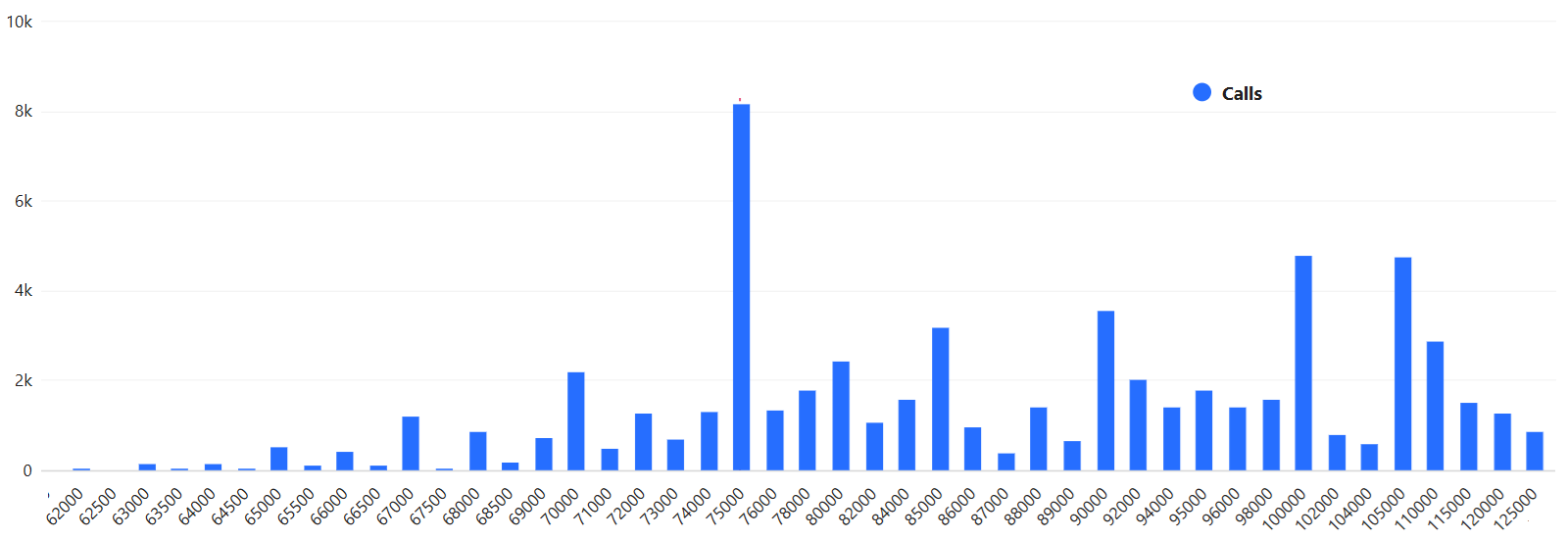
- Deribit dominates the derivatives landscape with about $4.5 billion in call options and $3.4 billion in put options, roughly three-quarters of the total market, followed by OKX and CME as secondary venues.
- Put options appear structurally resilient, and a substantial portion of call bets would expire worthless if BTC stays below $70,000 on Friday, highlighting skew toward downside protection in the event of a renewed pullback.
- Analysts point to a distribution of open interest across strikes that suggests potential tail-risk hedges around $60k–$75k, with three plausible expiry outcomes by price band (65k–69k, 69k–71k, 71k–74k).
Tickers mentioned: $BTC, $NVDA
Sentiment: Neutral
Price impact: Neutral. The setup points to several potential expiry outcomes rather than a clear directional edge, pending Friday’s settlement.
Trading idea (Not Financial Advice): Hold. Given the mixed signals and the dependency on the Friday expiry, a cautious stance remains prudent until price action clarifies the balance of risk.
Market context: The crypto complex continues to absorb climate-driven moves from equities, especially where AI-driven growth and large-cap tech results drive risk sentiment. The link between BTC and the Nasdaq suggests liquidity and sentiment could hinge on tech earnings and macro developments in the near term.
Why it matters
The proximity of a major options expiry adds a layer of probabilistic dynamics to BTC’s price path. If Friday’s settlement tilts the risk-reward balance toward puts, downside pressure could re-emerge, even if a broader macro backdrop improves later in the week. Conversely, a decisive rally back toward the mid-$70,000s could unlock renewed upside potential as hedges unwind and bullish bets reassert themselves. This interplay matters for traders betting on short-term volatility, for market-makers managing gamma exposure, and for investors watching risk parity dynamics across asset classes.
Beyond the technical setup, the influence of Nvidia’s earnings on risk appetite cannot be overstated. The company’s results, released after the market close, intersect with the AI sector’s broader profitability trajectory and margins, which have been a critical driver of forward-looking confidence in tech equities. A robust AI narrative tends to buoy liquidity across risk assets, including crypto, while disappointing guidance can deepen risk-off moves that weigh on BTC and related tokens. This cross-asset feedback loop helps explain why the BTC-iShares Nasdaq relationship remains a meaningful lens for traders assessing near-term catalysts.
In the backdrop, the derivative structure reveals a cautious stance among market participants. The largest share of put exposure sits below the current price, while still substantial upside hedges exist at higher strikes. This composition means that even if the spot moves higher, a portion of the derivative book remains positioned to dampen exuberance, reflecting a pragmatic approach to risk management as traders await Friday’s definitive outcome.
What to watch next
- Friday’s BTC options expiry outcomes by price band (65,000–69,000; 69,000–71,000; 71,000–74,000) and the resulting net tilt between puts vs. calls.
- Shifts in Deribit’s open interest and any reallocation of market share among OKX and CME after settlement.
- The Nvidia earnings release and any revised guidance that could alter AI-driven risk sentiment.
- BTC price action around the 60,000 and 75,000 levels and any validation of the upper and lower bounds suggested by the current option structure.
Sources & verification
- Bitcoin price action and the eight-day high with a double bottom near $62,500 as markets digest the upcoming expiry.
- Deribit’s market share and the breakdown of $4.5 billion in calls and $3.4 billion in puts.
- OKX and CME derivatives volumes: approximately $610 million in calls / $385 million in puts (OKX) and $255 million in calls / $287 million in puts (CME).
- Nvidia’s earnings outcomes and their potential impact on risk appetite for AI-related growth stocks.
- The observed 90% correlation between Bitcoin and the Nasdaq 100 Index, illustrating the tech-led sentiment linkage.
Bitcoin options expiry tests bulls as AI-driven sentiment sways risk assets
Bitcoin (CRYPTO: BTC) drifted to an eight-day peak as traders prepared for what could be a defining week for risk assets. A double bottom near the $62,500 zone offered a technical foothold, yet the asset remains about 21% below its level from a month earlier, underscoring the uphill climb for bulls ahead of Friday’s $10.5 billion options expiry. The event is more than a headline risk; it is a liquidity and risk-management inflection point that can shape the near-term trajectory for BTC. Deribit remains the dominant venue, commanding roughly three-quarters of the market with approximately $4.5 billion in call options and $3.4 billion in puts, while OKX and CME hold meaningful but smaller roles in the overall turnover. The market is balancing the lure of a potential rebound against the probability of further volatility driven by macro cues and tech-sector performance.
The derivatives landscape reveals a nuanced stance: although puts appear structurally well-positioned to absorb bearish shocks, a meaningful chunk of neutral-to-bullish positions was unsettled by BTC’s retreat below $75,000 in February. Data show that about 88% of Deribit’s call options would expire worthless if BTC remains under $70,000 on Friday, a statistic that underscores the risk premium baked into the expiring contracts. Even after stripping out extreme multi-leg strategies—often used to chase higher strikes—roughly 37% of the remaining bets sit below $75,000, implying that a robust rally is required to flip the balance in favor of bulls before expiry.
The balance of power in the larger market hinges on the broader tech narrative. The recent correlation suggests that as the Nasdaq moves, BTC tends to follow, at least in the near term. Nvidia (EXCHANGE: NVDA) looms large as a proxy for AI-driven demand and corporate margins; its earnings outcome, due after the close, could tilt risk appetite and inject further volatility into both equities and crypto. While Bitcoin’s path remains sensitive to the tech-driven risk-on/risk-off cycle, the current setup highlights that a decisive move would be necessary to overcome the accumulated option-based hedges and usher in a renewed upside trajectory.
Three plausible expiry outcomes emerge from the current price trajectory. If BTC trades between $65,000 and $69,000, puts have the edge by about $1.15 billion. In the $69,001–$71,000 range, puts would still dominate by roughly $845 million. If BTC finishes the week between $71,001 and $74,000, demand appears skewed toward puts with about $470 million in net exposure. Taken together, the data point to a scenario where a sustained rally beyond the current price is needed to shift the narrative, even as hedging structures offer a guardrail for contrarian bets. The dynamic nature of the option book means traders should stay vigilant for shifts in open interest across the major venues as Friday’s settlement approaches.
The interplay between crypto and traditional markets remains the defining feature of this period. While BTC can diverge from equities on longer horizons, the near-term linkage—especially via tech earnings and AI sentiment—continues to imprint volatility and liquidity conditions on the space. As the expiry nears, market participants will be watching not only the price levels but also how the hedges evolve in Deribit, OKX, and CME to determine the probable path for BTC in the days ahead.
Historically, whale inflows coincide with sensitive price phases and potentially influence XRP’s short-term market direction.
Amid a broader market uptick, XRP posted a modest 3% increase over the past 24 hours. There has also been a notable surge in token whale inflows to Binance.
The 30-day average of large wallet transfers to the exchange has risen to roughly 2.54 billion XRP, which signals renewed activity from major holders after a previous period of relative decline.
XRP Whale Inflows Spike
Daily whale inflows currently hover around 50 million XRP, which is indicative of ongoing engagement, though not as intense as the peaks observed in mid-2025. The whale flow metric, which tracks coins moving from large wallets to exchanges, is often used to gauge potential changes in the supply available for trading. Rising inflows can indicate that whales are repositioning, whether for selling, leveraging assets as collateral in derivatives, or preparing for increased trading activity.
CryptoQuant stated that the recent increase in the monthly average points to a gradual buildup rather than a single large transfer. In previous cases, higher whale inflows have coincided with sensitive phases in XRP’s price, sometimes preceding corrections due to added supply.
Other times it has signaled potential volatility, whether upward or downward.
As such, if spot demand remains weak, higher inflows could contribute to selling pressure, whereas if liquidity improves and market participation grows, the flows might reflect strategic repositioning by whales ahead of potential price movements.
Bears Still In Control
Against the backdrop of increased whale inflows and a slight price appreciation, data still show signs of bearish pressure. Analyst CasiTrades recently observed that the recent trendline break is forming resistance, and with the price dropping below the previous B-wave low, attention has shifted toward support levels at $1.11 and $0.87.
You may also like:
Local resistance around $1.40 remains significant, and as long as XRP trades below it, downward momentum may continue. She also added that the current phase is still a no-trade zone, and meaningful entries will only likely occur if lower supports are reached or if price flips above the $1.65 macro resistance.
On the institutional side of things, US spot XRP ETFs remained subdued. According to the data compiled by SoSoValue, no net inflows or outflows were recorded on February 20 and 23. On February 24, Bitwise’s XRP ETF bucked the trend with $3 million in inflows.
Binance Free $600 (CryptoPotato Exclusive): Use this link to register a new account and receive $600 exclusive welcome offer on Binance (full details).
LIMITED OFFER for CryptoPotato readers at Bybit: Use this link to register and open a $500 FREE position on any coin!
Key takeaways:
-
Bitcoin bulls need a 9% rally from current levels to take the advantage in Friday’s $10.5 billion options expiry.
-
The 90% correlation between Bitcoin and the Nasdaq 100 Index shows that tech investor sentiment drives market confidence.
Bitcoin (BTC) price surged to an eight-day high on Wednesday, successfully forming a double bottom near the $62,500 level. Despite these recent gains, Bitcoin price remains 21% lower than it was one month ago, suggesting bulls are unlikely to come out ahead during Friday’s $10.5 billion monthly BTC options expiry. Whether bulls can flip the tables at the last minute and shift momentum back in their favor remains up in the air.
Deribit remains the dominant leader with a 76% market share, totaling $4.5 billion in call (buy) options and $3.4 billion in put (sell) instruments. OKX follows in second place with $610 million in calls and $385 million in puts, representing 10% of the aggregate total. CME rounded out the top three with $255 million in calls and $287 million in puts, accounting for a 5% market share.
Put options are better positioned despite having less open interest
At first glance, the aggregate put options open interest appears 25% lower than equivalent call options. However, a more granular view reveals that neutral-to-bullish strategies were caught off guard by Bitcoin’s sharp decline below $75,000 in early February. 88% of call options on Deribit will expire worthless if the Bitcoin price remains below $70,000 on Friday.

Even when discarding calls targeting $105,000 and higher, which are typically part of complex multi-leg strategies with lower acquisition costs, only 37% of the remaining bets sit below $75,000. Realistically, this puts the effective call options open interest on Deribit at about $780 million. Given these current conditions, it is worth analyzing whether bearish traders have now overplayed their hand.

$1.44 billion in put options open interest on Deribit targets Bitcoin prices below $60,000, although it is unlikely that bets at $40,000 and $45,000 effectively aimed for those specific levels. Calendar strategies and ratio spreads are typically associated with extreme price targets, as they do not require a price crash to achieve profitability.
Put options at $72,000 and above total $1.15 billion in open interest on Deribit, which is more than enough to offset existing call options. Although Bitcoin’s decline toward $60,000 was likely not tied to macroeconomic trends, the relevance of Nvidia’s (NVDA US) earnings outcome after the US market close on Wednesday should not be understated.
The success of the artificial intelligence sector, particularly the sustainable operational margins of the world’s largest companies, remains decisive for every risk market. History suggests that Bitcoin’s correlation with the stock market seldom lasts long, but the fate of Friday’s $10.5 billion options expiry could be decided by stock market performance.
Related: Bitcoin tops $69.5K after stock market rebound, strong earnings data boost risk appetite

The current 90% correlation between Bitcoin and the Nasdaq 100 Index is clear evidence that the tech play is the leading driver of trader confidence, but as long as Bitcoin price remains below $75,000, the advantage continues to favor put options.
Below are three probable outcomes for Friday’s BTC options expiry at Deribit based on current price trends:
-
From $65,000 to $69,000: The net result favors the put (sell) instruments by $1.15 billion.
-
From $69,001 to $71,000: The net result favors the put (sell) instruments by $845 million.
-
From $71,001 to $74,000: The net result favors the put (sell) instruments by $470 million.
Ultimately, Bitcoin bulls need a 9% rally from the present $68,800 level to flip the tables on the February options expiry.
This article does not contain investment advice or recommendations. Every investment and trading move involves risk, and readers should conduct their own research when making a decision. While we strive to provide accurate and timely information, Cointelegraph does not guarantee the accuracy, completeness, or reliability of any information in this article. This article may contain forward-looking statements that are subject to risks and uncertainties. Cointelegraph will not be liable for any loss or damage arising from your reliance on this information.
XRP rallied 6% as bitcoin neared the $67,000 mark in U.S. morning hours Wednesday, with data from one exchange showing spot buyers outpaced sellers by more than 200%.
News Background
- Long-time XRP supporter and exchange Bitrue told CoinDesk that it observed a sharp surge in XRP spot activity between Feb. 23–24, with retail purchase volumes rising 212% and outpacing sell orders by more than two-to-one.
- The spike coincides with what some traders describe as a quiet accumulation phase following recent volatility.
- Institutional positioning also appears constructive. Since launching in mid-November, XRP exchange-traded funds have attracted roughly $1.1 billion in net assets, posting positive weekly inflows with only limited outflow days.
- That stands in contrast to bitcoin ETFs, which are down on a year-to-date basis, suggesting potential capital rotation within crypto allocations rather than broad-based exit.
- Spot traders also realized nearly $1.93 billion in losses during mid-February’s drawdown, Bitrue said, a shakeout that historically has preceded stronger recoveries once speculative leverage clears.
Price Action Summary
- XRP climbed from $1.34 to $1.42, gaining roughly 6%
- Break above $1.37 triggered a volume surge to 259M, more than double the daily average
- Price consolidated near $1.42 after testing $1.43
Technical Analysis
- The decisive move came with the sustained break above $1.37 resistance. Volume expansion confirmed participation beyond thin liquidity conditions, with price forming higher lows throughout the session.
- Near-term structure remains constructive while XRP holds above $1.40. However, overhead supply near $1.45 remains a key test.
- Failure to maintain current levels would shift focus back to the $1.37 breakout zone as first support.
What traders say is next?
- Traders are watching whether the $1.40–$1.42 zone can hold as a new base. A push above $1.45 would open room toward $1.50 and potentially $1.57.
- If momentum fades and XRP slips back below $1.37, the breakout risks turning into a false move, reopening the prior consolidation range.
- For now, elevated volume combined with spot-heavy buying suggests positioning is improving — but confirmation depends on follow-through above resistance.
XRP price is up about 2% in the past 24 hours. This small move is part of a broader rebound of nearly 6% after XRP briefly broke below a critical support level. Yes, a breakdown.
That breakdown initially confirmed a bearish head-and-shoulders pattern, which projected a steep 20% decline. But the story did not end there. Instead of accelerating lower, XRP rebounded quickly. New data now shows this breakdown may have served as bearish bait, drawing in short sellers before reversing.
XRP’s 20% Bearish Breakdown Created the Perfect Trap Setup
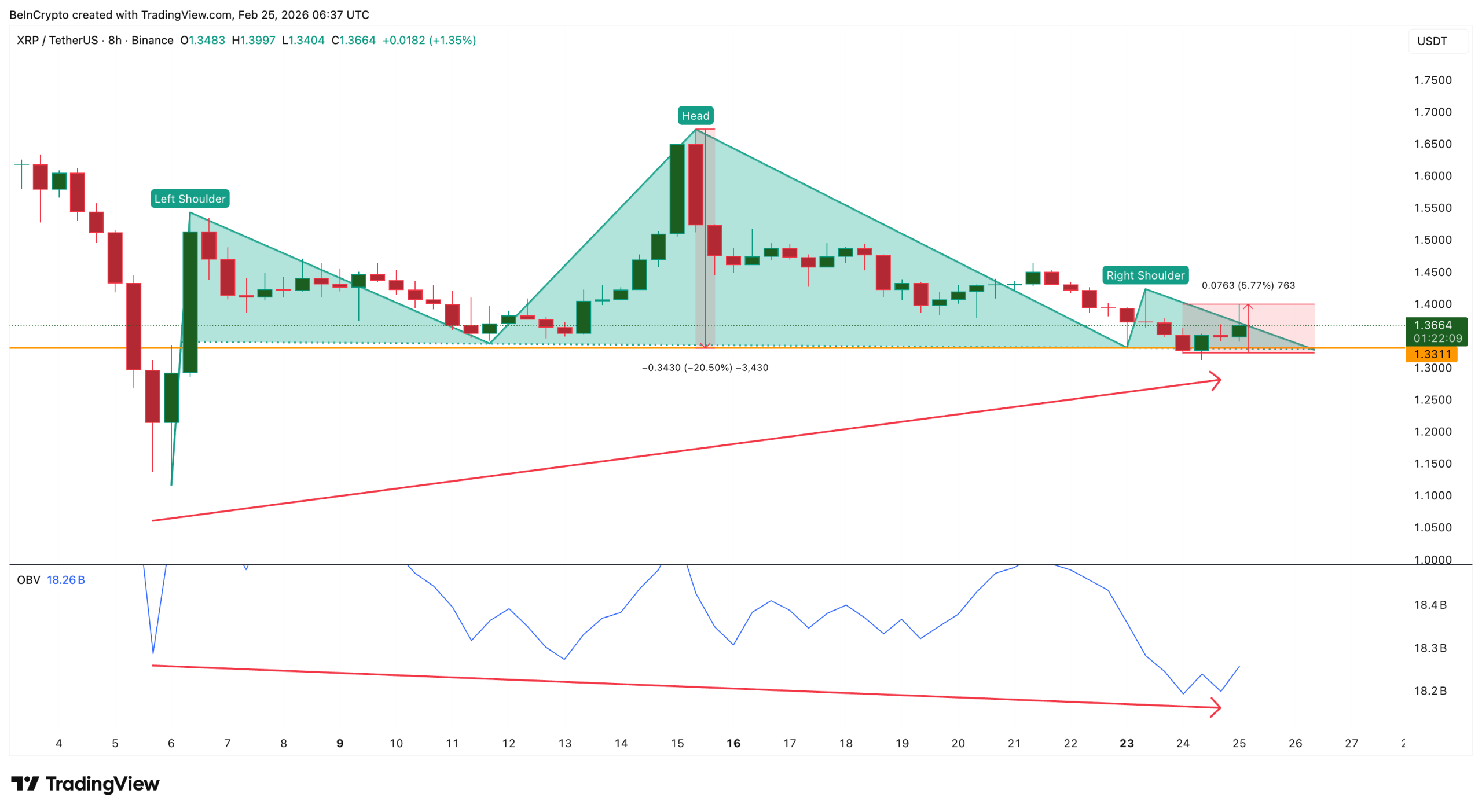
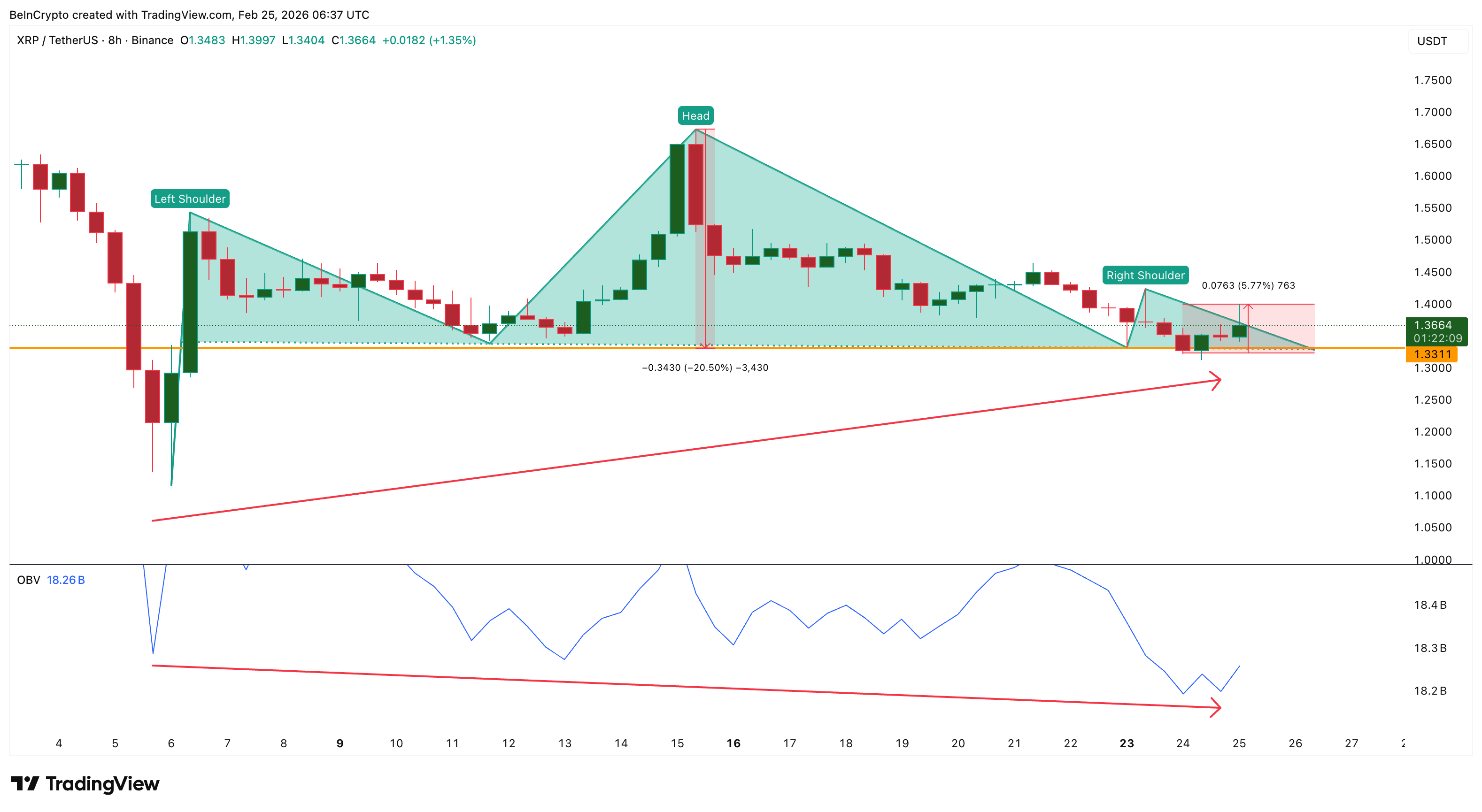
The bearish pattern began forming on the 8-hour chart on February 6. XRP created a head-and-shoulders pattern. It is one of the most widely watched bearish reversal patterns. The key level in this pattern is the neckline. For XRP, this support sat near $1.33.
When the XRP Ledger token broke below this level on February 24, it confirmed the bearish structure. Based on the height of the pattern, the projected downside target was about 20%. At the same time, another warning appeared, confirming the breakdown.
On-Balance Volume (OBV) was declining even as the XRP price was rising between February 5 and February 24. OBV measures buying and selling pressure using volume. When OBV falls while price rises, it shows weakening buyer strength. This made the breakdown look even more convincing.
Want more token insights like this? Sign up for Editor Harsh Notariya’s Daily Crypto Newsletter here.
But instead of continuing toward the 20% target, XRP quickly reversed and rebounded nearly 6%. This was the first sign that the breakdown had turned into a trap.
$770 Million Open Interest Surge Shows Traders Took the Bait
Open interest data confirms that traders reacted aggressively to the breakdown. Open interest, which measures the total value of active futures positions, surged from around $750 million on February 22 to nearly $770 million on February 23, just hours before the breakdown.
At the same time, funding rates dropped sharply from around –0.0025% to nearly –0.014%, a 460% surge in the short positioning intensity. This change is important.
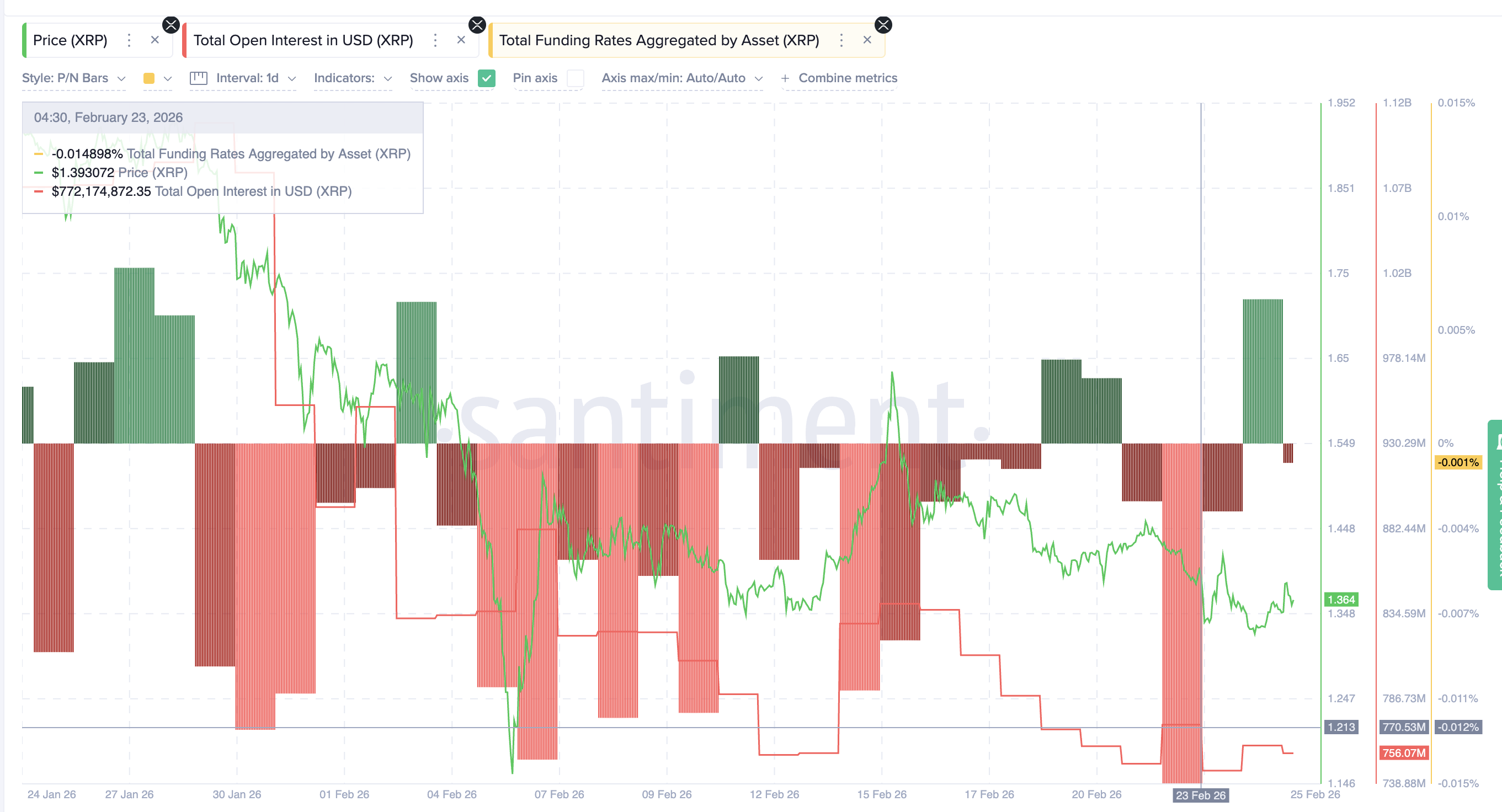
Funding rates becoming more negative means short sellers are increasing rapidly and are willing to pay a premium to hold those bearish bets. In simple terms, traders were aggressively betting on XRP to crash further.
This created a crowded short trade. But when XRP rebounded instead of collapsing, many of those short positions were likely forced to close or reduce exposure.
Open interest later dropped from $770 million to around $756 million as the price rebounded. This decline suggests leveraged positions were closed during the reversal. Open interest alone does not confirm whether longs or shorts exited.
However, because funding rates were heavily negative before the rebound, it indicates bearish positions were dominant, and some of those traders likely reduced exposure or got liquidated as the breakdown failed.
150 Million XRP Whale Buying Happened During the Trap — Not Before It
Whale behavior during this period adds another critical piece. Wallets holding between 1 million and 10 million XRP increased their holdings from 3.77 billion XRP to 3.81 billion XRP. At the same time, the largest whale group, holding between 100 million and 1 billion XRP, increased holdings from 8.35 billion XRP to 8.46 billion XRP.
Combined, these groups added approximately 150 million XRP over two days, from February 23 to February 25. At an average price of $1.35, this equals about $200 million in buying. Importantly, this accumulation happened during and immediately after the breakdown.
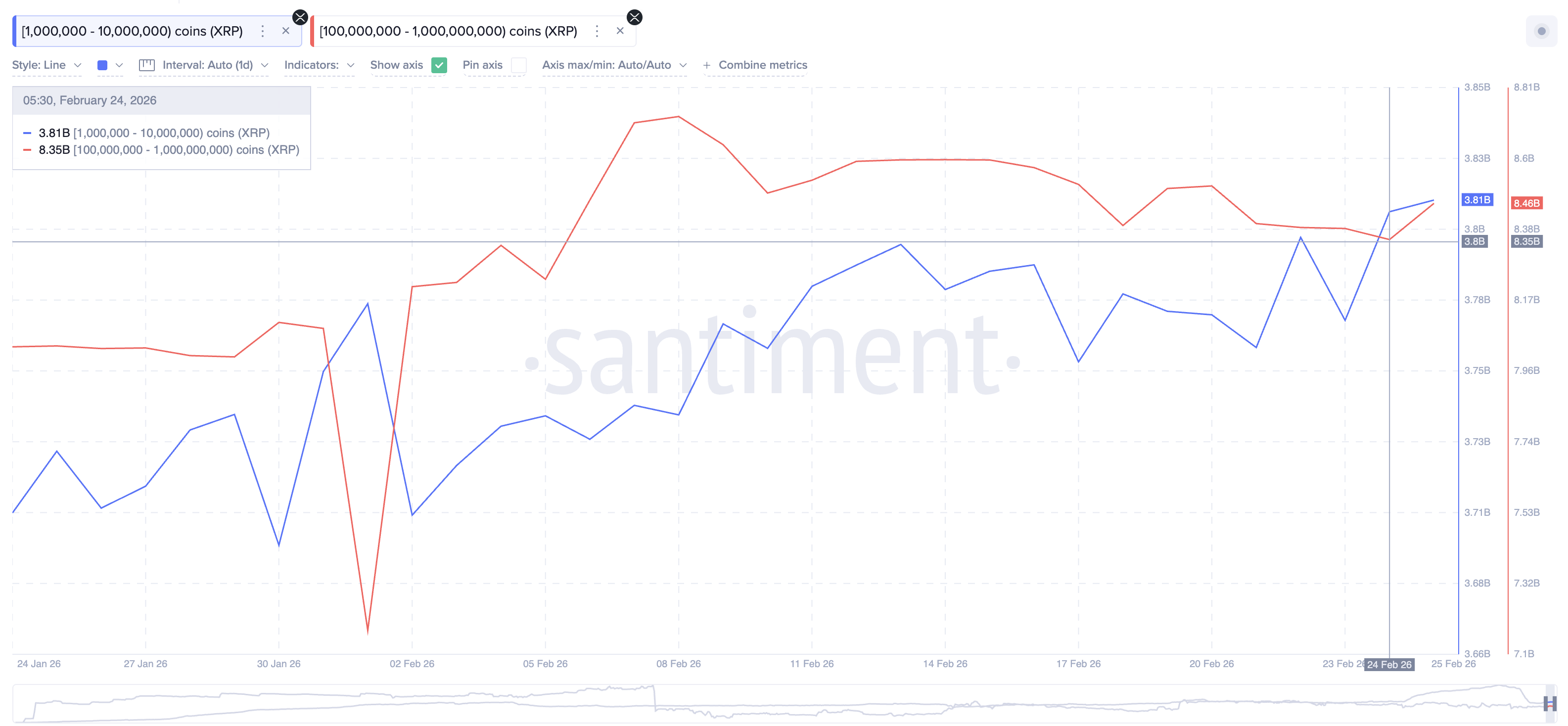
This means whales were not panic-selling. They were absorbing supply as traders exited positions.
This behavior often reflects positioning during periods of elevated market fear. It also increases the chances that breakdown continuation may remain limited unless whales begin selling.
XRP Price Now Approaches Another Breakdown Zone — But Trap Risk Remains High
XRP is now approaching another critical risk zone (the neckline), this time near $1.31 as another right shoulder forms. This level remains the most important support. If XRP breaks below $1.31 and holds below it, the bearish pattern, with another 20%+ breakdown path, could again get activated.
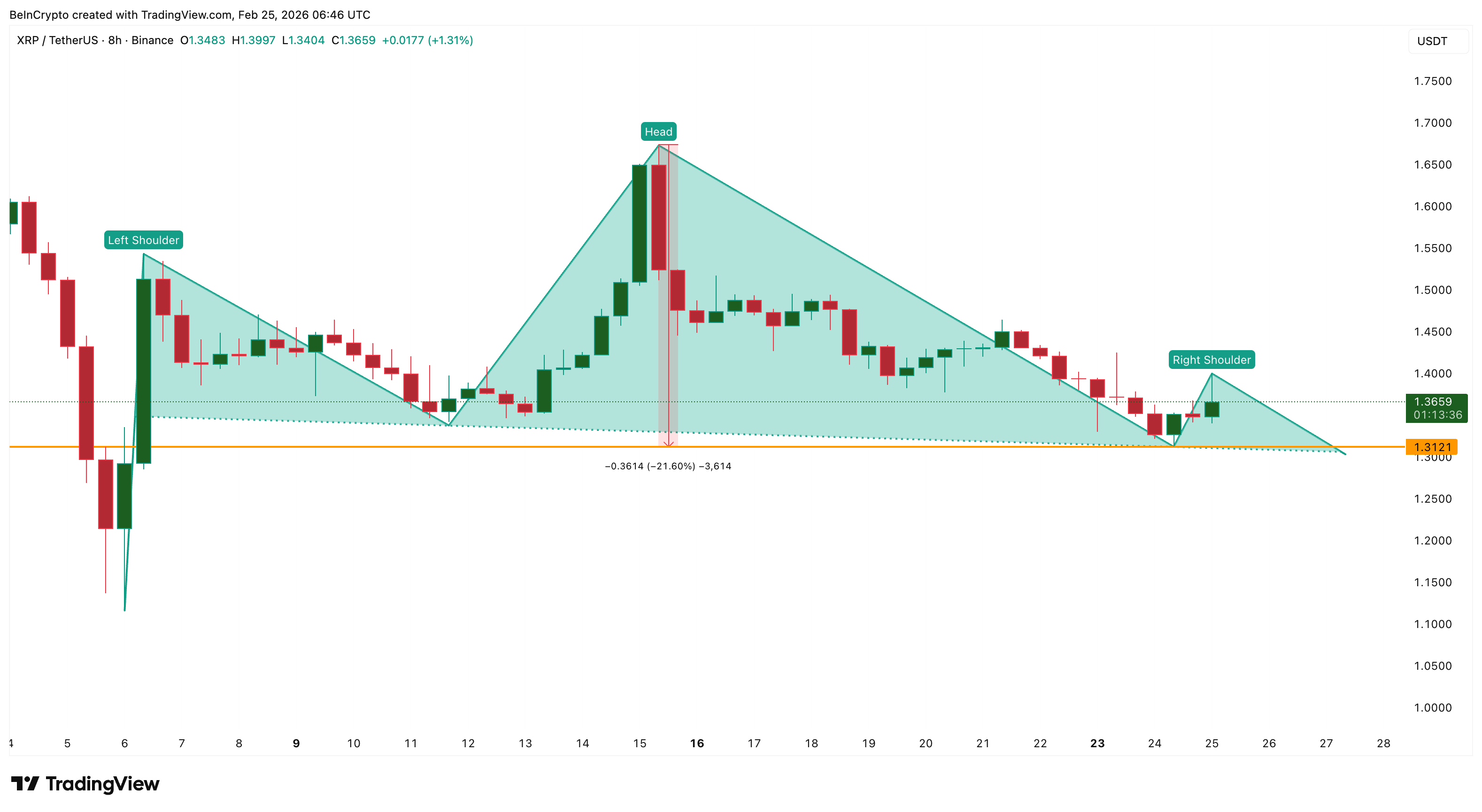
In that case, the next downside targets sit near $1.26 and $1.17, highlighted later. These levels align with key technical support zones.
However, recent trap behavior suggests another scenario is possible. If XRP briefly breaks below $1.31 but quickly recovers, it could trigger another short squeeze.
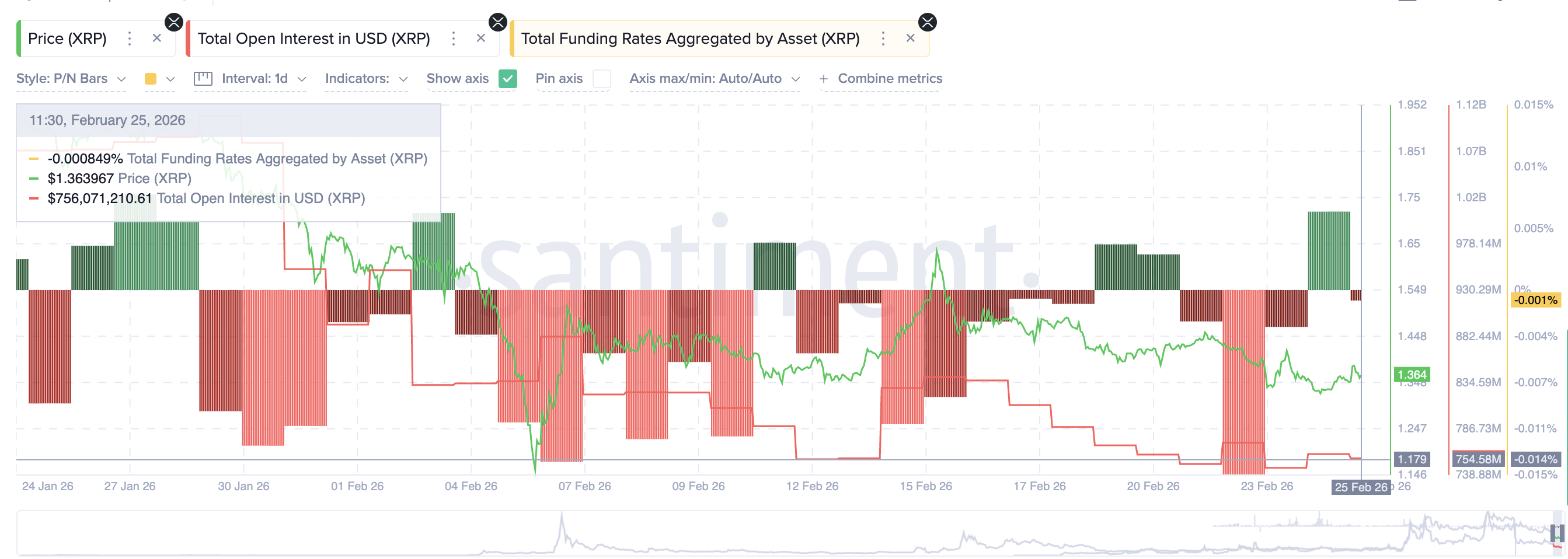
On the upside, reclaiming $1.40 would weaken the bearish setup. The trap may be forming, as open interest has risen again to $754 million, and funding rates have moved back into negative territory.
A move above $1.67 would fully invalidate the head-and-shoulders structure. Until either level breaks decisively, XRP may continue moving inside a trap-prone range. For now, the data shows a clear pattern.
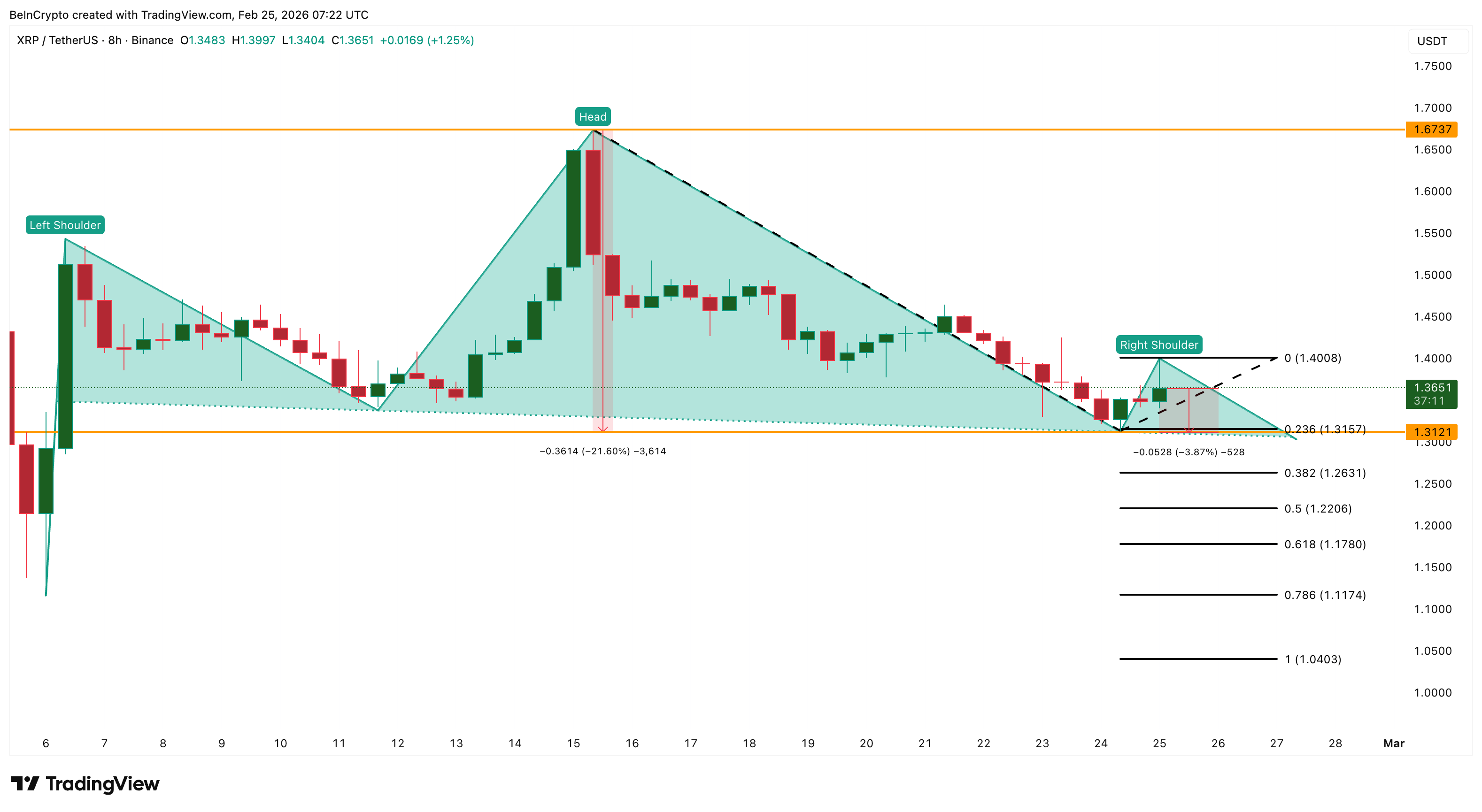
A 20% breakdown projection attracted aggressive short positions. Open interest surged. Funding turned deeply negative. But whales accumulated 150 million XRP during the panic. This combination suggests XRP’s bearish breakdown may have acted more as bait than confirmation.
The next move will decide whether the pattern finally delivers its projected decline or becomes another trap in an increasingly volatile derivatives-driven market.
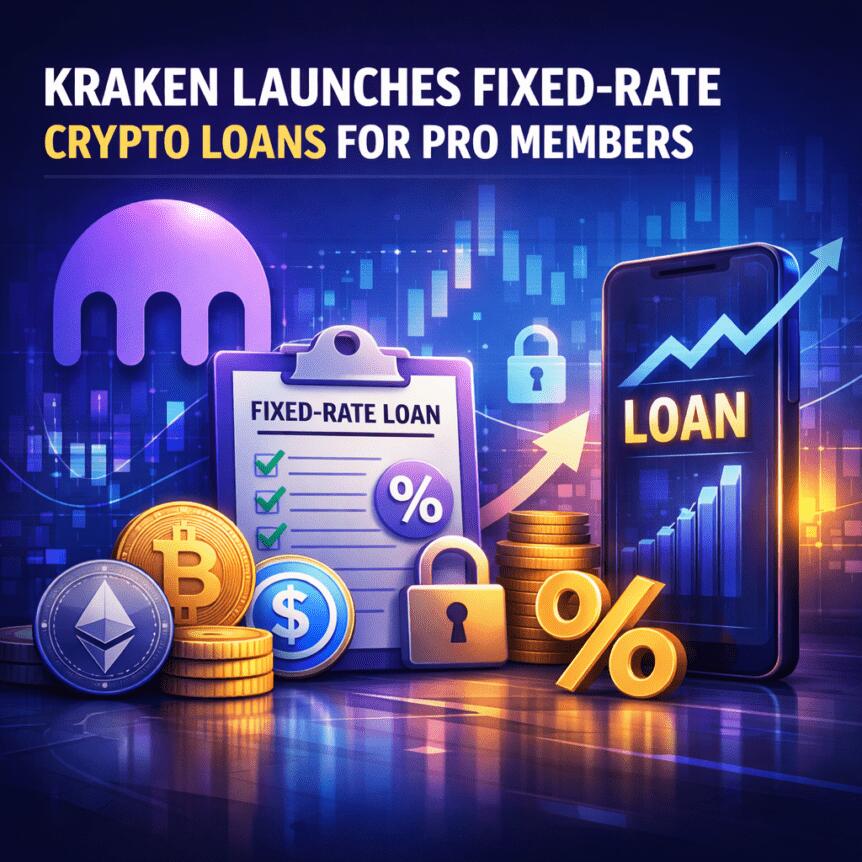
Kraken has expanded its lending toolkit with Flexline, a crypto-backed loan offering designed for Kraken Pro users seeking liquidity without selling their digital assets. The fixed-rate facility supports terms ranging from two days to two years, with loan proceeds issued in either cryptocurrency or stablecoins depending on eligibility. Collateral sits in segregated wallets and is included in Kraken’s Proof of Reserves attestations, which the exchange says verify client assets on a 1:1 basis. Annual percentage rates run from 10% to 25%, and borrowers can repay early, though an early repayment fee applies. Availability is restricted to certain regions, with the product not offered in Australia, Brazil, Canada, India, New Zealand, Switzerland, the United Arab Emirates, the United Kingdom, or the United States. The rollout follows Kraken’s recent foray into tokenized equity perpetual futures on its regulated derivatives platform, expanding leveraged exposure to major indices and select equities for eligible non-US clients. (CRYPTO: XRP) and other well-known assets feature in the broader landscape Kraken outlined, signaling a broader push toward collateralized liquidity across the ecosystem.
Key takeaways
- Flexline provides fixed-rate crypto-backed loans with terms from two days to two years, and borrowers can receive funds in crypto or stablecoins depending on eligibility; loan-to-value ratios are not disclosed.
- Collateral is held in segregated wallets and reflected in Proofs of Reserves attestations, offering 1:1 backing in the eyes of the lender.
- APR ranges between 10% and 25%; early repayment is allowed but carries a fee; the product is not available in several major markets, including the US and UK, among others.
- The launch sits within a broader trend of crypto-backed lending across centralized exchanges, DeFi, and traditional finance, highlighted by parallel moves such as Coinbase expanding its collateralized loan product and institutional participation in lending infrastructures.
- Kraken’s expansion comes as DeFi lending remains sizable, with on-chain data indicating substantial liquidity and borrowing activity across leading protocols and an ongoing consolidation of traditional finance actors into crypto lending ecosystems.
Tickers mentioned: $XRP, $DOGE, $ADA, $LTC, $USDC, MORPHO, $APO, $AAPL, $NVDA, $TSLA
Market context: The Flexline announcement arrives amid renewed momentum in crypto-backed lending, spanning exchanges, DeFi, and traditional finance. On-chain data show DefiLlama reporting roughly $51.9 billion in total value locked (TVL) across DeFi lending, with about $30.8 billion actively borrowed, led by the Aave ecosystem and a growing suite of collateralized products. This backdrop underpins Kraken’s push into flexible liquidity, aligning with a broader industry trend toward asset-backed credit facilities as market participants seek alternative funding rails amid liquidity cycles and evolving regulatory expectations.
Why it matters
For users, Flexline represents a structured path to liquidity without realizing tax-inefficient or market-timing-driven asset sales. By accepting collateral that remains on the books of the exchange, borrowers can access funds quickly, with the option to keep exposure to their upside while maintaining asset ownership. The 1:1 Proof of Reserves attestations Kraken cites aim to bolster confidence in the solvency and transparency of the arrangement, an important consideration as lenders navigate ongoing scrutiny and evolving custody standards. The inclusion of a wide array of collateral types—ranging from DeFi mainstays to stablecoins—highlights the industry’s ongoing effort to diversify liquidity channels and reduce dependence on any single asset class.
From a broader market perspective, Flexline fits a momentum arc where institutional and high-net-worth participants are increasingly experimenting with crypto-backed credit as a tool for liquidity management and yield optimization. The Coinbase expansion of its collateralized loan product to support a larger basket of assets, including XRP and other major tokens, underscores a competitive dynamic among CeFi players to offer more flexible borrowing terms without forcing asset liquidation. At the same time, rate environments and regional restrictions continue to shape how and where such products are deployed, with regulators in several jurisdictions paying closer attention to risk controls around collateral valuation and liquidation triggers. These dynamics are complemented by DeFi activity and institutional partnerships that point to a maturing ecosystem where multiple rails—CeFi, DeFi, and traditional finance—coexist and interact more frequently.
Looking ahead, market participants will watch how liquidity facilities such as Flexline influence user behavior during drawdowns, the appetite of counterparties to post diverse collateral (including tokens with volatile price trajectories), and the pace at which regulators delineate acceptable risk parameters for crypto-backed lending. The presence of established players like Apollo Global Management, which has engaged with Morpho in blockchain-enabled lending infrastructure, signals continued institutional curiosity, even if the path to broad adoption remains contingent on regulatory clarity and risk management frameworks. The evolving landscape suggests lenders will increasingly balance rapid funding with robust collateral-risk controls, aiming to deliver utility for traders and investors without compromising balance-sheet integrity.
As the ecosystem continues to evolve, Flexline could become a reference point for how crypto-backed credit products are designed, tested, and scaled across jurisdictions. The integration of transparent custody, reserve attestations, and a diverse set of collateral types could help normalize these facilities as a pragmatic tool for liquidity management on both retail and professional scales.
What to watch next
- Regional accessibility updates: whether Kraken expands Flexline availability to additional jurisdictions currently restricted.
- Asset coverage: whether more collateral types, including new tokens, are added to the supported list.
- Regulatory milestones: any changes in rules affecting crypto-backed lending, custody, and reserve reporting in major markets.
- Product integration: how Flexline interacts with Kraken’s other offerings, such as tokenized equity futures and other derivative products, and any cross-collateral or risk-management enhancements.
Sources & verification
- Kraken Flexline official page: https://www.kraken.com/en-gb/pro/flexline
- Kraken Learn comparison page: https://www.kraken.com/learn/kraken-vs-kraken-pro#:~:text=geared%20toward%20beginners%20and%20individual%20investors%2C%20while%20Kraken%20Pro%20is%20for%20advanced%20and%20institutional%20traders.
- Business Wire press release on Flexline launch: https://www.businesswire.com/news/home/20260225892767/en/Kraken-Launches-Flexline-a-Crypto-Secured-Loan-Offering-Flexible-Access-to-Liquidity
- DefiLlama lending data: https://defillama.com/protocols/lending
- Cointelegraph coverage of Apollo-Morpho partnership: https://cointelegraph.com/news/apollo-deepens-blockchain-play-enters-crypto-lending-via-morpho-partnership
What the article means for readers
Beyond the specifics of Flexline, Kraken’s move signals a continuing shift toward more accessible, asset-backed liquidity options in crypto markets. For builders, it reinforces the importance of secure custody architectures and transparent reserve reporting as core capabilities that enable scalable lending. For investors, the initiative highlights the evolving risk-reward calculus of crypto credit, where yield considerations must be weighed against the stability of collateral, platform risk, and the regulatory backdrop that governs use of crypto-backed lines of credit.
Rewritten Article Body: Kraken’s Flexline and the trajectory of crypto-backed lending
Kraken’s Flexline marks a deliberate pivot toward liquidity-first thinking in the crypto space. By enabling borrowers to post collateral and receive funds without parting with their holdings, the exchange is expanding the practical toolkit available to traders who face sudden cash needs or strategic opportunities. The mechanism rests on fixed-rate terms that stretch from a few days to several years, delivering predictability for budgeting while avoiding the volatility risk that can come with floating-rate loans in unsettled markets. The policy framework explicitly restricts some regions, a reminder that the regulatory landscape remains uneven across jurisdictions and that product design must respond to those realities. The stated APR band of 10% to 25% aligns with other crypto-backed facilities, though the precise Loan-to-Value ratios are not disclosed publicly, a common feature among lenders who balance risk with the flexibility to tailor terms to collateral type and borrower profile.
Collateral is held in segregated wallets, and the company asserts that it participates in 1:1 Proof of Reserves attestations. In effect, this positions Flexline as a transparent, auditable line of credit backed by clients’ on-chain assets. The prospect of liquidation remains a core risk management lever; Kraken notes that collateral can be liquidated if a borrower breaches maintenance requirements or fails to repay at maturity. Early repayment is allowed, but it comes with a fee, a design choice that aligns incentives toward timely settlement and preserves the lender’s ability to manage liquidity risk. The regional exclusions—Australia, Brazil, Canada, India, New Zealand, Switzerland, the United Arab Emirates, the United Kingdom and the United States—underscore the reality that jurisdictional risk remains a central concern for crypto lenders and borrowers alike, shaping product availability rather than merely reflecting policy preference.
From a product strategy standpoint, Flexline is not a stand-alone initiative. Kraken frames it within a broader expansion of liquidity options across its ecosystem. The same week, it launched tokenized equity perpetual futures on a regulated derivatives platform, providing eligible non-US traders with around-the-clock leveraged exposure to broad US stock indices, as well as individual equities such as Apple (CRYPTO: AAPL) and Nvidia (CRYPTO: NVDA), alongside other marquee names. This pairing of crypto-backed loans and tokenized equity instruments illustrates an integrated approach to liquidity and exposure that leverages both crypto and traditional markets. The inclusion of stablecoins as viable loan proceeds further broadens accessibility, enabling borrowers to receive funds in a form that can be immediately deployed within Kraken’s trading and settlement rails or withdrawn where geographic rules permit.
Across the broader market, Flexline exists within a resurgent appetite for crypto-backed lending that spans centralized exchanges, DeFi platforms, and traditional finance players. Coinbase’s recent expansion of its collateralized loan product—allowing US users to borrow up to $100,000 in USDC against a diverse asset set including XRP and other tokens—signals a competitive impulse among CeFi lenders to broaden asset coverage and reduce friction for borrowers. On the DeFi side, the liquidity story remains robust, with DefiLlama data indicating that the sector’s TVL hovered near $51.9 billion, with roughly $30.8 billion actively borrowed. Aave remains a dominant force, accounting for a substantial share of the TVL, while Morpho and other protocols continue to capture flows as lenders and borrowers explore alternatives to traditional custodial models.
Institutional involvement in crypto lending has also intensified. Apollo Global Management recently deepened its blockchain play through a Morpho partnership, signaling that traditional asset managers see potential in blockchain-based lending infrastructure and related token economics. The MORPHO token, along with related governance and staking dynamics, sits at the intersection of DeFi incentives and institutional risk management, illustrating how the line between traditional finance and crypto-native markets continues to blur. The broader ecosystem is also watching the dynamics around asset-backed liquidity in relation to regulatory expectations and risk controls, including how custody solves and reserve transparency practices evolve to meet stricter scrutiny.
For market participants, Flexline offers a practical option to unlock liquidity while maintaining exposure to digital assets. The decision to allow proceeds in both crypto and stablecoins provides flexibility, particularly for traders who want to execute spread trades or rebalance positions without triggering tax events or incurring high slippage from an asset sale. Yet with a fixed-rate structure and a potential liquidation path, borrowers must weigh the benefits of immediate liquidity against ongoing collateral risk and the potential cost of early repayment. In a landscape where DeFi lending has demonstrated resilience but remains sensitive to macro shifts and regulatory signals, Kraken’s Flexline contributes to a more nuanced, multi-rail approach to crypto credit—one that could push other players to refine their own terms, risk disclosures, and reserve practices to stay competitive while safeguarding investor confidence.
Looking forward, the evolution of crypto-backed lending will hinge on regulatory clarity, custody innovations, and the continued integration of crypto-native and traditional financial products. As lenders experiment with more asset classes and as traders increasingly treat crypto credit lines as a normal part of their toolkit, the industry will need to maintain rigorous risk management, transparent reporting, and robust liquidity provisions. Flexline’s early steps suggest a trend toward streamlined liquidity with stronger reserve guarantees, a combination that could help drive wider adoption while ensuring that credit facilities remain resilient in the face of price volatility and shifting regulatory winds.
What to verify
- Official Kraken Flexline terms and eligibility details on the Flexline page and the Learn portal.
- The Business Wire press release for the official rollout narrative and regional restrictions.
- DefiLlama’s current lending TVL and the distribution among leading DeFi lenders, including Aave and Morpho.
- Coinbase collateralized loan product expansion disclosures and any related regulatory filings or statements.
Wall Street firms are launching tokenized funds, stablecoins, and on-chain products, yet Bitwise’s CIO says that investors remain stuck in outdated crypto narratives.
Bitwise’s Chief Investment Officer Matt Hougan believes there is a fundamental disconnect between perception and reality in the crypto market. He argued that investors often misinterpret what is truly happening because behavioral biases, particularly anchoring bias, distort their view.
Anchoring bias, the tendency to fixate on the first piece of information encountered, shapes how people evaluate opportunities. This leads them to overweight initial impressions even when new evidence emerges. Hougan stated that this factor played a key role in his own entry into crypto in 2018.
Tokenization Is Exploding
In his latest memo, Hougan stressed that Wall Street is moving on-chain and pointed to several concrete developments. Paul Atkins launched “Project Crypto,” a commission-wide initiative aimed at modernizing securities regulation so that US markets can operate on-chain. Larry Fink said the industry is entering the early stages of tokenizing all assets. BlackRock followed that view by launching its $2 billion BUIDL tokenized Treasury fund on Uniswap. Apollo tokenized its $700 billion Diversified Credit Fund across six blockchains and announced plans to acquire a stake in Morpho.
Additionally, major banks, such as JPMorgan, Bank of America, Citigroup, and Wells Fargo, are discussing a joint stablecoin. JPMorgan has already launched a deposit token on Base. Fidelity is hiring a DeFi vaults manager.
Despite these initiatives, the Bitwise exec said that traditional investors fail to register these changes. Even crypto investors themselves, he added, exhibit fatigue from repeated claims of institutional adoption. Data, however, tells a different story.
Where Does the Value Go?
Tokenized real-world assets have grown sharply from 2020 to 2025. Hougan warned that while the opportunity is clear, the exact path to capture it is uncertain. Questions remain about whether value from tokenization will accrue to public Layer 1 networks like Ethereum and Solana, to quasi-private blockchains such as Canton Network and Tempo, to DeFi tokens, or to companies building in the ecosystem, including incumbents like BlackRock and JPMorgan, versus crypto-native firms.
“The biggest alpha opportunities come when the consensus narrative is stale and reality has moved on, but investors are still anchored on the old story. That’s exactly where we are with crypto today. “
Meanwhile, crypto analytics platform Presto Research expects tokenization to be a central driver of crypto’s next institutional phase. In its 2026 outlook, the firm projected that the combined value of tokenized real-world assets and stablecoins will approach $490 billion by the end of 2026.
You may also like:
The report also observed that growth will be fueled by demand for tokenized US Treasury bills and credit instruments.
Binance Free $600 (CryptoPotato Exclusive): Use this link to register a new account and receive $600 exclusive welcome offer on Binance (full details).
LIMITED OFFER for CryptoPotato readers at Bybit: Use this link to register and open a $500 FREE position on any coin!
GD Culture Group (GDC) has received board approval to sell part of its 7,500 bitcoin reserve to help fund a previously announced stock repurchase program, the company said.
The board authorization allows management to decide when and how to carry out the bitcoin sales. GD Culture emphasized it’s not obligated to sell any set amount and can alter or halt the plan at any time.
Facing a sharp decline in the stock price as the price of bitcoin has tumbled in recent months, the board approved a $100 million repurchase program earlier this month.
The company’s bitcoin holdings are currently worth about $497 million, according to data from CoinGecko. That value has dropped over time, with GD Culture carrying an unrealized loss of $344 million, down nearly 41% from its total acquisition cost of $841.5 million.
The company got its large bitcoin stash through the acquisition of Pallas Capital Holding. The move was, at the time, financed through the issuance of 39.18 million shares.
Other companies have also started divesting their bitcoin holdings. Earlier this week, Bitdeer sold all of its BTC to fund a move into AI data centers, while Riot Platforms reduced its BTC balance late last year.
GDC shares are higher by 7% on Wednesday alongside a modest bounce in the price of bitcoin to above $67,000. They remain down by nearly 70% from their September 2025 peak.

Why PSG aren’t top-tier Champions League title contenders

Skate’s developer is laying off staff before the game leaves early access

The Dollar Is DYING But Bitcoin Isn’t Rallying – Here’s The Scary Reason Why


-

 Video6 days ago
XRP News: XRP Just Entered a New Phase (Almost Nobody Noticed)
-

 Politics4 days ago
Baftas 2026: Awards Nominations, Presenters And Performers
-

 Fashion5 days ago
Weekend Open Thread: Boden – Corporette.com
-

 Sports2 days ago
Women’s college basketball rankings: Iowa reenters top 10, Auriemma makes history
-

 Politics2 days ago
Nick Reiner Enters Plea In Deaths Of Parents Rob And Michele
-
 Sports7 days ago
Clearing the boundary, crossing into history: J&K end 67-year wait, enter maiden Ranji Trophy final | Cricket News
-

 Crypto World2 days ago
XRP price enters “dead zone” as Binance leverage hits lows
-

 Business3 days ago
Mattel’s American Girl brand turns 40, dolls enter a new era
-

 Business3 days ago
Law enforcement kills armed man seeking to enter Trump’s Mar-a-Lago resort, officials say
-

 Tech1 day ago
Unsurprisingly, Apple's board gets what it wants in 2026 shareholder meeting
-
 NewsBeat3 days ago
‘Hourly’ method from gastroenterologist ‘helps reduce air travel bloating’
-

 Tech3 days ago
Anthropic-Backed Group Enters NY-12 AI PAC Fight
-

 NewsBeat3 days ago
Armed man killed after entering secure perimeter of Mar-a-Lago, Secret Service says
-

 Politics3 days ago
Maine has a long track record of electing moderates. Enter Graham Platner.
-
 NewsBeat1 day ago
Police latest as search for missing woman enters day nine
-

 Business1 day ago
True Citrus debuts functional drink mix collection
-

 Crypto World1 day ago
Entering new markets without increasing payment costs
-
 Sports3 days ago
2026 NFL mock draft: WRs fly off the board in first round entering combine week
-

 Crypto World6 days ago
83% of Altcoins Enter Bear Trend as Liquidity Crunch Tightens Grip on Crypto Market
-

 Business1 day ago
WBD says Paramount makes higher bid, board will weigh offer against Netflix deal