Random numbers are very important to us in this computer age, being used for all sorts of security and cryptographic tasks. [Theory to Thing] recently built a device to generate random numbers using nothing more complicated than simple camera noise.
The heart of the build is an ESP32 microcontroller, which [Theory to Thing] first paired with a temperature sensor as a source of randomness. However, it was quickly obvious that a thermocouple in a cup of tea wasn’t going to produce nice, jittery, noisy data that would make for good random numbers. Then, inspiration struck, when looking at vision from a camera with the lens cap on. Particularly at higher temperatures, speckles of noise were visible in the blackness—thermal noise, which was just what the doctor ordered.
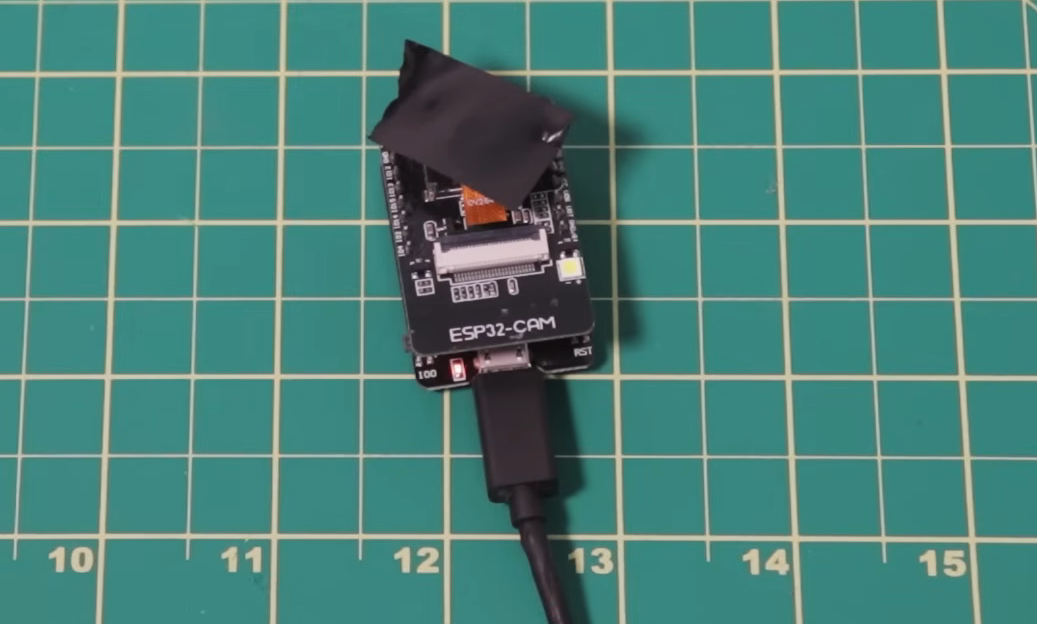
Thus, the ESP32 was instead hooked up to an OV3660 camera, which was then covered up with a piece of black electrical tape. By looking at the least significant bits of the pixels in the image, it was possible to pick up noise when the camera should have been reporting all black pixels. [Theory to Thing] then had the ESP32 collate the noisy data and report it via a web app that offers up randomly-generated answers to yes-or-no questions.
Advertisement
[Theory to Thing] offers up a basic statistical exploration of bias in the system, and shows how it can be mitigated to some degree, but we’d love a deeper dive into the maths to truly quantify how good this system is when it comes to randomness. We’ve featured deep dives on the topic before. Video after the break.
It’s always a fun day for the space nerds when a NASA team has new images to share from the James Webb Space Telescope. Today’s pair has brains on the brain, with a look at the fittingly named Exposed Cranium Nebula. More officially, this cloud of space dust and debris is known as Nebula PMR 1. The images shared today may capture a moment in the final stages of a star, as well as giving hints as to how the nebula got its brain-like shape.
“The nebula appears to have distinct regions that capture different phases of its evolution — an outer shell of gas that was blown off first and consists mostly of hydrogen, and an inner cloud with more structure that contains a mix of different gases,” NASA’s blog post reads. The dark line that runs vertically through the nebula, giving it the cranial appearance, could be the result of “an outburst or outflow from the central star, which typically occurs as twin jets burst out in opposite directions.” Both Webb’s Near-Infrared Camera (NIRCam) and its Mid-Infrared Instrument (MIRI) were used to document the nebula.
The US added 57 gigawatt-hours (GWh) of battery storage capacity to its electric grid last year – enough to supply the annual electricity needs of roughly five million homes. The SEIA report projects an additional 21 percent increase by the end of 2026, representing about 70 GWh of new capacity in a single year. Read Entire Article Source link
Over 30 years after the premiere of Neon Genesis Evangelion, Studio Khara announced that a new Evangelionanime is in the works. The franchise follows depressed teenager Shinji Ikari and his allies as they pilot giant robot EVAs to protect the world from the destructive Angels, only to discover another conspiracy at play that threatens all of humanity.
As an Evangelion fan, the prospect of seeing another series in the franchise is very exciting. However, the question lingers: will this new Evangelion anime live up to its predecessor with the talent behind it, and is such a series even necessary?
Evangelion already ended on a high note
Studio Khara / Studio Khara
Through Evangelion’s tumultuous history, audiences have witnessed three different endings to its story in the original anime series, The End of Evangelion, and Evangelion 3.0+1.0 Thrice Upon A Time. The latter film ended with Shinji overcoming his depression and recreating the world into one without EVAs, allowing him and his friends to grow up and have normal lives, giving them all the happy ending they deserve.
This film delivered a satisfying, uplifting conclusion to the long-running anime. Shinji’s decision to break the vicious cycle of trauma and remake the work aligned with the story’s themes of courage and moving forward in life, even if it means feeling pain or making mistakes. which is supposed to bring him and the audience closure after all these years. It was honestly my favorite of the franchise’s three endings, and it didn’t feel like Evangelion needed to go any further.
Advertisement
It’s unknown whether the next Evangelion series will be a prequel, sequel, or remake of the original anime. We may or may not see Shinji and his friends again in this new anime. Fortunately, Evangelion has left open some room for the story to progress after the most recent film.
Evangelion 3.0+1.0 revealed that Shinji and the rest of the cast were trapped in a time loop, forcing them to relive the franchise’s story as seen in the original show and films. This concept makes it easier for us to imagine the upcoming anime starting fresh while continuing where Evangelion’s story left off.
The new anime’s creators suggest a fresh, faithful follow-up
Studio Khara / Studio Khara
Though Evangelion creator Hideaki Anno won’t helm this new anime, it still features some returning talent working behind the scenes. Rebuild of Evangelion film director Kazuya Tsurumaki will lead the project alongside Evangelion 3.0+1.0 assistant director Toko Yatabe. Tsurumaki has worked closely with Anno since the days of Neon Genesis Evangelion, so someone with this much experience with the franchise should ensure the new anime stays true to the source material.
What is truly remarkable is that the upcoming Evangelion series will be written by Yoko Taro, who created the hit sci-fi video game series NieR. Similar to Evangelion, the NieR franchise has told subversive stories about characters who grapple with loneliness and seek purpose in life, all while depicting robots fighting in a post-apocalyptic world. Yoko has gone as far as to call NieR: Automata‘s story a retelling of Evangelion. Given Yoko’s success as a subversive storyteller and reverence for Evangelion, his writing a new chapter in the latter’s story would be interesting, to say the least.
The new anime will also be produced by Hideaki Anno’s animation company, Studio Khara, which produced the four Rebuild of Evangelion films. It will also be produced by CloverWorks, the animation studio behind popular shows like Darling in the Franxx, The Promised Neverland, Rascal Does Not Dream of Bunny Girl Senpai, and My Dress-Up Darling.
Advertisement
We’ve seen both Khara and CloverWorks deliver some top-tier animation with their respective projects. The two of them working together to revive Evangelion would lead to a dynamic, layered, and vibrant installment to an already stunning anime.
Will Evangelion be the same without Anno?
Studio Khara / Studio Khara
The Evangelion anime has long been the brainchild of Hideaki Anno. The acclaimed writer poured his experiences with clinical depression into the characters’ psychological journeys, particularly Shinji’s, presenting a harrowing, thought-provoking anime unlike any other.
Anno seemed to have finally made peace with his beloved anime with his final Rebuild of Evangelion film. Just as Shinji broke free from the cycle of sadness and violence that dominated his life, Anno finally concluded his magnum opus after writing multiple endings, allowing him to move on from the franchise after working on it for so long.
It’s hard to imagine this franchise without Anno at the helm. It’s also unclear what the new Evangelion creators will add to such a personal story that will allow it to stand out while honoring Anno’s work. However, Anno said in a 2016 interview that he hopes other creators will work on Evangelion in his stead.
“…I want them to be appealing works; it won’t be without specific conditions, but I will not confine them to what my works have established. Just like Gundam, which keeps continuously supporting the animation world, Eva can become a new pillar. After all, it is the purpose that led me to resume through the New Theatrical Versions. I want to maintain this pillar, which carries the animation world…,” said Anno. ‘I do this for the well-being of the animation industry. Gundam can be enjoyed through various works, and it would be nice if Eva can develop in the same way. I think it’s better if there is a diversity in the works.”
Advertisement
While Evangelion has long been a reflection of the man who created it, it is clear that the franchise has grown far beyond Anno, and he is happy to let the saga move forward with someone else.
Ultimately, Evangelion’s story is destined to repeat itself, but it seems to be for the better. An installment to such a prestigious franchise will undoubtedly be a huge economic boon for the animation industry. It will also keep Anno’s legacy alive and allow a new generation of viewers and creators to take in this story and conjure their own interpretations. Whatever this anime has in store for us, it will be a bold, new beginning for Evangelion worth watching.
The Samsung Galaxy Buds 4 Pro entered the market today with self-assured credentials, and early hands-on reviews are strengthening the argument that they have a good chance of overtaking competing wireless earbuds this year, notably the AirPods Pro 3. Despite being launched today, Prime members can pre-order a pair of the Galaxy Buds 4 Pro for $249.99 (was $279.99) with a $30 gift card today.
To start with, the engineers conducted thousands of simulations to refine the design of these items and essentially combed through millions of ear shapes to find the best one. With a canal fit design and silicone tips that assist establish a secure seal in your ear, each tiny bud weighs only 5.1 grams. Notably, a characteristic metal blade with a lovely polish runs along the stem. All of the controls are on this blade; all you have to do is pinch to adjust the volume.
PRE-ORDER BUNDLE: Prime members get an Amazon Gift Card when you pre-order Samsung Galaxy Buds4 Pro. Select the gift card bundle variation for…
EXCEPTIONAL AUDIO: Catch details like never before. Designed with a High-Res Audio¹ 24-bit hi-fi codec, the latest Galaxy earbuds maintain the…
TWO-WAY SPEAKER: Enjoy every audio experience to the fullest with two speakers in both Buds, including a tweeter for rich highs and a woofer for deep…
When the cover is closed, you can see the buds inside a transparent clamshell. They are available in black, white, and a pink gold color exclusive through Samsung. With the Buds 4 Pro, Samsung has really put a lot of effort into the audio. A 5.5mm planar tweeter and an 11mm super-wide woofer make up the new two-way speaker system. That woofer’s effective area has increased by about 20% over the previous generation, which helps to maintain the treble clear and sharp while reducing distortion and producing excellent, powerful bass lines.
Advertisement
Additionally, the codec has been upgraded to enable 24-bit/96kHz high-resolution audio on compatible Samsung phones and their Seamless Codec for smooth, high-fidelity streaming. In the meantime, 360 audio provides spatial dimension when combined with the appropriate equipment, and adaptive EQ essentially continuously scans your ear shape and fit in real time to sort out and maintain the audio.
Noise cancellation has also been improved; it can now adapt to low-volume rumbling noises from the road or transit while still allowing you to hear critical sounds like sirens. Chats are handled naturally by ambient mode, but a new function now recognizes your voice and lets in a little more of your surroundings while you’re speaking. The ANC is then turned back up after you’re done speaking. Super Clear Call activates during a call, expanding the audio bandwidth to 16 kHz and using machine learning to reduce background noise and boost your voice.
In terms of battery life, the Buds 4 Pro can play music for up to seven hours when ANC is off and six hours when it is turned on. This is extended in this case to 26 hours with ANC on and 30 hours without it. Talk time can last up to five hours while the ANC is off and four and a half hours when it is in use. Bluetooth 6.1 ensures you stay connected with zero dropped conversations and automatic device swapping, while fast charging keeps everything running smoothly. Broadcasting shared audio to other compatible devices is another benefit of Auracast capability.
Simple pinch and swipe movements allow you to manage playback and volume, and tilting your head allows you to answer calls or call your preferred assistant—whether it’s Perplexity, Google Gemini, or Bixby. Hands-free controls are incredibly useful. With an IP57 rating, the Buds 4 Pro meet high durability standards, allowing you to run or splash them in the shower without worrying about water getting in the way.
The Xiaomi Redmi Note 15 Pro Plus 5G is a reasonable mid-range Android phone in terms of decently zippy performance, a large and sharp OLED screen and a detailed 200MP snapper. Battery life is a strong point, too, although you can get more power and a less cluttered operating system for similar money.
Excellent battery life
Reasonable price to performance
Vivid, detailed OLED screen
Ad-riddled OS leaves a sour taste
Much more expensive than its predecessor
SQUIRREL_PLAYLIST_10208272
Key Features
Review Price: £429
6.83-inch 120Hz OLED screen
The Redmi Note 15 Pro Plus 5G has a slightly larger OLED screen before that can get super bright.
Advertisement
6500mAh battery
It’s also got a huge battery inside that can keep it going for several days on a charge.
Very robust
This Xiaomi phone is drop-proof from up to 2.5m and has full water and dust resistance that’s more flagship quality than mid-ranger.
Advertisement
Introduction
Xiaomi has become synonymous with budget-centred phones that punch above their weight into the mid-range, and the Redmi Note 15 Pro Plus 5G is the brand’s latest and greatest for 2026.
This new model has seen upgrades over the previous Note 14 Pro Plus 5G, such as a bigger AMOLED screen, improved IP rating, a new Snapdragon SoC and a lighter frame that seeks to make it the most complete Xiaomi Note phone yet.
I’ve been putting the Redmi Note 15 Pro Plus 5G through its paces for the last few weeks to see if this is truly one of the best Android phones in its price class.
Design
Polycarbonate frame makes it lighter than the older model
Curved edges may date it a little
Excellent dust and water resistance
The Redmi Note 15 Pro Plus 5G builds on the previous model’s successes by making some small, but noteworthy changes, to make this the sleekest Pro Plus model Xiaomi has made.
For instance, the chassis has moved to a polycarbonate material to shave some weight, meaning this phone weighs just 207g in the black colourway I have. Opt for the faux leather-backed Mocha Brown model, and it adds an extra gram. Either way, it makes this Xiaomi handset one of the lightest at its price point.
The Redmi Note 15 Pro Plus 5G is available in other colours besides black and brown, with Xiaomi also offering Glacier Blue if you’d prefer a more defined splash of colour.
Advertisement
Advertisement
Image Credit (Trusted Reviews)
There are curved edges on the front and back, unlike the other models in the Note 15 lineup, which isn’t as on-trend as it used to be. Nonetheless, I’ve always liked curved edges from the point of comfort, and this Xiaomi phone isn’t tiresome to hold.
Ports are standard fare for a modern phone, with a USB-C port for charging and a SIM slot off to the left. Gone are the days of cheaper phones still coming with things such as a headphone jack or expandable storage.
Image Credit (Trusted Reviews)
Where the Redmi Note 15 Pro Plus 5G really punches above its weight is with its improved water and dust resistance over its predecessor, with full IP66/IP68/IP69/IP69K certification that’s up there with flagship devices.
There is also Corning Gorilla Glass Victus 2 for added durability on the display, a pre-applied plastic screen protector, and a TPU case in the box so you’re ready to go as soon as you get the phone.
Advertisement
Screen
6.83-inch 120Hz 1280×2772 OLED
Dolby Vision and HDR10+ support
3200 nits peak brightness
The screen size on the Redmi Note 15 Pro Plus 5G has been upped from 6.67 inches to 6.83 inches, making its 1280×2772 resolution AMOLED panel one of the largest Xiaomi has fitted to a handset yet. It seems to be the same screen that was present on the more premium Xiaomi 15T, proving some components can trickle down to more affordable models.
Xiaomi promises up to 1800 nits of panel-wide brightness and up to 3200 nits peak, which would be seriously impressive for a more mid-range device. In real-world use, I didn’t feel any reason to doubt the brand’s claims, as displayed images in video and games were sharp and vibrant, indoors and out. The panel also benefits from HDR10+ and Dolby Vision HDR support for increased vibrancy in supported content for even greater vibrancy.
Advertisement
Image Credit (Trusted Reviews)
It’s up to 120Hz of refresh rate here, which gives an added slickness against the 60Hz we were stuck at for a long time, although the screen here lacks the more advanced LTPO tech we see in dearer phones, meaning the variable refresh rate works in a blockier manner. For the most part, the Redmi Note 15 Pro Plus 5G’s panel sticks at 120Hz, which isn’t much of a hardship.
Xiaomi has also included an optical under-display fingerprint sensor for this phone, mounted quite low down on the panel. It’s fine to use, although not quite as good as the ultrasonic ones seen on higher-end devices.
Advertisement
Cameras
200MP main sensor provides natural images
No telephoto lens meaning zoom isn’t too brilliant
Good 4K video from rear camera
In spite of Xiaomi’s long-running partnership with Leica, tech from that collaboration hasn’t worked its way down to the brand’s more affordable handsets just yet. Instead, the Redmi Note 15 Pro Plus 5G is bestowed with a dual camera setup, with an 8MP ultrawide and a 200MP 1/1.4-inch main sensor doing most of the heavy lifting.
It’s a similar setup to the previous model, and the same advice applies – stick to the main 200MP snapper as much as possible. That’s because it resolves the most detail, provides the most natural colours and pleasing imagery for a mid-range camera.
Image Credit (Trusted Reviews)
General wide photography yields a natural image that doesn’t have the saturation cranked up for unrealistic, poppy colours, with sharp detail and great dynamic range in my walkabout in London a few weeks’ back. The larger sensor size helps with this, with a 1/1.4-inch size surprisingly large for a more modest handset.
The main sensor does reasonably well in the dark, although let things get too dark, such as in the case of the beef sandwich image, and things begin to look a little fuzzy in places as detail retention drops.
Advertisement
Advertisement
Image Credit (Trusted Reviews)
The lack of a dedicated telephoto lens means Xiaomi is left to crop in on the 200MP sensor to offer an artificial form of zoom via pixel binning, and a choice of focal lengths in the phone’s camera app. At anything up to 4x, detail is still reasonably sharp and well-preserved, although go fully into a digital zoom range of 10x or more and it falls off a cliff in terms of sharpness, detail preservation and more besides.
The 32MP front selfie snapper on the Redmi Note 15 Pro Plus 5G is reasonable, although there isn’t any autofocus here to make sure you remain the star of the show. It’s still reasonable for vain photos of yourself, and the dedicated Portrait mode can add some pleasant bokeh, but images can come out a little soft.
Image Credit (Trusted Reviews)
We’ve got up to 4K/30fps video supported on the rear camera with good detail and smooth zoom action, although the front camera’s 1080p/60fps feels comparably limiting in both general performance and overall sharpness.
Performance
Newer Snapdragon chip inside
Middling performance for the price
Decent for gaming, although there are limitations
Advertisement
As expected for the Redmi Note 15 Pro Plus 5G, Xiaomi has opted to use a newer version of the Qualcomm chip found in last year’s model. Here, we’ve got an eight-core Snapdragon 7S Gen 4 SoC, against the Gen 3 model found in the 14 Pro+, along with 12GB of RAM and 512GB of storage in my sample.
The performance in the Geekbench 6 benchmark isn’t groundbreaking by any means, with as much performance as a flagship from a few years ago, and a modest boost over its predecessor. It’s largely in line with rivals, such as the Motorola Edge 60 Neo, although the OnePlus Nord 5 remains the standout for pure power at this price.
Advertisement
General use proves the Redmi Note 15 Pro Plus 5G doesn’t feel sluggish, in spite of the middling numbers. Navigating around Android felt zippy, as did my general workflow of using my phone for using social media, streaming music from Tidal and playing the odd game.
Image Credit (Trusted Reviews)
More serious multi-tasking can lead to some minor lags or stutters, although that’s perhaps more due to the middling LPDDR4X RAM and UFS 2.2 storage arrangement than the outright raw grunt of the processor.
Gaming is possible with the Redmi Note 15 Pro Plus 5G, and with the Game Boost features that spring into life when you open one, it’s possible to optimise your experience as much as possible. It’s possible to clear RAM and enable a faster performance profile to eke out more oomph, and there’s a decently competent GPU inside to allow for 60fps in the likes of Call of Duty Mobile.
Advertisement
For more prolonged intensive loads, expect this Xiaomi phone to get a little on the warm side, although it seems the phone’s vapour chamber cooling solution does its job well to prevent things from getting too warm.
Advertisement
Software & AI
HyperOS isn’t as polished as its rivals
More ad-riddled than previous versions
Middling OS and security upgrade commitments
I’ve had a couple of run-ins with Xiaomi’s HyperOS skin of choice in the past, and to be truthful, it’s never been my favourite Android skin against the likes of One UI or the Stock Pixel Launcher due to a lack of polish and the presence of pre-installed guff I didn’t ask for.
It borrows a lot of cues from Apple’s iOS, which become particularly noticeable with the OS’ quick settings menu that’s accessed by swiping on the right side of the screen and has a very Apple feel in terms of brightness and volume control. It’s the same as Honor’s MagicOS, so I’ve been quite used to it, but if you’re moving from other Android variants, it can take some getting used to.
Image Credit (Trusted Reviews)
There are also Google’s latest AI additions, such as Circle to Search and utilising Gemini as an assistant. There are Xiaomi-specific AI gubbins here, which mostly feature in the gallery app when editing images, such as object removal and portrait blurring with an artificial bokeh effect. There are also a few more advanced options, like the ability to remove backgrounds, FOV expansion and AI-powered automatic video editing.
Advertisement
What I dislike about HyperOS is the amount of bloatware that comes pre-installed, such as Xiaomi’s own MI app store, as well as OneDrive, the Opera browser, and the Booking.com app. Honor is guilty of this, too, and I wish more brands would opt for a cleaner approach to their Android skins.
Image Credit (Trusted Reviews)
The big problem here is the prevalence of ads at virtually every turn – most of them are for Temu – and it majorly cheapens the feel of the operating system.
Xiaomi promises more modest updates and software longevity for the Redmi Note 15 Plus 5G, with four years of OS and six years of security updates. It’s okay, if not class-leading.
Advertisement
Battery Life
6500 mAh battery
100W wired charging
No charger in the box
The Redmi Note 15 Plus 5G comes with a hefty 6500mAh battery, which is one of the largest available on a phone at this price, and I could comfortably get through a working day without so much as even thinking about battery life. Only a small top-up was needed with a charger before I went to bed to keep it ticking over without worrying for a second day.
Advertisement
This phone supports up to 100W wired fast charging, but unfortunately the proprietary Xiaomi charger isn’t included in the box. For my testing, I used a more modest 66W 6A charger that wasn’t as brisk in its speeds, taking 75 minutes to get to 50 percent and well in excess of two and a half hours for a full charge. It isn’t the quickest to get back to full.
Moreover, this phone doesn’t support any form of wireless charging, which feels like quite a misstep in 2026, as many of its rivals do.
SQUIRREL_PLAYLIST_10208272
Advertisement
Should you buy it?
You want a dazzling screen
The Redmi Note 15 Pro Plus excels with its bright, large OLED screen that’s one of the sharpest you’ll find on a phone at its price.
Advertisement
The letdown with this phone is its ad-riddled version of Android that leaves quite the sour taste against rivals.
Advertisement
Final Thoughts
The Xiaomi Redmi Note 15 Pro Plus 5G is a reasonable mid-range Android phone in terms of decently zippy performance, a large and sharp OLED screen and a detailed 200MP snapper. Battery life is a strong point, too, although you can get more power and a less cluttered operating system for similar money.
The likes of the Google Pixel 9a and OnePlus Nord 5 can outperform Xiaomi’s choice in terms of grunt, for instance, while Google’s own version of Android is much cleaner and easier to live with, and its camera is also a strong performer. The Nord 5 isn’t as strong on battery life as Xiaomi’s choice, though, but its OxygenOS skin is much less in your face with AI or any ads compared to HyperOS.
With this in mind, there’s still a fair bit to like about the Redmi Note 15 Pro Plus 5G, and it’s a cromulent Android handset for the price. For more options, check out our list of the best Android phones we’ve tested.
How We Test
We test every mobile phone we review thoroughly. We use industry-standard tests to compare features properly and we use the phone as our main device over the review period. We’ll always tell you what we find and we never, ever, accept money to review a product.
Advertisement
Used as a main phone for over a week
Thorough camera testing in a variety of conditions
Tested and benchmarked using respected industry tests and real-world data
Advertisement
FAQs
Does the Xiaomi Redmi Note 15 Pro Plus 5G come with a charger?
No, the Xiaomi Redmi Note 15 Pro Plus 5G doesn’t come with its own charger, so you’ll need to supply your own.
Is the Xiaomi Redmi Note 15 Pro Plus 5G water-resistant?
Advertisement
Yes, the Xiaomi Redmi Note 15 Pro Plus 5G is fully dust and water-resistant and comes with full IP66/IP68/IP69/IP69K certification.
How many upgrades will the Xiaomi Redmi Note 15 Pro Plus 5G get?
Xiaomi has committed to four years of OS updates and six years of security updates with the Redmi Note 15 Pro Plus.
Mathematics is often regarded as the ideal domain for measuring AI progress effectively. Math’s step-by-step logic is easy to track, and its definitive automatically verifiable answers remove any human or subjective factors. But AI systems are improving at such a pace that math benchmarks are struggling to keep up.
Way back in November 2024, non-profit research organization Epoch AI quietly released FrontierMath. A standardized, rigorous benchmark, Frontier Math was designed to measure the mathematical reasoning capabilities of the latest AI tools.
“It’s a bunch of really hard math problems,” explains Greg Burnham, Epoch AI Senior Researcher. “Originally, it was 300 problems that we now call tiers 1–3, but having seen AI capabilities really speed up, there was a feeling that we had to run to stay ahead, so now there’s a special challenge set of extra carefully constructed problems that we call tier 4.”
To a rough approximation, tiers 1–4 go from advanced undergraduate through to early postdoc level mathematics. When introduced, state-of-the-art AI models were unable to solve more than 2% of the problems FrontierMath contained. Fast forward to today and the best publicly available AI models, such as GPT-5.2 and Claude Opus 4.6, are solving over 40% of FrontierMath’s 300 tiers 1–3 problems, and over 30% of the 50 tier 4 problems.
Advertisement
AI takes on PhD level mathematics
And this dizzying pace of advancement is showing no signs of abating. For example, just recently Google DeepMind announced that Aletheia, an experimental AI system derived from Gemini Deep Think, achieved publishable PhD level research results. Though obscure mathematically—calculating certain structure constants in arithmetic geometry called eigenweights—the result is significant in terms of AI development.
“They’re claiming it was essentially autonomous, meaning a human wasn’t guiding the work, and it’s publishable,” Burnham says. “It’s definitely at the lower end of the spectrum of work that would get a mathematician excited, but it’s new—it’s something we truly haven’t really seen before.”
To place this achievement in context, every FrontierMath problem has a known answer that a human has derived. Though a human could probably have achieved Aletheia’s result “if they sat down and steeled themselves for a week,” says Burnham, no human had ever done so.
Aletheia’s results and other recent achievements by AI mathematicians point to new, tougher benchmarks being needed to understand AI capabilities, and fast, because existing ones will soon become irrelevant. “There are easier math benchmarks that are already obsolete, several generations of them,” says Burnham. “FrontierMath will probably saturate [meaning state-of-the-art AI models score 100%] within the next two years; could be faster.”
Advertisement
The First Proof challenge
To begin to address this problem, on February 6, a group of 11 highly distinguished mathematicians proposed the First Proof challenge, a set of 10 extremely difficult math questions which arose naturally in the authors’ research processes, and whose proofs are roughly five pages or less and had not been shared with anyone. The First Proof challenge was a preliminary effort to assess the capabilities of AI systems in solving research-level math questions on their own.
Generating serious buzz in the math community, professional and amateur mathematicians, and teams including OpenAI, all stepped up to the challenge. But by the time the authors posted the proofs on February 14, no one had submitted correct solutions to all 10 problems.
In fact, far from it. The authors themselves only solved two of the 10 problems using Gemini 3.0 Deep Think and ChatGPT 5.2 Pro. And most outside submissions fared little better, apart from OpenAI and a small Aletheia team at GoogleDeepMind. With “limited human supervision” OpenAI’s most advanced internal AI system solved five of the 10 problems, with Aletheia achieving similar outcomes—results met with a spectrum of emotions by different members of the mathematics community, from awe to disappointment. The team behind First Proof plans an even tougher second round on March 14.
A new frontier for AI
“I think First Proof is terrific: it’s as close as you could realistically get to putting an AI system in the shoes of a mathematician,” says Burnham. Though he admires how First Proof tests AI’s mathematical utility for a wide range of mathematics and mathematicians, Epoch AI has its own new approach to testing—FrontierMath: Open Problems. Uniquely, the pilot benchmark consists of 16 open problems (with more to follow) from research mathematics that professional mathematicians have tried and failed to solve. Since Open Problems’ release on January 27, none have been solved by an AI.
Advertisement
“With Open Problems, we’ve tried to make it more challenging,” says Burnham. “The baseline on its own would be publishable, at least in a specialty journal.” What’s more, each question is designed so that it can be automatically graded. “This is a bit counterintuitive,” Burnham adds. “No one knows the answers, but we have a computer program that will be able to judge whether the answer is right or not.”
Burnham sees First Proof and Open Problems as being complementary. “I would say understanding AI capabilities is a more-the-merrier situation,” he adds. “AI has gotten to the point where it’s, in some ways, better than most PhD students, so we need to pose problems where the answer would be at least moderately interesting to some human mathematicians, not because AI was doing it, but because it’s mathematics that human mathematicians care about.”
Survivor 50 is about to play the biggest game in Fiji history, and reality TV fans don’t have to break the bank to catch this season’s murderers’ row of castaways. Here’s the play:
You can watch Survivor for free in Canada. Traveling abroad in Australia, UK, Asia, India, etc? Theres a handy fix below (TLDR: get this VPN now to watch free anywhere).
No messy sign-ups, no price plans – just Jeff Probst, idols, advantages and blindsides that hit harder than the Mamanuca Islands monsoon rain.
Advertisement
Get ready for old-school grit and new-era gameplay in a battle for Day 26 glory – and the title of Sole Survivor 2026…
How to watch Survivor 50 for free
Survivor 50 is live on Canada’s Global TV (they also offer on-demand) – meaning you can watch for free right now.
Outside Canada? Use a VPN to access your Canadian services from anywhere, terms allowing – we’re watching Survivor on Global TV right now and it works fine.
It’s clearly a popular workaround for accessing Survivor 50 without paying for a fancy cable package. Plus, we’ve got a great free gift for your below…
How to watch Survivor free from anywhere
NordVPN is our best VPN (we actually have our own in-house expert, Mike, who tests VPNs 24/7 and he rates NordVPN top for price, features, security, etc).
Advertisement
We also find Nord works best for streaming – allowing you to access your domestic streaming services when abroad.
You can sign up in minutes and start watching Survivor free…
Quick start: Using a VPN to watch Survivor 50 free
Once you’ve signed up with your VPN:
Advertisement
1. Open the NordVPN app.
2. Connect to a server based in the Canada.
3. Fire up Global TV. If that doesn’t work, try it in Google Chrome’s Incognito mode and you should be off to the races.
4. Watch the 2026 Survivor streams at no cost.
Advertisement
Everything to know about Survivor 50
📺 When and where can I stream Survivor 50 in the US? Survivor 50 premiered Feb. 25, 2026, on CBS and streams on Paramount+. Premium subscribers can watch live as it airs; Essential subscribers get next-day on-demand. Remember: you can get a 30 day free Essential trial via Walmart Plus for $1.
🌍 Can I watch if I’m outside Canada or the U.S.? Yes — with a Paramount+ subscription you can stream episodes from abroad. Some fans also use a VPN to access their local free streams when travelling. We recommend NordVPN or Surfshark as the best options.
📅 What’s the release schedule and episode length? Weekly Survivor episodes drop on Wednesdays (8 p.m. ET) after a three-hour premiere, with later shows around 90 min runtime.
Advertisement
📱 Can I binge older seasons before watching S50? Absolutely – Paramount+ has nearly all past seasons ready for a pre-game binge.
💸 Is there a free way to stream Survivor 50? There’s a free stream on Global TV in Canada, and some services offer short free trials or cheaper plans that let you catch episodes shortly after they air. You may find a free Paramount Plus trial in the UK but not the US.
In conclusion
Season 50 isn’t just a reboot – fans have lit up social feeds with nostalgia and hype as 24 returnees hit Fiji, fan-voted twists take shape, and hidden idols are rumored in all 50 states. Even host Jeff Probst has been talking about embracing “uncertainty” and getting surprised by fan votes. Longtime superfans are calling Feb 25 “the biggest Survivor premiere ever”.
Advertisement
Canadian audiences can watch on Global TV, of course, but those away from home willing to use a VPN to stream the entire season free with a good VPN. It might be the cheapest legal way to tune in, especially if you have to catch the premiere live without cable.
You may also be interested in…
We test and review VPN services in the context of legal recreational uses. For example: 1. Accessing a service from another country (subject to the terms and conditions of that service). 2. Protecting your online security and strengthening your online privacy when abroad. We do not support or condone the illegal or malicious use of VPN services. Consuming pirated content that is paid-for is neither endorsed nor approved by Future Publishing.
The new skilled roles will be created as part of an initial five-year $350m investment.
AI infrastructure provider Equinix will create 200 jobs in Dundalk, Co Louth through an investment of up to $700m in a new facility that will be built by local company Hanley Energy.
New roles at the facility will be in technical fields such as precision engineering, quality assurance and lean manufacturing. Hiring has already begun, and there are plans for the facility to engage locally with apprenticeship and training programmes.
The deal guarantees an initial $350m across five years and is extendable to 10 years. The new facility will be used exclusively to build specialised power equipment for Equinix’s data centres worldwide.
Advertisement
Adaire Fox-Martin, the CEO and president of Equinix, said: “This investment builds upon Equinix’s longtime presence in Ireland and reflects the strategically important role the country plays in the global technology ecosystem.
“Our expansion in Dundalk further strengthens our ability to meet growing customer demand while creating local jobs and supporting the community.”
Equinix said that by centralising its production of components such as low-voltage switchgear, power distribution units and remote power panels at the new 150,000 sq ft facility, it expects to achieve up to 15pc faster lead times when compared to traditional procurement methods.
Taoiseach Micheál Martin, TD said: “This significant announcement reinforces Ireland’s position as a leader in digital infrastructure and advanced manufacturing. The creation of hundreds of skilled jobs and the introduction of world-class facilities in Dundalk is a major boost for the region and for our national economy.”
Advertisement
Equinix, which runs 280 data centres across six continents, works with partners such as Amazon Web Services, Nvidia, Azure and Google Cloud.
Managing director of Equinix Ireland Peter Lantry said the investment would secure the company’s supply chain locally in the Louth region and ensure its long-term presence there, while IDA Ireland CEO Michael Lohan said it would “deliver significant economic benefits and high-value jobs in Dundalk and the wider region”.
Hanley Energy, which employs around 850 worldwide, plans to build the new facility using “low-carbon materials and efficient construction practices”, according to Equinix. The facility will also feature a temperature-controlled testing laboratory – which Equinix claimed will be the only one of its kind in Ireland or the UK.
Hanley CEO John O’Driscoll said: “Partnering with Equinix on this transformative project highlights the strength of Irish engineering and innovation. Our advanced testing facilities and expertise will ensure that the equipment produced here meets the highest global standards, supporting data centres worldwide.”
Advertisement
At the end of last year, Hanley was acquired by US engineering and manufacturing company Jabil for around $725m.
Don’t miss out on the knowledge you need to succeed. Sign up for the Daily Brief, Silicon Republic’s digest of need-to-know sci-tech news.
This article is crossposted from IEEE Spectrum’s careers newsletter. Sign up now to get insider tips, expert advice, and practical strategies, written in partnership with tech career development company Parsity and delivered to your inbox for free!
Standing Out as a Remote Worker Takes a Different Strategy
My first experience as a remote worker was a disaster.
Before I joined a San Francisco-based team with a lead developer in Connecticut, I had worked in person, five days a week. I thought success was simple: write good code, solve hard problems, deliver results. So I put my head down and worked harder than ever.
Twelve-hour days became normal as the boundary between work and personal life disappeared. My kitchen table became my office.
Advertisement
I rarely asked for help because I didn’t want to seem incompetent. I stayed quiet in team Slack channels because I wasn’t sure what to say.
Despite working some of the longest hours of my career, I made the slowest progress. I felt disconnected from the team. I had no idea if my work mattered or if anyone noticed what I was doing. I was burning out.
Eventually, I realized the real problem: I was invisible.
The Office Advantage You Lose When Remote
In an office, visibility happens naturally. Colleagues see you arrive early or stay late. They notice when you are stuck on a problem. They hear about your work in hallway conversations and over lunch. Physical presence creates recognition with almost no effort.
Advertisement
Remote work removes those signals. Your manager cannot see you at your desk. Your teammates don’t know you’ve hit a roadblock unless you say so. You can work long days and still appear less engaged than someone in the office.
That is the shift many people miss: Remote work requires execution plus deliberate communication.
What Actually Works
By my second remote role, I knew I had to change to protect my sanity and still succeed.
Here are five things I did that made a real difference.
Advertisement
1. Over-communicating
I began sharing updates in team channels regularly, not just when asked. “Working on the payment integration today; ready for review tomorrow.” “Hit a blocker with API rate limits; investigating options.” These took seconds but made my work visible and invited help sooner.
2. Setting limits
When your home is also your office, overwork becomes the default. I started ending most days at 5 p.m. and transitioning out of work mode with a walk or gym session. That ritual helped prevent burnout.
Advertisement
3. Volunteering for presentations
Presenting remotely felt less intimidating than standing in front of a room. I started volunteering for demos and lunch-and-learns. This increased my visibility beyond my immediate team and improved my communication skills.
4. Promoting others publicly
When someone helped me, I thanked them in a public channel. When a teammate shipped something impressive, I called it out. This builds goodwill and signals collaboration. In remote environments, gratitude is visible and memorable.
Advertisement
5. Building relationships deliberately
In an office, relationships form naturally. Remotely, you have to create those moments. I started an engineering book club that met every other week to discuss a technical book. It became a low-pressure way to connect with people across the organization.
The Counterintuitive Reality
With these habits, I got promoted faster in this remote job than I ever did in an office. I moved from senior engineer to engineering manager in under two years, while maintaining a better work-life balance.
Remote work offers flexibility and freedom, but it comes with a tax. You are easier to overlook and more likely to burn out unless you are intentional in your actions.
Advertisement
So, succeeding remotely takes deliberate effort in communication, relationships, and boundaries. If you do that well, remote work can unlock more opportunities than you might expect.
—Brian
Despite its critical role in maintaining a secure network, authentication software often goes unnoticed by users. Alan DeKok now runs one of the most widely used remote authentication servers in the world—but he didn’t initially set out to work in cybersecurity. DeKok studied nuclear physics before starting the side project that eventually turned into a three-decade-long career.
We’re just two months into 2026, and layoffs in the tech industry are already ramping up. According to data compiled by RationalFX, more than half of the 30,700 layoffs this year have come from Amazon, which announced that it would be cutting the roles of 16,000 employees in late January. Will the trend continue through 2026?
Recent research suggests that a majority of organizations have a significant gap when it comes to AI skills among leadership. To help fill the gap, IEEE has partnered with the Rutgers Business School to offer an online “mini-MBA” program, combining business strategy and deep AI literacy. The program spans 12 weeks and 10 modules that teach students how to implement AI strategies in their own organizations.
Riley Walz, a software engineer famous for his online stunts, is joining OpenAI to research and develop new ways for humans to interact with AI, WIRED has learned. An OpenAI spokesperson confirmed the hire.
Walz built a reputation as Silicon Valley’s jester and has created a series of viral web projects that double as social commentary. His most recent initiative, Jmail, lets users search Jeffrey Epstein’s emails as if they’re accessing his personal Gmail inbox. Another project, Find My Parking Cops, used publicly available data to reverse engineer San Francisco’s parking ticket system to show people exactly where each parking enforcement officer last wrote a ticket.
Now, Walz’s skills creating novel web experiences will be put to use in OAI Labs, a relatively new team led by research leader Joanne Jang. The team is secretive about what it’s been working on but has been tasked with “inventing and prototyping new interfaces for how people collaborate with AI,” according to Jang.
OpenAI has spent the past several years racing with Google and Anthropic to create new, compelling ways for people to use its AI models. While ChatGPT has been a hit with consumers, now reaching more than 800 million people every week, the company is eyeing new interfaces to improve these experiences. The move comes as millions of developers have started using coding agents such as Claude Code as their main interface to access AI models. With hires like Walz, OpenAI hopes to get ahead of the next big AI product.
Advertisement
Walz’s online stunts have landed him in hot water from time to time. The Find My Parking Cops website lasted just four hours before San Francisco city officials shut down the live data feed Walz’s tool relied on. A San Francisco Municipal Transportation Agency representative said at the time that it shut down the tool to ensure “employees are able to do their jobs safely and without disruption.”
It’s not always city officials giving him a hard time, though. After the CEO of UnitedHealthcare was shot dead in New York City, and police said the killer had fled on a CitiBike, Walz tried to analyze trip data he had previously scraped for a separate project to help with the search. Walz told The New York Times that people online called him a “bootlicker” for helping authorities and threatened his safety.