

Crypto World
Kraken Launches Fixed-Rate Crypto Loans for Pro Members

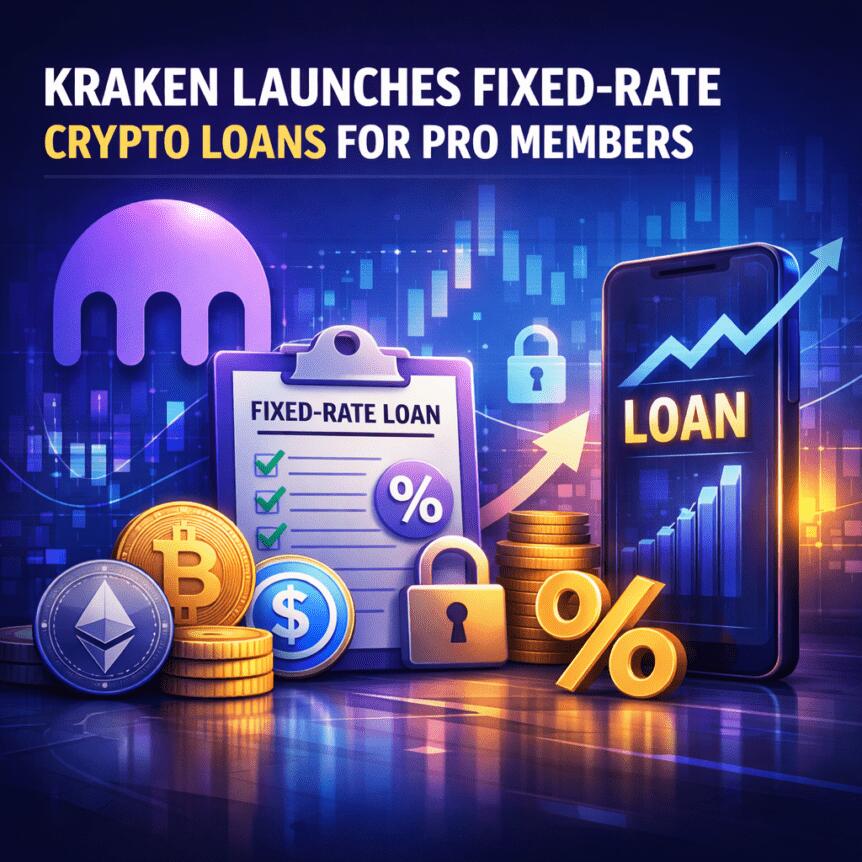
Kraken has expanded its lending toolkit with Flexline, a crypto-backed loan offering designed for Kraken Pro users seeking liquidity without selling their digital assets. The fixed-rate facility supports terms ranging from two days to two years, with loan proceeds issued in either cryptocurrency or stablecoins depending on eligibility. Collateral sits in segregated wallets and is included in Kraken’s Proof of Reserves attestations, which the exchange says verify client assets on a 1:1 basis. Annual percentage rates run from 10% to 25%, and borrowers can repay early, though an early repayment fee applies. Availability is restricted to certain regions, with the product not offered in Australia, Brazil, Canada, India, New Zealand, Switzerland, the United Arab Emirates, the United Kingdom, or the United States. The rollout follows Kraken’s recent foray into tokenized equity perpetual futures on its regulated derivatives platform, expanding leveraged exposure to major indices and select equities for eligible non-US clients. (CRYPTO: XRP) and other well-known assets feature in the broader landscape Kraken outlined, signaling a broader push toward collateralized liquidity across the ecosystem.
Key takeaways
- Flexline provides fixed-rate crypto-backed loans with terms from two days to two years, and borrowers can receive funds in crypto or stablecoins depending on eligibility; loan-to-value ratios are not disclosed.
- Collateral is held in segregated wallets and reflected in Proofs of Reserves attestations, offering 1:1 backing in the eyes of the lender.
- APR ranges between 10% and 25%; early repayment is allowed but carries a fee; the product is not available in several major markets, including the US and UK, among others.
- The launch sits within a broader trend of crypto-backed lending across centralized exchanges, DeFi, and traditional finance, highlighted by parallel moves such as Coinbase expanding its collateralized loan product and institutional participation in lending infrastructures.
- Kraken’s expansion comes as DeFi lending remains sizable, with on-chain data indicating substantial liquidity and borrowing activity across leading protocols and an ongoing consolidation of traditional finance actors into crypto lending ecosystems.
Tickers mentioned: $XRP, $DOGE, $ADA, $LTC, $USDC, MORPHO, $APO, $AAPL, $NVDA, $TSLA
Market context: The Flexline announcement arrives amid renewed momentum in crypto-backed lending, spanning exchanges, DeFi, and traditional finance. On-chain data show DefiLlama reporting roughly $51.9 billion in total value locked (TVL) across DeFi lending, with about $30.8 billion actively borrowed, led by the Aave ecosystem and a growing suite of collateralized products. This backdrop underpins Kraken’s push into flexible liquidity, aligning with a broader industry trend toward asset-backed credit facilities as market participants seek alternative funding rails amid liquidity cycles and evolving regulatory expectations.
Why it matters
For users, Flexline represents a structured path to liquidity without realizing tax-inefficient or market-timing-driven asset sales. By accepting collateral that remains on the books of the exchange, borrowers can access funds quickly, with the option to keep exposure to their upside while maintaining asset ownership. The 1:1 Proof of Reserves attestations Kraken cites aim to bolster confidence in the solvency and transparency of the arrangement, an important consideration as lenders navigate ongoing scrutiny and evolving custody standards. The inclusion of a wide array of collateral types—ranging from DeFi mainstays to stablecoins—highlights the industry’s ongoing effort to diversify liquidity channels and reduce dependence on any single asset class.
From a broader market perspective, Flexline fits a momentum arc where institutional and high-net-worth participants are increasingly experimenting with crypto-backed credit as a tool for liquidity management and yield optimization. The Coinbase expansion of its collateralized loan product to support a larger basket of assets, including XRP and other major tokens, underscores a competitive dynamic among CeFi players to offer more flexible borrowing terms without forcing asset liquidation. At the same time, rate environments and regional restrictions continue to shape how and where such products are deployed, with regulators in several jurisdictions paying closer attention to risk controls around collateral valuation and liquidation triggers. These dynamics are complemented by DeFi activity and institutional partnerships that point to a maturing ecosystem where multiple rails—CeFi, DeFi, and traditional finance—coexist and interact more frequently.
Looking ahead, market participants will watch how liquidity facilities such as Flexline influence user behavior during drawdowns, the appetite of counterparties to post diverse collateral (including tokens with volatile price trajectories), and the pace at which regulators delineate acceptable risk parameters for crypto-backed lending. The presence of established players like Apollo Global Management, which has engaged with Morpho in blockchain-enabled lending infrastructure, signals continued institutional curiosity, even if the path to broad adoption remains contingent on regulatory clarity and risk management frameworks. The evolving landscape suggests lenders will increasingly balance rapid funding with robust collateral-risk controls, aiming to deliver utility for traders and investors without compromising balance-sheet integrity.
As the ecosystem continues to evolve, Flexline could become a reference point for how crypto-backed credit products are designed, tested, and scaled across jurisdictions. The integration of transparent custody, reserve attestations, and a diverse set of collateral types could help normalize these facilities as a pragmatic tool for liquidity management on both retail and professional scales.
What to watch next
- Regional accessibility updates: whether Kraken expands Flexline availability to additional jurisdictions currently restricted.
- Asset coverage: whether more collateral types, including new tokens, are added to the supported list.
- Regulatory milestones: any changes in rules affecting crypto-backed lending, custody, and reserve reporting in major markets.
- Product integration: how Flexline interacts with Kraken’s other offerings, such as tokenized equity futures and other derivative products, and any cross-collateral or risk-management enhancements.
Sources & verification
- Kraken Flexline official page: https://www.kraken.com/en-gb/pro/flexline
- Kraken Learn comparison page: https://www.kraken.com/learn/kraken-vs-kraken-pro#:~:text=geared%20toward%20beginners%20and%20individual%20investors%2C%20while%20Kraken%20Pro%20is%20for%20advanced%20and%20institutional%20traders.
- Business Wire press release on Flexline launch: https://www.businesswire.com/news/home/20260225892767/en/Kraken-Launches-Flexline-a-Crypto-Secured-Loan-Offering-Flexible-Access-to-Liquidity
- DefiLlama lending data: https://defillama.com/protocols/lending
- Cointelegraph coverage of Apollo-Morpho partnership: https://cointelegraph.com/news/apollo-deepens-blockchain-play-enters-crypto-lending-via-morpho-partnership
What the article means for readers
Beyond the specifics of Flexline, Kraken’s move signals a continuing shift toward more accessible, asset-backed liquidity options in crypto markets. For builders, it reinforces the importance of secure custody architectures and transparent reserve reporting as core capabilities that enable scalable lending. For investors, the initiative highlights the evolving risk-reward calculus of crypto credit, where yield considerations must be weighed against the stability of collateral, platform risk, and the regulatory backdrop that governs use of crypto-backed lines of credit.
Rewritten Article Body: Kraken’s Flexline and the trajectory of crypto-backed lending
Kraken’s Flexline marks a deliberate pivot toward liquidity-first thinking in the crypto space. By enabling borrowers to post collateral and receive funds without parting with their holdings, the exchange is expanding the practical toolkit available to traders who face sudden cash needs or strategic opportunities. The mechanism rests on fixed-rate terms that stretch from a few days to several years, delivering predictability for budgeting while avoiding the volatility risk that can come with floating-rate loans in unsettled markets. The policy framework explicitly restricts some regions, a reminder that the regulatory landscape remains uneven across jurisdictions and that product design must respond to those realities. The stated APR band of 10% to 25% aligns with other crypto-backed facilities, though the precise Loan-to-Value ratios are not disclosed publicly, a common feature among lenders who balance risk with the flexibility to tailor terms to collateral type and borrower profile.
Collateral is held in segregated wallets, and the company asserts that it participates in 1:1 Proof of Reserves attestations. In effect, this positions Flexline as a transparent, auditable line of credit backed by clients’ on-chain assets. The prospect of liquidation remains a core risk management lever; Kraken notes that collateral can be liquidated if a borrower breaches maintenance requirements or fails to repay at maturity. Early repayment is allowed, but it comes with a fee, a design choice that aligns incentives toward timely settlement and preserves the lender’s ability to manage liquidity risk. The regional exclusions—Australia, Brazil, Canada, India, New Zealand, Switzerland, the United Arab Emirates, the United Kingdom and the United States—underscore the reality that jurisdictional risk remains a central concern for crypto lenders and borrowers alike, shaping product availability rather than merely reflecting policy preference.
From a product strategy standpoint, Flexline is not a stand-alone initiative. Kraken frames it within a broader expansion of liquidity options across its ecosystem. The same week, it launched tokenized equity perpetual futures on a regulated derivatives platform, providing eligible non-US traders with around-the-clock leveraged exposure to broad US stock indices, as well as individual equities such as Apple (CRYPTO: AAPL) and Nvidia (CRYPTO: NVDA), alongside other marquee names. This pairing of crypto-backed loans and tokenized equity instruments illustrates an integrated approach to liquidity and exposure that leverages both crypto and traditional markets. The inclusion of stablecoins as viable loan proceeds further broadens accessibility, enabling borrowers to receive funds in a form that can be immediately deployed within Kraken’s trading and settlement rails or withdrawn where geographic rules permit.
Across the broader market, Flexline exists within a resurgent appetite for crypto-backed lending that spans centralized exchanges, DeFi platforms, and traditional finance players. Coinbase’s recent expansion of its collateralized loan product—allowing US users to borrow up to $100,000 in USDC against a diverse asset set including XRP and other tokens—signals a competitive impulse among CeFi lenders to broaden asset coverage and reduce friction for borrowers. On the DeFi side, the liquidity story remains robust, with DefiLlama data indicating that the sector’s TVL hovered near $51.9 billion, with roughly $30.8 billion actively borrowed. Aave remains a dominant force, accounting for a substantial share of the TVL, while Morpho and other protocols continue to capture flows as lenders and borrowers explore alternatives to traditional custodial models.
Institutional involvement in crypto lending has also intensified. Apollo Global Management recently deepened its blockchain play through a Morpho partnership, signaling that traditional asset managers see potential in blockchain-based lending infrastructure and related token economics. The MORPHO token, along with related governance and staking dynamics, sits at the intersection of DeFi incentives and institutional risk management, illustrating how the line between traditional finance and crypto-native markets continues to blur. The broader ecosystem is also watching the dynamics around asset-backed liquidity in relation to regulatory expectations and risk controls, including how custody solves and reserve transparency practices evolve to meet stricter scrutiny.
For market participants, Flexline offers a practical option to unlock liquidity while maintaining exposure to digital assets. The decision to allow proceeds in both crypto and stablecoins provides flexibility, particularly for traders who want to execute spread trades or rebalance positions without triggering tax events or incurring high slippage from an asset sale. Yet with a fixed-rate structure and a potential liquidation path, borrowers must weigh the benefits of immediate liquidity against ongoing collateral risk and the potential cost of early repayment. In a landscape where DeFi lending has demonstrated resilience but remains sensitive to macro shifts and regulatory signals, Kraken’s Flexline contributes to a more nuanced, multi-rail approach to crypto credit—one that could push other players to refine their own terms, risk disclosures, and reserve practices to stay competitive while safeguarding investor confidence.
Looking forward, the evolution of crypto-backed lending will hinge on regulatory clarity, custody innovations, and the continued integration of crypto-native and traditional financial products. As lenders experiment with more asset classes and as traders increasingly treat crypto credit lines as a normal part of their toolkit, the industry will need to maintain rigorous risk management, transparent reporting, and robust liquidity provisions. Flexline’s early steps suggest a trend toward streamlined liquidity with stronger reserve guarantees, a combination that could help drive wider adoption while ensuring that credit facilities remain resilient in the face of price volatility and shifting regulatory winds.
What to verify
- Official Kraken Flexline terms and eligibility details on the Flexline page and the Learn portal.
- The Business Wire press release for the official rollout narrative and regional restrictions.
- DefiLlama’s current lending TVL and the distribution among leading DeFi lenders, including Aave and Morpho.
- Coinbase collateralized loan product expansion disclosures and any related regulatory filings or statements.



South Korea plans finfluencer disclosure law to curb manipulation and protect investors.
Summary
- Bill amends Capital Markets and Virtual Asset User Protection Acts to cover stocks and crypto promotions.
- Influencers must disclose asset types, quantities, and any paid compensation tied to recommendations.
- Violations face penalties similar to unfair trading, including fines and criminal liability, alongside new AI-based market surveillance.
South Korea’s Democratic Party has introduced legislation requiring financial influencers to disclose personal asset holdings and compensation when recommending cryptocurrencies or stocks, according to reports from the country’s legislative assembly.
The proposal, led by lawmaker Kim Seung-won, includes amendments to the Capital Markets Act and the Virtual Asset User Protection Act. The draft framework would mandate that influencers disclose the type and quantity of assets held when promoting specific tokens or stocks through social media, livestreams, or broadcast channels, according to the legislative text.
Influencers would also be required to reveal any compensation received in exchange for recommendations. Violations would carry penalties similar to those applied in unfair trading practice cases, including fines and potential criminal liability, the proposal states.
The legislation aims to prevent undisclosed promotional activity that can lead to pump-and-dump schemes, where influencers promote assets before selling into price increases, according to the Democratic Party’s statement. The measures seek to reduce market manipulation risks and improve investor protection through mandatory transparency around holdings and financial incentives.
The proposal follows broader regulatory expansion in South Korea throughout 2026. The Financial Supervisory Service has deployed AI-based monitoring tools designed to detect abnormal trading patterns and market manipulation in real time, according to the agency.
Additional measures introduced this year include new reporting requirements for foreign property investors, who must now disclose cryptocurrency transaction histories in certain cases, regulatory filings show.
South Korea maintains one of the world’s most active retail cryptocurrency markets. The legislation, if passed, would represent one of the most direct regulatory actions globally targeting social media-driven financial promotion in the digital asset sector, according to regulatory analysts.

Disclosure: The views and opinions expressed here belong solely to the author and do not represent the views and opinions of crypto.news’ editorial.
Trust in money doesn’t collapse overnight. It erodes slowly, through years of inflation and political interference that leave savers feeling exposed. When confidence finally breaks, people respond rationally: they abandon the faulty currency. They move their savings into foreign currencies or assets like gold and real estate.
Summary
- Currency trust is structural, not rhetorical: When savers abandon local money, speeches don’t fix it — credible, transparent infrastructure does. Tokenized bonds can provide that signal.
- Demand for bonds drives demand for currency: By improving liquidity, transparency, and settlement, digital local-currency debt can reduce dollarization and keep capital onshore.
- Transparency reshapes monetary politics: On-chain issuance and settlement reduce opacity, compress risk premiums, and shift credibility from promises to verifiable data.
Governments often try to reverse this dynamic with rhetoric: pledges of fiscal discipline, independence, or reform. But speeches aren’t always enough to restore trust; you sometimes need new institutions and infrastructure. In other words, you need credible signals that saving and investing locally is no longer a gamble. Nations now have a new tool to do this: by issuing tokenized bonds.
Tokenization brings transparency, programmability, and fast settlement to investment vehicles that are often perceived as opaque or risky. Applied to sovereign and corporate debt, these features can materially improve how local-currency markets function. Digital bonds obviously can’t be a substitute for good macroeconomic policy, but by eliminating some frictions, they can help restore confidence in a currency.
How tokenized bonds support local currencies
A currency’s strength depends heavily on demand for assets denominated in it. People hold currencies not because they like them, but because they want the assets priced in them. When local bond markets are illiquid or unreliable, demand for the currency weakens structurally. Tokenized bonds address this problem by making local-currency debt easier to access, cheaper to trade, and far more transparent. They’re not a silver bullet, but they help ease the problem.
Digital bonds can be purchased with fewer intermediaries and lower operational costs. They can also be fractionalized, integrated into digital wallets, and distributed globally. All of this lowers the barriers for domestic and foreign investors to hold local sovereign and corporate debt. More buyers of local-currency bonds translates into sustained demand for the currency itself. Over time, that demand makes an impact, big or small, on the strength of a given currency.
Improving domestic savings instruments also reduces the incentive to dollarize. In many countries around the world, households and firms turn to U.S. dollars when they don’t trust local institutions to preserve value or honor contracts.
But tokenized bonds offer visible proof that rules are being enforced, payments are happening as promised, and ownership is secure. When people feel confident saving and investing in their own currency, it opens a path for dollarization to recede organically, strengthening foreign-exchange stability.
The same logic applies to institutional capital. Pension funds and asset managers in emerging markets often overweight dollar assets because local-currency markets carry higher operational risk — slow settlement, unreliable registries, and opaque ownership records. Digital bonds reduce these risks, giving local institutions fewer reasons to export capital abroad. Keeping savings onshore can be an effective way of supporting a currency.
Tokenized bonds also impact monetary politics
One of the weaknesses of local debt markets is opacity. Investors rarely have a clear view of who owns what, how liquid the market really is, or whether issuance and settlement data can be trusted. Tokenized bonds change this by moving issuance, ownership, settlement, and secondary-market activity on-chain, where it can be observed in real time. This transparency lowers the opacity premium that investors demand for holding local-currency debt.
Moreover, central banks traditionally rely on reputational capital to guide expectations. But reputation is fragile in countries with a history of fiscal dominance. Tokenized bond markets shift part of that burden from institutional trust to observable data. Real-time signals allow investors to assess conditions independently of official messaging. Issuing digital bonds is also a visible signal of competence; it demonstrates accountability in ways that no press release can.
Smart contracts reinforce this effect through automation. By reducing reliance on intermediaries and manual processes, they minimize operational failures that usually undermine confidence in otherwise well-managed systems.
Immutability also matters politically. On-chain records make it much harder to quietly manipulate issuance volumes or obscure outstanding supply. For investors who worry about opaque fiscal practices or political interference, this permanence helps to anchor credibility.
The benefits to the market
The market-level benefits end up compounding. In many emerging economies, slow and unreliable settlement cycles are a major source of mistrust. Trades that take days to clear discourage participation and inflate yields. Digital bonds eliminate much of this friction, which in turn restores some confidence in the basic functioning of the market.
High yields in local-currency debt are often misinterpreted as pure compensation for inflation or credit risk. In reality, they also reflect settlement risk, inefficient infrastructure, questionable registries, and unpredictable liquidity. By removing these issues, tokenized bonds can naturally help compress yields and improve trust in the currency.
Tokenized bonds also open local markets to retail savers, expatriates, and global asset managers who were previously locked out by operational complexity. Greater access means there is a chance for more participants, which in turn could bring deeper liquidity and better price discovery to the local sovereign debt market.
And instead of thin, sporadically traded markets where rumors dominate, tokenized bonds provide constant visibility into yield curves and credit spreads. Clearer price signals anchor expectations and reduce the informational chaos that often precedes currency stress.
Finally, currency stability depends on whether policy decisions actually flow through the financial system. With real-time pricing and instant settlement, bond markets respond more efficiently to interest-rate changes and liquidity operations. Policy becomes more effective not because it is harsher, but because it is better transmitted.
At the end of the day, currency credibility mostly depends on fiscal and monetary fundamentals. But tokenized bonds help governments get rid of many small frictions they have to deal with, even under the best circumstances. Tokenized bonds can’t replace sound policy, but they can strengthen market plumbing. All of the small advantages that they bring end up compounding to provide support for local currencies.

Running carefully structured prompts through Grok AI produces ambitious 2026 price outlooks for XRP, Cardano and Ethereum, despite the near-term uncertainty rocking markets.
Below, we examine how realistic Grok’s projections are in the current cycle.
XRP (XRP): Grok AI Bets XRP to Hit $8 by 2026
In a recent update, Ripple reiterated that XRP ($XRP) remains the cornerstone of its plan to establish the XRP Ledger as a global, enterprise grade payments network.
With near instant settlement and extremely low fees, the Ripple is strategically manoeuvring to capture an early led in two rapidly expanding segments: stablecoins and tokenized real-world assets.
XRP currently trades around $1.42. According to Grok’s AI-driven, the token could rise to $8 by the end of 2026, implying gains of almost 6x from current levels.
Technical indicators support the constructive outlook. XRP’s Relative Strength Index (RSI) is rapidly climbing up from 44, while price remains below the 30-day moving average, a combination often associated with players buying the dip.
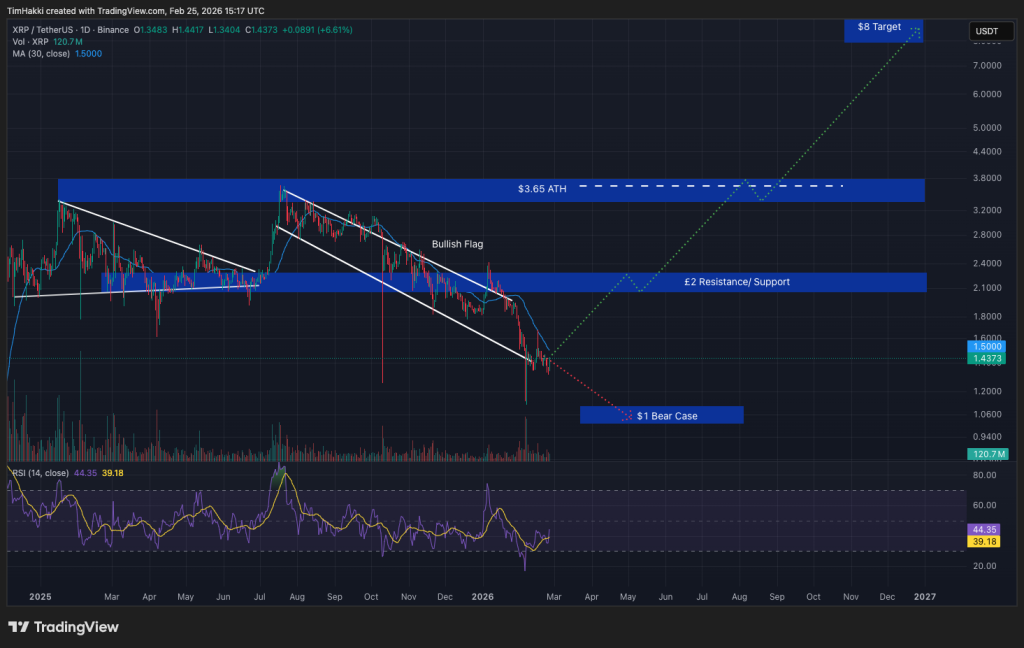
Potential price catalysts to anticipate include institutional demand following the rollout of U.S. XRP ETFs, Ripple’s growing list of international partnerships, and improved regulatory clarity if the proposed U.S. CLARITY bill advances this year.
Cardano (ADA): Grok Assigns Hoskinson’s Ethereum Rival a 1,250% Upside Scenario
Created by Ethereum co-founder Charles Hoskinson, Cardano ($ADA) focuses on academically peer-reviewed development, strong security guarantees, scalability, and long-term network resilience.
Despite broader market weakness, Cardano’s ecosystem continues to expand. The network holds a market capitalization of $10.3 billion and more than $124 million in total value locked (TVL).
Grok’s projections suggest ADA could surge by just over 1,250%, climbing from approximately $0.28 today to nearly $3.80 by the end of 2026. Such a move would push Cardano well beyond its previous 2021 high of $3.09.
That said, ADA is currently trading at its lowest levels since October 2024.
Given the volatility seen throughout this year, a prolonged bear scenario, could see prices potentially sliding down to $0.15.
Ethereum (ETH): Grok AI Sees a Run to $10k on the Cards
Ethereum ($ETH) remains the dominant smart contract blockchain and the backbone of most DeFi and Web3 applications.
With a market capitalization near $238 billion and over $54 billion locked across DeFi protocols, Ethereum is the primary settlement layer for on-chain commercial activity.
Its track record for security, leadership in stablecoin infrastructure, and early progress in tokenizing real-world assets place Ethereum in a strong position to attract substantial institutional interest.
However, meaningful capital inflows hinge on U.S. lawmakers passing the CLARITY bill, which would provide the regulatory certainty institutions need to deploy funds via stablecoins or tokenized assets on Ethereum.
ETH currently trades around $2,000, with significant resistance expected near $5,000 after setting an all-time high of $4,946.05 last August.
If Grok’s bullish scenario plays out, a breakout above $5,000 could unlock a series of new highs in 2026, with Grok calling $10,000 a bull target.
Maxi Doge: Early-Stage Meme Coin Aims for Outsized Growth
While Grok indicates that these top altcoins could deliver strong returns over time, their large market capitalizations may cap explosive upside compared to newer, smaller-cap projects.
Maxi Doge ($MAXI) is still in its early stages. The project has already raised $4.6 million during its ongoing presale among investors looking to recapture the magic of meme coins.
The character behind Maxi Doge is a loud, gym-obsessed, self-styled alpha doge, a distant rival and cousin to Dogecoin. His comic branding taps into the high-energy, irreverent tone that fueled the meme coin boom of 2021.
MAXI is an ERC-20 token on Ethereum’s proof-of-stake network, giving it a lower environmental footprint compared to Dogecoin’s proof-of-work model.
Early presale buyers can currently stake MAXI for yields of up to 67% APY, though returns decrease as more tokens enter the staking pool.
The token is $0.0002805 during the current presale phase, with automatic price increases at each funding milestone. Purchases are supported through wallets such as MetaMask and Best Wallet.
Stay updated through Maxi Doge’s official X and Telegram pages.
Visit the Official Website Here.
The post Elon’s Grok AI Predicts the Price of XRP, Cardano, and Ethereum By the End of 2026 appeared first on Cryptonews.

TLDR:
- Michael Saylor named Solana as the primary blockchain for deploying programmable digital credit at scale.
- Strategy’s STRF converts Bitcoin’s economic energy into structured cash flows with principal protection for investors.
- Saylor introduced BTC rating, BTC risk, and credit spread as core metrics for measuring digital credit risk.
- A reflexive flywheel effect ties credit creation to Bitcoin demand, driving equity value across the broader ecosystem.
Michael Saylor has made a bold claim about the future of programmable digital credit. The Strategy executive chairman recently stated that Solana will serve as the primary blockchain for deploying this next generation of digital credit instruments.
His remarks came alongside a detailed breakdown of Strategy’s STRF product and a broader framework for Bitcoin-backed credit.
The statement drew attention from across the crypto industry given Saylor’s long-standing association with Bitcoin maximalism.
Saylor Points to Solana as the Infrastructure for Digital Credit Deployment
Saylor’s choice of Solana as the deployment platform surprised many observers in the crypto space. He cited the blockchain’s speed, accessibility, and scalability as key reasons for the selection.
According to Saylor, programmable digital credit requires infrastructure that can handle tokenized instruments operating at scale. Solana, in his view, meets those technical requirements more effectively than other available options.
His vision extends beyond a single product. Saylor outlined how digital credit can be embedded into ETFs, tokens, bank accounts, and layer 3 blockchain solutions.
Each of these serves as a building block for creating digital yield and accessible digital money. Together, they form an interconnected system designed to move value across digital rails efficiently.
The programmable nature of this credit is central to Saylor’s argument. By encoding credit terms directly into blockchain infrastructure, issuers can automate dividend payments, collateral checks, and risk adjustments.
This removes the friction associated with traditional credit instruments and opens access to a much wider investor base. Solana’s architecture makes this level of programmability practical at a global scale.
Saylor also described a reflexive flywheel effect that programmable digital credit can trigger. Credit creation drives Bitcoin demand, which raises Bitcoin’s price and increases equity value.
That, in turn, strengthens the entire ecosystem and encourages further credit issuance. Deploying this mechanism on Solana, he argued, amplifies its reach and speed considerably.
Strategy’s STRF Lays the Foundation for Bitcoin-Backed Credit on Chain
STRF sits at the core of Saylor’s digital credit framework. Strategy converts Bitcoin’s economic energy into structured cash flows by stripping away risk, dampening volatility, and extracting yield.
The result is a variable preferred security that offers both principal protection and higher returns than traditional credit. Investors also benefit from return-of-capital tax treatment, which reduces their overall tax liability directly.
Saylor introduced three metrics for evaluating digital credit risk: BTC rating, BTC risk, and credit spread. These tools give investors a clear and measurable way to assess collateral coverage and under-collateralization probability.
Excess Bitcoin volatility is transferred to MSTR common equity holders rather than to credit investors. This structure protects STRF holders during market downturns.
STRF’s track record supports Saylor’s framework. The product maintained its value and continued paying dividends through significant Bitcoin price drawdowns.
That stability makes it competitive with traditional credit instruments that are often tax-inefficient and difficult to access. STRF, by contrast, is designed to be widely accessible and straightforward to hold.
Corporate treasuries represent a major target market for this product. Saylor argued that companies allocating a portion of holdings to STRF could potentially double their cash flow.
With Solana as the deployment layer, that access becomes even broader and more seamless for institutional and retail participants alike.


Ethereum slid ~5% toward $1.9k as whale selling and ETF outflows hit sentiment, despite bullish RSI divergence hinting at a potential reversal.
Summary
- ETH trades around $1.9k with key support at $1.8k–$1.85k; a daily close below opens $1.7k–$1.6k downside.
- Spot ETH ETFs logged multi‑week net outflows in recent sessions, with single‑day withdrawals near $40m–$50m weighing on demand.
- BitMine now holds about 4.42m ETH (3.66% of supply), mostly staked, while other whales and even Vitalik reduced exposure, adding mixed on‑chain signals.
Ethereum (ETH) traded near a critical support level as large holders sold significant amounts of the cryptocurrency, creating downward pressure despite technical indicators suggesting a potential reversal, according to market data and on-chain analytics.
The cryptocurrency displayed bullish divergence on 12-hour charts, with the Relative Strength Index making a higher low while the price established a lower low over the prior month. This technical pattern typically precedes price reversals in traditional technical analysis.
However, substantial selling activity by large holders has complicated the technical outlook. A major wallet address sold a substantial amount of Ethereum in a concentrated period, according to blockchain data. Another dormant whale address transferred coins to an exchange after remaining inactive for years, a movement typically associated with selling intentions. Ethereum co-founder Vitalik Buterin also sold a notable amount over recent days, data showed.
BitMine Immersion Technologies moved counter to the broader trend, substantially increasing its Ethereum holdings to represent a notable share of circulating supply, according to company disclosures. The firm maintains a large staked position generating annualized yield and completed a major purchase last week. The company has publicly stated an acquisition target that would capture a meaningful share of total supply.
Traditional financial institutions showed opposite behavior. Ethereum exchange-traded funds posted consecutive weeks of net outflows, indicating capital exiting these regulated investment products, according to fund flow data.
On-chain metrics presented mixed signals. New wallets received materially higher-than-normal inflows, whale inflows spiked well above average levels, and top profit-and-loss wallets added sizable amounts, blockchain analytics firms reported. The combination of ETF outflows and major whale selling has kept downward pressure on the price in the near term.
The cryptocurrency’s price trajectory depends on whether current support levels hold, analysts noted. A daily close below the key support level would invalidate the bullish divergence pattern and expose lower support zones. Technical analysts identified a downside scenario involving continued large holder selling, ongoing ETF outflows, and absent buying interest until a lower level triggers capitulation selling.
The alternative scenario requires the support level to hold, followed by a reclaim of recent consolidation highs, which would signal a reversal pattern and open movement toward the next technical resistance level, according to chart analysis.
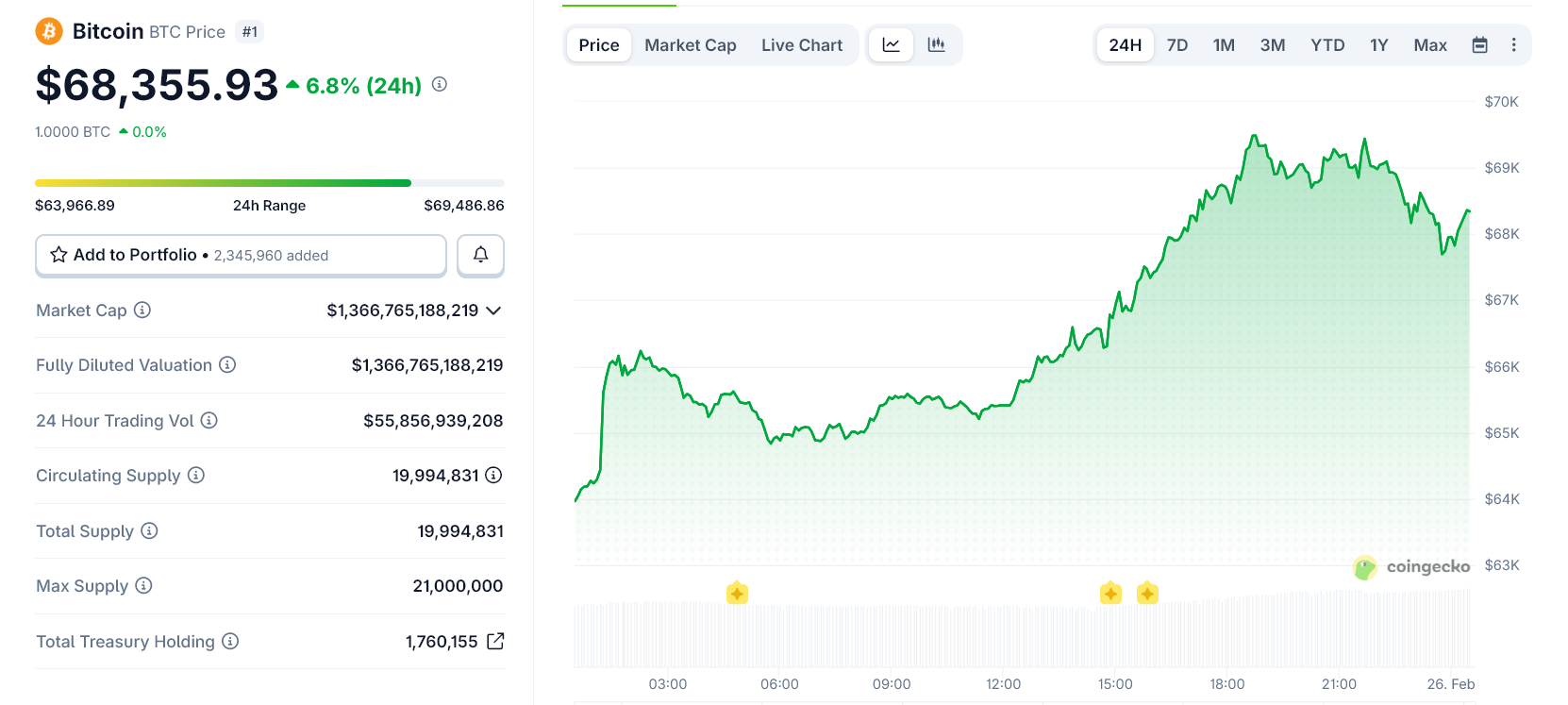
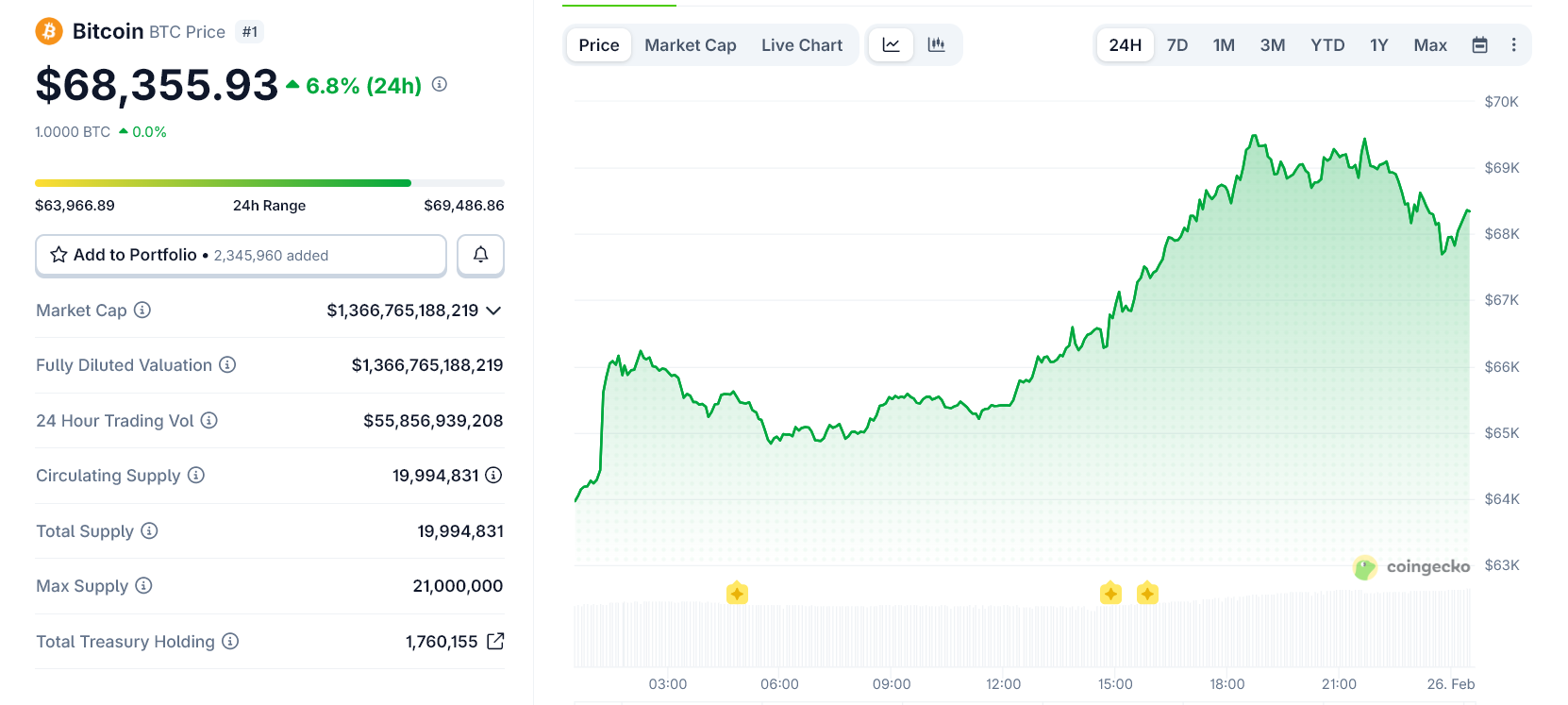
Bitcoin surged sharply this week, briefly nearing $70,000 before pulling back. The move sparked debate across the market: has Bitcoin finally bottomed, or is this just another relief rally inside a broader bear phase?
Multiple on-chain, derivatives, and institutional indicators show early signs of stabilization. However, key signals still point to a fragile recovery rather than a confirmed bullish reversal.
Options Market Shows Fragile Conditions, Not Strong Support
Bitcoin’s options positioning recently shifted into what traders call a negative gamma regime, according to Glassnode’s GEX heatmap.
In simple terms, gamma measures how options market makers hedge risk. When Bitcoin sits in a negative gamma zone, dealer hedging tends to amplify price moves.
That means rallies can accelerate quickly—but so can selloffs.
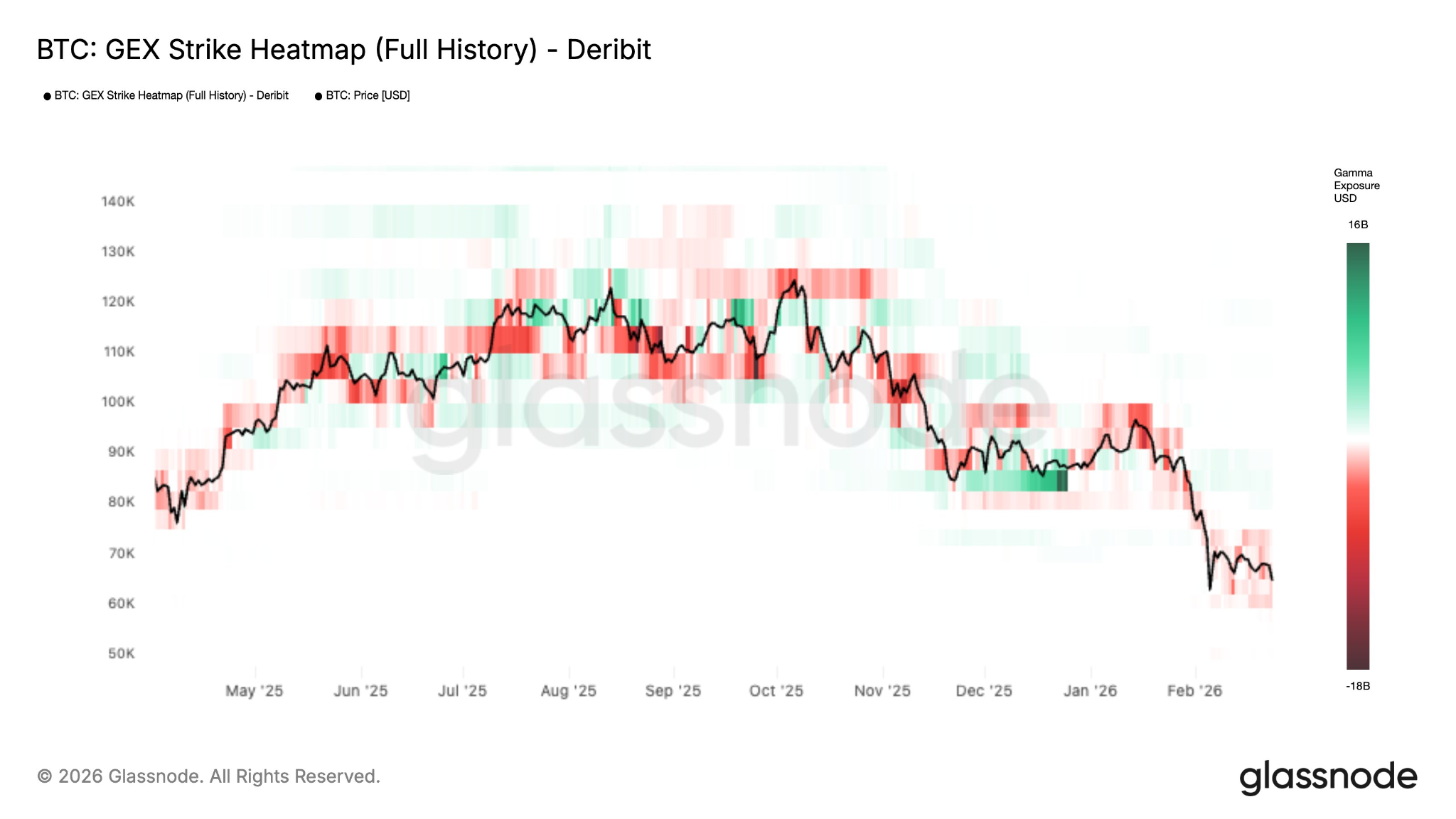
The heatmap also shows fewer strong resistance “gamma walls” above current prices. This creates less friction for upward moves, which helps explain Bitcoin’s sudden surge.
However, it also means the market lacks structural stability.
Without strong hedging support, price moves remain fragile and prone to reversal.
Bitcoin Spot Demand Is Improving for the First Time in Months
CryptoQuant data shows Bitcoin’s apparent demand, which measures net accumulation versus new supply, has turned positive for the first time since November.
This is an important early signal. When demand exceeds supply, it suggests buyers are stepping in and absorbing coins from sellers.
However, one positive shift does not confirm a full reversal. During past bear markets, temporary demand increases often occurred before further consolidation.
A sustained trend of rising demand over several weeks would provide stronger confirmation.
Short-Term Holders Are Still Selling at Losses
Another key indicator comes from CryptoQuant’s short-term holder profit and loss data, which tracks whether newer investors are selling at gains or losses.
The data shows short-term holders have been selling at losses consistently since late January. Several major loss spikes occurred in early February and again recently.
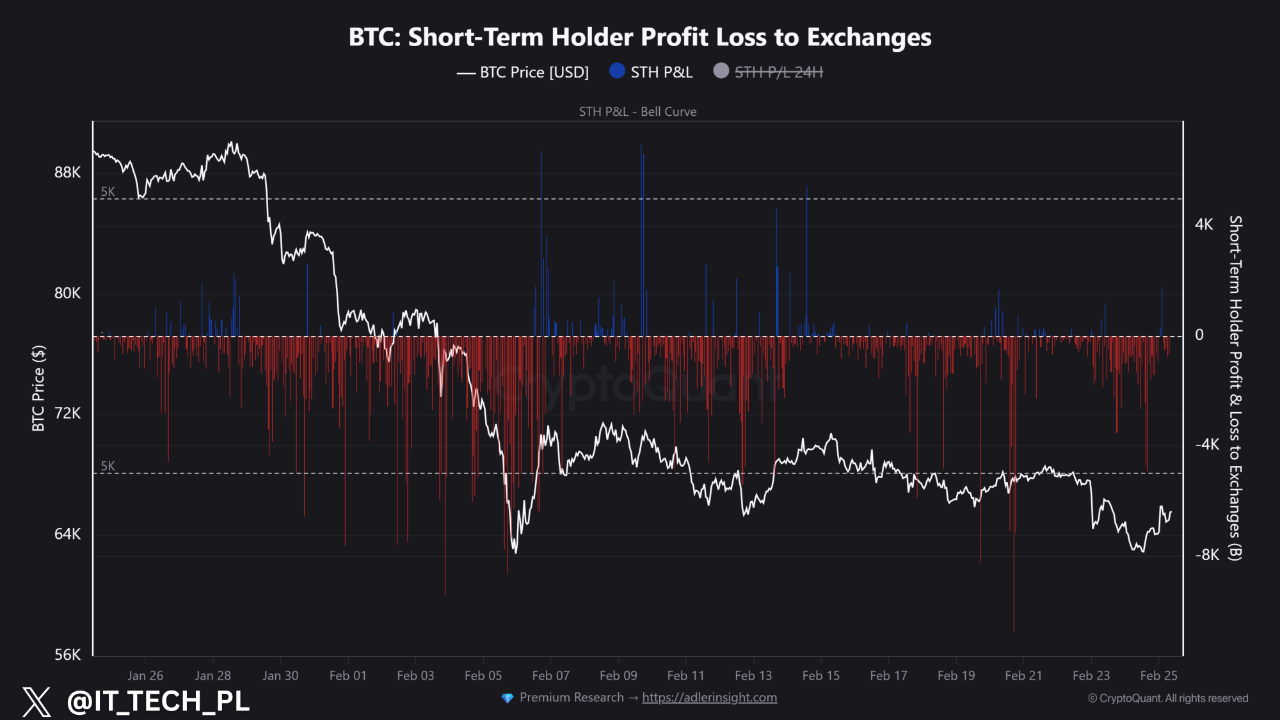
This pattern is known as capitulation, where weaker investors exit the market. Capitulation is common near market bottoms, because stronger buyers absorb those losses.
However, the signal has not fully reversed.
Until short-term holders begin selling at profits again, analysts warn that rallies can become “exit liquidity,” where trapped investors sell into strength rather than holding.
Technical and Historical Data Suggest Selling Pressure Is Easing
Bitcoin’s relative strength index (RSI), a momentum indicator, recently recovered after reaching extremely oversold levels in early February. This suggests selling pressure has weakened.
Historically, such RSI recoveries often lead to short-term rebounds.
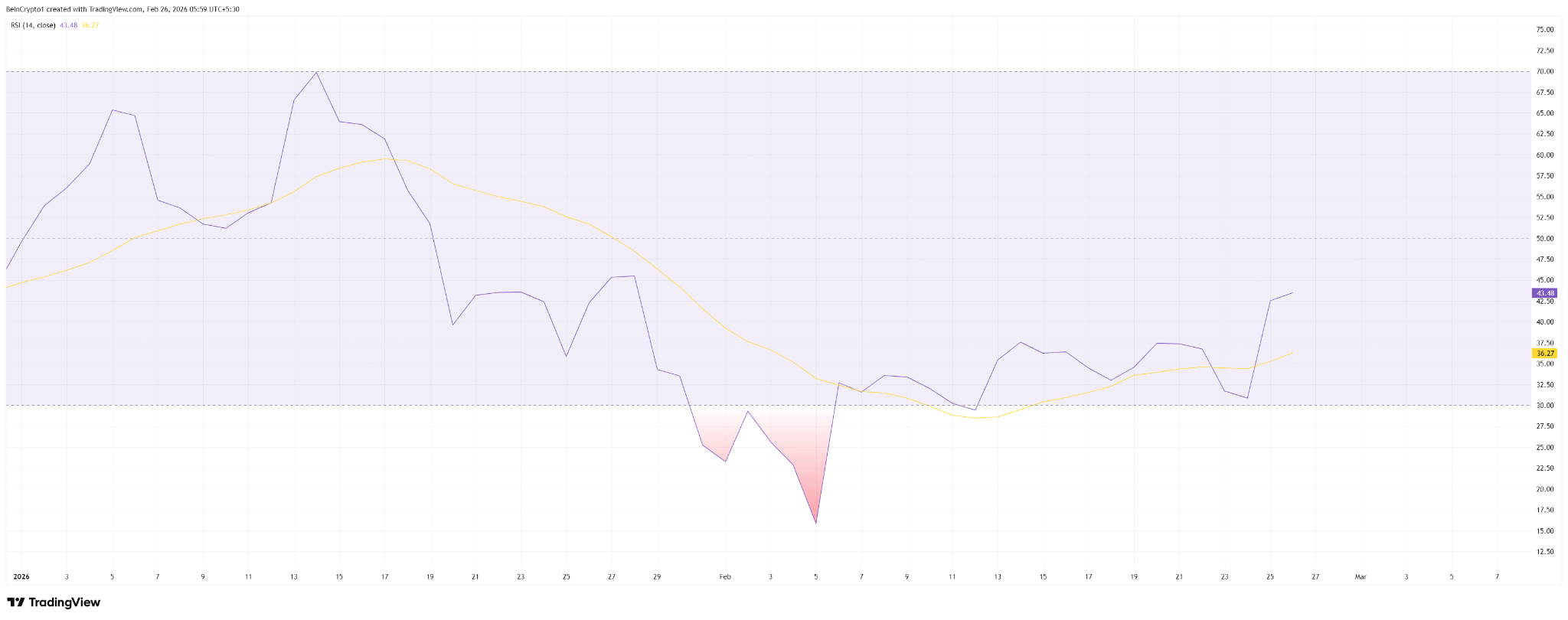
Quarterly performance data also shows Bitcoin rarely experiences multiple consecutive quarters of heavy losses.
While this pattern does not guarantee a bottom, it supports the view that the market may be entering a stabilization phase.
Institutional Flows Still Show Weakness
Institutional positioning remains a key concern. Earlier data showed Bitcoin ETFs experienced sustained outflows, and SEC filings revealed large investment advisors and hedge funds reduced exposure significantly in late 2025.
This suggests institutional demand has not fully returned. Strong bull markets typically require consistent inflows from large investors.
Early Bottoming Signs, But Bull Market Not Confirmed
Bitcoin is showing several early bottoming signals. Spot demand is improving, capitulation appears to be getting absorbed, and technical indicators suggest selling pressure is fading.
However, key confirmation signals are still missing.
Short-term holders remain in loss territory, institutional flows remain weak, and options market structure shows fragile conditions.
For now, Bitcoin’s rally appears more consistent with a relief bounce than a confirmed bull reversal.
A sustained recovery will likely require stronger demand, renewed institutional inflows, and price stability above key resistance levels.
TLDR
- Kraken has launched Flexline, a fixed-rate crypto-backed loan product for Kraken Pro users.
- The loans offer terms ranging from two days to two years with annual rates between 10% and 25%.
- Users can borrow against supported cryptocurrencies without selling their digital assets.
- Kraken holds collateral in segregated wallets and includes it in its Proof of Reserves attestations.
- The platform may liquidate collateral if users breach maintenance requirements or fail to repay on time.
Kraken has launched Flexline, a fixed-rate crypto-backed loan service for Kraken Pro users. The product allows clients to borrow against digital assets without selling them. Kraken said it designed the service for advanced and institutional traders seeking liquidity.
Kraken rolls out Flexline with fixed terms and instant funding
Kraken offers loan terms from two days to two years with fixed annual rates. The platform lists annual percentage rates between 10% and 25%. However, Kraken has not disclosed specific loan-to-value ratios.
Users can post supported cryptocurrencies as collateral and receive funds almost instantly. They can receive proceeds in crypto or stablecoins based on regional eligibility. They can trade or withdraw the funds on the platform where permitted.
Kraken holds collateral in segregated wallets and includes it in Proof of Reserves attestations. The exchange said these attestations verify client assets on a 1:1 basis. Collateral faces liquidation if users breach maintenance requirements or miss repayment at maturity.
Borrowers can repay loans early using their account balances on Kraken Pro. However, Kraken charges an early repayment fee for such actions. The product remains unavailable in several jurisdictions, including the United States and the United Kingdom.
Kraken excludes Australia, Brazil, Canada, India, New Zealand, Switzerland, and the United Arab Emirates. The exchange restricts access based on local regulations and internal compliance standards.
Exchanges and DeFi platforms expand crypto-backed lending services
Coinbase has expanded its own crypto-backed loan product for eligible United States users. It allows borrowing up to $100,000 in USDC against assets such as XRP, Dogecoin, Cardano, and Litecoin.
The company lets users access liquidity without selling their tokens. It supports multiple digital assets as collateral under the updated program.
Outside exchanges, mortgage lender Rate has introduced a program called RateFi. The initiative allows qualified borrowers to use verified cryptocurrency holdings during underwriting.
Rate permits digital assets to count as reserves and sometimes as income. Borrowers can therefore avoid liquidating their holdings to meet requirements.
Decentralized finance lending protocols also continue to grow in total value locked. Data from DefiLlama shows about $51.9 billion locked across DeFi lending markets.
Active borrowing across these protocols stands near $30.8 billion, according to the same data. Aave holds nearly $26.9 billion in total value locked.
Morpho follows with around $5.8 billion in total value locked. On Feb. 15, Apollo Global Management partnered with Morpho to support blockchain-based lending infrastructure.
Apollo said it could acquire up to 90 million MORPHO tokens under the agreement. The asset manager oversees about $940 billion in assets.


Bitcoin experienced a volatile overnight trading session, rising by as much as 3.7% before giving back some of those gains.
The largest cryptocurrency remains in the black since midnight UTC, up by 2.4% to trade around $65,600. That’s still within a price range that has persisted over the past three weeks.
The altcoin market is also showing signs of life, with layer-1 tokens solana (SOL) and each putting in a 4.5% rally while tokens including VIRTUAL, MORPHO and ETHFI climbed more than 10%.
U.S. equity index futures rose alongside the crypto market. Silver’s 4% rise since midnight suggests the broader risk-asset rally is speculative rather than news-driven.
The average crypto relative strength index (RSI) indicator has moved out of oversold territory back into a neutral zone, suggesting a period of consolidation might be on the cards on Wednesday.
Derivatives positioning
- Cumulative crypto futures open interest (OI) has risen by over 1.5% to $93.5 billion, although much of that notional growth comes from spot price appreciation rather than capital inflows.
- OI in bitcoin and ether (ETH) futures has largely held steady over 24 hours, with futures tied to tether gold (XAUT) seeing a 12% decline in open positions. Capital seems to be rotating out of gold-linked assets.
- TRX, AVAX, SOL, LINK and HBAR stand out as coins with the highest 24-hour cumulative volume delta. Positive CVD readings indicate that buying demand is outpacing selling demand.
- Bitcoin’s annualized 30-day implied volatility index, BVIV, dropped to 56%, reversing the early week pop to 65% to suggest market calm. This is supportive of continued recovery in BTC’s price. Ether’s volatility displays a similar pattern.
- On Deribit-listed bitcoin options, the $60,000 put has become the most popular play, reflecting downside concerns. Puts, or bearish bets, for both BTC and ETH continue to trade pricier than calls, or bullish ones.
Token talk
- The “altcoin season” indicator hit its highest level since early January on Wednesday, buoyed by rallies across the board.
- AI agent token VIRTUAL led the pack, rising 15.5% since midnight and more than 20% in the past 24 hours to make it the best-performing asset in the CoinDesk 80 (CD80) index, which added 1.7%.
- Restaking token ETHFI also rose more than 10% in the past 24 hours after CEO Mike Silagadze hinted at potentially rolling out a stablecoin.
- Lending platform Morpho’s native token rounded off Wednesday’s altcoin rally. It has now risen by 45.9% over the past 30 days after a 15% gain over the past 24 hours.
- On the flip side, toncoin (TON) and pippin (PIPPIN) are both in the red over the past 24 hours after increasing in value earlier this week, indicating asset rotation among traders and investors.
TLDR
- Russia will begin real-world testing of the digital ruble in coordination with the central bank and finance ministry.
- Prime Minister Mikhail Mishustin announced the testing plan during a speech before the State Duma.
- Authorities scheduled a phased rollout of the digital ruble starting in September 2026.
- Major banks and large merchants must enable digital ruble payments from the first stage of implementation.
- Smaller banks and companies will have until September 2028 to comply with the new requirements.
Russia has confirmed it will begin real-world testing of the digital ruble soon, according to Prime Minister Mikhail Mishustin. He announced the move before the State Duma while lawmakers reviewed the government’s annual report. At the same time, authorities prepared new legislation to legalize cryptocurrencies under strict state control.
Russia Moves Toward Digital Ruble Rollout
Prime Minister Mikhail Mishustin said the government will start active testing of the digital ruble shortly. He spoke before the State Duma and outlined coordination with financial authorities.
He said, “Regarding the digital ruble, my colleagues from the Bank of Russia and the Ministry of Finance and I will now begin actively testing it.”
He added that officials must build infrastructure and assess transactions before defining volumes and usage methods.
The Central Bank of Russia created the digital ruble as a central bank digital currency. It represents the third form of national fiat after cash and electronic bank money. The bank launched a limited pilot in August 2023 and involved selected participants. Authorities had planned a public launch for mid-2025, then postponed it to fall 2026 after President Vladimir Putin urged wider adoption.
Officials scheduled a phased introduction beginning September 1, 2026. Major banks and large merchants must offer digital ruble services from that date. Universal banks and firms with annual revenue above 30 million rubles will have one extra year to comply. Smaller institutions and companies must enable transactions by September 1, 2028, while very small retailers remain exempt.
Crypto Legalization Advances Under Strict Controls
Russian authorities have also prepared legislation to regulate decentralized digital assets. The Finance Ministry and the central bank drafted a bill that defines the structure of the domestic crypto market. According to reports, the draft will legalize activities such as investment and trading. The plan follows a central bank proposal published in December to classify cryptocurrencies and stablecoins as monetary assets.
Lawmakers aim to adopt the framework by July 1 under the current timetable. The bill sets a $4,000 cap on crypto purchases for non-qualified investors. It also establishes capital requirements for domestic platforms and strict compliance standards. Global exchanges must register local subsidiaries and store user data inside Russia or face blocking measures.
The regulatory push also affects digital ruble accounts. A February report stated that the Bank of Russia updated rules for opening such accounts. These rules introduce tighter procedures for users and service providers. Authorities continue to align both the CBDC rollout and crypto regulation under a unified legal framework.
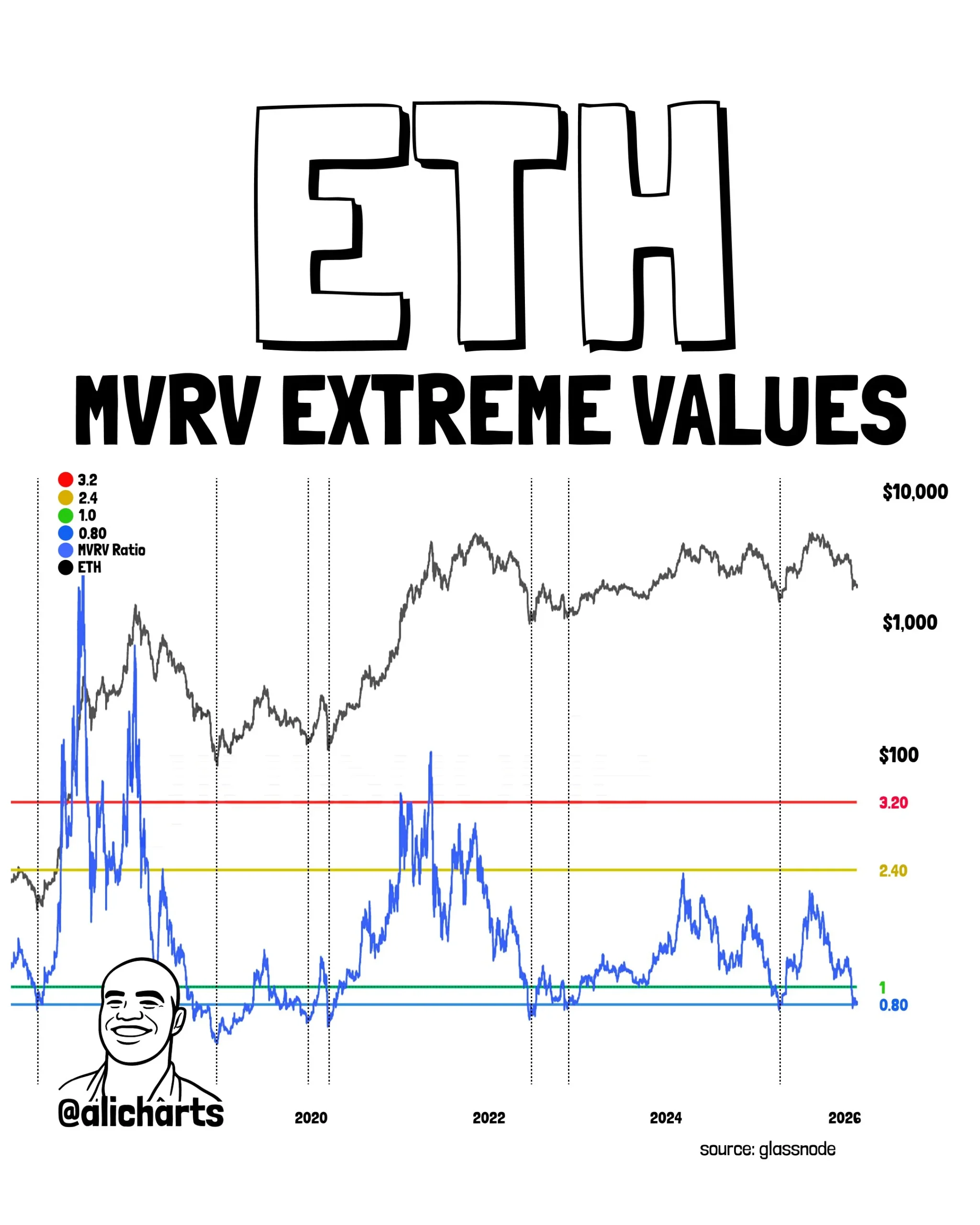
If history rhymes, here are the best ETH entry levels for the long-term.
After barely setting a new price record last summer at nearly $5,000, ETH joined the rest of the market in the post-October slump and dumped by almost 50% in months. It tried to resume its run in mid-January when it jumped to $3,400, but it was rejected again, and the subsequent correction pushed it south to $1,800 on a couple of occasions.
Although it has managed to defend that level for now, it still trades 45% lower than its mid-January peak. Substantial sell-offs have continued, while one popular analyst laid out what could be valid entry points for long-term exposure.
Sell-Offs Continue
If we compare ETH’s price with net flows into spot Ethereum ETFs, we will see a strong resemblance in investor behavior and price moves. For instance, the cumulative net flows peaked at over $15 billion in early October before the massive October 10 crash. Since then, outflows have consistently dominated, with investors pulling out well over $3 billion by February 24.
In addition, Ethereum’s co-founder has also joined the selling spree. CryptoPotato has reported on several occasions on Vitalik Buterin’s substantial disposal of ETH tokens for the past several weeks. Most recent on-chain data shows that he has dumped roughly 17,000 ETH in less than a month, valued at around $34 million.
In a post titled “Vitalik Buterin Is Selling Ethereum Near the Bottom,” renowned analyst Ali Martinez explained why the co-founder might regret his timing as the bottom could be closer than expected.
ETH Entry Points
Martinez said one of the most reliable “bottom-detection metrics” for the largest altcoin – the MVRV Ratio – is currently at 0.78, while the asset has neared or reached a macro bottom at levels below 0.80.
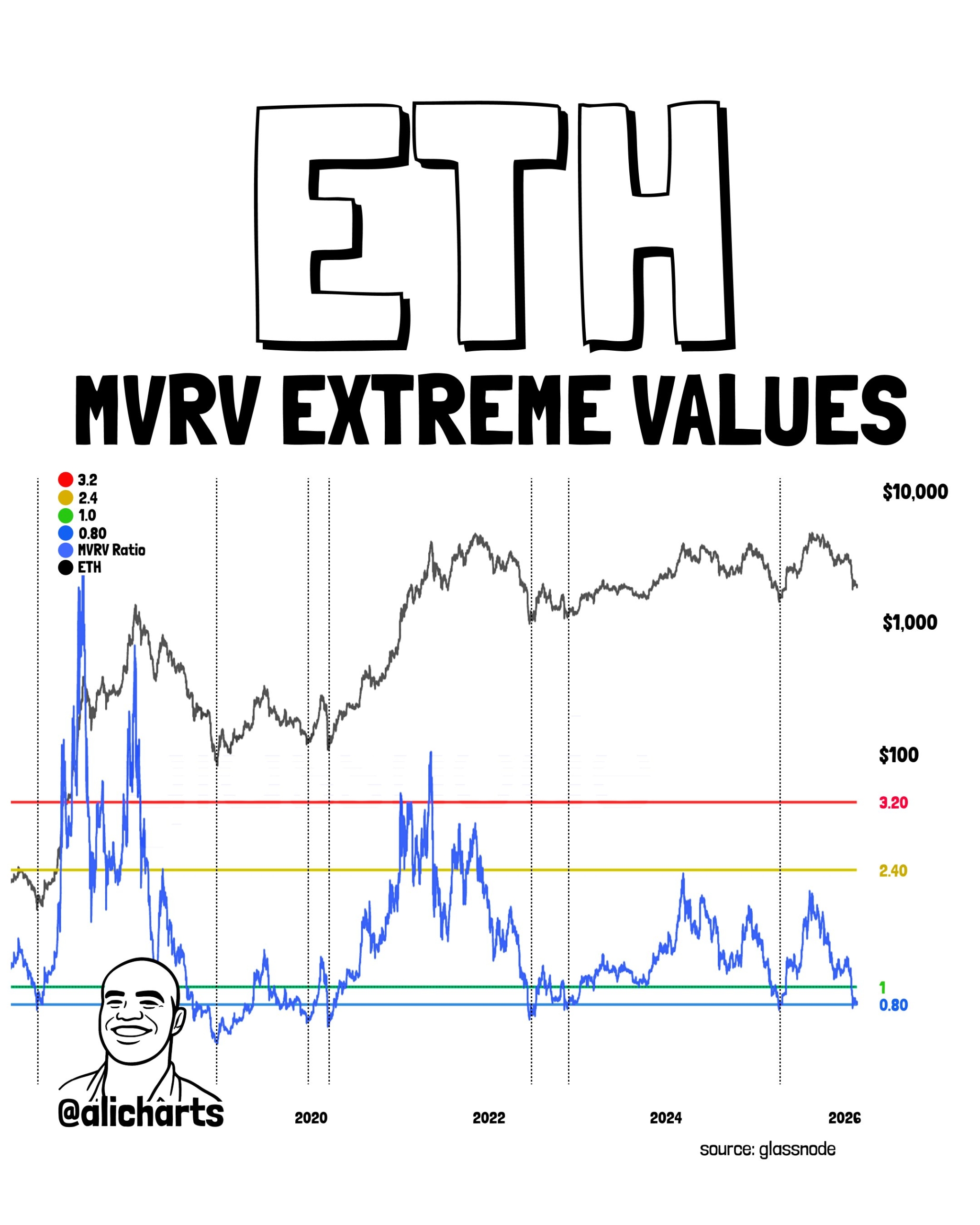
However, his disclaimer indicated that just because Ethereum is currently undervalued according to on-chain metrics, this doesn’t mean that its price cannot go any lower – “especially during heavy distribution phases.”
You may also like:
If another correction is to occur, the analyst outlined the most critical levels that could hold its downfall – $1,800 (which was tested yesterday), followed by $1,584 (first major support below), $1,238 (secondary macro support), and $1,089 (deeper capitulation zone). Martinez believes these precise levels could be proper entry zones.
“If history rhymes, accumulation below $1,800 – particularly near $1,584, $1,238, and $1,089 – could offer strong long-term positioning. But, volatility is likely to persist before a confirmed bottom forms.”
Binance Free $600 (CryptoPotato Exclusive): Use this link to register a new account and receive $600 exclusive welcome offer on Binance (full details).
LIMITED OFFER for CryptoPotato readers at Bybit: Use this link to register and open a $500 FREE position on any coin!

5 QUAY Sunglasses That Are Chic On Sight

Dominating Minecraft’s Most Brutal SMP

Racism and staffing issues factors in ‘failing’ maternity care, report finds


-

 Video6 days ago
XRP News: XRP Just Entered a New Phase (Almost Nobody Noticed)
-

 Politics4 days ago
Baftas 2026: Awards Nominations, Presenters And Performers
-

 Fashion5 days ago
Weekend Open Thread: Boden – Corporette.com
-

 Sports2 days ago
Women’s college basketball rankings: Iowa reenters top 10, Auriemma makes history
-

 Politics2 days ago
Nick Reiner Enters Plea In Deaths Of Parents Rob And Michele
-
 Sports7 days ago
Clearing the boundary, crossing into history: J&K end 67-year wait, enter maiden Ranji Trophy final | Cricket News
-

 Crypto World2 days ago
XRP price enters “dead zone” as Binance leverage hits lows
-

 Business4 days ago
Mattel’s American Girl brand turns 40, dolls enter a new era
-

 Business3 days ago
Law enforcement kills armed man seeking to enter Trump’s Mar-a-Lago resort, officials say
-

 Tech1 day ago
Unsurprisingly, Apple's board gets what it wants in 2026 shareholder meeting
-
 NewsBeat3 hours ago
Manchester Central Mosque issues statement as it imposes new measures ‘with immediate effect’ after armed men enter
-
 NewsBeat3 days ago
‘Hourly’ method from gastroenterologist ‘helps reduce air travel bloating’
-

 Tech3 days ago
Anthropic-Backed Group Enters NY-12 AI PAC Fight
-

 NewsBeat3 days ago
Armed man killed after entering secure perimeter of Mar-a-Lago, Secret Service says
-

 Politics3 days ago
Maine has a long track record of electing moderates. Enter Graham Platner.
-

 Business1 day ago
True Citrus debuts functional drink mix collection
-
 NewsBeat1 day ago
Police latest as search for missing woman enters day nine
-

 Crypto World1 day ago
Entering new markets without increasing payment costs
-
 Sports3 days ago
2026 NFL mock draft: WRs fly off the board in first round entering combine week
-

 Crypto World6 days ago
83% of Altcoins Enter Bear Trend as Liquidity Crunch Tightens Grip on Crypto Market