

Crypto World
Bitcoin’s $10.5B Options Expiry Could End Bear Market


Bitcoin (CRYPTO: BTC) has paused after a modest rally, carving an eight-day high while building a double bottom near $62,500. Despite the bounce, the token remains roughly 21% below its level from a month ago, underscoring the uphill path for bulls entering Friday’s massive options expiry. The $10.5 billion BTC options series looms large, with traders weighing whether a late bid can flip momentum or if selling pressure resumes as settlement approaches. Deribit continues to lead the space, accounting for about 76% of turnover, while OKX and CME register smaller but meaningful shares. In this environment, price action, tech-equity sentiment and macro developments converge to shape outcomes as traders position for what could be a pivotal weekend for BTC.
Key takeaways
- Bulls face a required roughly 9% rally from around $68,800 to tilt the balance in Friday’s $10.5 billion options expiry, underscoring how a single session can redefine near-term momentum.
- The asset’s price dynamics remain tightly linked to tech sentiment, with Bitcoin showing a 90% correlation to the Nasdaq 100 Index, signaling that AI-driven earnings and risk appetite in equities can spill into crypto flows.
- Deribit dominates the derivatives landscape with about $4.5 billion in call options and $3.4 billion in put options, roughly three-quarters of the total market, followed by OKX and CME as secondary venues.
- Put options appear structurally resilient, and a substantial portion of call bets would expire worthless if BTC stays below $70,000 on Friday, highlighting skew toward downside protection in the event of a renewed pullback.
- Analysts point to a distribution of open interest across strikes that suggests potential tail-risk hedges around $60k–$75k, with three plausible expiry outcomes by price band (65k–69k, 69k–71k, 71k–74k).
Tickers mentioned: $BTC, $NVDA
Sentiment: Neutral
Price impact: Neutral. The setup points to several potential expiry outcomes rather than a clear directional edge, pending Friday’s settlement.
Trading idea (Not Financial Advice): Hold. Given the mixed signals and the dependency on the Friday expiry, a cautious stance remains prudent until price action clarifies the balance of risk.
Market context: The crypto complex continues to absorb climate-driven moves from equities, especially where AI-driven growth and large-cap tech results drive risk sentiment. The link between BTC and the Nasdaq suggests liquidity and sentiment could hinge on tech earnings and macro developments in the near term.
Why it matters
The proximity of a major options expiry adds a layer of probabilistic dynamics to BTC’s price path. If Friday’s settlement tilts the risk-reward balance toward puts, downside pressure could re-emerge, even if a broader macro backdrop improves later in the week. Conversely, a decisive rally back toward the mid-$70,000s could unlock renewed upside potential as hedges unwind and bullish bets reassert themselves. This interplay matters for traders betting on short-term volatility, for market-makers managing gamma exposure, and for investors watching risk parity dynamics across asset classes.
Beyond the technical setup, the influence of Nvidia’s earnings on risk appetite cannot be overstated. The company’s results, released after the market close, intersect with the AI sector’s broader profitability trajectory and margins, which have been a critical driver of forward-looking confidence in tech equities. A robust AI narrative tends to buoy liquidity across risk assets, including crypto, while disappointing guidance can deepen risk-off moves that weigh on BTC and related tokens. This cross-asset feedback loop helps explain why the BTC-iShares Nasdaq relationship remains a meaningful lens for traders assessing near-term catalysts.
In the backdrop, the derivative structure reveals a cautious stance among market participants. The largest share of put exposure sits below the current price, while still substantial upside hedges exist at higher strikes. This composition means that even if the spot moves higher, a portion of the derivative book remains positioned to dampen exuberance, reflecting a pragmatic approach to risk management as traders await Friday’s definitive outcome.
What to watch next
- Friday’s BTC options expiry outcomes by price band (65,000–69,000; 69,000–71,000; 71,000–74,000) and the resulting net tilt between puts vs. calls.
- Shifts in Deribit’s open interest and any reallocation of market share among OKX and CME after settlement.
- The Nvidia earnings release and any revised guidance that could alter AI-driven risk sentiment.
- BTC price action around the 60,000 and 75,000 levels and any validation of the upper and lower bounds suggested by the current option structure.
Sources & verification
- Bitcoin price action and the eight-day high with a double bottom near $62,500 as markets digest the upcoming expiry.
- Deribit’s market share and the breakdown of $4.5 billion in calls and $3.4 billion in puts.
- OKX and CME derivatives volumes: approximately $610 million in calls / $385 million in puts (OKX) and $255 million in calls / $287 million in puts (CME).
- Nvidia’s earnings outcomes and their potential impact on risk appetite for AI-related growth stocks.
- The observed 90% correlation between Bitcoin and the Nasdaq 100 Index, illustrating the tech-led sentiment linkage.
Bitcoin options expiry tests bulls as AI-driven sentiment sways risk assets
Bitcoin (CRYPTO: BTC) drifted to an eight-day peak as traders prepared for what could be a defining week for risk assets. A double bottom near the $62,500 zone offered a technical foothold, yet the asset remains about 21% below its level from a month earlier, underscoring the uphill climb for bulls ahead of Friday’s $10.5 billion options expiry. The event is more than a headline risk; it is a liquidity and risk-management inflection point that can shape the near-term trajectory for BTC. Deribit remains the dominant venue, commanding roughly three-quarters of the market with approximately $4.5 billion in call options and $3.4 billion in puts, while OKX and CME hold meaningful but smaller roles in the overall turnover. The market is balancing the lure of a potential rebound against the probability of further volatility driven by macro cues and tech-sector performance.
The derivatives landscape reveals a nuanced stance: although puts appear structurally well-positioned to absorb bearish shocks, a meaningful chunk of neutral-to-bullish positions was unsettled by BTC’s retreat below $75,000 in February. Data show that about 88% of Deribit’s call options would expire worthless if BTC remains under $70,000 on Friday, a statistic that underscores the risk premium baked into the expiring contracts. Even after stripping out extreme multi-leg strategies—often used to chase higher strikes—roughly 37% of the remaining bets sit below $75,000, implying that a robust rally is required to flip the balance in favor of bulls before expiry.
The balance of power in the larger market hinges on the broader tech narrative. The recent correlation suggests that as the Nasdaq moves, BTC tends to follow, at least in the near term. Nvidia (EXCHANGE: NVDA) looms large as a proxy for AI-driven demand and corporate margins; its earnings outcome, due after the close, could tilt risk appetite and inject further volatility into both equities and crypto. While Bitcoin’s path remains sensitive to the tech-driven risk-on/risk-off cycle, the current setup highlights that a decisive move would be necessary to overcome the accumulated option-based hedges and usher in a renewed upside trajectory.
Three plausible expiry outcomes emerge from the current price trajectory. If BTC trades between $65,000 and $69,000, puts have the edge by about $1.15 billion. In the $69,001–$71,000 range, puts would still dominate by roughly $845 million. If BTC finishes the week between $71,001 and $74,000, demand appears skewed toward puts with about $470 million in net exposure. Taken together, the data point to a scenario where a sustained rally beyond the current price is needed to shift the narrative, even as hedging structures offer a guardrail for contrarian bets. The dynamic nature of the option book means traders should stay vigilant for shifts in open interest across the major venues as Friday’s settlement approaches.
The interplay between crypto and traditional markets remains the defining feature of this period. While BTC can diverge from equities on longer horizons, the near-term linkage—especially via tech earnings and AI sentiment—continues to imprint volatility and liquidity conditions on the space. As the expiry nears, market participants will be watching not only the price levels but also how the hedges evolve in Deribit, OKX, and CME to determine the probable path for BTC in the days ahead.

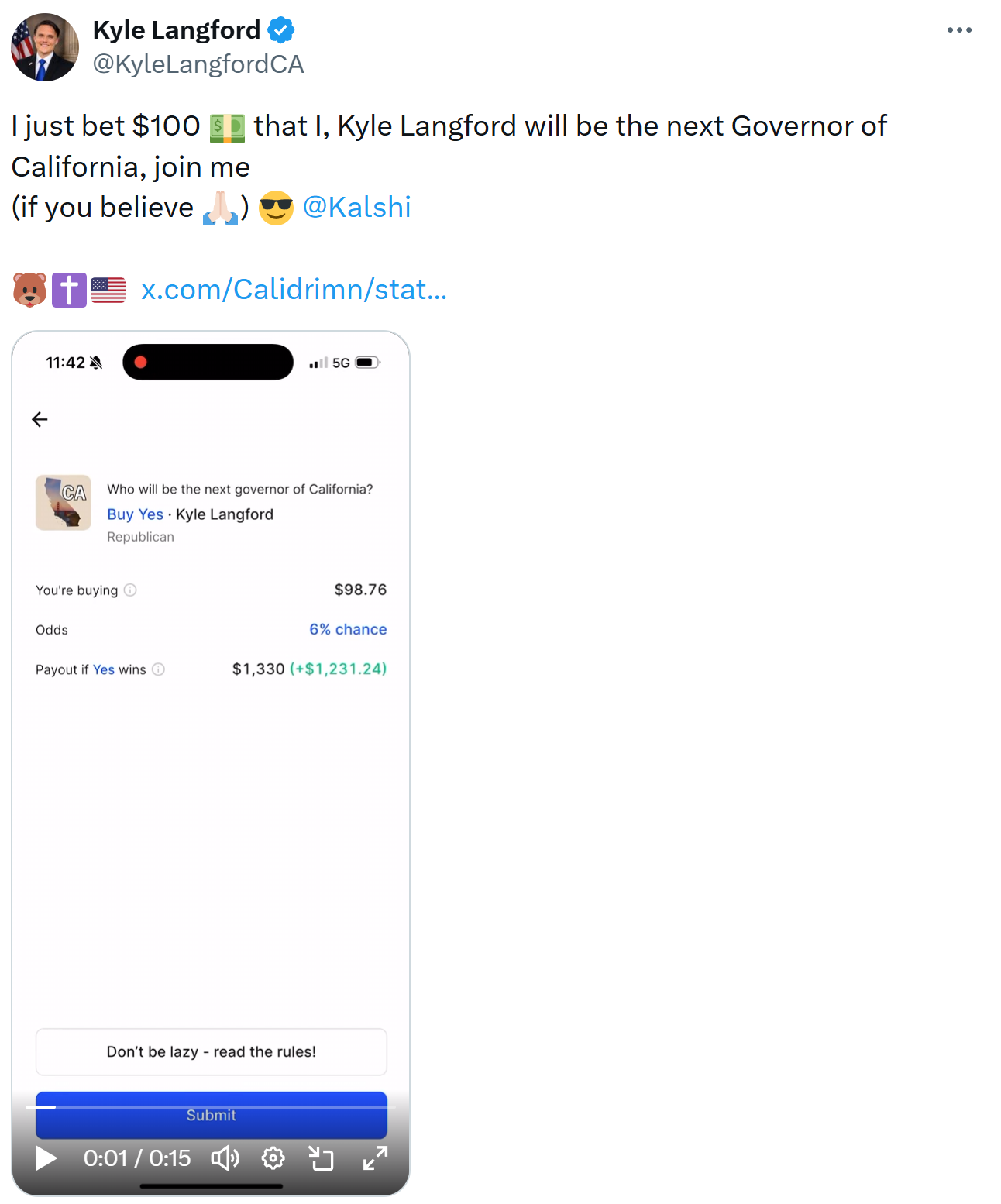
A former contender for governor of California has been banned from Kalshi after betting on his own candidacy last year in violation of insider trading rules, the prediction market platform said on Wednesday.
According to a statement from Kalshi’s head of enforcement, Robert DeNault, the politician bet about $200 on his candidacy for governor of California and posted about it on X, leading to a five-year suspension on the prediction market platform and a $2,000 penalty.
Kalshi did not name the politician, but said he is no longer running for governor and is now running for Congress.
The description appears to fit Kyle Langford, a former Republican turned Democrat who is now running for election to the US House to represent California’s 26th Congressional District.

In an X post published on May 25, 2025, Langford shared a video of himself placing a $98.76 bet on Kalshi, wagering that he would win.
Kalshi said the account did not withdraw any profits and that the case was reported to the CFTC.
Cointelegraph reached out to Langford for further comment but didn’t receive an immediate response.
Meanwhile, Kalshi said it also handed out penalties to a YouTube editor who traded about $4,000 on YouTube stream markets between August and September 2025 — also violating Kalshi’s insider trading rules, resulting in a two-year penalty and a roughly $20,000 fine.
“Our surveillance systems flagged his near-perfect trading success on markets with low odds, which were statistically anomalous,” said Kalshi, which, with the help of other traders on the platform, identified where he worked and concluded that he likely had access to material non-public information.
While Kalshi didn’t name the YouTube editor, mainstream media have widely reported that the editor is Artem Kaptur, an employee of the popular YouTuber MrBeast.

Kalshi, a Commodity Futures Trading Commission-regulated platform, said it has investigated 200 cases and frozen several flagged accounts. It has more than a dozen active cases.
Earlier this month, Kalshi strengthened its surveillance efforts by establishing a surveillance audit committee and partnering with crypto trading surveillance platform Solidus Labs to “detect, investigate, and address market abuse.”
Those efforts come in response to an uptick in regulatory scrutiny of prediction markets as they enter the mainstream.
US lawmakers introduced a bill last month to restrict trading by government insiders after one Polymarket user made over $400,000 on bets tied to Venezuelan President Nicolás Maduro, placing wagers hours before US forces captured him in Caracas.
CFTC sends strong warning to future violators
On Thursday, CFTC Chair Mike Selig said the agency established a prediction markets advisory to collaborate with industry participants in efforts to catch insider traders.
Related: Polymarket users favor Meteora in bets over ZachXBT crypto takedown
Selig warned that those engaging in insider trading will face consequences:
“Let me be clear: if you attempt to engage in manipulation, fraud, or insider trading, we will find you and take action.”
Magazine: Did a Hong Kong fund kill Bitcoin? Bithumb’s ‘phantom’ BTC: Asia Express

Matt Western, chair of the UK’s Joint Committee on National Security Strategy, has urged the government to put a temporary halt on crypto donations to political parties, citing concerns over foreign interference.
In his Monday letter to Steve Reed, Secretary of State for Housing, Communities and Local Government, Western recommended adding a “temporary moratorium” on crypto donations to the upcoming Representation of the People Bill. The moratorium would be lifted once the Electoral Commission issues statutory guidance.
“We are concerned that foreign state intent to interfere in UK political finance may grow out to the next election,” Western said.
“As the security environment worsens and the UK’s military role in Europe grows, the value of influencing the UK’s political positions, for example on Ukraine, or US/EU relations, is likely to increase,” he added.

In January, a group of MPs who chair parliamentary committees — including Western — advocated for a full ban on crypto donations to be included in the Representation of the People Bill, warning that foreign states could use such payments to influence UK politics. However, the bill didn’t include a full ban when it was introduced to the House of Commons on Feb. 12.
Ban funds from crypto mixers and anonymous sources
Western argued that the Electoral Commission’s guidance should require political parties to use only crypto services registered with the Financial Conduct Authority, the UK’s financial services regulator.
Donations that involve the upstream use of mixers or come from an unknown source should be prohibited, according to Western, and political parties that receive crypto should convert it to fiat within 48 hours of receipt.
The next general election in the UK must be held by Aug. 15, 2029. Meanwhile, the Representation of the People Bill is scheduled to have a second reading in the House of Commons on March 2.
National police force needed to tackle foreign interference
Western’s letter also offers longer-term solutions, such as creating a national police force dedicated to overseeing political finance and combating foreign interference.
“Our evidence suggests that there is no clear national enforcement lead for political finance and foreign interference risk. Responsibilities are split across the Electoral Commission, the Metropolitan Police Service, Counter-Terror Policing, the National Crime Agency, MI5 and local police forces,” he said.
Related: Revolut among 4 companies chosen to test stablecoins in UK sandbox
Western also recommended source-of-wealth checks for donors, a review of sentencing for electoral finance offenses, higher penalties for breaches and enhanced powers for the Electoral Commission to compel institutions to disclose the sources of donation funds.
Reform UK became the first party to accept crypto donations in May last year, with leader Nigel Farage announcing at the Bitcoin 2025 conference in Las Vegas that the group is accepting Bitcoin (BTC) and other cryptocurrency contributions from eligible donors.
Magazine: Clarity Act risks repeat of Europe’s mistakes, crypto lawyer warns
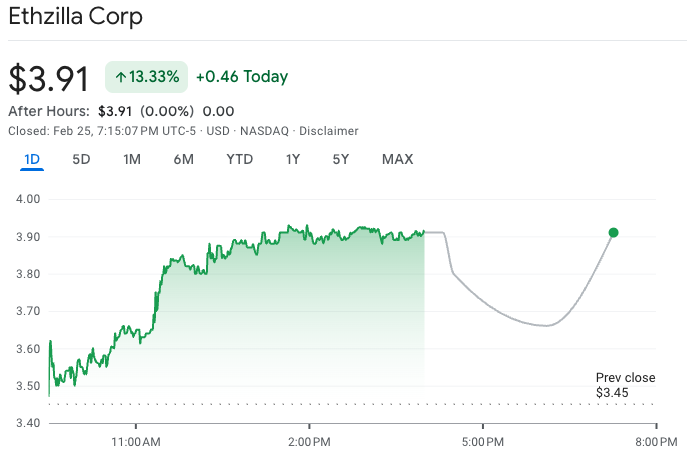
ETHZilla shares climbed 13% on Wednesday after the company changed its name to Forum as part of plans to ditch its crypto treasury strategy and become a tokenization company.
The company said on Wednesday that it has updated its corporate name and brand to Forum Markets and will do business as Forum. ETHZilla will also change its ticker symbol to “FRMM” as of market open on Monday, pending Nasdaq approval.
The company said the rebrand is the next step in its transition into a platform “connecting traditional capital markets with blockchain-based financial infrastructure.”
“Forum embodies our belief that the next generation of financial markets will be built around institutional-grade, on-chain products backed by real assets, governed by transparency, and delivered through regulated infrastructure,” said the company chair and CEO, McAndrew Rudisill.
ETHZilla shares climb 13% on rebrand
Shares in ETHZilla (ETHZ) ended trading on Wednesday up more than 13% to $3.91 and have traded flat after hours, recovering from a slight dip.

Its stock is down over 20% so far this year as a wide crypto market rout has hit stocks tied to digital assets.
ETHZilla was a biotech company called 180 Life Sciences that adopted the ETHZilla brand and started buying and holding Ether (ETH) in July 2025 amid peak hype around crypto treasury companies.
Related: Peter Thiel’s Founders Fund dumps ETHZilla stake as ETH treasuries face pressure
Its crypto treasury pivot sent its shares soaring to a multi-year high of $107 by August, as ETH climbed to just under $4,950 around the same time, but a crypto market rout has since decimated its share price, along with those of its crypto-buying rivals.
As Wall Street largely moved on from crypto treasuries and began to back tokenization firms, Rudisill announced in December that ETHZilla would pivot to bringing “real-world assets (RWA) on-chain through tokenization.”
The company has purchased two commercial jet engines leased to what it said is a “leading US air carrier,” and began offering a token tied to the engines earlier this month called Eurus Aero Token I.
ETHZilla currently holds 69,802 ETH worth $143.7 million at the cryptocurrency’s current price of $2,060, making it the seventh-largest corporate holder of the asset, per CoinGecko.
Magazine: Bitcoin’s ‘biggest bull catalyst’ would be Saylor’s liquidation — Santiment founder

TLDR
- Circle reported a 77% increase in total revenue and reserve income for Q4 2025.
- Circle generated $770 million in revenue, including $733 million in reserve income.
- USDC circulation reached $75.3 billion, rising 72% year over year.
- On-chain transaction volume hit $11.9 trillion in Q4, up 247% from last year.
- Circle posted $133 million in net income and $167 million in adjusted EBITDA.
Circle reported a 77% year over year increase in total revenue and reserve income for the fourth quarter of 2025. The company linked the growth to higher USDC circulation and reserve income. The latest figures outline a widening scale gap between USDC and Ripple’s RLUSD.
Circle Reports Revenue Surge as USDC Circulation Expands
Circle posted $770 million in total revenue and reserve income for Q4 2025. The company generated $733 million of that figure from reserve income.
Reserve income rose 69% from the previous year. Average USDC circulation expanded 100% during the same period.
USDC closed 2025 with $75.3 billion in circulation. That figure marked a 72% increase year over year.
Circle recorded $11.9 trillion in on-chain transaction volume during the fourth quarter. The volume represented a 247% increase from a year earlier.
The reserve yield declined to 3.8% during the quarter. The yield fell by 68 basis points compared with last year.
Revenue less distribution costs increased 136% to $309 million. Circle reported a margin of 40% for the period.
Net income from continuing operations reached $133 million. Adjusted EBITDA rose 412% to $167 million.
Circle stated that higher circulation supported reserve balances and interest income. The company attributed revenue growth to expanded USDC usage.
RLUSD Operates from Smaller Base in Stablecoin Market
Ripple’s RLUSD holds a market capitalization of nearly $1.56 billion. Daily trading volume stands around $124 million.
The supply gap between USDC and RLUSD shapes reserve income capacity. Larger circulation allows higher reserve balances and interest earnings.
Ripple remains privately held and does not publish detailed quarterly financial statements. As a result, direct profitability comparisons remain limited.
RLUSD benefits from Ripple’s global payments network and exchange integrations. However, public data shows a lower circulation base.
USDC’s market capitalization stands at $74.9 billion. That scale exceeds RLUSD by a wide margin.
Circle’s reported earnings provide measurable data on reserve income and operating performance. Ripple has not released comparable quarterly metrics for RLUSD.


Coinbase CEO Brian Armstrong has warned that proposed stablecoin rules in the United Kingdom risk undermining the country’s competitiveness as a global financial hub, arguing that draft measures could stifle innovation rather than support it.
Summary
- Brian Armstrong warned that proposed stablecoin caps by the Bank of England could damage the UK’s competitiveness in digital finance.
- Draft rules reportedly include a £20,000 limit for individuals and £10 million for businesses, prompting concerns the UK could fall behind the $180B global stablecoin market.
- A pro-crypto petition has surpassed 80,000 signatures and could be debated in Parliament if it reaches 100,000.
Coinbase CEO urges UK to rethink stablecoin caps
In a post on X, Armstrong said stablecoin regulations currently being finalized by the Bank of England include proposals to cap stablecoin holdings for individuals and businesses.
Critics of the framework say the suggested limits around £20,000 for individuals and £10 million for businesses, could act as structural barriers to adoption in a market valued at more than $180 billion globally.
“The UK has a long history of being a financial hub,” Armstrong wrote, adding that embracing blockchain innovation is critical as other jurisdictions move quickly to establish clearer crypto frameworks.
He urged UK residents to support a petition organized by Stand With Crypto UK, which has gathered more than 80,000 signatures. Under parliamentary rules, petitions crossing 100,000 signatures are considered for debate in Parliament.
The comments sparked debate online. Some users argued the U.S. should first resolve its own regulatory uncertainty, pointing to the pending Clarity Act in Congress. Others said regulation should manage systemic risk without suppressing innovation, calling for proportional frameworks that allow stablecoins to scale responsibly.
The debate highlights mounting global competition over stablecoin policy, as lawmakers in the U.S. and European Union push forward with new frameworks. For London, long seen as a premier financial center, the final shape of stablecoin rules may determine whether it remains at the forefront of digital asset finance or risks ceding ground to more agile jurisdictions.
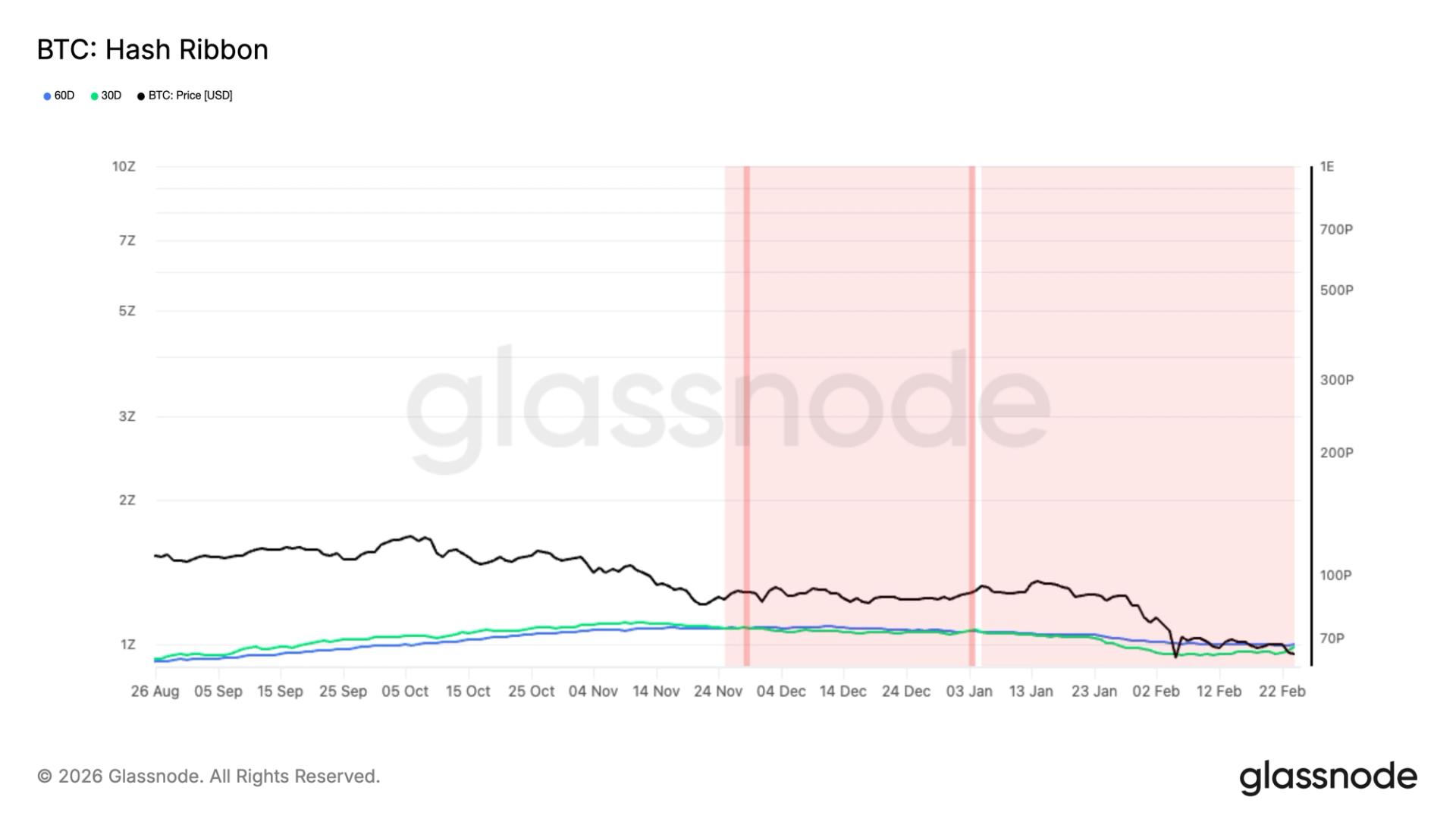
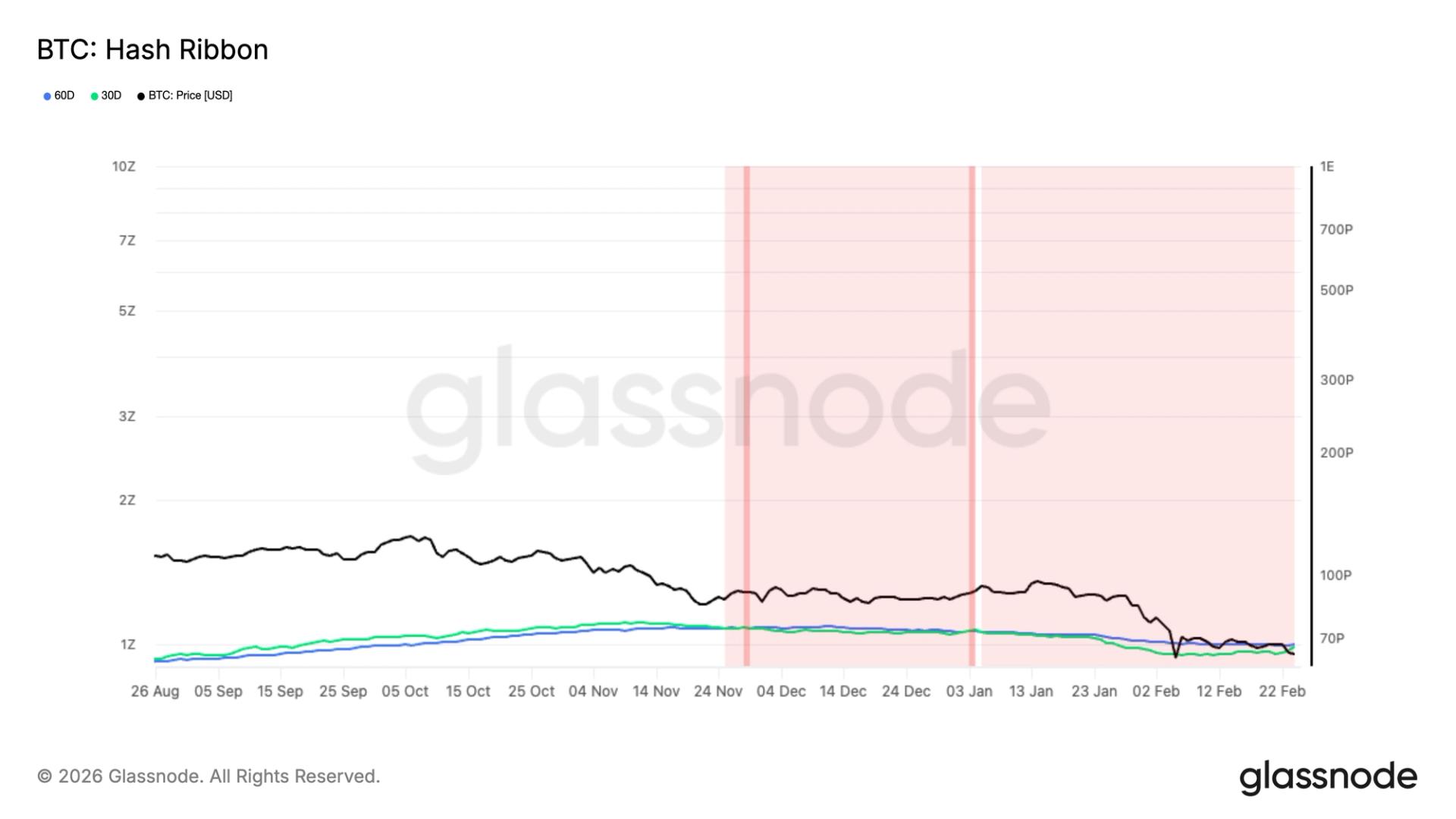
The worst of bitcoin’s 50% drawdown may already be behind us.
The Hash Ribbon indicator is close to signaling the end of a three month miner capitulation. One of the longest capitulations on record, according to Glassnode data.
The metric compares the 30 day and 60 day moving averages of hash rate and is based on the observation that bitcoin often bottoms when miners are under maximum financial stress. Capitulation occurs when mining revenue drops below operating costs, forcing less efficient miners to shut down machines and sell BTC reserves to fund electricity, debt, and overhead. That combination reduces hash rate and adds sustained sell pressure to the market.
A recovery signal is triggered when the 30 day hash rate moving average crosses back above the 60 day, indicating miners are returning online and network stress is easing and that moment is approaching. Historically, when this crossover aligns with improving price momentum, it has marked strong accumulation zones.
Since late November, when the metric first inverted, bitcoin has fallen from around $90,000 to a low near $60,000 in early February, before rebounding to roughly $65,000 as of press time.
Such major corrections are typical during miner stress events. Since 2011, there have been about 20 mining capitulations, most coinciding with local or major bottoms, including January 2015, December 2018 and December 2022.
Hash rate which is the total computational power securing the network is now rebounding, signaling renewed confidence among miners.
At the same time, bitcoin is now trading below its estimated average production cost of $66,000, a level often associated with deep value, according to checkonchain data. The last time this occurred was November 2022, when BTC bottomed near $15,500.
Polygon has fallen nearly 40% from its yearly high in tandem with a market-wide weakness. Can it recover from its losses now as its stablecoin market and app revenues surge?
Summary
- Polygon price is eyeing a rebound amid strengthening fundamentals, including stablecoin activity and revenue surge.
- A potential bullish crossover is forming on the daily chart.
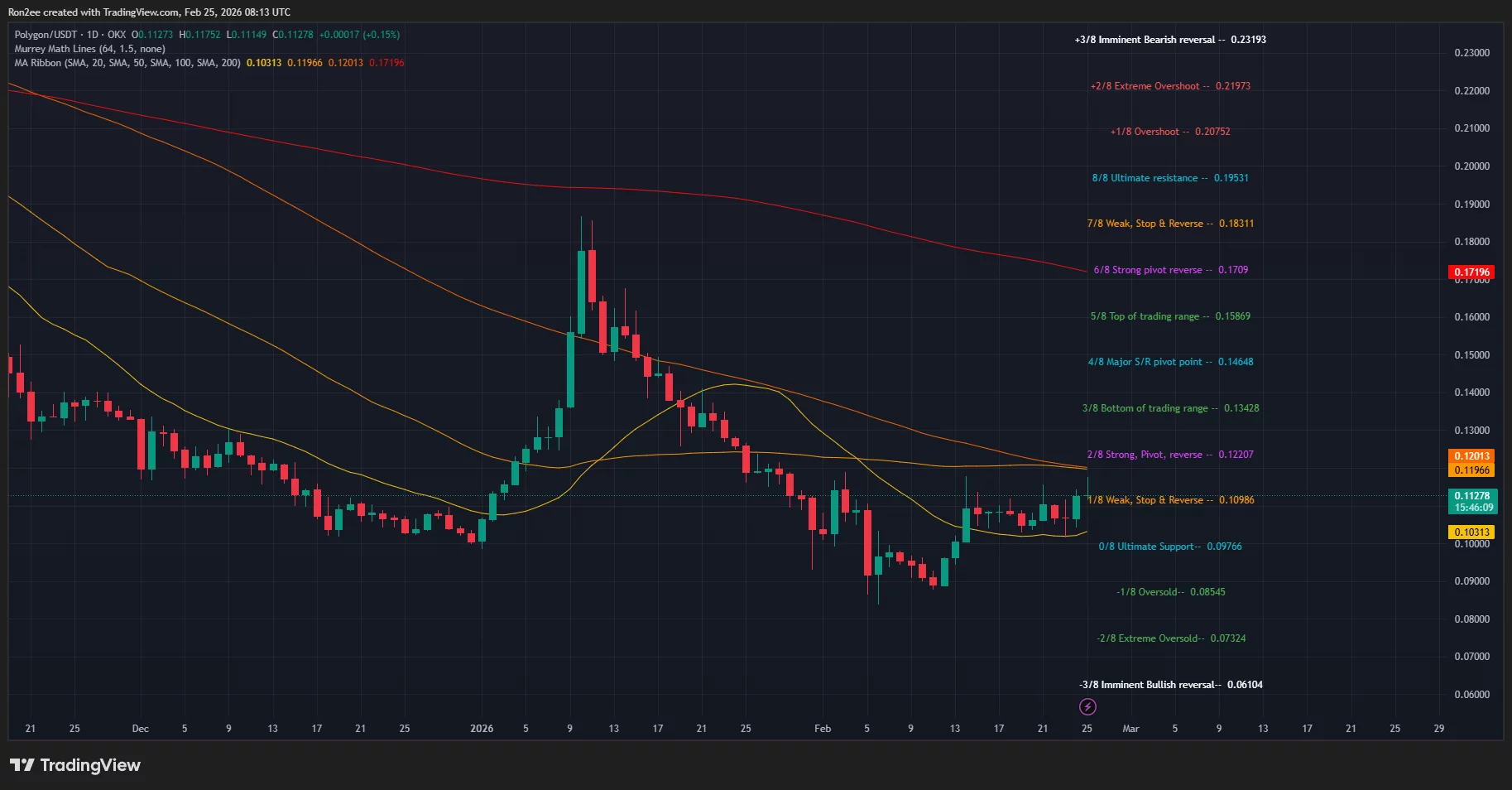
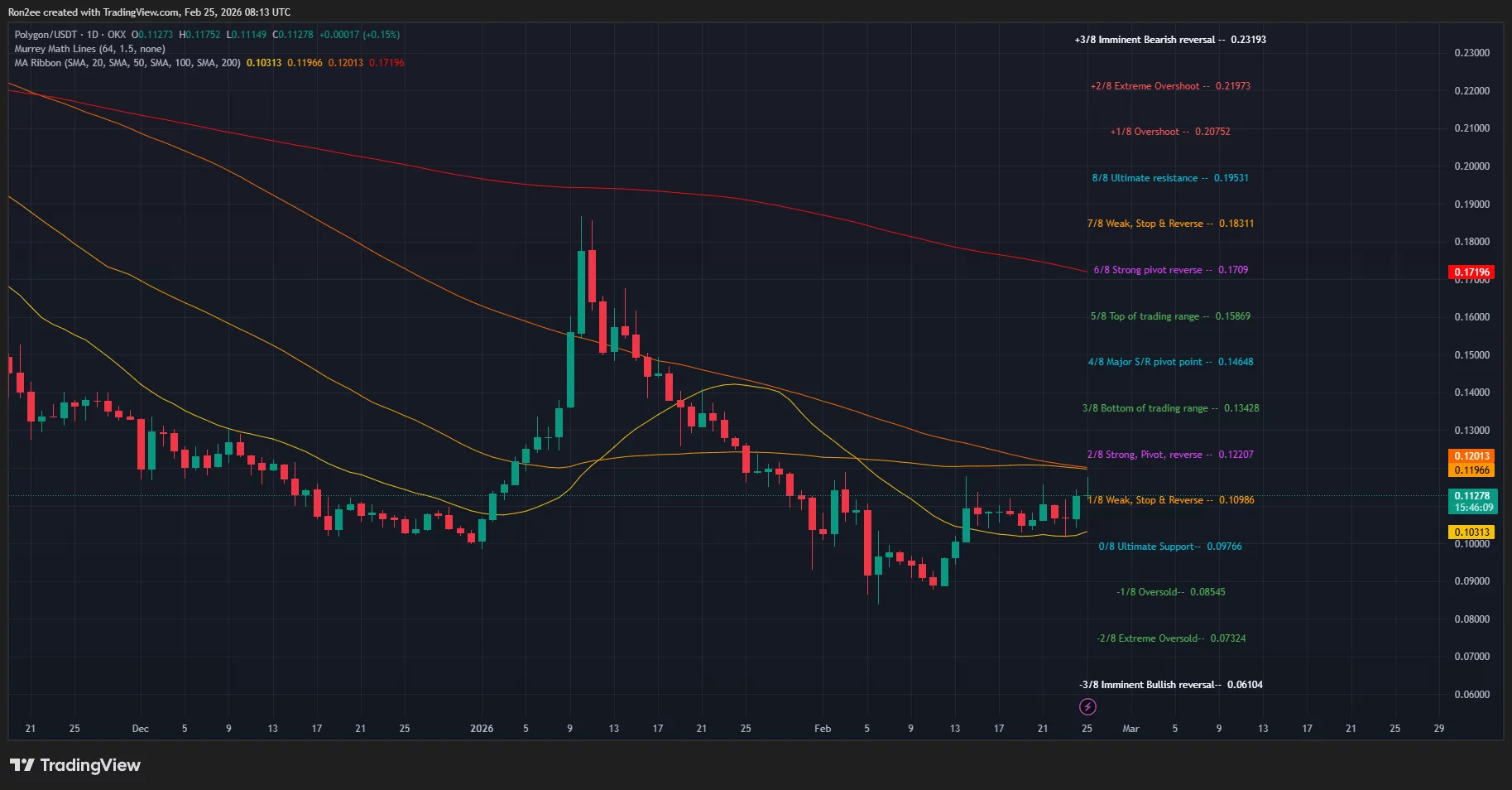
According to data from crypto.news, the Polygon (POL) price fell over 50% from its January high to a yearly low of $0.088 on Feb. 11. This occurred amid a broader market pullback triggered by massive liquidations across leveraged markets as Bitcoin fell below multiple key support zones due to macroeconomic and geopolitical stress.
POL has since bounced back and remained in consolidation between $0.100 and $0.115.
The Polygon network is showing signs of strength, which may position it for a breakout
First, its on-chain stats have grown significantly stronger over recent weeks. Data from DeFiLlama shows that the total supply of stablecoins on the network has surged to $3.26 billion from the $2.4 billion seen at the beginning of February.
At the same time, the weekly revenue generated by DeFi apps on the network has also soared by nearly 70% within the period.
A stronger stablecoin supply and weekly revenue suggest a surge in activity and liquidity, which is a healthy sign for a network and could likely attract more institutional capital.
Second, Polygon’s aggressive token burn strategy is also helping support its price gains. It has recently completed burning over 100 million POL tokens. As tokens are burnt, they are permanently removed from the circulating supply, driving scarcity and providing an accessible bullish narrative for short-term traders.
Third, the daily chart shows that the Polygon price is close to confirming a bullish crossover between the 50-day and 100-day moving averages. Bullish crossovers are typically followed by sustained rallies once confirmed.
Key levels to watch
For now, the next overhead resistance level lies at $0.122, which is the strong pivot reverse level of the Murrey Math lines. Bulls must reclaim this level to confirm a trend reversal.
Subsequently, bulls can then try to push the token all the way up to its January high at $0.184, which would mark a roughly 64% rally from its current price of $0.112.
On the contrary, failure to hold the ultimate support level of the Murrey Math lines at $0.097 will result in a drop back to its yearly low of $0.088.
Disclosure: This article does not represent investment advice. The content and materials featured on this page are for educational purposes only.


South Korea plans finfluencer disclosure law to curb manipulation and protect investors.
Summary
- Bill amends Capital Markets and Virtual Asset User Protection Acts to cover stocks and crypto promotions.
- Influencers must disclose asset types, quantities, and any paid compensation tied to recommendations.
- Violations face penalties similar to unfair trading, including fines and criminal liability, alongside new AI-based market surveillance.
South Korea’s Democratic Party has introduced legislation requiring financial influencers to disclose personal asset holdings and compensation when recommending cryptocurrencies or stocks, according to reports from the country’s legislative assembly.
The proposal, led by lawmaker Kim Seung-won, includes amendments to the Capital Markets Act and the Virtual Asset User Protection Act. The draft framework would mandate that influencers disclose the type and quantity of assets held when promoting specific tokens or stocks through social media, livestreams, or broadcast channels, according to the legislative text.
Influencers would also be required to reveal any compensation received in exchange for recommendations. Violations would carry penalties similar to those applied in unfair trading practice cases, including fines and potential criminal liability, the proposal states.
The legislation aims to prevent undisclosed promotional activity that can lead to pump-and-dump schemes, where influencers promote assets before selling into price increases, according to the Democratic Party’s statement. The measures seek to reduce market manipulation risks and improve investor protection through mandatory transparency around holdings and financial incentives.
The proposal follows broader regulatory expansion in South Korea throughout 2026. The Financial Supervisory Service has deployed AI-based monitoring tools designed to detect abnormal trading patterns and market manipulation in real time, according to the agency.
Additional measures introduced this year include new reporting requirements for foreign property investors, who must now disclose cryptocurrency transaction histories in certain cases, regulatory filings show.
South Korea maintains one of the world’s most active retail cryptocurrency markets. The legislation, if passed, would represent one of the most direct regulatory actions globally targeting social media-driven financial promotion in the digital asset sector, according to regulatory analysts.

Disclosure: The views and opinions expressed here belong solely to the author and do not represent the views and opinions of crypto.news’ editorial.
Trust in money doesn’t collapse overnight. It erodes slowly, through years of inflation and political interference that leave savers feeling exposed. When confidence finally breaks, people respond rationally: they abandon the faulty currency. They move their savings into foreign currencies or assets like gold and real estate.
Summary
- Currency trust is structural, not rhetorical: When savers abandon local money, speeches don’t fix it — credible, transparent infrastructure does. Tokenized bonds can provide that signal.
- Demand for bonds drives demand for currency: By improving liquidity, transparency, and settlement, digital local-currency debt can reduce dollarization and keep capital onshore.
- Transparency reshapes monetary politics: On-chain issuance and settlement reduce opacity, compress risk premiums, and shift credibility from promises to verifiable data.
Governments often try to reverse this dynamic with rhetoric: pledges of fiscal discipline, independence, or reform. But speeches aren’t always enough to restore trust; you sometimes need new institutions and infrastructure. In other words, you need credible signals that saving and investing locally is no longer a gamble. Nations now have a new tool to do this: by issuing tokenized bonds.
Tokenization brings transparency, programmability, and fast settlement to investment vehicles that are often perceived as opaque or risky. Applied to sovereign and corporate debt, these features can materially improve how local-currency markets function. Digital bonds obviously can’t be a substitute for good macroeconomic policy, but by eliminating some frictions, they can help restore confidence in a currency.
How tokenized bonds support local currencies
A currency’s strength depends heavily on demand for assets denominated in it. People hold currencies not because they like them, but because they want the assets priced in them. When local bond markets are illiquid or unreliable, demand for the currency weakens structurally. Tokenized bonds address this problem by making local-currency debt easier to access, cheaper to trade, and far more transparent. They’re not a silver bullet, but they help ease the problem.
Digital bonds can be purchased with fewer intermediaries and lower operational costs. They can also be fractionalized, integrated into digital wallets, and distributed globally. All of this lowers the barriers for domestic and foreign investors to hold local sovereign and corporate debt. More buyers of local-currency bonds translates into sustained demand for the currency itself. Over time, that demand makes an impact, big or small, on the strength of a given currency.
Improving domestic savings instruments also reduces the incentive to dollarize. In many countries around the world, households and firms turn to U.S. dollars when they don’t trust local institutions to preserve value or honor contracts.
But tokenized bonds offer visible proof that rules are being enforced, payments are happening as promised, and ownership is secure. When people feel confident saving and investing in their own currency, it opens a path for dollarization to recede organically, strengthening foreign-exchange stability.
The same logic applies to institutional capital. Pension funds and asset managers in emerging markets often overweight dollar assets because local-currency markets carry higher operational risk — slow settlement, unreliable registries, and opaque ownership records. Digital bonds reduce these risks, giving local institutions fewer reasons to export capital abroad. Keeping savings onshore can be an effective way of supporting a currency.
Tokenized bonds also impact monetary politics
One of the weaknesses of local debt markets is opacity. Investors rarely have a clear view of who owns what, how liquid the market really is, or whether issuance and settlement data can be trusted. Tokenized bonds change this by moving issuance, ownership, settlement, and secondary-market activity on-chain, where it can be observed in real time. This transparency lowers the opacity premium that investors demand for holding local-currency debt.
Moreover, central banks traditionally rely on reputational capital to guide expectations. But reputation is fragile in countries with a history of fiscal dominance. Tokenized bond markets shift part of that burden from institutional trust to observable data. Real-time signals allow investors to assess conditions independently of official messaging. Issuing digital bonds is also a visible signal of competence; it demonstrates accountability in ways that no press release can.
Smart contracts reinforce this effect through automation. By reducing reliance on intermediaries and manual processes, they minimize operational failures that usually undermine confidence in otherwise well-managed systems.
Immutability also matters politically. On-chain records make it much harder to quietly manipulate issuance volumes or obscure outstanding supply. For investors who worry about opaque fiscal practices or political interference, this permanence helps to anchor credibility.
The benefits to the market
The market-level benefits end up compounding. In many emerging economies, slow and unreliable settlement cycles are a major source of mistrust. Trades that take days to clear discourage participation and inflate yields. Digital bonds eliminate much of this friction, which in turn restores some confidence in the basic functioning of the market.
High yields in local-currency debt are often misinterpreted as pure compensation for inflation or credit risk. In reality, they also reflect settlement risk, inefficient infrastructure, questionable registries, and unpredictable liquidity. By removing these issues, tokenized bonds can naturally help compress yields and improve trust in the currency.
Tokenized bonds also open local markets to retail savers, expatriates, and global asset managers who were previously locked out by operational complexity. Greater access means there is a chance for more participants, which in turn could bring deeper liquidity and better price discovery to the local sovereign debt market.
And instead of thin, sporadically traded markets where rumors dominate, tokenized bonds provide constant visibility into yield curves and credit spreads. Clearer price signals anchor expectations and reduce the informational chaos that often precedes currency stress.
Finally, currency stability depends on whether policy decisions actually flow through the financial system. With real-time pricing and instant settlement, bond markets respond more efficiently to interest-rate changes and liquidity operations. Policy becomes more effective not because it is harsher, but because it is better transmitted.
At the end of the day, currency credibility mostly depends on fiscal and monetary fundamentals. But tokenized bonds help governments get rid of many small frictions they have to deal with, even under the best circumstances. Tokenized bonds can’t replace sound policy, but they can strengthen market plumbing. All of the small advantages that they bring end up compounding to provide support for local currencies.

Running carefully structured prompts through Grok AI produces ambitious 2026 price outlooks for XRP, Cardano and Ethereum, despite the near-term uncertainty rocking markets.
Below, we examine how realistic Grok’s projections are in the current cycle.
XRP (XRP): Grok AI Bets XRP to Hit $8 by 2026
In a recent update, Ripple reiterated that XRP ($XRP) remains the cornerstone of its plan to establish the XRP Ledger as a global, enterprise grade payments network.
With near instant settlement and extremely low fees, the Ripple is strategically manoeuvring to capture an early led in two rapidly expanding segments: stablecoins and tokenized real-world assets.
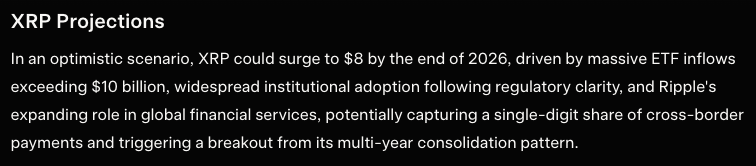
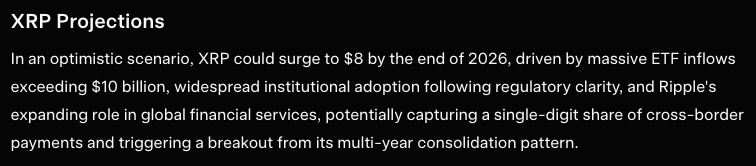
XRP currently trades around $1.42. According to Grok’s AI-driven, the token could rise to $8 by the end of 2026, implying gains of almost 6x from current levels.
Technical indicators support the constructive outlook. XRP’s Relative Strength Index (RSI) is rapidly climbing up from 44, while price remains below the 30-day moving average, a combination often associated with players buying the dip.
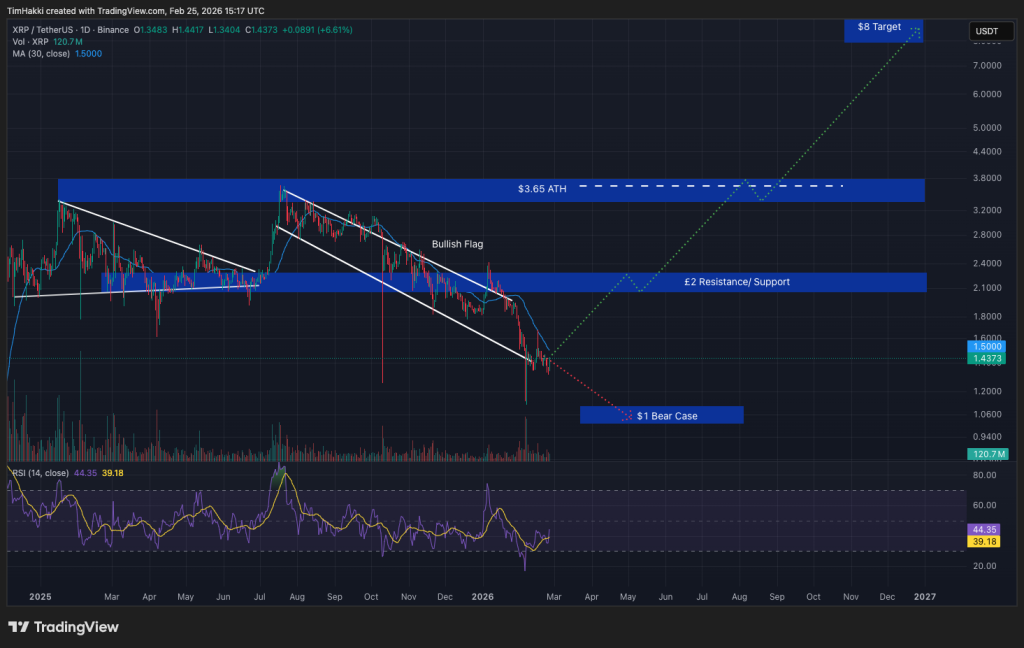
Potential price catalysts to anticipate include institutional demand following the rollout of U.S. XRP ETFs, Ripple’s growing list of international partnerships, and improved regulatory clarity if the proposed U.S. CLARITY bill advances this year.
Cardano (ADA): Grok Assigns Hoskinson’s Ethereum Rival a 1,250% Upside Scenario
Created by Ethereum co-founder Charles Hoskinson, Cardano ($ADA) focuses on academically peer-reviewed development, strong security guarantees, scalability, and long-term network resilience.
Despite broader market weakness, Cardano’s ecosystem continues to expand. The network holds a market capitalization of $10.3 billion and more than $124 million in total value locked (TVL).
Grok’s projections suggest ADA could surge by just over 1,250%, climbing from approximately $0.28 today to nearly $3.80 by the end of 2026. Such a move would push Cardano well beyond its previous 2021 high of $3.09.
That said, ADA is currently trading at its lowest levels since October 2024.
Given the volatility seen throughout this year, a prolonged bear scenario, could see prices potentially sliding down to $0.15.
Ethereum (ETH): Grok AI Sees a Run to $10k on the Cards
Ethereum ($ETH) remains the dominant smart contract blockchain and the backbone of most DeFi and Web3 applications.
With a market capitalization near $238 billion and over $54 billion locked across DeFi protocols, Ethereum is the primary settlement layer for on-chain commercial activity.
Its track record for security, leadership in stablecoin infrastructure, and early progress in tokenizing real-world assets place Ethereum in a strong position to attract substantial institutional interest.
However, meaningful capital inflows hinge on U.S. lawmakers passing the CLARITY bill, which would provide the regulatory certainty institutions need to deploy funds via stablecoins or tokenized assets on Ethereum.
ETH currently trades around $2,000, with significant resistance expected near $5,000 after setting an all-time high of $4,946.05 last August.
If Grok’s bullish scenario plays out, a breakout above $5,000 could unlock a series of new highs in 2026, with Grok calling $10,000 a bull target.
Maxi Doge: Early-Stage Meme Coin Aims for Outsized Growth
While Grok indicates that these top altcoins could deliver strong returns over time, their large market capitalizations may cap explosive upside compared to newer, smaller-cap projects.
Maxi Doge ($MAXI) is still in its early stages. The project has already raised $4.6 million during its ongoing presale among investors looking to recapture the magic of meme coins.
The character behind Maxi Doge is a loud, gym-obsessed, self-styled alpha doge, a distant rival and cousin to Dogecoin. His comic branding taps into the high-energy, irreverent tone that fueled the meme coin boom of 2021.
MAXI is an ERC-20 token on Ethereum’s proof-of-stake network, giving it a lower environmental footprint compared to Dogecoin’s proof-of-work model.
Early presale buyers can currently stake MAXI for yields of up to 67% APY, though returns decrease as more tokens enter the staking pool.
The token is $0.0002805 during the current presale phase, with automatic price increases at each funding milestone. Purchases are supported through wallets such as MetaMask and Best Wallet.
Stay updated through Maxi Doge’s official X and Telegram pages.
Visit the Official Website Here.
The post Elon’s Grok AI Predicts the Price of XRP, Cardano, and Ethereum By the End of 2026 appeared first on Cryptonews.
Emergency services called to incident at Ladbrokes in Bolton

GameStop (GME) Stock Trades Near $24 as Retail Interest Reignites, CEO Acquisition Vision Fuels Speculation

Kalshi Boots Politician, YouTuber For Insider Trading


-

 Video6 days ago
XRP News: XRP Just Entered a New Phase (Almost Nobody Noticed)
-

 Politics4 days ago
Baftas 2026: Awards Nominations, Presenters And Performers
-

 Fashion5 days ago
Weekend Open Thread: Boden – Corporette.com
-

 Sports2 days ago
Women’s college basketball rankings: Iowa reenters top 10, Auriemma makes history
-

 Politics2 days ago
Nick Reiner Enters Plea In Deaths Of Parents Rob And Michele
-
 Sports7 days ago
Clearing the boundary, crossing into history: J&K end 67-year wait, enter maiden Ranji Trophy final | Cricket News
-

 Crypto World2 days ago
XRP price enters “dead zone” as Binance leverage hits lows
-

 Business4 days ago
Mattel’s American Girl brand turns 40, dolls enter a new era
-

 Business3 days ago
Law enforcement kills armed man seeking to enter Trump’s Mar-a-Lago resort, officials say
-

 Tech1 day ago
Unsurprisingly, Apple's board gets what it wants in 2026 shareholder meeting
-
 NewsBeat4 hours ago
Manchester Central Mosque issues statement as it imposes new measures ‘with immediate effect’ after armed men enter
-
 NewsBeat3 days ago
‘Hourly’ method from gastroenterologist ‘helps reduce air travel bloating’
-

 Tech3 days ago
Anthropic-Backed Group Enters NY-12 AI PAC Fight
-

 NewsBeat3 days ago
Armed man killed after entering secure perimeter of Mar-a-Lago, Secret Service says
-

 Politics3 days ago
Maine has a long track record of electing moderates. Enter Graham Platner.
-

 Business1 day ago
True Citrus debuts functional drink mix collection
-
 NewsBeat1 day ago
Police latest as search for missing woman enters day nine
-

 Crypto World1 day ago
Entering new markets without increasing payment costs
-
 Sports3 days ago
2026 NFL mock draft: WRs fly off the board in first round entering combine week
-

 Crypto World6 days ago
83% of Altcoins Enter Bear Trend as Liquidity Crunch Tightens Grip on Crypto Market