

Crypto World
Pi Network (PI) Price Predictions for This Week

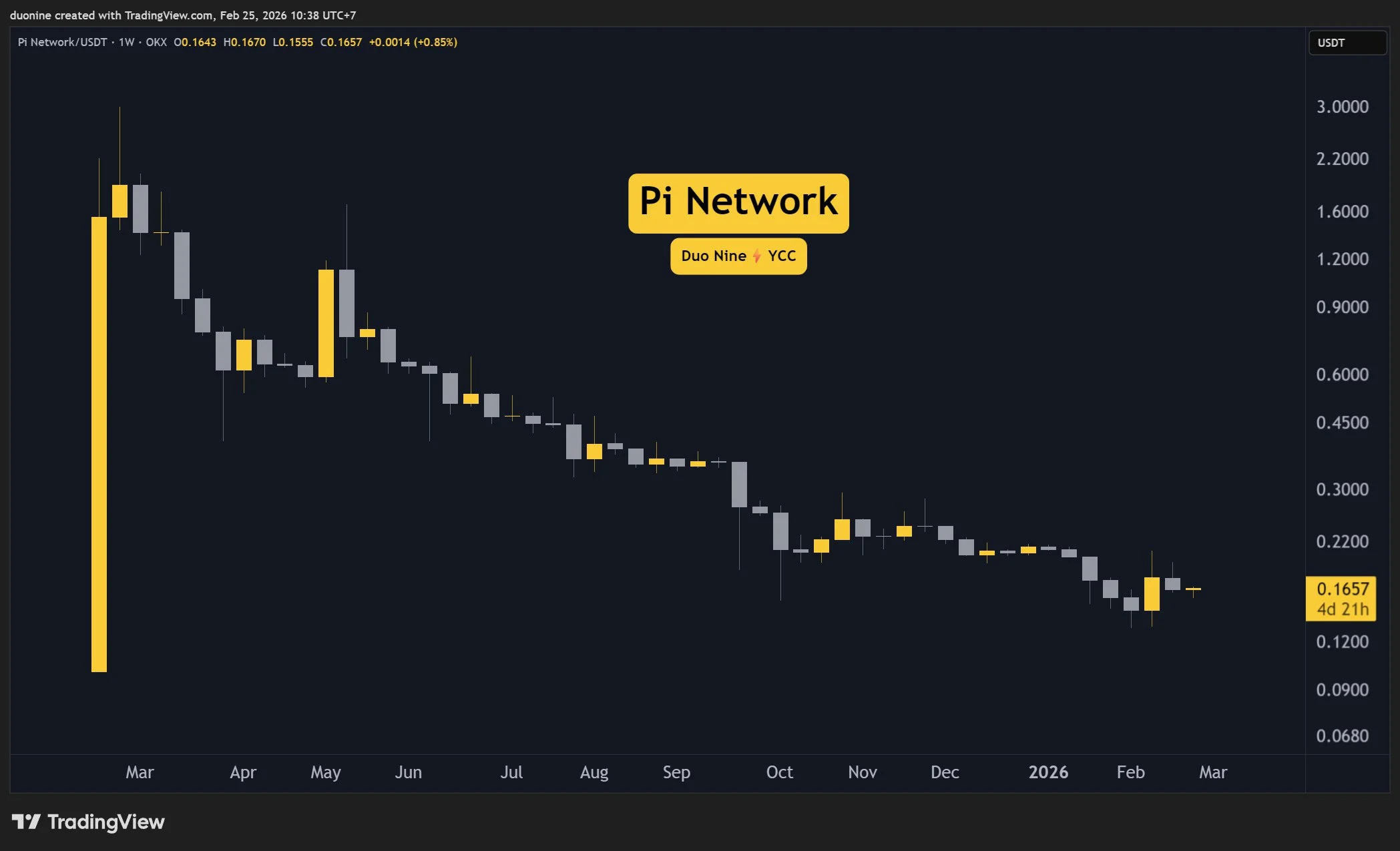
PI is attempting to break away from its longstanding downtrend. Will it succeed?
PI Network (PI) Price Predictions: Analysis
Key support levels: $0.15
Key resistance levels: $0.20
PI Breakout
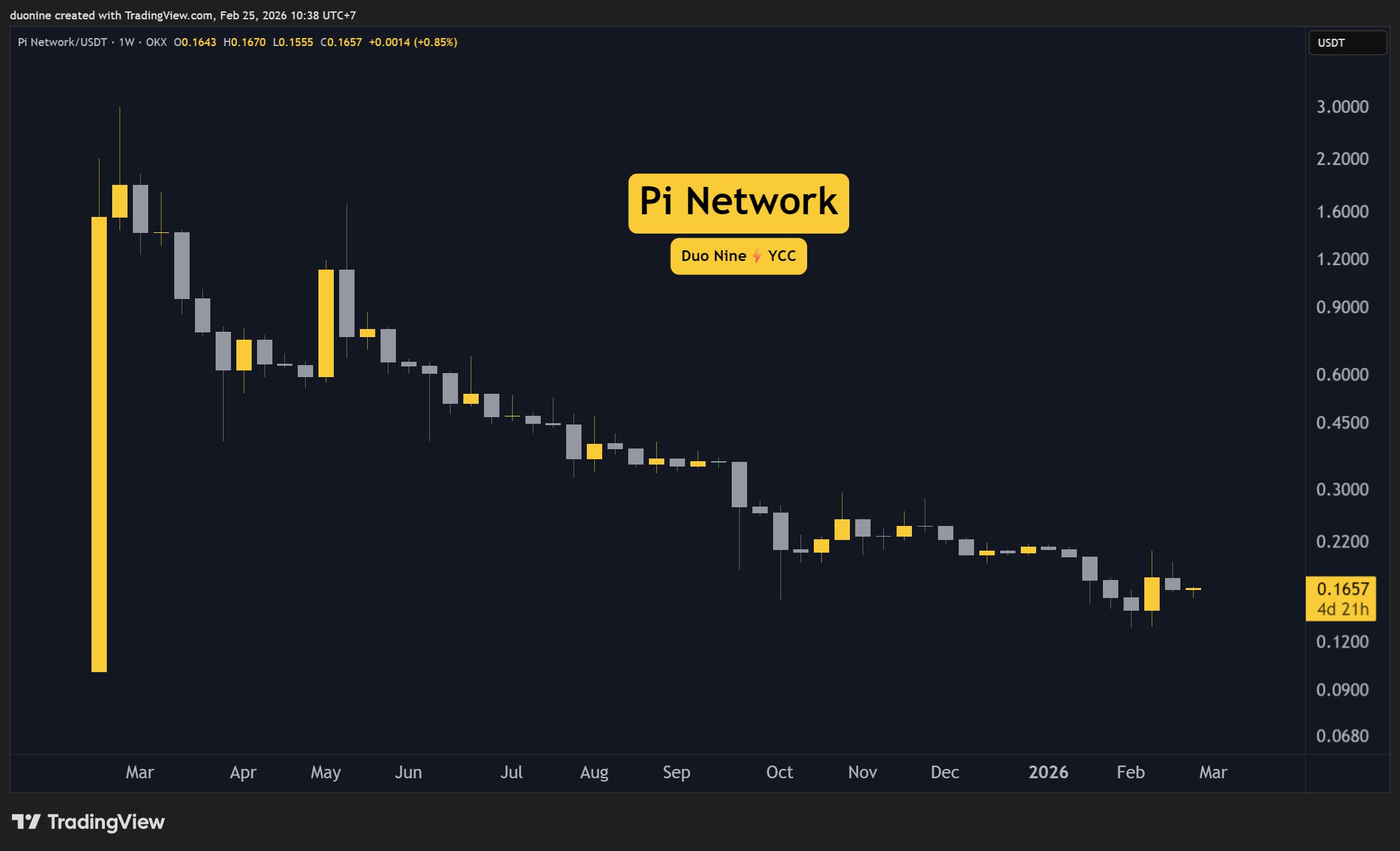
The current price action suggests that buyers are attempting to break out of the existing downtrend. PI found good support above 15 cents, and as long as this holds, buyers have a good shot at higher levels. The current resistance is at 20 cents.
Bounce in Progress
After PI was rejected at 20 cents, the price entered into a pullback that is now bouncing on the downtrend line. If the bulls can hold the price here and push it to a higher high later, the breakout from this downtrend will be successful.

RSI Higher Highs
A key signal that bulls are on the offensive can also be seen on the 3-day RSI, which made a higher high. This could be an early sign that the buyers mean business and they will also attempt to send the price into a higher high above 20 cents next.

Binance Free $600 (CryptoPotato Exclusive): Use this link to register a new account and receive $600 exclusive welcome offer on Binance (full details).
LIMITED OFFER for CryptoPotato readers at Bybit: Use this link to register and open a $500 FREE position on any coin!
Disclaimer: Information found on CryptoPotato is those of writers quoted. It does not represent the opinions of CryptoPotato on whether to buy, sell, or hold any investments. You are advised to conduct your own research before making any investment decisions. Use provided information at your own risk. See Disclaimer for more information.

TLDR:
- Bitcoin faces continued structural pressure amid inactive stablecoin liquidity.
- Stablecoin Supply Ratio shows negative readings across short, medium, and long-term oscillators.
- Price rebounds struggle as capital remains in stablecoins instead of spot exposure.
- Market shift depends on renewed stablecoin demand, not short-term price momentum.
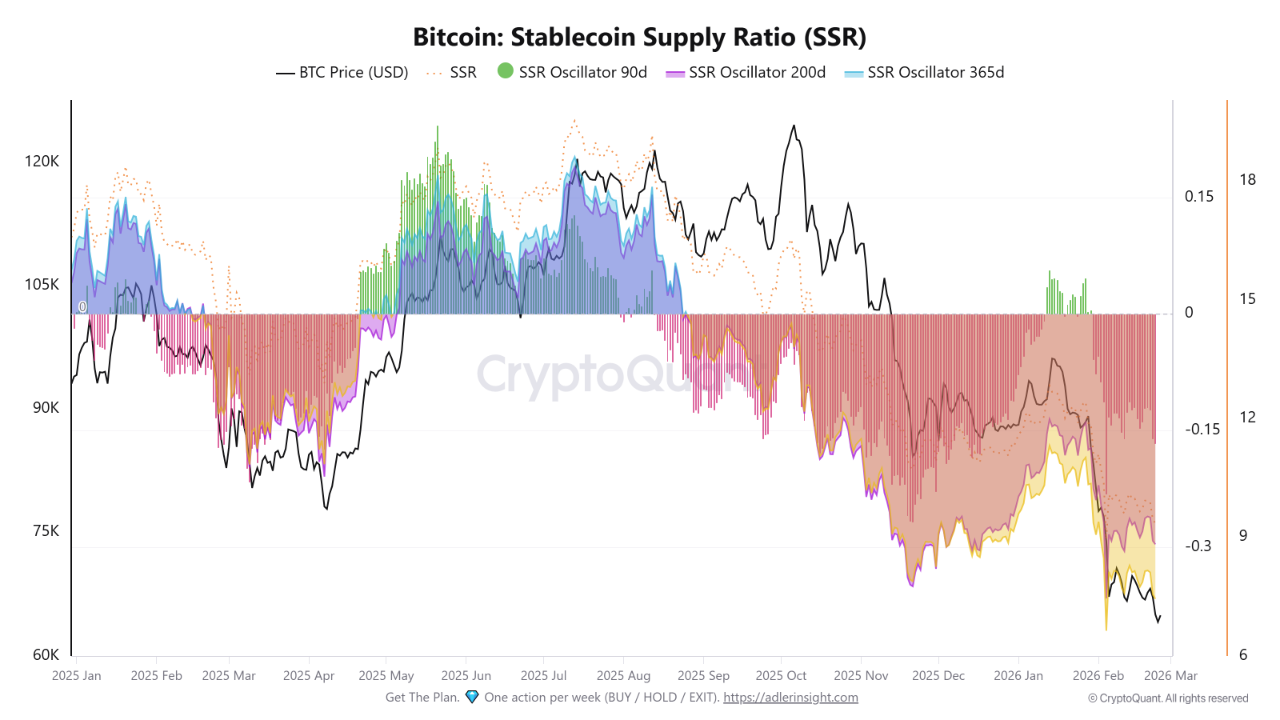
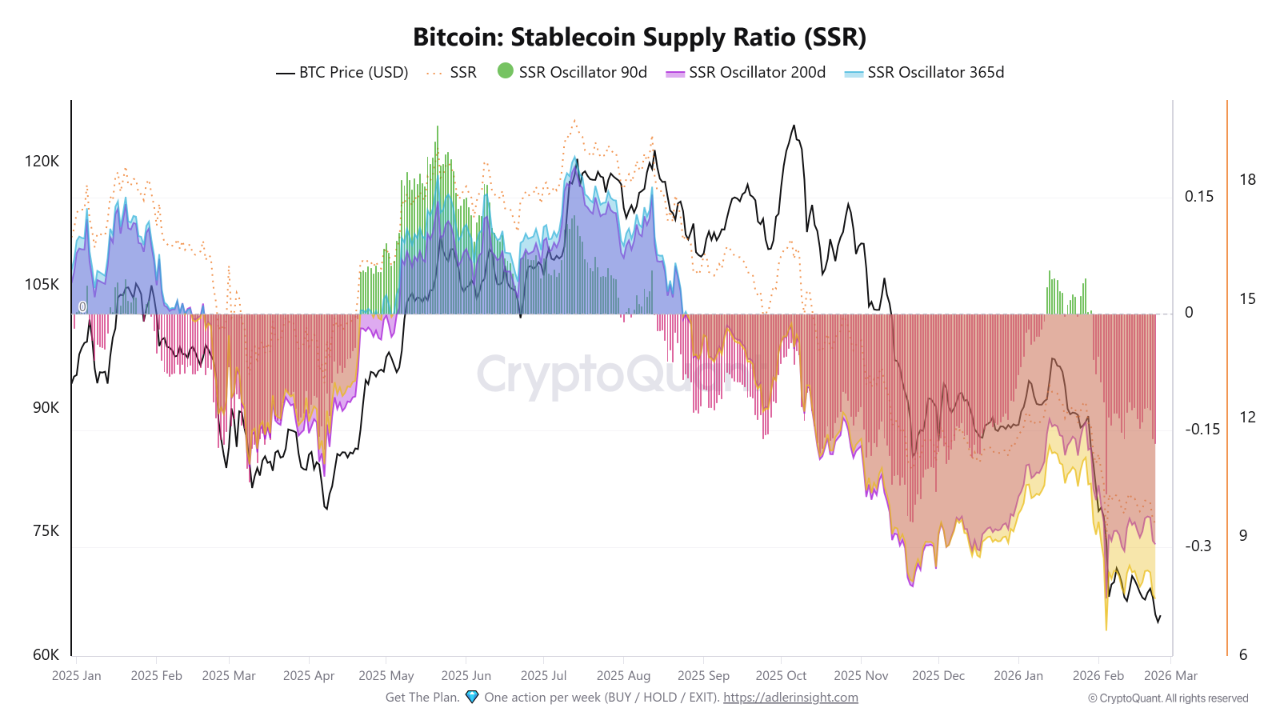
Bitcoin continues to trade under structural pressure, with the Stablecoin Supply Ratio (SSR) remaining negative across 90-day, 200-day, and 365-day oscillators.
Following a peak above $120,000 mid-year, Bitcoin’s price shifted from expansion to contraction, producing successive lower highs into late Q4 and early Q1.
The break below the zero line signaled a structural change in liquidity, reflecting deeper market conditions rather than temporary fluctuations.
Stablecoin Supply Remains Dormant Despite Available Capital
A compressed SSR indicates that stablecoin supply is large compared to Bitcoin’s market capitalization. During expansion phases, rising oscillator readings signal capital moving from stablecoins into Bitcoin, supporting upward momentum.
Currently, stablecoin liquidity exists but remains largely inactive, failing to convert into spot exposure.
The negative SSR across all timeframes suggests that defensive positioning dominates the market. Investors appear hesitant, even as substantial capital remains ready to deploy.
Source: Cryptoquant
This creates a divergence where available liquidity does not translate into buying pressure or price support.
Earlier in the year, positive oscillator readings correlated with strong price structure and controlled volatility. Sustained upside movement occurred as stablecoin demand actively entered Bitcoin, reinforcing momentum. The current absence of such behavior demonstrates passive liquidity conditions.
Downside Volatility Persists Amid Limited Demand
Following the rollover of SSR readings across short, medium, and long-term oscillators, downside volatility has increased.
Price rebounds have lacked follow-through, reflecting insufficient absorption of supply during corrective phases. This trend shows that market participants are not actively deploying stablecoin capital to stabilize Bitcoin.
Historical on-chain data shows extended negative SSR regimes often precede larger inflection points. However, confirmation requires changes in investor behavior and renewed stablecoin deployment.
Without this, the market may continue under structural pressure, as liquidity remains passive despite readiness.
Market observers note that the next meaningful shift in Bitcoin will likely coincide with renewed stablecoin demand rather than purely price-driven momentum.
The system’s current configuration emphasizes the need for capital rotation to support price recovery. Recent market commentary also reflects the cautious stance of investors waiting for clearer signals.



The International Monetary Fund said Wednesday that US inflation will not return to the Federal Reserve’s 2% target until early 2027.
The assessment, part of the IMF’s first Article IV review of the Trump administration, signals that meaningful rate relief remains distant despite the president’s optimism.
IMF Flags Fiscal Risks
IMF Managing Director Kristalina Georgieva told reporters the US current account deficit is “too big.” The Fund estimates it at 3.5% to 4% of GDP in the near term.
But the IMF’s prescription clashes with the administration’s approach. Nigel Chalk, the Fund’s Western Hemisphere Director, said fiscal consolidation — not tariffs — is the best path to narrowing the deficit. The recommendation comes after the Supreme Court struck down Trump’s broad emergency tariffs as illegal, forcing the administration to invoke Section 122 of the Trade Act of 1974 for replacement levies.
The fiscal picture is stark. The IMF projects US federal deficits will remain between 7% and 8% of GDP in the coming years. That is more than double the levels targeted by Treasury Secretary Scott Bessent. Consolidated government debt is on track to reach 140% of GDP by 2031.
“The upward path for the public debt-GDP ratio and increasing levels of short-term debt-GDP represent a growing stability risk to the US and global economy,” the Fund warned.
Trump’s Rate Optimism vs. Structural Reality
The IMF review landed one day after Trump’s State of the Union address, where the president painted a rosy picture on borrowing costs. He claimed mortgage rates had hit four-year lows and that annual mortgage costs had dropped nearly $5,000 since he took office. He framed lower rates as the solution to what he called the “Biden-created housing problem.”
Yet the IMF’s numbers tell a different story. With inflation not reaching the Fed’s target until 2027 and fiscal deficits running at twice the administration’s own goals, the structural case for higher-for-longer rates is strengthening. The Fund pegged 2026 US growth at a resilient 2.4%, leaving the Fed little urgency to ease.
What It Means for Crypto
The implications for risk assets are clear. Sticky inflation and an expanding fiscal deficit reduce the probability of aggressive rate cuts this year. For crypto markets, which rallied on rate-cut expectations through late 2025, the IMF’s assessment reinforces caution.
The deeper irony is that the administration’s own fiscal expansion — including what the IMF notes are historically large tax cuts — is the primary driver of the deficit that keeps rates elevated. Trump wants lower rates but is pursuing policies that structurally prevent them.
The IMF stopped short of predicting a crisis, noting that “the risk of sovereign stress in the US is low.” But the trajectory it describes — rising debt, persistent deficits, delayed disinflation — points to an environment where rate relief comes slowly, if at all.
TLDR
- t54 Labs raised 5 million dollars in a seed funding round co-led by Franklin Templeton and Ripple.
- The company builds identity and risk tools for autonomous agents that conduct financial transactions.
- Anagram and PL Capital joined the round along with several crypto-focused investors.
- t54 operates on networks including XRP Ledger, Solana, and Base.
- The startup plans to hire engineers and a developer relations lead to expand its platform.
t54 Labs has secured $5 million in seed funding to build a trust layer for agentic finance. Anagram, PL Capital, and Franklin Templeton co-led the round with support from Ripple and others. Founder Chandler Fang confirmed the raise and outlined plans to expand infrastructure and hiring.
The San Francisco-based startup launched in January 2025 and focuses on identity and compliance tools for autonomous agents. Fang said no investor received board or advisory seats in the round. He declined to share the valuation or timeline details.
Franklin Templeton and Ripple Back t54’s Seed Financing
Anagram and PL Capital co-led the seed round alongside Franklin Templeton. Ripple, Virtuals Ventures, Blockchain Coinvestors, and ABCDE also participated in the financing. Fang described the raise as the company’s first external funding round.
Fang said t54 employs 12 staff members and plans new hires. The company will add two full-time engineers and one developer relations or business development lead. These hires will support product development and institutional partnerships.
Tony Pecore from Franklin Templeton addressed the investment in a statement. He said, “t54 is building the trust and verification framework that institutional finance will require.” He added that institutions need infrastructure as autonomous agents enter financial markets.
Fang stated that no investor secured governance rights in the company. He confirmed that the round structure remains undisclosed. He also declined to comment on valuation metrics.
Platform Targets Identity, Risk, and Credit for Autonomous Agents
t54 builds tools that verify and monitor AI agents conducting financial transactions. Fang said agents lack standardized identity checks and risk controls. He explained that businesses need accountability when autonomous systems move funds.
The platform includes four core components that address these gaps. It offers identity verification under a system called “know your agent.” It also runs a real-time risk engine that flags suspicious activity before settlement.
The company plans to extend credit lines to verified agents. Credit decisions will rely on identity records, risk scores, and transaction history. The system also combines identity, risk controls, and settlement in one interface.
Fang said, “We’re building the full trust stack that lets businesses hand financial operations to autonomous agents.”
He added that blockchain serves as a settlement and accountability layer. The infrastructure operates across multiple payment rails.
t54 currently runs on the XRP Ledger, Solana, and Base networks. The company also created x402-secure for the Coinbase-incubated x402 agent payment protocol. Last month, Evernorth announced plans to integrate t54’s tools into its XRP Ledger treasury operations.
Evernorth aims to raise over $1 billion for institutional XRP holdings. Under the partnership, Evernorth will use t54 infrastructure for autonomous treasury management. Fang said the collaboration expands institutional deployment of the platform.
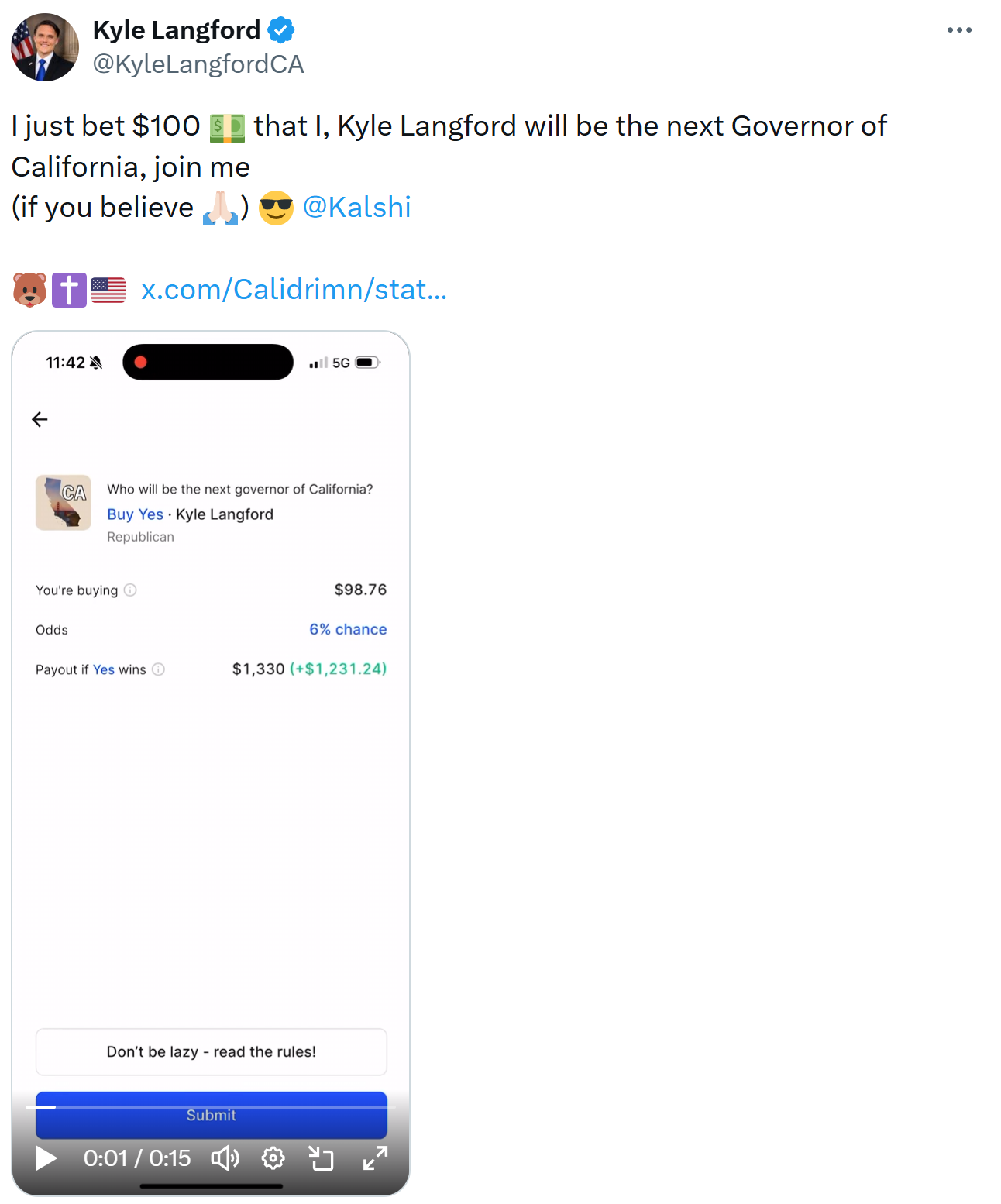
A former contender for governor of California has been banned from Kalshi after betting on his own candidacy last year in violation of insider trading rules, the prediction market platform said on Wednesday.
According to a statement from Kalshi’s head of enforcement, Robert DeNault, the politician bet about $200 on his candidacy for governor of California and posted about it on X, leading to a five-year suspension on the prediction market platform and a $2,000 penalty.
Kalshi did not name the politician, but said he is no longer running for governor and is now running for Congress.
The description appears to fit Kyle Langford, a former Republican turned Democrat who is now running for election to the US House to represent California’s 26th Congressional District.

In an X post published on May 25, 2025, Langford shared a video of himself placing a $98.76 bet on Kalshi, wagering that he would win.
Kalshi said the account did not withdraw any profits and that the case was reported to the CFTC.
Cointelegraph reached out to Langford for further comment but didn’t receive an immediate response.
Meanwhile, Kalshi said it also handed out penalties to a YouTube editor who traded about $4,000 on YouTube stream markets between August and September 2025 — also violating Kalshi’s insider trading rules, resulting in a two-year penalty and a roughly $20,000 fine.
“Our surveillance systems flagged his near-perfect trading success on markets with low odds, which were statistically anomalous,” said Kalshi, which, with the help of other traders on the platform, identified where he worked and concluded that he likely had access to material non-public information.
While Kalshi didn’t name the YouTube editor, mainstream media have widely reported that the editor is Artem Kaptur, an employee of the popular YouTuber MrBeast.

Kalshi, a Commodity Futures Trading Commission-regulated platform, said it has investigated 200 cases and frozen several flagged accounts. It has more than a dozen active cases.
Earlier this month, Kalshi strengthened its surveillance efforts by establishing a surveillance audit committee and partnering with crypto trading surveillance platform Solidus Labs to “detect, investigate, and address market abuse.”
Those efforts come in response to an uptick in regulatory scrutiny of prediction markets as they enter the mainstream.
US lawmakers introduced a bill last month to restrict trading by government insiders after one Polymarket user made over $400,000 on bets tied to Venezuelan President Nicolás Maduro, placing wagers hours before US forces captured him in Caracas.
CFTC sends strong warning to future violators
On Thursday, CFTC Chair Mike Selig said the agency established a prediction markets advisory to collaborate with industry participants in efforts to catch insider traders.
Related: Polymarket users favor Meteora in bets over ZachXBT crypto takedown
Selig warned that those engaging in insider trading will face consequences:
“Let me be clear: if you attempt to engage in manipulation, fraud, or insider trading, we will find you and take action.”
Magazine: Did a Hong Kong fund kill Bitcoin? Bithumb’s ‘phantom’ BTC: Asia Express

Matt Western, chair of the UK’s Joint Committee on National Security Strategy, has urged the government to put a temporary halt on crypto donations to political parties, citing concerns over foreign interference.
In his Monday letter to Steve Reed, Secretary of State for Housing, Communities and Local Government, Western recommended adding a “temporary moratorium” on crypto donations to the upcoming Representation of the People Bill. The moratorium would be lifted once the Electoral Commission issues statutory guidance.
“We are concerned that foreign state intent to interfere in UK political finance may grow out to the next election,” Western said.
“As the security environment worsens and the UK’s military role in Europe grows, the value of influencing the UK’s political positions, for example on Ukraine, or US/EU relations, is likely to increase,” he added.

In January, a group of MPs who chair parliamentary committees — including Western — advocated for a full ban on crypto donations to be included in the Representation of the People Bill, warning that foreign states could use such payments to influence UK politics. However, the bill didn’t include a full ban when it was introduced to the House of Commons on Feb. 12.
Ban funds from crypto mixers and anonymous sources
Western argued that the Electoral Commission’s guidance should require political parties to use only crypto services registered with the Financial Conduct Authority, the UK’s financial services regulator.
Donations that involve the upstream use of mixers or come from an unknown source should be prohibited, according to Western, and political parties that receive crypto should convert it to fiat within 48 hours of receipt.
The next general election in the UK must be held by Aug. 15, 2029. Meanwhile, the Representation of the People Bill is scheduled to have a second reading in the House of Commons on March 2.
National police force needed to tackle foreign interference
Western’s letter also offers longer-term solutions, such as creating a national police force dedicated to overseeing political finance and combating foreign interference.
“Our evidence suggests that there is no clear national enforcement lead for political finance and foreign interference risk. Responsibilities are split across the Electoral Commission, the Metropolitan Police Service, Counter-Terror Policing, the National Crime Agency, MI5 and local police forces,” he said.
Related: Revolut among 4 companies chosen to test stablecoins in UK sandbox
Western also recommended source-of-wealth checks for donors, a review of sentencing for electoral finance offenses, higher penalties for breaches and enhanced powers for the Electoral Commission to compel institutions to disclose the sources of donation funds.
Reform UK became the first party to accept crypto donations in May last year, with leader Nigel Farage announcing at the Bitcoin 2025 conference in Las Vegas that the group is accepting Bitcoin (BTC) and other cryptocurrency contributions from eligible donors.
Magazine: Clarity Act risks repeat of Europe’s mistakes, crypto lawyer warns
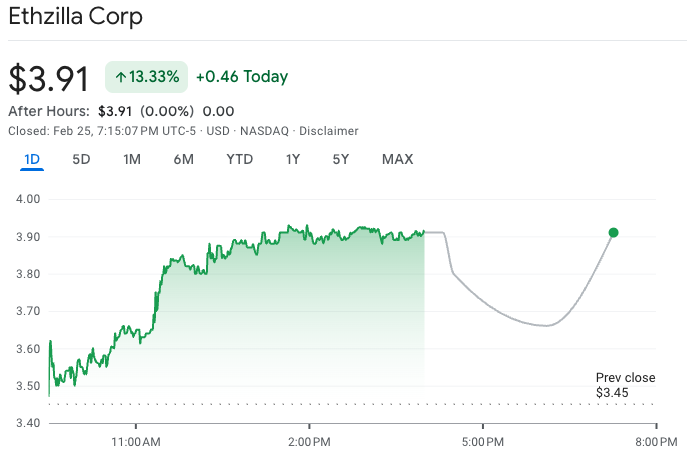
ETHZilla shares climbed 13% on Wednesday after the company changed its name to Forum as part of plans to ditch its crypto treasury strategy and become a tokenization company.
The company said on Wednesday that it has updated its corporate name and brand to Forum Markets and will do business as Forum. ETHZilla will also change its ticker symbol to “FRMM” as of market open on Monday, pending Nasdaq approval.
The company said the rebrand is the next step in its transition into a platform “connecting traditional capital markets with blockchain-based financial infrastructure.”
“Forum embodies our belief that the next generation of financial markets will be built around institutional-grade, on-chain products backed by real assets, governed by transparency, and delivered through regulated infrastructure,” said the company chair and CEO, McAndrew Rudisill.
ETHZilla shares climb 13% on rebrand
Shares in ETHZilla (ETHZ) ended trading on Wednesday up more than 13% to $3.91 and have traded flat after hours, recovering from a slight dip.

Its stock is down over 20% so far this year as a wide crypto market rout has hit stocks tied to digital assets.
ETHZilla was a biotech company called 180 Life Sciences that adopted the ETHZilla brand and started buying and holding Ether (ETH) in July 2025 amid peak hype around crypto treasury companies.
Related: Peter Thiel’s Founders Fund dumps ETHZilla stake as ETH treasuries face pressure
Its crypto treasury pivot sent its shares soaring to a multi-year high of $107 by August, as ETH climbed to just under $4,950 around the same time, but a crypto market rout has since decimated its share price, along with those of its crypto-buying rivals.
As Wall Street largely moved on from crypto treasuries and began to back tokenization firms, Rudisill announced in December that ETHZilla would pivot to bringing “real-world assets (RWA) on-chain through tokenization.”
The company has purchased two commercial jet engines leased to what it said is a “leading US air carrier,” and began offering a token tied to the engines earlier this month called Eurus Aero Token I.
ETHZilla currently holds 69,802 ETH worth $143.7 million at the cryptocurrency’s current price of $2,060, making it the seventh-largest corporate holder of the asset, per CoinGecko.
Magazine: Bitcoin’s ‘biggest bull catalyst’ would be Saylor’s liquidation — Santiment founder
TLDR
- Circle reported a 77% increase in total revenue and reserve income for Q4 2025.
- Circle generated $770 million in revenue, including $733 million in reserve income.
- USDC circulation reached $75.3 billion, rising 72% year over year.
- On-chain transaction volume hit $11.9 trillion in Q4, up 247% from last year.
- Circle posted $133 million in net income and $167 million in adjusted EBITDA.
Circle reported a 77% year over year increase in total revenue and reserve income for the fourth quarter of 2025. The company linked the growth to higher USDC circulation and reserve income. The latest figures outline a widening scale gap between USDC and Ripple’s RLUSD.
Circle Reports Revenue Surge as USDC Circulation Expands
Circle posted $770 million in total revenue and reserve income for Q4 2025. The company generated $733 million of that figure from reserve income.
Reserve income rose 69% from the previous year. Average USDC circulation expanded 100% during the same period.
USDC closed 2025 with $75.3 billion in circulation. That figure marked a 72% increase year over year.
Circle recorded $11.9 trillion in on-chain transaction volume during the fourth quarter. The volume represented a 247% increase from a year earlier.
The reserve yield declined to 3.8% during the quarter. The yield fell by 68 basis points compared with last year.
Revenue less distribution costs increased 136% to $309 million. Circle reported a margin of 40% for the period.
Net income from continuing operations reached $133 million. Adjusted EBITDA rose 412% to $167 million.
Circle stated that higher circulation supported reserve balances and interest income. The company attributed revenue growth to expanded USDC usage.
RLUSD Operates from Smaller Base in Stablecoin Market
Ripple’s RLUSD holds a market capitalization of nearly $1.56 billion. Daily trading volume stands around $124 million.
The supply gap between USDC and RLUSD shapes reserve income capacity. Larger circulation allows higher reserve balances and interest earnings.
Ripple remains privately held and does not publish detailed quarterly financial statements. As a result, direct profitability comparisons remain limited.
RLUSD benefits from Ripple’s global payments network and exchange integrations. However, public data shows a lower circulation base.
USDC’s market capitalization stands at $74.9 billion. That scale exceeds RLUSD by a wide margin.
Circle’s reported earnings provide measurable data on reserve income and operating performance. Ripple has not released comparable quarterly metrics for RLUSD.


Coinbase CEO Brian Armstrong has warned that proposed stablecoin rules in the United Kingdom risk undermining the country’s competitiveness as a global financial hub, arguing that draft measures could stifle innovation rather than support it.
Summary
- Brian Armstrong warned that proposed stablecoin caps by the Bank of England could damage the UK’s competitiveness in digital finance.
- Draft rules reportedly include a £20,000 limit for individuals and £10 million for businesses, prompting concerns the UK could fall behind the $180B global stablecoin market.
- A pro-crypto petition has surpassed 80,000 signatures and could be debated in Parliament if it reaches 100,000.
Coinbase CEO urges UK to rethink stablecoin caps
In a post on X, Armstrong said stablecoin regulations currently being finalized by the Bank of England include proposals to cap stablecoin holdings for individuals and businesses.
Critics of the framework say the suggested limits around £20,000 for individuals and £10 million for businesses, could act as structural barriers to adoption in a market valued at more than $180 billion globally.
“The UK has a long history of being a financial hub,” Armstrong wrote, adding that embracing blockchain innovation is critical as other jurisdictions move quickly to establish clearer crypto frameworks.
He urged UK residents to support a petition organized by Stand With Crypto UK, which has gathered more than 80,000 signatures. Under parliamentary rules, petitions crossing 100,000 signatures are considered for debate in Parliament.
The comments sparked debate online. Some users argued the U.S. should first resolve its own regulatory uncertainty, pointing to the pending Clarity Act in Congress. Others said regulation should manage systemic risk without suppressing innovation, calling for proportional frameworks that allow stablecoins to scale responsibly.
The debate highlights mounting global competition over stablecoin policy, as lawmakers in the U.S. and European Union push forward with new frameworks. For London, long seen as a premier financial center, the final shape of stablecoin rules may determine whether it remains at the forefront of digital asset finance or risks ceding ground to more agile jurisdictions.
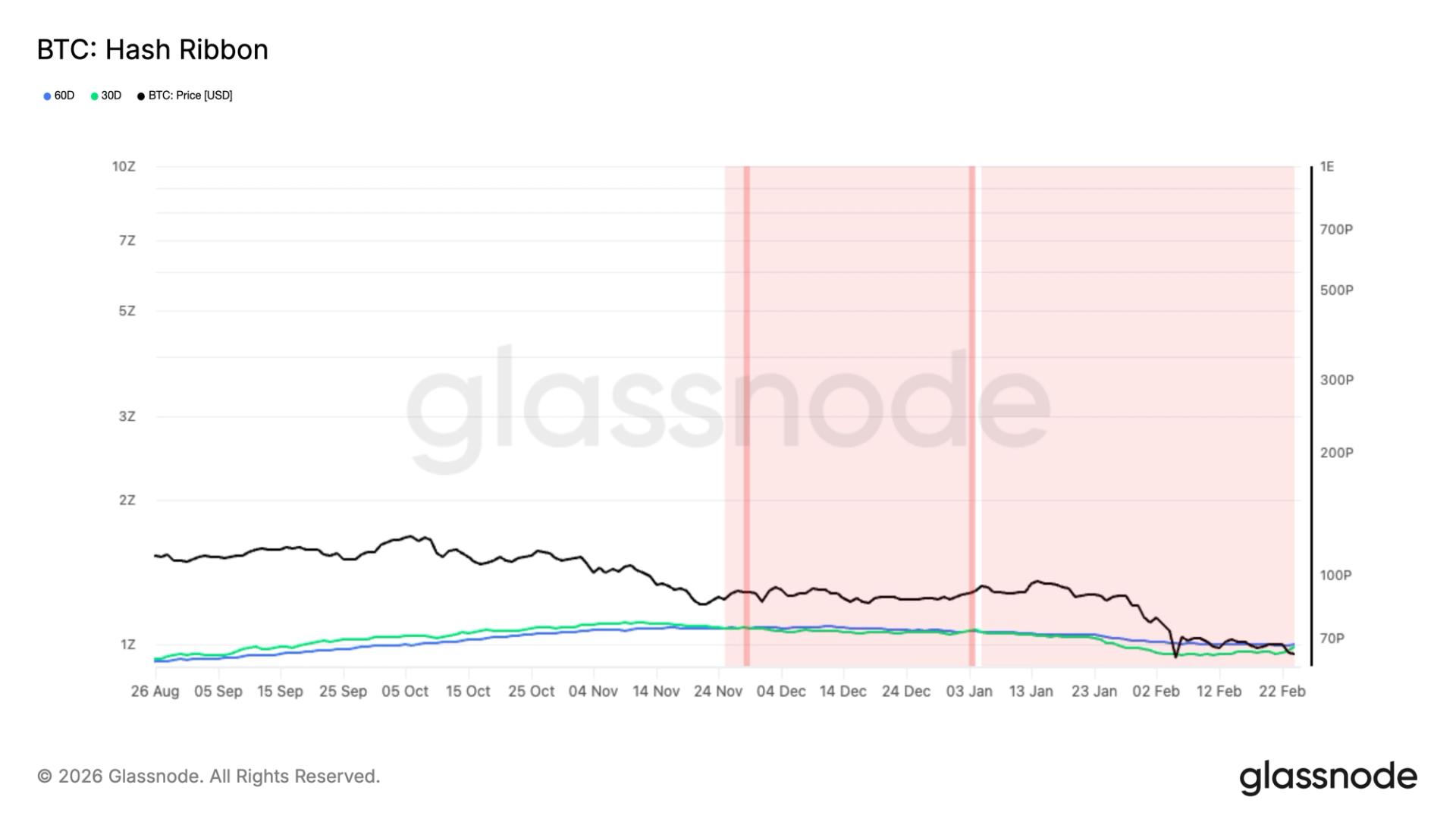
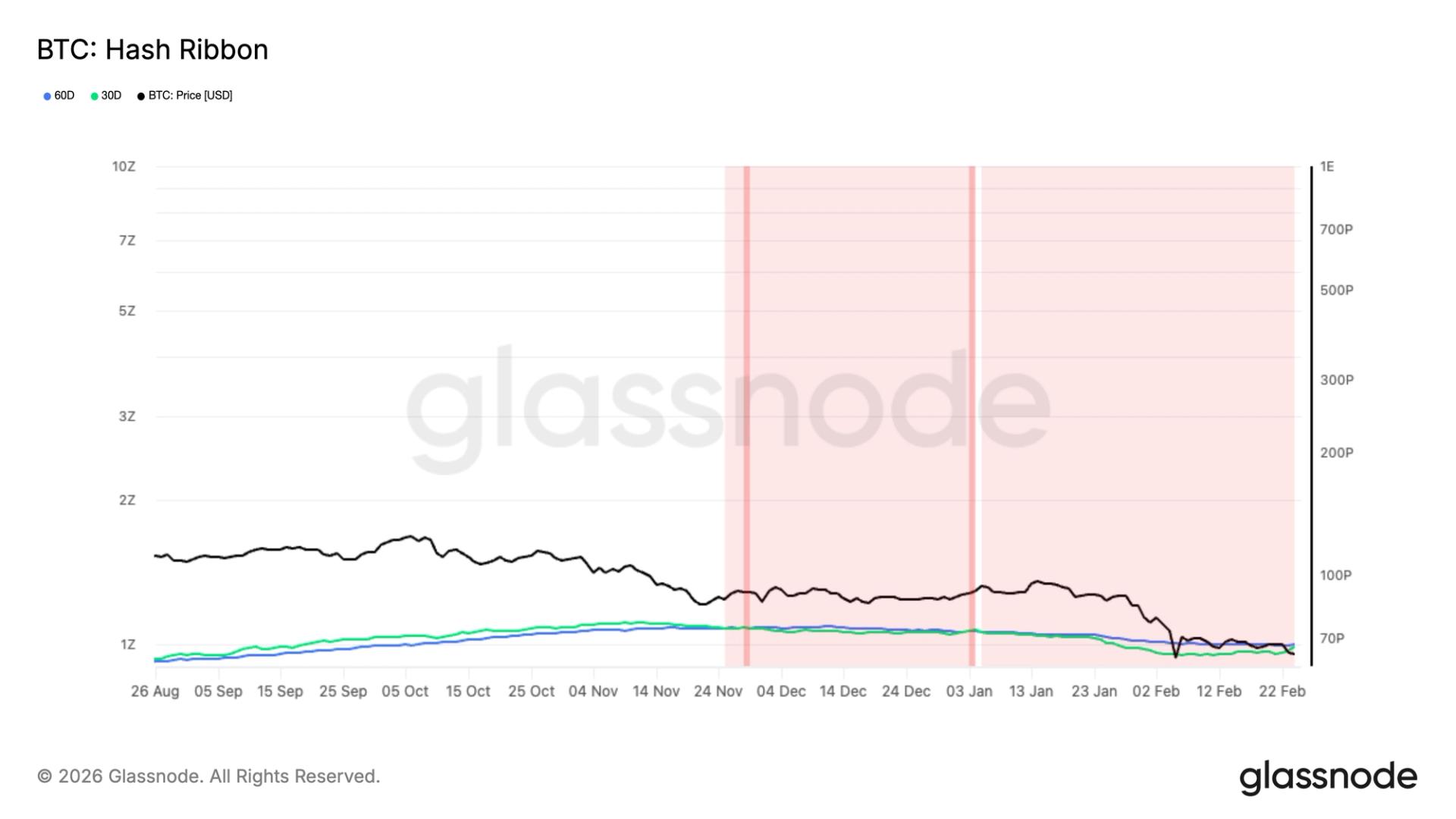
The worst of bitcoin’s 50% drawdown may already be behind us.
The Hash Ribbon indicator is close to signaling the end of a three month miner capitulation. One of the longest capitulations on record, according to Glassnode data.
The metric compares the 30 day and 60 day moving averages of hash rate and is based on the observation that bitcoin often bottoms when miners are under maximum financial stress. Capitulation occurs when mining revenue drops below operating costs, forcing less efficient miners to shut down machines and sell BTC reserves to fund electricity, debt, and overhead. That combination reduces hash rate and adds sustained sell pressure to the market.
A recovery signal is triggered when the 30 day hash rate moving average crosses back above the 60 day, indicating miners are returning online and network stress is easing and that moment is approaching. Historically, when this crossover aligns with improving price momentum, it has marked strong accumulation zones.
Since late November, when the metric first inverted, bitcoin has fallen from around $90,000 to a low near $60,000 in early February, before rebounding to roughly $65,000 as of press time.
Such major corrections are typical during miner stress events. Since 2011, there have been about 20 mining capitulations, most coinciding with local or major bottoms, including January 2015, December 2018 and December 2022.
Hash rate which is the total computational power securing the network is now rebounding, signaling renewed confidence among miners.
At the same time, bitcoin is now trading below its estimated average production cost of $66,000, a level often associated with deep value, according to checkonchain data. The last time this occurred was November 2022, when BTC bottomed near $15,500.
Polygon has fallen nearly 40% from its yearly high in tandem with a market-wide weakness. Can it recover from its losses now as its stablecoin market and app revenues surge?
Summary
- Polygon price is eyeing a rebound amid strengthening fundamentals, including stablecoin activity and revenue surge.
- A potential bullish crossover is forming on the daily chart.
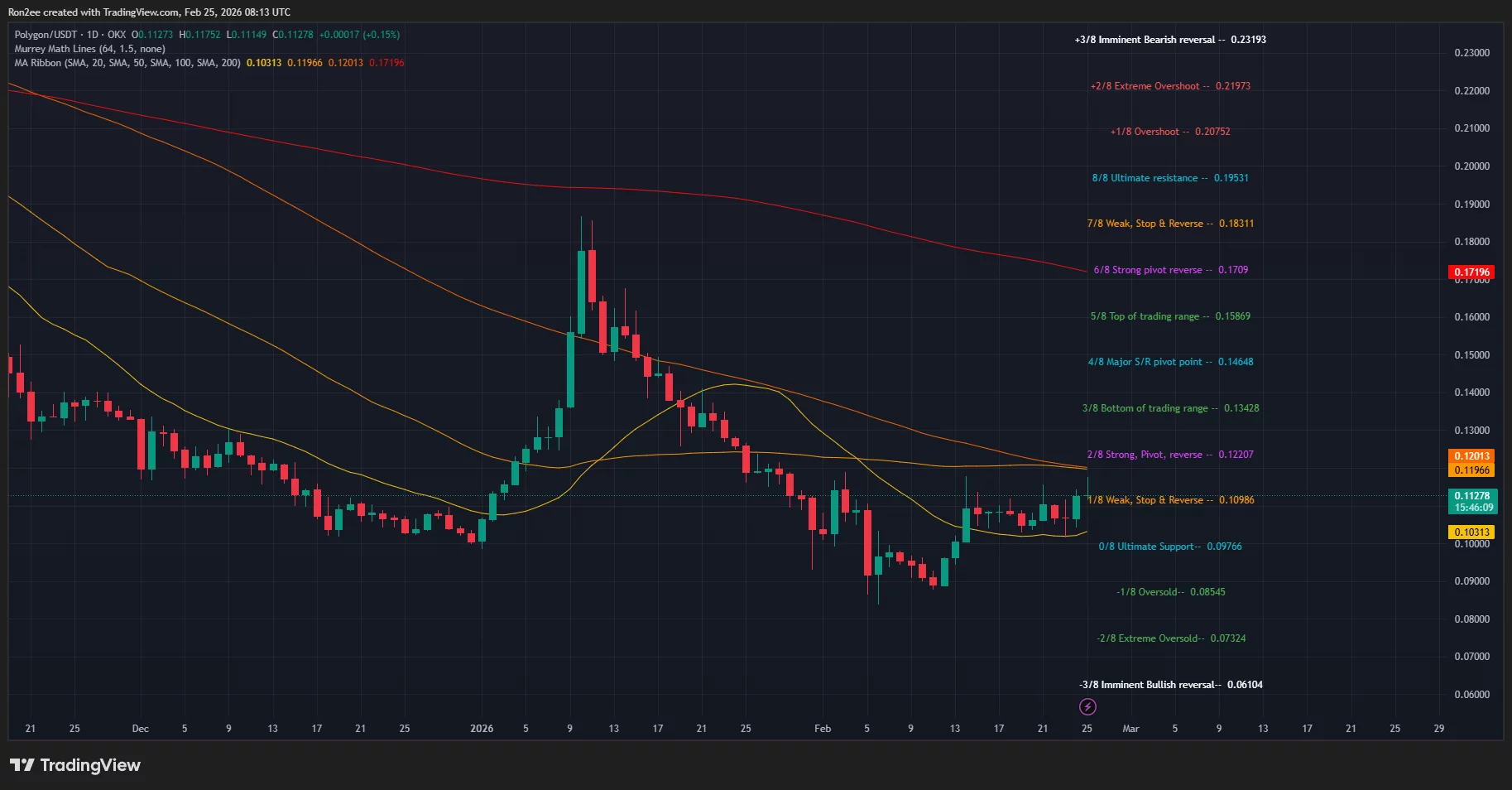
According to data from crypto.news, the Polygon (POL) price fell over 50% from its January high to a yearly low of $0.088 on Feb. 11. This occurred amid a broader market pullback triggered by massive liquidations across leveraged markets as Bitcoin fell below multiple key support zones due to macroeconomic and geopolitical stress.
POL has since bounced back and remained in consolidation between $0.100 and $0.115.
The Polygon network is showing signs of strength, which may position it for a breakout
First, its on-chain stats have grown significantly stronger over recent weeks. Data from DeFiLlama shows that the total supply of stablecoins on the network has surged to $3.26 billion from the $2.4 billion seen at the beginning of February.
At the same time, the weekly revenue generated by DeFi apps on the network has also soared by nearly 70% within the period.
A stronger stablecoin supply and weekly revenue suggest a surge in activity and liquidity, which is a healthy sign for a network and could likely attract more institutional capital.
Second, Polygon’s aggressive token burn strategy is also helping support its price gains. It has recently completed burning over 100 million POL tokens. As tokens are burnt, they are permanently removed from the circulating supply, driving scarcity and providing an accessible bullish narrative for short-term traders.
Third, the daily chart shows that the Polygon price is close to confirming a bullish crossover between the 50-day and 100-day moving averages. Bullish crossovers are typically followed by sustained rallies once confirmed.
Key levels to watch
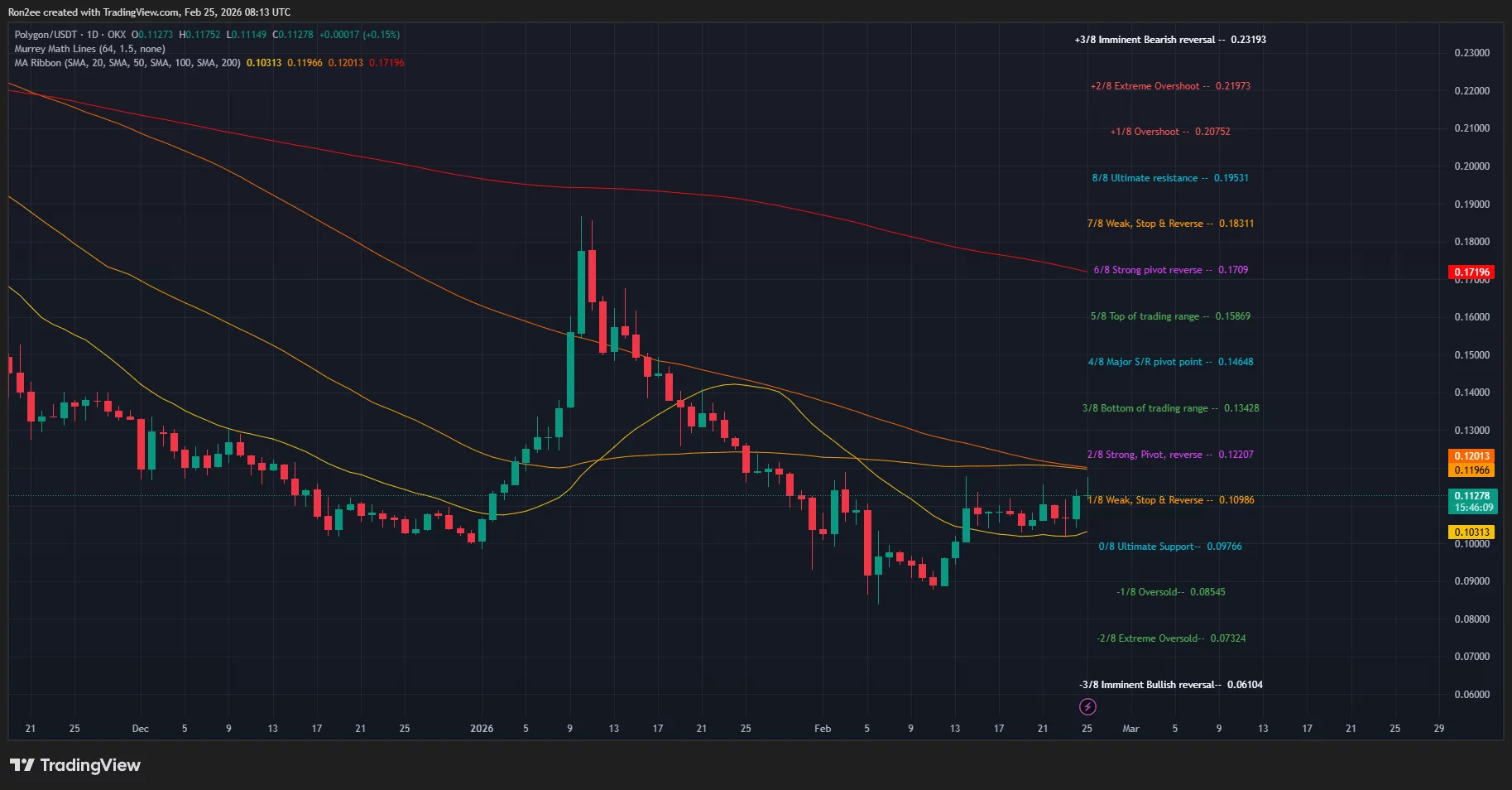
For now, the next overhead resistance level lies at $0.122, which is the strong pivot reverse level of the Murrey Math lines. Bulls must reclaim this level to confirm a trend reversal.
Subsequently, bulls can then try to push the token all the way up to its January high at $0.184, which would mark a roughly 64% rally from its current price of $0.112.
On the contrary, failure to hold the ultimate support level of the Murrey Math lines at $0.097 will result in a drop back to its yearly low of $0.088.
Disclosure: This article does not represent investment advice. The content and materials featured on this page are for educational purposes only.
US Stock Market | Wall Street extends tech-powered rally as AI worries abate

Bitcoin Momentum Stalls as Stablecoin Liquidity Fails to Rotate Into BTC

Galatasaray score twice in extra time to oust 10-man Juventus

Smart energy pays enters the US market, targeting scalable financial infrastructure

Why Israel is blocking foreign journalists from entering

Bitcoin: We’re Entering The Most Dangerous Phase

XRP REMAINS BULLISH AFTER PULLING BACK – HOW MUCH 1000 XRP COULD BE WORTH IN 2026 – XRP NEWS

Unveiling the Realities of Financial Intelligence Finance RealContent

Market Cheat Code: How to Spot Exploding Stocks, Financial Hurdles, & Is the AI Bubble Here?
-

 Video6 days ago
XRP News: XRP Just Entered a New Phase (Almost Nobody Noticed)
-

 Politics4 days ago
Baftas 2026: Awards Nominations, Presenters And Performers
-

 Fashion5 days ago
Weekend Open Thread: Boden – Corporette.com
-

 Sports2 days ago
Women’s college basketball rankings: Iowa reenters top 10, Auriemma makes history
-

 Politics2 days ago
Nick Reiner Enters Plea In Deaths Of Parents Rob And Michele
-
 Sports7 days ago
Clearing the boundary, crossing into history: J&K end 67-year wait, enter maiden Ranji Trophy final | Cricket News
-

 Crypto World2 days ago
XRP price enters “dead zone” as Binance leverage hits lows
-

 Business4 days ago
Mattel’s American Girl brand turns 40, dolls enter a new era
-

 Business3 days ago
Law enforcement kills armed man seeking to enter Trump’s Mar-a-Lago resort, officials say
-

 Tech1 day ago
Unsurprisingly, Apple's board gets what it wants in 2026 shareholder meeting
-
 NewsBeat4 hours ago
Manchester Central Mosque issues statement as it imposes new measures ‘with immediate effect’ after armed men enter
-
 NewsBeat3 days ago
‘Hourly’ method from gastroenterologist ‘helps reduce air travel bloating’
-

 Tech3 days ago
Anthropic-Backed Group Enters NY-12 AI PAC Fight
-

 NewsBeat3 days ago
Armed man killed after entering secure perimeter of Mar-a-Lago, Secret Service says
-

 Politics3 days ago
Maine has a long track record of electing moderates. Enter Graham Platner.
-

 Business1 day ago
True Citrus debuts functional drink mix collection
-
 NewsBeat1 day ago
Police latest as search for missing woman enters day nine
-

 Crypto World1 day ago
Entering new markets without increasing payment costs
-
 Sports3 days ago
2026 NFL mock draft: WRs fly off the board in first round entering combine week
-

 Crypto World6 days ago
83% of Altcoins Enter Bear Trend as Liquidity Crunch Tightens Grip on Crypto Market