



Connect with us

Tech

Valve Software sued by New York AG, accused of promoting illegal gambling via video game loot boxes

Published

on

(Valve Software Image)

A new suit filed by the New York attorney general seeks to stop Valve Software’s use of “loot box” mechanics in its popular PC games, accusing the Bellevue, Wash.-based company of making billions of dollars by luring children and teenagers into gambling on rare Counter-Strike skins.

The lawsuit alleges that Valve’s first-party games are essentially an illegal gambling operation aimed at younger players. It seeks to stop Valve from implementing loot box mechanics in its games going forward, as well as hit the company with a fine equal to “three times the amount of its gain from the illegal practices alleged herein.”

While it’s arguably best known for running the digital gaming marketplace Steam, Valve Software also owns and operates several of its own popular PC games, including Counter-Strike 2, Dota 2, and Team Fortress 2.

All three games feature an optional mechanic where players can pay real money in exchange for “loot boxes”: a virtual item that drops a randomly-generated piece of cosmetic gear that can be used in-game. Most of these items have no mechanical impact and are there strictly for looks, such as silly hats in TF2 or neon-painted “weapon skins” in CS2. This might not make sense to you, but there are people in this world who will pay any price to get an appropriately ugly virtual rifle, and these people are part of why Valve CEO Gabe Newell has a superyacht.

Despite their lack of actual effect, loot boxes and item trading are both an extraordinarily lucrative market for Valve. Virtual items for these three games have been sold for staggering amounts of real money. One estimate cited by the AG’s office indicates that the market for Counter-Strike skins alone was worth over $4.3 billion as of last year.

Advertisement

While Valve absolutely benefits from the strangely frenetic market for virtual items in CS2, TF2, and Dota 2 — it sell these loot boxes in the first place, and hosts the secondary market for them via the in-app Steam Marketplace — the occasionally shocking prices for these items is part of a player-created economy.

In an official press release, New York Attorney General Letitia James wrote that “illegal gambling can be harmful and lead to serious addiction problems… Valve has made billions of dollars by letting children and adults alike illegally gamble for the chance to win valuable virtual prizes. These features are addictive, harmful, and illegal, and my office is suing to stop Valve’s illegal conduct and protect New Yorkers.”

GeekWire reached out to Valve for further comment.

The suit against Valve marks the latest in a series of moves by James to tamp down on gambling operations within New York state, such as shutting down 26 online casinos last year, as well as taking aim at Meta and TikTok for those platforms allegedly posing “harms to young people’s mental health.”

Advertisement

Source link

Continue Reading
Click to comment

Leave a Reply

Your email address will not be published. Required fields are marked *

Tech

New York Times Debuts the Midi Crossword, Its In-Between Puzzle

Published

on

The daily New York Times Mini Crossword can be solved in a minute or so, while the newspaper’s iconic original crossword puzzle might take hours. Now, puzzlers who want an in-between diversion can try a new puzzle from the Times, introduced this week — the Midi Crossword puzzle. (And CNET readers can get daily answers for five Times puzzles — Wordle, Connections, Strands, Connections: Sports Edition and the Mini Crossword.)

New York Times Games subscribers can play the Midi in the New York Times Games app for iOS and Android devices, or on mobile or desktop web. It’s online-only, not in the print newspaper. 

“We’re really leaning into the digital-first nature of the puzzle,” NYT Games Puzzle Editor Ian Livengood said in a Times article about the new puzzle. “About once a week, the puzzle will have a visual effect — an extra flourish when you start or after you solve. This could be a cool animation or colorful shading.”

Advertisement

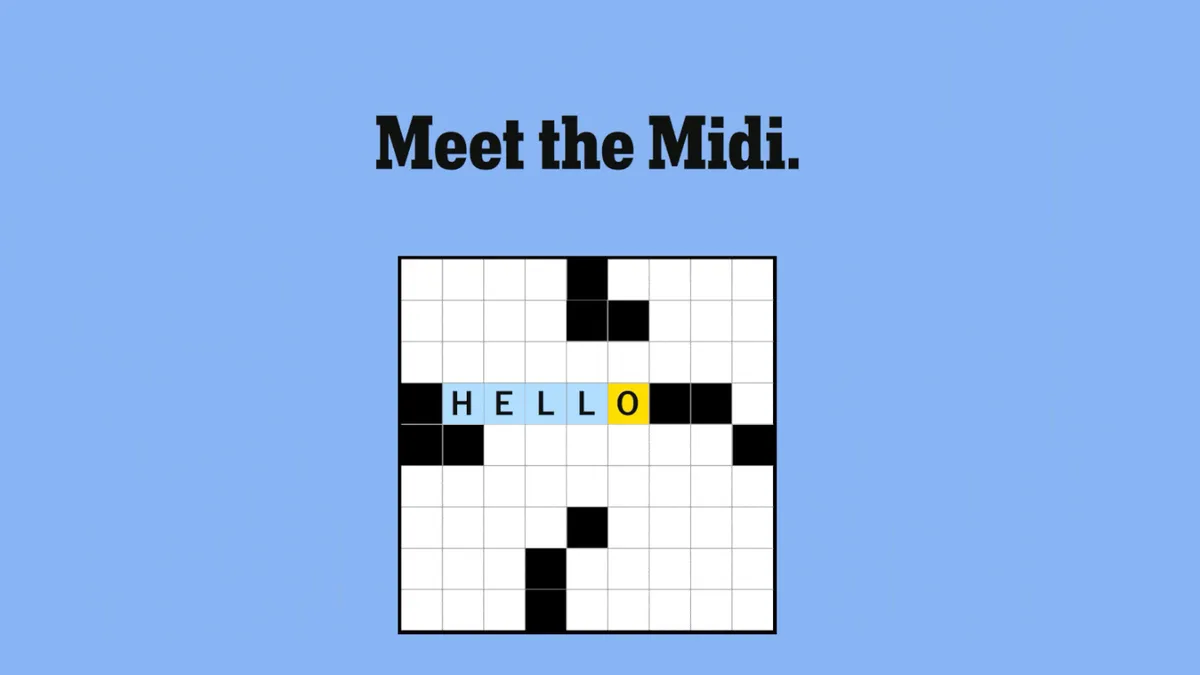
As the name “Midi” suggests, this is a mid-sized crossword puzzle. Where the Mini Crossword usually only has 5 Across and 5 Down clues, the Midi is usually a 9-by-9 puzzle, sometimes as long as 11-by-11.

“If you feel like the Mini is not enough but the Daily is too much, this will be the perfect puzzle for you,” Livengood said.

Each Midi Crossword has a theme that hints at the topics of the clues and answers. Unlike the other puzzles, Livengood says the Midi might occasionally have two-letter words and repeating answers.

I tried the Midi Crossword

Advertisement

I tried Wednesday’s Midi Crossword and solved it in just over 3 minutes. That’s much longer than I spend on the Mini Crossword, but much faster than the original New York Times crossword puzzle takes me. 

I thought most of the clues were pretty simple, and the few tricky ones filled themselves in once I moved from Across to Down.

If you’re a New York Times Games subscriber, this is a nice addition to your daily puzzle stable. It tests your mind a bit more than the Mini, but you can also solve it while watching TV or waiting for someone to text you back.

Advertisement

Source link

Continue Reading

Tech

Today’s NYT Connections: Sports Edition Hints, Answers for Feb. 26 #521

Published

on

Looking for the most recent regular Connections answers? Click here for today’s Connections hints, as well as our daily answers and hints for The New York Times Mini Crossword, Wordle and Strands puzzles.


Today’s Connections: Sports Edition is a fun one. I started mentally connecting the purple category answers right away. Movie-goers and TV watchers, this is a good puzzle for you. If you’re struggling with today’s puzzle but still want to solve it, read on for hints and the answers.

Connections: Sports Edition is published by The Athletic, the subscription-based sports journalism site owned by The Times. It doesn’t appear in the NYT Games app, but it does in The Athletic’s own app. Or you can play it for free online.

Advertisement

Read more: NYT Connections: Sports Edition Puzzle Comes Out of Beta

Hints for today’s Connections: Sports Edition groups

Here are four hints for the groupings in today’s Connections: Sports Edition puzzle, ranked from the easiest yellow group to the tough (and sometimes bizarre) purple group.

Yellow group hint: Meet the new boss.

Advertisement

Green group hint: SNL star.

Blue group hint: WNBA player.

Purple group hint: They’re not real.

Answers for today’s Connections: Sports Edition groups

Yellow group: Coaching decisions.

Advertisement

Green group: Will Ferrell sports movies.

Blue group: Associated with Diana Taurasi.

Purple group: Fictional coaches.

Read more: Wordle Cheat Sheet: Here Are the Most Popular Letters Used in English Words

Advertisement

What are today’s Connections: Sports Edition answers?

completed NYT Connections: Sports Edition puzzle for Feb. 26, 2026.

The completed NYT Connections: Sports Edition puzzle for Feb. 26, 2026.

NYT/Screenshot by CNET

The yellow words in today’s Connections

The theme is coaching decisions. The four answers are extend, fire, hire and promote.

The green words in today’s Connections

The theme is Will Ferrell sports movies. The four answers are Blades of Glory, Kicking & Screaming, Semi-Pro and Talladega Nights.

Advertisement

The blue words in today’s Connections

The theme is associated with Diana Taurasi. The four answers are Connecticut, Phoenix, six golds and White Mamba.

The purple words in today’s Connections

The theme is fictional coaches. The four answers are Bombay, Buttermaker, Dale and Lasso.

Source link

Advertisement
Continue Reading

Tech

The MOST Effective Thermal Mass Works Like A Sunburn

Published

on

Way, way back in the days when men wore beards and wide-lapelled suits in exotic colors, only NASA had access to photovoltaics and ‘solar’ meant solar thermal. In those days of appropriate technology, it was thought that the ultimate in thermal mass was a phase-change material– a salt or wax that in melting and re-freezing could hold far more heat than plain rock or water, which were more often used. Well, now that it’s the 21st century, we’ve got something even better. As Ars Technica reports about a recent paper in Science Magazine, Molecular Solar Thermal (MOST) energy storage can blow that old stuff right out of the water.

Molecular energy storage? That’s where the sunburn comes in. A sunburn occurs because proteins in your skin are denatured– kinked, twisted, and knocked out of shape– by ultraviolet light. The researchers realized that those kinky proteins are pretty energetic: like a spring, they’re storing energy in their distorted structure. Even better, certain chemicals, like the pyrimidone in the study, don’t ‘relax’ the way a phase change material does. It’s not a matter of warming up and giving up the energy stored in the molecular structure when cooling down– the energy needs coaxed out, in this case by an acidic solution.

That poses problems for a closed-loop system, since you’d be continuously diluting the pyrimidone with heat-releasing acid and neutralizing base. On the other hand, 1.65 MJ/kg of energy storage is nothing to sneeze at, especially when you’re collecting it with nothing more technically advanced than a fluid running through clear tubing. Conveniently enough, researchers found a way to make this stuff liquid at room temperature.

Comparing the heat in this MOST storage material to electrical potential in a battery is a case of apples and oranges, but in terms of pure energy density the pyrimidone cooked up for the paper is in the same range as Li-Ion batteries. There is some self-discharge, in that the altered “dewar” state of the pyrimidone decays naturally, but with a half-life of upto 481 days, you could imagine storing up a tankful UV-altered pyrimidone all year round to provide your winter’s heat.

Advertisement
There’s not much power making it to surface in the UV, but lower energy photons cannot effect the transition.

It’s not perfect. Right now you get about 20 “charge cycles” before the molecules break down, but then, if you’re using this for seasonal load-spreading, a two-decade service life is nothing to shake a stick at. It’s only collecting energy from the UV range of the spectrum, which is a tiny fraction of the energy from our sun. The quantum efficiency of the molecule is rather poor as well– it takes a lot of photons to get a dewar transition.

With solar photovaltaics being as cheap as they are, thermal builds are few and far between– even solar water heaters are powered by PV these days. Of course if you’re somewhere that doesn’t get much sun, you could always go for wind power instead.

Thanks to [zit] for the tip! If you’ve seen a bright idea in the wild, or have one yourself, our tips line is open rain or shine.


Source link

Advertisement
Continue Reading

Tech

Salesforce CEO Marc Benioff: This isn’t our first SaaSpocalypse

Published

on

Salesforce pulled out all the stops to convince investors that the AI revolution won’t be its death when it announced fourth-quarter earnings on Wednesday.

Salesforce reported a solid quarter of $10.7 billion in revenue, up 13% year-over-year. For the year, it reported $41.5 billion in revenue, up 10% over the previous year, with both results boosted by its $8 billion acquisition of data management company Informatica last May.

Net income landed at $7.46 billion, and the company offered strong guidance for the year ahead, projecting revenue of $45.8 billion to $46.2 billion — a 10% to 11% increase. It also said its “remaining performance obligation,” or RPO, is over $72 billion. That’s a figure that shows revenue under contact that has not yet been delivered or recognized as earned revenue.

The numbers, though, could only do so much. Software-as-a-service stocks, with Salesforce as their poster child, have been getting hammered lately. Investors fear the rise of AI agents will undermine these companies, making their per-employee-seat business models obsolete. The situation has been dubbed the “SaaSpocalypse.”

Advertisement

The concept hung so heavily in the air during the earnings call that CEO Marc Benioff mentioned the term at least six times.

“You’ve heard about the SaaSpocalypse? And it isn’t our first. We’ve had a few of them,” he said, later adding, “If there is a SaaSpocalypse, it may be eaten by the Sasquatch because there are a lot of companies using a lot of SaaS because it just got better with agents.”

In an attempt to convince the world of its continued health, Salesforce threw everything and the kitchen sink into this earnings report. The company increased its dividend by nearly 6% to $0.44 per share. It launched a new $50 billion share buyback program. That’s always a favorite with shareholders because it both creates a sturdy buyer of shares and reduces the number of shares in circulation (which can boost the stock price).

Techcrunch event

Advertisement

Boston, MA
|
June 9, 2026

The company also revamped the earnings call itself. It was part podcast, part infomercial, and part normal Q&A with a few questions from Wall Street analysts.

Advertisement

Instead of running through the numbers, Benioff interviewed three Salesforce customers on camera to testify to their love of its new agentic options: the CEO of home appliance company SharkNinja; the CEO of Wyndham Hotels and Resorts; and, just to hammer the point, the CEO of SaaStr, the software industry conference and media company. We’ll truncate the interviews to the shortest summary: They all love Salesforce’s AI agent products.

Salesforce also introduced a new metric for its agentic products: agentic work units (“AWU”). The idea here is that rather than simply counting “tokens” — the standard unit of AI processing volume — AWU attempts to measure something more meaningful: whether an agent actually completed a task, like writing to a record, rather than just generating text. (Salesforce logged 19 trillion tokens last quarter, which sounds like a lot but really is not in the AI world.)

“You can ask it a question and it can write you a poem, but that’s not really all that valuable in the enterprise world,” Salesforce president and CMO Patrick Stokes said on the call. So AWU is intended to measure when the agent writes to a record or does some other verifiable task.

On top of that, Salesforce also presented its own architectural vision of the coming world of agents. It shows SaaS software like itself owning most of the tech stack, with the AI model makers on the bottom as unseen, interchangeable, and commoditized work engines.

Advertisement

This was a direct counter to one of the causes of a SaaSpocalypse sell-off earlier this month, after OpenAI released its enterprise agent, Frontier. OpenAI’s architectural vision shows OpenAI owning most of the stack, with systems-of-record SaaS providers (the databases and business-software platforms where companies store their core data) on the bottom as the unseen engines.

And if all that wasn’t enough to influence investors: Benioff was dressed in a black leather jacket, echoing the signature look of the CEO clearly crushing it in the AI world: Nvidia’s Jensen Huang.

Source link

Advertisement
Continue Reading

Tech

Experience F1 tracks with 3D art in Apple Maps ahead of each race

Published

on

Apple Maps has been updated with a new “2026 Formula 1 Tracks Around the World” guide that showcases each racing location. Updated 3D art will be added throughout the season, starting now with Albert Park in Australia.

Apple Maps shown on iPad Pro with F1 tracks labeled around the globe and a sidebar explaining each track
Apple Maps gets F1 guide

It’s almost time for the first F1 season distributed by Apple TV to begin. Apple is known for its vertical integration and brand synergy, and it hasn’t wasted any time with F1 either.
As first discovered by 9to5Mac, Apple is promoting the F1 season in Apple Maps with a new guide. It is titled “2026 Formula 1 Tracks Around the World.”
Continue Reading on AppleInsider | Discuss on our Forums

Source link

Continue Reading

Tech

Today’s NYT Mini Crossword Answers for Feb. 26

Published

on

Looking for the most recent Mini Crossword answer? Click here for today’s Mini Crossword hints, as well as our daily answers and hints for The New York Times Wordle, Strands, Connections and Connections: Sports Edition puzzles.


Need some help with today’s Mini Crossword? Read on for all the answers. And if you could use some hints and guidance for daily solving, check out our Mini Crossword tips.

If you’re looking for today’s Wordle, Connections, Connections: Sports Edition and Strands answers, you can visit CNET’s NYT puzzle hints page.

Advertisement

Read more: Tips and Tricks for Solving The New York Times Mini Crossword

Let’s get to those Mini Crossword clues and answers.

completed-nyt-mini-crossword-puzzle-for-feb-26-2026.png

The completed NYT Mini Crossword puzzle for Feb. 26, 2026.

Advertisement

NYT/Screenshot by CNET

Mini across clues and answers

1A clue: Tesla or Toyota
Answer: CAR

4A clue: What the “M” of BMX stands for
Answer: MOTO

5A clue: Leafy lunch
Answer: SALAD

Advertisement

6A clue: Weighing device
Answer: SCALE

7A clue: “To be,” in Latin
Answer: ESSE

Mini down clues and answers

1D clue: Pepsi and Coke
Answer: COLAS

2D clue: Dickens’s “___ of Two Cities”
Answer: ATALE

Advertisement

3D clue: Took to another floor, as the [circled letters]
Answer: RODE

4D clue: Apple computers
Answer: MACS

5D clue: Dir. from San Francisco to Santa Monica
Answer: SSE

Advertisement

Source link

Continue Reading

Tech

Samsung Galaxy S26 Ultra's privacy screen is the most interesting upgrade this year

Published

on


The Galaxy S26 lineup runs on a customized version of Qualcomm’s latest Snapdragon 8 Elite Gen 5 SoC. Compared to last year’s Snapdragon 8 Gen 4, the new silicon delivers a 19% uplift in CPU performance, a 24% gain in GPU power, and a 39% boost in AI acceleration via…
Read Entire Article
Source link

Continue Reading

Tech

The Galaxy S26 lineup makes one thing clear: Samsung wants you in the Ultra

Published

on

Samsung‘s new Galaxy S26 lineup is by no means a reinvention of the popular smartphone brand. Instead, it’s a collection of design tweaks and some important, even one-of-a-kind, under-the-hood updates that could change the way you use your phone.

The best features, like the actually unique Privacy Display (a first for mobile phones), are confined to the Galaxy S26 Ultra. Not surprising when you consider it’s the true flagship, and the S26 and S26 Plus are more or less like bridesmaids carrying the bride’s lengthy train.

Advertisement

Source link

Continue Reading

Tech

How Petlibro is using AI to catch feline health issues early

Published

on

This post is brought to you in paid partnership with Petlibro

We spend a significant amount of time optimizing our own health: tracking our sleep, monitoring our heart rates, and dialing in our nutrition. But when it comes to our pets, we’re usually left guessing. Cats, in particular, are notorious for hiding pain or illness until a condition becomes severe.

Petlibro is shifting that dynamic with the Luma Smart Litter Box. Since its quiet launch late last year, it has quickly become a staple in thousands of modern households. It moves the concept of a self-cleaning litter box past mere convenience, turning an unpleasant daily chore into a sophisticated system for early health awareness.

AI waste analysis and health tracking

For the data-driven pet owner, the Luma Smart Litter Box provides a level of insight that was previously impossible to get without a vet visit. It’s equipped with an AI waste analysis system that differentiates between pee and poop, and can even identify the consistency of the waste.

Advertisement

Every time your cat uses the box, the system logs their weight and tracks their bathroom behavior. If your cat skips the box for 24 hours, or if there’s a sudden shift in their routine, the app sends a smart alert to your phone. For senior cats or those with sensitive stomachs or kidney issues, this continuous cat health monitoring gives you a critical head start on potential medical problems.

Multi-cat recognition and safety

If you have more than one cat, tracking who did what is usually a guessing game. Luma solves this with a built-in 1080p HD camera and advanced AI that recognizes up to 10 different cats from any angle, even from behind. You get individualized logs and video records for each pet, so you always know exactly whose health you are looking at.

Safety is also a non-negotiable factor with autonomous tech. Since hitting the market in November 2025, Luma has maintained a 100% safe-use record. It features a wide-open, spacious design rather than a cramped globe, and uses triple-check sensors with an anti-pinch system to ensure your cat is completely clear before the cleaning cycle begins.

Autonomous cleaning and odor control

Beyond the health metrics, this is still a highly engineered piece of smart home hardware designed to keep your space clean. It automatically sweeps waste into a sealed drawer after each visit, holding up to seven days of waste for two cats.

Advertisement

To ensure your home doesn’t smell like a pet sanctuary, it utilizes an active odor-control system. A built-in fan pulls air through carbon filters, filtering out 97% of odors, with adjustable fan speeds controlled directly from the app. It’s a quiet, seamless integration into a well-kept home.

The bottom line

The Petlibro Luma represents a maturation in pet technology. It is a smart litter box for cats that respects the aesthetics of your home while acting as a daily preventive care tool for your pets. It replaces guesswork with hard data, offering peace of mind that your cat’s health is always being monitored.

Source link

Advertisement
Continue Reading

Tech

The AirPods Pro 3 Are $20 Off

Published

on

Looking for a new pair of earbuds to pair with your favorite iPhone or iPad? Right now, you can grab the Apple AirPods Pro 3 for just $229 on Amazon or Best Buy, a $20 break from their usual price. They’re our favorite wireless headphones for iPhone owners, with great noise-canceling, easy connectivity, and unique features like heart rate and live translation.

  • Review: Apple AirPods Pro 3

  • Review: Apple AirPods Pro 3

The active noise-canceling on the third generation AirPods Pro has improved a great deal, with our reviewer Parker Hall comparing them to the Bose QuietComfort Ultra 2 Earbuds when it comes to filtering out all but the highest frequency, loudest noises. The improved ear tips, now lined with foam, are more comfortable and fit better in smaller ears, with four different sizes to choose from. They also have better sound isolation, which improves the noise canceling and transparency mode performance noticeably.

While Android owners have a variety of choices when it comes to earbuds and headphones, iOS users will appreciate the extra features specifically built for anyone in the Apple ecosystem. If you’re into running with minimal devices, the AirPods Pro 3 can actually take your heart rate through your ears, a neat trick that we found surprisingly consistent with other fitness trackers. Another unique feature, live translation, will bring up the Translate app on iOS and relay what someone else is saying directly into your ears in your own language. Once again, we were impressed by how fast and accurate the system was, and as more languages are added it will become even more useful.

We really only had two minor complaints about the AirPods Pro 3, one of which was that the default EQ is a bit V-shaped, with a slightly overdone bass that’s either really appealing or slightly grating. Thankfully you can tweak your EQ in Spotify or Apple Music to dial in that experience. The other issue is that these have limited compatibility with Android devices, so if you’re on a Samsung or Pixel, you’ll want to check out our other favorite earbuds. For iPhone and iPad owners looking for the latest and greatest for their listening experience, the discounted AirPods Pro 3 are an excellent choice.

Advertisement

Source link

Continue Reading

Trending

Copyright © 2025