

Crypto World
Mutuum Finance (MUTM) V1 Protocol: Feature Expansion & DeFi



DeFi cryptocurrency Mutuum Finance has launched its V1 protocol on the Sepolia testnet, introducing the core mechanics of its lending and borrowing system. The team also stated that an additional feature is scheduled to be rolled out next week as development continues.
Mutuum Finance Protocol Upgrade
In a recent statement published on X, the team confirmed that it is working on several upcoming features while refining key components of the codebase, including optimizations to the Stability Factor. According to the update, a new protocol feature is expected to be released in the coming week.
The project has reported more than $20.6 million raised to date, with over 19,000 holders of its MUTM token, currently priced at $0.04. In the same update, the team noted that the Sepolia testnet version of its lending and borrowing protocol has surpassed $90 million in testnet total value locked (TVL), reflecting simulated liquidity activity during beta testing.
Lending and Borrowing with Mutuum Finance
In the current beta version, users can interact with the protocol’s core functionality. The interface displays a protocol overview including total liquidity, available liquidity, and total variable debt. Four assets are currently supported for minting and interaction on testnet: ETH, USDT, LINK, and WBTC. The portfolio section provides data on net worth, net APY, Stability Factor, and total supplied and borrowed balances, with mtTokens also integrated into the current version of the platform.
When users supply assets to the platform, they receive corresponding mtTokens as proof of deposit. For example, supplying WBTC results in the issuance of mtWBTC. These tokens accrue value over time based on the applicable APY, which is determined by pool utilization.
By depositing $10,000 worth of USDT into the protocol, users receive mtUSDT in return. If the average annual percentage yield (APY) is around 4–5% over a one-year period, the position could generate approximately $400 to $500 in passive income, depending on pool utilization and borrowing demand. In addition, users can stake their mtTokens within the safety module, where eligible participants receive dividends denominated in MUTM tokens.
On the borrowing side, collateral is required to secure loans and protect the protocol against default risk. Rather than selling assets, users can post them as collateral and borrow against their value. For example, an investor holding $1,000 worth of ETH who does not wish to liquidate the position can deposit that ETH as collateral and borrow USDT. The borrowed stablecoins can then be used for expenses or deployed into other investments, while the user retains exposure to potential upside in ETH. Once the borrowed amount and accrued interest are repaid, the full collateral can be withdrawn.
Audited Protocol
Mutuum Finance has undergone a security audit of its lending and borrowing protocol conducted by Halborn, a blockchain security firm that has also performed audits for major projects such as Solana. In addition, the MUTM token smart contract was reviewed by CertiK, receiving a Token Scan score of 90 out of 100.
In partnership with CertiK, Mutuum Finance has established a bug bounty program with a reward pool of up to $50,000, aimed at identifying potential vulnerabilities and strengthening protocol security.
The total supply of MUTM is capped at 4 billion tokens. A portion of this allocation is designated for incentives, including giveaways, leaderboard bonuses, and other community reward programs.
Mutuum Finance continues to advance development of its lending and borrowing protocol as testing progresses on the Sepolia network. With additional features scheduled for rollout and security reviews completed, the project remains focused on refining its infrastructure ahead of full deployment.



Vitalik Buterin says Ethereum (ETH) will achieve quantum resistance soon via post-quantum hash-based signatures in the Strawmap, a four-year Layer 1 (L1) upgrade plan.
Why it matters:
- Quantum computers could break Ethereum’s current encryption; hash-based signatures would close that gap before the threat arrives.
- Buterin’s confirmation moves quantum resistance from a research topic to a scheduled Ethereum upgrade target.
- The Strawmap’s six-month fork schedule means quantum-resistant slots could ship within the plan’s first two upgrades.
The details:
- Buterin confirmed the timeline via X on February 26, 2026, citing the Ethereum Foundation’s Strawmap.
- The Strawmap was published at strawmap.org after an Ethereum Foundation workshop in January 2026.
- The name blends “strawman” and “roadmap,” meaning the plan is experimental and built to be revised.
- The four-year plan targets ~7 forks every six months; Glamsterdam and Hegotá are confirmed for 2026.
- Buterin also proposed cutting block time to 2 seconds and finality from ~16 minutes to 6–16 seconds.
The big picture:
- Bitcoin and Solana ecosystems are also running post-quantum research, making it a growing priority across blockchains.
- A fixed six-month fork schedule marks a faster, more structured upgrade cadence for Ethereum’s L1.
- The Strawmap is explicitly a draft — timelines, including quantum resistance, could shift as development progresses.
The post Vitalik Buterin Says Ethereum Will Soon Achieve Quantum Resistance appeared first on BeInCrypto.


Indiana lawmakers have passed House Bill 1042, commonly referred to as the Bitcoin Rights Bill, clearing both legislative chambers and sending the measure to Governor Mike Braun for final approval.
Summary
- Indiana’s HB 1042 Bitcoin Rights Bill has passed both legislative chambers and now awaits Governor Mike Braun’s signature.
- The bill would allow cryptocurrency investment options in public retirement plans and protect individual digital asset access.
- If signed, the law will take effect July 1, 2026, reflecting growing institutional adoption of Bitcoin.
Indiana passes Bitcoin Rights Bill as crypto adoption accelerates
If signed into law, the bill will take effect on July 1, 2026, and would allow cryptocurrency investment options within public retirement plans while affirming the rights of individuals to access and use digital assets.
The legislation marks a significant step in formalizing Bitcoin and broader digital asset participation within state-backed financial structures.
The news comes as Arizona lawmakers advanced Senate Bill 1649, which would create a Digital Assets Strategic Reserve Fund allowing the state to hold, invest and potentially lend seized cryptocurrencies.
By permitting exposure to cryptocurrencies in public pension portfolios, Indiana joins a growing list of jurisdictions responding to sustained institutional interest in Bitcoin (BTC), particularly following the strong performance and capital inflows into spot Bitcoin exchange-traded funds over the past several years.
Supporters argue the bill ensures that Indiana’s public institutions and citizens are not disadvantaged as digital assets increasingly become integrated into global financial markets. The measure also reinforces protections for individuals to hold and transact in cryptocurrencies without undue restriction, signaling a pro-innovation stance from state lawmakers.
The push comes amid mounting pressure from financial markets to modernize investment frameworks. Since the launch and expansion of Bitcoin ETFs, institutional adoption has accelerated, prompting policymakers to revisit existing rules around retirement portfolio diversification and digital asset access.
Governor Braun has yet to announce whether he will sign the bill, but if enacted, Indiana would position itself as one of the more crypto-forward states heading into the second half of 2026.


Bitcoin price rebounded over 7% to $69,487 on Thursday amid a spike in short liquidations and improved risk-on sentiment following a bullish Nvidia earnings report.
Summary
- Bitcoin price approached $70K amid a short squeeze and bullish Nvidia earnings report.
- Spot Bitcoin ETFs drew in $257 million in inflows on Wednesday.
According to data from crypto.news, Bitcoin (BTC) price shot up to an intraday high of $69,487 on Thursday, Feb. 26, before settling around $68,200 at press time, still holding 4.6% gains over the past 24 hours. The bellwether’s rebound follows just two days after it fell under $63,000 amid investor fears over macroeconomic and geopolitical uncertainty.
Bitcoin price rallied as investors bought the asset during the recent dip in prices. As BTC price rose, it triggered liquidations of highly leveraged bearish bets across leveraged crypto markets. Data from CoinGlass shows that roughly $576 million worth of positions were liquidated from BTC futures, with around $470 million coming from short positions. Bitcoin alone accounted for $194 million in short liquidations.
Short liquidation occurs when rising prices force traders who bet against the asset to close their positions, with traders having to buy back the asset at higher prices to cover their losses. This, in turn, leads to an immediate spike in prices through a feedback loop often called a short squeeze.
Another major tailwind that boosted BTC price and other altcoins came from investors embracing a risk-on sentiment as stocks posted modest gains and broader risk sentiment improved with Nvidia Corp.’s latest bullish earnings report.
Notably, the Dow Jones Index increased by 307 points on Wednesday. At the same time, the Nasdaq 100 and S&P 500 indices jumped by 351 and 56 points.
AI chip-making giant Nvidia, the world’s largest publicly traded company, reported record-breaking earnings for Q4 of Fiscal Year 2026. Quarterly revenue reached an all-time high, increasing 20% quarter-over-quarter and 73% year-over-year. For the full fiscal year 2026, total revenue reached $215.9 billion, a 65% increase from the previous year.
Previously, investors were concerned about excessive AI spending by Big Tech giants. However, the back-to-back bullish earnings from Nvidia, seen as a barometer for the AI-fueled trade, appear to have calmed investors’ nerves.
The return of inflows into spot Bitcoin ETFs also likely played a modest part in improving investor sentiment. Data from SoSoValue show that the 12 spot Bitcoin ETFs recorded $257.7 million in inflows on Wednesday, marking the first triple-digit inflows figures since Feb. 10.
While it is not yet a strong sign of a long-term trend, investors took it as a positive signal that institutional demand remains resilient despite recent market volatility.
Disclosure: This article does not represent investment advice. The content and materials featured on this page are for educational purposes only.


Trump-backed World Liberty Financial has introduced a new proposal to overhaul its governance through a new Governance Staking System designed to incentivize long-term participation, redirect arbitrage profits to committed token holders, and deepen adoption of its USD1 stablecoin.
Summary
- WLFI proposes mandatory staking for unlocked tokens to participate in governance, with ~2% targeted APR for active voters.
- A new Node and Super Node tier system offers OTC USD1 conversion access and prioritized partnership discussions.
- The plan aims to redirect stablecoin arbitrage profits from market makers to long-term WLFI ecosystem participants.
World Liberty Financial aims to redirect USD1 arbitrage profits to token stakers
Under the proposal, holders of unlocked WLFI (WLFI) tokens will be required to stake their tokens in order to participate in governance voting. Staking will carry a minimum lock-up period of 180 days, with voting power determined by a non-linear square root formula that factors in both the amount staked and remaining lock duration.
Governance rights will be dynamic and non-transferable, adjusting as lock-ups decline.
Active participation is central to the design. Stakers must vote at least twice during their lock-up period to qualify for base staking rewards, targeted at roughly 2% APR and paid from the WLFI treasury.
The reward rate will be determined at WLFI’s discretion and is not tied to revenue or operational performance. Only staking participants will receive USD1 deposit incentives on WLFI Markets provided by Dolomite.
The proposal also introduces a tiered structure. “Nodes,” defined as participants staking at least 10 million WLFI, would gain access to over-the-counter USD1 conversion via licensed market makers at 1:1 parity.
World Liberty Financial plans to subsidize these conversions, redirecting arbitrage opportunities previously captured by institutional intermediaries, estimated at 10–15 basis points per cycle.
At the top tier, “Super Nodes” staking 50 million WLFI would receive guaranteed access to the WLFI team for partnership discussions and potential economic incentives, subject to compliance and commercial review.
The proposal requires a quorum of 1 billion eligible WLFI voting tokens and a simple majority to pass, with a seven-day voting window. If approved, implementation will roll out in three phases, beginning with governance staking activation.
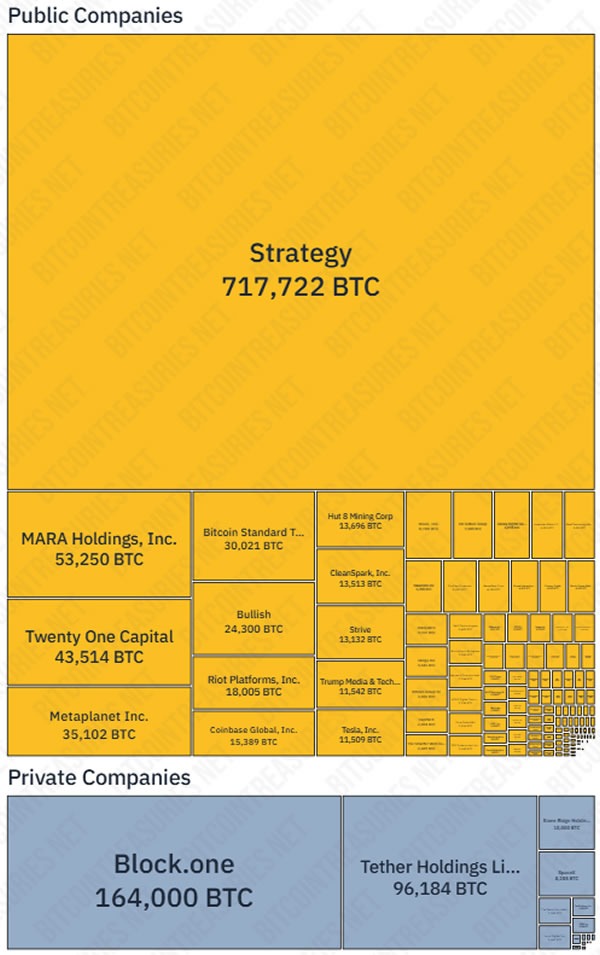
Swiss digital asset bank Sygnum unveiled Sygnum Select, a new institutional crypto asset management service aimed at corporate treasuries overseeing roughly $100 billion in digital assets. Launched on Thursday, the discretionary mandate product applies the discipline of traditional private banking to the crypto frontier, offering strategic asset allocation, active rebalancing, and rigorous risk oversight for institutional clients. The service arrives with live mandates and about $200 million already under active management, according to a Sygnum spokesperson. Data from Bitcoin (CRYPTO: BTC) holdings platform BitcoinTreasuries shows public companies hold 1.13 million BTC and private firms hold 287,990 BTC, collectively valued at about $97 billion. This snapshot underscores the scale at which corporations already engage with crypto assets, even as the market seeks mature infrastructure for professional management.
Key takeaways
- Sygnum launches Sygnum Select, a discretionary mandate service that brings traditional portfolio-management rigor to institutional crypto assets, with live client mandates already in place.
- The offering targets the growing market of corporate and public digital asset treasury entities (DATs), which collectively hold well over $100 billion in crypto assets, highlighting a broad demand for regulated, end-to-end management.
- Clients gain full execution authority within an agreed investment framework, including strategic asset allocation, active rebalancing, and risk oversight, bridging private banking discipline with crypto exposure.
- Live mandates cover a wide spectrum: spot, staking, hedging, derivatives, tokenized securities, and market-neutral strategies across traditional and crypto assets.
- Initially, the service will serve Swiss clients, with plans for broader geographic expansion as institutional demand and regulatory clarity evolve.
Tickers mentioned: $BTC, $ETH
Market context: The range of corporate crypto deployments is expanding as institutions seek regulated, scalable solutions amid ongoing debates about custody, risk controls, and tokenization in traditional finance. The broader market backdrop includes a rising interest in tokenized assets and state-backed crypto reserves, alongside ongoing regulatory developments in key jurisdictions.
Sentiment: Neutral
Price impact: Neutral. The article describes product launches and market demand rather than immediate price moves.
Trading idea (Not Financial Advice): Hold. The expansion of regulated, discretionary crypto management services could support institutional risk management and liquidity, without implying short-term price catalysts.
Market context: As institutional adoption accelerates, regulated infrastructure and holistic management solutions grow in importance for corporate treasuries, alongside shifts toward greater tokenization and crypto readiness in traditional finance. The Swiss regulatory environment and broader ETF and custody developments remain closely watched by market participants. For context on Switzerland’s regulatory landscape, see the overview of cryptocurrency regulations in Switzerland: here.
Why it matters
The launch of Sygnum Select marks a notable push toward integrating crypto exposure into the same disciplined framework that underpins private banking solutions for traditional assets. By offering a discretionary mandate, Sygnum signals that institutional clients are seeking more than custody or execution—they want an active partner who can manage a crypto portfolio with a holistic risk and governance approach. This shift aligns with the maturation of the asset class, where institutions expect outcomes that mirror established private-banking standards rather than bespoke, ad hoc arrangements.
The service also reflects a broader market reality: corporate and public sector DATs have accumulated substantial crypto holdings, with BitcoinTreasuries data illustrating a substantial reservoir of crypto on corporate balance sheets. As regulated, scalable services emerge to serve these needs, the industry could see stronger demand for multi-asset strategies, cross-asset hedging, and tokenized securities that enable traditional investors to participate in crypto markets through familiar risk controls. The combination of traditional asset management discipline and crypto-native execution logic is intended to reduce operational friction and counterparty risk for large holders navigating a rapidly evolving landscape.
At the same time, Sygnum’s own track record—such as its market-neutral Bitcoin fund and recent fundraising milestones—provides context for the platform’s credibility. The bank previously raised more than 750 BTC in January for its market-neutral Bitcoin fund, which delivered an annualized return in the fourth quarter of 2025. The bank’s growth narrative is underscored by a post-money valuation surpassing $1 billion after a notable early-2025 funding round. These dynamics matter because they offer institutional clients a clearer signal of the institution’s capacity to manage complex crypto strategies within a regulated framework, which remains a priority for many treasuries evaluating outsourcing options.
Looking ahead, the Swiss focus of Sygnum Select—paired with reported intentions to expand geographically—illustrates a broader trend in which regulated, cross-border crypto asset management solutions become more widely available. While the initial rollout is Switzerland-centric, market participants will be watching to see how the product scales across jurisdictions with varying regulatory regimes, especially as tokenization, state-backed reserve concepts, and more sophisticated crypto instruments gain traction in traditional finance.
For readers tracking corporate crypto exposure, the push toward professional, institution-grade management infrastructure is a notable development. It complements existing flows into exchange-traded and custody services, while potentially broadening the set of investable crypto strategies available to treasuries and asset managers. As liquidity in the space continues to evolve and regulatory frameworks mature, Sygnum Select could serve as a blueprint for how crypto assets are managed within a regulated, multi-asset portfolio architecture, rather than in isolated, standalone crypto vehicles.
What to watch next
- Timeline and criteria for expanding Sygnum Select beyond Switzerland, including any regulatory approvals required for new jurisdictions.
- Uptake metrics: the pace at which additional client mandates are onboarded and the diversification of assets across traditional and crypto classes.
- Performance data for existing portfolios, including risk metrics and the impact of active rebalancing on portfolio drawdowns.
- Further product development, such as additional hedging instruments, derivatives capabilities, and tokenized securities offerings within the discretionary framework.
Sources & verification
- BitcoinTreasuries data on BTC holdings by public and private companies: https://bitcointreasuries.net/
- Cointelegraph reporting on Sygnum’s Bitcoin fund and related fundraising milestones: https://cointelegraph.com/news/swiss-bank-sygnum-raises-750-btc-market-neutral-fund
- Cointelegraph coverage of tokenization and Bitcoin reserves in 2026: https://cointelegraph.com/news/2026-sovereign-bitcoin-reserves-tradfi-tokenization-adoption-sygnum
- Cointelegraph overview of cryptocurrency regulations in Switzerland: https://cointelegraph.com/learn/articles/an-overview-of-the-cryptocurrency-regulations-in-switzerland
Market reaction and key details
Market participants will likely view Sygnum Select as part of a broader evolution in crypto asset management toward regulated, scalable, and holistic offerings. The emphasis on active portfolio management, multi-asset exposure, and risk oversight aligns with a growing demand from institutional clients seeking to integrate crypto into sophisticated investment programs rather than treat it as a stand-alone hedge or speculative play. As more corporate treasuries and DATs consider long-term crypto strategies, the availability of a regulated, institution-grade management solution could shape whether crypto becomes a durable component of diversified portfolios, or remains a jurisdiction-specific niche.
What the next steps could look like
If Sygnum successfully scales Sygnum Select beyond its Swiss launch, expect further clarity on governance frameworks, performance reporting standards, and interoperability with traditional private-banking platforms. The evolving landscape may also see regulators scrutinize product disclosures, risk controls, and cross-border suitability assessments as more institutions adopt such mandates. In parallel, ongoing developments in tokenization and liquidity solutions may broaden the range of assets available within discretionary crypto strategies, potentially expanding the addressable market and accelerating institutional adoption.
What to watch next
- Expansion announcements and regulatory milestones for onboarding new jurisdictions within the next 12–18 months.
- New performance disclosures and risk metrics for active portfolios under Sygnum Select.
- Partnerships or integrations with custody providers, insurers, or traditional asset managers to streamline compliance and reporting.
Update (Feb. 26 at 06:00 UTC): This article has been updated to include commentary from Paolo Ardoino, CEO of Tether]
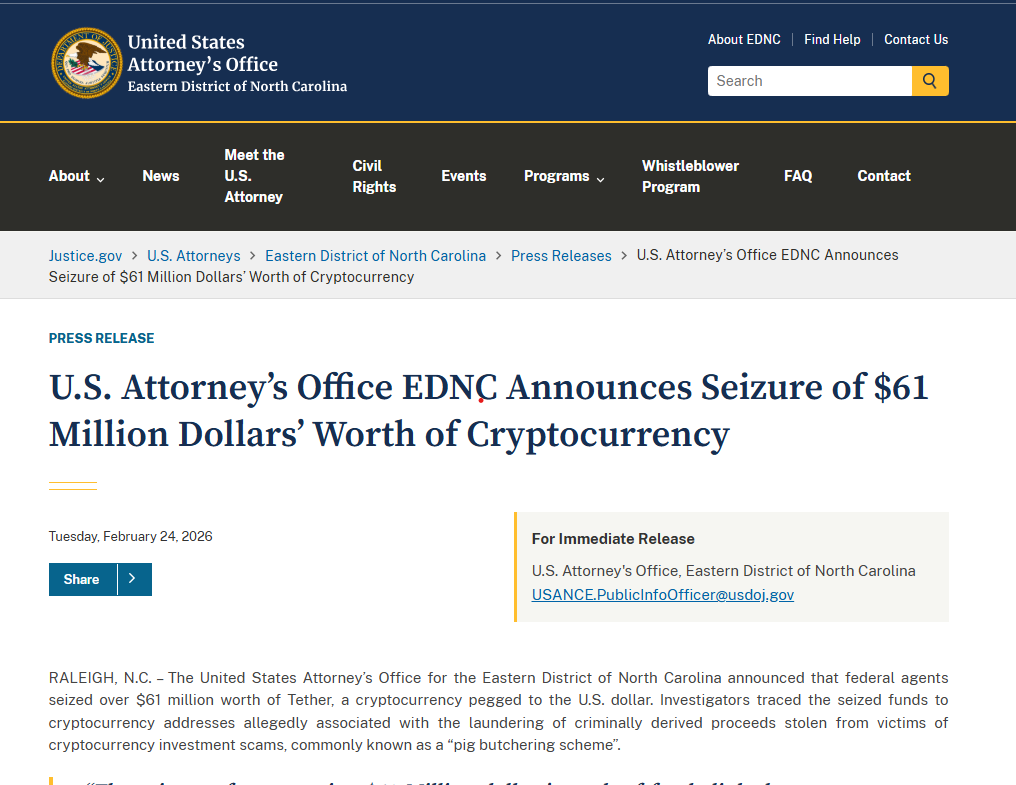
US Federal agents in North Carolina seized more than $61 million worth of USDt (USDT) tied to a large‑scale “pig butchering” crypto investment scam that preyed on victims through fake online relationships and fraudulent trading platforms.
According to the US Attorney’s Office for the Eastern District of North Carolina in Raleigh on Tuesday, the scammers posed as romantic partners and claimed to have special trading expertise.
They then steered their victims toward convincing but fake crypto sites that displayed fictitious investment portfolios showing unusually high returns that enticed them to invest more, before the scammers blocked their withdrawals and demanded extra fees when victims tried to get their money back.
Investigators from Homeland Security Investigations traced the victims’ funds across multiple wallets used to launder the proceeds before identifying several addresses that still held substantial amounts, which were then seized and made subject to forfeiture.

Prosecutors noted that Tether cooperated in the investigation: “The Department of Justice and HSI acknowledges Tether for its assistance in transferring these assets,” the release states, in the latest example of stablecoin issuers working with authorities to freeze and recover funds flowing through US dollar‑pegged tokens like Tether’s USDt.
Paolo Ardoino, CEO of Tether, said that the company’s cooperation with the DOJ highlighted the need for blockchain transparency to “empower law enforcement to act quickly and effectively against criminal activity.”
Crypto fraud scams on the rise
This latest case comes at a time of explosive growth in crypto fraud, including pig butchering schemes that blend romance scams with bogus trading opportunities.
Data from Chainalysis’ 2026 Crypto Scams report found that crypto scam losses in 2025 reached $17 billion, with artificial intelligence (AI) driven impersonation and social engineering scams increasing by 1,400% year‑on‑year and becoming far more profitable than traditional phishing or giveaway schemes.
Related: How pig-butchering crypto scams turn trust into a financial weapon
In one incident in December 2025, a Bitcoin investor said he lost his retirement savings after being groomed by an online “trader” who used AI‑generated images and a fabricated persona to build trust before convincing him to move his coins into a fake investment platform.
US prosecutors have started to secure major sentences against the perpetrators of these networks.
In February, a key figure in a pig butchering‑linked crypto laundering operation involving over $70 million was sentenced to 20 years in federal prison, reflecting how seriously courts are now treating this category of crime.
Magazine: South Korea gets rich from crypto… North Korea gets weapons
Global digital asset banking group Sygnum has announced the launch of an institutional crypto asset management service targeting the $100 billion corporate crypto treasury sector.
Sygnum Select, launched on Thursday, is described as a “discretionary mandate service” that applies Swiss banking’s established portfolio management model to crypto assets.
The service launches with live client mandates, client assets, and $200 million in actively managed portfolios already in place, a Sygnum spokesperson told Cointelegraph.
The move comes amid solid growth in corporate and public digital asset treasury companies (DATs) over the last few years, which now hold over $100 billion in crypto assets.
“Yet many lack the infrastructure for professional, institutional-grade management,” which creates “strong demand” for regulated services offering such products and addressing the gap, stated Sygnum.
There are currently 1.13 million BTC held by public companies and 287,990 BTC held by private firms worth a combined $97 billion, according to BitcoinTreasuries.

Not all DATs have been success stories. Ether treasury ETHZilla rebranded to “Forum” on Wednesday as part of a pivot out from holding crypto, with the new focus on tokenized assets following a 20% stock slide year to date.
Meanwhile, the world’s largest BNB treasury company, CEA Industries, has crashed 94% from its high last year, reportedly blaming the family office of Binance founder Changpeng Zhao, YZi Labs, for a “secret side agreement.”
Sygnum said there has been a shift in client needs
Sygnum Select takes full execution authority within a client’s agreed investment framework, handling strategic asset allocation, active rebalancing, and risk oversight.
“As digital assets mature and institutional adoption accelerates, we’re seeing a clear shift in what clients need,” said Sygnum chief investment officer Fabian Dori.
He added that crypto foundations and corporate treasuries are no longer simply looking for custody and trading, “they want a trusted, regulated counterparty who can actively manage their assets with the same discipline and holistic approach as a traditional private bank.”
Related: Sygnum sees tokenization and state Bitcoin reserves taking off in 2026
The live mandates include spot, staking, hedging, derivatives, tokenized securities, and market-neutral strategies, and most portfolios include multiple asset classes across traditional and crypto assets, according to Sygnum.
“Clients can now access bespoke portfolio management that combines what traditional asset managers or crypto-native firms can offer,” explained Markus Haemmerli, Sygnum’s head of portfolio management.
The service is initially available only to Swiss clients, but broader geographic expansion is planned.
Sygnum raised more than 750 BTC in January for its market-neutral Bitcoin (BTC) fund, which posted an annualized return of 8.9% in the fourth quarter of 2025.
The Swiss crypto bank reached a post-money valuation of more than $1 billion after securing $58 million in an oversubscribed strategic growth round in January 2025.
Magazine: Clarity Act risks repeat of Europe’s mistakes, crypto lawyer warns


South Korean authorities have arrested two suspects in connection with the theft of 22 bitcoins that had been held as evidence by the Gangnam Police Station, officials announced on Wednesday.
Summary
- Two suspects were arrested in South Korea for allegedly stealing 22 bitcoins seized as evidence in a 2021 case.
- The missing Bitcoin, worth about $1.5 million, was discovered during a nationwide audit of police custody practices triggered by other digital asset losses.
- Law enforcement plans to implement stronger custody procedures for seized digital assets, including dual custodians and secure storage protocols.
Suspects detained as South Korea police probe disappearance of seized Bitcoin
The digital assets, seized in November 2021 and valued at roughly ₩2.1 billion (about $1.5 million) at current market prices, were discovered missing during a nationwide audit of law enforcement’s virtual asset custody practices.
The Gyeonggi Northern Provincial Police Agency apprehended the two individuals on February 25, 2026, on suspicion of embezzling the Bitcoin (BTC) after it was held in connection with a criminal investigation that has since been suspended.
The audit was triggered following a separate high-profile incident in which 320 bitcoins went missing from the Gwangju District Prosecutors’ Office custody.
Investigators revealed that while the cold wallet device, a USB-based storage intended to secure the private keys, remained physically in police possession, the bitcoins it contained had been transferred out to an external address without authorization.
Police have not confirmed whether the stolen cryptocurrency has been recovered.
Authorities are tightening procedures for handling seized digital assets. New protocols to be introduced will include assigning dual custodians for wallets and sealing both hardware and recovery phrases, with plans to entrust assets to specialized custodians within the year.
A police official stated that steps will be taken to strengthen safeguards to prevent similar breaches going forward.
The arrests mark a significant escalation in the investigation into internal vulnerabilities related to law enforcement’s management of cryptocurrency evidence, prompting broader scrutiny and calls for overhauled digital asset custody standards.
The crypto market capitalization has moved higher over the past day, with broad gains across major coins reflecting improving investor sentiment.
At the same time, the rebound has squeezed bearish positions, with over $468.5 million in short liquidations recorded during the 24-hour window.
Crypto Liquidation Wave Hits Short Sellers
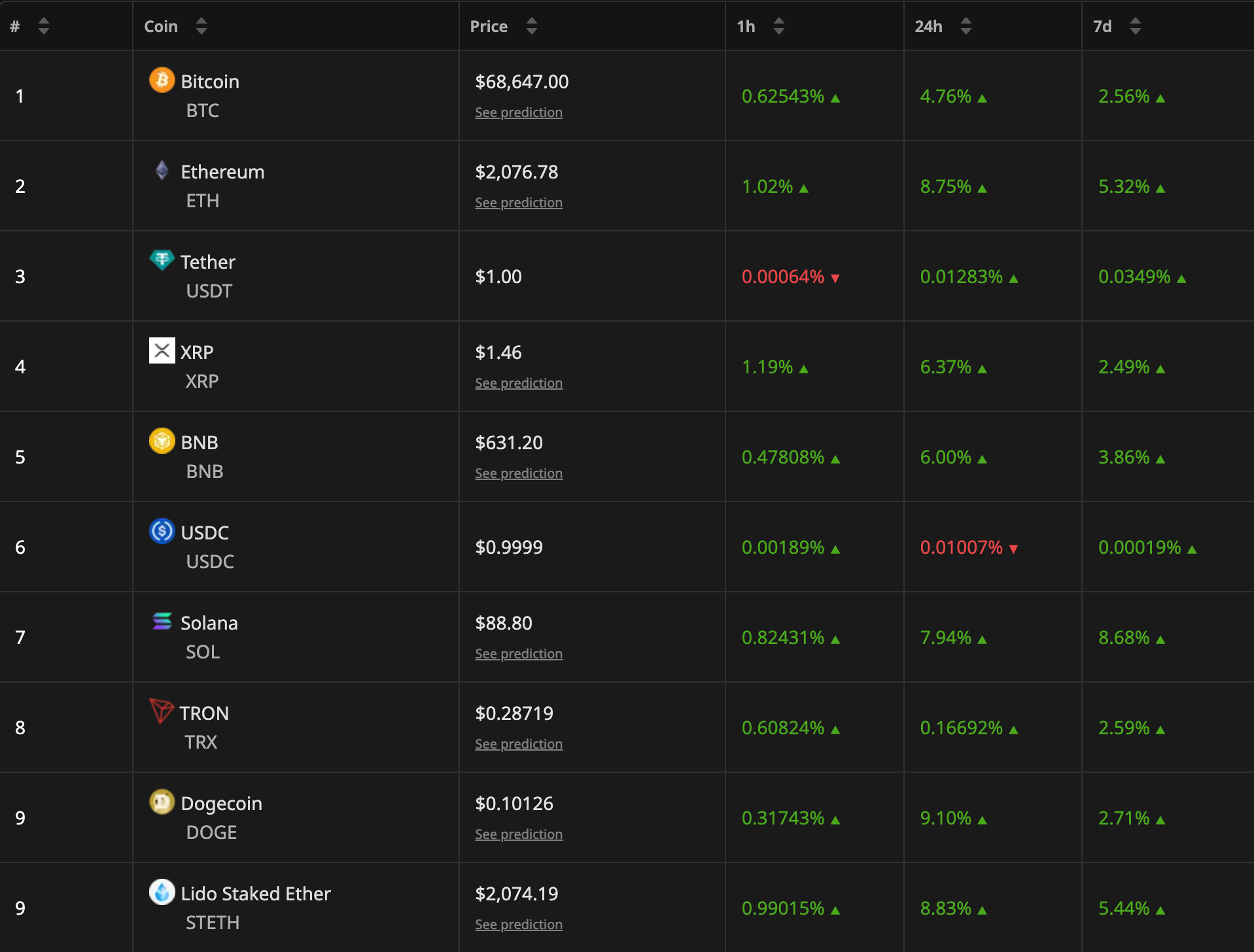
According to BeInCrypto Markets data, total market capitalization has increased by 4.29%. The majority of the top 10 cryptocurrencies have posted gains over the past 24 hours.
Dogecoin (DOGE) jumped 9.10%, marking the strongest performance among the 10 largest cryptocurrencies. Lido Staked Ether (STETH) followed, advancing 8.83%. Ethereum (ETH) ranked third among the top performers, jumping 8.75% and reclaiming the $2,000 level.
Bitcoin (BTC) also posted notable gains, climbing 4.76% over the past day. The flagship cryptocurrency briefly touched $70,027 on Binance yesterday before retracing slightly to trade at $68,647 at press time.
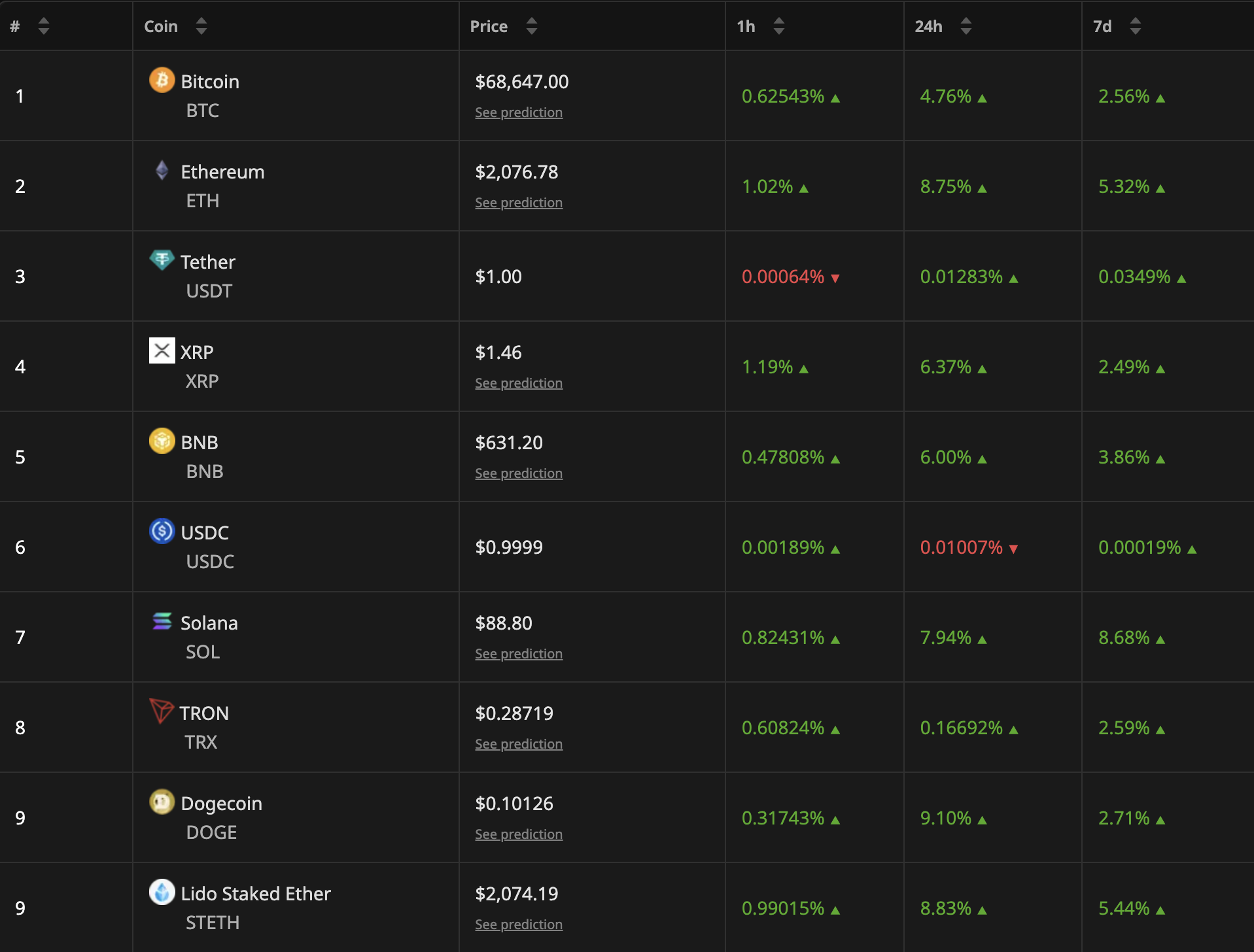
BeInCrypto reported that the rally benefited some long traders who recorded profits amid ETH’s latest rise. However, traders betting on further downside saw losses.
According to Coinglass, 128,348 traders were liquidated over the past 24 hours, with total liquidations reaching $575.59 million. Short traders bore the brunt of the losses, accounting for $468.53 million in liquidations, compared to $107.06 million in long positions.
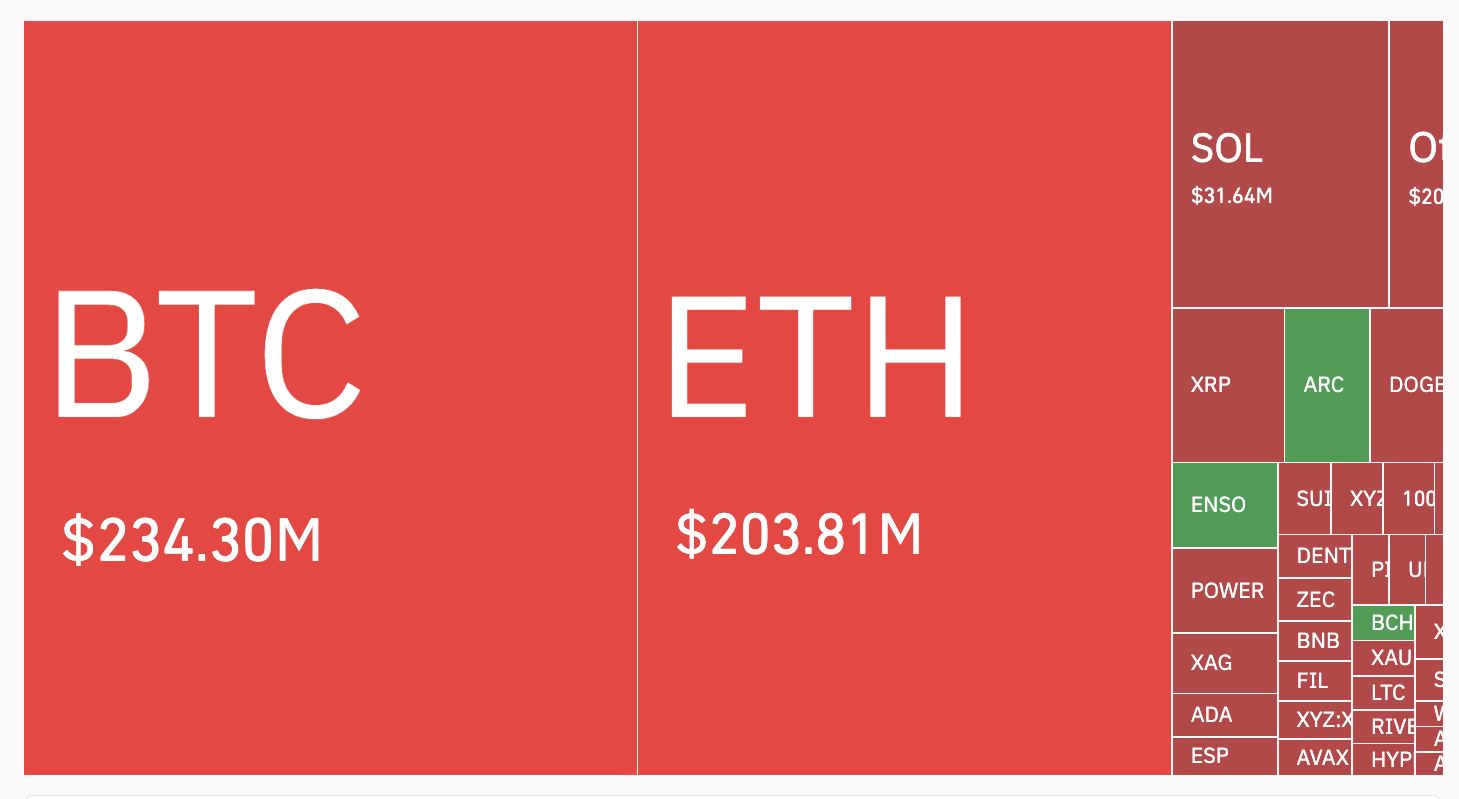
Bitcoin alone accounted for roughly 40% of total liquidations, with approximately $194.95 million in short positions liquidated. ETH recorded $203.8 million in total liquidations during the same period, with $175.16 million stemming from short positions.
The largest single liquidation order occurred on Hyperliquid for the BTC-USD pair, valued at $10.41 million.
Analysts Warn Crypto Relief Rally May Not Signal Full Trend Reversal
The recent rally has sparked optimism, but analysts warn it may not mark a full trend reversal. According to XWIN Research Japan, Open Interest has fallen sharply from prior highs, signaling a broad deleveraging phase.
“The recent drop in price was accompanied by falling OI, suggesting that liquidations and derivatives-driven unwinds — rather than aggressive spot selling — played a major role in the decline. This type of reset can stabilize the market, but it does not automatically signal renewed structural demand,” XWIN Research Japan wrote.
At the same time, Binance’s Fund Flow Ratio remains low at around 0.012. Since this metric tracks BTC inflows relative to total exchange holdings, a low reading suggests limited immediate sell pressure.
The analysis added that during the drop toward the mid-$60,000 range, the ratio did not spike. This suggested there was no panic-driven spot selling.
However, XWIN Research Japan noted that weak inflows do not imply strong accumulation. The medium-term trend of the Fund Flow Ratio’s moving averages is trending downward. It indicates that structural demand has not yet shifted upward.
“When leverage remains suppressed, upward price moves can easily trigger short squeezes. In that case, the rally is driven more by position unwinding than by expanding structural demand,” the post read.
Analyst Darkfost also stressed that an increase in spot trading volume will be necessary for any bullish recovery or solid market bottom to develop.
A senior US lawmaker launched a congressional inquiry into crypto exchange Binance following reports that the platform processed about $1.7 billion in transactions tied to sanctioned Iranian entities and Russia’s oil “shadow fleet.”
On Tuesday, Senator Richard Blumenthal, ranking member of the Senate Permanent Subcommittee on Investigations, sent a letter to Binance CEO Richard Teng requesting documents and internal records related to the exchange’s sanctions controls and compliance practices.
Citing reporting from the Wall Street Journal, New York Times and Fortune, Blumenthal said Binance compliance staff had identified two partner entities, including Hexa Whale and Blessed Trust, as intermediaries enabling trade with Iranian government-linked organizations. Internal investigators also reportedly traced transfers to wallets associated with Iran’s Islamic Revolutionary Guards Corps and payments to crews operating tankers used to bypass sanctions on Russian oil exports.
“Binance appears to have ignored clear warning signs, knowingly allowed illicit accounts to operate, and even provided hands-on support to entities engaged in money laundering,” the senator said. He requested communications, account records and internal compliance reports, including any materials related to users connected to Iran and participants in Russian sanction-evasion networks.
Related: Binance stablecoin reserves have sunk 19% since November
Binance denies sanctions allegations
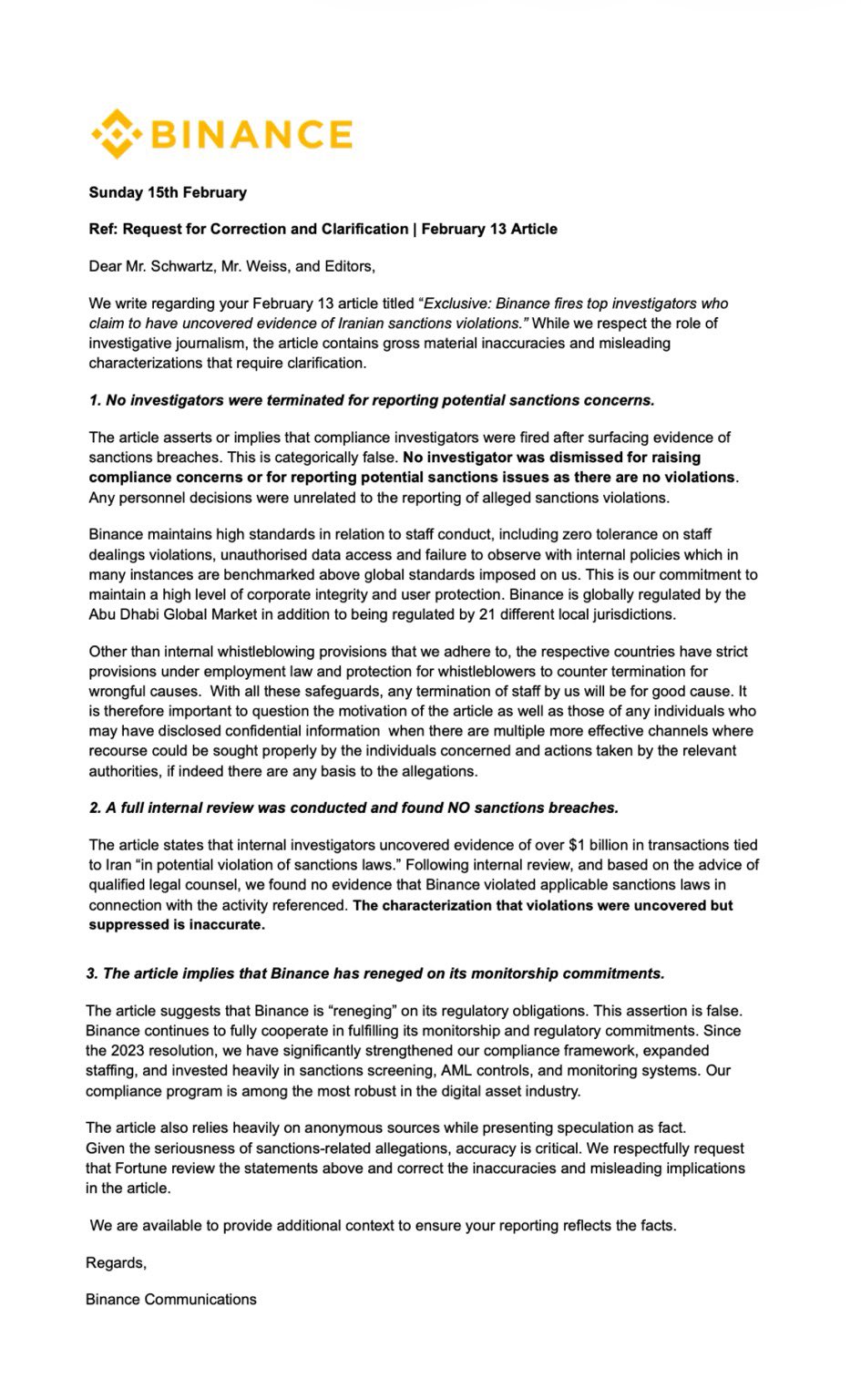
A Binance spokesperson told Cointelegraph that the recent allegations are inaccurate, saying that the platform identified and reported suspicious activity. The exchange disputed earlier media coverage and maintained that it does not allow Iranian users on the platform.
“Over the last several years, Binance has undergone one of the industry’s strongest compliance transformations, which has allowed us to achieve our current regulatory milestones,” the spokesperson said.
Binance has repeatedly pushed back against the recent media reports. Last week, the exchange denied a Fortune report alleging it processed over $1 billion in Iran-linked transactions and dismissed investigators who raised concerns.

On Tuesday, Binance CEO Richard Teng also criticized a Wall Street Journal report alleging $1.7 billion in Iran-linked transfers, calling it defamatory and demanding a retraction. In a blog post Monday, Binance said it has sharply cut exposure to sanctioned and high-risk jurisdictions, claiming a roughly 97% drop since January 2024 to about 0.009% of exchange volume.
Related: Binance confirms employee targeted as three arrested in France break-in
Senate probe questions Binance compliance
The inquiry follows Binance’s 2023 settlement with US authorities, in which the company agreed to pay $4.3 billion for Anti-Money Laundering (AML) and sanctions violations. Founder Changpeng Zhao stepped down as CEO and later served a four-month prison sentence. Binance also agreed to be monitored and pledged to strengthen compliance controls.
Blumenthal wrote that the newly reported activity could raise questions about the exchange’s adherence to that agreement. He set a March 6 deadline for Binance to provide the requested materials.
Magazine: How crypto laws changed in 2025 — and how they’ll change in 2026

Who Chelsea FC will face in Champions League last 16

Oil Futures Settle Lower Awaiting U.S.-Iran Moves

Vitalik Buterin Says Ethereum Will Soon Achieve Quantum Resistance


-

 Video6 days ago
XRP News: XRP Just Entered a New Phase (Almost Nobody Noticed)
-

 Politics4 days ago
Baftas 2026: Awards Nominations, Presenters And Performers
-

 Fashion6 days ago
Weekend Open Thread: Boden – Corporette.com
-

 Sports3 days ago
Women’s college basketball rankings: Iowa reenters top 10, Auriemma makes history
-

 Politics3 days ago
Nick Reiner Enters Plea In Deaths Of Parents Rob And Michele
-

 Crypto World2 days ago
XRP price enters “dead zone” as Binance leverage hits lows
-

 Business4 days ago
Mattel’s American Girl brand turns 40, dolls enter a new era
-

 Business4 days ago
Law enforcement kills armed man seeking to enter Trump’s Mar-a-Lago resort, officials say
-

 Tech2 days ago
Unsurprisingly, Apple's board gets what it wants in 2026 shareholder meeting
-
 NewsBeat9 hours ago
Manchester Central Mosque issues statement as it imposes new measures ‘with immediate effect’ after armed men enter
-

 NewsBeat7 hours ago
Cuba says its forces have killed four on US-registered speedboat | World News
-
 NewsBeat3 days ago
‘Hourly’ method from gastroenterologist ‘helps reduce air travel bloating’
-

 Tech4 days ago
Anthropic-Backed Group Enters NY-12 AI PAC Fight
-

 Business1 day ago
True Citrus debuts functional drink mix collection
-

 NewsBeat4 days ago
Armed man killed after entering secure perimeter of Mar-a-Lago, Secret Service says
-

 Politics4 days ago
Maine has a long track record of electing moderates. Enter Graham Platner.
-
 NewsBeat1 day ago
Police latest as search for missing woman enters day nine
-

 Business3 hours ago
Discord Pushes Implementation of Global Age Checks to Second Half of 2026
-

 Crypto World1 day ago
Entering new markets without increasing payment costs
-
 Sports3 days ago
2026 NFL mock draft: WRs fly off the board in first round entering combine week