

Crypto World
Buterin outlines 4-year roadmap to faster, quantum-resistant Ethereum


Ethereum (CRYPTO: ETH) co-founder Vitalik Buterin has expanded on a four-year roadmap designed to dramatically accelerate block production and transaction confirmations. The Strawmap, a visual plan released by the Ethereum Foundation’s Protocol team, frames the network’s next phase as a sequence of incremental steps intended to make the blockchain feel more live and responsive rather than a system where users wait for each new block to arrive.
In a Thursday update, Buterin added detail to the Strawmap, noting that “fast slots” sit in their own lane within the plan and do not connect directly to the rest of the roadmap, which remains largely independent of the slot time. The core objective is to shrink the current 12-second block cadence toward as low as 2 seconds over time, enabling swifter confirmations and a more immediate user experience.
The roadmap outlines a measured path: 12 seconds down to 8, then 6, 4, and ultimately 2 seconds per slot, with each step pursued incrementally to minimize disruption while preserving security and network reliability. This approach is designed to avoid the complexity and risk of implementing sweeping changes all at once, favoring controlled, bite-sized upgrades that can be deployed with fewer unintended consequences.
The Strawmap also highlights improvements to peer-to-peer communication among Ethereum nodes. By refining how blocks and data are shared—reducing duplicated data transfers and accelerating how quickly nodes achieve consensus—the network can sustain shorter slot times without compromising security. Buterin described these P2P enhancements as essential to making shorter slots viable while preserving the network’s integrity.
Finality from minutes to seconds
The second major thrust in the Strawmap is finality—the point at which a transaction is mathematically irreversible. Today, finality sits around 16 minutes, but the roadmap envisages a target window of roughly 6 to 16 seconds, achieved by replacing the current, more complex confirmation regime with a simpler, cleaner model that is also designed to be quantum-resistant.
“The goal is to decouple slots and finality, to allow us to reason about both separately,” Buterin explained. He described this as an invasive set of changes, prompting the team to bundle the most significant upgrade with a cryptographic switch—specifically a move to post-quantum hash-based signatures—to minimize risk and complexity across forks.
The push toward quantum resistance is anchored in a staged approach: slots would become quantum-resistant earlier than finality, a decision that could see the chain continue to function even if distant quantum threats emerged before full post-quantum finality is achieved. “One interesting consequence of the incremental approach is that there is a pathway to making the slots quantum-resistant much sooner than making the finality quantum-resistant,” Buterin noted. In practical terms, the network might quickly reach a regime where, if quantum computers materialize, the finality guarantee could be suspended temporarily, yet the chain would continue to operate.
Guardrails aside, the overarching plan is to pursue a component-by-component replacement of Ethereum’s slot structure and consensus, yielding a cleaner, simpler, quantum-resistant, prover-friendly, end-to-end formally verified framework. The four-year horizon envisages seven forks, roughly every six months, with Glamsterdam and Hegotá already confirmed for later this year.
The Strawmap is the Ethereum Foundation’s attempt to visualize a long view for Ethereum’s evolution beyond today’s constraints, balancing speed, security, and future-proof cryptography.
Key takeaways
- Current block time sits around 12 seconds, with the roadmap aiming for a path down to 2 seconds per slot in incremental steps.
- Improvements to peer-to-peer data sharing are designed to reduce block propagation time without sacrificing security.
- Finality is targeted to move from minutes (roughly 16) toward seconds (6–16) through a simpler, quantum-resistant approach to confirmations.
- The plan calls for seven forks over four years, with Glamsterdam and Hegotá already confirmed for later this year.
- Cryptography changes are paired with the upgrade path, including a shift to post-quantum hash-based signatures to support long-term security.
Tickers mentioned: $ETH
Sentiment: Neutral
Market context: The drive to accelerate Ethereum’s block production and simplify finality sits within broader industry efforts to improve L1 throughput while preparing for future cryptographic threats, all against a backdrop of growing demand for faster, more scalable blockchain services and ongoing debates about post-quantum readiness.
Why it matters
The Strawmap represents a fundamental rethinking of how Ethereum validates transactions and finalizes states. By decoupling slot timing from finality, the network aims to create a more modular upgrade path. This modularity could allow developers to test and deploy changes in smaller, safer increments, reducing the risk of destabilizing the network during major upgrades.
From a user and developer perspective, shorter slot times could translate into faster inclusion of transactions and more responsive DeFi and smart contract interactions. For validators and node operators, the proposed P2P optimizations and cryptographic shifts are expected to lessen the burden of processing large data loads and maintaining security in the face of emerging quantum-era threats, respectively.
Yet the changes are not trivial. The shift to a new cryptographic regime and the introduction of a simplified finality mechanism will require careful implementation across forks, with substantial testing to prevent disruption. The four-year horizon and seven forks underscore the breadth of coordination required among developers, researchers, and the wider ecosystem to ensure a smooth transition.
What to watch next
- The first of the planned forks under the Strawmap timeline, Glamsterdam, and Hegotá, slated for later this year, and their specific upgrade goals.
- Ongoing work on node communication protocols and data sharing improvements to reduce block propagation times.
- The cryptography switch to post-quantum signatures and the associated testing cycles across testnets and mainnet participants.
- Public updates from the Ethereum Foundation’s Protocol team on fork schedules and implementation milestones.
Sources & verification
What Strawmap changes for Ethereum’s block production and finality
Ethereum’s roadmap, as articulated by Vitalik Buterin and the Ethereum Foundation, centers on a deliberate, phased approach to transforming how blocks are produced and how state changes become final. At the heart of the plan is the intent to shrink the slot time—a metric that dictates how quickly new blocks are produced—from the current roughly 12 seconds toward a target as low as 2 seconds. The progression is designed to be gradual: 12 → 8 → 6 → 4 → 2 seconds, with each step evaluated for security and performance before advancing. This geometric, square-root-inspired trajectory is intended to preserve the network’s integrity while delivering tangible increases in transaction throughput and responsiveness.
Parallel to slot-time optimization, the Strawmap emphasizes improvements to how Ethereum nodes communicate with one another. By enhancing the efficiency of block propagation—reducing redundant data, and optimizing the sharing of new blocks and related information—it’s possible to support shorter slots without broadening attack surfaces or creating bottlenecks. Buterin has underscored that these improvements should not come at the expense of security, arguing that better messaging and data handling can unlock faster consensus without inviting new risks.
The roadmap’s second major thrust—finality—targets a dramatic reduction in the time required to irreversibly confirm a transaction. Where today finality hinges on a multi-layer, often lengthy confirmation process, the plan envisions a streamlined mechanism that can achieve finality within a window of about 6 to 16 seconds. A key part of this redesign is the switch to a more straightforward cryptographic architecture designed to be post-quantum resistant. This aligns with Ethereum Foundation materials that stress quantum readiness and the need to secure long-term security guarantees as the ecosystem scales.
To manage the scope and risk of such a sweeping overhaul, the strategy involves a decoupled approach to slots and finality. By treating these components as separable concerns, the network can be reasoned about more clearly, with targeted upgrades deployed in discrete forks. Buterin described the changes as highly invasive, necessitating a coordinated move that bundles the most significant cryptographic shift with the upgrade to a new, post-quantum hashing regime. This pairing aims to minimize disruption while laying the groundwork for future-proof security in a post-quantum era.
A notable implication of this incremental path is a staged advancement toward quantum resistance for slots ahead of finality. If quantum hardware were suddenly to arrive, there could be a temporary loss of finality guarantees; however, the chain would continue to operate, preserving usability and security in parallel. The overall trajectory anticipates ongoing, progressive reductions in both slot time and finality time, with a long horizon that envisions seven forks over four years and periodic, well-communicated upgrades designed to minimize risk for users and operators alike.


AllUnity, a stablecoin platform backed by Deutsche Bank, has launched a new stablecoin denominated in Swiss francs (CHF).
After introducing its euro-pegged EURAU stablecoin last year, AllUnity is rolling out CHFAU, a stablecoin pegged 1:1 to the franc, the company said in an announcement shared with Cointelegraph on Thursday.
Initially available to institutional and professional investors, CHFAU launches on the Ethereum blockchain as an ERC-20 token, with plans to expand to additional networks later this year.
CHFAU enters the market fully aligned with the EU’s Markets in Crypto-Assets Regulation (MiCA), as AllUnity secured an E-Money Institution (EMI) license from the German Federal Financial Supervisory Authority (BaFin) in July 2025.
“The launch of CHFAU is a fundamental milestone in our mission to build Europe’s regulated digital payments ecosystem,” AllUnity CEO Alexander Höptner said.
Regulated digital Swiss franc for institutional settlement
CHFAU will be exclusively available to institutional and professional clients through the AllUnity Mint Platform, a spokesperson for AllUnity said.
“We are currently finalizing exchange and trading venue integrations and will communicate specific listings as they go live,” the company said, adding that CHFAU is technically live, but broader availability across venues will be rolled out progressively through integrations.
“The primary purpose of CHFAU is to serve as a trusted, regulated digital Swiss franc for institutional settlement,” Höptner told Cointelegraph, adding:
“Whether for cross-border payments, digital asset markets, or treasury and liquidity management, CHFAU enables secure, real-time value transfer within a fully compliant framework.”
EURAU grows to $1.2 million since launch
AllUnity was founded in early 2024 as a joint venture by Deutsche Bank’s asset management arm DWS, market maker Flow Traders and crypto company Galaxy Digital with the aim of issuing fully regulated stablecoins.
Since its debut in July 2025, AllUnity’s EURAU stablecoin has seen its market capitalization rise to $1.2 million, ranking 16th by market cap among 22 euro‑pegged stablecoins listed on CoinGecko.
Related: ECB targets 2027 digital euro pilot as provider selection begins in Q1 2026
The stablecoin is available on a limited number of exchanges, with CoinGecko listing public centralized exchange Bullish and the decentralized exchange Aerodrome as venues trading EURAU at the time of publication. The stablecoin is also available on platforms including Bitpanda, Rulematch and WAWEX, AllUnity told Cointelegraph.

The total market capitalization of all euro-pegged stablecoins is now at $895 million, with EURC (EURC), issued by USDC (USDC) provider Circle, leading with $459 million.
Not the only Swiss franc stablecoin
Although AllUnity says CHFAU is the first MiCA-compliant Swiss franc‑pegged stablecoin, multiple companies have experimented with similar initiatives in recent years.
According to data from DefiLlama, there are at least three CHF‑denominated stablecoins, including Frankencoin (ZCHF), VNX Swiss Franc (VCHF) and Hedera Swiss Franc (HCHF). The combined market capitalization of these coins is about $38.6 million.

The largest of these, Frankencoin, is a decentralized stablecoin launched in 2023. The project is based in Switzerland and backed by the Frankencoin Association.
Other CHF stablecoin initiatives include CryptoFranc (XCHF), issued by crypto financial services provider Bitcoin Suisse. Launched around 2018, the stablecoin was later discontinued due to insufficient market adoption.
Magazine: 6 massive challenges Bitcoin faces on the road to quantum security
Crypto World
UK politician proposes ban on political crypto donations over foreign interference risks


Some Members of Parliament in the United Kingdom, led by the chairman of the Joint Committee on National Security Strategy, Matt Western, are pushing for a temporary ban on political crypto donations due to concerns over foreign interference.
Summary
- UK MPs have proposed a temporary moratorium on crypto donations to political parties until the Electoral Commission issues statutory guidance.
- The proposal calls for the use of FCA-registered platforms, mandatory source verification and a ban on mixer-linked funds among other provisions.
A letter directed to the Secretary of State for Housing, Communities and Local Government, Steve Reed, has proposed a temporary moratorium on cryptocurrency donations to political parties until the Electoral Commission produces statutory guidance.
In the letter, Western raised concerns around “foreign state intent to interfere in UK political finance” as there is “no clear national enforcement lead for political finance and foreign interference risk.”
“As the security environment worsens and the UK’s military role in Europe grows, the value of influencing the UK’s political positions (for example, on Ukraine, or US/EU relations) is likely to increase,” Western said.
He has urged the Electoral Commission to introduce interim safeguards, such as only allowing political parties to process crypto donations through Virtual Asset Service Providers registered with the Financial Conduct Authority, and accepting contributions where there is high confidence in identifying the ultimate source of the funds.
He also suggests prohibiting the use of crypto mixers or tumblers that can be used to obscure the provenance of assets, alongside a mandate that political parties should convert donations into pound sterling within 48 hours of receipt.
Further, Western recommended stricter source of wealth checks for donors and a review of sentencing for electoral finance offences, alongside higher penalties for breaches involving foreign money and expanded powers for regulators to pursue violations.
Last month, Western, along with a group of other committee chairs, lobbied for a full ban on cryptocurrency donations by including a provision in the Representation of the People Bill. That, however, was not included in the legislation when the bill was introduced to the House of Commons on Feb. 12.
According to a BBC report, Reform UK was the first party at Westminster to accept political cryptocurrency donations in the UK, led by pro-crypto figure Nigel Farage, who announced the move after appearing at the Bitcoin 2025 conference in Las Vegas.
However, details on the party’s official website state that it does not accept anonymous donations and applies permissibility checks to ensure funds originate from UK-registered companies or individuals listed on the electoral register, with contributions above £500 subject to standard compliance procedures.
Across the globe, crypto donations became a defining feature of the U.S. election cycle last year, with several political figures, including current President Donald Trump, having embraced digital asset fundraising. Trump’s campaign began accepting cryptocurrency contributions during the 2024 race.
As previously reported by crypto.news, Representative Mike Collins from Georgia also announced plans to accept cryptocurrency donations last year.
The Federal Election Commission permits cryptocurrency contributions to political committees, provided they adhere to existing contribution limits, disclosure standards, and other reporting requirements.


Former Ethereum treasury firm EthZilla has officially rebranded as Forum Markets as it moves ahead with its pivot towards a full-fledged tokenized real-world assets-focused firm.
Summary
- Rebranded as Forum Markets, the company will trade under the ticker FRMM from March 2.
- Under the Forum Markets brand, the company is repositioning itself as a tokenised real-world asset platform.
- Peter Thiel’s Founders Fund exited its position in the company earlier this month as the stock remained deeply below its August 2025 peak.
According to the official announcement, the company has updated its corporate name and brand to Forum Markets as it moves away from its earlier positioning as an Ethereum treasury company. As part of the rebranding, it has also changed its Nasdaq ticker symbol to FRMM and is expected to begin trading under the new symbol on March 2, subject to Nasdaq approval.
Forum framed the move as the “next development in the company’s planned strategic evolution” and said it plans on “connecting traditional capital markets with blockchain-based financial infrastructure.”
“Forum embodies our belief that the next generation of financial markets will be built around institutional-grade, on-chain products backed by real assets, governed by transparency, and delivered through regulated infrastructure,” the company’s chairman and CEO, McAndrew Rudisill, said in an accompanying statement.
The company said its platform is designed to aggregate, structure, and tokenize cash generating real world assets that were previously inaccessible to a broader base of investors. Forum will leverage its subsidiaries and strategic partners to create a repeatable pipeline to originate and distribute tokenized investment products across multiple asset classes.
Forum has already begun phasing out its balance sheet crypto strategy and announced earlier this month that it had acquired two commercial jet engines leased to a “leading US air carrier,” which will underpin its first aviation-backed offering, the Eurus Aero Token I.
ETHZilla shares climbed more than 13% after the company announced the rebrand and ticker change. However, on a year-to-date basis, the company’s shares were down over 20% as crypto treasury stocks have struggled to gain traction over the past months.
ETHZilla, formerly a biotech company known as 180 Life Sciences, transitioned into an Ethereum treasury firm last year while crypto treasury stocks were trending. Subsequently, it acquired as much as 102,246 ETH at the height of the strategy, but as the initial enthusiasm faded and share prices retreated, the company later announced its intent to pivot toward the tokenized real-world asset market.
Earlier this month, Peter Thiel’s Founders Fund, an early backer of the company, exited its position. ETHZilla has also moved to sell portions of its assets to scale back its crypto exposure and initiate share buybacks in an effort to stabilise its equity performance.


Vitalik Buterin says Ethereum (ETH) will achieve quantum resistance soon via post-quantum hash-based signatures in the Strawmap, a four-year Layer 1 (L1) upgrade plan.
Why it matters:
- Quantum computers could break Ethereum’s current encryption; hash-based signatures would close that gap before the threat arrives.
- Buterin’s confirmation moves quantum resistance from a research topic to a scheduled Ethereum upgrade target.
- The Strawmap’s six-month fork schedule means quantum-resistant slots could ship within the plan’s first two upgrades.
The details:
- Buterin confirmed the timeline via X on February 26, 2026, citing the Ethereum Foundation’s Strawmap.
- The Strawmap was published at strawmap.org after an Ethereum Foundation workshop in January 2026.
- The name blends “strawman” and “roadmap,” meaning the plan is experimental and built to be revised.
- The four-year plan targets ~7 forks every six months; Glamsterdam and Hegotá are confirmed for 2026.
- Buterin also proposed cutting block time to 2 seconds and finality from ~16 minutes to 6–16 seconds.
The big picture:
- Bitcoin and Solana ecosystems are also running post-quantum research, making it a growing priority across blockchains.
- A fixed six-month fork schedule marks a faster, more structured upgrade cadence for Ethereum’s L1.
- The Strawmap is explicitly a draft — timelines, including quantum resistance, could shift as development progresses.
The post Vitalik Buterin Says Ethereum Will Soon Achieve Quantum Resistance appeared first on BeInCrypto.


Indiana lawmakers have passed House Bill 1042, commonly referred to as the Bitcoin Rights Bill, clearing both legislative chambers and sending the measure to Governor Mike Braun for final approval.
Summary
- Indiana’s HB 1042 Bitcoin Rights Bill has passed both legislative chambers and now awaits Governor Mike Braun’s signature.
- The bill would allow cryptocurrency investment options in public retirement plans and protect individual digital asset access.
- If signed, the law will take effect July 1, 2026, reflecting growing institutional adoption of Bitcoin.
Indiana passes Bitcoin Rights Bill as crypto adoption accelerates
If signed into law, the bill will take effect on July 1, 2026, and would allow cryptocurrency investment options within public retirement plans while affirming the rights of individuals to access and use digital assets.
The legislation marks a significant step in formalizing Bitcoin and broader digital asset participation within state-backed financial structures.
The news comes as Arizona lawmakers advanced Senate Bill 1649, which would create a Digital Assets Strategic Reserve Fund allowing the state to hold, invest and potentially lend seized cryptocurrencies.
By permitting exposure to cryptocurrencies in public pension portfolios, Indiana joins a growing list of jurisdictions responding to sustained institutional interest in Bitcoin (BTC), particularly following the strong performance and capital inflows into spot Bitcoin exchange-traded funds over the past several years.
Supporters argue the bill ensures that Indiana’s public institutions and citizens are not disadvantaged as digital assets increasingly become integrated into global financial markets. The measure also reinforces protections for individuals to hold and transact in cryptocurrencies without undue restriction, signaling a pro-innovation stance from state lawmakers.
The push comes amid mounting pressure from financial markets to modernize investment frameworks. Since the launch and expansion of Bitcoin ETFs, institutional adoption has accelerated, prompting policymakers to revisit existing rules around retirement portfolio diversification and digital asset access.
Governor Braun has yet to announce whether he will sign the bill, but if enacted, Indiana would position itself as one of the more crypto-forward states heading into the second half of 2026.


Bitcoin price rebounded over 7% to $69,487 on Thursday amid a spike in short liquidations and improved risk-on sentiment following a bullish Nvidia earnings report.
Summary
- Bitcoin price approached $70K amid a short squeeze and bullish Nvidia earnings report.
- Spot Bitcoin ETFs drew in $257 million in inflows on Wednesday.
According to data from crypto.news, Bitcoin (BTC) price shot up to an intraday high of $69,487 on Thursday, Feb. 26, before settling around $68,200 at press time, still holding 4.6% gains over the past 24 hours. The bellwether’s rebound follows just two days after it fell under $63,000 amid investor fears over macroeconomic and geopolitical uncertainty.
Bitcoin price rallied as investors bought the asset during the recent dip in prices. As BTC price rose, it triggered liquidations of highly leveraged bearish bets across leveraged crypto markets. Data from CoinGlass shows that roughly $576 million worth of positions were liquidated from BTC futures, with around $470 million coming from short positions. Bitcoin alone accounted for $194 million in short liquidations.
Short liquidation occurs when rising prices force traders who bet against the asset to close their positions, with traders having to buy back the asset at higher prices to cover their losses. This, in turn, leads to an immediate spike in prices through a feedback loop often called a short squeeze.
Another major tailwind that boosted BTC price and other altcoins came from investors embracing a risk-on sentiment as stocks posted modest gains and broader risk sentiment improved with Nvidia Corp.’s latest bullish earnings report.
Notably, the Dow Jones Index increased by 307 points on Wednesday. At the same time, the Nasdaq 100 and S&P 500 indices jumped by 351 and 56 points.
AI chip-making giant Nvidia, the world’s largest publicly traded company, reported record-breaking earnings for Q4 of Fiscal Year 2026. Quarterly revenue reached an all-time high, increasing 20% quarter-over-quarter and 73% year-over-year. For the full fiscal year 2026, total revenue reached $215.9 billion, a 65% increase from the previous year.
Previously, investors were concerned about excessive AI spending by Big Tech giants. However, the back-to-back bullish earnings from Nvidia, seen as a barometer for the AI-fueled trade, appear to have calmed investors’ nerves.
The return of inflows into spot Bitcoin ETFs also likely played a modest part in improving investor sentiment. Data from SoSoValue show that the 12 spot Bitcoin ETFs recorded $257.7 million in inflows on Wednesday, marking the first triple-digit inflows figures since Feb. 10.
While it is not yet a strong sign of a long-term trend, investors took it as a positive signal that institutional demand remains resilient despite recent market volatility.
Disclosure: This article does not represent investment advice. The content and materials featured on this page are for educational purposes only.


Trump-backed World Liberty Financial has introduced a new proposal to overhaul its governance through a new Governance Staking System designed to incentivize long-term participation, redirect arbitrage profits to committed token holders, and deepen adoption of its USD1 stablecoin.
Summary
- WLFI proposes mandatory staking for unlocked tokens to participate in governance, with ~2% targeted APR for active voters.
- A new Node and Super Node tier system offers OTC USD1 conversion access and prioritized partnership discussions.
- The plan aims to redirect stablecoin arbitrage profits from market makers to long-term WLFI ecosystem participants.
World Liberty Financial aims to redirect USD1 arbitrage profits to token stakers
Under the proposal, holders of unlocked WLFI (WLFI) tokens will be required to stake their tokens in order to participate in governance voting. Staking will carry a minimum lock-up period of 180 days, with voting power determined by a non-linear square root formula that factors in both the amount staked and remaining lock duration.
Governance rights will be dynamic and non-transferable, adjusting as lock-ups decline.
Active participation is central to the design. Stakers must vote at least twice during their lock-up period to qualify for base staking rewards, targeted at roughly 2% APR and paid from the WLFI treasury.
The reward rate will be determined at WLFI’s discretion and is not tied to revenue or operational performance. Only staking participants will receive USD1 deposit incentives on WLFI Markets provided by Dolomite.
The proposal also introduces a tiered structure. “Nodes,” defined as participants staking at least 10 million WLFI, would gain access to over-the-counter USD1 conversion via licensed market makers at 1:1 parity.
World Liberty Financial plans to subsidize these conversions, redirecting arbitrage opportunities previously captured by institutional intermediaries, estimated at 10–15 basis points per cycle.
At the top tier, “Super Nodes” staking 50 million WLFI would receive guaranteed access to the WLFI team for partnership discussions and potential economic incentives, subject to compliance and commercial review.
The proposal requires a quorum of 1 billion eligible WLFI voting tokens and a simple majority to pass, with a seven-day voting window. If approved, implementation will roll out in three phases, beginning with governance staking activation.
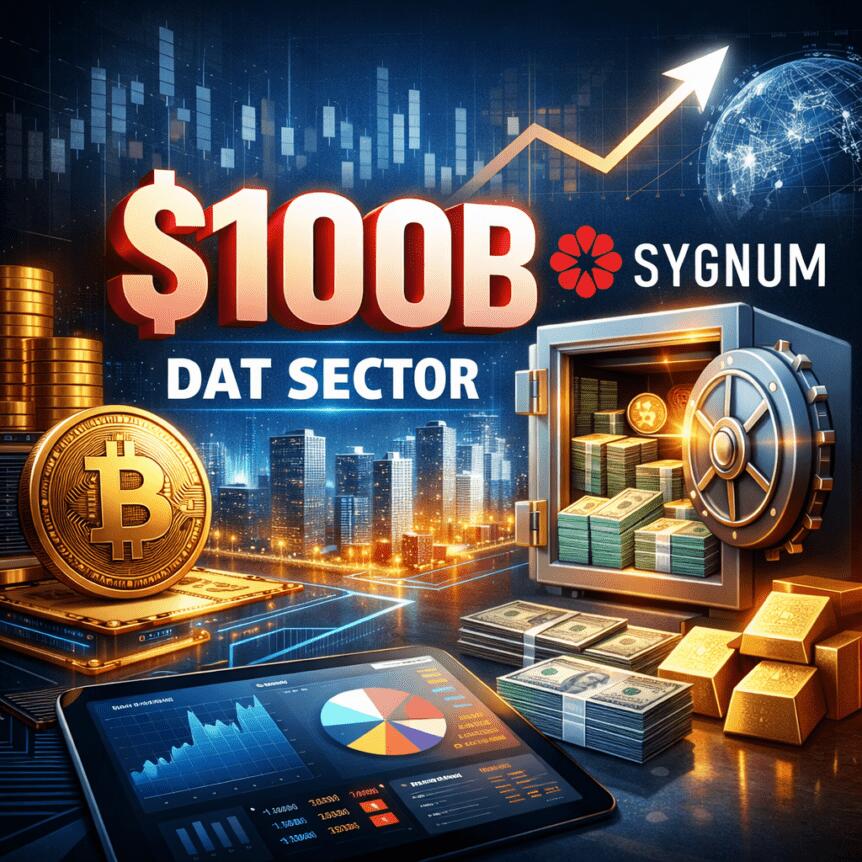
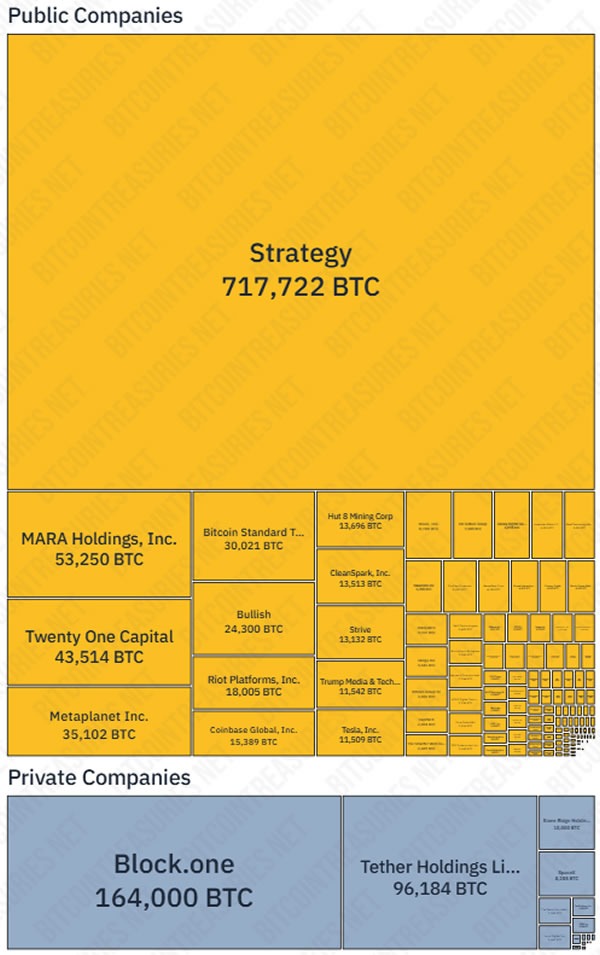
Swiss digital asset bank Sygnum unveiled Sygnum Select, a new institutional crypto asset management service aimed at corporate treasuries overseeing roughly $100 billion in digital assets. Launched on Thursday, the discretionary mandate product applies the discipline of traditional private banking to the crypto frontier, offering strategic asset allocation, active rebalancing, and rigorous risk oversight for institutional clients. The service arrives with live mandates and about $200 million already under active management, according to a Sygnum spokesperson. Data from Bitcoin (CRYPTO: BTC) holdings platform BitcoinTreasuries shows public companies hold 1.13 million BTC and private firms hold 287,990 BTC, collectively valued at about $97 billion. This snapshot underscores the scale at which corporations already engage with crypto assets, even as the market seeks mature infrastructure for professional management.
Key takeaways
- Sygnum launches Sygnum Select, a discretionary mandate service that brings traditional portfolio-management rigor to institutional crypto assets, with live client mandates already in place.
- The offering targets the growing market of corporate and public digital asset treasury entities (DATs), which collectively hold well over $100 billion in crypto assets, highlighting a broad demand for regulated, end-to-end management.
- Clients gain full execution authority within an agreed investment framework, including strategic asset allocation, active rebalancing, and risk oversight, bridging private banking discipline with crypto exposure.
- Live mandates cover a wide spectrum: spot, staking, hedging, derivatives, tokenized securities, and market-neutral strategies across traditional and crypto assets.
- Initially, the service will serve Swiss clients, with plans for broader geographic expansion as institutional demand and regulatory clarity evolve.
Tickers mentioned: $BTC, $ETH
Market context: The range of corporate crypto deployments is expanding as institutions seek regulated, scalable solutions amid ongoing debates about custody, risk controls, and tokenization in traditional finance. The broader market backdrop includes a rising interest in tokenized assets and state-backed crypto reserves, alongside ongoing regulatory developments in key jurisdictions.
Sentiment: Neutral
Price impact: Neutral. The article describes product launches and market demand rather than immediate price moves.
Trading idea (Not Financial Advice): Hold. The expansion of regulated, discretionary crypto management services could support institutional risk management and liquidity, without implying short-term price catalysts.
Market context: As institutional adoption accelerates, regulated infrastructure and holistic management solutions grow in importance for corporate treasuries, alongside shifts toward greater tokenization and crypto readiness in traditional finance. The Swiss regulatory environment and broader ETF and custody developments remain closely watched by market participants. For context on Switzerland’s regulatory landscape, see the overview of cryptocurrency regulations in Switzerland: here.
Why it matters
The launch of Sygnum Select marks a notable push toward integrating crypto exposure into the same disciplined framework that underpins private banking solutions for traditional assets. By offering a discretionary mandate, Sygnum signals that institutional clients are seeking more than custody or execution—they want an active partner who can manage a crypto portfolio with a holistic risk and governance approach. This shift aligns with the maturation of the asset class, where institutions expect outcomes that mirror established private-banking standards rather than bespoke, ad hoc arrangements.
The service also reflects a broader market reality: corporate and public sector DATs have accumulated substantial crypto holdings, with BitcoinTreasuries data illustrating a substantial reservoir of crypto on corporate balance sheets. As regulated, scalable services emerge to serve these needs, the industry could see stronger demand for multi-asset strategies, cross-asset hedging, and tokenized securities that enable traditional investors to participate in crypto markets through familiar risk controls. The combination of traditional asset management discipline and crypto-native execution logic is intended to reduce operational friction and counterparty risk for large holders navigating a rapidly evolving landscape.
At the same time, Sygnum’s own track record—such as its market-neutral Bitcoin fund and recent fundraising milestones—provides context for the platform’s credibility. The bank previously raised more than 750 BTC in January for its market-neutral Bitcoin fund, which delivered an annualized return in the fourth quarter of 2025. The bank’s growth narrative is underscored by a post-money valuation surpassing $1 billion after a notable early-2025 funding round. These dynamics matter because they offer institutional clients a clearer signal of the institution’s capacity to manage complex crypto strategies within a regulated framework, which remains a priority for many treasuries evaluating outsourcing options.
Looking ahead, the Swiss focus of Sygnum Select—paired with reported intentions to expand geographically—illustrates a broader trend in which regulated, cross-border crypto asset management solutions become more widely available. While the initial rollout is Switzerland-centric, market participants will be watching to see how the product scales across jurisdictions with varying regulatory regimes, especially as tokenization, state-backed reserve concepts, and more sophisticated crypto instruments gain traction in traditional finance.
For readers tracking corporate crypto exposure, the push toward professional, institution-grade management infrastructure is a notable development. It complements existing flows into exchange-traded and custody services, while potentially broadening the set of investable crypto strategies available to treasuries and asset managers. As liquidity in the space continues to evolve and regulatory frameworks mature, Sygnum Select could serve as a blueprint for how crypto assets are managed within a regulated, multi-asset portfolio architecture, rather than in isolated, standalone crypto vehicles.
What to watch next
- Timeline and criteria for expanding Sygnum Select beyond Switzerland, including any regulatory approvals required for new jurisdictions.
- Uptake metrics: the pace at which additional client mandates are onboarded and the diversification of assets across traditional and crypto classes.
- Performance data for existing portfolios, including risk metrics and the impact of active rebalancing on portfolio drawdowns.
- Further product development, such as additional hedging instruments, derivatives capabilities, and tokenized securities offerings within the discretionary framework.
Sources & verification
- BitcoinTreasuries data on BTC holdings by public and private companies: https://bitcointreasuries.net/
- Cointelegraph reporting on Sygnum’s Bitcoin fund and related fundraising milestones: https://cointelegraph.com/news/swiss-bank-sygnum-raises-750-btc-market-neutral-fund
- Cointelegraph coverage of tokenization and Bitcoin reserves in 2026: https://cointelegraph.com/news/2026-sovereign-bitcoin-reserves-tradfi-tokenization-adoption-sygnum
- Cointelegraph overview of cryptocurrency regulations in Switzerland: https://cointelegraph.com/learn/articles/an-overview-of-the-cryptocurrency-regulations-in-switzerland
Market reaction and key details
Market participants will likely view Sygnum Select as part of a broader evolution in crypto asset management toward regulated, scalable, and holistic offerings. The emphasis on active portfolio management, multi-asset exposure, and risk oversight aligns with a growing demand from institutional clients seeking to integrate crypto into sophisticated investment programs rather than treat it as a stand-alone hedge or speculative play. As more corporate treasuries and DATs consider long-term crypto strategies, the availability of a regulated, institution-grade management solution could shape whether crypto becomes a durable component of diversified portfolios, or remains a jurisdiction-specific niche.
What the next steps could look like
If Sygnum successfully scales Sygnum Select beyond its Swiss launch, expect further clarity on governance frameworks, performance reporting standards, and interoperability with traditional private-banking platforms. The evolving landscape may also see regulators scrutinize product disclosures, risk controls, and cross-border suitability assessments as more institutions adopt such mandates. In parallel, ongoing developments in tokenization and liquidity solutions may broaden the range of assets available within discretionary crypto strategies, potentially expanding the addressable market and accelerating institutional adoption.
What to watch next
- Expansion announcements and regulatory milestones for onboarding new jurisdictions within the next 12–18 months.
- New performance disclosures and risk metrics for active portfolios under Sygnum Select.
- Partnerships or integrations with custody providers, insurers, or traditional asset managers to streamline compliance and reporting.
Update (Feb. 26 at 06:00 UTC): This article has been updated to include commentary from Paolo Ardoino, CEO of Tether]
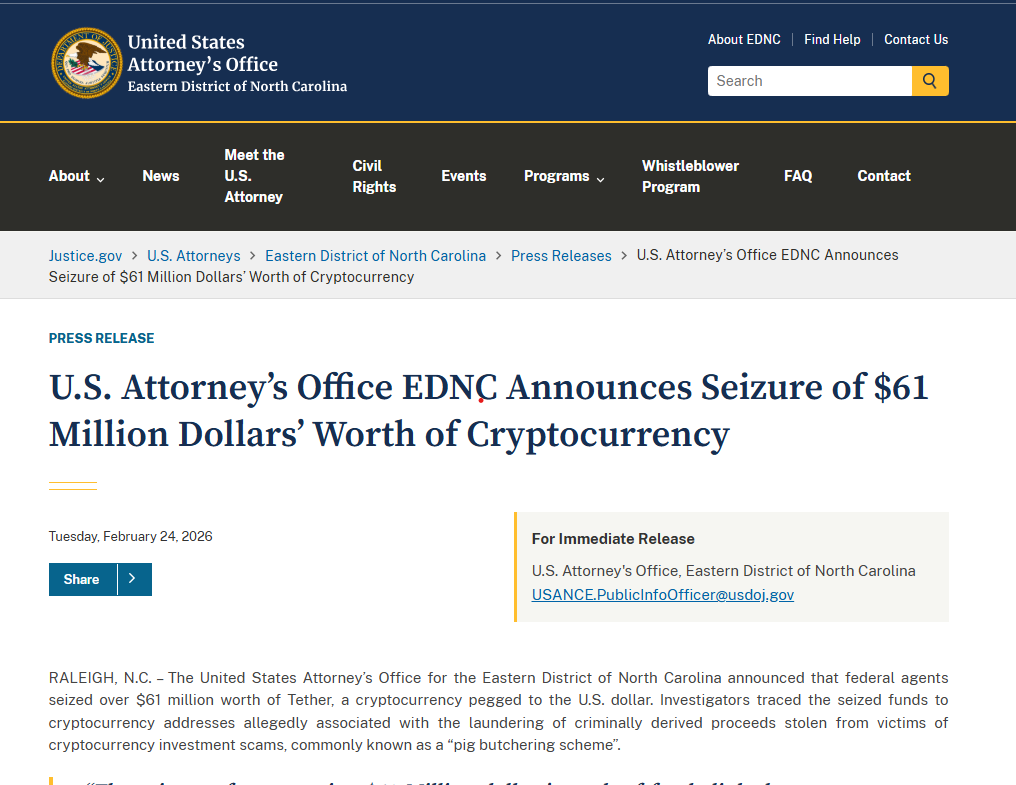
US Federal agents in North Carolina seized more than $61 million worth of USDt (USDT) tied to a large‑scale “pig butchering” crypto investment scam that preyed on victims through fake online relationships and fraudulent trading platforms.
According to the US Attorney’s Office for the Eastern District of North Carolina in Raleigh on Tuesday, the scammers posed as romantic partners and claimed to have special trading expertise.
They then steered their victims toward convincing but fake crypto sites that displayed fictitious investment portfolios showing unusually high returns that enticed them to invest more, before the scammers blocked their withdrawals and demanded extra fees when victims tried to get their money back.
Investigators from Homeland Security Investigations traced the victims’ funds across multiple wallets used to launder the proceeds before identifying several addresses that still held substantial amounts, which were then seized and made subject to forfeiture.

Prosecutors noted that Tether cooperated in the investigation: “The Department of Justice and HSI acknowledges Tether for its assistance in transferring these assets,” the release states, in the latest example of stablecoin issuers working with authorities to freeze and recover funds flowing through US dollar‑pegged tokens like Tether’s USDt.
Paolo Ardoino, CEO of Tether, said that the company’s cooperation with the DOJ highlighted the need for blockchain transparency to “empower law enforcement to act quickly and effectively against criminal activity.”
Crypto fraud scams on the rise
This latest case comes at a time of explosive growth in crypto fraud, including pig butchering schemes that blend romance scams with bogus trading opportunities.
Data from Chainalysis’ 2026 Crypto Scams report found that crypto scam losses in 2025 reached $17 billion, with artificial intelligence (AI) driven impersonation and social engineering scams increasing by 1,400% year‑on‑year and becoming far more profitable than traditional phishing or giveaway schemes.
Related: How pig-butchering crypto scams turn trust into a financial weapon
In one incident in December 2025, a Bitcoin investor said he lost his retirement savings after being groomed by an online “trader” who used AI‑generated images and a fabricated persona to build trust before convincing him to move his coins into a fake investment platform.
US prosecutors have started to secure major sentences against the perpetrators of these networks.
In February, a key figure in a pig butchering‑linked crypto laundering operation involving over $70 million was sentenced to 20 years in federal prison, reflecting how seriously courts are now treating this category of crime.
Magazine: South Korea gets rich from crypto… North Korea gets weapons
Global digital asset banking group Sygnum has announced the launch of an institutional crypto asset management service targeting the $100 billion corporate crypto treasury sector.
Sygnum Select, launched on Thursday, is described as a “discretionary mandate service” that applies Swiss banking’s established portfolio management model to crypto assets.
The service launches with live client mandates, client assets, and $200 million in actively managed portfolios already in place, a Sygnum spokesperson told Cointelegraph.
The move comes amid solid growth in corporate and public digital asset treasury companies (DATs) over the last few years, which now hold over $100 billion in crypto assets.
“Yet many lack the infrastructure for professional, institutional-grade management,” which creates “strong demand” for regulated services offering such products and addressing the gap, stated Sygnum.
There are currently 1.13 million BTC held by public companies and 287,990 BTC held by private firms worth a combined $97 billion, according to BitcoinTreasuries.

Not all DATs have been success stories. Ether treasury ETHZilla rebranded to “Forum” on Wednesday as part of a pivot out from holding crypto, with the new focus on tokenized assets following a 20% stock slide year to date.
Meanwhile, the world’s largest BNB treasury company, CEA Industries, has crashed 94% from its high last year, reportedly blaming the family office of Binance founder Changpeng Zhao, YZi Labs, for a “secret side agreement.”
Sygnum said there has been a shift in client needs
Sygnum Select takes full execution authority within a client’s agreed investment framework, handling strategic asset allocation, active rebalancing, and risk oversight.
“As digital assets mature and institutional adoption accelerates, we’re seeing a clear shift in what clients need,” said Sygnum chief investment officer Fabian Dori.
He added that crypto foundations and corporate treasuries are no longer simply looking for custody and trading, “they want a trusted, regulated counterparty who can actively manage their assets with the same discipline and holistic approach as a traditional private bank.”
Related: Sygnum sees tokenization and state Bitcoin reserves taking off in 2026
The live mandates include spot, staking, hedging, derivatives, tokenized securities, and market-neutral strategies, and most portfolios include multiple asset classes across traditional and crypto assets, according to Sygnum.
“Clients can now access bespoke portfolio management that combines what traditional asset managers or crypto-native firms can offer,” explained Markus Haemmerli, Sygnum’s head of portfolio management.
The service is initially available only to Swiss clients, but broader geographic expansion is planned.
Sygnum raised more than 750 BTC in January for its market-neutral Bitcoin (BTC) fund, which posted an annualized return of 8.9% in the fourth quarter of 2025.
The Swiss crypto bank reached a post-money valuation of more than $1 billion after securing $58 million in an oversubscribed strategic growth round in January 2025.
Magazine: Clarity Act risks repeat of Europe’s mistakes, crypto lawyer warns

Bridgerton season 4 part 2 ending explained: do Benedict and Sophie get married, post-credits surprise, shock death and predictions for season 5 of the hit Netflix show

Thibaut Flament: France’s Six Nations star on fertility treatment

Gov. Kathy Hochul demands $13.5B Trump tariff refunds for New Yorkers


-

 Video6 days ago
XRP News: XRP Just Entered a New Phase (Almost Nobody Noticed)
-

 Politics4 days ago
Baftas 2026: Awards Nominations, Presenters And Performers
-

 Fashion6 days ago
Weekend Open Thread: Boden – Corporette.com
-

 Sports3 days ago
Women’s college basketball rankings: Iowa reenters top 10, Auriemma makes history
-

 Politics3 days ago
Nick Reiner Enters Plea In Deaths Of Parents Rob And Michele
-

 Crypto World2 days ago
XRP price enters “dead zone” as Binance leverage hits lows
-

 Business4 days ago
Mattel’s American Girl brand turns 40, dolls enter a new era
-

 Business4 days ago
Law enforcement kills armed man seeking to enter Trump’s Mar-a-Lago resort, officials say
-

 Tech2 days ago
Unsurprisingly, Apple's board gets what it wants in 2026 shareholder meeting
-
 NewsBeat9 hours ago
Manchester Central Mosque issues statement as it imposes new measures ‘with immediate effect’ after armed men enter
-

 NewsBeat7 hours ago
Cuba says its forces have killed four on US-registered speedboat | World News
-
 NewsBeat3 days ago
‘Hourly’ method from gastroenterologist ‘helps reduce air travel bloating’
-

 Tech4 days ago
Anthropic-Backed Group Enters NY-12 AI PAC Fight
-

 Business2 days ago
True Citrus debuts functional drink mix collection
-

 NewsBeat4 days ago
Armed man killed after entering secure perimeter of Mar-a-Lago, Secret Service says
-

 Politics4 days ago
Maine has a long track record of electing moderates. Enter Graham Platner.
-
 NewsBeat1 day ago
Police latest as search for missing woman enters day nine
-

 Business4 hours ago
Discord Pushes Implementation of Global Age Checks to Second Half of 2026
-

 Crypto World1 day ago
Entering new markets without increasing payment costs
-
 Sports3 days ago
2026 NFL mock draft: WRs fly off the board in first round entering combine week