

Crypto World
Tap to Earn Game Development Guide 2026: Strategy & Growth


Tap to Earn is no longer a novelty mechanic. In 2026, it has matured into a scalable user acquisition & token distribution model built around frictionless onboarding, micro-interactions, and viral network effects, especially within the TON ecosystem and Telegram infrastructure.
Unlike traditional Web3 games that demand high production budgets and long development cycles, Tap to Earn games optimize for speed, distribution, and engagement density. However, while they may appear simple on the surface, building a sustainable Tap to Earn ecosystem on TON requires strategic architecture, disciplined tokenomics, backend scalability, and strong anti-fraud design.
This Tap to Earn game development 2026 guide explores the structural foundation on TON and what it takes to build for long-term growth.
What Is Tap to Earn in 2026?
Tap to Earn in 2026 is not just about tapping a screen to collect tokens. It represents a behavioral reward engine designed around micro-engagement cycles. At its core, Tap to Earn is built on three mechanics:
- Ultra-simple interaction loops
- Instant reward feedback
- Referral-amplified growth
However, what makes it powerful today is not the tap, it is the ecosystem design. Modern Tap to Earn systems integrate:
- On-chain reward validation
- Token-based incentive layers
- Community leaderboard gamification
- Progressive unlock systems
- Hybrid off-chain performance optimization
The reason this model works so effectively on TON is that Telegram removes the largest friction point in gaming that is app installation. Users need not download and they need not register. They simply click and start interacting. This instant participation layer plays a significant role in dramatically improving early retention metrics. In 2026, Tap to Earn is less about “earn by tapping” and more about “engage and amplify within an ecosystem.”
Reason Behind the Explosion of Tap to Earn in 2024–2026
The growth of Tap to Earn is not accidental. It is structurally aligned with current user behavior and Web3 distribution dynamics. Typically, there are four primary reasons for its rapid adoption.
1. Distribution Without Friction
Telegram provides a ready-made network. Every user is already authenticated. Wallet integrations through TON helps reduce onboarding complexity further. No app store policies applicable, no 30% deduction in revenue, and no installation barrier.
2. Viral Referral Loops
Tap to Earn thrives on referral multipliers. Most games are architected to incentivize inviting friends. Every new user increases reward potential for existing participants, which, in turn, creates network compounding effects.
3. Micro-Session Behavior
Modern users prefer short engagement bursts. Tap to Earn sessions often last seconds or minutes, making them highly repeatable. This helps increase daily active usage frequency.
4. Tokenized Incentives
Unlike Web2 games, Tap to Earn integrates token ownership. This adds speculative and financial motivation layered on top of gameplay.
However, growth alone does not guarantee sustainability. Many projects in 2024 collapsed because they were optimized for viral spikes rather than focusing on economic durability.
Tap to Earn vs Play to Earn: Structural Differences
A number of new entrants in the field of gaming tend to get confused between Tap to Earn and Play to Earn model. While both Tap to Earn and Play to Earn fall under the category of Web3 gaming, they are fundamentally different in architecture, user behavior, and scalability potential. Understanding the difference between Tap to Earn and Play to Earn helps businesses and decision-makers choose the right model for their Web3 gaming strategy.
| Factor | Tap to Earn Games | Play to Earn Games |
|---|---|---|
| Core Interaction Model | Built around simple micro-interactions such as tapping, claiming rewards, or completing lightweight tasks. Designed for rapid engagement cycles. | Built around deeper gameplay mechanics such as battles, quests, strategy, or asset management requiring longer sessions. |
| User Onboarding | Extremely low friction. Users can start instantly through Telegram Mini Apps or bots without downloads or complex registration. | Typically requires wallet setup, NFT purchases, or platform onboarding before meaningful participation begins. |
| Development Complexity | Focuses on scalable backend systems, referral engines, and reward validation logic rather than complex gameplay mechanics. | Requires complex gameplay systems, NFT logic, multiplayer infrastructure, and advanced in-game mechanics. |
| Infrastructure Requirements | Lightweight frontend but strong backend validation systems to support large user volumes and prevent bot abuse. | Heavy infrastructure requirements due to complex gameplay, marketplace interactions, and asset ownership tracking. |
| Economic Structure | Growth-driven economies that depend on network expansion and controlled reward distribution. | Asset-driven economies focused on NFT ownership and in-game asset value appreciation. |
| Entry Barrier for Users | Usually free-to-start, allowing rapid user acquisition and viral growth. | Often requires upfront investment in NFTs or tokens to participate meaningfully. |
| User Session Length | Short sessions lasting seconds or minutes, encouraging frequent return visits throughout the day. | Longer sessions require dedicated gameplay time and higher user commitment. |
| Scalability Potential | Highly scalable due to lightweight interaction design and Telegram-based distribution. Can reach millions of users quickly. | Scaling requires significant infrastructure investment and longer development cycles. |
| Primary Growth Driver | Viral distribution and referral mechanics integrated into Telegram ecosystems. | Gameplay quality, asset value, and long-term player engagement. |
| Sustainability Challenges | Requires strong anti-bot protection and controlled token emissions to maintain ecosystem stability. | Requires balanced tokenomics and consistent player demand to prevent economic collapse. |
Strategic Takeaway
Tap to Earn is optimized for speed & distribution, while Play to Earn is optimized for depth and long-term gameplay value.
For projects launching within the TON ecosystem, Tap to Earn models often provide a faster path to user acquisition and ecosystem expansion. Play to Earn models, on the other hand, require significantly higher investment and longer development timelines but can support deeper gaming experiences.
Want to Build Your Viral Tap to Earn Game on TON?
Why TON Became the Default Ecosystem for Tap to Earn
TON particularly favors Tap to Earn due to its messaging-based ecosystem. Its technical architecture complements Tap to Earn mechanics exceptionally well, thereby making it ideal for Tap to Earn game development.
1. Native Telegram Integration
TON is embedded within Telegram’s infrastructure. This means wallet setup, notifications, and user verification happen inside the same ecosystem.
2. Transaction Efficiency
Low gas fees make micro-reward distribution economically viable. High gas environments would render Tap to Earn unsustainable.
3. Scalability
TON supports high transaction throughput. Viral Tap to Earn games may experience explosive user growth; infrastructure must support it.
4. Community Alignment
Telegram’s user base is already crypto-aware, which reduces user education barriers.
However, simply launching on TON does not guarantee success. Smart contract design, backend validation, and anti-bot systems remain critical.
Technical Architecture of TON Tap to Earn Games
Although Tap to Earn games appear simple to users, production-ready TON Tap to Earn game development relies on a multi-layered technical architecture. Each layer plays a critical role in ensuring scalability, reward validation, and long-term stability. Behind the simplicity lies layered engineering.
| Architecture Layer | Components | Purpose | Why It Matters |
|---|---|---|---|
| User Interaction Layer | Telegram Mini Apps, Bot Interfaces, Lightweight UI Components, Instant Feedback Systems | Provides a frictionless gameplay experience directly inside Telegram without requiring downloads or account creation | Fast and responsive interaction directly affects retention and engagement. Even small delays reduce daily active usage. |
| Application Logic Layer | Game logic engines, Reward calculation modules, Progress tracking systems, Leaderboards | Processes gameplay actions and determines how rewards are generated and distributed. | Ensures fair reward distribution and consistent user progression without manipulation. |
| Backend Infrastructure Layer | User databases, Referral tracking engines, Activity logging systems, API services | Stores player activity, validates interactions, and maintains the state of the game ecosystem. | Without robust backend infrastructure, viral growth can cause system instability and downtime. |
| Reward Validation Layer | Anti-bot detection systems, Rate-limiting controls, Behavioral analysis tools, Fraud monitoring systems | Detects suspicious activity and prevents automated reward farming or exploit attempts. | Tap to Earn ecosystems attract bots quickly. Without protection, token pools can be drained within weeks. |
| Blockchain Integration Layer | TON smart contracts, Token reward logic, Wallet connectivity, On-chain verification | Handles token distribution, asset ownership, and secure blockchain-based validation. | Ensures transparency and trust while keeping transaction costs low enough for micro-rewards. |
| Wallet & Identity Layer | TON Wallet integration, User identity mapping, Secure session handling | Connects players to blockchain assets and enables secure reward distribution. | Seamless wallet interaction reduces onboarding friction and improves user retention. |
| Analytics & Optimization Layer | Player behavior tracking, Retention analytics, Economy monitoring dashboards | Provides data-driven insights into user behavior and token circulation. | Enables continuous optimization and prevents economic imbalance over time. |
| Administration Layer | Admin dashboards, Economy controls, Reward adjustment tools, and User management panels | Allows operators to manage rewards, monitor activity, and maintain system stability. | Without administrative control, adjusting reward systems after launch becomes difficult. |
Architectural Insight
Most failed Tap to Earn projects underestimate the backend and validation layers. The visible interface may be simple, but scalable TON Tap to Earn game development requires disciplined engineering across multiple layers.
Successful projects typically implement hybrid architectures where:
- Frequent user actions are processed off-chain for speed
- Final reward distribution happens on-chain for transparency
- Smart contracts handle ownership and token logic
- Backend systems protect against exploitation
This hybrid model is considered best practice for TON Tap to Earn game development in 2026.
Monetization & Sustainability in Tap to Earn
Monetization models must go beyond token distribution. Sustainable Tap to Earn models integrate:
- Token sinks (upgrades, boosts, access rights)
- NFT premium layers
- Sponsored reward campaigns
- Marketplace transaction fees
- Tier-based reward multipliers
The biggest mistake projects make is treating token emission as marketing rather than economic policy. Economic modeling should actually account for:
- User growth velocity
- Token circulation rate
- Secondary market liquidity
- Inflation control mechanisms
Without this, reward dilution erodes value quickly.
Risks & Common Reasons for Failure
The majority of failed Tap to Earn projects tend to share similar weaknesses.
1. Bot Exploitation
If reward validation is shallow, automated systems drain tokens rapidly.
2. Backend Instability
Sudden user spikes overwhelm weak infrastructure.
3. Poor Token Design
High emission with low utility leads to rapid devaluation.
4. Short-Term Hype Mentality
Projects focused solely on viral marketing rarely sustain engagement beyond initial weeks.
Proper engineering and long-term modeling mitigate these risks. This is exactly where the role of the best Tap to Earn game development company comes into play.
Choosing the Best Tap to Earn Game Development Company
Selecting the best Tap to Earn game development company requires evaluating more than just portfolio aesthetics. Key evaluation criteria include:
- TON smart contract expertise
- Proven anti-bot engineering capability
- Backend scalability experience
- Tokenomics advisory understanding
- Telegram Mini App specialization
Antier, as a professional Tap to Earn game development company, understands both blockchain and high-scale backend systems to approach your project as an ecosystem, not just a bot.
Strategic Outlook for 2026 and Beyond
Tap to Earn game development is evolving into:
- AI-personalized reward loops
- Dynamic token emission adjustments
- Cross-chain integration models
- Community governance overlays
- Hybrid Web2-Web3 reward systems
The projects that will dominate are those that appropriately integrate growth mechanics, secure architecture, sustainable economic design, and continuous iteration. Tap to Earn is not here to disappear. It is here to mature. Those who engineer for sustainability rather than hype will certainly capture long-term value.
Frequently Asked Questions
01. What is Tap to Earn in 2026?
Tap to Earn in 2026 is a behavioral reward engine focused on micro-engagement cycles, featuring ultra-simple interaction loops, instant reward feedback, and referral-amplified growth, all designed to enhance user acquisition and token distribution.
02. How does Tap to Earn leverage the TON ecosystem?
Tap to Earn leverages the TON ecosystem by utilizing Telegram’s infrastructure to eliminate friction points like app installation, allowing users to engage instantly without downloads or registrations, which significantly improves early retention metrics.
03. What are the key components of a successful Tap to Earn ecosystem?
A successful Tap to Earn ecosystem includes on-chain reward validation, token-based incentive layers, community leaderboard gamification, progressive unlock systems, and hybrid off-chain performance optimization, all contributing to sustainable growth.

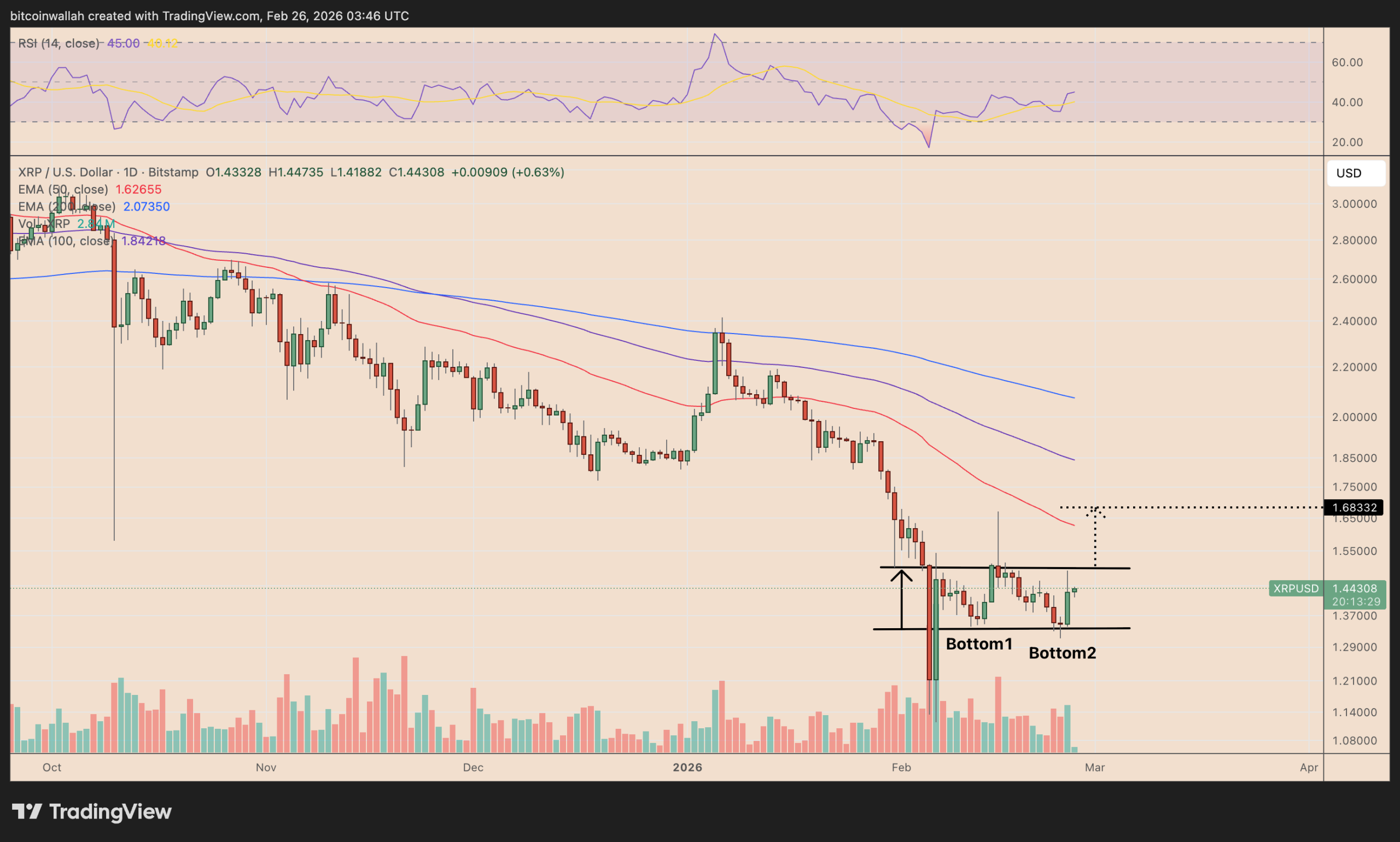
A convincing bullish reversal setup and hints of easing whale distribution may push the price of XRP up by 20% or more in March.
XRP (XRP) is down more than 50% since October 2025, with five consecutive monthly losses. Can March finally snap the bearish streak?
Key takeaways:
-
XRP’s double-bottom setup targets 20% upside in March.
-
Whale selling has cooled and larger-holder balances are rising, improving the bullish outlook.
Double bottom hints at 20% XRP rally
As of Thursday, XRP was forming what appeared to be a double bottom pattern after holding the $1.30–$1.35 support area twice in February.
A double bottom forms when the price hits the same floor twice an rebounds. It resolves on a breakout above the neckline, often setting an upside target equal to the pattern’s height from the breakout level.

For XRP, the neckline sits near $1.50. A decisive break above it increases the odds of XRP rising to $1.68–$1.70 by March, roughly 20% above the current levels.
XRP whale flows improve recovery chances
XRP net flows are shrinking toward neutral levels after spending months in distribution phase, according to data resource CryptoQuant.
As of Thursday, the total whale flow on a 90-day moving average was around -3.29 million XRP compared to roughly -33.50 million XRP in December. This shows that whale outflows have substantially decreased despite the 25% price drop in the same period.

At the same time, XRP supply held by wallets with at least 1,000 tokens has resumed its upward trajectory in recent weeks, suggesting that whales have stopped selling and may be re-accumulating near current lows.

A similar easing in whale flows occurred in April 2025, which preceded an XRP rebound of over 50%.
Therefore, a clean flip above zero would signal net accumulation and strengthen the case for XRP to follow through toward its $1.68–$1.70 double-bottom target in March.
What could spoil the bullish XRP scenario?
The $1.68–$1.70 area is above XRP’s 50-day exponential moving average (50-day EMA, the red trendline), a level the price has failed to break throughout February.
A pullback from the 50-day EMA could keep XRP from hitting its double-bottom target. That may further trigger a bear pennant scenario with the price target at around $1, down about 30% from the current price levels.
Related: $209B exited altcoins over the last 13 months: Did traders rotate into Bitcoin?
Macro risks are another headwind. The return of the AI-driven risk-off trade and US–Iran tensions can drain liquidity from high-beta assets, making it harder for XRP to sustain a breakout even if the chart setup currently looks promising.
This article does not contain investment advice or recommendations. Every investment and trading move involves risk, and readers should conduct their own research when making a decision. While we strive to provide accurate and timely information, Cointelegraph does not guarantee the accuracy, completeness, or reliability of any information in this article. This article may contain forward-looking statements that are subject to risks and uncertainties. Cointelegraph will not be liable for any loss or damage arising from your reliance on this information.
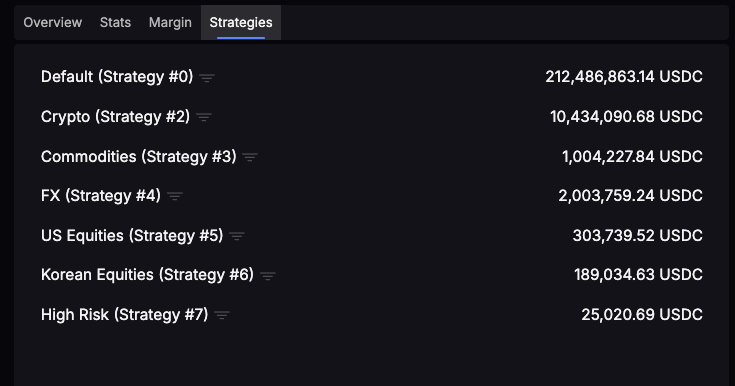
A large crypto trader lost roughly $8.2 million after a leveraged bet on the ARC perpetuals market unraveled on the decentralized derivatives platform Lighter, forcing the exchange to tap its backstop liquidity and trigger auto-deleveraging to manage risk.
In a series of posts on X, the platform explained that the whale built a very large long position over several days, pushing total open interest in the ARC (ARC) market to about $50 million, while roughly 600 traders and market makers took the opposite side.
The trade began to fail when ARC’s price dropped around 6:00 pm ET on Wednesday. About $2 million of the position was liquidated on the order book, and the remaining position was moved into Lighter’s liquidity provider pool (LLP), where it was handled under a high-risk strategy category.
The platform then activated auto-deleveraging (ADL), meaning some profitable short traders were partially closed so the system could safely unwind the position. At one point, the LLP briefly absorbed about 200 million ARC, worth roughly $14.7 million, before the position was reduced further as prices continued falling.
Related: How South Korea is using AI to detect crypto market manipulation
Risk caps limit LP losses to $75,000
Even with the large liquidation, losses to liquidity providers were limited. Lighter said only about $75,000 was affected because the ARC market was isolated in a separate risk bucket rather than exposing the exchange’s entire liquidity pool. Short traders who held positions against the whale were profitable.

“In the end, the big long trader lost around 8.2M USDC (USDC), LLP lost 75k, and the short traders who took the risk of betting against this position were profitable,” Lighter wrote.
Following the incident, Lighter added new safeguards to the market. In a pop-up message on its website, the platform said it introduced a $40 million open interest cap on ARC and moved the pair under a capped liquidity strategy with approximately $100,000 USDC in allocated capital. If that liquidity is exhausted, the system now automatically transitions to ADL to close risk.
The exchange also said similar caps may be applied to other assets.
Related: How pig-butchering crypto scams turn trust into a financial weapon
Manipulation concerns on decentralized platforms
The incident comes amid concerns over price manipulation on decentralized trading platforms. In August last year, four whales were accused of manipulating the price of Plasma (XPL) token on Hyperliquid after the asset jumped about 200% to above $1.80 within minutes.
In June, DeFi protocol Resupply also suffered a security breach in its wstUSR market, resulting in roughly $9.6 million in losses after an attacker manipulated prices through its integration with the synthetic stablecoin cvcrvUSD.
Magazine: Bitcoin may take 7 years to upgrade to post-quantum — BIP-360 co-author


Ethereum co-founder Vitalik Buterin has outlined sweeping changes to the network’s core consensus design following the release of the Ethereum Foundation’s new “strawmap,” a long-range technical roadmap aimed at accelerating layer-1 upgrades through the end of the decade.
Summary
- Vitalik Buterin outlined plans to reduce Ethereum slot times from 12 seconds toward as low as 2 seconds, with finality potentially dropping to 6–16 seconds.
- The Ethereum Foundation’s “strawmap” sketches seven forks through 2029, targeting faster UX, gigagas throughput, post-quantum security, and privacy.
- Upgrades include erasure-coded P2P networking, reduced attester counts, Minimmit-based finality, and eventual quantum-resistant cryptography.
Vitalik Buterin explains Ethereum Strawmap vision
In a detailed post, Buterin walked through one of the roadmap’s central goals: “fast L1,” which seeks to progressively reduce slot times and dramatically cut finality. Ethereum’s current average finality sits at roughly 16 minutes.
Under the proposed trajectory, slot times could gradually fall from 12 seconds to as low as 2 seconds, while finality could shrink to between 6 and 16 seconds using a one-round BFT-style algorithm known as Minimmit.
Buterin emphasized that slot time reductions would occur incrementally, potentially following a “sqrt(2) at a time” formula, and only when proven safe. Key enablers include peer-to-peer networking upgrades using erasure coding to improve block propagation efficiency, as well as architectural adjustments that reduce signature aggregation overhead by limiting the number of attesters per slot.
The strawmap, introduced by Ethereum Foundation researcher Justin Drake, presents five long-term “north stars”: fast L1, gigagas L1 throughput, teragas L2 scaling, post-quantum security, and native privacy. It spans seven projected forks through 2029, with upgrades grouped across consensus, data, and execution layers.
Buterin noted that many of the most invasive changes, including quantum-resistant hash-based signatures, may be bundled together in a gradual “ship of Theseus” style replacement of Ethereum’s consensus system.
While the document is described as a coordination tool rather than an official roadmap, it signals a push toward faster user experience, stronger cryptography, and end-to-end formal verification.
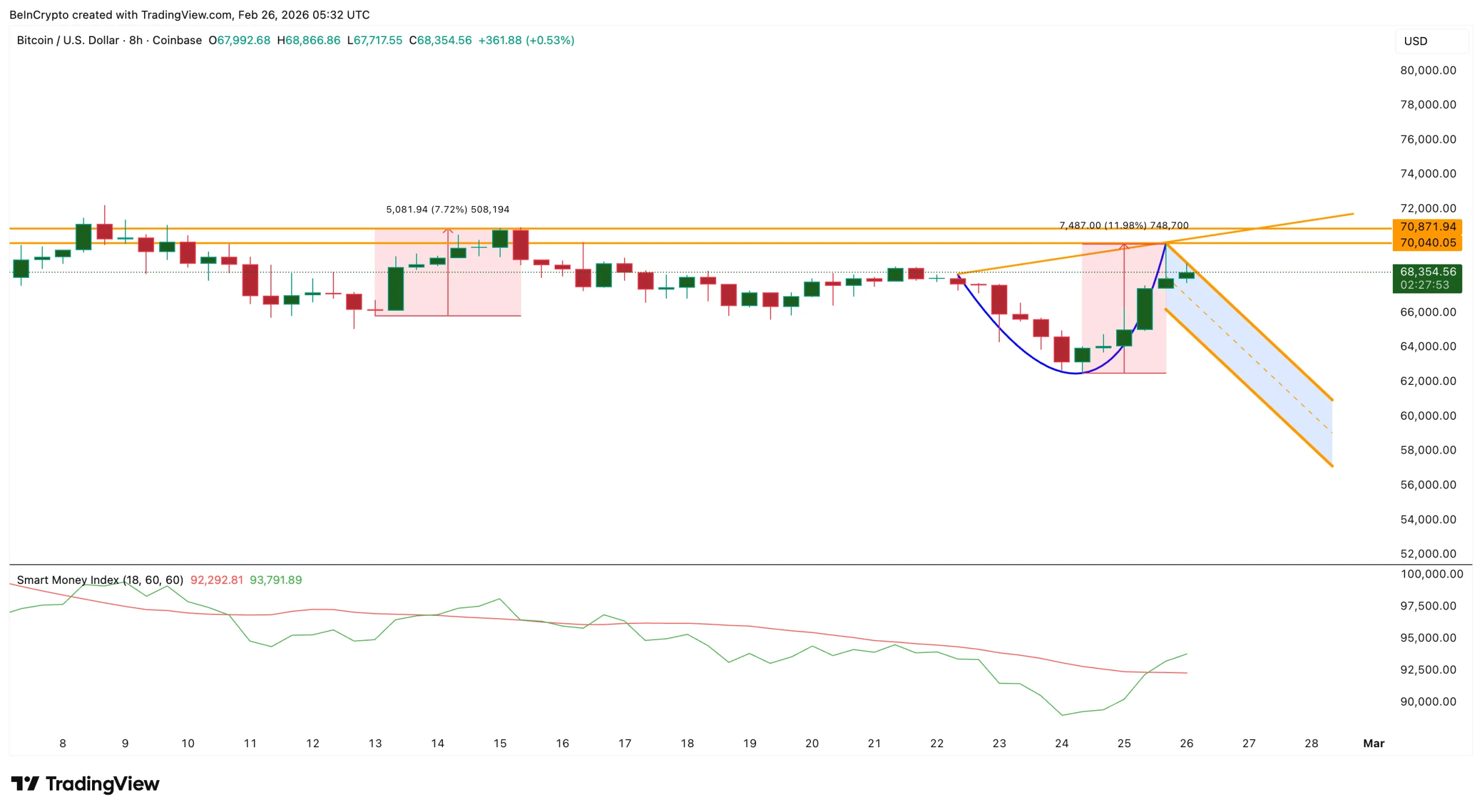
Bitcoin price is up nearly 5% in the past 24 hours, briefly touching the $70,000 level before pulling back toward $68,000. This rebound helped Bitcoin recover almost 12% from its February 24 low.
But despite this strong move, Bitcoin could not hold above $70,000. This hesitation is not random. It reflects a deeper issue that Dessislava Ianeva, Research Analyst at Nexo, says is still limiting Bitcoin’s recovery. Multiple data points now show that while buy signals are appearing, conviction remains weak. And until Bitcoin clears the $70,000 to $70,800 zone, this recovery may remain incomplete.
Smart Money Signals Price Recovery, But Breakout Still Needs Confirmation
Bitcoin’s recent rebound did not happen without warning. One key indicator called the Smart Money Index (SMI) began rising on February 24. This indicator tracks the trading behavior of informed traders, often linked to strategic positioning. When this index rises, it suggests experienced investors may be positioning early.
The last time this happened was February 13, when the SMI started moving toward the signal line. Back then, the Bitcoin price climbed about 7% over two days.
Want more token insights like this? Sign up for Editor Harsh Notariya’s Daily Crypto Newsletter here.
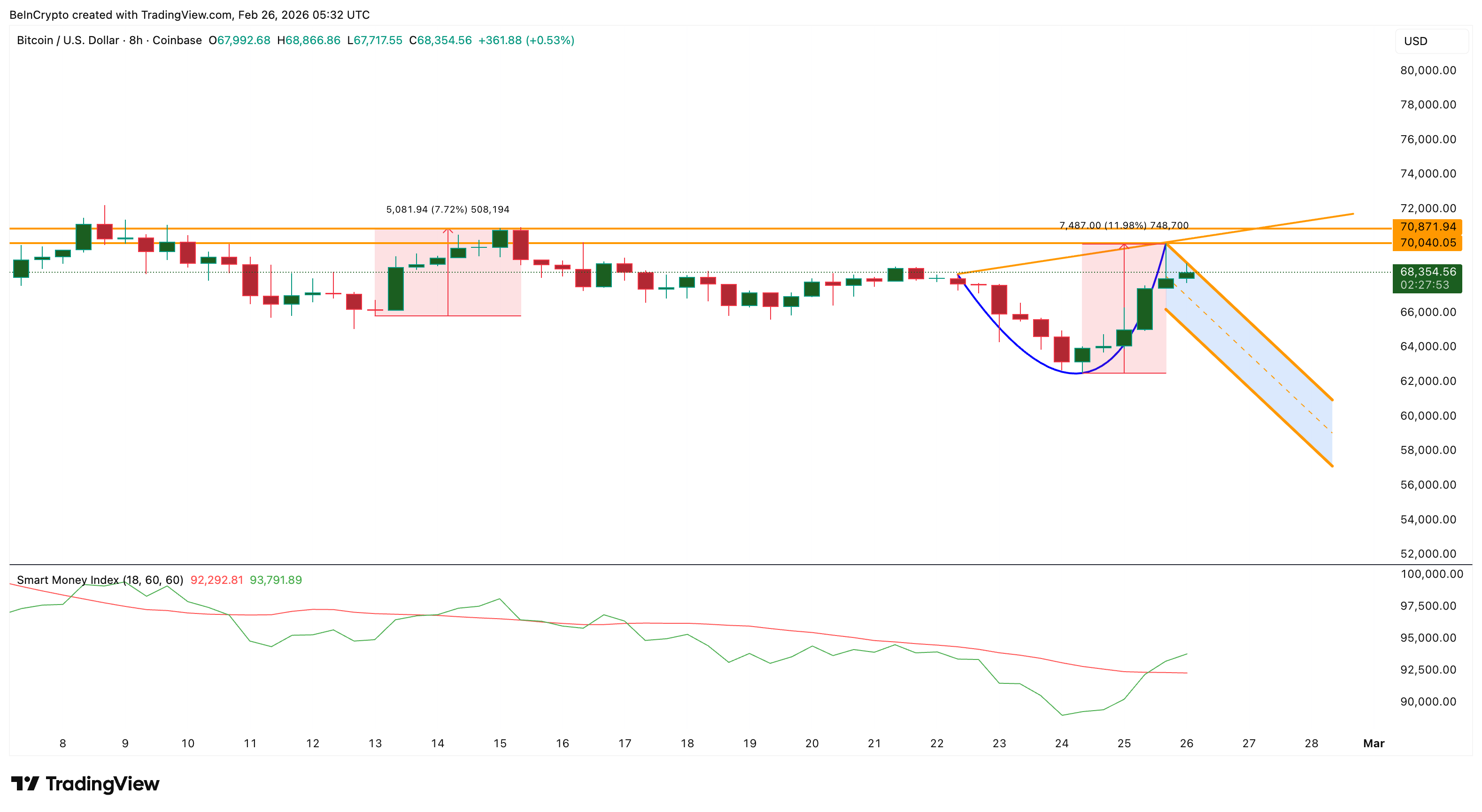
This time, the move was stronger. Bitcoin jumped nearly 12%, briefly touching $70,000. At the same time, Bitcoin is now forming what appears to be a cup and handle pattern. This is a bullish structure. It often appears before breakouts.
But the breakout is not confirmed yet. Because Bitcoin is still stuck below the critical upsloping neckline zone between $70,000 and $70,800.
This range now acts as the trigger level. Until Bitcoin crosses it, the pattern remains incomplete.
Nexo Analyst Explains Why Bitcoin Price Recovery Still Lacks Conviction
Despite bullish technical signals, the underlying demand is still weak. Trading volume shows this clearly.
Earlier in February, Bitcoin trading volume reached $125.5 billion. That was during the previous price move. Today, trading volume is around $52 billion. That is more than 58% lower.
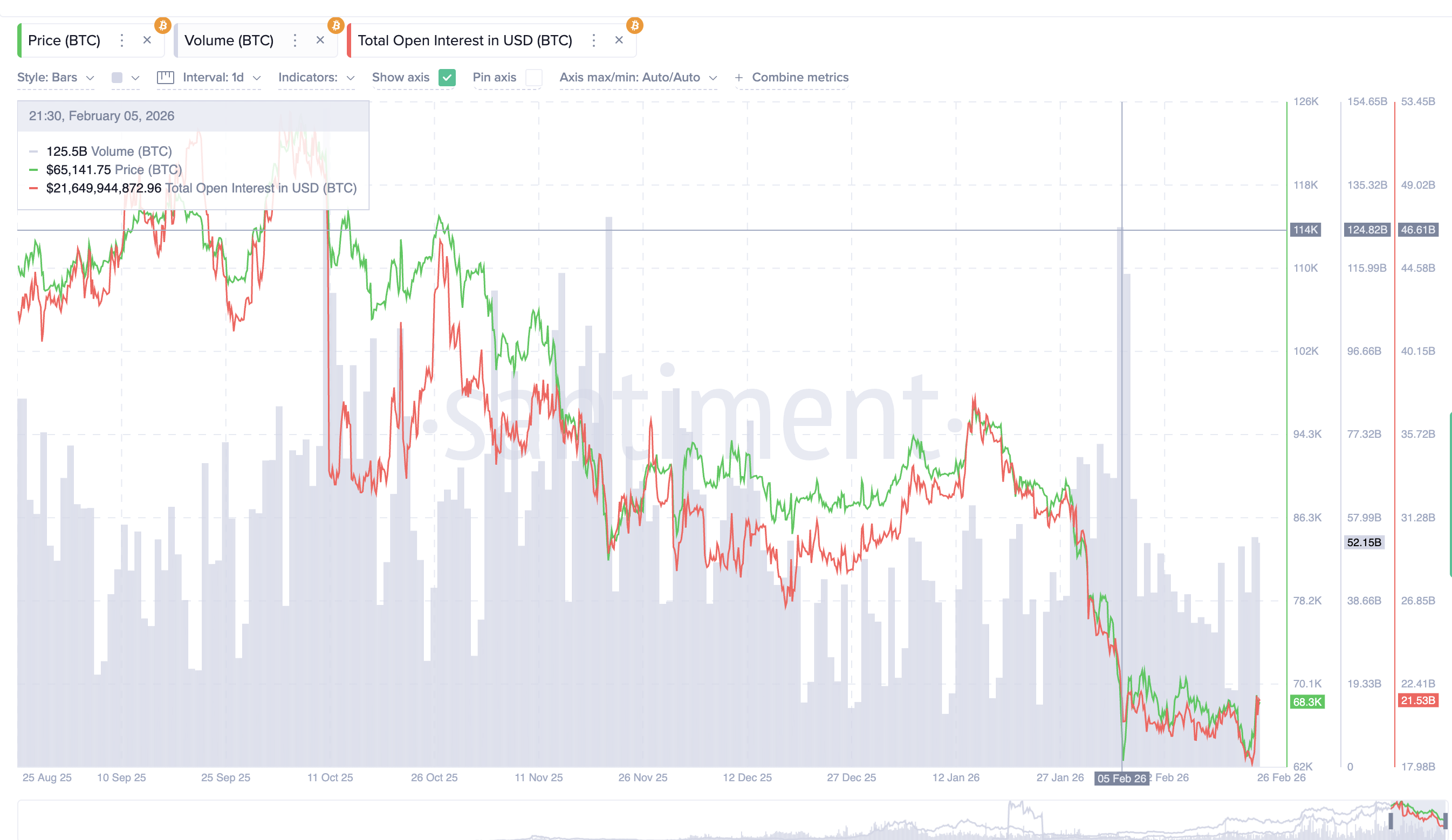
Even more importantly, Dessislava Ianeva confirmed this broader trading participation weakness.
“In 2026, BTC average trading volumes are down roughly 17% versus the 2025 average, reflecting subdued market participation,” Ianeva mentioned
This means fewer participants are supporting the move. This is critical because price rallies need strong participation to sustain themselves. At the same time, open interest has also dropped sharply.
Open interest measures the number of futures positions that are active. Earlier in January, open interest stood near $37.5 billion. Now it is around $21.5 billion. That is a 43% drop. This tells us fewer traders are willing to take large positions.
Ianeva added to this finding by saying that:
“Derivatives positioning has normalized and funding conditions have cooled, pointing to orderly deleveraging rather than systemic stress.”
This means the market is stabilizing. But it also means aggressive buying pressure is missing. This helps explain why Bitcoin recovery remains slow.
Long-Term Bitcoin Holders Are Still Selling Despite the Price Bounce
Another major sign of weak conviction, apart from the lack of aggressive buying, comes from Bitcoin’s long-term holders.
The Long-Term Holder Net Position Change metric tracks whether long-term investors are accumulating or selling Bitcoin over a 30-day period. These holders are considered the strongest hands because they typically buy during crashes and sell during market tops.
But right now, they are still selling.
February 24 showed a net reduction of 78,583 BTC on a 30-day rolling basis. That selling has only slightly slowed to 75,911 BTC recently. This is still significantly higher than the 61,431 BTC reduction seen on February 23.
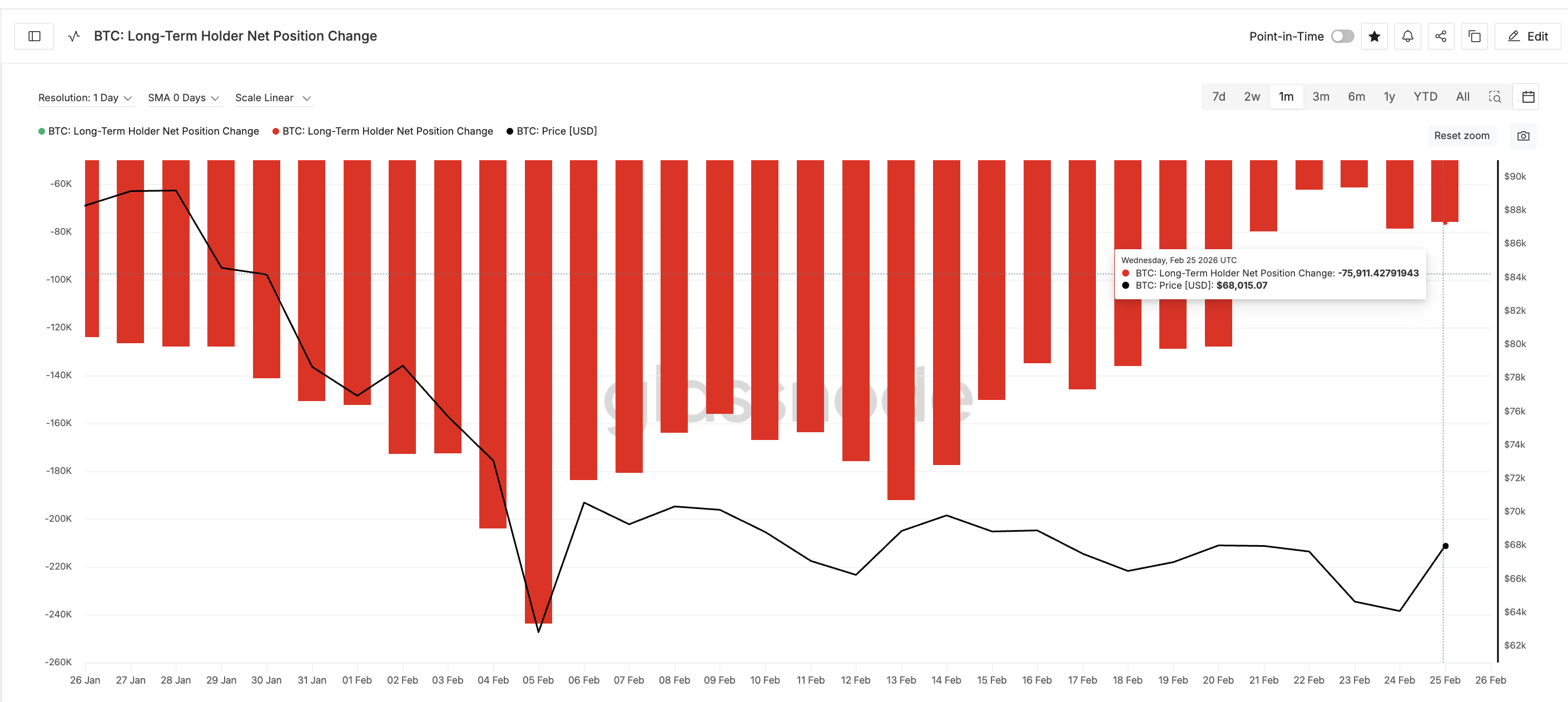
This shows that even as the Bitcoin price rebounded nearly 12%, long-term holders did not shift into accumulation. Instead, they continued distributing supply.
This creates a major problem for the rally. Because sustainable Bitcoin price recoveries usually begin when long-term holders start buying aggressively, not selling.
Dessislava Ianeva also pointed to this broader lack of conviction as part of the macroeconomic (global economic) concerns.
“Macro uncertainty continues to constrain liquidity, even as crypto-specific excess has largely been cleared and the market is in a healthier position.”
This confirms that while Bitcoin’s structure is improving with excess like leverage being cleared out, strong conviction has not fully returned. Until long-term holders stop selling and begin accumulating again, Bitcoin’s upside may remain limited — especially near major resistance zones like $70,000.
Supply Cluster at $70,000–$70,800 Is the Real Bitcoin Price Barrier
The strongest reason Bitcoin stalled near $70,000 comes from on-chain supply data. This data is called URPD, or UTXO Realized Price Distribution. It shows where investors last bought their Bitcoin.
Two major supply clusters exist right now. The first sits near $69,400 and holds about 0.93% of supply. The second sits at $70,600 and holds about 0.60% of supply. Together, this zone contains about 1.5% of the total Bitcoin supply.
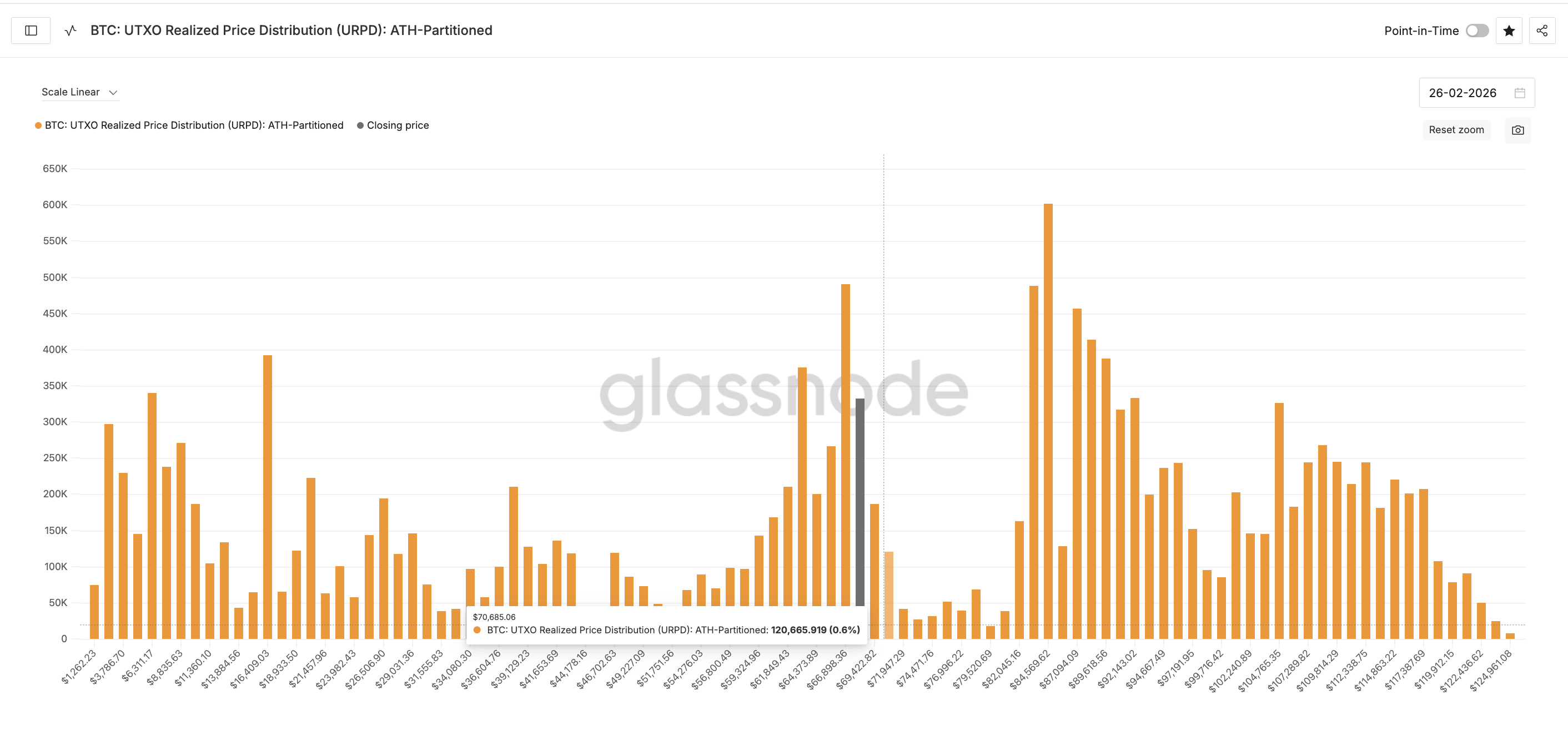
That makes it one of the strongest resistance zones. This explains why Bitcoin touched $70,000 but could not stay above it.
Investors who bought earlier at these levels are likely selling to break even. This creates selling pressure. But this also explains why breaking $70,800 could change everything.
Above $70,800, supply becomes significantly thinner, as the last key cluster sitting at $70,600 breaks. This means fewer sellers exist, and if Bitcoin breaks above $70,800, the next major target sits near $78,600. This represents a potential upside of over 11%, as projected by the cup-to-neckline distance.
Also, this level is not random, and the technical resistance aligns with a key URPD cluster as well at $78,200.
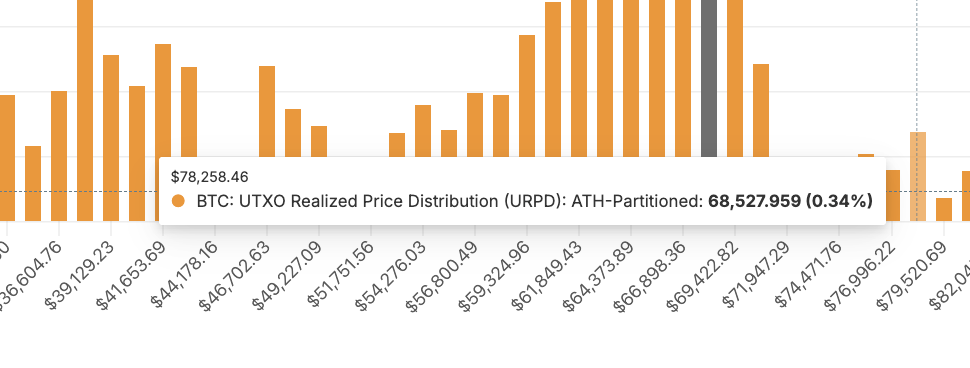
However, downside risks still exist as the broader trend for the BTC price points lower. Bitcoin must hold above $65,700 to maintain this bullish structure. If Bitcoin falls below $62,400, the bullish pattern would fail completely.
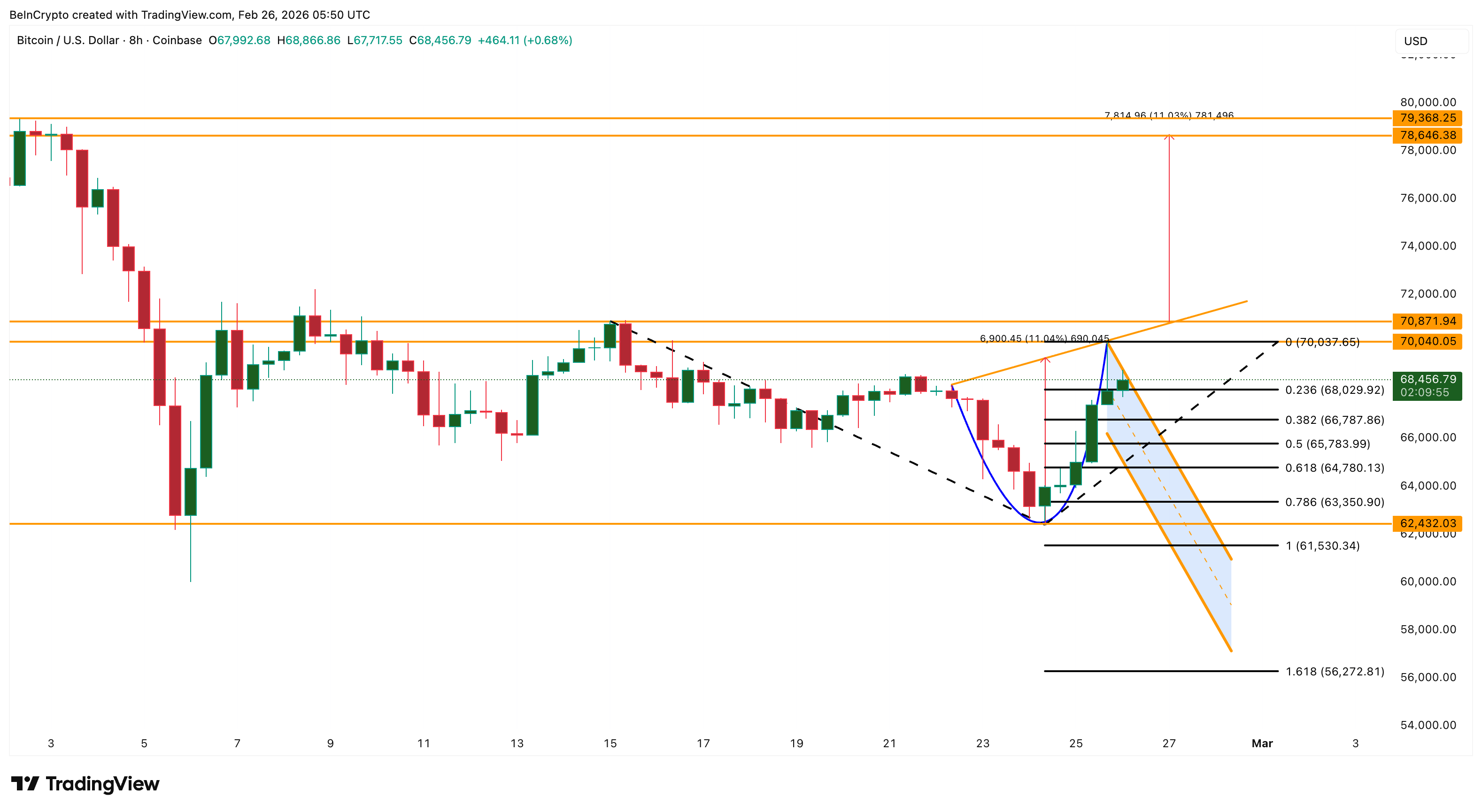
For now, Bitcoin is stuck at a decision point. Smart money signals show early positioning. But falling trading volume, lower open interest, and strong supply at $70,000 are still blocking the breakout. As the Nexo analyst Dessislava Ianeva explained, the market structure is improving. But conviction is not fully back yet.

AllUnity, a stablecoin platform backed by Deutsche Bank, has launched a new stablecoin denominated in Swiss francs (CHF).
After introducing its euro-pegged EURAU stablecoin last year, AllUnity is rolling out CHFAU, a stablecoin pegged 1:1 to the franc, the company said in an announcement shared with Cointelegraph on Thursday.
Initially available to institutional and professional investors, CHFAU launches on the Ethereum blockchain as an ERC-20 token, with plans to expand to additional networks later this year.
CHFAU enters the market fully aligned with the EU’s Markets in Crypto-Assets Regulation (MiCA), as AllUnity secured an E-Money Institution (EMI) license from the German Federal Financial Supervisory Authority (BaFin) in July 2025.
“The launch of CHFAU is a fundamental milestone in our mission to build Europe’s regulated digital payments ecosystem,” AllUnity CEO Alexander Höptner said.
Regulated digital Swiss franc for institutional settlement
CHFAU will be exclusively available to institutional and professional clients through the AllUnity Mint Platform, a spokesperson for AllUnity said.
“We are currently finalizing exchange and trading venue integrations and will communicate specific listings as they go live,” the company said, adding that CHFAU is technically live, but broader availability across venues will be rolled out progressively through integrations.
“The primary purpose of CHFAU is to serve as a trusted, regulated digital Swiss franc for institutional settlement,” Höptner told Cointelegraph, adding:
“Whether for cross-border payments, digital asset markets, or treasury and liquidity management, CHFAU enables secure, real-time value transfer within a fully compliant framework.”
EURAU grows to $1.2 million since launch
AllUnity was founded in early 2024 as a joint venture by Deutsche Bank’s asset management arm DWS, market maker Flow Traders and crypto company Galaxy Digital with the aim of issuing fully regulated stablecoins.
Since its debut in July 2025, AllUnity’s EURAU stablecoin has seen its market capitalization rise to $1.2 million, ranking 16th by market cap among 22 euro‑pegged stablecoins listed on CoinGecko.
Related: ECB targets 2027 digital euro pilot as provider selection begins in Q1 2026
The stablecoin is available on a limited number of exchanges, with CoinGecko listing public centralized exchange Bullish and the decentralized exchange Aerodrome as venues trading EURAU at the time of publication. The stablecoin is also available on platforms including Bitpanda, Rulematch and WAWEX, AllUnity told Cointelegraph.

The total market capitalization of all euro-pegged stablecoins is now at $895 million, with EURC (EURC), issued by USDC (USDC) provider Circle, leading with $459 million.
Not the only Swiss franc stablecoin
Although AllUnity says CHFAU is the first MiCA-compliant Swiss franc‑pegged stablecoin, multiple companies have experimented with similar initiatives in recent years.
According to data from DefiLlama, there are at least three CHF‑denominated stablecoins, including Frankencoin (ZCHF), VNX Swiss Franc (VCHF) and Hedera Swiss Franc (HCHF). The combined market capitalization of these coins is about $38.6 million.

The largest of these, Frankencoin, is a decentralized stablecoin launched in 2023. The project is based in Switzerland and backed by the Frankencoin Association.
Other CHF stablecoin initiatives include CryptoFranc (XCHF), issued by crypto financial services provider Bitcoin Suisse. Launched around 2018, the stablecoin was later discontinued due to insufficient market adoption.
Magazine: 6 massive challenges Bitcoin faces on the road to quantum security
Crypto World
UK politician proposes ban on political crypto donations over foreign interference risks


Some Members of Parliament in the United Kingdom, led by the chairman of the Joint Committee on National Security Strategy, Matt Western, are pushing for a temporary ban on political crypto donations due to concerns over foreign interference.
Summary
- UK MPs have proposed a temporary moratorium on crypto donations to political parties until the Electoral Commission issues statutory guidance.
- The proposal calls for the use of FCA-registered platforms, mandatory source verification and a ban on mixer-linked funds among other provisions.
A letter directed to the Secretary of State for Housing, Communities and Local Government, Steve Reed, has proposed a temporary moratorium on cryptocurrency donations to political parties until the Electoral Commission produces statutory guidance.
In the letter, Western raised concerns around “foreign state intent to interfere in UK political finance” as there is “no clear national enforcement lead for political finance and foreign interference risk.”
“As the security environment worsens and the UK’s military role in Europe grows, the value of influencing the UK’s political positions (for example, on Ukraine, or US/EU relations) is likely to increase,” Western said.
He has urged the Electoral Commission to introduce interim safeguards, such as only allowing political parties to process crypto donations through Virtual Asset Service Providers registered with the Financial Conduct Authority, and accepting contributions where there is high confidence in identifying the ultimate source of the funds.
He also suggests prohibiting the use of crypto mixers or tumblers that can be used to obscure the provenance of assets, alongside a mandate that political parties should convert donations into pound sterling within 48 hours of receipt.
Further, Western recommended stricter source of wealth checks for donors and a review of sentencing for electoral finance offences, alongside higher penalties for breaches involving foreign money and expanded powers for regulators to pursue violations.
Last month, Western, along with a group of other committee chairs, lobbied for a full ban on cryptocurrency donations by including a provision in the Representation of the People Bill. That, however, was not included in the legislation when the bill was introduced to the House of Commons on Feb. 12.
According to a BBC report, Reform UK was the first party at Westminster to accept political cryptocurrency donations in the UK, led by pro-crypto figure Nigel Farage, who announced the move after appearing at the Bitcoin 2025 conference in Las Vegas.
However, details on the party’s official website state that it does not accept anonymous donations and applies permissibility checks to ensure funds originate from UK-registered companies or individuals listed on the electoral register, with contributions above £500 subject to standard compliance procedures.
Across the globe, crypto donations became a defining feature of the U.S. election cycle last year, with several political figures, including current President Donald Trump, having embraced digital asset fundraising. Trump’s campaign began accepting cryptocurrency contributions during the 2024 race.
As previously reported by crypto.news, Representative Mike Collins from Georgia also announced plans to accept cryptocurrency donations last year.
The Federal Election Commission permits cryptocurrency contributions to political committees, provided they adhere to existing contribution limits, disclosure standards, and other reporting requirements.


Former Ethereum treasury firm EthZilla has officially rebranded as Forum Markets as it moves ahead with its pivot towards a full-fledged tokenized real-world assets-focused firm.
Summary
- Rebranded as Forum Markets, the company will trade under the ticker FRMM from March 2.
- Under the Forum Markets brand, the company is repositioning itself as a tokenised real-world asset platform.
- Peter Thiel’s Founders Fund exited its position in the company earlier this month as the stock remained deeply below its August 2025 peak.
According to the official announcement, the company has updated its corporate name and brand to Forum Markets as it moves away from its earlier positioning as an Ethereum treasury company. As part of the rebranding, it has also changed its Nasdaq ticker symbol to FRMM and is expected to begin trading under the new symbol on March 2, subject to Nasdaq approval.
Forum framed the move as the “next development in the company’s planned strategic evolution” and said it plans on “connecting traditional capital markets with blockchain-based financial infrastructure.”
“Forum embodies our belief that the next generation of financial markets will be built around institutional-grade, on-chain products backed by real assets, governed by transparency, and delivered through regulated infrastructure,” the company’s chairman and CEO, McAndrew Rudisill, said in an accompanying statement.
The company said its platform is designed to aggregate, structure, and tokenize cash generating real world assets that were previously inaccessible to a broader base of investors. Forum will leverage its subsidiaries and strategic partners to create a repeatable pipeline to originate and distribute tokenized investment products across multiple asset classes.
Forum has already begun phasing out its balance sheet crypto strategy and announced earlier this month that it had acquired two commercial jet engines leased to a “leading US air carrier,” which will underpin its first aviation-backed offering, the Eurus Aero Token I.
ETHZilla shares climbed more than 13% after the company announced the rebrand and ticker change. However, on a year-to-date basis, the company’s shares were down over 20% as crypto treasury stocks have struggled to gain traction over the past months.
ETHZilla, formerly a biotech company known as 180 Life Sciences, transitioned into an Ethereum treasury firm last year while crypto treasury stocks were trending. Subsequently, it acquired as much as 102,246 ETH at the height of the strategy, but as the initial enthusiasm faded and share prices retreated, the company later announced its intent to pivot toward the tokenized real-world asset market.
Earlier this month, Peter Thiel’s Founders Fund, an early backer of the company, exited its position. ETHZilla has also moved to sell portions of its assets to scale back its crypto exposure and initiate share buybacks in an effort to stabilise its equity performance.


Vitalik Buterin says Ethereum (ETH) will achieve quantum resistance soon via post-quantum hash-based signatures in the Strawmap, a four-year Layer 1 (L1) upgrade plan.
Why it matters:
- Quantum computers could break Ethereum’s current encryption; hash-based signatures would close that gap before the threat arrives.
- Buterin’s confirmation moves quantum resistance from a research topic to a scheduled Ethereum upgrade target.
- The Strawmap’s six-month fork schedule means quantum-resistant slots could ship within the plan’s first two upgrades.
The details:
- Buterin confirmed the timeline via X on February 26, 2026, citing the Ethereum Foundation’s Strawmap.
- The Strawmap was published at strawmap.org after an Ethereum Foundation workshop in January 2026.
- The name blends “strawman” and “roadmap,” meaning the plan is experimental and built to be revised.
- The four-year plan targets ~7 forks every six months; Glamsterdam and Hegotá are confirmed for 2026.
- Buterin also proposed cutting block time to 2 seconds and finality from ~16 minutes to 6–16 seconds.
The big picture:
- Bitcoin and Solana ecosystems are also running post-quantum research, making it a growing priority across blockchains.
- A fixed six-month fork schedule marks a faster, more structured upgrade cadence for Ethereum’s L1.
- The Strawmap is explicitly a draft — timelines, including quantum resistance, could shift as development progresses.
The post Vitalik Buterin Says Ethereum Will Soon Achieve Quantum Resistance appeared first on BeInCrypto.


Indiana lawmakers have passed House Bill 1042, commonly referred to as the Bitcoin Rights Bill, clearing both legislative chambers and sending the measure to Governor Mike Braun for final approval.
Summary
- Indiana’s HB 1042 Bitcoin Rights Bill has passed both legislative chambers and now awaits Governor Mike Braun’s signature.
- The bill would allow cryptocurrency investment options in public retirement plans and protect individual digital asset access.
- If signed, the law will take effect July 1, 2026, reflecting growing institutional adoption of Bitcoin.
Indiana passes Bitcoin Rights Bill as crypto adoption accelerates
If signed into law, the bill will take effect on July 1, 2026, and would allow cryptocurrency investment options within public retirement plans while affirming the rights of individuals to access and use digital assets.
The legislation marks a significant step in formalizing Bitcoin and broader digital asset participation within state-backed financial structures.
The news comes as Arizona lawmakers advanced Senate Bill 1649, which would create a Digital Assets Strategic Reserve Fund allowing the state to hold, invest and potentially lend seized cryptocurrencies.
By permitting exposure to cryptocurrencies in public pension portfolios, Indiana joins a growing list of jurisdictions responding to sustained institutional interest in Bitcoin (BTC), particularly following the strong performance and capital inflows into spot Bitcoin exchange-traded funds over the past several years.
Supporters argue the bill ensures that Indiana’s public institutions and citizens are not disadvantaged as digital assets increasingly become integrated into global financial markets. The measure also reinforces protections for individuals to hold and transact in cryptocurrencies without undue restriction, signaling a pro-innovation stance from state lawmakers.
The push comes amid mounting pressure from financial markets to modernize investment frameworks. Since the launch and expansion of Bitcoin ETFs, institutional adoption has accelerated, prompting policymakers to revisit existing rules around retirement portfolio diversification and digital asset access.
Governor Braun has yet to announce whether he will sign the bill, but if enacted, Indiana would position itself as one of the more crypto-forward states heading into the second half of 2026.


Bitcoin price rebounded over 7% to $69,487 on Thursday amid a spike in short liquidations and improved risk-on sentiment following a bullish Nvidia earnings report.
Summary
- Bitcoin price approached $70K amid a short squeeze and bullish Nvidia earnings report.
- Spot Bitcoin ETFs drew in $257 million in inflows on Wednesday.
According to data from crypto.news, Bitcoin (BTC) price shot up to an intraday high of $69,487 on Thursday, Feb. 26, before settling around $68,200 at press time, still holding 4.6% gains over the past 24 hours. The bellwether’s rebound follows just two days after it fell under $63,000 amid investor fears over macroeconomic and geopolitical uncertainty.
Bitcoin price rallied as investors bought the asset during the recent dip in prices. As BTC price rose, it triggered liquidations of highly leveraged bearish bets across leveraged crypto markets. Data from CoinGlass shows that roughly $576 million worth of positions were liquidated from BTC futures, with around $470 million coming from short positions. Bitcoin alone accounted for $194 million in short liquidations.
Short liquidation occurs when rising prices force traders who bet against the asset to close their positions, with traders having to buy back the asset at higher prices to cover their losses. This, in turn, leads to an immediate spike in prices through a feedback loop often called a short squeeze.
Another major tailwind that boosted BTC price and other altcoins came from investors embracing a risk-on sentiment as stocks posted modest gains and broader risk sentiment improved with Nvidia Corp.’s latest bullish earnings report.
Notably, the Dow Jones Index increased by 307 points on Wednesday. At the same time, the Nasdaq 100 and S&P 500 indices jumped by 351 and 56 points.
AI chip-making giant Nvidia, the world’s largest publicly traded company, reported record-breaking earnings for Q4 of Fiscal Year 2026. Quarterly revenue reached an all-time high, increasing 20% quarter-over-quarter and 73% year-over-year. For the full fiscal year 2026, total revenue reached $215.9 billion, a 65% increase from the previous year.
Previously, investors were concerned about excessive AI spending by Big Tech giants. However, the back-to-back bullish earnings from Nvidia, seen as a barometer for the AI-fueled trade, appear to have calmed investors’ nerves.
The return of inflows into spot Bitcoin ETFs also likely played a modest part in improving investor sentiment. Data from SoSoValue show that the 12 spot Bitcoin ETFs recorded $257.7 million in inflows on Wednesday, marking the first triple-digit inflows figures since Feb. 10.
While it is not yet a strong sign of a long-term trend, investors took it as a positive signal that institutional demand remains resilient despite recent market volatility.
Disclosure: This article does not represent investment advice. The content and materials featured on this page are for educational purposes only.

Newslinks for Thursday 26th February 2026

Looming Tyler Myers trade a blow to rebuilding Canucks

Building An Interactive Climbing Wall


-

 Video6 days ago
XRP News: XRP Just Entered a New Phase (Almost Nobody Noticed)
-

 Politics4 days ago
Baftas 2026: Awards Nominations, Presenters And Performers
-

 Fashion6 days ago
Weekend Open Thread: Boden – Corporette.com
-

 Sports3 days ago
Women’s college basketball rankings: Iowa reenters top 10, Auriemma makes history
-

 Politics3 days ago
Nick Reiner Enters Plea In Deaths Of Parents Rob And Michele
-

 Crypto World2 days ago
XRP price enters “dead zone” as Binance leverage hits lows
-

 Business4 days ago
Mattel’s American Girl brand turns 40, dolls enter a new era
-

 Business4 days ago
Law enforcement kills armed man seeking to enter Trump’s Mar-a-Lago resort, officials say
-

 Tech2 days ago
Unsurprisingly, Apple's board gets what it wants in 2026 shareholder meeting
-
 NewsBeat10 hours ago
Manchester Central Mosque issues statement as it imposes new measures ‘with immediate effect’ after armed men enter
-

 NewsBeat8 hours ago
Cuba says its forces have killed four on US-registered speedboat | World News
-
 NewsBeat3 days ago
‘Hourly’ method from gastroenterologist ‘helps reduce air travel bloating’
-

 Tech4 days ago
Anthropic-Backed Group Enters NY-12 AI PAC Fight
-

 Business2 days ago
True Citrus debuts functional drink mix collection
-

 NewsBeat4 days ago
Armed man killed after entering secure perimeter of Mar-a-Lago, Secret Service says
-

 Politics4 days ago
Maine has a long track record of electing moderates. Enter Graham Platner.
-
 NewsBeat1 day ago
Police latest as search for missing woman enters day nine
-

 Business4 hours ago
Discord Pushes Implementation of Global Age Checks to Second Half of 2026
-

 Crypto World1 day ago
Entering new markets without increasing payment costs
-
 Sports3 days ago
2026 NFL mock draft: WRs fly off the board in first round entering combine week