

Last year, investors worried that AI would crash the economy by making too little money.
Tech
AI recession: A memo laid out how AI could kill jobs. Wall Street panicked.

Now, they fear it will do so by making too much.
On Sunday, a little-known financial analysis firm called Citrini Research published a piece of science fiction: A memo dated June 2028, in which its researchers sketch a pocket history of “the global intelligence crisis” — an AI-triggered meltdown of the world’s financial, economic, and political systems.
In this account, the problem isn’t that AI proves unprofitable — and America’s data centers become rusted-out memorials to a 21st century Tulip Mania.
In Citrini’s telling, AI does exactly what its boosters promised (at first, anyway). The technology fuels rates of productivity growth unseen since the 1950s, generates mind-boggling profits for its owners, and massive GDP gains.
- A viral Substack post sketched how AI could trap the economy in a doom loop — and freaked out investors.
- It explained how AI could devalue white-collar labor and destroy consumer demand.
- The post also argued that AI agents will destroy the business models of several specific companies.
- But there are many reasons to doubt the scenario’s plausibility.
But it also irrevocably devalues white-collar labor and rapidly destroys a wide array of major businesses. Over time, the AI boom eats the rest of the economy. Growth and the S&P 500 both collapse, unemployment tops 10 percent, the mortgage market wobbles, the Occupy Silicon Valley movement blocks the entrance to OpenAI’s offices — all while the big labs keep raking in cash.
Such counterintuitive soothsaying might seem unremarkable. Bloggers sketch dystopian AI scenarios every day. Yet the Citrini memo appeared to do what few — if any — works of science fiction have done before: reduce the value of US stocks by more than $200 billion.
AI and the white-collar doom loop
To understand why the memo made such an impression, it’s worth examining its vision in more detail.
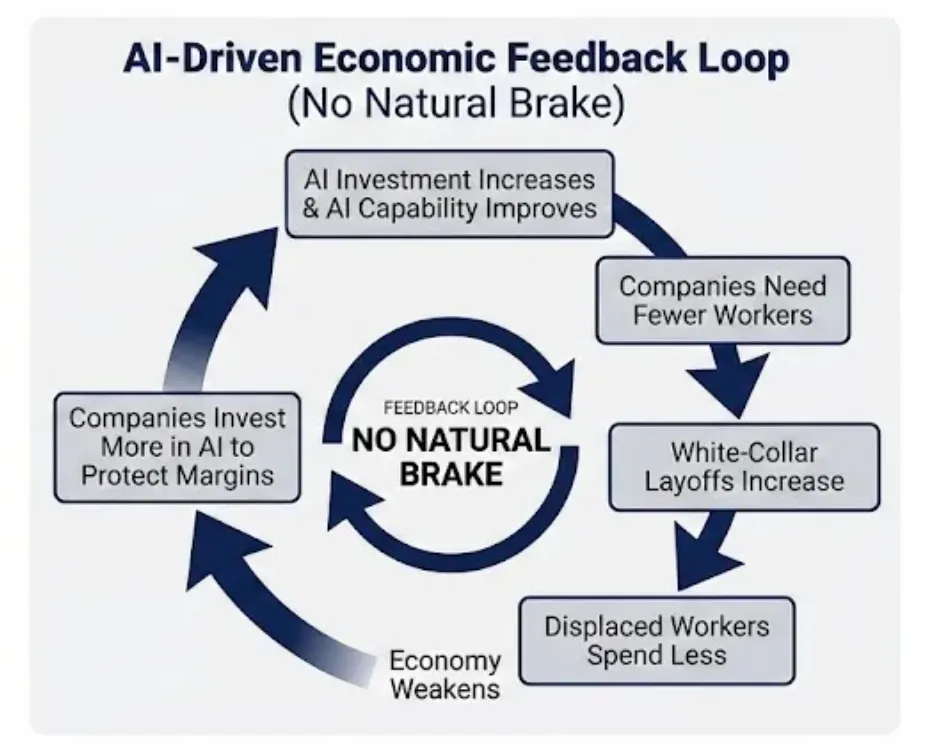
Citrini tells two distinct — but overlapping — stories. The first is about how AI could trigger a doom loop that destroys consumer demand. The narrative goes like this:
- AI advances render a steadily growing number of white-collar workers obsolete. By the end of 2026, Claude agents can do the work of “a $180,000 product manager for $200/month.” And the same is true of myriad other roles in consulting, software, real estate, financial advice, legal services, and more.
- Companies respond by cutting headcount and reinvesting their savings in AI.
- Higher investment in AI leads to more capable agents, devaluing the skills of even more white-collar workers.
- Displaced professionals slash their spending and drag down wages in the working-class economy: As laid-off McKinsey consultants start driving Ubers, rates for existing drivers fall amid heightened competition. And the same dynamic plays out in other sectors.
- AI’s productivity gains are generating massive wealth. But most of the returns flow to an extremely narrow elite. And when the super rich get richer, they don’t necessarily spend more money. Sam Altman needs only so many cars and TVs. So much of the AI industry’s profits don’t circulate back into the economy.
- Meanwhile, upper middle-class Americans are slashing their spending — either because they’re jobless or afraid they will be soon — and blue-collar workers aren’t seeing much wage growth. Thus, consumer demand collapses.
- As falling demand eats into companies’ profits, they scramble to find cost-savings. More and more discover that the easiest way to shore up their margins is to invest in AI and lay off workers.
- Higher investment in AI yields even more capable agents.
- More white-collar workers become obsolete.
- Companies respond by cutting headcount and reinvesting their savings in AI.
The cycle perpetuates itself with no natural brake.

Citrini Research
Citrini’s second story is a micro one, focused on how AI will disrupt certain businesses and industries. The core idea is that AI agents will turbo-charge competition — and shrink rents — throughout the white-collar economy.
Here’s a summary of the memo’s basic reasoning:
- Humans have a limited tolerance for comparison shopping. We don’t have the time or patience to exhaustively research every purchase we make. Instead, we default to familiar brands. Even corporate leaders do this when choosing which enterprise software to buy.
- This has enabled incumbent businesses to charge higher prices than perfectly competitive markets would allow. In total, trillions of dollars of enterprise value rests on this kind of rent extraction.
- AI agents don’t get impatient. And they can rapidly compare prices from across the entire internet.
- By 2028, people with no tech savvy will be using AI agents on a daily basis. They’ll simply click open an app and ask it to find them the cheapest flight, best apartment listing, or lowest-fee delivery app.
- Meanwhile, AI agents will massively lower the bar to entry in the markets for software, travel booking, real estate, food delivery, and much else. Using Claude Code, a single person — let’s call him Bob — can build a new delivery platform in an afternoon.
- On that platform, Bob offers lower fees than DoorDash or Seamless to consumers, restaurants, and drivers.
- In our world, Bob’s startup probably wouldn’t get anywhere; at first, it would have few participating drivers and restaurants. Consumers would stick with the brands they knew out of habit and convenience.
- But in the world where everyone is constantly using AI agents, hungry households don’t log into DoorDash to order pad thai — they ask ChatGPT to order them pad thai through whichever delivery service is charging the lowest fees. Likewise, restaurants and drivers don’t default to working with DoorDash but rather, ask their agents to sign them up for the least extractive platform. Bob’s app can therefore replicate DoorDash’s network in a matter of days.
- Thanks to people like Bob, rents in the food intermediary economy collapse.
- Similar dynamics play out in insurance (people and firms don’t automatically renew their coverage but engage in exhaustive comparison shopping), enterprise software (corporations can build their own in-house or choose from a cornucopia of agent-built startups, forcing down rates), real estate (traditional brokerages become unnecessary as AI agents eliminate information asymmetries between buyers and sellers), and elsewhere.
With margins collapsing, these rent-extracting firms accelerate the “do layoffs, invest in AI, see lower demand because no one has jobs, do layoffs” cycle.
And then there’s a financial crisis
In Citrini’s narrative, all this puts strains on the financial system. Traders and businesses made a lot of highly leveraged bets on the then-reasonable assumptions that 1) competition would not suddenly skyrocket throughout the consumer economy and 2) highly skilled professionals would almost always be able to pay off their mortgages.
AI explodes these premises, along with some financial institutions’ balance sheets. Credit conditions tighten. The recession deepens.
There are some problems with these stories
It can be difficult to know precisely why stocks moved up or down at any given time. But on Monday, it sure looked like Citrini’s memo weighed on markets, as shares of several companies it mentioned — including DoorDash — fell unexpectedly. Many financial publications attributed these declines to the Substack post.
For one thing, Citrini said it was merely exploring one under-discussed hypothetical, not claiming that its scenario was likely to happen.
For another, there are many reasons to think Citrini’s narrative is implausible — at least, in its full details.
Here are a few prominent objections to its reasoning:
AI won’t necessarily cause mass white-collar unemployment. Generative AI has been with us for a while now, yet US unemployment remains near historic lows. Even the most AI-exposed professions have been holding up well: Job openings for software developers actually increased over the past year and radiology employment has been rising.
Every previous general purpose technology has eliminated some jobs but also created new ones. The constraint on employment has historically been fiscal and monetary policy, rather than the capabilities of machines. Human wants are infinite. And companies have found countless ways to employ human labor in service of those wants.
There are reasons to think this time will be different — but also, reasons to think it will not. And our experience thus far provides cause for taking the latter seriously.
All that money invested in AI goes somewhere. That said, the memo’s core premise — that AI will displace a wide swath of white-collar workers — isn’t implausible. Its attempt to work through the implications, though, isn’t entirely convincing
In Citrini’s scenario, AI companies are reaping world-historic profits off the largest productivity gains in nearly a century — and plowing them into new infrastructure, at a rate of $200 billion per quarter. The sector’s boom continues, even as consumer demand collapses.
But it’s not clear that these two things could actually persist simultaneously.
When AI labs pour hundreds of billions into data centers, the money does not vanish — it flows to construction laborers, electricians, plumbers, HVAC technicians, steel workers, power plant supervisors, turbine technicians, engineers, and lawyers. And those people turn around and spend a portion of their earnings on goods and services in their local areas.
An economy in which AI monopolizes investment might not be ideal for national welfare. But it isn’t obviously inimical to growth-sustaining demand. Instead of addressing this point, Citrini simply asserts that the money spent on AI doesn’t circulate through the broader economy.
DoorDash exists for a reason. On a micro level, Citrini almost certainly overestimates how easily entrepreneurs can undercut existing firms with the aid of agentic AI.
Sure, Bob can vibecode “DoorSprint” overnight and offer lower fees. But providing competitive customer service, logistics optimization, insurance, or recourse for when a driver steals a pizza isn’t easy. And coding agents can’t instantly persuade restaurants, drivers, and consumers that DoorSprint can be trusted to faithfully mediate financial transactions. Which is a big problem since — in the world Citrini sketches — agentic AI would almost certainly be minting scam apps at industrial scale every day.
Collapsing rents would increase consumer demand. But okay, let’s say Citrini is right that AI will force down prices across a wide array of industries. That would effectively redistribute income away from business owners and toward consumers: When DoorDash is forced to charge lower fees, it makes less money and its customers’ dollars go further.
This sort of redistribution increases consumer demand. Working-class Americans spend a higher share of their incomes than wealthy shareholders do. So taking a dollar from the latter — and giving it to the former — tends to increase total consumer spending in the economy.
This dynamic wouldn’t necessarily outweigh the demand-destroying factors in Citrini’s scenario. But the memo fails to even acknowledge this tension between its two stories.
The government would probably do something. In Citrini’s narrative, America’s productive capacity skyrockets: Thanks to AI, the nation can generate drastically more economic value per worker-hour than it can today.
At the same time, millions of America’s most politically and socially influential citizens are ruined.
The first development would give the US government the capacity to restore growth: It could collect massive revenues from the beneficiaries of all that new production, and give the money to Americans who’d spend it.
The second development, meanwhile, would seemingly give Congress an impetus to enact such redistribution. When high-paid consultants, lawyers, financial analysts, and software engineers are all laid off at once, they are unlikely to suffer quietly. Privileged strata abruptly losing their expected status and living standards is the stuff from which revolutions are made. If their dispossession coincided with a collapse of the broader economy, politicians would likely scramble to redirect dollars in their general direction.
All this said, Citrini’s note is still a fascinating and useful thought experiment. No one can be certain where AI is taking us. And the technology’s consequences could very well be destabilizing.
The fact that Citrini’s memo (apparently) rattled global markets is itself an indication of this moment’s radical uncertainty: Even Wall Street traders are struggling to distinguish science fiction from reality.

Continue Reading

Samsung’s latest Galaxy smartphones—the Galaxy S26 series—are all about optimization and AI. Announced at its Galaxy Unpacked event in San Francisco, the phones are not hugely different from last year’s Galaxy S25 models, but the company is hyping up performance optimizations that purportedly boost AI processing. Naturally, there are a bunch of new AI features baked into the phones too.
The headline hardware change is reserved for the top-tier Galaxy S26 Ultra: the Privacy Display. It prevents stray eyes from peeping over your shoulder at sensitive information on your screen—no need to apply a third-party privacy screen protector. The Ultra otherwise doesn’t look as visually distinct next to the Galaxy S26+ and Galaxy S26; unlike the previous flagships, they now all share the same look.

The Galaxy S26 series is available for preorder now, with official sales kicking off on March 11. The Galaxy S26 and S26+ are getting a $100 price increase—likely due to a RAM bump, as RAM is expensive these days. They start at $900 and $1,100, respectively. The Galaxy S26 Ultra remains at the same price as its predecessor: $1,300. Samsung also unveiled a new pair of wireless earbuds, the Galaxy Buds4 ($179) and Buds4 Pro ($249), also arriving March 11. Here’s everything you need to know.
The Privacy Display
The Galaxy S26 Ultra has something you’ve never seen on a smartphone: a built-in privacy screen. This is a hardware-driven feature; there are two types of pixels on the OLED panel, one that shoots light directly to your eyes, and another next to it that is wider, allowing the light to reach the sides. That allows you to view the screen from all angles. When the Privacy Display is enabled, the latter pixels are turned off, severely limiting what people around you can see. It’s not just blocking the left and right sides of the smartphone like most two-way privacy screen protectors, but also the top and bottom.
What makes it more powerful than your usual privacy screen protector is that the Privacy Display can be customized via the software. You can toggle it on for the entire screen with a simple tap on the Quick Settings tile, or you can enable it for all incoming notifications, on a per-app basis, or for any app that requires a pin or passcode, like banking apps. Samsung says it’ll even work with its Routines, so you can automatically turn it on via geolocation, like when you leave the office.
Photograph: Julian Chokkattu

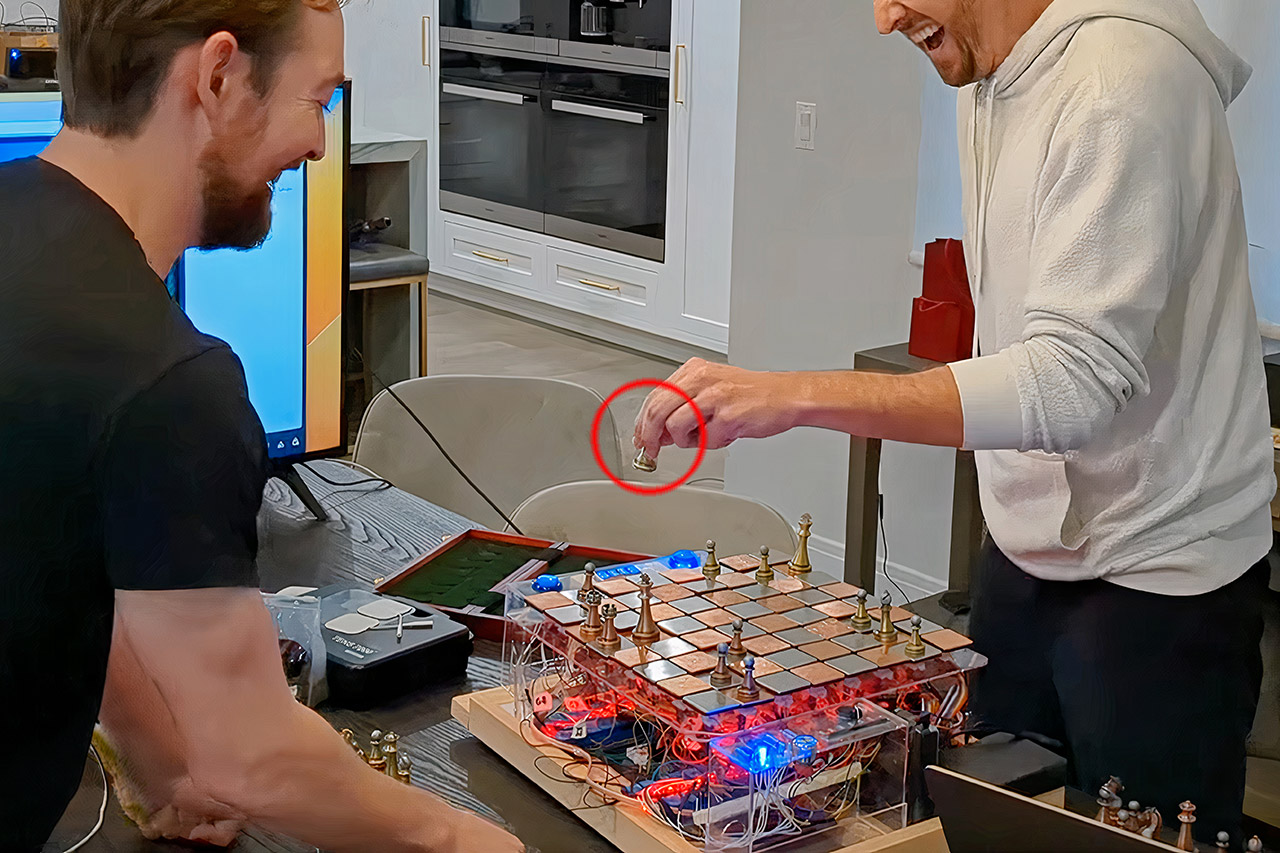
Fletcher Heisler was beaten by chess hustlers in the park, so he wanted revenge, but regular practice wasn’t cutting it. So he reasoned, “Maybe I need some negative reinforcement,” thus taser chess was born, or a chessboard that would literally penalize you for making blunders by delivering an electric shock.
Each square on this regular 8×8 grid has a secret. A mechanical keyboard switch sits underneath, activated by a magnet in the conductive chess pieces. When you lift a piece, the Raspberry Pi running Python chess library software detects it. When you put it back in the wrong spot, one of the relay switches turns on, and a TENS unit with the maximum setting shoots a shock straight through the metal square into your arm, which is strapped to the board. The discomfort brings the point home quickly.
Sale

2 in 1 Magnetic Chess Set & Checkers Board Game, 15″ Wooden Folding Chess Board with 2 Extra Queens…
- 2 In 1 Chess Set & Checkers – In addition to 34 standard chess (Including 2 extra queens), this set also includes 24 checkers game pieces, offering…
- Magnetic Chess And Chess Board – Our chess sets have strong magnets on the surface of the board and on the bottom of the pieces(Notice: The checkers…
- Quality Materials And Workmanship – This chess and checkers set is made of natural high-quality solid wood material, which is very sturdy and durable…
The chess pieces began as low-cost Amazon buys, and he used acetone to remove the lacquer as well as make them conductive. The felt bottoms melted away. He covered half of the squares with copper tape to show the colors without interrupting the circuit. There are four relay boards in there, each with 16 squares, to keep the electricity separated. To be honest, he didn’t bother with en passant; who does that anyway? The Pi just assumes a normal starting position and maintains track of when you lift or drop the pieces, thus it is simple, dependable, and quite effective at surprising you.
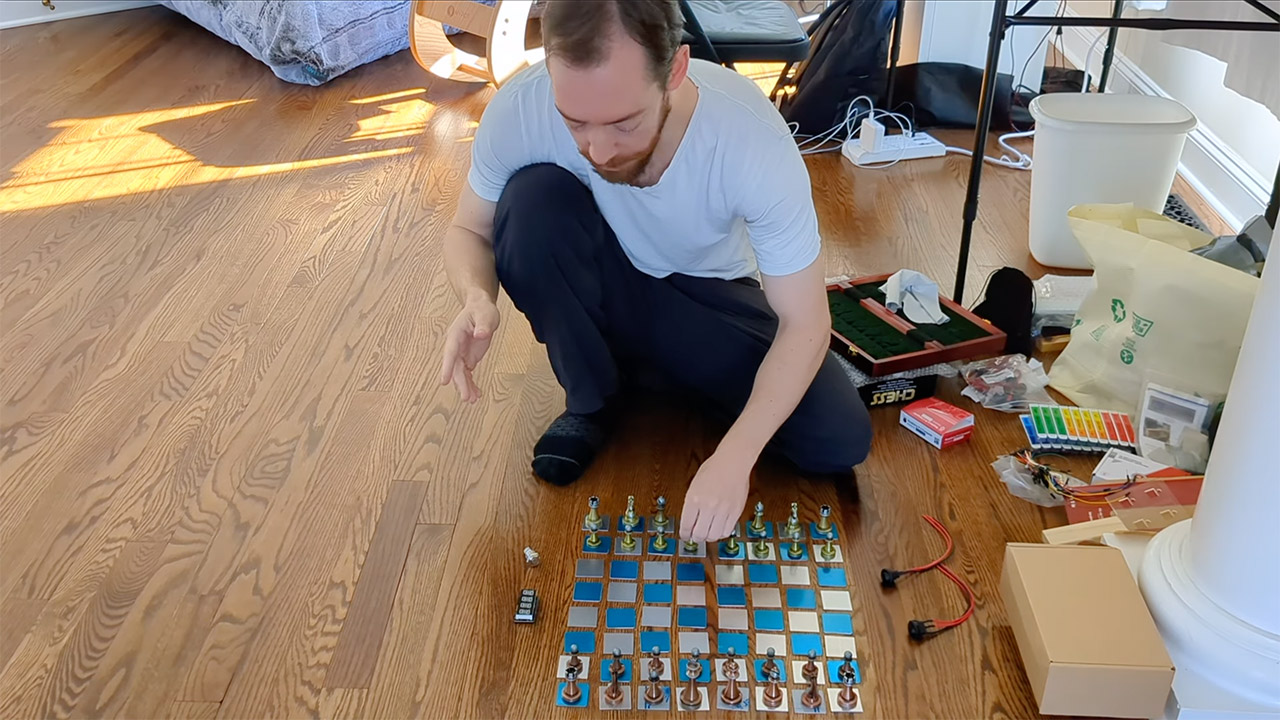
The system’s settings provide a wide range of punishment. The “illegal move” setting shocks you simply for picking the wrong piece up on your turn. The “capture” mode illuminates a little display to indicate you where you can go and, if you touch the wrong location, the board bites.The “Engine” option allows you to compete against stockfish and becomes extremely harsh if you make any mistakes. The “Timed” setting forces you to move quickly because you only have 5 seconds, and the pain increases if you stay too long. If you try to solve a puzzle and get it wrong, the board will punish you severely. When you fail, a current travels straight through your muscles, causing your arm to jerk, similar to a terrible handshake.

It took him a year to assemble the thing, starting with prototypes crammed in diaper boxes and breadboards, and spending the most of his time traveling with the wiring in disarray in Airbnb homes, with people becoming suspicious in the Cat Café lab, which he used as a makeshift workshop. The airline broke the checked luggage on its way to the Open Sauce Maker Fair, and one of the hotel rebuilds nearly set the room on fire by getting the wiring backwards and melting the power rails. In the end, duct tape held the final version together during demos.
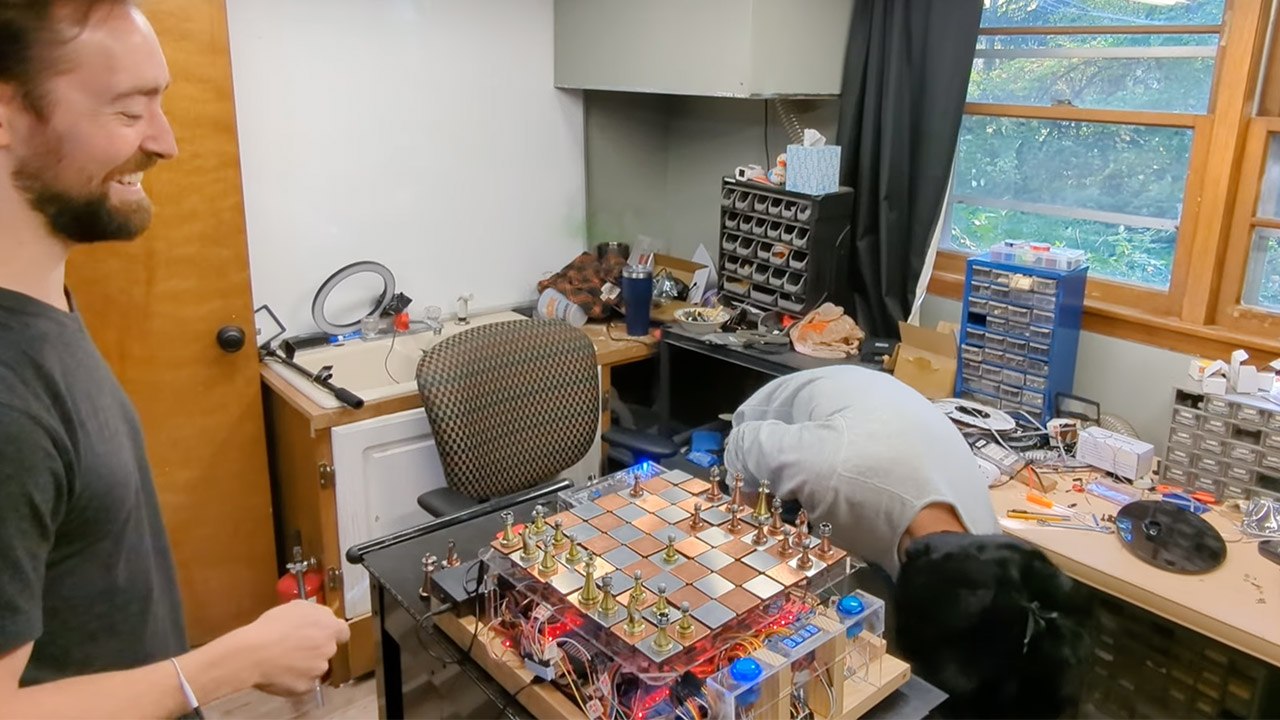
The shocks begin mildly, with a tingling sensation at level 2, but by level 8, you are experiencing full-body flinches. The pads did not last long, and the voltage continued to diminish. Heisler ended up spending far more time rewiring than attempting to understand the openings. As a result, chess expertise stalled; the whole thing was too delicate to continue working with.The board was constantly breaking down and needing to be repaired, until he acquired some conductive epoxy and sealed up all the loose connections. He also found a purpose for a bunch of old Ethernet cables, which provided him enough extra wire to fix some of the other wiring, including several battery adapters to make it more portable.

Taser chess completely reverses the learning process, since it turns out that the pain it causes is far more effective at getting ideas stuck in your head than repetition alone. As it turns, behavioral research actually supports this strategy, dating back to those old Skinner boxes and the penalties in video games; basically, both humans and animals are extremely attentive to consequences. This board, however, takes things to a whole new level. One solid game against some of those hustlers, and the surprises might just start working in your favor. Until then, every jolt feels like progress, even if it’s the hard way.
[Source]

Once the most talked-about TV show in the country, South Park, is on Paramount+. Don’t you want to know what got Trump in such a tizzy?
Stream the much buzzed-about South Park, fan-favorite Yellowstone, original series MobLand, and rebooted crime drama Dexter & Dexter on Paramount+. The streaming network has a bingeable TV series for almost everyone. And whether you want to remember Lindsay Lohan’s old face in the classic Mean Girls flick, or wonder just how many more sequels Tom Cruise has left in him with Top Gun: Maverick, there’s a bevy of films to stream, too.
If you’re like me and have at least half a dozen streaming services, our Paramount+ coupon codes can help you save so you can watch the content you want without having to get rid of one of your other beloved content platforms. (I love pretending the world isn’t full of suffering around me and instead focus on Sylvester Stallone’s ever-changing Play-Doh face in Tulsa King.)
Try Paramount+ Free With a One-Week Trial
If you’re unsure if you’ll actually want to commit to Paramount+, or if there’s a sports event like March Madness games and you only need to access the content for a little while, Paramount+’s free trial is a great option. The trial lasts one week, is for new subscribers only, and can’t be paired with other offers.
There are tiered plans, including Essential, which allows for 3 devices, select Showtime series, NFL games, and can be streamed on up to 3 devices at once, but has ads; and Premium, which includes all that except there are no ads, downloadable content, CBS live, and all of Showtime content.
Find the Right Paramount+ Plan Pricing and Get the Latest Deals
It’s important that you choose the right Paramount+ streaming plan for you so that you can get the best bang for your buck. Lucky for you, all plans come with a 7-day free trial so you can make sure you’re choosing the right plan for you. The first is Paramount+ Essential, which is $8 per month. It has ads included, but you’ll have access to over 40,000 episodes and movies. And you’ll be able to stream on 3 devices at once, be able to watch NFL games on CBS and UEFA Champions League, and select Showtime series are also available. Paramount+ Premium is the next tier (and the most popular choice), which starts at $13 per month (after the free trial ends), and you’ll get everything mentioned in the previous tier, without ads. You’ll have all that as well as the ability to watch in 4K UHD, Dolby Vision or HDR10, downloadable movies and shows, streaming CBS live and all of Showtime’s content library.
Can You Cancel Paramount Plus at any Time?
If you find the service isn’t right for you, or just need to cut down on subscriptions, you can cancel Paramount+ any time. However, the cancellation process depends on where you signed up. If you signed up directly on the website, you’ll need to go to your account page.
Save on a Paramount+ Subscription With Student and Military Discounts
If you’re a student now (or have your student ID lying around somewhere), you can get a Paramount+ plan at only $4 a month. All you have to do is verify your student status and you’ll get 50% off any plan of your choosing for the first year. Or if you’re a military member, Paramount+ gives 50% off any subscription for life.
Watch Paramount+ Originals and Fan Favorites
There’s truly something for everyone in the family, with movies, kids’ shows, and Paramount+ originals included in every plan. If you’re feeling spooky, I’d recommend Dexter: Resurrection, or Yellowjackets, but if you’re looking for something more family-friendly, there’s super popular cartoons like Rango or Sonic the Hedgehog to choose from.
Looking for specific recommendations? I’ve got you. There are tons of great new releases coming to Paramount+ this month, including Landman season 2, new Paramount+ original comedy series Crutch starring Tracy Morgan, and new episodes of (my favorite) newly premiered Ink Master Season 17. There are also tons of new movies, including The Cut, a boxing drama starring Orlando Bloom, dark comedy Shell, and true-crime tale My Nightmare Stalker: The Eva LaRue Story. Plus, Paramount+ will be playing the important NFL holiday games.
Check out the wide breadth of TV and movie content to choose from on Paramount+ (and use the Paramount+ promo codes above to save on whatever plan you decide).
Stream Live Sports and Events on Paramount+
For better or worse, I’m a Chiefs fan (cue the booing). I usually get a Paramount+ plan during the football season to keep up with my favorite beefy, TBI-ridden men. You can stream all of the NFL coverage you want all season long, plus, 24/7 live channels are now streaming on Paramount+, so you’ll never need to give your brain the time to process the horrors.
Stream UFC Fights Live on Paramount+
Paramount+ has all the man-on-man action you want, from bloody brawls to KO’s. Paramount+ is your one-stop shop to stream UFC live so you can catch every fight. This includes UFC 326: Holloway vs. Oliveira 2, airing March 7 and UFC Fight Night: Emmett vs. Vallejos, airing March 14.
Watch March Madness With Paramount+
The annual tournament that determines which men’s and women’s Division I teams will win the NCAA Basketball championships, March Madness, will be streaming on Paramount+ this spring. You can watch any men’s March Madness games that are being broadcast on CBS with Paramount+. Let the games begin!
Don’t Miss the Champions League Soccer on Paramount+
If football (or soccer) is more your jam, Paramount+ also has you covered. You can watch Champions League Soccer at Paramount+, including fan favorites and heated rivalries from Real Madrid, AC Milan, Bayern Munich, Liverpool, Barcelona, and more.


AMD and Meta have signed what they describe as a “strategic” partnership aimed at expanding large-scale computing capacity and continuing to bankroll Mark Zuckerberg’s long-running AGI ambitions. Central to the deal is a massive 6 gigawatts of total GPU capacity, which AMD will deploy in custom-built data center racks for…
Read Entire Article
Source link


An astronomical alert system developed at the University of Washington started off with a bang this week, sending out 800,000 notifications about moving asteroids, exploding stars and other celestial changes detected by the Vera C. Rubin Observatory in Chile.
Tuesday night’s surge was just the first wave of alerts. Eventually, the Alert Production Pipeline is expected to produce up to 7 million alerts per night. Astronomers around the globe will use the system to sift through the torrent of data, zeroing in on events ranging from newly detected asteroids to supernovas, variable stars and active galactic nuclei.
“Rubin’s alert system was designed to allow anyone to identify interesting astronomical events with enough notice to rapidly obtain time-critical follow-up observations,” Eric Bellm, a UW astronomer who leads the Alert Production Pipeline Group for the Rubin Observatory, said today in a news release. “Rubin will survey the sky at an unprecedented scale and allow us to find the most rare and unusual objects in the universe. We can’t wait to see the exciting science that comes from these data.”
The $800 million observatory, jointly funded by the National Science Foundation and the U.S. Department of Energy’s Office of Science, had its grand opening last June. It is now ramping up to begin its 10-year Legacy Survey of Space and Time. Each night, the facility’s Simonyi Survey Telescope — named after the family of Seattle-area software billionaire Charles Simonyi, who provided $20 million in seed funding — will scan a swath of the Southern Hemisphere sky, generating up to 20 terabytes of data nightly.
Processing trillions of bytes of raw data is no easy task. For the past decade, the University of Washington’s Institute for Data Intensive Research in Astrophysics and Cosmology, also known as the DIRAC Institute, has been working with other teams across the country to figure out how to manage the observatory’s astronomical riches.
“Enabling real-time discovery on such a massive data stream has required years of technical innovation in image processing algorithms, databases and data orchestration,” Bellm said. “We’re thrilled to continue the UW’s legacy of excellence in data-driven science.”
Rubin’s data processing system is designed to compare pixels in new imagery with previous pictures of the same patch of sky. Each change in the image — for example, a shift in the location of a moving asteroid, or a change in the brightness of a supernova — triggers an alert within two minutes of image capture.
“The scale and speed of the alerts are unprecedented,” said Hsin-Fang Chiang, who is leading operations for data processing at the SLAC National Accelerator Laboratory’s U.S. Data Facility. “After generating hundreds of thousands of test alerts in the last few months, we are now able to say, within minutes, with each image, ‘here is everything’ and ‘go.’ ”
Software agents known as brokers use machine learning algorithms to filter the alerts for research teams and observatories. The official brokers for Rubin data include ALeRCE, AMPEL, ANTARES, Babamul, Fink, Lasair, Pitt-Google, SNAPS, and POI Broker. Using these tools, astronomers can set hyper-specific criteria — for example, to show alerts for events that are brighter than 21st magnitude, that have been detected less than six days ago, and that are also associated with two previous detections.
Thanks to the alert system, other observatories will be able to follow up on Rubin’s data and confirm astronomical discoveries. And through collaborations with citizen-science initiatives like Zooniverse, anyone with access to a computer will be able to join in as well.

One thing some people hate about voice control is that you need to have a process always running, listening for the wake word. If your system isn’t totally locally-hosted, that can raise some privacy eyebrows. Perhaps that’s part of what inspired [SpannerSpencer] to create this 24th century solution: a Comm Badge straight out of Star Trek: The Next Generation he uses to control his smart home.
This hack is as slick as it is simple. The shiny comm badge is actually metal, purchased from an online vendor that surely pays all appropriate license fees to Paramount. It was designed for magnetic mounting, and you know what else has a magnet to stick it to things? The M5StickC PLUS2, a handy ESP32 dev kit. Since the M5Stick is worn under the shirt, its magnet attached to the comm badge, some features (like the touchscreen) are unused, but that’s okay. You use what you have, and we can’t argue with how easy the hardware side of this hack comes together.
[Spanner] reports that taps to the comm badge are easily detected by the onboard accelerometer, and that the M5Stick’s microphone has no trouble picking up his voice. If the voice recordings are slightly muffled by his shirt, the Groq transcription API being used doesn’t seem to notice. From Groq, those transcriptions are sent to [Spanner]’s Home Assistant as natural language commands. Code for the com-badge portion is available via GitHub; presumably if you’re the kind of person who wants this, you either have HA set up or can figure out how.
It seems worth pointing out that the computer in Star Trek: TNG did have a wake word: “computer”. On the other hand it seemed the badges were used to interface with it just as much as the wake word on screen, so this use case is still show accurate. You can watch it in the demo video below, but alas, at no point does his Home Assistant talk back. We can only hope he’s trained a text-to-speech model to sound like Majel Barrett-Roddenberry. At least it gives the proper “beep” when receiving a command.
This would pair very nicely with the LCARS dashboard we featured in January.

Climbing is a cool sport. With that said, like everything, it’s even better if you integrate lots of glowing colorful LEDs. To that end, [Superbender] worked up this fun climbing wall that features interactive lighting built right in.
Structurally, there’s nothing too wild going on here. It’s a wood-framed climbing structure that stands 10 meters long and 2.5 meters high, and can be covered in lots of climbing holds. It’s the electronic side of things where it gets fun. An Arduino Due is installed to run the show, hooked up with a small TFT display and some buttons for control. It’s then hooked up to control a whole bunch of LEDs and some buttons which are scattered all across the wall. It’s also paired with an Arduino Nano which runs sound feedback, and a 433 MHz remote for controlling the system at a distance.
[Superbender] uses the lighting for fun interactive games. One example is called Hot Lava, where after each climbing pass, more holds are forbidden until you can’t make the run anymore. Chase the Blues is another fun game, where you have to climb towards a given hold, at which point it moves and you have to scamper to the next one.
We’ve featured similar projects before from other inventive climbers. Video after the break.

Samsung took over San Francisco’s Palace of Fine Arts on February 25 for Galaxy Unpacked 2026 — and left little to the imagination. Three new phones, a new pair of earbuds, and a pile of AI features. Here’s the full breakdown.

The Galaxy S26 series arrives with familiar naming
The S26, S26+, and S26 Ultra all share a rounder, more cohesive design this year — which sounds minor until you remember the Ultra used to look like it came from a completely different product line.
Pick one up, and you notice the difference straight away — it sits better in the hand, feels less aggressive in the pocket. Under the hood, all three run on a slightly overclocked version of Qualcomm’s Snapdragon 8 Elite Gen 5 (denoted by the “For Galaxy” branding).

Samsung also quietly killed off the 128GB base model this year; every S26 model now starts at 256GB, and nobody is disappointed about that. What people are disappointed about is the price — both the S26 and S26+ crept up by $100 this cycle.
S26 Ultra: The Privacy Screen nobody knew they needed
The Ultra’s headline feature is a Privacy Display that darkens the screen from side angles and blurs sensitive notifications when someone nearby is clearly being nosy. In my opinion, it is one of the most useful innovations from Samsung in a while, and future Android flagships (even MacBooks) are likely to copy it.
The camera system gets a bump too, with wider apertures on the 200MP main and 5x telephoto sensors, but the selfie camera remains the same old tiny 12MP shooter.

Third-generation Galaxy AI features are cool, too
Now Brief gives you a personalized morning snapshot — weather, calendar, reminders — before you’ve unlocked your phone. Now Nudge surfaces relevant actions based on whatever’s on your screen.
Google jumped in too: Gemini-powered Scam Detection silently handles spam calls so you never have to, and Circle to Search can now identify multiple objects at once, like scanning a full outfit instead of a single item.

Galaxy Buds 4 and Buds 4 Pro
Samsung released two models — the standard Buds 4 and the Buds 4 Pro. The Pro is the one doing the heavy lifting, with adaptive ANC, improved spatial audio, and that upgraded call clarity. The base Buds 4 keep things simpler and more affordable, but still get the core Galaxy AI treatment.

All S26 models and the Buds 4 are available for pre-order now.
Tech
Bridgerton season 4 part 2 ending explained: do Benedict and Sophie get married, post-credits surprise, shock death and predictions for season 5 of the hit Netflix show

WARNING: spoilers for Bridgerton season 4 part 2 ahead.
I was pretty annoyed that Netflix decided to split another of its hit shows into two parts, but I think the payoff in Bridgerton season 4 part 2 is worth it.
Do Benedict and Sophie end up marrying in season 4 part 2?
Bridgerton Season 4 | Part 2 Official Trailer | Netflix – YouTube

Yes! Thankfully, Sophie immediately rejects Benedict’s offer of being a mistress, demeaning him for asking something of her that would push her even further down the social scale. There’s a lot of back and forth from Benedict insisting that this is the only way they could be together, and Sophie refusing it.
One thing leads to another and the pair end up in bed together — oops, they’re only human — leading Sophie to try and seek employment as a maid elsewhere. She asks Violet for a letter of introduction to another family, who becomes suspicious of why Sophie wants to leave so suddenly… and what she’s hiding.
Almost everyone in the town is convinced that Benedict has a secret woman, it’s just a case of working out who. Violet begins to dig deeper into Sophie’s past, sending her maid out to try and gather information. Another maid informs her that she used to work with Sophie’s mother, leading Violent and Lady Danbury to guess Sophie is illegitimate.
Violet also enlists Anthony’s (Johnathan Bailey) help to try and talk Benedict out of his fascination with Sophie. Anthony reminds him of the shame and scandal he would bring to the Bridgerton name, ruining the prospects for his younger siblings while effectively sending himself into social exile. Benedict is ready to retreat to the country cottage where he spent time with Sophie in part 1, but Violet is completely against the idea.

From there, it all kicks off. Benedict is beside himself that Sophie is to leave the Bridgeton house, but she’s missed the main opportunity that she was planning to go for. However, another opportunity comes up: help a family move overseas to the States, if she’s prepared to get on a boat in three days’ time.
At Hyacinth’s (Florence Hunt) recital, Benedict spots Violet and Lord Anderson together, furiously taking his mother aside to call out her hypocrisy over him and Sophie. Benedict reminds Violet that she taught her kids to follow love wherever it takes them, and after realizing that he’s indeed in love with Sophie, Violet does whatever she can to help him.
At this point, even approval for Queen Charlotte would only get Benedict off the social hook so far, leading him and Violet to plan his countryside escape. This is just before Sophie plans to leave for the Americas… but instead is thrown in jail by Araminta.
Why? Araminta is convinced that Sophie stole her diamond shoe clips, and also wants to punish her for impersonating nobility at Violet’s ball in episode 1. Benedict and Violet catch wind of what’s happened thanks to their maids, sweeping in to get Sophie out on bail just before she’s sentenced. The judge pleads for the ladies to sort their issues out between them, but Araminta doubles down on her cruelness.
At the Bridgerton house, Violet finally accepts that Benedict wants to marry Sophie. Before the, ahem, bathtub scene, Sophie reveals to Benedict that she’s the illegitimate daughter of the Earl of Penwood, with Benedict sure that he would have provided for her in his will.
With the help of Eloise (Claudia Jessie), Sophie sneaks into the old Penwood house to find her dad’s will, uncovering that the Araminta was being paid £4,000 for every year she kept Sophie in the house. On top of that, the Earl had split an equal dowry between Sophie, Posy (Isabella Wei) and Rosamund (Michelle Mao), with Sophie’s portion hijacked by Araminta to secure Rosamund’s engagement.
New lady in waiting Alice Mondrich (Emma Naomi) manages to get the two sparring sides into a room at the end of season ball thrown by Queen Charlotte, and they hash it out. Both sides threaten to take down the other if they are exposed, with Violet rationing that they come up with a mutually beneficial story that works for them all. By the time Queen Charlotte is called in, Sophie is presented as a cousin of Rosamund and Posy’s, officially becoming part of the Penwood family.
You’ll have to wait until after the episode 8 credits to see their wedding, with Benedict asking Sophie for her hand later at the ball.
So where does this leave the other Penwoods?

Unsurprisingly, Rosamund’s offer of engagement is immediately retracted when it’s discovered that she doesn’t have as much money to offer as first thought. However, Posy has a suitor of her own, with Eloise encouraging her to go after her heart rather than her mother’s wishes. It’s hinted that Posy’s romance could be what saves the Penwoods from complete social ridicule.
Then there’s the return of Cressida Cowper (Jessica Madsen), who is now the new Lady Penwood. She’s taken up residence in Araminta’s old house, and is at risk of being shunned in her reintroduction to the social circle. She tries to enlist the help of Penelope (Nicola Coughlan) but this doesn’t go as planned, with Penelope using Cressida’s ball to announce that she’s “hanging up her pen”.
What do you mean there’s no more Lady Whistledown?

Well, in a manner of speaking. After coming under some scrutiny and the power of being known as Lady Whistledown getting to her, Penelope gets the Queen’s permission to take her passion for writing in a different direction. As episode 8 draws to a close, we learn that she’s instead writing a novel.
However, somebody else has resumed Lady Whistledown’s newsletters, and we’ve got no idea who it is.
What about Francesca?

Sadly, Francesca (Hannah Dodd) has the most upsetting storyline of the bunch. After failing to reach her pinnacle in part 1, the pressure of giving John (Victor Alli) a child and being a respectable wife is getting too much for her. To top if off, his carefree cousin Michaela (Masali Baduza) constantly spending time with John after turning up at their house unannounced is getting her down.
Then, tragedy. At the end of episode 6, John dies in his sleep from a brain aneurysm, with episode 7 dedicated to his funeral. In the scenes beforehand, Francesca and Michaela became unexpected friends once they opened up to each other, and are on hand to get each other through the process as unsteady allies.
While Francesca feels obliged to grieve in the proper way, Michaela allows her to see things differently, commemorating John’s spirit with a lively family celebration. Michaela later takes off and leaves without word.
At Benedict and Sophie’s wedding, Francesca admits that she’s “had her one love” when asked if she’d ever marry again.
What about Violet?

Violet and Lord Anderson continue to see each other, with Violet desperate for her children not to find out. Anderson gives her the option to ease off or to make things official, leading to their engagement in episode 6.
However, this doesn’t last for long. While Violet has Agatha’s (Adjoa Andoh) blessing, she starts to have doubts about what she really wants, with all her attention diverted to Francesca.
At the last ball of the season, Anderson again claims his intensions to marry her — he wants to build a life with Violet, not just be a bit on the side. Violet refuses to go ahead with the engagement. She’s rather continue to see him while she discovers who she is as a single woman, but as their interests don’t align, they part ways.
Does Agatha get to leave?

Yes she does! Queen Charlotte’s ball is thrown in honor of Agatha, having agreed to let her leave after Agatha successfully installed Alice in her place. The Queen is tearful, but ultimately accepts what she didn’t before.
We don’t yet know how long Agatha will be gone for, but it could affect season 5.
Season 5 predictions

With Benedict and Sophie set to take a back seat, Eloise is the obvious choice to take over the leading role. She’s had a much quieter outing in season 4 part 2, after failing to avoid Violet’s matchmaking efforts in part 1.
Benedict and Eloise were Violet’s priorities for the season, and now the former has been successful, there’s only one left. However, we could be thrown a complete curveball, as returning cast are as of yet unconfirmed.
The books also suggest Francesca and Michaela (who was originally Michael) will begin a romantic relationship, but this is also unconfirmed for the show.
We also need to find out who the new Lady Whistledown is, though this isn’t a guarantee either.
Follow TechRadar on Google News and add us as a preferred source to get our expert news, reviews, and opinion in your feeds. Make sure to click the Follow button!
And of course, you can also follow TechRadar on YouTube and TikTok for news, reviews, unboxings in video form, and get regular updates from us on WhatsApp too.

Over the last few centuries, behavioral psychologists have documented all kinds of ways of modifying our actions and the actions of various animals. From the famous Skinner boxes to many modern video game mechanics, animals and humans alike can learn through the addition or subtraction of various rewards and punishments. And it doesn’t only impact simple actions either; [Everything is Hacked] took this idea to the extreme, using painful electric shocks to teach himself to avoid making blunders while playing chess.
This positive punishment system uses a medical device called transcutaneous electrical nerve stimulation (TENS) to deliver an electric shock to the skin. The electrical jolt is routed through a custom-built, conductive chess board where each square is isolated from the others and controlled by its own relay. The pieces are conductive as well, so if one is placed on a square where it shouldn’t go a relay will switch on to quickly provide the behavioral modification. The control logic is provided by a Raspberry Pi running the Stockfish chess engine, and it keeps track of the locations of the positions of all the pieces by using MX switches in the base of each square on the board.
This project took [Everything is Hacked] over a year to get into a working condition, including having to rebuild the entire project twice after mishaps with baggage handling at an airline. But he was able to demo the board to the Open Sauce tech festival and even took it to his local park to play chess with the local hustlers. Unfortunately, he reports that he spent more time reworking and rewiring his board over that year than he did improving his chess game, so unfortunately he still hasn’t been able to win any of his money back yet. Perhaps combining this project with a chess-playing robot would help.

Entertainment48 seconds ago
Prince William Demanded Andrew Be ‘Banished’ After Disastrous Interview

NewsBeat3 minutes ago
Wuthering Heights movie prompts a new wave of Brontemania in sisters’ village

Business4 minutes ago
Alphabet Stock Climbs on AI Momentum and Robust Cloud Growth Despite Heavy CapEx Concerns


-

 Video6 days ago
XRP News: XRP Just Entered a New Phase (Almost Nobody Noticed)
-

 Politics4 days ago
Baftas 2026: Awards Nominations, Presenters And Performers
-

 Fashion6 days ago
Weekend Open Thread: Boden – Corporette.com
-

 Sports3 days ago
Women’s college basketball rankings: Iowa reenters top 10, Auriemma makes history
-

 Politics3 days ago
Nick Reiner Enters Plea In Deaths Of Parents Rob And Michele
-

 Crypto World2 days ago
XRP price enters “dead zone” as Binance leverage hits lows
-

 Business4 days ago
Mattel’s American Girl brand turns 40, dolls enter a new era
-

 Business4 days ago
Law enforcement kills armed man seeking to enter Trump’s Mar-a-Lago resort, officials say
-

 Tech2 days ago
Unsurprisingly, Apple's board gets what it wants in 2026 shareholder meeting
-

 Business2 days ago
True Citrus debuts functional drink mix collection
-

 NewsBeat9 hours ago
Cuba says its forces have killed four on US-registered speedboat | World News
-
 NewsBeat11 hours ago
Manchester Central Mosque issues statement as it imposes new measures ‘with immediate effect’ after armed men enter
-
 NewsBeat3 days ago
‘Hourly’ method from gastroenterologist ‘helps reduce air travel bloating’
-

 Tech4 days ago
Anthropic-Backed Group Enters NY-12 AI PAC Fight
-

 NewsBeat4 days ago
Armed man killed after entering secure perimeter of Mar-a-Lago, Secret Service says
-

 Politics4 days ago
Maine has a long track record of electing moderates. Enter Graham Platner.
-

 Business6 hours ago
Discord Pushes Implementation of Global Age Checks to Second Half of 2026
-
 NewsBeat1 day ago
Police latest as search for missing woman enters day nine
-

 Crypto World1 day ago
Entering new markets without increasing payment costs
-
 Sports3 days ago
2026 NFL mock draft: WRs fly off the board in first round entering combine week