

Crypto World
AllUnity Launches Swiss Franc Stablecoin CHFAU


AllUnity, a stablecoin platform backed by Deutsche Bank, has launched a new stablecoin denominated in Swiss francs (CHF).
After introducing its euro-pegged EURAU stablecoin last year, AllUnity is rolling out CHFAU, a stablecoin pegged 1:1 to the franc, the company said in an announcement shared with Cointelegraph on Thursday.
Initially available to institutional and professional investors, CHFAU launches on the Ethereum blockchain as an ERC-20 token, with plans to expand to additional networks later this year.
CHFAU enters the market fully aligned with the EU’s Markets in Crypto-Assets Regulation (MiCA), as AllUnity secured an E-Money Institution (EMI) license from the German Federal Financial Supervisory Authority (BaFin) in July 2025.
“The launch of CHFAU is a fundamental milestone in our mission to build Europe’s regulated digital payments ecosystem,” AllUnity CEO Alexander Höptner said.
Regulated digital Swiss franc for institutional settlement
CHFAU will be exclusively available to institutional and professional clients through the AllUnity Mint Platform, a spokesperson for AllUnity said.
“We are currently finalizing exchange and trading venue integrations and will communicate specific listings as they go live,” the company said, adding that CHFAU is technically live, but broader availability across venues will be rolled out progressively through integrations.
“The primary purpose of CHFAU is to serve as a trusted, regulated digital Swiss franc for institutional settlement,” Höptner told Cointelegraph, adding:
“Whether for cross-border payments, digital asset markets, or treasury and liquidity management, CHFAU enables secure, real-time value transfer within a fully compliant framework.”
EURAU grows to $1.2 million since launch
AllUnity was founded in early 2024 as a joint venture by Deutsche Bank’s asset management arm DWS, market maker Flow Traders and crypto company Galaxy Digital with the aim of issuing fully regulated stablecoins.
Since its debut in July 2025, AllUnity’s EURAU stablecoin has seen its market capitalization rise to $1.2 million, ranking 16th by market cap among 22 euro‑pegged stablecoins listed on CoinGecko.
Related: ECB targets 2027 digital euro pilot as provider selection begins in Q1 2026
The stablecoin is available on a limited number of exchanges, with CoinGecko listing public centralized exchange Bullish and the decentralized exchange Aerodrome as venues trading EURAU at the time of publication. The stablecoin is also available on platforms including Bitpanda, Rulematch and WAWEX, AllUnity told Cointelegraph.

The total market capitalization of all euro-pegged stablecoins is now at $895 million, with EURC (EURC), issued by USDC (USDC) provider Circle, leading with $459 million.
Not the only Swiss franc stablecoin
Although AllUnity says CHFAU is the first MiCA-compliant Swiss franc‑pegged stablecoin, multiple companies have experimented with similar initiatives in recent years.
According to data from DefiLlama, there are at least three CHF‑denominated stablecoins, including Frankencoin (ZCHF), VNX Swiss Franc (VCHF) and Hedera Swiss Franc (HCHF). The combined market capitalization of these coins is about $38.6 million.

The largest of these, Frankencoin, is a decentralized stablecoin launched in 2023. The project is based in Switzerland and backed by the Frankencoin Association.
Other CHF stablecoin initiatives include CryptoFranc (XCHF), issued by crypto financial services provider Bitcoin Suisse. Launched around 2018, the stablecoin was later discontinued due to insufficient market adoption.
Magazine: 6 massive challenges Bitcoin faces on the road to quantum security

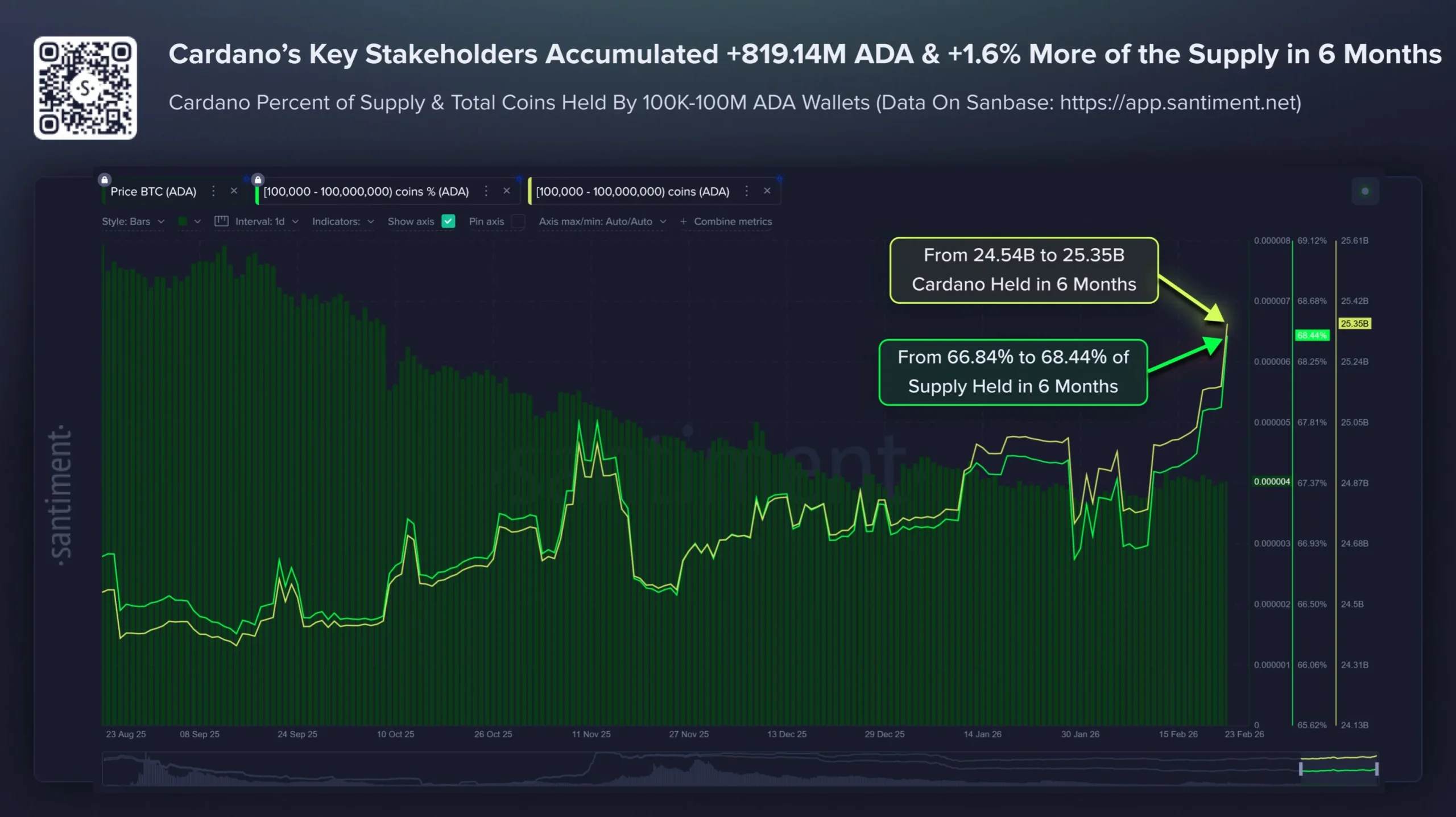
Cardano price is under pressure, but its largest holders are buying aggressively into the dip. Whales and sharks have accumulated more than 819 million ADA, signaling strong conviction beneath the surface volatility and hinting at a potential long-term reversal.
Summary
- Whales and sharks added 819.14 million ADA over six months, despite a 71% price decline.
- ADA is trading around $0.29, facing rejection near the $0.30 psychological barrier and upper Bollinger Band.
- While support sits at $0.2520, a slightly negative CMF shows short-term selling pressure persists.
Cardano whales and sharks go on a buying spree
Data from the on-chain analytics platform Santiment reveals a striking trend: wallets holding between 100,000 and 100 million ADA have been consistently stacking the token for the last six months.
This period saw ADA’s price endure a punishing 71% decline, falling from $0.90 to roughly $0.26.
Despite this capital erosion, these key stakeholders added 819.14 million ADA to their portfolios, representing a 1.6% increase in their total share of the circulating supply.
Valued at approximately $213.9 million, this concentrated buying during a steep drawdown is a classic signal of a market bottom, as high-conviction holders absorb the liquidity left behind by panicked sellers.
Cardano price at a crossroads
The ADA/USDT daily chart illustrates a market struggling to translate this whale accumulation into immediate upward momentum.
Currently trading near $0.2935, the price is hovering just above the 20-day Simple Moving Average (SMA) of $0.2753. Recent price action shows a clear rejection at the upper Bollinger Band near $0.2985, identifying it as the immediate ceiling that bulls must shatter.
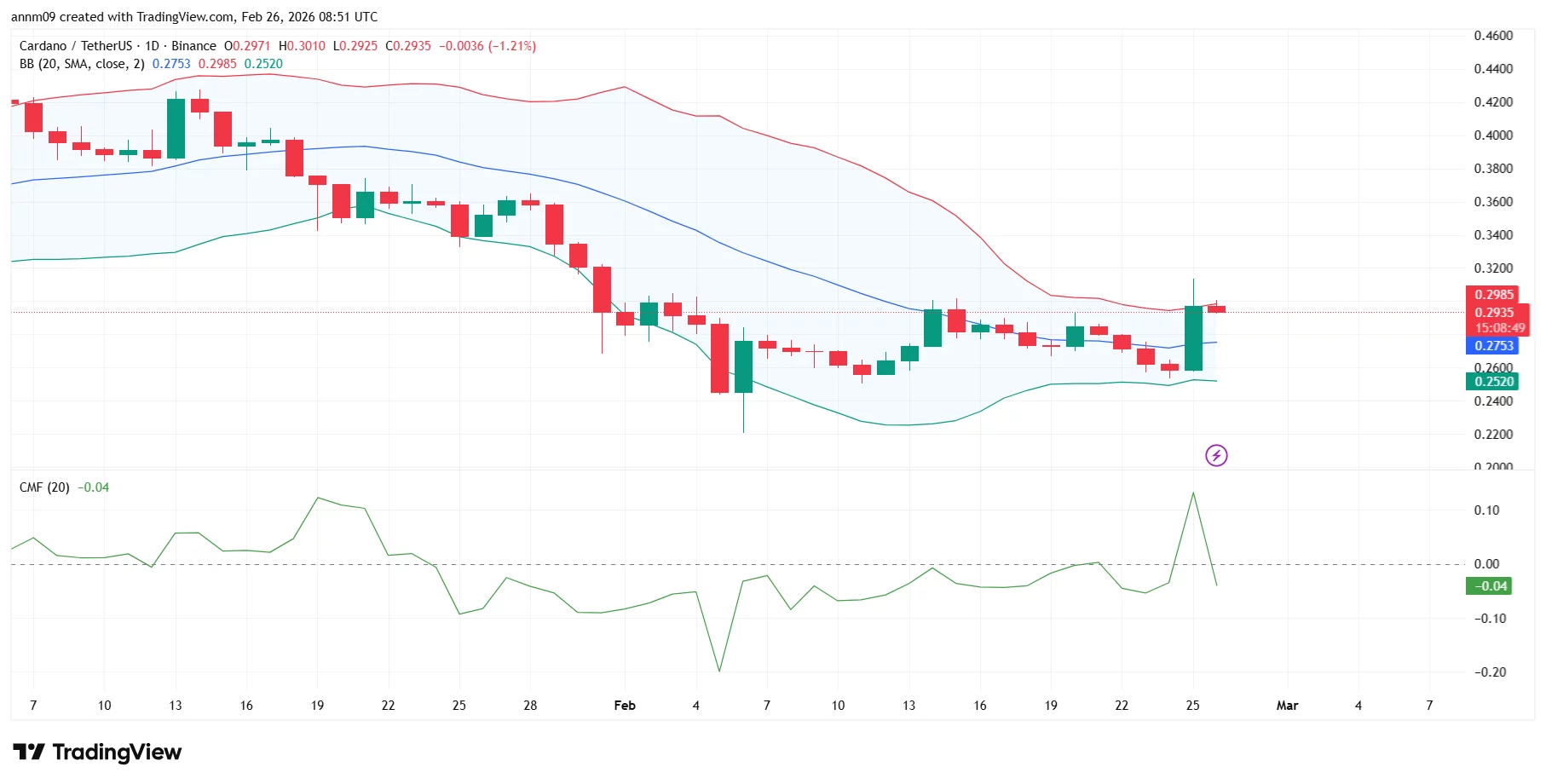
While strong horizontal support has been established at the $0.2520 level, the Chaikin Money Flow (CMF) remains slightly bearish at -0.04. This negative reading suggests that despite the whale activity, there is still enough short-term distribution from smaller participants to keep the price suppressed.
For a definitive bullish flip, ADA needs a sustained daily close above the $0.30 psychological barrier.
If it can maintain its position above the 20-day SMA, a retest of the $0.32 resistance is likely, though a slip below $0.25 would signal that the accumulation phase may need to extend further before a breakout occurs.


Bitcoin cooled off in Asia hours on Thursday, trading at $68,600 after testing $70,000 during a ferocious U.S. session on Wednesday.
As February draws toward a close, the largest cryptocurrency remains in a trading range that has persisted since early in the month, having tested $62,500 on Tuesday and $71,100 to the upside on Feb. 15.
It’s worth noting that bitcoin broke a similar trading range to the upside in January, trapping breakout traders before the price tumbled from $98,000 to $60,000 over the subsequent three weeks, forming a lower high in this recent bearish cycle.
A few tokens outshone the broader altcoin market. HYPE is up 4.3% since midnight UTC as it moves back toward $30, while privacy token decred (DCR) rose to its highest since November after adding 4%.
U.S. stock index futures are little changed, with NVIDIA’s earnings report failing to generate sustained upside amid lingering concerns that AI valuation is overdone.
Derivatives positioning
- Total crypto futures market open interest (OI) has increased by over 6.6% to nearly $100 billion. This is bigger than the increase in the total crypto market cap, indicating there’s been an influx of fresh capital into the market.
- ADA and ETH futures stand out with OI increases of 21% and 15%, respectively. Several other altcoins have seen increases of 9%.
- Bitcoin’s OI growth of over 3% appears largely due to the spot price gain.
- BTC and ETH’s 30-day implied volatility indices, BVIV and EVIV, remain near weekly lows, indicating market calm and supporting continued price gains.
- Annualized perpetual funding rates for most tokens, including bitcoin and ether, have stabilized to slightly above zero, indicating a renewed bias for bullish, long bets.
- On Deribit, bitcoin’s price bounce triggered demand for call options at strikes ranging from $85,000 to $90,000. However, the overall options market continues to show a bias for puts, a sign that downside reservations still linger.
- The $60,000 put option remains the most popular bet, with a notional open interest of over $1.4 billion.
Token talk
- Layer-1 token posted a 21% gain over the past 24 hours. While the move petered out in European hours, investors are showing appetite ahead of the network’s reward halving coming in March.
- Uniswap’s governance token (UNI) also jumped, adding 15%. The move can be attributed to a new governance vote that proposes increasing the protocol’s revenue capture across several layer-2 networks.
- One token that particularly underperformed was , which lost more than 6%, with the selloff continuing into European hours. There is no clear bearish catalyst for the move, which reflects persistent altcoin vulnerability due to a lack of liquidity.
- Crypto majors and ether (ETH) rose by around 8.5% since Wednesday morning. The moves were intriguing because open interest for both assets increased, suggesting they was backed by leverage as opposed to spot buying, according to Coinalyze.

TLDR:
-
- The OCC proposed a regulatory framework for payment stablecoin issuers under the GENIUS Act with a 60-day comment window.
- BSA, AML, and OFAC sanctions rules are excluded from this proposal and will be addressed in a separate Treasury rulemaking.
- Stablecoin transfer volume topped $10 trillion in January 2026, the highest recorded level since April 2022 on-chain activity.
- Over 200 stablecoins across 37 chains now carry a combined market cap exceeding $320 billion, per Dune Analytics data.
Payment stablecoins are now at the center of a major U.S. regulatory push. The Office of the Comptroller of the Currency (OCC) has issued a proposed rulemaking under the GENIUS Act.
The proposal covers regulations for permitted stablecoin issuers within the OCC jurisdiction. It also addresses foreign issuers and custody activities by OCC-supervised entities.
Public comments are open for 60 days after Federal Register publication.
OCC Sets the Scope of Its Proposed Rule
The proposed rule addresses most regulations the OCC must issue under the GENIUS Act. However, it does not cover Bank Secrecy Act or Anti-Money Laundering requirements.
Those areas will be handled in a separate rulemaking with the Department of the Treasury. The OCC confirmed it will coordinate with all relevant agencies throughout the process.
Comptroller Jonathan V. Gould spoke directly about the agency’s approach to the proposal. He stated, “The OCC has given thoughtful consideration to a proposed regulatory framework in which the stablecoin industry can flourish in a safe and sound manner.”
He further added, “We welcome feedback on the proposal to inform a final rule that is effective, practical and reflects broad industry perspective.” Gould also noted the OCC will keep working to provide regulated entities with more ways to serve customers and communities.
The proposed rule applies to both domestic and foreign payment stablecoin issuers equally. It also reaches custody activities conducted by OCC-supervised entities.
This broad coverage shows a clear intent to regulate a wide range of market participants. The OCC wants regulated entities to have more ways to serve their customers and communities.
The agency will continue working to fully implement the GENIUS Act going forward. It will also maintain close coordination with other federal agencies involved in the effort.
The public comment period offers stakeholders a formal channel to share concerns. Those responses will directly inform the structure of the final rule.
Stablecoin Market Growth Adds Urgency to New Rules
The stablecoin market has seen strong growth leading into this regulatory moment. Data from Dune Analytics tracks over 200 stablecoins across 37 different blockchain networks.
Total market capitalization has now exceeded $320 billion. That figure reflects how deeply stablecoins have embedded themselves in digital finance.
In January 2026, stablecoin transfer volume surpassed $10 trillion for the month. That marks the highest transfer activity recorded since April 2022.
Around 56% of that volume came from decentralized exchange liquidity pools. This shows the scale of on-chain stablecoin usage well beyond centralized platforms.
Centralized exchanges hold approximately $80 billion in stablecoins currently. That places them as the largest category among labeled on-chain addresses.
The data points to growing reliance on stablecoins across both retail and institutional segments. It also shows why a clear and workable framework has become a pressing need.
The proposed rule arrives as stablecoin adoption reaches a measurable high point. Market participants now have 60 days to formally submit their comments to the OCC.
Those responses will shape the final regulatory direction for payment stablecoins. The industry and regulators alike are now moving in the same direction.
Yesterday, the world’s most valuable company, Nvidia, released its quarterly earnings, which exceeded expectations:
→ Earnings per share: actual = $1.62 (forecast = $1.53);
→ Revenue: actual = $68.13 billion (forecast = $66.13 billion).
Sentiment was further supported by the chipmaker’s guidance for first-quarter revenue above market estimates, reflecting continued heavy spending by major technology companies on artificial intelligence processors.
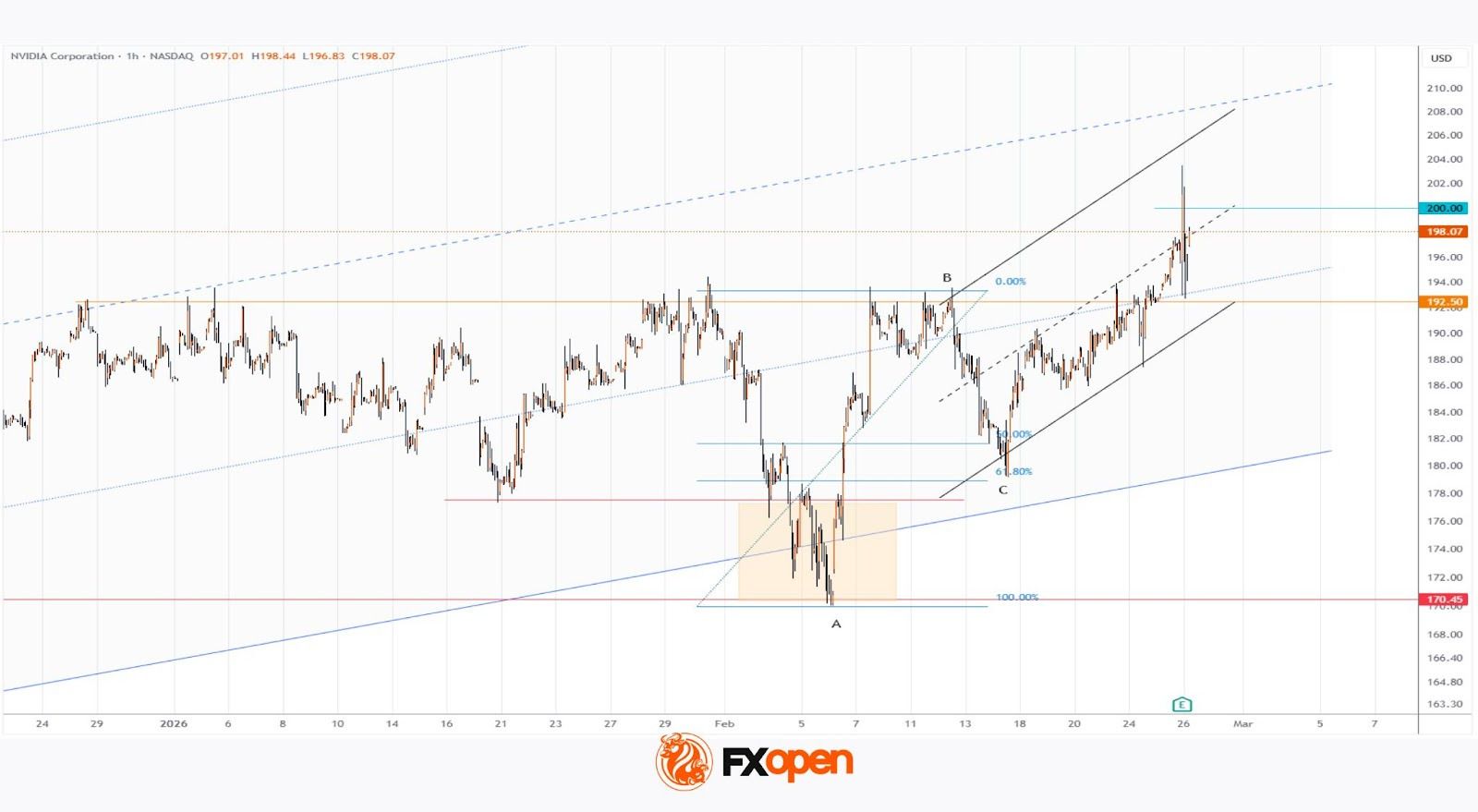
As the Nvidia (NVDA) share price chart shows, the stock rose above the psychological $200 level in after-hours trading, but subsequently pulled back, which may point to excessive optimism and aggressive selling pressure.
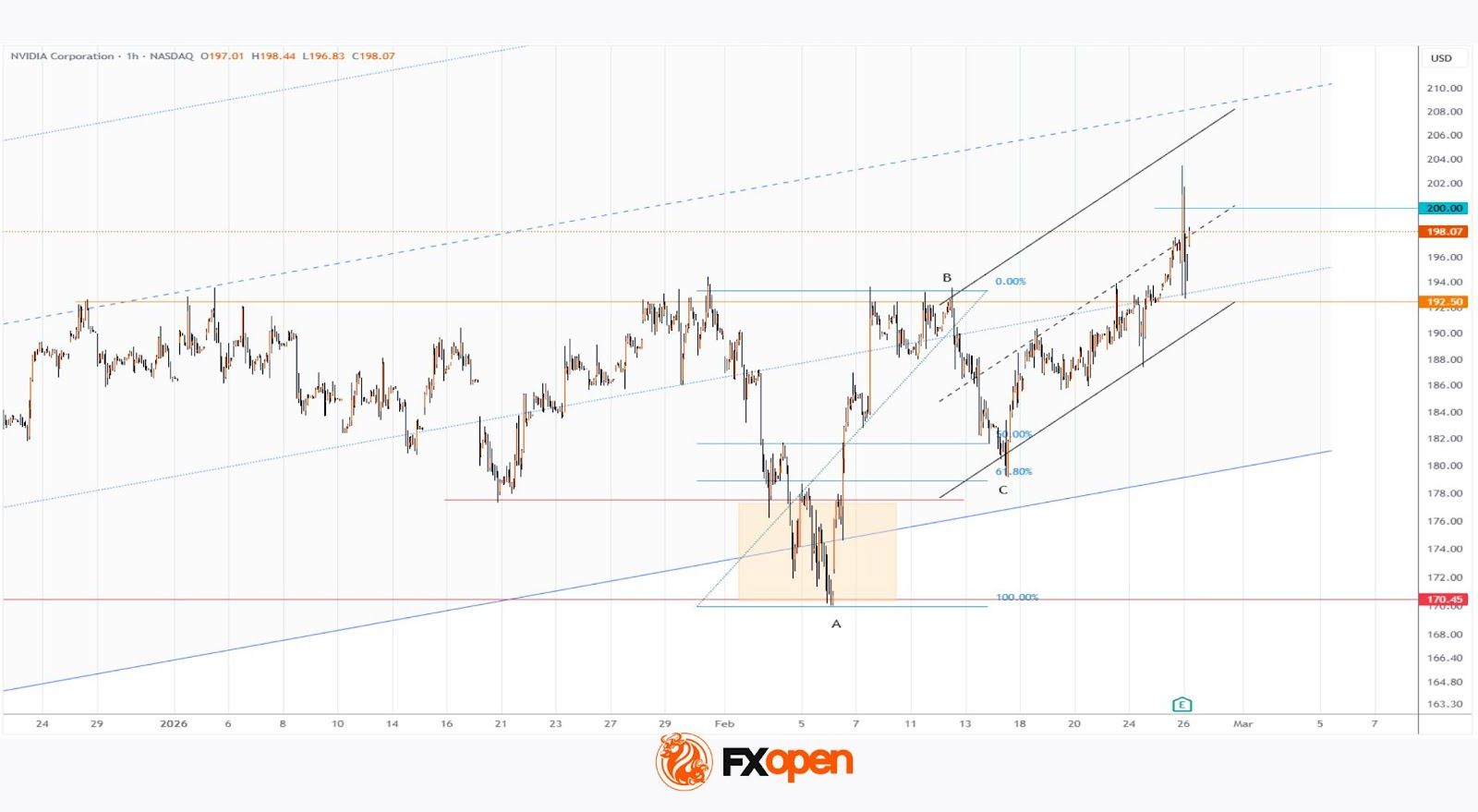
Technical Analysis of the Nvidia (NVDA) Chart
On 10 February, when analysing NVDA price movements, we:
→ reaffirmed the validity of the long-term ascending channel (which remains intact) and highlighted the importance of the $192.50 resistance level;
→ suggested that the initiative was on the side of the bulls, who were aiming to resume the long-term uptrend towards the psychological $200 mark.
Since then:
→ NVDA formed a pullback from the указанного resistance level towards the 50–61.8% Fibonacci retracement zone;
→ on 17 February, it resumed its advance, supported by a short-term ascending channel (marked in black), ultimately reaching $200.
Overall, the picture appears constructive, and the next potential target for NVDA may be the median line of the long-term channel. However, it is worth recalling the recent experience of other technology giants whose shares rallied briefly after earnings before turning lower (for example, Meta). The sharp reversal from above the $200 mark lends weight to this scenario.
Therefore, if bulls are to confirm control over NVDA shares, it is important for the price to hold above the $192.50 level.
Buy and sell stocks of the world’s biggest publicly-listed companies with CFDs on FXOpen’s trading platform. Open your FXOpen account now or learn more about trading share CFDs with FXOpen.
This article represents the opinion of the Companies operating under the FXOpen brand only. It is not to be construed as an offer, solicitation, or recommendation with respect to products and services provided by the Companies operating under the FXOpen brand, nor is it to be considered financial advice.
TLDR:
- Prevalon Energy added STRC to its treasury focusing on capital preservation, liquidity, and long-term financial discipline.
- Anchorage Digital holds STRC on its balance sheet, aligning its capital with Strategy’s institutional Bitcoin framework.
- Both companies conducted independent evaluations through their own management teams and boards before allocating STRC.
- Strategy’s STRC offers an 11.25% annual dividend paid monthly, designed for stable price dynamics in corporate treasuries.
Prevalon Energy and Anchorage Digital have publicly announced their allocations of STRC to their corporate treasuries. The disclosures were made during Strategy World 2026 in Las Vegas.
Both companies presented during the “Bitcoin for Corporations” track at the conference. Each firm conducted an independent evaluation before committing to the allocation.
The announcements were made on behalf of Strategy Inc., listed on Nasdaq under tickers including STRC, MSTR, STRF, STRK, and STRD.
Prevalon Energy and Anchorage Digital Step Forward With Independent Treasury Decisions
Prevalon Energy’s CFO, Benjamin Hunnewell, made the formal announcement on behalf of the company. He confirmed that Prevalon added STRC to its treasury as part of a broader capital management strategy.
Hunnewell stated, “As Prevalon continues to scale globally, we remain focused on maintaining a strong and flexible balance sheet.” He added that after evaluating a range of treasury alternatives, STRC aligned best with the company’s objectives.
Anchorage Digital’s Head of Prime Sales, Manuel Andreani, disclosed the firm’s STRC position during his presentation.
Nathan McCauley, Co-Founder and CEO of Anchorage Digital, further elaborated on the rationale behind the move.
McCauley said, “Institutions don’t adopt Bitcoin on conviction alone; they adopt it through structure and disciplined capital management.” He noted that holding STRC aligns Anchorage’s capital with Strategy’s institutional framework.
Both companies stressed that their evaluations were conducted independently by their own management teams and boards. Neither firm’s decision was influenced by the other’s allocation.
The separate reviews point to a shared conclusion reached through distinct internal processes. This adds credibility to STRC as a treasury instrument appealing across different corporate profiles.
Strategy CEO Phong Le responded to the announcements during the event. He described STRC as a flagship digital credit instrument built for stable price performance.
Le said, “We are encouraged to see innovative companies like Prevalon and Anchorage Digital integrate STRC into their corporate treasury strategies.” He added that the stock offers an 11.25% annual dividend distributed every month, with more institutions expected to follow.
STRC Draws Institutional Interest as a Structured Digital Credit Instrument
STRC stands for Strategy’s Variable Rate Series A Perpetual Stretch Preferred Stock. It is designed to deliver stable price dynamics alongside a consistent dividend yield.
The monthly distribution structure makes it attractive for treasury teams managing cash flow. Unlike direct Bitcoin exposure, STRC offers a structured entry point into the Bitcoin treasury ecosystem.
Anchorage Digital’s involvement carries additional weight given its position as a regulated crypto institution. McCauley noted that “the link between Bitcoin treasury strategy and regulated infrastructure becomes even more critical” as adoption accelerates.
The firm serves institutional clients and operates within a compliance-focused infrastructure. Its decision to hold STRC reinforces the connection between regulated custodians and Bitcoin-aligned treasury tools.
Prevalon Energy’s announcement broadens the conversation beyond financial and technology sectors. Hunnewell emphasized that the decision reflects Prevalon’s focus on “capital preservation, liquidity, and disciplined long-term financial management.”
Energy companies entering the digital credit space reflect a wider corporate shift in treasury thinking. Treasury diversification into instruments like STRC is gaining ground in unexpected corners of the corporate world.
Together, the two announcements at Strategy World mark a notable moment for STRC’s market visibility. The public disclosures during a major conference signal growing confidence in the instrument.
Both companies chose to go on record at a high-profile venue, lending further weight to their decisions. For Strategy, the announcements serve as real-world validation of its digital credit strategy.


After weeks of subdued activity, US spot ETH ETFs also witnessed a surge in inflows.
Ethereum reclaimed the coveted $2,000 level on Wednesday, amidst a broader improvement in market tone. The world’s largest altcoin by market cap extended its gains and rallied by 8% over the past day.
But new data suggest that ETH’s price action may be entering a more unstable phase.
Ethereum at a Crossroads
Ethereum’s 30-day realized volatility on Binance has climbed to nearly 0.97. According to CryptoQuant, this is its highest level since March 2025. Such a move indicates that ETH’s daily price swings have widened significantly, in what appears to be a pivot away from the relatively calm trading conditions seen in recent weeks.
At the same time, Ethereum is trading in an area that has acted as a mid-range support zone. The combination of rising volatility and price consolidation points to an active standoff between buyers and sellers. Market participants are repositioning as they anticipate a larger move.
The analytics platform explained that this type of volatility expansion often reflects a repricing phase, rather than random short-term fluctuations.
From a structural front, the current volatility levels imply that the market has exited a low-volatility environment and entered a more reactive and uncertain phase. If volatility continues to rise in addition to the price movement, it could pave the way for a decisive directional breakout.
However, if price fails to follow through despite high volatility, ETH may remain trapped in a range until stronger conviction emerges. In past cycles, sharp increases in volatility have frequently come just before strong price rallies, which means that the market may now be at a critical turning point.
You may also like:
Analysts have recently stated that Ethereum is trading within a five-year demand zone, which they say has historically favored accumulation rather than selling.
Meanwhile, the latest data from Santiment revealed that Ethereum’s 30-day MVRV sits at -5.5%, which places it in mildly undervalued territory despite the recent market rally. The negative MVRV suggests recent buyers are, on average, at a loss, a condition that historically aligns with improved risk-reward zones rather than local market tops.
Improving Sentiment
On the institutional front, US-based spot Ethereum ETFs saw a sharp pickup in demand on February 25, logging more than $157 million in net inflows – its strongest daily total in over a month. The surge was led by Fidelity’s FETH, which attracted $62 million.
Grayscale’s ETHE followed with $33.8 million in inflows, while BlackRock’s ETHA added $31 million.
Binance Free $600 (CryptoPotato Exclusive): Use this link to register a new account and receive $600 exclusive welcome offer on Binance (full details).
LIMITED OFFER for CryptoPotato readers at Bybit: Use this link to register and open a $500 FREE position on any coin!


Centrifuge jumps ~180% in hours on Upbit listing, then eases as traders take profits and mixed technicals flash caution.
Summary
- CFG spiked about 180% intraday before retreating from highs as profit-taking hit the market.
- Price reclaimed levels last seen in Oct 2025 and now trades above its 50D and 100D SMAs, while RSI sits in overbought territory.
- On-chain data show whale accumulation and a sharp volume spike after Upbit listed CFG with KRW, BTC, and a major stablecoin pairs.
Centrifuge’s CFG token rose more than 180% following the announcement that trading would commence on South Korean cryptocurrency exchange Upbit, according to market data.
The rally occurred as broader cryptocurrency markets posted gains, with Bitcoin advancing alongside several major alternative cryptocurrencies. The token subsequently retreated from intraday highs as traders took profits, according to trading data.
Upbit announced trading support for Centrifuge would begin on February 26, 2026, at 2 PM Korea Standard Time, according to the exchange’s statement. The listing includes spot trading pairs against the Korean won, bitcoin, and a major stablecoin. Deposit and withdrawal services were scheduled to become available shortly after the announcement, the exchange stated.
On-chain data indicated increased accumulation by large holders, referred to as “whales” in cryptocurrency markets, according to blockchain analytics. Trading volume increased substantially as the token’s price surged, market data showed.
Upbit’s user base and liquidity have historically generated significant price movements for newly listed tokens, according to market observers.
Centrifuge operates as a platform for tokenizing real-world assets, with its native token enabling governance functions that allow holders to participate in protocol decisions, according to the project’s documentation. The token’s price had followed broader cryptocurrency market declines until the Upbit listing drove prices to levels last observed in October 2025, according to historical price data.
Technical analysis presented mixed signals, with the Moving Average Convergence Divergence indicator suggesting bullish momentum while the Relative Strength Index reached levels typically associated with overbought conditions, according to chart data. The token traded above its 50-day and 100-day simple moving averages, technical indicators showed.
Market analysts noted that sustained trading volume from Korean market participants could drive prices toward higher resistance levels, though a decline below key moving averages could accelerate downside pressure.


Three companies have added Strategy’s perpetual preferred equity, Stretch (STRC), to their balance sheets as the security returns to its $100 par value.
Strategy said Prevalon Energy and Anchorage Digital disclosed during presentations at Strategy World 2026 in Las Vegas that each company has allocated a portion of its corporate treasury to STRC, Strategy’s Variable Rate Series A Perpetual Stretch Preferred Stock, during the “Bitcoin for Corporations” track. In separate remarks at the conference, OranjeBTC, a Brazilian bitcoin treasury company also confirmed it has added STRC to its balance sheet.
According to STRC.live, STRC briefly touched par during Wednesday’s trading session. Based on trading volume, it is estimated that roughly 22 BTC were purchased through STRC activity. In pre market trading, STRC is again at $100.
STRC is a short duration, high yield credit instrument that ranks senior to MSTR common stock and offers an 11.25% annual dividend, distributed monthly.
The conference also featured additional announcements, including 21Shares bringing STRC exposure to Europe through the Strategy Yield ETP on Euronext Amsterdam.
Separately, Morgan Stanley plans to introduce bitcoin trading, lending, yield, and custody services, with Amy Oldenburg, Head of Digital Asset Strategy at Morgan Stanley, confirming the plans during a panel discussion with Strategy CEO Phong Le.
Bitcoin is trading above $68,000, while MSTR rose 9% on Wednesday and is slightly lower in Thursday pre market trading at around $135.
Crypto World
Wikipedia vs. On-Chain: Why Jimmy Wales’ Bitcoin Bubble Call Clashes With Polymarket Data
Wikipedia founder Jimmy Wales is calling Bitcoin a bubble again. In a recent tweet on X, Wales predicted the asset would collapse to $10,000 by 2050, dismissing the trillion-dollar network as a “complete failure” of a currency that serves no real human purpose.
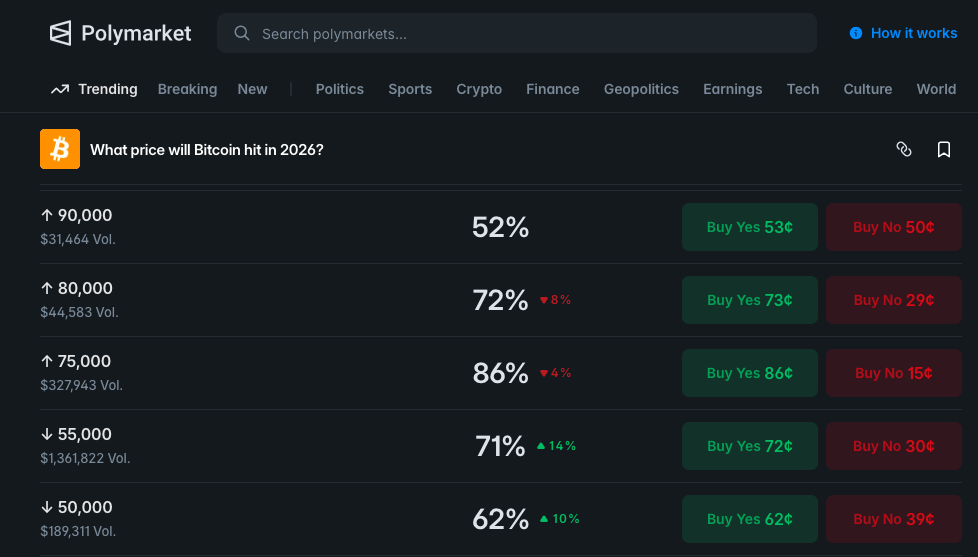
The market is taking the other side of that trade. Polymarket bettors and traders are currently pricing in a roughly 66% probability of continued upside, with millions in volume backing a bullish trajectory rather than a collapse. Smart money is betting on expansion, not extinction.
This creates a sharp divergence between a famous tech skeptic and the actual localized market sentiment driving price action.
Key Takeaways
- The Skeptic: Jimmy Wales predicts a crash to $10,000, calling the asset a failure.
- The Data: Prediction markets signal a 66% confidence in bullish continuation.
- The Divergence: On-chain volume and ETF flows contradict the “bubble” narrative.
The Bear Case: Wales Predicts Bitcoin Bubble Bursts to $10K
Wales’ argument is not new, but his timeline is specific. He posits that Bitcoin will slowly bleed out to $10,000 by 2050 as the “bubble” deflates relative to inflation and utility.
Speaking recently, he characterized the banking system’s engagement with crypto as predatory rather than supportive, suggesting institutions are merely extracting fees before the inevitable collapse.
This narrative echoes his past predictions that have largely failed to materialize. Yet, it resonates with a segment of the market concerned about sustainability.
Wales argues that without being an effective medium of exchange, the store-of-value proposition is hollow.
Discover: The best new crypto today
What Polymarket Is Actually Saying
Prediction markets offer a quantified rebuttal to opinion. On Polymarket, the leading decentralized prediction platform, the odds tell a story of confidence.
Contracts tracking Bitcoin’s price trajectory show a dominant preference for higher targets in 2024 and 2025.
The majority of Polymarket bettors believe the bull case is remaining intact, although they have different ideas about where the ceiling might be.
A staggering 86% see bitcoin rising to $75,000 contrasting with 71% who see it falling down to $55,000, a level described as a plausible bear case by Standard Chartered and CryptoQuant analysts.
Additionally, institutions are still quietly doubling down on Bitcoin. Both Strategy and Metaplanet revealed they intend to keep adding to their BTC treasuries.
If Wales is right, the industry smart money is spectacularly wrong. But if the market is right, Wales is fighting a phenomenon fueled by many billions in institutional treasuries and ETF liquidity.
On-Chain Data: Accumulation or Distribution?
To settle the debate, Bitcoin analysis must turn to the blockchain itself. Current on-chain metrics show a stark difference from the 2017 or 2021 tops.
Exchange reserves are deepening their multi-year downtrend. Coins are moving off exchanges into cold storage, a signal that usually precedes supply shocks.
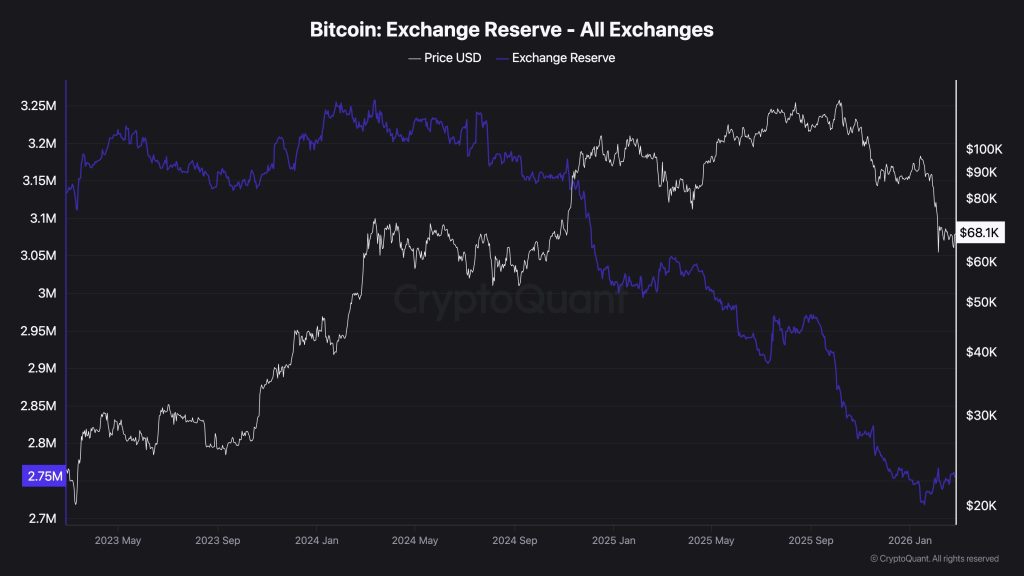
This accumulation is apparent globally. Whales are not distributing into this rally; they are buying the dips.
The recent defense of the $60,000 level proves this. When $370 million in long liquidations flushed the market, buyers stepped in immediately.
That is not the behavior of a popping bubble. It is the behavior of a market establishing a new fair value.
Will the Bitcoin Bubble Burst? The Million Dollar Question
The technical structure for Bitcoin remains constructively bullish as long as it doesn’t slip below the $60,000 support block. A move down to $55k opens the road to further new bottoms.
In the last 24 hours, Bitcoin rose 4% to trade near $68,200 at the time of writing. The next big milestone will be $75k, the preferred price target for most Polymarket bettors, and an indication of its psychological significance.
Clear that, and price discovery mode begins. However, if the broader crypto market weakens, a retest of $62,000 and the threat of a collapse down to $55k hang ominously over the industry.
Discover: The best pre-launch crypto sales
The post Wikipedia vs. On-Chain: Why Jimmy Wales’ Bitcoin Bubble Call Clashes With Polymarket Data appeared first on Cryptonews.


The Office of the Comptroller of the Currency (OCC) has unveiled a comprehensive proposal to implement the GENIUS Act, marking a significant step toward federally regulated stablecoin activity in the United States.
Summary
- The OCC has proposed detailed stablecoin regulations to implement the GENIUS Act, covering issuance, supervision, reserves, liquidity, and redemption requirements.
- A 60-day public comment period has been opened to refine the draft rules before finalization, with AML and sanctions provisions to be added later.
- The move marks a major regulatory milestone in bringing payment stablecoins under federal banking oversight following the GENIUS Act’s enactment.
New OCC stablecoin rule proposal seeks federal oversight
The notice of proposed rulemaking, issued on February 25, outlines how payment stablecoins can be issued, backed, supervised, and potentially revoked under federal banking oversight.
Under the draft rules, the OCC would regulate “permitted payment stablecoin issuers” including subsidiaries of national banks, federal qualified issuers, certain state qualified issuers, and foreign stablecoin issuers meeting specified requirements.
The proposal sets standards for reserve assets, mandatory redemption at par, liquidity and risk management, audits, supervisory examinations, custody, and application pathways laying the groundwork for stablecoins to operate within the traditional banking system.
The OCC has opened a 60-day public comment period to gather industry, stakeholder, and public feedback before finalizing the rules. Key aspects such as anti-money-laundering provisions, Bank Secrecy Act requirements, and sanctions rules will be addressed separately in coordination with the U.S. Department of the Treasury.
Comptroller Jonathan V. Gould described the proposed framework as designed to help the stablecoin sector “flourish in a safe and sound manner,” while providing clarity and regulatory certainty for issuers operating under federal supervision.
The GENIUS Act, enacted in July 2025, created a federal regulatory structure for payment stablecoins after years of debate over how to integrate digital assets into U.S. financial law.
The OCC’s proposal represents a landmark effort to translate that statute into enforceable federal rules, potentially shaping how banks, nonbanks, and foreign firms issue and manage stablecoins in the years ahead.

Cardano price outlook as sharks & whales quietly scoop up 819M ADA

Restraining Order Against Jada Pinkett Smith Denied, Filed by Will Smith’s Alleged Pal

Top 10 Record-Breaking Fast Money Scores (1st players)


-

 Video6 days ago
XRP News: XRP Just Entered a New Phase (Almost Nobody Noticed)
-

 Politics4 days ago
Baftas 2026: Awards Nominations, Presenters And Performers
-

 Fashion6 days ago
Weekend Open Thread: Boden – Corporette.com
-

 Sports3 days ago
Women’s college basketball rankings: Iowa reenters top 10, Auriemma makes history
-

 Politics3 days ago
Nick Reiner Enters Plea In Deaths Of Parents Rob And Michele
-

 Crypto World2 days ago
XRP price enters “dead zone” as Binance leverage hits lows
-

 Business4 days ago
Mattel’s American Girl brand turns 40, dolls enter a new era
-

 Business2 days ago
True Citrus debuts functional drink mix collection
-

 Business4 days ago
Law enforcement kills armed man seeking to enter Trump’s Mar-a-Lago resort, officials say
-

 Tech2 days ago
Unsurprisingly, Apple's board gets what it wants in 2026 shareholder meeting
-

 NewsBeat11 hours ago
Cuba says its forces have killed four on US-registered speedboat | World News
-
 NewsBeat13 hours ago
Manchester Central Mosque issues statement as it imposes new measures ‘with immediate effect’ after armed men enter
-
 NewsBeat3 days ago
‘Hourly’ method from gastroenterologist ‘helps reduce air travel bloating’
-

 Tech4 days ago
Anthropic-Backed Group Enters NY-12 AI PAC Fight
-

 NewsBeat4 days ago
Armed man killed after entering secure perimeter of Mar-a-Lago, Secret Service says
-

 Politics4 days ago
Maine has a long track record of electing moderates. Enter Graham Platner.
-

 Business7 hours ago
Discord Pushes Implementation of Global Age Checks to Second Half of 2026
-
 NewsBeat2 days ago
Police latest as search for missing woman enters day nine
-

 Crypto World2 days ago
Entering new markets without increasing payment costs
-
 Sports3 days ago
2026 NFL mock draft: WRs fly off the board in first round entering combine week