

Crypto World
Centrifuge price explodes as CFG trading goes live on Upbit



- Centrifuge price exploded by more than 180% to hit highs of $0.25.
- The sharp rise followed as news of CFG trading going live on Upbit.
- Profit-taking threatens to wipe out all the intraday gains as the price hovers near $0.16.
Centrifuge (CFG) has surged dramatically in the past 24 hours, posting gains of over 180% amid excitement over its listing on South Korea’s largest crypto exchange, Upbit.
Notably, the rally aligns with broader market gains, as Bitcoin climbed about 7% to near $70,000 before settling around $68k as of writing.
Several top altcoins also posted positive moves, including Ethereum’s uptick to above $2,000 despite continued selling by co-founder Vitalik Buterin.
On-chain data shows whale accumulation is picking up and could surge as price breaks above the $2k level.
CFG is up amid this potential market bounce, with the Upbit listing a major catalyst.
However, the overall crypto market sentiment remains cautious, and profit-taking could see a sharp pullback for several altcoins.
Centrifuge price rockets on Upbit listing news
Upbit, South Korea’s leading crypto exchange, announced that trading support for CFG would go live on February 26, 2026, at 2 PM KST.
The exchange added spot pairs against KRW, BTC, and USDT, and revealed that deposits and withdrawals would be available shortly after the announcement.
Upbit boasts a massive user base and liquidity, and these factors have historically seen listed tokens pump hard.
CFG’s price rose sharply amid the potential flip in visibility and adoption.
The token’s value jumped from around $0.08 to over $0.25, with trading volume spiking over 4,000% to $79 million.
With assets like Polkadot, NEAR, and Uniswap trending among the top 10 gainers, it’s Centrifuge’s vertical jump that stood out.
CFG market cap ballooned past $120 million before slipping lower as prices retreated from the intraday highs.
Centrifuge price forecast
Centrifuge is a crypto project focused on tokenizing real-world assets (RWAs), a market that’s attracting huge attention.
The CFG token powers governance on the platform, allowing holders to participate in protocol decisions.
Despite market potential, its price has largely followed the bearish trend across crypto.
A short-term upside tied to Upbit’s liquidity influx helped bulls revisit prices last seen in October 2025.
If Korean inflows persist, buyers could test higher resistances around $0.30 and move to $0.40.

However, broader profit deals have already seen CFG pull back, currently trading near $0.16.
The MACD suggests bullish sentiment, but an extended RSI signals overbought risks.
If prices fall below the 50-day and 100-day simple moving average lines, the nosedive could accelerate to $0.10 or lower.

Crypto World
Crypto Market Liquidity Is Shrinking Fast: Can the $50B USDT Level Survive the Pressure?

TLDR:
- Tether exchange reserves have dropped from $60B to $51.1B, draining $9B in liquidity over just two months.
- The $50B USDT level is now the critical support zone; a breakdown could push reserves toward the $44B mark.
- Active on-chain addresses fell sharply from 376,000 to 263,000, confirming weakening retail and institutional activity.
- CryptoQuant warns that without stablecoin stabilization and returning participants, market pain is likely to continue.
Crypto market liquidity is shrinking at a pace that has put analysts and traders on high alert. Tether’s exchange reserves have fallen from $60 billion to $51.1 billion in just two months.
That $9 billion withdrawal is widely seen as the main force behind the underwhelming market performance in January and February.
With reserves now hovering just above the $50 billion mark, attention has shifted to whether that level can hold. The answer may determine the near-term direction for Bitcoin, Ethereum, and XRP alike.
A $9 Billion Drain Is Reshaping Conditions Across the Crypto Market
The scale of the liquidity withdrawal has been swift and difficult to ignore. Over two months, Tether exchange reserves shed $9 billion, leaving the market noticeably thinner than it was heading into the new year.
As the dominant stablecoin, Tether serves as the primary liquidity engine for the entire crypto sector. When its reserves contract at this rate, the ripple effects are felt across trading pairs and asset classes.
Reduced stablecoin reserves translate directly into lower buying power on exchanges. Traders who might otherwise step in to absorb selling pressure simply have less dry powder available to deploy.
This dynamic helps explain why price action across major assets has been sluggish and unconvincing throughout the early months of 2025. Markets tend to drift lower when the liquidity cushion underneath them thins out.
CryptoQuant flagged this trend in a post on X, pointing to the reserve decline as the core issue behind recent market weakness.
The firm stated that without stabilization in stablecoin reserves and a return of active participants, the pain is likely to persist.
That framing puts the current situation in stark terms—recovery depends on reversing a trend that is still moving in the wrong direction.
The $50B USDT Level Now Stands as the Market’s Last Line of Defense
The $50 billion threshold has emerged as the most-watched level in the current market environment. CryptoQuant has identified this mark as a structural support zone that the market cannot afford to lose.
A confirmed breakdown below $50 billion would expose the next support level at $44 billion, leaving a wide gap with little in between. That kind of open air below a key level tends to accelerate downside moves rather than slow them.
On-chain data adds another layer of concern to the picture. Active addresses have dropped from a peak of 376,000 to 263,000, reflecting a sharp pullback in market participation.
Fewer unique senders and receivers point to both retail and institutional disengagement happening simultaneously. This retreat in user activity compounds the pressure that the stablecoin reserve decline is already generating.
When liquidity shrinks and participation falls at the same time, markets lose the structural support needed to sustain prices.
Each metric reinforces the weakness signaled by the other, making a recovery harder to achieve without a clear catalyst.
For the $50 billion USDT level to hold, stablecoin reserves would need to stabilize soon, and traders would need to return to the market in meaningful numbers.

Gate, the crypto exchange behind a platform that serves millions of users worldwide, has cleared another regulatory milestone in Europe. The Malta-based group received a Payment Institution license from the Malta Financial Services Authority (MFSA), authorizing Gate Technology to provide regulated payment services across the European Union under the PSD2 framework. The move broadens Gate’s EU footprint beyond trading and custody into fiat and stablecoin payment rails within the bloc, reinforcing its strategy to fuse traditional payments infrastructure with Web3 capabilities in Europe. Gate notes that its global user base surpasses 49 million, underscoring the potential reach of an EU-wide payments platform. This latest authorization complements Gate’s prior MiCA license achievement, which granted cross-border exchange and custody capabilities across member states starting in 2025.
Key takeaways
- Gate Technology received a PSD2-based Payment Institution license from MFSA, enabling regulated payment services across the EU.
- The license expands Gate’s EU operations from crypto trading and custody into fiat and stablecoin payment infrastructure with passporting across member states.
- The development builds on Gate’s prior MiCA authorization, announced on Oct. 1, 2025, which allowed exchange and custody services throughout the EU.
- The MFSA listing confirms the authorization covers payment accounts and related operations, signaling a broadening of Gate’s regulated activities beyond crypto custody.
- The move reflects a broader industry trend, with other exchanges like OKX also securing Malta payment licenses to support euro-denominated payments within regulated rails.
Tickers mentioned:
Market context: The industry is increasingly aligning crypto services with traditional payments regulation in the European Union, particularly under MiCA and PSD2, to enable regulated, cross-border flows for crypto-related payments and stablecoins.
Sentiment: Neutral
Price impact: Neutral. The licensing news signals regulatory alignment and potential product expansion, but does not by itself indicate immediate price moves.
Trading idea (Not Financial Advice): Hold. As Gate expands its EU payments capabilities, strategic execution and regulatory milestones will influence momentum, but investors should watch timelines and product launches for concrete impact.
Market context: The Maltese authorization sits within a broader EU push to regulate crypto-enabled payments. With MiCA shaping governance of crypto-asset providers and PSD2 guiding payment services, exchanges are increasingly obtaining cross-border licenses to deliver euro-denominated, regulated payments alongside crypto trading.
Why it matters
The MFSA’s decision to grant Gate Technology a PSD2-based Payment Institution license elevates Gate’s position from a crypto-trading platform to a dual-rails provider that can handle both digital assets and fiat payments within Europe. This is not merely a compliance tick-box; it expands the company’s ability to offer payment services that connect traditional financial rails with Web3 applications. For users, this could translate into streamlined on- and off-ramps, simpler fiat-to-crypto exchanges, and potentially cost-efficient mechanisms for transferring value across borders within the bloc.
From a strategic perspective, Gate’s move aligns with a growing trend among major crypto firms seeking to embed themselves more deeply in regulated payment ecosystems. By leveraging PSD2, Gate can passport payment services across EU member states, a capability that complements its MiCA authorization which already opened the door to cross-border exchange and custody. In practice, this means Gate aims to provide a more seamless experience for institutions and retail customers who rely on both crypto services and conventional payment rails—for example, funding accounts with cash or withdrawing funds into traditional bank accounts, all within a tightly regulated framework.
While the public benefits are clear, several questions remain. Gate did not specify which payment products it intends to launch first or the exact rollout timeline across EU markets. Industry observers will be watching for details on whether Gate will introduce fiat-to-crypto gateways, card-based payments, or stablecoin-enabled transfers tied to EU payment rails. The MFSA listing confirms that payment accounts and related operations are within Gate’s scope, but product-level specifics will determine how quickly end users experience tangible advantages.
In this environment, Gate’s competitors are also pursuing similar regulatory paths. OKX, for instance, obtained a Malta Payment Institution license to support products such as OKX Pay and the OKX Card, illustrating a coordinated push among exchanges to secure regulated access to euro-denominated payment channels. Under MiCA, providers that integrate stablecoin payments into regulated rails must stay aligned with EU payments law, which makes these licensing steps an increasingly common prerequisite for exchanges seeking broader European reach. As such, Gate’s PSD2 authorization is best understood as part of a wider shift toward regulated, interoperable crypto-financial services in Europe.
What to watch next
- Clarified product roadmap: Gate should reveal which payment services will launch first (fiat on/off ramps, card integration, or stablecoin payments) and the expected rollout timeline across EU member states.
- Regulatory cadence: Any MFSA-guided milestones or updates to Gate’s obligations under PSD2 and MiCA, including governance, reporting, or consumer protection enhancements.
- Merchant and institution adoption: Partnerships with banks, merchants, or fintechs that can leverage Gate’s regulated payment rails, potentially accelerating euro-denominated payment flows for crypto users.
- Cross-border usage: Practical tests of passporting capabilities across multiple EU jurisdictions and any friction points in onboarding or KYC processes for EU customers.
Sources & verification
- Gate Technology’s Malta PSD2 license grant announced by Gate via its public announcements.
- The MFSA public authorization catalogue listing Gate Technology as a licensed Payment Institution under Malta’s Financial Institutions Act.
- Gate’s earlier MiCA authorization announcement, confirming cross-border exchange and custody permissions across EU member states.
- OKX Malta Payment Institution license announcement as part of the broader EU compliance trend among major exchanges.
Gate expands EU payments with PSD2 license in Malta
Gate has openly described its Malta MFSA authorization as a strategic bridge between established payment infrastructure and emerging Web3 services across the European Union. The Maltese license is a formal recognition that Gate Technology can perform a spectrum of regulated payment activities, including initiating transfer operations, maintaining payment accounts, and enabling funds movement that originates from or terminates in the EU. In practical terms, Gate can, under PSD2, facilitate the kinds of payments that users expect when interacting with crypto platforms—cash-in and cash-out flows, transfers between wallets and bank accounts, and perhaps merchant-enabled payments that bridge crypto and fiat rails—without stepping outside regulatory boundaries.
The MFSA’s listing also underscores Gate’s ambition to deliver a fully compliant suite of services that integrate traditional financial rails with digital-asset tools. While the company has not named specific products for immediate launch, the authorization confirms a regulatory green light for operations that handle customer payments in a way that mirrors conventional financial institutions. This is particularly relevant for entities dealing with stablecoins, where staying within the ambit of regulated payment and electronic-money frameworks can facilitate smoother operations across borders while preserving consumer protections and compliance standards.
Market observers will be watching how Gate leverages this license to grow its European footprint, especially given the substantial scale of its user base. Gate reports a global user count exceeding 49 million, a figure that, if translated into EU activity, could significantly boost demand for euro-denominated payment solutions tied to crypto services. Yet the company’s reluctance to disclose a detailed EU user composition or a concrete product launch schedule hints at a cautious approach as it integrates new regulatory capabilities with its existing product lineup. In a sector where regulatory clarity is a competitive differentiator, Gate’s PSD2 license is a meaningful step toward a more seamless, compliant, and enterprise-friendly crypto ecosystem in Europe.


- Bybit adds stablecoin yield tools as crypto volatility rises.
- Exchange plans up to $10 million fixed-income opportunities in March.
- Firm says investors now prioritize capital preservation and yield.
Cryptocurrency exchange Bybit said it is expanding stablecoin-based income opportunities and fixed-return products as digital-asset markets face renewed volatility and falling investor sentiment.
The Dubai-based platform pointed to weakening market confidence, including a sharp pullback in bitcoin and a drop in the Crypto Fear and Greed Index, as a key reason for its latest initiatives.
Rather than reducing activity during uncertain conditions, the company said it intends to broaden earning options and support users seeking more predictable returns.
“We believe stability is what our users want most right now,” said Helen Liu, Co-CEO at Bybit. “The market will recover — we have no doubt about that. But in the meantime, our job is to help ease the pressure, offer real opportunities to earn stable income, and make sure our community knows that Bybit is right here with them.”
Focus on stable income during market uncertainty
Bybit said it has observed how rapidly market sentiment can shift during crypto cycles and how volatility can affect retail investors.
In response, the exchange is accelerating access to yield opportunities tied to stablecoins and introducing tools designed to preserve capital while generating consistent returns.
The company is promoting on-chain yield options, including Mantle Vault, and capital-efficiency tools such as BYUSDT, with the goal of allowing users to earn income without relying on speculative price appreciation.
“We want to find every opportunity for our users to earn stable income,” Liu said. “Whether it is on-chain yield through Mantle Vault or capital efficiency through BYUSDT, the goal is the same — make every dollar work harder so that our community can weather this period with less stress and more confidence.”
According to the company, the current market environment reflects a shift in investor priorities.
Bybit said users increasingly seek capital preservation and steady returns rather than highly leveraged gains.
“This cycle is different. Users are not chasing 100x returns — they are looking to protect capital and generate sustainable yield. That shift is structural, not emotional.”
New fixed-income opportunities planned
The exchange plans to introduce up to $10 million in fixed-income opportunities backed by stablecoins.
The initiative is expected to launch through March and is intended to provide predictable earnings options during periods of heightened volatility.
“Bybit will launch throughout March to offer stablecoin earn to its community. We are here for the industry for the long haul,” Liu said. “We have always believed in supporting our community — through bull markets and bear markets alike.”
The company said the offerings are part of a broader strategy to strengthen its role beyond trading by providing income-oriented financial products during uncertain market conditions.
Community engagement and long-term strategy
Bybit also emphasized continued communication with users and partners, saying transparency and constant engagement are key priorities during turbulent periods.
The exchange stated its teams remain connected around the clock to keep participants informed.
“We support stablecoin initiatives to help alleviate the financial pressure our users face during uncertain times. We invest in CSR and ecosystem development because a thriving industry benefits everyone. This commitment is unwavering — it is fundamental to Bybit’s identity.”
The company said market downturns can define the industry’s resilience and that its strategy is to remain active during challenging conditions while building confidence among users.
Bybit added that its focus is on offering stability and predictable earning opportunities as investors adjust to a more cautious phase in the digital-asset market cycle.


Institutional engagement with digital assets is no longer a uniform story. In recent years, major financial institutions have taken markedly different approaches to blockchain-based markets. Some have focused on tokenization, putting traditional instruments into programmable form. Banks, meanwhile, have explored tokenized deposit models and internal settlement rails as well as issuing their own digital assets like stablecoins.
Amid the growing wave of institutional capital entering digital assets, the more revealing question is not who participates, but how participation is governed inside the institution. Regulatory requirements, operational standards, and internal conviction often determine whether a strategy moves forward or stalls.
Speaking exclusively with BeInCrypto at Liquidity Summit 2026 in Hong Kong, Samar Sen, Head of International Markets at Talos, shared how those internal dynamics play out when institutions evaluate digital asset opportunities.
Adoption Requires More Than Rules
According to Sen, regulatory clarity remains the most decisive factor in institutional participation. He noted that progress across jurisdictions has helped reduce uncertainty, but clear rules remain essential for large-scale adoption.
“We’ve seen a lot of advancements in regulation all over the world,” Sen acknowledged.
While once the dominant concern, infrastructure has matured significantly. Institutional-grade custody, execution platforms, and portfolio management systems now operate across major markets, addressing many of the operational gaps that previously slowed adoption.
Yet even where regulatory frameworks have advanced and infrastructure is in place, in many institutions, the remaining hurdle is internal.
“There may be management that is still evaluating the underlying tech or still need some time to understand the potential of the tech to revolutionize finance,” he said.
That hesitation often reflects unfamiliarity rather than outright resistance, he added. For institutions built on decades of precedent, conviction takes time. As a result, digital asset initiatives can stall even when the external conditions appear favorable.
The Compliance Checklist Behind Institutional Trust
When asked what signals actually build trust for institutions evaluating crypto counterparties, Sen pushed back on the idea that visibility alone carries weight. While he acknowledged that industry gatherings and brand presence may help with awareness, institutional trust is earned differently.
“Typically, what builds trust will be, first of all, licensed or regulated entities within their jurisdictions,” Sen said.
He also added that institutions look for demonstrable internal controls, such as SOC 2 Type II certifications, audit trails, and operational safeguards. Track record also matters, particularly if leadership has experience in traditional finance and has built a reputation for delivering under regulatory scrutiny.
Peer adoption plays a role as well. Institutions often look outward, assessing who else is using the same infrastructure, and how widely it has been adopted across the industry.
“If you’re a big bank, and you go to talk to a vendor to provide you with technology, if that vendor is providing that technology to some of your peers and competitors, that’s another way that can establish some kind of trust,” he explained.
Not All Institutions Move at the Same Speed
Although regulatory clarity and operational safeguards form the foundation, institutions are not entering digital assets uniformly. Sen described three distinct profiles emerging in the market.
Some organizations act as early movers. These firms understand the structural shift underway in capital markets and are willing to commit resources ahead of full certainty. They tend to invest in building internal digital asset teams and engage proactively with new infrastructure providers.
Others take a more measured approach. These fast followers prefer to wait for clearer regulatory direction or proof of concept before scaling exposure. Their risk appetite is lower, and they often rely on external validation before committing capital.
Then there are institutions that remain behind the curve. In some cases, leadership has yet to develop conviction around the underlying technology. In others, digital asset initiatives exist but lack internal coordination, resulting in fragmented or misaligned strategies.
Sen noted that institutions should not be expected to move in lockstep. He added that different risk tolerances and internal mandates shape the pace of adoption.
“And that’s okay because with digital assets and the underlying technology, there are many entry points to participate in the asset class, to get comfortable with the new providers and ecosystem participants. We are here to help navigate that,” he stated.
By Omkar Godbole (All times ET unless indicated otherwise)
Bitcoin’s price bounce sparked optimism on social media, with X users declaring the bottom is in and a new rally is underway. Options market activity, however, reveals savvy traders remain skeptical, hedging against the risk of a potential slide below $60,000.
“While the bounce triggered some call buying in the $85,000 to $90,000 strikes, downside skew remains more elevated than upside, suggesting caution,” Sidrah Fariq, head of retail at Deribit, told CoinDesk in a Telegram chat.
The demand for call options, or bullish bets, indicates that bitcoin’s Wednesday bounce to $70,000 has some traders chasing upside. However, skew, which measures prices for calls relative to puts, remains negative across all time frames. It shows that traders remain worried about price drops and are still seeking puts for downside protection.
Underlying that theme, on Deribit, the $60,000 put remains the most popular position, with notional open interest (OI) of $1.48 billion. In contrast, the most popular call option, the $90,000 strike, has OI of $1.12 billion. Clearly, the overall positioning remains bearish.
That said, there could be some consolidation, as dealer positioning — net exposure of those who make markets by providing liquidity — has flipped positive between $60,000 and $70,000. This means dealers could buy low and sell high to maintain a net-neutral exposure, capping swings as they do so.
“Dealer positioning has shifted to neutral to slightly positive gamma, suggesting compressed volatility and range-bound price action,” Fariq said.
Other analysts are looking at the $74,000-$75,000 range as the level to beat for confirming a renewed uptrend.
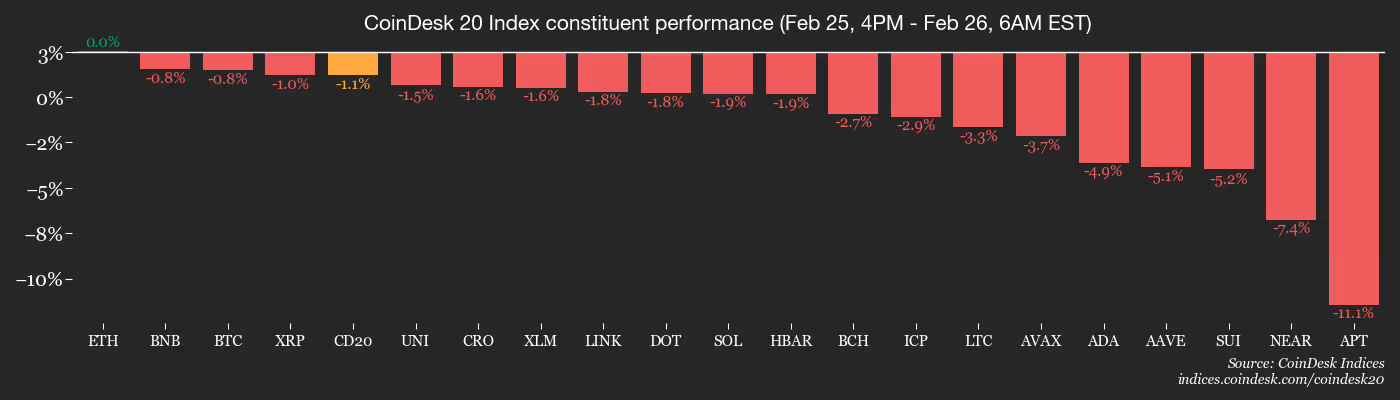
Bitcoin was recently trading near $68,500, up 4.6% on the day, while the broader market posted bigger gains, as evidenced by the CoinDesk 20 (CD20) index’s 5.8% advance. Ether (ETH) has risen over 8%, and XRP (XRP) and solana (SOL) both rose more than 6%.
In traditional markets, futures tied to the S&P 500 and Nasdaq 100 were little changed despite the AI giant Nvidia (NVDA) posting a blowout fourth-quarter earnings report. Gold and the Dollar Index ticked higher as investors awaited details on the U.S.-Iran talks scheduled for later in the day. Stay alert!
Read more: For analysis of today’s activity in altcoins and derivatives, see Crypto Markets Today
What to Watch
For a more comprehensive list of events this week, see CoinDesk’s “Crypto Week Ahead“.
- Crypto
- Macro
- Feb. 26, 8:30 a.m.: U.S. initial jobless claims for week ending Feb. 21 (Prev. 206K)
- Feb. 26, 10:00 a.m.: U.S. Fed Vice Chair for Supervision Michelle Bowman to testify before the U.S. Senate Committee on Banking, Housing and Urban Affairs.
- Earnings (Estimates based on FactSet data)
- Feb. 26: American Bitcoin (ABTC), pre-market, $0.01
- Feb. 26: MARA Holdings (MARA), post-market, -$0.11
- Feb 26: TeraWulf (WULF), post-market, -$0.15
- Feb. 26: Figure Technologies (FIGR), post-market,$0.20
- Feb. 26: Sui Group (SUIG), post-market, $0.01
- Feb. 26: Block (XYZ), post-market, $0.49
Token Events
For a more comprehensive list of events this week, see CoinDesk’s “Crypto Week Ahead“.
- Governance votes & calls
- Unlocks
- Token Launches
Conferences
For a more comprehensive list of events this week, see CoinDesk’s “Crypto Week Ahead“.
Market Movements
- BTC is down 0.52% from 4 p.m. ET Wednesday at $68,590.57 (24hrs: +4.67%)
- ETH is down 1.16% at $2,075.97 (24hrs: +8.36%)
- CoinDesk 20 is down 1.27% at 2,011.66 (24hrs: +5.83%)
- Ether CESR Composite Staking Rate is up 2 bps at 2.85%
- BTC funding rate is at 0.0005% (0.5595% annualized) on Binance

- DXY is unchanged at 97.75
- Gold futures are down 0.41% at $5,204.60
- Silver futures are down 3.98% at $87.99
- Nikkei 225 closed up 0.29% at 58,753.39
- Hang Seng closed down 1.44% at 26,381.02
- FTSE is up 0.17% at 10,824.61
- Euro Stoxx 50 is up 0.25% at 6,188.91
- DJIA closed on Wednesday up 0.63% at 49,482.15
- S&P 500 closed up 0.81% at 6,946.13
- Nasdaq Composite closed up 1.26% at 23,152.08
- S&P/TSX Composite closed up 0.46% at 34,127.33
- S&P 40 Latin America closed up 0.68% at 3,826.41
- U.S. 10-Year Treasury rate is up 0.4 bps at 4.052%
- E-mini S&P 500 futures are unchanged at 6,958.75
- E-mini Nasdaq-100 futures are unchanged at 25,380.75
- E-mini Dow Jones Industrial Average Index futures are down 0.13% at 49,471.00
Bitcoin Stats
- BTC Dominance: 58.55% (+0.12%)
- Ether-bitcoin ratio: 0.03023 (-0.12%)
- Hashrate (seven-day moving average): 1,058 EH/s
- Hashprice (spot): $29.79
- Total fees: 2.91 BTC / $194,801
- CME Futures Open Interest: 112,135 BTC
- BTC priced in gold: 13.2 oz.
- BTC vs gold market cap: 4.57%
Technical Analysis

- The chart shows bitcoin’s weekly price swings in candlestick format since mid-2024.
- While prices have bounced strongly this week, they remain well below the $73,000-$74,000 zone that is a former support-turned-resistance.
- The broader outlook, therefore, remains bearish. Prices need to overcome that resistance to confirm a trend reversal higher.
Crypto Equities
- Coinbase Global (COIN): closed on Wednesday at $183.94 (+13.52%), +0.95% at $185.69 in pre-market
- Circle Internet (CRCL): closed at $83.14 (+35.47%), +0.71% at $83.73
- Galaxy Digital (GLXY): closed at $22.83 (+5.99%), +1.40% at $23.15
- Bullish (BLSH): closed at $32.89 (+6.92%), -1.03% at $32.55
- MARA Holdings (MARA): closed at $8.57 (+6.46%), unchanged in pre-market
- Riot Platforms (RIOT): closed at $17.08 (+3.52%), -0.12% at $17.06
- Core Scientific (CORZ): closed at $18.08 (+1.18%), -0.22% at $18.04
- CleanSpark (CLSK): closed at $10.45 (+0.97%), +0.29% at $10.48
- CoinShares Valkyrie Bitcoin Miners ETF (WGMI): closed at $42.34 (-0.87%)
- Exodus Movement (EXOD): closed at $10.63 (+8.91%)
Crypto Treasury Companies
- Strategy (MSTR): closed at $135.65 (+8.86%), -0.18% at $135.41
- Strive (ASST): closed at $8.54 (+19.19%), -1.41% at $8.42
- SharpLink Gaming (SBET): closed at $7.44 (+13.59%), +0.27% at $7.46
- Upexi (UPXI): closed at $0.83 (+35.86%), +4.53% at $0.86
- Lite Strategy (LITS): closed at $1.18 (+6.31%)
ETF Flows
Spot BTC ETFs
- Daily net flows: $506.6 million
- Cumulative net flows: $54.56 billion
- Total BTC holdings ~1.26 million
Spot ETH ETFs
- Daily net flows: $157.2 million
- Cumulative net flows: $11.67 billion
- Total ETH holdings ~5.64 million
Source: Farside Investors
While You Were Sleeping


Vitalik Buterin has exceeded his previously stated plan to sell 16,384 ETH, with total disposals now reaching 18,684 ETH.
Ethereum co-founder Vitalik Buterin has surpassed his publicly stated target of selling 16,384 ETH, with on-chain data showing total disposals have now reached over 18,000 ETH, valued at more than $38 million.
The sales, which have accelerated over the past 24 hours, come with ETH struggling against a multi-month downtrend that has seen it lose nearly 60% of its value since last summer’s all-time high above $4,900.
Sales Accelerate Past Planned Target
Blockchain analytics firm Lookonchain reported early Thursday that wallets linked to Buterin have now exceeded the 16,384 ETH threshold he announced in late January.
The blockchain developer initially disclosed his plan on January 31, 2026, stating he had withdrawn 16,384 ETH to fund open-source software and hardware development, privacy tools, and security-critical infrastructure projects.
He characterized the move as part of a period of “mild austerity” for the Ethereum Foundation, with him personally assuming funding responsibilities for certain initiatives to ensure the Foundation’s long-term sustainability.
The selling began in early February and has unfolded in distinct phases. On February 5, Lookonchain reported Buterin had sold 2,961 ETH worth $6.6 million over three days at an average price of $2,228 per coin.
By February 6, total sales had grown to 6,183 ETH, valued at $13.2 million, with the pace accelerating later in the month. On February 22, on-chain data showed Buterin had withdrawn another 3,500 ETH from Aave, and by February 23, Lookonchain flagged additional sales of 1,869 ETH worth $3.67 million.
You may also like:
However, the most intense activity occurred between February 25 and 26. According to analyst Ted Pillows, Buterin sold another $2.83 million worth of ETH in the past few hours alone, bringing his total for February to $38.2 million. The sales included an additional 2,300 ETH dumped after Ethereum posted a 10% daily gain, its first such move in over four months.
Transaction data shared by Lookonchain shows multiple swaps routed through CoW Protocol, a decentralized exchange aggregator that splits large orders into smaller swaps to minimize market impact. These batches ranged from 7 to 70 WETH and were executed in quick succession, pushing the total past the planned 16,384 ETH to 18,684 ETH.
Despite the disposals, Arkham Intelligence data indicates Buterin remains one of the largest individual holders, with more than 240,000 ETH still in wallets associated with him.
Ethereum Price Action
The price of Ethereum has shown significant volatility during the period of Buterin’s sales. The asset is currently trading around $2,050, up 8.6% in the last 24 hours and 3.6% over the past week, according to CoinGecko. However, the token is still down nearly 30% over the past month and almost 18% across one year.
Analyst Ali Martinez noted that Ethereum’s broader decline coincided with significant ETF outflows, with data showing that over the last five weeks, institutional products have offloaded about 563,600 ETH, worth about $1.13 billion.
If selling pressure continues, Martinez identified several critical downside levels to watch, with $1,800 as an immediate pivot, followed by $1,584, $1,238, and a deeper capitulation zone near $1,089.
Binance Free $600 (CryptoPotato Exclusive): Use this link to register a new account and receive $600 exclusive welcome offer on Binance (full details).
LIMITED OFFER for CryptoPotato readers at Bybit: Use this link to register and open a $500 FREE position on any coin!


- Stellar price rose to near $0.17 on Thursday, February 26.
- XLM bounced higher as cryptocurrencies recorded gains across the board.
- Bulls could target $0.40 if sentiment holds, but bears remain largely in control.
Stellar (XLM) price rose to near $0.17 early Thursday as a broad market bounce lifted cryptocurrencies.
The altcoin’s price mirrored the movement of major alts and Bitcoin, jumping from lows of $0.15 as sentiment drove buy-side pressure.
Bitcoin’s surge to near $70k came ahead of Nvidia earnings.
BTC is holding above $68k, and this could mean a short-term retest of highs above the psychological level.
However, bulls are at risk of giving up all the intraday gains if bearish sentiment continues to dictate momentum, with analysts pointing to the latest uptick as a potential relief bounce that may yet fade quickly.
XLM price today
XLM price hovers at $0.1647 as of writing, up nearly 8% in the past 24 hours.
The gains put Stellar up about 3% in the past week, and extended the altcoin’s recovery from oversold levels near $0.15.
According to data from CoinMarketCap, the price jump has come amid a spike in daily trading volume.
The spot volume stood at $155 million, up 50% as XLM tested intraday highs around $0.169.
Stellar price technical analysis
Despite notable gains, XLM remains pinned below the 50-day and 100-day SMAs.
The moving averages are clustered near $0.18-$0.21, signalling continued downside pressure.
A descending resistance trendline also caps upside, and bulls need a clean break to sustain the advantage.
In terms of technical indicators, the daily RSI has inched up from oversold territory but stays neutral.
Meanwhile, the MACD shows bullish divergence, but a shrinking histogram suggests limited breakout potential without a notable volume surge.

For bulls, near-term recovery hinges on holding $0.16 support.
A push above $0.17 and a retest of highs above the key moving averages will buoy buyers.
Key targets lie in the $0.25-$0.41 area.
Helping Stellar’s bullish outlook is its traction in the payments and tokenization markets.
The blockchain network ranks among the top chains for distributed and represented real-world assets, alongside XRP Ledger and others.
Gains for XRP have often coincided with an uptick for XLM.
On the downside, bears may rely on a bearish tilt supported by negative trends in the derivatives market.
XLM’s futures open interest remains low compared to metrics seen during last year’s peak. Funding rates also reinforce this outlook.
As such, downside risks loom large, and a breakdown below $0.15 could be bad news for XLM bulls.


Gate, one of the world-leading players in crypto space, announced that Gate Technology Ltd, its Malta-based entity, has officially obtained a Payment Institution license under the EU’s Second Payment Services Directive (PSD2) from the Malta Financial Services Authority (MFSA).
This milestone places Gate among one of the crypto-native companies in Europe to secure this level of regulatory approval, reinforcing its long-term strategy to bridge legacy finance and Web3 infrastructure across the continent.
Gate Technology Ltd. CEO, Mr. Giovanni Cunti, commented on the achievement: “We are proud to have secured this Payment Institution license. It positions Gate to build a secure, scalable bridge between traditional finance and Web3, delivering compliant payment solutions to clients across Europe.
This accomplishment is the result of our team’s dedication and marks a critical step in aligning with MiCA’s regulatory framework.” He further emphasized the broader significance of the license, noting that it establishes a strong foundation for future financial services and ensures regulatory certainty for both institutional and retail clients in the dynamic European market.
This announcement builds on Gate’s earlier regulatory achievements in Malta, where Gate previously obtained a full MiCA license to provide exchange and custody services. These milestones are part of Gate’s comprehensive global compliance strategy, which spans multiple jurisdictions, including but not limited to Malta, Cyprus, the Bahamas, Japan, Australia, and Dubai.
Malta, in particular, has emerged as a strategic hub for European operations, offering a transparent and forward-looking regulatory environment that aligns with Gate’s vision for secure, scalable, and innovative digital asset services.
By securing the PSD2 license, Gate is now expanding its payment services across the European Union through passporting rights. The license not only affirms Gate’s commitment to compliance and regulatory excellence, but also enhances its ability to integrate traditional finance mechanisms with Web3 applications, creating a seamless, secure, and efficient ecosystem for users. As Europe’s crypto landscape continues to evolve, Gate is well-positioned to play a leading role in driving innovation, transparency, and trust in digital financial infrastructure.
About Gate
Founded in 2013, Gate is a pioneer in the cryptocurrency industry, with its flagship platform, Gate.com, serving over 49 million users globally and ranking among the top 3 crypto exchanges worldwide by market share.
For more information, please visit: Website | X | Telegram | LinkedIn| Instagram | YouTube
Disclaimer: This content does not constitute an offer, solicitation, or recommendation. You should always seek independent professional advice before making investment decisions. Gate may restrict or prohibit all or part of its services for users from restricted regions. For more information, please read the applicable User Agreement.
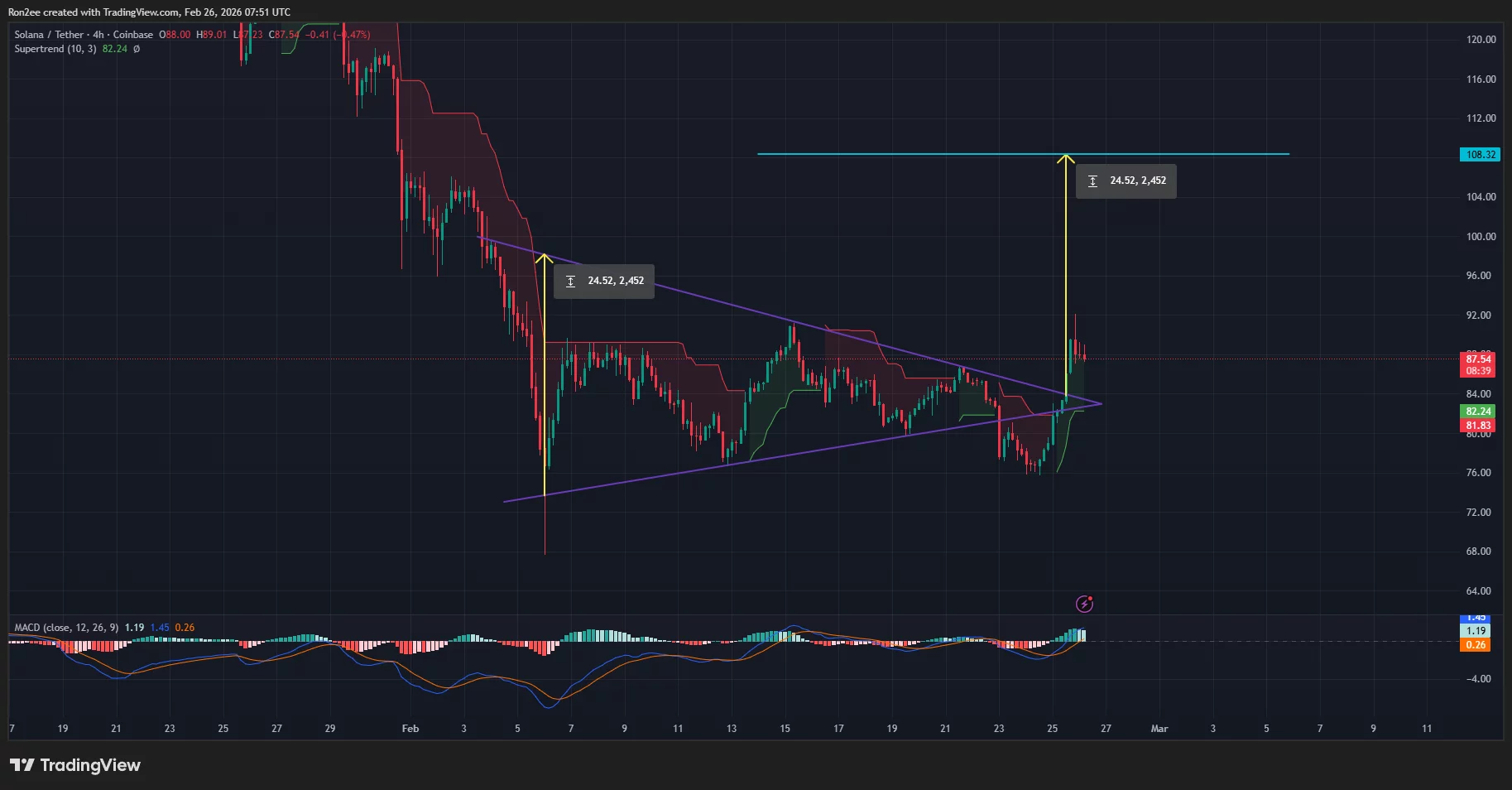
Solana price rallied for the second consecutive day, clocking over 17% as the broader crypto maker recovered. It has now confirmed a bullish breakout from a symmetrical triangle pattern, which could lead to more upside over the coming sessions.
Summary
- Solana price shot up to an intraday high of $90 on Thursday.
- SOL price has confirmed a bullish breakout from a symmetrical triangle pattern.
- Solana ETFs drew in over $30 million inflows over the past day.
According to data from crypto.news, Solana (SOL) price rebounded 17.5% from its weekly low of $76.56 to an intraday high of nearly $90 on Thursday.
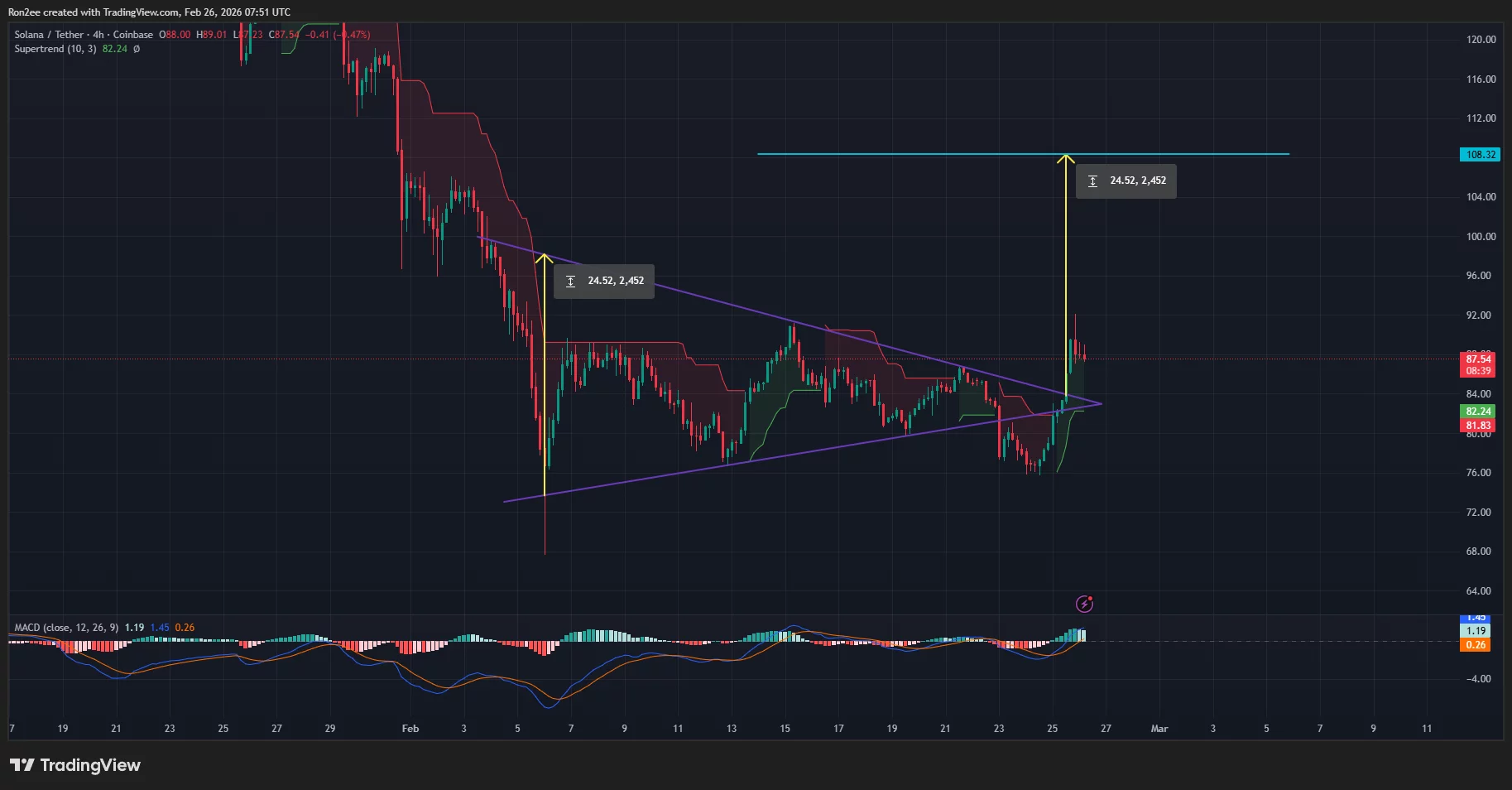
On the 4-hour chart, Solana price has broken out from the upper side of a symmetrical triangle pattern that had been forming since early February. A symmetrical triangle pattern is a structure formed when an asset price forms successive lower highs and higher lows as the asset undergoes a period of consolidation.
When an asset price breaks out from the upper side of such a pattern, it typically tends to continue its upward momentum over the sessions that follow.
In Solana’s case, while the token previously broke the lower trendline of the pattern due to a broader market drop, it was quickly reclaimed as bulls managed to push the token back above the upper trendline of the pattern that had been acting as dynamic resistance.
Based on the bullish breakout, Solana price eyes a rally past the $100 psychological resistance level toward $108, a target calculated by adding the height of the greatest swings within the symmetrical triangle to the point at which SOL price broke out of the pattern.
The bullish forecast is supported by other technical indicators, including the MACD and Supertrend. The MACD lines have pointed upwards with growing green histograms, while the Supertrend has flipped green.
Catalysts supporting Solana recovery
Solana price jumped amid a broader market rebound triggered by Bitcoin’s bounce back to near $70K levels and bullish market sentiment that followed after a stellar Q4 earnings report by AI chip-making titan Nvidia.
As Solana price surged, it led to liquidations of bearish bets on the leveraged markets. Data from CoinGlass shows nearly $27.5 million worth of short positions were liquidated from the SOL futures market in the past 24 hours, significantly outweighing long liquidations.
SOL futures open interest has also surged nearly 5% to $5.3 billion over the past day while the weighted funding rate has turned positive.
Meanwhile, a sudden spike in institutional demand for spot Solana ETFs has also played a part in supporting the Solana surge today. Data from SoSoValue shows the spot Solana ETFs recorded a combined inflow of $30.86 million on Wednesday, nearly an eight-fold jump from the prior day and also marking the highest single-day inflows recorded since mid-December last year.
This renewed demand for SOL amid both derivatives and institutional traders could help it on its way towards the $108 target.
Disclosure: This article does not represent investment advice. The content and materials featured on this page are for educational purposes only.
Crypto World
Was Jane Street behind the bitcoin crash? A deep dive into why that theory may not not hold


Bitcoin has dropped like clockwork every morning after the New York market open since late 2025, and crypto fans on X are accusing Jane Street for causing it.
A theory on X has gotten retail participants pointing to the firm for single-handedly driving the asset from $125,000 to $62,000 in recent months.
However, market data and inner workings of an exchange-traded fund (ETF) authorized participant like Jane Street suggest otherwise, observers have noted.
CoinDesk reached out to Jane Street for comment on BTC allegations and did not receive a reply as of European morning hours.
This is INSANE.
Since Jane Street was sued two days ago, the 10 AM manipulation has stopped.
Bitcoin is up 10%, adding $120 billion to its market cap, and the BTC weekly candle has turned green after 5 consecutive red candles.
The total crypto market has added nearly $200… pic.twitter.com/4dCrFewTE4
— Bull Theory (@BullTheoryio) February 25, 2026
The allegations
The claim, spread across dozens of viral posts, goes something like this: Jane Street, one of the world’s largest trading firms, was systematically selling bitcoin at 10 a.m. ET every day to push prices lower and then snap up ETFs cheaply.
“BTC has been consistently dumping ~2-3% within minutes of the U.S. cash open (10 a.m. ET) almost every trading day since early November. Many traders point to Jane Street’s massive $2.5B+ position in BlackRock’s IBIT as the likely driver: engineered liquidity sweeps to accumulate spot ETFs at a discount,” Whale Factor, a widely-followed X account said in December.
The recent 13/F filings revealed that Jane Street held roughly $790 million in IBIT shares as of the fourth quarter of 2025.
Jan Happel and Yann Allemann, the co-founders of blockchain analytics firm Glassnode, have also documented these patterns through their shared X account Negentropic and said Wednesday: “Jane street Lawsuit gets made public, and miraculously the 10am $btc slam disappears.”
The allegations have exploded this week, after the firm was sued by TerraForm Labs’ bankruptcy operator for insider trading that hastened Terra’s demise in 2022. If that’s not enough, the 10 a.m. volatility has vanished in the wake of the lawsuit. Bitcoin surged by over 6% to nearly $70,000 on Wednesday.
In June last year, India’s SEBI banned Jane Street from local markets and froze $566 million in alleged illegal gains, citing a “morning pump, afternoon dump” scheme manipulating the Bank Nifty index on 18 derivatives expiry days from January 2023 to March 2025. The accusations, therefore, suggest Jane Street’s reputation precedes it.
Market data and logic suggest otherwise
The conspiracy that Jane Street has been secretly driving prices lower to snap up IBIT cheap could be challenged, however, using data tracked by crypto economist Alex Kruger, which doesn’t confirm the 10 a.m. dump.
The IBIT ETF has posted cumulative gains of around 0.9% in the 10:00-10:30 ET window; meanwhile, returns in the first 15 minutes have been -1%, according to Kruger. That’s noisy data, not evidence of systematic dumping, Kruger said on X.
Everyone says bitcoin dumps at 10AM every day.
I pulled the data, and it’s not true.
Since Jan 1, IBIT’s cumulative return in the 10:00–10:30 window is +0.9%, and in the 10:00–10:15 window it’s –1%. Noisy, not a systematic dump.
More interesting: the performance pattern in… pic.twitter.com/jboe0eehG0
— Alex Krüger (@krugermacro) February 26, 2026
More importantly, both windows closely mirror Nasdaq performance, Kruger added, which means the so-called “10 a.m. dump” was a part of broad risk-asset repricing, not Jane Street foul play.
Jane Street, it should be pointed out, isn’t a rogue operator with unfettered power over bitcoin, but a single player — an authorized participant (AP) — in a regulated ecosystem designed to ensure smooth trading of the ETFs.
“No single firm sits at a terminal pressing “dump Bitcoin.” But the structure itself—the ETF architecture, the AP exemptions, the shift to in-kind creation—creates a grey window where price discovery can be muted without anyone breaking rules,” Yale ReiSoleil, chief technology officer of Untrading, an Ethereum-based financial infrastructure firm, said on X.
Spot ETFs are funds that track bitcoin’s spot price while holding actual coins in custody. Their shares trade on the stock exchange and their prices tend to drift away from the underlying asset’s net asset value (NAV) depending on the demand and supply.
APs like Jane Street, JPMorgan and Citadel Securities are tasked with creating new ETF shares with demand spikes and redeem when demand falls to ensure the ETF price remains tethered to the NAV.
In the case of bitcoin ETFs, APs are allowed “in-kind” creation and redemption, where they can swap a basket of actual BTC directly with the issuing company, rather than just cash. These dynamics, which are legal and not manipulation, could have led to 10 a.m. volatility.
Short first, buy later
On a typical day, when BTC rises during the Asian and European hours, demand for ETFs spikes in early U.S. hours. This temporarily pushes the ETF price above its NAV. The APs then respond by increasing the supply of shares — sometimes by shorting shares they don’t have — to meet buyer demand and keep trading smooth.
Normally, shorting requires borrowing shares first, which costs money (like loan interest), but regulators have exempted APs from that rule.
Later, when they create new shares, they don’t rush to buy spot BTC right away and often source it privately through an over-the-counter shop. They then short futures or buy put options to hedge the long exposure from creating new shares.
These things combined can inject temporary downside pressure in the market.
“APs can short IBIT without borrowing costs, thanks to a Reg SHO carve-out. They can hedge that short with futures instead of spot. That means the natural arb that should close the gap between ETF price and NAV never happens, because the AP never buys spot,” ReiSoleil explained.
“Meanwhile, in-kind creation lets them source bitcoin privately, OTC, at their own pace. The spot market never sees the buy pressure. The beginning looks like market-making. The end looks like market-making. The middle is where the integrity of price discovery goes to die,” he added.
Kruger agreed that Jane Street conspiracy theories are typical of the doom-laden sentiment that often emerges after prolonged bitcoin downtrends.
He firmly disagreed with the allegation that the “short first and buy later” mechanics employed by APs temporarily suppress the price.
“Whether the spot is bought by the AP or the basis trader, the net demand on BTC spot is identical,” he said, arguing that the notion that hedging with futures first (and delaying immediate spot buys) somehow compromises the integrity of price discovery is simply incorrect.
Jane Street has not commented publicly, and no onchain data or exchange records have surfaced tying the firm to a coordinated campaign to push bitcoin lower.

Zscaler’s AI-Powered Security: A Compelling Case For Aggressive Growth Investors (NASDAQ:ZS)

Crypto Market Liquidity Is Shrinking Fast: Can the $50B USDT Level Survive the Pressure?
The cast of “Law & Order: SVU”, then and now: See how the squad has changed over 27 seasons


-

 Video6 days ago
XRP News: XRP Just Entered a New Phase (Almost Nobody Noticed)
-

 Politics4 days ago
Baftas 2026: Awards Nominations, Presenters And Performers
-

 Fashion6 days ago
Weekend Open Thread: Boden – Corporette.com
-

 Sports3 days ago
Women’s college basketball rankings: Iowa reenters top 10, Auriemma makes history
-

 Politics3 days ago
Nick Reiner Enters Plea In Deaths Of Parents Rob And Michele
-

 Crypto World2 days ago
XRP price enters “dead zone” as Binance leverage hits lows
-

 Business4 days ago
Mattel’s American Girl brand turns 40, dolls enter a new era
-

 Business2 days ago
True Citrus debuts functional drink mix collection
-

 Business4 days ago
Law enforcement kills armed man seeking to enter Trump’s Mar-a-Lago resort, officials say
-

 Tech2 days ago
Unsurprisingly, Apple's board gets what it wants in 2026 shareholder meeting
-

 NewsBeat12 hours ago
Cuba says its forces have killed four on US-registered speedboat | World News
-
 NewsBeat14 hours ago
Manchester Central Mosque issues statement as it imposes new measures ‘with immediate effect’ after armed men enter
-
 NewsBeat3 days ago
‘Hourly’ method from gastroenterologist ‘helps reduce air travel bloating’
-

 Tech4 days ago
Anthropic-Backed Group Enters NY-12 AI PAC Fight
-

 NewsBeat4 days ago
Armed man killed after entering secure perimeter of Mar-a-Lago, Secret Service says
-

 Politics4 days ago
Maine has a long track record of electing moderates. Enter Graham Platner.
-
 NewsBeat2 days ago
Police latest as search for missing woman enters day nine
-

 Business9 hours ago
Discord Pushes Implementation of Global Age Checks to Second Half of 2026
-

 Crypto World2 days ago
Entering new markets without increasing payment costs
-
 Sports3 days ago
2026 NFL mock draft: WRs fly off the board in first round entering combine week