

Crypto World
USD/JPY and USD/CAD at Key Levels Awaiting News Catalysts

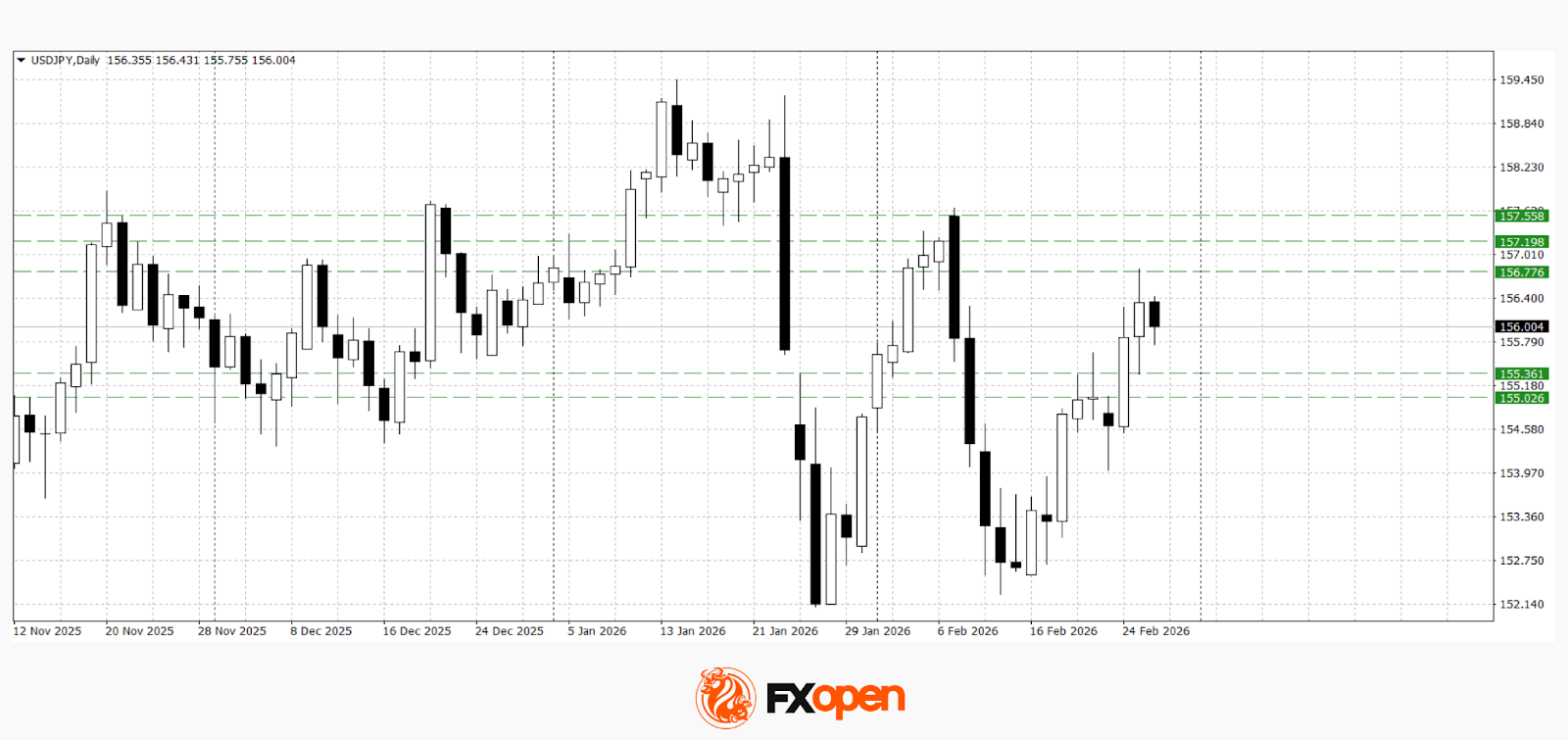
The dollar is trading mixed against the major currencies as investors await important macroeconomic releases and foreign policy signals. Market participants remain cautious ahead of upcoming US data, as well as potential statements following contacts between Washington and Beijing. The trade negotiations factor and the prospect of a meeting between Donald Trump and the Chinese leader remain in focus, as any signs of progress or escalation could influence demand for safe-haven assets and the dollar’s trajectory.
Upcoming macroeconomic releases and developments in the US–China trade agenda will be decisive: either the dollar maintains its advantage and continues to strengthen, or the market shifts into a deeper correction from current levels.
USD/JPY
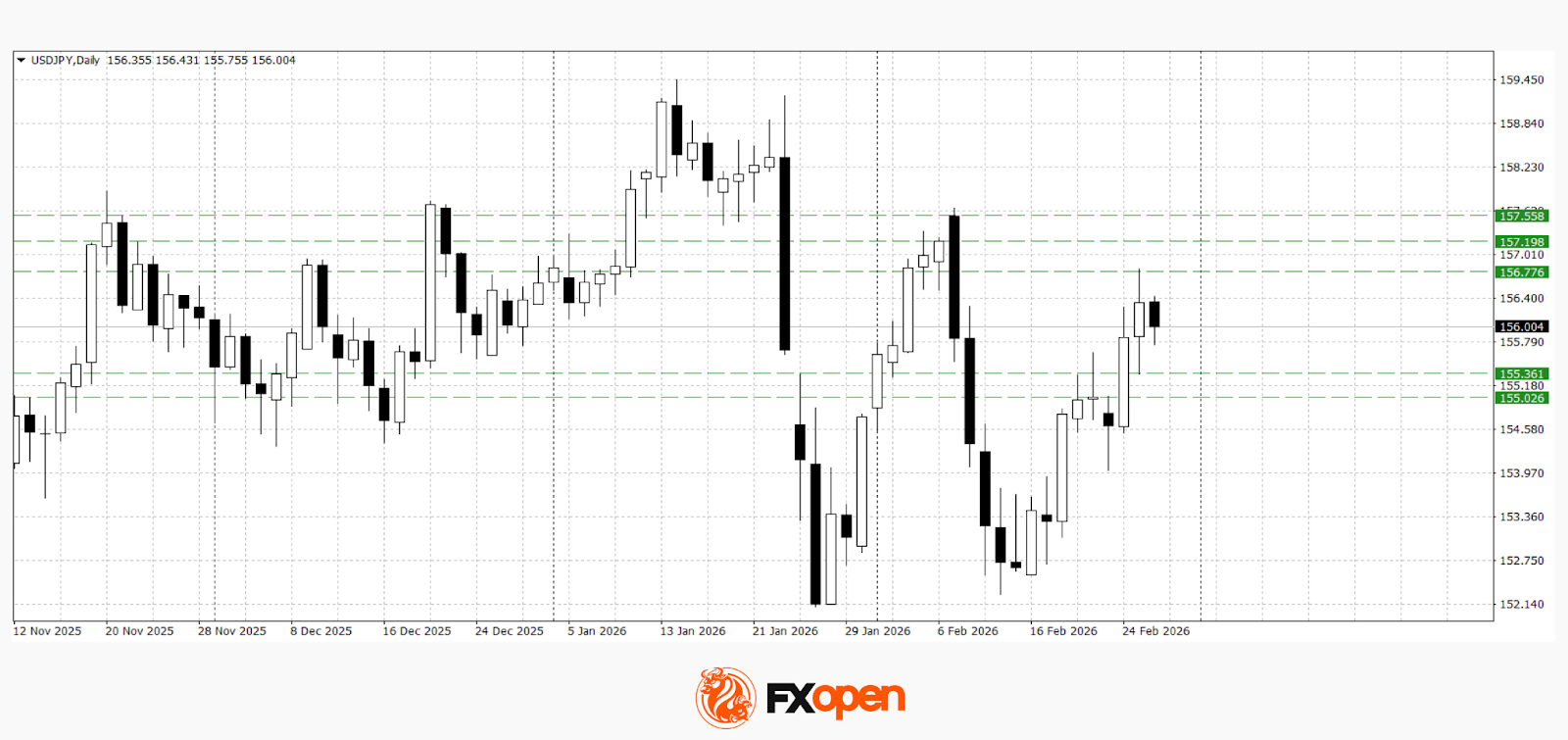
The USD/JPY pair showed a strong upward impulse at the start of the week and moved closer to recent highs. The rally reflects steady demand for the dollar and relative weakness of the yen amid stable expectations regarding Federal Reserve policy and the accommodative stance of the Bank of Japan. Additional support for the dollar comes from expectations surrounding US economic data, which may confirm the resilience of the American economy.
Should the data come in strong, the move towards fresh highs may continue, while weaker figures could trigger profit-taking and a short-term correction.
Key events for USD/JPY:
- Today at 15:30 (GMT+2): US initial jobless claims;
- Today at 17:00 (GMT+2): Speech by Federal Open Market Committee (FOMC) member Michelle Bowman;
- Tomorrow at 01:30 (GMT+2): Tokyo core Consumer Price Index (CPI), Japan.
USD/CAD
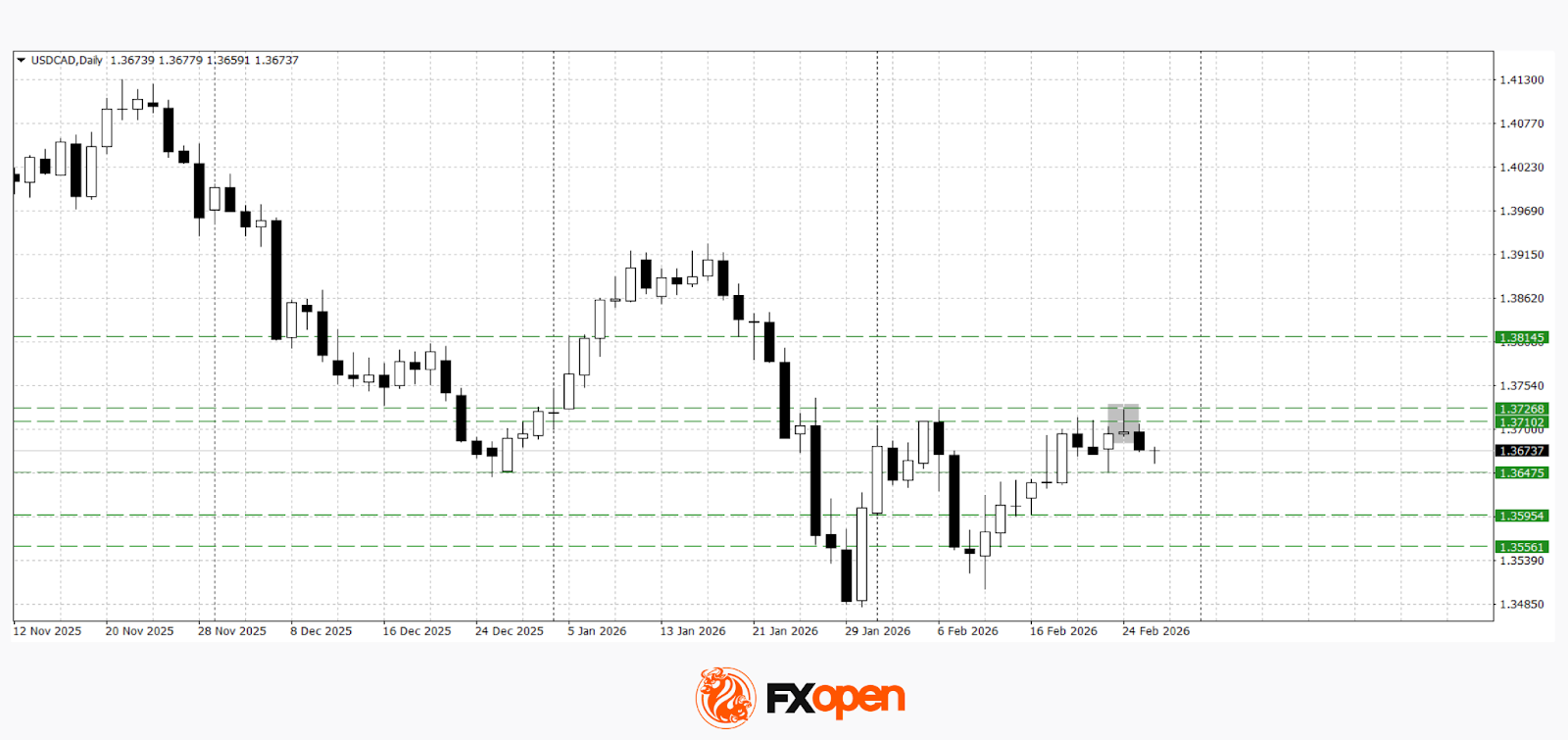
The USD/CAD pair remains in a sideways phase. The pair tested the upper boundary of the range but encountered resistance and shifted into a moderate pullback. Technical analysis suggests a possible move towards the lower boundary of the medium-term range, as a “doji” reversal pattern has formed on the daily timeframe.
A confident break and consolidation above 1.3730 could allow the upward momentum to resume.
Key events for USD/CAD:
- Today at 15:30 (GMT+2): Canadian wholesale sales;
- Tomorrow at 15:30 (GMT+2): Canada GDP (q/q);
- Tomorrow at 15:30 (GMT+2): US Producer Price Index (PPI).
Trade over 50 forex markets 24 hours a day with FXOpen. Take advantage of low commissions, deep liquidity, and spreads from 0.0 pips (additional fees may apply). Open your FXOpen account now or learn more about trading forex with FXOpen.
This article represents the opinion of the Companies operating under the FXOpen brand only. It is not to be construed as an offer, solicitation, or recommendation with respect to products and services provided by the Companies operating under the FXOpen brand, nor is it to be considered financial advice.

Crypto World
UAE Institutional Leaders Gather in Abu Dhabi as Digital Asset Strategy Accelerates Across the Gulf

Abu Dhabi, United Arab Emirates— Senior leaders from global finance, digital asset infrastructure, and regulatory institutions will convene in Abu Dhabi on May 13, 2026, for the inaugural Digital Assets Forum Abu Dhabi — a highly curated gathering examining the adoption of digital assets under the UAE’s progressive regulatory framework.
The forum comes amid rapid institutional momentum across the Gulf. The UAE has emerged as a global leader in digital asset regulation, providing structured licensing regimes, sovereign-backed innovation programs, and a robust ecosystem where banks, asset managers, and institutional investors are actively deploying capital and forming strategic partnerships.
Following the successful third edition of Digital Assets Forum in London — which gathered nearly 2,000 senior attendees from global banks, asset managers, and infrastructure providers — the forum now expands to the Middle East at a pivotal moment.
“Across our successful London editions, we have seen how regulatory clarity drives institutional engagement,” said Victoria Gago, Co-Founder of Digital Assets Forum. “Abu Dhabi is now at the center of a structural shift in global finance, with capital concentration, infrastructure buildout, and global firms relocating headquarters. This forum brings together the decision-makers who are shaping the future of digital finance and turning strategy into action.”
Confirmed institutional speakers include Christoph Richter, Head of Digital Assets & AI at ADGM; Sebastian Widmann, Head of Dubai at Komainu; Karl Naim, Group Chief Commercial Officer at XBTO Middle East; Yan Ma, Executive Director at Spartan Group; Catrina Wang, General Partner at Portal Ventures; Elliot Andrews, CEO of Aspen Digital; and Rachel Conlan, Global Chief Marketing Officer at Binance.
DAF Abu Dhabi will examine UAE digital asset regulation versus other jurisdictions, institutional digital asset management and portfolio strategies, stablecoins, payments and CBDCs, DeFi and TradFi integration, real-world asset tokenisation (RWA), the state of crypto ETFs, liquidity, custody and institutional market infrastructure, and institutional risk management frameworks — all with a focus on practical outcomes that enable investment, capital allocation, and partnership execution.
Digital Assets Forum Abu Dhabi is designed as a highly curated, executive-level gathering focused on deal-making, capital deployment, and strategic partnership formation. The format includes main-stage panels, closed-door sessions, dedicated one-to-one meeting areas, and private briefing rooms. The objective is not retail awareness, but to translate dialogue into tangible agreements and coordinated investment strategies for 2026 and beyond.
About Digital Assets Forum
Digital Assets Forum is a global institutional series bridging traditional finance and digital assets.
The Abu Dhabi edition marks its expansion into the Middle East, following established editions in London.
Launched in 2018 in Barcelona, the European Blockchain Convention — organiser of Digital Assets Forum — has become one of Europe’s leading blockchain platforms for financial institutions, policymakers, and infrastructure providers integrating blockchain into mainstream finance.
For tickets and information:
You can get 15% Discount General Pass with our Code: CRYPTOBREAKING15: www.eblockchainconvention.com/digital-assets-forum-abu-dhabi/
Crypto World
Gate Obtains Malta Payments Institution License, Strengthening EU Stablecoin Payment Infrastructure
[PRESS RELEASE – Malta, EU, February 26th, 2026]
Gate, a world-leading player in crypto space, announced that Gate Technology Ltd, its Malta-based entity, has officially obtained a Payment Institution license under the EU’s Second Payment Services Directive (PSD2) from the Malta Financial Services Authority (MFSA). This milestone places Gate among one of the crypto-native companies in Europe to secure this level of regulatory approval, reinforcing its long-term strategy to bridge legacy finance and Web3 infrastructure across the continent.
Gate Technology Ltd. CEO, Mr. Giovanni Cunti, commented on the achievement: “We are proud to have secured this Payment Institution license. It positions Gate to build a secure, scalable bridge between traditional finance and Web3, delivering compliant payment solutions to clients across Europe. This accomplishment is the result of our team’s dedication and marks a critical step in aligning with MiCA’s regulatory framework.” He further emphasized the broader significance of the license, noting that it establishes a strong foundation for future financial services and ensures regulatory certainty for both institutional and retail clients in the dynamic European market.
This announcement builds on Gate’s earlier regulatory achievements in Malta, where Gate previously obtained a full MiCA license to provide exchange and custody services. These milestones are part of Gate’s comprehensive global compliance strategy, which spans multiple jurisdictions including but not limited to Malta, Cyprus, the Bahamas, Japan, Australia, and Dubai. Malta, in particular, has emerged as a strategic hub for European operations, offering a transparent and forward-looking regulatory environment that aligns with Gate’s vision for secure, scalable, and innovative digital asset services.
By securing the PSD2 license, Gate is now expanding its payment services across the European Union through passporting rights. The license not only affirms Gate’s commitment to compliance and regulatory excellence, but also enhances its ability to integrate traditional finance mechanisms with Web3 applications, creating a seamless, secure, and efficient ecosystem for users. As Europe’s crypto landscape continues to evolve, Gate is well-positioned to play a leading role in driving innovation, transparency, and trust in digital financial infrastructure.
About Gate
Founded in 2013, Gate is a pioneer in the cryptocurrency industry, with its flagship platform, Gate.com, serving over 49 million users globally and ranking among the top 3 crypto exchanges worldwide by market share.
For more information, users can visit: Website | X | Telegram | LinkedIn| Instagram | YouTube
Disclaimer
This content does not constitute an offer, solicitation, or recommendation. Users should always seek independent professional advice before making investment decisions. Gate may restrict or prohibit all or part of its services for users from restricted regions. For more information, users can read the applicable User Agreements.
Binance Free $600 (CryptoPotato Exclusive): Use this link to register a new account and receive $600 exclusive welcome offer on Binance (full details).
LIMITED OFFER for CryptoPotato readers at Bybit: Use this link to register and open a $500 FREE position on any coin!
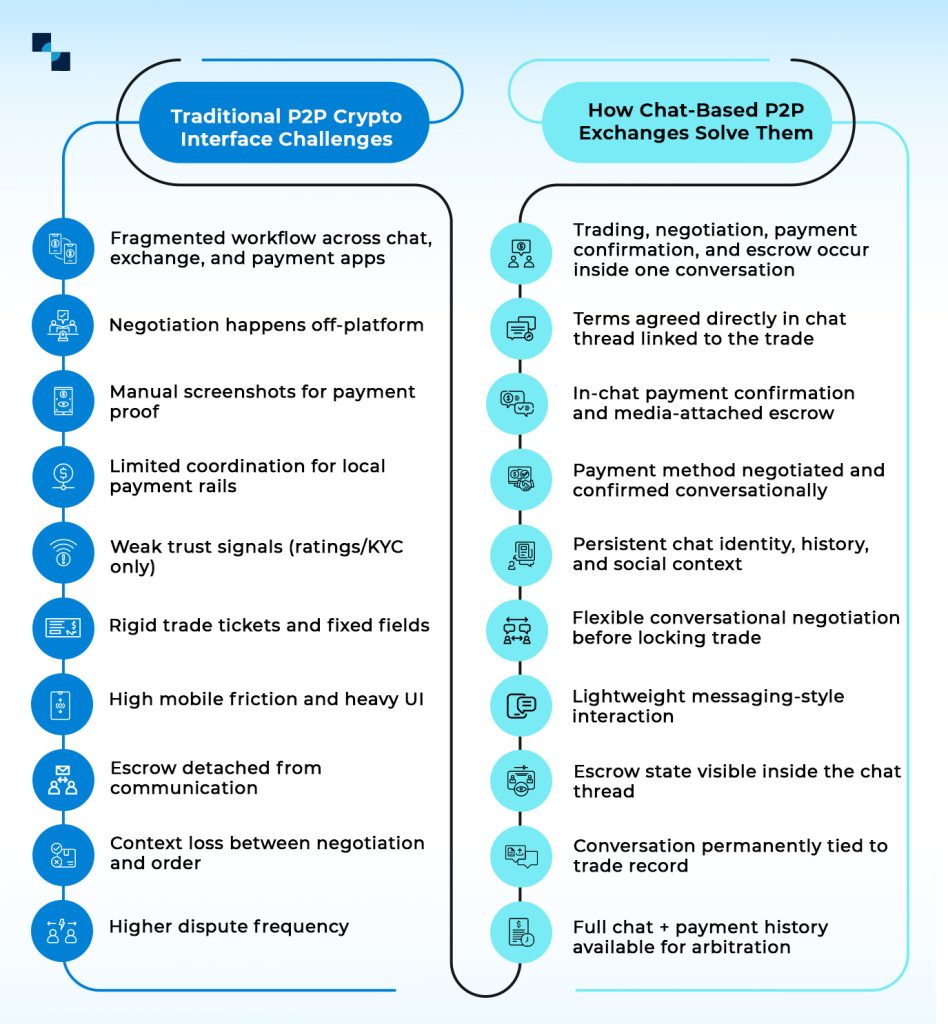
Over the past few years, a significant yet unnoticed shift has been occurring in peer-to-peer cryptocurrency trading, where discovery, negotiation, escrow, and settlement are leaving traditional exchange interfaces and entering messaging environments. Large volumes of OTC crypto trades today originate in Telegram groups, WhatsApp communities, and private chat networks where buyers and sellers coordinate directly and finalize payments off-platform. The crypto exchange software interface, in many instances, has effectively been replaced by conversation, mainly in mobile-first markets where users trust messaging applications more than financial dashboards. They negotiate prices in chat, confirm payment with screenshots, and rely on social reputation rather than order-book transparency. As a result, P2P crypto trading has naturally converged toward chat-centric workflows where everything happens on a conversational thread.
Recognizing the pattern, several platforms have begun formalizing chat-based crypto exchange software models rather than forcing users back into conventional UIs.
| Platform | Interface Type | Best Jurisdiction | Key Tech Feature |
|---|---|---|---|
| Vexl | Standalone App | Europe / Global | Social graph (Nostr-based) |
| Telegram @wallet | Native Bot | UAE / CIS / SE Asia | Direct Telegram integration |
| Noones | Chat-centric Web/App | Nigeria / Global South | 300+ payment methods |
| Peach Bitcoin | Swipe/Chat Hybrid | Europe / LatAm | No-KYC / privacy-first |
Users prefer to discuss terms, verify counterparties, and coordinate payment within chat before committing funds. Instead of separating messaging and trading into different systems, chat-based P2P crypto exchange software embeds escrow, wallets, and payment confirmation directly into conversational flows.
For enterprises and crypto exchanges targeting high-growth regions such as South Asia, Africa, and Latin America, this model aligns closely with real user behavior. It reduces friction, supports diverse local payment rails, and mirrors how informal crypto trading already occurs at scale.
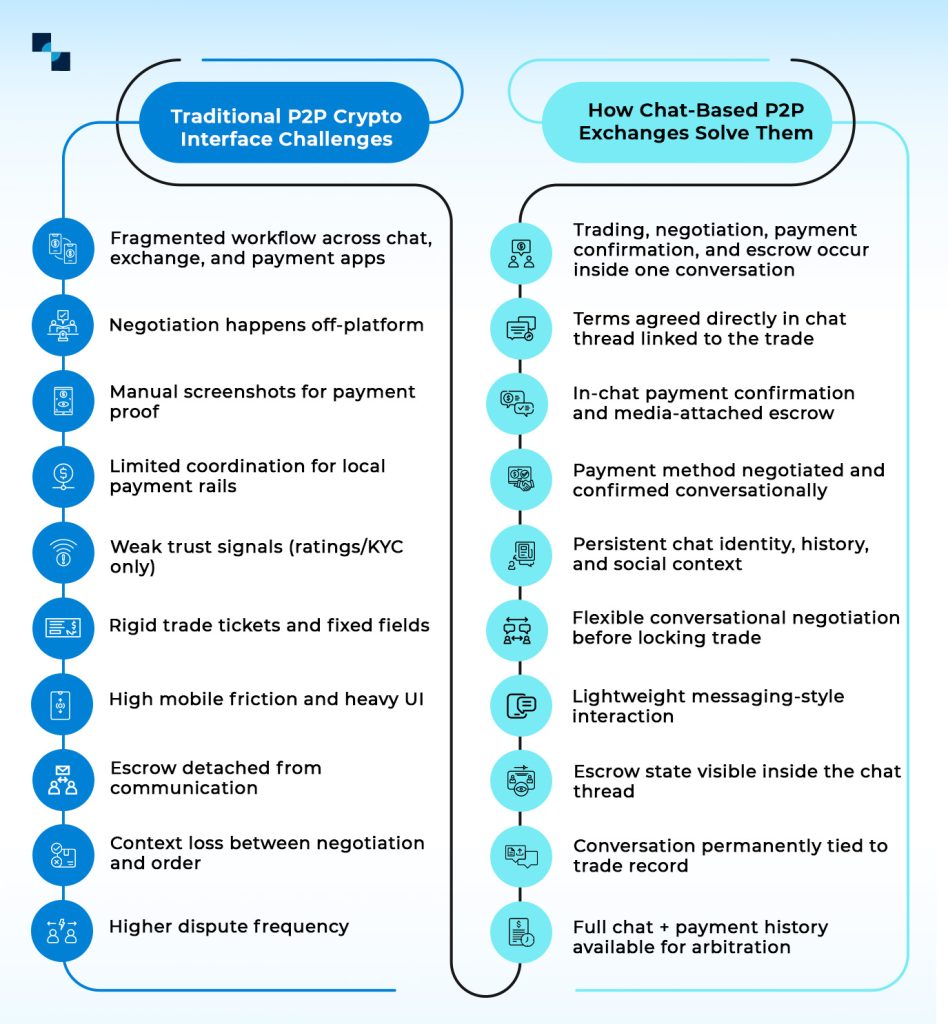
What Is Chat-Based P2P Crypto Exchange Development?
Chat-based P2P crypto exchange development refers to designing peer-to-peer trading systems where the conversational triggers drive and control trade objects linked to escrow, wallet, and settlement infrastructure.
Instead of listing offers and executing trades through marketplace-style trade forms, users initiate, confirm payment, and release escrow within an integrated chat environment linked to wallet and settlement infrastructure. In this model, messaging doesn’t remain an auxiliary feature but is the transaction layer itself. Each trade exists as a persistent conversation thread that contains counterparties, agreed terms, payment proof, and escrow state. The exchange backend orchestrates wallets, escrow locking, and dispute resolution while the user experience remains interaction-first and chat-native only.
Core Features of Chat-Based P2P Crypto Exchanges
1. Conversation-linked trade threads
Each trade must be anchored to a chat thread and stored as a persistent object containing counterparties, agreed terms, timestamps, and state transitions. This implementation ensures the inseparability of negotiation context and execution data.
2. Integrated crypto escrow within chat
Escrow lock, confirmation, timeout, and release actions must be triggered directly from the conversation interface while being enforced by smart contracts or custodial wallet logic in the backend.
3. Payment rail negotiation and mapping
This chat-based crypto exchange software module must support dynamic selection of regional payment methods (UPI, Pix, mobile money, bank transfer) within the chat. It must also bind the chosen rail to the trade state for verification and audit.
4. Embedded payment proof with hash linkage
Payment receipts, transaction IDs, or media confirmations shared in chat must be cryptographically or database-linked to the escrowed trade record to prevent substitution or post-dispute alteration.
5. Counterparty identity and reputation context
User profiles must expose trade history, completion ratios, dispute records, and social linkage signals during negotiation to enable well-informed decisions before escrow commitment.
6. Conversation-native dispute invocation
Either party should be able to escalate directly from the trade thread, allowing moderators or automated systems to evaluate the full sequence of messages, payment evidence, and escrow events without reconstruction.
7. Mobile-native messaging UX
The conversational crypto exchange software interface must prioritize lightweight message exchange, quick action buttons, and asynchronous confirmations to maintain usability on low-bandwidth devices and emerging-market mobile environments.
Technical Architecture of a Chat-Based P2P Exchange Development
In a chat-based crypto exchange architecture, conversational events trigger and update backend trade states while settlement infrastructure manages escrow, wallets, and dispute workflows.
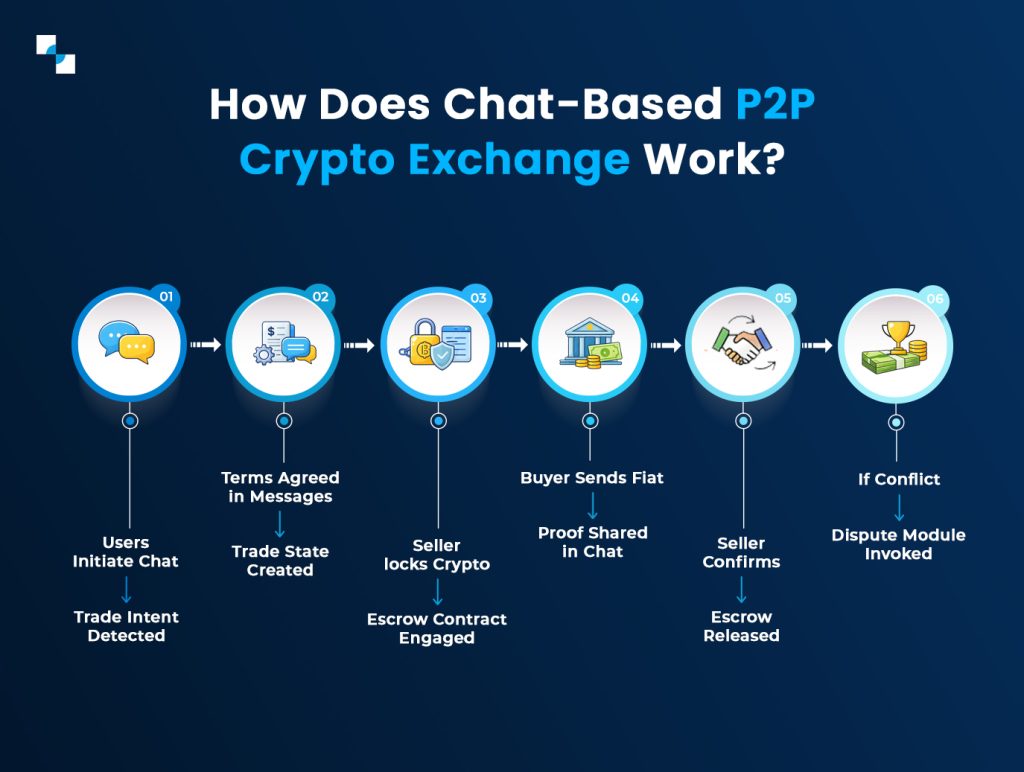
- Chat Interface Layer: It represents the messaging UI (app, web, or bot) where users negotiate, confirm payment, and trigger escrow actions.
- Trade State Engine: The system converts conversation events into structured trade states (initiated, terms agreed, escrow locked, payment pending, released, disputed).
- Escrow and Wallet Layer: This layer includes smart contracts or custodial wallets that lock, hold, and release crypto assets based on trade state transitions.
- Payment Coordination Layer: This level manages the selection of fiat payment methods, proof attachment, and confirmation signals associated with the trade thread.
- Identity and Reputation Services: Persistent counterparty profiles, trade history, and trust signals are accessible within conversations.
- Dispute and Arbitration Module: These moderation tools consistently access full chat, payment, and escrow context for resolution.
- Notification and Event System: This layer facilitates real-time updates for escrow status, payment confirmation, counterparty actions, and deadlines.
Where to Launch Chat-Based P2P Crypto Exchange Software
.
| Jurisdiction | Dominant Payment Integration | Why It’s Relevant for Chat-P2P | Regulatory Body | Licensing Difficulty |
|---|---|---|---|---|
| India | UPI / IMPS | The world’s largest informal WhatsApp/Telegram P2P market. Users expect “Chat-to-Pay” workflows. | FIU (Financial Intelligence Unit) | High (Strict AML/Tax) |
| Brazil | Pix / WhatsApp Pay | Brazil is the global “alpha” for WhatsApp Pay. Pix makes instant chat-settlement frictionless. | Central Bank of Brazil | Moderate |
| Nigeria | Mobile Money / OPay | High mobile-first population. Messenger apps bypass the need for expensive web infrastructure. | SEC Nigeria | Moderate-High |
| El Salvador | Lightning Network | Ideal for “micro-chats” where users send small amounts of BTC/Satoshis over a chat bubble. | CNAD (Digital Assets) | Low |
| UAE (Dubai) | Wio / Local Banks | Focuses on “Social Wealth”—chatting about trades and executing them in a “Superapp” environment. | VARA | High (Costly) |
| European Union | SEPA Instant | Relevant for “Social Investing” apps (Gen Z). Must be MiCA-compliant to operate cross-border. | MiCA (ESMA) | Very High |
Deployment Models for Chat-Based P2P Exchange Development
In-chat or chat-based crypto exchanges can be deployed through different messaging ownership models depending on regulatory exposure, user acquisition strategy, and infrastructure control. The choice of deployment model directly impacts custody design, compliance scope, scalability, and user trust assumptions.
1. Standalone Chat-Native P2P Exchange Development
In custom chat-based P2P crypto exchange development, enterprises create a proprietary application where the messaging system, trading logic, escrow, and wallets are fully owned and operated by the exchange.
Characteristics
- Custom-built chat protocol and trade-state engine
- Direct integration with custodial or smart-contract escrow
- Native wallet and payment rail orchestration
- Platform-controlled identity and reputation graph
When is this P2P exchange development model suitable?
- Regulated or semi-regulated jurisdictions
- For exchanges seeking full custody and compliance control
- Multi-asset or multi-chain expansion plans
- Institutional or high-volume P2P environments
Advantages of Chat-Native P2P Crypto Exchange Development
- Complete control over trade lifecycle and escrow logic
- Independent compliance and KYC framework
- No dependency on external messaging policies
- Stronger monetization and data ownership
Constraints
- Higher development and infrastructure costs are associated with building a complete chat-based P2P exchange app from the ground up.
- Messaging UX must compete with existing apps. This adds an extensive amount of effort to crypto exchange development, while they just reinvent the wheel.
- The chat-driven crypto exchange is required to find its own buyers and sellers, create initial liquidity, build network effects, and grow communities independently. No built-in audience for them
2. Messaging-Platform Integrated P2P Crypto Exchange Software(Telegram / Superapp Bots)
This is one of the most popular ways in which chat-based crypto exchanges are implemented. The exchange backend operates independently while the user interface is delivered through an existing messaging platform such as Telegram or a regional superapp.
Kraken recently picked up on this strategy and announced its collaboration with ICE chat:
“This integration opens a direct line into core institutional workflows, enabling traders to engage with our OTC desk’s expertise and execution in the digital asset class through a familiar interface.”
“Head of Kraken Institutional Gurpreet Oberoi
Characteristics
- A bot or mini-app acts as a conversational interface.
- The external platform handles messaging transport.
- Escrow and wallets are managed off-platform.
- Identity is partially inherited from a messaging account.
When is this chat-based cryptocurrency exchange development model suitable?
- High chat-native user populations
- OTC-heavy or informal trading regions
- Rapid go-to-market requirements
- Community-driven P2P ecosystems
Advantages
- Offers immediate access to existing user networks
- Familiar UX reduces onboarding friction.
- Viral distribution happens through chats and groups.
- Lower frontend development overhead
Constraints
- Dependency on platform APIs and policies
- Limited control over the identity layer
- Compliance boundaries are tied to platform rules.
- Messaging provider risk (blocking, restrictions)
3. Hybrid Chat-Linked P2P Crypto Exchange Software Development
In this model, conversation occurs in external messaging environments, while escrow, wallets, and trade state are managed in a separate exchange system linked through deep links or session binding.
Characteristics
- Negotiation in external chat (Telegram, WhatsApp, etc.)
- Trade instantiated via link or session handoff
- Escrow and settlement executed in the backend
- Conversation reference stored with the trade record
When is this chat-based P2P crypto exchange development model successful?
- Markets where OTC negotiation already occurs off-platform
- Exchanges transitioning from marketplace P2P to chat-based
- Compliance-sensitive jurisdictions
- Cross-platform user bases
Advantages
- Preserves existing user chat behavior
- Lower messaging infrastructure burden
- Clear separation between communication and custody
- Easier regulatory positioning
Constraints
- Context fragmentation risk
- This model requires reliable chat-to-trade linking.
- Less immersive conversational UX
- Dispute’s evidence may be split across chat and cryptocurrency exchange software systems.
Revenue Models and Build Cost for Chat-Based P2P Crypto Exchange Development
| Revenue Model | How It Works in Chat-P2P Context | Who Pays | Implementation Notes |
|---|---|---|---|
| Escrow transaction fee | A small percentage is charged when crypto is released from escrow after a successful trade | Typically buyer or both parties | Deducted automatically from escrowed asset at release |
| Offer a visibility boost | Sellers pay to prioritize their trade offers or profiles in discovery chats or listings | Sellers/merchants | Ranking algorithm or sponsored placement flag |
| Merchant / pro trader accounts | High-volume traders pay a subscription or reduced-fee tier for higher limits and tools | Professional traders | Tiered fee engine and volume tracking required |
| Payment rail markup | Spread added when facilitating specific fiat rails (e.g., local transfer aggregation) | Buyer or seller | Requires payment processor or liquidity partner integration |
| Spread facilitation | Chat-based P2P crypto exchange software platform intermediates pricing between counterparties and retains the spread | Both parties indirectly | Needs an internal pricing engine or liquidity sourcing |
| Dispute resolution fee | Charged when arbitration is invoked, and the platform mediates settlement | Disputing party or loser | Triggered on dispute workflow initiation |
| Withdrawal/custody fee | Fee for moving crypto out of platform wallets post-trade | User withdrawing | Standard wallet fee policy |
| Liquidity seeding incentives | P2P crypto exchange software platform shares fees with early merchants, providing consistent liquidity | Platform revenue share | Smart contract or backend rebate accounting |
| FX/stablecoin conversion margin | Margin on crypto-to-crypto or fiat-equivalent conversions inside chat trade | Converting user | Requires internal swap or routing logic |
Typical chat-based P2P crypto exchange development cost: Chat-based P2P crypto exchange software development generally ranges from $50K-$250K+, depending on custody model, messaging ownership, payment rail integrations, and compliance scope.
Estimated build timelines: 8-24 weeks, depending on messaging model (standalone or Telegram-integrated), custody design, and payment rail integrations.
Security and Compliance Considerations For Chat-Based P2P Crypto Exchange Development
Chat-native P2P trading introduces distinct fraud, identity, and payment risks because negotiation, trust formation, and settlement coordination occur conversationally. In-chat exchanges must implement controls that bind chat activity to verifiable trade and payment states while meeting jurisdictional AML and custody obligations.
Key Security Risks In Chat-Based P2P Crypto Exchange Software Include
- Impersonation and account takeover: Attackers mimic known traders or compromise messaging identities to redirect payments or escrow release.
- Off-rail payment fraud: Counterparties claim payment via manipulated receipts, reversible transfers, or third-party senders.
- Escrow manipulation attempts: Social engineering can trigger premature release or cancellation outside a valid trade state.
- Reputation gaming: Collusive trades or low-value cycles may be maintained to inflate trust metrics before large fraud attempts.
- Conversation tampering or deletion: Fraudsters may attempt to alter or remove chat evidence prior to dispute review.
Enable Crypto Trading Inside Conversations With Chat-Based P2P Exchange Development
Required Platform Controls To Mitigate Chat-Based Crypto Exchange Development Risks
- Trade-bound identity verification: A cryptocurrency exchange development company must create a workflow that binds each trade to authenticated user sessions and device fingerprints before escrow actions.
- Payment proof validation workflows: The chat-based P2P cryptocurrency exchange software must require structured receipt capture (ID, amount, timestamp) and cross-check against the expected rail format.
- Escrow action gating: The in-chat cryptocurrency exchange development must also allow release/cancel only from valid state transitions with counterparty confirmation or timeout logic.
- Immutable conversation logging: The cryptocurrency exchange must store message hashes or append-only records linked to trade objects to preserve evidence integrity.
- Reputation anomaly detection: AI-powered security can typically be implemented during crypto exchange development to flag abnormal trade patterns, circular trading, or sudden volume spikes in trust scoring.
Compliance and Regulatory Considerations For Chat-Based P2P Crypto Exchange Development
- AML/KYC scope alignment: The jurisdiction determines whether both parties, merchants, or only custodial wallet holders require KYC. Those building chat-based P2P crypto exchange software can implement a flexible KYC/AML module along with a geofencing mechanism.
- Custody classification: The licensing and safeguarding obligations depend on whether you’re choosing a smart-contract escrow or a custodial wallet.
- Payment rail monitoring: Regional rails (UPI, Pix, mobile money) may require transaction reporting or merchant registration as required by the local laws.
- Dispute and record retention: Chat-based P2P crypto exchange software requires integrations to store chat, payment, and escrow logs for mandated periods to satisfy audit or regulatory requests.
- Sanctions and counterparty screening: A centralized P2P crypto exchange software must screen wallet addresses and user identities before enabling escrow participation.
Final Word
P2P crypto exchange software development has been increasingly shaped by conversational behavior rather than marketplace navigation. As OTC activity continues to originate in messaging environments, exchanges that bring escrow, wallet, and payment directly into chat workflows will align more closely with how users already trade in mobile-first regions.
For builders and emerging exchanges, chat-based P2P crypto exchange development architecture is the most pressing structural shift. They can collaborate with their P2P cryptocurrency exchange development company to build such innovative models after carefully evaluating messaging ownership, custody model, and jurisdictional exposure for deployment choices, monetization design, and compliance scope
Platforms that successfully unify conversational interaction with verifiable escrow execution and regulatory controls can reduce friction while maintaining auditability and dispute integrity. This combination is what enables chat-native crypto exchange software to scale beyond informal OTC channels into structured, compliant trading infrastructure.
Antier delivers chat-based P2P crypto exchange software development tailored to regional payments and compliance needs. Share your requirements today!
Frequently Asked Questions
01. What is chat-based P2P crypto exchange development?
Chat-based P2P crypto exchange development involves creating trading systems where conversations drive and manage trade processes, integrating escrow, wallets, and settlement directly into chat interactions.
02. Why are users shifting to chat-based platforms for cryptocurrency trading?
Users prefer chat-based platforms because they allow for direct negotiation, payment verification, and coordination within messaging apps, which aligns with their trust in these environments over traditional exchange interfaces.
03. What are some key features of chat-centric P2P crypto exchange platforms?
Key features include integration with messaging apps, support for diverse payment methods, and the ability to conduct trades without separating messaging from trading, enhancing user experience and reducing friction.


- Internet Computer token ICP traded to highs of $2.58 to extend its uptick.
- Gains came amid a notable spike in volume as crypto prices bounced higher.
- ICP could target $4.00 or higher, though risks of a sharp pullback remain.
Internet Computer (ICP) price has retested the pivotal supply zone above $2.50 as bulls edge higher from the seven-day low near $2.
The retest occurs amid broader recovery efforts across the cryptocurrency market, with ICP among the top altcoin gainers on the day.
With prices up 9% in the past 24 hours, and volume up 93% to over $125 million, it’s likely bulls could target resistance at higher levels.
Internet Computer price jumps above $2.50
ICP currently boasts intraday gains of about 9% over the past 24 hours, with the price currently trading down from its peak in the period.
But having pushed from a low near $2, it appears bulls have their sight on more.
Gains for ICP mirror broader market sentiment, where Bitcoin tested highs near $70,000 amid Nvidia-driven risk appetite.
The AI narrative also pushed tokens like NEAR, Bittensor, and Render higher.
The uptick to intraday highs of $2.58 sees the Internet Computer token trade at levels last seen in mid-February.
ICP price technical picture
From a technical standpoint, ICP’s retest of the $2.50 hurdle marks a potentially critical flip.
The price action signals buyer interest, and a breakout from a long-term downtrend line is likely to strengthen.
Bulls now need to successfully hold above this level to validate a bullish reversal pattern.
Targets on the upside include resistance at $3.21 and $4.00, with volume confirmation key to buyer conviction.

RSI on the daily chart suggests bulls may have room to test bears’ resilience, while the MACD also displays potential bullish strength.
However, price is below key moving averages, and the shape of the 50 and 100-day simple moving averages outlines overhead resistance.
If price drops from current levels, robust support lies at $2.00 and the October 10 low of $1.98.
The token changed hands at around $2.41 at the time of writing.
Key ICP proposal
Notably, ICP is rising amid Internet Computer’s recent proposal for a tokenomics upgrade.
In its plan, DFINITY Foundation seeks the introduction of revenue-funded burns, with 20% from cloud engine fees alongside usage-based node rewards being removed.
This will directly tie ICP supply reduction to network demand, a mechanism that then sees 80% of cloud engine revenue allocated to node providers.
In this case, the Internet Computer wants to shift from fixed subsidies to performance-linked incentives, a model that would mirror other cloud compute-focused chains.
Crypto World
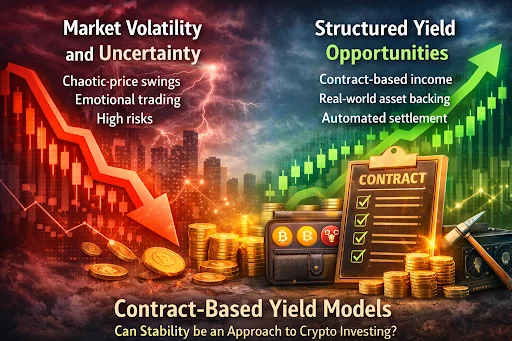
With crypto markets in turmoil, investors are turning to contract-based yield for income
Disclosure: This article does not represent investment advice. The content and materials featured on this page are for educational purposes only.
As XRP struggles, SolStaking positions contract-based staking and real-world asset integration as an alternative to direction-dependent crypto strategies.
Summary
- After a 69% drawdown and one of the largest realized-loss events since 2022, XRP faces both potential bottoming signals and ongoing technical resistance, leaving short-term direction uncertain.
- SolStaking offers structured, contract-based staking and cloud mining models designed to reduce reliance on price timing, supported by audits, custody insurance, and segregated asset management.
- By incorporating Real-World Assets such as bonds, commodities, and infrastructure projects, the platform aims to provide more stable, rule-based settlement mechanisms amid persistent crypto market volatility.
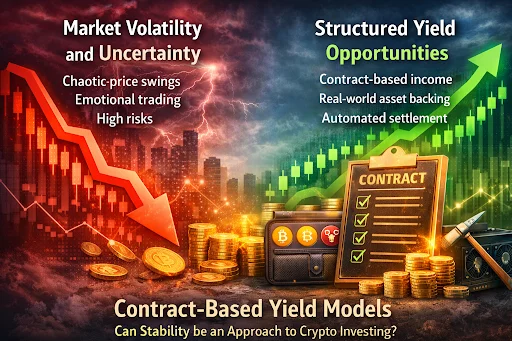
Recent market turbulence has put XRP back in the spotlight. After falling roughly 69% from its recent high, XRP has triggered mixed reactions among analysts. Some point to historical precedents where similar drawdowns were followed by strong recoveries, particularly after periods of heavy capitulation. On-chain data shows one of the largest realized-loss events since 2022, which some interpret as a potential sign of a developing local bottom.
Others, however, remain cautious. From a technical perspective, XRP continues to face meaningful resistance, and failure to reclaim key levels could open the door to further downside. In the near term, price action remains highly sensitive to liquidity shifts and broader market sentiment.
What’s clear is that directional conviction has become increasingly difficult in this environment.
When volatility itself becomes the primary risk
As market volatility intensifies, many participants are realizing that risk does not come solely from being “wrong on direction,” but from overexposure to price fluctuations themselves.
In choppy, range-bound market cycles, strategies built around short-term trading or leverage are often disrupted by abrupt changes in liquidity and sentiment. Even well-timed positions can be undermined by sudden moves that have little to do with fundamentals.
As a result, some investors are beginning to explore participation models with clearer rules, fixed timeframes, and automated settlement, seeking ways to stay involved in the crypto ecosystem without being entirely dependent on short-term price trends.
What is SolStaking?
SolStaking is a platform offering multi-asset staking and cloud mining services. Rather than focusing on market timing or price prediction, SolStaking is structured around contract-based participation models designed to operate across varying market conditions.
At the infrastructure level, the platform emphasizes long-term operational stability and risk control, including:
- A U.S.-registered operating entity: Sol Investments, LLC
- Strict segregation of user staking assets from operating funds
- Periodic independent audits conducted by PwC
- Custody insurance provided by Lloyd’s of London
- Enterprise-grade security, including layered encryption and 24/7 risk monitoring
This framework is not intended for short-term speculation, but for sustained operation in volatile market environments.
The role of real-world assets
Unlike models that are fully exposed to on-chain price movements, SolStaking incorporates Real-World Assets (RWA) as part of its underlying support structure. These assets may include AI data centers, sovereign and investment-grade bonds, physical gold and commodities, industrial metal inventories, logistics and cold-chain infrastructure, as well as agricultural and clean energy projects.
These assets operate off-chain and generate relatively stable revenue streams. After verification and accounting, relevant data is mapped on-chain, where smart contracts execute settlements automatically based on predefined rules. This approach is designed to reduce reliance on any single market’s price volatility.
Contract-based participation (illustrative examples)
SolStaking offers a range of contracts tailored to different capital levels and participation periods. Examples include:
Contract Type
Starting Amount
Duration
Estimated Settlement*
Trial Plan
$100
2 days
approx. $108
TRX Income Plan
$3,000
15 days
approx. $3,585
XRP Flagship Plan
$30,000
30 days
approx. $44,400
BTC Flagship Plan
$300,000
50 days
approx. $630,000
*Figures are model illustrations only. Actual outcomes depend on contract terms and system performance.
Under certain configurations, the model can generate outputs equivalent to several thousand XRP per day, driven primarily by operational design and execution efficiency, rather than short-term market price movements.
Conclusion: From predicting markets to rethinking participation
As Bitcoin and major altcoins continue to test critical support levels, volatility is becoming a constant rather than an exception. For many market participants, the challenge may no longer be improving price forecasts, but adapting how they engage with the market.
SolStaking represents one approach focused on structured participation and operational consistency, offering an alternative for those looking to reduce direct exposure to unpredictable price swings while remaining active in the digital asset space.
To learn more about SolStaking, visit the official website.
Disclosure: This content is provided by a third party. Neither crypto.news nor the author of this article endorses any product mentioned on this page. Users should conduct their own research before taking any action related to the company.


The Indiana state legislature authorized public retirement and savings plans to gain exposure to digital assets and spot exchange-traded funds (ETFs), while affirming residents’ access to crypto investments.
Governor Mike Braun is expected to sign HB 1042 into law within the next 10 days.
Indiana joins at least seven other states, including Wyoming, Wisconsin, Michigan and Arizona, that have moved to integrate crypto-linked products into public investment frameworks.
Almost half of the state governments in the U.S. are either on a path toward putting some of their money into crypto or already have, with much of this trend developing since President Donald Trump directed his administration to establish a Bitcoin Strategic Reserve.
A total of 21 states are investing or evaluating investments in digital assets, primarily bitcoin , and in some cases dollar-pegged stablecoins, according to CoinDesk analysis. States such as Arizona, Tennessee, Oklahoma and Nebraska have signed legislation opening certain public funds to cryptocurrency purchases, aligning with Trump’s pledge to make the U.S. the “crypto capital of the world.”
The Indiana legislature passed another crypto-related measure on Tuesday banning the operation of virtual currency kiosks, commonly known as crypto ATMs, across the state. Violations would be subject to enforcement by the state attorney general under deceptive consumer sales laws.
The bill follows warnings from state and local law enforcement about rising fraud tied to crypto ATMs. In Evansville, Indiana, authorities reported that in 2025 residents lost approximately $400,000 in scams connected to the kiosks.
The Massachusetts state Attorney General filed a lawsuit against ATM operator Bitcoin Depot alleging they allowed criminals to use its machines to scam users. The FBI has estimated that in the first half of 2025, Americans lost $240 million to crypto ATM fraud and that it received nearly 11,000 ATM fraud complaints in 2024, a 99% increase from the previous year.
Crypto World
Dragonfly Launches $650M Fund IV as Co-Founder Reveals the Blueprint Behind Building a Crypto VC Firm

TLDR:
- Dragonfly Capital launched a $650M Fund IV, bringing total assets under management to approximately $4 billion.
- Co-founder Qureshi credits geographic arbitrage between Asia and the US as the firm’s earliest competitive edge.
- Dragonfly avoided trending crypto deals like Terra and Axie, instead backing Ethena and Polymarket at low-interest periods.
- Qureshi argues that non-consensus investments drive the majority of venture returns, making contrarian discipline essential.
Dragonfly Fund IV, a $650 million crypto venture capital fund, has officially launched amid widespread skepticism about the industry.
Dragonfly Capital now manages approximately $4 billion in assets across offices in New York, San Francisco, and Singapore, with around 45 staff members.
Co-founder Haseeb Qureshi recently shared a detailed account of the lessons behind building the firm, offering rare transparency into the mechanics of crypto venture capital.
Starting From Zero: Reputation and Finding a Niche
Dragonfly Fund IV’s story begins long before the launch announcement. Qureshi entered crypto in 2018, just as the ICO bubble collapsed and most participants were exiting the space.
He later partnered with Bo to launch Dragonfly Capital at a time when dominant players like Polychain, Pantera, and a16z controlled the market.
According to Qureshi, first-time fund managers must stake their personal reputation to get started. He wrote that raising from friends, former bosses, and wealthy connections is non-negotiable for a debut fund. Without putting everything on the line, he argued, there is little to no chance of success.
The firm’s early edge was a geographic arbitrage strategy. Qureshi was based in the United States while his partner, Bo operated in Asia.
This east-meets-west positioning helped Dragonfly earn allocations in early rounds, even without leading deals. The approach was demanding, requiring long hours and constant coordination across time zones.
Talent Management and Brand Building as Competitive Advantages
As Dragonfly grew, Qureshi identified talent retention as a major differentiator. He noted that VC firms are notoriously poor at corporate management, including basic practices like mentorship, clear responsibilities, and open communication. Poor management often goes unaddressed because power law returns mask internal dysfunction.
Dragonfly took a different path. The firm invested in giving junior team members stability, voice, and independence.
Qureshi credited this approach for helping retain people who could have joined larger platforms. Over time, those individuals became central to the firm’s performance.
Brand distribution was another focus area. Qureshi stressed that every team member should build a personal audience. He encouraged public writing, social media presence, and individual thought leadership.
Firms that discourage employees from engaging publicly, he wrote, are making a strategic error.
Investment Philosophy: Non-Consensus Bets and Long-Term Discipline
On investment strategy, Qureshi outlined a clear framework. Most returns in venture come from a small number of deals, often just two or three per fund. He pointed out that consensus deals are usually overpriced, leaving little room for outsized returns.
Dragonfly’s biggest wins came from avoiding popular trends. The firm passed on Terra, Axie Infinity, and Yuga Labs during their peaks.
Instead, it backed Ethena shortly after the Terra collapse and invested in Polymarket before the 2024 election cycle drew mainstream attention.
Hsseeb wrote on X: “Every cycle has a narrative that feels irresistible…most of those themes turn out to be a waste of money.” He tied this discipline directly to portfolio construction, warning that trend-following produces a portfolio of “what was popular 18 months ago.”
Qureshi also addressed fundraising timing, noting that the best window to raise capital rarely aligns with the best time to deploy it. Managing that tension, he concluded, is one of the defining skills in venture.
Crypto World
Crypto Market Liquidity Is Shrinking Fast: Can the $50B USDT Level Survive the Pressure?
TLDR:
- Tether exchange reserves have dropped from $60B to $51.1B, draining $9B in liquidity over just two months.
- The $50B USDT level is now the critical support zone; a breakdown could push reserves toward the $44B mark.
- Active on-chain addresses fell sharply from 376,000 to 263,000, confirming weakening retail and institutional activity.
- CryptoQuant warns that without stablecoin stabilization and returning participants, market pain is likely to continue.
Crypto market liquidity is shrinking at a pace that has put analysts and traders on high alert. Tether’s exchange reserves have fallen from $60 billion to $51.1 billion in just two months.
That $9 billion withdrawal is widely seen as the main force behind the underwhelming market performance in January and February.
With reserves now hovering just above the $50 billion mark, attention has shifted to whether that level can hold. The answer may determine the near-term direction for Bitcoin, Ethereum, and XRP alike.
A $9 Billion Drain Is Reshaping Conditions Across the Crypto Market
The scale of the liquidity withdrawal has been swift and difficult to ignore. Over two months, Tether exchange reserves shed $9 billion, leaving the market noticeably thinner than it was heading into the new year.
As the dominant stablecoin, Tether serves as the primary liquidity engine for the entire crypto sector. When its reserves contract at this rate, the ripple effects are felt across trading pairs and asset classes.
Reduced stablecoin reserves translate directly into lower buying power on exchanges. Traders who might otherwise step in to absorb selling pressure simply have less dry powder available to deploy.
This dynamic helps explain why price action across major assets has been sluggish and unconvincing throughout the early months of 2025. Markets tend to drift lower when the liquidity cushion underneath them thins out.
CryptoQuant flagged this trend in a post on X, pointing to the reserve decline as the core issue behind recent market weakness.
The firm stated that without stabilization in stablecoin reserves and a return of active participants, the pain is likely to persist.
That framing puts the current situation in stark terms—recovery depends on reversing a trend that is still moving in the wrong direction.
The $50B USDT Level Now Stands as the Market’s Last Line of Defense
The $50 billion threshold has emerged as the most-watched level in the current market environment. CryptoQuant has identified this mark as a structural support zone that the market cannot afford to lose.
A confirmed breakdown below $50 billion would expose the next support level at $44 billion, leaving a wide gap with little in between. That kind of open air below a key level tends to accelerate downside moves rather than slow them.
On-chain data adds another layer of concern to the picture. Active addresses have dropped from a peak of 376,000 to 263,000, reflecting a sharp pullback in market participation.
Fewer unique senders and receivers point to both retail and institutional disengagement happening simultaneously. This retreat in user activity compounds the pressure that the stablecoin reserve decline is already generating.
When liquidity shrinks and participation falls at the same time, markets lose the structural support needed to sustain prices.
Each metric reinforces the weakness signaled by the other, making a recovery harder to achieve without a clear catalyst.
For the $50 billion USDT level to hold, stablecoin reserves would need to stabilize soon, and traders would need to return to the market in meaningful numbers.

Gate, the crypto exchange behind a platform that serves millions of users worldwide, has cleared another regulatory milestone in Europe. The Malta-based group received a Payment Institution license from the Malta Financial Services Authority (MFSA), authorizing Gate Technology to provide regulated payment services across the European Union under the PSD2 framework. The move broadens Gate’s EU footprint beyond trading and custody into fiat and stablecoin payment rails within the bloc, reinforcing its strategy to fuse traditional payments infrastructure with Web3 capabilities in Europe. Gate notes that its global user base surpasses 49 million, underscoring the potential reach of an EU-wide payments platform. This latest authorization complements Gate’s prior MiCA license achievement, which granted cross-border exchange and custody capabilities across member states starting in 2025.
Key takeaways
- Gate Technology received a PSD2-based Payment Institution license from MFSA, enabling regulated payment services across the EU.
- The license expands Gate’s EU operations from crypto trading and custody into fiat and stablecoin payment infrastructure with passporting across member states.
- The development builds on Gate’s prior MiCA authorization, announced on Oct. 1, 2025, which allowed exchange and custody services throughout the EU.
- The MFSA listing confirms the authorization covers payment accounts and related operations, signaling a broadening of Gate’s regulated activities beyond crypto custody.
- The move reflects a broader industry trend, with other exchanges like OKX also securing Malta payment licenses to support euro-denominated payments within regulated rails.
Tickers mentioned:
Market context: The industry is increasingly aligning crypto services with traditional payments regulation in the European Union, particularly under MiCA and PSD2, to enable regulated, cross-border flows for crypto-related payments and stablecoins.
Sentiment: Neutral
Price impact: Neutral. The licensing news signals regulatory alignment and potential product expansion, but does not by itself indicate immediate price moves.
Trading idea (Not Financial Advice): Hold. As Gate expands its EU payments capabilities, strategic execution and regulatory milestones will influence momentum, but investors should watch timelines and product launches for concrete impact.
Market context: The Maltese authorization sits within a broader EU push to regulate crypto-enabled payments. With MiCA shaping governance of crypto-asset providers and PSD2 guiding payment services, exchanges are increasingly obtaining cross-border licenses to deliver euro-denominated, regulated payments alongside crypto trading.
Why it matters
The MFSA’s decision to grant Gate Technology a PSD2-based Payment Institution license elevates Gate’s position from a crypto-trading platform to a dual-rails provider that can handle both digital assets and fiat payments within Europe. This is not merely a compliance tick-box; it expands the company’s ability to offer payment services that connect traditional financial rails with Web3 applications. For users, this could translate into streamlined on- and off-ramps, simpler fiat-to-crypto exchanges, and potentially cost-efficient mechanisms for transferring value across borders within the bloc.
From a strategic perspective, Gate’s move aligns with a growing trend among major crypto firms seeking to embed themselves more deeply in regulated payment ecosystems. By leveraging PSD2, Gate can passport payment services across EU member states, a capability that complements its MiCA authorization which already opened the door to cross-border exchange and custody. In practice, this means Gate aims to provide a more seamless experience for institutions and retail customers who rely on both crypto services and conventional payment rails—for example, funding accounts with cash or withdrawing funds into traditional bank accounts, all within a tightly regulated framework.
While the public benefits are clear, several questions remain. Gate did not specify which payment products it intends to launch first or the exact rollout timeline across EU markets. Industry observers will be watching for details on whether Gate will introduce fiat-to-crypto gateways, card-based payments, or stablecoin-enabled transfers tied to EU payment rails. The MFSA listing confirms that payment accounts and related operations are within Gate’s scope, but product-level specifics will determine how quickly end users experience tangible advantages.
In this environment, Gate’s competitors are also pursuing similar regulatory paths. OKX, for instance, obtained a Malta Payment Institution license to support products such as OKX Pay and the OKX Card, illustrating a coordinated push among exchanges to secure regulated access to euro-denominated payment channels. Under MiCA, providers that integrate stablecoin payments into regulated rails must stay aligned with EU payments law, which makes these licensing steps an increasingly common prerequisite for exchanges seeking broader European reach. As such, Gate’s PSD2 authorization is best understood as part of a wider shift toward regulated, interoperable crypto-financial services in Europe.
What to watch next
- Clarified product roadmap: Gate should reveal which payment services will launch first (fiat on/off ramps, card integration, or stablecoin payments) and the expected rollout timeline across EU member states.
- Regulatory cadence: Any MFSA-guided milestones or updates to Gate’s obligations under PSD2 and MiCA, including governance, reporting, or consumer protection enhancements.
- Merchant and institution adoption: Partnerships with banks, merchants, or fintechs that can leverage Gate’s regulated payment rails, potentially accelerating euro-denominated payment flows for crypto users.
- Cross-border usage: Practical tests of passporting capabilities across multiple EU jurisdictions and any friction points in onboarding or KYC processes for EU customers.
Sources & verification
- Gate Technology’s Malta PSD2 license grant announced by Gate via its public announcements.
- The MFSA public authorization catalogue listing Gate Technology as a licensed Payment Institution under Malta’s Financial Institutions Act.
- Gate’s earlier MiCA authorization announcement, confirming cross-border exchange and custody permissions across EU member states.
- OKX Malta Payment Institution license announcement as part of the broader EU compliance trend among major exchanges.
Gate expands EU payments with PSD2 license in Malta
Gate has openly described its Malta MFSA authorization as a strategic bridge between established payment infrastructure and emerging Web3 services across the European Union. The Maltese license is a formal recognition that Gate Technology can perform a spectrum of regulated payment activities, including initiating transfer operations, maintaining payment accounts, and enabling funds movement that originates from or terminates in the EU. In practical terms, Gate can, under PSD2, facilitate the kinds of payments that users expect when interacting with crypto platforms—cash-in and cash-out flows, transfers between wallets and bank accounts, and perhaps merchant-enabled payments that bridge crypto and fiat rails—without stepping outside regulatory boundaries.
The MFSA’s listing also underscores Gate’s ambition to deliver a fully compliant suite of services that integrate traditional financial rails with digital-asset tools. While the company has not named specific products for immediate launch, the authorization confirms a regulatory green light for operations that handle customer payments in a way that mirrors conventional financial institutions. This is particularly relevant for entities dealing with stablecoins, where staying within the ambit of regulated payment and electronic-money frameworks can facilitate smoother operations across borders while preserving consumer protections and compliance standards.
Market observers will be watching how Gate leverages this license to grow its European footprint, especially given the substantial scale of its user base. Gate reports a global user count exceeding 49 million, a figure that, if translated into EU activity, could significantly boost demand for euro-denominated payment solutions tied to crypto services. Yet the company’s reluctance to disclose a detailed EU user composition or a concrete product launch schedule hints at a cautious approach as it integrates new regulatory capabilities with its existing product lineup. In a sector where regulatory clarity is a competitive differentiator, Gate’s PSD2 license is a meaningful step toward a more seamless, compliant, and enterprise-friendly crypto ecosystem in Europe.


- Bybit adds stablecoin yield tools as crypto volatility rises.
- Exchange plans up to $10 million fixed-income opportunities in March.
- Firm says investors now prioritize capital preservation and yield.
Cryptocurrency exchange Bybit said it is expanding stablecoin-based income opportunities and fixed-return products as digital-asset markets face renewed volatility and falling investor sentiment.
The Dubai-based platform pointed to weakening market confidence, including a sharp pullback in bitcoin and a drop in the Crypto Fear and Greed Index, as a key reason for its latest initiatives.
Rather than reducing activity during uncertain conditions, the company said it intends to broaden earning options and support users seeking more predictable returns.
“We believe stability is what our users want most right now,” said Helen Liu, Co-CEO at Bybit. “The market will recover — we have no doubt about that. But in the meantime, our job is to help ease the pressure, offer real opportunities to earn stable income, and make sure our community knows that Bybit is right here with them.”
Focus on stable income during market uncertainty
Bybit said it has observed how rapidly market sentiment can shift during crypto cycles and how volatility can affect retail investors.
In response, the exchange is accelerating access to yield opportunities tied to stablecoins and introducing tools designed to preserve capital while generating consistent returns.
The company is promoting on-chain yield options, including Mantle Vault, and capital-efficiency tools such as BYUSDT, with the goal of allowing users to earn income without relying on speculative price appreciation.
“We want to find every opportunity for our users to earn stable income,” Liu said. “Whether it is on-chain yield through Mantle Vault or capital efficiency through BYUSDT, the goal is the same — make every dollar work harder so that our community can weather this period with less stress and more confidence.”
According to the company, the current market environment reflects a shift in investor priorities.
Bybit said users increasingly seek capital preservation and steady returns rather than highly leveraged gains.
“This cycle is different. Users are not chasing 100x returns — they are looking to protect capital and generate sustainable yield. That shift is structural, not emotional.”
New fixed-income opportunities planned
The exchange plans to introduce up to $10 million in fixed-income opportunities backed by stablecoins.
The initiative is expected to launch through March and is intended to provide predictable earnings options during periods of heightened volatility.
“Bybit will launch throughout March to offer stablecoin earn to its community. We are here for the industry for the long haul,” Liu said. “We have always believed in supporting our community — through bull markets and bear markets alike.”
The company said the offerings are part of a broader strategy to strengthen its role beyond trading by providing income-oriented financial products during uncertain market conditions.
Community engagement and long-term strategy
Bybit also emphasized continued communication with users and partners, saying transparency and constant engagement are key priorities during turbulent periods.
The exchange stated its teams remain connected around the clock to keep participants informed.
“We support stablecoin initiatives to help alleviate the financial pressure our users face during uncertain times. We invest in CSR and ecosystem development because a thriving industry benefits everyone. This commitment is unwavering — it is fundamental to Bybit’s identity.”
The company said market downturns can define the industry’s resilience and that its strategy is to remain active during challenging conditions while building confidence among users.
Bybit added that its focus is on offering stability and predictable earning opportunities as investors adjust to a more cautious phase in the digital-asset market cycle.

Soham murderer Ian Huntley seriously injured after prison attack

AI, functional energy drinks influencing beverage innovation

UAE Institutional Leaders Gather in Abu Dhabi as Digital Asset Strategy Accelerates Across the Gulf


-

 Video6 days ago
XRP News: XRP Just Entered a New Phase (Almost Nobody Noticed)
-

 Politics4 days ago
Baftas 2026: Awards Nominations, Presenters And Performers
-

 Fashion6 days ago
Weekend Open Thread: Boden – Corporette.com
-

 Sports3 days ago
Women’s college basketball rankings: Iowa reenters top 10, Auriemma makes history
-

 Politics3 days ago
Nick Reiner Enters Plea In Deaths Of Parents Rob And Michele
-

 Business2 days ago
True Citrus debuts functional drink mix collection
-

 Crypto World2 days ago
XRP price enters “dead zone” as Binance leverage hits lows
-

 Business4 days ago
Mattel’s American Girl brand turns 40, dolls enter a new era
-

 Business4 days ago
Law enforcement kills armed man seeking to enter Trump’s Mar-a-Lago resort, officials say
-

 Tech2 days ago
Unsurprisingly, Apple's board gets what it wants in 2026 shareholder meeting
-

 NewsBeat13 hours ago
Cuba says its forces have killed four on US-registered speedboat | World News
-
 NewsBeat15 hours ago
Manchester Central Mosque issues statement as it imposes new measures ‘with immediate effect’ after armed men enter
-
 NewsBeat3 days ago
‘Hourly’ method from gastroenterologist ‘helps reduce air travel bloating’
-

 Tech4 days ago
Anthropic-Backed Group Enters NY-12 AI PAC Fight
-

 NewsBeat4 days ago
Armed man killed after entering secure perimeter of Mar-a-Lago, Secret Service says
-

 Politics4 days ago
Maine has a long track record of electing moderates. Enter Graham Platner.
-
 NewsBeat2 days ago
Police latest as search for missing woman enters day nine
-

 Business9 hours ago
Discord Pushes Implementation of Global Age Checks to Second Half of 2026
-

 Crypto World2 days ago
Entering new markets without increasing payment costs
-
 Sports3 days ago
2026 NFL mock draft: WRs fly off the board in first round entering combine week