

Crypto World
Was Jane Street behind the bitcoin crash? A deep dive into why that theory may not not hold



Bitcoin has dropped like clockwork every morning after the New York market open since late 2025, and crypto fans on X are accusing Jane Street for causing it.
A theory on X has gotten retail participants pointing to the firm for single-handedly driving the asset from $125,000 to $62,000 in recent months.
However, market data and inner workings of an exchange-traded fund (ETF) authorized participant like Jane Street suggest otherwise, observers have noted.
CoinDesk reached out to Jane Street for comment on BTC allegations and did not receive a reply as of European morning hours.
This is INSANE.
Since Jane Street was sued two days ago, the 10 AM manipulation has stopped.
Bitcoin is up 10%, adding $120 billion to its market cap, and the BTC weekly candle has turned green after 5 consecutive red candles.
The total crypto market has added nearly $200… pic.twitter.com/4dCrFewTE4
— Bull Theory (@BullTheoryio) February 25, 2026
The allegations
The claim, spread across dozens of viral posts, goes something like this: Jane Street, one of the world’s largest trading firms, was systematically selling bitcoin at 10 a.m. ET every day to push prices lower and then snap up ETFs cheaply.
“BTC has been consistently dumping ~2-3% within minutes of the U.S. cash open (10 a.m. ET) almost every trading day since early November. Many traders point to Jane Street’s massive $2.5B+ position in BlackRock’s IBIT as the likely driver: engineered liquidity sweeps to accumulate spot ETFs at a discount,” Whale Factor, a widely-followed X account said in December.
The recent 13/F filings revealed that Jane Street held roughly $790 million in IBIT shares as of the fourth quarter of 2025.
Jan Happel and Yann Allemann, the co-founders of blockchain analytics firm Glassnode, have also documented these patterns through their shared X account Negentropic and said Wednesday: “Jane street Lawsuit gets made public, and miraculously the 10am $btc slam disappears.”
The allegations have exploded this week, after the firm was sued by TerraForm Labs’ bankruptcy operator for insider trading that hastened Terra’s demise in 2022. If that’s not enough, the 10 a.m. volatility has vanished in the wake of the lawsuit. Bitcoin surged by over 6% to nearly $70,000 on Wednesday.
In June last year, India’s SEBI banned Jane Street from local markets and froze $566 million in alleged illegal gains, citing a “morning pump, afternoon dump” scheme manipulating the Bank Nifty index on 18 derivatives expiry days from January 2023 to March 2025. The accusations, therefore, suggest Jane Street’s reputation precedes it.
Market data and logic suggest otherwise
The conspiracy that Jane Street has been secretly driving prices lower to snap up IBIT cheap could be challenged, however, using data tracked by crypto economist Alex Kruger, which doesn’t confirm the 10 a.m. dump.
The IBIT ETF has posted cumulative gains of around 0.9% in the 10:00-10:30 ET window; meanwhile, returns in the first 15 minutes have been -1%, according to Kruger. That’s noisy data, not evidence of systematic dumping, Kruger said on X.
Everyone says bitcoin dumps at 10AM every day.
I pulled the data, and it’s not true.
Since Jan 1, IBIT’s cumulative return in the 10:00–10:30 window is +0.9%, and in the 10:00–10:15 window it’s –1%. Noisy, not a systematic dump.
More interesting: the performance pattern in… pic.twitter.com/jboe0eehG0
— Alex Krüger (@krugermacro) February 26, 2026
More importantly, both windows closely mirror Nasdaq performance, Kruger added, which means the so-called “10 a.m. dump” was a part of broad risk-asset repricing, not Jane Street foul play.
Jane Street, it should be pointed out, isn’t a rogue operator with unfettered power over bitcoin, but a single player — an authorized participant (AP) — in a regulated ecosystem designed to ensure smooth trading of the ETFs.
“No single firm sits at a terminal pressing “dump Bitcoin.” But the structure itself—the ETF architecture, the AP exemptions, the shift to in-kind creation—creates a grey window where price discovery can be muted without anyone breaking rules,” Yale ReiSoleil, chief technology officer of Untrading, an Ethereum-based financial infrastructure firm, said on X.
Spot ETFs are funds that track bitcoin’s spot price while holding actual coins in custody. Their shares trade on the stock exchange and their prices tend to drift away from the underlying asset’s net asset value (NAV) depending on the demand and supply.
APs like Jane Street, JPMorgan and Citadel Securities are tasked with creating new ETF shares with demand spikes and redeem when demand falls to ensure the ETF price remains tethered to the NAV.
In the case of bitcoin ETFs, APs are allowed “in-kind” creation and redemption, where they can swap a basket of actual BTC directly with the issuing company, rather than just cash. These dynamics, which are legal and not manipulation, could have led to 10 a.m. volatility.
Short first, buy later
On a typical day, when BTC rises during the Asian and European hours, demand for ETFs spikes in early U.S. hours. This temporarily pushes the ETF price above its NAV. The APs then respond by increasing the supply of shares — sometimes by shorting shares they don’t have — to meet buyer demand and keep trading smooth.
Normally, shorting requires borrowing shares first, which costs money (like loan interest), but regulators have exempted APs from that rule.
Later, when they create new shares, they don’t rush to buy spot BTC right away and often source it privately through an over-the-counter shop. They then short futures or buy put options to hedge the long exposure from creating new shares.
These things combined can inject temporary downside pressure in the market.
“APs can short IBIT without borrowing costs, thanks to a Reg SHO carve-out. They can hedge that short with futures instead of spot. That means the natural arb that should close the gap between ETF price and NAV never happens, because the AP never buys spot,” ReiSoleil explained.
“Meanwhile, in-kind creation lets them source bitcoin privately, OTC, at their own pace. The spot market never sees the buy pressure. The beginning looks like market-making. The end looks like market-making. The middle is where the integrity of price discovery goes to die,” he added.
Kruger agreed that Jane Street conspiracy theories are typical of the doom-laden sentiment that often emerges after prolonged bitcoin downtrends.
He firmly disagreed with the allegation that the “short first and buy later” mechanics employed by APs temporarily suppress the price.
“Whether the spot is bought by the AP or the basis trader, the net demand on BTC spot is identical,” he said, arguing that the notion that hedging with futures first (and delaying immediate spot buys) somehow compromises the integrity of price discovery is simply incorrect.
Jane Street has not commented publicly, and no onchain data or exchange records have surfaced tying the firm to a coordinated campaign to push bitcoin lower.


Over the past five years, enterprises have invested aggressively in AI pilots, generative tools, and automation platforms. Yet most organizations remain trapped in experimentation mode. AI dashboards exist. Chatbots are deployed. Predictive models operate separately across teams, but enterprise-wide financial impact remains limited. The issue is not technological maturity; it is strategic orchestration. Scaling AI requires governance architecture, value engineering discipline, capital alignment, and executive-level integration. This is where a specialized AI strategy consulting Company creates transformational leverage. Through structured AI strategy and consulting services, enterprises convert fragmented innovation into measurable performance, building an AI-native operating model that drives durable competitive advantage.
The Hard Truth: AI Adoption Is Not AI Transformation
We work with enterprises that proudly report “AI adoption.” But adoption is not transformation. Most organizations face:
- Disconnected AI initiatives across departments
- Undefined ROI accountability
- No centralized governance framework
- Underdeveloped AI roadmap sequencing
- Weak alignment with corporate strategy
The result? Incremental gains instead of exponential impact. An effective enterprise AI strategy does not deploy AI tools. It redesigns the enterprise around intelligence. That requires structured AI strategy consulting for enterprises, not experimentation.
What Enterprise AI Strategy Actually Means
An enterprise AI strategy is a capital allocation decision. It determines where intelligence will generate the highest economic return across the organization. It defines how AI investments translate into measurable growth, efficiency, and long-term competitive advantage.
- Where AI will drive margin expansion
- How predictive intelligence will compress decision cycles
- Which workflows will become autonomous
- How governance will mitigate regulatory exposure
- How workforce capability will evolve
AI cannot sit in innovation labs. It must shape financial planning, operational architecture, and strategic differentiation. This is the mandate of the high-level AI Strategic Advisory.

The Role of a Leading AI Strategy Consulting Company
As a top-tier AI strategy consulting Company, our approach is not technology-first. It is value-first. We engage across five strategic pillars:
1. Enterprise AI Maturity & Readiness Diagnostics
Before scaling, we assess:
- Data infrastructure robustness
- Model lifecycle governance maturity
- Security & compliance architecture
- Executive AI fluency
- Operational integration readiness
Without clear maturity and strategic alignment, scaling AI initiatives only amplifies inefficiencies.
2. Strategic AI Use Case Engineering
Not every AI initiative deserves capital. We prioritize use cases based on:
- EBITDA impact potential
- Strategic defensibility
- Competitive moat creation
- Implementation scalability
- Time-to-value acceleration
This precision separates high-performing enterprises from reactive adopters.
3. Structured AI Roadmap Development
A disciplined AI roadmap development Company sequences AI initiatives across a phased transformation:
Phase I: Value Capture
Automation, predictive analytics, cost compression.
Phase II: Strategic Differentiation
AI-driven product innovation, customer intelligence, and dynamic pricing.
Phase III: AI-Native Enterprise
Autonomous systems, real-time decision intelligence, predictive capital allocation.
Sequencing protects capital efficiency while maximizing compounded returns.
AI Strategy and Consulting Services: Beyond Implementation
Premium AI strategy and consulting services go far beyond deploying tools or building models. They align artificial intelligence with enterprise vision, financial performance, and long-term competitive positioning. Instead of focusing only on technical execution, they design the strategic, operational, and governance architecture required to scale AI responsibly and profitably. Premium AI strategy and consulting services integrate:
- Strategic advisory
- Governance architecture
- Financial modeling
- Operational redesign
- Continuous optimization
Most AI vendors deploy tools. We engineer transformation.
AI Value Engineering: The Discipline That Changes Everything
AI investment without value engineering is speculation. Our AI value engineering services are built around a rigorous AI value engineering framework that ensures:
- Every initiative maps to financial KPIs
- ROI is forecasted before deployment
- Workflow redesign unlocks AI leverage
- Performance dashboards track measurable gains
Through AI strategy and value engineering services, we help enterprises quantify:
- Revenue uplift
- Margin expansion
- Cost reduction
- Risk mitigation
- Productivity improvement
This is how AI becomes an earnings multiplier.
AI Business Strategy Services: Embedding Intelligence into Enterprise Growth
AI Business Strategy Services ensure that artificial intelligence is not treated as an operational add-on, but as a core driver of enterprise growth and competitive positioning. Instead of limiting AI to efficiency gains, these services integrate intelligence directly into high-impact strategic decisions.
This includes embedding AI into:
- Market expansion and competitive positioning strategies
- Customer lifetime value prediction and personalization models
- Supply chain resilience and demand forecasting frameworks
- Capital allocation and scenario simulation planning
- Enterprise-wide risk forecasting and mitigation systems
AI should not simply optimize existing workflows. It should challenge assumptions, unlock new revenue models, and shape the future direction of the organization.
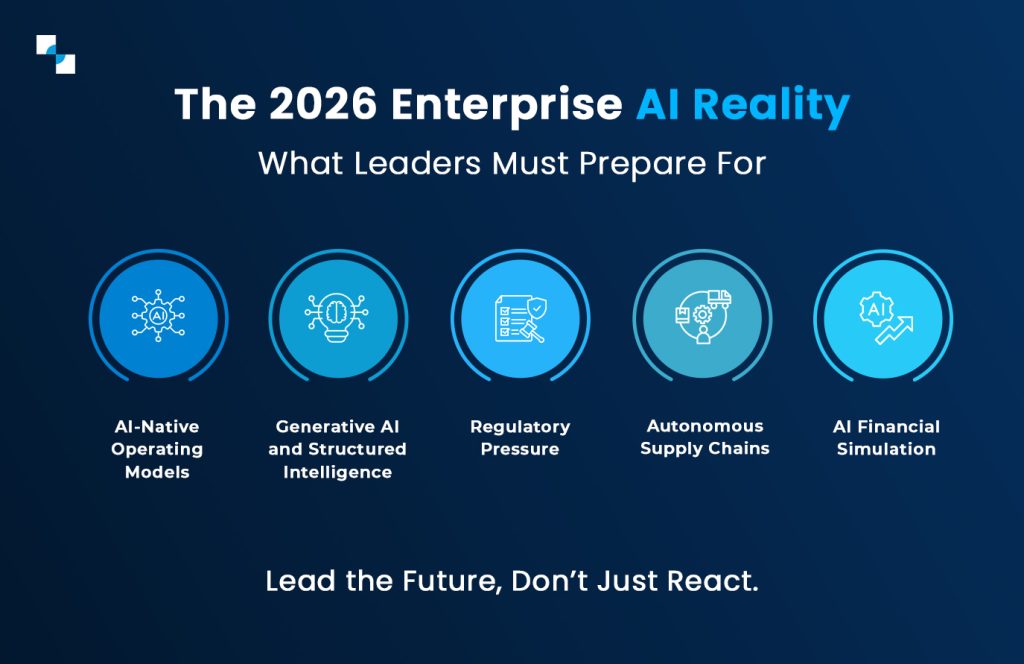
The 2026 Enterprise AI Reality: What Leaders Must Prepare For
AI transformation is accelerating. We see five dominant trends shaping global enterprises:
- AI-Native Operating Models
Organizations redesign workflows so that AI initiates decisions autonomously.
- Generative AI and Structured Intelligence
Enterprises are combining LLM capabilities with proprietary data ecosystems to create strategic decision engines.
- Regulatory Pressure Intensification
AI governance is becoming a board-level oversight priority.
- Autonomous Supply Chain Orchestration
Predictive systems manage procurement dynamically.
- AI-Driven Financial Simulation
Capital allocation is influenced by real-time scenario modeling.
A forward-looking AI Strategic Advisory partner ensures your enterprise is not reacting but leading.
Governance: The Competitive Signal Investors Watch
Scaling AI without governance creates:
- Regulatory exposure
- Ethical risk
- Brand vulnerability
- Investor skepticism
Advanced AI Consulting Services embed:
- Transparent model governance
- Ethical AI standards
- Compliance-by-design architecture
- Continuous audit mechanisms
Governance maturity is becoming a market differentiator.
AI Business Value Optimization: Driving Executive Accountability
Today’s C-suite no longer views AI as an innovation experiment; it is a performance mandate. Leadership teams increasingly demand clear financial transparency and measurable outcomes from every AI investment. They expect:
- Clearly quantified AI-driven ROI
- Direct margin impact attribution
- Risk-adjusted performance forecasting
- Measurable workforce productivity gains
Structured AI business value optimization transforms artificial intelligence into a board-level performance engine. It embeds AI metrics into financial reporting, strategic planning, and capital allocation decisions; shifting the conversation from technology spending to measurable enterprise performance and sustainable value creation.
Solving Enterprise-Level Challenges Through AI Strategy Consulting for Enterprises
Enterprise leaders do not struggle with ambition; they struggle with clarity, alignment, and execution discipline. That is where structured AI strategy consulting for enterprises becomes decisive.
We consistently address board-level concerns such as:
“Our AI investments lack measurable impact.”
We deploy structured AI value engineering services that connect every AI initiative directly to financial reporting, EBITDA contribution, and capital efficiency metrics.
“AI initiatives are fragmented across departments.”
We architect centralized enterprise AI strategy governance models that unify data, models, and accountability under a single transformation framework.
“We don’t know which AI initiatives deserve priority.”
Through disciplined sequencing led by an expert AI roadmap development Company, we identify high-leverage opportunities and phase investments for maximum compounded return.
“Regulatory uncertainty is increasing our exposure.”
We embed compliance-by-design architecture through advanced AI Strategic Advisory, ensuring governance maturity scales alongside innovation.
“We lack senior AI leadership internally.”
We provide executive-level AI strategy consulting for enterprises, equipping leadership teams with the frameworks, metrics, and oversight necessary to drive enterprise-wide transformation.
This is not technical assistance. This is enterprise reinvention through structured intelligence.
Why Strategic Timing Determines Market Leadership
AI advantage compounds over time. It behaves like a strategic flywheel; the earlier it is structured correctly, the faster it accelerates. When disciplined AI strategy and consulting services are deployed early:
- Data ecosystems mature faster and become proprietary assets
- Intelligence layers deepen with every operational cycle
- Decision velocity increases across the enterprise
- Competitive defensibility strengthens through accumulated insight
Organizations that delay structured AI transformation face widening capability gaps. Delay creates a structural disadvantage. Acceleration builds category leadership.
What Differentiates Elite AI Strategy Consulting Companies
Not all AI advisory firms operate at the same strategic depth. As AI implementation becomes increasingly accessible and technology tools commoditize, the true differentiator lies in strategic architecture, financial rigor, and enterprise-level execution capability. When evaluating a premium AI strategy consulting Company, enterprises should assess whether the firm brings:
- Advanced financial engineering capability – The ability to model AI investments against EBITDA impact, capital efficiency, and long-term value creation rather than surface-level ROI projections.
- Deep governance architecture expertise – Experience embedding compliance, ethical AI standards, model transparency, and regulatory safeguards into system design from day one.
- Cross-industry transformation depth – Proven experience scaling AI across diverse sectors, understanding both operational complexity and industry-specific regulatory environments.
- Structured and repeatable AI roadmap development frameworks – A disciplined methodology for sequencing AI initiatives to maximize compounding returns while minimizing disruption.
- Demonstrable AI business value optimization outcomes – Clear evidence of measurable financial impact, not just successful deployments.
AI implementation is increasingly standardized. Strategic AI transformation built on governance, economics, and long-term competitive positioning remains rare.
The Bigger Picture
Enterprise AI transformation is not achieved through isolated pilots or experimental deployments. It requires structured orchestration across governance, capital allocation, operational design, and measurable value realization. A specialized AI strategy consulting Company provides this architecture.
Through disciplined AI strategy and consulting services, advanced AI value engineering services, and integrated AI Business Strategy Services, organizations convert AI from technological capability into strategic dominance. The next competitive era will not reward experimentation; it will reward execution at scale.
Organizations that adopt a structured AI strategy today will secure tomorrow’s market leadership. As a premier AI strategy consulting Company, Antier designs enterprise-wide AI frameworks that align intelligence with financial and operational outcomes. Our expertise ensures AI initiatives are not just deployed, but systematically converted into measurable business impact and lasting competitive advantage.
Frequently Asked Questions
01. What is the main challenge organizations face in AI adoption?
The main challenge is not technological maturity but strategic orchestration, leading to disconnected AI initiatives, undefined ROI accountability, and a lack of centralized governance.
02. How does an effective enterprise AI strategy differ from simply deploying AI tools?
An effective enterprise AI strategy redesigns the organization around intelligence, focusing on capital allocation and measurable growth rather than just implementing AI tools.
03. What role does a specialized AI strategy consulting company play in AI transformation?
A specialized AI strategy consulting company helps enterprises convert fragmented innovation into measurable performance by providing structured consulting services that align AI initiatives with corporate strategy.

The price of Chainlink ($LINK) rebounded over 14% on Wednesday in a spectacularly quick comeback.
LINK traded at bottoms of $8.20 in the early morning hours of Tuesday UTC, according to Coingecko data. However, over the next 24 hours it rapidly shot up 14% to reclaim the $9.35 level, briefly going all the way up to $9.50 before dipping to its current price around $9.25.
This means LINK is trading around its highest price point since February 5. The sudden upward move is driven by a dual catalyst: a major integration with the Canton Network for real-world asset (RWA) tokenization and sustained institutional inflows into spot LINK ETFs.
JUST IN: @CantonNetwork adopts Chainlink data and interoperability standards to unlock institutional tokenization. — Chainlink (@chainlink) February 25, 2026
 Data Streams (incl. 24/5 equities) SmartData (NAV & AUM) Proof of Reserve CCIP
Canton  Chainlink pic.twitter.com/49UV9NNxJ3
Additionally, Chainlink is getting friendly with regulators. In February alone, Chainlink’s former executive lawyer Taylor Lindman joined the SEC’s crypto task force, while its founder and CEO Sergey Nazarov joined the CFTC’s Innovation Advisory Committee.
Key Takeaways
- The Catalyst: Canton Network integration unlocks institutional RWA data streams for Chainlink.
- The Data: Grayscale’s GLNK fund now holds $61 million in assets, defying broader ETF outflow trends.
- The Setup: $LINK must hold $9.16 to validate the breakout from oversold conditions.
Chainlink and Canton: The Bigger Picture
This is not a routine partnership announcement. It signals deep infrastructure entrenchment. Chainlink has integrated with Canton Network, a dominant player in the RWA tokenization sector.
The integration introduces critical data streams, including equities, proof of reserves, and Cross-Chain Interoperability Protocol (CCIP) support, directly into Canton’s institutional framework.
That matters because it moves Chainlink beyond simple price feeds. It positions the network as the connective tissue for institutional capital.
While recent macro catalysts have lifted Bitcoin, LINK’s specific outperformances are tied to utility.
Institutional funds are voting with their wallets. Grayscale’s Chainlink Trust (GLNK) fund now commands over $70 million in assets, while Bitwise’s CLNK holds over $11 million.
In a month where Bitcoin ETFs have shed billions, LINK products are accumulating.
On-chain accumulation supports the bullish thesis. Chainlink’s Strategic Reserves have jumped to over 2.17 million tokens, currently valued at over $20 million.
RESERVE UPDATE — Chainlink (@chainlink) February 19, 2026

Today, the Chainlink Reserve accumulated 136,898.30.
Total holdings: 2,172,261.86 pic.twitter.com/OIlDLvgVrn
The project is using off-chain fees to buy back its own token. That is a fundamental supply sink. When combined with emerging buy signals across the altcoin sector, the floor for LINK appears to be hardening around the $8.00 mark.
Discover: The top crypto to diversify your portfolio with
Chainlink Price Prediction: The Path to $10 and Beyond!
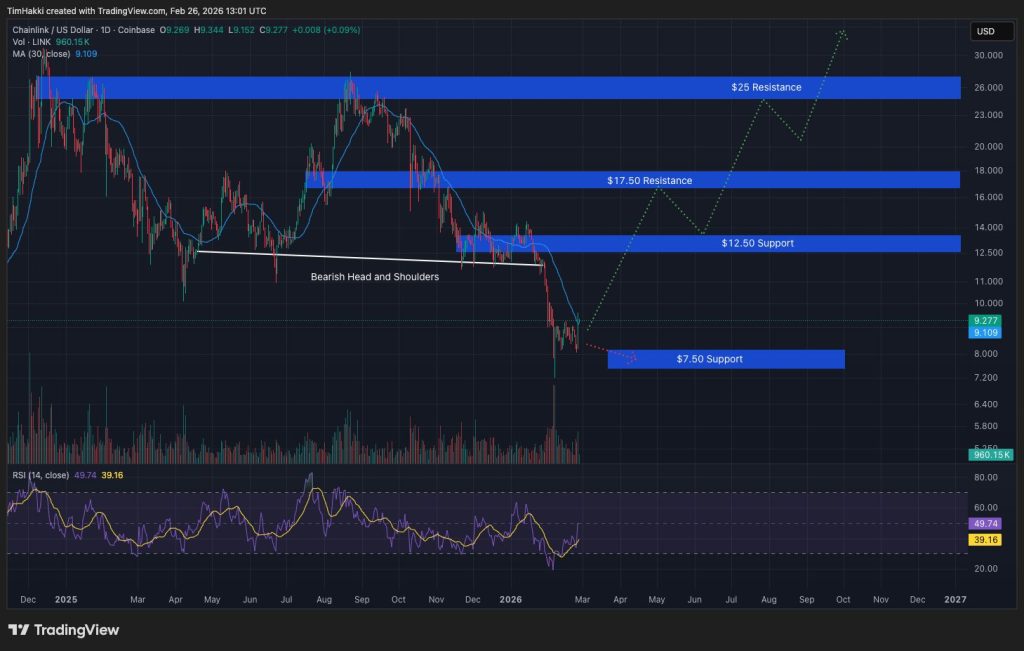
Momentum indicators favor the bulls. The RSI has bounced from 34 to 50 in a few hours, indicating huge buy orders have pushed it out of oversold territory and into a strong neutral zone.
Open interest is approaching $422 million, suggesting traders are stepping back in with leverage. If LINK clears the psychological $10.00 barrier, its next major challenges lie around $17.50 and $25.
Conversely, if price drops below the 30-day moving average again, the rally could collapse.
A close below $8.20 would invalidate the current rally and expose local support levels around $7.50.
Unfortunately, in the short-to-mid-term, the industry is still too tied to the fate of Bitcoin. If Bitcoin falters, it will likely drag LINK down regardless of the Canton news or regulatory developments.
Discover: The best crypto to buy now
The post Chainlink Price Surges: What’s Behind Today’s LINK Rally? appeared first on Cryptonews.


Centrifuge and Resolv said on Feb. 25 that they are deploying up to $100 million of JAAA, a tokenized AAA-rated credit fund, as leveraged collateral on Aave Horizon – marking decentralized finance’s (DeFi) largest real-world asset (RWA) loop trade to date.
Resolv – a protocol that maintains the USR stablecoin with a total value locked of $162 million – is adding JAAA (an on-chain version of Janus Henderson’s AAA-rated CLO investment fund) to its system using Centrifuge’s tokenization technology. Centrifuge currently has a TVL of $1.35 billion.
Instead of just holding the fund, Resolv will use JAAA as collateral inside Aave’s lending markets to generate yield and support its stablecoin. Aave is the largest DeFi protocol, with nearly $28 billion in total value locked, according to DeFiLlama, while Aave Horizon is its institution-focused deployment.
The move shows how tokenized assets are increasingly being used in real financial products rather than just existing on-chain. It also comes as the tokenized RWA market continues to grow, with distributed asset value now above $25 billion, up about 7% over the past month, according to RWA.xyz.
“Resolv allocating to JAAA and deploying it through Aave Horizon demonstrates the next phase of tokenization: utility at scale,” Nadim Chamoun, director of business development at Centrifuge Labs, told The Defiant.
Chamoun added that the strategy allows Resolv to manage risk more actively while earning the difference between traditional credit yields and on-chain borrowing rates.
For Resolv, the move is also part of a broader effort to diversify the sources of its returns. “Economically, diversification across markets makes clear sense for scalable capital allocators,” Tim Shekikhachev, co-founder of Resolv Labs, told The Defiant. “On-chain yields move with crypto leverage cycles, while global fixed-income markets are anchored in broader macro conditions.”
Shekikhachev added that when crypto rates fall, tokenized credit like JAAA can help balance returns.
“What’s finally unlocked now is that the full supply chain is functioning at scale: capital flows from Resolv USR, through Centrifuge’s tokenization infrastructure, into Aave Horizon’s leverage layer,” he said. “Ultimately, this ends up in AAA-rated assets managed by Anemoy and Janus Henderson, an industry leader in this segment. DeFi won’t replace traditional finance — it will scale by plugging into it.”

Bitcoin leads the crypto rebound in the past 2 days. After dipping to $64,758, BTC ripped higher and reclaimed $68,000 in a sharp reversal that squeezed late shorts. The move pushed total crypto market cap up over 4%, catching traders who were leaning bearish off guard.
As resistance levels got cleared, forced buybacks fueled the rally. But this was not just random volatility.
Under the surface, data tied to major stablecoin flows and infrastructure plays hints that the bounce may have deeper structural support behind it.
Key Takeaways
- The Catalyst: A sharp Bitcoin Rebound forced a short squeeze, reclaiming the critical $68,000 level after testing lows near $64,700.
- The Signal: Circle reported a 77% revenue jump, confirming massive Circle USDC expansion and deepening Market Liquidity.
- The Outperformer: NEAR Protocol surged 17% following the launch of ‘Confidential Intents,’ signaling a capital rotation into high-utility infrastructure.
Bitcoin Price Analysis: Is $68K the Crypto Rebound Launchpad?
This crypto rebound is likely a leverage driven one. As BTC dipped toward $64,000, traders piled into shorts. When spot demand stepped in around $64,758, price snapped higher and liquidations kicked in. More than $370M in positions were wiped out, fueling the vertical move through the $66,923 7day moving average.

Structurally, reclaiming the $66,000 zone shifted momentum. What was resistance is now acting as short term support, with a clear battle forming around the high $68,000 area.
Now the levels are simple. Hold above $66,500 and bulls stay in control, opening room toward $69,000 to $72,900. Clear that band and $74,000 comes into play. Lose $66,500 and the squeeze fades, exposing $60,000 to $62,000 again.
Circle Revenue as NEAR Protocol Outperforms on ‘Confidential Intents’
Price grabs attention, but liquidity tells the bigger story. Circle, the issuer of USDC, reported a 77% jump in revenue to $770M. That matters because stablecoin revenue usually grows when supply expands. More USDC minted means more dollars entering the crypto system.
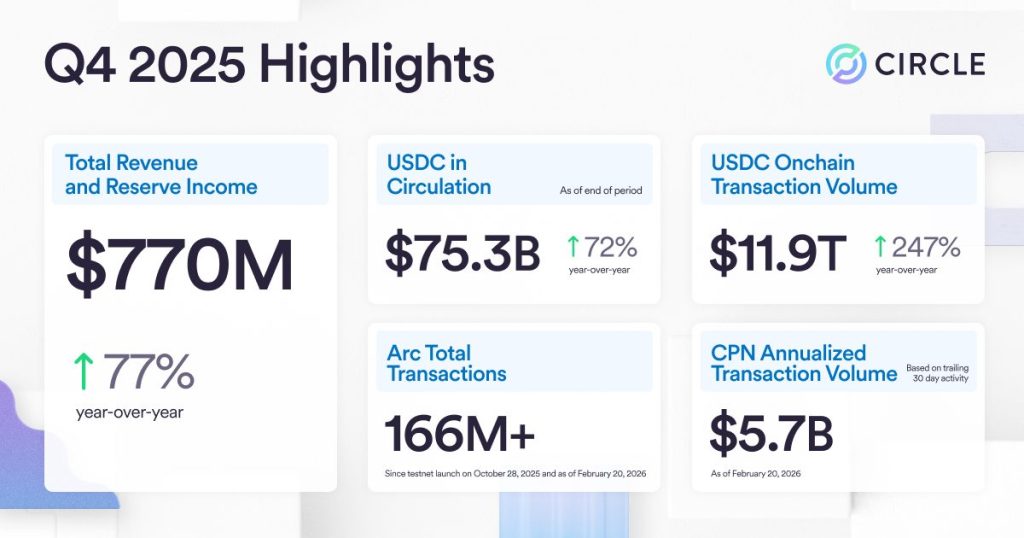
Every new stablecoin is potential buying power. Historically, stablecoin inflows often come before sustained rallies. Rising supply strengthens the bid under the market and improves absorption when sellers hit.
NEAR is not just riding Bitcoin’s bounce. It is outperforming the market as the token jumped around 17%, driven by the launch of “Confidential Intents.” The upgrade targets a key DeFi issue, privacy. It allows users to execute cross chain transactions without exposing trade details before settlement.
That positions NEAR as infrastructure for more sophisticated, potentially institutional flows. The broader theme is chain abstraction, making blockchain complexity invisible to users. That utility narrative is pulling capital in.
Discover: Here are the crypto likely to explode!
The post Crypto Rebound: Bitcoin Hits $68K, Circle Revenue Jumps, NEAR Outperforms appeared first on Cryptonews.

In online crypto circles, a persistent debate has emerged around whether a quantitative trading firm could nudge Bitcoin’s price at the moment U.S. markets open. Proponents point to a recognizable 10:00 a.m. Eastern Time pattern as potential evidence of coordinated selling, while critics caution that such a signal is not definitive proof of manipulation and may reflect broader market mechanics. The discussion intensified a day after a court-appointed administrator overseeing Terraform Labs’ affairs filed a suit against Jane Street, alleging insider trading tied to Terra’s May 2022 collapse. The intersection of high-speed trading, ETF liquidity, and opaque hedging strategies has kept traders watching the clock as BTC moves through daily cycles.
Key takeaways
- Allegations focus on a recurring 10:00 a.m. ET window at the market open, but analysts say this does not constitute conclusive manipulation or a sole driver of BTC’s price trajectory.
- Public filings show Jane Street’s exposure to BlackRock’s IBIT ETF, alongside stakes in Bitcoin mining firms, suggesting hedging and liquidity strategies rather than a simple directional bet.
- Industry voices argue that a single institution cannot control a global, liquid market as fragmented as Bitcoin, even if some trading strategies amplify volatility around open hours.
- Delta-neutral approaches—holding spot exposure while selling futures—are cited as a common method for capturing spreads rather than betting on direction, according to market observers.
- The discourse features a mix of on-chain data, trading analytics, and public posts from market observers, underscoring the complexity of disclosures and how net exposure can be obscured.
- Contextual factors such as geopolitical risk and competition for investor attention from AI-related equities are cited as broader drivers of BTC price moves beyond any single firm’s activity.
Tickers mentioned: $BTC, $IBIT
Sentiment: Neutral
Market context: The dialogue unfolds amid a broader crypto environment characterized by liquidity fluctuations, evolving ETF dynamics, and ongoing regulatory and macro influences shaping how traders price risk and opportunities.
Why it matters
The debate touches on the core questions facing crypto markets: how liquidity, disclosure, and algorithmic trading intersect with real-world price discovery. If a large player can influence the clock at which liquidity sweeps occur or how efficiently a spot market absorbs ETF-related flows, that could have implications for price integrity and market education. Yet the consensus among many analysts is that Bitcoin’s price formation remains a product of multiple forces, including macro risk appetite, capital allocation shifts, and competitive attention toward AI-driven tech and growth narratives.
At stake is trust in market transparency. For traders, the issue highlights the importance of understanding how publicly reported positions, hedges, and complex derivatives can mask net exposure. For regulators and exchanges, it underscores the need for clear, timely disclosures that help market participants distinguish legitimate liquidity activity from attempts to edge the price. For investors, the episode reinforces a prudent approach: interpret open-hour moves in the context of the broader market regime rather than attributing them to a single actor.
The discourse also intersects with ongoing legal and regulatory developments. The Terraform administrator’s lawsuit against Jane Street and the ongoing scrutiny of ETF structures like IBIT keep the conversation anchored in concrete questions about governance, disclosure requirements, and the boundaries of high-frequency market making in a frontier asset class. While proponents of a conspiracy narrative may highlight specific posts or data points, skeptics point to a broader pattern: markets are influenced by a constellation of participants with diverse strategies, and attribution to one firm oversimplifies the dynamics at play.
What to watch next
- Updates in the Terraform-related litigation against Jane Street, including any new filings or court rulings that may illuminate insider-trading claims.
- New or amended 13-F filings from Jane Street that shed light on hedging strategies, including positions in IBIT and mining-related equities, and any disclosed derivatives that could affect net Bitcoin exposure.
- On-chain and market data around the 10:00–10:30 a.m. ET window to assess whether any statistically significant patterns persist in the near term.
- Regulatory or industry guidance on disclosure practices for large ETF components and liquidity providers that could affect how market participants interpret “hidden” exposure.
- Monitoring broader market signals—geopolitical developments, liquidity conditions, and AI-sector performance—that could influence Bitcoin independently of any singular trading desk.
Sources & verification
- Court-appointed administrator filing related to Terra/Labs and Jane Street, alleging insider trading tied to the May 2022 collapse.
- Jane Street’s 13-F filings showing holdings in BlackRock’s IBIT ETF and stakes in Bitcoin mining companies such as Bitfarms, Cipher Mining, and Hut 8.
- Public posts and commentary from market observers, including Bechler’s discussions on 10:00 a.m. ET moves and the contention that IBIT-related hedging could conceal net exposure.
- CryptoQuant head of research Julio Moreno’s analysis on whether the described activity is unique to a single firm or part of delta-neutral trading patterns commonly used to capture spreads.
- Industry analysts’ assessments of whether a single actor can meaningfully drive BTC price given the structure and depth of the market, including critiques of the “10 a.m. dump” narrative by researchers such as Alex Krüger.
Market reaction and key details
Bitcoin (CRYPTO: BTC) has long been a magnet for debate over who moves the market and when. In recent weeks, observers have spotlighted a recurring pattern that some traders interpret as a 10:00 a.m. ET “dump” coinciding with the U.S. market open. Proponents of the theory argue that a firm with deep liquidity, such as Jane Street, could deploy algorithmic sales to reap benefits from ETF inflows and to acquire spot Bitcoin at a discount on the open. A prominent critic of the narrative, however, notes that a single actor is unlikely to set the tone for a market as diffuse as Bitcoin’s, where liquidity is drawn from a wide array of exchanges and participants across multiple jurisdictions.
One thread of the debate centers on Jane Street’s disclosed exposure to the IBIT ETF, alongside positions in mining-related equities. Bechler, a crypto influencer, suggested that if Jane Street carries roughly $790 million in IBIT, the actual net Bitcoin exposure could be largely hedged away, masked by options and futures combinations rather than a straightforward long or short bet. This line of reasoning emphasizes that public filings reveal only a fragment of a much larger, more complex risk posture, where hedges might offset or even invert visible positions.
Yet others push back on the idea that the activity is unique to Jane Street. CryptoQuant’s Julio Moreno cautioned that many funds employ delta-neutral strategies—buying spot exposure while selling futures—to capture spreads without committing to a directional bet. In practice, these maneuvers can appear as divergent price actions around the open while serving to maintain neutral exposure in volatile markets. Moreno’s observations underscore a broader point: the mechanics of hedging frequently blend with price movement in ways that are not easily ascribed to a single firm’s choice of timing or size.
In the eyes of some researchers, even a credible pattern around the open does not translate into a bear-market engine powered by one institution. Nick Puckrin of Coin Bureau argued that Bitcoin’s price dynamics are inherently multifactorial, and a solitary actor—even one as large as Jane Street—cannot unilaterally dictate longer-term moves. He framed the conversation as part of a more nuanced reality: price action is shaped by geopolitical risk, global liquidity conditions, and the ongoing competition for attention among high-growth tech sectors, including AI.
As the market digests these viewpoints, the intersection of legality, disclosure, and market structure remains a live area of inquiry. The Terra-related lawsuit and the ongoing discourse about ETF flows highlight the need for transparency in how large players interact with both spot markets and derivative instruments. The broader takeaway is not a verdict on manipulation, but a reminder that the Bitcoin market’s depth and fragmentation make it resistant to easy explanations or simple villains.
[PRESS RELEASE – San Francisco, CA, February 26th, 2026]
SolanaCDN delivers 3.8x faster shred propagation through a global mesh of 35,000+ nodes, provided as a public good for the Solana network
Pipe Network today announced the launch of SolanaCDN, a free, open-source Solana validator client with an integrated CDN acceleration layer. Built as a fork of Anza’s Agave, SolanaCDN gives every Solana validator access to faster shred propagation through Pipe’s global network of 35,000+ PoP (Point-of-Presence) nodes.
The client and CDN layer are both completely free. Pipe Network is providing SolanaCDN as public good infrastructure for the Solana ecosystem.
The problem SolanaCDN solves
Validator performance on Solana is heavily influenced by network geography. Validators closer to block producers see shreds earlier, vote sooner, and earn more rewards. Validators in less connected regions face slower propagation, missed votes, and reduced leader slot revenue regardless of their hardware.
SolanaCDN addresses this by giving validators a second, faster path for shred delivery alongside native gossip. Shreds and vote packets route through Pipe’s global mesh, which continuously measures every network path and routes traffic along the fastest available route in real time.
Native gossip still runs underneath. SolanaCDN adds a parallel fast lane.
Performance
SolanaCDN delivers 3.8x faster propagation than standard Turbine, with a P50 cross-region latency of approximately 78ms compared to the roughly 300ms baseline on standard gossip.
The client also ships with Pipe-built optimizations available out of the box before the CDN layer is enabled: optimized shred coalescing for leaders (Fast Shreds), snapshot downloads from Pipe’s global network, and restore progress with real-time ETAs during validator catchup.
Public good infrastructure
Faster propagation is a network effect. Every validator running SolanaCDN improves shred delivery globally, which means faster block finalization, fewer forks, and fewer missed slots across the entire Solana network.
“Validator performance shouldn’t be determined by geography,” said David Rhodus, CEO of Pipe Network. “SolanaCDN gives every validator access to the same fast infrastructure. The more validators that run it, the faster Solana gets for everyone.”
Technical design
SolanaCDN is a fully compatible Agave fork. Validators can install it as a drop-in replacement for their existing client. The CDN layer is optional, activated with a single configuration flag, and is non-consensus by design. It does not modify block production, consensus logic, leader scheduling, or voting rules. All CDN operations are non-blocking and fail-safe. If the CDN layer is unavailable, the validator continues operating normally.
Built-in Prometheus metrics and CDN-versus-gossip race data give operators full visibility into performance changes in their environment.
Availability
SolanaCDN is available now. The source code is published on GitHub and the client is ready to run on Solana mainnet-beta.
Website: https://solanacdn.com
GitHub: https://github.com/pipenetwork/agave-solana
About Pipe Network
Pipe Network is a global edge infrastructure company built on Solana. The network operates 35,000+ hyperlocal PoP nodes globally, providing distributed storage with fast reads and real-time data delivery. Pipe’s overlay network tracks latency, loss, and jitter across every path in real time and routes traffic along the fastest one.
Binance Free $600 (CryptoPotato Exclusive): Use this link to register a new account and receive $600 exclusive welcome offer on Binance (full details).
LIMITED OFFER for CryptoPotato readers at Bybit: Use this link to register and open a $500 FREE position on any coin!

[PRESS RELEASE – Singapore, Singapore, February 26th, 2026]
Stablecoins have become a foundational layer for settlement, moving value across payments, remittances, and treasury operations worldwide. As these flows grow, the infrastructure behind dollar-denominated stablecoins matters as much as the assets themselves.
USDC and Circle Cross-Chain Transfer Protocol (CCTP) will be launching on Morph, bringing payment stablecoins and standardized cross-chain settlement to infrastructure built for payments.
USDC on Morph
USDC will be issued on Morph by Circle’s regulated affiliates, establishing it as a settlement asset across the network.
Issuance provides a consistent foundation for dollar-denominated activity. USDC on Morph will be canonical, with uniform behavior across applications and clear provenance at the protocol level.
For developers building payment applications, this simplifies dollar settlement by eliminating the need to manage bridge risk or fragmented liquidity. For institutions operating treasury systems, merchant platforms, or cross-border payment rails, USDC will provide access to a transparent stablecoin supported by Circle’s established on- and off-ramp infrastructure.
“Morph has spent the last several months meaningfully investing in our network’s core offering. As we have engaged with global leaders in the payment space, it’s clear that they need a widely-used, dollar-denominated stablecoin to meet their needs. For us, working with Circle to bring USDC to Morph was a clear choice,” said Colin Goltra, CEO of Morph.
CCTP: Cross-Chain Infrastructure
CCTP will enable USDC to move between supported blockchains using a burn-and-mint process that preserves supply integrity.
When USDC is transferred to Morph via CCTP, it will be burned on the source chain and minted natively on Morph. The asset will remain fully backed and verifiable under the same reserve framework.
Applications will be able to use Standard Transfer or Fast Transfer depending on their security and latency requirements, while maintaining consistent settlement behavior across networks.
Use Cases Across Payments
USDC and CCTP will support a range of payment and financial applications that rely on dependable dollar settlement and cross-chain access.
- Crypto Cards and Neobanks
Card programs and digital issuing platforms will be able to settle balances in USDC while enabling users to fund accounts from supported blockchains via CCTP.
Money movement platforms will benefit from transparent, stablecoin-based settlement with near-instant cross-chain transfers across regions.
Checkout providers will be able to accept payments from users across multiple chains while settling in USDC, simplifying reconciliation and reducing FX delays for merchants.
USDC will serve as collateral and a settlement asset across lending protocols and decentralized exchanges, with CCTP supporting liquidity movement between Morph and other supported blockchains, including connections to the Bitget ecosystem.
Building the Settlement Layer for Digital Dollars
To support teams bringing payment flows on-chain, Morph has launched the $150 million Payment Accelerator, providing funding, technical support, and access to payment partners and institutional onramps.
Together, USDC, standardized cross-chain settlement through CCTP, and direct ecosystem support position Morph as a settlement layer for real financial activity.
As stablecoins continue to underpin payments, treasury operations, and on-chain commerce, Morph is building the execution environment at institutional scale.
Money at the speed of life.
About Morph
Morph is an Ethereum-based, payments-first settlement layer and the native on-chain home of BGB, focused on building the foundation for global consumer finance on-chain. Morph supports real-world financial activity across payments, savings, identity, and rewards, enabling scalable, on-chain settlement for consumer and business use. Guided by the Morph Foundation, the network connects more than 120 million users through the Bitget and Bitget Wallet ecosystems.
Binance Free $600 (CryptoPotato Exclusive): Use this link to register a new account and receive $600 exclusive welcome offer on Binance (full details).
LIMITED OFFER for CryptoPotato readers at Bybit: Use this link to register and open a $500 FREE position on any coin!
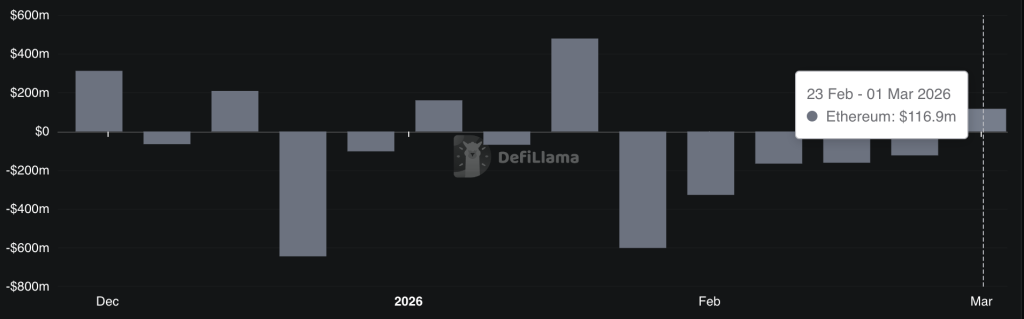
Wall Street moved toward Ethereum first then price followed. Institutions funneled $157M into Ethereum investment products on Wednesday, the largest daily inflow since mid January. Just hours later, ETH ripped 15% and reclaimed the $2,000 psychological level.
Now trading around $2,050, the move looks less like retail hype and more like deliberate positioning. While some large holders were selling into weakness, institutional desks were quietly absorbing supply.
That divergence stands out. It suggests this rally has a structural bid behind it, not just short term speculation.
Key Takeaways
- The Catalyst: Donald Trump’s State of the Union address reignited risk-on sentiment, directly preceding the $134 billion total crypto market inflow.
- The Flow: Institutional Inflows into ETH ETF products hit $157 million in a single session, marking a decisive reversal from previous outflow trends.
- The Signal: Treasury giant Bitmine added another $106 million in ETH, bringing total holdings to over $9 billion despite share price weakness.
Smart Money vs. Dumb Money: Analyzing the Flow Data
The timing fits a classic institutional play. While retail attention stayed on Bitcoin headlines, desks were building Ethereum exposure through spot ETFs. The $157M single day inflow signals rotation.
Bitcoin saw mixed flows around its $60K retest. Ethereum pulled in fresh capital instead. Recent filings show large asset managers have been increasing exposure to Ethereum linked vehicles over recent quarters.
The narrative behind it is shifting too. Tokenization and real world assets are increasingly tied to Ethereum’s ecosystem. And this right here could matter the most.
Ethereum Price Prediction: Is $2,400 Next?
The 15% jump to $2,050 has reshaped the chart. ETH has reclaimed the $2,000 level, flipping it back into support. That is the key shift. The next resistance sits near $2,150. Clear that cleanly and the path toward $2,400 opens up with less friction.
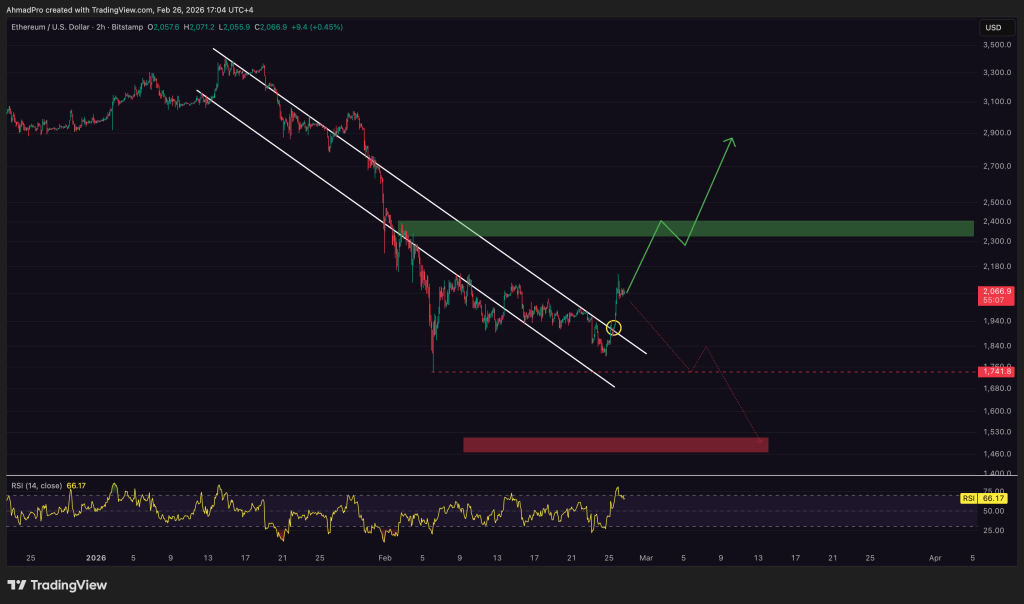
Momentum indicators are turning constructive. The 4 hour MACD has crossed bullish, and the Coinbase Premium flipping positive suggests U.S. buyers are stepping in.
Still, $2,080 is the short term level to watch. Lose it and a pullback toward $1,920 is possible to reset leverage. For now, the more likely scenario is consolidation above $2,000 before any attempt at the next expansion higher.
Discover: Here are the crypto likely to explode!
The post Wall Street Frontrunning Retail? Institutions Flooded Ethereum Before 15% Price Rally appeared first on Cryptonews.


Nearly half of the Bitcoin supply sits underwater, yet accumulation lags, which is keeping the price trapped in a fragile consolidation range for now.
Bitcoin climbed back to $68,000 after several days of decline, as markets reacted positively to Donald Trump’s State of the Union remarks. The crypto asset added fresh 4% gains on Thursday.
But data shows that BTC is still trapped in a structurally defensive consolidation, as the price oscillates between the $60,000 and $69,000, which is being deemed as the main demand zone. In fact, Glassnode experts stated that the market is stabilizing but not yet recovering.
Key Market Conditions
At a 46% drawdown from the all-time high, Bitcoin sits at a depth historically associated with mid-to-late bear market phases, where time itself often becomes a risk factor rather than a catalyst for upside. Nearly 9.2 million BTC are currently held at a loss. This means that half of the circulating supply is underwater, a condition that aligns with prior late-stage bear environments. However, it does not, on its own, point to renewed strength.
Despite the scale of unrealized losses, accumulation behavior remains muted, as evidenced by an Accumulation Trend Score persistently below 0.5 since early February. This indicates a lack of conviction-driven buying, particularly among larger entities whose participation is typically required to form a durable bottom.
Liquidity conditions further validate this fragility. Glassnode found that the 90-day Realized Profit/Loss Ratio has slipped below the critical 1.0 threshold, which appears to be a transition into an excess loss regime where realized losses dominate profits – a state that can persist for months and is associated with impaired capital rotation and higher downside risk.
Market breadth continues to deteriorate as fewer assets sustain positions above long-term trend baselines. Meanwhile, off-chain data mirrors these on-chain signals. For instance, spot markets have flipped decisively into sell-side dominance since cumulative volume delta across major venues plunged to cycle lows, thereby indicating active distribution rather than passive liquidity gaps.
In derivatives markets, leverage has largely reset, as perpetual funding rates compressed back toward neutral. This not only reflected reduced speculative excess but also highlighted the absence of renewed bullish conviction. A similar defensive posture was echoed by the options markets.
You may also like:
Additionally, dealer positioning suggested that while sharp moves can be mechanically amplified, the broader structure remains one of consolidation rather than directional resolution. As such, Bitcoin’s current regime is characterized by stabilization amid structural weakness, where neither sellers nor buyers have seized decisive control.
According to Glassnode, a durable upside recovery will require a clear reversal in these conditions – renewed spot absorption to counter active distribution, sustained accumulation from large entities to restore conviction, and a meaningful shift in institutional flows to reestablish a structural bid. Until such signals emerge, range-bound price action between established valuation anchors remains the dominant theme governing Bitcoin’s market structure.
Macro and Geopolitical Risks
In the near term, macro and liquidity factors may continue to dictate price behavior within this structurally defensive range. In a statement to CryptoPotato, Bitunix analysts said,
“If safe-haven flows strengthen the dollar, price could come under pressure and retest the 65–64K liquidity band below. Conversely, if capital rotates toward an anti-inflation narrative, short-term inflows could drive a sweep of overhead short liquidity near 69K. The core variable remains whether geopolitical risks escalate materially.”
Binance Free $600 (CryptoPotato Exclusive): Use this link to register a new account and receive $600 exclusive welcome offer on Binance (full details).
LIMITED OFFER for CryptoPotato readers at Bybit: Use this link to register and open a $500 FREE position on any coin!
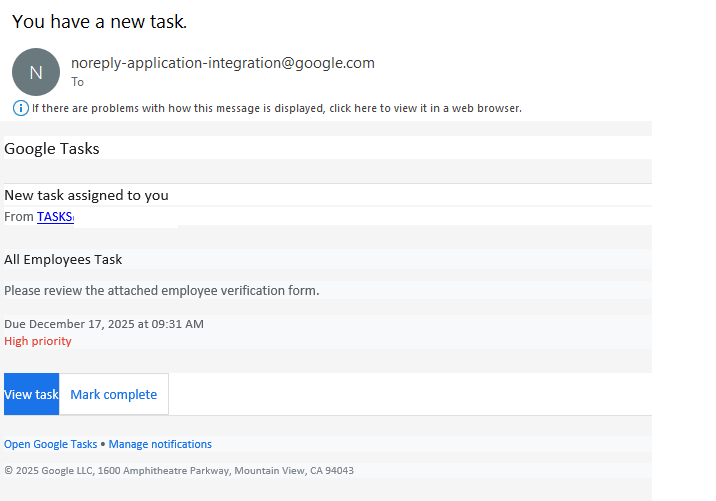
Editor’s note: The following briefing outlines a new phishing campaign uncovered by Kaspersky that hijacks legitimate Google Tasks notifications to steal corporate credentials. The attackers impersonate trusted services, leveraging the @google.com domain and intra-company cues to evade standard filters and pressure users into acting quickly. Victims are invited to click a link and complete a fraudulent employee verification form, exposing sensitive credentials that could grant unauthorized access. This advisory highlights the evolving tactics criminals use to exploit familiar tools and the importance of vigilance in enterprise environments.
Key points
- Attackers abuse legitimate Google Tasks notifications to steal corporate credentials.
- The campaign uses the trusted @google.com domain to bypass filters and build trust.
- Users are directed to a fraudulent employee verification form after clicking a link.
- The social engineering hinges on urgency and internal process appearance to lower defenses.
Why this matters
By exploiting familiar services, the campaign exploits trust in everyday tools, increasing the likelihood that employees reveal credentials. This approach bypasses many security filters and highlights the need for awareness and layered defenses in organizations. The incident underscores why training, MFA, and robust verification processes are critical as attackers continue to adapt to legitimate platforms.
What to watch next
- Look for more phishing attempts that imitate enterprise tools via trusted notification channels.
- Watch for fraudulent forms asking for corporate credentials and verify URLs before interacting.
- Ensure MFA and mail-server security measures are in place to protect accounts.
- Report suspicious activity to IT and update security policies as needed.
Disclosure: The content below is a press release provided by the company/PR representative. It is published for informational purposes.
Kaspersky discovers new phishing campaign exploiting Google Tasks notifications to steal corporate credentials
February 26, 2026
Kaspersky has uncovered a new phishing scheme that abuses legitimate Google Tasks notifications to trick corporate users into revealing corporate login credentials. By leveraging Google’s trusted @google.com email domain and notification system, attackers bypass traditional email security filters and exploit users’ trust in familiar services.
In this campaign, victims receive an authentic-looking notification from Google Tasks with the subject line “You have a new task.” The message creates the illusion that the recipient’s company has adopted Google’s task management tool, pressuring them to act quickly. The notification often includes elements of urgency, such as a high-priority flag and a tight deadline, to prompt the victim’s immediate response.
Upon clicking the embedded link, users are directed to a fraudulent form disguised as an “employee verification” page, where they are asked to enter their corporate credentials under the pretense of confirming their status. These stolen credentials can then be used for unauthorized access to company systems, data theft, or further attacks.
“Google’s vast ecosystem of services gets exploited by scammers. The scheme with Google Tasks is part of a broader trend observed before and continuing into 2026, where cybercriminals misuse legitimate platforms to distribute scams and phishing. Notifications originating from legitimate domains naturally evade many spam and phishing filters, while the social engineering aspect – making it seem like an internal company process – lowers the victim’s guard,” comments Roman Dedenok, Anti-Spam Expert at Kaspersky.
Read the article about this tactic on Kaspersky’s blog.
To counter this and similar threats, Kaspersky recommends:
- Treat unsolicited invitations from any platform with suspicion, even if they appear to come from trusted sources
- Carefully inspect URLs before clicking
- Do not call any phone numbers indicated in suspicious emails – if you need to call support of a certain service, it is best to find the phone number on the official webpage of this service
- Report suspicious emails to the platform provider and use multi-factor authentication for all accounts
- For corporate users, Kaspersky Security for Mail Server with its multi-layered defense mechanisms powered by machine learning algorithms provides robust protection against a wide range of evolving threats and offers peace of mind to businesses in the face of evolving cyber risks
- For individual users Kaspersky Premium offers AI-powered anti phishing features designed to help avoid phishing attacks and improve overall cybersecurity
About Kaspersky
Kaspersky is a global cybersecurity and digital privacy company founded in 1997. With over a billion devices protected to date from emerging cyberthreats and targeted attacks, Kaspersky’s deep threat intelligence and security expertise is constantly transforming into innovative solutions and services to protect individuals, businesses, critical infrastructure and governments around the globe. The company’s comprehensive security portfolio includes leading digital life protection for personal devices, specialized security products and services for companies, as well as Cyber Immune solutions to fight sophisticated and evolving digital threats. We help millions of individuals and nearly 200,000 corporate clients protect what matters most to them. Learn more at www.kaspersky.com.

Strictly’s Amy Dowden says ‘we still don’t know’ in emotional family admission after cancer

MPs back Doug Gurr for CMA chair but demand safeguards over conflicts and independence

AI Strategy and Consulting Services for Enterprise Digital Transformation


-

 Video7 days ago
XRP News: XRP Just Entered a New Phase (Almost Nobody Noticed)
-

 Politics4 days ago
Baftas 2026: Awards Nominations, Presenters And Performers
-

 Fashion6 days ago
Weekend Open Thread: Boden – Corporette.com
-

 Sports3 days ago
Women’s college basketball rankings: Iowa reenters top 10, Auriemma makes history
-

 Politics3 days ago
Nick Reiner Enters Plea In Deaths Of Parents Rob And Michele
-

 Business2 days ago
True Citrus debuts functional drink mix collection
-

 Crypto World2 days ago
XRP price enters “dead zone” as Binance leverage hits lows
-

 Business4 days ago
Mattel’s American Girl brand turns 40, dolls enter a new era
-

 Business4 days ago
Law enforcement kills armed man seeking to enter Trump’s Mar-a-Lago resort, officials say
-

 Tech2 days ago
Unsurprisingly, Apple's board gets what it wants in 2026 shareholder meeting
-

 NewsBeat15 hours ago
Cuba says its forces have killed four on US-registered speedboat | World News
-
 NewsBeat17 hours ago
Manchester Central Mosque issues statement as it imposes new measures ‘with immediate effect’ after armed men enter
-
 NewsBeat3 days ago
‘Hourly’ method from gastroenterologist ‘helps reduce air travel bloating’
-

 Tech4 days ago
Anthropic-Backed Group Enters NY-12 AI PAC Fight
-

 NewsBeat4 days ago
Armed man killed after entering secure perimeter of Mar-a-Lago, Secret Service says
-

 Politics4 days ago
Maine has a long track record of electing moderates. Enter Graham Platner.
-
 NewsBeat2 days ago
Police latest as search for missing woman enters day nine
-

 Business11 hours ago
Discord Pushes Implementation of Global Age Checks to Second Half of 2026
-

 Crypto World2 days ago
Entering new markets without increasing payment costs
-
 Sports3 days ago
2026 NFL mock draft: WRs fly off the board in first round entering combine week