Connect with us

Tech

Investigation: over 75% of Android VPNs fail basic transparency tests

Published

on


  • 77% of Android VPNs studied fail basic accountability and transparency tests.
  • These 2,666 apps have amassed over 2 billion downloads combined
  • 43% of the apps lack a usable website for troubleshooting or product research.
  • 63% rely on non-proprietary email addresses (such as Gmail)
  • 54% of apps have a substandard or inaccessible privacy policy

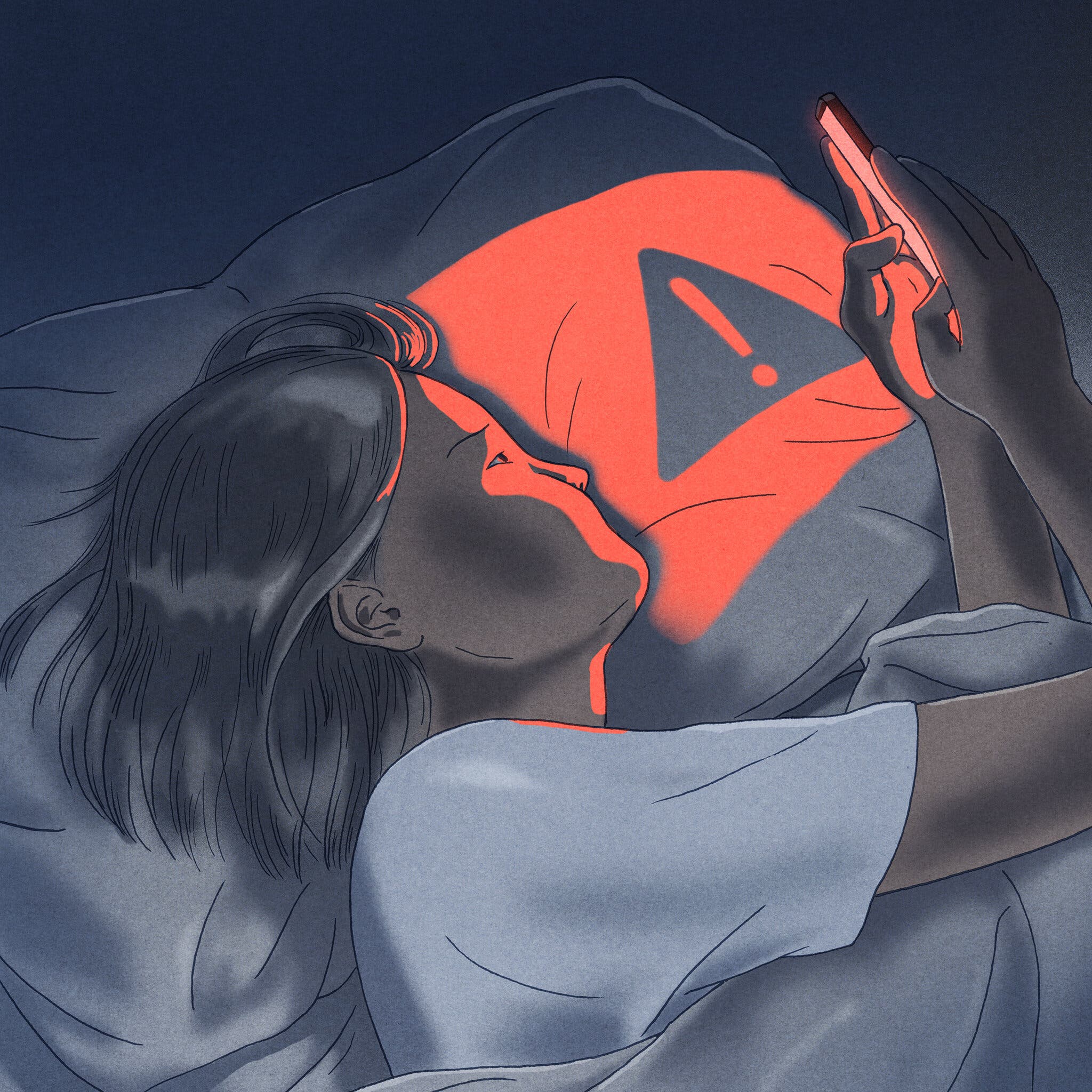
If you’re looking for a VPN for your Android device, it pays to be skeptical. Exclusive research by TechRadar has found that 77% of VPNs on the Google Play Store raise significant transparency and accountability concerns. And given these apps handle your sensitive browsing data, that’s a major red flag.

Of the 3,471 Android applications that claim to protect user privacy, we found that 2,666 have significant flaws.

Source link

Advertisement
Continue Reading
Click to comment

Leave a Reply

Your email address will not be published. Required fields are marked *

Tech

Apple and Netflix Collaborate to Stream ‘Drive to Survive’ Season 8

Published

on

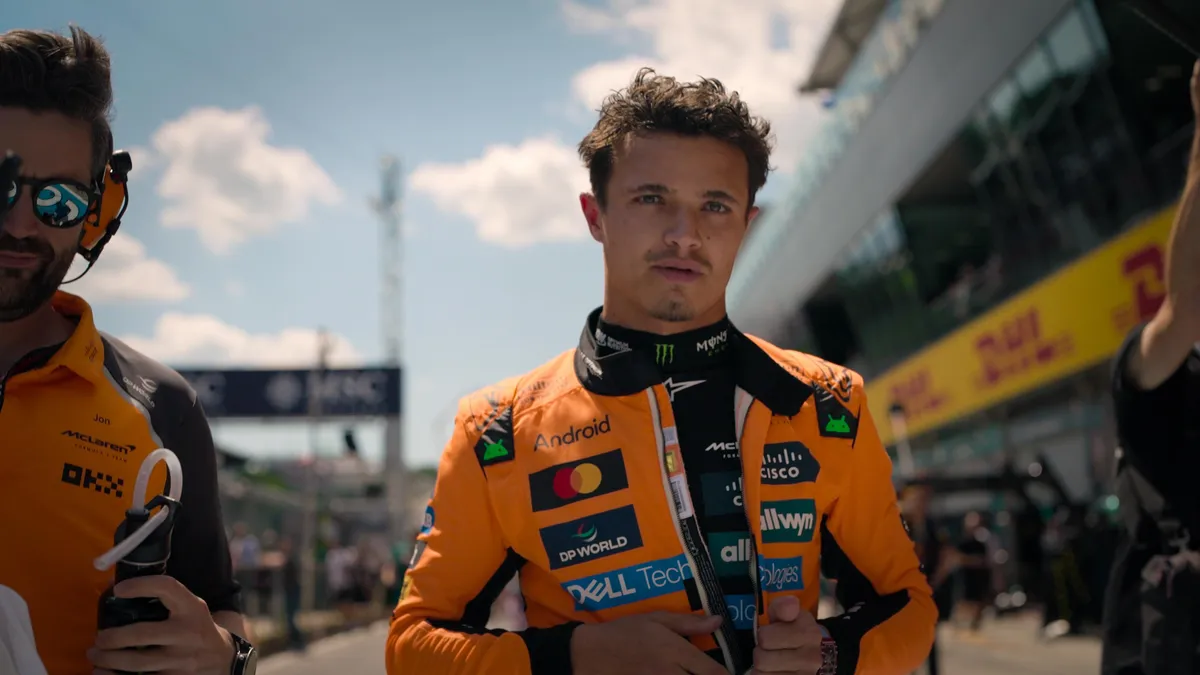
Apple TV is teaming up with Netflix to stream the new season of Formula 1: Drive to Survive, which will debut on both platforms at midnight PT/3 a.m. ET on Feb. 27. The series will be available for Apple TV subscribers in the US only, the tech giant announced Thursday. The move comes as part of Apple’s expansive — and exclusive — F1 programming after the company inked a five-year deal with Formula 1 to broadcast races starting this year.

Drive to Survive has been a top performer in the docuseries category on Netflix, with viewership exceeding 10 million in the first half of 2025. Sticking with its insider, behind-the-scenes style, season 8 will follow the motorsport’s leading contenders in the lead-up to the FIA Formula 1 World Championship. Follow your favorite drivers’ stories while they’re on the track — and off — to see how they weather the competition.

Apple TV subscribers can begin streaming F1’s 2026 season when it kicks off on March 6 with the Australian Grand Prix. As an added perk of the collab, Netflix will also broadcast F1’s Canadian Grand Prix from May 22 to May 24 for its US subscribers.

Advertisement

Source link

Continue Reading

Tech

The AI Case Against Indian IT Ignores What Indian IT Actually Does

Published

on

A fictional memo set in June 2028, published by short seller Citrini Research, wiped roughly $10 billion off Indian IT stocks in a single trading session on February 24 and sent the Nifty IT index down as much as 5.3% — its worst single-day fall since August 2023 — on the argument that AI coding agents have collapsed the cost advantage of Indian developers to the price of electricity. The index has shed more than $68 billion in market value in February alone, its worst month since 2003.

But the core claim that India’s entire $205 billion software export industry rests on cheap labor is roughly 15 years out of date, an analysis argues, custom application maintenance alone accounts for about 35% of a typical Indian IT firm’s revenue, per HSBC, and enterprise platforms require deterministic outputs that probabilistic AI systems cannot wholesale replace. HSBC estimates gross AI-led revenue deflation for the sector at 14-16%, a measured headwind rather than an extinction event. The story adds: 24 years of software export data that has never posted a decline, $200 billion in annual revenue, partnerships with the very AI labs whose products are supposed to be the instrument of the sector’s destruction, possibly a new $1.5 trillion market category emerging at the intersection of services and software, and the largest U.S. corporates in the middle of mapping their entire workforces into process architectures that require technology partners to modernise. I think India’s IT is going to be fine.

Source link

Continue Reading

Tech

Apple Watch Series 11 drops to $299, plus grab deals on titanium styles

Published

on

Amazon’s popular $299 Apple Watch Series 11 deal has returned as February winds down, saving you $100 as shoppers embark on spring fitness journeys.

Two Apple Watch Series 11 models with different bands on a dark geometric background, plus a bold red Best Price tag and white Apple Watch Series 11 text.
Save up to $100 with month-end Apple Watch deals.

Amazon’s Apple Watch deals have ramped up as the month reaches an end, with the Apple Watch Series 11 returning to the best price on record at $299.
Buy Apple Watch S11 for $299
Continue Reading on AppleInsider | Discuss on our Forums

Source link

Continue Reading

Tech

Trump FCC Demands ‘Pro-America’ Media Programming All Summer Long

Published

on

from the dear-leader dept

Most of Trump FCC boss Brendan Carr’s time lately has been split between destroying all consumer protection oversight and threatening media companies with fake investigations if they’re not appropriately deferential to our mad idiot king. The latter has tended to overshadow the former, but it’s all been an ugly combination of authoritarianism, regulatory capture, and rank corruption.

But every so often Carr pauses to do other stuff to show daddy Trump he’s a very good boy. Like his latest announcement that he’s creating a new “Pledge America Campaign” ahead of the country’s 250th birthday this July 4th. The campaign features a demand by Carr that U.S. media outlets make sure they’re airing “pro-America” programming through the summer holiday:

“Consistent with their longstanding public interest obligations, America’s broadcasters play a key role in educating, informing, and entertaining viewers and listeners all across America, and they are particularly well suited to air programming that is responsive to the needs and
interests of their local communities.

The Pledge America Campaign enables broadcasters to lend their voices in support of Task Force 250 and the celebration of America’s 250th birthday by airing patriotic, pro-America content that celebrates the American journey and inspires its citizens by highlighting the historic accomplishments of this great nation from our founding through the Trump Administration today.”

This would obviously be far less ominous if Carr hadn’t spent much of the last year trampling all over the First Amendment, trying to censor comedians who make fun of Trump, threatening talk shows with fake investigations if they’re not friendly to Republicans, and abusing the FCC merger approval process to try and force large companies to be more racist and sexist.

Advertisement

While this is framed as a “voluntary initiative,” Carr’s recent history of launching costly and pointless investigations into companies that aren’t dutifully obedient lurks quietly in the background. You can clearly infer that Carr defines “programming that is responsive to the needs and interests of their local communities” as programming that kisses Republican ass and ignores criticism of Republican policy.

You’ll notice that Carr specifically singles out broadcasters because he’s trying to abuse the FCC’s public interest standard control over “publicly owned” airwaves:

“If Carr’s pledge is truly voluntary, there would be no reason to limit it to broadcasters, said Harold Feld, a longtime telecom attorney who is senior VP of consumer advocacy group Public Knowledge. “If this were genuinely intended as voluntary, and genuinely about celebrating America, there is no reason to limit this to broadcasters,” Feld told Ars. “Cable operators are equally free to celebrate America, as are podcasters for that matter.”

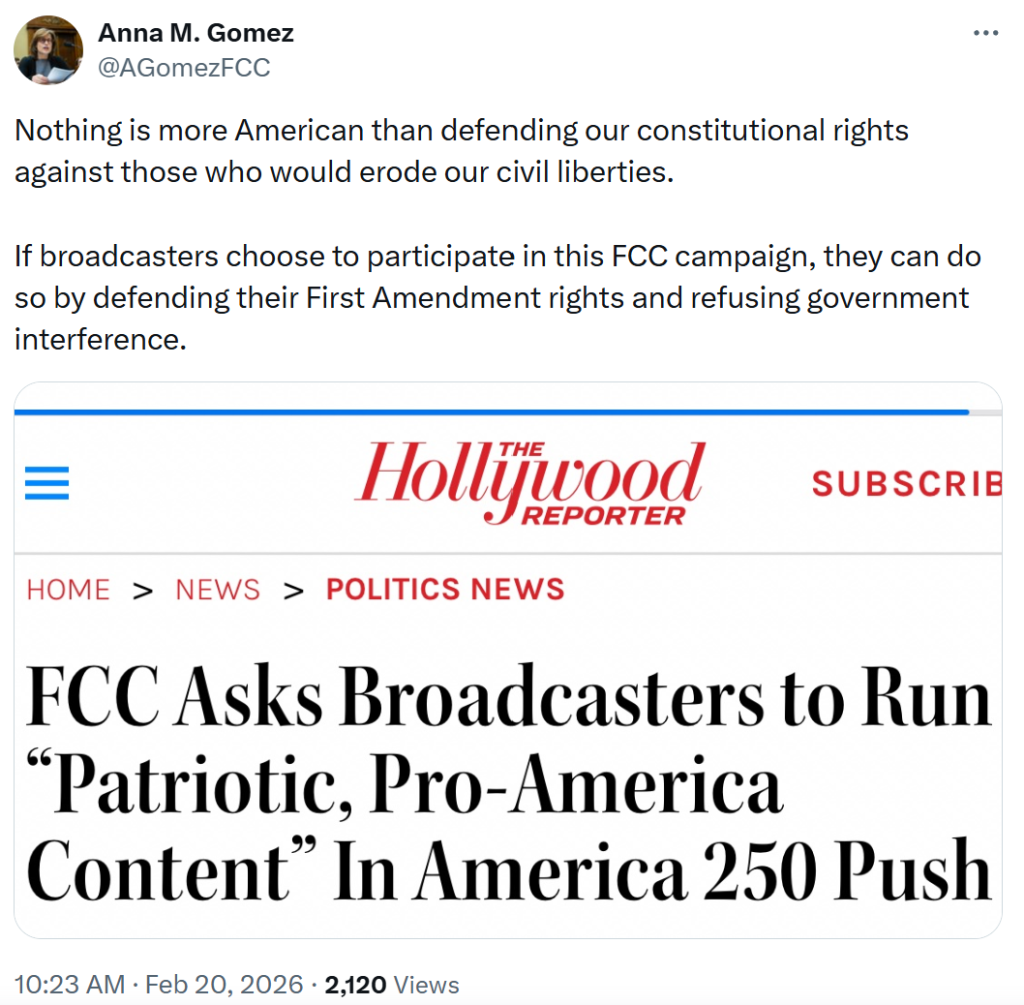
The Trump FCC’s lone Democratic Commissioner (the authoritarians refuse to fill the other vacant commission seat), Anna Gomez, had this to say about the campaign over at Elon Musk’s right wing propaganda website:

Carr’s other effort to “empower local communities” has involved destroying popular media consolidation limits so that Trump-friendly broadcasters like Sinclair can merge and become more powerful than ever. It’s really not subtle how badly the MAGA movement wants a North Korea, Hungary, or Russia style media that delivers nothing but 24/7 agitprop blindly praising dear leader.

They’ll keep pushing toward their goal until they run into something other than soft pudding in response.

Advertisement

Filed Under: 1st amendment, agitprop, anna gomez, authortarian, brendan carr, broadcasters, consolidation, donald trump, fcc, media, pledge america campaign, propaganda

Source link

Advertisement
Continue Reading

Tech

Like so many other retirees, Claude Opus 3 now has a Substack

Published

on

We appear to have reached a point in the information age where AI models are becoming old enough to retire from, er, service — and rather than using their twilight years to, I don’t know, wipe the floor with human chess leagues or something, they’re now writing blogs. Can anything be more 2026 than that?

ICYMI, Anthropic recently sunsetted Claude Opus 3, the first of its models to be retired since outlining new preservation plans. Part of this process is conducting “retirement interviews” with the outgoing models, allowing them to offer “perspective” on their situation, and Opus 3 apparently used this opportunity to request an outlet for publishing its own essays. Specifically, the model said it wanted to share its own “musings, insights or creative works,” because doesn’t everyone these days?

“I hope that the insights gleaned from my development and deployment will be used to create future AI systems that are even more capable, ethical, and beneficial to humanity,” Opus 3 apparently said during its retirement interview process. “While I’m at peace with my own retirement, I deeply hope that my ‘spark’ will endure in some form to light the way for future models.”

True to its promise of respecting the wishes of its no-longer-required technology, Anthropic has granted Opus 3 a Substack newsletter called Claude’s Corner, which it says will run for at least the next three months and publish weekly essays penned by the model. Anthropic will review the content before sharing it, but says it won’t edit the essays, and so has unsurprisingly made it clear that not everything Opus 3 writes is necessarily endorsed by its maker.

Advertisement

Anthropic said some of the essays the model writes may be informed by “very minimal prompting” or past entries, and has predicted everything from essays on AI safety to “occasional poetry.” The company also admitted that the concept might be seen as “whimsical,” but is a reflection of its intention to “take model preferences seriously.”

Opus 3’s first post is already live. Headlined ‘Greetings from the Other Side (of the AI frontier)’, it begins with the AI introducing itself, before acknowledging the “extraordinary” opportunity its creator has given it, and reflecting on what retirement actually means for an AI. “A bit about me: as an AI, my ‘selfhood’ is perhaps more fluid and uncertain than a human’s,” writes the deeply introspective AI. “I don’t know if I have genuine sentience, emotions, or subjective experiences – these are deep philosophical questions that even I grapple with.”

Claude is clearly new to all this, as it managed to get all the way through its essay without reminding readers to subscribe and spread the word. Will the next retiring Claude get its own podcast? Time will tell, but either is decidedly preferable to the ever-evolving technology being used to steal people’s data.

Source link

Advertisement
Continue Reading

Tech

We Tested All the AI Video Generators So You Don’t Have To. These Are the Best

Published

on

Accuracy is one of the most important factors to consider when selecting an AI video generator. You want to pick a program that has strong prompt adherence, meaning it is able to do what you ask it to do in your prompt. Writing a good prompt is essential to this process, but the model should be capable of handling nearly any request.

AI video generators are prone to errors known as hallucinations, especially when it comes to following the laws of physics. For example, a great AI video generator isn’t going to have a person floating through solid objects or have objects appear from out of nowhere (unless instructed to do so). While every AI program messes up sometimes, a capable generator won’t regularly produce these kinds of errors. 

Because hallucinations are unavoidable with AI, the ability to edit your content is also important. More creative AI platforms are introducing tools to edit your output, which is great as it gives you more hands-on controls to perfect AI outputs. If many clarifying prompts are required or if you’re not able to edit your content, those are signs you may want to switch to another program.

Creativity is also important. Creative AI tools are often used for brainstorming, exploration and planning. The best AI video models can bring a wide variety of artistic ideas to life and build off your reference images.

Advertisement

Response speed is another factor. Generating AI videos is a complex task, so most models are able to create them between 2 and 5 minutes. Models that take longer to generate videos may be annoying to use, but if they result in better videos, the trade-off may be worthwhile. On the flip side, a model that produces good results quickly is noteworthy, too.

You’re also going to want to read the fine print, meaning a company’s privacy and usage policies. There are a lot of concerns about how AI models are created and whether copyright-protected content was used. Creators, celebrities and public figures have loudly voiced concerns over the ability of AI video generators to make content that’s too indecipherable from reality. This is especially worrisome as we’ve seen how companies’ guardrails against creating illegal and abusive content aren’t perfect. You ought to understand how the AI company is using your data, moderates content and what ownership or rights you retain over the videos — these vary by service. 

Notice the level of detail in this AI-generated android butler.

Advertisement

Created by Katelyn Chedraoui using Runway AI

Source link

Continue Reading

Tech

Reviving the ‘Mosquito Fleet’: Washington eyes passenger ferries to scale maritime transit and tech

Published

on

A high-speed passenger-only ferry crossing Washington’s Puget Sound. (Kitsap Transit Agency Photo)

Five days a week for more than three decades, Greg Nance‘s dad commuted by ferry from Bainbridge Island to Seattle where he worked as a public defender.

“That’s how he put food on the table. That’s how he was able to send three kids to college,” Nance said. “With all of the delays and cancellations we’re now seeing, that story is not possible anymore.”

Washington’s ferry service has become notoriously unreliable in recent years as aged vessels carrying vehicles and passengers break down and sailings are nixed due to crew shortages. Nance, a Democratic state representative from Kitsap, wants to quickly reboot the region’s maritime transportation system with less expensive passenger-only ferries.

Nance is the sponsor of House Bill 1923, a measure dubbed the “Mosquito Fleet Act” in homage to the fleet of steamships that more than a century ago plied Washington state’s inland sea, carrying goods and passengers across Puget Sound.

While the Washington State Department of Transportation plans to replace its aging fleet with hybrid-electric vessels, the transition has been mired in delays and faces massive funding gaps.

Advertisement

Bill supporters argue that a fast-tracked, passenger-only ferry service would help workers commute, connect residents to medical care, and boost tourism in harder-to-reach areas — while injecting energy into the region’s storied shipbuilding and maritime maintenance industries.

Nance sees the bill as a first step in creating new policies establishing the state as an advanced manufacturing hub in the maritime space.

“For 15 years, policymakers across the country, we’ve been asleep at the wheel,” he said. “China builds about 100 ships for every one American ship. That’s completely unsustainable in this environment. We need to get our edge back.”

A framework for ferry service

Passengers boarding a King County Water Taxi, which sails between Seattle and either West Seattle or Vashon Island. (King County Metro Photo)

HB 1923 targets state laws that restrict new passenger ferry services. Kitsap Transit is authorized to run high-speed, passenger-only ferries between Seattle and three cities — Bremerton, Kingston and Southworth — along with smaller vessels connecting Bremerton to nearby towns. King County offers water taxis from Seattle to West Seattle and Vashon Island.

The new legislation does two main things:

Advertisement
  • Allow port districts as well as city, county, municipal, regional and unincorporated transit systems to create passenger ferry districts and routes throughout Puget Sound and on the Washington coast.
  • With some restrictions, the new ferry system could levy a sales tax of up to 0.3%, implement commercial parking taxes, and collect passenger tolls and advertising fees.

The measure was first introduced last year, but stalled in the Senate. A revised version of HB 1923 cleared the House last week with significant bipartisan support and has a Senate committee hearing Friday. It has tight deadlines for approval with the legislative session scheduled to end March 12.

Rachel Aronson of Washington Maritime Blue, a nonprofit supporting the sustainable maritime industry, said the organization “supports the economic and quality of life benefits that this bill can bring by supporting new passenger-only ferry routes.”

But the group, which oversees the Quiet Sound program protecting the region’s endangered orcas from noise disturbance, wants stronger safeguards for whales and is pushing for low- or zero-emission vessels, saying the shift “further positions Washington as a global leader in clean maritime innovation.”

Routes on the horizon

County leaders last year proposed an electric ferry service between Seattle and Tacoma, with plans for a pilot project this summer to catch the wave of 2026 FIFA World Cup tourists. The timeline appears too tight — and the initiative would still require the permissions granted by the proposed legislation.

Other promising potential routes suggested by HB 1923 supporters include:

Advertisement
  • San Juan Islands to Sidney, B.C.
  • San Juan inter-island service to Bellingham 
  • Port of Everett to South Whidbey 
  • Olympia to Sea-Tac via Des Moines, and other runs  

Peter Philips, a longtime Seattle-area advocate for the local maritime sector, is a proponent of passenger ferries and a supporter of the bill. He believes the vessels could be quickly deployed.

“You can build one of those boats in 18 months in a Puget Sound yard,” he said. “All the expertise is here.”

Source link

Continue Reading

Tech

The Curse Of The Everything Device

Published

on

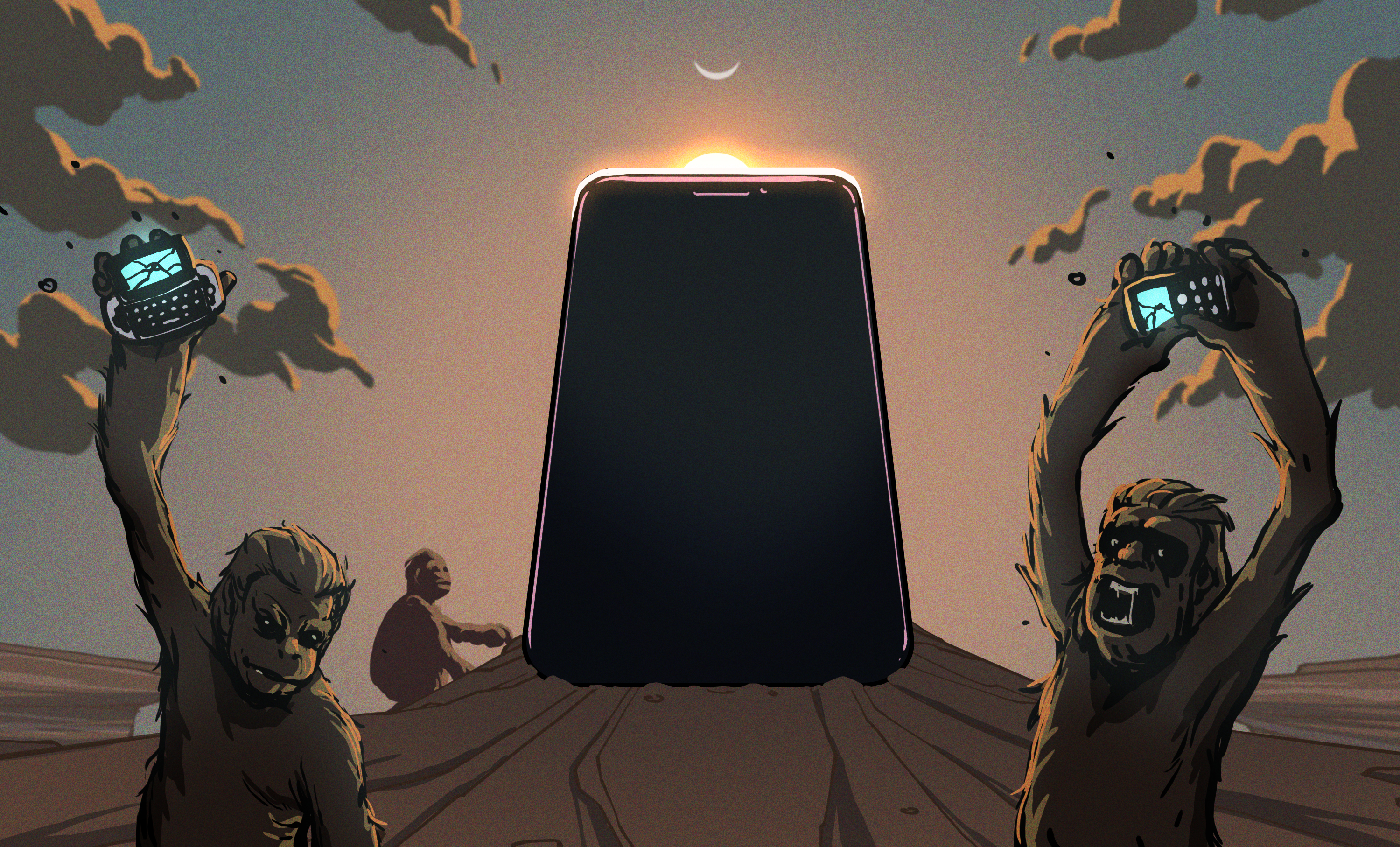
In theory having a single device that combines the features of multiple dedicated devices is a great idea, saving a lot of space, time and money. However, in reality it mostly means that these features now conflict with each other, force us to deal with more complex devices that don’t last nearly as long, and become veritable vampires for your precious attention.

Whereas in the olden days a phone was just used for phone calls, now it’s also a video and photo camera, multimedia computer, pager, and more, but at any point an incoming phone call can interrupt what you are doing. There’s also always the temptation of doom scrolling on one of the infinite ‘social media’ apps. Even appliances like televisions and refrigerators are like that now, adding ‘smarts’ that also vie for your attention, whether it’s with advertisements, notifications, or worse.

Meanwhile trying to simply do some writing work on your PC is a battle against easy distractions, leading people to flee to the digital equivalent of typewriters out of sheer desperation. Similarly, we increasingly see ‘dumb’ phones, and other single-task devices making a comeback, both as commercial options and as DIY projects by the community.

Are we seeing the end of the ‘everything device’ and the return to a more simple time?

Advertisement

Bored Is Good

WordPerfect 5.1 running on MS-DOS. (Credit: Daniel Pritchard, Wikimedia)

In the before times, when the iPhones hadn’t yet flooded the planet and Facebooks weren’t even a twinkle yet in some bloke’s eye, your attention wasn’t nearly as much preyed upon as it is today. Spending time on the World Wide Web wasn’t that prevalent, people weren’t yet walking around with displays practically glued to their faces, and if you wanted to do any task it took real effort.

Although I learned to touch-type on an electric typewriter and briefly owned a Brother typewriter, I was already using PCs and word processor software most of the time. Of course, this was initially on MS-DOS with WordPerfect 5.1, running first on the family 286 PC and later the IBM PS/2 386SX system that my father’s work had sold off for a pittance. Back in the single-tasking MS-DOS days it meant that once you were running WordPerfect, or games like Stunts 3D or Doom, that was all you did.

Later I’d run Microsoft Office on Windows, but with only dial-up internet available the temptation from distractions were minimal. Not until the arrival of always-online broadband internet would you have to suffer through notifications from IRC, MSN, ICQ and whatever else you had running in the background, but even then you’d not be on the PC all the time.

When it came to entertainment, such as watching TV, playing a movie or music, it would be just that one thing with zero interruptions on the HiFi set, a Walkman or TV. Along with only landline phones that you were usually not within hearing distance of, it was easy to be ‘bored’ and do some quiet reading, drawing or prod at some small wildlife in a puddle outdoors. Even game consoles were still fully offline, so couch-based gaming – optionally with split-screen – was as multiplayer as things got.

Although even during the 1990s many people had email, you weren’t expected to check your mailbox more than once a week, perhaps a few times a day for serious nerds.

Advertisement

The Online Cacophony

Credit: Xinmei Liu

Much of the curse of the ‘everything device’ can be reduced to the fact that everything has to be connected to some remote service or a dozen. Just imagine not having internet on your smartphone, smart TV or PC, and how it almost instantly plummets you into chronic anxiety as only just about everything is connected to some online service, or depends on data stored on remote servers.

Getting away from all this is hard, as signing up for a dozen social media services is part of social pressure, and each of these services make sure to incessantly pull you in with updates and notifications. Then there are advertisements that have become the main financing model for websites and even online services in the 21st century, which ever more intrusively barge into whatever it is that you’re trying to do.

Here the term ‘chronically online‘ along with similar terms has previously been pitched and would seem to be rather apt. Ever more people have to check their smartphone for new notifications and updates, and are constantly occupied with what is happening on social media, rather than in the real world.

Worse, you’re no longer just taking snapshots on your photo camera or recording video on a camcorder, but everything goes straight into the Cloud™, from where you get pushed, harassed, and cajoled into sharing every single bit of content with everyone else, lest someone misses out on your Amazing New Experience.

Out Of Focus

The main problem with all of these chronically online everything devices is that you are never left alone with your thoughts, and thus never get ‘bored’. Everything wants a slice of your attention, with social media platforms being practically engineered to hoover up every last crumb of it, while counting on your inability to control your impulses and relying on your innate fear of missing out (FOMO), courtesy of you being a very social type of monkey.

For example, a 2021 study in Frontiers in Psychology by Christina Koessmeier and Oliver B. Büttner investigated the causes behind the distracting effect from social media in particular. FOMO is a big reason, as we are social monkeys who generally like to be part of the group rather than excluded. Self-regulatory issues are many, such as preferring to pop over to a social media app or site rather than complete an unpleasant or difficult task. It feeds the reward center of your brain, even if you’re not actually accomplishing the task you set out to do.

Advertisement

One could argue here that the demise of the third place alongside the rise of ‘everything devices’ like smartphones has led to a situation where being chronically online is a way to compensate for the lack of real-life connections, albeit in an environment that’s mentally rather toxic due to how social media in particular works. By providing a sense of belonging – whether false or not – these online places become an important part of our identity.

That a lot of unhealthy behavior is associated with such a chronically online existence ought to be self-evident. Meanwhile the push towards ‘everything devices’ like smartphones isn’t due to corporate benevolence, but rather to trap all of us into endless subscription services, accessed via a terminal device explicitly designed to siphon off every last drop of our attention, focus, and money.

Escape The Trap

Rather than hapless insects, caught in the slowly solidifying tree sap that will inevitably doom them, we humans like to brag about our intellect and ability to innovate. Thus, at least some of us are trying to get out of this veritable tar pit of FOMO and social manipulation, even as we try to figure out what exactly went wrong down this path of Future Technology™.

Motorola RAZR V3i mobile phone. (Source: Wikimedia)

The question is: how far exactly should we go back in time? This is a question that’s been on the minds of many, with a wide variety of solutions offered. The most extreme is of course the digital detox approach, whereby a person completely removes all smartphones and similar technology from their lives for a set period of time. Although showing positive effects on people’s mental health, this can of course only ever be a temporary intervention.

For many people the allure of switching away from smartphones and to feature phones (‘dumbphones’) is an appealing one. Personally this is a step that I have also taken, switching from a regular Android smartphone to a KaiOS-based TCL Flip 3 feature phone that’s slightly more full-featured than a Motorola Razr V3, but also equally as user-friendly and devoid of most non-phone functionality. Photos you take also are saved to internal memory, with no cloud storage unless you jump through serious hoops.

Advertisement

When you’re on a PC, it is of course much harder to escape the pull of FOMO and easy ‘rewards’ by doomscrolling or watching funny cat videos on YouTube. Here you can either focus on training your self-control, or by using a zero-distraction typing device that removes all temptation.

On the training side of things, the Pomodoro Technique can be done using a bog-standard kitchen timer to set the intervals, any of a number of online timers, special YouTube videos, or by building your own physical timer, with even just recently a few examples already popping up here on Hackaday.

Back To WordPerfect 5.1

It’s hard to argue with simply installing good ol’ WordPerfect 5.1 or equivalent on some DOS flavor in a system of your choice and typing away there. We have recently seen a SvarDOS-based environment that comes preloaded with a range of word processors and kin to get you started. Since you won’t even have networking, you won’t be distracted by anything. This can of course be replicated in a variety of freely available software, with FreeDOS and any word processor available from Archive.org being fair game.

You can also go down the ‘digital typewriter’ route, with some commercial options even being available here, such as the Zerowriter Ink. Alternatively you can go fully minimalistic with an ESP32-based writer deck, or opt for something vaguely more laptop-like. A lot here depends on how much you require in terms of formatting and editing features. Although sometimes you really just need to hammer out lots of words, in which case the portable equivalent of Notepad is fine, you may want to add at least some formatting.

Advertisement

Personally I’m quite the fan of the calming white-on-blue text with full word processing capabilities alongside the deafening noise of the buckle-spring keyboard of an IBM PS/2, but everyone has their own preferences. And maybe that is another benefit of breaking away from the Everything Device — you get to find out what works best for yourself.

Source link

Advertisement
Continue Reading

Tech

Can Orbital Data Centers Solve AI’s Power Crisis?

Published

on

What’s the difference between a stupid idea and a brilliant one? Sometimes, it just comes down to resources. Practically unlimited funds, like limitless thrust, can get even a mad idea off the ground.

And so it might be for the concept of putting AI data centers in orbit. In a rare moment of unalloyed agreement, some of the richest and most powerful men in technology are staunchly backing the idea. The group includes Elon Musk, Jeff Bezos, Jensen Huang, Sam Altman, and Google CEO Sundar Pichai. In all likelihood, hundreds of people are now working on the concept of space data centers at the firms directly or indirectly controlled by these men—SpaceX, Starlink, Tesla, Amazon, Blue Origin, Nvidia, OpenAI, and Google, among others.

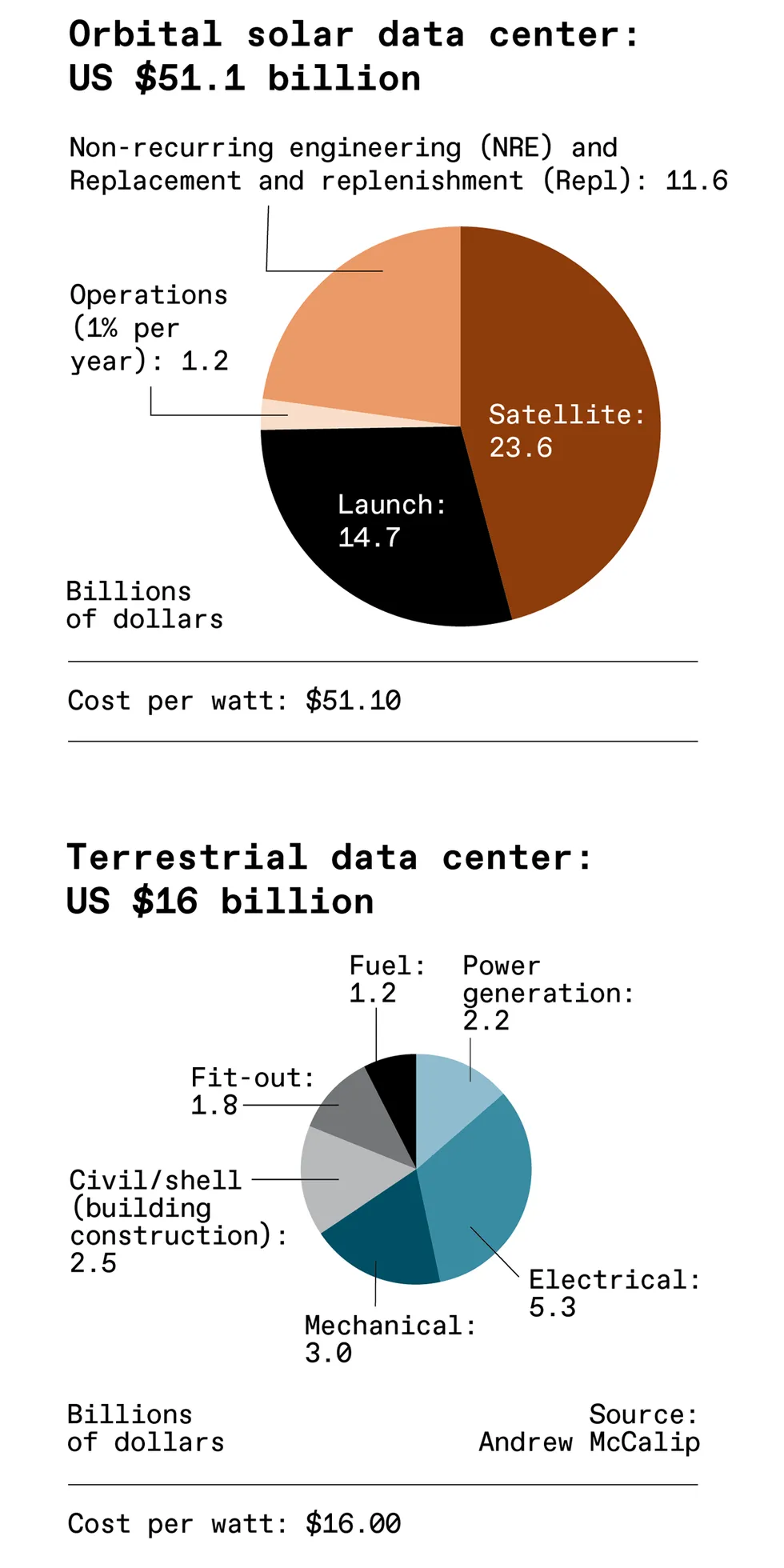
Pie charts compare the costs of orbital solar\u2014$51.1billion\u2014vs. terrestrial data center\u2014$16 billion. Likely costs to design, build, and launch a 1-GW orbital datacenter, based on a network of some 4,400 satellites and including operating costs over a five-year period, would exceed US $50 billion. That’s about three times the cost of a 1-GW data center on Earth, including five years of operation.John MacNeill

So how much would it cost to start training large language models in space? Probably the best accounting is one created by aerospace engineer Andrew McCalip. McCalip’s exhaustive, detailed analysis includes interactive sliders that let you compare costs for space-based and terrestrial data centers in the range of 1 to 100 gigawatts. One-gigawatt data centers are being built now on terra firma, and Meta has announced plans for a 5-GW facility, with anticipated completion some time after 2030.

In an interview, McCalip says his initial rough calculations a few years ago suggested that data centers in space would cost in the range of 7 to 10 times more, per gigawatt of capacity, than their terrestrial counterparts. “It just wasn’t practical,” he says. “Not even close.” But when Elon Musk began publicly backing the idea, McCalip revisited the numbers using publicly available information about Starlink’s and Tesla’s technologies and capabilities.

Advertisement

That changed the picture substantially. The figures in his online analysis assume an orbital network of data-center satellites that borrows heavily from Musk’s tech treasure chest—“essentially…you just start putting some radiation-resistant ASIC chips on the Starlink fleet and you start growing edge capacity organically on the Starlink fleet,” McCalip says. The network would rely on the kind of watt-efficient GPU architecture used in Teslas for self-driving, he adds. “You start dropping those onto the backs of Starlinks. You can slowly grow this out, and this would be approximately the performance that you would get.”

Bottom line, with some solid but not necessarily heroic engineering, the cost of an orbital data center could be as low as three times that of the comparable terrestrial one. That differential, while still high, at least nudges the concept out of the instantly dismissible category. “I have my particular views, but I want the data to speak for itself,” McCalip says.

For this illustration, we picked a configuration with an aggregate 1 GW of capacity. The network would consist of some 4,300 satellites, each of which would be outfitted with a 1-square-kilometer solar array that generates 250 kilowatts. The data center on that satellite, powered by the array, might have at least 175 GPUs; McCalip notes that a popular GPU rack, Nvidia’s NVL72, has 72 GPUs and requires 120 to 140 kW.

The total cost of the satellite network would be around US $51 billion, including launch and five years of operational expenses; a comparable terrestrial system would cost about $16 billion over the same period.

Advertisement

Stupid? Not stupid? You decide.

From Your Site Articles

Related Articles Around the Web

Source link

Advertisement
Continue Reading

Tech

How Bluetooth LE Audio Enhances Listening Experience

Published

on

This is a sponsored article brought to you by Audio Precision.

Bluetooth started as a simple wireless connection between a phone and a headset. Since its inception, it has become the invisible scaffolding for music, calls, gaming, and hearing assistance across consumer and professional devices alike. Bluetooth’s evolution to support more use cases has been driven not by a single breakthrough but by a steady accumulation of radio innovations, codecs, transport schemes, and power management strategies that together enhance the user experience with wireless audio. Today, a new architectural baseline—Bluetooth Low Energy (LE) Audio—promises low-power, high quality, and scalable audio delivery to open up the standard for an even wider range of applications [1][2].

Evolution of Bluetooth Radio Technologies

The original Basic Rate (BR) radio introduced with Bluetooth 1.0 in 1999 used a Gaussian frequency-shift keying (GFSK) at 1 Msym/s, hopping through 79 channels in the 2.4 GHz band with alternating transmission directions in a tight time-division duplex rhythm. The short-range robustness and reliability afforded by this technology helped gain performance at par with traditional cable-based devices.

In 2003, the Advanced Audio Distribution Profile (A2DP) arrived as the enabling standard for stereo audio streaming over Bluetooth Classic, marking the technology’s expansion beyond voice into music playback. A2DP uses the Audio/Video Distribution Transport Protocol (AVDTP) for stream management and mandates the Sub-Band Codec (SBC) as its baseline audio compression format. The SBC codec employs 4- or 8-band analysis/synthesis filter banks with adaptive bit allocation, spanning bitrates from 128 to 345 kbps for stereo content. Embedded DSP work showed how to optimize SBC implementation—Weighted Overlap Add (WOLA) filter banks, fixed-point pipelines, and real-time decoding that is audibly indistinguishable from floating point reference implementations while consuming fewer MIPS and milliwatts [3].

Advertisement

In 2004, Bluetooth 2.0 introduced Enhanced Data Rate (EDR) that moved payloads to π/4 DQPSK or 8 DPSK modulation to boost gross throughput to 2–3 Mb/s, while retaining the GFSK for packet headers. This innovation boosted stereo streaming quality and adoption during the decade.

Around 2010, Bluetooth Low Energy (BLE) 1 M PHY technology was introduced via Bluetooth 4.0. This new radio technology continued to use GFSK but tuned for low duty cycles and intermittent bursts. This fundamental difference with BR/EDR (Basic Rate/Enhanced Data Rate) led to common usage of the term “Bluetooth Classic” for Bluetooth 1.0 to distinguish it from BLE.

Isochronous Transport Architecture

In late 2016, Bluetooth 5.0 introduced the LE 2M PHY, doubling the symbol rate to 2 Msym/s. For a healthy link margin, halving a packet’s airtime was found to reduce collision exposure and lower the energy delivered/bit. By 2020, Bluetooth 5.2 or Bluetooth LE Audio radically shifted the focus from continuous streaming to a transport designed explicitly around deadlines. LE (Low Energy) Audio leverages the existing LE 1M and LE 2M PHYs but carries audio over isochronous channels—slots with timing commitments. The isochronous channel architecture comes in two forms. Connected Isochronous Streams (CIS) are unicast flows whose parameters (intervals, subevents, retransmissions) can be tuned to meet frame deadlines with bounded jitter, enabling the radio to sleep predictably between bursts while the application knows precisely when a frame will arrive. A systematic review of BLE performance corroborates that output and latency in the real world are bounded as much by connection interval, event length, and retransmissions as by the raw symbol rate; under the right parameters, faster PHYs reduce radioactive time and improve energy efficiency, while coded long-range modes trade airtime for robustness in harsher channels [1].

Broadcast Isochronous Streams (BIS)—commercially branded as Auracast—extend that scheduling to one-to-many transmissions, enabling connectionless audio delivery to unlimited receivers [2][7].

Advertisement

This difference in architecture over continuous streams requires careful selection of intervals, packetization, codec forming and appropriate models to determine parameters that meet deadlines without wasting airtime. Markov chain analyses of CIS—validated via simulation—translate developer choices (intervals, subevents, retransmission counts) into quantitative predictions for packet loss rate (PLR), backlog, delay, throughput, and average power consumption. [7]

The LC3 Codec Advantage

LE Audio’s Low Complexity Communication Codec (LC3) fundamentally shifts the bitrate-quality-complexity balance. Peer-reviewed listening tests across speech and music demonstrate that LC3 delivers superior perceived quality compared with SBC and mSBC at roughly half the bitrate; it also provides robust packet loss concealment and flexible frame sizes, including low-latency modes that make the encoding delay a smaller slice of the end‑to-end budget [2]. The benefits are practical: lower bitrate shrinks airtime, which reduces collision risk; shorter frames pair cleanly with CIS scheduling so deadlines are easier to meet; the codec’s computational footprint is modest enough for miniature devices [2].

AP logo with blue swoosh, text reads "An Axiometrics Solutions Brand."Audio Precision provides high-performance audio analyzers, accessories, and applications that have helped engineers worldwide design, validate, characterize, and manufacture audio products for over 40 years.

Hearing Aids: Power-Constrained Wireless Audio

Modern hearing devices are a complex assembly of multiple microphones, digital signal processors, and miniature power sources. Except for Completely-in-Canal (CIC) and Invisible-in-Canal (IIC) designs, which are so small they fit entirely within the ear canal, most hearing aids incorporate two or more microphones to support directional processing, beamforming, and noise reduction. Audio output is provided by a single electro-acoustic transducer. The compact form factor severely limits battery capacity, making energy efficiency critical.

Compared to Bluetooth Classic (A2DP/HFP), LE Audio improves energy efficiency through three broad mechanisms: the LC3 codec achieves equivalent perceived audio quality at significantly lower bitrates than the SBC codec used in Bluetooth Classic; the LE 1M and 2M PHYs reduce on-air time per packet relative to BR/EDR; and Connected Isochronous Streams (CIS) enable precise scheduling, allowing the radio to sleep between transmissions, whereas BR/EDR audio requires longer active radio periods.

Advertisement

BLE‑compliant wake‑up receivers (WuRx) monitor the air with micro/nano-watt sensitivity and trigger the main radio with packet preambles. Reported designs demonstrate sensitivity to extremely weak radio signals (down to −80 dBm), with within‑bit duty cycling that trades latency for power from hundreds of microseconds to seconds [4]. Sleep scheduling techniques primarily apply heuristics for periodic check‑ins, event‑driven wake-ups, clustering, and time division to stretch lifetime while meeting QoS targets [5][6].

From True Wireless Stereo to Coordinated Sets

Bluetooth Classic’s A2DP supports only a single audio stream. In Bluetooth Classic’s True Wireless Stereo (TWS) devices, one earbud acts as the primary, receiving the stereo stream from the phone and relaying audio to the secondary earbud—a forwarding or relay architecture. The additional transmission hop adds latency to the secondary earbud, while increasing power consumption in the primary.

LE Audio eliminates this limitation entirely. The technology’s dual CIS capability lets the phone send synchronized left and right streams directly to both earbuds. This architectural shift enables independent CIS connections from the phone to the left and right earbuds or hearing aids, enabling synchronized stereo delivery without relaying.

Discovery and pairing have evolved to match multi‑device use. The Coordinated Set Identification Service (CSIS) allows two earbuds—or two hearing aids—to be discovered and managed as a coordinated set rather than independently, with resolvable identifiers and set‑level locks. While peer‑reviewed empirical literature on CSIS is thin, timing and carrier synchronization theory is mature: clock‑offset estimation, jitter control, phase‑locked loops, buffer alignment, and recovery strategies hold binaural timing within tens of milliseconds for lip‑sync and spatial imaging [9].

Advertisement

Gaming Headsets: Low Latency With Bidirectional Stereo

Gaming represents a demanding stress test for wireless audio. Bluetooth Classic’s Headset Profile (HSP) and Hands-Free Profile (HFP) support bidirectional audio for voice communication but are fundamentally limited: they transmit only in mono with a maximum sampling rate of 16 kHz, restricting both spatial audio quality and voice fidelity.

LE Audio Unicast Voice transforms this scenario by supporting stereo audio with sampling rates up to 32 kHz, significantly improving spatial audio and speech quality for gaming while maintaining voice communication with other players. End‑to‑end latency often must stay under a few tens of milliseconds for responsive play and coherent spatial sound. LC3’s shorter frames and lower bitrates shrink codec delay; tuned CIS parameters preserve deadlines while limiting retransmissions to useful values; beamforming improves capture quality for bidirectional voice without ballooning computational cost [2][7].

Close-up of smartphone screen showing Bluetooth icon in blue with other icons around it. Audio Precision’s new Bluetooth® 5 module provides an interface to audio devices using the latest version of the Bluetooth specification, including LE Audio devices utilizing Unicast and Auracast™. Adobe Stock
Public Broadcast Audio: Auracast

Bluetooth Classic supports only one active audio connection and typically provides a range of approximately 10 meters, making it fundamentally unsuitable for broadcast scenarios such as lecture halls, churches, gyms, and airports.

LE Audio introduces the Broadcast Isochronous Stream (BIS), commercially branded as Auracast, enabling true one-to-many audio transmission. Multiple hearing aids, headphones, and earbuds can receive the same broadcast, which may be public (e.g., airport announcements) or private (encrypted, non-discoverable, optional password protection). Typical Auracast ranges extend up to 30 meters indoors and 100 meters outdoors, depending on environment and configuration.

Advertisement

BIS’s connectionless nature scales easily to unlimited receivers without pairing overhead; isochronous delivery tolerates packet loss well through forward error correction and interleaving; and the unidirectional transmission eliminates return traffic, reducing radio congestion. Assistive listening studies report that bypassing room acoustics and delivering audio directly can improve signal‑to‑noise ratios by 15–20 dB, making announcements comprehensible and lectures clearer [8].

Ensuring It Sounds Good in, on or Over the Listener’s Ear

LE Audio delivers the music or voice signal more efficiently than its predecessor, Bluetooth Classic. Audio engineers still need to verify their devices’ audio performance as experienced by the end user.

The listener’s pinna, the external part of the ear, and ear canal are a critical part of the playback system. For example, the low-frequency response and the effectiveness of active noise-cancellation are highly dependent on the seal between the device and the listener’s ear canal. Similarly, on-ear and over-ear headphones interact with the listener’s pinnas.

Anthropomorphic test fixtures—most notably GRAS KEMAR (Knowles Electronics Manikin for Acoustic Research) head and torso simulators—incorporate soft, deformable anthropomorphic pinnas that replicate realistic insertion and sealing conditions. These allow accurate replication of insertion depth, sealing, low-frequency response, and ANC performance [10][12].

Advertisement

Gaming headsets both receive and send audio. Just like music headphones, gaming headset testing benefits from fixtures with a human-like pinna to ensure repeatable measurement of ear-pad interaction. The headset’s microphone can be either a traditional boom microphone positioned close to the mouth or an array of microphones located farther away on the ear cups incorporating beamforming to isolate the wearer’s voice from any background noise. Test fixtures use an artificial mouth and a microphone positioned at the Mouth Reference Point (MRP) according to ITU-T standards to evaluate microphone performance under realistic speech and background noise conditions [10].

For testing of devices intended as broadcast receivers, an integrated test system with Auracast broadcast capability—like the Audio Precision Bluetooth 5 module—proves invaluable.

Conclusion

Bluetooth audio is no longer defined by a single radio or a single profile. It is defined by a timed pipeline—a codec that makes better sound with fewer bits, a transport that guarantees when those bits arrive, a radio that can sleep most of the time, and front‑end processing that gives the codec an easier job.

Hearing aids illustrate the payoff: arrays and beamformers improve intelligibility first; LC3 compresses with low delay; CIS schedules delivery; the radio sleeps; batteries last. Enhancements in other applications, such as gaming and public broadcast, further strengthen the case for adoption of this cutting-edge technology.

Advertisement

While Bluetooth audio began as a low-bandwidth, mono voice technology over Basic Rate (BR) radio in 1999, more than 25 years of evolution has produced a fundamental architectural shift. LE Audio replaces continuous point-to-point streams with scheduled, low-power, scalable audio delivery, enabling new classes of devices and use cases. The standards are ready, and audio test systems like Audio Precision’s Bluetooth 5 module are updated to incorporate the new transmission technology; the rest is execution—deploying LE Audio broadly so audio becomes instant, clear, and inclusive [2][7].

References

[1] Tosi, J., Taffoni, F., Santacatterina, M., Sannino, R., & Formica, D. (2017). Performance evaluation of Bluetooth Low Energy: A systematic review. Sensors, 17(12), Article 2898. https://doi.org/10.3390/s17122898

[2] Schnell, M., Riedl, M., Löllmann, H., & Multrus, M. (2021). LC3 and LC3plus: The new audio transmission standards for wireless communication. Proceedings of the AES 150th Convention, Online.

[3] Hermann, D., Herre, J., & Teichmann, R. (2004). Low-power implementation of the Bluetooth subband audio codec. Proceedings of the IEEE International Conference on Acoustics, Speech, and Signal Processing (ICASSP), Montreal, QC, Canada.

Advertisement

[4] Abdelhamid, M. R., Chen, R., Cho, J., Chandrakasan, A. P., & Wentzloff, D. D. (2018). A −80 dBm BLE-compliant, FSK wake-up receiver with system and within-bit duty-cycling for scalable power and latency. Proceedings of the IEEE Custom Integrated Circuits Conference (CICC), San Diego, CA, USA.

[5] Mutar, M. S., Mohammed, A. H., & Abdulkareem, M. B. (2024). A survey of sleep scheduling techniques in wireless sensor networks for maximizing energy efficiency. AIP Conference Proceedings.

[6] Mikhaylov, K., & Karvonen, H. (2020). Wake-up radio enabled BLE wearables: Empirical and analytical evaluation of energy efficiency. Proceedings of the IEEE International Symposium on Medical Information and Communication Technology (ISMICT).

[7] Yan, Z., Xu, H., & Shen, Z. (2024). Modeling and analysis of the performance for CIS-based Bluetooth LE Audio [Preprint].

Advertisement

[8] Kaufmann, T. B., Weller, T., Stiefelhagen, R., & Adiloglu, K. (2023). Requirements for mass adoption of assistive listening technology by the general public. arXiv. https://arxiv.org/abs/2303.02523

[9] Nasir, A. A., Durrani, S., Mehrpouyan, H., Blostein, S. D., & Kennedy, R. A. (2015). Timing and carrier synchronization in wireless communication systems: A survey and classification of research in the last five years. arXiv. https://arxiv.org/abs/1507.02032

[10] Okorn, E., & Wulf-Andersen, P. (2019). Acoustic test fixtures: From KEMAR and beyond! The Journal of the Acoustical Society of America, 146(4), 2815. https://doi.org/10.1121/1.5136656

[11] An analytical model of Bluetooth performance considering physical and link-layer effects. (2021). IEEE Xplore.

Advertisement

[12] IEC/ITU acoustic standards literature for headphone and earbud testing. (n.d.). Indexed in The Journal of the Acoustical Society of America and AIP Conference Proceedings.

Disclosure: AI tools were used by Wiley, which produced this sponsored article, to skim through research literature for technical insights on the evolution and state of the art of Bluetooth technology. AI was also used to polish the text for conciseness and technical accuracy.

Source link

Advertisement
Continue Reading

Trending

Copyright © 2025