

Crypto World
Analysts Rebuke Jane Street 10am Dump; Bitcoin Not Easily Manipulated


In online crypto circles, a persistent debate has emerged around whether a quantitative trading firm could nudge Bitcoin’s price at the moment U.S. markets open. Proponents point to a recognizable 10:00 a.m. Eastern Time pattern as potential evidence of coordinated selling, while critics caution that such a signal is not definitive proof of manipulation and may reflect broader market mechanics. The discussion intensified a day after a court-appointed administrator overseeing Terraform Labs’ affairs filed a suit against Jane Street, alleging insider trading tied to Terra’s May 2022 collapse. The intersection of high-speed trading, ETF liquidity, and opaque hedging strategies has kept traders watching the clock as BTC moves through daily cycles.
Key takeaways
- Allegations focus on a recurring 10:00 a.m. ET window at the market open, but analysts say this does not constitute conclusive manipulation or a sole driver of BTC’s price trajectory.
- Public filings show Jane Street’s exposure to BlackRock’s IBIT ETF, alongside stakes in Bitcoin mining firms, suggesting hedging and liquidity strategies rather than a simple directional bet.
- Industry voices argue that a single institution cannot control a global, liquid market as fragmented as Bitcoin, even if some trading strategies amplify volatility around open hours.
- Delta-neutral approaches—holding spot exposure while selling futures—are cited as a common method for capturing spreads rather than betting on direction, according to market observers.
- The discourse features a mix of on-chain data, trading analytics, and public posts from market observers, underscoring the complexity of disclosures and how net exposure can be obscured.
- Contextual factors such as geopolitical risk and competition for investor attention from AI-related equities are cited as broader drivers of BTC price moves beyond any single firm’s activity.
Tickers mentioned: $BTC, $IBIT
Sentiment: Neutral
Market context: The dialogue unfolds amid a broader crypto environment characterized by liquidity fluctuations, evolving ETF dynamics, and ongoing regulatory and macro influences shaping how traders price risk and opportunities.
Why it matters
The debate touches on the core questions facing crypto markets: how liquidity, disclosure, and algorithmic trading intersect with real-world price discovery. If a large player can influence the clock at which liquidity sweeps occur or how efficiently a spot market absorbs ETF-related flows, that could have implications for price integrity and market education. Yet the consensus among many analysts is that Bitcoin’s price formation remains a product of multiple forces, including macro risk appetite, capital allocation shifts, and competitive attention toward AI-driven tech and growth narratives.
At stake is trust in market transparency. For traders, the issue highlights the importance of understanding how publicly reported positions, hedges, and complex derivatives can mask net exposure. For regulators and exchanges, it underscores the need for clear, timely disclosures that help market participants distinguish legitimate liquidity activity from attempts to edge the price. For investors, the episode reinforces a prudent approach: interpret open-hour moves in the context of the broader market regime rather than attributing them to a single actor.
The discourse also intersects with ongoing legal and regulatory developments. The Terraform administrator’s lawsuit against Jane Street and the ongoing scrutiny of ETF structures like IBIT keep the conversation anchored in concrete questions about governance, disclosure requirements, and the boundaries of high-frequency market making in a frontier asset class. While proponents of a conspiracy narrative may highlight specific posts or data points, skeptics point to a broader pattern: markets are influenced by a constellation of participants with diverse strategies, and attribution to one firm oversimplifies the dynamics at play.
What to watch next
- Updates in the Terraform-related litigation against Jane Street, including any new filings or court rulings that may illuminate insider-trading claims.
- New or amended 13-F filings from Jane Street that shed light on hedging strategies, including positions in IBIT and mining-related equities, and any disclosed derivatives that could affect net Bitcoin exposure.
- On-chain and market data around the 10:00–10:30 a.m. ET window to assess whether any statistically significant patterns persist in the near term.
- Regulatory or industry guidance on disclosure practices for large ETF components and liquidity providers that could affect how market participants interpret “hidden” exposure.
- Monitoring broader market signals—geopolitical developments, liquidity conditions, and AI-sector performance—that could influence Bitcoin independently of any singular trading desk.
Sources & verification
- Court-appointed administrator filing related to Terra/Labs and Jane Street, alleging insider trading tied to the May 2022 collapse.
- Jane Street’s 13-F filings showing holdings in BlackRock’s IBIT ETF and stakes in Bitcoin mining companies such as Bitfarms, Cipher Mining, and Hut 8.
- Public posts and commentary from market observers, including Bechler’s discussions on 10:00 a.m. ET moves and the contention that IBIT-related hedging could conceal net exposure.
- CryptoQuant head of research Julio Moreno’s analysis on whether the described activity is unique to a single firm or part of delta-neutral trading patterns commonly used to capture spreads.
- Industry analysts’ assessments of whether a single actor can meaningfully drive BTC price given the structure and depth of the market, including critiques of the “10 a.m. dump” narrative by researchers such as Alex Krüger.
Market reaction and key details
Bitcoin (CRYPTO: BTC) has long been a magnet for debate over who moves the market and when. In recent weeks, observers have spotlighted a recurring pattern that some traders interpret as a 10:00 a.m. ET “dump” coinciding with the U.S. market open. Proponents of the theory argue that a firm with deep liquidity, such as Jane Street, could deploy algorithmic sales to reap benefits from ETF inflows and to acquire spot Bitcoin at a discount on the open. A prominent critic of the narrative, however, notes that a single actor is unlikely to set the tone for a market as diffuse as Bitcoin’s, where liquidity is drawn from a wide array of exchanges and participants across multiple jurisdictions.
One thread of the debate centers on Jane Street’s disclosed exposure to the IBIT ETF, alongside positions in mining-related equities. Bechler, a crypto influencer, suggested that if Jane Street carries roughly $790 million in IBIT, the actual net Bitcoin exposure could be largely hedged away, masked by options and futures combinations rather than a straightforward long or short bet. This line of reasoning emphasizes that public filings reveal only a fragment of a much larger, more complex risk posture, where hedges might offset or even invert visible positions.
Yet others push back on the idea that the activity is unique to Jane Street. CryptoQuant’s Julio Moreno cautioned that many funds employ delta-neutral strategies—buying spot exposure while selling futures—to capture spreads without committing to a directional bet. In practice, these maneuvers can appear as divergent price actions around the open while serving to maintain neutral exposure in volatile markets. Moreno’s observations underscore a broader point: the mechanics of hedging frequently blend with price movement in ways that are not easily ascribed to a single firm’s choice of timing or size.
In the eyes of some researchers, even a credible pattern around the open does not translate into a bear-market engine powered by one institution. Nick Puckrin of Coin Bureau argued that Bitcoin’s price dynamics are inherently multifactorial, and a solitary actor—even one as large as Jane Street—cannot unilaterally dictate longer-term moves. He framed the conversation as part of a more nuanced reality: price action is shaped by geopolitical risk, global liquidity conditions, and the ongoing competition for attention among high-growth tech sectors, including AI.
As the market digests these viewpoints, the intersection of legality, disclosure, and market structure remains a live area of inquiry. The Terra-related lawsuit and the ongoing discourse about ETF flows highlight the need for transparency in how large players interact with both spot markets and derivative instruments. The broader takeaway is not a verdict on manipulation, but a reminder that the Bitcoin market’s depth and fragmentation make it resistant to easy explanations or simple villains.

Recordings and screenshots reviewed by the blockchain investigator show internal tools that surfaced users’ private wallets and trade histories.
Blockchain sleuth ZachXBT has accused employees at crypto trading platform Axiom of abusing internal tools to spy on users and trade using private wallet data, according to a detailed investigation posted on X today.
The alleged activity dates back to early 2025 and involves a senior business development employee based in New York.
According to ZachXBT, the employee, Broox Bauer, is heard on recordings claiming he could track “any Axiom user via ref code, wallet, or UID” and could “find out anything to do with that person.” In one clip cited by ZachXBT, Bauer also describes gradually increasing the number of wallets he monitored “so it does not look that suspicious.”

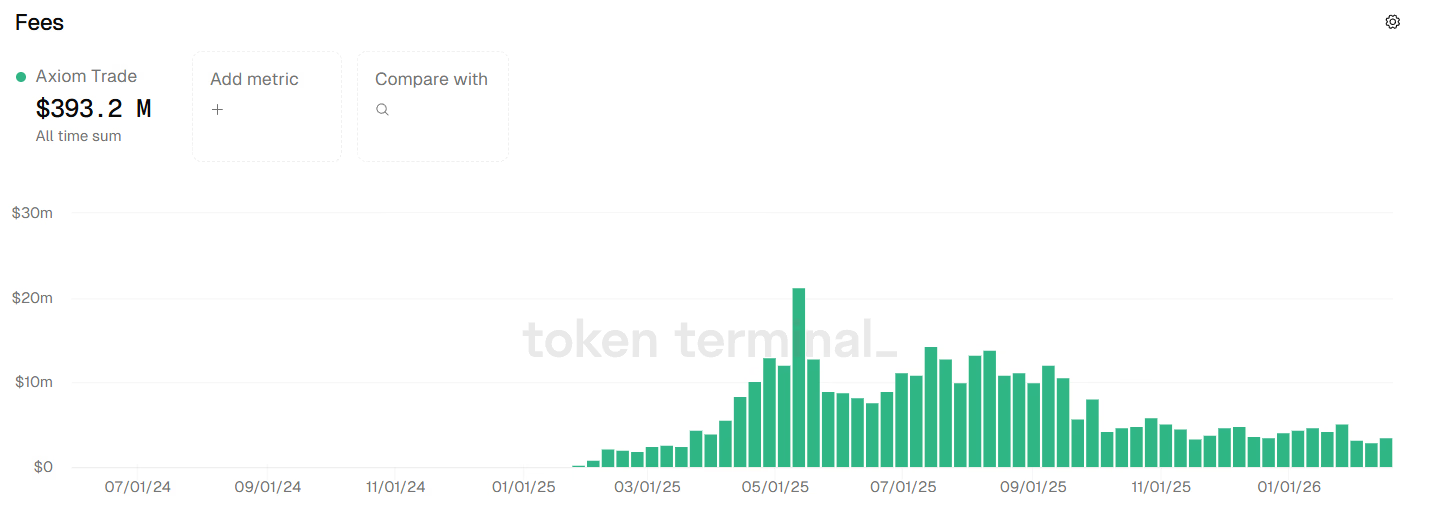
Axiom was founded by Henry Zhang — also known as Mist — and Preston Ellis — also known as Cal — in 2024 and later went through Y Combinator before quickly becoming one of the most profitable crypto platforms. The web-based trading terminal pulled in tens of millions of dollars in fees just months after launching in late January 2025, The Defiant reported earlier.
‘No Monitoring or Access Controls’
Screenshots shared in the X thread also show internal dashboards listing users’ private wallets, linked accounts, and transaction history, data that sources contacted by ZachXBT said appeared accurate.
The group also allegedly maintained shared spreadsheets mapping wallets tied to well-known traders and memecoin promoters. In another recording, Bauer lays out a plan to help a colleague make $200,000 by abusing this access, saying he would send over “the full list of wallets.”
“Regardless of whether Cal or Mist were aware, there was little to no monitoring or access controls in place to mitigate this abuse from happening in the first place,” ZachXBT wrote.
Because Bauer is based in New York, he added that the case could fall under the Southern District of New York, even if no criminal charges are ultimately filed.
It’s unclear, however, how much profit, if any, was made using the alleged insider information.
‘Shocked and Disappointed’
As the details came out, Axiom said in an X post, “We are shocked and disappointed to hear that someone on our team abused internal customer support tools to look up user wallets.” The company added that it “removed access to these tools and will continue to investigate and hold the offending parties responsible.”
Days before ZachXBT publicly named the firm, an alleged Axiom affiliate using the alias devininsider was already pushing back on speculation around Axiom. “We are simply a terminal that allows people to trade open market memecoins, what could we be possibly insider trading lol,” they said.
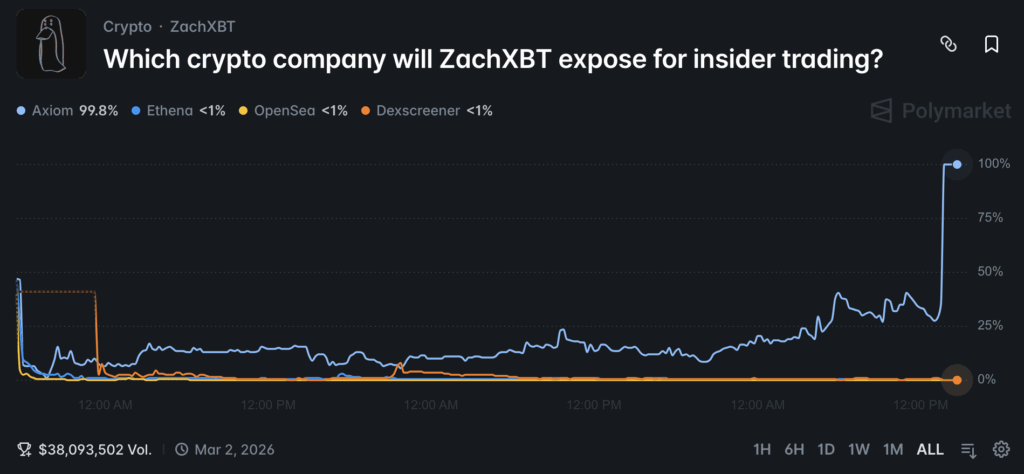
Blockchain tracker Lookonchain noted in an X post that just hours before ZachXBT named Axiom as the company accused of insider trading, two new anonymous wallets bet $59,800 on Axiom on Polymarket, and within three hours, turned it into $109,000.


Blockchains and artificial intelligence are complementary technologies, according to crypto asset manager Grayscale, even as markets have recently treated them as part of the same trade.
Zach Pandl, Grayscale’s head of research, said that while disruptive technologies tend to produce clear winners and losers, the relationship between AI and blockchain is more symbiotic than competitive. Rapid AI adoption is expected to reward some industries, such as chipmakers, while pressuring others, including segments of professional services.
“Although crypto valuations have been tightly correlated with the drawdown in software stocks, we think blockchains and AI are complementary from a fundamental standpoint,” he said in the Wednesday blog post.
U.S. equity markets have lately focused on the downside. The S&P 500 software index has fallen roughly 20% year to date, and crypto valuations have moved closely with the selloff. But Pandl maintains that the parallel drawdown obscures a more constructive long-term dynamic between the two technologies.
Investor anxiety about artificial intelligence’s disruptive potential has sparked a broad sell-off in tech and software stocks, erasing significant market value as traders reassess long-held valuations.
U.S. software and services shares have plunged sharply, wiping out roughly $1 trillion in market capitalization, as fears mount that fast-advancing AI tools could upend traditional business models and revenue streams.
The S&P 500 software index has slumped as investors rotate out of high-flight tech names amid heightened volatility and skepticism over how quickly and profitably AI adoption will play out.
Pandl contends that blockchains are likely to become the financial rails for AI agents. Today’s chatbots operate largely outside the financial system. But if AI agents are equipped with digital wallets, he expects them to transact over blockchains rather than traditional bank infrastructure.
Blockchains offer transparency, near-instant settlement, 24/7 availability and global reach with an internet connection, he said. While opening a bank account requires a human intermediary, any user, including a bot, can create a blockchain address. Pandl said rising volumes of low-value stablecoin transactions would be an early signal that this thesis is playing out.
At the same time, he argued that blockchain technology could help mitigate some of AI’s risks. As large language models proliferate, concerns around data provenance, deepfakes and the concentration of control over resources and decision-making are likely to intensify. Public blockchains, Pandl said, can provide verifiable records and more decentralized infrastructure to counterbalance those trends.
The report acknowledged AI may also introduce new challenges for crypto networks. Advanced tools could make blockchain surveillance more effective, potentially eroding user privacy. AI agents may also uncover new vulnerabilities in smart contracts; OpenAI recently launched EVMbench, an initiative aimed at using AI to identify and patch such risks.
Read more: Crypto isn’t losing to AI, its just ‘capitalism doing its job,’ says Dragonfly
Leading altcoins retraced some of their gains from Wednesday.
Crypto markets dipped slightly on Thursday, with the total market cap dropping by about 2% over the past day to around $2.39 trillion.
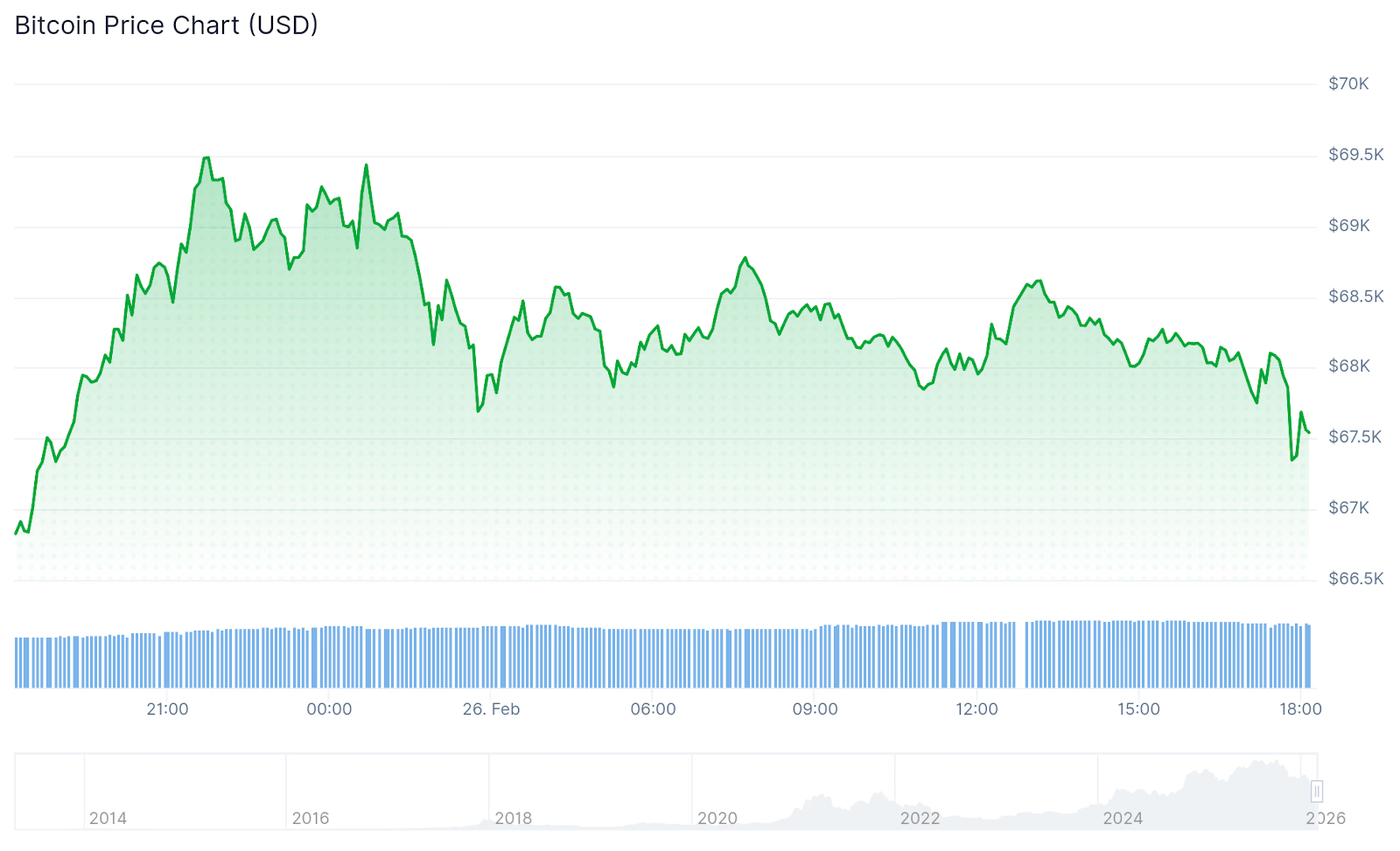
Bitcoin (BTC) is trading near $67,000, down 2% over the past day but up 1% for the week, slightly below Wednesday’s peak.

Ethereum (ETH) slipped to $1,992, posting a 3% daily loss. Among other Top 10 assets, Solana (SOL) dropped 3.5%, XRP plunged 5%, and BNB fell 1.5%.
‘Constructive Return of Liquidity’
Analysts at glassnode noted in an X post today that “profit-taking continues to absorb momentum at the $70K threshold,” implying that this is consistent with a thin liquidity regime where even modest realization events are sufficient to suppress recovery attempts.

“Historically, breaks below 1 have persisted for 6+ months before reclaiming it, a recovery that typically signals a constructive return of liquidity to the market,” they added.
Paul Howard, senior director at crypto trading firm Wincent, said in commentary for The Defiant that stronger-than-expected earnings overnight had lifted tech stocks and risk assets more broadly.
He noted that “the short squeeze on Circle was notable, alongside the significant short interest in MSTR and the earnings beat from NVDA,” adding that these moves contributed to Bitcoin’s rally over the past 24 hours.
Howard added that the market is still looking for a clear catalyst that could push cryptocurrencies significantly higher, rather than just supporting them as a hedge trade.
Big Movers and Liquidations
Among the Top 100 assets by market cap, Pippin (PIPPIN) led gains with an 18.4% jump, followed by Internet Computer (ICP), which is up 8.5%.
On the downside, Cosmos Hub (ATOM) fell 7.9%, and Morpho (MORPHO) declined 3.6%.
CoinGlass reports that more than 157,000 traders were liquidated over the past 24 hours for a total of $560 million.
Shorts dominated with around $420 million liquidated, compared with nearly $148 million in long positions.
ETFs and Macro Conditions
Spot Bitcoin ETFs saw inflows of $506 million on Wednesday, Feb. 25, the largest single-day inflow since Jan. 5, bringing total net assets to $87.6 billion. On that same day, spot Ethereum ETFs added $157 million, bringing cumulative net assets to $11.8 billion.
On the macro front, U.S. Treasury yields were mostly flat. The 10-year note slipped slightly to 4.042%, the 30-year bond yield edged down to 4.687%, and the 2-year note ticked higher to 3.473%.
Thursday’s Labor Department report showed initial unemployment claims for the week ended Feb. 21 at 212,000, slightly above the prior week’s revised 208,000 but below the 215,000 forecast, CNBC reported.
On the geopolitical side, Iran’s foreign ministry said today’s nuclear talks in Geneva produced “very constructive” proposals, but didn’t give any details, according to the Associated Press. The U.S. and Iran are negotiating indirectly, with Oman’s foreign minister and the UN’s nuclear watchdog also present.
The AI and data center boom partly driven by Bitcoin miners is increasingly being financed through high-yield bond issuance, underscoring how lenders are pricing both risk and opportunity in the sector.
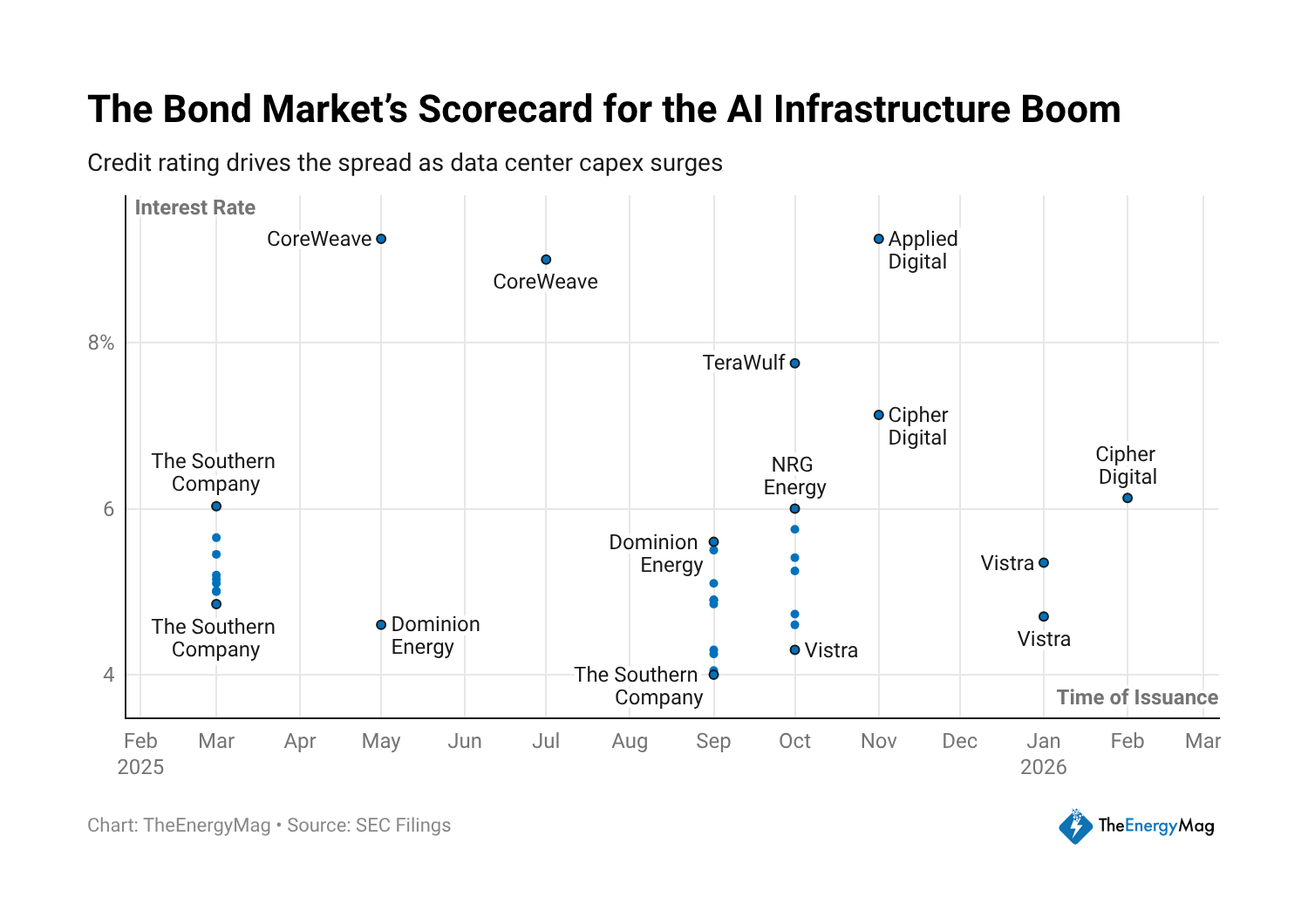
According to TheEnergyMag’s latest newsletter, companies tied to AI data center development have raised about $33 billion in long-term senior notes over the past 12 months, excluding convertible debt — bonds that can later be converted into equity and typically carry different risk dynamics.
The interest rate spread is notable: While regulated utilities and traditional energy companies generally borrow at 4% to 5%, AI- and crypto-linked issuers pay closer to 7% to 9%.
The average coupon on newly issued US dollar high-yield debt has was close to 7.2% in late 2025, from 8% to 9% in 2023, according to Janus Henderson Investors, citing BofA Global Research, average coupon, as of Nov. 30.
Those at the higher end of the spectrum are largely current or former digital asset mining companies that have pivoted into AI infrastructure, suggesting capital remains comparatively expensive for the group.
TheEnergyMag cited recent raises, including CoreWeave at 9.25% and 9% in May and July 2025, Applied Digital at 9.2% in November, TeraWulf at 7.75% and Cipher Mining at 7.125% and 6.125%.

“The message from lenders is clear,” TheEnergyMag wrote. “Regulated load and contracted generation still get treated as infrastructure. AI and bitcoin, even when attached to long-term offtake agreements, are still treated as growth credit.”
Related: Canaan buys 49% stake in three Texas mining sites for $40M
AI infrastructure boom intensifies
Despite concerns about overspending and potential overcapacity, the AI data center build-out remains one of the most visible trends in the economy, and a major driver of demand on Wall Street.
The scale of that momentum was underscored on Wednesday when chipmaker Nvidia posted blockbuster fourth-quarter results, with profit rising 94% and revenue climbing 73% year-on- year. The chipmaker reported $43 billion in net income and $68.1 billion in revenue.
Meanwhile, Bitcoin mining companies are planning about 30 gigawatts of new power capacity aimed at AI workloads, nearly triple the capacity they currently operate. Much of it remains in development pipelines or early-stage planning, but the industry has made clear that AI infrastructure is a strategic priority.
Related: The real ‘supercycle’ isn’t crypto, it’s AI infrastructure: Analyst
Crypto World
Ethereum’s Fast L1 Vision: Vitalik Buterin Unveils Strawmap Plan for Slots and Finality

TLDR:
-
- Vitalik proposes cutting Ethereum’s slot time from 12 seconds to 2 seconds using a sqrt(2) formula.
- Erasure coding upgrades to Ethereum’s p2p layer will reduce block propagation time across the network.
- The Minimmit finality algorithm targets a reduction from 16 minutes today down to just 8 seconds.
- Ethereum’s quantum-resistant upgrades will roll out in phases, with slot protection arriving first.
- Vitalik proposes cutting Ethereum’s slot time from 12 seconds to 2 seconds using a sqrt(2) formula.
Ethereum’s Fast L1 goal took center stage as Vitalik Buterin published a detailed strawman roadmap outlining how the network plans to evolve its base layer.
The document covers slot time reductions, peer-to-peer network upgrades, and a new finality algorithm. Buterin walks through each goal methodically, explaining how the changes interconnect.
The roadmap presents a phased, component-by-component transformation of Ethereum’s consensus layer toward a faster, simpler, and quantum-resistant design.
Slot Time and Network Architecture at the Core of Fast L1
Ethereum’s Fast L1 goal begins with a structured reduction of slot time across multiple incremental steps. Buterin proposes moving from the current 12 seconds down through 8, 6, 4, 3, and eventually 2 seconds per slot.
Each reduction follows a “sqrt(2) at a time” formula, with steps only taken when safety is confirmed.
Supporting shorter slots requires major improvements at the network layer. Buterin points to ongoing work by @raulvk on an optimized peer-to-peer design using erasure coding.
The new architecture splits each block into pieces so that any subset of them is enough to reconstruct the full block.
In his post, Buterin explained: “split each block into 8 pieces so that with any 4 of them you can reconstruct the full block.” This design cuts 95th percentile block propagation time and makes shorter slots viable without security tradeoffs.
That said, adding protocols like ePBS and FOCIL to the slot structure tightens timing constraints. These changes shrink the safe latency window from one-third of a slot to one-fifth.
To offset this, researchers are exploring a model where only 256 to 1,024 randomly selected attesters sign per slot, eliminating the aggregation phase and shortening slot duration further.
Finality Overhaul and the Shift to Quantum-Resistant Consensus
Beyond slot time, the strawman roadmap targets a complete rework of how Ethereum achieves finality. Today, finality takes roughly 16 minutes on average, calculated across 12-second slots, 32-slot epochs, and 2.5 epochs. Buterin wants to decouple finality from slot time entirely so each can be optimized on its own path.
The target is a one-round-finality algorithm called Minimmit, a variant of the established BFT consensus design. A projected trajectory moves from 16 minutes today through several intermediate stages, eventually reaching as low as 8 seconds with aggressive Minimmit parameters.
These changes will also carry a transition to post-quantum cryptography, including hash-based signatures and a STARK-friendly hash function.
Three hash function options are under active research: adjusting Poseidon2’s round count, returning to Poseidon1, or adopting BLAKE3 as a conventional alternative.
Buterin described the overall transformation as a “ship of Theseus” style process, replacing each part of Ethereum’s consensus layer one at a time.
Notably, the phased approach means slot-level quantum resistance could arrive well ahead of finality-level protection, providing an early security layer if quantum computing advances faster than anticipated.


A Florida man accused of running what is arguably the largest crypto-linked Ponzi scheme involving $328 million has been arrested, federal prosecutors said Wednesday.
Christopher Alexander Delgado, 34, of Apopka, Florida, was taken into custody on a criminal complaint charging him with wire fraud and money laundering, according to the U.S. Attorney’s Office for the Middle District of Florida. If convicted on all counts, he faces up to 30 years in federal prison. A criminal complaint contains allegations, and Delgado is presumed innocent unless and until proven guilty.
According to a TRM Labs global report, pyramid and Ponzi schemes received approximately $6.1 billion in victim funds globally in 2025, a 49% increase from the previous year. The most recent case prior to Goliath Ventures involves Ramil Ventura Palafox, the CEO of Praetorian Group International (PGI), who was sentenced to 20 years for misleading more than 90,000 investors and draining over $62.7 million in funds.
Prosecutors allege Delgado served as president and CEO of Goliath Ventures, formerly known as Gen-Z Venture Firm, from January 2023 through January 2026. During that period, authorities claim he raised at least $328 million from investors by promising monthly returns generated through cryptocurrency “liquidity pools,” sometimes described as “guaranteed” or “low risk,” with contracts promising monthly returns of roughly 3% to 8%.
Instead of investing the funds as represented, Delgado allegedly operated Goliath as a Ponzi scheme, using money from new investors to pay purported returns to earlier backers and to meet withdrawal requests.
The complaint alleges that the firm’s claims about deploying capital into crypto liquidity pools were false. According to court filings, investigators said blockchain analysis showed only about $1.5 million was sent to Uniswap, while the “vast majority” of investor funds were not placed into liquidity pools.
To build credibility and attract victims, prosecutors say Delgado relied on personal referrals, polished marketing materials, luxury events, charitable sponsorships and periodic payments marketed as returns. The court documents also revealed investors were shown account updates via an online portal that displayed consistent gains, but the reported “returns” were allegedly fabricated and adjusted to match promised rates.
The case is being investigated by IRS Criminal Investigation and Homeland Security Investigations and is being prosecuted by the U.S. Attorney’s Office in Orlando. Law enforcement officials are asking potential victims to come forward as the investigation continues.


Ethereum co-founder Vitalik Buterin outlined a roadmap on Thursday to protect the blockchain from the long-term risks posed by quantum computers — a move that comes shortly after the Ethereum Foundation established a dedicated post-quantum research team to study the issue.
Although practical quantum computers capable of breaking modern cryptography do not yet exist, they could one day crack the digital signatures and cryptographic systems that secure Ethereum.
In a post on X, Buterin identified four key areas of vulnerability: validator signatures used in consensus, Ethereum’s data availability system, everyday wallet signatures, and certain zero-knowledge proofs used by applications and layer-2 networks.
A big part of the plan involves changing how Ethereum’s validators sign and confirm blocks. Right now, they use a type of digital signature called BLS. In a world with powerful quantum computers, those signatures could eventually be broken. Buterin suggests switching to “hash-based” signatures, which are considered much safer against quantum attacks.
Another area that would need updating is how Ethereum checks and stores large batches of transaction data. The system it uses today relies on a cryptographic tool called KZG commitments. Replacing that with a quantum-safe alternative is possible, Buterin said, but it would require significant behind-the-scenes engineering work and could make some parts of the system more complicated.
For everyday users, the proposed fix revolves around a planned upgrade called EIP-8141. In simple terms, this upgrade would make Ethereum wallets more flexible. Today, most wallets rely on one standard type of digital signature to approve transactions. EIP-8141 would allow accounts to switch to different types of signatures in the future — including ones designed to be safe against quantum computers.
There’s a similar issue with zero-knowledge proofs, a type of advanced cryptography used by privacy tools and many layer-2 scaling networks. Quantum-safe versions of these proofs are currently far more expensive to verify on Ethereum.
Buterin pointed to a longer-term solution built into EIP-8141 known as “validation frames.” These would allow the network to bundle together many signatures and proofs and replace them with a single combined proof. Instead of checking each one individually on the blockchain, Ethereum would only need to verify one compressed proof, helping keep costs down.
Read more: Quantum threat gets real: Ethereum Foundation prioritizes security with leanVM and PQ signatures

“The growth in Cardano’s technology has been amazing, and the best is yet to come,” one X user stroke back.
Cardano’s native token reached an all-time high of almost $3.10 in late 2021. Despite sporadic runs in the following years, it has not managed to break its record and is currently worth around $0.29, representing a staggering 90% decline from the historic peak.
The steep decline has left many investors frustrated, including popular content creator Jake Gagain, who described ADA as one of his worst investments since entering the crypto market.
Wasting “Such a Great Opportunity?’
Besides expressing regret over his investment, Gagain emphasized that Cardano still has a strong community and huge potential. He said he was disappointed to see the team waste “such a great opportunity” and asked his followers whether they still hold ADA.
His post on X sparked a heated debate, with many users sharing their experiences with the token. One person agreed with Gagain, arguing that Cardano’s community is among the most dedicated, “but the execution and speed have just been painful to watch for years now.”
The discontent was echoed by numerous others, some of whom pledged to step away from ADA and all altcoins for good and to shift their capital solely to Bitcoin (BTC) from now on.
Others differentiated from this thesis. X user Michael Lesser claimed that Gagain doesn’t understand the definition of a bear market, adding that his timing is bad.
“If you have an investment thesis and patience, ‘paper losses’ are just that. The growth in Cardano’s technology has been amazing, and the best is yet to come,” he said.
Many investors who remain optimistic said they would keep accumulating ADA, convinced that the token will set a new all-time high sooner or later. Some even flashed the “diamond hands” emoji to signal their determination not to sell under any circumstances.
You may also like:
Meanwhile, certain X users attacked Gagain for promoting meme coins, which performed much worse than ADA. In the summer of 2024, for instance, he claimed that NEIRO could be the next “billion-plus dollar project” on the Ethereum blockchain. It is important to note that the asset’s market cap briefly surged above $1 billion in late 2024, but since then, it has been in a sharp decline, and its current capitalization stands at less than $30 million.
What’s Next for ADA?
Cardano’s native token has been among the biggest beneficiaries of the recent market resurgence, with its price rallying by 9% on a weekly scale. The recent whale activity suggests a further jump might be on the way.
As CryptoPotato reported, large investors have scooped up almost 820 million coins over the past six months, thus increasing their total holdings to 25.36 billion tokens, or nearly 70% of ADA’s circulating supply.
Big purchases of this type leave fewer tokens on the open market, which could result in a surging price (should demand remain constant or rise). Whales’ buying also sends a strong signal that they believe in the asset’s long-term future, and that confidence could draw smaller players into the ecosystem.
Some analysts observed ADA’s recent comeback and envisioned further gains if key levels are reclaimed. X user Nehal argued that breaking and holding above $0.30 could lead to a pump to $0.32 and $0.34.
Binance Free $600 (CryptoPotato Exclusive): Use this link to register a new account and receive $600 exclusive welcome offer on Binance (full details).
LIMITED OFFER for CryptoPotato readers at Bybit: Use this link to register and open a $500 FREE position on any coin!
US-based asset manager REX Shares has launched an exchange-traded fund that bundles leveraged covered-call strategies tied to nine individual stocks, including crypto-linked names Coinbase and Strategy, into a single income-focused product trading under the ticker GIF.
According to Thursday’s announcement, the fund holds equal-weighted positions in REX’s existing single-stock Growth & Income ETFs, each of which targets about 1.25x exposure to its underlying equity while writing covered calls on a portion of the portfolio to generate option premium income.
GIF trades on Cboe Global Markets and each underlying ETF seeks to distribute income on a weekly basis, with payouts largely derived from covered call premiums.
Covered call premiums are the upfront payments a fund collects for selling options on stocks it already owns, generating income in exchange for capping some of the shares’ upside potential.
REX Shares said the ETF holds equal-weighted exposure to nine REX funds tied to Nvidia (NVII), Tesla (TSII), Strategy (MSII), Coinbase (COII), Robinhood (HOII), Palantir (PLTI), CoreWeave (CWII), Eli Lilly (LLII) and Walmart (WMTI), spanning crypto-linked equities, technology, AI, healthcare and retail sectors.
Related: Michael Saylor says quantum threat to Bitcoin is more than 10 years away
21Shares lists STRC ETP as companies add Strategy preferred shares to treasuries
The launch comes amid a week of new allocations tied to Strategy-linked securities.
On Wednesday, 21Shares introduced an exchange-traded product (ETP) giving European investors exposure to STRC, Strategy’s variable-rate perpetual preferred stock. The 21Shares Strategy Yield ETP began trading on Euronext Amsterdam under the ticker STRC NA on Thursday.
Also on Wednesday, Strategy said Prevalon Energy, an energy infrastructure company, and Anchorage Digital, a crypto-focused digital asset bank, had allocated portions of their corporate treasuries to STRC, though they did not disclose the size of their positions.
Strategy describes STRC as a digital credit instrument with an 11.25% annual dividend, part of its broader effort to issue fixed-income securities tied to its Bitcoin (BTC) holdings.

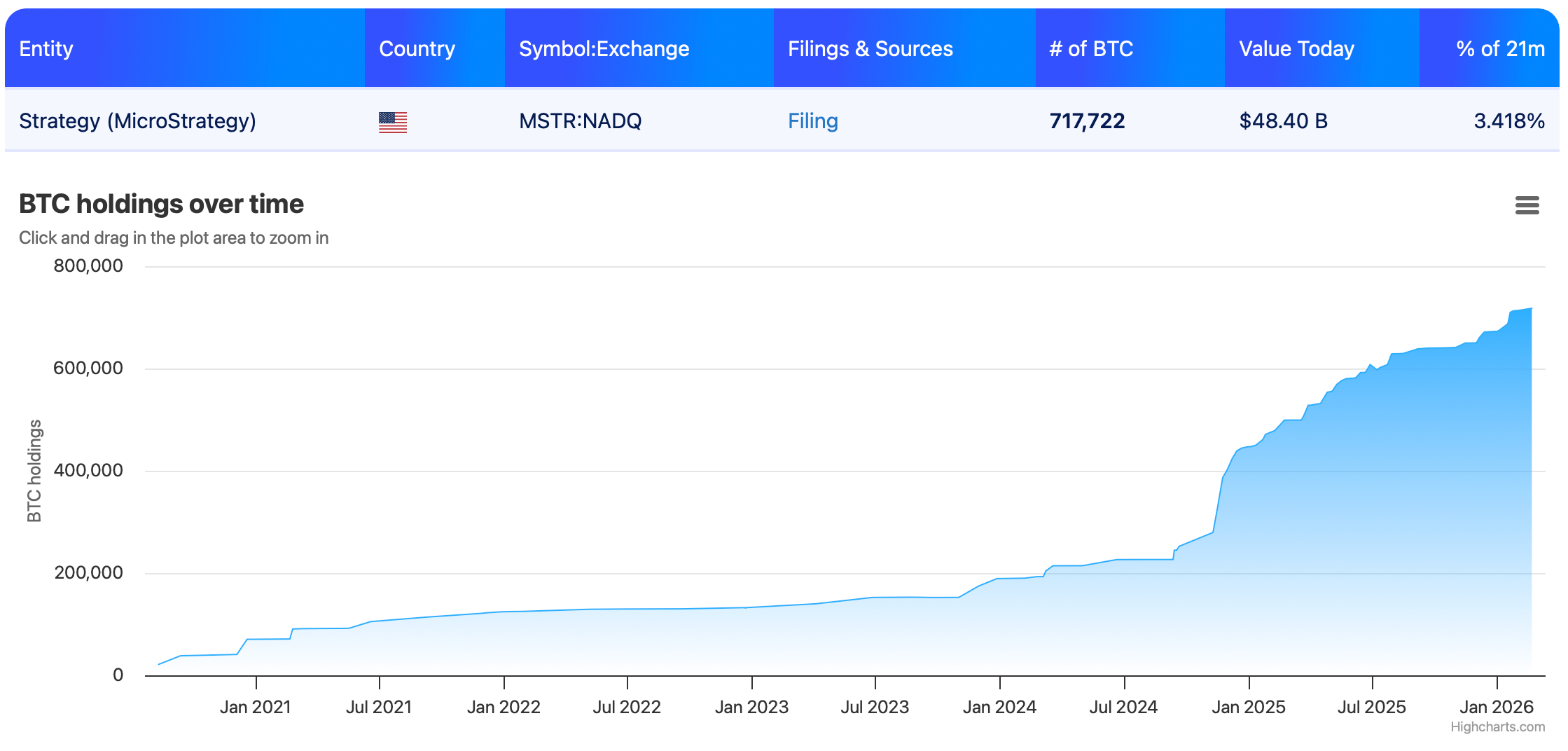
Since adopting its Bitcoin treasury strategy in August 2020, Strategy has become the largest corporate holder of Bitcoin, reporting 717,722 BTC, or about 3.4% of the fixed 21 million supply.
Despite demand for Strategy-linked securities, the company’s shares have fallen alongside Bitcoin’s price. The stock is down more than 60% over the past six months and about 50% over the past year, according to Yahoo Finance data.

Strategy has also emerged as the most heavily shorted large-cap US stock on Goldman Sachs’ latest ranking, based on short interest relative to market value.
Magazine: Bitcoin’s ‘biggest bull catalyst’ would be Saylor’s liquidation: Santiment founder
Crypto investigator ZachXBT detailed the results of a recent investigation today that show how a group of Axiom employees allegedly abused weak internal controls to spy on sensitive user data and carry out insider trading using wallet activity.
The previously teased exposé shows a group of Axiom employees and moderators discussing how they used the company’s dashboard to pull up “anything” on its users.
They apparently mapped out key opinion leaders (KOLs) within the crypto industry and targeted wallet details made available by one of the company’s senior business development professionals, Broox Bauer.
The group was recorded strategizing on how to insider trade and showed Bauer describing the ways he can pull up Axiom user data by tracking a user’s reference code, wallet, or user ID.
Bauer lays out ground rules to his group during the call, telling them not to send any Discord messages alluding to what they’re doing, and promising that if they send him specific identifying information, he’ll then get them “what they need.”
Read more: Here’s how insiders dump blockchain game tokens using Sybil attacks
Bauer also details how he’s slowly increased the number of wallets he’s probing from an initial 10 to 20 “so it does not look that suspicious.” He also promises one of his members a profit of $200,000 thanks to his access to Axiom’s data.
ZachXBT’s findings also revealed how the group targeted “a trader with a poor reputation for using his followers on X and Telegram as exit liquidity.”
Indeed, one member in the call says, “Time to farm the farmers.”
Axiom shocked by ZachXBT’s findings
In response to ZachXBT’s investigation, Axiom said it’s “shocked and disappointed to hear that someone on our team abused internal customer support tools to look up user wallets.”
“We have removed access to these tools and will continue to investigate and hold the offending parties responsible,” the crypto exchange said, adding, “This does not represent us as a team, we have always tried to put the user first. We’ll share updates on our twitter as we learn more.”
ZachXBT hinted that the insider trading evidence might be fit for a legal case against the alleged group in the Southern District of New York.
He said, “Whether or not criminal charges are filed, I hope the Axiom co-founders further investigate the abuse and consider taking legal action against the employees involved.”
ZachXBT’s Axiom teaser caused $38 million hype train
On February 23, ZachXBT announced that he’d undertaken a “major investigation” into one of “crypto’s most profitable businesses where multiple employees abused internal data to insider trade over a prolonged period of time.”
This teaser said all would be revealed today, sending Crypto Twitter into speculation overdrive as users tried to guess which firm he was talking about. The post alone has over 11 million views.
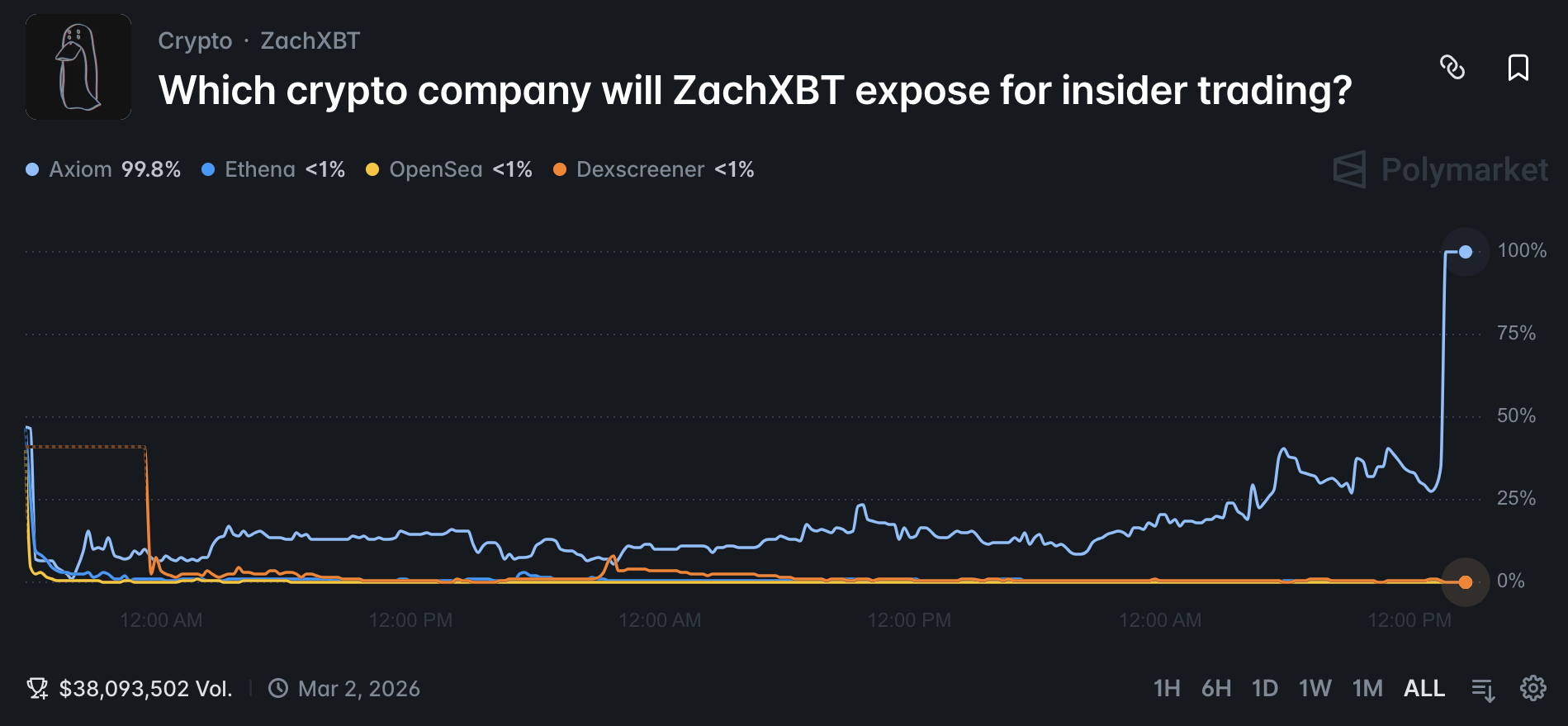
It soon caught Polymarket’s attention, and it launched a prediction market based on which firm would be outed.
This market attracted $38 million in trading volume, with Polymarket also taking bets on which day the investigation would be released and at what specific time.
Read more: Israeli soldier allegedly used military secrets to gamble on Polymarket
Ironically, some in crypto warned users to avoid this particular market, as the potential for somebody related to the investigation to use insider information to trade on the market is high.
ZachXBT also noted that after the teaser was dropped, “prediction market bros started raiding my DMs for insider info.” He also suggested that the number of interviewees means a “leak is probably inevitable.”
One Axiom employee was left red-faced when they confidently denounced Axiom’s potential to be in ZachXBT’s exposé. They have since apologised for their wayward takes.
“Devin” has also subsequently claimed that they’d been trading in this prediction market about the firm where they work and lost $20,000 as a result.
The potential for insider trading is a frequent criticism of prediction markets. Indeed, Polymarket rival Kalshi fined Mr. Beast’s editor, Artem Kaptur, for insider trading ahead of various markets related to his YouTube channel.
Kalshi also fined the former California Governor Kyle Langford for using non-public information to insider trade in his own elections.
An investigation was also opened by Israel against two military personnel who were accused of using military secrets to insider trade markets involving missile strikes against Iran.
Got a tip? Send us an email securely via Protos Leaks. For more informed news and investigations, follow us on X, Bluesky, and Google News, or subscribe to our YouTube channel.

New AirSnitch attack breaks Wi-Fi encryption in homes, offices, and enterprises

Fire on Flyingdales Moor: Police investigating report

SpaceX-xAI Merger Fuels Space-Based AI Ambitions as Wealth Nears Trillion-Dollar


-

 Video7 days ago
XRP News: XRP Just Entered a New Phase (Almost Nobody Noticed)
-

 Politics4 days ago
Baftas 2026: Awards Nominations, Presenters And Performers
-

 Fashion6 days ago
Weekend Open Thread: Boden – Corporette.com
-

 Sports3 days ago
Women’s college basketball rankings: Iowa reenters top 10, Auriemma makes history
-

 Politics3 days ago
Nick Reiner Enters Plea In Deaths Of Parents Rob And Michele
-

 Business2 days ago
True Citrus debuts functional drink mix collection
-

 Crypto World2 days ago
XRP price enters “dead zone” as Binance leverage hits lows
-

 Business4 days ago
Mattel’s American Girl brand turns 40, dolls enter a new era
-

 Business4 days ago
Law enforcement kills armed man seeking to enter Trump’s Mar-a-Lago resort, officials say
-

 Tech2 days ago
Unsurprisingly, Apple's board gets what it wants in 2026 shareholder meeting
-

 NewsBeat18 hours ago
Cuba says its forces have killed four on US-registered speedboat | World News
-
 NewsBeat20 hours ago
Manchester Central Mosque issues statement as it imposes new measures ‘with immediate effect’ after armed men enter
-
 NewsBeat3 days ago
‘Hourly’ method from gastroenterologist ‘helps reduce air travel bloating’
-

 Tech4 days ago
Anthropic-Backed Group Enters NY-12 AI PAC Fight
-

 NewsBeat4 days ago
Armed man killed after entering secure perimeter of Mar-a-Lago, Secret Service says
-

 Politics4 days ago
Maine has a long track record of electing moderates. Enter Graham Platner.
-
 NewsBeat2 days ago
Police latest as search for missing woman enters day nine
-

 Business14 hours ago
Discord Pushes Implementation of Global Age Checks to Second Half of 2026
-

 Crypto World2 days ago
Entering new markets without increasing payment costs
-
 Sports3 days ago
2026 NFL mock draft: WRs fly off the board in first round entering combine week