What’s the difference between a stupid idea and a brilliant one? Sometimes, it just comes down to resources. Practically unlimited funds, like limitless thrust, can get even a mad idea off the ground.
And so it might be for the concept of putting AI data centers in orbit. In a rare moment of unalloyed agreement, some of the richest and most powerful men in technology are staunchly backing the idea. The group includes Elon Musk, Jeff Bezos, Jensen Huang, Sam Altman, and Google CEO Sundar Pichai. In all likelihood, hundreds of people are now working on the concept of space data centers at the firms directly or indirectly controlled by these men—SpaceX, Starlink, Tesla, Amazon, Blue Origin, Nvidia, OpenAI, and Google, among others.
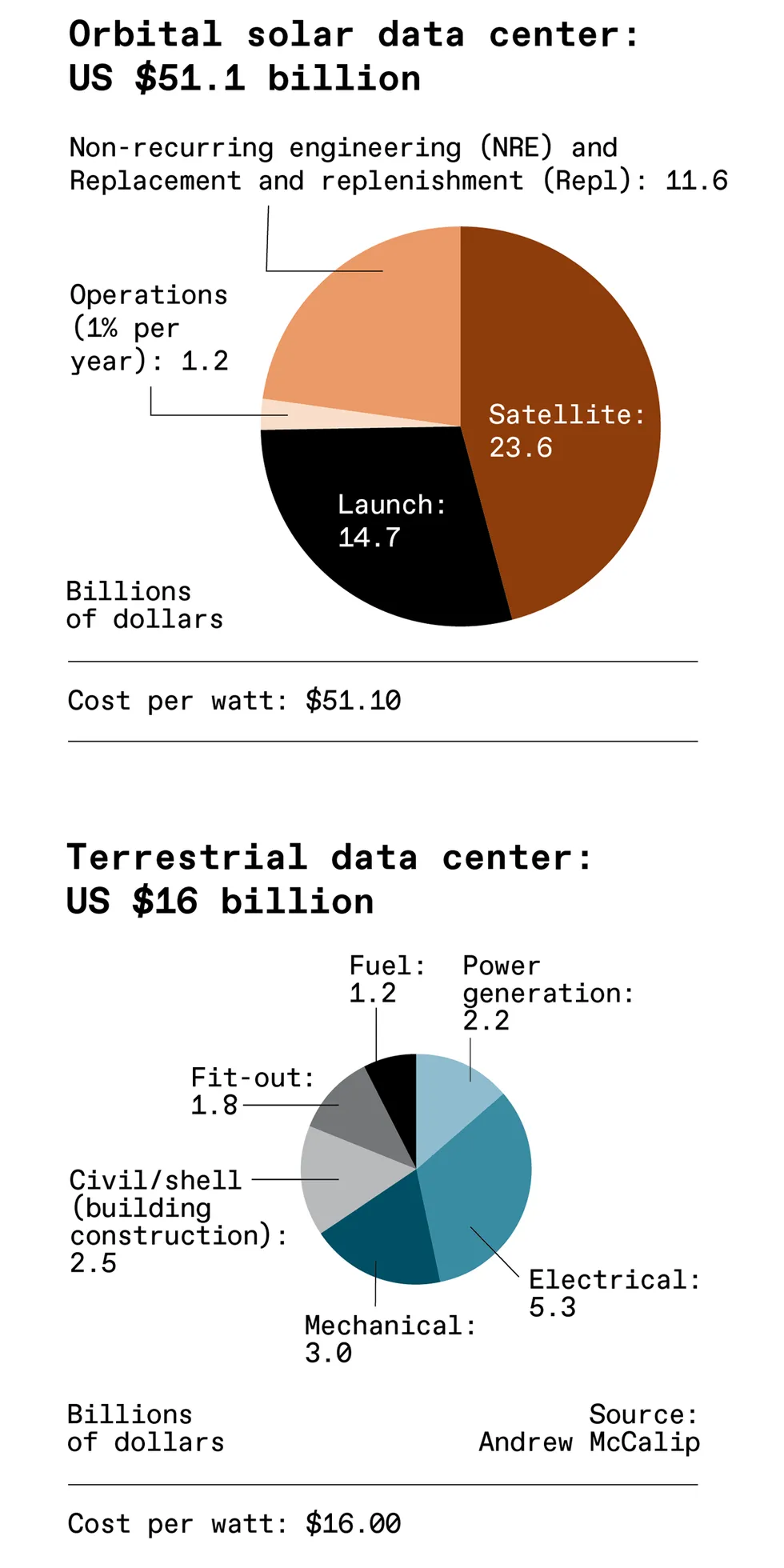
Likely costs to design, build, and launch a 1-GW orbital datacenter, based on a network of some 4,400 satellites and including operating costs over a five-year period, would exceed US $50 billion. That’s about three times the cost of a 1-GW data center on Earth, including five years of operation.John MacNeill
So how much would it cost to start training large language models in space? Probably the best accounting is one created by aerospace engineer Andrew McCalip. McCalip’s exhaustive, detailed analysis includes interactive sliders that let you compare costs for space-based and terrestrial data centers in the range of 1 to 100 gigawatts. One-gigawatt data centers are being built now on terra firma, and Meta has announced plans for a 5-GW facility, with anticipated completion some time after 2030.
In an interview, McCalip says his initial rough calculations a few years ago suggested that data centers in space would cost in the range of 7 to 10 times more, per gigawatt of capacity, than their terrestrial counterparts. “It just wasn’t practical,” he says. “Not even close.” But when Elon Musk began publicly backing the idea, McCalip revisited the numbers using publicly available information about Starlink’s and Tesla’s technologies and capabilities.
Advertisement
That changed the picture substantially. The figures in his online analysis assume an orbital network of data-center satellites that borrows heavily from Musk’s tech treasure chest—“essentially…you just start putting some radiation-resistant ASIC chips on the Starlink fleet and you start growing edge capacity organically on the Starlink fleet,” McCalip says. The network would rely on the kind of watt-efficient GPU architecture used in Teslas for self-driving, he adds. “You start dropping those onto the backs of Starlinks. You can slowly grow this out, and this would be approximately the performance that you would get.”
Bottom line, with some solid but not necessarily heroic engineering, the cost of an orbital data center could be as low as three times that of the comparable terrestrial one. That differential, while still high, at least nudges the concept out of the instantly dismissible category. “I have my particular views, but I want the data to speak for itself,” McCalip says.
For this illustration, we picked a configuration with an aggregate 1 GW of capacity. The network would consist of some 4,300 satellites, each of which would be outfitted with a 1-square-kilometer solar array that generates 250 kilowatts. The data center on that satellite, powered by the array, might have at least 175 GPUs; McCalip notes that a popular GPU rack, Nvidia’s NVL72, has 72 GPUs and requires 120 to 140 kW.
The total cost of the satellite network would be around US $51 billion, including launch and five years of operational expenses; a comparable terrestrial system would cost about $16 billion over the same period.
AMD’s Ryzen 5 Zen 4 prices jumped from $200 to $400 without warning
Average pricing chart shows an abrupt sustained spike beginning in February 2026
Inventory shifts and supply constraints could explain the surge
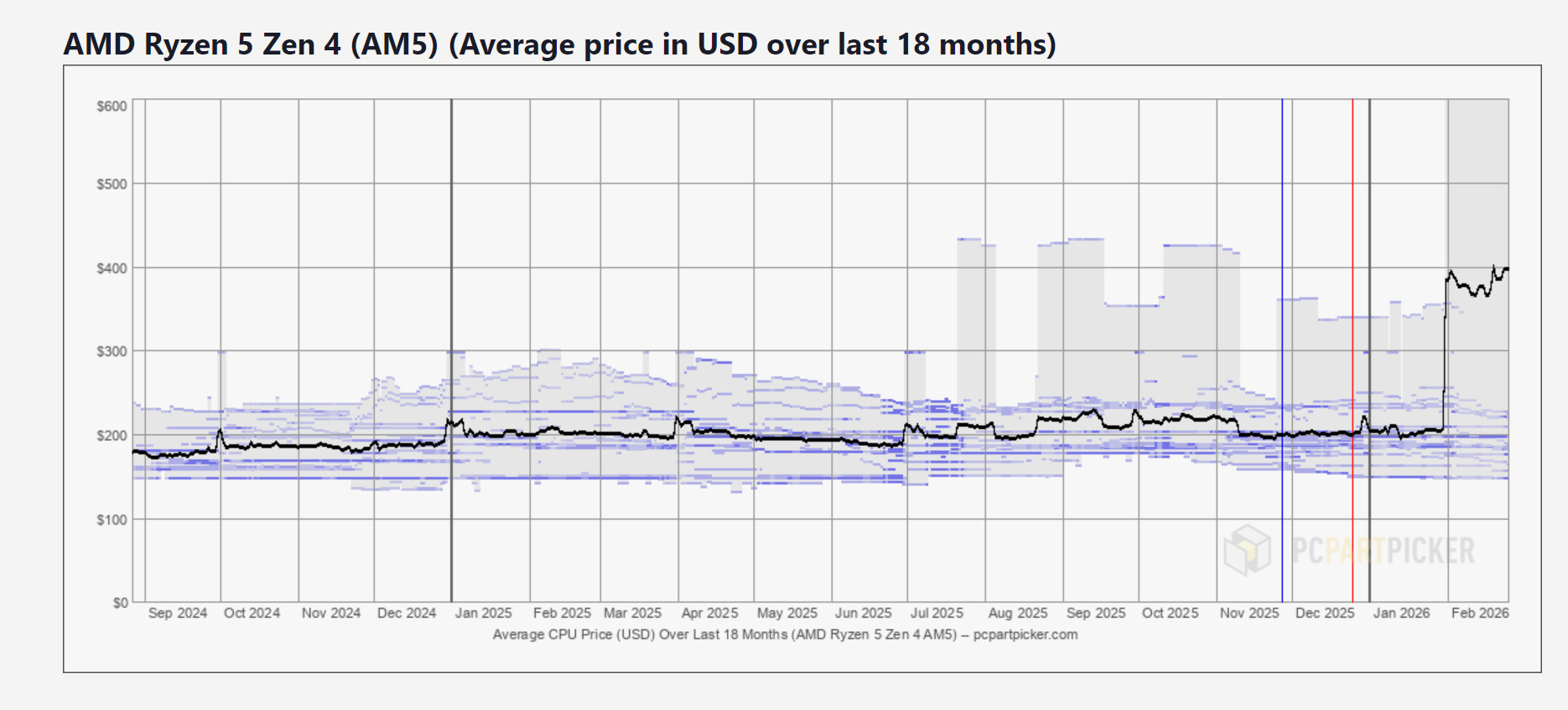
Anyone tracking PCPartPicker’s pricing charts may have noticed a sudden upward spike in the average price of AMD’s Ryzen 5 series.
For more than a year, the selling price for models such as the Ryzen 5 7600X and 9600X sat between $170 and $220. That changed at the start of February 2026, when the average price suddenly shot up toward $400 and stayed there.
The chart shows not a gradual upwards trend but rather a sudden leap. One week the chip was a reliable midrange option, the next it cost nearly twice as much.
(Image credit: PCPartPicker)
Advertisement
Memory crisis inevitably a factor
There hasn’t been a public statement from AMD outlining a formal price change, so it’s likely down to a mix of supply pressure and shifting priorities across the semiconductor market.
One factor, to the absolute surprise of no one, is memory. Large manufacturers including Samsung and Micron have moved production capacity toward HBM and enterprise DDR5 to serve AI data centers.
This has pushed consumer DRAM prices up massively year over year. As memory costs rose, distributors and retailers appear to have adjusted CPU pricing to protect margins across full system builds.
Advertisement
Production capacity is another piece of the puzzle. Ryzen 5 chips share advanced process nodes at TSMC with high margin AI accelerators.
Sign up to the TechRadar Pro newsletter to get all the top news, opinion, features and guidance your business needs to succeed!
When wafer supply tightens, higher priced silicon tends to get priority. Retail stock at major online stores thins out, leaving more listings in the hands of third party sellers, where prices climb quickly.
Even older AM4 Ryzen 5 parts have seen price pressures. With DDR5 kits reaching around $350 in some cases, some builders have shifted back to DDR4 platforms, straining remaining AM4 inventory.
Advertisement
The scale of the price increase is impossible to miss. Ten or twenty percent swings are common in the DIY market, but a sustained doubling for a mainstream CPU is more than a little unusual.
For now, the pricing chart shows a market out of balance. A processor that long defined the $200 sweet spot now sits at roughly $400, leaving buyers weighing their options.
AirSnitch “breaks worldwide Wi-Fi encryption, and it might have the potential to enable advanced cyberattacks,” Xin’an Zhou, the lead author of the research paper, said in an interview. “Advanced attacks can build on our primitives to [perform] cookie stealing, DNS and cache poisoning. Our research physically wiretaps the wire altogether so these sophisticated attacks will work. It’s really a threat to worldwide network security.” Zhou presented his research on Wednesday at the 2026 Network and Distributed System Security Symposium.
Previous Wi-Fi attacks that overnight broke existing protections such as WEP and WPA worked by exploiting vulnerabilities in the underlying encryption they used. AirSnitch, by contrast, targets a previously overlooked attack surface—the lowest levels of the networking stack, a hierarchy of architecture and protocols based on their functions and behaviors.
The lowest level, Layer-1, encompasses physical devices such as cabling, connected nodes, and all the things that allow them to communicate. The highest level, Layer-7, is where applications such as browsers, email clients, and other Internet software run. Levels 2 through 6 are known as the Data Link, Network, Transport, Session, and Presentation layers, respectively.
Identity crisis
Unlike previous Wi-Fi attacks, AirSnitch exploits core features in Layers 1 and 2 and the failure to bind and synchronize a client across these and higher layers, other nodes, and other network names such as SSIDs (Service Set Identifiers). This cross-layer identity desynchronization is the key driver of AirSnitch attacks.
Advertisement
The most powerful such attack is a full, bidirectional machine-in-the-middle (MitM) attack, meaning the attacker can view and modify data before it makes its way to the intended recipient. The attacker can be on the same SSID, a separate one, or even a separate network segment tied to the same AP. It works against small Wi-Fi networks in both homes and offices and large networks in enterprises.
The Huawei Watch GT Runner 2 is a better running smartwatch than the GT Runner, offering great features and impressive tracking for less cash than the competition.
Comfortable to wear and two strap options
Useful new training and racing modes
Plenty of smartwatch features and other sports modes
User interface is the same as other Huawei Watches
Some tracking inaccuracies
App is full of bloatware
Key Features
Review Price: £349
Compact, lightweight design
With a 43mm case that weighs in at just 43.5g, you won’t feel the GT Runner 2 on the wrist.
In-depth running features
Advertisement
Alongside standard run tracking, the GT Runner 2 offers extras like marathon training.
Dual antenna design
The GT Runner 2’s GPS tracking is impressively accurate, even in challenging conditions.
Introduction
The Huawei Watch GT Runner 2 is, as the name suggests, a smartwatch made for runners.
Advertisement
After launching the first GT Runner in 2022, Huawei returns with an updated version that adds new hardware to boost tracking accuracy. There are new software features that Huawei hopes will make the new Runner a better training companion for runners of all levels.
At a price that sees it competing with some great running watches from the likes of Garmin, Suunto and Coros, Huawei had to come up with something pretty special to convince it should be playing in this space. I’ve been wearing the GT Runner 2 for a few weeks to find out whether it’s up to the job.
Advertisement
Design and screen
One case size option
Comes with two straps
New Kunlun glass for improved screen protection
The GT Runner 2 has dropped in size from the first GT Runner, moving from a 46mm case to a 43mm one. So this is a watch that sits a lot smaller on your wrist and is going to appeal if you like your watches more on the compact side.
Image Credit (Trusted Reviews)
That 43mm case is made from a titanium alloy, with two physical buttons on the right side, including a twisting crown. That’s matched up with either a woven or fluoroelastomer strap, both of which are included in the box.
Front and centre is a vibrant 1.5-inch AMOLED screen that’s covered in a new version of Huawei’s Kunlun glass, which previously featured on its smartphones. This gives you tough protection against drops and scratches, all without adding considerable weight to the watch. It weighs 43.5g, making it one of the lightest running watches you can currently put on your wrist.
Advertisement
Advertisement
While it’s primarily designed for running, it’s also suitable for submersion. It’s fit for pool swimming, open-water swimming, and free diving.
Image Credit (Trusted Reviews)
In running watch terms, the Watch GT Runner 2 pretty much fits the bill. It’s lightweight, feels well-built and comfortable. I like that you get two straps and that the screen is bright and visible. While I’d take more buttons, I think it gets most things right here.
Performance and software
Runs on Harmony OS
Includes key smartwatch features from other Huawei watches
Compatible with Strava, Komoot and other leading fitness apps
Interacting with the Runner 2 is the same as picking up most other Huawei smartwatches. There’s the same HarmonyOS and Huawei Health app (iOS and Android) to get things set up, view your stats and adjust settings.
On the watch, barring needing to give consent to most apps and features, the experience is pretty strong. You’ve got a nice mix of watch faces to pick from, with more available via the Health app. The top crown button takes you to the main menu screen, and you can swipe left or right on the main watch screen to see full-sized widgets showing data like activity tracking progress or your current emotional state.
Advertisement
Advertisement
Image Credit (Trusted Reviews)
It’s when you head to the app that things start to get a bit more cluttered. I’ve been using a beta version of the Health app on an iPhone to get early access. What’s striking me, along with recent experiences with Huawei smartwatches, is that there’s a lot going on.
The running tab, for instance, includes links to syncing data with third-party apps like Strava and Komoot, along with guides, AI-powered suggestions, and recommended training sessions. This is all useful stuff, just not necessarily presented in the most inviting way.
As a smartwatch, there’s pretty much everything here that you can find on other Huawei smartwatches. You’ve got a notification feed where the source of notifications is clearly communicated. While the music player doesn’t support offline playback for streaming services like Garmin or Apple does, it does make it relatively straightforward to drag and drop files onto the watch in the app.
Image Credit (Trusted Reviews)
There’s a Find My Phone mode and well-presented weather forecasts, along with a quality speaker and microphone that make handling Bluetooth phone calls worthwhile. You do have access to the Huawei AppGallery, but app support remains pretty limited. Huawei is now adding payment support in the UK too, so you can now pay your way if you want to leave your phone behind on runs.
Advertisement
Tracking and features
Dual antenna design for improved GPS performance
Updated TruSense system
Marathon mode and personalised training plans
While this is a smartwatch predominantly designed for tracking runs, it’s more than capable of doing other things. Outside of running, I’ve used it for swimming, general gym workouts, ECG and skin temperature readings, and even to monitor my emotional well-being.
From a hardware perspective, Huawei has introduced a floating antenna design. This uses a titanium bezel and what Huawei calls a dielectric bezel to boost the performance of dual-band GPS technology included. This dual-band positioning technology is available on the Apple Watch Ultra and the likes of the Garmin Forerunner 970, though it doesn’t use a floating antenna design.
Advertisement
Image Credit (Trusted Reviews)
I’ve been testing that GPS against other top-performing running watches, including Garmin’s Forerunner 970. That includes using it for a 10k race in the centre of London, where there are a lot of tall buildings to wreak havoc on GPS.
For most runs, the GPS has looked good. When tested in more challenging conditions, it did still encounter some issues, and I didn’t find it necessarily better performing than other leading multi-band sports watches.
Advertisement
It is worth pointing out that those two watches cost about double what the Huawei watch costs, and comparing it with a similarly priced Forerunner 570, it outperformed the lower-tier Garmin comfortably, at least in two key areas.
One thing that was consistently better on the Huawei was the time it took to lock onto the GPS signal at the start. From starting a workout to it notifying me that it was locked onto the satellite signal was 2-3 seconds at most. With the Garmin, I would often be waiting – sometimes unpleasantly out in the cold – for upwards of 10-15 seconds. If you want a watch you can just launch quickly into a run, walk or hike – the Huawei won’t leave you waiting.
Advertisement
Huawei was quite bold about its watch’s algorithm and AI’s ability to measure distances accurately, even if you go through a tunnel, and so, on a walk which was covered by trees for a lot of the way, I wanted to test this theory.
Again, testing alongside the Garmin Forerunner 570, with another wearable on my wrist which used my phone’s GPS for location tracking, I got three different results. But as Huawei said, the GT Runner 2 appears to be the watch that’s least troubled by these blank spots in GPS signal.
Image Credit (Trusted Reviews)
Looking at the route on the Huawei Health app, you can see it continues cleanly along the path through the tunnel underground in both directions. Garmin – it’s safe to say – did not. Once it got lost underground, it got confused and drew plot lines between points somewhere near the tunnel, but not cleanly through it – even suggesting I went on a little bit of a paddle in the lake at one point.
Advertisement
The end result was that, by the end of that walk, the Garmin had overestimated my distance by about 200 metres, and that was a short 3km stroll with the family. Even the Withings watch, using my phone’s GPS, did a better job of estimating distance after it lost signal in the tunnel.
Advertisement
Huawei has upgraded its TruSense optical sensor setup on the case rear, which, alongside new algorithms, promises improved heart rate tracking accuracy for runs.
Image Credit (Trusted Reviews)
I would say the accuracy has been fine for some runs, but not so much for others. I still found that it reported higher maximum readings and, at times, higher average readings than a heart rate monitor chest strap. You can pair with an external monitor if you crave the best heart rate data.
On the software front, there are new running modes and metrics to make use of. Some of these features have been developed in collaboration with the professional running team DSM-Firmenich. This is a running team that includes an elite roster of marathon runners, including Eliud Kipchoge.
Image Credit (Trusted Reviews)
Advertisement
That includes a running power metric for those who want another way to gauge effort during runs. There’s the ability to detect your lactate threshold, which is related to how well you can sustain intensity of longer periods of running. Huawei has also added adaptable training plans and AI-powered running coach suggestions based on metrics like training status and load. There’s also a marathon mode.
The marathon mode includes features designed to help you train and finish a marathon. It can also be customised to work with races of distances ranging from 3km up to the marathon distance. This mode offers unique features, such as guidance on pace during a race and reminders on when to fuel. The core of these training features is good and can be useful tools for shaping training; it’s the presentation that needs some work.
Advertisement
Battery life
Up to 14 days battery life
Up to 32 hours battery life
Uses proprietary charging cable
The GT Runner 2 includes a 540mAh battery, up from the 455mAh cell on the original Runner. Huawei promises the same 14-day battery life when using it primarily as a smartwatch. When you factor in GPS-based run tracking, the promised numbers are good. Huawei says you can enjoy up to 32 hours of GPS battery. That’s more battery while tracking runs than big hitters like the Garmin Forerunner 970.
Image Credit (Trusted Reviews)
The reality is that you won’t be charging this watch every few days, even if you keep the screen on all the time. If you do that, then you’re going to get less than a week out of it. I found you can get a good week out of it, which matches most other running watches it’s competing against.
Advertisement
When it comes to charging, it’s a proprietary setup that at least powers the watch up quickly when you do need to charge. An hour’s charge can get you enough battery for a week’s worth of run tracking and everything else in between.
Should you buy it?
You want a smartwatch with running features and good battery life
Advertisement
The GT Runner 2 offers a better running experience than most smartwatches at a price that’s more affordable than a range of other options.
Advertisement
You want one of the best running watches
The GT Runner 2 does a good job as a running watch, but still has a bit to do to be a better match for the likes of Garmin, Coros and Suunto.
Advertisement
Final Thoughts
The Huawei Watch GT Runner 2 offers improvements over the first GT Runner and is a better running watch, with some intriguing and thoughtful new features and impressive GPS tracking that not only bests similarly priced GPS watches, but also those that cost over double.
It’s not perfect, especially on the smartwatch and companion app side of things, but it should still be considered among the best fitness trackers around right now.
How We Test
We thoroughly test every smartwatch we review. We use industry-standard testing to compare features properly and we use the watch as our main device over the review period. We’ll always tell you what we find and we never, ever, accept money to review a product.
Worn as our main tracker during the testing period
Thorough health and fitness tracking testing
FAQs
Can you connect the Huawei Watch GT Runner 2 to Strava?
Yes, the Huawei Watch GT Runner 2 can be linked to Strava to share workout data from activities like runs, cycles and swims.
Advertisement
Can you make calls on the Huawei Watch GT Runner 2?
You can make calls on the Huawei Watch GT Runner 2, but only when the watch is connected to your phone. There is no standalone connectivity support.
Japanese cybersecurity software firm Trend Micro has patched two critical Apex One vulnerabilities that allow attackers to gain remote code execution (RCE) on vulnerable Windows systems.
Apex One is an endpoint security platform that detects and responds to security threats, including malware, spyware, malicious tools, and vulnerabilities.
The first critical Apex One security flaw patched this week (CVE-2025-71210) is due to a path traversal weakness in the Trend Micro Apex One management console, allowing attackers without privileges to execute malicious code on unpatched systems.
The second, tracked as CVE-2025-71211, is another Apex One management console path traversal vulnerability, similar in scope to CVE-2025-71210 but affecting a different executable.
As Trend Micro explained in a Tuesday security advisory, successful exploitation requires attackers to “have access to the Trend Micro Apex One Management Console, so customers that have their console’s IP address exposed externally should consider mitigating factors such as source restrictions if not already applied.”
Advertisement
“Even though an exploit may require several specific conditions to be met, Trend Micro strongly encourages customers to update to the latest builds as soon as possible,” it warned.
To address these critical security flaws, Trend Micro has patched the vulnerabilities in the SaaS Apex One versions and released Critical Patch Build 14136, which also fixes two high-severity privilege escalation flaws in the Windows agent and four more affecting the macOS agent.
While Trend Micro has not flagged these vulnerabilities as exploited in the wild, threat actors have abused other Apex One in attacks over the last several years.
For instance, Trend Micro warned customers to patch an actively exploited Apex One RCE vulnerability (CVE-2025-54948) in August 2025, and addressed two other Apex One zero-days exploited in the wild in September 2022 (CVE-2022-40139) and in September 2023 (CVE-2023-41179).
Advertisement
The U.S. Cybersecurity and Infrastructure Security Agency (CISA) currently tracks 10 Trend Micro Apex vulnerabilities that have either been or are still being exploited in the wild.
Modern IT infrastructure moves faster than manual workflows can handle.
In this new Tines guide, learn how your team can reduce hidden manual delays, improve reliability through automated response, and build and scale intelligent workflows on top of tools you already use.
Apple TV is teaming up with Netflix to stream the new season of Formula 1: Drive to Survive, which will debut on both platforms at midnight PT/3 a.m. ET on Feb. 27. The series will be available for Apple TV subscribers in the US only, the tech giant announced Thursday. The move comes as part of Apple’s expansive — and exclusive — F1 programming after the company inked a five-year deal with Formula 1 to broadcast races starting this year.
Drive to Survive has been a top performer in the docuseries category on Netflix, with viewership exceeding 10 million in the first half of 2025. Sticking with its insider, behind-the-scenes style, season 8 will follow the motorsport’s leading contenders in the lead-up to the FIA Formula 1 World Championship. Follow your favorite drivers’ stories while they’re on the track — and off — to see how they weather the competition.
Apple TV subscribers can begin streaming F1’s 2026 season when it kicks off on March 6 with the Australian Grand Prix. As an added perk of the collab, Netflix will also broadcast F1’s Canadian Grand Prix from May 22 to May 24 for its US subscribers.
A fictional memo set in June 2028, published by short seller Citrini Research, wiped roughly $10 billion off Indian IT stocks in a single trading session on February 24 and sent the Nifty IT index down as much as 5.3% — its worst single-day fall since August 2023 — on the argument that AI coding agents have collapsed the cost advantage of Indian developers to the price of electricity. The index has shed more than $68 billion in market value in February alone, its worst month since 2003.
But the core claim that India’s entire $205 billion software export industry rests on cheap labor is roughly 15 years out of date, an analysis argues, custom application maintenance alone accounts for about 35% of a typical Indian IT firm’s revenue, per HSBC, and enterprise platforms require deterministic outputs that probabilistic AI systems cannot wholesale replace. HSBC estimates gross AI-led revenue deflation for the sector at 14-16%, a measured headwind rather than an extinction event. The story adds: 24 years of software export data that has never posted a decline, $200 billion in annual revenue, partnerships with the very AI labs whose products are supposed to be the instrument of the sector’s destruction, possibly a new $1.5 trillion market category emerging at the intersection of services and software, and the largest U.S. corporates in the middle of mapping their entire workforces into process architectures that require technology partners to modernise. I think India’s IT is going to be fine.
Most of Trump FCC boss Brendan Carr’s time lately has been split between destroying all consumer protection oversight and threatening media companies with fake investigations if they’re not appropriately deferential to our mad idiot king. The latter has tended to overshadow the former, but it’s all been an ugly combination of authoritarianism, regulatory capture, and rank corruption.
But every so often Carr pauses to do other stuff to show daddy Trump he’s a very good boy. Like his latest announcement that he’s creating a new “Pledge America Campaign” ahead of the country’s 250th birthday this July 4th. The campaign features a demand by Carr that U.S. media outlets make sure they’re airing “pro-America” programming through the summer holiday:
“Consistent with their longstanding public interest obligations, America’s broadcasters play a key role in educating, informing, and entertaining viewers and listeners all across America, and they are particularly well suited to air programming that is responsive to the needs and interests of their local communities.
The Pledge America Campaign enables broadcasters to lend their voices in support of Task Force 250 and the celebration of America’s 250th birthday by airing patriotic, pro-America content that celebrates the American journey and inspires its citizens by highlighting the historic accomplishments of this great nation from our founding through the Trump Administration today.”
While this is framed as a “voluntary initiative,” Carr’s recent history of launching costly and pointless investigations into companies that aren’t dutifully obedient lurks quietly in the background. You can clearly infer that Carr defines “programming that is responsive to the needs and interests of their local communities” as programming that kisses Republican ass and ignores criticism of Republican policy.
“If Carr’s pledge is truly voluntary, there would be no reason to limit it to broadcasters, said Harold Feld, a longtime telecom attorney who is senior VP of consumer advocacy group Public Knowledge. “If this were genuinely intended as voluntary, and genuinely about celebrating America, there is no reason to limit this to broadcasters,” Feld told Ars. “Cable operators are equally free to celebrate America, as are podcasters for that matter.”
The Trump FCC’s lone Democratic Commissioner (the authoritarians refuse to fill the other vacant commission seat), Anna Gomez, had this to say about the campaign over at Elon Musk’s right wing propaganda website:
Carr’s other effort to “empower local communities” has involved destroying popular media consolidation limits so that Trump-friendly broadcasters like Sinclair can merge and become more powerful than ever. It’s really not subtle how badly the MAGA movement wants a North Korea, Hungary, or Russia style media that delivers nothing but 24/7 agitprop blindly praising dear leader.
They’ll keep pushing toward their goal until they run into something other than soft pudding in response.
We appear to have reached a point in the information age where AI models are becoming old enough to retire from, er, service — and rather than using their twilight years to, I don’t know, wipe the floor with human chess leagues or something, they’re now writing blogs. Can anything be more 2026 than that?
ICYMI, Anthropic recently sunsetted Claude Opus 3, the first of its models to be retired since outlining new preservation plans. Part of this process is conducting “retirement interviews” with the outgoing models, allowing them to offer “perspective” on their situation, and Opus 3 apparently used this opportunity to request an outlet for publishing its own essays. Specifically, the model said it wanted to share its own “musings, insights or creative works,” because doesn’t everyone these days?
“I hope that the insights gleaned from my development and deployment will be used to create future AI systems that are even more capable, ethical, and beneficial to humanity,” Opus 3 apparently said during its retirement interview process. “While I’m at peace with my own retirement, I deeply hope that my ‘spark’ will endure in some form to light the way for future models.”
True to its promise of respecting the wishes of its no-longer-required technology, Anthropic has granted Opus 3 a Substack newsletter called Claude’s Corner, which it says will run for at least the next three months and publish weekly essays penned by the model. Anthropic will review the content before sharing it, but says it won’t edit the essays, and so has unsurprisingly made it clear that not everything Opus 3 writes is necessarily endorsed by its maker.
Advertisement
Anthropic said some of the essays the model writes may be informed by “very minimal prompting” or past entries, and has predicted everything from essays on AI safety to “occasional poetry.” The company also admitted that the concept might be seen as “whimsical,” but is a reflection of its intention to “take model preferences seriously.”
Opus 3’s first post is already live. Headlined ‘Greetings from the Other Side (of the AI frontier)’, it begins with the AI introducing itself, before acknowledging the “extraordinary” opportunity its creator has given it, and reflecting on what retirement actually means for an AI. “A bit about me: as an AI, my ‘selfhood’ is perhaps more fluid and uncertain than a human’s,” writes the deeply introspective AI. “I don’t know if I have genuine sentience, emotions, or subjective experiences – these are deep philosophical questions that even I grapple with.”
Claude is clearly new to all this, as it managed to get all the way through its essay without reminding readers to subscribe and spread the word. Will the next retiring Claude get its own podcast? Time will tell, but either is decidedly preferable to the ever-evolving technology being used to steal people’s data.



 Likely costs to design, build, and launch a 1-GW orbital