FOX Business reporter Jeff Flock reports on mortgage rates falling to their lowest level since February 2023 as President Donald Trump pushes efforts to make homeownership more affordable on ‘Varney & Co.’
Despite mortgage rates just dipping below the 6% mark, American homebuyers aren’t retreating just yet.
While high mortgage rates have historically chilled demand, the latest data reveals a defiant consumer base: new home sales remain higher than year-ago levels, and a massive surge in refinancing suggests homeowners are pouncing on any slight dip in borrowing costs.
Advertisement
Recent data from the Census Bureau reveals that while new home sales dipped slightly by 1.7% in December, the market remains surprisingly resilient, with annual sales outpacing 2024 levels by nearly 4%.
The Mortgage Bankers Association additionally reported Wednesday that refinance applications are 150% higher than the same week last year, and up 4% from the previous week, potentially signaling that homeowners who bought at 7% or 8% are racing to lower their monthly overhead.
“The growth in mortgage demand reflects the gradual erosion of the lock-in effect, which began in early 2022 with the Fed [pivoting] to higher interest rates. Rising inventory in many markets has brought more choices to consumers and slowed home price growth,” StreetMatrix real estate analyst Jonathan Miller told Fox News Digital.
Advertisement
New home sales and mortgage application data offer a fresh pulse on the state of America’s housing market. (Getty Images)
“While many potential homebuyers are still hoping for mortgage rates to fall sharply,” he continued, “there is a growing recognition that they won’t return to the rock-bottom levels coming out of the pandemic and that home prices are only getting higher.”
It’s a potential sign that buyers are still acclimating to a new normal of borrowing costs, even as the median price tag for a new build jumped to $414,400 last month.
“The existing home market… remains constrained by the lock-in effect, with many owners unwilling to trade a 3% mortgage for a 6% one,” Palm Beach-based RWB Construction Management’s Robert Burrage chimed in. “So while both markets are supply-limited, new construction has been more agile in stimulating demand.”
Housing supply currently sits at 7.6 months. Anything over six months typically cues a buyer’s market, giving shoppers more leverage to negotiate for concessions.
Advertisement
‘The Big Money Show’ discusses why millions of American homeowners are not selling.
“Because we build exclusively for end users, not as a spec developer, our pipeline looks very different from what you see in the national new home sales data,” Burrage noted.
“When a custom home starts, it’s typically tied to a committed client who has already secured financing or is paying cash. That removes a lot of the speculative risk from the equation,” he expanded. “So even if new home sales tick down nationally, that doesn’t necessarily translate into excess inventory in the true custom segment. These homes aren’t sitting on the market waiting for a buyer, they’re being delivered to one.”
“The opportunity cost isn’t just about the rate, it’s about price trajectory and competition. Buyers and sellers get the same memo when rates are falling. The perception of improved affordability for buyers with lower rates are offset with sellers believing that can get a higher price because buyers have more financial strength to purchase. If we learned anything during the housing boom five years ago, [it’s] that lower rates push housing prices higher,” Miller added.
Advertisement
StreetMatrix’s analyst also noted that beneath the national surface, Florida is seeing a 2.7% year-over-year price cooling as national averages remain resilient. That decline could be tied to high insurance and maintenance costs.
Florida Chamber of Commerce President and CEO Mark Wilson speaks to Fox News Digital about the latest statistics around the Sunshine State’s newest population and wealth migration boom.
“Across the Sun Belt, states like Florida are experiencing a housing market reset after a prolonged period of price growth, and inbound migration is waning. Expect a period of more modest sales and price growth going forward,” Miller said.
On the national level, Miller advises keeping a close eye on U.S. jobs and wage numbers throughout 2026.
“We’ve been in a rapid housing growth period where affordability remains strained, but distressed sales remain limited so far,” he said. “Thankfully, mortgage lenders didn’t lose their minds like they did during the great financial crisis. If jobs and wages hold, the market is more likely to grind sideways than correct.”
Seeking Alpha’s transcripts team is responsible for the development of all of our transcript-related projects. We currently publish thousands of quarterly earnings calls per quarter on our site and are continuing to grow and expand our coverage. The purpose of this profile is to allow us to share with our readers new transcript-related developments. Thanks, SA Transcripts Team
The 2026 NFL Scouting Combine is underway at Lucas Oil Stadium, where more than 300 of the nation’s top college football prospects are showcasing their athleticism, measurements and interview skills for NFL teams in advance of the April 23-25 draft in Pittsburgh.
NFL
The event, running from Thursday, Feb. 26, through Sunday, March 1, features on-field workouts grouped by position, medical evaluations, team interviews and bench press sessions. It serves as a critical evaluation period for general managers, coaches and scouts assessing talent for the upcoming draft class.
The full workout schedule, with all times Eastern, is as follows:
Coverage is available on NFL Network, with additional programming on ESPN and ESPN2, including pre- and post-drill analysis. Fans can register for in-person access via nfl.com/onepass, with gates opening early each day for the Combine Experience and Inside Look areas.
Advertisement
The combine has already generated buzz with early arrivals and media sessions featuring head coaches and general managers starting earlier in the week. While on-field drills began Thursday, much of the focus remains on how prospects perform in key tests like the 40-yard dash, vertical jump, broad jump, three-cone drill and bench press, alongside their official measurements and positional workouts.
This year’s class features a mix of high-upside athletes, with several consensus top prospects expected to solidify or elevate their draft stock. Experts like Daniel Jeremiah, Mel Kiper Jr. and Mike Renner have released updated big boards in recent days, highlighting a quarterback at the top and strong depth at edge rusher, linebacker and offensive line.
Here are the top 10 prospects based on the latest consensus rankings from sources including NFL Network’s Jeremiah (updated Feb. 23), ESPN’s Kiper, CBS Sports’ Renner and others:
1. Fernando Mendoza, QB, Indiana — The junior signal-caller tops most big boards, praised for his arm talent, poise and production in a breakout 2025 season. Jeremiah and Renner have him No. 1 overall, with Kiper calling him a “lock” for the top spot. Teams view him as a potential franchise quarterback.
Advertisement
2. Rueben Bain Jr., EDGE, Miami (FL) — A dominant pass rusher with explosive traits, Bain ranks No. 2 on Renner’s board and high across others. His combination of size (6-3, 275 pounds), speed and bend makes him a nightmare for offensive tackles.
3. Arvell Reese, LB/EDGE, Ohio State — Versatile and instinctive, Reese appears in multiple top-5 lists, including Jeremiah’s earlier rankings. Ohio State’s defense has produced several high picks, and Reese’s athletic profile stands out.
4. Kadyn Proctor, OT, Alabama — One of the premier offensive tackles in the class, Proctor’s massive frame and technical prowess make him a Day 1 starter candidate at left tackle.
5. David Bailey, EDGE, Texas Tech — Explosive off the edge with strong production, Bailey features prominently in top-10 discussions and could rise further with a strong combine showing.
Advertisement
6. Caleb Downs, S, Ohio State — A do-it-all defensive back with elite instincts, range and tackling ability. Downs is a frequent top-10 name for his football IQ and playmaking.
7. Jeremiyah Love, RB, Notre Dame — Among the top running backs, Love’s combination of speed, vision and receiving skills has scouts excited in a class with solid RB depth.
8. Kenyon Sadiq, TE, Oregon — A rising star at tight end, Sadiq is drawing Freaks List mentions for his athletic testing potential. Experts predict a sub-4.6 40 and elite jumps could vault him higher.
9. Sonny Styles, LB, Ohio State — Another Buckeye standout, Styles brings size, speed and coverage skills to the linebacker position, making him a versatile fit in modern defenses.
Advertisement
10. Makai Lemon, WR, USC — A polished route-runner with high grades from PFF as one of the top receivers in college football last season, Lemon could surge with explosive testing.
Other notable prospects to watch include Oregon TE Kenyon Sadiq (predicted to dominate workouts), Ohio State LB Sonny Styles, Kentucky WR Kendrick Law and Penn State DT Zane Durant, all highlighted for their athletic upside on Bruce Feldman’s Freaks List revisits.
The combine’s importance cannot be overstated, as athletic testing often reshapes draft boards. Past examples include explosive 40 times boosting stock (like Xavier Worthy’s 4.21 in 2024) or strong positional drills confirming tape evaluations.
With the draft less than two months away, performances this week could shift projections significantly. Teams are particularly focused on quarterbacks like Mendoza, edge rushers and offensive linemen in a class viewed as deep in trenches talent but lighter at some skill positions compared to recent years.
Advertisement
As drills unfold, the spotlight will remain on how these top prospects translate their college production to NFL-level measurables and interviews. The 2026 class promises intrigue, with early indications pointing to a quarterback-needy team potentially landing a cornerstone in Mendoza or a defense bolstered by elite edge talent like Bain.
| Revenue of $17.24M (-79.41% Y/Y) beats by $1.57M
Wave Life Sciences Ltd. (WVE) Q4 2025 Earnings Call February 26, 2026 8:30 AM EST
Company Participants
Kate Rausch – Head of Investor Relations Paul Bolno – President, CEO & Director Christopher Wright – Chief Medical Officer Kyle Moran – CFO & Principal Accounting Officer Erik Ingelsson – Chief Scientific Officer
Advertisement
Conference Call Participants
Jenny Leigh Gonzalez-Armenta – Leerink Partners LLC, Research Division Salim Syed – Mizuho Securities USA LLC, Research Division Steven Seedhouse – Cantor Fitzgerald & Co., Research Division Joon Lee – Truist Securities, Inc., Research Division Alec Stranahan – BofA Securities, Research Division Madison Wynne El-Saadi – B. Riley Securities, Inc., Research Division Catherine Novack – JonesTrading Institutional Services, LLC, Research Division Cheng Li – Oppenheimer & Co. Inc., Research Division Angela Qian – Canaccord Genuity Corp., Research Division Craig McLean – Wells Fargo Securities, LLC, Research Division Cha Cha Yang – Jefferies LLC, Research Division Cassie Yuan
Advertisement
Presentation
Operator
Good morning, and welcome to the Wave Life Sciences Fourth Quarter and Full Year 2025 Earnings Conference Call. [Operator Instructions] As a reminder, this call is being recorded and webcast.
I’ll now turn the call over to Kate Rausch, Vice President of Corporate Affairs and Investor Relations. Please go ahead.
Advertisement
Kate Rausch Head of Investor Relations
Thank you, Sophie, and good morning to everyone on the call. Earlier this morning, we issued a press release outlining our fourth quarter and full year 2025 earnings update. Joining me today with prepared remarks are Dr. Paul Bolno, President and Chief Executive Officer; Dr. Chris Wright, Chief Medical Officer; and Kyle Moran, Chief Financial Officer. Dr. Eric Ingelsson, Chief Scientific Officer, will be available for questions after the call. The press release issued this morning is available on the Investors section of our website, www.wavelifesciences.com.
Before we begin, I would like to remind you that discussions during this conference call will include forward-looking statements. These
‘The Big Money Show’ panel discusses President Donald Trump’s push to sell falling inflation, lower gas prices and rising manufacturing growth ahead of the midterm elections.
Americans are facing rising electricity costs around the country as winter weather and the rise of artificial intelligence (AI) data centers increase demands on the electric grid.
Electricity prices have risen faster than the pace of inflation in the last year. January consumer price index (CPI) data from the Bureau of Labor Statistics showed electricity costs were up 6.3% from a year ago, while CPI was up 2.4% in that period.
Advertisement
Data from the Energy Information Administration (EIA) showed that, as of December, electricity prices rose nationally from 12.82 cents per kilowatt-hour to 13.72 cents, an increase of 7.1%. The data covers electricity use across all sectors of the economy, including residential, commercial, industrial and transportation.
Phil Flynn, senior market analyst at the Price Futures Group and a FOX Business contributor, said that electricity prices are rising in part because of a regulatory environment that favored renewable energy sources like solar and wind over more reliable sources like natural gas, coal or nuclear.
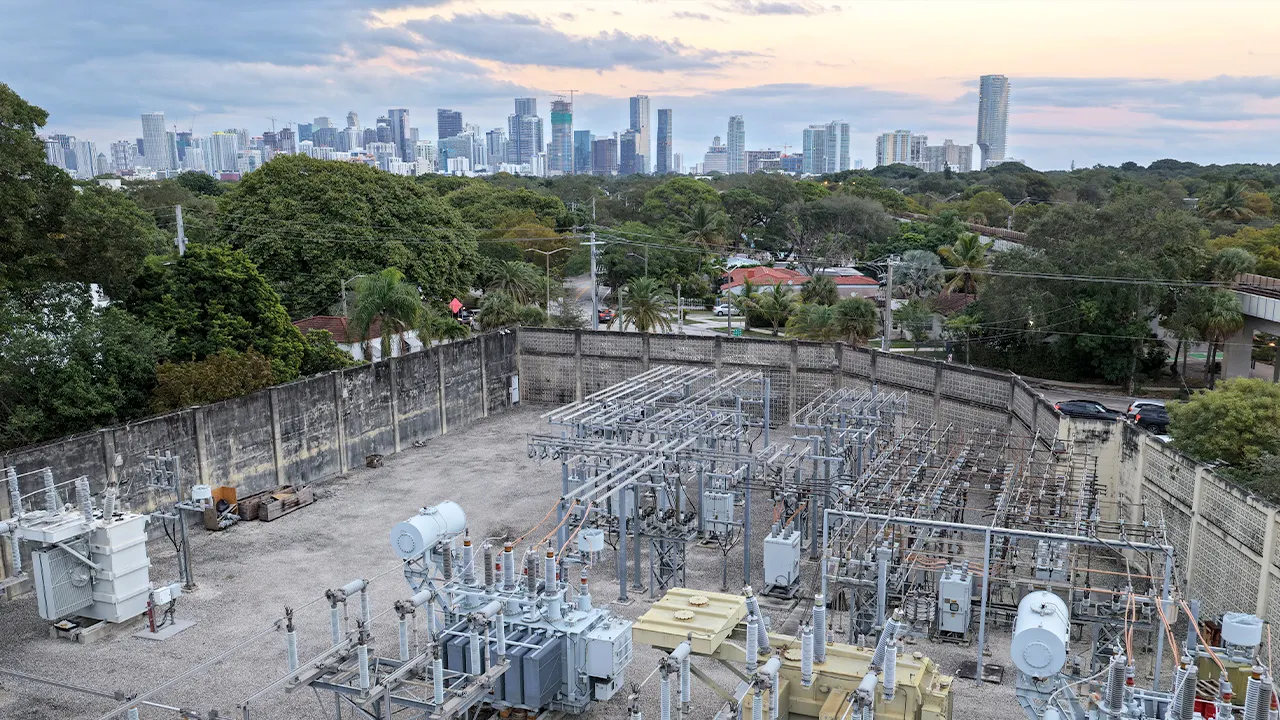
Electricity costs have jumped double digits in a number of states from a year ago. (Joe Raedle/Getty Images)
“They forced the grid away from reliable and cheap baseload power and made it nearly impossible to upgrade power plants, build new pipelines and, in some cases, mandated new builds be powered with electricity instead of natural gas,” Flynn told FOX Business.
Advertisement
While some states have seen modest increases or even declines in electricity costs in the last year, ratepayers in a number of states have seen double-digit percentage increases in the electric bills that can put a significant dent in household budgets.
The District of Columbia saw the biggest spike when compared with the 50 states, with its electricity prices rising 26.29%.
Here’s a look at the 10 states that saw the largest increases in overall electricity costs from a year ago and those that experienced the smallest increases or declines, according to EIA data.
Overview The World Bank Group’s latest report reveals a significant global gap between the enactment and actual enforcement of laws promoting women’s economic equality, with only 4% of women living in economies that provide near-full legal rights.
While many nations have made progress in passing equal-opportunity legislation, the lack of supporting policies and enforcement mechanisms means women still enjoy only about two-thirds of the legal rights afforded to men. Addressing these disparities in safety, childcare, and credit access is presented as an economic necessity to unlock global growth and support the 1.2 billion young people entering the workforce over the next decade.
Key Points
Global laws designed to ensure economic opportunity for women are, on average, only half-enforced, and the systems needed to implement those rights score even lower at 47 out of 100.
Even if current laws were fully enforced, women would still lack one-third of the legal rights granted to men.
Safety from violence is a major deficiency; the world has only one-third of the necessary safety laws, and enforcement of existing protections fails 80% of the time.
Access to affordable childcare is a critical predictor of women’s workforce participation, yet less than half of the 190 economies surveyed provide financial or tax support for families.
While women can legally start businesses in most economies, only half of these countries promote equal access to credit, effectively locking women entrepreneurs out of necessary financing.
Despite enforcement challenges, 68 economies enacted 113 positive legal reforms over the last two years, with the most significant progress occurring in Sub-Saharan Africa. Egypt was identified as the world’s top reformer during the period, implementing changes such as expanded parental leave, mandated equal pay, and flexible work arrangements. Closing the gender gap is vital for the global economy, as half of the 1.2 billion people reaching working age in the next decade are girls who face significant barriers to entry in many regions.
Despite these challenges, progress is being made through legislative reforms. In the past two years, 68 economies have enacted 113 positive legal changes, particularly in Sub-Saharan Africa and the Middle East. Highlighting the economic urgency, the report notes that 1.2 billion young people will enter the workforce over the next decade, making gender equality a vital economic necessity rather than just a social goal.
Advertisement
Thailand demonstrates a mixed performance in women’s economic participation, generally outperforming regional and global averages in legal frameworks and enforcement perceptions, yet falling short in supportive implementation. While the country possesses strong legal protections in areas such as childcare, flexible work, and pay, a significant gap remains between established laws and the practical frameworks necessary to support them.
Key Findings for Thailand
Thailand’s legal frameworks score (69) exceeds both the global average (66.97) and the East Asia and Pacific regional average (59.77), with particular strengths in work, pay, parenthood, and childcare.
The country is one of only seven economies in its region that legally allows employees to request flexible work arrangements.
Despite strong legal scores, the supportive frameworks score (33) is significantly lower than both the global and regional averages, indicating a deficit in the practical infrastructure needed to implement laws.
Enforcement perceptions (53) are generally higher than regional averages, though they lag in specific categories such as safety, marriage, and entrepreneurship.
In the two-year period from October 2023 to October 2025, Thailand did not enact any new reforms related to the Women, Business and the Law (WBL) metrics.
Regional advantages are most prominent in the pillars of mobility, safety, and marriage within the supportive frameworks category, despite the overall low score in that pillar.
The absence of affordable childcare and adequate safety measures hinders GDP growth by limiting women’s ability to participate fully and consistently in the workforce. The report highlights that achieving gender equality is an essential economic imperative to unlock the full potential for growth and job creation.
The specific impacts are detailed below:
Impact of Inadequate Safety Protections
The document identifies safety from violence as a critical factor in a nation’s economic health:
Work Consistency: Safety from violence is a “key shortcoming” that leaves women less able to work consistently. Without a secure environment at home, at work, or in public, women cannot thrive or contribute effectively to the economy.
Enforcement Gap: Globally, countries have only one-third of the necessary safety laws. Furthermore, even when these laws exist, enforcement fails 80% of the time, maintaining steep barriers to prosperity.
Growth Barriers: These safety hurdles are described as barriers that keep women from contributing fully to “growth and prosperity,” which is particularly detrimental to the growth potential of developing economies.
Impact of Lacking Affordable Childcare
The report highlights childcare as a primary predictor of economic mobility:
Labor Force Participation: Affordable and reliable childcare is one of the strongest indicators of whether parents—and mothers specifically—can enter the workforce.
Barriers to High-Productivity Jobs: Without childcare support, women are often unable to move into higher-productivity jobs, which limits the overall economic output of the nation.
Severity in Low-Income Economies: While less than half of the world’s economies provide financial or tax support for childcare, the situation is most dire in low-income economies, where only 1% of the necessary childcare support mechanisms are in place. This lack of infrastructure prevents these nations from reaching their full potential to create jobs.
GDP Growth Potential and Future Workforce
The document connects these barriers to the long-term economic outlook of developing nations:
Missed GDP Boost: Over the next decade, 1.2 billion young people will enter the workforce, half of whom are girls. Many of these individuals reside in regions where women face the largest barriers. The report notes that these are the same regions where the “GDP boost” resulting from women’s participation is “most needed.”
Underutilized Human Capital: Currently, only 4% of women live in economies providing nearly full legal equality. The document states that the resulting “opportunity gaps” keep economies from reaching their full potential to grow.
Economic Necessity: Closing these gaps is framed as a necessity to reverse the decline in the growth potential of developing economies. Providing equal opportunity is described as a strategy that benefits “societies as a whole, not just women.”
Despite these challenges, significant progress is being achieved through legislative reforms. Over the past two years, 68 economies have implemented 113 positive legal changes, with notable advancements in Sub-Saharan Africa and the Middle East. Emphasizing the economic urgency, the report highlights that 1.2 billion young people are projected to enter the workforce within the next decade, positioning gender equality as a critical economic necessity rather than merely a social objective.
The lack of affordable childcare and sufficient safety measures continues to hinder GDP growth by restricting women’s ability to fully and consistently participate in the workforce. The report underscores that achieving gender equality is not just a moral imperative but an essential economic driver to unlock the full potential for growth and job creation.
Ford is recalling more than 4.3 million pickup trucks and SUVs due to a software issue that could cause trailer brakes not to function.
The recall affects certain model year 2021 through 2026 F-150s, 2022-2026 Super Duty trucks, 2024-2026 Rangers, 2022-2026 Expeditions, Mavericks, Lincoln Navigators and 2026 Transit vehicles.
Advertisement
When towing a trailer, the Integrated Trailer Module may lose communication with the vehicle, potentially causing a loss of brake and turn signal lights, or a loss of brake function.
A model year 2021 Ford F-150 pickup truck. (Ford Motor Co. / Fox News)
If a vehicle experiences the communications loss, Ford said the driver will see a “Trailer Brake Module Fault” message on the instrument panel, and the turn signal indicator will flash rapidly. It said a “Blind Spot Assist System fault” message may also appear.
Ford said it is not aware of any accidents, injuries or fires attributed to the issue.
The automaker told FOX Business that beginning on March 17, updates will be available for the majority of vehicles over the air (OTA), through dealerships or mobile service. The OTA updates are expected to be deployed for all vehicles by May.
The action announced Thursday follows recent recalls involving Ford Explorer SUVs. Nearly 413,000 model year 2017-2019 Explorers are being recalled due to a rear suspension toe link that can fracture, potentially affecting steering control.
A 2017 Ford Explorer equipped with the XLT Sport Appearance Package. (Ford Motor Co.)
Toe links help maintain rear wheel alignment. If one breaks, it can cause changes in vehicle handling and raise the risk of a crash, according to the National Highway Traffic Safety Administration.
In a separate action, Ford is also recalling 40,655 vehicles to address battery failures and brake pedal defects, which regulators said could increase the risk of a crash.
In 2025, Ford issued 103 safety recalls, surpassing its previous annual high with months still remaining in the calendar year, FOX Business previously reported.
Country-rock artist Koe Wetzel unveiled his most ambitious outing yet with the announcement of The Night Champion World Tour, a 45-date trek spanning Australia, Canada and the United States set to launch in May 2026 and run through October.
The Texas native revealed the full slate on February 26, 2026, building excitement around his recent album “9 Lives” and fresh singles. The tour promises high-energy performances featuring hits like the 3x platinum “High Road,” alongside newer tracks such as “Surrounded” and “Time Goes On.”
Koe Wetzel
“It’s called The Night Champion World Tour because that’s what we do — we stay up late, party hard and give everything on stage,” Wetzel said in a statement accompanying the announcement. “This is the biggest run we’ve put together, and I can’t wait to bring the chaos to new places and old favorites.”
The itinerary begins internationally with three Australian shows in May: May 3 at Forum Melbourne in Melbourne, Victoria; May 5 at Enmore Theatre in Sydney, New South Wales; and May 9 at Fortitude Music Hall in Brisbane, Queensland. Australian tickets are already on sale.
The North American leg follows, starting with three Canadian dates in July: July 8 at Rogers Place in Edmonton, Alberta; July 10 at South Okanagan Events Centre in Penticton, British Columbia; and another stop (details pending full confirmation in some reports). U.S. dates commence July 23 in Nampa, Idaho, encompassing a diverse mix of venues including amphitheaters, arenas and theaters.
Advertisement
Highlights include stops at iconic spots like Red Rocks Amphitheatre in Morrison, Colorado; Bridgestone Arena in Nashville, Tennessee; The Anthem in Washington, D.C.; and a home-state finale October 30 at Cook’s Garage in Lubbock, Texas. Other notable markets feature Evansville, Indiana (Ford Center, August 7); Fishers, Indiana (Fishers Event Center, October 9); St. Petersburg, Florida; and Little Rock, Arkansas (Simmons Bank Arena).
The tour features rotating support acts tailored to regional legs, including Shane Smith & The Saints, Wade Bowen, Wyatt Flores, Corey Kent, Bayker Blankenship, Logan Jahnke, Ole 60 and others. This lineup underscores Wetzel’s deep ties to the Red Dirt and Texas country scenes while appealing to broader country-rock audiences.
Wetzel’s rise has been fueled by a grassroots approach, amassing a loyal following through relentless touring and authentic songwriting before mainstream breakthroughs. His blend of rowdy anthems, introspective ballads and rock-infused energy has earned him a reputation as one of the most dynamic live performers in modern country.
The extensive routing reflects growing demand, with previous tours selling out theaters and moving into larger arenas. This 2026 world tour marks his first true international headline run beyond select festival appearances, including three Australian dates to tap into expanding global interest in American country acts.
Advertisement
Ticket details include artist presales beginning March 10 at 10 a.m. local time via TheNightChampionWorldTour.com for early access in the U.S. and Canada. General on-sale for North American shows starts March 13 at 10 a.m. local time through primary vendors like Ticketmaster and venue box offices. Australian dates remain available now.
VIP packages, meet-and-greets and upgrades are expected, with details forthcoming on Wetzel’s official website. Fans are encouraged to sign up for notifications at koewetzelmusic.com to stay updated on additional shows or changes.
The announcement arrives amid a strong period for Wetzel, whose “9 Lives” has garnered praise for its raw honesty and musical versatility. Tracks from the project are anticipated to dominate setlists, mixed with fan favorites and potential surprises.
As the tour approaches, Wetzel continues festival and one-off appearances in early 2026, including Boots In The Park events, RodeoHouston and Gulf Coast Jam, keeping momentum building toward the summer launch.
Advertisement
With its scale and international scope, The Night Champion World Tour positions Wetzel as a headliner capable of filling diverse venues while delivering the high-octane shows his fans crave. The run promises to be a defining chapter in his career, bringing his signature blend of rebellion, heart and hell-raising energy to stages worldwide.
It comes as the Cardiff-based firm has secured additional growth capital in a latest fundraising round
15:29, 26 Feb 2026Updated 16:24, 26 Feb 2026
Jeremy Verba chief executive of CoinCover.
Digital asset disaster recovery firm Coincover has appointed Silicon Valley veteran Jeremey Verba as its new chief executive as it looks to further expand following its latest equity fundraising round.
He joins the Cardiff-based fintech as digital asset adoption grows exponentially at both an institutional and consumer level. Globally, figures suggest that 86% of institutional investors have exposure to digital assets and 820 million crypto wallets were active worldwide in 2025.
Advertisement
Traditional financial institutions are also exploring the digital asset potential, with a heavy focus on stablecoins. Nine European banks partnered to issue stablecoins in 2026, and ten major global banks are also jointly exploring issuing a stablecoin pegged to G7 currencies.
CoinCover has become a key player in the maturation of the sector, ensuring that institutions and their crypto users can hold digital assets with confidence by providing wallet recovery solutions, underpinned by world-class encryption and decryption.
Founded in 2018 it has safeguarded more than 600 businesses and protected over 22 million wallets to date. It is now a crucial partner to the likes of Fireblocks, BitGo and Ledger.
Advertisement
It comes as the Cardiff-based company has closed its latest equity fundraising round. The amount raised has not been disclosed, but has been supported by existing investors, including the Development Bank of Wales.
With deep expertise in scaling multi-million dollar businesses, including Walmart Video and eHarmony, Mr Verba will use this experience to accelerate the delivery and growth of CoinCover.
He said: “I have built my career scaling fast-growth businesses that have a very clear market need. Since its inception, CoinCover has played an incredibly important role in the evolution of the digital assets industry, and we now have an even greater opportunity to position ourselves at the forefront of the safe transition to a new world of finance.
“What CoinCover offers will become table stakes for institutions rolling out digital asset strategies and offerings, and I’m excited to drive forward our new phase of growth in this rapidly evolving market.
Advertisement
“As a proudly Welsh-based business, we’re equally committed to contributing to the momentum of Wales’ growing fintech sector and demonstrating the global impact that innovative companies from Wales can achieve.”
The appointment follows recent news that Digital Asset, the creator of the Canton Network, has integrated CoinCover within its Copper-based treasury infrastructure, a move designed to reinforce resilience and confidence amidst greater awareness of the institutional need for robust safety measures.
Mr Verba replaces David Janczewski, co-founder of CoinCover, as CEO. Mr Janczewski remains a key advisor to CoinCover, serving on the Board of the business.
Mr Janczewski said: “I founded the company to revolutionise the world of blockchain protection by making digital asset ownership safe and secure for everyone. Our platform and technology are now proven in the market, and we are well positioned to continue underpinning the future of the industry. Jeremy’s appointment, combined with the injection of additional capital from our investors, gives us the experience and resources needed to scale with confidence.”
Advertisement
Jack Christopher, investment executive with the Development Bank of Wales, said: “CoinCover is a great example of a Welsh fintech with global reach, scaling rapidly while solving a critical challenge in the digital asset market. We’ve backed the company from its early days and are pleased to continue to support the team as they build on their success and accelerate their growth with Jeremy at the helm.”
Bank of MontrealBMO 3.82%increase; green up pointing triangle logged a stronger-than-expected rise in earnings for the latest quarter on the back of strong fee growth in its markets-facing businesses and revenue growth in its Canadian-banking, wealth-management and capital-markets operations.
The Canadian bank’s net income rose to 2.49 billion Canadian dollars (US$1.82 billion), or C$3.39 a share, for the fiscal first quarter against C$2.14 billion, or C$2.83, a year earlier. On an adjusted basis used by the lender to reflect its underlying business performance, Bank of Montreal reported earnings of C$3.48 a share for the three months to Jan. 31, an increase of 14% on last year to beat the C$3.21 consensus forecast of analysts polled by FactSet.