

This article was first published in The Conversation UK’s World Affairs Briefing email. Sign up to receive weekly analysis of the latest developments in international relations, direct to your inbox.
It would be wrong to say Russia’s full-scale invasion of Ukraine, four years ago this week, came out of the blue. For months there had been worrying reports of a huge build-up of Russian troops on Ukraine’s border. Through the winter of 2021/22, Moscow scoffed at suggestions it was planning to invade its neighbour as “alarmist”. But at the same time the Russian president, Vladimir Putin, was making aggressive noises, issuing demands for Nato to pull its troops back from its eastern front and calling for a ban on Ukraine’s accession to the western alliance.
And on February 21, he made a speech in which he called Ukraine “an inalienable part of our own history, culture and spiritual space” which had been taken over by a neo-Nazi “puppet regime” that should be removed.
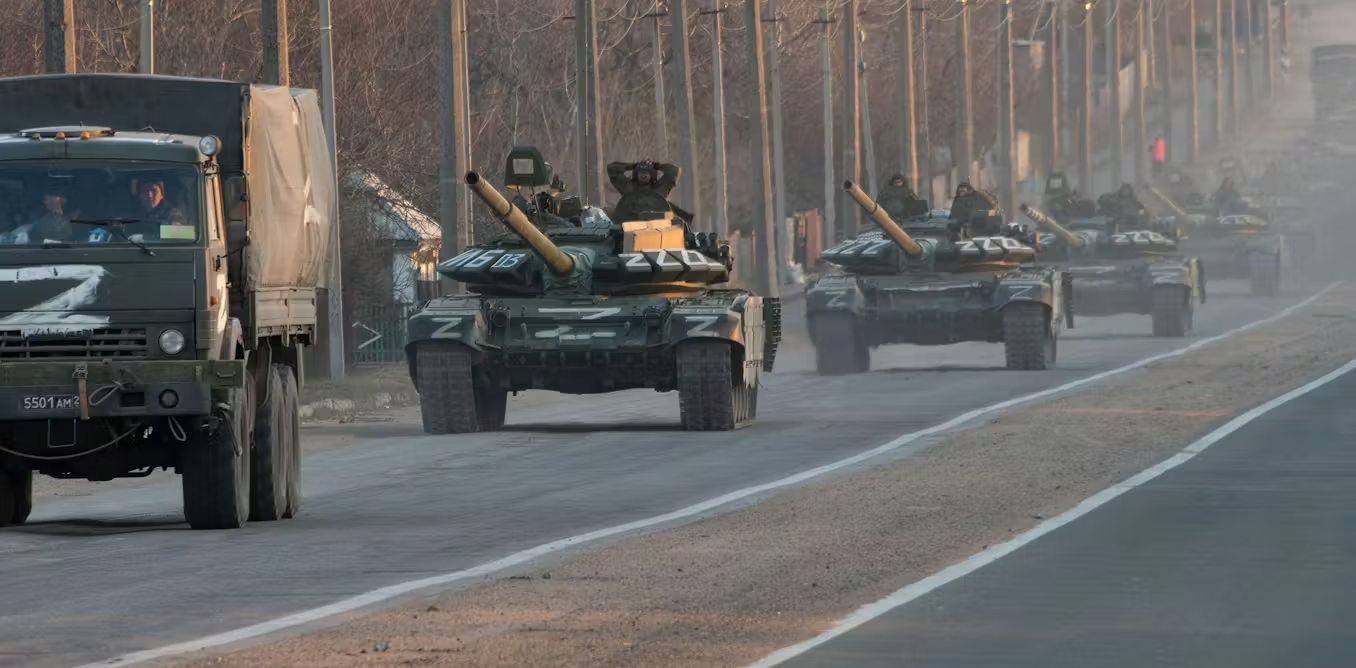
Still, it was a shock to wake in the early hours of Thursday February 22 to learn that Putin had launched what he called a “special military operation … to protect people who have been subjected to abuse and genocide by the Kyiv regime for eight years”. Images began to emerge of tanks and armoured vehicles with the now-familiar “Z” (a Russian victory symbol) streaming across the borders from Russia and Belarus, the latter the shortest route to the Ukrainian capital Kyiv.
US intelligence reported in the Washington Post.
Four years and about 1.8 million casualties later, Russia has gained about 75,000sq km of territory, about 12% of Ukraine to add to the 7% it had occupied since it annexed Crimea and parts of eastern Ukraine in 2014. The war has developed into a “meat-grinder” – Russia’s advances have been glacially slow and very costly, an estimated 78 casualties per square kilometre in 2025.
But if, as many insist, the war on the battlefield itself has slowed into something resembling a stalemate, the geopolitical shifts that have accompanied the conflict have been considerable – particularly since Donald Trump was elected for a second term as US president, promising to end the conflict, “in a single day”. Of course, like many of his campaign promises this has proved to be pie in the sky, but the US president’s cordial relations with Putin, his decision to curtail US financial aid to Kyiv and his apparent support for many of the Russian president’s war aims have come as an unpleasant surprise for Ukraine and its allies.
Another big feature of this war, the biggest armed conflict in Europe since 1945, has been the huge technological changes we’ve seen employed on the battlefield. Stefan Wolff and Tetyana Malyarenko call it the “drone war”, as both sides have become heavily reliant on unmanned autonomous vehicles (UAVs) for both combat and reconnaisance. Wolff – an expert in international security at the University of Birmingham – and Malyarenko – of the National University Odesa Law Academy – have been regular contributors to our coverage of the conflict since February 2022.
This week they are part of a panel of experts analysing the four years of conflict, alongside Wolff’s colleague Mark Webber as well as Scott Lucas of University College Dublin, both also regular contributors. They have looked into the key issues raised by the four years of conflict, including the way the war has been prosecuted, the involvement of the US president and the potential for China and/or Europe to break the stalement: Beijing potentially abandoning its support for Moscow or Europe vastly increasing its support for Ukraine in an attempt to tip the balance in Kyiv’s favour.
À lire aussi :
Ukraine war: after four surprising years, where does it go next? Experts give their view
It’s hard to imagine any reasons to be cheerful about the conflict. But optimists may take heart at the prospect of trilateral talks in March between Ukraine, Russia and the US. Realistically the prospect of the talks achieving anything significant seem pretty bleak at present. Russia continues to take Ukrainian territory and even if these are snail’s pace advances, Putin will consider that they add leverage to Russia’s negotiating position. Ukraine’s president, Volodymyr Zelensky, meanwhile, will consider that the cost of this slow pace of advance, both in terms of casualties and the damage the war is now certainly doing to Russia’s economy, are good reasons to keep going. Surveys suggest he is supported in this by the majority of Ukrainians.
In the end it will probably be sheer exhaustion that forces and end to the conflict, writes Alex Titov of Queen’s University Belfast. Without the wholehearted support of the US president, Ukraine cannot defeat Russia on the battlefield. And, despite the massive advantage in manpower, Russia is really beginning to feel the
effects of this war of attrition – both on the health of its economy and its ability to attract enough new recruits to replace the casualties who are being either killed or wounded faster than they can be replaced. For this reason alone, Titov sees chinks of light in what is a very dark time.
À lire aussi :
Ukraine: after four years of war, exhaustion on both sides is the main hope for peace
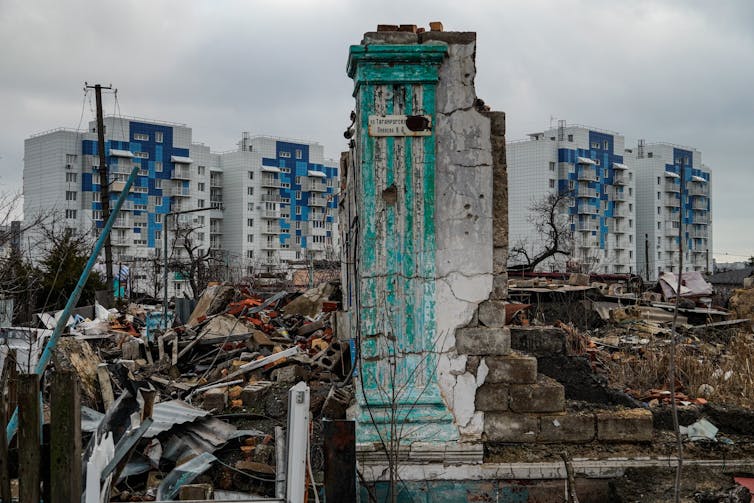
Let’s share Titov’s cautious optimism for the present. Say a peace deal is struck sometime soon, Ukraine is faced with a massive task of rebuilding. The most recent World Bank estimate is that this will take more than a decade and cost around US$588 billion (£435 billion). The biggest and most immediate question facing Kyiv and its allies, writes Olena Borodyna, a senior geopolitical risks advisor at ODI Global is how this can be funded.
The consensus is that Ukraine will need to find ways to incentivise private-sector investment in reconstruction, something for which Borodyna sees varying amounts of enthusiasm for from Ukraine’s partners and friends. Part of the problem is the volatile security situation, which represents a considerable risk moving forward. Add to that the corruption which has dogged Ukraine since well before the invasion and the incentive to invest looks very shaky indeed.
Another big problem, she writes, is that so many Ukrainians left the country since February 2022, which has caused acute labour shortages. The challenge of persuading people to return will be paramount and here again, the lack of security will work against Ukraine.
EPA/stringer
There is also the strong possibility that political developments in Europe could affect the level of support for Kyiv, with elections in countries such as France, Italy and Denmark. There are already several EU members which are pretty openly hostile to the notion of supporting Ukraine, including Slovakia, the Czech Republic and Hungary – the latter is already trying to obstruct a vital €90 billion (£78 billion) to help cover Ukraine’s needs for 2026 and 2027.
Peace deal or not, it’s a long and hard road ahead for Ukraine.
À lire aussi :
The three big challenges facing Ukraine when the war ends
But adversity can often be inspiring. Hugh Roberts, an expert in language and culture at the University of Exeter, has been charting the upsurge in Ukrainian poetry since the invasion. He has unearthed two poets who have come to represent this cultural renaissance: Yaryna Chornohuz and Artur Dron’.
Both have served in Ukraine’s armed forces. Chornohuz is still a drone operator of the Ukrainian Marine Corps in the frontline city of Kherson. Dron’ signed up in February 2022, four years before he reached the age of conscription. He’s now a veteran following serious injury. The words of both are available in English and both have been recognised with major literary awards in their home country.
Roberts gives us some of their most moving lines.
À lire aussi :
Lines from the frontline: the poet soldiers defending Ukraine
Death in Mexico
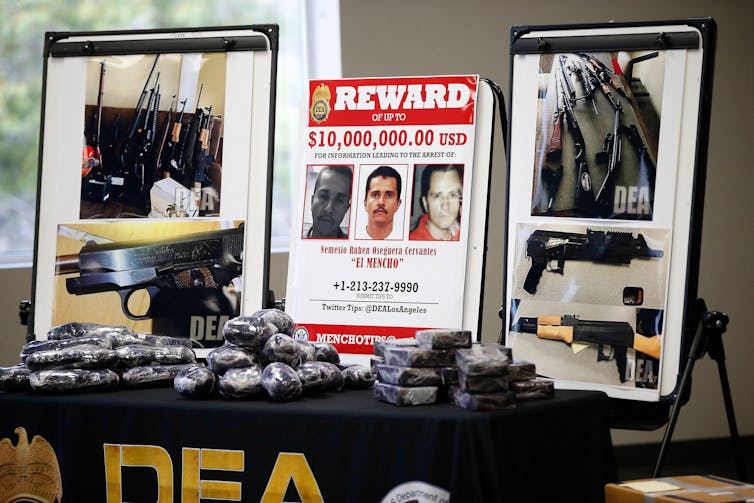
Also this week, we heard of the death of Mexican drug kingpin Nemesio Oseguera Cervantes, also known as El Mencho, in what was reportedly a massive military operation involving what appears to have been hundreds of troops and the killing of 74 people, including 25 national guard officers.
K.C. Alfred/San Diego Union-Tribune/TNS)
Repercussions will continue for some time, writes Raul Zepeda Gil, an expert in crime and conflict at King’s College London. The apprehension or killing of a cartel boss often causes a spike in violence as other criminal groups try to cut in on the cartel’s operations. There also likely to be a bitter and violent power struggle within El Menche’s organisation, the Jalisco New Generation Cartel (CJNG).
À lire aussi :
Mexico may pay a steep price for the killing of Jalisco cartel leader El Mencho
There has already bee speculation that Oseguera may be succeeded by his wife, Rosalinda González Valencia. Otherwise known as “La Jefa” (the boss), she is alleged to control the cartel’s finances, although apart from a five-year jail spell for money laundering, there has reportedly never been enough evidence of the wrongdoing of which she is suspected to charge her with anything else.
Adriana Marin, who specialises in terrorism, organised crime, and transnational threats in Latin America, examines the prominent role some women have played in organised crime gangs.
À lire aussi :
La Jefa: the wife of slain drug kingpin El Mencho and the women at the heart of the cartels

Sign up to receive our weekly World Affairs Briefing newsletter from The Conversation UK. Every Thursday we’ll bring you expert analysis of the big stories in international relations.










































You must be logged in to post a comment Login