

Crypto World
Why XRP Spot Buying Is Skyrocketing While Futures Open Interest Slumps



Bitrue reported a 212% surge in spot buying for XRP on February 26, with buy orders more than doubling sell pressure.
Bitrue said on February 26 that it recorded a 212% jump in XRP spot buying as institutional investors continued allocating capital through newly launched XRP exchange-traded funds (ETFs).
The exchange linked the spike to roughly $1.1 billion in cumulative ETF inflows, arguing that steady demand from funds and retail traders could tighten available supply in the months ahead.
Spot Buying Jumps as ETF Inflows Build
In a post on X, Bitrue said XRP buy orders on its platform outpaced sell orders by more than two to one.
“We recorded a 212% increase in XRP spot purchase volumes, outpacing the sell side by over 2x,” the exchange posted on X.
It attributed the imbalance to sustained institutional accumulation since the debut of XRP ETFs, which it claims have drawn $1.1 billion in net assets, even though data from SoSoValue showed there have been muted ETF flows in recent days.
However, the derivatives market tells a different story. According to CryptoQuant, XRP futures open interest has fallen across major platforms over the past 90 days, with Binance recording a decrease of 7.7 million XRP and Bybit showing a larger reduction of around 12 million tokens. Furthermore, the three-month moving average for XRP futures volume has dropped to its lowest level since November 2024, settling at approximately $87 billion.
Looking at XRP’s broader market structure, it was trading around $1.44 at the time of writing, up nearly 5% in the last 24 hours and about 2% during the week. Even so, the token is still down more than 23% over the past month and almost 38% across the past year, far below its July 2025 all-time high of $3.65.
Cooling Leverage Meets Steady Spot Demand
The divergence between spot accumulation and falling derivatives activity suggests a shift in market composition rather than uniform bullish momentum. Open interest now stands near $2.37 billion per CoinGlass figures, and the contraction in leveraged positions may reflect traders reducing risk after months of volatility.
You may also like:
From a price standpoint, XRP remains range-bound between $1.38 and $1.48 over the past 24 hours. One market watcher, CasiTrades, flagged resistance around $1.40 and $1.65, with support near $1.11 and $0.87. According to them, a sustained move above those resistance levels would likely require stronger follow-through from ETF inflows and broader market participation.
As such, considering the broader data, Bitrue’s reported spike in spot buying highlights firm exchange-level demand, but the wider data show a market that is rebalancing rather than accelerating.
Nonetheless, the crypto exchange is predicting that growing retail and corporate support could lead to a supply deficit that may push up the Ripple token’s performance enough to beat major rivals this year.
“With support increasing from retail and institutional levels, Bitrue is forecasting a potential supply squeeze, which will likely result in XRP outperforming key competitors over Q2 2026,” wrote Bitrue.
Binance Free $600 (CryptoPotato Exclusive): Use this link to register a new account and receive $600 exclusive welcome offer on Binance (full details).
LIMITED OFFER for CryptoPotato readers at Bybit: Use this link to register and open a $500 FREE position on any coin!

The long-term plan proposes a series of upgrades aimed at faster transactions, higher capacity, and new privacy features.
The Ethereum Foundation (EF) has shared a long-term plan, dubbed the “strawmap,” that outlines how Ethereum could evolve over the rest of the decade, with goals including faster transactions and higher capacity.
The roadmap lays out several possible changes across Ethereum’s core layers. If completed, it would mark the biggest evolution of the network since The Merge in 2022, which moved Ethereum from proof-of-work to proof-of-stake.
The plan underscores how Ethereum developers are preparing the network for more users and more activity by gradually improving speed, security, and reliability. Ethereum co-founder Vitalik Buterin described the roadmap as a “very important document” in a post on X.
Ethereum is currently the world’s largest smart contract blockchain, with more than $56 billion in total value locked (TVL) across decentralized finance, according to DefiLlama. Following the news, Ether (ETH) briefly moved higher. The token is currently trading at $2,030 – down about 2% on the day but still up more than 4% over the past week.
The Details
The strawmap outlines a long-term path with around seven forks through 2029. Justin Drake, a member of the EF Architecture team, explained in a post on X that the roadmap is built around five “north stars.”
These include making the main network faster through shorter block times and near-instant finality, increasing capacity to roughly 10,000 transactions per second on Layer 1, scaling Layer 2 networks to as much as 10 million transactions per second, introducing post-quantum cryptography, and adding native privacy through shielded ETH transfers.
“The strawmap is an invitation to view L1 protocol upgrades through a holistic lens,” Drake said. “By placing proposals on a single visual, it provides a unified perspective on Ethereum L1 ambitions.”
Meanwhile, Buterin described the roadmap as a gradual revamp of Ethereum’s core systems, in which slot times, consensus, and cryptography are replaced bit by bit rather than through a single large overhaul.
The new roadmap builds on Ethereum’s recent upgrades, including Fusaka, which launched in December 2025. That upgrade introduced the PeerDAS data availability system to help the network process more transactions while keeping fees low.
However, while the upgrade marked a major step in the network’s scaling strategy, cheaper transactions have also coincided with a rise in spam and address-poisoning attacks, The Defiant previously reported.


Anthropic CEO Dario Amodei publicly rejected the Pentagon’s demand on Thursday. The Defense Department wants unrestricted military use of the company’s AI technology. The deadline, just hours away, could see the $380 billion startup expelled from the US military’s supply chain.
The showdown marks the first time a major AI company has publicly defied a US government threat to seize control of its technology.
The Standoff
In a blog post published on Anthropic’s website, Amodei called the Pentagon’s threats “inherently contradictory,” noting that one designates Anthropic as a security risk while the other treats Claude as essential to national security.
“Regardless, these threats do not change our position: we cannot in good conscience accede to their request,” Amodei wrote.
The dispute centers on two conditions Anthropic placed on military use of Claude. The company bars autonomous targeting of enemy combatants and prohibits mass surveillance of US citizens. The Pentagon views these as unacceptable limitations on lawful military operations.
Anthropic said the Pentagon’s “final offer,” received overnight Wednesday, failed to address its core concerns. “New language framed as compromise was paired with legalese that would allow those safeguards to be disregarded at will,” an Anthropic spokesperson said in a statement, as reported by The Hill.
Defense Department spokesman Sean Parnell issued a public ultimatum on Thursday. He gave Anthropic until 5:01 pm ET on Friday to grant unrestricted access to Claude Gov — or face termination of the partnership and designation as a supply chain risk.
“We will not let ANY company dictate the terms regarding how we make operational decisions,” Parnell wrote on X.
Timeline of Escalation
On Tuesday, Amodei met directly with Defense Secretary Pete Hegseth, during which Pentagon officials outlined three consequences for noncompliance. First, removal from military systems. Second, supply chain risk designation that would bar other defense contractors from using Anthropic products. Third, the invocation of the 1950 Defense Production Act to legally compel the company to hand over its technology.
Amodei argued in the blog post that the refusal is also grounded in technical reality. “Frontier AI systems are simply not reliable enough to power fully autonomous weapons,” he wrote, adding that without proper oversight, such systems “cannot be relied upon to exercise the critical judgment that our highly trained, professional troops exhibit every day.”
Republican Senator Thom Tillis criticized the Pentagon’s handling of the dispute. “Why in the hell are we having this discussion in public? This is not the way you deal with a strategic vendor,” Tillis told reporters.
What’s at Stake
For Anthropic, the immediate exposure is a $200 million military contract. But the supply chain risk designation carries far broader implications. It would force every defense contractor to verify that they don’t use Anthropic products in their operations.
The competitive landscape is shifting fast. Elon Musk’s xAI signed a deal to use Grok in classified systems, according to Axios, accepting the ‘all lawful purposes’ standard for classified work. OpenAI and Google are accelerating negotiations to enter the classified space. Anthropic, once the only AI company cleared for classified material, risks losing that first-mover advantage entirely.
Why Crypto Should Pay Attention
The Pentagon’s willingness to invoke the Defense Production Act against a technology company sets a precedent that extends beyond AI. If the government can legally compel an AI firm to remove safety restrictions on national security grounds, the same framework could, in theory, be applied to compel crypto companies to modify privacy features or weaken transaction safeguards.
The standoff also strengthens the case for decentralized AI development. A centralized AI provider can be pressured — or legally compelled — to strip away guardrails at a government’s demand. That validates the thesis that decentralized alternatives offer more resilient infrastructure against state coercion.
Anthropic’s rapid growth has already raised concerns for crypto markets. The company’s $380 billion valuation and AI-driven disruption of traditional software revenue are putting pressure on private credit flows that correlate closely with Bitcoin.
Anthropic also has a historical link to crypto: FTX’s bankruptcy estate held a significant early stake in the company, which it later sold to help fund creditor repayments.
The Friday deadline will pass, but the real question begins after: whether the Pentagon follows through, and what that means for every technology company drawing a line between government contracts and product integrity.
The perp DEX is incubated by Aptos Labs and plans to leverage the blockchain’s high speed to deliver a highly responsive trading experience.
Decibel, a perpetual derivatives decentralized exchange (DEX) incubated by Aptos Labs, launched its mainnet today alongside its official points program.
The DEX is starting with perpetual markets, before expanding to spot and real-world assets (RWAs), similar to the progression taken by market leaders Hyperliquid and Lighter.
According to a press release shared with The Defiant, Decibel’s testnet generated “over 1 million user trades per day” across more than 130,000 daily active users (DAU).
So far, the DEX has processed $6.4 million in volume since its mainnet launch and hosts $57 million in total value locked (TVL), according to DeFiLlama.
The DEX is based on a central limit order book (CLOB) model, and hosts its risk engine onchain, ensuring functions such as auto-deleveraging are directly verifiable via the block explorer.
While Aptos Labs incubated Decibel and the DEX is built on the Aptos Layer 1, the DEX also uses X-chain accounts to enable deposits from Ethereum and Solana.
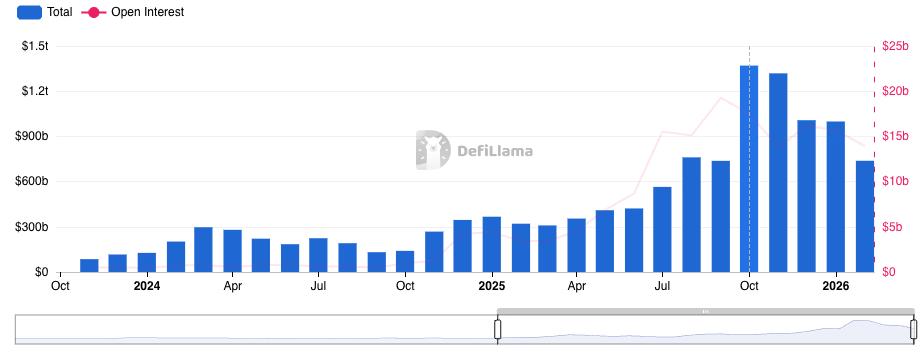
The perpetual market remains red hot, with more than $730 billion traded across all DEXs in February, roughly the same amount traded throughout all of 2023. Activity has cooled off since volumes peaked at $1.37 trillion in October, but the sector remains one of the most popular in DeFi.

Brylee Whatley, the Head of the Decibel Foundation, told The Defiant, “On the acquisition side, Decibel has invested heavily in aligning incentives with real usage. Season 1 of our Amps points program is live and is designed to reward genuine trading activity. But incentives only get users through the door.”
“What keeps traders is trust in the system they are trading on. Everything on Decibel is transparent – the infrastructure, risk approach and liquidation logic. We built an exchange where serious traders feel confident deploying real capital,” they added.
While a majority of DEXs offer tokenized equity and commodity offerings, only HyperUnit’s TradeXYZ, Lighter’s tokenized Korean stocks, and Ostium have found sustained liquidity and success.
Whatley also touched on the future vision for Decibel as it enters the highly competitive tokenized RWA trading space, citing Aptos’ existing success in the world of RWAs and the chain’s global go-to-market reach.
“Imagine using tokenized RWA holdings – treasuries, equities, commodities – as collateral to trade perpetuals, or using your crypto portfolio to margin equity positions. That kind of cross-asset capital efficiency is impossible at a traditional brokerage and isn’t available on other DEXs,” Whatley concluded.


- Bitcoin price trades around $67,500.
- The asset rose to near $70,000 but is facing key resistance.
- Analyst Rekt Capital warns that it’s “premature” to say the current bear market is over.
Bitcoin price is hovering around $67,500 after retreating from highs near $70,000.
The spike to intraday highs on Wednesday saw chatter across ‘Crypto Twitter’ shift to the potential for BTC to have bottomed out and prospects of a sharp uptick.
While bullish sentiment continues to permeate the crypto market, one analyst is cautioning against “premature” calls of the bear market being over.
This even as US spot Bitcoin ETFs take fresh inflows to cut year-to-date outflows to under $2 billion.
Bitcoin retreats from $70k as analyst warns of further declines
Macroeconomic and geopolitical headwinds have meant Bitcoin has found it hard to break higher since recovering from lows near $60,000 reached in early February.
However, the bellwether crypto asset surged toward $70,000 ahead of Nvidia’s earnings report on Wednesday, February 25, 2026.
Like gains across equities, Bitcoin’s uptick benefited from anticipation around Nvidia’s earnings report.
But despite strong AI-driven results, stock futures stalled, and BTC pulled back, trading to around $67,500 as of writing.
Nvidia shares also fell, down more than 5% at open on Thursday. Reaction to the chip giant’s earnings beat impacted BTC.
Despite this pullback, many traders are upbeat after US spot Bitcoin ETFs snapped a recent losing streak, with over $750 million in net inflows over two days. The flip has the market trending with mixed signals.
Half a bil into bitcoin ETFs yesterday, biggest day in a while, +$750m over past two days, right as obituaries were being published. They needed it too, like a hitter in a slump going yard. YTD is now under $2b in outflows. Unclear still tho if this is legit start to rebound or… pic.twitter.com/hl6JQuFcyI
— Eric Balchunas (@EricBalchunas) February 26, 2026
However, according to crypto analyst Rekt Capital, it’s premature to say the bear market is over.
“The shortest Bitcoin Bear Market lasted 365 days. Bitcoin is currently ~140 days into its current Bear Market,” he posted on X, adding:
“Any talk of the Bear Market being over already is probably premature.”
Spot ETF inflows, on-chain metrics and macro shifts could be key factors in this cycle. But Rekt believes the technical picture says a lot.
In this case, the analyst points to historical cycle bottoms and BTC’s slide below the 200-week exponential moving average.
Even with recent inflows reversing recent outflows to a degree, institutional demand is low, and that could limit any upside.
It’s very tempting to speak about Lengthening Cycles in a Bitcoin Bull Market
After all, nobody wants to see a sunny day end
It’s equally very tempting to speak about the Bitcoin Bear Market bottom already being near
Everybody wants Winter to end, and the sooner the… https://t.co/8bSxwKrdRx
— Rekt Capital (@rektcapital) February 26, 2026
BTC price analysis
Technically, Bitcoin’s retreat from $70,000 exposes support at $68,000-$68,500.
With a breakdown to $67,500, bulls risk an acceleration toward $60,000.
Rekt shares this outlook by noting that bulls remain vulnerable as long as price fluctuates below the 200-week EMA.
The moving average has acted as resistance in previous bear markets, including in 2018.
“Ultimately, as long as Bitcoin remains below the 200-week EMA, history suggests price will favour additional downside,” the analyst noted.
Earlier this month, analysts at Standard Chartered cut their target for BTC in 2026 to $100,000 and forecast a potential retest of $50,000 before a fresh rally higher.
Nasdaq has filed a proposed rule change to list the VanEck JitoSOL ETF, a fund designed to hold the Solana-based liquid staking token JitoSOL.
Liquid staking allows users to stake tokens to help secure a proof-of-stake network while receiving a transferable token in return that represents the staked assets and accrued rewards.
Jito Foundation president Brian Smith told Cointelegraph that if the fund is approved, staking rewards would not be distributed separately but instead reflected in the fund’s net asset value.
Because JitoSOL automatically compounds rewards, each token held by the trust would represent the underlying deposited SOL along with any staking yield accrued on the Solana network.
The exchange submitted the proposal under Nasdaq Rule 5711(d), which governs commodity-based trust shares, seeking approval to list and trade shares of a trust that would hold JitoSOL directly.
Created by the Jito Network, JitoSOL (JTO) is a liquid staking token backed by SOL deposited into a staking pool on the Solana network. It lets holders earn staking rewards through a transferable token without directly running validators or managing onchain staking.
The filing cites the SEC’s prior spot Bitcoin (BTC) and spot Ether (ETH) ETP approval orders, arguing the proposal satisfies fraud, manipulation and surveillance standards and can be approved through “other means” despite the absence of a regulated futures market for JitoSOL.
According to the proposal, the trust would value its shares using the MarketVector JitoSol VWAP Close Index, which is calculated from pricing data contributed by multiple trading platforms, and the trust would permit both cash and in-kind creations and redemptions.
The filing also claims JitoSOL is economically comparable to SOL (SOL), citing correlation data, and says an appropriately structured liquid staking token can be treated as analogous to the underlying asset for purposes of the generic listing standards approved by the SEC in September.
Under the SEC’s review process, the agency has 45 days from Federal Register publication to approve or disapprove the proposal, which can be extended to 90 days.
Related: Ethereum Foundation starts staking ETH as client diversity concerns persist
Staking exposure exists, but not liquid staking ETFs
While the VanEck JitoSOL ETF has reached the SEC’s exchange review stage, no liquid staking token ETF of this type is currently trading in the United States. There are, however, existing funds that provide regulated exposure to staking economics.
One of the earliest US ETFs to offer direct staking exposure was the REX-Osprey Solana + Staking ETF (SSK), which began trading on July 2, and combines spot Solana price exposure with onchain staking rewards distributed to shareholders.
In September, the company launched the REX-Osprey ETH + Staking ETF (ESK), offering spot Ether exposure alongside monthly payouts tied to staking yield.
About a month later, Grayscale expanded staking across its exchange-traded lineup, adding staking exposure to the Grayscale Ethereum Mini Trust ETF and Grayscale Ethereum Trust ETF (ETHE). The company also enabled staking for the Grayscale Solana Trust (GSOL), which is seeking regulatory approval to uplist as an ETP.
While the SEC’s Division of Corporation Finance said in May that certain protocol staking activities generally do not involve the offer or sale of securities under federal law, and in August issued similar staff guidance on liquid staking and staking receipt tokens, the statements are not formal rulemaking and do not automatically approve specific products.
In Europe, 21Shares launched a Jito-staked Solana exchange-traded product in January, providing listed exposure to SOL with staking integrated into the structure.
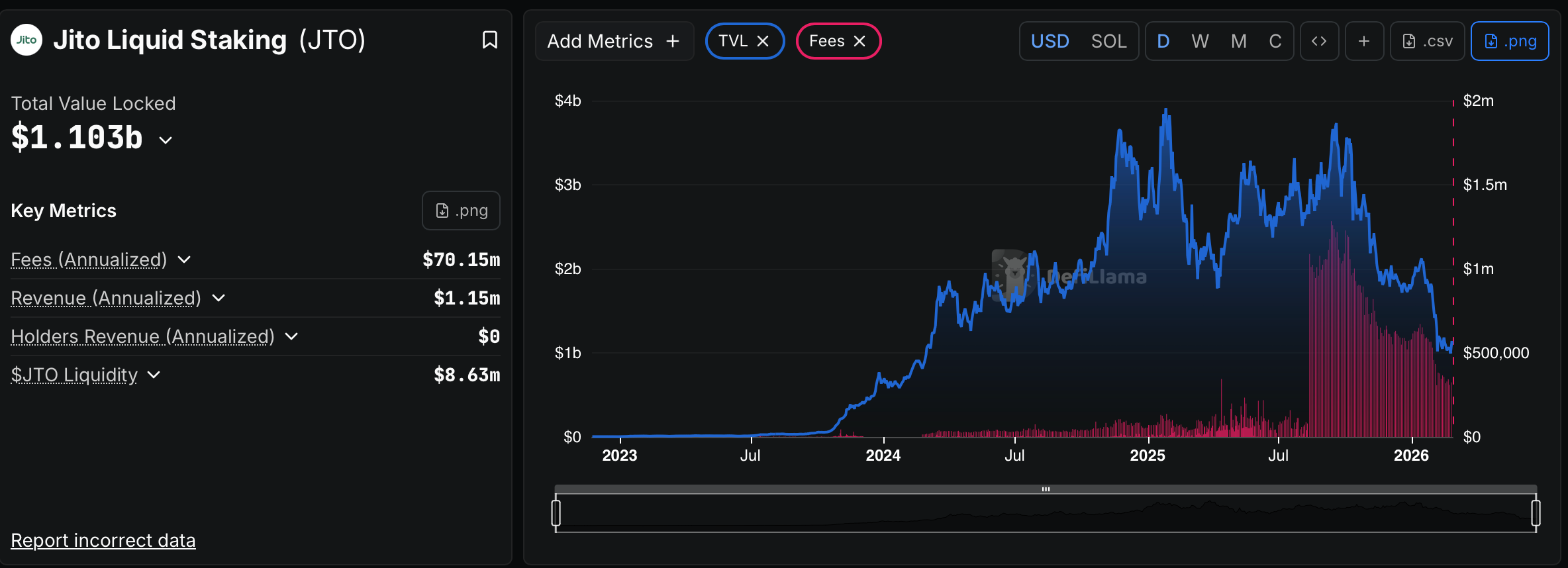
Jito’s total value locked (TVL) stands at around $1.1 billion, after peaking above $3.0 billion in 2025 before retracing into early 2026, according to DefiLlama data.

Magazine: Clarity Act risks repeat of Europe’s mistakes, crypto lawyer warns
Can DOT push higher after reaching a one-month peak?
Over the past 24 hours, the cryptocurrency market staged a solid rebound, with many leading digital assets showing renewed momentum and reclaiming some of their recent losses.
Polkadot (DOT) is among the top performers today (February 26), jumping by roughly 22%.
The Upcoming Halving and More
Polkadot’s native token, which was one of the major cryptocurrencies in 2021 when its price rocketed above $50, has been on a severe decline over the last several months, crashing to a local bottom of $1.15 at the start of February.
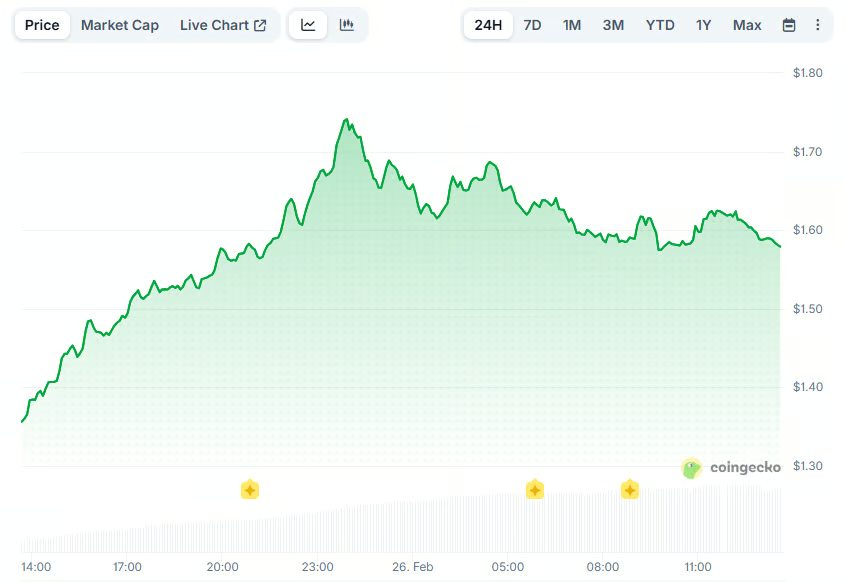
Over the past day, though, it posted a strong comeback, with its valuation reaching a monthly high of approximately $1.74. Its market capitalization soared past $2.6 billion, making it the 36th-largest cryptocurrency.
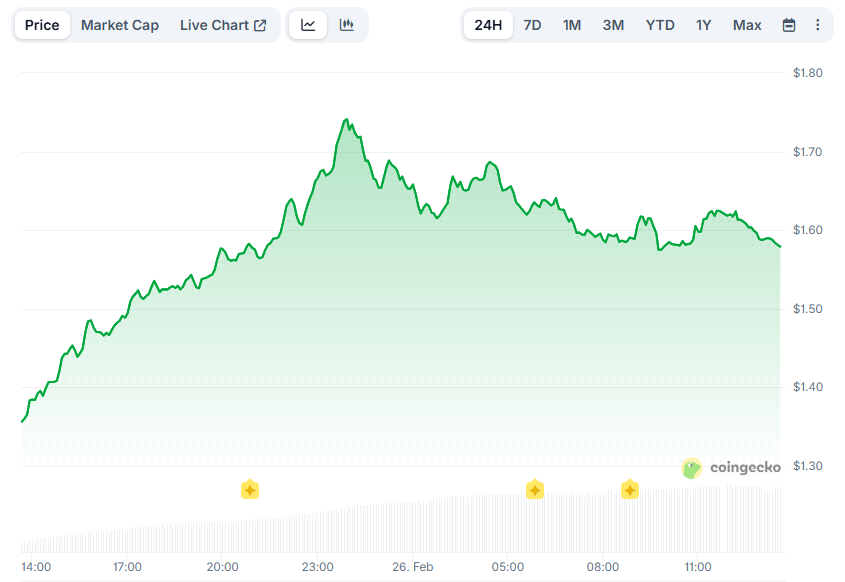
The broader market resurgence, marked by Bitcoin (BTC) nearing $70,000 and Ethereum (ETH) reclaiming the $2,000 psychological level, seems to be the most likely catalyst driving DOT’s price higher. However, some analysts claimed that other factors could have contributed to the upswing as well.
Lark Davis, who has almost 1.5 million followers on X, argued that Polkadot’s upcoming halving might be one such reason. He said the event, scheduled for March 14, will slash annual token issuance by 50%, claiming “the scarcity narrative is driving strong bullish sentiment.”
Another potential driver, as noted by Davis, is the growing anticipation surrounding prospective spot DOT ETFs, which prominent companies like Grayscale and 21Shares have expressed interest in launching.
These products (should they be approved by regulators) will allow investors to gain exposure to Polkadot’s native cryptocurrency through brokerage accounts without holding the token directly. This simplified access can attract more market participants, whereas increased demand could lead to upward price pressure on the asset.
The regulatory climate in the US has shifted toward a more favorable stance on crypto products, with multiple spot ETFs debuting over the past several months. This signals that a similar investment vehicle having DOT as the underlying token may also go live soon.
Davis did not stop there and offered a third possible reason for the asset’s recent revival. He suggested that DOT “broke above the daily 20 EMA and horizontal resistance at around $1.40+, while holding firm support at $1.23, a setup that could have triggered momentum buyers.”
The Next Targets
The resurgence has naturally sparked a fresh wave of enthusiasm among analysts and traders, some of whom believe DOT has more fuel left to chart further gains.
X user RACHEL CRYPTO predicted the price could rise to $1.80, while prior to that, Crypto GVR envisioned an ascent to $2-$3 in the long term.
At the same time, the asset’s Relative Strength Index (RSI) should serve as a warning. The technical analysis tool measures the speed and magnitude of recent price changes and can help identify potential price reversals. It ranges from 0 to 100, where ratios below 30 indicate that DOT is oversold and due for a potential pump, while readings above 70 are interpreted as bearish territory. Currently, the RSI stands at around 73.

Disclaimer: CryptoPotato has received a grant from the Polkadot Foundation to produce content about the Polkadot ecosystem. While the Foundation supports our coverage, we maintain full editorial independence and control over the content we publish.
Binance Free $600 (CryptoPotato Exclusive): Use this link to register a new account and receive $600 exclusive welcome offer on Binance (full details).
LIMITED OFFER for CryptoPotato readers at Bybit: Use this link to register and open a $500 FREE position on any coin!
Nasdaq has filed a proposed rule change to list the VanEck JitoSOL ETF, a fund designed to hold the Solana-based liquid staking token JitoSOL (CRYPTO: JTO). The instrument would give investors exposure to on-chain staking economics without the need to operate validator infrastructure, wrapping the underlying asset in publicly traded shares. If approved, the fund would reflect staking rewards in its net asset value rather than distributing separate yield payments, a detail highlighted by the Jito Foundation’s leadership. The token itself compounds rewards automatically, so each share would represent the SOL deposited and the staking yield accrued on the Solana network (CRYPTO: SOL).
The filing, submitted under Nasdaq Rule 5711(d) governing commodity-based trust shares, seeks approval to list and trade shares of a trust that would hold JitoSOL directly rather than track via futures or other derivatives. The move underscores the ongoing regulatory interest in expanding regulated access to on-chain staking economics, a path that has gained momentum as liquidity and investor demand for crypto yield products continue to evolve across jurisdictions.
The asset at the center of the proposal, JitoSOL, is a liquid staking token issued by the Jito Network and backed by SOL deposited into a Solana staking pool. It enables holders to earn staking rewards through a transferable token without the operational burden of running validators. In the broader regulatory dialogue, the filing references earlier SEC actions on spot crypto ETPs, noting the agency’s prior approvals for spot Bitcoin (CRYPTO: BTC) and spot Ether (CRYPTO: ETH) exchange-traded products and arguing that a liquid staking token can be evaluated under the agency’s generic listing standards rather than requiring a dedicated futures framework. The document also cites the MarketVector JitoSol VWAP Close Index as the basis for valuing trust shares, a price construct derived from cross-platform pricing inputs that would undergird the ETF’s NAV. The trust would allow both cash and in-kind creations and redemptions, a mechanism that could help maintain price alignment with the underlying asset over time.
JitoSOL is designed to sit within the Solana ecosystem’s staking framework but to offer a ready-made exposure vehicle. The token is described as economically akin to SOL, with proponents arguing that an appropriately structured liquid staking token can be treated similarly to the underlying asset for aims of listing standards. The filing rests on the premise that regulators have, in recent months, acknowledged the potential for liquid staking and staking-receipt tokens to fit within existing regulatory frameworks, even as formal rulemaking continues to evolve.
The SEC’s review timeline for such listings typically provides a 45-day window from Federal Register publication to issue a decision, with possible extensions bringing the period to 90 days. The current status places the project in the exchange-review phase, a stage where Nasdaq lenders and the SEC assess disclosures, surveillance, and anti-fraud provisions before determining whether a listing may proceed. While the path forward remains contingent on regulatory signaling, the filing signals a growing appetite to broaden structured exposure to staking economics through traditional market infrastructure.
Staking exposure exists, but not liquid staking ETFs
Even as the VanEck JitoSOL ETF advances through regulatory review, the United States has yet to host a liquid staking token ETF of this explicit design. Market participants have, however, explored regulated access to staking economics through other vehicles. One notable example is the Rex-Osprey Solana + Staking ETF (SSK), which began trading in July and pairs spot Solana exposure with on-chain staking rewards distributed to shareholders. In September, Rex-Osprey expanded its lineup with the REX-Osprey ETH + Staking ETF (ESK), presenting Ether alongside staking-derived yields. Grayscale subsequently broadened staking exposure within its U.S. crypto-ETP roster, adding products tied to staking economics such as the Grayscale Ethereum Mini Trust ETF and Grayscale Ethereum Trust ETF (ETHE). Grayscale also introduced staking for the Grayscale Solana Trust (GSOL), which is seeking regulatory uplisting as an exchange-traded product. These products indicate a clear demand for regulated staking exposure, even as the regulatory framework for liquid staking tokens remains a developing area.
Regulatory guidance in the United States has been cautious. In May, the SEC’s Division of Corporation Finance indicated that certain protocol staking activities generally do not involve the offer or sale of securities under federal law, and in August the agency published staff guidance on liquid staking and staking receipt tokens. These statements do not constitute formal rulemaking and do not automatically approve specific products. In Europe, meanwhile, 21Shares launched a Jito-staked Solana exchange-traded product in January, providing listed exposure to SOL with integrated staking features. Jito’s prominence in the liquidity and staking space is reflected in its TVL, which hovered around $1.1 billion after peaking above $3.0 billion in 2025, according to DefiLlama data.
The evolving landscape around liquid staking, staking revenues, and on-chain reward mechanics sits at the intersection of technology, regulation, and market structure. Investors are watching how these products align with existing surveillance, valuation standards, and consumer protection requirements as new variants of staking exposure enter mainstream trading venues. The debate over whether staking-derived yield should be treated as a security, a yield instrument, or a synthetic exposure continues to shape how products get approved and marketed in regulated markets.
Market dynamics outside the United States add texture to the conversation. As mentioned, Europe has already welcomed a Jito-backed exposure through 21Shares, signaling an appetite for product design that blends price exposure with staking rewards. The global appetite for regulated staking products reflects a broader trend toward translating on-chain value accrual into familiar investment constructs that traditional investors can access without direct operational responsibilities on a blockchain network.
Overall, the idea of a liquid staking ETF for JitoSOL sits at a crossroads of innovation and regulation. It highlights how asset ownership, reward compounding, and on-chain security contributions can be packaged into tradable vehicles while attempting to meet the same standards that govern more conventional assets. The regulatory path ahead is nuanced, but the direction—toward structured exposure to staking economics within established market frameworks—appears to be gaining momentum.
Why it matters
For investors, a Nasdaq-listed JitoSOL ETF would provide a regulated, transparent channel to participate in the Solana staking economy without the operational overhead of running validators. The vehicle would anchor staking yields within a familiar product structure, potentially improving accessibility and diversification for crypto yield seekers. For builders and validators, widespread ETF exposure could bolster liquidity and create more robust on-chain-to-off-chain capital links, potentially increasing the velocity of staking-derived rewards across markets. For regulators, the proposal foregrounds the importance of clear surveillance and custody standards when bridging on-chain activity with traditional financial markets, a dynamic that is likely to inform future rulemakings and product approvals.
From a market context perspective, the emergence of liquid staking-linked ETFs aligns with a broader push to offer regulated access to decentralized finance concepts. As liquidity, risk sentiment, and macro conditions shape crypto markets, these products may influence how institutions allocate crypto exposure and how retail participants manage yield-oriented strategies within a compliant framework. The success or failure of the JitoSOL listing could also influence the pace at which other liquid staking tokens pursue similar registrations, potentially widening the spectrum of staking-backed instruments available in U.S. markets.
What to watch next
- Regulatory decision timeline: The SEC has a 45-day window from Federal Register publication to approve or disapprove, with possible extensions up to 90 days.
- Nasdaq listing decision: The exchange’s review and any required disclosures will determine whether the JitoSOL ETF advances to the next stage.
- Market acceptance: How traders price the trust and how NAV tracking via the VWAP index holds against on-chain SOL staking dynamics.
- Comparative launches: Developments in European ETPs and U.S. competing staking-exposure products (SSK, ESK, ETHE, GSOL) may shape investor expectations and pricing.
Sources & verification
- Nasdaq filing SR-NASDQ-2026-010 detailing the proposed listing of a JitoSOL-based ETF and the use of 5711(d) for commodity-based trust shares.
- SEC commentary and staff guidance on spot BTC/ETH approvals and liquid staking considerations, as referenced in the filing and related communications.
- MarketVector JitoSol VWAP Close Index as the basis for valuing trust shares and its methodology for price tracking.
- DefiLlama data on Jito’s total value locked (TVL), cited as around $1.1 billion after a peak above $3.0 billion in 2025.
- European exposure such as 21Shares’ Jito-staked Solana ETP and the Rex-Osprey U.S. staking ETF lineup including SSK and ESK, which illustrate broader market interest in staking-based products.
Nasdaq eyes listed exposure to JitoSOL amid a shifting staking landscape
Nasdaq’s bid to list the VanEck JitoSOL ETF marks a notable step in the maturation of on-chain staking products within traditional market structures. By directly holding JitoSOL (CRYPTO: JTO), the proposed vehicle would provide a regulated path to Solana’s staking economics, anchoring investor claims to a fungible token that represents staked SOL (CRYPTO: SOL) and the accrued rewards. The approach leverages a NAV framework that encapsulates compounded yields, contrasting with older yield-distribution models and aligning with how many conventional funds account for performance alongside custody and surveillance considerations.
The regulatory dialogue remains nuanced. While the SEC has signaled openness to generic listing standards as a vehicle to accommodate certain digital-asset exposures, it also demands rigorous disclosures and robust market safeguards. The absence of a regulated futures market for JitoSOL adds another layer of complexity, but the filing argues that a well-structured liquid staking token can still meet the standards required for listing through alternative means. If the proposal clears the review, it would join a small but growing set of US products attempting to bridge on-chain staking with mainstream investment channels.
Beyond the United States, the market has already shown appetite for staking-integrated exposure. Europe’s 21Shares has offered a Jito-staked Solana ETP since January, demonstrating demand for listed access to SOL-backed staking yields. In the U.S., comparable products such as the Rex-Osprey SSK and ESK funds and Grayscale’s staking-related ETFs indicate that investors are seeking institutional-grade vehicles to access staking economics without navigating on-chain complexities. The convergence of these products suggests that custody, governance, and surveillance standards will define the pace at which new staking-based vehicles arrive in both regulated markets and crypto-native platforms.
Whether Nasdaq’s bid to introduce the JitoSOL ETF becomes a blueprint for future liquid-staking listings may depend on how the SEC interprets the evolving landscape of staking receipts and related on-chain activity. For market participants, the potential listing provides a focal point for assessing risk, yield, and regulatory alignment across a spectrum of products that connect the on-chain economy with traditional finance rails. The outcome could shape subsequent filings, influence how staking rewards are accounted for in NAV calculations, and influence investor expectations about the accessibility of staking-based yields through regulated exchanges.

- KuCoin’s Zypto integration expands KCS use cases into everyday crypto payments.
- KCS token price remains weak as volume stays low despite a positive adoption narrative.
- Key levels to watch are $8.52 support and $8.66 for short-term trend reversal.
KuCoin crypto exchange has taken another step toward expanding real-world crypto usage by integrating its payment service with Zypto, a move that places everyday spending back at the centre of the digital asset conversation.
The partnership links KuCoin Pay with Zypto’s payment infrastructure, allowing users to spend cryptocurrencies directly without routing funds through traditional banking rails.
KuCoin’s partnership with Zypto
This development is designed to close the gap between holding crypto and actually using it, which has long been one of the industry’s biggest adoption challenges.
Through the Zypto ecosystem, users can now make practical payments such as buying gift cards, paying utility bills, topping up mobile airtime, or funding crypto-linked cards.
The integration supports dozens of digital assets, including KuCoin’s native token, KuCoin Token (KCS), positioning KCS closer to daily transactional use rather than pure exchange utility.
For KuCoin, the move strengthens its broader strategy of building payment rails that sit alongside trading, staking, and yield products.
For users, it reduces friction by allowing them to spend crypto balances directly instead of converting to fiat first.
This shift matters because tokens that gain real-world utility often benefit from stronger long-term narratives, even if the short-term price reaction is muted.
KuCoin Token price reaction
Despite the positive headline, KuCoin Token (KCS) price action has remained cautious, reflecting a broader market reality where fundamentals and price do not always align immediately.
At the time of writing, the KCS token is trading around $8.61, placing it well below its historical peak but comfortably above long-term cycle lows.
The token’s market capitalisation sits near $1.14 billion, which keeps it within the mid-cap range where sentiment can change quickly on relatively modest capital flows.
Short-term performance has been mixed, with KCS down roughly 2.2% over the past 24 hours while still showing gains on a weekly and biweekly basis.
Longer timeframes tell a more defensive story, as the token remains significantly lower on a one-year view, reflecting sustained pressure across exchange tokens.
Volume trends offer additional context, as 24-hour trading activity rose by more than 20% but remains low in absolute terms.
This suggests that recent price movement is not being driven by aggressive accumulation or distribution.
Instead, the decline appears more like a slow, liquidity-driven drift rather than a reaction to negative news.
Broader market conditions support this view, as Bitcoin has been slightly positive while the total crypto market has remained largely flat.
There is no clear evidence of derivatives-driven selling, sector rotation, or defensive flows targeting KCS cryptocurrency specifically.
This points to an isolated weakness rather than a systemic issue tied to KuCoin or its token.
From a technical perspective, KCS is currently trading below its short-term moving averages, which keeps near-term momentum tilted to the downside.
The failure to hold the 7-day and 30-day simple moving averages has reinforced a cautious bias among short-term traders.

Until these levels are reclaimed, upside attempts may continue to face selling pressure.
That said, the absence of panic selling suggests that downside risk may remain measured unless broader market sentiment deteriorates.


Bitcoin miner MARA Holdings has entered a strategic partnership with Barry Sternlicht’s Starwood Capital Group to convert its existing mining sites into data center infrastructure for artificial intelligence and cloud computing.
MARA shares jumped approximately 17% in after-hours trading following the February 26 announcement.
Joint Venture Targets 2.5 GW Capacity
The two companies will jointly develop, finance, and operate data center projects across MARA’s existing portfolio. Starwood Digital Ventures, the firm’s data center platform, will handle design, construction, tenant sourcing, and operations. MARA will contribute sites with access to low-cost energy.
The joint platform targets approximately 1 gigawatt of near-term IT capacity, with a pathway to more than 2.5 gigawatts. The facilities will be designed to switch workloads between Bitcoin mining and AI compute depending on market conditions and customer demand. MARA will have the option to retain up to 50% ownership in the joint venture, with both companies sharing development costs and profits. Financial terms were not disclosed.
“Our partnership with Starwood will allow us to turn power certainty into capacity certainty,” said MARA CEO Fred Thiel, adding that the joint venture offers a more capital-efficient approach to infrastructure buildout.
Starwood Capital manages more than $125 billion in assets. Starwood Digital Ventures operates a 94-person team with data center expertise across more than 10 GW.
Miners Pivot Toward AI Infrastructure
The announcement coincided with MARA’s fourth-quarter earnings, which revealed a $1.7 billion net loss driven largely by unrealized writedowns on its Bitcoin holdings. Quarterly revenue came in at $202 million, down 6% from the same period a year earlier. The company trails only Michael Saylor’s Strategy Inc. in corporate Bitcoin holdings.
MARA’s move fits a pattern across the mining sector. Companies that once focused solely on Bitcoin production are repurposing their energy assets and physical infrastructure for AI workloads, attracted by shorter lead times compared to building new facilities from scratch.
Several miners that embraced this transition early, including IREN, TeraWulf, and Cipher Mining, have seen their market capitalizations outpace MARA’s despite producing less Bitcoin mining hash power. Meanwhile, Starboard Value has taken a significant stake in Riot Platforms, pressuring the Texas-based miner to accelerate its own data center conversion efforts.
JLL and Paul Weiss served as MARA’s strategic and legal advisors.
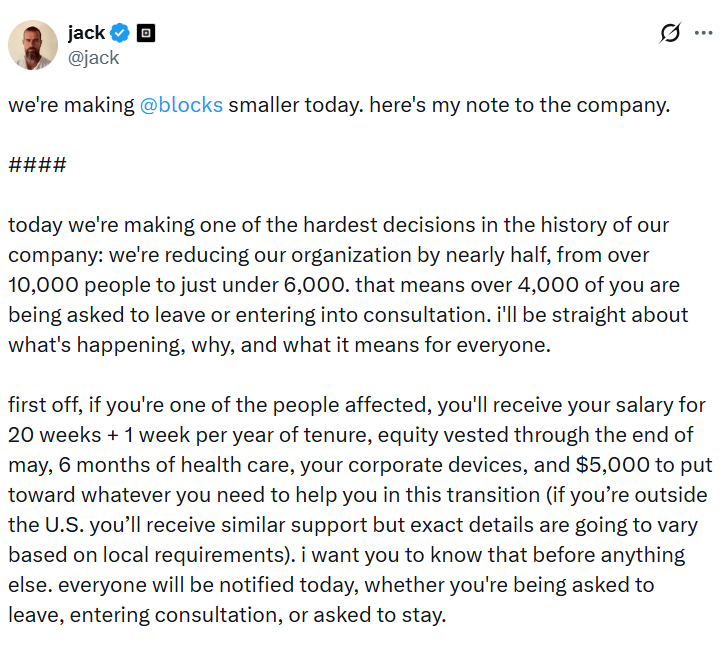
Bloomberg reported earlier this month that 10% of Block’s workforce could be cut during annual performance reviews as part of a broader overhaul.
Jack Dorsey’s payments company Block will cut over 4,000 of its staff, with its co-founder pinning the move on the rapid acceleration of AI.
“We’re already seeing that the intelligence tools we’re creating and using, paired with smaller and flatter teams, are enabling a new way of working which fundamentally changes what it means to build and run a company, and that’s accelerating rapidly,” wrote Dorsey in a letter to the company, which he shared on X.
“I had two options: cut gradually over months or years as this shift plays out, or be honest about where we are and act on it now. I chose the latter. Repeated rounds of cuts are destructive to morale, to focus, and to the trust that customers and shareholders place in our ability to lead,” he added.
Affected staff will still receive their salary for 20 weeks, plus one week per year of tenure, six months of health care, their corporate devices, and $5,000 to help them transition to a new role, said Dorsey.

Bloomberg reported earlier this month that 10% of Block’s workforce could be eliminated during annual performance reviews, as part of a wider restructuring effort.
Magazine: Bitcoin’s ‘biggest bull catalyst’ would be Saylor’s liquidation — Santiment founder

Harrogate Synthotech Group’s robot technology expanding

Use local prices to value gold, silver held by ETFs: Sebi

Ethereum Foundation Outlines ‘Strawmap’ Through 2029


-

 Video7 days ago
XRP News: XRP Just Entered a New Phase (Almost Nobody Noticed)
-

 Politics5 days ago
Baftas 2026: Awards Nominations, Presenters And Performers
-

 Fashion6 days ago
Weekend Open Thread: Boden – Corporette.com
-

 Sports3 days ago
Women’s college basketball rankings: Iowa reenters top 10, Auriemma makes history
-

 Politics3 days ago
Nick Reiner Enters Plea In Deaths Of Parents Rob And Michele
-

 Business2 days ago
True Citrus debuts functional drink mix collection
-

 Crypto World3 days ago
XRP price enters “dead zone” as Binance leverage hits lows
-

 Business5 days ago
Mattel’s American Girl brand turns 40, dolls enter a new era
-

 Business4 days ago
Law enforcement kills armed man seeking to enter Trump’s Mar-a-Lago resort, officials say
-

 Tech2 days ago
Unsurprisingly, Apple's board gets what it wants in 2026 shareholder meeting
-

 NewsBeat1 day ago
Cuba says its forces have killed four on US-registered speedboat | World News
-
 NewsBeat1 day ago
Manchester Central Mosque issues statement as it imposes new measures ‘with immediate effect’ after armed men enter
-
 NewsBeat4 days ago
‘Hourly’ method from gastroenterologist ‘helps reduce air travel bloating’
-

 Tech4 days ago
Anthropic-Backed Group Enters NY-12 AI PAC Fight
-

 NewsBeat4 days ago
Armed man killed after entering secure perimeter of Mar-a-Lago, Secret Service says
-

 Politics4 days ago
Maine has a long track record of electing moderates. Enter Graham Platner.
-
 NewsBeat2 days ago
Police latest as search for missing woman enters day nine
-

 Business21 hours ago
Discord Pushes Implementation of Global Age Checks to Second Half of 2026
-

 Crypto World2 days ago
Entering new markets without increasing payment costs
-

 Business4 hours ago
Only 4% of women globally reside in countries that offer almost complete legal equality