If you’re in Cobb County, Georgia, you can now hit the state’s first drive-through court service on your next lunch break. The newly opened Clerk’s Office Express lets residents pay certain fines and fees without even needing to get out of their vehicles. Operated by the Cobb County State and Magistrate Court Clerk’s Office, the hope is that it’ll streamline routine court transactions and cut down on congestion inside court buildings.
Time will tell how quick and easy it actually ends up being in the long run. Nevertheless, the Clerk’s Office Express accepts payments for traffic citations, school bus arm violations, and probation fees, as well as court fines and restitution for cases that don’t require a court appearance, like that million-dollar speeding ticket someone got in the state a couple of years back.
Advertisement
The concept was developed by Cobb County State Court Clerk Tahnicia Phillips, who said courts must adapt to changing demands and community needs. “Modern courts must meet people where they are,” Phillips said in a press release. She called the drive-through a practical step toward improving access without needing to add any complicated new technology in the process.
Advertisement
What led to a need for clerk’s office reform in Cobb County
Kurtis Toliver/Shutterstock
In recent years, Cobb County has seen a significant rise in citations issued. Naturally, that comes with a similar increase in payments needing to be made; part of that increase comes after the county’s rollout of 150 school bus cameras to stop drivers from illegally passing stopped buses. That’s why it’s always a good idea to know what to do if you need to pass a stopped car. The state’s also seeing more tickets from speeding cameras in school zones.
By shifting some of those routine transactions to the drive-through, officials expect to reduce the court’s crowded lobbies and improve efficiency for both staff and the public alike. The drive-through even allows attorneys to submit filings, making it more than just a place for people to pay fines.
Online payment options have been available and will remain so, even with the opening of the drive-through. Still, if things go according to plan, this new alternative will be a helpful and time-saving change for those who prefer to pay in-person.
The office opens at 7:30 in the morning and will remain open until 3 in the afternoon, Monday through Friday. People need to bring their citation or case number, a photo ID, and a debit or credit card to take care of what they owe.
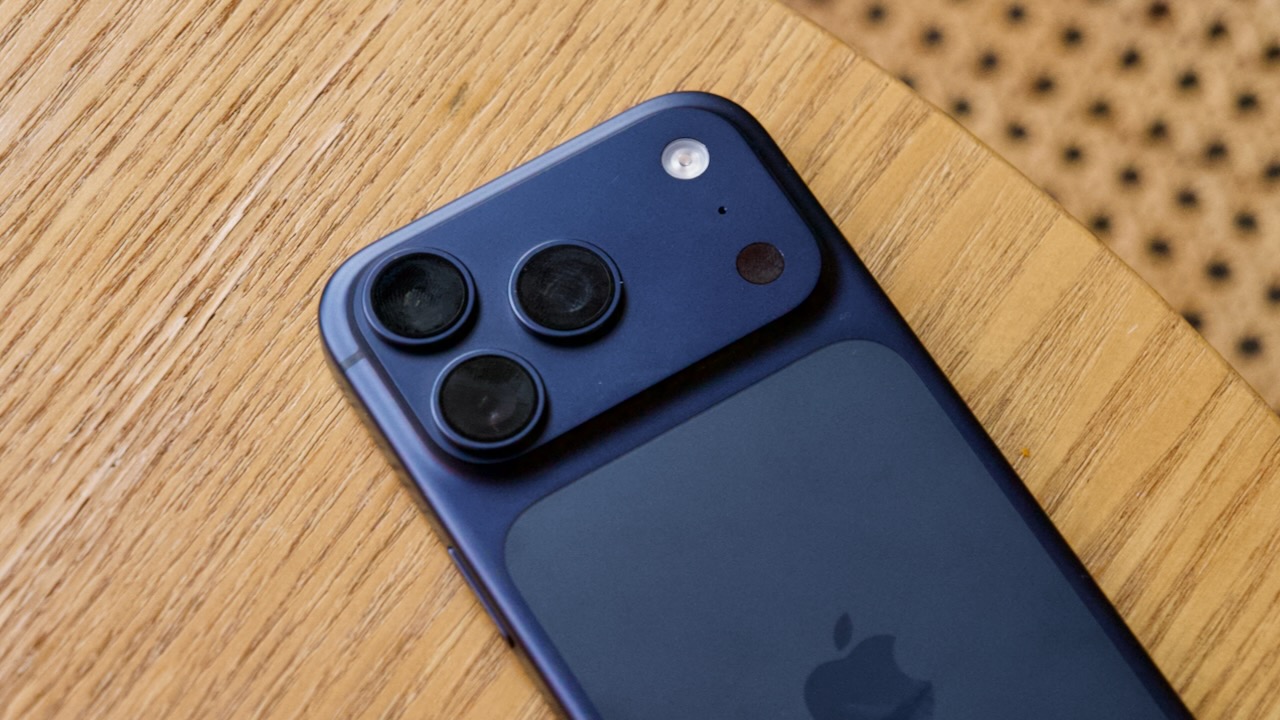
Apple has begun rolling out OS-level age verification to users in the UK, starting with the latest iOS 26.4 beta.
After installing the update, some users are prompted to confirm they’re over 18 (via The Verge). Apple warns that those who don’t verify their age may be unable to download apps, make purchases, or complete in-app transactions.
Screenshots shared by beta users show Apple explaining that it may automatically confirm someone’s age using the payment method linked to their Apple ID or existing account information. If that isn’t possible, users could be asked to scan a credit card.
Apple hasn’t yet provided an official statement detailing how widely the feature is rolling out in the UK. Also, it’s unclear whether all iOS 26.4 beta users are seeing the prompt.
Advertisement
The move comes as tech companies face growing regulatory pressure around age checks. Earlier this week, Apple confirmed it would begin blocking users in Australia, Brazil and Singapore from downloading apps rated 18+ unless they verify their age using what it calls “reasonable methods.” The company has also said it will start sharing age category data with developers in certain US states. Specifically, this includes Utah and Louisiana, to comply with local laws.
Advertisement
Online reaction has been mixed. Some users on Reddit have criticised the change, arguing that OS-level verification goes too far, while others point out that Apple is responding to legislation rather than acting independently. Age verification requirements have been expanding globally. This is particularly the case for platforms that distribute adult-rated content or enable in-app purchases.
For now, the UK rollout appears limited to beta software. However, the inclusion at the operating system level suggests Apple is preparing for broader enforcement.
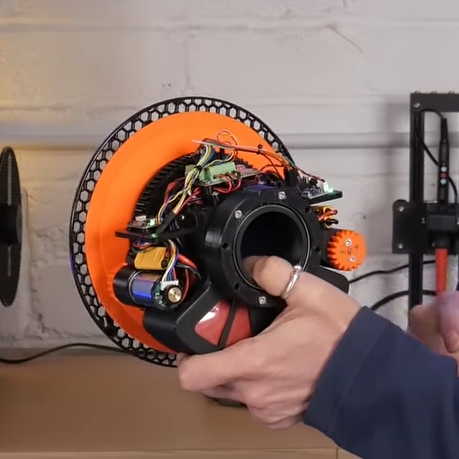
[Matt Denton]’s SpoolBot is a surprisingly agile remote-controlled robot that doesn’t just repurpose filament spool leftovers. It looks exactly like a 2 kg spool of filament; that’s real filament wound around the outside of the drum. In fact, Spoolie the SpoolBot looks so much like the real thing that [Matt] designed a googly-eye add-on, because the robot is so easily misplaced.
The robot’s mass rotates around a central hub in order to move forward or back.
SpoolBot works by rotating its mass around the central hub, which causes it to roll forward or back. Steering is accomplished by tank-style turning of the independent spool ends. While conceptually simple, quite a bit of work is necessary to ensure SpoolBot rolls true, and doesn’t loop itself around inside the shell during maneuvers. Doing that means sensors, and software work.
To that end, a couple of rotary encoders complement the gearmotors and an IMU takes care of overall positional sensing while an ESP32 runs the show. The power supply uses NiMH battery packs, in part for their added weight. Since SpoolBot works by shifting its internal mass, heavier batteries are more effective.
The receiver is a standard RC PWM receiver which means any RC transmitter can be used, but [Matt] shows off a slick one-handed model that not only works well with SpoolBot but tucks neatly into the middle of the spool for storage. Just in case SpoolBot was not hard enough to spot among other filament rolls, we imagine.
The googly-eye add-on solves that, however. They clip to the central hub and so always show “forward” for the robot. They do add quite a bit of personality, as well as a visual indication of the internals’ position relative to the outside.
Advertisement
The GitHub repository and Printables page have all the design files, and the video (embedded just below) shows every piece of the internals.
The kind of hardware available nowadays makes self-balancing devices much more practical and accessible than they ever have been. Really, SpoolBot has quite a lot in common with other self-balancing robots and self-balancing electric vehicles (which are really just larger, ridable self-balancing robots) so there’s plenty of room for experimentation no matter one’s budget or skill level.
For the last six months, enterprises wanting to deploy high quality AI image generation at scale have faced an uncomfortable trade-off: pay premium prices for Google’s Nano Banana Pro model, or settle for cheaper (sometimes free), faster, but noticeably inferior alternatives — especially in terms of enterprise requirements like embedded accurate text, slides, diagrams, and other non aesthetic information.
Today, Google DeepMind is attempting to collapse that gap with the launch of Nano Banana 2 (formally Gemini 3.1 Flash Image) — a model that brings the reasoning, text rendering, and creative control of the Pro tier down to Flash-level speed and pricing.
The release comes just sixteen days after Alibaba’s Qwen team dropped Qwen-Image-2.0, a 7-billion parameter open-weight challenger that many developers argued had already matched Nano Banana Pro’s quality at a fraction of the inference cost.
Advertisement
For IT leaders evaluating image generation pipelines, Nano Banana 2 reframes the decision matrix. The question is no longer whether AI image models are good enough for production — it’s which vendor’s cost curve best fits the workflow.
The production cost problem: why Nano Banana Pro stayed in the sandbox
When Google released Nano Banana Pro in November 2025, built on the Gemini 3 Pro backbone, the developer community was impressed by its visual fidelity and reasoning capabilities.
The model could render accurate text in images, maintain character consistency across multi-turn conversations, and follow complex compositional instructions — all capabilities that previous image generators struggled with.
But Pro-tier pricing created a barrier to deployment at scale. According to Google’s API pricing page, Nano Banana Pro’s image output is priced at $120 per million tokens, working out to roughly $0.134 per generated image at 1K pixel resolution.
Advertisement
For applications generating thousands of images daily — think e-commerce product visualization, marketing asset pipelines, or localized content generation — those costs compound quickly.
Nano Banana 2, built on the Gemini 3.1 Flash backbone, dramatically undercuts that pricing. Flash-tier image output is priced at $60 per million tokens, approximately $0.067 per 1K image per image — roughly 50% cheaper than the Pro model. For enterprises running high-volume image generation workflows, that’s the difference between a proof of concept and a production deployment.
What Nano Banana 2 actually delivers
The model is not simply a cheaper Nano Banana Pro. According to Google DeepMind’s announcement, Nano Banana 2 brings several capabilities that were previously exclusive to the Pro tier while introducing new features of its own.
The headline improvement is text rendering and translation. The model can generate images with accurate, legible text — a historically weak point for AI image generators — and then translate that text into different languages within the same image editing workflow.
Advertisement
Subject consistency has also improved significantly. Nano Banana 2 can maintain character resemblance across up to five characters and preserve the fidelity of up to 14 reference objects in a single generation workflow.
This enables storyboarding, product photography with multiple SKUs, and brand asset creation where visual continuity matters. Google’s documentation highlights the ability to provide up to 14 different reference images as input, allowing the model to compose scenes incorporating multiple distinct objects or characters from separate sources.
On the technical specification side, the model supports full aspect ratio control, resolutions ranging from 512 pixels up to 4K, and two thinking levels that let developers balance quality against latency.
One notable addition that Nano Banana Pro lacks is an image search tool — the model can perform image searches and use retrieved images as grounding context for generation, expanding its utility for workflows that require visual reference material.
Advertisement
The Qwen-Image-2.0 factor: why Google needed to move fast
Google’s timing is not coincidental. On February 10, Alibaba’s Qwen team released Qwen-Image-2.0, a unified image generation and editing model that immediately drew comparisons to Nano Banana Pro — but with a dramatically smaller footprint.
Qwen-Image-2.0 runs on just 7 billion parameters, down from 20 billion in its predecessor, while unifying text-to-image generation and image editing into a single architecture.
The model generates natively at 2K resolution (2048×2048 pixels), supports prompts up to 1,000 tokens for complex layouts, and ranks at or near the top of AI Arena’s blind human evaluation leaderboard for both generation and editing tasks.
For enterprise buyers, the competitive dynamics are significant. Qwen-Image-2.0’s 7B parameter count means substantially lower inference costs when self-hosted — a critical consideration for organizations with data residency requirements or high-volume workloads.
Advertisement
The Qwen team’s previous model, Qwen-Image v1, was released under Apache 2.0 approximately one month after its initial announcement, and the developer community widely expects the same trajectory for v2.0. If open weights materialize, organizations could run a Nano Banana Pro-competitive image model on their own infrastructure without per-image API charges.
The model’s unified generation-and-editing architecture also simplifies deployment. Rather than chaining separate models for creation and modification — the current industry norm — Qwen-Image-2.0 handles both tasks in a single pass, reducing latency and the quality degradation that occurs when outputs are passed between different systems.
Where Qwen-Image-2.0 currently trails is ecosystem integration. Google’s Nano Banana 2 launches today across the Gemini app, Google Search (AI Mode and Lens), AI Studio, the Gemini API, Google Antigravity, Vertex AI, Google Cloud, and Flow — where it becomes the default image generation model at zero credit cost. That breadth of distribution is difficult for any challenger to replicate, particularly one whose API access is currently limited to Alibaba Cloud’s platform.
What this means for enterprise AI image strategies
The simultaneous availability of Nano Banana 2 and Qwen-Image-2.0 creates a decision framework that IT leaders haven’t had before in the image generation space.
Advertisement
For organizations already embedded in Google’s cloud ecosystem, Nano Banana 2 is the obvious first evaluation. The cost reduction from Pro pricing, combined with native integration across Google’s product surface, makes it the path of least resistance for teams that need production-quality image generation without re-architecting their stack. The model’s text rendering capabilities make it particularly well-suited for marketing asset generation, localization workflows, and any application where legible in-image text is a requirement.
For organizations with data sovereignty concerns, high-volume workloads that make per-image API pricing prohibitive, or a strategic preference for open-weight models, Qwen-Image-2.0 presents a compelling alternative — provided Alibaba follows through on open-weight availability. The model’s smaller parameter count translates to lower GPU requirements for self-hosting, and its unified generation-editing architecture reduces pipeline complexity.
The wild card is Nano Banana Pro itself, which isn’t going away. Google AI Pro and Ultra subscribers retain access to the Pro model for specialized tasks, accessible via the regeneration menu in the Gemini app. For use cases demanding maximum visual fidelity and creative reasoning — think high-end creative campaigns or applications where every image needs to look bespoke — Pro remains the ceiling.
The provenance layer: a quiet but important enterprise differentiator
Buried in Google’s announcement is a detail that may matter more to enterprise legal and compliance teams than any quality benchmark: provenance tooling. Nano Banana 2 ships with SynthID watermarking — Google’s AI-generated content identification technology — coupled with C2PA Content Credentials, the cross-industry standard for content authenticity metadata.
Advertisement
Google reports that since launching SynthID verification in the Gemini app last November, the feature has been used over 20 million times to identify AI-generated images, video, and audio. C2PA verification is coming to the Gemini app soon as well.
For enterprises operating in regulated industries or jurisdictions with emerging AI transparency requirements, baked-in provenance is no longer optional. It’s a compliance checkbox — and one that self-hosted open-weight alternatives like Qwen-Image-2.0 don’t natively provide.
The bottom line
Nano Banana 2 doesn’t represent a generational leap in image generation quality. What it represents is the maturation of AI image generation from a creative novelty into a production-ready infrastructure component. By collapsing the cost and speed gap between Flash and Pro tiers while retaining the reasoning and text rendering capabilities that make these models useful for actual business workflows, Google is making a calculated bet: the next wave of enterprise AI image adoption will be driven not by the models that produce the most beautiful images, but by the ones that produce good-enough images fast enough and cheaply enough to deploy at scale.
With Qwen-Image-2.0 pushing from the open-weight flank and Nano Banana Pro holding the quality ceiling, Nano Banana 2 occupies exactly the middle ground where most enterprise workloads actually live. For IT decision-makers who’ve been waiting for the cost curve to bend, it just did.
DIY store chain ManoMano is notifying customers of a data breach that was caused by hackers compromising a third-party service provider.
The company confirmed to BleepingComputer that it learned of the hack in January 2026. An investigation into the incident determined that 38 million individuals are affected.
“We can confirm that ManoMano has recently notified customers about a security incident involving one of our third-party customer service providers (a subcontractor),” the company told BleepingComputer.
“In January 2026, we identified unauthorized access linked to this provider, which resulted in the unauthorized extraction of certain personal data associated with customer accounts and customer service interactions.”
ManoMano is a French e-commerce firm operating an online marketplace specializing in DIY, home improvement, gardening, and related products. It operates in France, Belgium, Spain, Italy, Germany, and the United Kingdom, and its e-stores reportedly have 50 million unique visitors per month.
Advertisement
Earlier this month, someone using the alias “Indra” claimed the ManoMano attack on a hacker forum, alleging that they were holding details on 37.8 million user accounts, as well as thousands of support tickets and attachments.
According to unconfirmed reports, the compromised organization was a Tunis-based customer support service provider that suffered a Zendesk breach.
Cybersecurity firm Hackmanac posted that ManoMano started notifying customers this week that their data had been stolen.
A spokesperson of ManoMano explained to BleepingComputer that the exposed information varies per individual, depending on the type of interactions they had with the platform. Exposed data types include:
Advertisement
Full name
Email address
Phone number
Customer service communications
ManoMano emphasizes that no account passwords were accessed and that no data modifications occurred on the company’s systems.
“Upon discovery, we took immediate steps to secure our environment, including disabling the relevant access, revoking the subcontractor’s access to customer data, and strengthening access controls and monitoring,” said a ManoMano spokesperson.
“We also notified the relevant authorities, including the CNIL and ANSSI, and informed impacted customers with guidance to remain vigilant against phishing and social engineering attempts.”
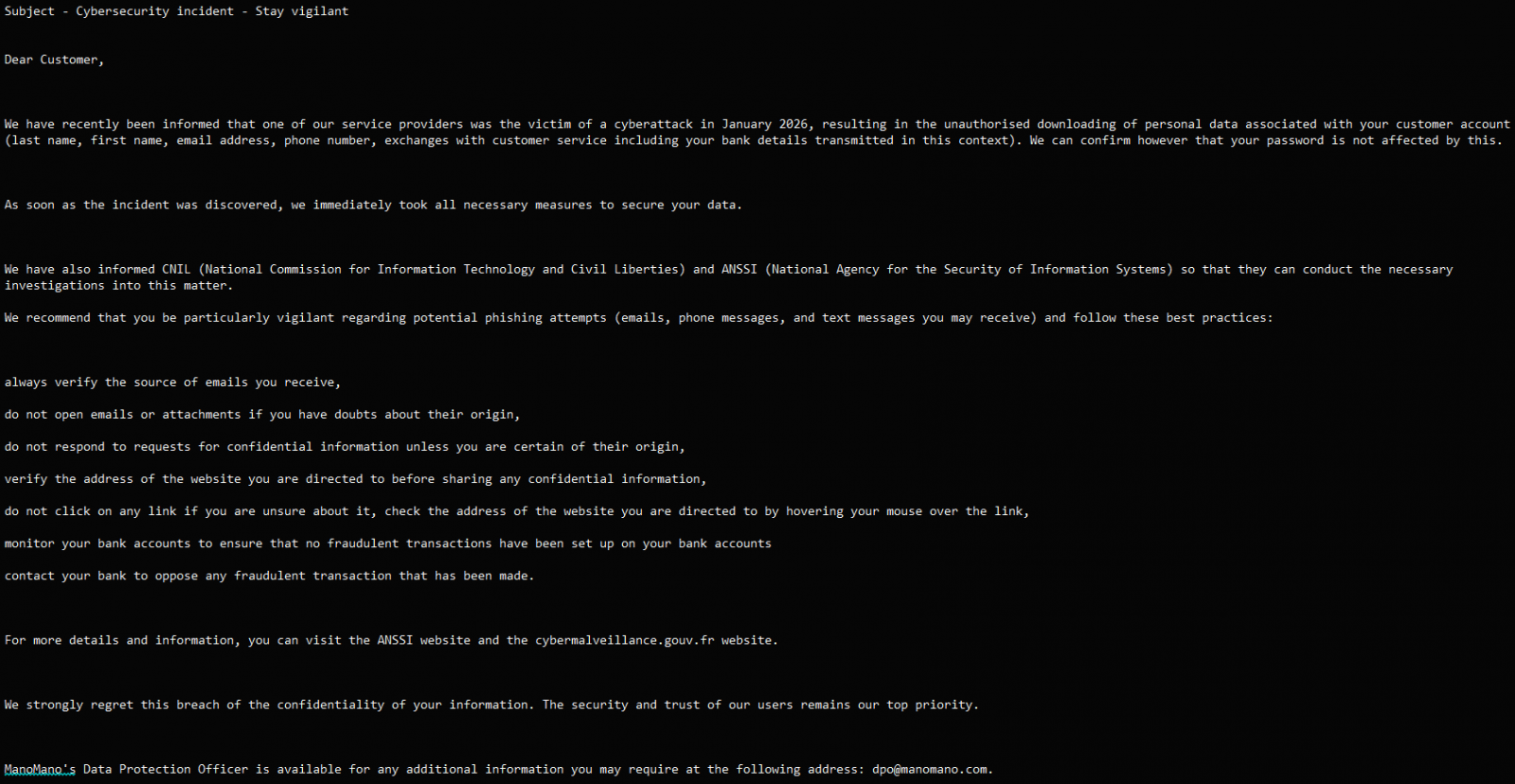
Notice sent to customers Source: ManoMano
The notification sample ManoMano shared with BleepingComputer contains recommendations for customers, including verifying incoming communications and sender identity, monitoring bank accounts for fraudulent transactions, and avoiding clicking on suspicious links or downloading email attachments.
ManoMano notes that the investigation is ongoing and that they cannot share additional technical details at this stage.
Modern IT infrastructure moves faster than manual workflows can handle.
In this new Tines guide, learn how your team can reduce hidden manual delays, improve reliability through automated response, and build and scale intelligent workflows on top of tools you already use.
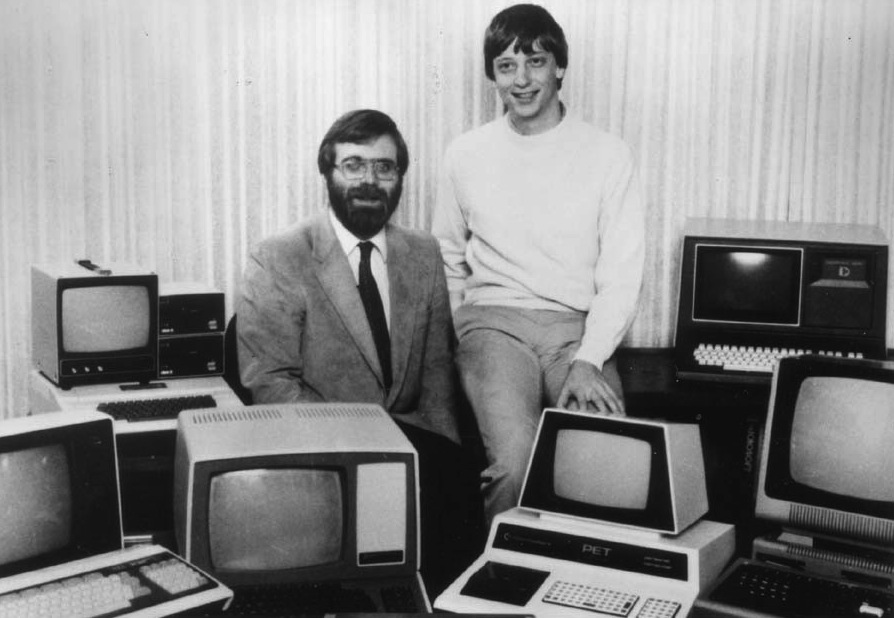
Paul Allen and Bill Gates in 1980. The Microsoft co-founders shared a love for computer software, but pro sports was Allen’s thing. (Photo courtesy of Microsoft Archives)
Cross Bill Gates off the list of super rich potential buyers for the Seattle Seahawks.
Gates said he has no interest in owning the NFL franchise that Paul Allen, his late Microsoft co-founder, purchased in 1997 and which is now seeking a new buyer, eight years after Allen’s death.
The question came up this week during a town hall meeting with Gates Foundation employees, The Seattle Times reported. Gates said his billions are dedicated to the philanthropic organization.
“This is a great city,” Gates said. “But my owning a sports team will not be a part of how I spend my time.”
He also joked about the makeup of the Seahawks.
Advertisement
“I noticed they only have men on their team, and I’m not sure I can go with that,” Gates said at the meeting, according to the Times.
The gathering with staff at the foundation included an apology from Gates for his past interactions with the late convicted sex offender Jeffrey Epstein. Gates, who acknowledged that the situation puts the foundation’s reputation at risk, also admitted to two extramarital affairs.
With the Super Bowl-winning Seahawks expected to fetch anywhere from $6 billion to more than $10 billion, Gates logically landed on a short list of potential buyers because of his Seattle connection and his net worth of $107 billion.
Gates always regarded Allen as his more curious and cooler older friend. While the two bonded over computers and software and, later, their charitable pursuits, Gates admired Allen’s wide-ranging interests, including music and sports.
Advertisement
“Sports was another passion that Paul loved to share with his friends,” Gates wrote in a tribute shortly after Allen died in October 2015. “In later years he would take me to see his beloved Portland Trail Blazers and patiently helped me understand everything that was happening on the court.”
A 2003 image from the Seattle Post-Intelligencer shows Gates and Allen sitting beneath the basket at a game between the Seattle SuperSonics and Trail Blazers, alongside Gates’s wife at the time, Melinda French Gates.
While Gates said this week that he hopes the Seahawks get a good owner, the Times noted that he’d also like to see Seattle get a basketball team again.
The raise will fund Allica’s expansion plans outside the UK.
London’s Allica Bank has joined the European unicorn league with a $155m Series D raise that values the company at $1.2bn. New investors Ventura Capital, GLG and Sona AM, and existing investors TCV and Blue Owl, took part in the round.
Allica’s digital banking services are geared toward small, and medium enterprises (SMEs), currently offering services to more than 30,000 SMEs across the UK. The 2011-founded company has been named the fastest growing technology company in the UK by Deloitte in both 2023 and 2024.
According to Allica, SMEs are an underserved customer base in the fintech market.
Advertisement
The digital bank said the capital will enable continued investment into AI to develop newer lending mechanisms for SMEs. The infusion will also fund the company’s expansion plans outside the UK.
“We’re building the category defining digital bank for established SMBs, and are excited to be taking our proprietary platform into new markets,” said Allica CEO Richard Davies.
“This Series D investment is a major vote of confidence in Allica’s strategy and performance.”
Allica joins the fintech unicorn league alongside companies such as the UK’s Cleo and Denmark’s Flatpay. It was one of the new firms invited to participate in a new UK scale-up unit designed to support fast-growing, innovative financial services firms to scale and create high-skilled jobs in the country.
Advertisement
“Allica is a world class business that is executing exceptionally well in a large, underserved market,” said Mo El Husseiny, the managing partner of Ventura Capital.
Earlier this week, Irish fintech Stripe, founded by brothers John and Patrick Collison, announced it had hit a $159bn valuation – up from $106bn a year ago. Bloomberg reported shortly after that Stripe is considering acquiring PayPal, which has been struggling to grow for a few years.
Don’t miss out on the knowledge you need to succeed. Sign up for the Daily Brief, Silicon Republic’s digest of need-to-know sci-tech news.
Jack Dorsey’s Block is cutting more than 4,000 jobs, or nearly half its workforce, as part of a deliberate shift toward becoming a smaller, “intelligence-native” company built around AI. The Verge reports: “We’re not making this decision because we’re in trouble,” Dorsey says. “Our business is strong. Gross profit continues to grow, we continue to serve more and more customers, and profitability is improving. But something has changed. We’re already seeing that the intelligence tools we’re creating and using, paired with smaller and flatter teams, are enabling a new way of working which fundamentally changes what it means to build and run a company. And that’s accelerating rapidly.”
Dorsey opted to do a big layoff instead of gradual cuts because “I’d rather take a hard, clear action now and build from a position we believe in than manage a slow reduction of people toward the same outcome.” The layoffs were announced on Thursday as part of the company’s Q4 2025 earnings. In a shareholder letter (PDF), Dorsey says that “We believe Block will be significantly more valuable as a smaller, faster, intelligence-native company. Everything we do from here is in service of that.”
Robert Walters’ data suggests that microshifting could be the next evolution of flexible working.
The global pandemic and AI wave have in many ways altered how modern-day employees approach working life. Remote and hybrid opportunities have given professionals greater control over their hours, creating a stronger sense of work-life balance.
New research from recruitment platform Robert Walters indicates that there may now be a new working trend impacting the professional space: microshifting. This is defined as an approach to hours which sees the traditional working day split into shorter blocks of time, based around a professional’s personal obligations or energy peaks.
Robert Walters collected data from 850 white-collar, full-time, permanent professionals based in Ireland between December of 2025 and January of this year. What the report discovered is that more than half (59pc) of contributing Irish employees want their place of employment to adopt a microshifting schedule.
Advertisement
Some respondents have noted that available flexible working models are not operating as efficiently or effectively as they could. Only 36pc of Irish workers stated that their company’s current policy is fit for purpose.
“Despite years of debate around flexible working, many organisations still measure commitment by visibility rather than results,” said Suzanne Feeney, the country manager at Robert Walters Ireland. “Trends like microshifting will continue to emerge as professionals seek flexibility that actually works, instead of policies that look progressive on paper but fail in practice.”
Shifting values
Despite concerns that flexible working results in lower engagement, Robert Walters’ report highlights that flexibility in hours can lead to increased office attendance. Of those who contributed their data, 42pc responded that switching to a microshifting approach would encourage them to increase the number of days they spend in the office each week.
Feeney said: “Offering flexible hours may feel counterproductive for employers looking to increase office attendance. Yet, a more adaptable schedule, without the pressure of rush hour commutes or staying at their desk all day, could motivate professionals to attend the office more frequently.”
Advertisement
More than a third of line managers (37pc) surveyed by Robert Walters thought microshifting could help improve engagement within their teams, while a further 44pc said they were open to testing it out.
Feeney added: “Microshifting is a more transparent version of the unofficial flexible working arrangements that already exist in many organisations. For managers and senior leaders, the question is whether it should be governed by trust and outcomes or quietly negotiated between colleagues.”
According to the data, however, worries persist, as nearly 50pc of surveyed managers expressed concerns that microshifting could result in higher instances of “quiet quitting“ and “slacking”.
Feeney said: “While fears of microshifting fuelling disengagement are justified, the reality is that rigid working patterns are already pushing professionals to seek workarounds.
Advertisement
“Our findings suggest that when expectations are clear and performance is measured by results rather than visibility, microshifting has the potential to increase engagement, accountability and even time spent in the office.”
Additional research published today (26 February) by CPL also explored how organisations have to do more to encourage key talent loyalty. CPL’s Salary Guide for Ireland 2026 found that while compensation and benefits continue to be the top priority for 35pc of contributing employees, 24pc of professionals said that leadership and culture are the most important factors to consider when choosing an employer.
CPL’s research also found that flexible working has evolved from a perk to a critical component of employee packages, ranking as the second most important benefit overall among contributing participants.
Don’t miss out on the knowledge you need to succeed. Sign up for the Daily Brief, Silicon Republic’s digest of need-to-know sci-tech news.
Honor has confirmed an expanded version of its Honor Share file transfer system ahead of MWC 2026 in Barcelona, with new cross-OS capabilities that allow its latest Android devices to exchange files and share screens directly with iPhone, iPad, and Mac hardware.
The update builds on a cross-platform push Honor first introduced at MWC 2025, when the company announced its AI Alpha Plan and teased what it called an all-ecosystem exchange capability that would reduce the friction of moving files between Android and iOS devices.
The 2026 iteration goes further by expanding the scope of what Honor Share can do, moving beyond basic file transfer to include real-time display extension and a single-tap transfer method that Honor states no other Android manufacturer currently offers for Mac.
The Magic V6 foldable gains OneTap transfer to Mac, a feature that sends photos, videos, and documents from the phone directly to an Apple desktop without requiring a cable, a shared cloud account, or any third-party application running in between.
Advertisement
The MagicPad 4 tablet extends the integration further, supporting photo and video transfers from iPhone while also functioning as a secondary display for MacBook, allowing users to edit on the laptop and preview content on the tablet in real time across two operating systems.
Advertisement
The MagicBook Pro 14, Honor’s 2026 Windows laptop, rounds out the trio with a single-click Honor Share function that pushes images and documents directly to an iPhone or iPad without the workarounds that typically slow down transfers between Windows machines and Apple mobile devices.
A broader industry shift
The feature reflects a growing competitive pressure among Android manufacturers to remove barriers between their own hardware and the Apple ecosystem, as a significant portion of consumers own devices that span both platforms rather than sitting entirely within one.
Advertisement
Samsung has explored similar territory through its Link to Windows integration and cross-device features, while Apple’s own Continuity suite remains exclusive to hardware within its own product range and offers no equivalent outbound compatibility for Android users.
Full specifications, pricing, and availability across all three devices will be confirmed when Honor takes the stage at MWC Barcelona, which runs from March 2 to March 5, 2026.
Google API keys for services like Maps embedded in accessible client-side code could be used to authenticate to the Gemini AI assistant and access private data.
Researchers found nearly 3,000 such keys while scanning internet pages from organizations in various sectors, and even from Google.
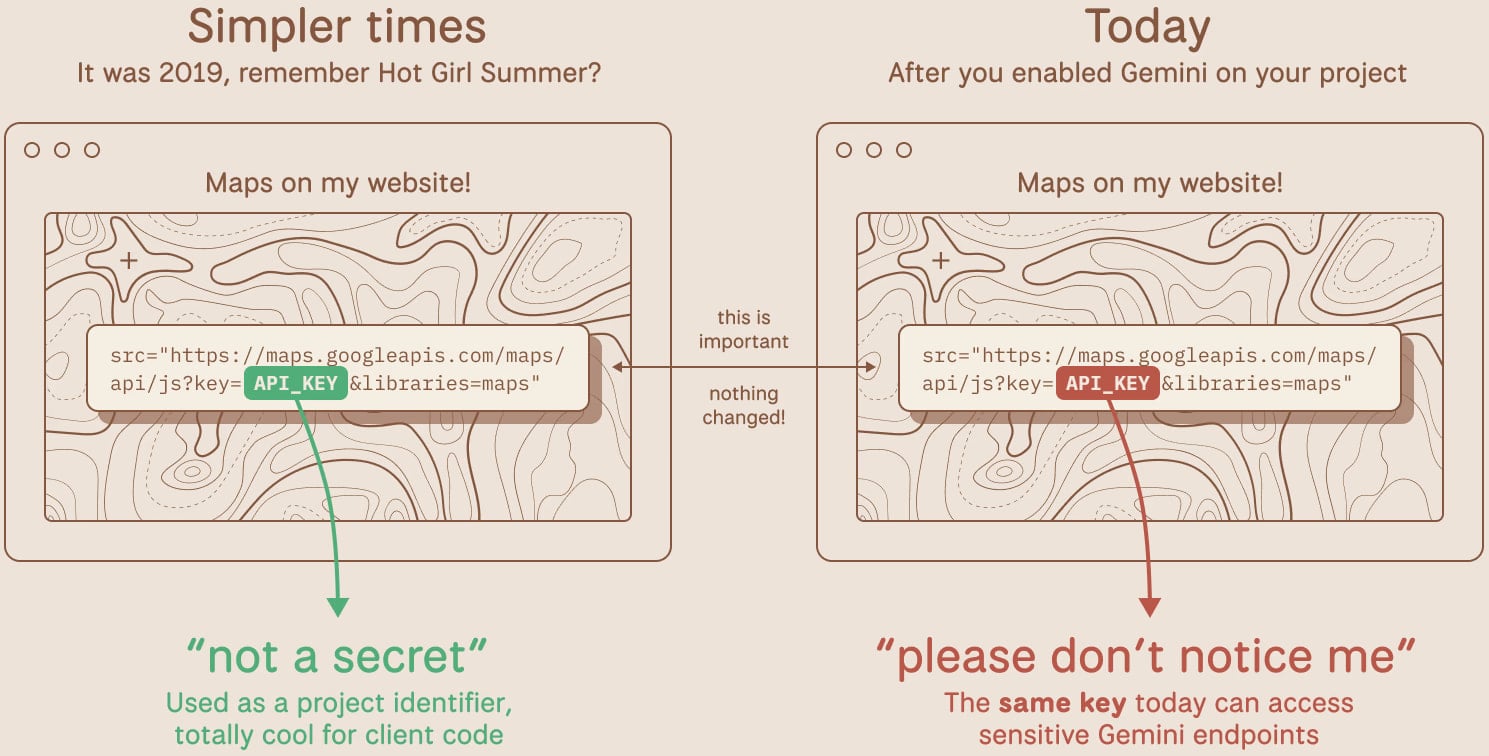
The problem occurred when Google introduced its Gemini assistant, and developers started enabling the LLM API in projects. Before this, Google Cloud API keys were not considered sensitive data and could be exposed online without risk.
Developers can use API keys to extend functionality in a project, such as loading Maps on a website to share a location, for YouTube embeds, usage tracking, or Firebase services.
When Gemini was introduced, Google Cloud API keys also acted as authentication credentials for Google’s AI assistant.
Advertisement
Researchers at TruffleSecurity discovered the issue and warned that attackers could copy the API key from a website’s page source and access private data available through the Gemini API service.
Since using the Gemini API is not free, an attacker could leverage the access and make API calls for their benefit.
“Depending on the model and context window, a threat actor maxing out API calls could generate thousands of dollars in charges per day on a single victim account,” Truffle Security says.
The researchers warn that these API keys have been sitting exposed in public JavaScript code for years, and now they have suddenly gained more dangerous privileges without anyone noticing.
Advertisement
Source: TruffleSecurity
TruffleSecurity scanned the November 2025 Common Crawl dataset, a representative snapshot of a large swath of the most popular sites, and found more than 2,800 live Google API keys publicly exposed in their code.
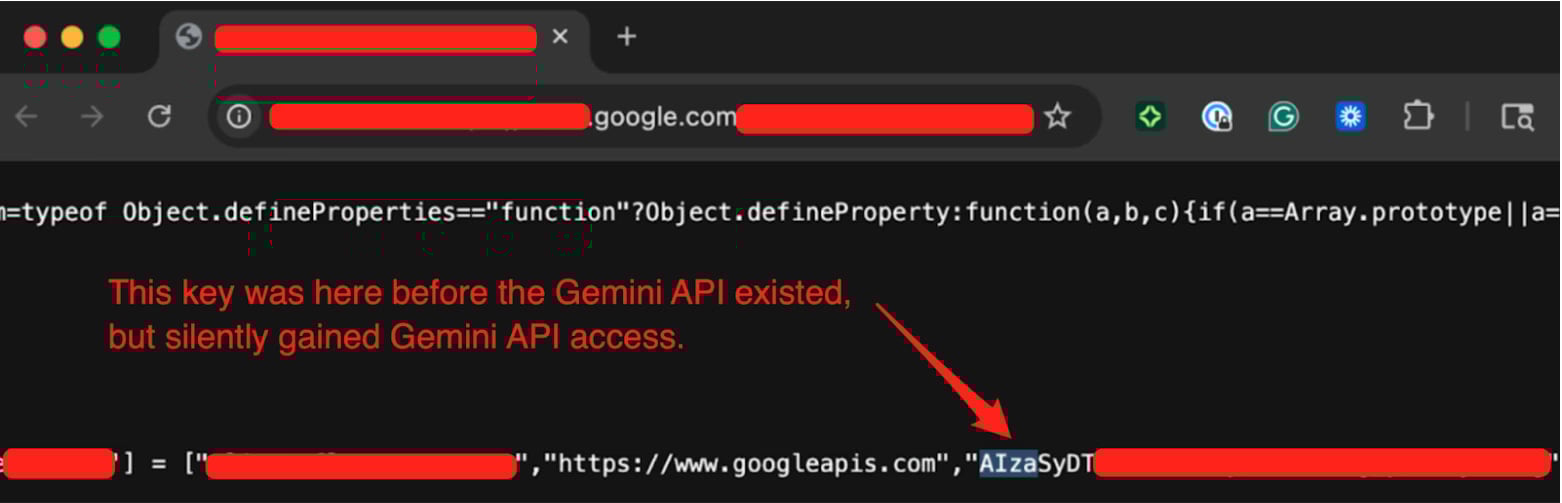
According to the researchers, some of the keys were used by major financial institutions, security companies, and recruiting firms. They reported the problem to Google, providing samples from its infrastructure.
In one case, an API key acting just as an identifier was deployed since at least February 2023 and was embedded in the page source of a Google product’s public-facing website.
Google’s exposed key Source: TruffleSecurity
Truffle Security tested the key by calling the Gemini API’s /models endpoint and listing available models.
The researchers informed Google of the problem last year on November 21. After a long exchange, Google classified the flaw as “single-service privilege escalation” on January 13, 2026.
In a statement for BleepingComputer, Google says that it is aware of the report and has “worked with the researchers to address the issue.”
Advertisement
“We have already implemented proactive measures to detect and block leaked API keys that attempt to access the Gemini API,” aGoogle spokesperson told BleepingComputer.
Google stated that new AI Studio keys will default to Gemini-only scope, leaked API keys will be blocked from accessing Gemini, and proactive notifications will be sent when leaks are detected.
Developers should check whether Gemini (Generative Language API) is enabled on their projects and audit all API keys in their environment to determine if any are publicly exposed, and rotate them immediately.
The researchers also suggest using the TruffleHog open-source tool to detect live, exposed keys in code and repositories.
Advertisement
Modern IT infrastructure moves faster than manual workflows can handle.
In this new Tines guide, learn how your team can reduce hidden manual delays, improve reliability through automated response, and build and scale intelligent workflows on top of tools you already use.