Connect with us

Business

Space X supplier Filtronic launches expanded North East base

Published

on

Business Live

The new factory and headquarters space in County Durham brings larger capacity to the technology innovator

Filtronic has substantially increased capacity with its new NETPark base.

Filtronic’s new base gives it the capacity to drive more than £200m in annual revenue.(Image: Simon Dewhurst)

Satellite communications specialist Filtronic has launched a new, multimillion-pound factory in County Durham.

The world-leading firm, which has a key supplier to Elon Musk’s Starlink satellite programme, has opened the 44,000 sqft headquarters and manufacturing facility close to its original home at NETPark. The purpose-built site significantly expands production capacity with a doubling of its manufacturing footprint and a six-fold increase in cleanroom facilities.

Filtronic says the move means it now has the capacity to support £200m annual revenue, from its current position of about £55m. The firm says the new home will help it cement its position as the country’s top producer of “mission-critical” high frequency technologies used in satellite communications, space systems and defence programmes.

In it, Filtronic’s engineers will design, develop, qualify, manufacture and test high performance connectivity technology. The new facility – which has been entirely self funded by the London-listed business – is intended to make production more scalable via growing automation.

Advertisement

Nat Edington, CEO at Filtronic, said, “Our investment in this new facility brings the scale, capability and resilience needed for our next phase of growth. As our markets shift decisively towards higher frequencies, higher bandwidth and ultra-reliable solid-state architectures, it’s a signal that we’ll continue to pre-empt, support and surpass our customer’s long-term requirements.”

Filtronic's expansion comes on the back of lucrative deals with Space X.

Sedgefield’s Filtronic has opened new premises.(Image: North News & Pictures Ltd)

With hopes of growing a record order book that includes Space X projects worth tens of millions of dollars, Filtronic is also hoping to capitalise on increased spending by Governments on secure satellite communications and next-generation defence systems. In recent months it has attracted a more diverse range of customers including a €7m agreement with a European space customer and a £13.4m contract with a leading European defence client.

Space Minister Liz Lloyd said: “The opening of this state-of-the-art facility is a clear demonstration of the strength and confidence within the UK’s space sector, and a powerful example of British industrial ambition in action. Filtronic is helping to reinforce the UK’s status as a world leader in cutting-edge communications technology.”

Filtronic is hoping to reach £200m annual revenue in the years ahead.

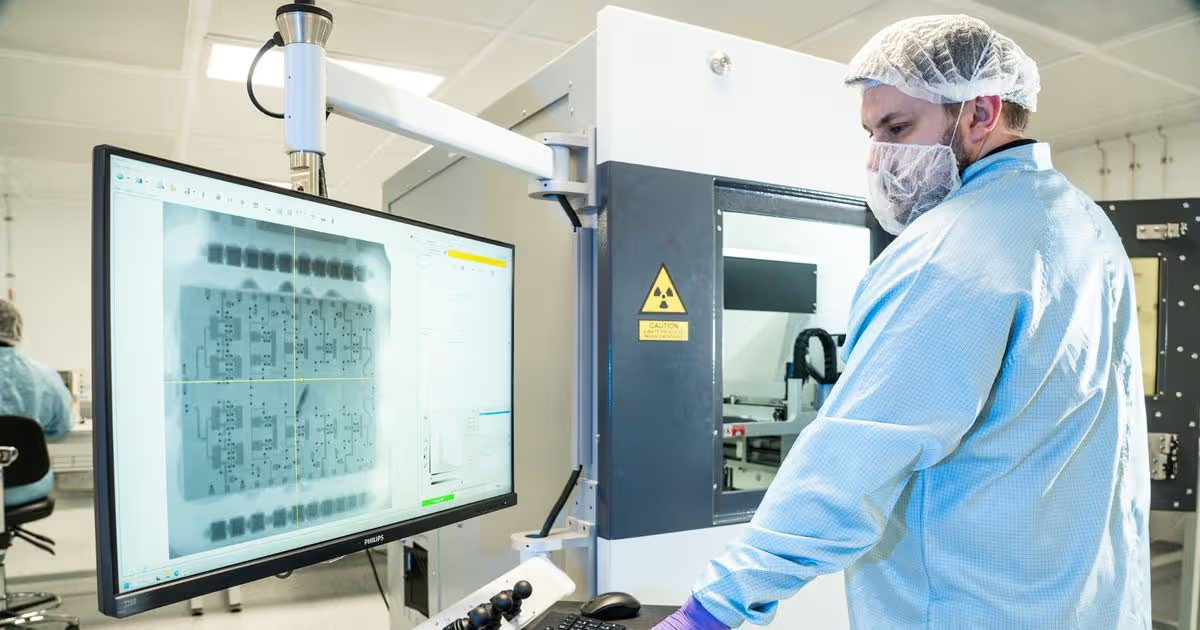
Inside Filtronic’s new 44,000 sqft headquarters at NETPark.(Image: Simon Dewhurst)

Filtronic’s technology is used in surface‑to‑space, space‑to‑space, and space‑to‑surface communications. The company says it is now the only high‑volume supplier of very high‑frequency solid‑state power amplifiers in the space sector.

Advertisement

Paul Bate, CEO, UK Space Agency, said: “Filtronic’s new facility at NETPark is a statement of intent for UK space manufacturing. Doubling their production footprint and dramatically expanding cleanroom capacity demonstrates exactly the kind of long-term industrial commitment that strengthens Britain’s capability in critical space technologies. As demand grows for high-performance RF solutions across satellite constellations and defence programmes, having world-class manufacturers of this calibre operating at scale in the UK are a significant asset.”


Continue Reading
Click to comment

Leave a Reply

Your email address will not be published. Required fields are marked *

Business

The worst day for Nvidia's stock since last spring drags Wall Street lower

Published

on

The worst day for Nvidia's stock since last spring drags Wall Street lower

The worst day for Nvidia’s stock since last spring dragged the U.S. market lower on Thursday, even though most stocks on Wall Street rose.

Continue Reading

Business

NSE invites investment banks to pitch for managing IPO

Published

on

NSE invites investment banks to pitch for managing IPO
Mumbai: The National Stock Exchange has invited as many as 15 investment bankers to pitch for managing its proposed IPO, said sources in the know. JPMorgan Chase, Kotak Mahindra Capital Company, JM Financial, Axis Capital and ICICI Securities are among bankers in the fray for the mandate to manage the issue, they said.

“The pitching process is expected to commence by mid-March, with the exchange likely to initiate the process of filing its draft red herring prospectus in April,” a source told ET. An email sent to NSE remained unanswered.

Rothschild is assisting NSE to select lead bankers, legal counsels and other intermediaries for the IPO. The IPO will be an offer for sale, which means existing shareholders may dilute their stake while the exchange will receive no fresh funds.

According to people familiar with the IPO details, existing investors are expected to offload about 4-4.5% of the exchange’s total equity. Life Insurance Corporation of India continues to be the single largest investor in NSE with a 10.72% holding. It is followed by Aranda Investments Mauritius Pte at 4.54%, Stock Holding Corporation of India Ltd at 4.44%, SBI Capital Markets Ltd at 4.33%, and Veracity Investments Ltd with a 3.93% stake. It couldn’t be ascertained who will offer their shares in the IPO.

Advertisement

In the unlisted market, NSE is currently valued at ₹5 lakh crore. Based on prices in the unlisted market, the IPO could raise approximately ₹23,000 crore. On Thursday, NSE shares in the unlisted market were trading at ₹2,035 per share. Last month, the Sebi issued the much-awaited no-objection certificate for the IPO, ending a regulatory impasse that had stalled the listing for nearly a decade.


Early in February, NSE’s board approved the IPO and appointed a six-member panel to facilitate the IPO process. The newly-constituted committee is led by Tablesh Pandey, along with public interest directors Srinivas Injeti, Prof. Mamata Biswal, Abhilasha Kumari and Prof. G Sivakumar, as well as NSE’s MD and CEO, Ashishkumar Chauhan.

Continue Reading

Business

Sebi tightens rules on MF classification, overlaps

Published

on

Sebi tightens rules on MF classification, overlaps
Mumbai: The capital markets regulator has tightened rules on classification of mutual fund (MF) schemes and capped portfolio overlaps, leading to the immediate closure of a plan category, potentially forcing a consolidation of thematic investment choices, and likely causing a shrinkage in the returns on arbitrage funds.

“For easy identification by investors, to bring uniformity in scheme names for a particular category across mutual funds and to ensure they remain ‘true to label,’ scheme name shall be the same as its category,” the Securities and Exchange Board of India (Sebi) said.

It scrapped the solution-oriented schemes category, putting a stop to all such subscriptions with immediate effect.

Sebi stressed the need to delink investment plan names and returns. It said the ‘type of scheme’ description in offer documents and advertisements must adhere to a prescribed format. “Words or phrases that highlight or emphasise only the return aspect of the scheme shall not be used in the name,” it said.

Sebi has broadly classified schemes into five categories – equity, debt, hybrid, life cycle and other. The last includes fund of fund schemes and passive ones such as index or exchange traded funds.

Advertisement

Screenshot 2026-02-27 061539Agencies

Cos have Time to Comply
The regulator said no more than 50% of a thematic equity scheme’s portfolio must overlap with other thematic schemes and other equity categories, except for large-cap schemes. “Over a period of time, this could lead to some thematic funds, which may not have scaled, to be merged with similar schemes,” said Aditya Agarwal, cofounder of Wealthy.in, a platform for mutual fund distributors.
Sebi said thematic funds have three years to comply, while the others have six months. Schemes that are unable to meet the portfolio overlap criteria after three years would have to be mandatorily merged with other schemes, it said.
“Sebi has done something it rarely does – admitted a category was pointless and killed it. Solution-oriented funds were always a labelling exercise, and their removal is long overdue,” said Dhirendra Kumar, head of Value Research. “The overlap restrictions on thematic funds are also welcome. They force fund companies to prove their schemes are genuinely different, not just creatively named.”

New Product Category
The regulator also said asset managers could now introduce life cycle funds, while clarifying that foreign securities would not be treated as a separate asset class.

Asset managers have also been allowed to offer both value and contra funds, but the overlap between the two portfolios cannot exceed 50%.

“Arbitrage funds need to restrict debt exposure to only government securities with a residual maturity of less than a year. With arbitrage funds allocating up to 35% to debt, this along with the increase in STT (securities transaction tax) from April could bring down returns from the category by 30-40 basis points,” said the product head at a domestic fund house.

Flip Side
Some believe the regulatory latitude on allowing a new class of schemes could give confusing signals to the average saver.

Advertisement

“I worry that with one hand Sebi is simplifying, and with the other it’s handing the industry new avenues to proliferate – sectoral debt funds, life cycle funds, and an elaborate fund of funds matrix that reads like a regulatory spreadsheet, not an investor guide,” said Kumar of Value Research. “The average investor needs four types of funds, not forty. Every new category Sebi creates becomes an NFO (new fund offering) opportunity for the industry. The real question isn’t whether this circular is well-drafted, which it is. But two years from now, will we have fewer, clearer choices for investors, or just more sophisticated clutter?”

Add ET Logo as a Reliable and Trusted News Source

Continue Reading

Business

PennyMac’s Stark sells $174k in shares

Published

on


PennyMac’s Stark sells $174k in shares

Continue Reading

Business

Form 144 Health Catalyst For: 26 February

Published

on


Form 144 Health Catalyst For: 26 February

Continue Reading

Business

Global Market Today | Asian markets retreat following decline in US stocks

Published

on

Global Market Today | Asian markets retreat following decline in US stocks
Asian stocks edged lower from record levels after a decline in Wall Street benchmarks, as sentiment was weighed down by a muted reaction to Nvidia Corp.’s earnings.

Japan’s Nikkei and South Korea’s Kospi indexes both slipped at the open, keeping the MSCI Asia Pacific Index little changed in early Friday trading. Even so, the gauge has gained more than 6% in February — set for a third consecutive monthly advance — and widen its outperformance over US and European benchmarks this year.

Futures contracts for US benchmarks also retreated in early Asian trading after the S&P 500 Index dropped 0.5% and the Nasdaq 100 fell 1.2% on Wednesday. Nvidia slumped 5.5%, its worst day since April last year, weighing on the Magnificent Seven group of mega-caps.

The moves were a further sign of the market’s vulnerability to AI headlines, as investors, businesses, governments and central banks all attempt to understand the long-term impacts of the quickly advancing technology. By contrast, Asian equities have outperformed as investors pile into companies supplying the AI build-out, viewing the region’s firms as the “picks and shovels” of the AI supply chain.

Advertisement

The sober response to Nvidia’s results, which included beats on revenue, net income and guidance, was partly because investors now expect such outperformance, according to Hardika Singh at Fundstrat Global Advisors.


“But where it did miss was easing investors’ concerns about its narrowing moat in the evolving world of compute and explaining its gameplan for how it’ll fare in a world of AI disruption that could upend all kinds of businesses from cybersecurity to food delivery to banks,” she said.
Elsewhere, Treasuries held their gains with the yield on the 10-year hovering around 4%. At one point during the US session, it touched its lowest this year. Australia’s 10-year yield declined five basis points to 4.65% early Friday. The dollar wavered.West Texas Intermediate crude largely held its losses to trade around $65.25 a barrel. The US and Iran will continue nuclear talks next week after making “significant progress” in Switzerland, mediator Oman said.

Meanwhile, AI headlines continued to hit the market even after the closing bell in New York.

Shares in Jack Dorsey’s payments giant Block Inc. surged more than 20% in after-market trading following news the company would cut nearly half its workforce — some 4,000 roles — in a pivot to AI. Dell Technologies Inc. shares also jumped in extended trading after a better-than-expected outlook for sales of artificial intelligence servers.

Amid the turmoil, Asian and other emerging markets have been a bright spot for traders. Asian stocks have made their beset start versus the US this century.

Advertisement

The MSCI Asia Pacific Index has advanced in February, taking the year-to-date gains to 15%. In comparison, the S&P 500 has gained 0.9% this year, while the Nasdaq 100 Index has fallen by the same amount.

Global asset managers who collectively oversee more than $20 trillion of assets have grown more bullish across emerging-market equities, currencies, domestic bonds and credit, potentially offering fresh momentum to the sector’s record-busting rally.

Citigroup Inc., which reviewed the published outlooks of some of the world’s biggest asset managers, found that funds had added to long positions in markets across Asia, Latin America, as well as Europe, the Middle East and Africa. The findings came as MSCI’s main emerging equity index trades close to record highs.

In Japan, Tokyo’s core inflation gauge eased to the slowest pace in more than a year as Prime Minister Sanae Takaichi’s utility subsidies curbed household energy costs. The yen was a touch stronger Friday.

Advertisement
Continue Reading

Business

Ley resigns from parliament, triggering by-election

Published

on

Ley resigns from parliament, triggering by-election

Political candidates are jostling ahead of a crucial by-election test after Sussan Ley was deposed as opposition leader.

Continue Reading

Business

Virgin's profit dented by post-administration tax bill

Published

on

Virgin's profit dented by post-administration tax bill

Virgin Australia has released its initial set of first-half results after listing on the stock exchange last year.

Continue Reading

Business

54.7% of Retail Brands now Have Their Own Product Line

Published

on

UK retail sales rose 1% in February, outpacing forecasts despite weak consumer confidence. Clothing and homeware drove growth, raising hopes of a Bank of England rate cut in May.

Businesses are rapidly growing their branded product lines in an attempt to meet changing consumer behaviour. Private labels now account for over 54.7% of sales made at grocery stores.

Retailer-owned products not being seen as a cheap alternative anymore, but instead, a way to convey luxury and exclusivity.

Price-Led Positioning is No Longer Dominating UK Supermarkets

Small UK businesses are aggressively growing

, with price-led positioning becoming a dated trend. It’s becoming evident that brands are no longer using their own branded products as a way to be a cheap alternative. Instead, supermarkets are now investing in more premium or luxury ranges, in an attempt to target different consumer demographics. Tesco’s Finest range is an example here, but at the same time, Sainsbury’s has also expanded their Taste the Difference range quite significantly.

Aldi and Lidl also have their own branded product lines. Supermarkets are relying more and more on consumer loyalty to support them through bigger operating costs. Consumers are more willing to try alternative supermarkets, and brands are trying to compete by offering exclusive products that can’t be found elsewhere.

Advertisement

Brands are Exploring Own-Branded Products outside the Grocery Sector

It’s not just the supermarket sector that is exploring brand-name products. Even outside the grocery sector, we are seeing brands launch their own lines as a way to control pricing, as well as packaging and sustainability goals. Boots, for example, have their own brand, Soap & Glory. We are also seeing a shift in entertainment.

Netflix is dominating with Netflix Originals, which reduces its reliance on licensing content for set periods of time. Spotify also has Spotify-exclusive podcasts as a way to differentiate itself from the competition. We are also seeing this trend in the iGaming sector. Visiting an online live casino UK site often means discovering a range of exclusive titles like The Sun Live Roulette that reflect the site’s identity. This allows brands to tweak the rules or offer new gameplay experiences for games like blackjack, roulette, and baccarat. At the same time, it also dials in on exclusivity, as brands can protect their content while appealing directly to their target audience.

Even though we are seeing big trends right now, it’s more of a structural change that is changing how businesses compete with each other. Supermarkets might be providing premium-level ready meals, but at the same time, the beauty sector is also building global cosmetic brands. This not only reduces the store’s reliance on vendors but also opens up the door to new and creative marketing opportunities.

For small businesses across the UK, brands can no longer get by with offering a standard range of products. If this approach is adopted, it’s simply a race to the bottom to see who can offer the lowest prices. By offering exclusivity, it becomes possible to offer a product nobody else does, and in instances like this, it becomes easier to set price points that cannot be compared or competed with. Brands are finally taking control of an unpredictable market, and consumers stand to benefit significantly.

Advertisement

Continue Reading

Business

Use local prices to value gold, silver held by ETFs: Sebi

Published

on

Use local prices to value gold, silver held by ETFs: Sebi
Mumbai: The Securities and Exchange Board of India (Sebi) has asked mutual funds to use domestic stock exchange spot prices to value physical gold and silver held by exchange-traded funds.

The new rule will come into effect from April 1, 2026.

At present, fund houses use London Bullion Market Association prices to value physical gold and silver held by mutual fund schemes.

“…it was deliberated that polled spot prices published by recognised stock exchanges may be used for the valuation of gold and silver held by mutual fund schemes. As stock exchanges are subject to transparency and compliance requirements under the regulatory framework, using the spot price published by such regulated entities shall lead to a valuation reflective of domestic market conditions and also ensure uniformity in the valuation practices,” Sebi said in a circular on Thursday.

Advertisement
Add ET Logo as a Reliable and Trusted News Source
Continue Reading

Trending

Copyright © 2025