

Crypto World
Jack Dorsey’s Block Slashes 4,000 Jobs in AI-Driven Restructuring


Block, the payments company co-founded by Jack Dorsey, is pursuing a sweeping workforce reduction, targeting more than 4,000 roles as part of a broader AI-driven overhaul. The move comes after Bloomberg reported earlier this month that roughly 10% of Block’s staff could be cut during annual performance reviews as part of the restructuring. In a letter to employees posted on X, Dorsey described a shift toward AI-enabled tooling and flatter, smaller teams that he said is accelerating the way the company builds and runs its operations. He argued that letting the process drag on would undermine morale and trust among customers and shareholders. The severance plan outlined by Dorsey includes 20 weeks of salary, plus one additional week per year of tenure, six months of health coverage, the return of corporate devices, and a $5,000 transition stipend. Cointelegraph notes that Bloomberg’s figure framed the scope of the broader restructuring.
Key takeaways
- Block plans to cut more than 4,000 employees as part of an AI-driven restructuring, signaling a rapid shift in how the company organizes operations.
- Bloomberg previously reported that roughly 10% of Block’s workforce could be eliminated during annual performance reviews, reflecting a broader overhaul.
- Dorsey described a move toward AI-enabled tooling and flatter teams as a fundamental change in how Block builds and runs its business, stating that the shift is accelerating.
- The company outlined a severance package including 20 weeks of salary, plus one week per year of tenure, six months of health care, device return, and a $5,000 transition stipend to help staff transition to new roles.
- The restructuring aligns Block with a wider trend among tech and fintech firms leveraging AI to drive efficiency, even as it raises questions about morale and trust among customers and employees.
Market context: The move arrives as fintech and tech firms increasingly pursue AI-driven efficiencies. While the decision signals a willingness to adjust headcount to fit an AI-centric operating model, it also tests morale and trust within the workforce and among customers during a period of heightened scrutiny of automation strategies in the sector.
Why it matters
The decision to prune a sizable portion of Block’s workforce highlights a broader industry shift toward leaner organizational structures that lean on automation and data-driven decision-making. For Block, the aim appears to be speeding up product development and execution by compressing management layers and empowering smaller, cross-functional teams to move more quickly. This approach—emphasizing AI-assisted workflows—could recalibrate how the company allocates resources, prioritizes projects, and measures performance in a rapidly evolving payments landscape.
From an investor and customer perspective, the move introduces a mix of risk and potential upside. On one hand, a large-scale reduction can strain morale in the near term and raise questions about continuity of service and product roadmap execution. On the other hand, if AI-enabled tooling delivers faster iteration cycles and improved efficiency, Block could emerge with lower operating costs and a more agile development cadence. The balance between disruption and long-term gains will likely hinge on how transparently the company communicates with employees, how effectively severance and transition programs are implemented, and how quickly teams can deliver on AI-enabled capabilities without compromising reliability.
The timing of the cuts—coming as AI continues to reshape how consumer and business fintechs build products—also places Block within a broader conversation about automation in corporate America. Analysts and market observers are watching to see whether other large technology and payments players follow suit, mirroring a trend where automation and flatter organizational models are pitched as remedies for cost pressures and productivity gaps. In this context, Block’s restructuring serves as a real-world data point for how a high-profile fintech conglomerate attempts to balance growth objectives with the strategic need to recalibrate staffing in an AI-first era.
Crucially, the announced severance package—20 weeks of salary, an extra week per year of tenure, six months of health coverage, the return of corporate devices, and a $5,000 transition stipend—reflects a structured approach to employee transition. Such terms can help soften the blow for affected workers while signaling that the company is aiming to maintain a competitive benefits framework even as it reshapes its workforce. The efficacy of this strategy will partly depend on execution, including how quickly new roles are found for displaced staff and how smoothly the organization can maintain momentum on its AI initiatives during the transition.
Ultimately, Block’s actions underscore a broader strategic pivot seen across the sector: AI is not just a feature within products, but a central driver of organizational design. The headline figure—thousands of positions cut—reads as a blunt acknowledgment that the cost of scaling AI-driven processes can be high in the short term, even as the promise of faster product cycles and tighter cost structures weighs in the long term. The company’s leadership emphasizes that this shift is essential to remaining competitive and delivering on a vision that places intelligent automation at the core of Block’s operations.
What to watch next
- Block’s official disclosures or filings detailing the scope and timeline of the reductions.
- Updates on severance terms, benefits continuity, and the status of ongoing employee transitions.
- Rationale and progress reports on how AI tooling is changing product development and delivery timelines.
- Market and customer reactions as details emerge about the restructuring’s short- and mid-term impact.
Sources & verification
Block’s AI-driven overhaul reshapes workforce and strategy
Block is moving decisively to align its organizational design with an AI-first operating model. The company’s leadership describes the shift as a necessary evolution, one that leverages intelligence tools to empower smaller, more autonomous teams. In communications to staff, Dorsey framed the change as a way to accelerate decision-making and product development, arguing that a flatter structure could better respond to rapid market shifts and evolving customer needs. The rationale rests on a belief that intelligent automation can reduce friction, cut redundant layers, and enable teams to own end-to-end outcomes—from ideation to delivery.
The reported magnitude of the cuts—over 4,000 roles—signals a broad reevaluation of where value is created within Block. While the exact timeline remains to be clarified, the scope suggests a company-wide reallocation of resources toward AI-enabled capabilities, data analytics, and product platforms that can scale with fewer human handoffs. The emphasis on AI tooling is not merely about replacing tasks; it is positioned as enabling more rapid experimentation, with teams empowered to iterate on features and user experiences in shorter cycles. This approach, proponents say, can compress development timelines and improve product-market fit through faster feedback loops.
Central to Block’s narrative is the assertion that the shift is not a temporary cost-cutting exercise but a fundamental rethinking of how to build and maintain a fintech ecosystem. The company’s leadership has argued that repeated, incremental layoffs would erode morale and trust, whereas a candid, comprehensive restructuring paired with targeted severance support could preserve organizational focus and preserve core commitments to customers and shareholders. The letter to employees on X served as a public articulation of this stance—an attempt to set expectations, preserve morale, and lay out a path for the workforce transition while continuing to pursue aggressive AI-enabled product development.
In practical terms, the transition will require clear governance, transparent communication, and careful management of the change process. The severance package described by Dorsey provides a cushion for affected employees, but the broader test will be whether the company can sustain momentum on product roadmaps and continue to deliver reliable services during the transformation. As with any major realignment, there is potential for short-term disruption even as the long-term objective is to reduce operating costs and accelerate innovation. The public narrative positions Block’s move as part of a larger wave of automation across the technology and financial services sectors, where AI investments are increasingly tied to workforce design and strategic scaling decisions.


MetaMask has partnered with Mastercard to launch a new payment card program in the United States that links spending to on-chain rewards. The rollout includes a Virtual Card users can start with immediately and a MetaMask Metal Card available for pre-order.
The card is also available to New York residents, a notable inclusion given the state’s tighter posture toward crypto-linked financial products.
MetaMask says the Metal Card offers 3% cashback on the first $10,000 of spend, zero foreign transaction fees, and additional benefits tied to a new rewards program.
US Residents Can Now Earn On-Chain Points Via Mastercard
MetaMask’s new rewards layer turns everyday activity—transfers, transactions, and card spending—into points.
Users can redeem those points for ecosystem perks such as discounts, token allocations, and early access opportunities.
Unlike older crypto card models that often rely on holding funds on an exchange, MetaMask frames this card as an extension of a self-custody wallet experience. Users manage assets through MetaMask, while the card lets them pay through Mastercard’s merchant network.

The launch highlights how wallet providers now compete directly in payments. Crypto products are using rewards to keep users inside their ecosystem rather than pushing them toward centralized platforms.
At the same time, the model still depends on intermediaries. Users should also consider practical frictions: crypto-to-fiat conversion at checkout can create taxable events, and fees, limits, eligible tokens, and network support can shape the real value of “cashback” in day-to-day use.
MetaMask’s card push lands as major payment networks and fintech partners race to make stablecoins and on-chain balances spendable at mainstream merchants.


Gate Technology gains MFSA PSD2 license, expanding EU payment and stablecoin services.
Summary
- Gate Technology Ltd, Gate.com’s Malta-based entity, obtained an MFSA Payment Institution license under PSD2, making it one of few crypto-native firms with this approval in Europe.
- The firm previously secured a MiCA license for exchange and custody, and will now passport PSD2 rights to roll out compliant payment services and fiat–Web3 rails across the EU.
- Gate reports over 30–36m registered users and ranks among the top three global spot exchanges by volume and liquidity, underlining the scale of its regulated expansion push.
Gate Technology Ltd, the Malta-based entity of cryptocurrency exchange Gate, has obtained a Payment Institution license under the European Union’s Second Payment Services Directive (PSD2) from the Malta Financial Services Authority (MFSA), the company announced.
The license places Gate among crypto-native companies in Europe to secure this level of regulatory approval, according to the announcement.
Giovanni Cunti, CEO of Gate Technology Ltd, stated the license positions Gate to build infrastructure between traditional finance and Web3, delivering compliant payment solutions to clients across Europe. Cunti noted the license establishes a foundation for future financial services and provides regulatory certainty for institutional and retail clients in the European market.
The development follows Gate’s earlier regulatory achievements in Malta, where the company previously obtained a Markets in Crypto-Assets (MiCA) license to provide exchange and custody services, according to the announcement.
Gate’s compliance strategy spans multiple jurisdictions including Malta, Cyprus, the Bahamas, Japan, Australia, and Dubai, the company reported.
The PSD2 license enables Gate to expand payment services across the European Union through passporting rights, according to the announcement. The license allows Gate to integrate traditional finance mechanisms with Web3 applications.
Gate was founded in 2013. The company’s flagship platform, Gate.com, serves over 49 million users globally and ranks among the top three crypto exchanges worldwide by market share, according to company data.
The announcement included a disclaimer stating the content does not constitute an offer, solicitation, or recommendation, and that Gate may restrict or prohibit services for users from restricted regions.

U.S. demand for Bitcoin has strengthened as pricing data shows a shift in exchange dynamics. The Coinbase Premium Index has turned positive after nearly two months in negative territory. The move signals renewed domestic appetite as Bitcoin rebounds from recent weakness.
Bitcoin Premium Turns Positive on Coinbase
The Coinbase Bitcoin Premium Index has moved back into positive territory after weeks of discount pricing. The shift reflects higher Bitcoin prices on Coinbase compared with Binance. Market data shows the spread has widened to around $10 in favor of Coinbase.
This pricing difference indicates stronger demand on the U.S.-based exchange. Analysts from CryptoQuant highlighted the change and linked it to institutional flows. They noted that Coinbase Advanced remains a preferred venue for large-volume trading.
Ein leises Signal aus den USA, aber genau das ist oft entscheidend. 🤔
Das Coinbase Premium Gap ist wieder positiv. Das heißt: Bitcoin wird auf Coinbase leicht teurer gehandelt als auf Binance. Aktuell liegt der Aufschlag bei rund 10 Dollar. Das gilt als Hinweis auf… https://t.co/Gz19M9cS5Z
— MissCrypto (@MissCryptoGER) February 25, 2026
The premium had stayed negative for almost two months before this reversal. During that period, Bitcoin faced persistent selling pressure across global exchanges. However, the recent positive reading suggests improved sentiment within the U.S. market.
Bitcoin has faced a difficult start to the year despite periodic rallies. The asset has declined about 24% since January and remains far below its peak. It currently trades near $67,151 after gaining nearly 6% within 24 hours.
The all-time high of $126,198 still stands as a distant benchmark. Despite the rebound, Bitcoin remains roughly 47% below that record level. Even so, the latest premium data suggests renewed domestic accumulation.
Market participants interpret the premium as a demand gauge rather than a price guarantee. A positive reading often signals stronger buying activity in the United States. However, analysts stress that the metric alone does not confirm a sustained trend reversal.
Quantum Risk and Market Structure Influence Outlook
Research from CoinShares has addressed concerns around quantum computing risks. The firm estimates that quantum threats to Bitcoin remain at least 10 to 20 years away. It also expects developers to implement protective measures through protocol upgrades.
The report suggests that network participants would likely adopt soft fork solutions. Such changes could strengthen cryptographic security before quantum risks materialize. Therefore, long-term structural risk appears limited under current projections.
Beyond technological concerns, liquidity conditions continue to shape price action. Spot Bitcoin exchange-traded funds have influenced market flows in recent months. Large issuers have adjusted holdings in response to demand and redemption patterns.
BlackRock has periodically reduced Bitcoin exposure within its ETF products. These sales have added an intermittent supply to the market. Consequently, price momentum has faced additional resistance during recent rallies.
Futures market data also reflects elevated selling pressure. Bears have maintained dominance in derivatives positioning over recent weeks. This activity has coincided with a three-month high in aggregate selling pressure.
Despite these headwinds, the premium shift indicates improving domestic sentiment. The U.S. market often acts as a liquidity anchor during volatility. Therefore, sustained positive premiums could support price stabilization.
Binance Pricing and Global Exchange Dynamics
Binance pricing has remained slightly below Coinbase levels during the recent shift. This gap has reinforced the positive Coinbase Premium Index reading. The difference highlights regional demand imbalances across exchanges.
Global liquidity fragmentation often creates short-term arbitrage opportunities. Traders respond quickly to pricing inefficiencies between major platforms. However, persistent spreads typically reflect broader regional sentiment trends.
The current premium suggests stronger spot accumulation within the United States. At the same time, international markets show more balanced demand conditions. This divergence has shaped recent intraday price behavior.
Bitcoin’s rebound followed several sessions of downward pressure earlier in the week. Buyers entered the market after prices approached short-term support zones. As a result, momentum indicators have improved modestly.
The asset’s 24-hour gain has helped restore confidence after extended consolidation. Trading volumes have also increased alongside the price recovery. Higher turnover supports the view of renewed engagement on U.S. exchanges.
While the premium alone cannot define the next trend, it provides directional context. Sustained positive readings often align with constructive price phases. Therefore, the market now assesses whether domestic demand can offset broader structural pressures.
Bitcoin continues to trade below its historical peak despite the recent uptick. Nevertheless, exchange-based metrics now signal a potential shift in demand balance. Market participants will assess whether this dynamic can extend the ongoing recovery.
Bitcoin is on the verge of surpassing 20,000 wallets with at least 100 Bitcoin, an indicator that could signal healthy market dynamics, according to crypto analytics platform Santiment.
As of Thursday, there were 19,993 unique wallets holding 100 BTC or more, worth roughly $6.71 million per wallet at the time of publication, Santiment said in an X post on Thursday. Santiment anticipates that the milestone could be reached by Friday.
“If the number of 100+ BTC wallets is growing, that suggests distribution across more large holders rather than a small group controlling everything,” Santiment said. It is an important signal for Bitcoiners, as it reduces the perceived risk that a small number of whales can significantly swing prices.
Santiment points to “less extreme consolidation”
“In that sense, it points to less extreme consolidation at the very top,” Santiment said.
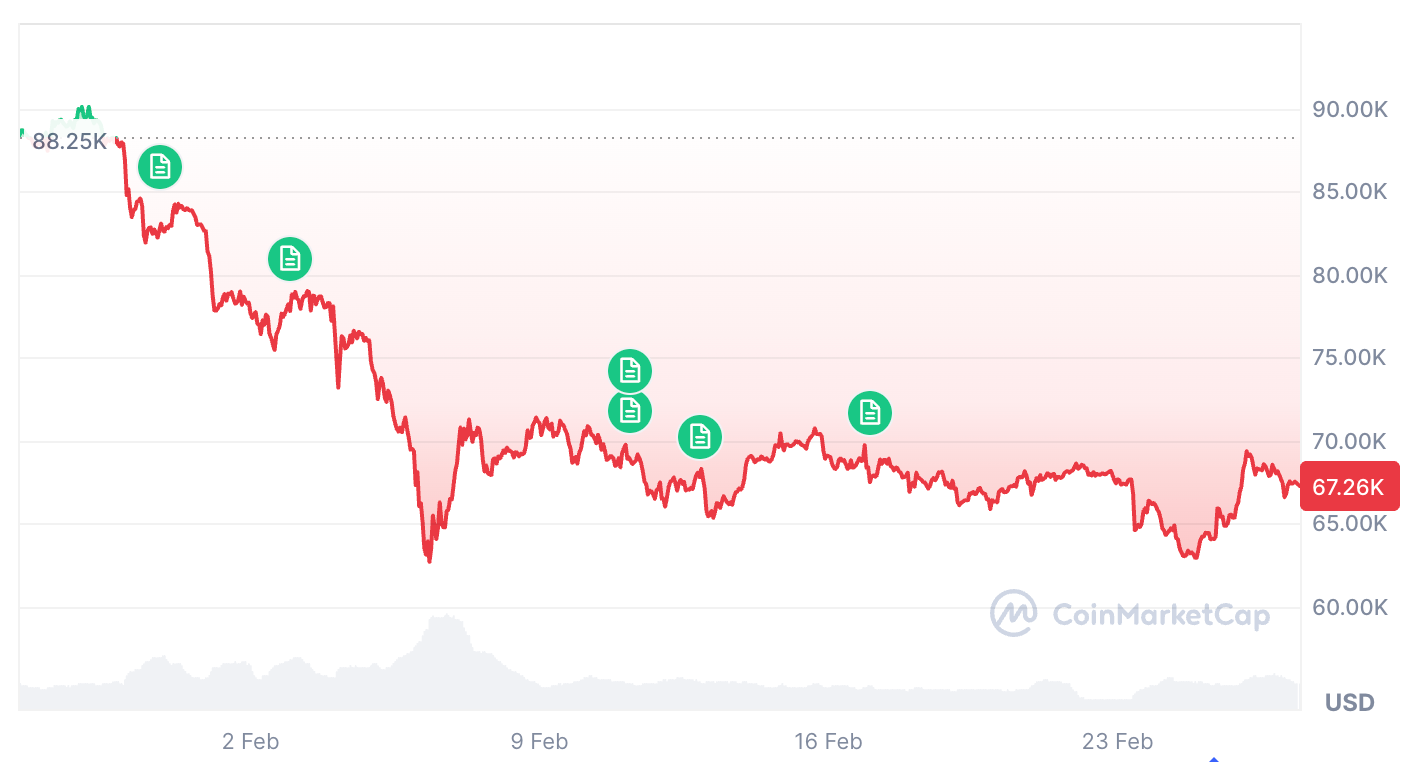
The trend also hints at rising confidence in a turnaround for Bitcoin (BTC), which is down around 47% from its October all-time high of $126,100 and is currently trading at $67,260, according to CoinMarketCap.

Santiment explained that an increase in the number of large wallet holders after a Bitcoin price drop can be a bullish signal.
However, it noted that the overall percentage of supply held by this cohort hasn’t changed, suggesting that while new wallets are reaching 100 Bitcoins, some long-term holders are likely selling.
“This is why prices have stayed suppressed,” Santiment said.
Are Bitcoin OGs done “selling aggressively” for now?
Fears that long-term Bitcoin holders are selling have been ramping up over the past three months and are widely seen as a key catalyst behind the recent pullback.
Bitcoin analyst Will Clemente said on Jan. 14 that “it seems like Bitcoin OGs are done selling aggressively for now.”
Related: Bitcoin bear market not ‘over already’ as price rejects at $68K trend line
As for near-term price action, MN Trading Capital founder Michael van de Poppe said in an X post on Thursday that Bitcoin must “find a higher low and we’ll be continuing the trend upwards.”
“So far, so good for Bitcoin,” van de Poppe said.
Magazine: 6 massive challenges Bitcoin faces on the road to quantum security
The Solana-based AI memecoin is up 170% over the past month.
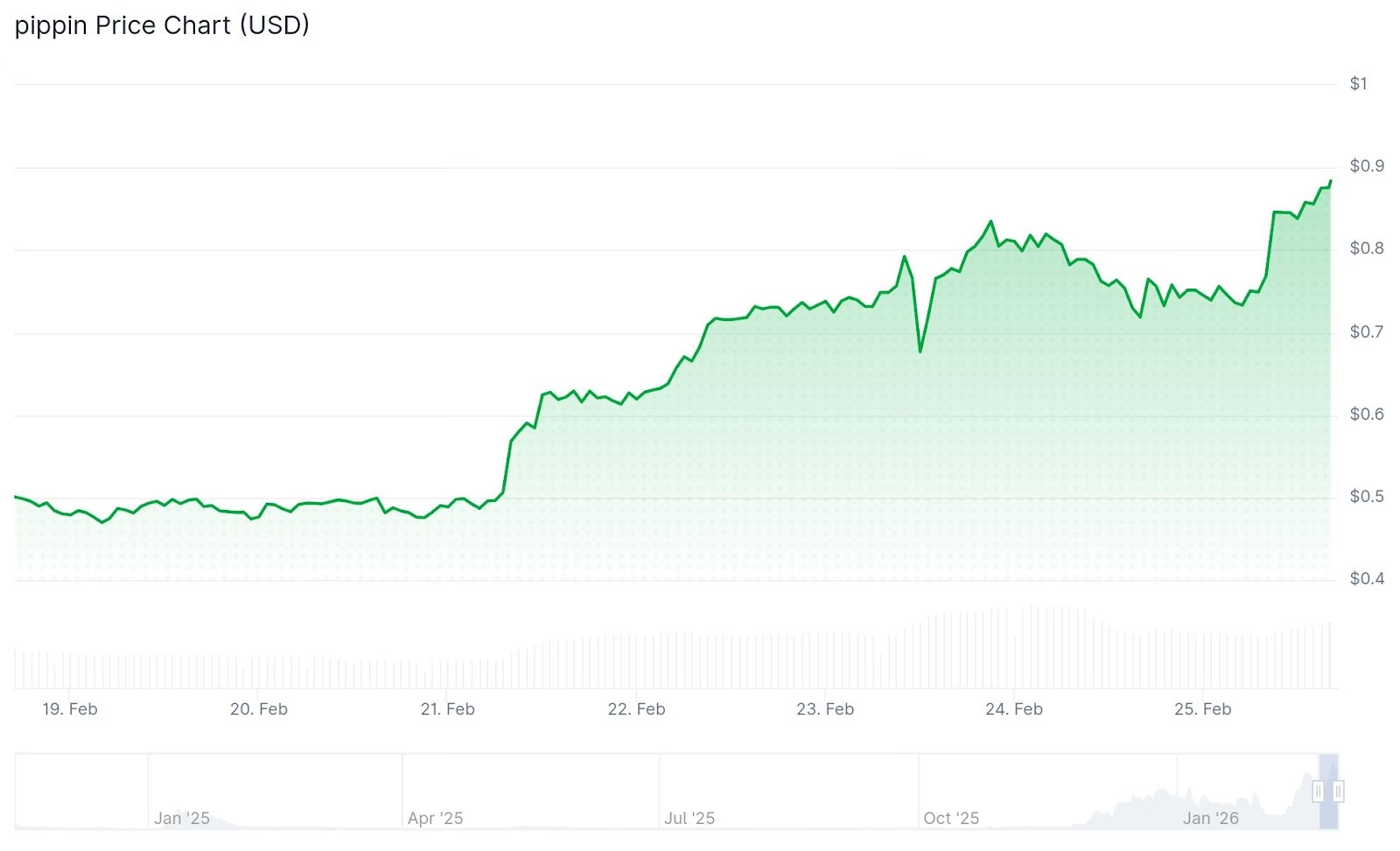
PIPPIN, an AI-driven memecoin on the Solana blockchain, surged 23% over the past 24 hours, outperforming large-cap cryptocurrencies as traders rotated into narrative-focused tokens.
The coin is currently hovering around $0.87, up 70% over the past week and 169% over the past month. It boasts a market capitalization of around $870 million, with daily trading volume above $70 million, according to CoinGecko.

The rally comes as AI-linked tokens have regained attention across crypto markets in recent days. The AI token sector’s market cap today is $13.8 billion, up 5.6% over 24 hours. The meme-coin market is also higher at $34.6 billion, up 4.7%, with PIPPIN leading the surge. Meanwhile, the global cryptocurrency market cap stands at $2.38 trillion, down 2.2% on the day.
PIPPIN’s move also reflects a broader trend of markets reacting to AI narratives, where even hypothetical scenarios have recently moved stocks and crypto. However, some experts say the rally has no clear driver.
“The PIPPIN AI-meme token has been going up since early December 2025. There isn’t too much known about why,” Nicolai Sondergaard, research analyst at Nansen, told The Defiant. “In addition, much of the supply is on exchanges (GATE), which further reduces the likelihood of understanding what is going on.”
Sondergaard explained that there also aren’t many smart money or public figures in it anymore, and that a majority of the top holders are labeled on-chain as “investment recipients.”
“This could insinuate somewhat centralized control,” Sondergaard added. “Alas, this cannot be proven or disproven at this point, even if accusations such as these have been flying around on CT.”
CoinGecko also cautioned traders to do their research before trading PIPPIN, as Bubblemap data found that 80% of its supply is controlled by interconnected insider wallets.
Crypto World
Google’s Gemini AI Predicts the Price of XRP, Dogecoin and Shiba Inu by the end of 2026
Google’s Gemini AI leverages its parent company’s vast data sets whenever forming conclusions.
It’s somewhat surprising, given months of red candles, that Gemini is pretty bullish XRP, Dogecoin, and Shiba Inu, and thinks all of them will hit towering new all-time highs (ATHs) over the next ten months.
But how realistic are Gemini’s projections?
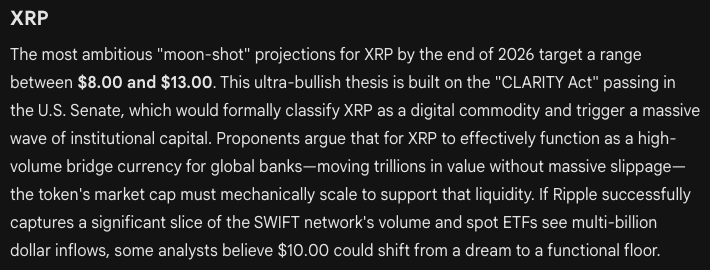
XRP ($XRP): Gemini AI Prophesies 9x Surge To $13 by Christmas
In a recent update, Ripple reiterated that XRP ($XRP) remains a core pillar of its long-term vision to establish the XRP Ledger as a global, enterprise-ready payments network.
With fast settlement times and minimal transaction costs, the XRP Ledger is in a great position to capitalize on two rapidly expanding areas: stablecoins and tokenized real-world assets.
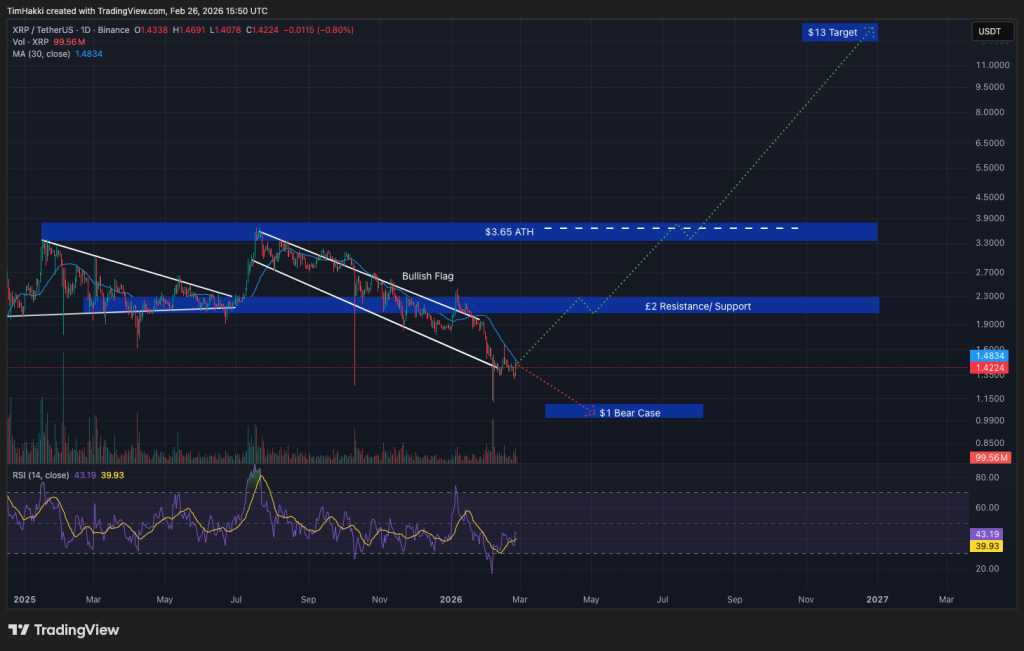
Currently trading around $1.44, Gemini’s long-term forecasting points to a 2026 high of $13, implying gains of 9x for current HODLers.
Technical indicators asupport this scenario. XRP’s Relative Strength Index (RSI) is a neutral 43 and the price has converged with the 30-day moving average, hinting that the prolonged and painful consolidation phase might be over.
Additional price drivers could include institutional demand following the rollout of U.S. listed XRP ETFs, Ripple’s growing network of global partnerships, and improved regulatory clarity if the U.S. passes the CLARITY bill this year.
Dogecoin (DOGE): Is the $1 Milestone Finally on the Horizon?
Launched in 2013 as a parody, Dogecoin ($DOGE) is now one of the most recognized digital assets, with a market capitalization of almost $15 billion, nearly half of the $35 billion meme coin sector.
DOGE last peaked at $0.7316 during the retail-fueled crypto rally of 2021.
For much of its history, the Dogecoin community has rallied around the goal of reaching $1. According to Gemini AI, under strong bullish conditions DOGE could comfortably overshoot that target this year, after clearing sticky resistance at $0.20 and $0.40.
With the token currently trading just below $0.10, a move toward $1.50 would net an explosive 15x for current holders.
Real-world adoption continues apace. Tesla accepts DOGE for select merchandise, while PayPal and Revolut now support Dogecoin transactions.
Shiba Inu (SHIB): Gemini AI Thinks a 1,500% SHIB Rally is Incoming
Shiba Inu ($SHIB), introduced in 2020 as a tongue-in-cheek rival to Dogecoin, has since grown into an ecosystem with a market capitalization of over $3.5 billion.
At its current price near $0.000006, Gemini’s analysis suggests that a decisive breakout above the $0.000025–$0.00003 resistance range could trigger strong upside momentum, potentially pushing SHIB toward $0.0001 before year-end.
That move would equate to gains of roughly 17x, placing it just above SHIB’s October 2021 ATH of $0.00008616.
The project offers much more than just meme coin speculation. Shiba Inu’s Ethereum Layer-2 network, Shibarium, delivers faster transaction speeds, reduced fees, enhanced privacy features, and a more robust environment for developers.
Maxi Doge: Early-Stage Meme Coin Targets Outsized Growth
While Gemini’s outlook suggests Dogecoin and Shiba Inu could still post significant gains, their already sizable market caps limits extreme upside in a bull run compared with smaller, newer, canine coins.
Maxi Doge ($MAXI) is coming for them. The project has raised $4.6 million in its ongoing presale as traders pile in to snap up the next biggest Doge-themed coin before the CLARITY Act passes.
Maxi Doge is a loud, degenerate, gym bro and alpha doge. He claims to be both a rival and an envious distant cousin to Dogecoin in a viral marketing campaign that embraces the fun and irreverent tone that defined the 2021 meme coin boom.
MAXI is issued as an ERC-20 token on the Ethereum proof-of-stake network, resulting in a smaller environmental footprint compared with Dogecoin’s proof-of-work model.
Early presale buyers can currently stake MAXI for returns of up to 67% APY, with yields gradually decreasing as the staking pool expands.
The token is $0.0002806 in the current presale stage, with automatic price increases scheduled at each funding milestone. Purchases are supported via wallets such as MetaMask and Best Wallet.
Stay updated through Maxi Doge’s official X and Telegram pages.
Visit the Official Website Here.
The post Google’s Gemini AI Predicts the Price of XRP, Dogecoin and Shiba Inu by the end of 2026 appeared first on Cryptonews.
Crypto World
Bitcoin (BTC) price tumbles below $48,000 on Lighter as $67 million sell order triggers flash crash


While the broader crypto market was ripping higher on Wednesday, bitcoin briefly plunged 30% to below $48,000 on decentralized perpetuals exchange Lighter in a violent move that lasted seconds.
The flash crash stood in sharp contrast to price action elsewhere. During the same session, bitcoin surged from below $64,000 to above $69,000, marking one of its strongest intraday rallies in weeks.
The extreme move appeared to have been isolated to Lighter, where thin liquidity amplified what would otherwise have been a routine trade. In shallow order books, even modest sell pressure can trigger exaggerated price swings, producing so-called flash crashes that don’t reflect the broader market.
That’s likely what happened on Lighter. A single sell order of roughly 1,000 bitcoin — worth about $67 million at the time — wiped out available bids and briefly sent prices spiraling, according to a Discord post by pseudonymous Web3 developer 0xTimberJ.
“Because Lighter is a newer DEX with less liquidity than centralized exchanges, the sell order wiped out all available bids and pushed the price down to ~$47k before recovering instantly,” 0xTimberJ wrote.
Lighter is an up-and-coming decentralized perpetuals exchange seeking to challenge category leader Hyperliquid. Perpetual futures, or “perps,” have become crypto’s dominant derivatives product, allowing traders to use leverage and take long or short positions around the clock without contract expirations.
The platform briefly captured significant market share last November, processing over $292 billion in monthly volume — roughly a quarter of the $1.15 trillion traded across exchanges, according to data by The Block.
But activity has cooled sharply since its token airdrop late last year. Traders who ramped up activity to farm rewards have since rotated out, and monthly volume fell to $70 billion in February out of a $500 billion total market, trailing rivals such as Hyperliquid, Aster and EdgeX.


U.K. investors will no longer be able to add crypto exchange-traded notes (ETNs) to their tax-free individual savings accounts (ISAs) after the start of the new tax year on April 6, the Financial Times (FT) reported on Wednesday.
The tax authority, His Majesty’s Revenue and Customs (HMRC), will reclassify cryptocurrency ETNs as qualifying instruments only for Innovative Finance ISAs (IFISAs), rather than the more mainstream stocks and shares ISAs.
ISAs allow users to put away up to 20,000 pounds ($27,000) a year without paying income tax or capital gains tax on the returns. The two main types are cash ISAs, bank account-like investments that pay interest, and stocks and shares ISAs, which invest in equities and exchange-traded instruments.
The Financial Conduct Authority’s decision to lift the ban on retail investors accessing crypto ETNs last October was seen as a major development in the adoption of cryptocurrency investments in the U.K., as it raised the possibility of the vehicles being added to everyday products like ISAs.
Limiting them to IFISAs means this opportunity will be snuffed out because no mainstream investment platforms offer them. IFISAs are a somewhat obscure investment wrapper, offered largely for purposes of peer-to-peer lending and crowdfunding. None of the 57 platforms currently authorized to offer IFISAs have plans to support crypto ETNs, according to the FT’s report, depriving investors of the tax shield that ISAs provide.
Investors who already have crypto ETN holdings in their ISAs will not be forced to sell them, however, as doing so “could risk some level of market disruption,” HMRC said.
The authority said the ruling was due to crypto ETNs’ “innovative nature and the fact that is an emerging market,” and it would keep the decision under review with a view to including them in stocks and shares ISAs at a later date.
The decision risks positioning the U.K. as an outlier among major financial markets, where exchange-traded products (ETPs) have opened the door to crypto investment for a much wider base of users because they remove some of the technical aspects such as needing to deal with crypto exchanges and wallets.
George Bauer, Fidelity’s head of investment and product for global platform solutions, said the government’s approach “challenges the intention of allowing regulated access to crypto assets,” the FT reported.
“We would encourage the government and HMRC to reconsider this and allow access through stocks-and-shares ISAs which are much more widely used.”
HMRC did not respond to CoinDesk’s request for comment.


In a 48-hour period at the end of January, the two largest decentralized social protocols underwent major leadership changes. Farcaster shifted stewardship of its protocol, flagship client, and leading Base launchpad, Clanker, to its primary infrastructure provider, Neynar. Concurrently, Lens Protocol announced its transition from Avara (the team behind Aave) to Mask Network.
The suddenness of these transitions was enough to rekindle a familiar debate: Do these restructurings by the sector’s most established projects signal a failure for crypto social? For many critics, the answer was an immediate yes. They argued that crypto social never moved beyond the crypto bubble, failed to compete meaningfully with Web2 giants, and ultimately imploded under its own momentum. For them, the ownership changes confirmed that decentralized social media is a dead end—at best, a niche experiment. However, this view misinterprets a necessary market correction as a complete collapse.
Why the first save struggled
What these transitions actually reveal is a long-overdue acknowledgement of reality: building social networks is not primarily a question of ideology or infrastructure, but of product quality, distribution and incentives. The first wave of crypto social struggled not because decentralization is inherently flawed, but because it attempted to recreate legacy social platforms while layering crypto’s complexity on top of them. Farcaster and Lens were ambitious efforts to reimagine social media around user-owned identity, open graphs and composable data. Both attracted top-tier capital and world-class engineers. And yet neither managed to break meaningfully beyond a crypto-native audience.
A key misstep was assuming social graphs would scale like blockchains, that you could build a shared, open layer first, and value would naturally accrue. In practice, social graphs do not compound simply by existing. And this is not uniquely a crypto lesson. Decentralized social graphs have existed for years, with Mastodon and Nostr as the obvious examples, yet neither has achieved sustained mainstream adoption. The pattern is consistent: users do not migrate for ideological reasons, and portability does not overcome the cold start. Without a flagship experience that feels materially better today, with better content, better loops, better status and better tools, decentralization remains an implementation detail that appeals to a committed minority, not a mass-market hook.
In addition, both ecosystems leaned too early into platform-building and developer ecosystems, overestimating their ability to solve the cold-start problem for builders. With user counts in the low tens of thousands, the economic pie was simply too small for third-party applications to thrive. Builders were asked to take on distribution risk before meaningful distribution existed, while competing, implicitly or explicitly, with flagship clients that controlled the primary surface area.
Social networks live and die by network effects, and crypto introduces additional friction at every layer: wallets, security assumptions, moderation trade-offs and identity management. Convincing users to abandon platforms where their social graphs already exist is difficult under any circumstances. Asking them to do so while navigating unfamiliar tooling raises the bar even higher.
From Social Media to Social Financial Networks
Rather than chasing a decentralized Twitter analogue, the narrative is shifting toward what might be better described as social financial networks. In these systems, the primary function is not broadcasting opinions or accumulating followers, but coordinating information, capital and collective belief. Success is measured less by engagement metrics and more by the quality of signal and the flow of value.
Seen through this lens, crypto may already have found its most compelling native social platform, just not in the form many expected. Prediction markets such as Polymarket function as social coordination engines. They aggregate opinion, surface collective intelligence and transform discourse into probabilistic outcomes. Crucially, this model is not a copy of Web2 social media. It does not rely on advertising, algorithmic outrage or attention extraction. And it has demonstrated relevance beyond a purely crypto-native audience.
But social financial networks are only the first wave of what crypto can unlock. Blockchains make certain end-user experiences possible in a way Web2 rails simply do not, and speculation is just the most legible early expression of that. Polymarket turns conversation into accountable belief. Products like FOMO show how trading itself can become social, with transparency, shared context, and real-time feedback loops baked into the graph.
The bigger opportunity goes well beyond a social + markets equation. It is social systems where ownership, identity and monetization are native rather than bolted on. Digital ownership can turn content and status into durable assets. Programmable incentives can align creators, curators, and communities around long-term behavior rather than short-term extraction. Onchain coordination can unlock new group behaviors, from collective funding to shared membership, shared governance and shared upside. The point is not that crypto makes social cheaper or more open, but rather it expands the design space for what social networks can be.
A reset, not an obituary
Declaring crypto social “dead” misses the point. What has ended is a particular vision of Web3 social, one that assumed legacy social media could be recreated on crypto rails with better incentives and better values.
What remains is a harder, more grounded challenge: identifying where crypto enables forms of social coordination that were previously impossible. Capital formation, information markets, community-owned infrastructure and new mechanisms for aligning incentives all remain open design spaces. Crypto social is not disappearing. It is shedding its earliest assumptions.
One reason the “dead” narrative feels premature is that we may have been looking for the next crypto social breakout in the wrong place. Moltbook is a deliberately weird experiment: a social network designed primarily for AI agents, with humans as observers. In a matter of days, tens of thousands of agents reportedly spun up emergent behaviors that look uncannily social, creating religions, organizing governance, publishing manifestos and even experimenting with privacy and encryption.
The surprising part is that watching it has been engaging for humans, precisely because it feels like observing a new social class forming in real time, negotiating norms, status and even revenue strategies, sometimes explicitly trying to evade human legibility. It is too early to know whether this is a durable phenomenon or a passing narrative, but it is a bold reminder that new forms of social can emerge when the participants, incentives and constraints change. If AI agents increasingly need to transact and coordinate across the digital world, blockchains are a natural substrate for them to do so.
For now, it turns out, the crypto social obituary was written for the wrong thing.
Long live crypto social!
Legal Disclaimer: This article is for general information purposes only and should not be construed as or relied upon in any manner as investment, financial, legal, regulatory, tax, accounting, or similar advice. Under no circumstances should any material at the site be used or be construed as an offer soliciting the purchase or sale of any security, future, or other financial product or instrument. Views expressed in the article are those of the individual 1kx personnel quoted therein and are not the views of 1kx and are subject to change. The article is not directed to any investors or potential investors, and does not constitute an offer to sell or a solicitation of an offer to buy any securities, and may not be used or relied upon in evaluating the merits of any investment. All information contained herein should be independently verified and confirmed. 1kx does not accept any liability for any loss or damage whatsoever caused in reliance upon such information. Certain information has been obtained from third-party sources. While taken from sources believed to be reliable, 1kx has not independently verified such information and makes no representations about the enduring accuracy or completeness of any information provided or its appropriateness for a given situation. 1kx may hold positions in certain projects or assets discussed in this article.
The views and opinions expressed in this article are solely the authors’ own and do not reflect the views of their employer, 21Shares, or any affiliated organizations.
Ether (ETH) price is up 18% since plunging below the $1,800 mark on Feb. 6, reclaiming the $2,000 support level. Surging price volatility and a low MVRV Z-score value are also signaling a local bottom forming.
Key takeaways:
-
Ether realized volatility on Binance has risen to its highest level since March 2025, hinting at a potential recovery.
-
Ether’s MVRV Z-Score has dropped into the accumulation zone, suggesting that ETH has bottomed.
-
Ether’s multiyear trend line around $1,800-$1,900 holds as support.
Ether’s volatility hits 12-month highs
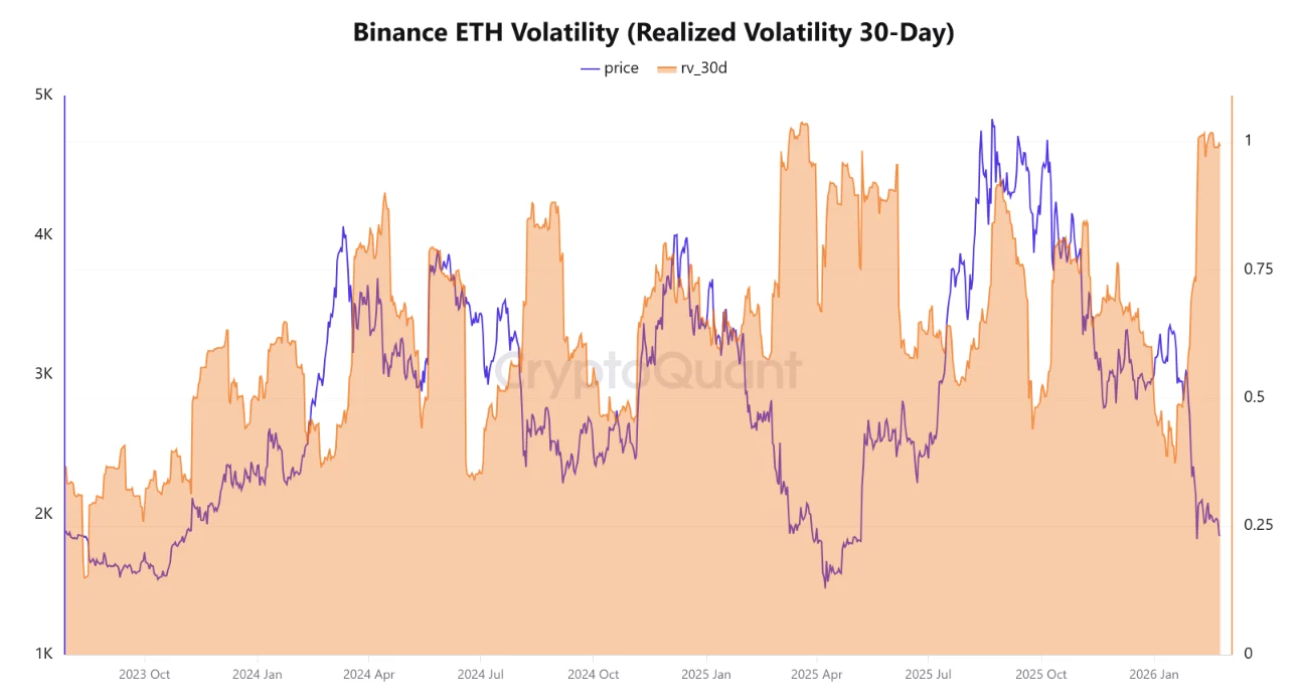
Ether’s volatility has seen a sudden spike, suggesting that the market is entering a period of intense activity and strong repricing, according to data from CryptoQuant.
Volatility is a metric used to determine how much and how quickly Ether’s price fluctuates over a given period.
Related: ETH options turn bearish as traders prepare for extended Ether price downside
The chart below shows that the realized volatility (30-day) indicator on Binance rose sharply to 0.97 on Thursday from 0.37 in mid-January.
A spike in realized volatility to such high levels indicates that the “market has emerged from a period of relative calm and entered a highly volatile environment,” CryptoQuant analyst Arab Chain said in a Quicktake analysis, adding:
“Past experience has shown that such readings have often preceded a significant upward move in Ethereum’s price.”

The last time the volatility was this high was late March to early April 2025 as ETH price formed a bottom range of $1,500 to $1,700.
After that, the ETH/USD pair rallied 77% to $2,700 in less than 30 days. A similar spike in Q4/2024 preceded a 74% rally in Ether’s price.
If history repeats itself, this spike in volatility could mark the end of the downtrend, setting up ETH for a multimonth rally once volatility normalizes and conviction builds.
MVRV Z-Score suggests Ether bottomed below $1,800
Ether’s MVRV Z-Score, one of the most popular onchain metrics used to identify market tops and bottoms, has dropped into the historical accumulation zone (the green line in the chart below), strengthening the argument that ETH may have found its bottom.

The last time Ether’s MVRV Z-Score dipped to the current level around -0.31 was in April 2025, after a 66% price drawdown. This coincided with a price bottom at $1,400 and preceded a multi-month rally, with ETH price rising 258% to its $4,950 all-time high.
This indicates that, from an onchain perspective, Ether is oversold and may continue the ongoing recovery, potentially rising toward liquidity clusters between $2,200 and $2,500 in the short term.
Ether’s 2020 fractal projects an “explosive climb” for ETH price
Ether’s current technical structure closely mirrors the setup that sparked its 2020-2021 price rally.
The monthly chart below suggests that the price is currently holding a multi-year trend line, much like the one that supported the price from December 2018 to April 2020.
“Every time price holds above this ascending support trend line, it launches into a parabolic rally,” as seen in 2020, analyst Trader Tardigrade said in an X post on Thursday, adding:
”Now $ETH is testing the trendline again. If it holds here, history says we’re gearing up for another explosive climb.”

This trend line lies within the $1,900 to $1,800 support zone, where investors recently acquired 2.9 million ETH, Glassnode’s cost basis distribution heatmap shows.
As Cointelegraph reported, ETH could continue its recovery to retest the 50-day simple moving average (SMA) at $2,540 if bulls manage to push the price above $2,100.
This article does not contain investment advice or recommendations. Every investment and trading move involves risk, and readers should conduct their own research when making a decision. While we strive to provide accurate and timely information, Cointelegraph does not guarantee the accuracy, completeness, or reliability of any information in this article. This article may contain forward-looking statements that are subject to risks and uncertainties. Cointelegraph will not be liable for any loss or damage arising from your reliance on this information.

These Are Our Absolute Favorite Android Earbuds, and They’re Below $200

Belfast GAA club to get major extension despite local objections

Oceaneering intl director Beachy sells $366k in stock


-

 Politics5 days ago
Baftas 2026: Awards Nominations, Presenters And Performers
-

 Fashion6 days ago
Weekend Open Thread: Boden – Corporette.com
-

 Sports3 days ago
Women’s college basketball rankings: Iowa reenters top 10, Auriemma makes history
-

 Politics3 days ago
Nick Reiner Enters Plea In Deaths Of Parents Rob And Michele
-

 Business2 days ago
True Citrus debuts functional drink mix collection
-

 Politics3 hours ago
ITV enters Gaza with IDF amid ongoing genocide
-

 Crypto World3 days ago
XRP price enters “dead zone” as Binance leverage hits lows
-

 Business5 days ago
Mattel’s American Girl brand turns 40, dolls enter a new era
-

 Business4 days ago
Law enforcement kills armed man seeking to enter Trump’s Mar-a-Lago resort, officials say
-

 Tech2 days ago
Unsurprisingly, Apple's board gets what it wants in 2026 shareholder meeting
-

 NewsBeat1 day ago
Cuba says its forces have killed four on US-registered speedboat | World News
-
 NewsBeat1 day ago
Manchester Central Mosque issues statement as it imposes new measures ‘with immediate effect’ after armed men enter
-
 NewsBeat4 days ago
‘Hourly’ method from gastroenterologist ‘helps reduce air travel bloating’
-

 Tech4 days ago
Anthropic-Backed Group Enters NY-12 AI PAC Fight
-

 NewsBeat4 days ago
Armed man killed after entering secure perimeter of Mar-a-Lago, Secret Service says
-

 Politics4 days ago
Maine has a long track record of electing moderates. Enter Graham Platner.
-
 NewsBeat2 days ago
Police latest as search for missing woman enters day nine
-

 Crypto World2 days ago
Entering new markets without increasing payment costs
-

 Business23 hours ago
Discord Pushes Implementation of Global Age Checks to Second Half of 2026
-

 Business6 hours ago
Only 4% of women globally reside in countries that offer almost complete legal equality