

Crypto World
Futures and Options Market Signals Caution as BTC Chases $70K

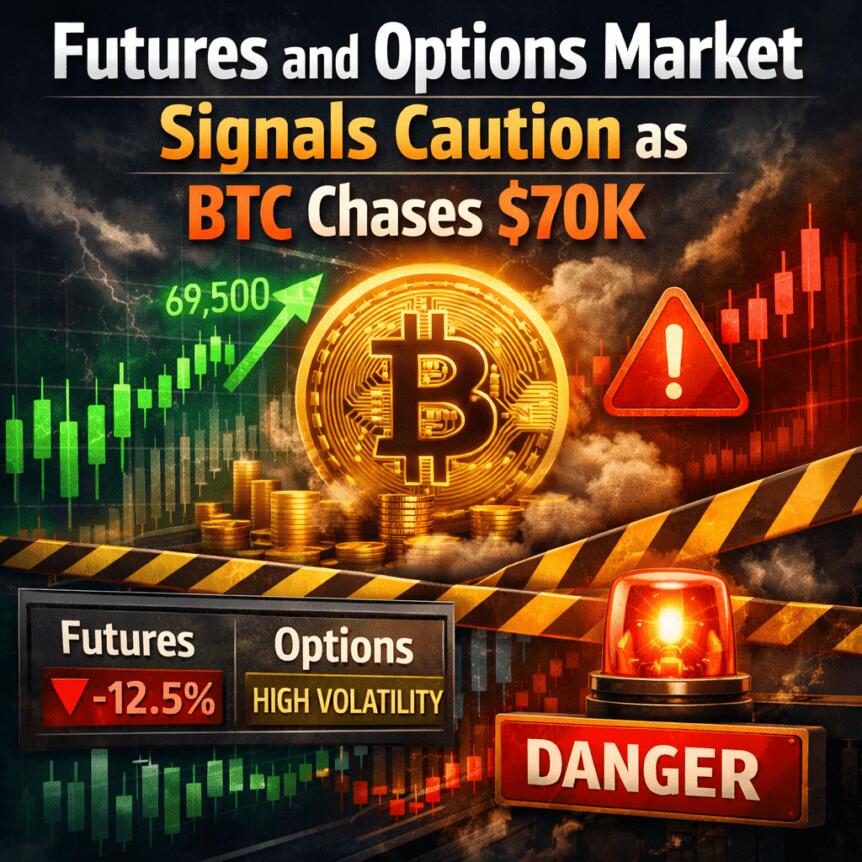
Bitcoin has inched back toward the $70,000 mark, but traders remain wary as derivatives signals fail to echo the price recovery. On Wednesday, the benchmark cryptocurrency briefly touched the round level after a Tuesday dip to around $62,500, a move that was supported by a fresh wave of inflows into U.S.-listed Bitcoin ETFs. Yet the mood in the derivatives market stayed guarded: the annualized futures premium versus the spot price hovered near 2%, well below a neutral readings range, and options markets showed a cautious stance despite the price rebound. The combination of a tepid cycle in bullish bets and lingering macro and liquidity concerns suggests that bulls may need a more durable catalyst before revisiting higher targets, such as $75,000. For context, Bitcoin has been trading in a choppy corridor as market participants weigh the near-term risk-and-reward dynamics.
Bitcoin has retested the $70,000 level amid a broader risk-off environment that has cooled some of the enthusiasm that followed the earlier rally. Official data indicates that inflows into U.S.-listed Bitcoin exchange-traded funds helped stabilize sentiment over a two-day window, with net inflows of $764 million, partially offsetting $1.2 billion of outflows observed over the prior eight trading sessions. In practice, this signals that institutional demand can surface when prices experience sharper pullbacks, even if momentum remains fragile. The underlying caution, however, is underscored by the futures market where traders appear reluctant to extend bullish exposure through leverage, a sentiment that has persisted since late January when BTC briefly relinquished a long-standing $85,000 support level.
Analysts tracking the options surface point to a more nuanced risk posture. The 30-day delta skew on BTC options, a proxy for appetite to buy protection versus chasing gains, showed a 14% premium on put options relative to calls on the most recent session, indicating that risk-off hedging remained a priority for many market participants. Although this measure has moved away from the distress levels seen earlier in the week, it remains outside a balanced range, suggesting that professional traders prefer downside protection even as the spot price paused near $70,000. Data from Laevitas.ch, cited in the market commentary, also highlights that the two-month futures annualized premium persists well below the neutral threshold of 5%, with readings around 2% on Thursday.
Beyond pure price mechanics, a spectrum of theories has circulated about what’s keeping Bitcoin under pressure. Some observers have pointed to a potential exogenous shock—quantitative trading activity and internal market dynamics at major venues—that could have contributed to the recent volatility, including episodes linked to well-known trading desks. In particular, a highly publicized line of inquiry has centered on the activities of a prominent quantitative trading firm and its relationship to other liquidity channels in the ecosystem. While those theories have triggered debate, there is no conclusive public evidence tying any single entity to the broader price weakness. The narrative has nonetheless fueled ongoing market chatter about liquidity risk and cross-venue arbitrage.
Is a single entity behind Bitcoin’s price weakness?
Over the past several weeks, a constellation of explanations has circulated for the price pullback from multi-year highs. Some narratives trace the decline to macro headlines and risk-off sentiment, while others hinge on perceived vulnerabilities within the crypto liquidity stack. The discussion intensified when a market-catalyzing event earlier in the year coincided with a broader shift in institutional posture toward risk assets. In parallel, discussions about long-term security risks—some tied to advancements in quantum computing—reappeared in market commentary, prompting blockchain developers to explore on-chain post-quantum cryptography enhancements (for example, proposals centered on upgrading cryptographic resilience).
Within this broader debate, the possibility that several market actors are reconfiguring leverage and hedging strategies has drawn attention. Recent filings from major trading firms in the context of public equity positions have sparked speculation about delta-neutral approaches and how those strategies might intersect with crypto exposure. One notable thread has involved the public disclosures of holdings that intersect with Bitcoin-related instruments, underscoring how large players may be combining on- and off-chain positions to manage risk.
Meanwhile, price action has occasionally mirrored shifts in benchmark technology equities, with macro-driven risk-off moves weighing on speculative bets. A notable signal came from a sector that often correlates with sentiment across growth and tech equities: a sharp daily decline in a leading semiconductor stock, historically viewed as a bellwether for risk appetite. The implication is not that Bitcoin’s trajectory directly mirrors that stock, but that broader risk sentiment remains a powerful driver of crypto price behavior in the near term.
On the regulatory and governance front, the crypto community has kept a close eye on proposals aimed at strengthening on-chain security and resilience. Proponents of post-quantum readiness have advanced technical ideas, including on-chain upgrades that could reduce future exposure to quantum-related risks. While the market remains in a wait-and-see mode, these technical conversations underscore the industry’s ongoing effort to harden infrastructure in the face of evolving threats.
Another strand of the discourse centers on the role of major exchanges and liquidity providers in shaping market outcomes. In the wake of high-profile liquidations tied to oracle pricing and latency issues, industry participants have emphasized the importance of robust risk controls and transparent pricing mechanisms to prevent cascading effects during periods of stress. While it is difficult to attribute BTC’s price dynamics to a single cause, the confluence of macro headwinds, hedging demand, and structural liquidity considerations appears to be anchoring sentiment at a cautious level as traders monitor the path to the next price milestone.
The conversation around Bitcoin’s price trajectory continues to be informed by a mix of on-chain indicators, derivatives signals, and macro context. While the price flirted with the $70,000 zone, the absence of a broad-based acceleration in bullish bets, coupled with persistent hedging interest, suggests that a sustained move into higher territory will require more than a momentary price bounce. Investors and traders will be watching whether this resilience can translate into a clean breakout or whether the market remains tethered to a diplomatic, risk-aware stance as the year progresses.
Why it matters
The ongoing tension between price action and derivatives signals matters for a wide range of market participants. For retail traders, the current environment underscores the importance of risk management and positioning beyond simple directional bets. For institutions, the pattern of ETF inflows and hedging activity highlights the appetite for crypto exposure when prices pull back, while also signaling caution about leverage-driven risk during periods of volatility. Miners and token issuers watch these dynamics closely because sustained price strength could influence capital expenditure plans and liquidity provisioning.
From a broader market perspective, the narrative around Bitcoin cycles—how price recovers against a backdrop of risk-off sentiment and evolving on-chain security considerations—helps frame the trajectory for other digital assets. The confluence of derivatives mood, ETF flows, and major macro indicators can serve as a guide to the potential impulse needed to push liquid markets back into a more constructive regime. In this sense, Bitcoin’s near-term path remains a useful proxy for assessing risk appetite within the crypto sector and for calibrating expectations around liquidity and institutional engagement in the months ahead.
What to watch next
- Upcoming ETF flow data and their potential to sustain or extend recent inflows, particularly if prices test or breach key levels such as $75,000.
- Public disclosures and 13-F filings from major market participants that could signal shifts in delta-neutral strategies or crypto exposure across portfolios.
- Regulatory or technical updates aimed at post-quantum security on-chain, including any formal governance proposals or implementation milestones.
- Bitcoin volatility and option markets around major expiries, which could amplify price moves if hedging demand surges or wanes.
- Key macro developments that influence risk sentiment and liquidity conditions across traditional and digital-asset markets.
Sources & verification
- Bitcoin price and futures premium data cited from Laevitas.ch, including the annualized premium around 2% and the 5% neutral benchmark.
- Bitcoin put-call delta skew data from Deribit via Laevitas.ch, showing a 14% premium for puts on the latest session.
- Net flows into US-listed Bitcoin ETFs, with $764 million in two days of inflows and prior $1.2 billion of outflows.
- Market commentary referencing on-chain security discussions and post-quantum cryptography proposals (e.g., BIP-360 concepts).
- Industry observations on liquidity dynamics, exchange risk controls, and the impact of large-scale trading activity on price moves.
Market reaction and key details
The near-term narrative remains one of cautious optimism rather than a decisive bullish breakout. While price action has managed to flirt with the $70,000 threshold, the lingering fear in derivatives markets and the absence of broad bullish momentum point to a more nuanced transition phase for Bitcoin. Investors will be watching whether upcoming ETF inflows persist and whether major options expiries bring a clearer signal about the direction of risk appetite. In the meantime, Bitcoin (CRYPTO: BTC) continues to function within a spectrum of hedging considerations and risk-management strategies as market participants weigh the evolving balance of incentives and constraints facing the crypto sector.
Tickers mentioned: $BTC, $NVDA
Market context: The current environment reflects cautious risk sentiment across both crypto and traditional markets, with liquidity conditions and hedging activity shaping short-term moves as macro factors and regulatory considerations continue to influence pricing.
Why it matters: The interaction between ETF flows, futures hedging, and security-focused on-chain proposals determines how quickly the market can transition from a risk-off stance to a more constructive rally, with implications for traders, institutions, and developers alike.


TLDR
- Michael Saylor hinted at more Bitcoin purchases as the asset traded near $67000.
- Strategy currently holds 718722 BTC valued at about $48 billion.
- The company bought its Bitcoin at an average price of around $76000.
- Strategy faces an unrealized loss of about 12% on its holdings.
- Saylor said Bitcoin allows $1 billion to move globally with ease.
Bitcoin traded near $67,000 as Michael Saylor signaled continued accumulation through a new social media post. He shared an image showing himself carrying a large orange bag covered with Bitcoin logos. He added the caption, “Maybe I need a bigger one,” and implied further purchases.
Bitcoin Holdings and Accumulation Strategy
Saylor posted the image on X as Bitcoin attempted to stabilize around $67,000. He used the visual to reinforce the strategy’s ongoing acquisition plan. The caption suggested that the company may expand its holdings further.
Strategy currently holds 718,722 BTC worth about $48 billion at current prices. The company acquired its holdings at an average price of $76,000. Therefore, Strategy holds an unrealized loss of roughly 12% on its position.
Despite the paper loss, Strategy reports an mNAV ratio near 1. The company also lists an adjusted enterprise value multiple of 1.256. These figures reflect the firm’s market valuation relative to its Bitcoin reserves.
Saylor has maintained a consistent position on long-term holding periods. He has stated that investors should prepare to hold Bitcoin for seven to ten years. He continues to frame corrections as part of the asset’s normal cycle.
Strategy reports its Bitcoin transactions weekly when activity occurs. Market participants expect the next update in the coming days. The company has not disclosed any new purchases this week.
Strategy World 2026 and Market Performance
Strategy hosted Strategy World 2026 earlier this week. During the event, Saylor repeated his view that Bitcoin represents digital capital. He said, “Bitcoin’s value lies in its ability to move one billion dollars anywhere in the world.”
He contrasted Bitcoin transfers with traditional asset transfers. He said moving large sums in traditional systems involves greater complexity. He emphasized practical capital mobility rather than abstract narratives.
Saylor also addressed Bitcoin’s price volatility during the event. He stated that volatility limits large capital inflows. He argued that fluctuations, not structural flaws, remain the main challenge.
Meanwhile, Strategy’s stock MSTR trades at $132.8. The shares have fallen 12.6% year-to-date in 2026. The stock remains 75.8% below its all-time high of $542.
Goldman Sachs has identified MSTR as the most shorted stock in the market. The company continues to tie its equity performance closely to Bitcoin holdings. Strategy plans to release further updates on Bitcoin activity next week.


Circle is advancing its Arc blockchain project, with plans for a native token, according to CEO Jeremy Allaire.
Circle, one of the largest stablecoin issuers in the industry, is exploring the possibility of a native token for its Arc blockchain, according to the company’s chief executive Jeremy Allaire.
During the company’s Q4 2025 earnings call, Allaire said Circle is exploring a native token for the Arc blockchain and that the company is gaining a strong understanding of how it would work.
“We’re getting a very good understanding of how a token can play a key role in providing stakeholder incentives, governance, security, utility and other things on the Arc network,” Allaire said, though no timeline for a launch was revealed.
The company launched the public testnet for Arc in October 2025, with plans for a full mainnet release expected later this year.
Circle announced Arc in August last year, designing the network specifically for issuing and transacting stablecoins. As The Defiant reported, the network would focus on faster settlement and lower transaction costs compared with existing public blockchains.
Kevin Lehtiniitty, CEO of Borderless.xyz, told The Defiant last year that the competition for the “stablecoin chain” just brings the industry back to fragmented payment systems with new branding. As Lehtiniitty explained, “The answer that does push open finance forward in my mind is connectivity and interoperability; not another chain or another token.”
This article was generated with the assistance of AI workflows.
Ethereum co-founder Vitalik Buterin has identified and proposed a plan to address four areas of the network that he sees as most quantum-vulnerable.
Quantum computing and crypto have been in the headlines recently as concerns mount over Bitcoin and other blockchains’ resistance to quantum-capable supercomputers.
Buterin posted his quantum resistance roadmap for Ethereum on Thursday, stating that the four areas are: validator signatures, data storage, user account signatures, and zero-knowledge proofs.
He said that replacing the current BLS (Boneh-Lynn-Shacham) consensus signatures with “Lean” quantum-safe hash-based signatures would fix that component. The tricky part is picking the right hash function, since this choice will likely stick around for a long time.
“This may be ‘Ethereum’s last hash function’, so it’s important to choose wisely,” he said.
Ethereum Foundation researcher Justin Drake proposed “Lean Ethereum,” a plan to make the network quantum-secure, in August 2025.
Quantum safe data storage and accounts
Regarding data storage, or “blobs”, Ethereum currently uses a system called KZG (Kate-Zaverucha-Goldberg) for storing and verifying data.
The plan is to swap this out for STARKs (Zero-Knowledge Scalable Transparent Argument of Knowledge), which are quantum-resistant. “It’s manageable, but there’s a lot of engineering work to do,” said Buterin.
Related: Buterin outlines 4-year roadmap to speed up and quantum-proof Ethereum
The third challenge is user accounts. Ethereum currently uses ECDSA (Elliptic Curve Digital Signature Algorithm) signatures, which are standard cryptographic keys. The fix is to upgrade the network so that accounts can use any signature scheme, including “lattice-based” quantum-resistant ones.
However, quantum-safe signatures are much heavier computationally and would consume more gas.
“The long-term fix is protocol-layer recursive signature and proof aggregation, which could reduce these gas overheads to near-zero,” he said.
Quantum-resistant proofs are very expensive
Quantum-resistant proofs are extremely expensive to run onchain so “the solution again is protocol-layer recursive signature and proof aggregation,” said Buterin.
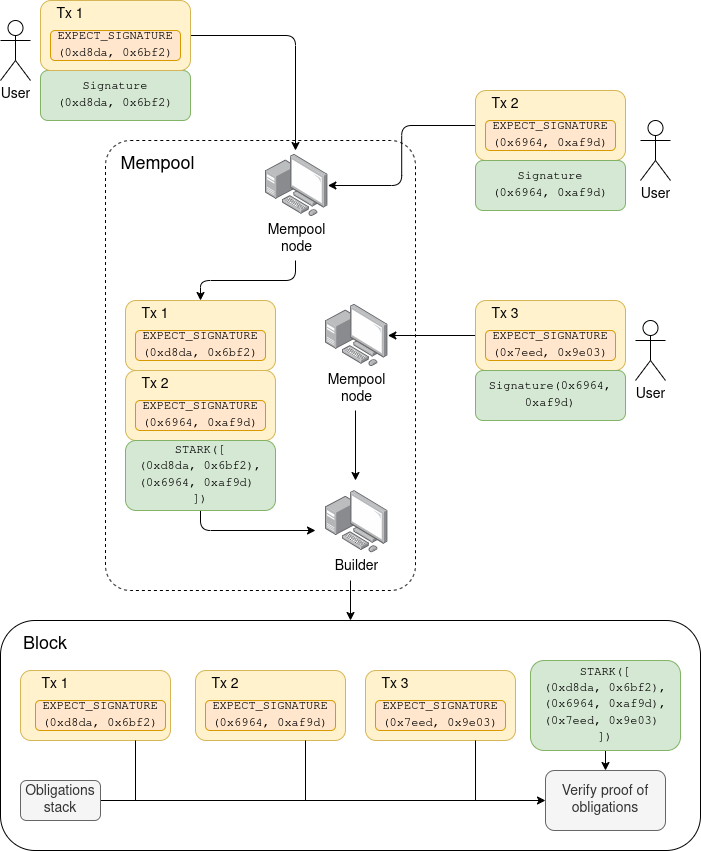
Instead of verifying every signature and proof individually onchain, a single master proof or “validation frame” would verify thousands of them at once, keeping costs near zero.
“This way, a block could ‘contain’ a thousand validation frames, each of which contains either a 3kB signature or even a 256kB proof,” he explained.

Buterin also commented on the Ethereum Foundation’s “Strawmap” on Thursday, stating that he expects to see “progressive decreases of both slot time and finality time.”
Magazine: Bitcoin may take 7 years to upgrade to post-quantum: BIP-360 co-author


Summary
- NIGHT briefly hit ~$1b cap with ~$1b 24h volume, trading near $0.07 as it advances through Kūkolu toward a late-March mainnet for privacy smart contracts on Cardano.
- PIPPIN, an AI-agent meme coin on SOL from Yohei Nakajima, posted ~170–185% monthly gains to a ~$450–$836m cap, with recent moves in the $0.51–$0.70 range.
- Both face high risk: NIGHT from unlock-driven sell pressure and privacy regulation; PIPPIN from insider concentration, elevated leverage, and reliance on speculative social momentum.
Two cryptocurrency projects are positioned to potentially reach $1 billion market capitalizations during the first half of 2026, according to market analysis published by Finbold.
Midnight, a privacy-focused token on the Cardano network, launched in December and has experienced rapid growth, approaching the billion-dollar market-cap threshold. The token briefly achieved that milestone earlier this month before declining amid broader sector volatility, according to market data.
The project’s mainnet launch, designated Kūkolu, is scheduled for late March. The rollout will transition the network from its current Hilo phase to a live environment designed to support privacy-preserving smart contracts, according to project documentation. The launch represents the first major utility test for the network.
Midnight faces a defined token unlock schedule that could introduce selling pressure as locked tokens become available for trading. Price performance in the near term is expected to be influenced by the March mainnet launch and potential partnership announcements, according to market observers.
Pippin, an AI-agent meme coin associated with founder Yohei Nakajima, has recorded recent gains. The project’s trajectory depends on its ability to establish partnerships and develop tools for community use cases, according to project analysis.
The token’s market position reflects risks common to meme coins, including supply concentration among insider wallets and reliance on speculative trading. Market data shows the token trading above key moving averages, with derivatives data indicating rising open interest during recent rallies and elevated leverage levels.
Both tokens carry significant risk factors, including regulatory scrutiny of privacy-focused cryptocurrencies and volatility inherent to speculative digital assets. Market analysts characterize these investments as high-risk opportunities targeting speculative traders rather than conservative investors.

Disclosure: The views and opinions expressed here belong solely to the author and do not represent the views and opinions of crypto.news’ editorial.
Despite the wave of attention RWAs have received over the past couple of years, there’s a sense that everyone is waiting for something to shift. The problem is that many “tokenized” assets are still legal promises dressed up as tokens. Vague token rights, improvised custody and transfer controls, and servicing shortcomings make the whole thing still feel speculative. While the tokenised RWA market sits around $25B (which demonstrates serious growth), it’s still modest in comparison to global markets.
Summary
- Tokens aren’t titles: Many RWAs remain legal promises wrapped in blockchain rails. Without enforceable rights, controlled transfer, and servicing, tokenization stays speculative.
- The UAE is building the legal stack: Through DIFC, ADGM, and the Dubai Land Department, the UAE is treating tokenized real estate as regulated market infrastructure — not a crypto experiment.
- Rights beat throughput: The trillion-dollar RWA opportunity will go to jurisdictions that make token-holder rights unambiguous and enforceable, not to chains with the fastest settlement.
In Dubai, work on this is picking up. The Dubai Land Department has launched Phase II of its Real Estate Tokenization Project, with secondary-market resales scheduled to begin on 20 February 2026. In DIFC, the DFSA’s inaugural tokenization regulatory sandbox drew 96 expressions of interest. In short, the UAE is assembling the regulatory and institutional scaffolding needed to make tokenised real estate scalable – that’s certainly something worth talking about.
The crypto RWA fallacy
The best RWA pitch in crypto happens to be the simplest: take a deed, a fund share, or a receivable, put it on-chain, and let liquidity do the rest. In practice, that often means shipping a minting interface attached to a legal promise that lives somewhere else. The token trades 24/7, but the underlying rights don’t.
When markets tighten, everyone rediscovers the same truth: a token is not a title, nor a court order. Instead, it’s a digital representation recorded on a programmable platform – and it’s notoriously difficult to make it legally and operationally identical to what it claims to represent.
This idea shows up in three places. First, think about enforceability. If token holders can’t clearly understand what they own, what jurisdiction governs it, and how a claim is enforced, the idea of ownership is just branding. As a matter of fact, IOSCO warns that investors may not understand the legal aspects of ownership and transfer rights for tokenised assets, and flags legal uncertainty as a central risk holding back adoption.
Second, consider controlled transfer. Real assets don’t move like meme coins. Eligibility checks, transfer restrictions, and the ability to halt or reverse activity under lawful orders are not optional in institutional markets. OECD research notes that implementing restrictions like forced transfers or trading suspensions can be especially challenging on public, permissionless networks.
Third, there’s servicing. Real estate is an operating system: taxes, insurance, maintenance, tenant issues, distributions, valuations, reporting, audits. Tokenization can streamline records and transactions, but it doesn’t eliminate the admin layer that makes cash flows real and disclosures defensible. Until projects address these issues, RWAs are a bit stuck.
The UAE’s blueprint
If the UAE wins the real estate tokenization boom, it will be because it treated tokenization as a regulated financial product, a market-structure upgrade, and has built rules and institutions around that assumption.
- In DIFC, the DFSA launched a dedicated tokenization Regulatory Sandbox and drew 96 expressions of interest. This is an early indicator that serious firms are looking for a supervised pathway.
- In Abu Dhabi, ADGM has been explicit about positioning itself as a comprehensive regulatory home for digital assets, and it went further by introducing a DLT Foundations regime designed for token issuance and on-chain organisational structures.
- In 2025, the DIFC reported 8,844 active companies, demonstrating rapid year-on-year expansion.
- In Dubai, the Dubai Land Department is running a controlled pilot that explicitly tests governance, investor protection, and operational readiness while enabling secondary-market resale from 20 February 2026.
- The UAE also hosts pools of dry powder that can fund compliant issuance once the infrastructure is credible. Mubadala reported AED 1.2 trillion in assets under management, and Reuters notes Abu Dhabi’s major funds together manage around $1.7 trillion.
The UAE is building something of a regulatory SDK for RWAs — standardized rules, venues, and counterparties that make tokenized real estate deployable.
The winning stack
The projects that scale in the UAE are likely to be regulated market infrastructure that happens to use blockchain. Starting with licensing. In DIFC, the DFSA’s tokenization Regulatory Sandbox provides a supervised route where selected firms can test in a controlled environment and, if successful, transition toward full authorisation.
Next, the packaging has to be familiar. DIFC SPVs (Prescribed Companies) are designed to ring-fence and isolate assets and liabilities (something institutions already understand and can underwrite). Tokenization then simply becomes a distribution and settlement upgrade.
Then comes the hard constraint most crypto-native RWAs avoid – controlled transfer and custody. Institutional markets require governance, safe custody, and clear oversight. ADGM’s FSRA guidance is clear about addressing safe custody, market abuse, and related controls via a thorough regulatory framework.
Finally, the winning stack anchors to the registry. The Dubai Land Department is currently testing tokenization on title deeds within a regulated model, in collaboration with VARA, and moving into a phase that activates secondary resale under a controlled framework focused on governance and investor rights.
Put together, the archetype that wins looks license-first, SPV-based, compliance-native, and obsessed with issuance plus servicing.
The implication for crypto
Here’s the part crypto needs to internalize — the trillion-dollar RWA upside will be won by the players that can make token-holder rights unambiguous, transfers compliant, and cash flows serviceable at scale.
IOSCO makes a good point — investors can end up unsure whether they hold the underlying asset or merely a digital representation, with risks concentrated around legal structure and intermediaries rather than chain throughput.
That’s why the UAE matters to the broader market. The Dubai Land Department is running a controlled tokenization pilot that moves into secondary resale from 20 February 2026, framed around governance, operational readiness, and investor protection. DIFC’s regulator is doing the same at the market-structure level.
For crypto, the chain becomes the settlement, transparency, and automation layer (inside this regulated perimeter). It’s useful precisely because it is programmable, auditable, and interoperable. But pay attention to the jurisdictions and infrastructure providers building enforceable rights – that’s arguably more important right now.

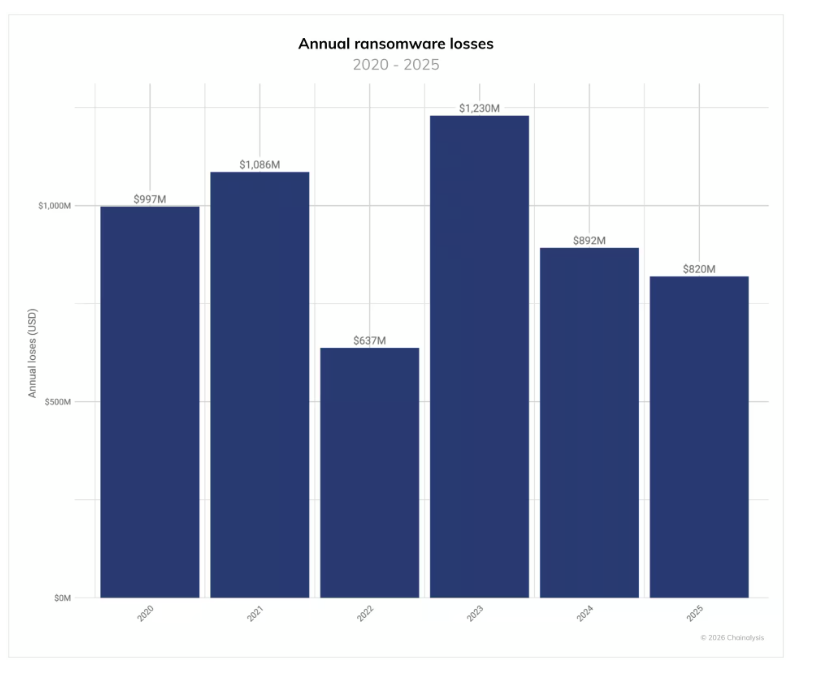
The number of ransomware attacks rose 50% in 2025 as hackers shifted their focus from large-scale attacks to small and medium-sized targets, according to blockchain analytics firm Chainalysis.
In an annual report published on Wednesday, Chainalysis said there were nearly 8,000 total leak events in 2025, a 50% increase from 2024. However, total on-chain ransom payments amounted to $820 million, marking an 8% decrease from 2024.
Chainalysis said increased regulatory scrutiny, enforcement actions targeting laundering network infrastructure, and a general refusal by big firms or organizations to pay ransoms all contributed to lower overall payments in 2025, forcing attackers to go after smaller targets.
“We’re seeing a structural shift in targeting: fewer large, headline-grabbing intrusions and more volume focused on small and medium enterprises. The assumption is simple — smaller victims pay faster,” eCrime.ch founder Corsin Camichel said in the report, adding:
“However, Chainalysis’ data shows payments trending downward despite an all-time high in public claims. That divergence is important. It suggests attackers are working harder for diminishing returns.”

Meanwhile, the increase in attempted attacks was attributed to a continued decline in the average “price for victim access” on the dark web, from $1,427 at the start of 2023 to $439 at the start of 2026.
A flood of cheap software and ransomware strains on the market, combined with AI integrations to streamline attacks, has resulted in increased output by hackers, Chainalysis said.
“We are seeing industrialized access pipelines, AI-assisted tooling, and a proliferation of infostealer logs that lower the barrier to entry, which has resulted in an oversupply of cheap but operationally constrained inventory that floods the market and depresses pricing.”
Hackers and scammers causing crypto chaos
Despite a modest reduction in blockchain ransomware payments last year, 2026 has kicked off with some big losses from crypto exploits and scams.
Related: Why address poisoning works without stealing private keys
According to a recent report from cybersecurity company CertiK, a whopping $370.3 million in crypto was stolen in January through exploits and scams. The lion’s share of funds was stolen via phishing scams, which accounted for $311.3 million.
Magazine: South Korea gets rich from crypto… North Korea gets weapons


Crypto markets are in retreat during U.S. morning hours on Thursday, rapidly reversing yesterday’s strong gains.
Just under $67,000, bitcoin has pulled back more than 4% after touching $70,000 late on Wednesday. Ether (ETH) and solana (SOL) are showing similar declines.
The selloff comes alongside a 2% decline in the Nasdaq following Nvidia’s (NVDA) earnings last night. While Nvidia didn’t disappoint, investors are selling the news after the stock’s sizable run higher into the earnings event. NVDA is lower by 4.8%, with related names like Broadcom (AVGO), Micron (MU) and Intel (INTC) also sharply lower.
Curiously, the software names are nicely higher today, with the Software Sector ETF (IGV) ahead more than 2%. Bitcoin’s correlation with this embattled group has been well documented, but to BTC bulls’ chagrin, they apparently only move together when IGV heads lower.
A check of stocks finds Coinbase (COIN) down 1%, Strategy (MSTR) down 2.3%, and Galaxy Digital (GLXY) down 3%. Outperforming is stablecoin issuer Circle Financial (CRCL), up another 3.3% today, and bringing its two-day post-earnings advance to about 40%.


Disclosure: This article does not represent investment advice. The content and materials featured on this page are for educational purposes only.
As the Crypto Fear and Greed Index plummets, Bybit is doubling down on stablecoin yield and fixed-income-style products to help users generate steady returns amid volatility.
While the Crypto Fear and Greed Index plunges to historic lows and Bitcoin pulls back sharply from its highs, the crypto exchange Bybit is expanding new opportunities, strengthening fixed-income-style products.
“We believe stability is what our users want most right now,” said Helen Liu, Co-CEO at Bybit. “The market will recover, we have no doubt about that. But in the meantime, our job is to help ease the pressure, offer real opportunities to earn stable income, and make sure our community knows that Bybit is right here with them.”
The company is accelerating access to stablecoin yield opportunities and capital-efficient tools designed to help users preserve value and earn predictable returns during uncertain times.
“We want to find every opportunity for our users to earn stable income,” said Helen. “Whether it is on-chain yield through Mantle Vault or capital efficiency through BYUSDT, the goal is the same, make every dollar work harder so that our community can weather this period with less stress and more confidence.”
Bybit believes the current market is also revealing a deeper structural change in investor behavior. They stated that this cycle is different, and that users are not chasing 100x returns, they are looking to protect capital and generate sustainable yield. Bybit reiterates that the shift is structural, not emotional.
Bybit will roll out up to $10 million in fixed-income opportunities backed by stablecoins, giving users more ways to earn predictable returns during volatile markets.
Disclosure: This content is provided by a third party. Neither crypto.news nor the author of this article endorses any product mentioned on this page. Users should conduct their own research before taking any action related to the company.


Circle stock price popped by over 35% on Wednesday, its best day since going public, after publishing stronger revenue and USDC stablecoin growth than expected.
Summary
- Circle stock price soared after publishing strong financial results on Wednesday.
- Canaccord Genuity analysts maintained a bullish outlook for the stock.
- They slashed their CRCL stock target to $160, a 93% upside from the current level.
Circle Internet Group jumped to $83, its highest level since January 15, and 66% above its lowest level this year. This surge boosted its market capitalization to nearly $20 billion.
Canaccord Genuity slashes Circle stock forecast
Analysts at Canaccord Genuity, a firm with more than $110 billion in assets under management, maintained the bullish view on the company, even as they reduced the price target. They slashed their Circle stock forecast by 35% from $247 to $160.
In a note, the analysts praised Circle for another solid quarter in which its stablecoin holdings and revenue jumped. Its stablecoins in circulation rose by over 100% to $75 billion, a figure that Circle expects to have a CAGR of over 40%.
Canaccord Genuity also identified other potential catalysts. The most notable one is Circle Payment Network, which aims to disrupt how money moves globally.
Instead of using the expensive and time-consuming Swift network, banks and other fintech companies can use its stablecoin-powered platform. CPN costs are negligible, while transactions are completed in seconds. Its annualized volume has jumped to over $5.7 billion, with 55 institutions in the network.
Most notably, Circle is building Arc, its layer-1 network, which has attracted hundreds of developers. Canaccord believes that CPN will ultimately run on Arc, leading to higher revenues in the future.
Circle named the “Switzerland of stablecoins”
Additionally, Canaccord believes that Circle is the “Switzerland of Stablecoins” since stablecoins are its only business, and that USDC is the biggest GENIUS-Act compliant coin. As such, it can gain more adoption from companies seeking to leverage stablecoins to cut transaction costs. The report added:
“The launch of competitive stablecoins from eCommerce or financial services giants could be more problematic in terms of their widespread adoption. For example, would Amazon really want to accept WalMart’s stablecoin?”
Meanwhile, John Todaro, a top Needham analyst, slashed Circle’s target from $190 to $130, while William Blair reiterated its outperform rating on the stock. The consensus estimate among Wall Street analysts is $131, up by about 57% above the current level.
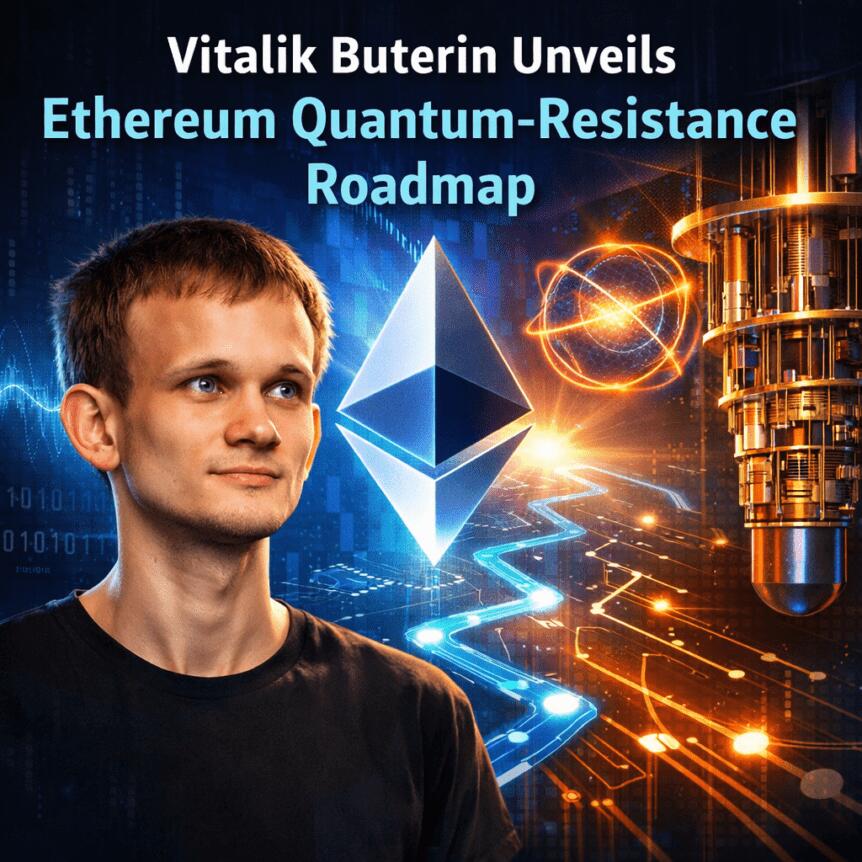
Vitalik Buterin has outlined a four-pronged plan to harden Ethereum against quantum threats, identifying four areas most vulnerable: validator signatures, data storage, user account signatures, and zero-knowledge proofs. As headlines spotlight quantum risk across crypto, including discussions around Bitcoin (CRYPTO: BTC) and other chains, the Ethereum co-founder argues that a careful, long-horizon upgrade path is essential. In a Thursday post, he described a roadmap that hinges on selecting a post-quantum hash function for all signatures—an issue that could determine the network’s security stance for years. The discussion echoes prior proposals, including Justin Drake’s Lean Ethereum idea proposed in August 2025.
Key takeaways
- Buterin identifies four pillars for quantum resistance: validator signatures, data storage, user account signatures, and zero-knowledge proofs, framing a holistic upgrade rather than piecemeal fixes.
- The plan contemplates replacing the current BLS signatures with lean, quantum-safe hash-based signatures, with the choice of hash function carrying long-term implications for the network.
- Data storage would transition from KZG to STARKs, a move that aims to preserve verifiability while enhancing quantum resistance, albeit with significant engineering work ahead.
- User accounts would shift from ECDSA toward signatures compatible with lattice-based, quantum-resilient schemes, though heavier gas costs are a concern.
- A long-term solution centers on protocol-layer recursive signatures and proof aggregation to keep on-chain verification costs in check, potentially enabling vast scalability for quantum-resistant proofs.
- The conversation nods to ongoing research, including ETHresearch discussions on recursive-STARK approaches and the broader Strawmap effort to accelerate finality and throughput.
Sentiment: Neutral
Market context: The push toward quantum-resistant primitives sits against a backdrop of ongoing network upgrades and a broader move toward scalable zero-knowledge proofs, with developers weighing security, efficiency, and long-term viability as they plan multi-year transitions.
Why it matters
The four-pronged approach to quantum resistance is more than a theoretical exercise; it signals how Ethereum intends to preserve user trust as quantum threats loom on the horizon. If effective, a hash-based signature layer could become the de facto standard for post-quantum security, shaping how users interact with wallets, smart contracts, and validator participation for years to come. The decision on the hash function is particularly consequential: once a standard is chosen, it tends to anchor the protocol for a generation, influencing tooling, hardware requirements, and compatibility with future cryptographic advances.
On data storage, the plan to replace KZG with STARKs reflects a subtle shift in cryptographic assumptions. STARKs are lauded for being quantum-resistant and transparent, but integrating them into Ethereum’s data availability and verification stack would demand substantial engineering effort, optimization, and rigorous security audits. Buterin has framed it as “manageable, but there’s a lot of engineering work to do.” The move would balance the need for robust post-quantum guarantees with the practical realities of a live, globally used network.
Account signatures represent another frontier. Ethereum currently relies on ECDSA, a staple of today’s cryptographic ecosystem. Moving to a system that can accommodate lattice-based or other quantum-safe schemes may impose heavier computational loads and gas costs in the near term. Yet the long‑term payoff could be a network that remains secure even as quantum computing capabilities grow. Buterin points to a longer-term fix—protocol-layer recursive signature and proof aggregation—that could dramatically reduce gas overheads by verifying many signatures and proofs within a single frame. If realized, that approach could unlock scalable, quantum-resistant transactions without sacrificing usability.
A central theme across the discussion is the balance between immediate practicality and enduring security. Quantum-safe signatures are not a cosmetic upgrade; they alter core data paths, from how validators validate blocks to how users sign transactions and how proofs are verified. The blockchain community increasingly recognizes that a “one-size-fits-all” cryptographic choice may not suffice; instead, a layered strategy—where traditional primitives coexist with post-quantum alternatives and where recursive techniques optimize verification—could define Ethereum’s security posture for years to come.
Beyond the cryptographic specifics, the conversation is anchored in ongoing academic and developer experiments. For example, researchers have explored recursive-STARK concepts to compress bandwidth and computation, including discussions on a bandwidth-efficient mempool that leverages recursive proofs. This line of inquiry mirrors Ethereum’s broader push toward scalable, verifiable computation that remains tenable in a post-quantum world. The discussion also nods to real-world upgrade planning, such as Lean Ethereum, which Justin Drake proposed in August 2025 as a pragmatic framework for accelerating quantum readiness without destabilizing current operations.
In parallel, governance and roadmap conversations continue to unfold within the Ethereum Foundation and the wider developer community. Buterin’s own posts have highlighted expectations that progress on “Strawmap” could yield progressive decreases in both slot time and finality time, signaling a more agile path to security without sacrificing decentralization or user experience. The architecture changes under consideration—ranging from signature schemes to data verification protocols—must harmonize with these operational expectations to minimize disruption while maximizing resilience against quantum-era threats.
What to watch next
- Updates on Lean Ethereum: Any formal milestones or testnet deployments that demonstrate practical quantum-ready components in action.
- Hash-function selection for post-quantum signatures: The criteria, security proofs, and network-wide implications of choosing a long-term standard.
- Progress toward STARK-based data storage: Engineering roadmaps, performance benchmarks, and on-chain verification strategies.
- Adoption of lattice-based or alternative signatures for user accounts: Changes to wallets, client libraries, and tooling compatibility.
- Implementation of recursive signatures and proof aggregation: Realistic timelines, gas impact assessments, and potential protocol changes needed to support such a paradigm.
Sources & verification
- Vitalik Buterin’s quantum-resistance roadmap post and related discussions: https://x.com/VitalikButerin/status/2027075026378543132
- Lean Ethereum proposal by Justin Drake: https://cointelegraph.com/news/justin-drake-proposes-lean-ethereum
- Headlines about quantum threats to Bitcoin: https://cointelegraph.com/news/saylor-says-quantum-threat-to-bitcoin-is-more-than-10-years-out-expects-coordinated-global-upgrade-if-risk-emerges
- Quantum-resistant data storage and STARKs vs KZG discussion: https://cointelegraph.com/news/vitalik-details-roadmap-for-faster-quantum-resistant-ethereum
- Ethereum Foundation quantum gas‑limit priorities and protocol considerations: https://cointelegraph.com/news/ethereum-foundation-quantum-gas-limit-priorities-protocol
- Strawmap and related timing expectations: https://cointelegraph.com/magazine/bitcoin-7-years-upgrade-post-quantum-bip-360-co-author/
- Recursive-STARK mempool concept: https://ethresear.ch/t/recursive-stark-based-bandwidth-efficient-mempool/23838
Ethereum’s quantum resilience roadmap: four frontiers and the road ahead
Ethereum’s path to quantum resistance, as articulated by Buterin, centers on four pivotal domains: validator signatures, data storage, user account signatures, and zero-knowledge proofs. The proposal calls for replacing the current Boneh-Lynn-Shacham (BLS) consensus signatures with a lean, hash-based, post-quantum alternative. The selection of the hash function is underscored as a long-term decision, potentially locking in an approach for years to come. This shift aims to preserve the integrity of validator operations while mitigating the risk that quantum computers could break current signatures used to attest to blocks and transactions.
In parallel, the data layer would transition away from KZG-based storage to STARKs, a move designed to maintain verifiability under quantum pressure. Buterin notes this is a technically manageable transition, yet it requires substantial engineering effort to integrate seamlessly with Ethereum’s existing data availability and verification mechanisms. If realized, the change would address a core vulnerability by ensuring that data proofs remain verifiable even in a quantum era, without compromising network performance.
On user accounts, the plan envisions a broader compatibility with signature schemes beyond ECDSA, including lattice-based approaches that resist quantum attacks. The practical challenge here is gas consumption: quantum-safe signatures tend to be heavier to compute, which could elevate gas costs in the near term. The longer-term payoff, though, would be a network able to function securely even when advanced quantum hardware becomes capable of breaking traditional cryptographic keys. To counterbalance the added computational load, Buterin points to a protocol-layer solution—recursive signature and proof aggregation—that could dramatically reduce on-chain gas overhead by consolidating verification work into master frames that validate thousands of signatures or proofs at once.
Quantum-resistant proofs pose another cost hurdle, motivating the same aggregation strategy. Instead of individually verifying every signature and proof on-chain, a single, compiled structure—an overarching validation frame—would authorize thousands of sub-validations in a single operation. This approach could reduce the per-transactions verification burden to near-zero costs in practice, enabling a scalable model for post-quantum proof workloads. The narrative echoes ongoing research, including discussions around a recursive-STARK-based bandwidth-efficient mempool, which envisions more efficient data flow and validation under heavy workloads.
Finally, the Strawmap discussions hint at a broader tempo for the network upgrade. Buterin and researchers anticipate incremental improvements in slot times and finality, signaling a measured cadence for upgrading cryptographic primitives without triggering disruptive forks. The convergence of these threads—signature upgrades, data storage shifts, and aggregation-based efficiency—paints a future where Ethereum (ETH) remains secure and usable as quantum capabilities advance. The dialogue around these topics reflects a mature, evidence-based approach to governance and engineering, balancing theoretical security with the practicalities of a live, billions-of-dollars ecosystem.

Strategy Eyes More Bitcoin as Saylor Teases Bigger Bag

Greens Claim Historic By-Election Victory In Crushing Blow For Keir Starmer

Eddie Hearn reacts to Conor Benn facing Regis Prograis in first fight after split


-

 Politics5 days ago
Baftas 2026: Awards Nominations, Presenters And Performers
-

 Fashion6 days ago
Weekend Open Thread: Boden – Corporette.com
-

 Sports3 days ago
Women’s college basketball rankings: Iowa reenters top 10, Auriemma makes history
-

 Politics3 days ago
Nick Reiner Enters Plea In Deaths Of Parents Rob And Michele
-

 Business2 days ago
True Citrus debuts functional drink mix collection
-

 Politics4 hours ago
ITV enters Gaza with IDF amid ongoing genocide
-

 Crypto World3 days ago
XRP price enters “dead zone” as Binance leverage hits lows
-

 Business5 days ago
Mattel’s American Girl brand turns 40, dolls enter a new era
-

 Business4 days ago
Law enforcement kills armed man seeking to enter Trump’s Mar-a-Lago resort, officials say
-

 Tech2 days ago
Unsurprisingly, Apple's board gets what it wants in 2026 shareholder meeting
-

 NewsBeat1 day ago
Cuba says its forces have killed four on US-registered speedboat | World News
-
 NewsBeat1 day ago
Manchester Central Mosque issues statement as it imposes new measures ‘with immediate effect’ after armed men enter
-
 NewsBeat4 days ago
‘Hourly’ method from gastroenterologist ‘helps reduce air travel bloating’
-

 Tech4 days ago
Anthropic-Backed Group Enters NY-12 AI PAC Fight
-

 NewsBeat4 days ago
Armed man killed after entering secure perimeter of Mar-a-Lago, Secret Service says
-

 Politics5 days ago
Maine has a long track record of electing moderates. Enter Graham Platner.
-
 NewsBeat2 days ago
Police latest as search for missing woman enters day nine
-

 Crypto World2 days ago
Entering new markets without increasing payment costs
-

 Business1 day ago
Discord Pushes Implementation of Global Age Checks to Second Half of 2026
-

 Business7 hours ago
Only 4% of women globally reside in countries that offer almost complete legal equality