Two gangs from Edinburgh appeared to use various weapons including batons and knives
Husna Anjum Senior Live News Reporter and Jacob Farr
03:06, 27 Feb 2026
Gangs involved in armed fight in Asda car park
Locals shouted ‘this is a medieval fight’ during a horrific knife brawl in a supermarket car park. Video footage at The Jewel Asda car park showed two Edinburgh gangs fighting with various weapons, including knives and batons.
Advertisement
The terrifying clip has been shared online over the last 24 hours however the exact time of the incident is unknown. In the footage, two males can be seen duelling where one is seen holding what appears to be a black baton.
Edinburgh Live reports his rival seems to be holding a bladed weapon in his hand. Another man in grey can be seen jumping around behind the male brandishing a blade, it was also reported the youths wore face coverings.
Several slashes and swings of the baton are exchanged before three other males appear in the shot. One individual, who is seen in a hooded top with grey colouring on the shoulders, appears to be carrying a weapon with a long blade.
He is visibly swinging the lethal weapon at a male in dark clothing. A chase then begins with the the gangs seen running through the supermarket car park.
Advertisement
Onlookers gasped ‘he’s been slashed’ as one fleeing male is seen to be struck after he is seen tripping on a petrol pump. Another eyewitness can be heard saying: “He’s got a big kitchen knife. Holy s**t. No, this is a medieval fight.”
One local, 49, said: “All of a sudden it just erupted. I don’t know if it was rival gangs or what but it’s not what you expect in broad daylight at the local supermarket.
Advertisement
“It looked like they all had weapons, knives, huge blades and I think one had a bat. They were wildly slashing at each other as shoppers wandered by – it’s terrifying really.”
The video ends with members of one gang fleeing the scene. Police Scotland have been approached for comment.
Ensure our latest news and sport headlines always appear at the top of your Google Search by making us a Preferred Source. Click here to activate or add us as Preferred Source.
“After using whitening toothpaste over the years and them not working I am extremely impressed by these strips”
Eleanor Fleming and Laura McKenna Audience Writer
06:00, 27 Feb 2026
This article contains affiliate links, we will receive a commission on any sales we generate from it. Learn more
Everyday staples such as tea, coffee and red wine are amongst the most frequent culprits behind tooth discolouration, as they can diminish the natural radiance of a smile over time. Increasingly, people are looking for gentle, home-based teeth whitening solutions that integrate seamlessly into their daily routines without the sensitivity sometimes associated with conventional bleaching methods.
Modern day whitening products are advanced enough to offer gradual stain elimination rather than aggressive chemical lightening, placing priority on enamel protection and convenience. One such product is from MySweetSmile, whose approach reportedly focuses on merging cosmetic outcomes with formulations designed to be appropriate for routine application.
Advertisement
Currently, the MySweetSmile Teeth Whitening Stripsare priced at £19.99 on Amazon, with over 300 purchased in the past month. The whitening strips are formulated to address surface stains resulting from everyday habits whilst being appropriate for sensitive teeth.
They feature an enamel-safe composition that excludes peroxide-based bleaching, instead concentrating on a more progressive brightening effect that corresponds with regular use. Designed to fit into a typical morning routine, the strips require only a brief application period and are intended to work without complex preparation or extended wear.
The design aims to provide a handy solution for those seeking to brighten their smile without disrupting daily routines. Each pack includes 21 individual treatments, sufficient for three full cycles and, as per the website, they should be used once daily for seven days to achieve optimal results, reports the Mirror.
The Teeth Whitening Strips are available from MySweetSmile
The strips are proving popular during the festive season
Also available on Amazon is the MySweetSmile Teeth Whitening Powder,reduced to £19.99 from £24.99. This product comes in two flavours, mint and strawberry, and is designed to combat everyday staining, as its formula assists in removing discolouration caused by coffee, tea, wine, smoking and natural ageing.
Advertisement
According to Amazon, the straightforward dip and brush routine takes just a few minutes and is peroxide-free, safe for enamel and suitable for older teeth as well as dental work such as crowns, veneers and bonding. If these aren’t the products for everyone, Smile Therapy offers its Advanced Teeth Whitening and Cleaning Strips (14 Treatments) for £17.99, reduced from £39.99 on their website.
When applied to teeth, each strip is said to release the active ingredients of the whitening formula into the tooth’s structure to help remove surface stains. Boots offers another option with the Rapid White 5 Minute Dissolving Tooth Whitening Strips priced at £25.
Claimed to be clinically proven to brighten teeth by up to five shades in four days, or three shades in a single use, these strips are ultra-thin, flexible and include an accelerator along with an instant whitening toothpaste. TheMySweetSmile products have achieved a respectable 3.9 out of 5 stars rating on Amazon.
Advertisement
One customer commented: “Used these for 7 days now and noticed quite a difference. Have ordered my second box.”
Another added as part of a more detailed review: “Took a chance on this because of the reviews on different sites/social media. Glad I did as it worked. Okay, I don’t have sparking bright white teeth (yet), but they are around 5-6 shades lighter after 7 days.
“I understand how long it takes to work and how much can vary from person to person, so I was very surprised and pleased I noticed a slight change from the first time I used it. After using whitening toothpaste over the years and them not working I am extremely impressed by these strips. They are not overly cheap, but I wouldn’t say they were really expensive, but as they worked they are worth the money.”
Some buyers deducted a star, noting: “After using a few weeks, it seems to help remove stains from teeth. Easy to use but need to keep it for at least 25 mins which is quite long. Also, after removing it, there is a very sticky residue left on teeth when needs a bit of effort to remove it. Doesn’t taste bad either.”
Another individual commented: “Really clear instructions and comfortable to use. Didn’t really have high expectations and have only had for two days but I’m sure I am already seeing a difference.”
On the whole, most people were satisfied: “They’re super easy to use. enamel-safe and don’t cause any sensitivity at all. I’ve tried sooo many whitening products before, but these are on another level.
“Within a few days, I noticed a significant difference – my teeth are visibly whiter and brighter! Plus, they fit comfortably and don’t slip around. Trust me, try them and you won’t be disappointed!”.
We hope you love the products we recommend! All of them were independently selected by our editors. Just so you know, HuffPost UK may collect a share of sales or other compensation from the links on this page if you decide to shop from them. Oh, and FYI – prices are accurate and items in stock as of time of publication.
World Book Day seems to come around in the blink of an eye – and every year I find myself scrabbling to pull together a suitable costume that won’t result in an early-morning meltdown.
If you don’t have time to craft something from scratch – and let’s face it, who does with all the other life and school admin piling up? – I’ve done the heavy lifting for you.
Here’s a cool collection of costumes (and matching books), so you can simply click, add to basket, hit ‘buy’ and feel smug next Thursday (5 March) when everything’s sorted.
Advertisement
It’s thought the idea behind World Book Day actually began in Spain, with the Catalan tradition of giving books to friends and family in honour of the author Miguel de Cervantes.
In 1995, World Book and Copyright Day was created by UNESCO with a view to promoting reading, publishing and copyright. Each year it falls on 23 April.
As children in the UK are usually on a school holiday around that time of year, World Book Day is typically celebrated on the first Thursday in March instead.
The Gorton and Denton byelection had been billed as a close three-horse race. Then Hannah Spencer won by a remarkable landslide.
06:07, 27 Feb 2026Updated 06:18, 27 Feb 2026
Victory was the flavour of the night for the Hannah Spencer. In a stunning landslide, the Greater Manchester plumber, and newly qualified plasterer as she so gleefully announced, became the first Green Party member to win a seat in the north of England.
It had long been billed as a close three-horse race. But that reality soon faded when the count at Manchester Central was finally revealed after six tense hours. The polls closed at 10pm sharp – and the battle was firmly on, much like it had been for weeks.
The people of Denton and Gorton are too used to scandal and sleaze – their home constituency thrust into a manic media spotlight with infighting and dirty tricks which all started with a WhatsApp scandal last year.
Advertisement
As ballot boxes arrived one by one on Thursday (February 26), the night was not without its fair share of chaos. Journalists at the Manchester Evening News were snubbed by Labour, a row erupted over claims of ‘family voting’ and colluding between voting intentions, resulting in brash claims of party ‘cheating’, and an overwhelmed Hannah Spencer arrived late to the count and managed to avoid media questioning.
It’s been a night to remember. Commentators and journalists have repeatedly noted the constituency’s huge divide and for a while, it was anyone’s game.
It is a constituency of two halves, as explored by the Manchester Evening News, with the Manchester side predominantly made up of younger and ethnically diverse residents and the Tameside half inhabited by mainly older, white British people.
Advertisement
There was a tough bid from Spencer, Goodwin and Stogia. They were tipped as the top runners early on, but a clear winner was vacant. Polls repeatedly changed. Nobody really knew which way it was going to go.
The firm said they had visited 22 of the 45 polling stations, and claimed to have witnessed incidents of family voting in 15 of the 22 polling stations observed, with some 32 cases in total. The Green Party, Reform UK and Labourhave also since all responded to the claims, which Reform’s Matt Goodwin described as ‘deeply concerning’.
It prompted early fears of a re-count or appeal. Manchester council asked why the group issued their statement after polls closed at 10pm and not sooner. They also said staff were not told of family voting issues on-the-ground.
It was then that voting numbers were released. Despite more than 50 per cent of electorate not turning out to vote, it was billed as being a success, with more crossing their sheet than in the general election. Officials revealed the turnout was 47.62 per cent, with 36,903 votes cast.
Shortly after, the mood changed in the counting room. Reporters at the scene said rumblings of a Green victory began after the votes were verified. The ambiguity of the result was all of a sudden becoming much clearer and excitement grew.
So loud was the noise, that Labour’s Lucy Powell got herself in a sticky situation on Sky News, admitting that the Greens had ‘won the argument‘ on getting voters to divert away from Reform. She looked downtrodden as she said: “What’s clear is the Greens have turned out their vote higher than they might have otherwise done.
Advertisement
“There was a clear majority in this constituency that didn’t want Reform to win. People have been grappling with what to do in choosing who to vote for, and on the day the Greens have won that argument more strongly than we have.”
It was also referenced just how unique this byelection was. The Manchester-half of the constituency is largely ethnic minority groups and younger – a patch where smaller parties previously made inroads. It is also double the population of the Tameside and Denton part of the patch.
Advertisement
The candidates arrived one by one. Sir Oink-A-Lot, from the Monster Raving Loony party was met with cheers and fanfare. A bizarre but expected entrance, jumping in like he’d just necked a few pints at the pub, complete with stick on snout.
There was silence in the room as Labour’s candidate, Angeliki Stogia arrived. News had already escaped the was likely to have been pipped to the post by the Greens and Reform. Walking alongside Powell, she put on a brave face, but was clearly downtrodden and emotional.
Next up was Matt Goodwin for Reform, who launched quite quickly into a rant and conceded victory to the Greens, slamming the expected victory as being down to ‘a coalition of woke progressives and islamists’.
Advertisement
And last to arrive was Hannah Spencer. With Green’s leader Zack Polanski grinning like a Cheshire cat, it’s as though they already knew. She was quizzed on her punctuality, or lack of, seeming to dodge the camera and make a run for it before the big announcement.
Then the results came. A landslide victory for the Green Party and a working-class girl from Manchester. Not only throwing Keir Starmer’s tenure into dispute, but marking her as the first Green MP elected in the North. The 34-year-old won by a majority of more than 4,000 votes.
Her speech offered hope to the working class people of Greater Manchester. Hailing from the region and working in south Manchester, she emphasised that she is one of us.
“I am no different to every single person here in this constituency. I work hard. That is what we do,” she said. “People in their thousands told me, on the doorstep and at the ballot box, that what we are sick of is being let down and looked down on.
“We will finally get a seat at the table. We can demand better without hating each other. We ran a hopeful campaign backed by thousands of volunteers and activists. We defeated the parties of billionaire donors.
“Because this is Manchester. We do things differently here.”
But the bitterness that we have seen in this fight didn’t cease. Reform UK leader Nigel Farage swiftly accused the Greens of cheating their way to victory in a damning statement. Labour’s Angeliki snubbed the Manchester Evening News and refused to talk after she was pushed down to third place, making a swift exit.
Advertisement
It isn’t all catfighting. Hannah Spencer’s confident and profound speech will be music to the ears of many in Gorton and Denton. The only people who may be disappointed, are her customers she won’t have chance to visit.
“I might have to cancel the work you’ve booked in,” she quipped. “I’m heading to Parliament.”
PC Stanley Kennett, 31, ran The Coffee Cycle, based in a bike shop in Storrington, West Sussex
A police officer has been sacked for moonlighting as a barista while receiving full pay from his force.
PC Stanley Kennett, 31, ran The Coffee Cycle, based in a bike shop in Storrington, West Sussex, while employed by the Metropolitan Police.
He tried to register it as a business interest while suspended from duty in April 2024, but was rejected.
Despite not appealing the decision, he continued working at the coffee shop.
Advertisement
The misconduct hearing found this amounted to gross misconduct, and he has been placed on the College of Policing’s barred list.
Sign up for all of the latest stories
Start your day informed with Metro’s News Updates newsletter or get Breaking Newsalerts the moment it happens.
Advertisement
Commander Andy Brittain said: ‘This was not simply a volunteering opportunity, this was a full-blown and expanding business supported by incorporation of that business, the granting of a director’s loan and employment of staff.
He tried to register it as a business interest while suspended from duty in April 2024, but was rejected (Picture: Google)
‘Pc Kennett is also noted to have been actively engaged on social media promoting that business.
‘This was a sophisticated operation, and Pc Kennett appears heavily involved at all points.
‘All of which appears to undermine the submission on his behalf that at relevant points he lacked capacity to understand the significance of the consequences of his actions.’
He added: ‘Running a business, whether for financial gain or not, whilst suspended on full pay, brings policing and the MPS (Metropolitan Police Service) in particular into disrepute.
Advertisement
‘Members of the public would not expect serving police officers to act in this way.’
It comes as an officer, referred to as Sergeant X by Avon and Somerset Police, has been barred from working in any UK law enforcement agencies after she used a work-from-home hack.
She was found to have weighed down her keyboard with a picture frame, while her keystrokes were identified as ‘significantly high’ in 2024 by the force’s Professional Standards Department.
An investigation was opened, and it was discovered the majority of shifts she worked had between three to eight times higher keystroke count than her colleagues in a similar role.
Advertisement
She admitted to using the corner of a picture frame to weight down her keyboard so her laptop would not go into ‘sleep mode’ while going through challenges in her personal life.
The earthquake was widely felt across both Canary Islands on Thursday, with residents reporting rooms vibrating and furniture shaking, though no damage was reported
Residents and tourists across Tenerife and Gran Canaria have been urged to remain calm after thousands of people on both islands experienced a 4.1 magnitude earthquake.
Advertisement
Scientists have confirmed it is not linked to the seismic activity recorded over the past two weeks beneath Mount Teide on Tenerife, and have stressed that a volcanic eruption is not imminent.
Authorities acknowledge that many people were alarmed by the earthquake and questioned whether it was connected to the unusual seismic activity beneath Teide, but experts have moved to reassure the public that there is no such connection.
“In 1989, in this same area, an earthquake of 5.3 was recorded that was felt throughout the island of Tenerife,” said IGN volcanologist Rubén López, who dissociated this earthquake from the recent rebound in seismicity in the Cañadas del Teide area.
Witnesses reported rooms shaking and furniture rattling following the earthquake, which struck at 12.26pm today at a depth of ten kilometres.
Advertisement
The quake was not centred beneath Mount Teide, but rather beneath the Enmedio volcano, situated between Tenerife and Gran Canaria.
The National Geographic Institute confirmed the earthquake measured 4.1 in the vicinity of the Enmedio Volcano, located in the channel separating the two islands.
The tremor was widely felt by residents and visitors across various parts of both Tenerife and Gran Canaria.
Advertisement
Given its magnitude and the depth of its hypocentre, the quake prompted a significant number of reports from members of the public who distinctly felt the movement.
In municipalities such as Arico in Tenerife, witnesses Residents reported vibrations lasting around five seconds, with some describing how “the whole room was shaking” throughout the incident.
One Agaete resident in Gran Canaria explained: “It lasted about ten seconds and was more noticeable than ever, moving the whole house,” adding: “It went from less to more. At first it seemed like the closing of a door, but then the whole house moved.”
The National Geographic Institute (IGN) has documented the towns where the earthquake was detected at different intensity levels. The tremor didn’t just affect Tenerife but also impacted multiple locations across Gran Canaria, being registered in over 100 populated areas spanning the two principal islands.
Advertisement
Among these locations are several popular tourist destinations including Los Cristianos in Tenerife and Las Palmas on Gran Canaria. Within these zones, the earthquake was felt distinctly inside buildings, causing alarm among some residents and holidaymakers. Authorities have confirmed no significant material damage or injuries have been recorded.
The Volcanological Institute of the Canary Islands (INVOLCAN) has emphasised that “this earthquake has no relation whatsoever” to the volcanic seismicity recorded in Tenerife in recent weeks.
The area of Enmedio Volcan The region ranks among the Canary Islands’ most seismically active zones, situated on a submerged fault line between the two capital islands.
Whilst seismic activity is routine in this location, earthquakes surpassing magnitude 4 typically cause heightened alarm amongst residents as they’re distinctly felt within properties.
Advertisement
Experts are reconvening tomorrow to further analyse the thousands of tremors detected beneath Mount Teide on Tenerife.
They emphasise an eruption is not expected in the near or medium-term future, as the warning signs would be markedly different. Nevertheless, they’re urging all Tenerife municipalities to refresh their emergency protocols, pointing out that residents in countries such as Iceland are fully prepared with clear procedures should an eruption occur.
Tenerife’s government maintains the island possesses the most advanced and comprehensive monitoring infrastructure available and stresses there’s no reason for public concern.
The Reform UK leader hit out after his party’s candidate, Matt Goodwin, was comfortably beaten into second place by the Greens’ Hannah Spencer.
She won with a majority of nearly 4,500 after a bitterly-fought contest which saw Labour beaten into third place.
After the polls closed on Thursday night, independent election observers Democracy Volunteers revealed they had witnessed “concerningly high levels of family voting” throughout the day.
Advertisement
That is where where two people use one polling booth and potentially direct each other on voting.
Democracy Volunteers director John Ault said: “Based on our assessment of today’s observations, we have seen the highest levels of family voting at any election in our 10 year history of observing elections in the UK.
“We rarely issue a report on the night of an election, but the data we have collected today on family voting, when compared to other recent by-elections, is extremely high.
“In the other recent Westminster parliamentary by-election in Runcorn and Helsby we saw family voting in 12% of polling stations, affecting 1% of voters. In Gorton and Denton, we observed family voting in 68% of polling stations, affecting 12% of those voters observed.”
Advertisement
In a post on X shortly after the by-election result was announced, Farage said that was why the Greens had won.
He said: “This election was a victory for sectarian voting and cheating.”
This election was a victory for sectarian voting and cheating.
Matt Goodwin was a great candidate for us.
Roll on the elections on May 7th.
Advertisement
It will be goodbye Starmer and goodbye to the Tory party.
In a separate post, Farage said the high amount of family voting “raises serious questions about the integrity of the democratic process in predominantly Muslim areas”.
In a statement, Matt Goodwin said: “We are losing our country. A dangerous Muslim sectarianism has emerged.”
Advertisement
But a Green Party spokesman said: “The scale of our victory shows that the Green Party has picked up substantial support in all parts of the constituency, in all areas, among all people.
“It was a victory for unity over division, for hope over hate. Our message to lower bills, protect the NHS and public services and for peace and human rights was a message which resonated here, to all voters in this by-election.”
Greens’ leader Zack Polanski, meanwhile, suggested he would back a probe into family voting.
He told BBC Newsnight: “I think it’s important that there’s full transparency about the democratic process, and if the recommendation is that there should be an inquiry or further steps then yes I’d support that.”
The Green Party’s Hannah Spencer has won the Gorton and Denton by-election, with 14,980 votes.
She beat Reform UK’s Matt Goodwin with 10,578 votes, and Labour’s Angeliki Stogia with 9,364 votes.
The constituency had long been considered a safe Labour seat, with the vote triggered by the resignation of former Labour MP Andrew Gwynne in January due to ill health.
He was elected as a Labour MP in 2005 in the previous Denton and Reddish constituency, but was suspended from the party last year after sending offensive WhatsApp messages.
For most of human existence, listening was closely tied to moments that carried meaning, emotion or survival. Nature supplied the backdrop – wind, water, animals – and music surfaced in hunting rituals, healing ceremonies and communal celebrations.
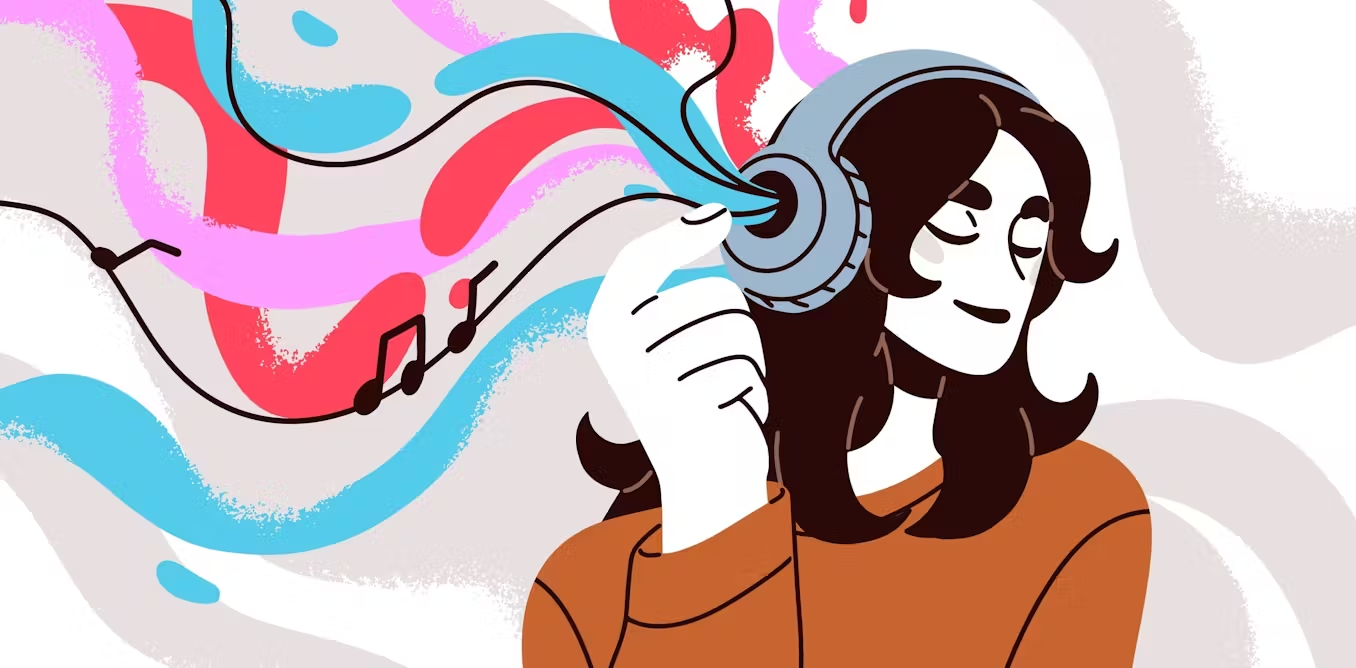
That balance began to shift with the industrial revolution, and the arrival of many loud, unnatural sounds. Today, many people move through the day with a near-constant stream of sounds: playlists for work, ambient study tracks, noise-cancelling headphones on commutes, podcasts on walks, background music for comfort.
Sound is no longer occasional or, for much of the time, collective. It is personal, portable and continuous.
What has changed is not only how we listen, but what listening is for. Many people use sound to manage how they feel and perform – to drown out distractions, stay motivated, reduce stress or make demanding tasks feel easier. Streaming platforms use music labels such as “deep focus” or “workflow” – signalling that these sounds are designed to do something for your mind.
Advertisement
There are upsides to this modern soundscape. In busy workplaces or homes, shaping the auditory environment can restore a sense of control and reduce disturbance – especially from intelligible speech. What we listen to can be a key tool for emotional self-regulation.
But there are downsides too. Continuous audio can crowd out silence, which supports recovery and reflection. What often disappears in a continuous soundscape is not just silence but the space to think. This daily exposure to non-stop music, chat and other sounds may be shaping how you think, decide and cope without you even noticing.
The always-on effect
Neuroscience points not to a dramatic rewiring of our brains through this changing audio experience, but a gradual adaptation. Repeated sound environments shape how attention is allocated, how effort is experienced and how mental states stabilise over time.
Those effects vary, though, depending on the context. Music can support repetitive or low-complexity tasks by increasing engagement and reducing boredom. But when tasks rely on language, problem-solving or new learning, the same music can compete for attention, making sustained thinking feel more effortful.
Reviews consistently find that music with lyrics is more likely to interfere with reading, writing and verbal reasoning, and that harder tasks are generally more vulnerable to interference. When sound competes with task demands, it can increase mental effort and fatigue, even if outward performance remains unchanged.
Experimental work suggests higher background sound levels can impair auditory working-memory performance — the capacity to hold and rehearse spoken information while filtering competing sounds. In other words, sound can reshape how thinking is experienced from the inside, long before measurable performance changes become visible.
Advertisement
Because these shifts accumulate gradually, they rarely announce themselves as effects. Instead, they shape mental defaults – how patiently you think, how quickly you judge and how you cope when answers aren’t clear.
How noise affects our health. Video: BBC World Service.
Three principles of audio happiness
A simple principle is to match the sound environment to the kind of thinking you’re doing. Some types of louder sound can support repetitive work, while quieter conditions are often better for reading, writing or analytical reasoning.
Advertisement
While lyrical music is more likely to disrupt reading, writing and analytical work, simpler sound is often safer for language-heavy tasks. By contrast, for repetitive or low-complexity work, self-selected or familiar music may support engagement for some listeners by tuning arousal into a more workable range.
Familiar or self-selected music can sometimes support repetitive work because the brain spends less effort processing novelty. Instead of continuously analysing new sounds, attention can remain anchored on the task itself, helping stabilise alertness during routine activities.
A second principle is self-monitoring. Generic “focus playlist” advice is less useful than paying attention to your own signals: rising distraction, mental fatigue, irritability or the feeling that you are working harder than you should. Audio that boosts energy or enjoyment does not always improve sustained concentration.
When these signals appear, pausing your soundtrack and shifting to a simpler sound environment can help reset your attention balance. Reducing linguistic content, lowering volume or introducing short periods of silence may ease the cognitive load before performance begins to suffer.
Advertisement
Which brings me on to the third principle: protect silence. Quiet time supports neural recovery and internally directed thought – functions linked to default-mode brain activity, when regions linked to reflection, memory integration and future planning become more active.
But valuing silence does not mean removing sound altogether. Beginning complex tasks in quieter settings, introducing short sound-free intervals between activities, or ending the day without continuous background audio can give the brain space to reset attention and recover from sustained input.
Environmental noise can also influence sleep quality by increasing micro-awakenings and reducing deeper restorative stages, even when people do not fully wake up. Many people use sound to help them sleep, but evidence shows it can have a disruptive effect on sleep quality.
Day or night, the sounds we live with do more than just fill the background. They help shape the mental conditions under which we learn, decide and live.
Advertisement
And that is the perhaps uncomfortable point. If you don’t actively choose your soundscape, someone or something will choose it for you – and your mind may start adapting before you realise it.
When we think about school bullying, we often focus on victims given the emotional toll they endure, the academic disruption they face and the long-term scars that follow them into adulthood.
Victim-centred research has been critical in shaping strategies to prevent bullying. But there’s a perspective that would help us understand bullying that is too often ignored: that of the aggressors themselves.
There is a growing body of research that explores how students themselves understand and explain bullying, but very few explicitly address the perspectives of the aggressors. Consequently, there’s a risk of misunderstanding the complex social and psychological forces that drive this behaviour.
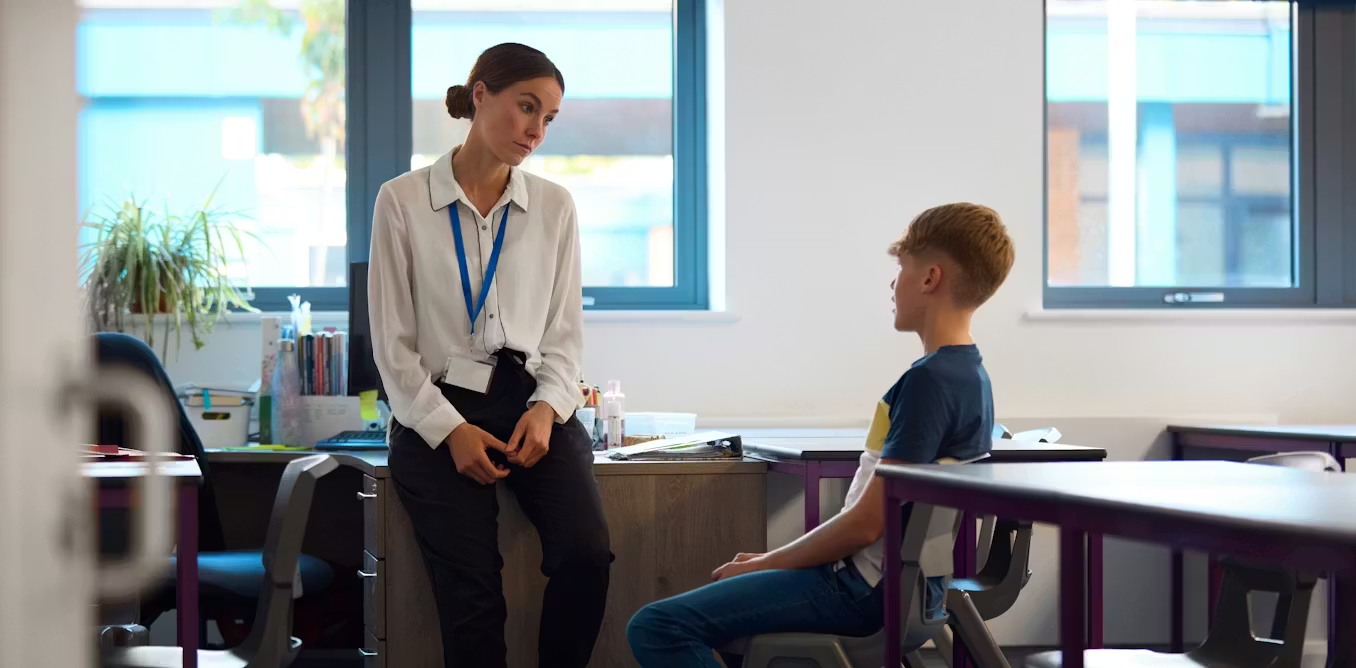
In a study I carried out in Mexico, I interviewed 13 former secondary students – now adults – who had once been bullies. By delving into their life stories and memories from childhood and adolescence, the study uncovered critical insights into why school violence occurs and how we might interrupt it.
Advertisement
What emerged from these conversations was not a portrait of monsters, but of children navigating harsh environments, social pressure and emotional confusion. The findings challenge some of the myths that revolve around bullies. My research reveals reveal how aggression is often learned, normalised, and even rewarded.
What do bullies say?
Many participants told me that their aggressive behaviour was modelled and reinforced in their homes, schools and communities. Several recounted growing up in households where domestic violence and dysfunctional relationships were common. “We grow up in a violent environment … it becomes normalised … even to survive,” one said.
Others described how violence was institutionalised in several community spaces. This included in sport clubs where abusive coaches “toughened up” players, inadvertently teaching them to equate aggression with strength. Media and social media also played a role. One interviewee admitted to replicating a violent social media trend, highlighting how digital platforms can amplify harmful behaviour.
People in my research described how, rather than being punished, physical dominance and violence was praised and reinforced through the approval of their peers. One explained: “The jerk who made life impossible was the one everyone wanted to hang out with … How are you going to change if everyone celebrates you?”
Perhaps most revealing was the role of bullying in securing social status and group belonging. Participants described aggression as a way to solidify friendships, join peer groups or avoid becoming victims themselves. The “game” of bullying, as they called it, was often seen as a ritual – one rooted in reciprocal joking, physical roughhousing and group cohesion. One participant explained: “You’d hit someone as a sign of friendship … That’s just how the group got along. If you complained, no one would invite you anymore.”
Importantly, such practices also involve blaming the victim, especially when victims were constructed as “weak” or “deserving” of mistreatment.
Bullying functioned also as a way to police norms, particularly around gender and conformity. Boys who failed to perform dominant masculinity, broadly understood as an idealised manhood shaped by aggression and toughness, were often a target. One recalled: “A guy who doesn’t fight back is labelled ‘pathetic’, ‘coward’, ‘less of a man’.” But girls, too, engaged in bullying to maintain social order, often within friendship circles.
These testimonies challenge simplistic views of bullies as merely “bad kids”. Instead, they reveal a troubling mirror of broader social values: competition, dominance, emotional repression and the normalisation of exclusion.
Advertisement
What this means for schools
School-based programmes must go beyond punitive discipline. Many former aggressors shared that suspensions or expulsions had little impact, and in some cases, even increased their hostility. One participant described expulsion as a “reward” that placed them in a school with other aggressive peers, perpetuating the cycle of violence.
What mattered more were moments of emotional connection. For some, a heartfelt conversation with a parent or a teacher’s genuine concern became a turning point. As one interviewee shared: “I stopped bullying when my mom talked to me … I saw her crying and realised I needed to change.”
Interventions should include restorative practices such as family group boards, reflection circles and community service, which are aimed at building community rather than just punishing. These practices include dialogue sessions, peer mediation, and conflict resolution and reparation mechanisms such as apologies, paying for damages or any other agreement to repay the harm.
Equally, social-emotional learning that helps students to understand and manage their feelings and teacher training focused on recognising subtle forms of aggression, also must be considered. Parents must be engaged not only as disciplinarians but as partners in emotional development. And importantly, students must be invited into honest conversations about empathy, belonging, and responsibility (to themselves and to other peers).
Advertisement
By listening to the voices of those who once caused harm, we can have a better picture of the complex dynamics that underpin school bullying. And in doing so, we open up new pathways for healing, not just for victims, but for those who once harmed.
Scream is available to stream for free on BBC iPlayer (Picture: Miramax/Kobal/Shutterstock)
One of the most beloved horror films of all time is now streaming for free, just in time to get fans caught up as the franchise’s next chapter arrives.
The original Scream (1996), often hailed as the greatest horror movie ever made, is currently available to watch on BBC iPlayer, alongside Scream 2 and Scream 3.
With Scream 7 hitting cinemas today, it’s the perfect excuse to revisit the film that reinvented the slasher genre.
Directed by the late Wes Craven and written by Kevin Williamson, Scream changed horror forever when it debuted in the 90s. Blending genuine scares with razor-sharp self-awareness, the film poked fun at horror tropes while still delivering some of the most iconic moments in genre history.
Advertisement
Ghostface became one of the most iconic horror movie baddies of all time, and the film also offered one of cinema’s most enduring ‘final girls,’ Sidney Prescott.
Nearly 30 years on, fans still hold the original in towering regard.
Advertisement
On Rotten Tomatoes, one viewer described it as ‘Absolutely a masterpiece,’ while another called it ‘One of the best slasher films of all time.’
Another fan praised its lasting impact, writing: ‘A horror classic, man…This completely reinvigorated the slasher genre, with an interesting meta-approach and a great set of characters, with it being a legitimately fun mystery, too.
‘It’s thoroughly entertaining, and introduces one of the better final girls of all time in Sidney Prescott. Even in a franchise that’s still running strong, the original remains easily its best.’
Advertisement
What’s your favourite Scream movie?
Many still consider Ghostface to be one of the best ever horror movie bad guys (Picture: Dimension Films/Kobal/REX/Shutterstock)
You can watch the iconic original just in time for Scream 7 to hit cinemas (Picture: Miramax/Kobal/REX/Shutterstock)
Scream franchise: Rotten Tomatoes scores and where to watch
Scream (1996) – 78% RT Score – Streaming on: BBC iPlayer, Netflix, Amazon Prime Video, and Paramount Plus
Scream 2 (1997) – 83% RT Score – Streaming on: BBC iPlayer, Netflix, Amazon Prime Video, and Paramount Plus
Scream 3 (2000) – 45% RT Score – Streaming on: BBC iPlayer, Netflix, Amazon Prime Video, and Paramount Plus
Scream 4 (2011) – 61% RT Score – Available to rent or buy digitally on Amazon, Apple, YouTube and Rakuten TV
Scream (2022) – 76% RT Score – Streaming on: Paramount Plus
Scream 6 (2023) – 77% RT Score – Available to rent or buy digitally on Amazon, Apple, YouTube and Rakuten TV
That influence can still be felt today, with countless modern horror films borrowing Scream’s knowing tone.
The timing of its free streaming release feels no accident. With Scream 7 in cinemas, it’s the perfect time to catch up on the whole franchise.
Whether you’re a die-hard fan or a newcomer curious about what all the fuss is about, revisiting Scream now is a reminder of why it’s still talked about as the gold standard for slasher movies.
Scream 7 is out in cinemas from February 27, 2026.
Advertisement
A version of this article was first published on February 2, 2026.
Got a story?
If you’ve got a celebrity story, video or pictures get in touch with the Metro.co.uk entertainment team by emailing us celebtips@metro.co.uk, calling 020 3615 2145 or by visiting our Submit Stuff page – we’d love to hear from you.