

Crypto World
Bitcoin price recovery falters, drops to $67k as popular analyst predicts major crash



- Bitcoin stalls near $67,000 after partial recovery from all-time highs.
- On-chain data shows half of BTC is held at a loss, hinting at market fatigue.
- Analyst warns deeper correction possible, with bottom around $45,000.
Bitcoin’s recent recovery attempt has stalled just below $70,000, with the cryptocurrency slipping back to around $67,250 at press time.
The drop comes as the broader crypto market struggles to maintain upward momentum following a few months of volatility.
After reaching an all-time high of $126,080 in October 2025, Bitcoin (BTC) has now retraced nearly half of its value.
All eyes are now on the cryptocurrency as it appears to consolidate around $67,000 after the steep drawdown.
Analyst Willy Woo warns of further downside
Renowned on-chain analyst Willy Woo has predicted a significant price correction following the recent bounce.
He estimates that the bear market bottom could be around $45,000, with more extreme scenarios potentially testing $30,000 or even lower.
Woo’s caution stems from declining liquidity across spot and derivatives markets, which historically reduces the strength of rallies.
He suggests that Bitcoin may briefly climb to the mid-$70,000 range before facing renewed downward pressure.
On-chain signals hint at market fatigue
On-chain metrics suggest that Bitcoin may be entering the later stages of a bear market cycle rather than the early phase.
Roughly half of all circulating BTC, nearly 9.2 million coins, are currently held at a loss, according to the latest weekly report by on-chain analytics firm Glassnode.
Historically, such levels indicate significant selling pressure and potential capitulation, yet the pace of accumulation by long-term holders hints at a market beginning to stabilise.
Some analysts view these patterns as signs that bitcoin’s price may be closer to a bottom than the start of a prolonged decline.
The balance between holders in profit and those in loss is an important measure of market sentiment, and it shows that while short-term volatility remains high, there is underlying support at current levels.
Bitcoin ETF inflows show cautious optimism
Institutional investors have recently stepped back into the market, with Bitcoin ETFs recording over $1 billion in net inflows over a few days.
This trend follows a period of withdrawals totalling nearly $3 billion, signalling that some investors see the current price as a buying opportunity.
Spot ETFs, in particular, are attracting attention from long-term investors looking for regulated exposure to Bitcoin.
The renewed interest demonstrates that, despite the pullback from all-time highs, there is confidence in the asset’s long-term prospects.
However, inflows are not a guarantee of sustained upward momentum.
Short-term technical indicators suggest that Bitcoin is trading near the top of a tight consolidation range between $67,000 and $68,000, and a breakout above this zone could spark a rally, although rejection may force the price back toward $63,000 or lower.

Disclosure: This article does not represent investment advice. The content and materials featured on this page are for educational purposes only.
BestChange positions itself as a long-running exchange aggregator helping users compare rates, liquidity, and reliability across 670+ services in one interface.
Summary
- Founded in 2007, BestChange is a non-custodial exchange monitoring platform listing 670+ exchangers and 95+ cryptocurrencies, offering real-time rate comparisons across 52,000+ currency pairs.
- The platform provides advanced tools, including multi-stage exchange routing, AML address checks, filtering systems, and cross-platform access via web, mobile apps, browser extensions, and Telegram integrations.
- With millions of tracked rates and user reviews, BestChange emphasizes transparency and ongoing partner monitoring, though it has faced periodic regulatory restrictions and user feedback related to partner services and usability updates.
The crypto space has now become a haven for unscrupulous businesses posing as innovative exchanges. Choosing a platform to trade on in the midst of all this chaos is not an easy task. That’s where aggregators come into the picture. They offer a single interface where investors can compare the rates and features of various exchanges and make better decisions.
Today, let’s take a look at one such platform: BestChange.
Overview
Website: https://bestchange.com/
Sector: Crypto exchange aggregator
Supported coins: 95+ cryptocurrencies
Listed exchangers: 670+ exchange services
Fees: No fees for the aggregator itself
KYCverification: Not required
User support: Email support
Language support: English/Russian
Product ecosystem: Web platform, mobile applications (iOS and Android), Telegram bot, Telegram mini app, browser extensions, and AML address analyzer
What is BestChange?
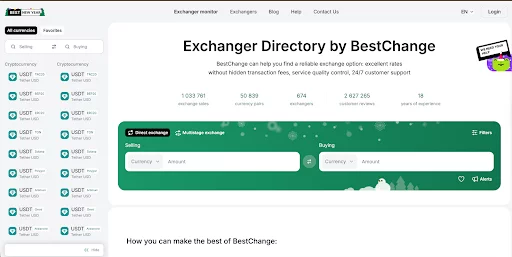
Launched in 2007, BestChange is a non-custodial exchange aggregator registered in Dubai under the brand Agretis Software Design LLC. The platform offers information from 670+ exchange services across more than 52,000 currency pairs. BestChange does not process transactions or store user funds. It instead operates as an independent information resource that connects users to third-party exchange providers.
Though it started off as desktop only, after its latest update in 2025, BestChange is now a full-fledged ecosystem designed to enable exchange rate comparisons on any device, at any time.
With nearly two decades in the market, BestChange operates as an infrastructure solution within the crypto exchange ecosystem combining long-term reputation with up-to-date tools tailored to today’s typical crypto user behaviors.
Features
- BestChange offers a real-time comparison of core exchange variables, including rates, fees, limits, reserves, etc., so users can instantly compare rates instead of spending hours going back and forth between various websites. This functionality helps maintain market transparency.
- Having tracked over 1,126,483 exchange rates across 52,070 currency pairs from 670 listed exchanges, BestChange has built a strong reputation as a reliable and transparent crypto exchange monitoring platform.
- BestChange has also collected over 2,692,722 user reviews and 1,338,312 referrals in its 18 years of continuous operation.This extensive and publicly visible feedback base strengthens transparency, allowing users to evaluate exchange services based on real community experiences rather than marketing claims. At the same time, it enables the platform to continuously monitor partner reliability and maintain high service standards.
- BestChange conducts ongoing monitoring of listed exchanges’ activity. The team actively identifies and addresses negative patterns such as review manipulation, misleading rate practices, or violations of platform rules, applying corrective measures when necessary.
- Beyond maintaining compliance with the rules for listed exchanges, BestChange places strong emphasis on the accuracy of exchange rates and the integrity of displayed data. Continuous independent monitoring across hundreds of currency pairs ensures that rates reflect real market conditions, helping users access genuine, market-based offers rather than artificially inflated or misleading quotes.
- The platform also offers sorting, filtering, and alert systems designed to reduce information asymmetry. These advanced systems help users to make faster, better-informed decisions without the need for constant manual monitoring.
- BestChange also has a multistage exchange tool that helps identify viable liquidity paths when direct exchange pairs are inefficient or unavailable, which means users can automatically route their transaction through two exchanges to secure a better rate or complete a swap that wouldn’t be possible in a single step.
- In addition to the above-mentioned features, BestChange has an AML check tool, which aggregates data from multiple compliance providers to assess the risks related to crypto wallet addresses before a transaction. This allows users to spot high-risk funds in advance, avoid scams, account freezes, and compliance issues, and make informed decisions without exposing sensitive personal data.
- On a greater scale, BestChange is an ecosystem that employs cross-platform access via web, mobile apps, browser extensions, and messaging interfaces. This way, market data remains available to all users regardless of device, location, or constraints.
- The BestChange mobile app is available on App Store, Google Play, and Huawei AppGallery, with distribution across 175+ countries. This multi-format approach allows users to access exchange data, comparisons, and tools in a way they prefer without being confined to a single interface.
Pros and cons
BestChange has a whole list of advantages, from a multi-stage exchange to cross-platform access, but that does not mean the platform is without its limitations.
Following the launch of its new products, BestChange received some user feedback regarding minor bugs and usability issues. This is a fairly common occurrence during major updates and rebranding phases. The team acknowledged the feedback promptly and addressed the concerns through continuous iterative improvements.
BestChange has also faced several temporary restrictions by Roskomnadzor in Russia. But these restrictions were mostly driven by shifts in Russia’s crypto regulation, rather than it being about BestChange’s operations itself. Currently, the BestChange team is in full compliance with all of Russia’s formal demands, and there are no more access concerns.
At one point, users also raised concerns about BestChange listing exchange services with questionable reputations or scam-related behavior. However, BestChange strengthened its screening shortly after, making sure these issues were completely eradicated.
Public review
With a 4.1 rating on TrustPilot, 4.6 on MyWot, and 4.5 on TenereTeam, BestChange appears to be leading in terms of public interest. One user on the platform commented, “BestChange.com is an excellent resource for finding the best cryptocurrency and e-currency exchange rates. The platform is easy to navigate, updated in real time, and helps me choose the most reliable exchangers quickly. Highly recommended for anyone looking to save time and money when exchanging digital assets.”
Still, the aggregator has received some criticism. One such reviewer highlighted that the cancellation charges were high, while another complained about the slow and often unresponsive customer service. However, most of the negative reviews seem to be about the individual exchange partners on the platform and not BestChange itself.
Conclusion
Crypto exchange aggregators have made the exchange game easier than it ever was. Instead of choosing a single platform and accepting its rate, users can now compare offers and features from over hundreds of different platforms in a single interface. If traders were to do this comparison manually, that would take them hours, if not days. With aggregators like BestChange, traders can now complete this tedious task in minutes. The result is more time on their hands to make better decisions.
Disclosure: This content is provided by a third party. Neither crypto.news nor the author of this article endorses any product mentioned on this page. Users should conduct their own research before taking any action related to the company.

South Korea’s National Tax Service (NTS) accidentally exposed a crypto wallet seed phrase in an official press release on Thursday, leading to a loss of 4 million PRTG (Pre‑Retogeum) tokens worth about $4.8 million from the address, according to local media reports.
According to multiple Korean media reports on local sites Naver, Chosun and others, the press release related to the National Tax Service’s enforcement campaign against tax delinquents and seizures that the authorities had carried out. The release reportedly included an image of a Ledger cold wallet and a sheet of paper showing the wallet’s full mnemonic phrase without any blur or masking.

Blockchain researchers later identified an Ether (ETH) address linked to the leaked phrase that briefly held the 4 million PRTG tokens before the entire balance was transferred out.
Onchain data for that address shows three inbound transfers totaling 4 million PRTG, followed by a single outbound transfer sending exactly 4 million PRTG to another wallet, consistent with those reports.
Related: 3 Solana platforms to shutter following devastating $40M hack
Associate professor Jaewoo Cho of Hansung University’s Blockchain Research Center, who analyzed the flows, noted on X on Friday, “We have confirmed that 4 million PRTG tokens, worth approximately $4.8 million, were stolen from the mnemonic that was leaked (disclosed) through a press release from the National Tax Service.”
He added that, “fortunately, the other exposed mnemonics do not seem likely to cause any major issues,” and argued that because the stolen tokens were difficult to cash out, “the actual damage is at a negligible level.”
He said he hoped the episode would be a “blessing in disguise” that pushed Korean public bodies to build proper virtual asset custody systems.
Crypto custody failures test Korean authorities
The incident comes as South Korean authorities face another crypto custody scandal. In a separate case, police discovered in February 2026 that 22 Bitcoin (BTC) seized in a 2021 hacking investigation had vanished from a cold wallet stored in a Gangnam police vault.
Two suspects were arrested on Thursday after investigators found that the coins had been moved using a mnemonic phrase that the police had never controlled.
Separately, regulators are under pressure over Bithumb’s recent 620,000 BTC fat finger promotion error, where the exchange briefly credited users with about $43 billion in non‑existent Bitcoin, and the Financial Services Commission extended its probe after criticism that it failed to spot serious systems flaws earlier.
Magazine: South Korea gets rich from crypto… North Korea gets weapons

The United Kingdom’s Gambling Commission is evaluating whether cryptocurrency could function as a consumer payment option within licensed online gambling, as the country moves to bring crypto activity under a new regulatory regime led by the Financial Conduct Authority (FCA). Tim Miller, the commission’s executive director for research and policy, told attendees at the Betting and Gaming Council’s annual general meeting in London that policymakers want to map out “the potential path forward” for cryptoasset payments in Great Britain. He noted that, once the regime starts, regulated crypto activities would require FCA authorization under the Financial Services and Markets Act 2000. The licensing framework is targeted for 2027.
Key takeaways
- The Gambling Commission is actively exploring a formal path to allow crypto payments for licensed gambling in Great Britain, as part of the FCA-regulated regime.
- Any entities conducting regulated crypto activities would need FCA authorization under FSMA once the regime commences.
- The commission ties crypto payments to consumer protection, citing evidence that crypto is among the top searches leading British bettors to illegal sites.
- Even if crypto payments are permitted, this would not automatically subject casinos to full UK regulation, given challenges around customer suitability checks.
- The FCA has published a final consultation with 10 proposals for crypto markets, with the licensing regime slated to go live in October 2027 and an application window expected to open in September 2026.
Tickers mentioned:
Sentiment: Neutral
Market context: The UK’s approach reflects a broader movement toward regulated crypto services as policymakers weigh consumer protections and AML safeguards amid evolving crypto legislation worldwide. The FCA’s upcoming licensing framework signals tighter oversight that could influence how payment rails, operator compliance, and consumer protections evolve across Europe and beyond.
Why it matters
The potential acceptance of cryptocurrency as a legitimate payment option within licensed gambling could reorder the onboarding experience for players and redefine how operators manage risk. If crypto payments are permitted within a regulated framework, operators would likely have to implement rigorous know-your-customer (KYC) and due-diligence processes to ensure that crypto flows do not bypass existing controls. This shift could also influence the competitive dynamics of online gambling, encouraging platforms to invest in compliance infrastructure to win consumer trust in a landscape that remains under intense regulatory scrutiny.
regulators emphasize consumer protection and the integrity of the market. The commission’s stance reflects a cautious acknowledgement that crypto payments may offer consumer benefits—such as faster settlement options and alternative funding channels—while also raising new questions about identity verification, transaction tracing, and the risk of financial harm if illicit actors exploit crypto rails. The idea is not to hastily embrace digital assets as a mainstream payment method but to evaluate a measured, regulated pathway that aligns with the UK’s broader financial oversight framework. The ultimate objective is to reduce the exposure of legitimate bettors to illegal operators while ensuring that any crypto-enabled gambling activity sits on a robust licensing backbone.
This discussion sits at the intersection of technology, consumer protection, and public policy. It mirrors a wider regulatory trend in which governments are testing how digital assets can coexist with traditional financial safeguards. The UK’s approach—balancing innovation with precaution—adds to a growing chorus of inquiries across jurisdictions that are trying to determine whether crypto payments can be integrated into regulated consumer sectors without undermining the rule of law or consumer protections.
What to watch next
- The FCA’s final consultation on crypto market proposals and the timeline for implementing the regime, with the licensing gateway expected to open in September 2026 and the regime going live by October 2027.
- The Industry Forum’s recommendations on the practical path forward for crypto payments in licensed gambling, as the regulator weighs feasibility and safeguards.
- The ongoing regulatory developments, including potential UK government or parliamentary inquiries and related activity around stablecoins and broader crypto regulation.
- Any concrete steps operators take to prepare for a regime that could permit crypto payments, including enhanced KYC, AML controls, and consumer protection measures.
Sources & verification
- Gambling Commission – Tim Miller’s remarks at the Betting and Gaming Council AGM in London (https://www.gamblingcommission.gov.uk/news/article/bgc-agm-2026-tim-miller-speech).
- UK crypto rules and regulatory outlook — final FCA consultation on crypto markets (Cointelegraph article referencing the FCA’s proposals) (https://cointelegraph.com/news/uk-dodges-us-malaise-regulator-new-crypto-rules).
- FCA licensing timeline for cryptoassets, including September 2026 application window and October 2027 live date (https://cointelegraph.com/news/uk-crypto-september-2026-fca-licensing-gateway# and https://www.fca.org.uk/firms/new-regime-cryptoasset-regulation/how-gateway-will-operate).
- Related regulatory context — UK Lords’ inquiry into stablecoins (Cointelegraph article) (https://cointelegraph.com/news/uk-lords-open-stablecoin-regulation-inquiry).
Crypto payments in licensed gambling: charting a regulatory path
The conversation around crypto-enabled payments in Britain’s regulated gambling sector has shifted from a speculative debate to a structured policy inquiry. At the heart of the discussion is a governance framework that would bring crypto activity under the FCA’s umbrella, ensuring that any use of digital assets for consumer payments remains within a tested, transparent boundary. Tim Miller’s remarks signal a willingness to explore practical steps rather than to provide a rushed verdict on crypto as a payment method. The Betting and Gaming Council event served as a platform to translate high-level regulatory intent into a concrete, industry-facing inquiry.
Under the proposed regime, entities conducting regulated crypto activities would need to secure authorization from the FCA under the FSMA when the regime becomes operative. This requirement underscores the government’s intent to avoid creating a parallel, under-regulated ecosystem for crypto gambling activities. The emphasis on licensing suggests that operators would be expected to meet the same or higher standards of consumer protection, anti-money laundering, and risk management as traditional payment providers. The objective is not only to deliver a lawful pathway for crypto payments but also to ensure that consumer safety remains the cornerstone of any new financing mechanism.
“And that, as well as the growing appetite we see from punters, means we do now want to start looking at what the potential path forward would be to create a way for cryptoasset to be used as a consumer payment option for licensed and regulated gambling in Great Britain.”
The debate also touches on a broader risk-reward calculus. On one hand, crypto payments could align Britain’s gambling market with evolving digital finance technologies, potentially offering faster settlement times and new user experiences. On the other hand, regulators remain vigilant about the possibility of illicit platforms operating on the periphery of legality. The Gambling Commission’s data showing crypto as a leading entry point to illegal sites reinforces the need for robust controls if such payments are to be legalized within licensed venues. Miller’s comments suggest that any forward-looking framework would be designed to close gaps that currently allow illicit access, rather than to normalize risky activity without guardrails.
Crucially, authorities are careful to separate the act of permitting crypto payments from the broader question of licensing. The fact that crypto payments could be allowed does not automatically imply a broader expansion of regulatory reach over operators. Instead, regulators appear intent on upholding rigorous customer suitability checks and ongoing oversight, which could complicate how crypto-based payments are integrated. This nuance matters for operators weighing whether to pilot crypto-enabled deposits and withdrawals, as well as for investors tracking how regulatory risk might shape the value proposition of gaming platforms that move to accept digital assets.
From a market perspective, the UK’s stance sits within a global mosaic of crypto regulation, where authorities are increasingly seeking to harmonize innovation with accountability. The FCA’s licensing roadmap, coupled with related inquiries in other domains such as stablecoins, creates a framework that could influence the pace at which crypto-friendly payments scale in other regulated sectors. While the path to full integration remains under discussion, the UK’s approach signals that crypto as a payment option in gambling is not a hypothetical fantasy; it is a policy question being actively worked through by regulators, lawmakers, and industry stakeholders.
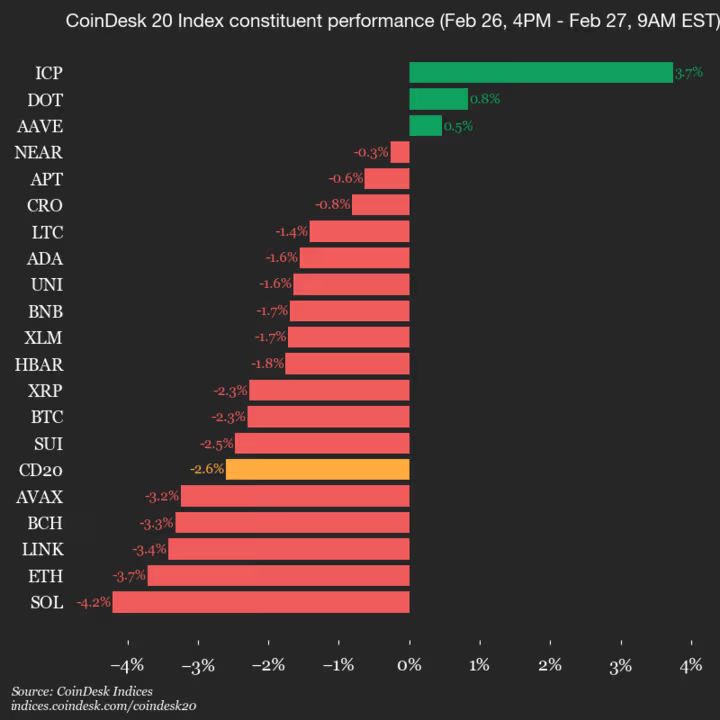
CoinDesk Indices presents its daily market update, highlighting the performance of leaders and laggards in the CoinDesk 20 Index.
The CoinDesk 20 is currently trading at 1920.56, down 2.6% (-51.26) since 4 p.m. ET on Thursday.
Three of the 20 assets are trading higher.

Leaders: ICP (+3.7%) and DOT (+0.8%).
Laggards: SOL (-4.2%) and ETH (-3.7%).
The CoinDesk 20 is a broad-based index traded on multiple platforms in several regions globally.
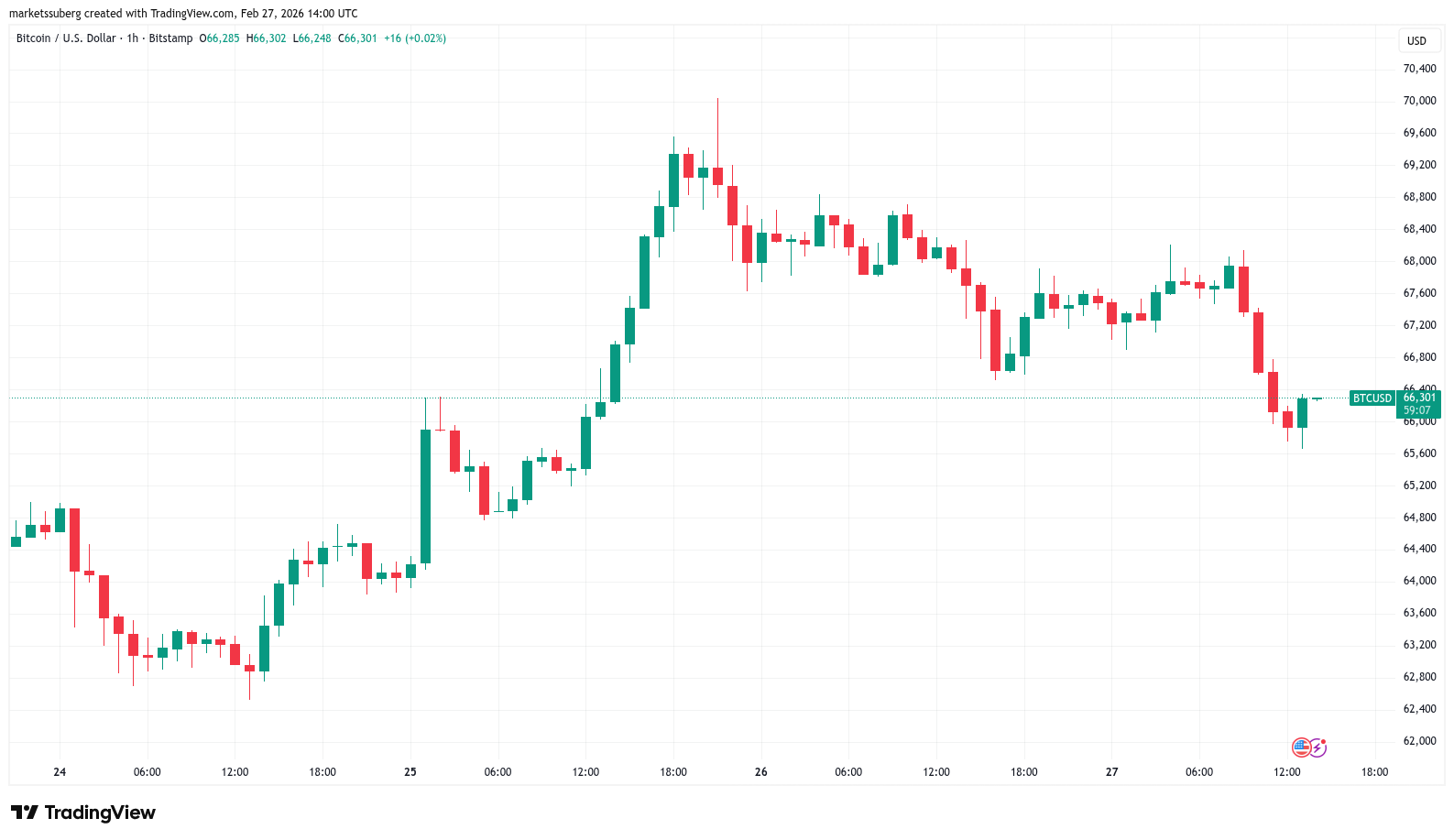
Hotter US PPI inflation data boosted precious metals but punished Bitcoin bulls, with BTC price downside nearing 3% on the day.
Bitcoin (BTC) slid further into Friday’s Wall Street open as US inflation data overshot expectations.
Key points:
-
Bitcoin price downside strengthens as US inflation data comes in hot.
-
Gold and silver benefit from a risk-off response to January PPI data.
-
Bitcoin price expectations face the prospect of a rocky monthly candle close.
Bitcoin under pressure after hot US PPI print
Data from TradingView showed daily BTC price downside nearing 2.5% on Bitstamp, while gold eyed its highest levels since late January.

The January print of the Producer Price Index (PPI) came in markedly above expectations at 0.5% month over month versus an anticipated 0.3%, per data from the US Bureau of Labor Statistics (BLS).
Core PPI fared even worse at 0.8% month over month instead of 0.3%.

“The January increase in prices for final demand can be traced to a 0.8-percent advance in the index for final demand services. In contrast, prices for final demand goods declined 0.3 percent,” an official statement added.
With US inflation creeping higher more quickly than markets assumed, risk-asset pressure increased, while safe havens outperformed.
Gold passed $5,200 per ounce, while silver revisited $92 to hit its highest levels since Jan. 30.

Expectations for interest-rate cuts by the Federal Reserve at its March meeting fell below 4%, according to the latest readings from CME Group’s FedWatch Tool.

BTC price fears over “massive collapse”
With the monthly close in focus, Bitcoin market participants remained on edge.
Related: Hodlers have ‘given up’ at $65K: Five things to know in Bitcoin this week
Crypto trader, analyst and entrepreneur Michaël van de Poppe warned of a possible rerun of events from early February, where BTC/USD put in 15-month lows near $59,000.
“Pretty crucial area for me to hold on to. I’d highly favor that $BTC finds a higher low at $65k,” he wrote in his latest analysis on X.
“However, last day of the month; remember last month? A massive collapse on the markets. Let’s see what it brings: holding $65K opens up the scenario to run up from here.”

Earlier, Cointelegraph reported on key resistance levels for bulls to reclaim, notably the 200-week exponential moving average (EMA) and old all-time highs around $69,000.
At the time of writing, BTC/USD roughly matched February 2025 in terms of performance, with losses nearing 17% month-to-date.
The pair prepared its fifth consecutive month of losses, a phenomenon absent from the charts since 2018, data from CoinGlass confirms.

This article does not contain investment advice or recommendations. Every investment and trading move involves risk, and readers should conduct their own research when making a decision. While we strive to provide accurate and timely information, Cointelegraph does not guarantee the accuracy, completeness, or reliability of any information in this article. This article may contain forward-looking statements that are subject to risks and uncertainties. Cointelegraph will not be liable for any loss or damage arising from your reliance on this information.


- MYX rebounds 29% after heavy losses, driven by V2 partnership news.
- Trading volume surges; whales and institutions show bullish signals.
- The immediate key levels to watch out for are the support at $0.441–$0.430 and the resistance at $0.546.
MYX Finance has surprised many traders by climbing nearly 29% in the last 24 hours.
This comes after a brutal 91% drop over the past month, which left the coin trading near historically low levels.
What sparked the MYX Finance price rebound?
The most immediate driver appears to be MYX’s partnership with Consensys to launch MYX Finance V2 after a successful funding round.
The upcoming V2 upgrade promises gasless trading and 50x leverage, features that can attract both retail and institutional traders.
The news has been framed as a “comeback,” and it has sparked genuine buying interest, not just speculative chatter.
Technical factors are also playing a role.
MYX has been bouncing off extreme lows, and the sudden increase in trading volume confirms strong participation in the rebound.
The 24-hour volume surged to over $55 million, suggesting that bargain hunters and momentum traders are stepping in.
Indicators like the Relative Strength Index (RSI), which is oversold, hint at the selling pressure easing, signalling the end of capitulation.

This combination of fundamental and technical drivers has created a near-term bullish environment.
MYX price technical analysis
After climbing above the $0.49 level, MYX is now consolidating rather than extending its breakout.
Market watchers expect the token to trade in the $0.50 to $0.60 range in the near term.
A sustained pickup in buying interest, particularly if supported by larger capital inflows, could open the door for a move toward $0.70.
If participation from larger investors increases, price swings could become more pronounced, with upside levels around $1, $1.50 and potentially $2 coming into focus.
At the same time, the risk of sharp pullbacks remains.
Such declines are common in volatile markets and are often viewed as part of normal price discovery, where weaker positions are forced out, and liquidity is absorbed by larger participants.
Despite the possibility of short-term setbacks, the broader structure is seen as gradually constructive.
Upcoming risks
Traders should be aware of a key event risk.
On March 6th, about 9.72 million MYX tokens will unlock, worth roughly $9.67 million.
This could create short-term selling pressure as holders choose to liquidate some of their positions.
It is an important factor to watch alongside technical levels and the V2 launch.
MYX price forecast
For short-term traders, the near-term support is around $0.441–$0.430.
On the upside, the first resistance lies at $0.546, the previous swing high.
If the price breaks above this level, gains could extend toward $0.570 and potentially beyond.
On the downside, failure to hold $0.430 could see MYX revisit $0.405.
For now, consolidation above $0.49 sets the stage for a gradual upward move, while the V2 launch and new capital entering the market could trigger sharper rallies.


A heated debate has erupted over whether Canton Network is quietly positioning itself to replace XRP as the likely onboarder of institutions into crypto technology.
The DTCC processes quadrillions in value annually, and the market is suddenly debating the repercussions of its decision to pivot into real world asset (RWA) tokenization with the help of Canton.
This binary view is flawed. Canton Network builds the private rails for compliance, while XRP provides the liquidity that moves between them.
Key Takeaways
- The Infrastructure: Canton Network is designed for the privacy-preserving Tokenization of real-world assets like U.S. Treasuries, ensuring regulatory compliance on a private ledger.
- The Role: XRP functions as a neutral bridge asset for cross-border liquidity, solving the pre-funding problem rather than the custody problem.
- The Signal: Atomic Settlement on Canton complements the liquidity corridors of the XRP Ledger—they are distinct layers in the Institutional Crypto stack.
Canton Network: The Private Crypto Ledger for Atomic Settlement
The Canton Network, launched in 2023 by enterprise blockchain firm Digital Asset, is not a consumer-facing payment rail.
It is a network of networks designed specifically for regulated financial institutions looking to leverage blockchain while requiring absolute privacy.
Its primary engine is the Daml smart contract language, which allows financial institutions to synchronize data across disparate private blockchains without exposing sensitive trade details to the public.
Canton’s core utility is the Tokenization of real-world assets (RWAs). In pilots involving major players like Goldman Sachs and BNY Mellon, Canton demonstrated the ability to execute atomic settlement, swapping tokenized U.S. Treasuries for cash equivalents simultaneously.
This eliminates settlement risk and manages collateral mobility with a precision that legacy systems cannot match.
That matters because institutions cannot operate on fully transparent public ledgers.
Canton acts as a global synchronizer for these records. Unlike XRP, it does not predominantly seek to be a universal bridge currency; it seeks to be the verified vault where the assets live.
Discover: The next crypto to explode
XRP: The Crypto-Native Liquidity Bridge Canton Cannot Be
While Canton secures the asset, XRP moves the value. The XRP Ledger (XRPL) was designed with a specific friction point in global finance in mind: the dormant capital trapped in pre-funded nostro/vostro accounts. XRP acts as a neutral bridge asset, allowing a bank to swap fiat currencies in seconds without holding reserves in every target market.
The misconception that Canton replaces XRP ignores the difference between settlement logic and liquidity provision.
A private ledger can record a change in ownership instantaneously, but it does not inherently provide the deep, neutral market liquidity required to bridge volatile fiat currencies globally.
Ripple has deployed billions to cement XRP’s role as this connector between the banking world and the crypto economy.
For the DTCC, utilizing Canton for ledger synchronization does not negate the need for a mechanism to move value into and out of those synchronized ledgers efficiently. XRP operates on the liquidity layer, distinct from the asset custody layer that Canton occupies.
Two Layers, One Ecosystem: Why the Replacement Narrative Is Wrong
Essentially, Canton Network functions as the digital notary; XRP functions as the armored transport.
If Canton handles the atomic settlement of a tokenized Treasury bill within a permissioned U.S. network, XRP remains the most efficient tool for a foreign entity to source the USD liquidity needed to buy that bill.
This mirrors the challenge discussed by LiquidChain regarding cross-chain liquidity: distinct ledgers need a neutral connector to function efficiently at scale. Without a bridge asset, liquidity remains fragmented across private chains.
In conclusion, as with many debates in crypto, it’s rarely ever a case of backing the stronger horse when both horses excel at totally different things.
Discover: The best crypto to buy now
The post Canton Crypto Network vs. XRP: Breaking Down DTCC’s Infrastructure and Liquidity Needs appeared first on Cryptonews.
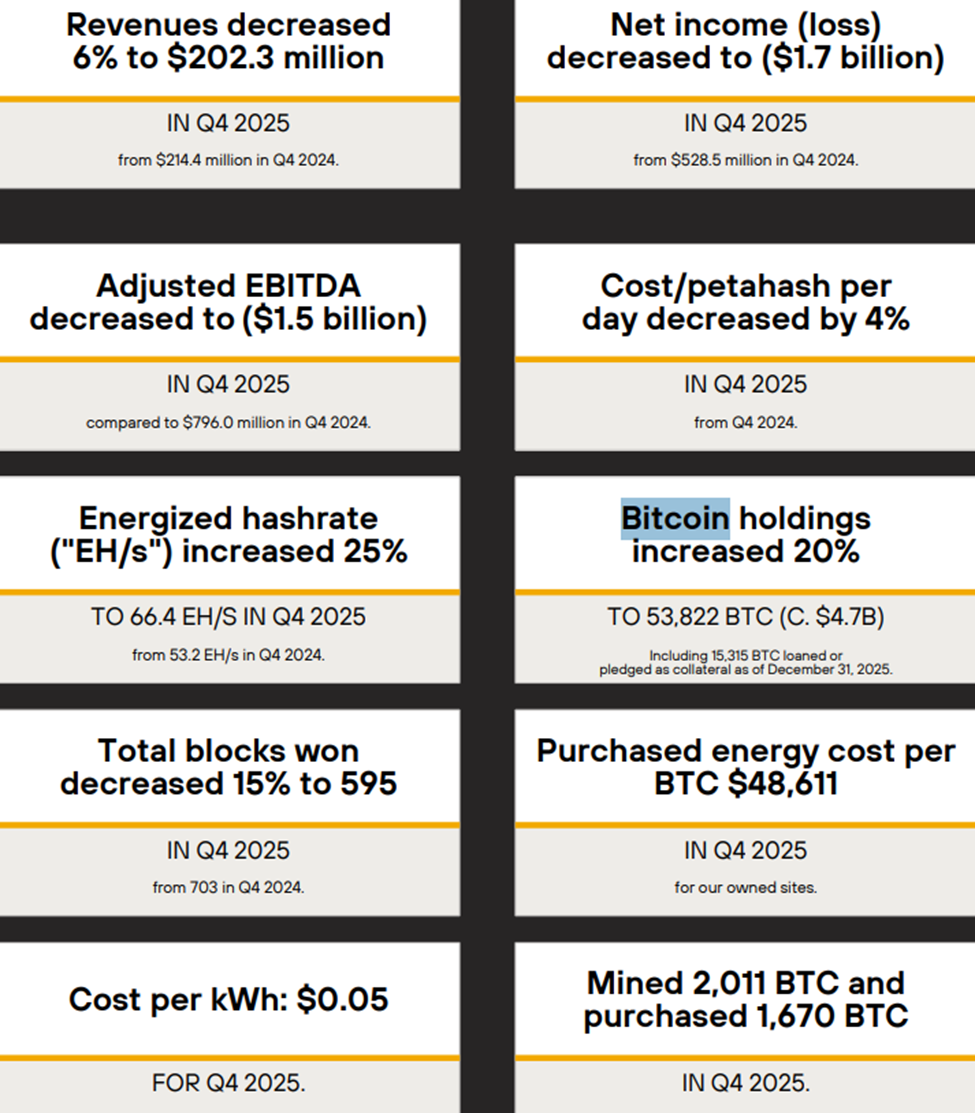
MARA Holdings Inc. posted a $1.7 billion net loss in the fourth quarter (Q4) of 2025, a sharp reversal from the $528 million profit it recorded a year earlier.
This report comes only hours after the Bitcoin miner entered a strategic partnership with Barry Sternlicht’s Starwood Capital Group.
MARA’s $1.7 Billion Loss Underscores Bitcoin Volatility — But AI Pivot Signals a New Playbook
MARA’s $1.7 billion Q4 loss came against the backdrop of a roughly 30% decline in Bitcoin’s price during the period. This forced the company to take a $1.5 billion non-cash fair value write-down on its digital asset holdings.
- Revenue for the quarter slipped 6% year-over-year (YoY) to $202.3 million, down from $214.4 million in Q4 2024.
- Adjusted EBITDA swung dramatically to negative $1.49 billion, compared with positive $796 million in the same period last year.
- For the full year, MARA reported a net loss of $1.3 billion, compared with net income of $541 million in 2024.
This shows how mark-to-market accounting can amplify volatility for large Bitcoin treasuries. Despite the earnings hit, MARA ended 2025 with 53,822 BTC on its balance sheet, up 20% YoY.
At a year-end valuation of approximately $87,498 per Bitcoin, those holdings were worth roughly $4.7 billion. Of the total:
- 38,507 BTC were unrestricted,
- 9,377 were loaned, and
- 5,938 were pledged as collateral.
This means about 28% of its Bitcoin stack is encumbered. The company generated $32.1 million in interest income from lending activities during the year.
Liquidity remained substantial. MARA reported about $5.3 billion in combined unrestricted cash and Bitcoin holdings, including loaned and pledged assets.
It also raised $568.6 million in 2025 through its at-the-market (ATM) program but suspended usage in Q4, marking the first quarter since 2022 without tapping the facility.
Operationally, the miner continued to expand. Energized hashrate reached a record 66.4 exahash per second (EH/s) in Q4, up 25% from a year earlier. However, this was below its previously stated 75 EH/s target as management emphasized capital discipline.
AI Infrastructure Pivot Reshapes MARA’s Growth Strategy
Bitcoin production totaled 2,011 BTC in the quarter, down 6% YoY, reflecting higher network difficulty and seasonal energy pressures.
Purchased energy cost per Bitcoin rose to $48,611 in Q4, while cost per petahash per day improved 4% to $30.5. It points to efficiency gains from the deployment of newer equipment.
Beyond mining, MARA is accelerating a strategic pivot toward energy and digital infrastructure, particularly AI and high-performance computing (HPC).
The company announced a joint venture with Starwood Digital Ventures to develop hyperscale, enterprise, and AI-capable data centers.
The partnership aims to deliver approximately 1 gigawatt (GW) of near-term IT capacity, with a roadmap exceeding 2.5 GW over time.
MARA can invest up to 50% in the projects, positioning itself for recurring infrastructure revenue and reduced exposure to Bitcoin price swings.
The company also highlighted its 64% stake in Exaion and the acquisition of a 42-megawatt data center in Nebraska as part of its AI/HPC expansion strategy.
Adding to market intrigue, MARA recently updated its executive compensation metrics in an 8-K filing. The company tied stock awards to megawatt capacity and contracted recurring revenue rather than solely to mining output.
The filing also introduced a change-of-control provision under which performance targets would automatically be treated as achieved if the company is sold. This move has fueled takeover speculation among investors.
Taken together, MARA appears to be balancing a massive Bitcoin treasury with an ambitious infrastructure buildout.
If this is true, then its transformation from a pure-play miner to a diversified energy and AI platform may determine whether it can smooth earnings volatility in the next crypto cycle.

Artificial intelligence has entered a defining new phase. The competitive conversation is no longer centered solely around model innovation, data volume, or algorithmic breakthroughs. Instead, the question enterprise leaders must now answer is far more foundational:
Is our compute foundation strong enough to scale AI across the business?
In 2026, the AI race has evolved into an infrastructure race – one that demands collaboration with the right AI infrastructure development Company and long-term architectural foresight. Amazon’s $12 billion investment in AI-focused data center campuses in Louisiana reflects a larger global reality: enterprise AI growth now depends on physical and architectural compute capacity.
The message for business leaders is clear: compute strategy defines market leadership.
The Shift from AI Experimentation to AI Industrialization
For years, AI initiatives lived in innovation labs – contained within pilots, proofs of concept, or isolated departmental use cases. Infrastructure requirements were minimal because workloads were temporary and limited in scale.
That reality has fundamentally changed.
AI now operates inside mission-critical systems, powering core operations, customer experience platforms, cybersecurity defenses, supply chain optimization, real-time analytics engines, and generative copilots. These are not experimental environments; they are revenue-generating, risk-sensitive business functions.
This evolution demands a formalized enterprise AI infrastructure strategy.
Deloitte’s 2026 Tech Trends analysis highlights a critical inflection point: the challenge is no longer just training models, but managing the long-term economics and scalability of inference at enterprise scale. As AI becomes operational, compute demand shifts from sporadic experimentation to continuous, production-level execution.
Enterprises must now make deliberate decisions about workload placement, hybrid scaling models, cost governance, and performance optimization.
AI is no longer a tactical deployment.
It is a strategic compute architecture commitment.
Amazon’s $12B Move: A Blueprint for AI-Ready Data Centers
Amazon’s $12 billion investment in new AI-focused data center campuses in Louisiana is more than geographic expansion – it is a signal of where global AI infrastructure economics are heading.
As reported by CNBC and covered in depth by Bloomberg, Amazon is expanding its cloud and AI capacity through purpose-built, next-generation data center campuses engineered for high-density compute workloads. These facilities are designed to support advanced AI applications that demand massive processing power, ultra-fast networking, and scalable energy infrastructure.
This investment reflects:
- Long-term compute capacity expansion
- AI-optimized hardware integration
- Advanced cooling systems built for dense GPU clusters
- Infrastructure tailored for large-scale, real-time AI inference
This is what AI-ready data center architecture for enterprises looks like in practice.
Unlike traditional facilities designed for general enterprise IT, AI-optimized data centers are engineered specifically to handle:
- GPU-intensive model training
- High-bandwidth, low-latency interconnects
- Continuous inference workloads
- Distributed real-time data processing environments
Amazon’s strategic expansion reinforces a broader industry truth: AI leadership is no longer defined solely by software innovation – it is secured through physical infrastructure leadership.
Why Compute Architecture Is Now a Strategic Weapon
Modern AI systems, particularly generative AI, real-time analytics engines, and autonomous decision systems, demand far more than virtualized servers. They require a reimagined enterprise compute architecture for AI workloads. Let’s examine why.
1. AI Is Compute-Intensive by Design
Training advanced foundation models can require thousands of GPUs operating simultaneously. Even inference, once considered lightweight, now demands specialized accelerators for high-speed response times.
Organizations that rely on outdated compute environments face:
- Processing bottlenecks
- Latency spikes
- Escalating operational costs
- Infrastructure fragility
AI doesn’t tolerate inefficiency. It exposes it.
2. Real-Time AI Changes Infrastructure Requirements
AI is increasingly embedded in live environments:
- Fraud detection in financial services
- Predictive maintenance in manufacturing
- Personalized product recommendations in e-commerce
- AI copilots in enterprise workflows
These applications require infrastructure for real-time AI, not batch-processing systems designed for overnight analytics.
Real-time AI demands:
- Ultra-low latency networking
- Edge integration capabilities
- Distributed processing
- Seamless scalability
According to TechRepublic’s enterprise AI coverage, many organizations struggle to transition AI from pilot to production because their compute, storage, and networking layers weren’t designed for production-grade workloads, creating bottlenecks that delay or derail deployments.
3. Energy, Cooling, and Sustainability Are Now AI Variables
One often overlooked aspect of AI infrastructure is energy intensity. AI workloads consume significantly more power than traditional enterprise systems.
Modern AI-optimized facilities incorporate:
- Advanced liquid cooling systems
- High-density rack configurations
- Renewable energy integration
- Intelligent power distribution networks
Amazon’s Louisiana campuses are expected to include significant utility and infrastructure upgrades – including new electrical systems funded in partnership with Southwestern Electric Power Company and up to $400 million in water infrastructure improvements to support high-performance operations.
The AI era is also an energy era. Infrastructure planning must integrate sustainability, resilience, and cost efficiency simultaneously.
The Rise of a Formal Enterprise AI Infrastructure Strategy
What separates AI leaders from followers is not experimentation – it is architectural foresight. A strong enterprise AI infrastructure strategy includes:
- Strategic Capacity Planning
Forecasting compute requirements aligned with AI adoption roadmaps.
- Hybrid & Multi-Cloud Alignment
Balancing hyperscale cloud, on-premise systems, and edge environments.
Monitoring inference economics to prevent uncontrolled compute spend.
Embedding zero-trust principles into AI workloads and data flows.
Workload Placement Intelligence
Running the right workloads on the right platforms for performance and cost optimization.
Without a structured strategy, enterprises face:
- Siloed AI deployments
- Fragmented compute environments
- Rising operational costs
- Limited scalability
Infrastructure must move from reactive to predictive.
Why Enterprises Are Turning to Specialized Partners
Designing, deploying, and optimizing AI infrastructure is not trivial. It requires deep expertise across hardware, orchestration, networking, and AI deployment pipelines.
This is why organizations increasingly collaborate with experienced:
- AI infrastructure development companies
- Enterprise AI development companies
These partners help enterprises:
- Architect scalable compute frameworks
- Optimize GPU utilization
- Design resilient multi-cloud ecosystems
- Integrate AI seamlessly into enterprise environments
Infrastructure transformation is complex, but strategic partnerships reduce risk and accelerate deployment timelines.
The Economic Implications of AI Data Center Expansion
Large-scale AI infrastructure investments are signaling a structural transformation in the global economy. Compute capacity is becoming a strategic asset influencing energy markets, semiconductor supply chains, regional talent hubs, and capital allocation priorities.
Enterprises are no longer simply purchasing software licenses; they are competing for sustained access to scalable compute ecosystems. As AI adoption accelerates, infrastructure availability, performance efficiency, and cost governance increasingly determine which organizations can innovate reliably at scale.
The deeper shift is this: AI infrastructure is becoming industrial infrastructure.
Just as railroads powered manufacturing growth and broadband enabled digital commerce, AI-ready compute environments now form the backbone of competitive enterprise ecosystems. Organizations that recognize infrastructure as strategic capital, not operational overhead, will define the next decade of market leadership.
What Enterprise Leaders Must Do Now
Infrastructure decisions can no longer be deferred to IT roadmaps. They must sit at the center of enterprise AI strategy. To remain competitive in the Infrastructure Era of AI, leaders should:
1. Conduct a Compute Readiness Assessment
Identify architectural bottlenecks, GPU constraints, latency risks, and cost inefficiencies that could limit AI scale.
2. Formalize an enterprise AI infrastructure strategy
Align infrastructure investment with long-term AI adoption plans, ensuring compute capacity grows alongside business ambition.
3. Redesign enterprise compute architecture for AI workloads
Move beyond retrofitting legacy systems. Build environments purpose-designed for training, inference, and hybrid scaling.
4. Build a dedicated infrastructure for real-time AI
Enable low-latency, production-grade AI systems that operate within mission-critical workflows.
5. Partner with AI Infrastructure Experts
Work with specialists who can design scalable compute environments and ensure your infrastructure supports sustainable AI growth.
The organizations that act decisively will turn infrastructure into a growth multiplier. Those who delay will find their AI ambitions constrained by architectural limits.
The New Definition of AI Leadership
AI leadership in 2026 is no longer measured by isolated model innovation, but by the strength and scalability of enterprise compute foundations. As AI shifts from experimentation to industrialization, competitive advantage depends on a well-defined enterprise AI infrastructure strategy and a purpose-built enterprise compute architecture for AI workloads. Organizations that invest in AI-ready data center architecture for enterprises and build infrastructure for real-time AI position themselves to scale efficiently, control costs, and sustain performance.
In this new era, infrastructure is not operational support – it is strategic capital. Market leaders will be those who align compute capacity with long-term business vision. Aniter, an enterprise AI development company, helps organizations design, deploy, and optimize scalable AI systems that deliver resilient, production-grade performance and measurable business impact.


ZachXBT just uncovered what looks like a coordinated insider trading ring at Axiom crypto. According to his findings, senior employees used internal data tools to front-run user trades for more than 10 months, allegedly pocketing over $400,000 in the process. The method involved privileged back-end access that allowed staff to track and mirror high-value wallets before the broader market reacted.
This points to deeper governance failures at a platform generating roughly $390 million in annual revenue. Non-technical staff reportedly had unrestricted access to live user identifiers, exposing a serious breakdown in internal controls.
Key Takeaways
- The Actor: Senior business development staff with unrestricted admin access to live user databases.
- The Method: Cross-referencing internal UIDs with on-chain data to identify and front-run KOL wallets.
- The Failure: A YC-backed unicorn generating $390M revenue operating with zero role-based access controls.
How the Insider Trading Scheme Operated Inside Axiom Crypto
The scheme was simple and effective. Investigators say employees used internal admin dashboards meant for support and compliance to pull private user data. By linking User IDs to on-chain wallets, they could identify high-profile traders and institutions behind supposedly anonymous addresses.
From there, the play was straightforward. Monitor activity, then trade ahead of it. Buy before a large wallet pushed price. Sell before a whale exits. It was front-running their own users.
The activity reportedly lasted at least 10 months. The troubling part is that business development staff had the same level of system access as technical security teams. That breakdown in internal controls created the information asymmetry that made the scheme possible.
Discover: The best crypto to diversify your portfolio with
$390M Revenue vs. Zero Access Controls: What Is Axiom Team Response?
Axiom generated $390 million in revenue and scaled rapidly, but the investigation shows its internal controls lagged far behind its growth.
The platform reportedly lacked basic role-based access controls. Business development staff had broad visibility into user identifiers and trading data, creating a “God mode” environment. Proper least-privilege systems and audit logs likely would have flagged the activity early. Instead, it allegedly went unnoticed for nearly a year.
The case highlights a common startup flaw: growth and volume are prioritized, while governance is deferred. That works at a small scale. At billions in volume, it becomes a liability.
Axiom has confirmed a full internal audit. But the reputational damage is significant, and regulators may view the alleged $400,000 in insider profits as potential fraud.
Discover: The best new crypto in the world
The post Axiom Crypto Exposed: ZachXBT Alleges $400k Insider Trading appeared first on Cryptonews.

Secretary of State confirms Hillsborough Castle visit records disposed of as questions remain over Epstein’s visits to NI
California Resources set to report earnings ahead of merger close

Comparing crypto exchange aggregators: A look at BestChange


-

 Politics5 days ago
Baftas 2026: Awards Nominations, Presenters And Performers
-

 Fashion7 days ago
Weekend Open Thread: Boden – Corporette.com
-

 Sports4 days ago
Women’s college basketball rankings: Iowa reenters top 10, Auriemma makes history
-

 Politics4 days ago
Nick Reiner Enters Plea In Deaths Of Parents Rob And Michele
-

 Business3 days ago
True Citrus debuts functional drink mix collection
-

 Politics14 hours ago
ITV enters Gaza with IDF amid ongoing genocide
-

 Crypto World3 days ago
XRP price enters “dead zone” as Binance leverage hits lows
-

 Business5 days ago
Mattel’s American Girl brand turns 40, dolls enter a new era
-

 Business5 days ago
Law enforcement kills armed man seeking to enter Trump’s Mar-a-Lago resort, officials say
-
 NewsBeat2 days ago
Manchester Central Mosque issues statement as it imposes new measures ‘with immediate effect’ after armed men enter
-

 NewsBeat2 days ago
Cuba says its forces have killed four on US-registered speedboat | World News
-

 Tech3 days ago
Unsurprisingly, Apple's board gets what it wants in 2026 shareholder meeting
-
 NewsBeat4 days ago
‘Hourly’ method from gastroenterologist ‘helps reduce air travel bloating’
-

 Tech5 days ago
Anthropic-Backed Group Enters NY-12 AI PAC Fight
-

 NewsBeat5 days ago
Armed man killed after entering secure perimeter of Mar-a-Lago, Secret Service says
-

 Politics5 days ago
Maine has a long track record of electing moderates. Enter Graham Platner.
-

 Business1 day ago
Discord Pushes Implementation of Global Age Checks to Second Half of 2026
-
 NewsBeat3 days ago
Police latest as search for missing woman enters day nine
-
 Sports4 days ago
2026 NFL mock draft: WRs fly off the board in first round entering combine week
-

 Crypto World3 days ago
Entering new markets without increasing payment costs