Connect with us

Business

How to Keep Your Email Marketing Up to Date in 2026

Published

on

How to Keep Your Email Marketing Up to Date in 2026

Digital marketing has changed a lot over the years. The days of non-targeted ads, desktop-first web design and mass communication blasts are all but behind us. With that in mind, many wonder whether it’s worth doing email marketing at all in 2026. While digital marketing and email techniques have evolved, there’s no need to think of emails as obsolete in this age’s cyber landscape. 

Modern emails need to be AI-optimised, personalised and technically sound, among other things. This article will offer guidance on proper digital agency techniques to benefit your email marketing metrics, keeping the marketing channel alive well into the back half of the 2020s. 

Personalisation is everything in email marketing

For those wondering how to create an effective email marketing campaign, personalisation is king. Personalisation has become more important in every facet of marketing and promotion. It’s no longer enough to use someone’s first name as a way of showing you “care”. Batch-and-blast email marketing will easily get you blacklisted as spam. 

  • Real-time behavioural actions should trigger flows and campaigns, rather than you simply sending out as many generalised newsletters as possible. Say a customer repeatedly views a page about a specific product. That should trigger an email with information about the product.
  • Software like HubSpot can swap out email sections based on past behaviours and purchases, ensuring people aren’t greeted by irrelevant listings. 

Generalisation kills engagement. Use data to drive your email offerings. 

Optimise your emails for AI 

People with email marketing jobs have already embraced generative AI in terms of creating outlines or even building emails from scratch. However, these days, much like your average Google search, many email providers will create AI summaries, meaning people might not even read the whole thing. 

Advertisement
  • Provide a proper value proposition in plain HTML text, not in a graphic.
  • Use H1 and H2 tags to display a clear hierarchy throughout the content of the email.
  • Place the most important information in the first 50 words for the AI to understand.

Artificial intelligence is here to stay, so you need to know how to work with it, rather than trying to bypass it in email marketing. 

Make data collection more consensual

Privacy laws are tighter than ever, and for good reason. However, this does mean traditional data tracking can be a little more complicated, which is why you need to make the collection of the data more of a cooperative thing. 

  • Allow subscribers the chance to set their preferences during sign-up, ensuring you never overload them with quantity or unwanted information. 
  • Use interactive polls and questionnaires inside your emails to capture data willingly, which is also likely to increase the details offered.

This is a more compliant and effective way to collect data than ever before, which will allow for personalisation to be even more optimised. 

Technical must-haves for a good email marketing career in 2026

Starting with a weak technical foundation is cancerous to your email marketing campaigns. You won’t even reach the Promotions tab, being destined to exist solely in the realm of spam communications. 

  • DMARC, SPF and DKIM are all essential authentication steps to eliminate the possibility that you’re a ‘spoofer’.
  • Accessible layouts, colour schemes, easy-use buttons and Alt-Texts are all essential for maximising user friendliness.
  • Optimising your imagery and text for ‘Dark Mode’, which is very popular. 

A solid technical base is key for the rest of your efforts to be effective.

These guidelines aren’t just pieces of advice for your campaigns; they’re absolute essentials for anyone trying to capture the success of a dedicated email marketing agency. Email marketing can very easily become outdated without the right approach, but when you put modern techniques first, it can remain a valuable part of any 2026 plan,

Advertisement
Continue Reading
Click to comment

Leave a Reply

Your email address will not be published. Required fields are marked *

Business

Vishal Mega Mart bulk deal: Govt of Singapore, HDFC MF buy stakes as promoter sells 14% for Rs 7,636 crore

Published

on

Vishal Mega Mart bulk deal: Govt of Singapore, HDFC MF buy stakes as promoter sells 14% for Rs 7,636 crore
The Government of Singapore and HDFC Mutual Fund acquired promoter stakes worth Rs 1,485 crore and Rs 1,100 crore, respectively, in Vishal Mega Mart through separate bulk deals on Friday. The Monetary Authority of Singapore also emerged as a key buyer, picking up shares worth Rs 858 crore in the grocery-to-fashion retailer.

Promoter entity Samayat Services LLP offloaded a 14% stake representing 65.25 crore shares in two tranches that were together valued at Rs 7,636 crore.

The Government of Singapore bought 12.69 crore shares at a price of Rs 117 apiece. Meanwhile, HDFC MF executed a couple of deals to acquire over 9.40 crore shares in the company. The Monetary Authority of Singapore purchased 7.33 crore shares.

Shares of Vishal Mega Mart today ended at Rs 117.85 on the NSE, down by Rs 9.68 or 7.59% over the Thursday closing price.

Advertisement

Samayat Services held 54.09% (252.74 crore) in Vishal Mega Mart as of December 31, 2025. Under the stake sale, 3.05 crore shares will be offloaded, the report said.

Vishal Mega Mart shares have gained 14% over a one year period, which is a slight outperformance over Nifty’s 12% and BSE Sensex’s 9% in the same period.
The stock is currently trading below its 50-day and 200-day simple moving averages (SMA) of Rs 127 and Rs 136, respectively according to Trendlyne data.
The company’s consolidated net profit for the December ended quarter stood at Rs 313 crore, which is a growth of 19% over Rs 263 crore in the year ago period. Its total revenue in the quarter under review stood at Rs 3,695 crore, up 17% 3,155 crore in the corresponding quarter of the last financial year.
Vishal Mega Mart is one of the leading Indian fashion-led hypermarket chain with over 780 stores, focusing on affordable fashion, general merchandise, and grocery for middle-income customers.

(Disclaimer: The recommendations, suggestions, views, and opinions given by the experts are their own. These do not represent the views of The Economic Times.)

Continue Reading

Business

Rising business confidence in North East sees region outpace national average

Published

on

Business Live

The Business Barometer from Lloyds Bank points to signs of a turnaround in the region’s economy

The Newcastle skyline, viewed looking across from Gateshead towards the Tyne Bridge and the Glasshouse

The Newcastle skyline, viewed looking across from Gateshead towards the Tyne Bridge and the Glasshouse(Image: Newcastle Chronicle)

Business confidence in the North East rose significantly in February amid growing signs of a turnaround in the region’s economy.

The latest Business Barometer from Lloyds Banks suggests that companies in the region are reporting higher confidence in their own business prospects, as well as the wider UK economy. That saw overall confidence levels increase 15 percentage points to 55%, while a majority of businesses (57%) said they expect to increase staff levels over the next year. That finding was up 13 points on last month.

Looking ahead to the next six months, North East businesses identified their top target areas for growth as investing in their team or evolving their offering, either by introducing new products and services or entering new markets. The North East outperformed other areas of the country and scored well above national confidence levels of 44%.

The construction sector saw the strongest gains in overall confidence nationally, while manufacturing also saw a boost. But confidence for retail and service sector firms softened slightly, down two and three points respectively.

Advertisement

Martyn Kendrick, regional director for the North East at Lloyds, said: “It’s encouraging to see a rise in North East business confidence, with firms in the region feeling more positive about their own trading prospects as well as the economy itself.

“It’s particularly good to see hiring and training so high on many firms’ agendas. This month, it was announced that a new MTC Training advanced manufacturing training centre was coming to Tyneside, which will play a major role in strengthening the region’s capability in a key local sector. This centre is an initiative that we’re backing, and just one of the ways we’ll be offering our support to North East businesses, of all sizes and sectors, as they continue to grow.”

Last week a separate survey suggested that growth in the UK’s private sector had gained further momentum this month, as manufacturers were boosted by the biggest surge in export orders since 2021. But the S&P Global flash UK composite purchasing managers’ index (PMI), which is watched closely by economists, also pointed to continuing job losses. Unemployment recently reached a 10-year high in the North East.

Hann-Ju Ho, senior economist at Lloyds Commercial Banking, said: “It’s encouraging to see optimism in the wider economy returning, although with a small reduction in firms’ confidence in their own trading prospects. The majority of the survey results were collected following the Bank of England’s close decision to hold interest rates at its February meeting, signalling potential easing ahead, which may have alleviated business concerns, including those around cost pressures.

Advertisement

“While the rise in pricing expectations to a six-month high may indicate firms are looking to rebuild their margins in 2026. It’s also great to see confidence increase for manufacturers and construction firms as they are key for UK growth.”

Continue Reading

Business

Welsh fintech firm Delio Wealth looking to expand on its acquisition by US firm

Published

on

Business Live

The Cardiff-based firm has been acquired by New York based iAltA

Gareth Lewis, Delio Wealth(Image: Brand Content)

Welsh fintech venture Delio Wealth has been acquired by New York-based private markets infrastructure venture iAltA Holdings.

The value of the deal has not been disclosed, but will see the existing management team of Delio remaining in place to drive the next growth phase of the business with plans to double headcount to 50. It has also moved to larger offices at Windsor Place in the centre of Cardiff next to its previous location.

Advertisement

Delio provide operating systems and investment structures that enable asset managers, wealth firms and other distributors to digitize, distribute, and report on private market products.

Founder and co-chief executive of Delio, Gareth Lewis, said: “Private markets have seen tremendous growth over the past few years, but the infrastructure has not kept up the demand for access and offerings. iAltA is our ideal partner since both our organisations were founded on the principle that the markets need more seamless and effective solutions to meet the challenges of demand. This partnership will increase both our reach and our impact.”

Launched in 2025 by founding partners Scott Ganeles, Bill Sherman, Bill Crager and Laurence Tosi, iAltA operates under a holding structure that blends core shared capabilities with foundational technologies and strategic partnerships with industry leaders. Each subsidiary operates independently while collectively contributing to the holding company’s larger cross-functional strategy and unified digital ecosystem.

Chief executive Mr Ganeles said: “We founded iAltA because we saw a tremendous market need to solve systemic issues within the private market landscape for general partners and distributors.

Advertisement

Delio has emerged as a digital infrastructure provider of choice for financial institutions seeking to integrate alternatives into their offerings while maintaining control over client experience.”

Trusted by more than 50 global financial institutions across 18 regulatory jurisdictions, Delio’s infrastructure supports more than 12,000 end clients worldwide, reinforcing its position as the leading industry utility for digital private markets capability. The company has been a cornerstone of fintech growth in Wales.

Its expansion in Cardiff has been supported by Cardiff Council.

Russell Goodway, cabinet member for investment and development, said: “Cardiff Council is delighted to have worked with the local Delio team to support their plans to create more business space in the centre of Cardiff. Given the opportunity for expansion locally we help this acquisition will lead to further growth in employment in the city and a strengthening of Cardiff’s leading role as a leading fintech cluster for Wales and the UK.”

Advertisement
Continue Reading

Business

A Deep Dive Into Workplace Psychology

Published

on

A Deep Dive Into Workplace Psychology

In their most simple forms, expense policies are designed to control costs, ensure fairness and reduce financial risk. On paper, most organisations already have these documents in place, often reviewed annually and signed off by finance and HR teams. In theory, they should provide clarity and consistency.

In practice, however, many expense policies fail to deliver the control they promised at the offset. Spend becomes unpredictable, enforcement slips into inconsistency, and finance teams are left responding to problems rather than preventing them.

It’s easy to assume that this failure stems from careless or dishonest employees. Humans are, after all, only human. In most cases, however, expense-related issues are far more likely to be the result of policies built around assumptions that do not reflect how people actually think, decide, and behave in real working environments.

To understand why expense policies break down, we need to look beyond the documents themselves, and examine the psychological and social forces shaping everyday spending decisions at work. That’s quite a hefty task, so we’ve parachuted in the aid of expense management software specialists at Webexpenses to assist with exploring this topic further.

Flawed assumptions lead to flawed systems

Most company policies are written for a hypothetical, “best-case” employee: rational, attentive, well-rested, and operating in a low-pressure environment. They assume employees will read the rules carefully, remember them, and apply them consistently at the point of purchase.

Advertisement

As appealing as this assumption may be, it bears little resemblance to how real workplaces operate. Expense decisions are frequently made at the end of long days, during travel, or between meetings, when time and attention are limited. By the time an expense is submitted, the decision has already been made – often quickly, with incomplete information and little cognitive bandwidth.

Behavioural economics describes this pattern as bounded rationality. When mental resources are constrained, people simplify decisions rather than optimise them. They rely on habits, prior approvals, and social cues instead of consulting formal policy documents. The gap between assumption and reality is reflected in the data.

From a governance perspective, this is important because expense policies aren’t operating in isolation. Instead, they’re competing with faster, more intuitive decision-making processes that often win.

Vaguery creates fragmentation, not flexibility

Many expense policies hinge on terms such as “reasonable”, “appropriate”, or “within limits”. These “legalese” buzzwords are intended to provide flexibility, but in reality, they invite ambiguity. Ambiguity forces interpretation, and interpretation is shaped by context rather than policy wording.

Advertisement

When boundaries are unclear, employees will start looking for guidance elsewhere: what their manager approved previously, what colleagues typically submit, or what appears acceptable within their team. Phrases like “I just submit it like this” override the written rule.

Over time, these informal cues become the “street” rules your employees – both old and new – will follow. Your policy documents may say one thing, but in the face of ambiguity, different teams will inevitably develop different interpretations of the same rules, influenced by culture, seniority, and precedent.

For finance teams, this fragmentation has tangible consequences. Inconsistent interpretation makes spending harder to forecast, harder to benchmark across departments and harder to challenge without appearing arbitrary. In plain terms, ambiguity does not allow for flexibility, and it does not reduce disputes; it simply pushes them downstream, after the money has already been spent.

Social pressure outweighs financial rules

Expense decisions are rarely confined to the consistent sphere of cold, mathematical calculations – emotions and social elements also play a part.

Advertisement

Choices around travel, accommodation, and client entertainment are tied to perceptions of professionalism, competence, and status. In many roles, particularly client-facing ones, employees feel pressure to meet (or exceed) unspoken benchmarks about what is “appropriate” for the situation. People use money to signal competence, generosity, seniority, or professionalism – especially around clients and travel.

Being forced to book the cheapest option can lead employees to feel as though they’re undervalued. If they have the ability to apply upgrades, this can be done with a sense of feeling like they’ve earned the right. Picking a nicer venue for a client lunch may be justified as “representing the brand” in the best possible light.

When expense policies fail to acknowledge these social dynamics, employees are left balancing formal rules against informal expectations. In these moments, the immediate risk of appearing unprofessional or out of step can feel more pressing than the abstract risk of breaching policy.

This dynamic shows up in reported behaviour. Surveys indicate that nearly one in four employees admit to having misreported or bent an expense claim, while broader reviews of improper claims suggest that around 13% involve deliberate reimbursement irregularities, often in socially sensitive categories such as travel and entertainment.

Advertisement

It might be easy to boil this down to opportunistic and dishonest behaviours, and while that may be the driving factor behind a small number of cases, it’s not typically the underlying issue.

Inconsistent enforcement undermines policy legitimacy

Even well-designed policies struggle when enforcement is unpredictable.

If similar claims receive different outcomes depending on who approves them, employees quickly conclude that the system is inconsistent. Once that perception takes hold, behaviour changes; claims become more defensive, more heavily justified, or disengaged altogether.

Reimbursement delays compound this effect, and when employees are regularly left out of pocket, expense processes stop feeling administrative and start feeling adversarial.

Advertisement

From a governance standpoint, trust functions as an informal control mechanism. When employees believe the system is fair and predictable, they are more likely to self-regulate. When trust erodes, formal rules lose authority and administrative costs increase.

Policies fall behind modern working practices

Many expense policies fail not because they are ignored, but because they are outdated.

Hybrid working, remote travel, and digital-first transactions have introduced new scenarios that older policy frameworks were never designed to address. Grey areas multiply, and employees are forced to rely on judgement rather than guidance.

At the same time, technological change has reshaped the risk landscape. Digital documentation and AI-generated receipts have made manual verification less reliable. In 2025, industry reporting found that AI-generated fake receipts accounted for around 14% of flagged fraudulent documentation, a rapid shift that legacy control processes were not built to handle.

Advertisement

In this context, policy failure is often a matter of misalignment rather than misconduct. Controls that do not reflect how work is actually done lose relevance, and relevance is a prerequisite for compliance.

Adding more rules often makes things worse

When expense issues arise, the instinctive response is to tighten control: more rules, more exceptions, more detailed guidance. While understandable, this approach often backfires.

Long, complex policies increase cognitive load. Faced with dense documentation, employees are less likely to consult it in real time. Instead, they rely on memory, precedent, or judgement. Attempts to cover every edge case can make everyday decisions harder rather than clearer.

Effective policies focus on clarity where it matters most: common scenarios, clear examples, and predictable outcomes. Simplicity, in this context, is not a lack of rigour but a deliberate design choice.

Advertisement

What makes an expense policy effective?

Expense policies work best when they are designed around real – rather than idealised – behaviour. This means recognising cognitive limits, social pressures, and the realities of modern working environments.

Clear examples outperform abstract rules, consistent enforcement builds legitimacy, and predictable reimbursement reinforces trust. Systems that support judgement, rather than relying solely on manual oversight, reduce friction and error.

Ultimately, expense policies are not just financial controls. They are signals about how an organisation balances trust, accountability, and practicality. When they align with how people actually operate, they become effective tools for cost control. When they do not, they risk becoming well-written documents that fail quietly in practice.

Advertisement

Continue Reading

Business

eBay slashes 800 jobs representing 6% of workforce after $1.2 billion Depop acquisition

Published

on

eBay slashes 800 jobs representing 6% of workforce after $1.2 billion Depop acquisition

E-commerce giant eBay announced Thursday it is slashing hundreds of jobs, just days after the company dropped $1.2 billion in cash to acquire a trendy Gen Z fashion app and settled a federal stalking lawsuit involving former executives.

Multiple outlets have reported that eBay will cut a total of 800 roles, or 6% of its workforce, as company documents indicated about 12,300 employees worldwide as of Dec. 31, 2025.

Advertisement

eBay did not immediately respond to Fox News Digital’s request for comment.

HOME DEPOT CUTS 800 JOBS, ORDERS CORPORATE STAFF BACK TO OFFICE FULL TIME

The company told Reuters, “We are taking steps to reinvest across our business and align our structure with our strategic priorities, which will affect certain roles across our workforce.”

eBay pop-up store in Los Angeles

A view of the eBay pop-up store is seen on Sept. 20, 2025, in Los Angeles, California. (Getty Images)

Just hours before the layoff news, eBay settled a civil lawsuit against the couple and newsletter writers David and Ina Steiner. Reuters detailed how former employees sent the Steiners live cockroaches, spiders, a funeral wreath and a bloody pig mask to allegedly silence their reporting.

Advertisement

Former eBay executives were sentenced to prison in 2022, and this week’s settlement was reached for an undisclosed amount.

Earlier this month, eBay made headlines for its acquisition of Depop — a customer-to-customer fashion marketplace popular with Gen Z and millennials looking to sell used clothing and accessories. eBay purchased the platform for approximately $1.2 billion in cash.

GET FOX BUSINESS ON THE GO BY CLICKING HERE

Advertisement

Depop’s user base is 90% under age 34, according to a press release, meaning eBay is positioning itself to reach younger consumers who have largely moved away from the traditional auction model.

“Fashion represents more than $10 billion in annual gross merchandise volume (GMV) for eBay and delivered 10% year-over-year GMV growth in the U.S. in 2025,” CEO Jamie Iannone said in a statement. “This acquisition presents an opportunity to advance one of our newest and fastest-growing Focus Categories with a marketplace that complements our existing presence, and enables us to reach a younger demographic across the expanding recommerce landscape.”

READ MORE FROM FOX BUSINESS

Advertisement
Continue Reading

Business

Mark My Words February 27 2026

Published

on

Mark My Words February 27 2026

Mark Pownall and Tom Zaunmayr discuss Sussan Ley’s exit, Wittenoom legal case, Fortescue’s wind farms Laurence Escalante, and apartments in Mount Hawthorn.

Continue Reading

Business

MBIA Inc. (MBI) Q4 2025 Earnings Call Transcript

Published

on

OneWater Marine Inc. (ONEW) Q1 2026 Earnings Call Transcript

Operator

Welcome to the MBIA Inc. Fourth Quarter and Full Year 2025 Financial Results Conference Call. I would now like to turn the call over to Greg Diamond, Managing Director of Investor and Media Relations at MBIA. Sir, please go ahead.

Greg Diamond
MD and Head of Investor & Media Relations

Advertisement

Thank you, Chelsea, and welcome to our conference call for the full year 2025 MBIA Financial results. After the market closed yesterday, we issued and posted several items on our websites, including our financial results, 10-K, quarterly operating supplement and statutory financial statements for both MBIA Insurance Corporation and National Public Finance Guarantee Corporation. We also posted updates to the listings of our insurance company’s insurance portfolios. Regarding today’s call, please note that anything said on the call is qualified by the information provided by the company’s 10-K and other SEC filings as our company’s definitive disclosures are incorporated in those documents. We urge investors to read our 10-K as it contains our most current disclosures about the company and its financial and operating results.

The 10-K also contains information that may not be addressed on today’s call. The definitions and reconciliations of the non-GAAP terms included in our remarks today are also included in our 10-K as well as our financial results report and our quarterly operating supplement. The recorded replay of today’s call will become available approximately 2 hours after the end of the call. Now for our safe

Advertisement
Continue Reading

Business

Saudi Aramco bringing shale gas revolution to Arabian Desert

Published

on

Saudi Aramco bringing shale gas revolution to Arabian Desert


Saudi Aramco bringing shale gas revolution to Arabian Desert

Continue Reading

Business

Mondelez CEO worries high cocoa prices may return

Published

on

Mondelez CEO worries high cocoa prices may return

Company is investing in diversifying cocoa production around the world. 

Continue Reading

Business

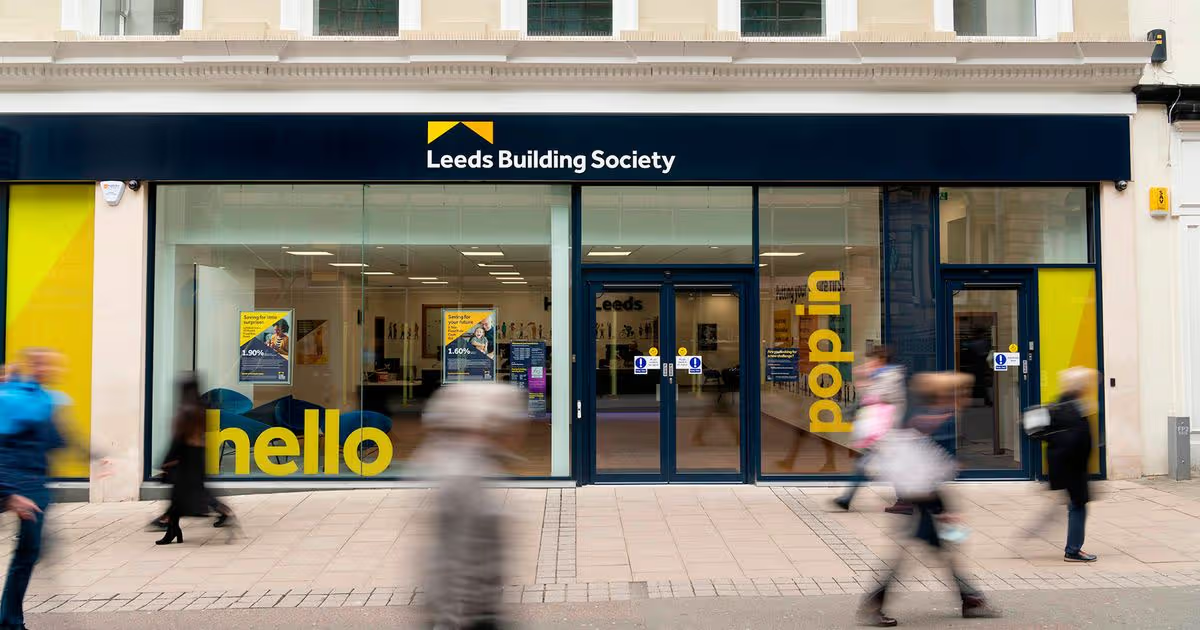
Revenues rise sharply at Leeds Building Society

Published

on

Business Live

The building society said that it increased both savings and mortgage balances during 2025

Leeds Building Society says stress-testing requirements have unduly held some borrowers back.

Leeds Building Society has revisited its mortgage affordability assessments following guidance from the FCA.(Image: Taken from the Leeds Building Society image library. https://www.leedsbuildingsociety.co.uk/press/im)

Profits fell slightly at Leeds Building Society even as its revenues grew to nearly £800m.

The society’s annual reports show an increase in total income to £794 during 2025. But over the same period, net profit fell slightly to stand at £275.5m.

The society said it supported its members through favourable savings rates, which helped increase savings balances by £1.1bn year on year to £54.0bn. Mortgage balances also grew to £51.9bn, the annual report revealed.

Bosses said they were make progress on a number of strategic targets, including a record investment in technology and systems to improve speed of inbound payments.

Advertisement

It said it was committed to its branch network and its role in local communities included an ongoing partnership with the charity FareShare, plus hosting Citizens Advice advisers at 44 of its branches to provide financial and legal advice.

Chief executive Susan Allen said: “Yorkshire Building Society delivered a solid performance for the year ending December 2025, growing our mortgage and savings balances sustainably and sharpening our Purpose, Real Help with Real Life, to set a clear path for the future.

“We continued to provide our members with above market average savings rates and went further to make good homes possible for more people. We launched targeted, innovative products to help overcome the challenges people face in finding a good home and building financial wellbeing. With economic challenges likely to remain in 2026, our renewed Purpose – and the support we offer our customers and communities as one of the UK’s biggest mutuals – matters more than ever.”

Looking ahead, the society said it would continue its focus on its strategic priorities, delivering competitive products and services for its members, and maintaining its financial strength.

Advertisement

It said that it expected high levels of competition in mortgages and savings to persist but that it had “confidence in our business model and financial resilience and are well placed to navigate future challenges or periods of economic uncertainty.”

Continue Reading

Trending

Copyright © 2025