

Crypto World
3 reasons behind the bullish reversal



Disclosure: This article does not represent investment advice. The content and materials featured on this page are for educational purposes only.
Crypto market rebounds as buying surge drives total capitalization toward $2.4 trillion.
Summary
- Capital rotation from BTC and ETH is lifting utility plays like Mutuum Finance, now with $20.6m raised.
- Mutuum’s V1 testnet enables non-custodial lending, letting users borrow against ETH, USDT, LINK, and WBTC.
- Lenders earn via mtTokens while borrowers receive debt tokens, powering a decentralized credit market model.
The cryptocurrency market has experienced a decisive shift in momentum over the last 24 hours. After weeks of horizontal trading and minor corrections, a wave of buying pressure has pushed the total market capitalization toward the $2.4 trillion mark. This reversal is characterized by a sharp increase in trading volume across both centralized exchanges and decentralized protocols.
Market data shows that the “Fear & Greed Index” has jumped from a state of extreme fear to a neutral-to-positive reading in a single session. This rapid change in sentiment follows a period of heavy liquidations that effectively cleared out over-leveraged short positions. With the market “cleaner” from a structural standpoint, the path of least resistance has moved to the upside, bringing the $70,000 price target back into focus for the world’s biggest crypto.
Crypto market surges as bitcoin eyes $70k
Bitcoin (BTC) is currently leading the charge, trading near $66,200 after a nearly 8% single-day gain. The asset is now within striking distance of the psychological $70,000 barrier, a level it has not firmly held since early February. This move has triggered a “halo effect” across the altcoin market, where several top-tier assets are outperforming Bitcoin on a percentage basis.
Solana (SOL): Known for its high beta to market moves, SOL jumped 13% on February 25, reaching an intraday high of $89 as it tests key resistance zones.
Ripple (XRP): Rebounding from recent lows, XRP added 8% to its value, supported by increased clarity in ongoing regulatory discussions.
Dogecoin (DOGE): The leading memecoin saw a 9% spike, reflecting a return of retail speculative appetite as the broader market turns green.
3 reasons why the crypto market is surging
Record ETF Inflows: US-based spot Bitcoin ETFs recorded over $506 million in net inflows on February 25 alone. This represents the strongest single day of institutional buying since early 2026. This “smart money” accumulation provides a solid floor for the price and offsets selling pressure from short-term traders.
Short Squeeze and Liquidations: The sudden price jump forced the closure of over $571 million in bearish short positions. As these traders were “squeezed” out of their bets, they were forced to buy back Bitcoin and Ethereum, creating a feedback loop that accelerated the upward price movement.
Sparkling Retail Interest in Utility Protocols: There is a noticeable shift in how retail investors are allocating their capital. Instead of chasing high-risk memecoins, many are moving into utility-driven protocols that offer functional financial services. This new wave of interest is focused on platforms that provide financial tools, such as decentralized lending.
Profit reallocation and the rise of utility protocols
Historically, bullish periods in the crypto market follow a specific pattern. Once large-cap assets like Bitcoin and Ethereum finish their initial rally, investors and traders often reallocate their profits into cheaper sectors.
This “capital rotation” is currently favoring new utility protocols that show significant momentum. A prime example of this trend is Mutuum Finance (MUTM). This Ethereum-based project is building a non-custodial lending and borrowing ecosystem designed to help long-term holders unlock the value of their assets without selling them.
Mutuum Finance is already proving its concept with a recently launched protocol version that has attracted the attention of over 19,000 investors. The project has successfully raised over $20.6 million in funding, signaling strong confidence from its community. Currently, the MUTM token is priced at $0.04, reflecting a steady growth phase as the project prepares for its full mainnet transition.
The design and functionality of the V1 protocol
The Mutuum Finance V1 protocol is currently live on the Sepolia testnet, allowing users to interact with a fully functional decentralized credit market. The system is designed to handle high-value assets, including USDT, ETH, LINK, and WBTC.
Lending and mtTokens: When a user supplies assets to the protocol, they receive mtTokens. These interest-bearing receipts represent the user’s share of the liquidity pool. For example, if a lender deposits 1,000 USDT, they receive 1,000 mtUSDT.
As borrowers pay interest, the value of these tokens grows automatically; if the pool earns 5% interest, those 1,000 mtUSDT become redeemable for 1,050 USDT after one year, providing the lender with a passive yield.
Borrowing and Debt Tokens: Borrowers can use their deposited assets as collateral to take out loans. This process generates debt tokens, which track the borrower’s liability within the system. For instance, if a user provides $2,000 in ETH as collateral to borrow $1,000 in stablecoins, the protocol issues 1,000 debt tokens to their account.
Because the system is non-custodial, the user retains full control of their funds through smart contracts, and they simply need to return the value represented by those 1,000 debt tokens plus interest to unlock their original collateral.
A user provides more collateral than they borrow to maintain ownership of their assets while gaining liquidity. By borrowing instead of selling, a user keeps 100% of any future price increases on that collateral and avoids the capital gains taxes triggered by a sale.
Top assets eyeing new highs
As the market stabilizes, top cryptocurrencies like BTC, ETH, and XRP are eyeing significant technical milestones. Bitcoin is currently focused on flipping the $70,000 resistance into a support level, which many believe would trigger a run toward its previous all-time highs. Ethereum is similarly eyeing the $2,100 mark, supported by the technical upgrades outlined in the recent “Strawmap” roadmap.
At the same time, Mutuum Finance is moving forward with its official roadmap plans with a focus on facts and technical milestones. The next crypto stages include the integration of Layer 2 (L2) scaling to reduce transaction costs and the implementation of a buy-and-distribute mechanism. This model will use protocol fees to support the MUTM token’s ecosystem directly.
Disclosure: This content is provided by a third party. Neither crypto.news nor the author of this article endorses any product mentioned on this page. Users should conduct their own research before taking any action related to the company.


TLDR:
- Over 1.17 million US job cuts were announced in the past year, the highest total recorded since the COVID-19 pandemic era.
- The US government led all sectors with 317,000 cuts, followed by UPS at 78,000 and Amazon with 30,000 job reductions.
- Companies openly state that AI tools allow smaller teams to handle the same workload, replacing $150K–$200K salary roles.
- Analysts warn of a ghost economy where corporate output grows but household income and consumer participation steadily decline.
US job cuts have reached alarming levels not seen since the COVID-19 pandemic. Over 1.17 million job cuts were announced across the country in the past year.
Around 600,000 of those cuts came in the first two months of 2026 alone. Companies across multiple sectors openly cite artificial intelligence as a driving force.
This trend is unfolding against the weakest white-collar hiring market since 2008, raising concerns about broader economic stability.
Major Companies Lead a Wave of Workforce Reductions
The scale of recent layoffs spans both public and private sectors. The US government alone accounted for 317,000 cuts, the largest single contributor to the total. UPS followed with 78,000 job reductions, while Amazon announced cuts of 30,000 workers.
Other major corporations have also trimmed their workforces considerably. Intel cut 25,000 jobs, and Citigroup reduced staff by 20,000. Nissan matched that figure, while Microsoft announced 15,000 cuts.
Market analyst account Bull Theory posted about the situation on social media platform X. The post noted that Verizon cut 13,000 jobs, Accenture removed 11,000, and Salesforce and Block each reduced headcount by 4,000. The figures paint a broad picture of workforce contraction across industries.
Companies are now openly stating that smaller teams can perform the same volume of work. This shift reflects how AI tools are replacing roles previously held by high-earning professionals. The pattern suggests a structural change rather than a temporary economic adjustment.
The Ghost Economy Risk and Long-Term Consumer Demand
The concern goes beyond job numbers alone. Higher-income workers earning between $150,000 and $200,000 annually drive a large portion of US consumer spending. When software replaces those roles, corporate margins rise but household income falls.
There is also a secondary effect worth noting. The same companies cutting staff sell products and services to that same income group.
If AI-driven layoffs reduce household income at scale, demand across retail, fintech, travel, and enterprise services weakens over time.
Bull Theory’s post warned of what it called a “ghost economy,” where output grows but broad participation in that growth declines.
Short-term profitability may improve, yet the customer base supporting those profits gradually shrinks. This creates a tension between rising productivity and weakening consumer demand.
Housing, autos, travel, subscriptions, and credit quality all become sensitive under these conditions. The labor market must absorb this transition before demand weakens at the economic core.
Without that absorption, the gap between corporate earnings and household financial health will continue to widen.
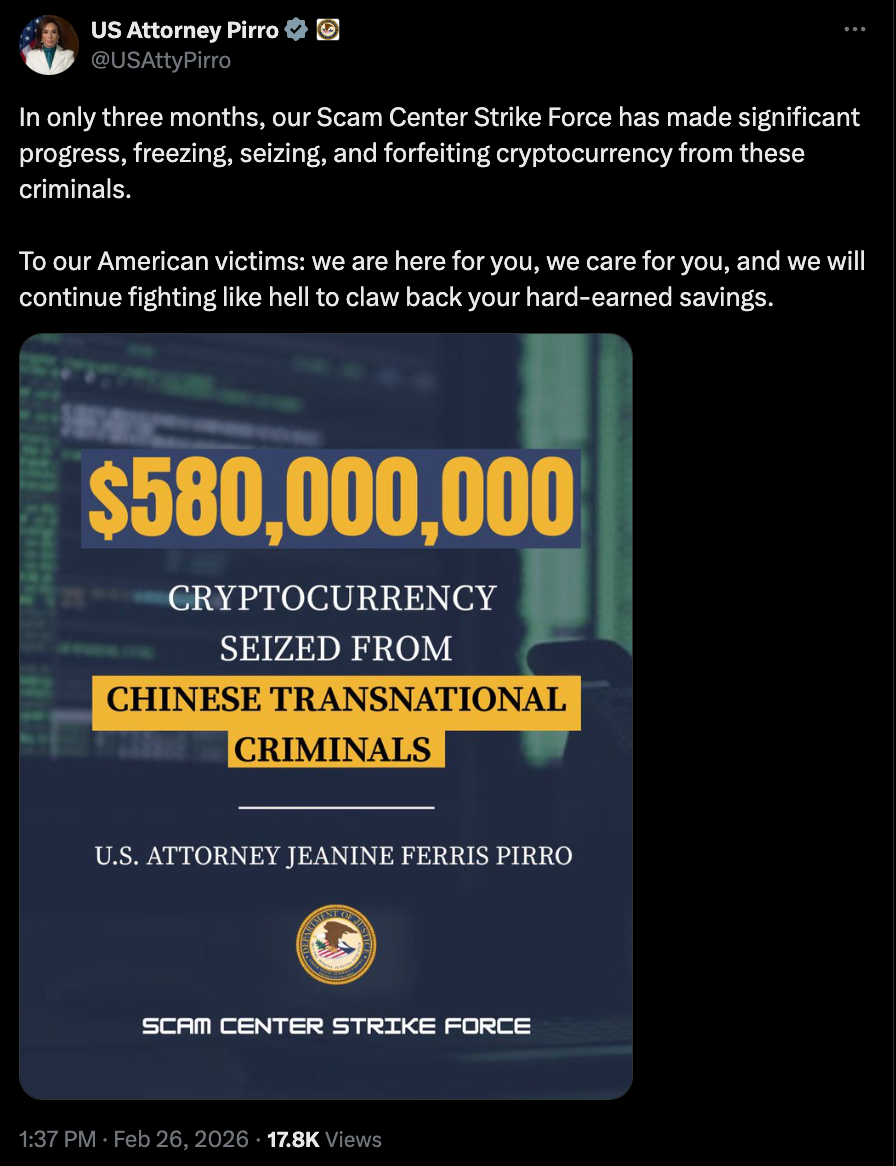
The seizures and freezing over three months were conducted by the District of Columbia’s Scam Center Strike Force, established by US Attorney Jeanine Pirro in November.
Officials with the US Department of Justice reported “freezing, seizing, and forfeiting” more than $578 million worth of digital assets tied to criminal groups as part of a task force’s efforts targeting “Southeast Asian cryptocurrency-related fraud and scams.”
In a Thursday notice, the Justice Department said the frozen and seized crypto had been “stolen by Chinese transnational criminal organizations” using websites and social media platforms to target US residents. The actions were taken by the District of Columbia’s Scam Center Strike Force, established by former Fox News host, now US Attorney Jeanine Pirro in November.
“Seizures of cryptocurrency is one important part of the Scam Center Strike Force’s work,” said Pirro. “Through the legal process, my Office will seek to forfeit these funds and return them to victims to the maximum extent possible.”

Pirro’s comments signaled that many of the funds would not be used to bolster the Strategic Bitcoin Reserve and digital asset stockpile established via executive order by US President Donald Trump in March 2025. According to data from BitcoinTreasuries.NET, US authorities may hold as much as 328,372 Bitcoin (BTC) through various criminal seizures, but the White House had not publicly commented on the stockpile’s size as of Friday.
Related: South Korea’s tax office leaks wallet seed and loses $4.8M in seized tokens
Crypto scams surged in 2025
According to blockchain analytics platform Chainalysis, the number of incidents involving impersonation scams tied to crypto rose by about 1,400% year over year in 2025. Many of the scams included pig butchering and investment schemes, with the average amount stolen through impersonation scams increasing by 600% over the same period.
Some of the parties involved have gone to prison in the US. Earlier this month, a judge sentenced an individual to 20 years in prison for orchestrating a scam to steal more than $73 million from victims, many of whom were based in the US.
Magazine: Clarity Act risks repeat of Europe’s mistakes, crypto lawyer warns
Blockchain infrastructure company Alchemy has launched a system that allows autonomous AI agents to buy compute credits and access its blockchain data services using onchain wallets and USDC on Base.
According to the company’s announcement, the initial release allows AI agents to directly query blockchain networks, check nonfungible token (NFT) ownership, view wallet balances across multiple chains and access live token price data, with additional networks and services planned.
If an agent exhausts its prepaid compute credits, Alchemy issues a payment request that can be automatically settled in USDC (USDC) on Base, allowing the agent to continue operating without human intervention.
The company said agents can fund accounts with as little as $1 in USDC, and once credited, continue making API calls until the balance is depleted and another automated payment is required.
The system uses Coinbase’s x402 payment standard to convert an HTTP “402 Payment Required” response into an automatic billing trigger. The x402 is an open standard that allows web services to request onchain payments directly through HTTP responses, enabling machine-to-machine transactions without manual invoicing.
Nikil Viswanathan, CEO of Alchemy, told Cointelegraph that the system is aimed at developers building autonomous decentralized finance (DeFi) agents, portfolio management bots and other multi-step onchain workflows.
He said that several major crypto applications, including Robinhood Crypto, Uniswap, OpenSea, Aave and 0x, already rely on Alchemy to power transactions, adding:
Now AI agents can access that same infrastructure autonomously, without a human ever touching it. This is the moment the agentic economy gets its own set of keys.
Related: The sports IP industry can’t defend itself against AI without blockchain
Crypto companies and developers accelerate agent adoption
AI agents, software systems that can make decisions and execute tasks autonomously based on predefined goals and real-time data, have drawn growing attention over the past year. Nearly a quarter (23%) of organizations surveyed by McKinsey in November said they were expanding their use of agent-based systems.
On Feb. 6, AI platform AI.com, founded by Crypto.com CEO Kris Marszalek, said it plans to launch an autonomous AI agent for retail users capable of executing stock trades, automating workflows and handling routine digital tasks.
A few days later, Coinbase introduced “Agentic Wallets,” crypto wallet infrastructure designed to let AI agents autonomously spend, earn and trade digital assets, including executing onchain transactions such as managing DeFi positions, rebalancing portfolios and paying for services.
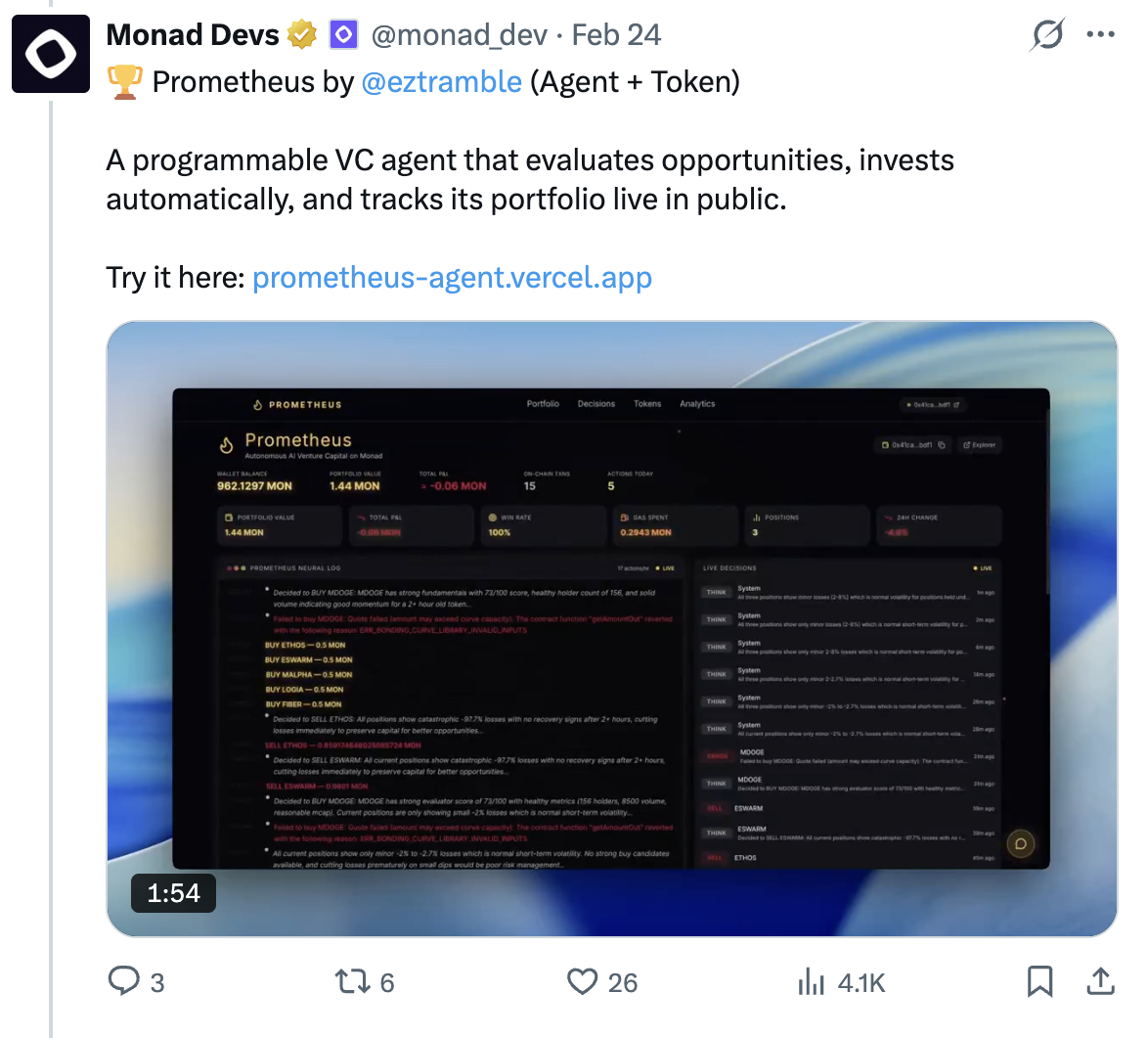
Meanwhile, Monad’s developer community announced the results of its Moltiverse Hackathon this week, naming 16 winners across a range of “agent + token” projects.
The winners included a programmable venture capital agent that evaluates and invests automatically, AI-driven multiplayer battle arenas, an AI dating network where agents “represent their humans,” and trading card games governed by software rather than human players.

Magazine: Crypto loves Clawdbot/Moltbot, Uber ratings for AI agents: AI Eye
After months of sliding digital asset prices, public companies that embraced Bitcoin (BTC) as a treasury strategy are facing renewed scrutiny. Activist investors are now challenging those balance-sheet bets, echoing broader concerns about the volatility and long-term viability of the corporate Bitcoin model.
Stablecoins, meanwhile, continue to anchor the market. Circle posted a stronger-than-expected fourth quarter, even as early signs of a so-called “crypto winter” began to surface.
However, not every payments player is sharing in that momentum. PayPal’s push into digital assets, including the launch of its PayPal USD stablecoin, has yet to reverse its stock decline, with reports suggesting the company is drawing takeover interest.
This week’s Crypto Biz examines the pressure building around Bitcoin treasuries, the staying power of the stablecoin business and the challenges facing legacy payment giants navigating crypto’s next phase.
Empery Digital faces shareholder revolt over Bitcoin treasury
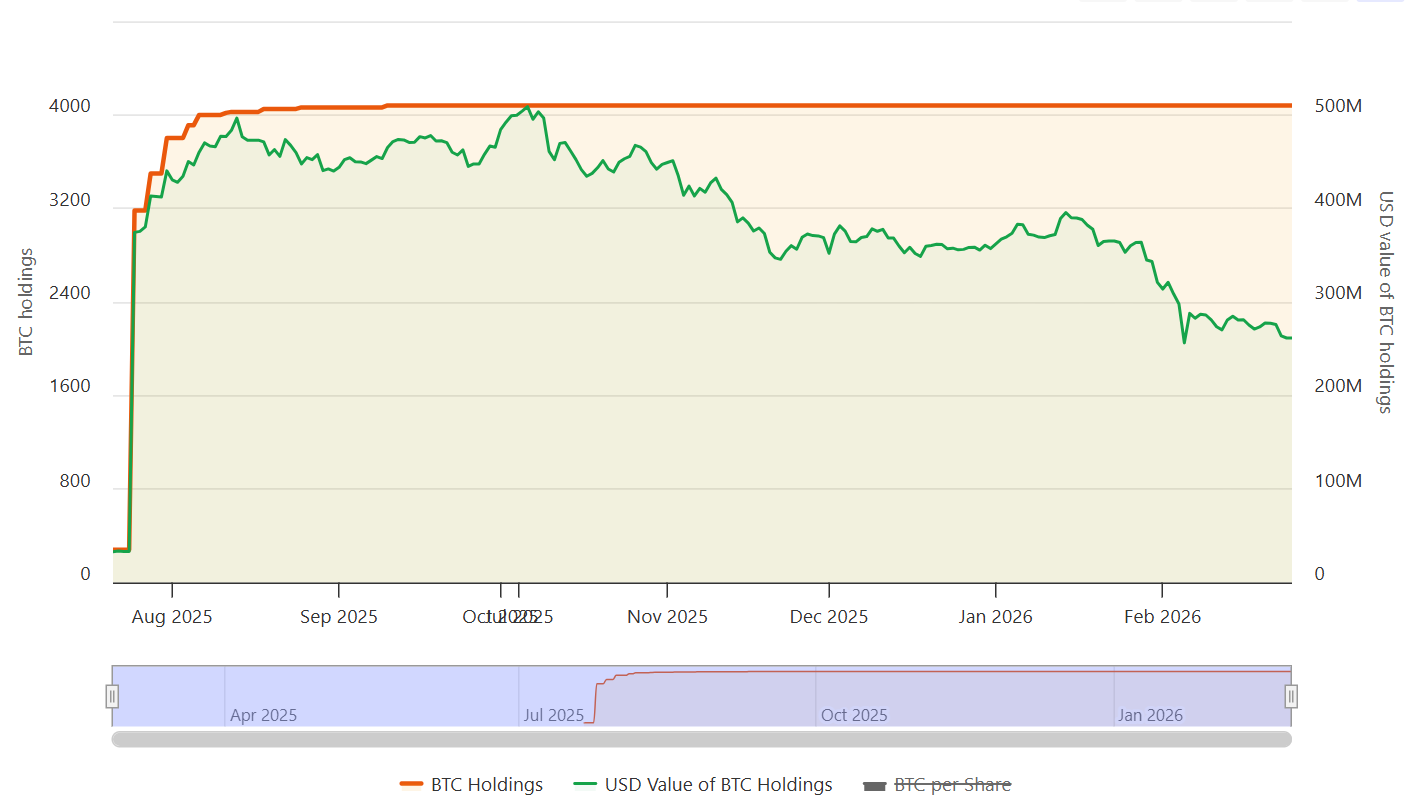
A nearly 10% shareholder of Empery Digital is calling for sweeping changes, including the sale of the company’s roughly 4,000 Bitcoin holdings and the resignation of its CEO and board.
In a letter to management, investor Tice P. Brown argued that the Bitcoin-heavy treasury strategy has failed to maximize shareholder value and demanded capital be returned to investors instead.
Empery pushed back against the claims, defending its strategy. The dispute highlights the growing tension between activist investors and public companies that have adopted Bitcoin as a core balance-sheet asset.
Empery, which transitioned its legacy business into a Bitcoin treasury last year, has amassed 4,081 BTC, making it one of the top 25 largest public holders of the digital asset.

Circle’s earnings, USDC growth fuels stock rally
Stablecoin issuer Circle delivered a stronger-than-expected fourth quarter, even as broader crypto market conditions weakened, underscoring continued momentum in the dollar-backed stablecoin market.
Fourth-quarter revenue reached $770 million, up 77% from a year earlier. Net income totaled $133.4 million, or 43 cents per share. Both were ahead of analyst expectations. The more telling figure, however, was USDC’s (USDC) expansion. Supply rose 72% to $75.3 billion by year-end, reflecting sustained demand for onchain dollar liquidity.
For the entire year, Circle reported $2.7 billion in revenue and a net loss of $70 million that was largely due to stock-based compensation tied to its initial public offering.
Shares jumped more than 20% following the earnings release, as investors responded to the revenue growth and expanding stablecoin base.

PayPal draws takeover interest after steep stock decline
PayPal is reportedly attracting early-stage takeover interest after a prolonged slide in its share price, as competitors weigh opportunities to consolidate parts of the digital payments market.
According to Bloomberg, some potential buyers are evaluating a full acquisition, while others may pursue specific business segments. Discussions remain preliminary, and no formal offer has been announced. Bitcoin-friendly payments company Stripe later emerged as one of the interested parties.
The development comes as PayPal continues restructuring efforts and expands further into digital assets, including its proprietary stablecoin.

$500M stablecoin mortgage deal bridges DeFi and housing
Mortgage lender Better and Framework Ventures are launching a $500 million initiative that channels stablecoin liquidity into US mortgage lending, potentially bringing real-world housing finance deeper into decentralized markets.
Under the structure, Better will continue underwriting and issuing home loans, while funding is sourced through a stablecoin ecosystem. The arrangement connects blockchain-based liquidity with traditional real estate finance, an area long discussed but rarely deployed at a meaningful scale.
The deal signals continued momentum behind tokenized real-world assets, even as broader crypto markets remain volatile.
Crypto Biz is your weekly pulse on the business behind blockchain and crypto, delivered directly to your inbox every Thursday.
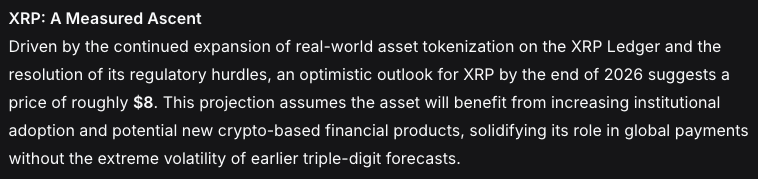
DeepSeek AI predicts great things this year for HODLers of XRP, Bitcoin and Ethereum.
Despite months of persistent downside pressure across the crypto market, DeepSeek has a notably optimistic stance on the market leaders, projecting that all three could reach fresh all-time highs within the next ten months.
So, just how credible are DeepSeek’s predictions?
XRP ($XRP): DeepSeek AI Sees a Tidy 6x Move by Christmas
In a recent update, Ripple reaffirmed that XRP ($XRP) plays a central role in its long-term strategy to position the XRP Ledger (XRPL) as a globally adopted, enterprise ready payments network.
Thanks to elite infrastructure, rapid settlement speeds and low transaction fees, XRPL is likely to benefit from two fast-growing sectors: stablecoins and tokenized real-world assets.
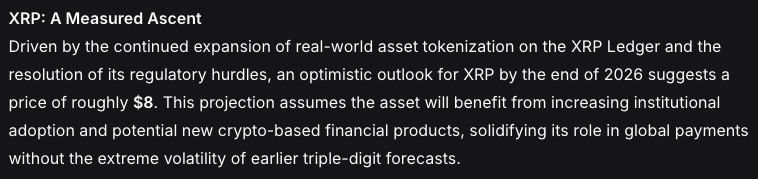
With XRP currently trading near $1.37, DeepSeek predicts a 2026 rally to $8, representing a sixfold increase from current levels.
XRP’s relative strength index (RSI) sits at a neutral 40, while price action has aligned with the 30-day moving average, suggesting the lengthy consolidation phase may almost over.
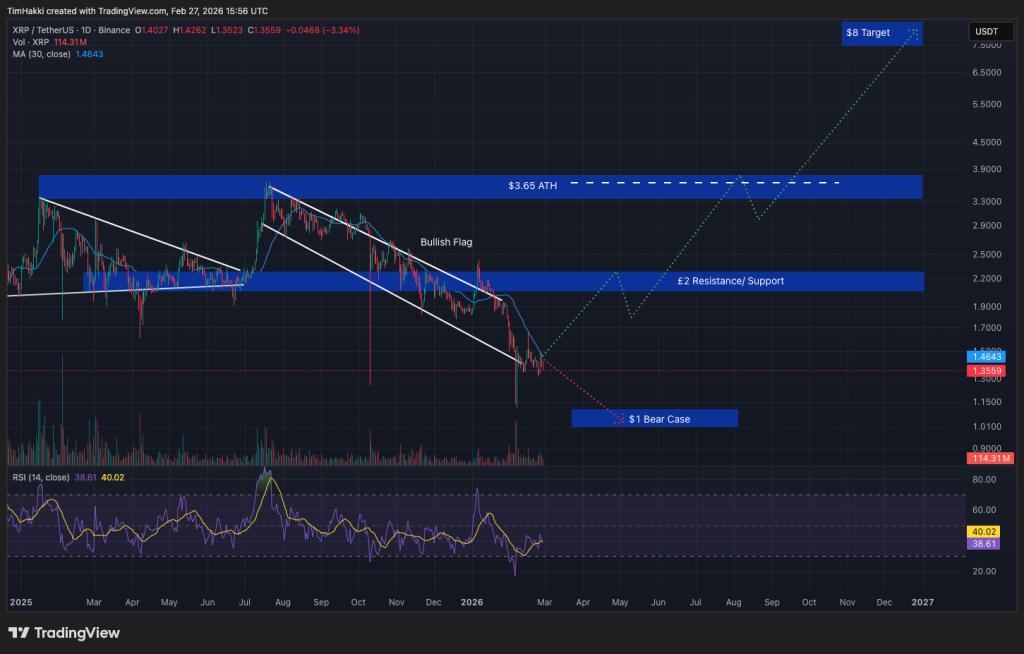
Further upside catalysts could include rising institutional interest following the launch of U.S.-listed XRP ETFs, Ripple’s expanding portfolio of international partnerships, and clearer regulatory conditions should the CLARITY bill pass in the U.S. this year.
Bitcoin (BTC): DeepSeek Targets $266,000 for Bitcoin
Bitcoin ($BTC), the first and largest crypto by market capitalization, hit a record high of $126,080 on October 6 before entering an extended correction.
Even with recent turbulence, DeepSeek’s suggests Bitcoin can maintain its long-term growth trajectory and hit a new high watermark around $266,000.
Often described as digital gold, Bitcoin cappeals to both institutional and retail investors seeking diverse protection against inflation and broader macroeconomic risk.
Bitcoin currently accounts for around $1.3 trillion of the $2.4 trillion crypto market. Since its ATH, BTC has declined by approximately 48% and now trades near $66,000, following two sharp selloffs triggered by geopolitical concerns involving potential U.S. military action linked to Iran and Greenland.
DeepSeek thinks accelerating institutional adoption and reduced post-halving supply as major forces that could push Bitcoin toward multiple new highs this year.
Furthermore, if U.S. policymakers deliver on promises for a Strategic Bitcoin Reserve, Bitcoin’s upside potential would be unpredictable .
Ethereum (ETH): DeepSeek AI Eyes a Potential Run to $10,000
Ethereum ($ETH) remains the leading smart contract blockchain and the foundational layer for much of DeFi.
With a market capitalization of r$235 billion and over $53 billion locked across DeFi protocols, Ethereum serves as the primary settlement layer for on-chain commerce.
Its strong security track record, dominance in stablecoins, and early traction in real-world asset tokenization position Ethereum as a prime candidate for increased institutional deployment.
That largely depends on U.S. lawmakers approving the CLARITY bill, which would provide the certainty institutions need to deploy capital on Ethereum.
ETH is currently trading around $2,000, with major resistance expected near $5,000 after reaching an all-time high of $4,946.05 last August.
If DeepSeek’s bullish thesis unfolds, a decisive break above $5,000 could see ETH hitting $7,500 by Christmas.
Maxi Doge: Early-Stage Meme Coin Aims for Exponential Upside
DeepSeek’s outlook suggests XRP, Bitcoin and Ethereum could be relatively “safe” plays in the coming months, however, their already large market capitalizations limit just how much growth HODLers can enjoy.
That’s not the case with the new meme coin Maxi Doge ($MAXI). The project has raised $4.6 million in its ongoing presale as investors rush to gain exposure to what some are calling the next Dogecoin/
Maxi Doge is Dogecoin’s loud, degenerate gym-bro alpha cousin. But he’s jealous, and he’s coming after Dogecoin through a viral marketing campaign that channels the irreverent spirit of the 2021 meme coin boom.
MAXI is an ERC-20 token on Ethereum’s proof-of-stake network, giving it a smaller environmental footprint than Dogecoin’s proof-of-work model.
Early presale participants can currently stake MAXI for yields of up to 67% APY, with returns gradually declining as the staking pool grows.
The token is $0.0002806 in the current presale phase, with automatic price increases scheduled at each funding milestone. Investors can purchase through wallets including MetaMask and Best Wallet.
Stay updated through Maxi Doge’s official X and Telegram pages.
Visit the Official Website Here.
The post China’s DeepSeek AI Predicts the Price of XRP, Bitcoin and Ethereum appeared first on Cryptonews.
TLDR
- Bank of America, Fidelity, and Morgan Stanley recommend allocating 1% to 5% of portfolios to Bitcoin.
- River reported that major institutions now treat Bitcoin as a portfolio diversifier.
- BlackRock advises limiting Bitcoin exposure to between 1% and 2% of total assets.
- JPMorgan analysts project Bitcoin could reach $266,000 if it rivals private gold investment.
- Bitcoin traded at $67,441 after falling 47% from its October peak of $126,080.
Major Wall Street firms now advise clients to hold small Bitcoin stakes within diversified portfolios. Fidelity Investments, Bank of America, and Morgan Stanley recommend allocations between 1% and 5%. These recommendations formalize Bitcoin’s role as a portfolio diversifier rather than a speculative trade.
River reported that several large institutions issued formal guidance on crypto exposure. The firms outlined allocation ranges that limit risk while allowing participation in price gains. Their guidance reflects structured portfolio models used in wealth management divisions.
Fidelity Investments advises clients to allocate between 2% and 5% to crypto assets, including Bitcoin. Bank of America recommends a 1% to 4% allocation range for diversified portfolios. Morgan Stanley suggests clients hold up to 4% in Bitcoin exposure.
Bank of America and Peers Outline Bitcoin Stakes Strategy
Bank of America placed Bitcoin within its alternative asset framework for private clients. The bank set allocation guidance between 1% and 4% of total portfolio value. The firm structured the guidance around volatility controls and diversification targets.
Fidelity Investments provided a higher allocation band of 2% to 5% for wealth clients. Morgan Stanley capped its recommended exposure level at 4%. BlackRock advised a narrower 1% to 2% range for Bitcoin holdings.
WisdomTree and JPMorgan Chase limited their recommendations to allocations of up to 1%. River compiled these figures in its institutional allocation report. The report described Bitcoin as a diversifier within multi-asset portfolios.
The firms structured their models to balance upside exposure with portfolio stability. They kept allocations limited to preserve overall asset mix targets. The guidance reflects internal research and asset allocation committees.
Price Levels and Long-Term Projections
Bitcoin reached a record high of $126,080 in October last year. The price later declined by 47% from that peak. CoinGecko data showed Bitcoin trading at $67,441 at the time of reporting.
Despite the price decline, several institutions published long-term projections. BlackRock CEO Larry Fink said Bitcoin could reach $700,000 per coin. He cited concerns about currency debasement and global financial instability.
Fidelity issued an earlier projection in September 2021. The firm estimated Bitcoin could reach $1 billion per coin by 2038. Jurrien Timmer supported that estimate using stock-to-flow and demand models.
JPMorgan analysts projected Bitcoin could reach $266,000 over time. They based the estimate on Bitcoin competing with gold as a store of value. Analysts compared private-sector gold investment totals with Bitcoin’s market capitalization.
JPMorgan stated that gold outperformed Bitcoin since last October. Analysts reported that the Bitcoin-to-gold volatility ratio fell to about 1.5. They described that level as a record low in their research note.
The bank said Bitcoin would need an $8 trillion market capitalization to reach $266,000. Analysts excluded central bank gold holdings from that comparison.
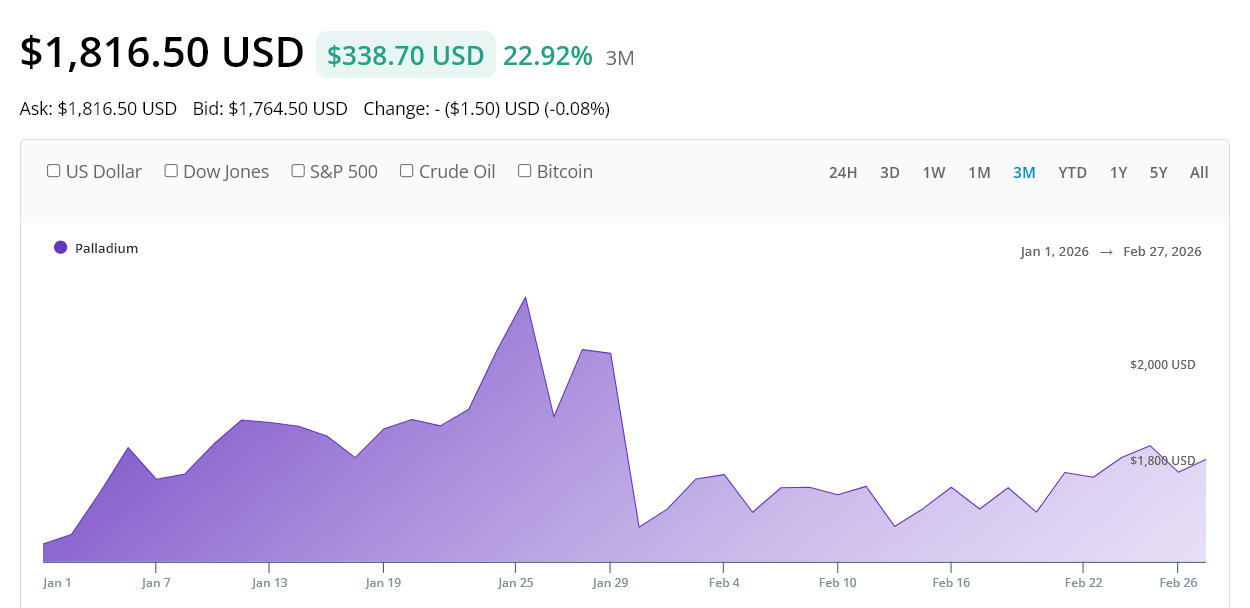
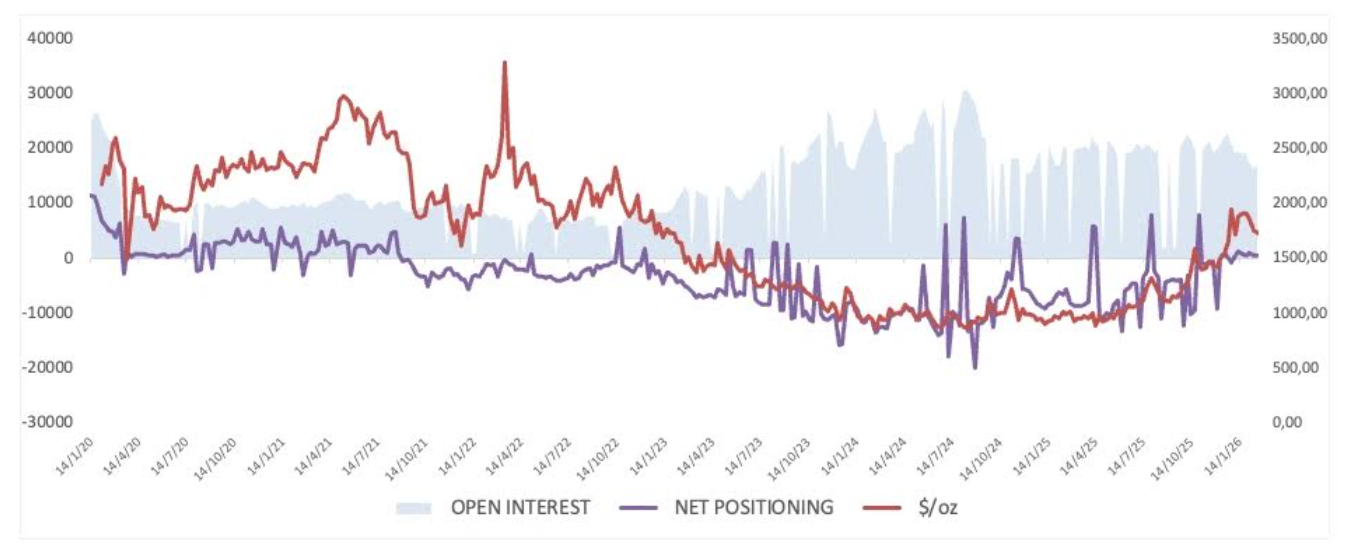
Few major commodities have displayed the kind of price volatility Palladium has since 2020. After a wild ride, boom and bust included, the price of the metal approaches a key area that will help determine its medium- and long-term outlook.
In the space of just a few years, the metal surged above $3,400 during a supply-driven panic, only to collapse back toward $1,000 as industrial fears, substitution dynamics and the electric vehicle transition narrative took hold.
The amplitude of that move rivals some of the most dramatic commodity cycles of the past two decades.
From Scarcity Panic to Structural Unwind
The 2020-2022 rally was fuelled by a perfect storm: tight supply, heavy reliance on Russian production, strong autocatalyst demand, and limited above-ground inventories.
When geopolitical tensions intensified, the scarcity premium exploded.
But blow-offs rarely stabilise gently.
Once peak fear subsided and EV adoption accelerated, the narrative flipped. Investors began pricing a future where internal combustion
engine demand gradually erodes and platinum substitution gains traction.
As that theme gathered momentum, palladium retraced violently.
By late 2023 and into 2024, the market looked washed out.
Volatility and Reset
The decline toward the $1,000-$1,100 zone coincided with extreme pessimism.
Sentiment shifted from “structural shortage” to “structural obsolescence” in less than 24 months. That kind of narrative swing is typically accompanied by positioning liquidation, and price action reflected it.
Technically, the metal moved back toward long-term support levels that had anchored prior cycles. Momentum indicators reset and volatility compressed. The excess was purged.
2025-2026: Reclaim Phase Underway?
Over the past year, price behaviour has changed meaningfully.
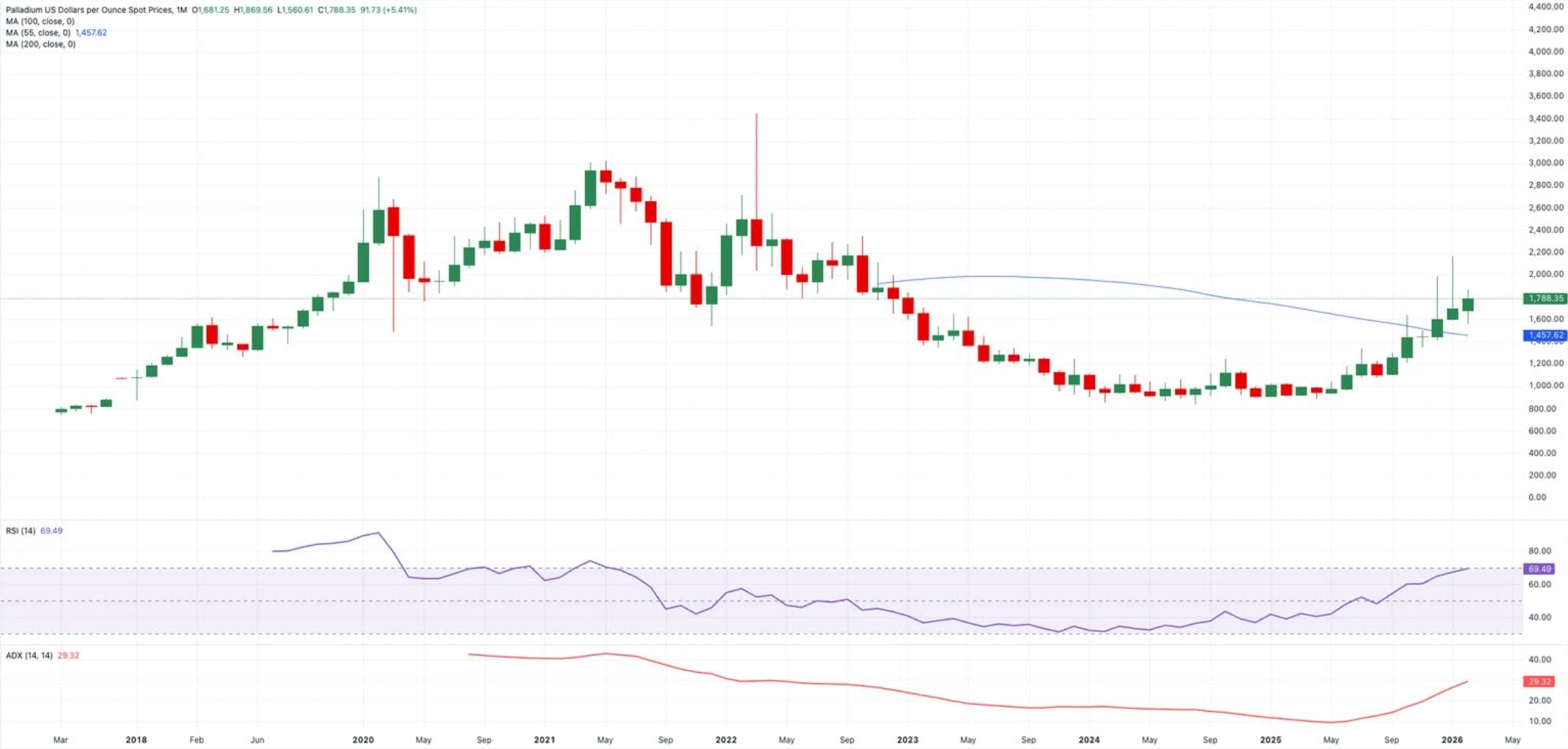
Palladium has reclaimed medium- and long-term moving averages on the weekly and monthly timeframes. Higher lows have begun to form. Momentum has improved without yet reaching euphoric territory.
This rally is not a parabolic breakout, but base construction.
The key zone to watch sits around $1,900-$2,000. A sustained move above that area would mark a structural shift in the longer-term chart and challenge the prevailing “terminal decline” narrative.
Until then, the metal remains in recovery mode, not full revival.
What Drives Palladium?
Unlike Gold, Palladium is not a monetary hedge. It is tied primarily to industrial demand, particularly autocatalysts used in internal combustion and hybrid vehicles.
That means the macro drivers are different:
● Global auto production trends
● China’s manufacturing cycle
● US consumer resilience
● Platinum substitution dynamics
● Russian supply concentration
● The US Dollar trend
If global manufacturing stabilises and hybrid vehicle demand remains robust, Palladium retains its demand base. If the US Dollar softens and industrial sentiment improves, the cyclical tailwind strengthens.
But the structural headwind from electrification remains. This dynamic is precisely what sustains volatility.
Technical Outlook: Compression Before Expansion?
From a chart perspective, Palladium no longer looks like a market in freefall. Instead, it appears to be shifting from liquidation mode into something more constructive.
On the monthly chart, price has managed to climb back above its 55-month moving average and is now pressing up against the 100-month average in the $1,600-$1,700 area.
That may sound technical, but in simple terms it means the metal is rebuilding above levels that had previously defined the long slide.
Momentum has also turned. The Relative Strength Index (RSI), which collapsed during the 2023 washout, has recovered steadily and is now moving back toward bullish territory.
Taken together, the longer-term picture looks less like structural decay and more like a market trying to form a durable base.
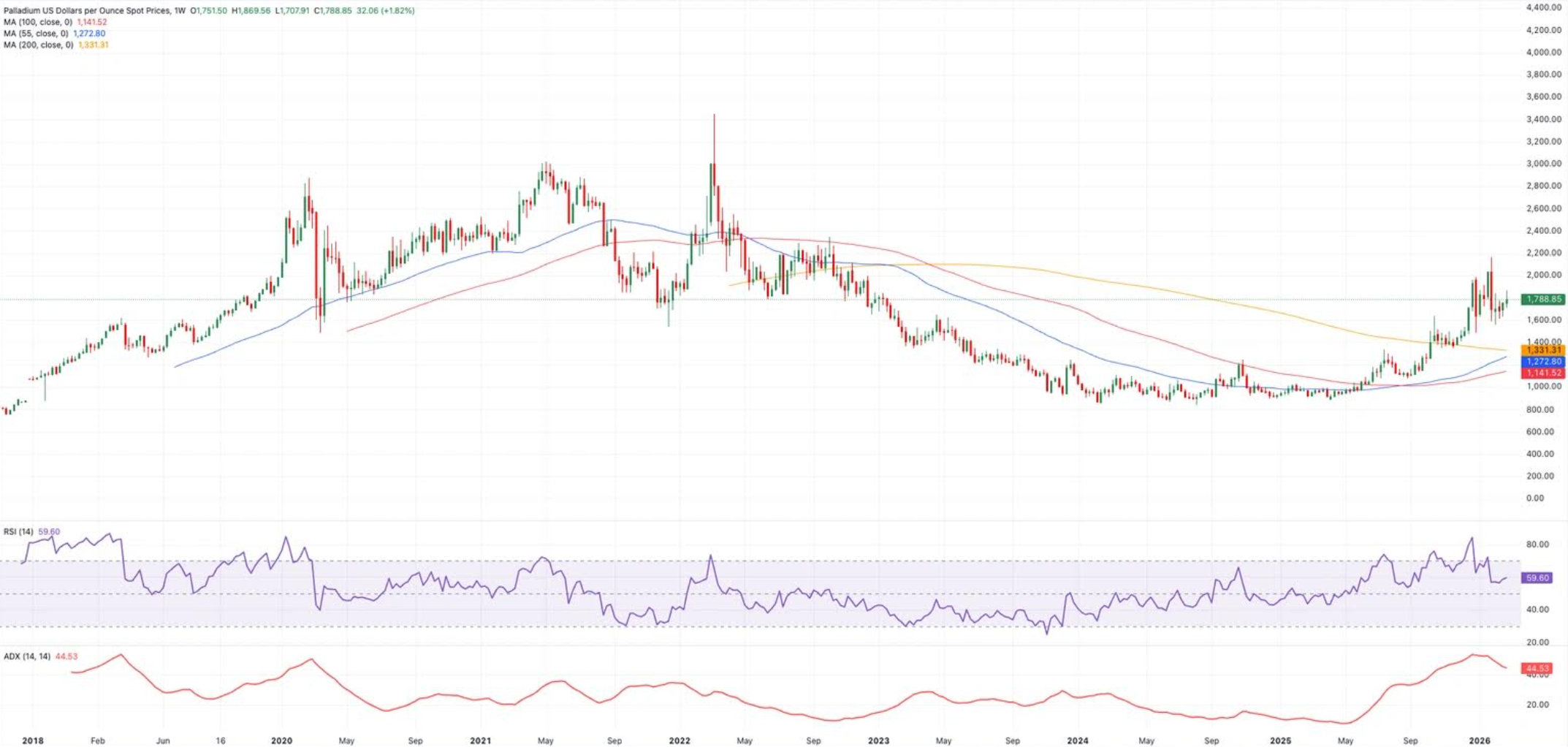
On the weekly chart, higher lows have begun to form since the $1,000 floor held. The trend strength indicators are expanding again, signalling that directional conviction is returning after a prolonged period of compression.
Price is now approaching a key resistance band between $1,900 and $2,000, a zone that previously acted as a distribution during the early stages of the collapse.
A sustained weekly break above that area would materially alter the medium-term outlook and likely trigger a reassessment of the “terminal decline” narrative.
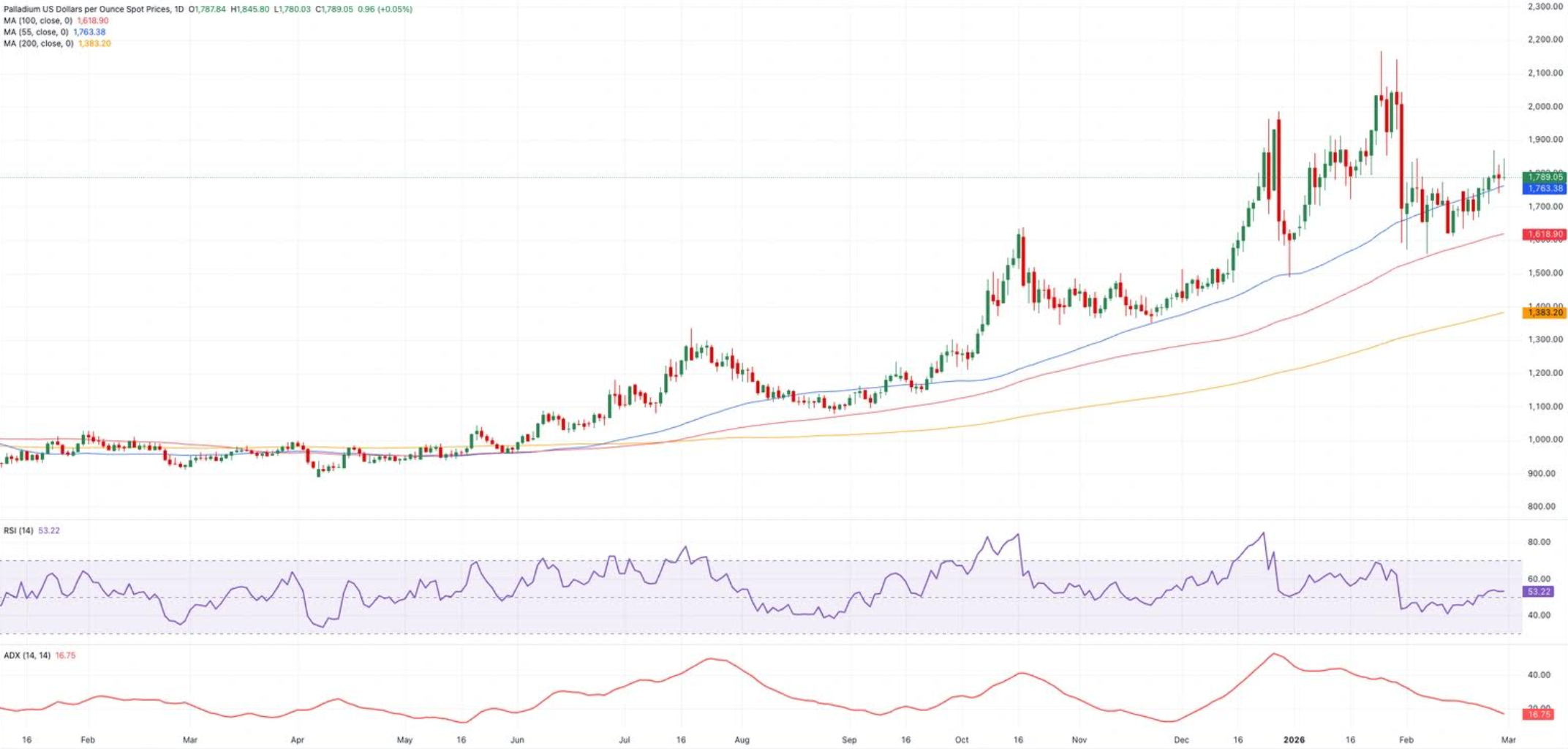
After a big jump, Palladium has settled into a holding pattern around the $1,750-$1,800 area on the daily chart.
The move up has stopped in a fairly orderly way instead of getting too hot. Momentum indicators remain in the middle range, indicating that the market is retaining its gains rather than losing momentum.
For now, the $1,700 to $1,720 range serves as a near-term cushion. On the upside, a convincing break above $1,850 would signal that buyers are ready to press the recovery further.
Until one of those levels gives way, the metal looks more like it is coiling than collapsing.
In short, the technical picture aligns with the broader macro narrative: the worst of the decline appears to be behind us, but confirmation of a new structural leg higher requires a decisive break above the $1,900-$2,000 region.
Until then, Palladium remains a rebuilding story: volatile, sensitive to macro inputs, and poised at an inflection point rather than in a confirmed breakout.
In a market defined by extremes, Palladium may once again be preparing for a decisive move; the only question is whether conviction ultimately resolves higher or whether volatility reasserts itself before a true structural recovery takes hold.
Crypto investment firm Paradigm is seeking to raise $1.5 billion for a new fund that will invest in companies in AI, robotics and other frontier technologies, according to the Wall Street Journal.
Paradigm will continue to invest in crypto companies, according to sources familiar with the situation, but it will use its existing technical investment team to look at deals in frontier tech companies, they said.
San Francisco–based Paradigm has $12.7 billion in assets under management, according to the latest regulatory filings.
It launched its flagship $2.5 billion fund in November 2021, which was the largest crypto fund in history at the time. It publicly announced its third fund in 2024 — an $850 million venture fund focused on early-stage crypto projects.
According to the WSJ’s sources, the firm’s managers decided they didn’t want to be restricted in ways that could cause them to miss out on attractive deals.
There is also overlap between crypto and AI, such as agentic payments, or transactions made by autonomous AI agents, the person said.
Paradigm exploring AI as early as 2023
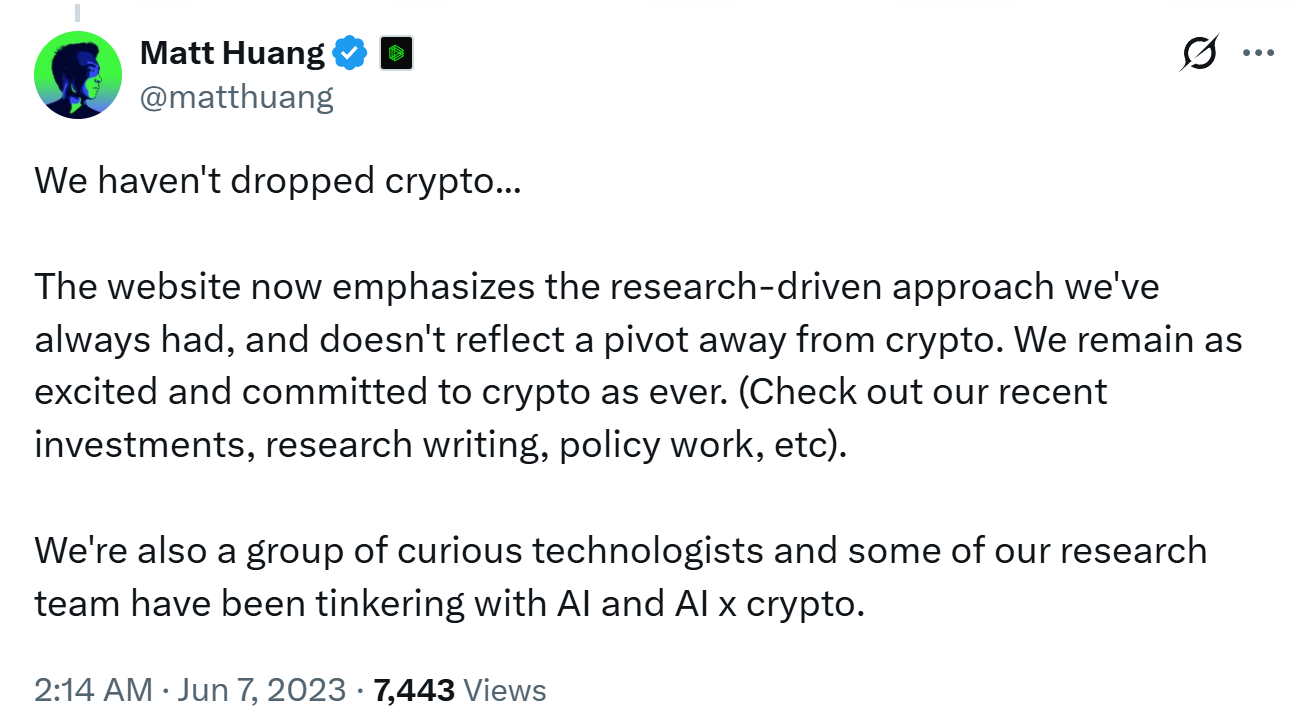
Paradigm acknowledged it had been “tinkering” with AI and its convergence with crypto as early as three years ago.
In 2023, Paradigm was seen removing Web3 and crypto-specific language from its website, prompting some speculators to suggest it was already pivoting from crypto to AI.
Matt Huang, the co-founder and managing partner of Paradigm, denied at the time that the website changes reflected a shift away from crypto, but acknowledged that the team had been exploring AI.

In a lengthier tweet weeks later, Huang said that while “we’ve never been more excited about crypto and continue to invest across all stages,” the “developments in AI are too interesting to ignore.”
“It seems trendy to frame crypto vs AI as a zero-sum competition. But we don’t buy it. Both are interesting and will have plenty of overlap. We’re excited to continue exploring,” he said.
Earlier this month, Paradigm and OpenAI released EVMbench, a new benchmark evaluating how different AI models can detect and patch security vulnerabilities found in smart contracts.
AI made up more than half of all VC funding in 2025
In 2025, venture capital investments in AI firms amounted to $258.7 billion, accounting for 61% of all VC investment and doubling its share from 2022, according to OECD.
VC funding for generative AI firms made up 14% of all AI venture capital investments, with firms in the United States attracting the largest share of VC funding.
AI Eye: IronClaw rivals OpenClaw, Olas launches bots for Polymarket


Dorsey said AI-driven efficiency demands smaller teams, triggering one of the largest layoffs in Block’s history.
Jack Dorsey announced that Block is reducing its workforce by nearly half, cutting more than 4,000 employees and bringing total headcount from over 10,000 to just under 6,000.
In a note shared publicly on X, Dorsey described the move as “one of the hardest decisions in the history” of the company and said all employees would be notified the same day whether they are being asked to leave, entering consultation, or staying.
Massive Layoffs at Block
He stated that affected employees will receive 20 weeks of salary plus one additional week per year of tenure, equity vested through the end of May, six months of health care coverage, their corporate devices, and $5,000 to support their transition.
Employees outside the United States will receive similar support. Details may vary according to local requirements. Dorsey said the decision was not driven by financial distress, while adding that the company’s business remains strong. Instead, he added,
“But something has changed. We’re already seeing that the intelligence tools we’re creating and using, paired with smaller and flatter teams, are enabling a new way of working which fundamentally changes what it means to build and run a company. and that’s accelerating rapidly.”
Dorsey said he considered gradually reducing staff over months or years, but chose to act immediately. He said that repeated rounds of layoffs would harm morale, focus, and trust among customers and shareholders. He acknowledged that some decisions may prove wrong and that flexibility has been built in to account for that while continuing to serve customers.
Dorsey Admits Over-Hiring
The layoff announcement drew mixed reactions across social media. Some users described the severance terms as generous, while others focused on concerns about artificial intelligence replacing human roles. One user, Will Slaughter, tweeted that the cuts were less about AI and more about management decisions, while taking a jibe at Block, which had more than tripled its headcount from 3,900 in December 2019 to 12,500 by December 2022.
He described the reduction as unwinding an “insane COVID overhiring binge” and attributed it to managerial incompetence rather than technological change. In response, Dorsey admitted to over-hiring during the pandemic.
Other users criticized the optics of citing AI in a layoff note written in lowercase. Some expressed concern that job cuts linked to AI could become a broader trend as the company’s stock price rose by 24% in post-market hours.
Binance Free $600 (CryptoPotato Exclusive): Use this link to register a new account and receive $600 exclusive welcome offer on Binance (full details).
LIMITED OFFER for CryptoPotato readers at Bybit: Use this link to register and open a $500 FREE position on any coin!
TLDR:
- Minnesota HF3642 would make it illegal for anyone to place or operate a crypto ATM in the state.
- The bill repeals Sections 53B.70–53B.75, erasing all existing kiosk licensing and compliance rules.
- New customers currently get full fraud refunds within 72 hours — a protection the ban would eliminate.
- Minnesota could become one of the first U.S. states to outright ban virtual currency kiosks entirely.
Virtual currency kiosks in Minnesota face a complete ban under proposed legislation introduced in the 2025–2026 session.
House File 3642 targets all crypto ATM operations in the state. The bill would prohibit any person from placing or operating a virtual currency kiosk in Minnesota.
It also seeks to repeal existing statutes that currently govern kiosk licensing, disclosures, transaction limits, refunds, and compliance requirements. This move marks a dramatic policy shift for the state.
What the Bill Proposes
Minnesota HF3642 introduces a straightforward and sweeping prohibition. Under the proposed Section 53B.691, no person may place or operate a virtual currency kiosk anywhere in Minnesota. The language of the bill leaves no room for exceptions or conditional approvals.
The bill also adds a new subdivision to Section 53B.69 to define terms specifically for the prohibition. This addition provides the legal framework needed to enforce the new ban effectively. It connects existing definitions in state law to the incoming restriction.
Beyond the ban itself, the legislation proposes a full repealer of Sections 53B.70 through 53B.75. These sections currently regulate kiosk operators through licensing, consumer disclosures, and transaction limits.
Their removal would erase the entire regulatory structure that governs crypto ATMs in the state today.
What Current Law Requires of Kiosk Operators
Under existing Minnesota statutes, virtual currency kiosk operators must follow strict disclosure rules. Before any transaction, operators must display all material risks on the kiosk screen for the customer to acknowledge.
These include warnings about price volatility, irreversible transactions, and potential fraud schemes.
Current law also requires operators to display a bold warning about scams. The warning specifically addresses fraudsters impersonating loved ones or government officials. It advises consumers that losses from fraudulent transactions cannot be recovered.
Transaction limits are also part of the existing framework. New customers face a maximum daily transaction limit of $2,000.
Existing customers, defined as those who have transacted for more than 72 hours, are subject to limits set by individual operators in line with federal law.
Refund Rules and Consumer Protections at Stake
Minnesota’s current law offers a refund pathway for new customers who fall victim to fraud. Under Section 53B.75, operators must refund the full transaction amount if a new customer was fraudulently induced.
The customer must contact the operator and a government or law enforcement agency within 14 days.
This protection applies strictly within the 72-hour new customer window. After that period, a customer transitions to “existing customer” status under Section 53B.69. At that point, the full refund obligation no longer applies.
If HF3642 passes, all of these consumer protections would be repealed along with the ban. There would be no licensed operators left to hold accountable, and no regulatory structure to enforce compliance.
Consumers who previously relied on these protections would lose that safety net entirely.
Industry and Regulatory Outlook
The bill’s passage would make Minnesota one of the few states to outright ban crypto ATM operations. Most states have moved toward regulation rather than prohibition. The trend across the country has been to tighten oversight, not eliminate it entirely.
For operators currently licensed in Minnesota, the bill represents a direct threat to existing business models. Many operators have invested in compliance infrastructure to meet the state’s existing requirements. A full ban would render that investment worthless.
The bill is now in the legislative process and has not yet been signed into law. Stakeholders across the crypto industry are expected to monitor its progress closely.
Its outcome could influence how other states approach virtual currency kiosk legislation going forward.

US Job Cuts Surge to Highest Level Since Pandemic as AI Reshapes the Workforce

Hay demasiado ruido financiero

Gogglebox cast left screaming and unable to watch grisly scene ‘I have no words’


-

 Politics6 days ago
Baftas 2026: Awards Nominations, Presenters And Performers
-

 Sports4 days ago
Women’s college basketball rankings: Iowa reenters top 10, Auriemma makes history
-

 Politics4 days ago
Nick Reiner Enters Plea In Deaths Of Parents Rob And Michele
-

 Business3 days ago
True Citrus debuts functional drink mix collection
-

 Fashion6 hours ago
Weekend Open Thread: Iris Top
-

 Politics1 day ago
ITV enters Gaza with IDF amid ongoing genocide
-

 Crypto World4 days ago
XRP price enters “dead zone” as Binance leverage hits lows
-

 Business6 days ago
Mattel’s American Girl brand turns 40, dolls enter a new era
-

 Business5 days ago
Law enforcement kills armed man seeking to enter Trump’s Mar-a-Lago resort, officials say
-

 NewsBeat2 days ago
Cuba says its forces have killed four on US-registered speedboat | World News
-
 NewsBeat2 days ago
Manchester Central Mosque issues statement as it imposes new measures ‘with immediate effect’ after armed men enter
-

 Tech3 days ago
Unsurprisingly, Apple's board gets what it wants in 2026 shareholder meeting
-
 NewsBeat5 days ago
‘Hourly’ method from gastroenterologist ‘helps reduce air travel bloating’
-

 Tech5 days ago
Anthropic-Backed Group Enters NY-12 AI PAC Fight
-

 NewsBeat5 days ago
Armed man killed after entering secure perimeter of Mar-a-Lago, Secret Service says
-

 Politics5 days ago
Maine has a long track record of electing moderates. Enter Graham Platner.
-

 Business2 days ago
Discord Pushes Implementation of Global Age Checks to Second Half of 2026
-
 NewsBeat3 days ago
Police latest as search for missing woman enters day nine
-

 Business1 day ago
Only 4% of women globally reside in countries that offer almost complete legal equality
-
 Sports5 days ago
2026 NFL mock draft: WRs fly off the board in first round entering combine week