

Crypto World
Three cryptocurrencies trading under $0.10 attract investor attention in March



VET, HBAR, DOGE trade below $0.1 with neutral RSI as tax refund season sparks speculative March flows as cryptocurrencies continue to plummet.
Summary
- VET trades below $0.1 with RSI in neutral territory and key support around $0.0070–$0.0072 and resistance near $0.0082–$0.0089 as key cryptocurrencies face broader market decline.
- HBAR consolidates just under $0.1, with support around $0.08–$0.09 and resistance near $0.11; FedEx’s Hedera Council membership strengthens the project’s real‑world tokenization narrative.
- DOGE trades around $0.09–$0.10, with targets at $0.11–$0.16 into March 2026 as neutral RSI and healthy spot volume leave room for upside if BTC and ETH stabilize and U.S. tax refunds fuel risk appetite.
As Bitcoin (BTC) faces resistance and major cryptocurrencies trade within established ranges, several low-priced digital assets are drawing attention from traders seeking potential gains in March, according to market analysis.
The cryptocurrency market is experiencing volatility following a difficult 2026, with the U.S. Internal Revenue Service’s tax refund season potentially creating buying pressure for lower-priced tokens, market observers noted.
VeChain (VET), despite underperforming in 2026, has been implementing a network upgrade since late 2025. The blockchain project faces a March 15 deadline for legacy node migration, which stems from the StarGate upgrade to its staking system. The asset’s relative strength index indicates neither overbought nor oversold conditions, according to technical analysis. Market participants are monitoring support and resistance levels around the migration deadline.
Hedera (HBAR) has reduced its year-to-date losses following a decline in early February and is currently trading near key price levels. The platform has positioned itself in real-world asset tokenization and recently announced that FedEx joined the Hedera Council. Technical analysts identified current price levels as critical thresholds, with movement below support potentially signaling further declines, while a break above resistance could indicate upward momentum.
Dogecoin (DOGE), the largest meme coin by market capitalization, has experienced significant volatility in 2026 alongside broader market trends. The approaching tax refund season could generate buying activity as some investors receive additional funds, market watchers suggested. Analysts noted that Dogecoin’s performance in March may depend on the price action of larger cryptocurrencies including Bitcoin and Ethereum, with stability in those assets potentially supporting interest in more volatile tokens.
All three cryptocurrencies are currently trading below $0.10, according to market data.



ARB is trading ~96% below its 2024 ATH, with analysts framing current demand-zone compression as a potential long-term accumulation phase for a future trend reversal.
Summary
- ARB sits near historic lows, roughly 96% below its 2024 peak and at major wick support in a multi‑year descending channel.
- Price is compressing in a high‑timeframe demand block, with volume absorption signaling weakening sell pressure and possible Wyckoff‑style accumulation.
- Traders watch two key resistance levels for structure confirmation; a breakdown below invalidation would void the accumulation thesis.
Arbitrum’s (ARB) native token is trading near historic lows following a prolonged decline from its 2024 peak, with technical analysts identifying the current price level as a potential long-term entry point, according to market analysis.
The token reached its all-time high in 2024 before entering a sustained downtrend. The asset now trades at approximately 96% below its peak, positioned within what analysts describe as a high-timeframe demand block, according to technical chart analysis.
One market analyst noted the token is positioned at the bottom of a multi-year descending channel inside a high-timeframe demand block. The level holds historical significance, with prior capitulation wicks forming in the same area, according to the analysis. Price action has compressed sideways following the most recent decline.
Technical analysts are treating the current range as a structural accumulation zone. Volume absorption at this level suggests diminishing selling momentum, according to market observers. The compression in volatility supports the possibility that a price base could be forming, analysts stated.
Characteristics of a Wyckoff accumulation cycle appear to be forming on the token’s chart, according to technical analysis. Phase C, which typically marks the final shakeout before a recovery in the classical framework, appears to be in play. Demand absorption signals point to institutional-style accumulation at the current price range, analysts reported.
Two levels stand out as critical confirmation points for traders monitoring the asset. A break above initial resistance would mark the first break of structure favoring buyers, while a move above higher resistance would signal a full trend regime change, according to the technical analysis.
The analyst outlined a multi-stage target path reaching prior resistance zones and longer-term projection targets. A full cycle expansion would represent substantial gains from current levels, according to the analysis. On the downside, a defined invalidation level remains the reference point for the accumulation thesis. A sustained close below that level would void the current technical structure, analysts stated.
The setup draws attention from technically driven traders due to multiple technical confluences, including channel support, historical wick lows, volume absorption, and volatility compression converging at the same zone, according to market analysis.
Arbitrum is classified as a high-beta asset, meaning it tends to move sharply when broader cryptocurrency market conditions shift. This amplified sensitivity creates both downside risk and potential upside opportunity during recovery cycles, analysts noted.
No directional move has been confirmed, and traders are waiting on structure confirmation before taking larger positions, according to market observers.

Tensions between Washington and Tehran escalated further on February 27 after the FBI designated Iran as a State Sponsor of Wrongful Detention. The bureau said it remains committed to returning Americans held captive abroad and bringing their captors to justice.
The FBI highlighted two long-running cases. One involves Robert A. Levinson, a retired FBI special agent who disappeared in 2007 during a trip to Kish Island, Iran.
The US government continues to offer rewards totaling up to $25 million for information leading to his recovery
The second case involves Shayan Kazemi, a US citizen who went missing in Istanbul in 2011. The US government is offering up to $200,000 for information leading to his safe return.
What the FBI’s Designation Means
A “State Sponsor of Wrongful Detention” designation signals that the US government believes a country is detaining American citizens unfairly, often for political leverage. It does not automatically trigger military action.
However, it elevates diplomatic pressure and centralizes recovery efforts under the US Hostage Recovery Fusion Cell.

The move sharply increases political friction. It frames detentions not as isolated incidents but as state-backed tactics.
US Military Posture Tightens
The announcement comes amid heightened military activity in the Middle East. The US has moved advanced fighter jets and additional assets into Israel and the surrounding areas as tensions with Iran rise.
Officials describe the deployment as a deterrence. Yet markets view the buildup as preparation for a potential escalation if nuclear talks collapse or regional clashes intensify.
Cuba Pressure Adds to Global Risk
Meanwhile, President Donald Trump suggested earlier today that the US could pursue a “friendly takeover” of Cuba.
His comment follows weeks of economic pressure on Havana, including oil restrictions that triggered blackouts and fuel shortages.
The combination of Iran escalation and Cuba pressure rattled markets.
Bitcoin, which had been attempting to recover toward $70,000, fell more than 3% on the day to around $65,000. Traders appear to be reducing risk exposure as geopolitical uncertainty rises.
For now, diplomatic channels remain open. But the language from Washington suggests tensions are entering a more dangerous phase.
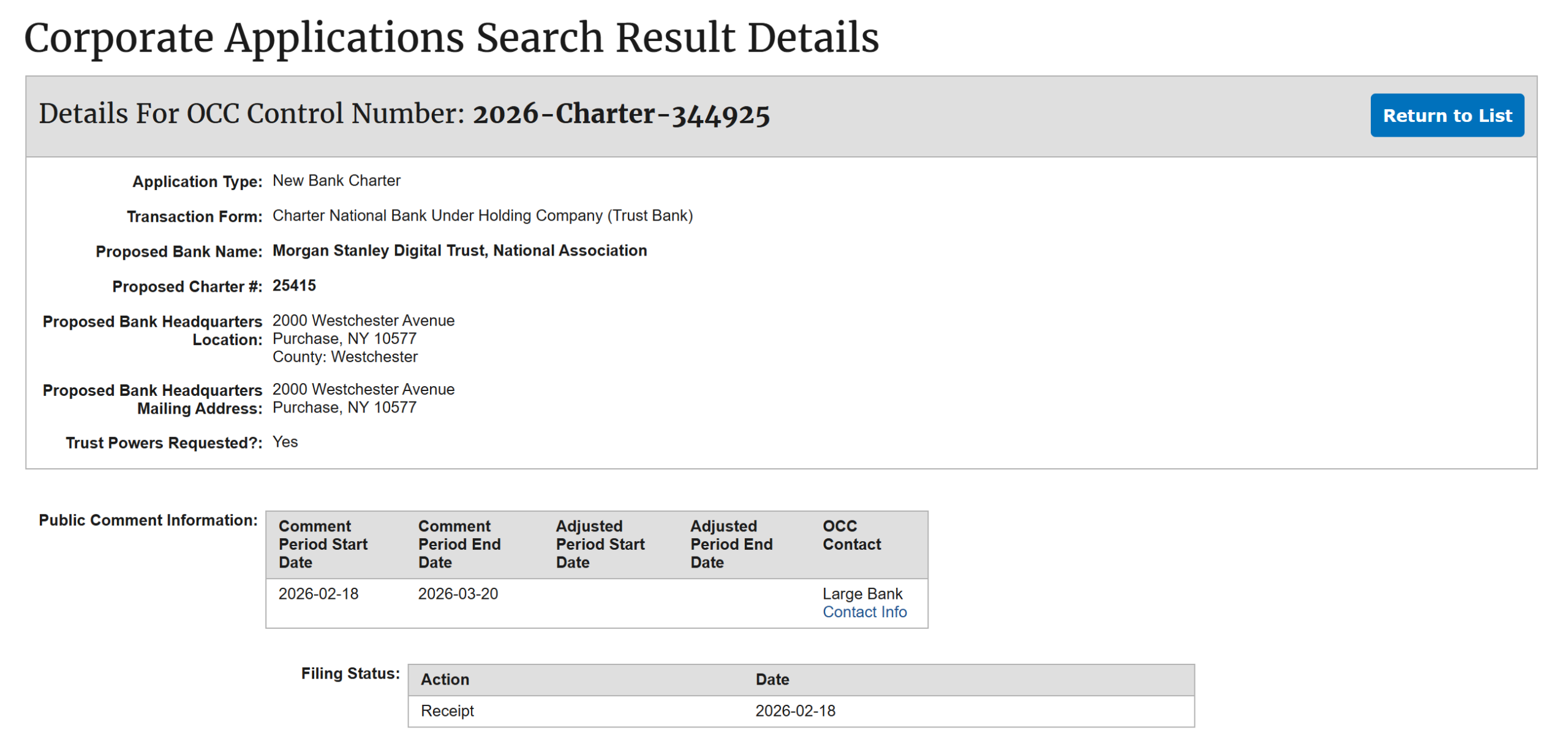
Morgan Stanley has applied for a de novo national trust bank charter, allowing the bank to hold digital assets on behalf of its clients — a move in rhythm with its recent crypto expansion.
A public filing with the Office of the Comptroller of the Currency (OCC) shows the application for a bank trust charter was received on Feb. 18 under the name “Morgan Stanley Digital Trust, National Association.”
More details of the business plan were released on Friday, according to reports from Bloomberg and Forbes, revealing that the Morgan Stanley subsidiary will custody certain digital assets and execute purchases, sales, swaps and transfers to support client investment activities, along with crypto staking.

A national bank trust charter authorizes a financial institution to engage in fiduciary activities such as trust services, custody and asset safekeeping. “De novo” is a Latin term for “anew,” meaning it is a newly created entity rather than an acquired one.
This is Morgan Stanley’s first trust charter with a specific focus on crypto and follows 14 de novo bank charter applications in 2025. There are approximately 60 national trust banks supervised by the OCC in the US.
Rush for crypto bank charters
In December, the OCC conditionally approved five applications for crypto-related national trust banks, including First National Digital Currency Bank, Ripple, BitGo, Fidelity Digital Assets and Paxos.
Stablecoin platform Bridge, owned by payments processor Stripe, said it received conditional approval for a national trust bank earlier this month, which was followed by Crypto.com on Monday.
Related: OCC proposal seeks to settle stablecoin yield debate, clearing way for CLARITY
Days later, Payoneer, a global financial services firm, said it had filed for a national trust bank charter in the US, which could enable it to issue a stablecoin and provide various crypto services.
Morgan Stanley doubling down on crypto
Morgan Stanley has accelerated its moves toward crypto in recent months. In January, the Wall Street bank tapped equity markets executive Amy Oldenburg to lead its new crypto unit.
Job listings on LinkedIn show the $2 trillion investment bank is also looking to expand its crypto team, advertising positions for digital assets strategy director, digital assets strategist and digital assets product lead.
Morgan Stanley also filed to launch spot Bitcoin (BTC) and Solana (SOL) exchange-traded funds in January, and later filed for a staked Ether (ETH) ETF.
Big Questions: Is China hoarding gold so yuan becomes global reserve instead of USD?


BTC ETFs saw ~+$507m net inflow Feb. 25 as BlackRock bought thousands of BTC from Coinbase Prime, but BTC still slipped on profit‑taking.
Summary
- BlackRock shifted multiple 300 BTC batches plus a 108.6 BTC transfer from Coinbase Prime to IBIT wallets around 5:45 PM UTC on Feb. 26.
- U.S. spot BTC ETFs booked about $507m net inflows on Feb. 25, the strongest single‑day inflow in roughly two weeks, led by IBIT’s ~$297m.
- BTC traded near recent highs but dipped on profit‑taking, with on‑chain data showing sellers capping price below key resistance despite renewed ETF demand.
BlackRock purchased a substantial amount of bitcoin during the strongest single-day inflow for U.S. spot bitcoin exchange-traded funds in two weeks, according to market data.
Data showed BlackRock transferred thousands of bitcoin to its iShares Bitcoin Trust wallets on Feb. 26, according to blockchain analytics firms. The transfers originated from Coinbase Prime hot wallets and occurred in several batches within the same hour, the data showed. Blockchain analytics firms shared logs showing multiple transfers of approximately 300 bitcoins to addresses linked to the iShares trust. The timestamp for these transfers was recorded at approximately 5:45 PM UTC.
BlackRock had purchased additional bitcoin days earlier and had transferred bitcoin to Coinbase the day before, according to transaction records. Market analysts tracked the activity as other ETFs reported outflows during the same period.
U.S. spot bitcoin ETFs recorded strong net inflows on Feb. 25, marking the highest one-day inflow in two weeks, according to data from SoSoValue. Total cumulative inflows have reached tens of billions of dollars across all issuers, the data showed. BlackRock’s iShares Bitcoin Trust led inflows for the day. Fidelity’s bitcoin ETF, Grayscale’s trust and Bitwise also reported inflows, according to the data. Other issuers recorded smaller inflows, while some smaller ETFs reported no net flows that day.
Bloomberg ETF analyst Eric Balchunas noted the renewed inflows followed weeks of withdrawals. Balchunas stated the rise in interest was well timed for the market but that it remained unclear whether the trend would mark a sustained rebound.
Bitcoin traded near recent highs but declined that day, falling even as ETF inflows increased, according to market data. Charts showed bitcoin briefly declined during the trading session. On-chain data indicated recent profit-taking kept bitcoin below certain resistance levels, with demand slowing near that range and recovery attempts in February meeting resistance at similar levels, according to blockchain analysts.
A tense exchange unfolded at a Senate Banking Committee hearing as Senator Elizabeth Warren pressed Comptroller of the Currency Jonathan Gould over a pending bank charter application tied to President Donald Trump’s crypto company, World Liberty.
Summary
- Warren questioned whether Trump-linked crypto firm World Liberty properly disclosed a reported 49% UAE stake in its OCC bank charter application.
- Comptroller Jonathan Gould declined to discuss specifics but pledged to follow standard OCC procedures.
- Warren warned that foreign ownership and presidential conflicts of interest pose risks if the charter is approved.
Elizabeth Warren demands answers on World Liberty’s bank application
Warren cited a Wall Street Journal report alleging that a senior United Arab Emirates official secretly acquired a 49% stake in Trump’s crypto venture shortly before Trump returned to office.
She questioned whether the foreign investor was properly disclosed in World Liberty’s application to the Office of the Comptroller of the Currency (OCC), which regulates national banks.
“Did World Liberty disclose that the UAE official’s company was a shareholder?” Warren asked.
Gould declined to discuss specifics of any pending application, stating that the OCC would follow established regulatory procedures. Warren countered that OCC rules require full disclosure of any principal shareholder with a 10% or greater stake, arguing that failure to do so would warrant dismissal of the application.
She requested access to an unredacted filing for committee oversight, saying lawmakers needed to verify compliance with disclosure requirements. Gould said he would consider the request consistent with established protocols.
Warren framed the issue as both a national security and conflict-of-interest concern, warning that foreign ownership of a U.S. bank tied to a sitting president posed significant risks. She also accused the OCC of potentially enabling corruption if it approved the charter.
Gould rejected allegations of political influence, saying the only pressure he had felt “is from you,” and maintained that the agency would process the application like any other.
The clash shows escalating political tensions surrounding crypto regulation, bank charters, and the intersection of digital asset ventures with presidential business interests.

Paradigm, the San Francisco-based crypto investment firm, is pursuing a new $1.5 billion fund aimed at backing companies across artificial intelligence, robotics and other frontier technologies. The fundraising plan, reported by the Wall Street Journal, signals the firm’s intention to broaden its mandate while continuing to back crypto-related ventures using its established technical-investment team. Public filings show Paradigm already manages roughly $12.7 billion in assets, underscoring the scale it brings to a fund that blends crypto with cutting-edge tech bets. The strategy reflects a broader industry twist: the convergence of digital assets with AI and automation, a nexus that has attracted increased capital over the past year.
Paradigm will continue to invest in crypto companies, according to familiar sources, but the new vehicle will also evaluate frontier-tech opportunities outside the traditional crypto ecosystem. The Wall Street Journal noted that the firm’s managers sought greater latitude to avoid constraints that could cause them to pass on attractive deals. The approach mirrors a broader trend among crypto-focused funds expanding into adjacent technologies as capital markets prize diversification and cross-disciplinary expertise. The fundraise aligns with Paradigm’s history: it launched its flagship $2.5 billion fund in November 2021, at the time the largest crypto fund in history, and in 2024 publicly announced its third fund—a venture vehicle of about $850 million focused on early-stage crypto projects. These milestones punctuate a firm comfortable with large-scale vehicles and multi-cycle exposure to digital assets.
Beyond capital allocations, Paradigm’s strategy underscores a belief that crypto and AI are not mutually exclusive. The firm’s leadership has argued for a pragmatic view of the two domains, noting substantial overlap in areas such as how autonomous systems can execute transactions. This concept—agentic or autonomous AI agents performing actions within financial networks—has become a focal point in industry conversations about security, efficiency and governance. For readers familiar with the technical dialogue around AI agents and how they interact with decentralized systems, the connection is a natural extension of Paradigm’s investment thesis. The discussion sits at the intersection of risk management, smart-contract integrity and the evolving architecture of programmable money.
Open questions about the precise structure of the new fund remain, but the narrative around Paradigm’s pivot away from crypto appears to have evolved. In 2023, the firm faced public speculation after it trimmed crypto-specific language from its website, prompting some observers to wonder if it planned a broader shift toward AI. Co-founder Matt Huang disputed that interpretation, stating that the team had simply been exploring AI while remaining deeply committed to crypto across all stages. In a subsequent note, Huang emphasized that developments in AI are compelling enough to merit parallel exploration alongside ongoing crypto initiatives. This stance captures a pragmatic view in which crypto remains central, but AI opportunities are too consequential to ignore. The firm’s recent collaboration with OpenAI to release EVMbench—a benchmark evaluating how AI models can detect and patch security vulnerabilities in smart contracts—illustrates that the overlap between the two sectors is not theoretical, but operational and testable.
Paradigm’s frontier-tech push comes amid a broader AI funding boom
Industry data cited by the OECD shows venture-capital investments in artificial intelligence reached $258.7 billion in 2025, accounting for about 61% of all VC activity and effectively doubling AI’s share since 2022. Within AI, fundraising for generative AI firms made up roughly 14% of total AI VC investments, with the United States drawing the largest portion of capital. The numbers illustrate a market backdrop where AI is a driving force behind liquidity and deal flow, a context that investors like Paradigm are trying to leverage while maintaining a crypto footprint. The momentum around AI funding complements the evolving crypto landscape, where innovations in on-chain security, scalable infrastructure and tokenized financial assets continue to attract capital from traditional and specialized investors alike.
For readers tracking the practical side of AI-crypto convergence, Paradigm’s activities provide a useful case study. The firm’s involvement in AI benchmarking and security—through collaborative efforts with OpenAI on EVMbench—signals a preference for concrete, talent-driven assessments of risk and opportunity in crypto infrastructure. The project evaluates how AI agents can identify vulnerabilities in smart contracts and suggest patches, a capability that could improve the resilience of programmable money and decentralized applications. This line of work aligns with a broader push to raise the bar on cryptographic and governance standards as AI adoption scales across blockchain-native ecosystems.
In parallel, the market continues to size up the potential for frontier-tech finance to reshape venture ecosystems. The integration of AI with crypto workflows hints at new value propositions for developers, operators and investors who want to combine the speed and automation of intelligent agents with the structural transparency of decentralized networks. The 2025 funding landscape, highlighted by OECD figures, reinforces the idea that technology bets are increasingly pluralistic—funds seek to back teams that can navigate both AI breakthroughs and crypto-market dynamics, a stance Paradigm appears to be formalizing through its latest fundraising efforts.
Why it matters
The strategic timing of Paradigm’s fundraising matters for several reasons. First, it demonstrates how crypto-focused funds are maturing into multi-technology platforms capable of supporting complex portfolios that straddle AI, robotics and digital assets. This evolution could attract a broader set of LPs seeking diversified exposure to frontier tech themes without sacrificing deep domain expertise in crypto risk management. Second, the collaboration with AI researchers and benchmarks like EVMbench signals a willingness to invest not only in companies but in tooling and standards that improve security and efficiency across the crypto stack. If AI-driven testing and patching become mainstream in on-chain development, the resulting improvements in smart-contract safety could raise the confidence of users and institutions alike.
From a market perspective, Paradigm’s move sits at the nexus of two transformative trends. AI funding is surging, while crypto funding cycles remain active as investors wager on improvements in scalability, governance and regulatory clarity. The OECD data cited above illustrate a capital environment where AI is a dominant driver of VC flows, yet the crypto sector still presents material opportunities for those who can blend deep technical risk assessment with strategic portfolio construction. The cross-pollination of these domains could fertilize ecosystems where AI helps automate, audit and optimize crypto infrastructure, while blockchain technologies provide new data-native workloads for intelligent agents and automation platforms.
For the broader user and investor community, Paradigm’s approach signals that the near-term future of crypto funding may increasingly resemble traditional technology venture models: larger raised funds, diversified mandate, and a portfolio approach that prioritizes talent, rigorous due diligence and technical interoperability. The firm’s willingness to maintain its crypto commitments while pursuing frontier tech investments could set a template for other crypto-focused funds confronting the same balance: remaining anchored in digital assets while embracing adjacent advances that could reshape the entire technology stack.
What to watch next
- Progress toward closing the $1.5 billion frontier-tech fund, including potential fundraising milestones and any anticipated close dates.
- Regulatory filings and disclosures related to the new vehicle, especially as the strategy expands beyond crypto into AI and robotics.
- Portfolio visibility: any announcements of investments or co-investments in AI, robotics or related frontier technologies, alongside crypto companies.
- Updates on EVMbench adoption and results, and whether AI-driven security tooling becomes a standard in crypto development workflows.
- Continued commentary from Paradigm leadership on the crypto-AI overlap and strategic priorities across stages of investment.
Sources & verification
- Wall Street Journal report detailing Paradigm’s $1.5 billion frontier-tech fund and the firm’s expansion into AI and robotics.
- Regulatory filings showing Paradigm’s assets under management at roughly $12.7 billion.
- Cointelegraph coverage discussing Paradigm’s ongoing crypto investments and references to executive commentary.
- Announcement of EVMbench, a joint effort with OpenAI to benchmark AI agents’ ability to detect and patch smart-contract flaws.
- OECD data on AI venture-capital investments through 2025, highlighting the scale of AI funding and cross-sector allocations.
Paradigm widens the lens on frontier tech and crypto
Paradigm’s current fundraising push to assemble a $1.5 billion frontier-tech fund underscores a practical shift in how crypto-focused capital views the technology landscape. While the firm remains firmly rooted in crypto, the new vehicle signals a deliberate strategy to diversify into AI, robotics and other high-potential sectors. At the same time, Paradigm’s public record—$12.7 billion in AUM and a history of large crypto funds—offers a credible backdrop for investors weighing the risks and rewards of a broader tech mandate. The collaboration with OpenAI on EVMbench exemplifies the concrete, value-driven work that can emerge when crypto publics intersect with AI researchers and standards bodies. As the sector contends with regulatory questions and evolving market dynamics, Paradigm’s approach provides a lens into how crypto-focused firms may evolve to participate in the broader tech economy while maintaining a disciplined risk profile.
Key points:
-
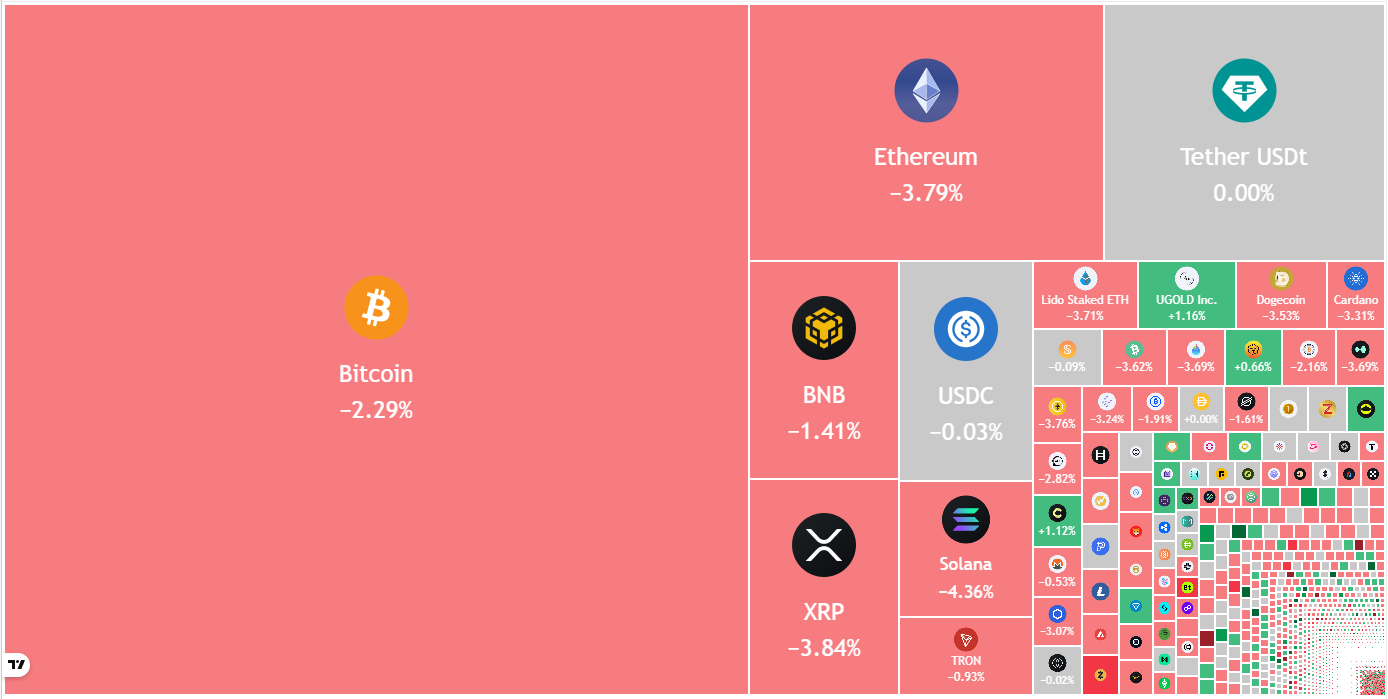
Bitcoin continues to face selling on minor rallies, indicating a negative sentiment.
-
Several altcoins have turned down from the overhead resistance levels, indicating the bears are active at higher levels.
Bitcoin (BTC) continues to face selling on rallies, with bears attempting to sink the price below $66,000. However, some analysts believe the downside may be limited.
Analyst Willy Woo said in a post on X that the selling may have exhausted and BTC is likely to enter a period of consolidation. He expects the rebound to be rejected in the mid $70,000 level. Woo anticipates the bearish trend to end in Q4 of this year and the bullish momentum to begin in Q1 or Q2 2027.
Another positive sign in favor of the bulls is that BTC exchange-traded funds have started attracting investors. The BTC ETFs have recorded $1.01 billion in inflows since Tuesday, according to SoSoValue data.

Analysts also expect Ether (ETH) to remain sideways for some time. Swyftx lead analyst Pav Hundal told Cointelegraph on Thursday that ETH may remain “subdued over the next few weeks” and in the medium term may test even “the most experienced investors.”
Could BTC and select major altcoins hold on to their support levels? Let’s analyze the charts of the top 10 cryptocurrencies to find out.
Bitcoin price prediction
BTC’s relief rally is facing selling at the 20-day exponential moving average (EMA) ($68,895), indicating a negative sentiment.

The BTC/USDT pair has formed a symmetrical triangle, which usually acts as a continuation pattern. If the Bitcoin price continues lower and breaks below the support line, it puts the $60,000 level at risk of breaking down. If that happens, the pair may plunge to the next major support at $52,500.
The first sign of strength will be a close above the resistance line. The pair may then rally to the breakdown level of $74,508. This is a crucial level for the bears to defend, as a close above $74,508 suggests that the price may have bottomed out at $60,000.
Ether price prediction
Buyers pushed ETH above the $2,111 resistance on Wednesday but could not sustain the breakout.

The Ether price has turned down sharply from the $2,111 resistance, indicating that the bears are vigorously defending the level. That suggests the ETH/USDT pair may extend its stay inside the $1,750 to $2,111 range for a while.
The next trending move is expected to begin on a close above $2,111 or below $1,750. If the $1,750 level cracks, the next stop is likely to be $1,537. Alternatively, a close above $2,111 might thrust the pair toward the 50-day simple moving average (SMA) ($2,494).
XRP price prediction
XRP (XRP) remains stuck between the 20-day EMA ($1.44) and the support line of the descending channel pattern.

Sellers will attempt to sink the XRP price below the support line, but are likely to encounter solid resistance from the bulls. If the price bounces off the support line with strength, the bulls will again try to push the XRP/USDT pair above the 20-day EMA. If they succeed, the pair may rally to the 50-day SMA ($1.67) and then to the downtrend line.
Contrarily, a break and close below the support line puts the Feb. 6 low of $1.11 at risk of breaking down. The pair may then tumble to the psychological support at $1.
BNB price prediction
Sellers are attempting to halt BNB’s (BNB) recovery at the 20-day EMA ($638), but the bulls have kept up the pressure.

That shows a greater potential for a possible breakout above the 20-day EMA in the near term. The BNB/USDT pair may rally to $669 and subsequently to the breakdown level of $730.
This bullish view will be negated in the near term if the price turns down sharply from the 20-day EMA and breaks below the $570 support. That signals the resumption of the downtrend toward the psychological support at $500.
Solana price prediction
Solana (SOL) rose above the 20-day EMA ($86) on Wednesday, but the bears halted the recovery at the $95 level.

Sellers have pulled the price below the 20-day EMA, opening the gates for a drop to the $75 level. If the price rebounds off the $75 level with strength, it suggests that the bulls are trying to form a higher low. The SOL/USDT pair may then consolidate between $75 and $95 for a few days.
Contrary to this assumption, a close below the $75 level suggests that the bears remain in control. The Solana price may then plummet to the Feb. 6 low of $67.
Dogecoin price prediction
Dogecoin (DOGE) broke above the 20-day EMA ($0.10) on Wednesday, but the bulls could not sustain the higher levels.

Sellers will attempt to pull the Dogecoin price below the $0.09 support. If they can pull it off, the DOGE/USDT pair may retest the Feb. 6 low of $0.08. A strong rebound off the $0.08 level signals a possible range formation. The pair may swing between $0.08 and $0.12 for some time.
The bulls will be back in the driver’s seat after they thrust the price above the $0.12 resistance. That opens the doors for a rally to $0.16.
Bitcoin Cash price prediction
Buyers pushed Bitcoin Cash (BCH) above the $500 level on Wednesday and Thursday, but the long wick on the candlesticks shows selling at higher levels.

Sellers will attempt to sink the Bitcoin Cash price to the solid support at $443, which is a critical support to watch out for. If the price closes below $443, the BCH/USDT pair will complete a bearish head-and-shoulders pattern. That may start a new downtrend toward $380.
Buyers will have to swiftly push the price above the moving averages to prevent the downside. If they do that, the pair may march toward $580.
Related: Bitcoin to $30K? Analysts debate when and at what price BTC will bottom
Hyperliquid price prediction
Hyperliquid (HYPE) has been trading inside a large range of $20.82 to $36.77 for the past few days.

The flattening moving averages and the relative strength index (RSI) near the midpoint do not give a clear advantage either to the bulls or the bears. If the price sustains above the 20-day EMA ($29.07), the HYPE/USDT pair may rise to $32.50 and later to the stiff overhead resistance of $36.77.
On the downside, the bears will have to tug the Hyperliquid price below the $25.62 support to gain the upper hand. That clears the path for a drop to the solid support at $20.82. A break above $36.77 or below $20.82 is likely to start the next trending move.
Cardano price prediction
Cardano (ADA) cleared the 20-day EMA ($0.28) hurdle on Wednesday, but the bulls could not pierce the 50-day SMA ($0.31).

A positive sign in favor of the bulls is that they are attempting to arrest the pullback at the 20-day EMA. If the price turns up from the 20-day EMA, buyers will make another attempt to overcome the barrier at the downtrend line. If they succeed, the ADA/USDT pair may rally toward $0.44. Such a move suggests a short-term trend change.
Instead, if the Cardano price breaks and closes below the 20-day EMA, it indicates that the bears are active at higher levels. That may keep the pair inside the descending channel for some more time.
Chainlink price prediction
Chainlink (LINK) broke above the 20-day EMA ($9) on Wednesday, but the bulls are struggling to sustain the higher levels.

Sellers will attempt to pull the Chainlink price to the solid support at $8. Buyers are expected to defend the $8 level with all their might, as a close below it might sink the LINK/USDT pair to the Feb. 6 low of $7.15.
This negative view will be invalidated in the near term if the price turns up and closes above the 20-day EMA. The bulls will then attempt to propel the pair to the $10.94 to $11.61 overhead resistance zone.
This article does not contain investment advice or recommendations. Every investment and trading move involves risk, and readers should conduct their own research when making a decision. While we strive to provide accurate and timely information, Cointelegraph does not guarantee the accuracy, completeness, or reliability of any information in this article. This article may contain forward-looking statements that are subject to risks and uncertainties. Cointelegraph will not be liable for any loss or damage arising from your reliance on this information.


Pi ecosystem tokens prioritize utility and user acquisition over speculative fundraising, debuting from Testnet to Mainnet rollout.
Summary
- Pi ecosystem tokens are community-created assets on the Pi blockchain, already live on Testnet and nearing Mainnet deployment.
- Tokens must support working products, with launch programs using them for user acquisition and in‑app utility instead of capital raising.
- Pi’s model aims to hold projects accountable, letting weak apps phase out while Web3 tools reduce the cost of building user engagement.
Pi (PI) Network has announced the incorporation of ecosystem tokens on its Mainnet, with co-founder Chengdiao Fan detailing the initiative’s structure and objectives in a video presentation, according to reports from cryptocurrency news outlets.
The new assets are tokens created by community members and issued on the Pi blockchain, Fan stated. The tokens have been released on the Testnet, with their Mainnet launch currently in final stages, according to the announcement.
Fan addressed the design framework for the new tokens, stating that a misalignment exists between token design and innovation in the broader cryptocurrency market. “Tokens on most other crypto networks function primarily as tools to raise capital. Yet, despite this approach, most projects frequently fail to provide real utility and innovation,” Fan said in the video, characterizing the issue as a structural problem.
The co-founder described Pi Network’s approach as focused on integrating cryptocurrency tokens for products and innovations, with an emphasis on utility as a driver for long-term stability and success for blockchain projects.
According to Fan, the tokens are designed to enable projects to acquire users for their products through Pi launch programs. “Projects issue tokens to fulfill the need to acquire users for their products and integrate these tokens for utility-based use cases inside their products,” Fan explained.
Users will receive access to the tokens through the launch programs and will be able to utilize them within products, according to the announcement. Fan noted that developing user-engaging programs within a startup ecosystem typically represents a lengthy and expensive process, but stated that costs can be reduced through Web3 tools from Pi Network, including the ecosystem tokens.
The framework allows users to hold products accountable for their services, Fan said, adding that this structure ensures value for users as underperforming products would naturally phase out over time.
“Pi ecosystem tokens are not about copying existing token models. In fact, we have deliberately sought to avoid the traditional approach. Because many of the problems in Web3 stem from how tokens have been traditionally designed. And this design will also evolve as it gets iterated in practice,” Fan stated.
The announcement comes as Pi Network continues to develop its ecosystem amid ongoing discussions within its online community regarding project development timelines.
Pi trades near $0.17, roughly -91% below its $2.99 all‑time high, after slipping about -8% over the past week despite a modest -0.6% 24h move and ~$15m in daily volume; with Mainnet upgrades, migration, and validator rewards ramping into early March, price action into March 1 will likely hinge on whether this bullish-flag structure resolves higher toward the $0.20–$0.21 resistance zone or fades back toward the $0.15 support area as traders reassess the upgrade timeline and on-chain positioning.
TruStage pilots TSDA runs through H1 2026, leveraging GENIUS Act-driven stablecoin growth and $2t cap forecasts.
Summary
- TSDA is a dollar-pegged stablecoin with 1:1 cash reserves for U.S. credit unions.
- Pilot runs through H1 2026, focusing on loans, P2P, cross-border and inter-union settlement use cases.
- GENIUS Act and forecasts of a $2t stablecoin market by 2028 frame TSDA’s regulatory and macro backdrop.
TruStage has announced a pilot program for a dollar-pegged stablecoin targeting US credit unions, representing one of the sector’s largest coordinated efforts to test blockchain-based payments infrastructure, according to the company.
The TruStage Stablecoin, designated as TSDA, will be issued through a partnership with Block Time Financial. A TruStage affiliate will serve as issuer and manage one-to-one cash reserves backing the token, while Block Time will provide operational support, including security protocols and digital account capabilities, the company stated.
The pilot program is scheduled to run through the first half of 2026, with TruStage recruiting credit unions to participate. The company said TSDA is designed for loan funding and settlement, peer-to-peer transfers, cross-border payments and inter-credit union disbursements.
TruStage, founded in 1935, works with approximately 93 percent of US credit unions, offering insurance, retirement and investment products tailored to the sector. Company executives said interest in stablecoin solutions has accelerated following passage of the GENIUS Act, which established federal standards for stablecoin issuers.
Lawmakers continue debating broader crypto market structure legislation, with some banking and credit union groups raising concerns that yield-bearing stablecoins could draw deposits away from traditional accounts, according to industry reports.
Analysts at Standard Chartered have projected total stablecoin market capitalization could reach $2 trillion by 2028, potentially increasing demand for US Treasury securities that often back dollar-linked tokens.


OCC’s GENIUS Act rule drafts 100%‑reserved payment stablecoin regime, tightening oversight.
Summary
- Draft rule covers full payment stablecoin lifecycle: issuance, reserves, supervision, and wind-down procedures.
- Only authorized GENIUS-compliant issuers may serve U.S. users, with 1:1 reserve, capital, liquidity, audit, and custody standards.
- OCC and NCUA gain direct authority over bank, credit union, and some foreign issuers, while BSA/OFAC rules follow in separate Treasury action.
The Office of the Comptroller of the Currency released draft regulations Wednesday outlining how payment stablecoins would be issued, backed, and supervised under federal oversight, according to the agency’s notice of proposed rulemaking.
The OCC opened a 60-day public comment period to operationalize the GENIUS Act for stablecoin issuance, seeking feedback on the full lifecycle of a payment stablecoin from launch and reserve management to supervision and potential wind-down procedures.
The proposal implements the Guiding and Establishing National Innovation for U.S. Stablecoins Act, known as the GENIUS Act, which became effective in July and established the first federal stablecoin framework in the United States. The statute permits only authorized payment stablecoin issuers to issue payment stablecoins domestically and prohibits digital asset service providers from offering non-compliant stablecoins to U.S. users.
The draft regulations establish reserve asset standards requiring redemption at par, along with liquidity and risk controls, audits, supervisory examinations, and custody rules. The proposal outlines application pathways for new issuers, introduces capital and operational requirements, and updates portions of the OCC’s capital adequacy and enforcement framework.
The agency stated it would have regulatory or enforcement authority over certain permitted payment stablecoin issuers, including subsidiaries of national banks and federal savings associations, federally qualified issuers, and some state-qualified issuers. The draft extends oversight to foreign payment stablecoin issuers seeking access to American users.
Bank Secrecy Act and sanctions requirements will be addressed separately in coordination with the Treasury Department, according to the notice.
Banking groups have raised concerns about potential deposit outflows to third-party yield products tied to stablecoins. OCC Chief Jonathan Gould stated that any material outflow would be visible and would not occur overnight, according to the agency. Gould noted that the requirement for 100% reserves to support one-to-one redemptions exceeds typical bank capital ratios. In an extreme scenario, the Federal Reserve could serve as an indirect backstop by supporting reserve assets stablecoins hold, including U.S. Treasuries and cash equivalents, according to the proposal.

Arbitrum price nears historic low, traders eye long-term rebound

Macklin Celebrini’s father on gold-medal loss: ‘It’s fuel’
5 Of The Best Soldering Irons For Electronics


-

 Politics6 days ago
Baftas 2026: Awards Nominations, Presenters And Performers
-

 Sports4 days ago
Women’s college basketball rankings: Iowa reenters top 10, Auriemma makes history
-

 Fashion8 hours ago
Weekend Open Thread: Iris Top
-

 Politics4 days ago
Nick Reiner Enters Plea In Deaths Of Parents Rob And Michele
-

 Business3 days ago
True Citrus debuts functional drink mix collection
-

 Politics1 day ago
ITV enters Gaza with IDF amid ongoing genocide
-

 Crypto World4 days ago
XRP price enters “dead zone” as Binance leverage hits lows
-

 Business6 days ago
Mattel’s American Girl brand turns 40, dolls enter a new era
-

 Business5 days ago
Law enforcement kills armed man seeking to enter Trump’s Mar-a-Lago resort, officials say
-

 NewsBeat2 days ago
Cuba says its forces have killed four on US-registered speedboat | World News
-
 NewsBeat2 days ago
Manchester Central Mosque issues statement as it imposes new measures ‘with immediate effect’ after armed men enter
-

 Tech3 days ago
Unsurprisingly, Apple's board gets what it wants in 2026 shareholder meeting
-
 NewsBeat5 days ago
‘Hourly’ method from gastroenterologist ‘helps reduce air travel bloating’
-

 Tech5 days ago
Anthropic-Backed Group Enters NY-12 AI PAC Fight
-

 NewsBeat5 days ago
Armed man killed after entering secure perimeter of Mar-a-Lago, Secret Service says
-

 Politics5 days ago
Maine has a long track record of electing moderates. Enter Graham Platner.
-

 Business2 days ago
Discord Pushes Implementation of Global Age Checks to Second Half of 2026
-
 NewsBeat3 days ago
Police latest as search for missing woman enters day nine
-

 Business1 day ago
Only 4% of women globally reside in countries that offer almost complete legal equality
-
 Sports5 days ago
2026 NFL mock draft: WRs fly off the board in first round entering combine week