

Crypto World
Minnesota Moves to Fully Ban Crypto ATMs With New 2025 House Bill


TLDR:
- Minnesota HF3642 would make it illegal for anyone to place or operate a crypto ATM in the state.
- The bill repeals Sections 53B.70–53B.75, erasing all existing kiosk licensing and compliance rules.
- New customers currently get full fraud refunds within 72 hours — a protection the ban would eliminate.
- Minnesota could become one of the first U.S. states to outright ban virtual currency kiosks entirely.
Virtual currency kiosks in Minnesota face a complete ban under proposed legislation introduced in the 2025–2026 session.
House File 3642 targets all crypto ATM operations in the state. The bill would prohibit any person from placing or operating a virtual currency kiosk in Minnesota.
It also seeks to repeal existing statutes that currently govern kiosk licensing, disclosures, transaction limits, refunds, and compliance requirements. This move marks a dramatic policy shift for the state.
What the Bill Proposes
Minnesota HF3642 introduces a straightforward and sweeping prohibition. Under the proposed Section 53B.691, no person may place or operate a virtual currency kiosk anywhere in Minnesota. The language of the bill leaves no room for exceptions or conditional approvals.
The bill also adds a new subdivision to Section 53B.69 to define terms specifically for the prohibition. This addition provides the legal framework needed to enforce the new ban effectively. It connects existing definitions in state law to the incoming restriction.
Beyond the ban itself, the legislation proposes a full repealer of Sections 53B.70 through 53B.75. These sections currently regulate kiosk operators through licensing, consumer disclosures, and transaction limits.
Their removal would erase the entire regulatory structure that governs crypto ATMs in the state today.
What Current Law Requires of Kiosk Operators
Under existing Minnesota statutes, virtual currency kiosk operators must follow strict disclosure rules. Before any transaction, operators must display all material risks on the kiosk screen for the customer to acknowledge.
These include warnings about price volatility, irreversible transactions, and potential fraud schemes.
Current law also requires operators to display a bold warning about scams. The warning specifically addresses fraudsters impersonating loved ones or government officials. It advises consumers that losses from fraudulent transactions cannot be recovered.
Transaction limits are also part of the existing framework. New customers face a maximum daily transaction limit of $2,000.
Existing customers, defined as those who have transacted for more than 72 hours, are subject to limits set by individual operators in line with federal law.
Refund Rules and Consumer Protections at Stake
Minnesota’s current law offers a refund pathway for new customers who fall victim to fraud. Under Section 53B.75, operators must refund the full transaction amount if a new customer was fraudulently induced.
The customer must contact the operator and a government or law enforcement agency within 14 days.
This protection applies strictly within the 72-hour new customer window. After that period, a customer transitions to “existing customer” status under Section 53B.69. At that point, the full refund obligation no longer applies.
If HF3642 passes, all of these consumer protections would be repealed along with the ban. There would be no licensed operators left to hold accountable, and no regulatory structure to enforce compliance.
Consumers who previously relied on these protections would lose that safety net entirely.
Industry and Regulatory Outlook
The bill’s passage would make Minnesota one of the few states to outright ban crypto ATM operations. Most states have moved toward regulation rather than prohibition. The trend across the country has been to tighten oversight, not eliminate it entirely.
For operators currently licensed in Minnesota, the bill represents a direct threat to existing business models. Many operators have invested in compliance infrastructure to meet the state’s existing requirements. A full ban would render that investment worthless.
The bill is now in the legislative process and has not yet been signed into law. Stakeholders across the crypto industry are expected to monitor its progress closely.
Its outcome could influence how other states approach virtual currency kiosk legislation going forward.

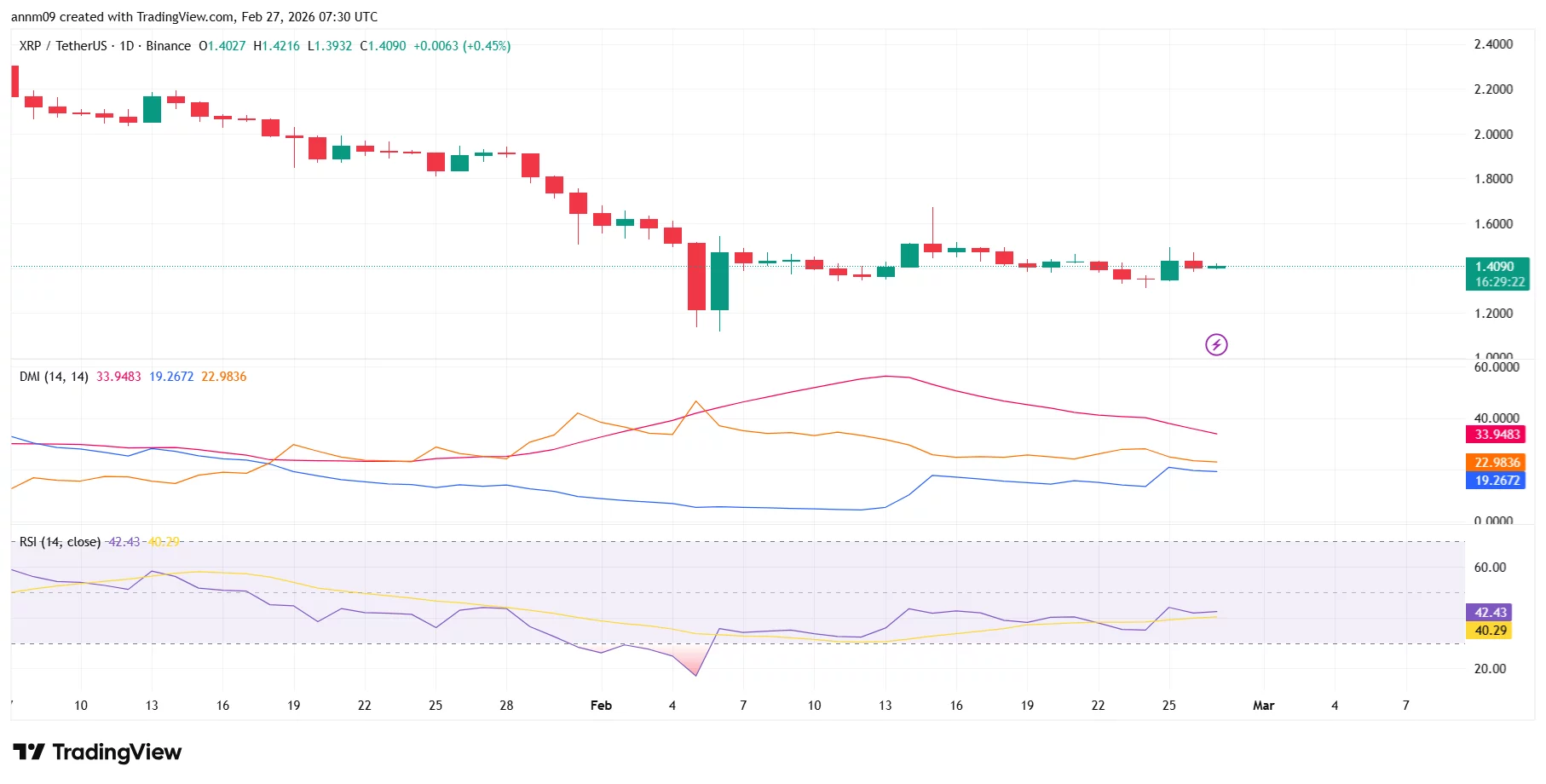
Ripple’s latest funding push for the XRP Ledger is drawing renewed attention to XRP, with traders closely watching whether the ecosystem expansion can translate into sustained price momentum.
Summary
- Ripple boosts XRPL funding: New grants and investments aim to accelerate DeFi, tokenization, and enterprise adoption.
- XRP consolidating near $1.40: Price remains range-bound between $1.35 and $1.50 after February volatility.
- Breakout level to watch: A move above $1.50–$1.60 could signal bullish continuation, while $1.35 remains key support.
While the Ripple token (XRP) remains range-bound near $1.40, the announcement might reinforce bullish long-term sentiment around the network’s growth prospects.
In a recent blog post, Ripple detailed expanded financial backing for developers building on the XRP Ledger (XRPL), including grants and strategic investments targeting compliance-first DeFi, real-world asset (RWA) tokenization, and enterprise-grade blockchain solutions.
The initiative is designed to deepen liquidity, expand institutional participation, and strengthen core infrastructure.
By prioritizing regulated DeFi applications and tokenization frameworks, Ripple is positioning XRPL as a scalable, enterprise-ready network aligned with global financial standards. The move shows Ripple’s strategy of pairing institutional partnerships with grassroots developer growth, a combination that could enhance long-term demand for XRP as a utility asset within the ecosystem.
XRP price analysis
XRP is currently trading around $1.40, up modestly on the day, as price action consolidates following a sharp early-February decline that briefly drove the token toward $1.20 before a rebound.
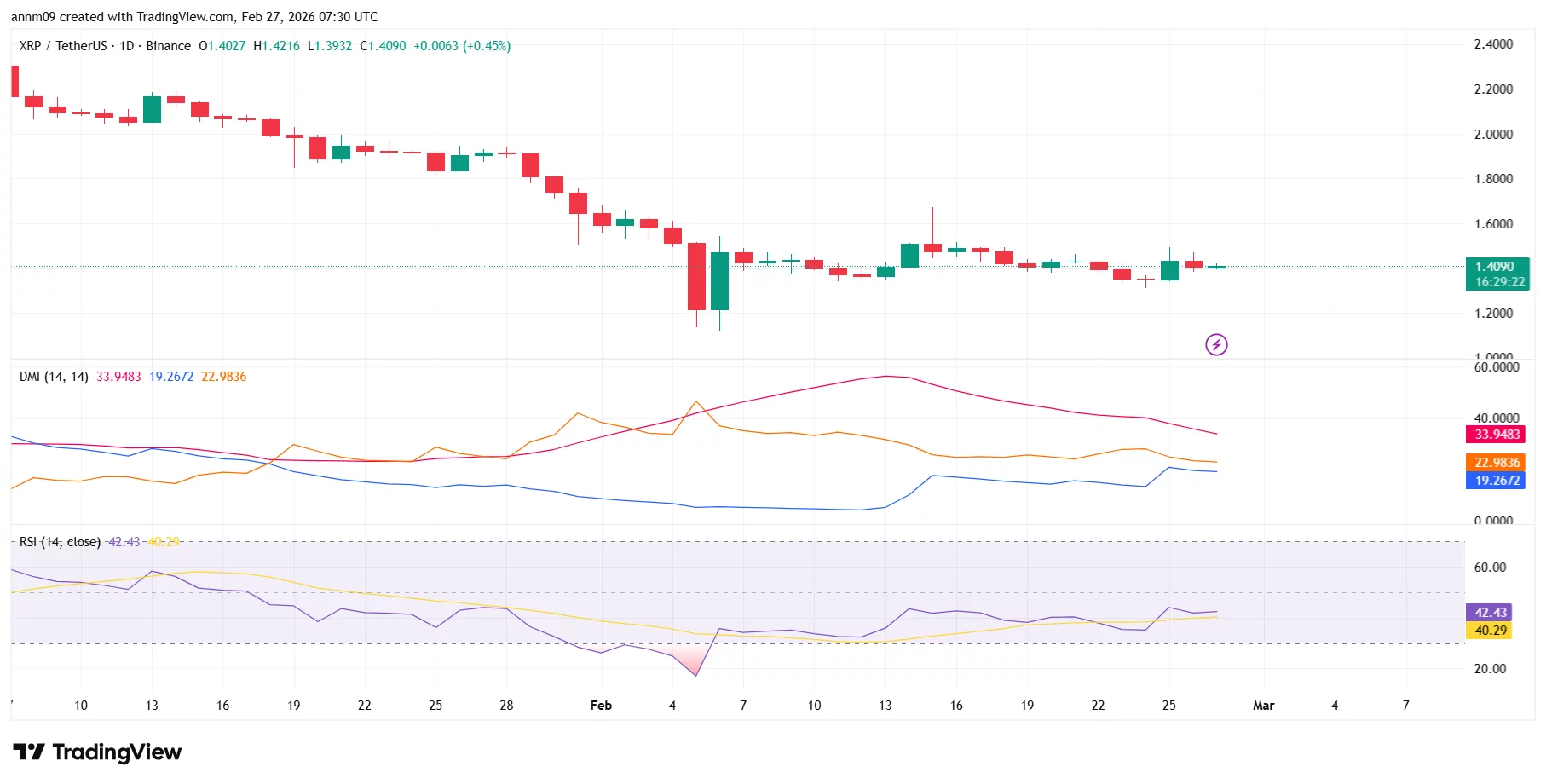
Since that capitulation move, XRP has traded within a tight $1.35–$1.50 range, signaling potential accumulation. Immediate resistance stands near $1.50, with a stronger ceiling around $1.60, where prior rejection occurred.
A confirmed breakout above $1.60 could open the door toward $1.80. On the downside, key support remains at $1.35, followed by the psychological $1.20 level.
Meanwhile, the RSI (14) sits near 42, below the neutral 50 mark, indicating subdued bullish momentum but no longer oversold conditions. Meanwhile, the DMI shows the negative trend line still leading, though the gap is narrowing, suggesting bearish pressure may be weakening.
A decisive move above $1.50, particularly on rising volume, would be needed to confirm a bullish shift.
Bitcoin (BTC) sellers returned on Friday, pulling BTC price 5.5% below Wednesday’s high of $70,000 to trade at $65,950 at the time of writing. Several analysts said Bitcoin is “going much lower,” potentially reaching a bottom during the last quarter of 2026.
Key takeaways:
-
Analysts forecast BTC price to hit a bottom in Q4 based on various technical and onchain metrics.
-
Rising exchange reserves and “supply in profit” falling to 2022 lows suggest further downside pressure.
Analysts say Bitcoin price will bottom after June
According to multiple analysts, Bitcoin could extend its downtrend, possibly reaching as low as $30,000 to $45,000 during the last quarter of the year.
Related: Bitcoin’s five-month losing streak may not end in March as $70K caps price
The shortest bear market lasted 365 days, and “Bitcoin is currently about 140 days into its current bear market,” crypto trader Darky said in a Friday post on X, adding:
“We are going much lower, just a matter of time.”
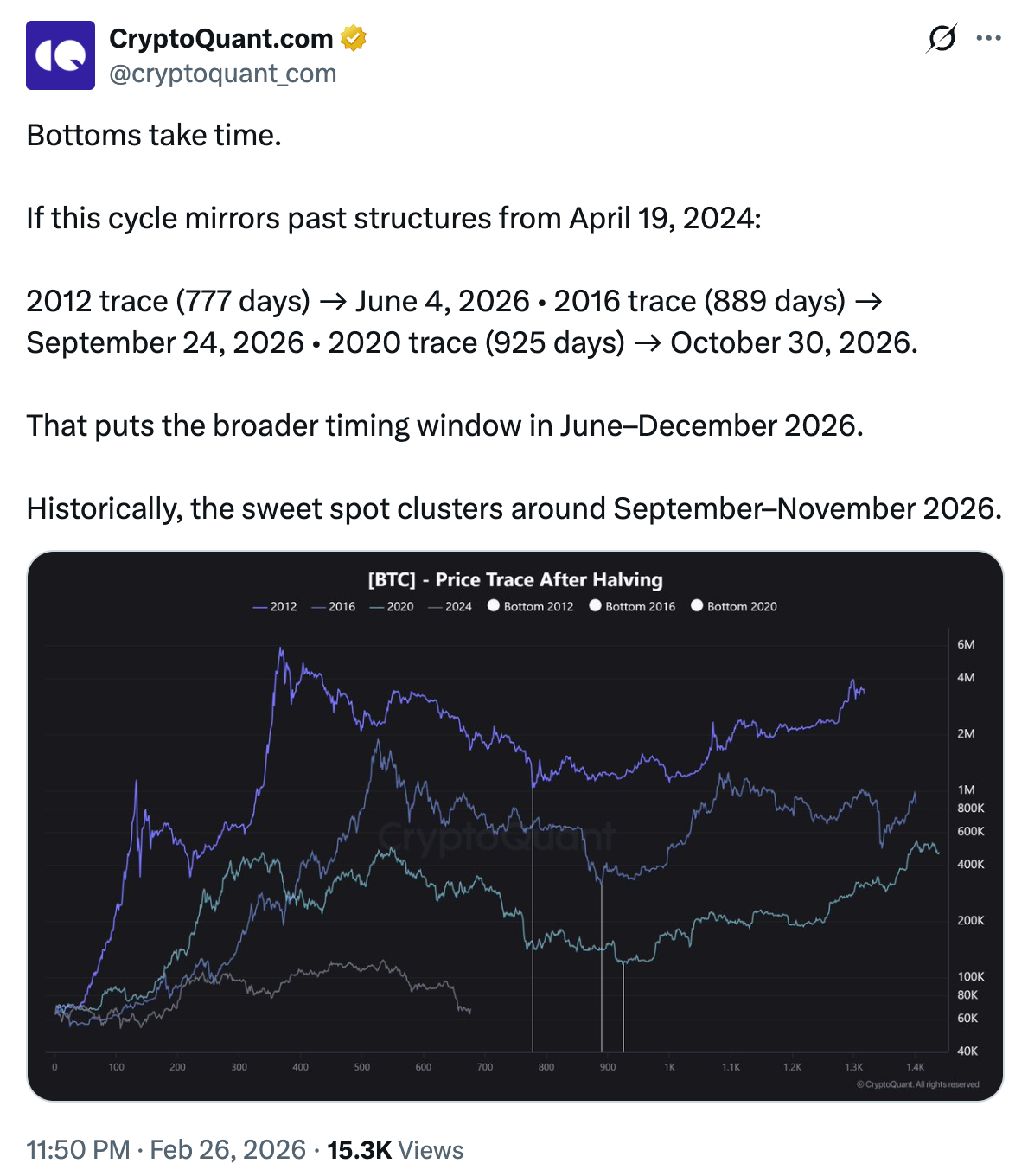
Onchain data provider CryptoQuant said “bottoms take time” to form, and that Bitcoin could reach its cycle lows between “June and December,” based on previous post-halving price structures.
“Historically, the sweet spot clusters around September–November 2026.”

Fellow analyst Batman said that previous bear cycles printed their lows 365 and 396 days after the market top.
Bitcoin’s current all-time high of over $126,000 was reached on Oct. 2, 2025, and “adding 365 to 396 days puts us around October to November 2026,” Batman said, adding:
“So whatever price we get by then, I think it’s fair to say it will be a no-brainer buy.”
Meanwhile, the Bitcoin “supply in profit” metric has dropped to levels last seen at the depths of the 2022 bear market, according to data from CryptoQuant.
In 2022, the bottom phase lasted for about six months.
Overlaying the exact downward price action from that period onto the current chart, it aligns with the -70% to -75% drawdown range projected for the fifth cycle.
This suggests that Bitcoin could drop further from current levels, possibly bottoming between $31,500 and $38,000 six months from now.

On-Chain College shared a chart showing that Bitcoin broke below its Long-Term Holder True Cost Basis at $65,700 and needed to reclaim it as support.
Cost basis levels act as psychological pivots, and when the price trades below them, investors face unrealized losses and the risk of distribution increases.
A sustained position below the band tends to increase investor stress and encourages BTC capitulation.
“History would suggest that Bitcoin is due for a trip down to $42K or lower.”

As Cointelegraph reported, many analysts expect 2026 to be a bear market year, and various forecasts predict the BTC price dropping to as low as $40,000.
Bitcoin supply on exchanges keeps rising
Onchain data from CryptoQuant shows Bitcoin balance on exchanges has grown to 2.752 million BTC from 2.723 million in mid-January. This represents a total increase of about 28,489 BTC (+1.0%) over 45 days.
Increasing BTC supply on exchanges is a classic bearish signal that can outpace demand.
“Until the reserve turns lower and breaks back below 2.723M BTC, structural selling pressure remains intact,” analyst Axel Adler Jr. said in a recent analysis, adding:
“The key trigger for a regime change is a sustained decline in the reserve below the January lows.”

This article does not contain investment advice or recommendations. Every investment and trading move involves risk, and readers should conduct their own research when making a decision. While we strive to provide accurate and timely information, Cointelegraph does not guarantee the accuracy, completeness, or reliability of any information in this article. This article may contain forward-looking statements that are subject to risks and uncertainties. Cointelegraph will not be liable for any loss or damage arising from your reliance on this information.
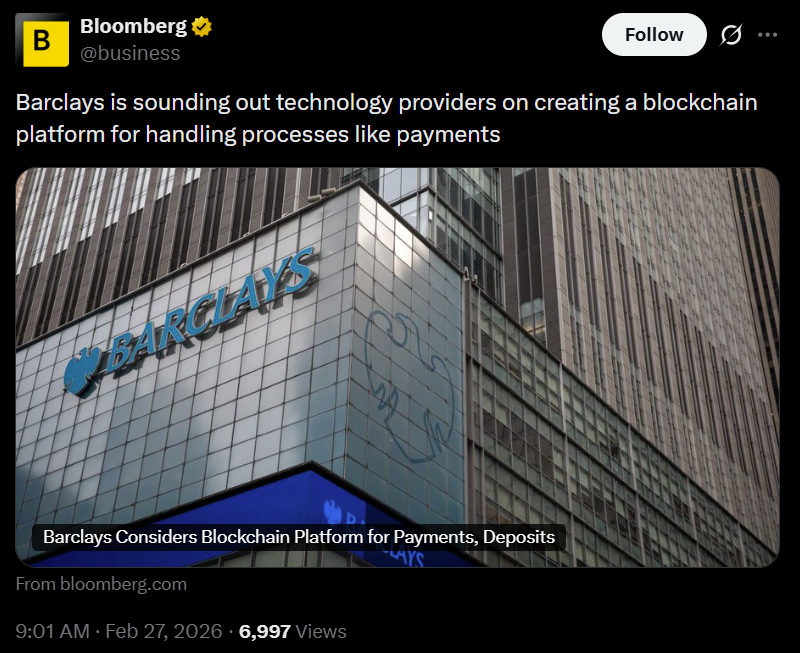
UK banking giant Barclays is reportedly exploring blockchain technology for core banking services, the latest sign that major financial institutions are evaluating digital ledger infrastructure to modernize legacy systems.
Citing people familiar with the matter, Bloomberg reported Friday that Barclays is seeking technology providers for a blockchain platform capable of handling payments, deposits and crypto-related applications such as stablecoins and tokenized deposits.
The lender has issued requests for information to several technology suppliers, though the companies were not identified. A vendor selection could be made as early as April, the report said.

The move would align with Barclays’ recent activity in the digital asset space. As Cointelegraph reported last month, the bank made its first stablecoin-related investment in Ubyx, a US-based stablecoin clearing platform, signaling a growing interest in tokenized payment infrastructure.
Separate reports have also suggested that Barclays may play a role in a potential initial public offering by crypto hardware company Ledger, though that involvement has not been confirmed.
Related: Wall Street’s crypto debate is over as banks go all-in on BTC, stablecoins, tokenized cash
Banks and Big Tech accelerate stablecoin push
Bloomberg framed Barclays’ reported blockchain initiative within a broader push by banks and technology companies to evaluate stablecoins, which enable faster, lower-cost and around-the-clock settlement compared to traditional payment rails.
Interest in stablecoins has accelerated as institutions explore tokenized deposits and onchain payment systems that could streamline cross-border transfers and reduce reliance on intermediaries.
The shift isn’t limited to banks. Meta Platforms is reportedly revisiting its stablecoin ambitions years after shelving its high-profile Diem project, signaling renewed Big Tech interest in blockchain-based payments.
For traditional lenders such as Barclays, stablecoins present both an opportunity and a competitive risk. If widely adopted, privately issued digital dollars could weaken banks’ control over deposits and payment flows, two pillars of their business model.

The debate is especially relevant in the United States, where lawmakers are weighing market structure and stablecoin legislation, including discussions around whether issuers should be permitted to offer rewards.
Even without yield-bearing features, however, large-scale stablecoin adoption could shift liquidity away from traditional bank deposits and into tokenized alternatives.
Related: Modern Treasury integrates stablecoin settlement alongside ACH and wires
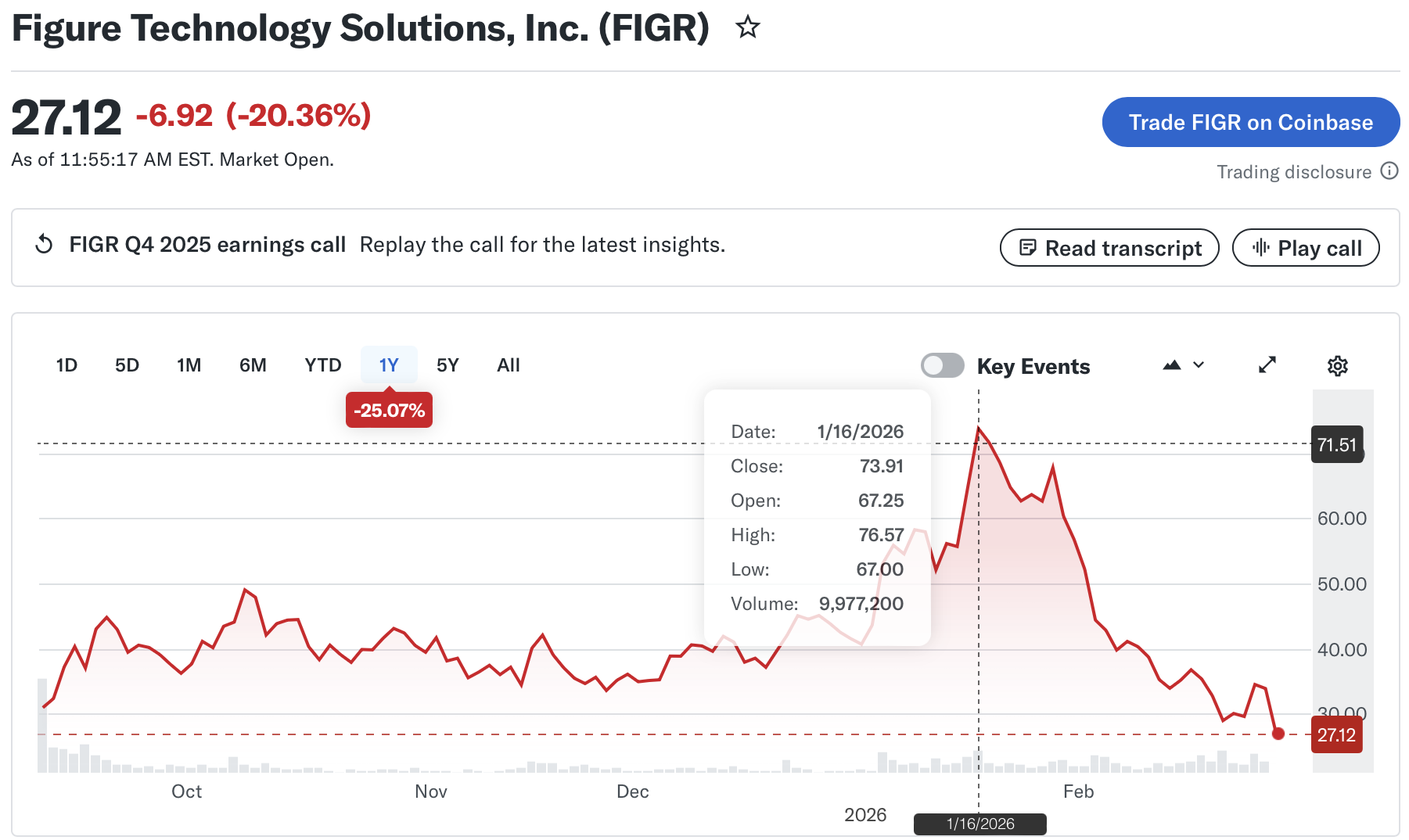
Shares of Figure Technology Solutions, a blockchain-based consumer lending marketplace, plunged on Friday after the company reported mixed fourth-quarter results the prior day, signaling a more difficult operating environment even as revenue continued to climb.
For the quarter ended Dec. 31, the company posted revenue of $159.9 million, up from $83.9 million a year earlier, and net income of $15.1 million, compared with $5.9 million in the same period of 2024. Earnings were $0.06 per diluted share, compared to zero a year earlier.
Analysts polled by Yahoo Finance expected earnings of $0.18 per share on revenue of $157.7 million.
Growth was driven by increased lending activity. Consumer Loan Marketplace volume, which reflects total loans originated and traded on the platform, reached $2.7 billion during the quarter, up from $1.2 billion a year earlier.
For the full year, net income totaled $134.3 million, up from $19.9 million in 2024, while revenue reached $506.9 million, compared with $340.9 million a year earlier.
The company also authorized a share repurchase program allowing it to buy back up to $200 million of its stock over the next 12 months.
Shares fell about 20% to $27.12 in morning trading on Friday following the earnings release.

Related: Figure Technology unveils blockchain platform for direct stock lending: Report
Crypto stocks surged in 2025 before retracing
Figure began trading on the Nasdaq in September after pricing its initial public offering at $25 per share, raising nearly $800 million. The stock rose more than 24% on its first day of trading and climbed to a high near $74 in January, before retreating.
Figure’s post-IPO trajectory mirrors volatility seen across other crypto-linked equities, many of which rallied sharply in late 2025 before surrendering gains amid the broader crypto market pullback.
Shares of crypto exchange Gemini Space Station (GEMI) surged on its Nasdaq debut on Sept. 12 after pricing its IPO at $28 per share. The stock briefly topped $40 on its first day of trading, but has since fallen to around $5.94, at the time of writing.

Stablecoin issuer Circle also experienced a volatile debut. The company went public on June 5, after upsizing its IPO to $1.05 billion, selling 34 million shares at $31 each, above its initial target of 24 million shares priced between $24 and $26.
In its first day of trading, Circle’s shares surged 167%, opening at $69 and climbing as much as 235% intraday before closing at $82. The stock later reached an all-time high of $263.45 on May 25, then retraced nearly 70% to around $83, per Yahoo Finance data.

Magazine: Would Bitcoin really be at $200K if not for Jane Street? Trade Secrets


The White House pushed for a breakthrough on stablecoin yield negotiations for the CLARITY Act this weekend. It did not happen. Instead, fresh reports from sources close to the talks suggest the crypto market structure bill remains far from a final deal.
Banking representatives and crypto lobbyists are still divided over whether stablecoins can generate yield for users. That dispute continues to block progress in the Senate.
The CLARITY Act Nowhere Near a Resolution?
According to Eleanor Terrett, banking-side sources described the negotiations bluntly. Draft language exists, but the sides are “not close.”
Other banking trade groups pushed back on claims the talks are collapsing, saying discussions are ongoing and input on draft text continues.
The split narrative reflects how fragile the negotiations have become.
Where the Bill Stands Now
The House passed the CLARITY Act in July 2025 with bipartisan support. The bill aims to define when digital assets fall under SEC oversight and when they qualify as commodities under the CFTC. It also establishes registration rules for exchanges, brokers, and custodians.
After clearing the House, the bill moved to the Senate Banking Committee. There, it stalled.
No markup has been completed. No floor vote is scheduled.
The legislation remains stuck in committee.
Stablecoin Yield Is the Flashpoint
Originally, the bill focused on regulatory clarity between the SEC and CFTC. But in early 2026, the fight shifted to stablecoins.
Senate negotiators introduced draft language that would restrict interest or yield payments tied to stablecoin holdings. Banks support tighter limits. They argue that yield-bearing stablecoins could function like unregulated bank deposits.
Crypto firms strongly oppose that view. Coinbase CEO Brian Armstrong has publicly argued that stablecoins can generate yield responsibly and that banning rewards would harm innovation.
That disagreement now threatens the broader market structure framework.
White House Pressure, But No Breakthrough
The White House has convened meetings between banks and crypto firms in recent weeks. Officials reportedly wanted a deal on yield before March.
However, sources say key language remains unresolved.
Bank trade groups such as the American Bankers Association and the Independent Community Bankers of America have reportedly rejected claims that negotiations are collapsing. Still, there is no finalized text.
What Is Still Unresolved
Four core issues remain:
- Whether stablecoin rewards count as prohibited interest
- How sharply to limit exchange incentives
- The final boundary between SEC and CFTC authority
- The scope of obligations for DeFi developers
Until yield language is settled, broader market structure reforms cannot move forward.
When Will the CLARITY Act Pass?
The next key step is a Senate Banking Committee markup. No date has been announced.
If negotiators narrow differences in March, a committee vote could follow later in the month. If talks drag on, the bill risks slipping deeper into election-year politics.
For now, the CLARITY Act remains alive — but stalled.
The question is no longer whether Congress wants crypto rules. It is whether banks and crypto firms can agree on who controls stablecoin economics.


ARB is trading ~96% below its 2024 ATH, with analysts framing current demand-zone compression as a potential long-term accumulation phase for a future trend reversal.
Summary
- ARB sits near historic lows, roughly 96% below its 2024 peak and at major wick support in a multi‑year descending channel.
- Price is compressing in a high‑timeframe demand block, with volume absorption signaling weakening sell pressure and possible Wyckoff‑style accumulation.
- Traders watch two key resistance levels for structure confirmation; a breakdown below invalidation would void the accumulation thesis.
Arbitrum’s (ARB) native token is trading near historic lows following a prolonged decline from its 2024 peak, with technical analysts identifying the current price level as a potential long-term entry point, according to market analysis.
The token reached its all-time high in 2024 before entering a sustained downtrend. The asset now trades at approximately 96% below its peak, positioned within what analysts describe as a high-timeframe demand block, according to technical chart analysis.
One market analyst noted the token is positioned at the bottom of a multi-year descending channel inside a high-timeframe demand block. The level holds historical significance, with prior capitulation wicks forming in the same area, according to the analysis. Price action has compressed sideways following the most recent decline.
Technical analysts are treating the current range as a structural accumulation zone. Volume absorption at this level suggests diminishing selling momentum, according to market observers. The compression in volatility supports the possibility that a price base could be forming, analysts stated.
Characteristics of a Wyckoff accumulation cycle appear to be forming on the token’s chart, according to technical analysis. Phase C, which typically marks the final shakeout before a recovery in the classical framework, appears to be in play. Demand absorption signals point to institutional-style accumulation at the current price range, analysts reported.
Two levels stand out as critical confirmation points for traders monitoring the asset. A break above initial resistance would mark the first break of structure favoring buyers, while a move above higher resistance would signal a full trend regime change, according to the technical analysis.
The analyst outlined a multi-stage target path reaching prior resistance zones and longer-term projection targets. A full cycle expansion would represent substantial gains from current levels, according to the analysis. On the downside, a defined invalidation level remains the reference point for the accumulation thesis. A sustained close below that level would void the current technical structure, analysts stated.
The setup draws attention from technically driven traders due to multiple technical confluences, including channel support, historical wick lows, volume absorption, and volatility compression converging at the same zone, according to market analysis.
Arbitrum is classified as a high-beta asset, meaning it tends to move sharply when broader cryptocurrency market conditions shift. This amplified sensitivity creates both downside risk and potential upside opportunity during recovery cycles, analysts noted.
No directional move has been confirmed, and traders are waiting on structure confirmation before taking larger positions, according to market observers.

Tensions between Washington and Tehran escalated further on February 27 after the FBI designated Iran as a State Sponsor of Wrongful Detention. The bureau said it remains committed to returning Americans held captive abroad and bringing their captors to justice.
The FBI highlighted two long-running cases. One involves Robert A. Levinson, a retired FBI special agent who disappeared in 2007 during a trip to Kish Island, Iran.
The US government continues to offer rewards totaling up to $25 million for information leading to his recovery
The second case involves Shayan Kazemi, a US citizen who went missing in Istanbul in 2011. The US government is offering up to $200,000 for information leading to his safe return.
What the FBI’s Designation Means
A “State Sponsor of Wrongful Detention” designation signals that the US government believes a country is detaining American citizens unfairly, often for political leverage. It does not automatically trigger military action.
However, it elevates diplomatic pressure and centralizes recovery efforts under the US Hostage Recovery Fusion Cell.

The move sharply increases political friction. It frames detentions not as isolated incidents but as state-backed tactics.
US Military Posture Tightens
The announcement comes amid heightened military activity in the Middle East. The US has moved advanced fighter jets and additional assets into Israel and the surrounding areas as tensions with Iran rise.
Officials describe the deployment as a deterrence. Yet markets view the buildup as preparation for a potential escalation if nuclear talks collapse or regional clashes intensify.
Cuba Pressure Adds to Global Risk
Meanwhile, President Donald Trump suggested earlier today that the US could pursue a “friendly takeover” of Cuba.
His comment follows weeks of economic pressure on Havana, including oil restrictions that triggered blackouts and fuel shortages.
The combination of Iran escalation and Cuba pressure rattled markets.
Bitcoin, which had been attempting to recover toward $70,000, fell more than 3% on the day to around $65,000. Traders appear to be reducing risk exposure as geopolitical uncertainty rises.
For now, diplomatic channels remain open. But the language from Washington suggests tensions are entering a more dangerous phase.
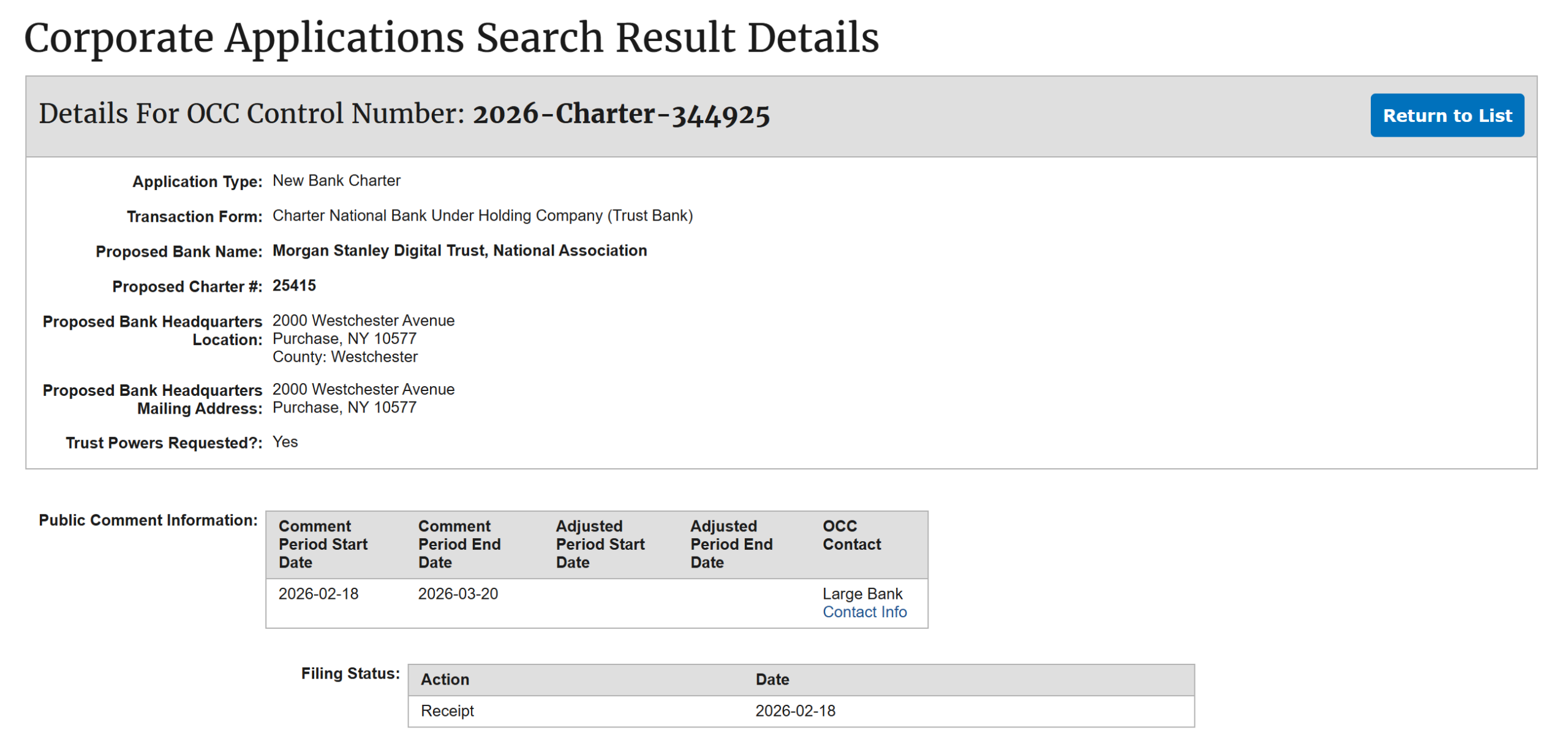
Morgan Stanley has applied for a de novo national trust bank charter, allowing the bank to hold digital assets on behalf of its clients — a move in rhythm with its recent crypto expansion.
A public filing with the Office of the Comptroller of the Currency (OCC) shows the application for a bank trust charter was received on Feb. 18 under the name “Morgan Stanley Digital Trust, National Association.”
More details of the business plan were released on Friday, according to reports from Bloomberg and Forbes, revealing that the Morgan Stanley subsidiary will custody certain digital assets and execute purchases, sales, swaps and transfers to support client investment activities, along with crypto staking.

A national bank trust charter authorizes a financial institution to engage in fiduciary activities such as trust services, custody and asset safekeeping. “De novo” is a Latin term for “anew,” meaning it is a newly created entity rather than an acquired one.
This is Morgan Stanley’s first trust charter with a specific focus on crypto and follows 14 de novo bank charter applications in 2025. There are approximately 60 national trust banks supervised by the OCC in the US.
Rush for crypto bank charters
In December, the OCC conditionally approved five applications for crypto-related national trust banks, including First National Digital Currency Bank, Ripple, BitGo, Fidelity Digital Assets and Paxos.
Stablecoin platform Bridge, owned by payments processor Stripe, said it received conditional approval for a national trust bank earlier this month, which was followed by Crypto.com on Monday.
Related: OCC proposal seeks to settle stablecoin yield debate, clearing way for CLARITY
Days later, Payoneer, a global financial services firm, said it had filed for a national trust bank charter in the US, which could enable it to issue a stablecoin and provide various crypto services.
Morgan Stanley doubling down on crypto
Morgan Stanley has accelerated its moves toward crypto in recent months. In January, the Wall Street bank tapped equity markets executive Amy Oldenburg to lead its new crypto unit.
Job listings on LinkedIn show the $2 trillion investment bank is also looking to expand its crypto team, advertising positions for digital assets strategy director, digital assets strategist and digital assets product lead.
Morgan Stanley also filed to launch spot Bitcoin (BTC) and Solana (SOL) exchange-traded funds in January, and later filed for a staked Ether (ETH) ETF.
Big Questions: Is China hoarding gold so yuan becomes global reserve instead of USD?


BTC ETFs saw ~+$507m net inflow Feb. 25 as BlackRock bought thousands of BTC from Coinbase Prime, but BTC still slipped on profit‑taking.
Summary
- BlackRock shifted multiple 300 BTC batches plus a 108.6 BTC transfer from Coinbase Prime to IBIT wallets around 5:45 PM UTC on Feb. 26.
- U.S. spot BTC ETFs booked about $507m net inflows on Feb. 25, the strongest single‑day inflow in roughly two weeks, led by IBIT’s ~$297m.
- BTC traded near recent highs but dipped on profit‑taking, with on‑chain data showing sellers capping price below key resistance despite renewed ETF demand.
BlackRock purchased a substantial amount of bitcoin during the strongest single-day inflow for U.S. spot bitcoin exchange-traded funds in two weeks, according to market data.
Data showed BlackRock transferred thousands of bitcoin to its iShares Bitcoin Trust wallets on Feb. 26, according to blockchain analytics firms. The transfers originated from Coinbase Prime hot wallets and occurred in several batches within the same hour, the data showed. Blockchain analytics firms shared logs showing multiple transfers of approximately 300 bitcoins to addresses linked to the iShares trust. The timestamp for these transfers was recorded at approximately 5:45 PM UTC.
BlackRock had purchased additional bitcoin days earlier and had transferred bitcoin to Coinbase the day before, according to transaction records. Market analysts tracked the activity as other ETFs reported outflows during the same period.
U.S. spot bitcoin ETFs recorded strong net inflows on Feb. 25, marking the highest one-day inflow in two weeks, according to data from SoSoValue. Total cumulative inflows have reached tens of billions of dollars across all issuers, the data showed. BlackRock’s iShares Bitcoin Trust led inflows for the day. Fidelity’s bitcoin ETF, Grayscale’s trust and Bitwise also reported inflows, according to the data. Other issuers recorded smaller inflows, while some smaller ETFs reported no net flows that day.
Bloomberg ETF analyst Eric Balchunas noted the renewed inflows followed weeks of withdrawals. Balchunas stated the rise in interest was well timed for the market but that it remained unclear whether the trend would mark a sustained rebound.
Bitcoin traded near recent highs but declined that day, falling even as ETF inflows increased, according to market data. Charts showed bitcoin briefly declined during the trading session. On-chain data indicated recent profit-taking kept bitcoin below certain resistance levels, with demand slowing near that range and recovery attempts in February meeting resistance at similar levels, according to blockchain analysts.
A tense exchange unfolded at a Senate Banking Committee hearing as Senator Elizabeth Warren pressed Comptroller of the Currency Jonathan Gould over a pending bank charter application tied to President Donald Trump’s crypto company, World Liberty.
Summary
- Warren questioned whether Trump-linked crypto firm World Liberty properly disclosed a reported 49% UAE stake in its OCC bank charter application.
- Comptroller Jonathan Gould declined to discuss specifics but pledged to follow standard OCC procedures.
- Warren warned that foreign ownership and presidential conflicts of interest pose risks if the charter is approved.
Elizabeth Warren demands answers on World Liberty’s bank application
Warren cited a Wall Street Journal report alleging that a senior United Arab Emirates official secretly acquired a 49% stake in Trump’s crypto venture shortly before Trump returned to office.
She questioned whether the foreign investor was properly disclosed in World Liberty’s application to the Office of the Comptroller of the Currency (OCC), which regulates national banks.
“Did World Liberty disclose that the UAE official’s company was a shareholder?” Warren asked.
Gould declined to discuss specifics of any pending application, stating that the OCC would follow established regulatory procedures. Warren countered that OCC rules require full disclosure of any principal shareholder with a 10% or greater stake, arguing that failure to do so would warrant dismissal of the application.
She requested access to an unredacted filing for committee oversight, saying lawmakers needed to verify compliance with disclosure requirements. Gould said he would consider the request consistent with established protocols.
Warren framed the issue as both a national security and conflict-of-interest concern, warning that foreign ownership of a U.S. bank tied to a sitting president posed significant risks. She also accused the OCC of potentially enabling corruption if it approved the charter.
Gould rejected allegations of political influence, saying the only pressure he had felt “is from you,” and maintained that the agency would process the application like any other.
The clash shows escalating political tensions surrounding crypto regulation, bank charters, and the intersection of digital asset ventures with presidential business interests.

Real reason cucumbers are wrapped in plastic at supermarkets – and it’s surprising

Intuit Guidance Misses Estimates. CEO Says AI Isn’t a Threat.

XRP price prediction as Ripple announces funding push for XRP Ledger


-

 Politics6 days ago
Baftas 2026: Awards Nominations, Presenters And Performers
-

 Sports4 days ago
Women’s college basketball rankings: Iowa reenters top 10, Auriemma makes history
-

 Fashion8 hours ago
Weekend Open Thread: Iris Top
-

 Politics4 days ago
Nick Reiner Enters Plea In Deaths Of Parents Rob And Michele
-

 Business3 days ago
True Citrus debuts functional drink mix collection
-

 Politics1 day ago
ITV enters Gaza with IDF amid ongoing genocide
-

 Crypto World4 days ago
XRP price enters “dead zone” as Binance leverage hits lows
-

 Business6 days ago
Mattel’s American Girl brand turns 40, dolls enter a new era
-

 Business5 days ago
Law enforcement kills armed man seeking to enter Trump’s Mar-a-Lago resort, officials say
-

 NewsBeat2 days ago
Cuba says its forces have killed four on US-registered speedboat | World News
-
 NewsBeat2 days ago
Manchester Central Mosque issues statement as it imposes new measures ‘with immediate effect’ after armed men enter
-

 Tech3 days ago
Unsurprisingly, Apple's board gets what it wants in 2026 shareholder meeting
-
 NewsBeat5 days ago
‘Hourly’ method from gastroenterologist ‘helps reduce air travel bloating’
-

 Tech5 days ago
Anthropic-Backed Group Enters NY-12 AI PAC Fight
-

 NewsBeat5 days ago
Armed man killed after entering secure perimeter of Mar-a-Lago, Secret Service says
-

 Politics5 days ago
Maine has a long track record of electing moderates. Enter Graham Platner.
-

 Business2 days ago
Discord Pushes Implementation of Global Age Checks to Second Half of 2026
-
 NewsBeat3 days ago
Police latest as search for missing woman enters day nine
-

 Business1 day ago
Only 4% of women globally reside in countries that offer almost complete legal equality
-
 Sports5 days ago
2026 NFL mock draft: WRs fly off the board in first round entering combine week