


Connect with us

Tech

BMW Sends AEON Humanoid Robots to the Line in Leipzig

Published

on

BMW AEON Humanoid Robots Leipzig Factory
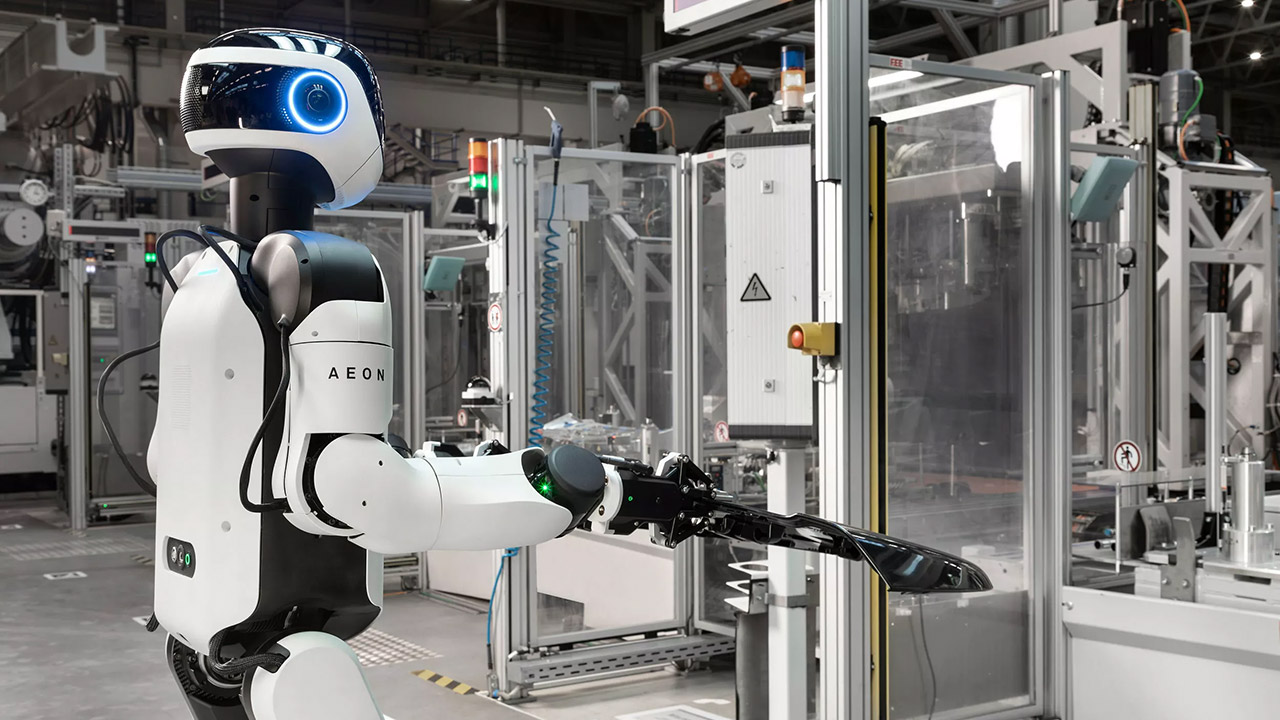
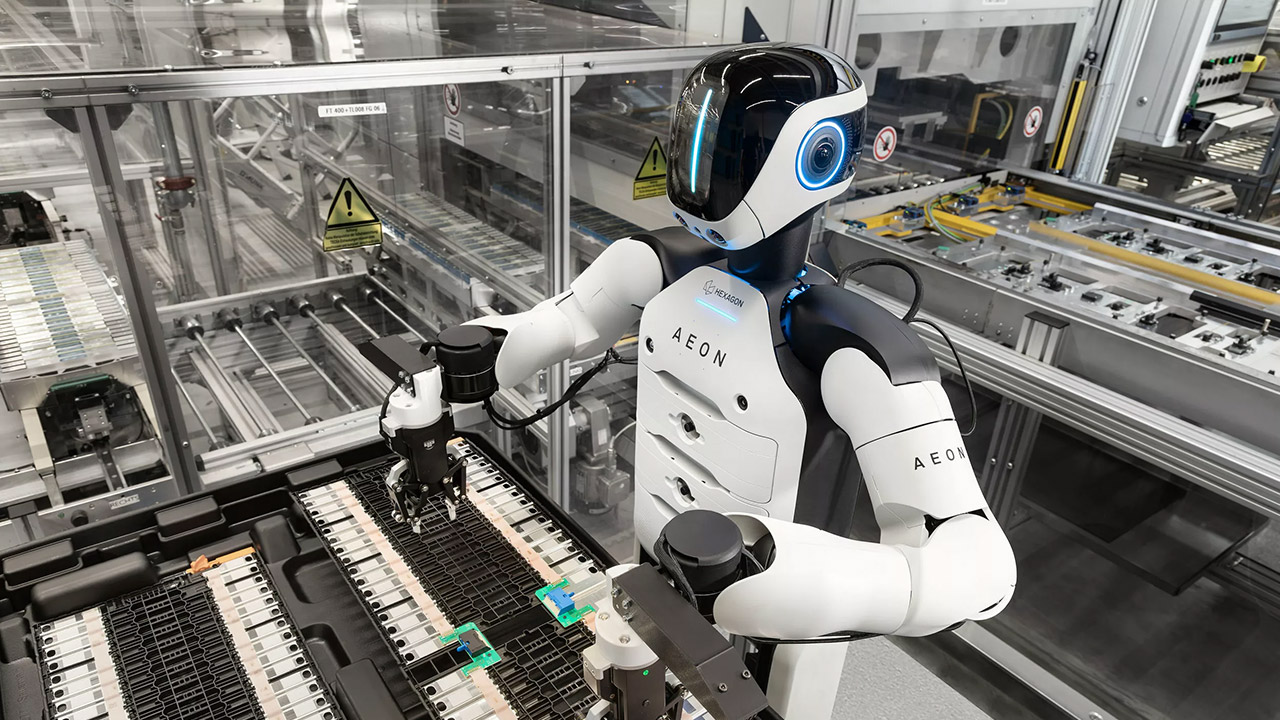
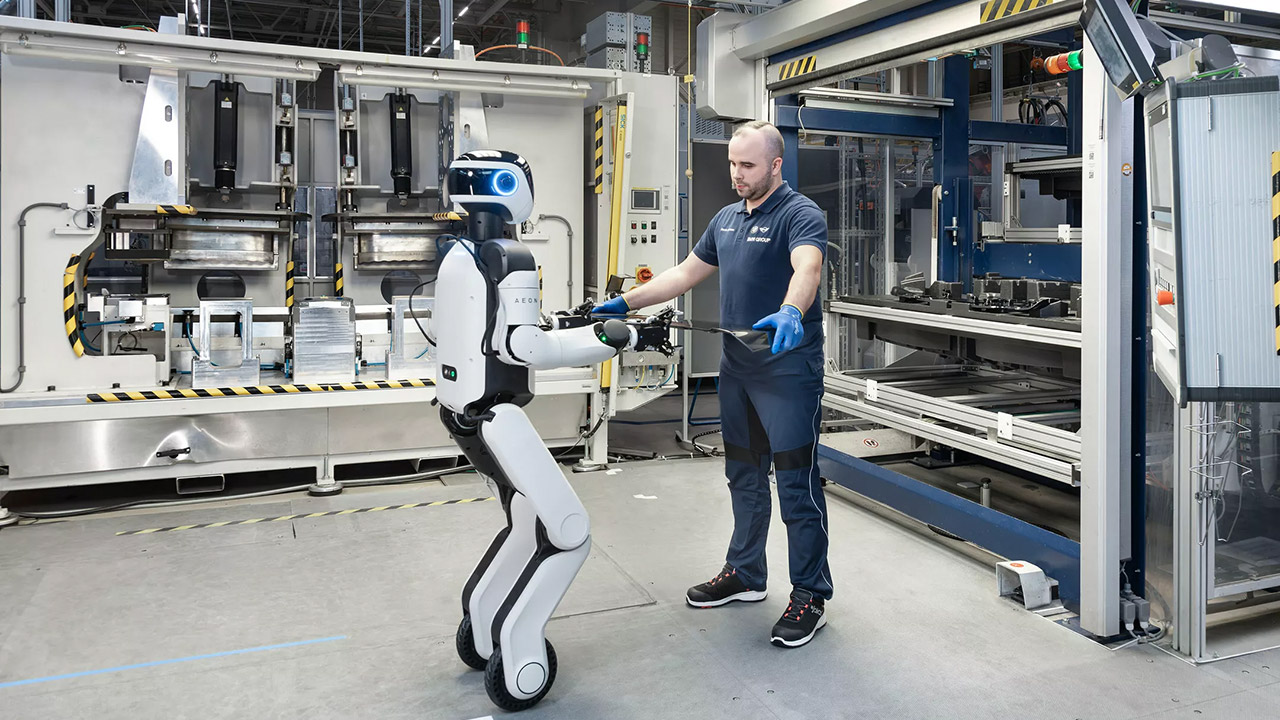
BMW employees at the Leipzig plant have been juggling all the complex parts of vehicle assembly, especially the hefty battery modules. However, a new member has joined the team: the AEON humanoid robot. AEON was created by Hexagon Robotics, a company BMW has been collaborating with for years on grunt work, to manage the physically taxing and repetitive tasks that wear people out.


By April 2026, the AEON prototype will be put through its paces in a larger round of assessments, with a complete pilot phase scheduled to begin this summer. The goal is to make AEON extremely adaptable so that it can transition between activities as needed; simply switch out the gripper or scanner and you’re ready to go. It travels from station to station without the need for fixed rails because it has wheels rather than legs.


Unitree G1 Humanoid Robot(No Secondary Development)
  • Height, width and thickness (standing): 1270x450x200mm Height, width and thickness (folded): 690x450x300mm Weight with battery: approx. 35kg
  • Total freedom (joint motor): 23 Freedom of one leg: 6 Waist Freedom: 1 Freedom of one arm: 5
  • Maximum knee torque: 90N.m Maximum arm load: 2kg Calf + thigh length: 0.6m Arm arm span: approx. 0.45m Extra large joint movement space Lumbar Z-axis…

Electric vehicle battery modules need extra care, and workers frequently need to wear safety gear simply to move them. After a few shifts, it becomes monotonous, but AEON is more than willing to relieve them of that kind of work without putting undue strain on the human workers. External component production is also relevant since, let’s face it, robotic consistency is a huge bonus when performing the same operation repeatedly.

BMW AEON Humanoid Robots Leipzig Factory
BMW is doing something a little different from the conventional industrial arms that are fastened to the ground. Thanks to data from BMW’s recently unified systems, AEON is able to move around, adjust to any arrangement, and become more intelligent every day. For a more seamless operation, the business had to dismantle the outdated data silos that were creating so much friction; now, all of that data streams directly into AEON. Naturally, safety is the top priority, which entails improved wireless coverage, additional barriers to keep people safe, and other measures. Since everything is linked into the current Smart Robotics network, there is no need to worry about anything getting left behind.

BMW AEON Humanoid Robots Leipzig Factory
The main benefit in this case is that human labor is still essential to the entire operation. BMW wants employees to be able to do something more interesting for a change by eliminating the monotony of their jobs. The personnel on the floor have been won over by early buy-in from safety teams, IT, and logistics, and having their support from the beginning has made everything go much more smoothly. The strategy here was shaped by lessons learned from an earlier test in the US facility in Spartanburg, which demonstrated how rapidly AEON could catch up and the dependability of everything in an actual production environment.

BMW AEON Humanoid Robots Leipzig Factory
In all of this, Leipzig has established a new Center of Competence for Physical AI, and its experts are getting to work assessing partners, conducting pilots, and expanding the concepts that prove effective. To stay competitive in Europe, executives are already discussing quantifiable improvements in speed and accuracy for these difficult activities.
[Source]

Advertisement

Source link

Continue Reading
Click to comment

Leave a Reply

Your email address will not be published. Required fields are marked *

Tech

Wicklow’s Trinity Biotech secures $25m in SEPA funding

Published

on

The NASDAQ-listed company can access discretionary funds through a 36-month agreement with New Jersey’s Yorkville Advisors.

Irish health diagnostic solutions company Trinity Biotech has secured new funding of up to $25m through a standby equity purchase agreement (SEPA), with proceeds going towards R&D programmes and commercialisation initiatives.

The SEPA deal in conjunction with Yorkville Advisors – based in New Jersey, US – gives Trinity Biotech the option, but with no obligation, to sell up to $25m of newly issued American depositary shares to Yorkville at its discretion over a period of up to 36 months.

John Gillard, Trinity Biotech president and CEO, said: “Our key strategic objectives at Trinity Biotech are to grow our existing business profitably and to advance our exciting innovation agenda, including our flagship development CGM+.”

Advertisement

CGM+ is the company’s new continuous glucose monitoring platform, currently in the later stages of device development, which uses a “proprietary needle-free glucose sensor” that eliminates the need for “finger-stick calibration” by users, the company said.

“This financing agreement provides us with significant additional capability to progress these objectives,” Gillard added.

NASDAQ-listed Trinity Biotech, based in Bray, Co Wicklow, is a commercial stage biotech company focused on diabetes management solutions and human diagnostics, including wearable biosensors. It sells direct in the US and through a network of distributors and partners in more than 75 countries.

The company reported revenues of $48.6m over a trailing 12-month period ended September 30 2025, and said it expects continued operational and financial progress into 2026, based in significant part on it catering to continued global demand for HIV testing provisions.

Advertisement

Innovations currently in development at Trinity Biotech include a cancer monitoring technology and a biomarker-based bioinformatics diagnostic platform.

In April 2023, Trinity Biotech agreed to sell its life sciences supply business to Switzerland’s Biosynth for $30m. A year earlier, a $45m investment in the Trinity Biotech from South Korea’s MiCo saw it take a 29.9pc share of the Irish company.

Don’t miss out on the knowledge you need to succeed. Sign up for the Daily Brief, Silicon Republic’s digest of need-to-know sci-tech news.

Advertisement

Source link

Continue Reading

Tech

Microsoft testing Windows 11 batch file security improvements

Published

on

Windows

Microsoft is rolling out new Windows 11 Insider Preview builds that improve security and performance during batch file or CMD script execution.

As Microsoft explained today, IT administrators can now enable a more secure processing mode that prevents batch files from being modified while they run by adding the LockBatchFilesInUse registry value under HKEY_LOCAL_MACHINE\Software\Microsoft\Command Processor.

Policy authors can also enable this mode using the LockBatchFilesWhenInUse application manifest control.

Wiz

This change is designed to boost performance and security in enterprise environments where admins rely heavily on scripted workflows.

“We are giving administrators and Application Control for Business policy authors additional controls over the processing of batch files and CMD scripts. Starting with this release, administrators may enable a more secure mode for processing batch files that ensures they do not change during execution,” the Windows Insider team said.

Advertisement

“This enhances the performance and security of batch file processing when code integrity is enabled, as signature validation will only be required to be performed a single time, instead of per statement executed in the batch file.”

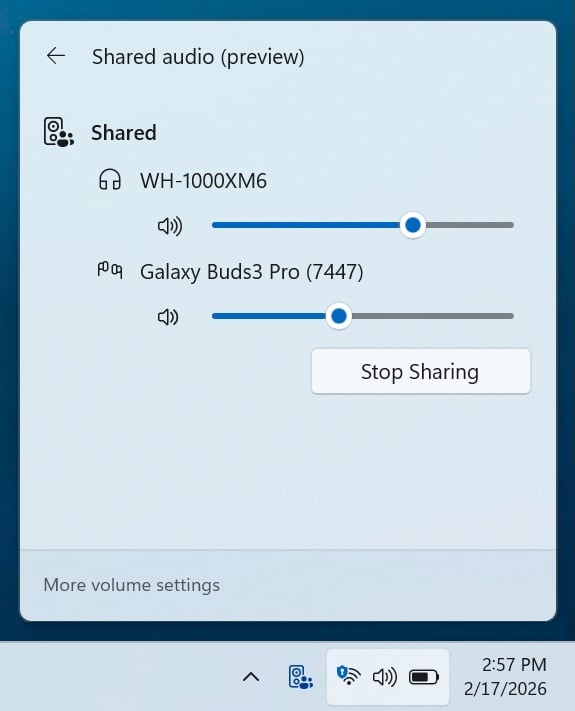
With today’s Windows Insider builds, Microsoft has also improved the Shared audio feature, introduced in October, which allows sharing audio between two headphones, speakers, earbuds, or hearing aids.

Shared Audio volume sliders
Shared Audio volume sliders (Microsoft)

Previously, volume adjustments affected both users equally, but the new update adds individual volume sliders for each listener and device. A new taskbar indicator also appears during active sharing sessions to provide a visual reminder and a one-click shortcut to sharing settings.

The compatible device lineup has also expanded to include more Bluetooth LE Audio accessories, with the Samsung Galaxy Buds 4 and Buds 4 Pro, Sony WF-1000XM6, and Xbox Wireless Headset now also supporting the feature.

These new capabilities are rolling out to Windows Insiders in the Beta and Dev channels who have installed Windows 11 Preview Build 26220.7934 (KB5077242) and Windows 11 Preview Build 26300.7939 (KB5077243), respectively.

Advertisement

Modern IT infrastructure moves faster than manual workflows can handle.

In this new Tines guide, learn how your team can reduce hidden manual delays, improve reliability through automated response, and build and scale intelligent workflows on top of tools you already use.

Source link

Continue Reading

Tech

NaCl Casting Technique Really Earns Its Salt

Published

on

Sodium Chloride has a melting point of 801 C (1,474 F), putting it comfortably between commonly-cast materials like aluminum and bronze. Which led to [Robinson Foundry] asking the question: can you cast salt like a metal? The answer, surprisingly, was yes!

[Robinson] tries casting the salt with two different methods: like it was glass, and like it was metal. In the glass-like casting, he packs a ceramic mold with salt and tosses it into an electric kiln, there to melt and very slowly cool. In metal-like casting, he just tosses salt into a crucible and melts it in the same beer-can kiln we saw when we featured his lost-pla casting a while back. The molten salt is poured very carefully into sand casting molds. If you’re familiar with the technique, you can skip to about 5:20 when he does the reveal.

As it turns out, the sand casting works out much better. While the glass-style casting in the electric kiln grew much larger crystals and so is more translucent, it’s also stuck completely inside the porous ceramic. Perhaps the ceramic would need glazed to pull off that technique?

On the other hand, the sand reacts with the salt in some way– molten salt isn’t exactly a noble gas, after all–to create a lovely gunmetal finish to the parts. They almost look like metal, though the brittleness gives away the game when he opens the mold to show a dagger in several pieces. For the decorative busts and megalodon teeth in the test, though, it is a great success.

Advertisement

Now, we’re not going to say this video came about because of high metal prices, or comment on what sort of trade policies might be driving up the price of metals like aluminum in the USA, but we do think this a great hack. While salt-based castings are obviously going to have very different physical properties than metal, for decorative work, it creates a lovely finish out of a material that’s cheap as dirt. Hopefully he comes back to the glass-style casting; we would not want to trust that black coating around food, and a salt crystal salt shaker sounds too good to pass up.

The only times we’ve seen molten salt around here is in nuclear reactors, and in homemade batteries, though that first one obviously wasn’t table salt.

Advertisement

Source link

Continue Reading

Tech

Omloop Het Nieuwsblad Free Streams: How to watch the first cobbled classic of 2026

Published

on

There have been skirmishes in the desert nations and a plethora of small stage races on the Iberian Peninsula but this is where the warm-up ends and proper racing begins. This is Belgium, and this is the opening weekend.

Source link

Continue Reading

Tech

These 5 US Airlines Are Most Likely To Have Regular Flight Delays

Published

on


Nobody likes a delayed flight; it’s inconvenient, throws plans into disarray, and puts additional costs on both passengers and the airline. There could be several reasons for such events — from technical issues and weather changes to personnel strikes and busy airspaces — and in many cases, the airline has no direct control over them. Nevertheless, some airlines have a better grip on their operations than their competitors, allowing them to keep delays at a minimum.

So, if you’re booking a flight and want to reduce your chances of getting hit with a late departure (or even a canceled flight), we’re looking at five American carriers that had the greatest number of delays by percentage. We based our numbers on the U.S. DOT’s Bureau of Transportation Statistics reports on arrival performance by marketing carrier, with data from March to October 2025. Unfortunately, we’re unsure if we’ll get more recent data, as the biggest U.S. airlines have asked the DOT to stop publishing performance statistics and are lobbying to make flying much worse for everyone.

Furthermore, we looked at the ratio of delayed flights versus the total number of flights. After all, it would be unfair to compare Delta, which had 207,770 delays out of more than 1.1 million flights and one of the best on-time performance rates in the United States, with Frontier, which operated fewer than 134,000 flights, of which more than 37,000 arrived late.

Advertisement

Frontier Airlines

The worst performer by far is Frontier Airlines, with 37,329 delays out of a total of 133,328 flights in the counted period. This meant that 28%, or more than one in four flights, were delayed. It also had the second-highest number of cancellations, with 2,111 flights, or 1.58% of its schedule, getting called off. This is probably one of the reasons why this airline is at the bottom of reliability and customer satisfaction rankings, with its cheap fares being the only thing going right for its passengers.

While airlines cannot do anything about airport traffic congestion and weather-based delays and cancellations, other issues, like crew scheduling limitations, can often be mitigated through advanced crew scheduling systems. Even delays caused by unforeseen technical problems at hub airports can be fixed with the ready availability of backup aircraft or by reducing the number of flights each airframe is assigned per day. However, these measures can be costly for airlines, especially for low-cost carriers that rely on razor-thin margins.

Advertisement

What’s worse is that Frontier says that it does not offer reimbursements, hotel accommodations, or monetary compensation to passengers who are impacted by flight delays or cancellations. The best that you can get is a seat on the next available Frontier flight and meal vouchers if your delay or rebooking is more than three hours and is considered a “controllable situation” like delayed baggage, aircraft damage, or a mechanical issue. If the delay is defined as an “uncontrollable situation,” like those caused by weather, Air Traffic Control, or an incident like a bird strike, then all you can get is a flight rebooking. Alternatively, you can seek a full refund under 14 CFR Part 260 if the delay is over three hours for domestic flights and six hours for international flights.

Advertisement

JetBlue

JetBlue is the second-worst airline when it comes to delays, with 38,117, or 24.52% of flights, arriving 15 minutes late (or longer) out of a total of 155,432 scheduled flights. While this isn’t as bad as Frontier, it is still close to one in four flights getting delayed. It also ranked third when it comes to cancellations, with 1,885, or 1.21% of flights, affected. This number is likely influenced by the emergency software update on Airbus A320 family aircraft in late 2025 that resulted in numerous cancellations and delays. The update was prompted after a JetBlue A320 made an uncommanded rapid descent in flight due to solar radiation. This is especially notable given that JetBlue’s fleet is composed entirely of Airbus aircraft.

JetBlue outlines its policy regarding reimbursements and options in case of delays or cancellations. According to the airline’s website, flights affected by weather disruptions, domestic delays of more than three hours, international delays of more than six hours, or a change from nonstop to a connecting or stopover flight are eligible for a fee waiver. This allows you to change your flight at no extra cost or receive a full refund to the original form of payment.

Advertisement

American Airlines

This is the first and only mainline carrier that lands on our list of airlines with the worst on-time performance. According to the U.S. DOT, out of American’s 1,363,530 flights (which, incidentally, is the highest number of scheduled flights within our time frame), 333,396 flights, or 24.45%, were delayed. That number is so high that it’s greater than the total number of flights operated by Frontier and JetBlue combined. American Airlines is also the worst airline when it comes to cancellations, with the carrier scrapping 28,204, or 2.07%, of its schedules.

Nevertheless, it seems that American is trying to do something about this, at least for affected passengers. The airline is said to be testing an AI tool that keeps track of passengers who could potentially miss their connecting flights because of a delay on a prior flight. It will then adjust the connecting flight without affecting the rest of the day’s schedule, ensuring that passengers can still reach their destination on time. This system will also benefit the airline, as it wouldn’t have to deal with rebooking the affected passengers (although it could likely infuriate other customers who might have to wait up to an hour for the incoming flight).

If you’re flying with American and you experience a significant delay or cancellation caused by the airline, it says that it will give you a voucher for an approved hotel plus round-trip transportation to the airport if the delay is overnight. Furthermore, it will provide meal vouchers for delays that are three or more hours after the scheduled departure. Unfortunately, if you’re affected by unforeseen delays and cancellations caused by weather, you’re not entitled to anything except a rebooking on the next flight with available seats at no extra charge.

Advertisement

Allegiant

Despite having one of the fewest numbers of flights (second only to Hawaiian before it merged with Alaska Airlines), Allegiant still managed to have one of the worst on-time performances. This airline had 22,210 delays, which is 24.40% of its total of 91,015 flights. But despite offering some of the cheapest airfares available, it still manages to have the best cancellation record in our time frame, reporting only 238 canceled flights, or just 0.26% of its entire schedule.

Just like Frontier, which is also a low-cost carrier, Allegiant says it does not offer delayed passengers any meals, alternate transportation, or reimbursement for incurred overnight expenses. If your flight is rescheduled due to a delay or cancellation and you choose not to take it, your only available options are to either change to a different flight on the same route or cancel the remaining flights and receive a refund for the unused portions of your ticket.

This might be a deal breaker for some people, but those who are looking for the best possible deals on airfare might be willing to take the risk. The airline mentions on its page the possibility of getting reimbursed by Allianz Travel Insurance for cancellations. So, it might be a worthwhile investment to spend a little extra on this type of insurance, which is one of the services that AAA offers and is likely far more affordable than a ticket on a legacy airline.

Advertisement

Southwest Airlines

After the big three (American, Delta, and United), Southwest Airlines has the greatest number of flights, at 954,366 scheduled flights. However, it also has a significant number of delays, at 211,262 flights, or 22.14% of its schedule. Nevertheless, it does have a good track record when it comes to cancellations, with only 5,602 canceled flights, or just 0.59% of its total number of flights.

Southwest Airlines pioneered the low-cost carrier (LCC) model, so just like the other LCCs listed above, don’t expect to get any benefits from it in case of a delay, except the bare minimum required by law. Nevertheless, it is one of the U.S. airlines that offers onboard Wi-Fi, costing just $8 per device throughout the entire flight. While you may not appreciate this service for short hops around the country, you might find it an indispensable yet affordable offering on the airline’s longest routes, like the more than seven-hour flight from Phoenix to Honolulu.

Advertisement


Source link

Advertisement
Continue Reading

Tech

This Ryobi Carpet Cleaner Uses Modern Tech To Help You Wash & Dry With Ease

Published

on


We may receive a commission on purchases made from links.

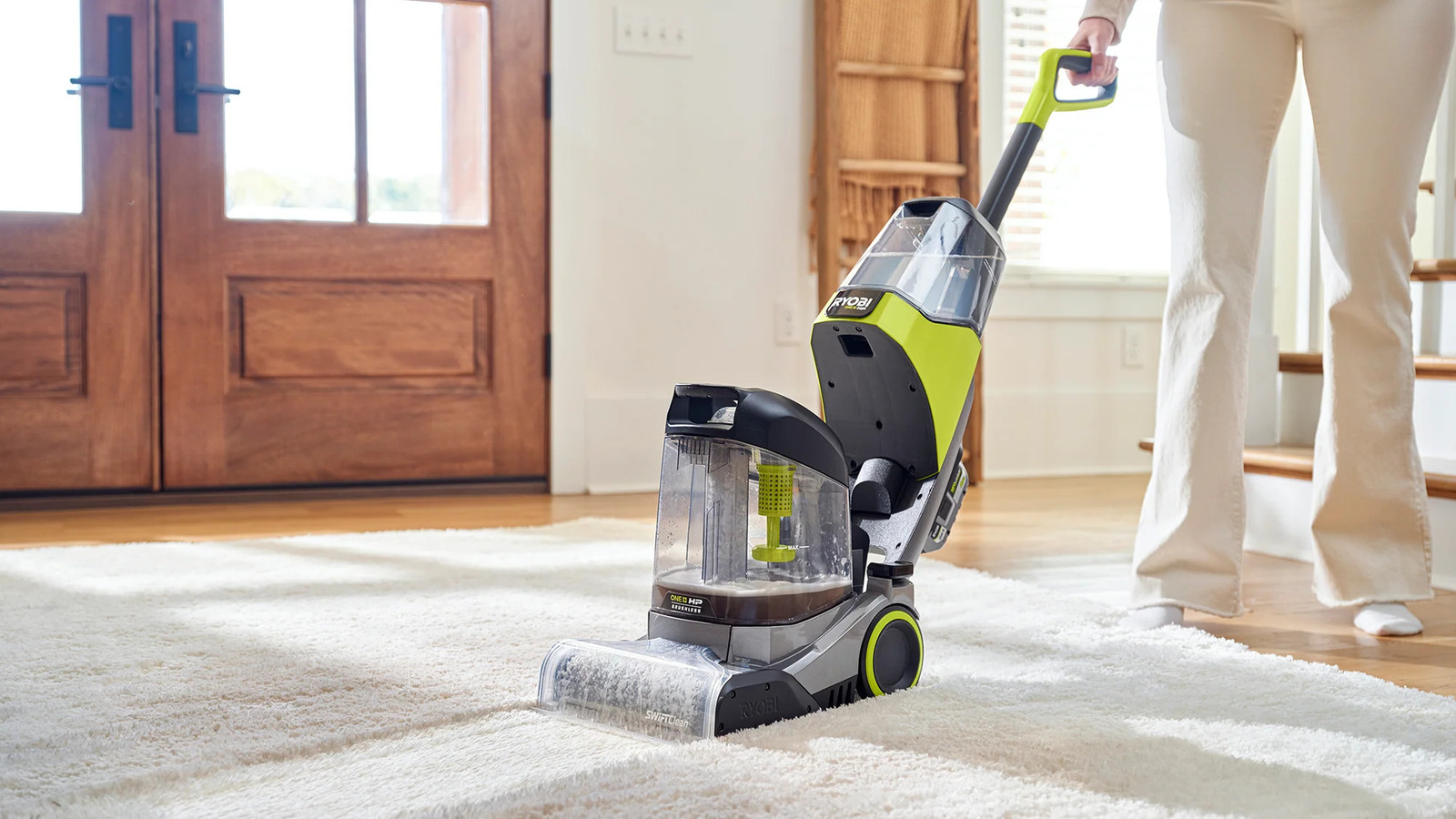
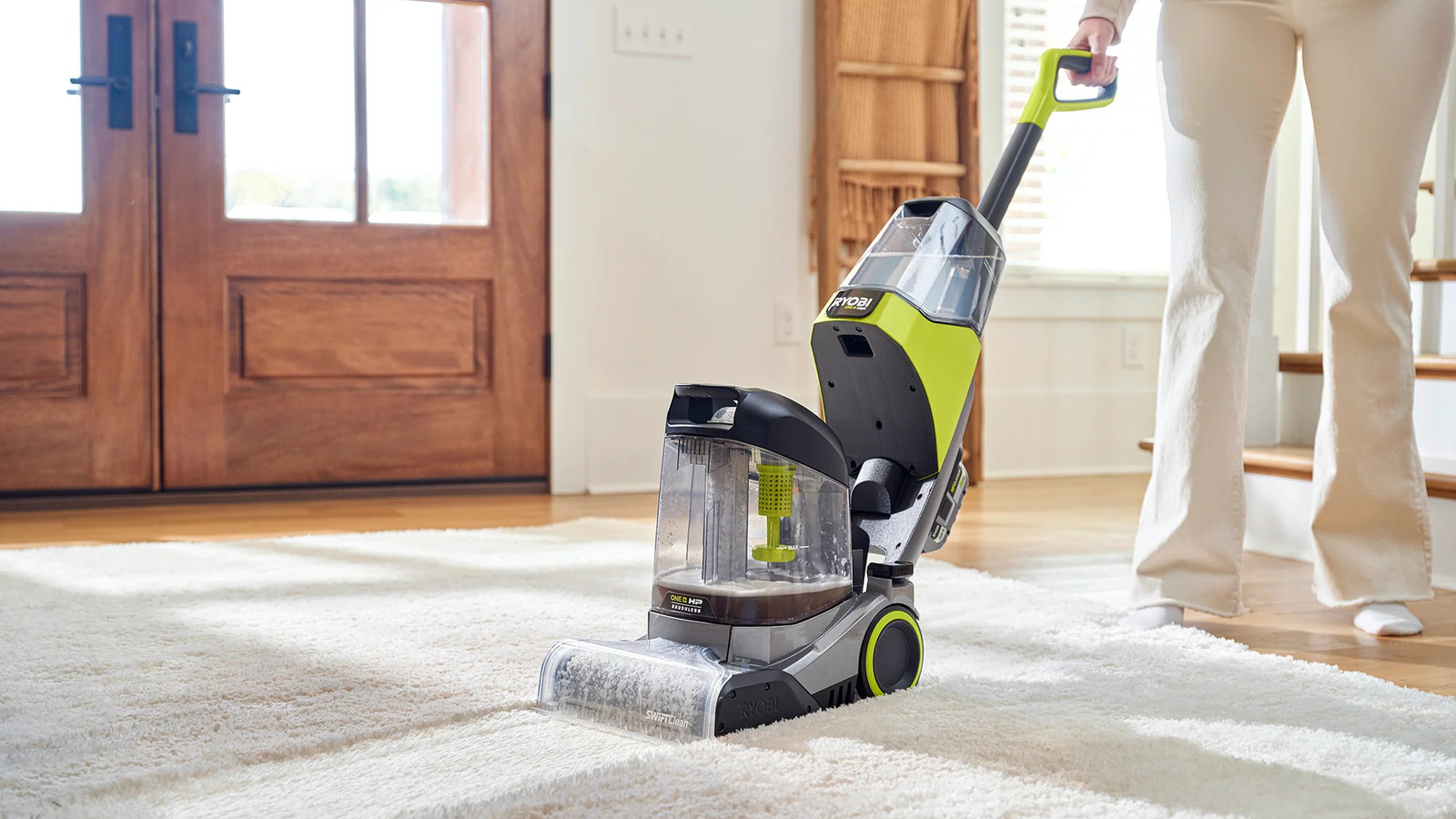
Fans of the Ryobi brand will already know that its 18V One+ cordless battery line stretches well beyond DIY-focused power tools. Ryobi also offers a range of home landscaping tools that run using the same battery packs, and buyers looking for cleaning products aren’t short of 18V One+ options either. With so many battery-powered tools and products in Ryobi’s current lineup, it can be easy to overlook a few of them, but one that shouldn’t be missed is the brand’s SwiftClean rug and carpet cleaner.

Advertisement

It’s available at Home Depot as a standalone tool for $299, or as a bundle with two 4Ah batteries for $384.64. Both versions come with two brush rolls and a bottle of Ryobi’s cleaning solution. Ryobi makes the washing and drying process as simple as possible, with one tank in the cleaner to dispense cleaning solution when you push the cleaner forwards, and another tank that collects dirty solution when you pull it backwards. By moving the cleaner forwards and backwards across either carpets or rugs, you can clean and dry them without needing to swap between tools.

The cleaner isn’t cheap, but buyers who have picked the tool up at Home Depot are almost unanimously satisfied with their purchase. At the time of writing, the cleaner has accrued a few dozen reviews with an average rating of 4.8 out of five stars across them. When asked, 91% of those reviewers said they’d be happy to recommend it.

Advertisement

Some reviewers report drawbacks with the cleaner

While the initial reviews don’t suggest buyers have any worries about durability or longevity, the cleaner is covered by Ryobi’s long warranty just in case. Like most 18V One+ tools, the cleaner is covered for three years after purchase, and if you buy the bundle with the two batteries, they’re covered by the same warranty too. Anyone with a lot of Ryobi tools to keep track of could download the brand’s app, where they can register their tools and access customer service if necessary.

Durability might not be a concern, but one reviewer at Home Depot reported that the cleaner’s washing and drying function might not work with every type of rug. They claim that, when trying to clean a rug that they describe as being “very flat,” the cleaner returned an error. However, when using the cleaner on a different “shag type rug,” the error would go away. 

Advertisement

Another reviewer expressed concern with Ryobi’s recommendation to mix cleaning solution in the clean water tank, which they claim left a residue on the carpet. Furthermore, they claim that even after pulling the tool back to dry the carpet, it was still left partially wet. Several reviewers also note that the tool can get through multiple batteries on longer jobs.

It’s not perfect then, but there’s still plenty to like about Ryobi’s high-tech rug and carpet cleaner. It’s one of many Ryobi tools that can help make spring cleaning a breeze, with the brand also offering everything from power scrubbers to pet-friendly vacuum cleaners.

Advertisement


Source link

Continue Reading

Tech

Google quantum-proofs HTTPS by squeezing 2.5kB of data into 64-byte space – Ars Technica

Published

on

Google and other browser makers require that all TLS certificates be published in public transparency logs, which are append-only distributed ledgers. Website owners can then check the logs in real time to ensure that no rogue certificates have been issued for the domains they use. The transparency programs were implemented in response to the 2011 hack of Netherlands-based DigiNotar, which allowed the minting of 500 counterfeit certificates for Google and other websites, some of which were used to spy on web users in Iran.

Once viable, Shor’s algorithm could be used to forge classical encryption signatures and break classical encryption public keys of the certificate logs. Ultimately, an attacker could forge signed certificate timestamps used to prove to a browser or operating system that a certificate has been registered when it hasn’t.

To rule out this possibility, Google is adding cryptographic material from quantum-resistant algorithms such as ML-DSA. This addition would allow forgeries only if an attacker were to break both classical and post-quantum encryption. The new regime is part of what Google is calling the quantum-resistant root store, which will complement the Chrome Root Store the company formed in 2022.

The MTCs use Merkle Trees to provide quantum-resistant assurances that a certificate has been published without having to add most of the lengthy keys and hashes. Using other techniques to reduce the data sizes, the MTCs will be roughly the same 64-byte length they are now, Westerbaan said.

Advertisement

The new system has already been implemented in Chrome. For the time being, Cloudflare is enrolling roughly 1,000 TLS certificates to test how well the MTCs work. For now, Cloudflare is generating the distributed ledger. The plan is for CAs to eventually fill that role. The Internet Engineering Task Force standards body has recently formed a working group called the PKI, Logs, And Tree Signatures, which is coordinating with other key players to develop a long-term solution.

“We view the adoption of MTCs and a quantum-resistant root store as a critical opportunity to ensure the robustness of the foundation of today’s ecosystem,” Google’s Friday blog post said. “By designing for the specific demands of a modern, agile internet, we can accelerate the adoption of post-quantum resilience for all web users.”

Source link

Advertisement
Continue Reading

Tech

Vivo X300 FE Moves Closer to Debut; X300 Ultra Could Get Dual Teleconverter Kit

Published

on

Following the company’s expansion of its X-series lineup in the past few months, Vivo is now gearing up to launch the Vivo X300 FE and Vivo X300 Ultra. The X300 FE has been reported to have obtained certifications from IMDA and TUV, indicating that the handset is close to release in the market. On the other hand, the X300 Ultra is expected to come with a dual lens teleconverter kit.

Vivo X300 FE

vivo X300 Fe image from the back

Vivo’s upcoming X300 FE, with model number V2537, has appeared on IMDA and TUV certification websites. The TUV listing suggests the phone may support 90W wired fast charging. On the other hand, the IMDA certification confirms that the device will come with 5G, Wi-Fi, Bluetooth, and NFC connectivity. Since devices typically receive these certifications close to launch, the X300 FE’s debut could be just around the corner.

The Vivo X300 FE is looking like a compact flagship with punch. It will be powered by the Snapdragon 8 Gen 5, accompanied by LPDDR5X RAM and UFS 4.1 storage. The phone may feature a 6.31-inch OLED display with a 120Hz refresh rate for smoother and clearer visuals.

Despite the smartphone being compact, the battery appears quite large, measuring around 6,500mAh, and may include silicon-carbon technology to enhance battery life. As far as the camera is concerned, there are rumors of a triple camera system, which will include a 50MP primary sensor, a 50MP periscope telephoto lens, and an ultra-wide lens. The front camera may benefit from a 50MP sensor optimized by ZEISS. The phone is also expected to come with IP68/IP69 ratings and a high-quality glass and metal body.

Vivo X300 Ultra

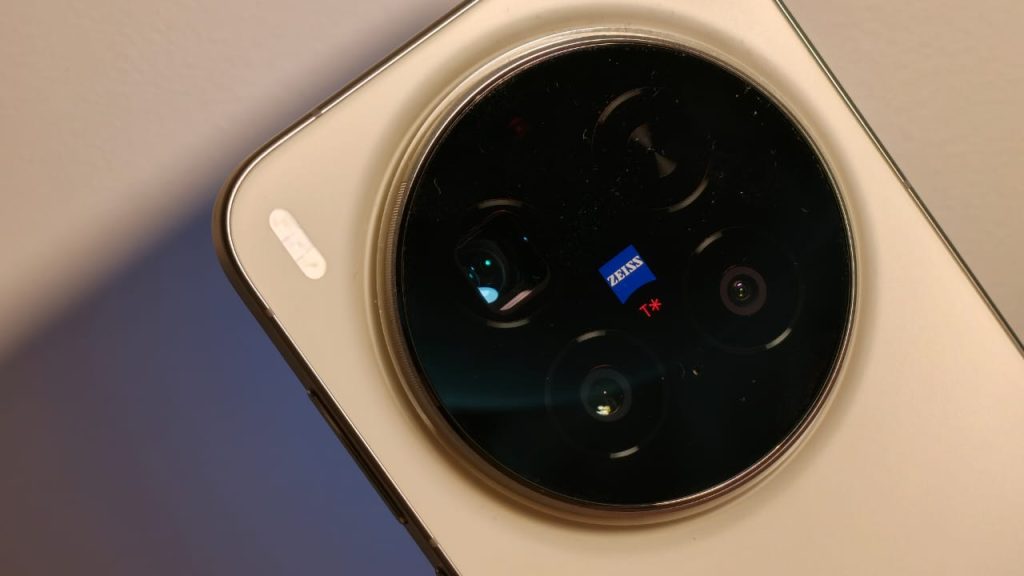
Close up of vivo X300 Pro cameras

According to recent rumors, the Vivo X300 Ultra could introduce a dual-lens external teleconverter kit for better zoom photography. The setup may offer a 400mm fixed-focus lens and support 200mm focal-length shooting. Users would likely switch between the two options instead of using them together. Vivo builds the system on its V-mount platform to deliver a more professional optical zoom experience.

The Vivo X300 Ultra is looking like a real flagship, with the best hardware inside. The phone is expected to come with Snapdragon 8 Elite Gen 5, which will provide great gaming performance and multitasking capabilities. The camera system will include a dual-camera setup with two 200MP cameras from Sony and Samsung, along with a 5MP multispectral camera and a 50MP ultra-wide lens.

Advertisement

The camera system may include ZEISS T* coating and optical image stabilization to improve overall image quality. In terms of battery life, rumors suggest the phone will feature a massive 7,000mAh battery that supports 100W wired charging and 40W wireless charging. When combined with an IP69 rating and USB 3.2 support, this phone suddenly feels like a real flagship.

Source link

Continue Reading

Tech

What’re The Differences Between Freightliner And Western Star Semi Trucks?

Published

on


Western Star and Freightliner are owned by Daimler Trucks North America, and both of these brands are powered by diesel engines, which are ideal for long-haul trucking. Where they differ is in their specific applications, the type of users they are aimed at, and some variations in their design approaches.

Freightliner semi trucks are focused on the demands of long-haul transportation and are often found in large trucking fleets. This could have a lot to do with why Freightliner is the top dog in Class 8 truck sales, claiming 35.2% of all sales in 2025, with a total of 73,360 trucks sold out of a yearly total of 208,155. By comparison, Western Star, which places more emphasis on the mining, logging, and construction markets, finished 2025 with a grand total of 11,496 Class 8 trucks, giving it a 5.5% share of the pie. Freightliner sells many more units than Western Star does.

Another major difference between Freightliner and Western Star semi trucks is in the way they are built. Western Star trucks are ruggedly built for the rigors of their intended markets, which requires firmer, heavy-duty suspensions as well as reinforced frame structures. This compares to what is important for a Freightliner truck that will be used for hauling freight long distances — good fuel economy, overall efficiency, and low cost of ownership matter most to the fleet operators who run Freightliners.

Advertisement

What else should you know about Freightliner And Western Star semi trucks?

The differences between Freightliner and Western Star semi trucks extend to the engines that power them. Freightliners are built for cruising the highways with minimal fuel consumption, so fuel-sipping engines like the Detroit DD13 and DD15 are commonly used. For to the specific needs of the operators of Western Star trucks, something more brawny like the Detroit 57X and 49X have the required output, measured in both higher horsepower and torque, to do the job on the logging trail or while hauling ore from the mine.

Freightliner trucks tend to retain more value, largely due to an extensive parts and service network, making it easy to get your Freightliner truck fixed wherever you roam. Western Star trucks also hold their value well — they are appreciated by those who use them for their intended missions, where their ultimate strength and on-the-job durability are highly valued. 

Advertisement

For over-the-road freight hauling, the Freightliner trucks are the undisputed champions in terms of sales. Freightliner semi trucks have been designed to provide the aerodynamic performance and overall fuel efficiency that both fleets and individual owner-operators can appreciate in their day-to-day operations. Western Star semi trucks, made in two U.S. plants, are better suited to the heavy-duty demands of construction, mining, and logging, in which their more rugged structures and more powerful engines make them ideally suited for these missions.


Advertisement

Source link

Continue Reading

Tech

Get a $200 gift card with the Samsung Galaxy S26 Ultra, plus a free upgrade to 512GB

Published

on

The Samsung Galaxy S26 Ultra is already looking like an unbelievable flagship phone, but this deal makes it even better.

You might have noticed by now that the pre-order deals for the Ultra are now in full swing, and for anyone looking to upgrade to an outstanding new handset, there’s no shortage of offers. With that in mind, we’ve picked out one of the very best.

Head on over to Amazon right now, and you can pick up the unlocked 512GB variant of the Samsung Galaxy S26 Ultra, and get a $200 gift card for your trouble, plus that free upgrade from 256GB.

To put the whole thing into context, that super high-end Galaxy S26 Ultra will set you back $1299.99 right now, which is a full $400 cheaper than the phone’s asking price after the pre-launch period.

Advertisement
Deal Samsung Galaxy S26 Ultra and $200 Gift CardDeal Samsung Galaxy S26 Ultra and $200 Gift Card

Get a $200 gift card with the Samsung Galaxy S26 Ultra, plus a free upgrade to 512GB

Pick up the Samsung Galaxy S26 Ultra and you’ll walk away with a $200 gift card and a complimentary bump to 512GB.

View Deal

That’s a good deal for what is likely to be one of the best phones on the market, and a gift card that can get you towards the cost of a cheaper product in Samsung’s ecosystem, such as a Galaxy Buds.

Advertisement

Advertisement

The phone certainly doesn’t skimp on the user experience; it’s quite the opposite, in fact. Being a ‘S Ultra’ phone, the S26 Ultra is loaded to the gills with the best that Samsung has to offer.

As an example, the included Privacy Display is unlike anything we’ve seen on another phone, as it can keep the information on your locking screen away from prying eyes. When it’s time to unlock the screen, it also lets you do so with the power of your own unique Galaxy AI.

You also have an eye-popping 512GB of storage, giving you far more leeway to add apps, download films, and more.

Also included is Super Fast Charging 3.0, which apparently allows the phone to reach up to 75% capacity in around just 30 minutes.

Advertisement

This incredible form of top-up is made possible by a durable battery which has a 5000 mAh capacity, giving the phone plenty of longevity from a single charge.

Advertisement

Given everything that the Samsung Galaxy S26 Ultra brings to the table, even without the added $200 gift card and $400 off ($600 in total), it’s still a fantastic buy in the world of premium phones, but with the gift card in tow, it’s a must-buy for upgrading bargain hunters.

SQUIRREL_PLAYLIST_10148964

Advertisement

Source link

Continue Reading

Trending

Copyright © 2025