






Connect with us

Tech

Google quantum-proofs HTTPS by squeezing 2.5kB of data into 64-byte space – Ars Technica

Published

on

Google and other browser makers require that all TLS certificates be published in public transparency logs, which are append-only distributed ledgers. Website owners can then check the logs in real time to ensure that no rogue certificates have been issued for the domains they use. The transparency programs were implemented in response to the 2011 hack of Netherlands-based DigiNotar, which allowed the minting of 500 counterfeit certificates for Google and other websites, some of which were used to spy on web users in Iran.

Once viable, Shor’s algorithm could be used to forge classical encryption signatures and break classical encryption public keys of the certificate logs. Ultimately, an attacker could forge signed certificate timestamps used to prove to a browser or operating system that a certificate has been registered when it hasn’t.

To rule out this possibility, Google is adding cryptographic material from quantum-resistant algorithms such as ML-DSA. This addition would allow forgeries only if an attacker were to break both classical and post-quantum encryption. The new regime is part of what Google is calling the quantum-resistant root store, which will complement the Chrome Root Store the company formed in 2022.

The MTCs use Merkle Trees to provide quantum-resistant assurances that a certificate has been published without having to add most of the lengthy keys and hashes. Using other techniques to reduce the data sizes, the MTCs will be roughly the same 64-byte length they are now, Westerbaan said.

Advertisement

The new system has already been implemented in Chrome. For the time being, Cloudflare is enrolling roughly 1,000 TLS certificates to test how well the MTCs work. For now, Cloudflare is generating the distributed ledger. The plan is for CAs to eventually fill that role. The Internet Engineering Task Force standards body has recently formed a working group called the PKI, Logs, And Tree Signatures, which is coordinating with other key players to develop a long-term solution.

“We view the adoption of MTCs and a quantum-resistant root store as a critical opportunity to ensure the robustness of the foundation of today’s ecosystem,” Google’s Friday blog post said. “By designing for the specific demands of a modern, agile internet, we can accelerate the adoption of post-quantum resilience for all web users.”

Source link

Advertisement
Continue Reading
Click to comment

Leave a Reply

Your email address will not be published. Required fields are marked *

Tech

GTA 6 may feature unprecedented real-world realism, claims alleged ex-Rockstar Employee

Published

on

The hype around Grand Theft Auto 6 continues to build, and an alleged former Rockstar Games employee has added to the high expectations with a fresh rumor. The new set of potential features suggests that GTA 6 might raise the bar on realism in ways that go beyond graphics alone.

GTA 6 NPCs are the biggest leap forward

One of the biggest claims in the Reddit leak centers around NPC behavior and interaction. Building on the systems introduced in Red Dead Redemption 2, the upcoming game will allegedly expand NPC interaction in a major way. Players can now have basic interaction options like greeting, insulting, flirting, or more.

Another standout feature could be a custom text input system, allowing players to type their own dialogue, which the NPCs can respond to contextually. These NPCs will reportedly retain memory over time. Treating someone poorly may cause them to react differently when you see them again. The leaker describes a system that allows players to build relationships and deepen bonds or rivalries organically.

There are levels to the life of crime

Crime in GTA 6 is described as more layered and situational than before. Smaller targets like convenience stores are reportedly easier to rob, with slower police response and smaller payouts. But as soon as you hit some high-value targets, such as luxury stores and jewelry shops, the situation becomes more complex. These locations are covered with silent alarms and security cameras that bring faster police responses. So players must plan their actions rather than just rushing in.

Simulating everyday life

Environmental realism is another major focus of the leak, with areas like airports and supermarkets bustling with people and various kinds of minor interactions. GTA 6 is expected to build fully enterable interiors rather than decorative set pieces to expand the realism in these everyday spaces.

Advertisement

Phones also appear to be a part of the gameplay, packed with functional apps that let you text NPCs, manage contacts, and browse social media. According to the claim, phones play a key role in communication, planning crimes, and engaging with the open-world dynamically.

Take it for what it is

These details remain as unverified claims from an alleged former employee. So I’d recommend taking this with a grain of salt for now. But even if parts of this description hold true, GTA 6 could showcase a significant shift towards deeper immersion and realism. So until the global release, this leak can best be passed on as an insider perspective, rather than a promise.

Source link

Advertisement
Continue Reading

Tech

Whistleblower: ICE Has Slashed Its Training Program And Its Boss Is Lying To Congress About It

Published

on

from the not-sending-our-best,-making-them-worse dept

ICE can’t keep up with the baseline set by resident ghoul/White House advisor Stephen Miller. Miller has demanded 3,000 arrests per day, which he presented as the minimum he would be satisfied with.

To reach this goal, tons of talent from other federal law enforcement agencies have been added to the mix. The results have been less than impressive, to be entirely too kind to these kidnappers and murderers.

CBP and Border Patrol officers used to handling border crossing business are now roaming the streets of Midwestern cities looking for anyone who seems a bit too dark to be a native. In addition, nearly half of FBI agents have been placed on the “find the brown person” beat, along with volunteers/voluntolds from DEA, ATF, US Secret Service, Homeland Security Investigations, and anyone else with a badge they’re unwilling to display prominently when raiding local day care centers.

The GOP threw a whole lot of money at ICE with the “Big Beautiful Bill.” ICE is throwing a lot of money at potential hires, much to the chagrin of law enforcement agencies everywhere, as well as already-understaffed prisons and jails.

Advertisement

The expectations were lowered, along with the bar for entry. The promise of a $50,000 signing bonus has managed to attract the expected blend of MAGA faithful, retired cops, bigots (but I repeat myself…), and anyone who thinks they have what it takes to frog-walk five-year-olds to the nearest rented SUV.

Hiring a bunch of people is only half the battle. The next step is preparing them to do their jobs. Ridding the nation of migrants is Job #1 here in America at the moment. But it’s a job too important to be done well by fully trained ICE officers. Quantity over quality is the name of the game, as former ICE trainer Ryan Schwank — who only resigned last week — told Congress. Here’s the Washington Post with the details:

[S]chwank… told congressional Democrats at a hearing that the agency eliminated 240 hours of “vital classes” from a mandatory 580-hour training program, including instruction about the legal boundaries for the use of force, how to safely handle firearms, and the proper way to detain and arrest immigrants.

Seems like a pretty sweet deal for new hires. Not only do they get a hefty signing bonus, but they don’t have to go through 40% of the training. Giving people guns and the power to deprive others of their lives and liberties should mean giving them the best possible training you can in hopes of heading off… well… pretty much everything we’ve been seeing lately during Trump’s anti-blue state/city surges.

Certainly, the administration is already doing everything it can to undercut the credibility of its now-former employee. But it’s not going to work unless you’re an idiot who prefers nigh-incoherent MAGA invective to actual facts. You see, Schwank didn’t just bring himself to this hearing. He also brought receipts.

Advertisement

Ahead of the hearing, Schwank provided a joint panel of House and Senate Democrats copies of internal ICE documents that he said show the extent of the cuts. The documents indicated that the Federal Law Enforcement Training Centers in Glynco, Georgia, shortened its training program from 72 days to 42 days.

Except that’s not what Todd Lyons said to Congress when he was asked to testify following two murders committed by federal officers in Minneapolis, Minnesota. Lyons claimed nothing important had been cut. He also said this, which is directly contradicted by the documents Schwank gave to lawmakers:

In a statement Monday, the Department of Homeland Security said ICE recruits receive 56 days of training before beginning their assignments…

Lyons went on to say that an “average” of 28 days of additional “on the job training” occurs after that. But even if you might believe Lyons is stacking his apples against the apples in ICE’s internal documents to come up with 84 days of training, you’re miscounting apples the same way Lyons is. OJT is post-assignment. Even if you choose to believe Lyons more than the documents his own agency generated, officers are still being put on the street two weeks earlier than they used to be.

The lies persist, of course. The statement provided to the Post says something else entirely, which is also contradicted by the documents and statements made by Schwank.

“No training hours have been cut. Our officers receive extensive firearm training, are taught de-escalation tactics, and receive Fourth and Fifth Amendment comprehensive instruction,” said Lauren Bis, a spokeswoman for the department.

But training hours have been cut. And the rest of it is pure horseshit, especially the part about training new hires about the Fourth and Fifth Amendment. Schwank’s testimony noted that he was asked to review an internal memo signed by Lyons that claimed — untruthfully — that ICE officers can enter people’s homes using only a self-issued administrative warrant.

Advertisement

Other rights were similarly glossed over. In fact, some of them are ignored completely.

[Schwank] also said that a two-hour class on the rights of protesters was shortened into 10 minutes of discussion during a lecture on “the concept of seizure.”

Nice. That’s the way to do it. Goodbye, First Amendment. Instead, here’s 10 minutes of ICE’s interpretative dance: “The Fourth Amendment, And What It Doesn’t Mean To Us.”

Everyone knew that once the cattle call began, ICE would be swarmed with opportunists who saw a great way to combine their bigotry and violence tendencies with a career — however short-lived — in public service. A steady paycheck, and all the government asked was that you show up at least 40% of the time during training.

This horde (actual number unknown) is being pushed through the doors towards their on-the-job-training, armed with little more than their masks, their guns, and some very comprehensive incorrecting of their constitutional notions.

Advertisement

Of course, none of this will matter to the people running ICE. I’m pretty sure they love this press. They have no interest in heading up a finely-tuned precise instrument of immigration law enforcement. They’d rather have the untargeted terrorizing of entire neighborhoods and the unearned swagger of a paramilitary death squad that somehow can still be hooted, horn-honked, and whistled into submission by suburbanites. And maybe this isn’t even an intentional design decision. There’s a good chance no one up top is intelligent enough to recognize the self-destructiveness of their actions. For now, at least, we know what they know. And we know this is wrong.

Filed Under: dhs, ice, mass deportation, ryan schwank, todd lyons, trump administration

Source link

Advertisement
Continue Reading

Tech

Washington state gets federal sign-off for huge broadband buildout

Published

on

(Photo by Jason Richard on Unsplash)

Washington state has received a federal green light for its final plan under the Broadband Equity, Access, and Deployment (BEAD) program — the national push to extend high-speed internet to places that still don’t have adequate service.

The National Telecommunications and Information Administration signed off on the BEAD proposal, giving the Washington State Broadband Office authority to start contracting with internet service providers and begin construction.

The approved plan directs $736 million in federal BEAD funding and $112 million in state match toward connecting about 166,500 homes and small businesses across 238 project areas. Combined with private match funding and other contributions, the total investment tops $1 billion.

Of the locations being funded, 76% are completely unserved (no qualifying high-speed service) while the remaining 24% are underserved.

“This is a transformative moment for Washington,” WSBO Director Jordan Arnold said in a statement. “For rural and underserved communities, internet access is a lifeline to economic opportunity, education, health care, and the modern world.”

Advertisement

The buildout breaks down roughly as fixed wireless (38% of locations), fiber (35%), and low-earth orbit satellite (27%). Nine of the 238 project areas are on tribal lands.

The inclusion of low-earth-orbit satellite could be relevant for SpaceX’s Starlink and Amazon Leo, both of which have operations tied to satellite connectivity in Washington state. It’s not yet clear exactly how much each provider will receive, but both have emerged as major winners of BEAD funding nationally. They each also have substantial satellite manufacturing operations in the state. Update: SpaceX will receive $45.8 million and Amazon will receive $9.25 million.

With NTIA approval in hand, the WSBO will now formally announce awards, execute contracts with providers, and begin overseeing construction. All projects must be completed within four years, though the office said some could break ground this year.

Source link

Advertisement
Continue Reading

Tech

That crazy cheap holiday deal could secretly fund cybercrime and drain someone else’s bank account overnight

Published

on


  • Buyers of cheap travel deals often face canceled bookings and lost money
  • Fraudulent travel reservations can appear legitimate until banks freeze accounts unexpectedly
  • Cardholders discover unauthorized charges after multiple bookings have already been completed

Holiday discounts can look tempting, especially when flights and hotels feel overpriced during peak seasons – but experts have warned some of the cheapest deals circulating online are tied to criminal networks operating so-called buy-for-you schemes.

These operations rely on stolen credit card data to secure real bookings, which are later resold at steep discounts to unsuspecting buyers.

Source link

Advertisement
Continue Reading

Tech

Jack Dorsey’s Block cuts 4,000 jobs, citing AI as the reason

Published

on

Block opened a new strategic European hub in Dublin late last month.

Block is cutting 4,000 jobs – or around 40pc of its global workforce – as company co-founder, head and chair Jack Dorsey said that AI tools and flatter teams are proving more productive.

In a lengthy post on X, Dorsey stated that he made the decision to cut jobs after realising how small teams and intelligence tools have enabled a “new way of working” that “fundamentally changes” the company’s future landscape.

He maintained that the job cuts were not a cost saving measure. “Our business is strong. Gross profit continues to grow … and profitability is improving,” he said.

Advertisement

He also doubled down on his decision in a letter to Block’s shareholders, stating that a “majority of companies” will reach similar conclusions around smaller teams and make similar structural changes “within the next year”.

As pointed out by major publications, Block has conducted several rounds of layoffs in recent years, but it has never cited AI as a reason for redundancies before.

The company previously laid off Irish employees in 2024 as part of its then plans to cut around 1,000 jobs globally.

The new layoffs come after the global fintech giant opened a new Dublin office late last month where it plans to situate 300 of its workers. SiliconRepublic.com has asked Block what impact the layoffs would have on its Irish employees.

Advertisement

Block shares rose by more than 24pc following the announcement, which came alongside a Q4 report boasting 24pc year-over-year growth in gross profit, marked by 51pc growth in its financial solutions and 10pc growth in its bitcoin ecosystem divisions.

As of the end of 2025, Block had 10,205 full-time employees globally, with 2,472 of them working from outside the US. According to Block’s US government filings, the layoffs will be mostly complete by the end of Q2 of the 2026 financial year and will cost the company anywhere between $450m and $500m.

Block, formerly known as Square until 2021, is the operator behind popular fintech services including the consumer-focused Cash App and seller-focused Square.

Just last month, Amazon announced that it is cutting 16,000 roles across its departments internationally to, according to the company, reduce organisational layers and remove bureaucracy.

Advertisement

The company employs more than 6,000 across various sites in Dublin, Cork and Drogheda. RTÉ reported that around 300 Ireland-based jobs would be at risk.

Don’t miss out on the knowledge you need to succeed. Sign up for the Daily Brief, Silicon Republic’s digest of need-to-know sci-tech news.

Jack Dorsey, 2018. Image: © Mark Warner via Flickr (CC BY 2.0)

Advertisement

Source link

Continue Reading

Tech

Evolved Nerf RC Tank Now Leaves Welts

Published

on

[Joshua Clay] recently unveiled his newest RC Nerf Dart Robot and talks through his design choices, pointing out that in his aim to have it launch darts fast and hard he may have somewhat overshot the mark. He found out first hand during testing that it shoots hard enough to leave welts through a sweatshirt and probably should be downgraded a bit. Thankfully, one of the features of his new unit is a highly modular design that makes iterating easier than ever.

A modular, glue-free assembly that leaves wiring accessible helps make design iterations faster and easier.

This model is an evolution of his first Nerfbot, and the new one is a smaller, tighter design that trades a wheeled base for a tracked one, among other changes.

The tank platform is one example of [Joshua] using affordable, off-the-shelf solutions where it makes sense to do so. For example, the inexpensive tank-track platform means he can focus on the rest of the bot without having to design or make his own tank treads. Similarly, to control the bot he opts for a PlayStation 4 controller, paired to the bot over Bluetooth. It’s high quality, inexpensive, commonly available, and easily interfaced with the RP2040 that runs the show.

[Joshua] aims for a modular, LEGO-inspired mechanical assembly that makes maintenance, wiring, and iteration as easy as possible. We especially like how the battery, wiring, and things like gears for the pan-and-tilt mechanism of the Nerf launcher are easily accessible.

The dart launcher uses two flywheels to grip and propel each dart fed from a high-capacity magazine, and you can watch it move and shoot around the 9:44 mark in the video, embedded below. It’s plenty loud, but the camera is barely able to register darts leaving the barrel.

Advertisement

If you like the looks of [Joshua]’s newest Nerfbot, keep an eye out because he’s got more to share about it and is considering other features like a camera. In the meantime, there are a few more photos on his website.

Source link

Advertisement
Continue Reading

Tech

Digital bank Monzo to nearly double Irish headcount by 2027

Published

on

Representatives for the organisation stated that recent investments are driving the expansion of the Dublin-based European headquarters and the creation of new jobs.

UK neobank Monzo has announced plans to grow its Ireland-based team to 70 employees by mid-2027, nearly doubling its current headcount. Over the last two years, Monzo has invested €83.5m into its Irish operations, expanding the Dublin premises – which is also the European headquarters. 

The new roles will span a range of areas including operations, risk and compliance, technology and engineering, financial crime prevention, and product development. 

The European expansion, which is supported by the Irish Government through IDA Ireland, is being led by Michael Carney, Monzo’s EU CEO. He is supported by a leadership team that includes EU chief financial officer Nicola O’Brien, EU chief operating officer Sonia Flynn, and Elaine Deehan, the country manager for Ireland.

Advertisement

Commenting on the expansion news, the Tánaiste and Minister for Finance Simon Harris, TD said: “Monzo’s decision to expand its team and establish its European headquarters in Dublin is testament to the country’s reputation as a hub for innovation and financial services.   

“This significant investment not only brings new jobs and opportunities but also strengthens Ireland’s position within the European banking sector. I look forward to seeing Monzo contribute to our vibrant economy and deliver innovative banking solutions.”

Carney added: “We’re excited to see our founding Dublin team grow, welcoming experts who bring together the best of banking and technology. Ireland’s deep and expanding talent pool offers the world-class expertise needed to support Monzo’s expansion ambitions across Europe.

“As we take our mission to make money work for everyone in Europe, we’re proud to kick-start that journey in Ireland, with individuals and small businesses now able to join the waitlist.”

Advertisement

In December, Monzo became the first digital bank to secure a full European banking licence through the Central Bank of Ireland. This enables the company to bring its fully regulated personal and business banking products to customers across the EU, starting in Ireland. 

Don’t miss out on the knowledge you need to succeed. Sign up for the Daily Brief, Silicon Republic’s digest of need-to-know sci-tech news.

Source link

Advertisement
Continue Reading

Tech

OpenAI strikes a deal with the Defense Department to deploy its AI models

Published

on

OpenAI has reached an agreement with the Defense Department to deploy its models in the agency’s network, company chief Sam Altman has revealed on X. In his post, he said two of OpenAI’s most important safety principles are “prohibitions on domestic mass surveillance and human responsibility for the use of force, including for autonomous weapon systems.” Altman claimed the company put those principles in its agreement with the agency, which he called by the government’s preferred name of Department of War (DoW), and that it had agreed to honor them.

The agency has closed the deal with OpenAI, shortly after President Donald Trump ordered all government agencies to stop using Claude and any other Anthropic services. If you’ll recall, US Defense Secretary Pete Hegseth previously threatened to label Anthropic “supply chain risk” if it continues refusing to remove the guardrails on its AI, which are preventing the technology to be used for mass surveillance against Americans and in fully autonomous weapons.

It’s unclear why the government agreed to team up with OpenAI if its models also have the same guardrails, but Altman said it’s asking the government to offer the same terms to all the AI companies it works with. Jeremy Lewin, the Senior Official Under Secretary for Foreign Assistance, Humanitarian Affairs, and Religious Freedom, said on X that DoW “references certain existing legal authorities and includes certain mutually agreed upon safety mechanisms” in its contracts. Both OpenAI and xAI, which had also previously signed a deal to deploy Grok in the DoW’s classified systems, agreed to those terms. He said it was the same “compromise that Anthropic was offered, and rejected.”

Anthropic, which started working with the US government in 2024, refused to bow down to Hegseth. In its latest statement, published just hours before Altman announced OpenAI’s agreement, it repeated its stance. “No amount of intimidation or punishment from the Department of War will change our position on mass domestic surveillance or fully autonomous weapons,” Anthropic wrote. “We will challenge any supply chain risk designation in court.”

Advertisement

Altman added in his post on X that OpenAI will build technical safeguards to ensure the company’s models behave as they should, claiming that’s also what the DoW wanted. It’s sending engineers to work with the agency to “ensure [its models’] safety,” and it will only deploy on cloud networks. As The New York Times notes, OpenAI is not yet on Amazon cloud, which the government uses. But that could change soon, as company has also just announced forming a partnership with Amazon to run its models on Amazon Web Services (AWS) for enterprise customers.

Source link

Continue Reading

Tech

Wicklow’s Trinity Biotech secures $25m in SEPA funding

Published

on

The NASDAQ-listed company can access discretionary funds through a 36-month agreement with New Jersey’s Yorkville Advisors.

Irish health diagnostic solutions company Trinity Biotech has secured new funding of up to $25m through a standby equity purchase agreement (SEPA), with proceeds going towards R&D programmes and commercialisation initiatives.

The SEPA deal in conjunction with Yorkville Advisors – based in New Jersey, US – gives Trinity Biotech the option, but with no obligation, to sell up to $25m of newly issued American depositary shares to Yorkville at its discretion over a period of up to 36 months.

John Gillard, Trinity Biotech president and CEO, said: “Our key strategic objectives at Trinity Biotech are to grow our existing business profitably and to advance our exciting innovation agenda, including our flagship development CGM+.”

Advertisement

CGM+ is the company’s new continuous glucose monitoring platform, currently in the later stages of device development, which uses a “proprietary needle-free glucose sensor” that eliminates the need for “finger-stick calibration” by users, the company said.

“This financing agreement provides us with significant additional capability to progress these objectives,” Gillard added.

NASDAQ-listed Trinity Biotech, based in Bray, Co Wicklow, is a commercial stage biotech company focused on diabetes management solutions and human diagnostics, including wearable biosensors. It sells direct in the US and through a network of distributors and partners in more than 75 countries.

The company reported revenues of $48.6m over a trailing 12-month period ended September 30 2025, and said it expects continued operational and financial progress into 2026, based in significant part on it catering to continued global demand for HIV testing provisions.

Advertisement

Innovations currently in development at Trinity Biotech include a cancer monitoring technology and a biomarker-based bioinformatics diagnostic platform.

In April 2023, Trinity Biotech agreed to sell its life sciences supply business to Switzerland’s Biosynth for $30m. A year earlier, a $45m investment in the Trinity Biotech from South Korea’s MiCo saw it take a 29.9pc share of the Irish company.

Don’t miss out on the knowledge you need to succeed. Sign up for the Daily Brief, Silicon Republic’s digest of need-to-know sci-tech news.

Advertisement

Source link

Continue Reading

Tech

Microsoft testing Windows 11 batch file security improvements

Published

on

Windows

Microsoft is rolling out new Windows 11 Insider Preview builds that improve security and performance during batch file or CMD script execution.

As Microsoft explained today, IT administrators can now enable a more secure processing mode that prevents batch files from being modified while they run by adding the LockBatchFilesInUse registry value under HKEY_LOCAL_MACHINE\Software\Microsoft\Command Processor.

Policy authors can also enable this mode using the LockBatchFilesWhenInUse application manifest control.

Wiz

This change is designed to boost performance and security in enterprise environments where admins rely heavily on scripted workflows.

“We are giving administrators and Application Control for Business policy authors additional controls over the processing of batch files and CMD scripts. Starting with this release, administrators may enable a more secure mode for processing batch files that ensures they do not change during execution,” the Windows Insider team said.

Advertisement

“This enhances the performance and security of batch file processing when code integrity is enabled, as signature validation will only be required to be performed a single time, instead of per statement executed in the batch file.”

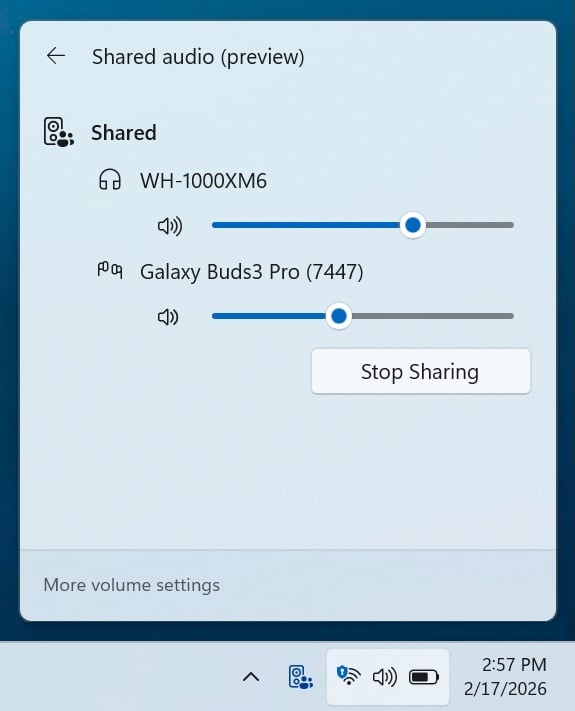
With today’s Windows Insider builds, Microsoft has also improved the Shared audio feature, introduced in October, which allows sharing audio between two headphones, speakers, earbuds, or hearing aids.

Shared Audio volume sliders
Shared Audio volume sliders (Microsoft)

Previously, volume adjustments affected both users equally, but the new update adds individual volume sliders for each listener and device. A new taskbar indicator also appears during active sharing sessions to provide a visual reminder and a one-click shortcut to sharing settings.

The compatible device lineup has also expanded to include more Bluetooth LE Audio accessories, with the Samsung Galaxy Buds 4 and Buds 4 Pro, Sony WF-1000XM6, and Xbox Wireless Headset now also supporting the feature.

These new capabilities are rolling out to Windows Insiders in the Beta and Dev channels who have installed Windows 11 Preview Build 26220.7934 (KB5077242) and Windows 11 Preview Build 26300.7939 (KB5077243), respectively.

Advertisement

Modern IT infrastructure moves faster than manual workflows can handle.

In this new Tines guide, learn how your team can reduce hidden manual delays, improve reliability through automated response, and build and scale intelligent workflows on top of tools you already use.

Source link

Continue Reading

Trending

Copyright © 2025