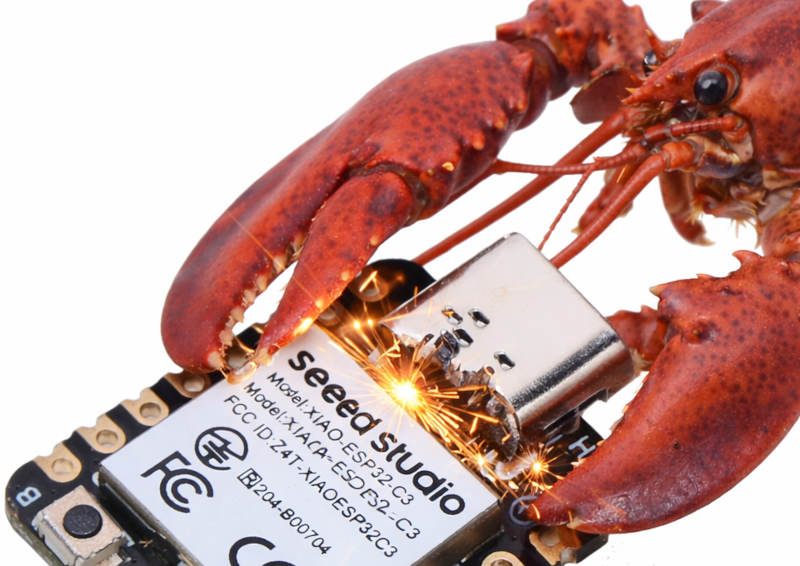
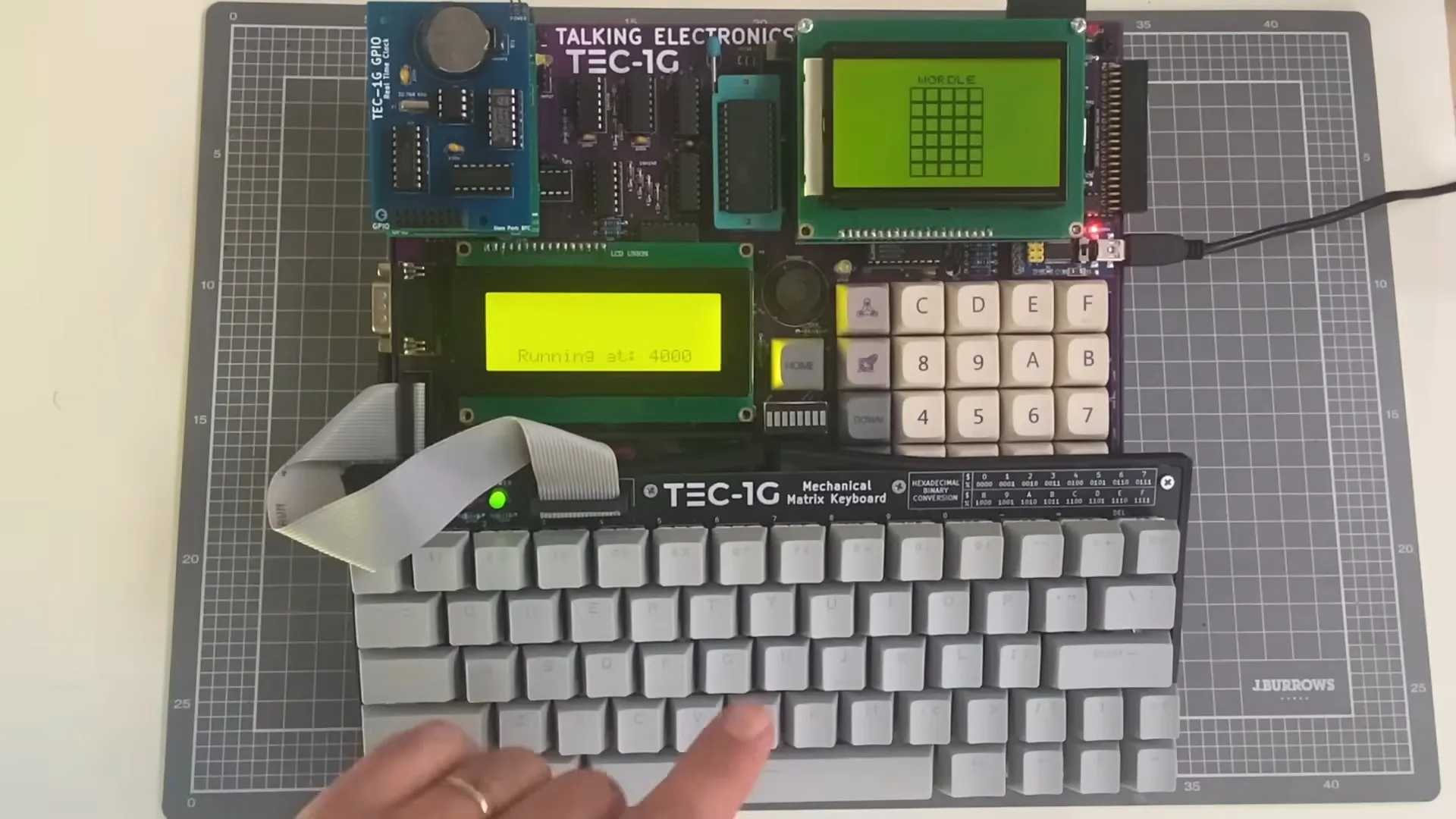
Having an AI assistant is all the rage these days, but AI assistants usually don’t know about your automation setups and may have difficulty dealing with tasks asynchronously. Enter zclaw. It gives you the option to have a personal assistant on an ESP32 backed by Anthropic, OpenAI, or OpenRouter. The whole thing fits in 888KB, and while it doesn’t host the LLM, it does add key capabilities to monitor and control devices connected to the ESP32.
You communicate with the assistant via telegram. You can say things like “Remember the garage sensor is on GPIO 4.” Then later you might say: “In 20 minutes, check the garage sensor and if it is high, set GPIO 5 low.” It has an RTOS for scheduling tasks and is aware of the timezone and common periods. Memory persists across reboots, and you can pick different personas.

Some of the use cases mentioned in the manual show how having something that can precisely schedule, control, or monitor devices might pay off. Ideas like bringing up a lab setup, scheduling plant watering, and more would be difficult to do with just a stock chatbot.
Advertisement
The AI can also introspect. For example, you could create a few tasks on a schedule and then ask the device to “show me my schedules.” You can also create up to 8 tools with a name, description, and action. This lets you describe something like “power_down_bench” and then tell zclaw to execute it on demand or even on a schedule. Overall, an interesting and well-documented setup.
We spend hours testing every product or service we review, so you can be sure you’re buying the best. Find out more about how we test.
Skullcandy Crusher PLYR 720: two-minute review
The Skullcandy Crusher PLYR 720 is an open-back headset with a bass-heavy sound designed to impart as much impact as possible when playing games.
For a gaming headset, the Crusher PLYR 720 has quite a muted appearance; even the RGB lighting is restrained. In fact, the most prominent feature is the sheer bulk of the drivers, which are hard to ignore and aren’t exactly flattering when cupped over your ears.
Advertisement
The entire headset is built to a high standard. The materials feel premium and sturdy, and the various buttons and controls operate with a reassuring solidity. All this means the Crusher PLYR 720 ranks among the best wireless gaming headset in terms of construction.
Wearing the Crusher PLYR 720 is largely a joy, despite that aforementioned bulk. Even when wearing glasses, I experienced little fatigue on my ears or head, even after long sessions.
This is partly due to the thick padding of the earcups, although their inner circumference is smaller than you might imagine from the outside, which may be a problem for those with larger lobes.
Advertisement
The headband is also supremely comfortable. It has a second layer that stretches across the top of your head, therefore eliminating the soreness that single-layer headbands can cause — even those with soft padding.
However, the fit isn’t all that secure. Whenever I leaned my head back, the entire headset almost fell off completely, only saved by the grip of the headband.
Sign up for breaking news, reviews, opinion, top tech deals, and more.
Both the desktop and mobile apps for the Crusher PLYR 720 are easy to use and full of useful tweaks, complete with handy graphs and visualizations to help you make them. In my time with them, they ran smoothly without any glitches or stability issues.
Advertisement
(Image credit: Future)
The overall sound quality of the Crusher PLYR 720 is excellent. When gaming, every detail is audible and impactful, even with the bass dialed back. However, it perhaps lacks the treble clarity of the best headphones around. This is somewhat forgivable when gaming, but less so when listening intently to music. I still found the Crusher PLYR 720 enjoyable for the latter purpose, though, and it’s a better gaming headset than many in this regard.
Given the name, it’s no surprise that Skullcandy’s Crusher feature is the sonic highlight. This allows you to crank the bass of the Crusher PLYR 720 to frankly absurd levels. How much you need to dial in depends greatly on the specific source, but at its best it adds an unparalleled amount of weight to low-end frequencies, from gunshots to kick drums.
The Crusher PLYR 720 also gets THX Spatial Audio support. The head-tracking feature works well enough, although it lacks precision and subtlety. The surround sound distance adjustments also fail to impart a sense of space all that accurately.
Along with these features, there’s also the obligatory EQ graph, with four presets and four custom slots for tuning your own. However, I didn’t find any tweaking useful, as the default flat mode was sufficient for every scenario.
Advertisement
The microphone offers plenty of clarity, too, rendering my voice without distortion. It’s a small shame the stalk can’t be manipulated to the same degree as gooseneck designs can be, but I found the positioning adequate nonetheless.
Connecting the Crusher PLYR 720 to various devices was quick and easy, whether it was via the 2.4GHz USB dongle or Bluetooth. Also, being able to connect to your smartphone and your gaming system simultaneously is a blessing, as this allows you to alter settings in the mobile app mid-play.
The battery life of the Crusher PLYR 720 is quite impressive. Skullcandy quotes a time of 48 hours, and I believe this figure. Over the course of several days, when used with a variety of platforms, all sonic features activated, and RGB lighting on, it still had juice left.
All of these quality features come at a price, though, as the Crusher PLYR 720 sits firmly at the premium end of the market. There are great wireless headsets for considerably less, such as the Razer BlackShark V3 and theBeyerdynamic MMX 150 Wireless, but if you need untold amounts of bass in your life, the Crusher PLYR 720 scratches that itch like nothing else.
The Skullcandy Crusher PLYR 720 costs $269.99 / £229.99 / AU$449.99 and is available now. Two editions are available: Xbox and multi-platform. Both are the same price.
If you want to save some serious money, then the Razer BlackShark V3 might be for you. In our glowing review, we highlighted its comfortable, lightweight design that felt more premium than its mid-range price tag suggests, as well as its impressive noise isolation and versatile sonics. For these reasons, we think it ranks among the best PC gaming headsets around right now.
For those who prize audio quality first and foremost, the Beyerdynamic MMX 150 Wireless is a better option. We were impressed with its immersive sound stage, although we were less taken with its microphone. This headset is also a lot cheaper than the Crusher PLYR 720.
(Image credit: Future)
Advertisement
Skullcandy Crusher PLYR 720 review: specs
Swipe to scroll horizontally
Price
$269.99 / £229.99 / AU$449.99
Weight
0.78lbs / 354g
Advertisement
Compatibility
PC, Xbox Series X/S, PlayStation 5, Nintendo Switch, Android, iOS
Skull-HQ (PC), Skullcandy mobile app (Android and iOS)
(Image credit: Future)
Skullcandy Crusher PLYR 720 review: design and features
Very comfortable
Excellent build quality
Plenty of audio-based features
For a gaming headset, the Crusher PLYR 720 has a reasonably muted style. The design is devoid of any gamer-aesthetic touches typical to many in this sector. The premium-looking and feeling matte black finish even lends an element of sophistication.
The RGB lighting is similarly subtle: there’s some illumination strained through small strips and a honeycomb mesh on the drivers, but the lion’s share is reserved for the inside of the earcups — which, of course, you won’t see when wearing the Crusher PLYR 720.
Advertisement
I should also highlight the build quality of the Crusher PLYR 720, as it’s excellent. Despite it being a relatively light unit, it feels sturdy and well-made. I particularly liked the 180-degree rotating drivers, which is convenient when you want to take a break and hang the headset around your neck.
What makes the headset stand out above all else, though, is the bulky drivers. They’re very wide, which makes the Crusher PLYR 720 less than ideal as a travel companion; not only because the drivers take up a lot of space, but also because they don’t look particularly fetching around your ears.
Despite this bulk, the actual inner circumference of the earcups is quite small. Personally, I didn’t find them too small for my ears, but it’s possible others might.
In fact, I found the Crusher PLYR 720 exceptionally comfortable all-round. There’s plenty of padding on the earcups, yet its fabric is more breathable than many. Also, as a glasses-wearer, I can confirm that the cups don’t present any issues when sat on top the arms of frames.
Advertisement
The headband is solid yet flexible, and feels reassuringly durable. You don’t get any padding here; instead, there’s a supplementary band, made from an elastic material to fit snugly on your head, running underneath the main one. I found this incredibly comfortable; I didn’t experience any aching or fatigue at all, even after long sessions, as I have with many other headsets.
The adjustments for the earcup height are also excellent. They have a sufficient range to accommodate various head sizes, and the operation of these adjustments is very smooth with no notching. Despite this, the cups remain at your chosen height setting with a surprising amount of stability, which impressed me.
However, the overall fit of the Crusher PLYR 720 isn’t particularly secure. The earcup padding provided little friction to the side of my head, so whenever I tilted my head back the entire headset moved with it; only the grip of the headband kept it from falling off completely. However, this wasn’t an issue during normal use, so it’s a trade-off I’m willing to accept for the supreme overall comfort of the headset.
(Image credit: Future)
The switches and other controls on the Crusher PLYR 720 operate with a satisfying solidity and smoothness. There are three main buttons, all of which are easy to reach, thanks to their convenient positioning and generous size. One is named Custom, which is misleading, since as far as I can work out, can only be used to toggle THX Spatial Audio Head Tracking on or off.
Advertisement
The joystick for adjusting volume and other parameters is easy to use for the most part, although there isn’t much feedback when you move it. At least it’s hard to trigger accidentally, by, say, leaning against the back of your chair — something I’ve experienced numerous times with conventional volume wheels.
It’s a slight shame, though, that the jumps between the volume increments are quite large, meaning it’s hard to dial in a very precise volume with the joystick; for such purposes, you’d be better served by the volume settings of your connected device or inside Skullcandy’s software.
Thankfully, the Crusher wheel doesn’t suffer from accidental triggering or overlarge increments. It’s tactile and smooth to operate, while the small point that sticks out makes it easy to know where exactly you are in the setting.
There are three ports on the Crusher PLYR 720: a USB-C port for charging and playback, a 3.5mm audio jack, and the microphone input. All are located on the left-hand driver. The various cables fit securely in these ports, and what’s more, they’re nicely recessed for protection from accidental disconnections.
Advertisement
The microphone appears to be as well made as the rest of the headset. The soft rubber feels more upmarket than many others, but while it can bend around, it’s not a true gooseneck, so gamers who are particular about their mic placement might be a little disappointed by its lack of maneuverability.
(Image credit: Future)
Skull-HQ, the desktop app for the Crusher PLYR 720, is feature-packed and quite easy to use. It has a faux-retro interface that employs the terminal font, tapping into that mid-nineties hacker vibe. It ran smoothly during my time with it; I didn’t experience any slowdown or bugs.
The layout is clear, although I was a little disappointed by the lack of explanations for certain features. Some are only denoted by symbols, which aren’t always self-explanatory. A tutorial for the joystick controls would’ve been appreciated, too, rather than having to always refer to the manual.
There are plenty of tweaks that can be made to the Crusher PLYR 720 in the app. These range from rudimentary RGB customizations and basic adjustments volume, game mix, and the sidetone function.
Advertisement
Beyond these, there’s an parametric EQ with FPS, RPG, Music, and Default (flat) presets to choose from. There are also four custom slots, allowing you to save your own sculpted sound. This is achieved by dragging eight points on a graph, with a range of 32Hz to 16KHz, to cut or boost frequencies by 12BD.
Various adjustments for THX Spatial Audio are available, too, including the ability to set speaker distance. Strangely, however, there isn’t a toggle for the Head Tracking function, as there is in the Skullcandy mobile app (which has a better, cleaner interface than Skull-HQ, by the by).
Then there’s a section for the Crusher bass enhancement. Here, you can alter the cut-off points for the low and high frequencies on another EQ graph. This is rather overkill for such a setting, but nonetheless I always welcome a visual representation for sonic settings. It’s also accompanied by a humorous ditherpunk face depicting various expressions depending on the strength of the Crusher setting.
Skull-HQ even features a hearing test, designed to calibrate the Crusher PLYR 720 based on your individual hearing. What’s more, a knock-off version of Space Invaders is buried in the app, too.
Advertisement
Beyerdynamic MMX 150 Wireless review: performance
Skull-shaking bass feature
Great overall for gaming and music
Clear mic
The general sound of the Crusher PLYR 720 is punchy and clear, with all frequencies represented well. Overall fidelity isn’t quite up there with the best wireless headphones, though, which is most apparent when listening to music. This is due to the slight lack of crispness and clarity at the high end.
It’s the bass response that the Crusher PLYR 720 is sold on, though — thanks to its Crusher feature. Whether this is something you like comes down to personal preference, but I have to say that when the mood struck, I loved cranking the wheel to maximum and letting the drivers shake (and they really do shake) to my favorite bass-heavy tracks or to gunfire, something I certainly noticed when playing Counter-Strike 2.
However, you’ll find yourself riding the Crusher level frequently, as the prominence of the bass enhancement can vary widely between sources; even those you thought had a relatively tame low-end suddenly become a booming mess, causing the drivers to audibly rattle — even before you’ve enabled the extra Crusher Bass Boost on top. In fact, I wouldn’t want maximum “Crushing” for an entire session, even for sources that can handle it without distorting.
The THX Spatial Audio is reasonably effective. With Head Tracking enabled, changes to the audio space react quickly to head movements, without being too disconcerting or disorientating.
Advertisement
However, you’ll have to move your head by large degrees to notice the effect. Also, it’s a shame that the sensitivity of the effect can’t be adjusted, as it lacks the precision and subtlety of some of the best THX headsets and headphones. Adjusting the virtual distance of the surround sound speakers noticeably changes the soundscape, but at the cost of reducing fidelity. What’s more, I found it largely ineffective at imparting a realistic sense of space.
The microphone for the Crusher PLYR 720 is clear and largely free of distortion. The Sidetone mode allows an appropriate level of ambient noise to spill through, so you can hear your own voice more clearly.
(Image credit: Future)
During my time with the Crusher PLYR 720, it proved easy to connect to the various devices I tested it with. The 2.4GHz USB dongle allows for instant plug-and-play, and merely requires the flip of a switch on the dongle itself to change compatibility modes from PC to Xbox.
In terms of connectivity to Microsoft’s console, then, the Crusher PLYR 720 up there with the best Xbox Series X headsets. It also connected to my Nintendo Switch just as easily, via the dongle and Bluetooth.
Advertisement
Oddly, even though I had the Xbox version of the Crusher PLYR 720, it still worked with my PlayStation 5 via the dongle. There’s conflicting information as to whether this is intended or not: the printed manual states that the Xbox variant only works with the PS5 when connected via the 3.5mm audio cable, while the product page on Skullcandy’s website states that wireless play is possible with Sony’s console. If the latter is correct, it then begs the question as to why there are two versions of the Crusher PLYR 720.
It connected seamlessly to my Android smartphone via Bluetooth, with no discernable drop in audio quality. Better yet, you can connect to your phone and console or PC at the same time; during my testing, I was impressed by the ease with which it established and maintained these simultaneous connections. The benefit of this is that you can adjust settings in the mobile app on the fly, taking effect while playing your game.
Even with this multiplatform use, the battery of the Crusher PLYR 720 endured admirably well. Skullcandy claims it can last 48 hours, but with all the bells and whistles enabled, you can see lifespan deplete at a considerable rate in the software readouts. Still, it managed to last several long sessions over a few days, which, in addition to connecting to various devices, also involved activating all its various sound features and keeping the RGB lighting on.
Advertisement
Should I buy the Beyerdynamic MMX 150 Wireless?
Buy it if…
Don’t buy it if…
Beyerdynamic MMX 150 Wireless review: also consider
Swipe to scroll horizontally
Row 0 – Cell 0
Skullcandy Crusher PLYR 720
Advertisement
Razer BlackShark V3
Beyerdynamic MMX 150 Wireless
Price
$269.99 / £229.99 / AU$449.99
Advertisement
$149.99 / £149.99 / AU$350
£159 (around $210)
Weight
0.78lbs / 354g
Advertisement
0.6lbs / 270g
0.7lbs / 336g
Compatibility
PC, Xbox Series X/S, PlayStation 5, Nintendo Switch, Android, iOS
Advertisement
Xbox Series X|S, Xbox One, PlayStation, Nintendo Switch, PC, Mobile
PC, Xbox Series X/S, PlayStation 5, Playstation 4, Nintendo Switch 2, Steam Deck
THX Spatial Audio,detachable Razer HyperClear Super Wideband 9.9mm mic
Five-band EQ, 10 sound presets, Sidetone mode, custom button settings, plug-in mic with noise reduction
Battery life
48 hours
Advertisement
70 hours
50 hours
Software
Skull-HQ (PC), Skullcandy mobile app (Android and iOS)
Advertisement
Arctis Companion App
Beyerdynamic app
How I tested the Beyerdynamic MMX 150 Wireless
Tested for several days
Used for various scenarios and with multiple platforms
Experience reviewing gaming headsets
I tested the Skullcandy Crusher PLYR 720 for several days. Not only did I use it for gaming, but I also listened to music and watched videos with it on.
I tested it with a Windows PC, an Xbox Series S, a PlayStation 5, and a Nintendo Switch, connecting to each of these devices with the USB dongle. I also tested Bluetooth connectivity with the latter console, as well as with my Android phone. I used both the desktop Skull-HQ app and the Skullcandy mobile app to try out all the various features.
Advertisement
I’ve been gaming for decades, using a variety of headsets, headphones, and speakers for the activity. I’ve also reviewed a number of headsets professionally, all the way from budget wired offerings to premium multiplatform wireless options.
“This is just not the right pathway forward,” Isaacman said.
A senior NASA official, speaking on background to Ars, noted that the space agency has experienced hydrogen and helium leaks during both the Artemis I and Artemis II prelaunch preparations, and these problems have led to monthslong delays in launch.
“If I recall, the timing between Apollo 7 and 8 was nine weeks,” the official said. “Launching SLS every three and a half years or so is not a recipe for success. Certainly, making each one of them a work of art with some major configuration change is also not helpful in the process, and we’re clearly seeing the results of it, right?”
The goal therefore is to standardize the SLS rocket into a single configuration in order to make the rocket as reliable as possible, and launching as frequently as every 10 months. NASA will fly the SLS vehicle until there are commercial alternatives to launch crews to the moon, perhaps through Artemis V as Congress has mandated, or perhaps even a little longer.
Advertisement
Is Everyone on Board?
The NASA official said all of the agency’s key contractors are on board with the change, and senior leaders in Congress have been briefed on the proposed changes.
The biggest opposition to these proposals would seemingly come from Boeing, which is the prime contractor for the Exploration Upper Stage, a contract worth billions of dollars to develop a more powerful rocket that was due to launch for the first time later this decade. However, in a NASA news release, Boeing appeared to offer at least some support for the revised plans.
“Boeing is a proud partner to the Artemis mission and our team is honored to contribute to NASA’s vision for American space leadership,” said Steve Parker, Boeing Defense, Space & Security president and CEO, in the news release. “The SLS core stage remains the world’s most powerful rocket stage, and the only one that can carry American astronauts directly to the moon and beyond in a single launch. As NASA lays out an accelerated launch schedule, our workforce and supply chain are prepared to meet the increased production needs.”
Solid Reasons for Changing Artemis III
NASA’s new approach to Artemis reflects a return to the philosophy of the Apollo program. During the late 1960s, the space agency flew a series of preparatory crewed missions before the Apollo 11 lunar landing. These included Apollo 7 (a low-Earth-orbit test of the Apollo spacecraft), Apollo 8 (a lunar orbiting mission), Apollo 9 (a low-Earth-orbit rendezvous with the lunar lander), and Apollo 10 (a test of the lunar lander descending to the moon, without touching down).
Advertisement
With its previous Artemis template, NASA skipped the steps taken by Apollo 7, 9, and 10. In the view of many industry officials, this leap from Artemis II—a crewed lunar flyby of the moon testing only the SLS rocket and Orion spacecraft—to Artemis III and a full-on lunar landing was enormous and risky.
The Artemis II crew rehearse a walkout from the Neil A. Armstrong Operations and Checkout Building at NASA’s Kennedy Space Center.Photograph: Joe Raedle/Getty Images
The CL1 is the first commercial system from the same researchers who wowed the tech world in 2022 by teaching a cluster of 800,000 neurons to play Pong. The new CL1 pushes the idea into engineered hardware, built around 59 electrodes positioned on a planar array of metal and glass…. Read Entire Article Source link
Choosing a high-resolution display for your Mac doesn’t mean splashing out on an Apple Pro Display XDR, and the $2,500 Alogic Clarity 6K Touch monitor proves it.
Alogic Clarity Touch 6K review: 32 inches makes for a huge canvas
At $4,999 before you add a stand, the Pro Display XDR is a beast of a display. Its 32-inch size makes it a great option for productivity and creativity alike, and the 6K resolution makes for Retina-like pinpoint sharpness. Alogic’s alternative matches all of those specs. It also measures 32 inches from corner to corner, and its 6K resolution gives it a pixel density of 216 pixels per inch. Continue Reading on AppleInsider | Discuss on our Forums
The 2026 Microsoft Office Pro Bundle has 8 courses to help you master essential Office skills. Courses cover Access, PowerPoint, Word, Excel, and more. It’s on sale for $25.
Note: The Techdirt Deals Store is powered and curated by StackCommerce. A portion of all sales from Techdirt Deals helps support Techdirt. The products featured do not reflect endorsements by our editorial team.
Earlier this year we noted how the Trump FCC, at the direct request of wireless phone giants, destroyed popular phone unlocking rules making it easier and cheaper to switch wireless carriers. The rules, applied via spectrum acquisition and merger conditions after years of activism, required that Verizon unlock your phone within 60 days after purchase so you could easily switch to competitors.
Verizon, as we’ve long established, hates competition, and early last year immediately got to work lobbying the Trump administration to destroy the rules (falsely) claiming, without evidence, that the modest phone unlocking requirements were a boon to criminals and scammers.
The pay-to-play Trump administration quickly agreed, killed the rules, and shortly thereafter Verizon started telling wireless customers on its many prepaid phone brands (including Tracfone) they had to wait a year before switching phones after purchasing one from Verizon:
“While a locked phone is tied to the network of one carrier, an unlocked phone can be switched to another carrier if the device is compatible with the other carrier’s network. But the new TracFone unlocking policy is stringent, requiring customers to pay for a full year of service before they can get a phone unlocked.”
Recently, Verizon implemented a whole bunch of additional restrictions made possible by the Trump administration. More specifically, they imposed a new 35-day waiting period when a customer pays off their device installment plan online or in the Verizon app and wants to take their device to another carrier:
Advertisement
“Payments made over the phone also trigger a 35-day waiting period, as do payments made at Verizon Authorized Retailers. Getting an immediate unlock apparently requires paying off the device plan at a Verizon corporate store.”
So first, they implemented the most draconian restrictions on its prepaid customers, who tend to be lower income and the most impacted from high prices. Now they’re starting to push restrictions onto their more lucrative postpaid (month to month) customers.
Verizon insists (falsely) that these restrictions are necessary to “prevent fraud,” but the real goal is to increase friction when it comes to switching to a competitor. They don’t want the press to outright acknowledge this is anti-competitive in coverage, so they’re engaging in the slow-boiling frog approach that just steadily makes porting your phone out steadily more difficult and annoying.
These unlocking conditions were broadly popular, served the public interest, and took decades of activism and reform advocacy to pass. They ensured that it was easier for consumers to switch between our ever-consolidating, anti-competitive wireless phone giants (consolidation directly made possible by the Trump administration’s past rubber stamping of shitty telecom mergers).
Verizon lobbied the FCC by repeatedly lying, without evidence, that these conditions resulted in a wave of black market phone thefts. FCC boss Brendan Carr, ever the industry lackey, parroted the lies in his subsequent industry-friendly rulings. You know, to make America great again via “populism” or whatever.
Advertisement
Verizon (and Carr) know that there’s a lot going on and the mundanity of a subject like phone unlocking won’t get much attention in the press. Given that the Trump administration has largely lobotomized regulatory independence (at Verizon’s request), there’s very little chance Verizon will see any future accountability, but it’s positively adorable that they’re proceeding cautiously just in case.
“The survey did not ask students whether they had used chatbots to write essays or generate other assignments…” notes the New York Times. “But nearly 60% of teenagers told Pew that students at their school used chatbots to cheat ‘very often’ or ‘somewhat often.’” Agreeing with that are the Pew Researchers themselves. “Our survey shows that many teens think cheating with AI has become a regular feature of student life.”
One worried teenager still told the researchers that AI “makes people lazy and takes away jobs.” But another teenager told the researchers that “Everyone’s going to have to know how to use AI or they’ll be left behind.”
Thanks to long-time Slashdot reader theodp for sharing the article.
Xiaomi has officially unveiled the Xiaomi 17 Ultra, and on paper, it has one of the most ambitious camera systems we’ve seen on a smartphone to date.
Built under an expanded co-creation partnership with Leica, the new flagship combines a 1-inch main sensor with a 200MP telephoto lens with mechanical zoom and advanced cinema-grade video tools. Xiaomi is positioning it as its most serious photography phone yet.
At the heart of the setup is a 50MP Leica 1-inch “Ultra Dynamic” main camera using the new Light Fusion 1050L sensor with LOFIC HDR technology. It is designed to boost dynamic range and improve colour accuracy in high-contrast scenes.
Image Credit (Trusted Reviews)
Advertisement
Xiaomi pairs that with a 200MP Leica telephoto camera. This camera offers a 75–100mm mechanical optical zoom range and up to 400mm (17.2x) optical-level zoom without heavy in-sensor cropping.
Advertisement
The optics themselves lean heavily into Leica’s influence. Xiaomi uses a 1G+6P hybrid lens design with multi-layer coatings to reduce ghosting and colour fringing. Meanwhile, the telephoto module includes Leica’s first APO optical lens in the company’s flagship line-up.
Video gets a notable upgrade too. The 17 Ultra can shoot 8K at 30fps, as well as 4K at 120fps with Dolby Vision. It also supports 4K 120fps Log recording with ACES colour encoding. This gives creators far more room to grade footage in post.
Despite the large sensors and 6000mAh battery, Xiaomi says this is its thinnest and lightest Ultra model yet, measuring 8.29mm thick. It features a flat 6.9-inch HyperRGB OLED display with 2K-level clarity. There is a 1–120Hz LTPO refresh rate and up to 3500 nits peak brightness.
Powering everything is Qualcomm’s Snapdragon 8 Elite Gen 5, paired with up to 16GB RAM and 1TB storage. A 3D Dual-Channel IceLoop cooling system keeps performance stable during extended shooting sessions. Meanwhile, 90W wired and 50W wireless charging aim to minimise downtime.
Advertisement
Image Credit (Trusted Reviews)
Advertisement
Xiaomi is also introducing upgraded Photography Kits, including a Pro version with a built-in 2000mAh battery and Leica-inspired grip.
If Xiaomi’s previous Ultra models were about pushing boundaries, the 17 Ultra looks more focused: bigger sensors, smarter optics, and tools designed for people who actually care about colour science and long-range detail. Whether it lives up to that promise will depend on real-world testing, but the spec sheet alone makes a strong case.
Projectors usually fall into one of two buckets: cheap models that look underwhelming the second you turn them on, or premium ones that feel great until you see the price. This deal lands in a very appealing middle ground. The XGIMI HORIZON Ultra is down to $998.98 for a limited time, which is a big drop from $1,699.99. That’s a 41% discount on a projector that’s clearly aimed at people who want a real living-room upgrade, not a toy for occasional use.
What you’re getting
The HORIZON Ultra is a 4K projector with Dolby Vision, 2300 ISO lumens, and dual light technology that combines LED and laser light sources. XGIMI also lists 3840 x 2160 resolution, built-in Bluetooth, and a set of smart image features like auto focus, auto obstacle avoidance, and auto screen alignment.
This isn’t a barebones projector where you’re expected to do all the work yourself. XGIMI says it uses its Intelligent Screen Adaption 3.0 system to adjust screen correction, handle wall color, and make setup smoother. That matters because the difference between “I use this all the time” and “this was a fun idea” often comes down to how annoying setup is.
It also includes 2 x 12W Harman Kardon speakers, plus Wi-Fi and Bluetooth, which makes it easier to use as an all-in-one entertainment device instead of immediately needing to add more stuff to your cart just to make things happen.
Advertisement
Why it’s worth it
This deal works because the HORIZON Ultra checks the boxes people actually care about. It’s bright enough to be practical, it supports premium HDR-friendly viewing with Dolby Vision, and it has the kind of built-in intelligence that makes everyday use feel easier instead of fiddly. That is exactly what you want if this projector is going in a living room, media room, or shared space where people want to press play, not troubleshoot.
The 2300 ISO lumens spec is the part that helps this feel more serious than the flood of bargain projectors online. It gives you more flexibility for rooms that aren’t perfectly dark, which is important in the real world, where not everyone is building a blacked-out theater cave. And the 200-inch image potential is the kind of thing that reminds you why projectors are fun in the first place: this can create a much bigger-feeling setup than most TVs, especially for movies and sports.
The bottom line
At $998.98, the XGIMI HORIZON Ultra feels like the sweet spot version of a premium projector buy. You’re getting 4K, Dolby Vision, strong brightness, smart setup features, and built-in speakers in a package that now costs hundreds less than usual. If you’ve been waiting for a home theater upgrade that feels substantial without going fully overboard, this is a very easy deal to like
Alongside a global launch for Xiaomi’s 17 Ultra (read about that right here), the company announced a further deepening of its relationship with Leica. The CEO of Leica, Mattias Harsch, took to the stage to announce a new Leitzphone, which appears to be an even deeper collaboration than 17 Ultra by Leica, which is a different phone. Confused? That’s fair.
Design-wise, Leica has shifted back to a single tone body color, which looks more “Leica” to this camera dilettante’s eyes. And if you’re thinking you’ve heard of the Leitzphone before, you probably have: it was a series of phones made by Sharp that launched in Japan in 2021. They all had a 1-inch camera sensor and yes, as does Xiaomi’s first Leitzphone. It also gets a customizable ring to control camera settings.
The camera interface is also designed by Leica. with the aim of being as intuitive as possible, with a new Essential mode within the camera app for stripping away all those modes and labels, showcasing whatever you’re looking to shoot.
Image by Mat Smith for Engadget
The regular Xiaomi 17 Ultra and Leica edition have a Snapdragon 8 Elite Gen 5 chip and a 6.9-inch 120Hz display that can reach up to 3,500 nits of peak brightness. While cameras are the focus, it’s a flagship device by pretty much any metric — and the Leitzphone seems to have a very similar specsheet. We’ll be taking a closer look at what’s different when we get to test it out very soon.
Advertisement
After years of collaboration (and cute little badges), this may be the first pure “Leica phone” manufactured by Xiaomi but sold directly by both companies. It’s priced at €1,999 (roughly $2,362), but it’s not known yet whether this phone will launch in the US.