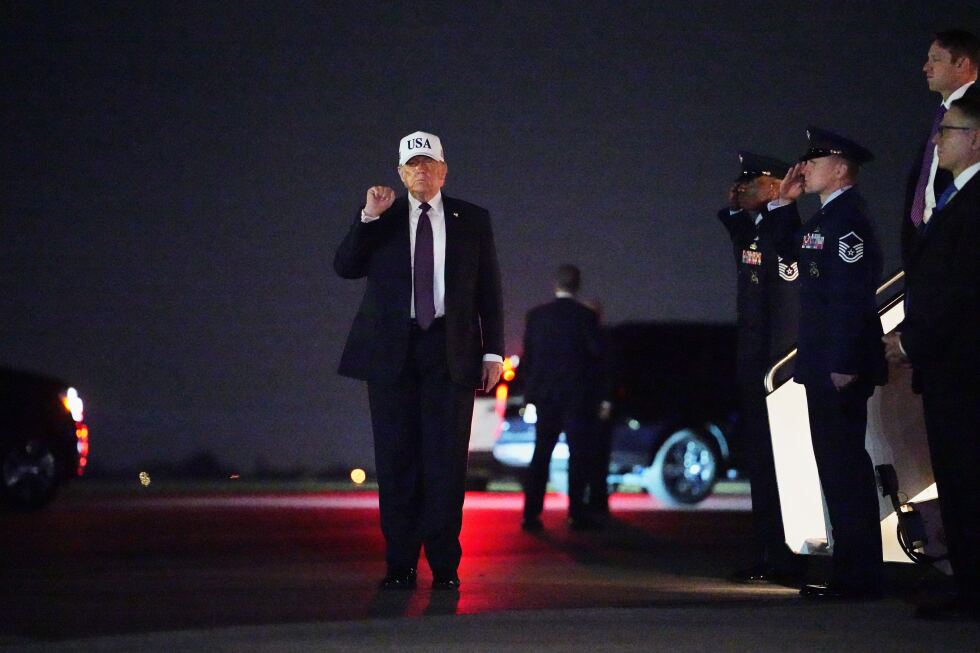
WEST PALM BEACH, Fla. (AP) — With Saturday’s military operation against Iran, President Donald Trump demonstrated a dramatic evolution in risk tolerance, adjusting in just a matter of months how far he was willing to go in using American military might to confront Tehran’s clerical rule.
Guardrails were tossed aside, as Trump and Israeli Prime Minister Benjamin Netanyahu ordered up a battle plan that included targeted strikes on Iran’s leadership, including the 86-year-old Supreme Leader Ayatollah Ali Khamenei whose death Trump triumphantly announced in a social media post hours after launching the military operation.
For Trump, it was a far cry from where he stood just eight months ago. At Israel’s urging during its 12-day war with Iran last June, he agreed to deployB-2 bombers to pummel three key Iranian nuclear sites — but drew a bright red line when Israelis presented his administration with a plan for killing Khamenei.
The president peppered the supreme leader with thinly veiled threats back in June that he could have killed him if he wanted to. But he rejected the Israeli plan out of concern that it would destabilize the region.
That caution was set aside on Saturday with Trump announcing Khamenei had been killed, while the Israeli military announced it had taken out Iran’s defense minister and the commander of its Revolutionary Guard. Iranian state media early Sunday reported the 86-year-old Supreme Leader’s death, without elaborating on a cause.
Khamenei “was unable to avoid our Intelligence and Highly Sophisticated Tracking Systems and, working closely with Israel, there was not a thing he, or the other leaders that have been killed along with him, could do,” Trump said. “This is the single greatest chance for the Iranian people to take back their Country.”
Trump loses patience
Trump had pursued talks with Iran for months. Administration officials told reporters that they offered Iran many ways to have a peaceful nuclear program that could be used for civilian purposes, including an offer of free nuclear fuel in perpetuity.
But the officials, who were not authorized to comment publicly and spoke on condition of anonymity, said it was clear to them that Iran wanted enriched uranium for a nuclear weapon. One of them said that Iran has met their offers with “games, tricks, stall tactics.”
The order to launch strikes came just two days after Trump dispatched his special envoys, Steve Witkoff and Jared Kushner, for another round of talks with Iranian officials. Middle East and European allies were urging the U.S. administration to give negotiations more time as Trump signaled he was running out of patience.
“The consequences are likely to be as far-reaching as they are uncertain: Within the system that has held power for nearly five decades, between the government and a dissatisfied populace, and between Iran and its adversaries,” said Ali Vaez, Iran project director at the International Crisis Group. “And although the regime is weakened, a sense that this showdown is an all-or-nothing struggle for its very survival could lead it to respond with every tool still at its disposal.”
Revised risk calculation
Saturday’s strikes came after a series of past provocative actions against Iran that resulted in limited blowback, which seemed to inform Trump’s risk calculation, said Aaron David Miller, who served as an adviser on Middle East issues to Democratic and Republican administrations over two decades.
Trump in 2018 pulled out of the Iran nuclear deal negotiated by Democratic President Barack Obama’s administration. In 2020, Trump ordered a drone strike killing top Iranian Gen. Qassem Soleimani.
At the time, the killing of Soleimani, the head of Iran’s elite Quds Force, was arguably the most provocative U.S. military action in the Middle East since President George W. Bush launched the 2003 Iraq War to topple Saddam Hussein.
And then Trump this past June ordered the strikes on Iran’s nuclear facilities, which he claimed had “obliterated” their program.
“He did all of these things without cost or consequence to him,” said Miller, who is now a senior fellow at the Carnegie Endowment for International Peace. “He’s been risk-ready. That’s the nature of his personality.”
Trump administration officials had publicly urged Tehran to give up its nuclear weapons and ballistic missile programs and end its backing of regional armed proxies. But administration officials said that Tehran would not engage on the missile and proxy concerns.
Iran’s rigidity, at a moment when its economy is in shambles weighed by decades of sanctions and its military battered by last year’s war, astounded Trump.
Even before the latest round of talks ended on Thursday, there were signs Trump was leaning toward military action.
On Tuesday, Trump in his State of the Union speech claimed that Iran has been building ballistic missiles that could reach the U.S. homeland — a justification that he repeated again on Saturday as he announced the bombardment of Iran was underway.
Iran hasn’t acknowledged it is building or seeking to build intercontinental ballistic missiles. The U.S. Defense Intelligence Agency, however, said in an unclassified report last year that Iran could develop a militarily viable intercontinental ballistic missile by 2035 “should Tehran decide to pursue the capability.”
Secretary of State Marco Rubio told reporters on Wednesday that Iran’s refusal to speak to its ballistic missile program was a “big problem.” Rubio declined to address the DIA finding that Iran was still years away from developing a missile that could reach the United States.
And Vice President JD Vance, a former U.S. Marine who served in Iraq and has been skeptical of U.S. interventions, on Thursday told The Washington Post that Trump hadn’t decided whether to strike Iran. But he offered assurances that military action would not result in the United States becoming involved in a drawn-out conflict.
“The idea that we’re going to be in a Middle Eastern war for years with no end in sight — there is no chance that will happen,” Vance said.
By Friday, Trump was venting anew about Iran’s approach.
“ I’m not happy with the fact that they’re not willing to give us what we have to have,” Trump said. “I’m not thrilled with that. We’ll see what happens.”
Senior U.S. lawmakers were told early Saturday that the strikes were coming. Trump monitored the operation from his Mar-a-Lago resort in Palm Beach, Florida, with members of his national security team.
Trump may have been emboldened by his Venezuela experience
Trump’s success with the U.S. military operation earlier his year to capture Venezuelan leader Nicolás Maduro and whisk him and his wife to New York City to face federal drug conspiracy charges also may have emboldened the president, said Jonathan Schanzer, a former Treasury Department official who is now executive director of the Foundation for Defense of Democracies, a hawkish Washington think tank.
Trump had threatened military action last month, but held off, as Iran carried out a deadly crackdown on protests. The demonstrations were spurred by economic grievances but morphed into a nationwide, anti-government push against the ruling clerics.
As human rights groups reported that thousands were killed in the Iranian crackdown, Trump told protesters that help was on its way, but it did not immediately come and the protests petered out.
Schanzer said that Trump’s decision not to follow through last month gave his team more time to assemble the now massive presence of fighter jets and warships in the region — as he had done in the Caribbean ahead of the Venezuela operation.
It was leverage, Trump hoped, that would get Khamenei to blink. But the Supreme Leader would not capitulate.
“The way this unfolded was inevitable, because there was no way that the Ayatollah was going to show flexibility,” Schanzer said.
___
Madhani reported from Washington.