

Crypto World
Bitcoin ETFs post $787M inflows, break outflow streak

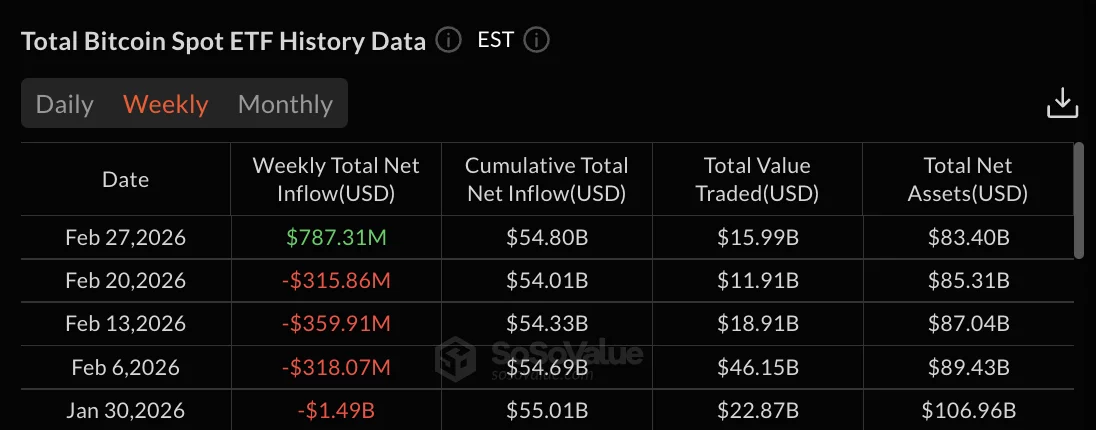
Bitcoin ETFs recorded $787.31 million in net inflows for the week ending February 27, reversing the prior week’s $315.86 million in outflows.
Summary
- Bitcoin ETFs posted $787M in weekly inflows, ending four red weeks.
- Three-day buying wave added $1.02B, led by a $506M peak day.
- Cumulative net inflows dipped slightly to $54.8B despite rebound.
The positive weekly flow came from three consecutive days of strong buying from February 24-26, totaling $1.02 billion, which offset outflows on February 23 and 27.
Bitcoin traded at $66,000 with gains of 1.7% over 24 hours following the weekly ETF reversal. The asset traded in a 24-hour range of $63,176 to $67,039.
Total net assets reached $83.40 billion while cumulative total net inflow stood at $54.80 billion.
Buying wave drives $1.02 billion in Bitcoin ETFs inflow
February 25 posted the week’s strongest single-day performance with $506.51 million in inflows.
February 26 added $254.46 million while February 24 contributed $257.71 million. The three-day streak brought $1.02 billion into Bitcoin ETF products.
February 23 recorded $203.82 million in outflows before the buying wave began. February 27 posted $27.55 million in redemptions, ending the three-day positive streak.
Weekly trading volume reached $15.99 billion for the period ending February 27, down from $22.87 billion during the week ending January 30.
Total net assets climbed from $85.31 billion on February 20 to $83.40 billion on February 27, showing a drop from the week’s peak despite positive flows.
Weekly reversal breaks four-week outflow streak
The $787.31 million weekly inflow was the first positive week since late January. The four prior weeks posted consecutive outflows.
That was $315.86 million for the week ending February 20, $359.91 million ending February 13, $318.07 million ending February 6, and $1.49 billion ending January 30.
The five-week outflow period from late January through mid-February totals approximately $2.48 billion before this week’s reversal.
Cumulative total net inflow fell from $55.01 billion on January 30 to $54.80 billion on February 27.


A federal judge in Manhattan has refused Binance’s bid to move a long-running securities lawsuit into private arbitration, allowing a class action alleging the exchange sold unregistered digital tokens to US investors to continue in court.
Key Takeaways:
- A US judge rejected Binance’s attempt to force arbitration, allowing a class action over alleged unregistered token sales to proceed in court.
- The court found users were not properly notified of the 2019 terms and the arbitration clause could not apply retroactively.
- The ruling moves the case closer to addressing whether some tokens listed on Binance qualify as securities under US law.
In a Thursday opinion, US District Judge Andrew L. Carter Jr. ruled that Binance did not properly notify users when it revised its Terms of Use in February 2019 to include an arbitration clause and a class-action restriction.
The plaintiffs, which are customers from California, Nevada and Texas, opened their accounts between September 2017 and April 2018, before those provisions existed.
Appeals Court Revives Binance Securities Case
The lawsuit is part of a wave of cases filed in April 2020 against crypto exchanges and token issuers during heightened scrutiny of token sales.
A lower court dismissed the complaint in 2022, but the Second Circuit revived it in 2024, concluding that US securities laws could apply to Binance even though the exchange lacked a formal domestic headquarters.
The Supreme Court declined to review that decision in early 2025.
Binance argued its updated 2019 terms governed the relationship with users. Judge Carter disagreed, stating that simply posting revised terms online was insufficient notice.
The court noted that customers had no duty to routinely check whether a company unilaterally altered contractual language.
Even if users later learned of the arbitration clause during the litigation, the court said it could not apply retroactively.
Under California contract law, a unilateral change that does not clearly address earlier claims cannot be used to limit disputes tied to past conduct.
The exchange also failed to enforce its class-action waiver. Although the heading referenced such a waiver, the body of the agreement never defined its scope.
The judge described the language as unclear and interpreted the standardized contract against Binance, which drafted the document.
Plaintiffs previously narrowed the case by dropping claims tied to activity after February 2019, leaving allegations focused on earlier token sales.
The decision clears a major procedural barrier and allows the case to move toward substantive arguments over whether certain listed tokens qualify as securities.
US Senators Urge Probe Into Binance Over Sanctions and AML Concerns
The ruling arrives as Binance faces renewed political scrutiny in Washington. A group of 11 US senators recently asked federal authorities to review whether the exchange complies with sanctions and anti-money-laundering requirements.
Lawmakers cited reports alleging roughly $1.7 billion in digital assets moved through the platform to Iranian-linked entities and raised concerns about possible sanctions evasion through newer payment products.
Roughly 20% of people change jobs yearly. It's normal. Organziation should have turnover. People move to better jobs. More growth/promotion opportunites for remaining team too. — CZ
(Not picking on Tom or EF, just making a point that people don't need to spin job changes related to… https://t.co/EqcmfpaAZ2
 BNB (@cz_binance) February 13, 2026
Separately, Senator Richard Blumenthal launched a congressional inquiry seeking records on the company’s compliance controls.
Binance has rejected the accusations, saying it reports suspicious activity and bars Iranian users from its platform.
The company also disputed media reports that it handled Iran-related transfers and denied claims it dismissed employees who flagged them.
The Securities and Exchange Commission moved to drop its own enforcement action against Binance last year, but the private lawsuit remains active.
The post US Judge Lets Binance Unregistered Token Class Action Proceed appeared first on Cryptonews.
Crypto World
How Strategy and Metaplanet Bitcoin Singularity Turns Cheap Legacy Capital into an Endless Bitcoin Accumulation Machine

TLDR:
- Strategy and Metaplanet Bitcoin Singularity captures a 6.6% annual spread to fund Bitcoin purchases at zero net cost.
- STRC perpetual preferreds now yield 11.5%, widening the spread gap since Livingston first outlined the trade in November 2025.
- Scaling the model to $100 million in raised capital generates up to $6.6 million in free Bitcoin purchases every single year.
- Any public company with access to low-cost capital can theoretically run this Bitcoin Treasury arbitrage playbook right now.
Strategy and Metaplanet Bitcoin Singularity is reshaping how public companies think about capital deployment and Bitcoin accumulation.
Crypto strategist Adam Livingston recently outlined a model where companies borrow at low rates and park capital into high-yield STRC perpetual preferreds.
The gap between both figures funds Bitcoin purchases at zero net cost. With STRC yields now near 11.5%, the trade is drawing serious attention from institutional observers watching Bitcoin Treasury companies closely.
How Strategy and Metaplanet Bitcoin Singularity Works in Practice
The mechanics behind Strategy and Metaplanet Bitcoin Singularity are built on a simple but powerful spread. A company raises capital at roughly 4.9% and deploys it into STRC perpetual preferreds yielding 11.5%.
The 6.6% difference between those two figures becomes the engine for Bitcoin accumulation. No extra capital is needed to fund the Bitcoin purchases.
Livingston broke the trade down using a clean $100 illustration. Raising $100 at 4.9% costs $4.90 per year in interest.
Deploying that same $100 into STRC returns $11.50 annually. The remaining $6.60 goes directly into Bitcoin, creating a self-funding accumulation loop.
Livingston posted on X, stating: “Scale it: $10M raised → $660k free Bitcoin per year. $100M raised → $6.6M free Bitcoin per year.” He described the structure as textbook positive-carry arbitrage, Bitcoin-Treasury edition.
Legacy capital flows in cheap, high-yielding paper flows out, and the excess funds Bitcoin at zero net cost.
The trade operates on a perpetual basis as long as the spread holds. There are no complex derivatives or leveraged instruments involved.
The structure simply captures the gap between borrowing costs and coupon income, then redirects that gap into Bitcoin every single year.
Metaplanet’s Structural Edge Within the Bitcoin Singularity Framework
Metaplanet sits at the center of this conversation for a specific reason. Japan’s ultra-low interest rate environment gives the company access to borrowing costs that most Western companies cannot match.
That structural advantage makes the spread wider and the Bitcoin accumulation rate faster compared to higher-rate markets.
Livingston was clear that Metaplanet is used as an example, not the exclusive operator of this strategy. Any sophisticated public company with access to low-cost capital could theoretically run the same playbook. The Japan dynamic simply offers one of the most favorable entry points available today.
Livingston first identified this opportunity in November 2025, when Metaplanet was raising at 4.9% and STRC was yielding around 10.5%. Since then, STRC yields have climbed to approximately 11.5%, making the spread even more attractive than when he first outlined it.
The Strategy and Metaplanet Bitcoin Singularity framework turns legacy financial infrastructure into a Bitcoin accumulation machine.
Traditional capital markets, rather than competing with Bitcoin Treasury companies, are effectively funding their growth — without realizing it.


Crypto markets snapped back hard on Sunday after spending Saturday pricing in what looked like the start of a prolonged regional war.
Bitcoin climbed to $66,843, up 5.2% over the past 24 hours, recovering most of the losses from Saturday’s slide below $64,000 after U.S. and Israeli strikes on Iran.
The bounce accelerated after Iranian state TV confirmed the death of Supreme Leader Khamenei, which markets interpreted as raising the odds of a shorter conflict.
Solana led the recovery among majors, surging 10.8% to $86.42. Ether rose 7.5% to reclaim $1,994, putting it back within touching distance of $2,000 for the first time since Thursday. Cardano added 6.7%, dogecoin gained 6.5%, XRP rose 5.6%, and BNB climbed 4.8%.
The weekly picture is messier, however. Bitcoin is still down 1.6% over seven days, XRP has lost 2%, and dogecoin is off 2.5%. Solana and ether are the only majors that have clawed back into the green on the week, up 1.7% and 1.1% respectively.
The weekend volatility has been enormous but net movement has been small, which captures the broader story of a market whipsawing on global headlines without actually going anywhere.
The bounce looks convincing on a 24-hour chart but fragile in context. Saturday’s sell-off happened on thin weekend liquidity. Sunday’s rally happened on the same thin liquidity, just in the opposite direction.
The real test arrives in hours when equity futures, oil, and bond markets reopen and institutional capital has its first chance to react to Saturday’s events.
The Polymarket’s ceasefire contract gives a 78% chance of a U.S.-Iran ceasefire by April 30 and 61% by March 31, as reported earlier Sunday.
If that pricing holds once traditional markets digest the weekend, the bounce has legs. However, if oil spikes and equities gap lower on the open, crypto’s Sunday optimism could get faded the same way Wednesday’s push to $70,000 was.
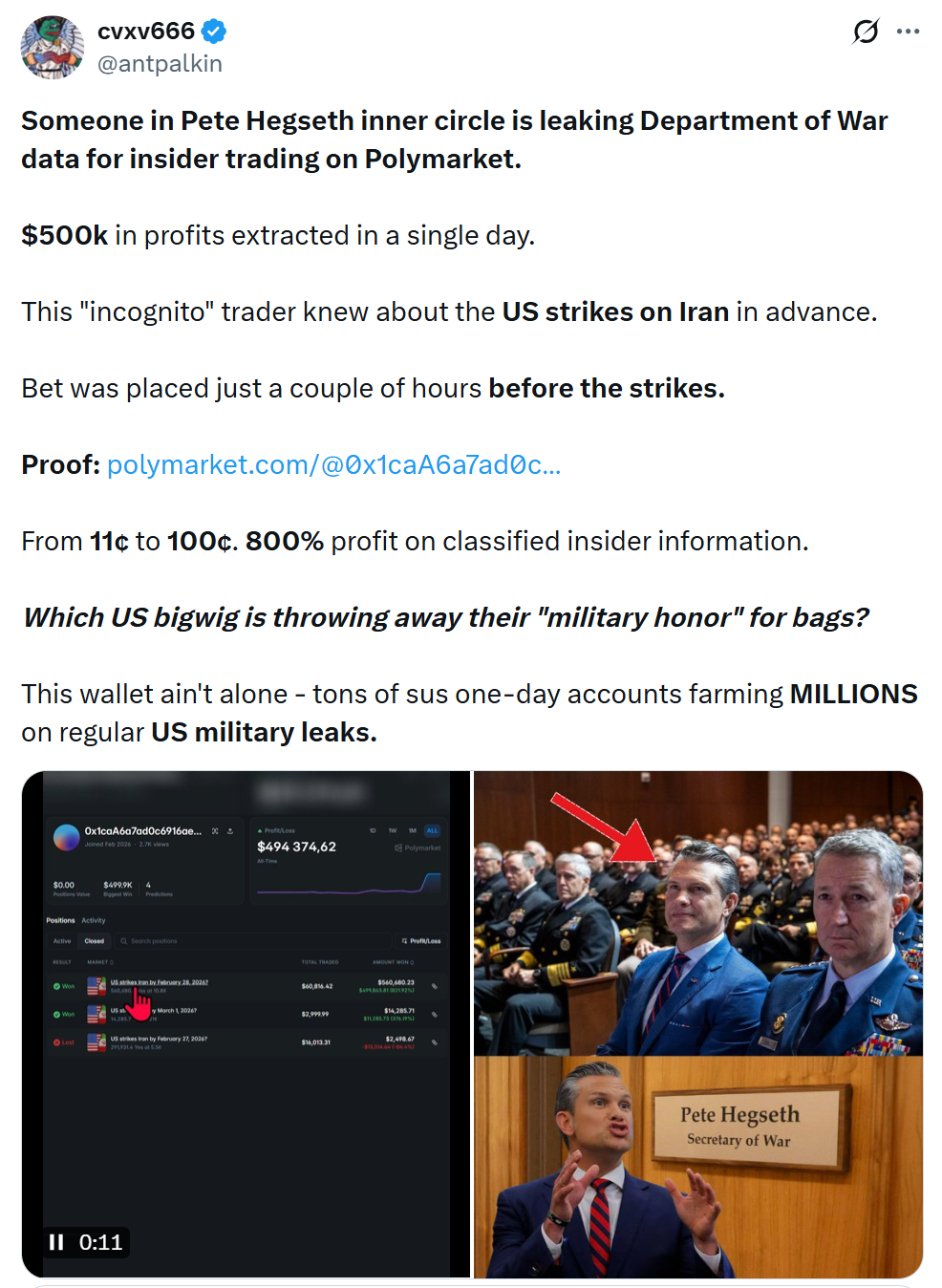
Six Polymarket traders earned roughly $1 million after accurately betting that the United States would strike Iran before the end of February, triggering insider trading suspicions.
The six wallets were all created in February and placed nearly all of their activity on contracts predicting the timing of a potential US attack, Bloomberg reported, citing data shared by analytics firm Bubblemaps SA. In several cases, shares were purchased only hours before explosions were first reported in Tehran, with some contracts acquired for around $0.10, per the report.
The timing drew attention from onchain investigators, who said the pattern resembles behavior previously linked to suspected insider activity on prediction markets.

“In cases involving war or conflict, information can circulate within a broader circle before becoming public,” Nicolas Vaiman, chief executive of Bubblemaps, reportedly said. “Combined with the fact that Polymarket generally only requires a wallet to trade, which allows for a high level of anonymity, this can create incentives for informed participants to act early,” he added.
Cointelegraph reached out to Polymarket for comment, but had not received a response by publication
Related: Polymarket user gains $400K betting on ZachXBT investigation
Polymarket Iran strike bets draw $529 million in volume
During the recent escalation, more than $529 million flowed into strike-related contracts on Polymarket. The specific Feb. 28 contract alone attracted roughly $90 million in trading volume, making it the most popular strike date among traders. A Jan. 31 scenario followed with about $42 million.
Notably, one of the flagged accounts had previously lost money on an earlier prediction before placing a larger wager that later returned more than $170,000, suggesting that the trades do not by themselves prove wrongdoing. Washington had also publicly warned of possible military action for weeks, drawing speculators to the platform.
There have been more instances of insider-trading allegations on Polymarket. This week, a small cluster of crypto wallets earned more than $1.2 million betting on a contract tied to an onchain investigation into DeFi platform Axiom, shortly before investigator ZachXBT published claims that an Axiom employee and associates had been engaged in insider trading since early 2025.
Last month, a Polymarket account made about $400,000 from a well-timed wager on the capture of Venezuelan President Nicolás Maduro. The wallet had placed roughly $32,000 on Maduro’s removal shortly before the news became public, raising insider trading concerns.
Related: Polymarket users favor Meteora in bets over ZachXBT crypto takedown
US lawmaker moves to ban insider trading on prediction markets
As Cointelegraph reported, US Representative Ritchie Torres is preparing legislation called the Public Integrity in Financial Prediction Markets Act of 2026 to limit insider trading on prediction platforms. The proposal would bar elected officials, political appointees and executive-branch employees from trading contracts tied to government policy or political outcomes when they possess nonpublic information.
Meanwhile, Polymarket has faced a wave of regulatory actions worldwide, with several countries, including the Netherlands, Hungary, Belgium, France, Italy, Romania, Poland, Singapore and Portugal, blocking or banning the platform after classifying its event-based contracts as unlicensed online gambling rather than financial trading.
Magazine: Bitcoin may take 7 years to upgrade to post-quantum — BIP-360 co-author
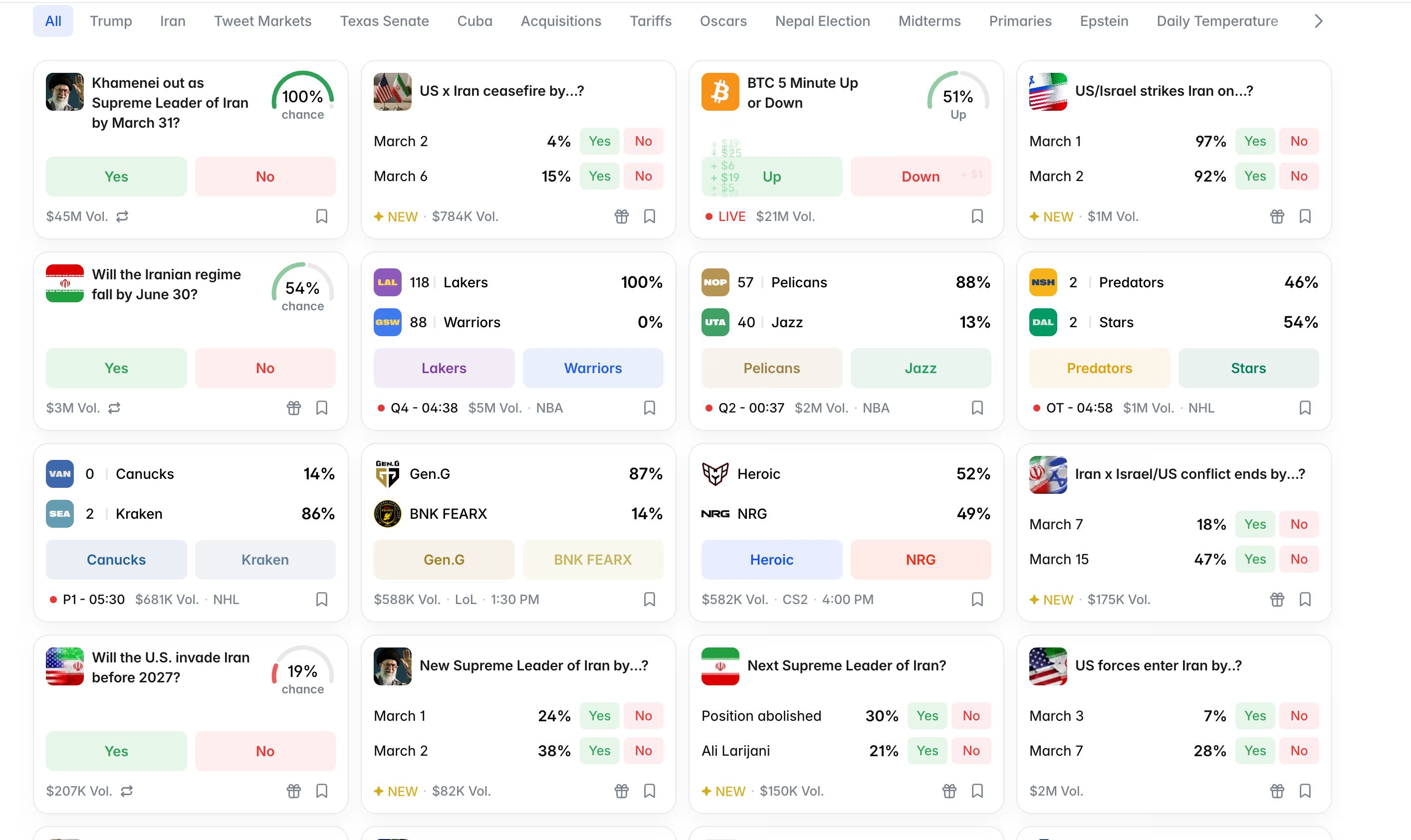
It took Polymarket less than 24 hours to turn a Middle Eastern war into an active trading floor.
Since the U.S. and Israel launched strikes on Iran Saturday, the prediction market has seen a flood of new contracts covering everything from ceasefire timelines to whether the Iranian regime will collapse by June.
The speed and specificity of the markets is striking. Bettors aren’t just wagering on whether the conflict escalates, but pricing the week it ends, who replaces Iran’s Ayatollah Ali Khamenei and whether U.S. ground forces enter Iran by March 7.

Polymarket’s largest completed market is “Khamenei out as Supreme Leader of Iran by March 31?” which resolved to 100% after Iranian state TV confirmed his death on Saturday.
The contract pulled $45 million in volume, making it one of the most-traded geopolitical markets in the past week. The top trader, an account called “Curseaaaaaaa,” made $757,000 on a “yes” bet. Four other traders each cleared six figures.

The chart on that market hovered between 25% and 50% through January and February as tensions built, then spiked vertically to 100% when confirmation came through.
The biggest market, however, is the “US strikes Iran by…?” contract, which has been live since December 22 and has now pulled $529 million in total volume, making it one of the largest single markets Polymarket has ever hosted.
That figure makes it the largest market in Polymarket’s “World” and “Geopolitics” categories by a wide margin, and the fourth-largest in the broader “Politics” category behind only Trump-related contracts from the 2024 election cycle.

The February 28 date alone attracted $89.6 million in trading. Every daily contract from February 28 through early March resolved to “yes” after the strikes began, meaning anyone who bought the specific date before the attack collected on a binary bet about when the U.S. military would bomb another country.
The market’s resolution rules were precise. It required drone, missile, or air strikes on Iranian soil by U.S. forces, with interceptions, cyberattacks, and ground operations not counting.
Now the trading action has shifted to what comes next.
The ceasefire market gives just a 4% chance of a U.S.-Iran ceasefire by March 2 and 15% by March 6, but jumps to 61% by March 31 and 78% by April 30. Bettors are pricing a resolution within weeks, not months, consistent with bitcoin’s bounce to $68,000 on the same thesis.

“Will the Iranian regime fall by June 30?” sits at 54%, up sharply from the low-20s where it had traded for months. The “Next Supreme Leader of Iran” market gives a 30% chance to “position abolished” entirely, meaning bettors see nearly a one-in-three shot that the theocratic structure itself doesn’t survive. Ali Larijani, a former parliament speaker, leads the named candidates at 21%.
The ground invasion contracts are pulling real volume too. “Will the U.S. invade Iran before 2027?” trades at 19% with $207,000 in volume, while “US forces enter Iran by March 7” sits at 28% with $2 million traded.
What Polymarket is doing here is something traditional markets structurally, and legally, cannot. Equity and oil futures don’t reopen until Sunday evening, but on Polymarket, anyone with a crypto wallet can take a position on Iranian regime change on a weekend and see real-time pricing from thousands of other participants doing the same thing.
But the most striking activity may have happened before the first missiles landed.
Onchain analytics firm Bubblemaps on Saturday identified six wallets that collectively netted $1.2 million in profit by betting on a U.S. strike on Iran by February 28, the exact day the strikes occurred.
Most of the wallets were funded within 24 hours of the attack, bet specifically on the February 28 contract rather than broader timeframes and purchased “yes” shares hours before the military operation began. The largest single wallet turned roughly $61,000 into over $493,000 in profit. A second netted approximately $120,000 from a $30,000 position.
The platform is aware of the optics, meanwhile.
Polymarket added a note to its Middle East markets on Sunday stating that “the promise of prediction markets is to harness the wisdom of the crowd to create accurate, unbiased forecasts for the most important events to society.” It went on to claim that after speaking with people directly affected by the attacks, it found that prediction markets “could give them the answers they needed in ways TV news and X could not.”
The site also created an entire, dedicated section for Iran-focused markets.
UPDATE (March 1, 2026, 06:30 UTC): Adds additional detail.
UPDATE (March 1, 2026, 07:15 UTC): Adds that Polymarket bets set a new record for the platform.
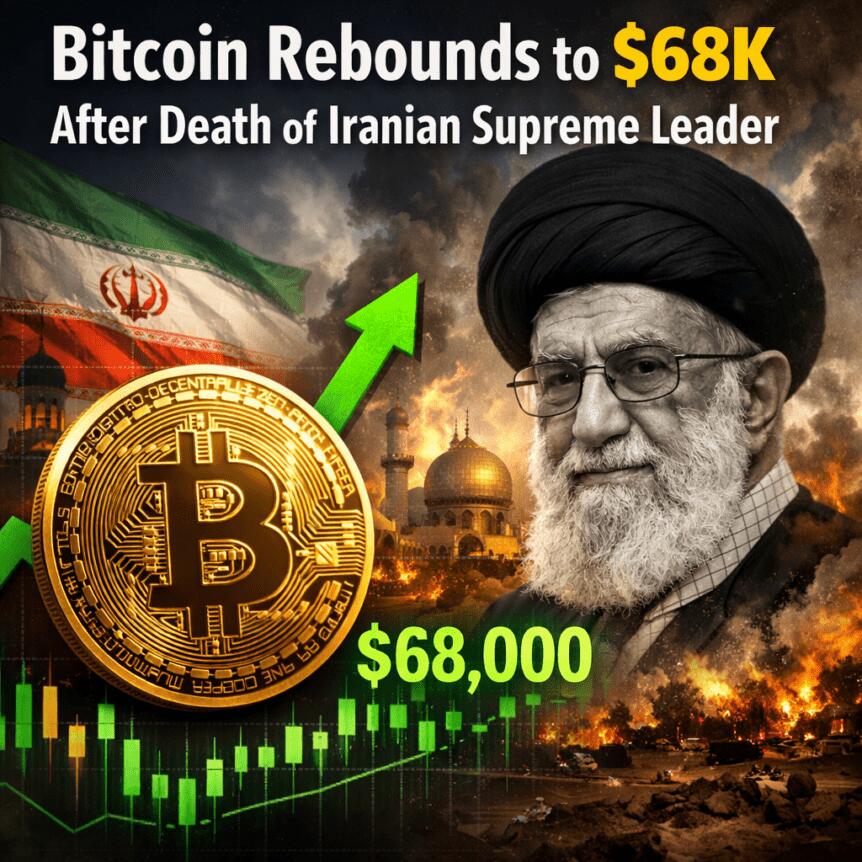
Bitcoin prices have recovered from a dip tied to geopolitical headlines, shifting sentiment in a market that has grown increasingly sensitive to macro risk events. In early Sunday trading, Bitcoin (CRYPTO: BTC) climbed toward the upper end of a recent range after yesterday’s volatility driven by reports of U.S.-and-Israel strikes on Iran. The asset had briefly touched a floor near $63,000 before a run higher helped recoup the losses in less than a day. By Sunday morning, price data circulated by TradingView placed BTC on Coinbase at about $68,200, signaling a relief rally as traders weighed the potential implications for risk assets in the near term. The bounce comes after a weekend that saw liquidity stress and rapid re-pricing as newsflow evolved.
The market’s day-long swing was notable not just for the price spike but for the underlying fragility it exposed. In the 24-hour window, roughly 157,000 traders were liquidated, translating to about $657 million in total liquidations, with a near-even split between leveraged long and short positions. The figure, tracked by CoinGlass, underscored the extent to which risk-on and risk-off trades collide in a geopolitical backdrop that has kept many participants on edge. While the move higher drew some relief, the overall liquidity environment remains sensitive to headlines, complicating calls about sustained momentum in the weeks ahead.
Key takeaways
- Bitcoin briefly surged to around $68,200 on Coinbase before a pullback left it near $67,350, continuing a three-week trading range around the $67k level.
- Over the past 24 hours, about 157,000 liquidations occurred, totaling roughly $657 million, with roughly equal shares of longs and shorts liquidated, per CoinGlass.
- Unverified but widely circulated reports of high-level leadership casualties in Iran fed sudden volatility, though the situation remained fluid as markets awaited official confirmation.
- February closed as Bitcoin’s third-worst February on record, with a decline close to 15%, marking one of the worst month-ends since 2013 and contributing to a difficult start to the year (Q1) for the asset.
- Analysts cautioned that de-escalation signs before the week’s opening could help sustain gains, though upside remains contingent on geopolitical clarity and macro risk sentiment.
Tickers mentioned: $BTC
Sentiment: Neutral
Price impact: Neutral. The bounce offset a steep intraday drop, but BTC remains within a tight, range-bound pattern rather than establishing a clear breakout.
Market context: The price action sits amid a broader backdrop of geopolitical risk and risk-off liquidity dynamics, with intraday moves driven by headlines as traders recalibrate exposure to macro and policy risks. Recent data show concentrated volatility around major news events, reinforcing a cautious stance among most market participants.
Why it matters
For traders, the brief rebound toward the mid-to-high $60k zone after a sharp decline emphasizes Bitcoin’s role as a potential haven within a high-risk environment, even as it remains tethered to overall risk sentiment. The rapid liquidations in a 24-hour period highlight how quickly leveraged positions can unwind when headlines shift, underscoring the importance of risk management and hedging in crypto portfolios. The episode also demonstrates that, despite episodic spikes, price action continues to reflect a balance between demand from allocators seeking a store of value and the pressure from macro and geopolitical headlines that can compress liquidity and amplify moves in either direction.
Analysts’ commentary around the potential for de-escalation to support further gains captures a common thread: Bitcoin’s near-term trajectory in this environment is highly contingent on the speed and visibility of political developments. One analyst noted that if conflict signals resolve ahead of the next market open, BTC could stabilize and potentially push higher. Others warned that any renewed escalation or uncertainty could quickly reverse the recent rebound, given the asset’s history of volatile responses to global tensions. In this context, the market’s probability distribution shifts with every fresh headline, making prudent risk management more important than ever for participants navigating this space.
Beyond geopolitics, Bitcoin’s February performance remains a cautionary signal. The asset finished the month down about 15%, marking its third-worst February in the data set and contributing to a challenging start to the year. This performance places Bitcoin on track for its worst first quarter since 2018, with losses approaching the mid-20% range year-to-date in a few scenarios. Such numbers reinforce that the cryptocurrency market is not immune to broader cyclicality and risk-off periods, even when episodic catalysts temporarily provide support. The data points to a market still digesting a period of elevated volatility, with traders weighing whether a more sustained recovery can emerge from macro normalization and improved liquidity conditions.
Against this backdrop, traders continue to monitor on-chain activity and liquidations as practical indicators of market risk appetite. The scale of recent liquidations suggests a broad reticence among highly leveraged participants, and it remains to be seen whether this sentiment translates into a more durable bid or gives way to renewed selling pressure if the geopolitical picture remains uncertain. The episode also highlights the constant tension between macro risk signals and crypto-specific fundamentals, where retail and institutional participants alike seek price discovery in a market characterized by 24/7 trading and near-instantaneous reaction to news flow.
What to watch next
- Any official statements or de-escalation signals from U.S. or allied authorities regarding Iran and the region, ahead of the next market open.
- Price action around key support and resistance levels near the current three-week range, with attention to whether BTC maintains momentum above or retreats below the mid-$60k zone.
- Changes in liquidity and funding rates on major exchange platforms as risk sentiment shifts in response to headlines and macro data releases.
- Updates on geopolitical developments, including any verification of leadership changes or military assessments, that could alter risk-on versus risk-off dynamics for crypto markets.
Sources & verification
- Bitcoin price data and range observations from Coinbase trading data and TradingView.
- Liquidation figures (157,000 traders; about $657 million total) reported by CoinGlass.
- BBC reporting on Iran’s leadership developments and attribution of events to the Iranian leadership.
- Public posts and commentary on the geopolitical situation, including statements on Truth Social by former U.S. President Donald Trump.
- Reported US-Israel air strikes on Iran as referenced in market commentary.
Bitcoin price moves amid geopolitical tensions and liquidity shifts
Bitcoin (CRYPTO: BTC) kept a close watch on news flow as markets absorbed headlines about U.S.-led strikes in the Middle East and the broader risk landscape. After a dip that briefly carried prices toward the low $60k region, BTC staged a partial recovery, briefly topping $68,200 on Coinbase before easing back. The rebound unfolded within a roughly three-week trading band centered near $67,000, illustrating the market’s struggle to establish a durable directional bias amid ongoing geopolitical uncertainty. The intraday swing, while dramatic, did not necessarily translate into a lasting breakout, and traders remained cautious about the asset’s medium-term trajectory.
From a risk-management perspective, the latest price action coincided with large liquidation activity. In the last 24 hours, data indicated around 157,000 liquidations totaling approximately $657 million—an amount that underscores how quickly highly leveraged positions can be unwound when volatility spikes. The liquidations appeared roughly evenly split between longs and shorts, suggesting a broad spectrum of market participants faced margin pressure regardless of their directional stance. These dynamics are emblematic of a market where liquidity can be episodically thin and sentiment-sensitive, particularly in the wake of geopolitical events and shifting macro cues.
The geopolitical narrative surrounding Iran added another layer of complexity. Reports from credible sources suggested that Ayatollah Khamenei, Iran’s Supreme Leader, had been killed in a Saturday operation, with subsequent coverage by outlets such as the BBC. Such claims, whether confirmed or refuted, tend to catalyze rapid price revision as traders reassess risk premia and potential spillover effects on regional stability. Notably, commentary from market observers emphasized that the trajectory of Bitcoin would likely hinge on whether the conflict shows signs of de-escalation before the market opens on Monday, a scenario that could preserve or extend the current gains. As one analyst noted on social media, the possibility of a peaceful trajectory could help Bitcoin maintain momentum, while renewed hostilities could precipitate renewed volatility.
Despite the back-and-forth, February’s performance looms large in the narrative surrounding BTC. The asset closed the month with a near-15% slide, marking its third-worst February on record and continuing a pattern of weak early-year performance. The broader implication is an ongoing risk-off phase that has persisted into 2026, with the question for market participants being whether a combination of de-risking, thin liquidity, and regulatory developments can eventually pave the way for a more sustained recovery. The data point toward a volatile environment where macro and geopolitical developments can overshadow even localized bullish catalysts, compelling traders to adopt disciplined risk controls and clear exit strategies.
As the market awaits more clarity, the path forward appears to be shaped by the interplay between conflict resolution signals and the crypto market’s own liquidity dynamics. The narrative remains unsettled, and the potential for further volatility persists as new information emerges. In this context, BTC’s price action will likely reflect not only technical support and resistance but also broader shifts in risk appetite, funding costs, and investors’ willingness to allocate capital to an asset class that remains highly sensitive to global developments. For now, the market seems to be testing the resilience of Bitcoin’s bid while staying vigilant for the next headline that could swing the balance.
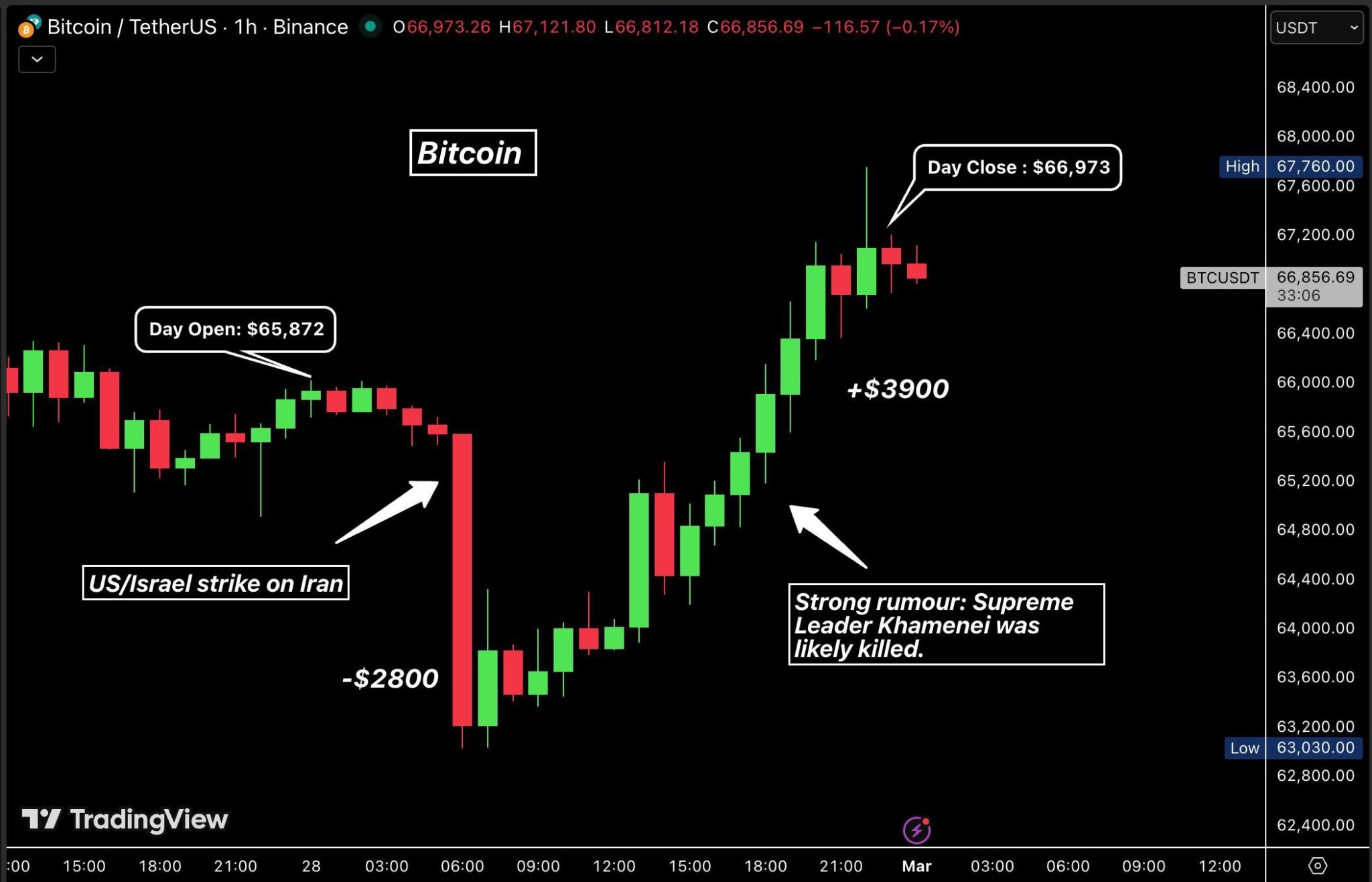
Bitcoin prices have recovered from their dip following the US-Israeli air strikes on Iran and reports of the death of the Iranian Supreme Leader.
Bitcoin (BTC) prices reached $68,200 in early trading on Sunday morning on Coinbase, according to TradingView.
The asset has now recovered all losses from its dip to $63,000 on Saturday, adding $5,000 in less than 24 hours following the news that the United States and Israel had commenced air strikes on Iran.
BTC is currently trading back at Friday’s levels, around $67,350 at the time of writing, but remains within a three-week range-bound channel.
Over the past 24 hours, around 157,000 traders were liquidated, with total liquidations coming in at $657 million, roughly evenly split between leveraged longs and shorts, according to CoinGlass.
Iranian Supreme Leader Killed
Iran’s Supreme National Security Council said Ayatollah Khamenei was killed early Saturday morning at his office, reported the BBC.
US President Donald Trump described the hardline Islamist cleric as “one of the most evil people in history” on his social media platform, Truth Social.
“This is not only justice for the people of Iran, but for all great Americans, and those people from many countries throughout the world, that have been killed or mutilated by Khamenei and his gang of bloodthirsty thugs,” he said.
The commander-in-chief of the Islamic Revolutionary Guard Corps, Mohammad Pakpour, and the secretary of Iran’s Defense Council, Ali Shamkhani, were also killed in the US-Israel strikes.
Related: Bitcoin bottom fractal calls for 130% rally, but is the model valid in 2026?
“After news of Iran’s Supreme Leader Khamenei’s death, the market pumped because people are taking it as the end of the US-Iran war,” commented analyst Ash Crypto on Sunday.
“If this conflict shows signs of resolution before Monday’s open, I think Bitcoin can hold its gains and move higher,” he added.

Bitcoin’s third-worst February ever
Despite the recent gains, Bitcoin has just closed its third-worst February in history and only the fourth time since 2013 that the asset has ended the month in the red.
BTC shed just under 15% last month, but its worst February was in 2014 when it lost 31%, followed by 2025 when it fell 17.4%, according to CoinGlass.
The asset is also on track to close its worst-performing first quarter since 2018, having lost almost 23% so far since the beginning of the year.
Magazine: 6 massive challenges Bitcoin faces on the road to quantum security
It took Polymarket less than 24 hours to turn a Middle Eastern war into a trading floor.
Since the U.S. and Israel launched strikes on Iran Saturday, the prediction market has seen a flood of new contracts covering everything from ceasefire timelines to whether the Iranian regime will collapse by June.
The speed and specificity of the markets is striking. Bettors aren’t just wagering on whether the conflict escalates, but pricing the week it ends, who replaces Khamenei, and whether U.S. ground forces enter Iran by March 7.
Polymarket’s largest completed market is “Khamenei out as Supreme Leader of Iran by March 31?” which resolved to 100% after Iranian state TV confirmed his death.
The contract pulled $45 million in volume, making it one of the most-traded geopolitical markets in the platform’s history. The top trader, an account called ‘Curseaaaaaaa,’ made $757,000 on a Yes bet. Four other traders each cleared six figures.
The chart on that market hovered between 25% and 50% through January and February as tensions built, then spiked vertically to 100% when confirmation came through.
Now the action has shifted to what comes next.
The ceasefire market gives just a 4% chance of a U.S.-Iran ceasefire by March 2 and 15% by March 6, but jumps to 61% by March 31 and 78% by April 30. Bettors are pricing a resolution within weeks, not months, consistent with bitcoin’s bounce to $68,000 on the same thesis.
“Will the Iranian regime fall by June 30?” sits at 54%, up sharply from the low-20s where it had traded for months. The “Next Supreme Leader of Iran” market gives a 30% chance to “position abolished” entirely, meaning bettors see nearly a one-in-three shot that the theocratic structure itself doesn’t survive. Ali Larijani, a former parliament speaker, leads the named candidates at 21%.
The ground invasion contracts are pulling real volume too. “Will the U.S. invade Iran before 2027?” trades at 19% with $207,000 in volume, while “US forces enter Iran by March 7” sits at 28% with $2 million traded.
What Polymarket is doing here is something traditional markets structurally cannot. Equity and oil futures don’t reopen until Sunday evening, but on Polymarket, anyone with a crypto wallet can take a position on Iranian regime change on a casual weekend and see real-time pricing from thousands of other participants doing the same thing.
But the most striking activity may have happened before the first missiles landed.
Onchain analytics firm Bubblemaps on Saturday identified six wallets that collectively netted $1.2 million in profit by betting on a U.S. strike on Iran by February 28, the exact day the strikes occurred.
Most of the wallets were funded within 24 hours of the attack, bet specifically on the Feb. 28 contract rather than broader timeframes, and purchased “yes” shares hours before the military operation began. The largest single wallet turned roughly $61,000 into over $493,000 in profit. A second netted approximately $120,000 from a $30,000 position.
The platform is aware of the optics, meanwhile.
Polymarket added a note to its Middle East markets on Sunday stating that “the promise of prediction markets is to harness the wisdom of the crowd to create accurate, unbiased forecasts for the most important events to society,” adding that after speaking with people directly affected by the attacks, it found that prediction markets “could give them the answers they needed in ways TV news and X could not.”

Ethereum (CRYPTO: ETH) is on track to roll out native account abstraction as part of the Hegota upgrade, with timing that insiders say could land within a year. Vitalik Buterin outlined that smart accounts—often described as account abstraction—will be delivered once EIP-8141, the omnibus proposal consolidating the remaining AA challenges, is deployed. The push marks a significant shift in how users interact with on-chain transactions, moving away from single-step operations toward a more modular, frame-based approach. The idea is to simplify user experiences, reduce reliance on external custodians, and preserve Ethereum’s core ethos of permissionless, censorship-resistant finance. The timeline and the scope of EIP-8141 place the project squarely in the crosshairs of developers and wallet builders seeking a more flexible, secure transaction model for the network and its users.
“We have been talking about account abstraction ever since early 2016,” Buterin said over the weekend, signaling that the long arc of research is now converging on a deployable design. The release would introduce a framework in which a transaction is not a single operation but a sequence of interlinked steps, or “frames,” that can reference one another and indicate who pays the gas or authorizes the sender. This framing enables a wide range of use cases, from multi-signature wallets to quantum-resistant security models, while keeping the pipeline of on-chain validation efficient and scalable.
“Finally, after over a decade of research and refinement of these techniques, this all looks possible to make happen within a year (Hegota fork).”
The core concept is meant to be as simple as possible while retaining broad generality. The frame-transaction architecture lays out an execution plan in which each frame contributes a piece of the final outcome, and each frame’s authorization can be bundled into a larger, privacy-preserving sequence. This design is not just about reducing the number of steps; it aims to enable sophisticated flows while maintaining a developer-friendly model that can be adopted by wallets, dApps, and infrastructure providers alike.
A core principle of cypherpunk Ethereum
At the heart of the proposal lies a rebalance of how validation and execution happen. Smart accounts, including multisig configurations, quantum-resistant wallets, or keys that can be changed over time, rely on a validation frame to verify signatures and authorize actions, followed by an execution frame that carries out the operation. The arrangement is intended to minimize the number of required intermediaries while maximizing what users can accomplish even if traditional infrastructure becomes unavailable. In practical terms, gas could be paid in non-ETH tokens through a paymaster contract, or via a specialized decentralized exchange that provides real-time Ether without intermediaries—an arrangement that aligns with Ethereum’s cypherpunk ethos of resilience and user sovereignty.
“Intermediary minimization is a core principle of non-ugly cypherpunk Ethereum: maximize what you can do even if all the world’s infrastructure except the Ethereum chain itself goes down.”
The design also speaks directly to the privacy dimension of on-chain activity. If the model is adopted widely, privacy-focused protocols could reduce or redefine their reliance on public broadcasting networks that have historically caused UX pain. Instead, a general-purpose public mempool could serve as a more flexible, scalable substrate for private transactions, potentially making privacy tools more practical for everyday users. In the long run, this could influence how privacy layers and wallets interact with the base chain, offering smoother, more interoperable experiences while preserving strong cryptographic guarantees.
Native account abstraction is expected to be delivered in the latter half of 2026 according to the Strawmap projection maintained by the Ethereum Foundation. The Strawmap estimates are widely watched because they reflect community expectations about when core features might land across the ecosystem, including developments around account abstraction and related scaling improvements. The projection underscores the sense that AA is moving from concept to implementation, with multiple development tracks converging around a unified upgrade path.
Quantum-resistant Ethereum in the pipeline
Buterin stressed that the AA framework could accommodate all existing accounts, enabling batch operations and transaction sponsorship while maintaining a consistent security model. In the same thread, he outlined a broader quantum resistance roadmap for Ethereum, identifying four critical areas: validator signatures, data storage, user account signatures, and zero-knowledge proofs. The emphasis on quantum safety reflects a growing consensus that post-quantum cryptography will be essential as computing capabilities evolve and adversaries potentially gain access to more powerful attack vectors.
On the scaling front, Buterin suggested that progress toward shorter slot times and faster finality could come progressively as part of a broader, longer-term roadmap for a faster, more efficient Ethereum. The roadmap envisions incremental improvements that reduce latency and increase throughput without compromising security, a balance that has long been a central challenge for the network’s developers.
As the discussion around quantum resistance evolves, the broader ecosystem is watching for practical implementations that could integrate with existing protocols. The quantum-resistance conversation complements the AA push by emphasizing stronger, future-proof cryptography that can withstand emerging threats while preserving user control and network performance. The combined trajectory—account abstraction paired with quantum-safe measures—signals a holistic approach to Ethereum’s evolution, one that seeks to marry user-centric design with durable security guarantees.
In private discussions and public threads, researchers have highlighted quantum resistance as a multi-faceted problem: it involves updating validator signatures, supporting larger data-collection capabilities for verification, ensuring robust user signatures, and deploying advanced zero-knowledge proofs that can operate efficiently in a post-quantum world. While these are technical milestones, they carry practical implications for wallet developers, validators, and users who expect faster, cheaper, and more private interactions on the network.
In sum, the push for account abstraction, reinforced by the EIP-8141 consolidation and a quantum-ready roadmap, marks a notable inflection point for Ethereum. The combination of frame-based transactions, gas sponsorship mechanisms, and privacy-oriented optimizations could redefine how users engage with decentralized applications, lowering barriers to entry while enhancing security and resilience. The community is watching closely as milestones move from theoretical proposals to real-world deployments, with the Strawmap timeline offering a rough guide to when broader AA features may begin to impact wallets, dApps, and users across the ecosystem.


Bitcoin jumped to $68,000 early Sunday, recovering nearly all of Saturday’s war-driven losses within hours of Iranian state TV confirming that Supreme Leader Ayatollah Ali Khamenei was killed in U.S. and Israeli airstrikes.
Khamenei held ultimate authority over Iran’s military, foreign policy, and nuclear program. Under Iran’s constitution, a temporary council of the president, head of the judiciary, and a Guardian Council jurist assumes leadership duties until the Assembly of Experts appoints a successor.
U.S. president Donald Trump, meanwhile, has urged Iranians to overthrow the regime, calling this “probably your only chance for generations.” Tehran has continued firing missiles at Israel, and Israeli strikes on Iran are ongoing. Whether a period of mourning affects military operations remains unclear.
Trump added U.S. attacks would continue for as long as necessary.
But bitcoin moved before any of those questions were answered. The $64,000 to $68,000 swing happened on thin Sunday liquidity, driven by a single headline. That’s a roughly $80 billion market cap move in hours.
The read across crypto and broader risk markets is that a leadership vacuum makes a ceasefire more likely than continued escalation, creating a swift flight to risk assets.
Oil and equity futures open later on Sunday, and monitoring their moves may tell whether the optimism holds or whether Sunday’s bounce gets faded the same way Wednesday’s push to $70,000 did.
Iran sits at the center of a region responsible for roughly a third of global crude exports. If markets interpret Khamenei’s death as raising the probability of regime destabilization or disruption to supply routes, energy prices could spike, pressuring global inflation expectations and tightening financial conditions. That would typically weigh on risk assets, including crypto.
However, if traders believe succession mechanisms will stabilize decision-making and avoid broader war, risk assets may continue to find support.

I wish Apple made this sleek wireless power bank, but it works just fine with the iPhone

10 realty stocks tumble up to 22% in 2 months amid AI-led IT concerns
US Judge Lets Binance Unregistered Token Class Action Proceed


-

 Sports6 days ago
Women’s college basketball rankings: Iowa reenters top 10, Auriemma makes history
-

 Fashion2 days ago
Weekend Open Thread: Iris Top
-

 Politics6 days ago
Nick Reiner Enters Plea In Deaths Of Parents Rob And Michele
-

 Business4 days ago
True Citrus debuts functional drink mix collection
-

 Politics2 days ago
ITV enters Gaza with IDF amid ongoing genocide
-
Sports1 day ago
The Vikings Need a Duck
-

 Crypto World5 days ago
XRP price enters “dead zone” as Binance leverage hits lows
-

 Tech4 hours ago
Unihertz’s Titan 2 Elite Arrives Just as Physical Keyboards Refuse to Fade Away
-

 Business7 days ago
Mattel’s American Girl brand turns 40, dolls enter a new era
-

 Tech5 days ago
Unsurprisingly, Apple's board gets what it wants in 2026 shareholder meeting
-
 NewsBeat15 hours ago
Dubai flights cancelled as Brit told airspace closed ’10 minutes after boarding’
-

 Business7 days ago
Law enforcement kills armed man seeking to enter Trump’s Mar-a-Lago resort, officials say
-

 NewsBeat3 days ago
Cuba says its forces have killed four on US-registered speedboat | World News
-
 NewsBeat3 days ago
Manchester Central Mosque issues statement as it imposes new measures ‘with immediate effect’ after armed men enter
-
 NewsBeat19 hours ago
The empty pub on busy Cambridge road that has been boarded up for years
-
 NewsBeat6 days ago
‘Hourly’ method from gastroenterologist ‘helps reduce air travel bloating’
-

 Tech7 days ago
Anthropic-Backed Group Enters NY-12 AI PAC Fight
-

 NewsBeat11 hours ago
Abusive parents will now be treated like sex offenders and placed on a ‘child cruelty register’ | News UK
-

 NewsBeat7 days ago
Armed man killed after entering secure perimeter of Mar-a-Lago, Secret Service says
-

 Politics7 days ago
Maine has a long track record of electing moderates. Enter Graham Platner.