

Crypto World
Bitcoin Recovers to $68K After Iran Supreme Leader Killed

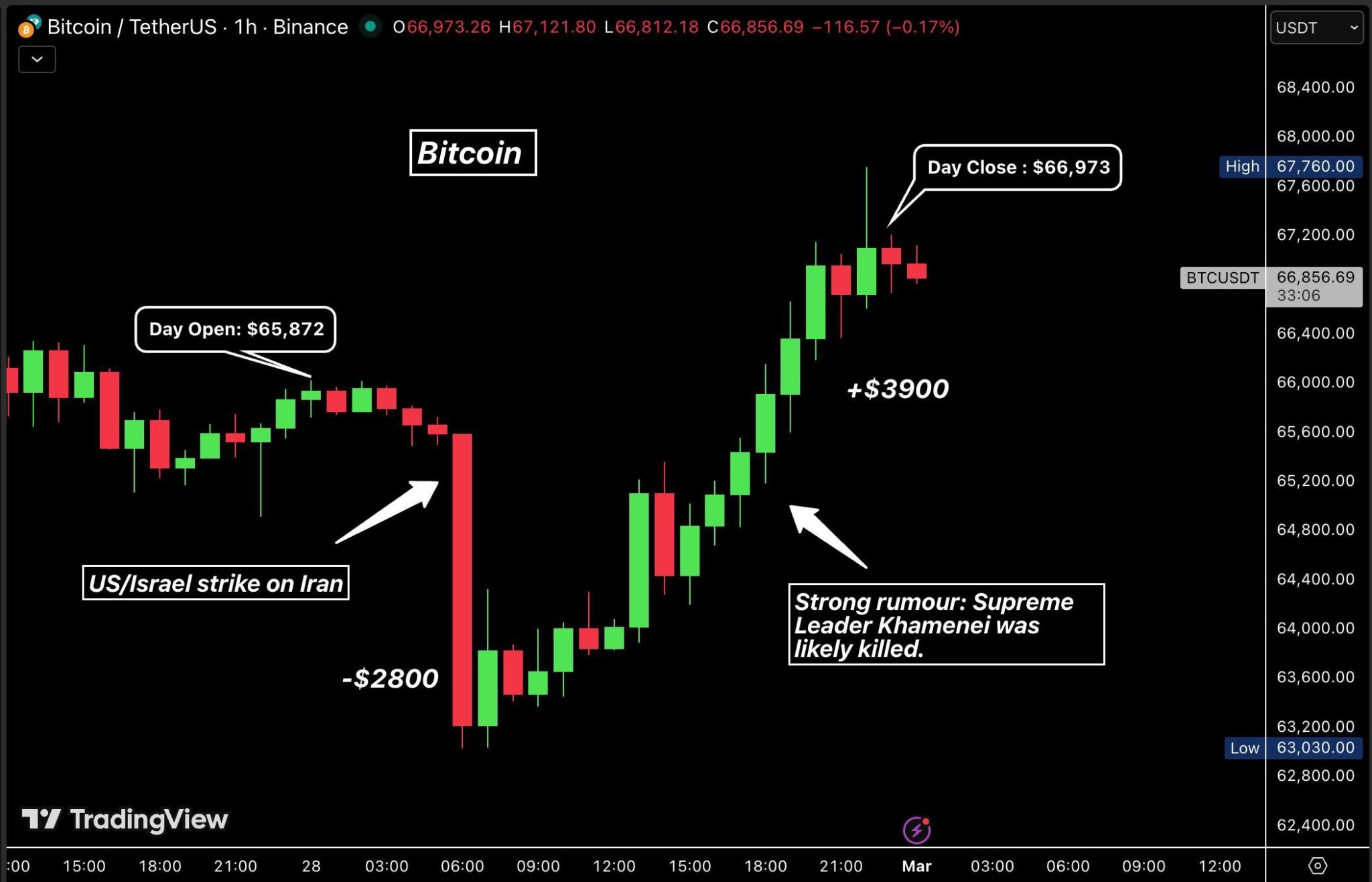
Bitcoin prices have recovered from their dip following the US-Israeli air strikes on Iran and reports of the death of the Iranian Supreme Leader.
Bitcoin (BTC) prices reached $68,200 in early trading on Sunday morning on Coinbase, according to TradingView.
The asset has now recovered all losses from its dip to $63,000 on Saturday, adding $5,000 in less than 24 hours following the news that the United States and Israel had commenced air strikes on Iran.
BTC is currently trading back at Friday’s levels, around $67,350 at the time of writing, but remains within a three-week range-bound channel.
Over the past 24 hours, around 157,000 traders were liquidated, with total liquidations coming in at $657 million, roughly evenly split between leveraged longs and shorts, according to CoinGlass.
Iranian Supreme Leader Killed
Iran’s Supreme National Security Council said Ayatollah Khamenei was killed early Saturday morning at his office, reported the BBC.
US President Donald Trump described the hardline Islamist cleric as “one of the most evil people in history” on his social media platform, Truth Social.
“This is not only justice for the people of Iran, but for all great Americans, and those people from many countries throughout the world, that have been killed or mutilated by Khamenei and his gang of bloodthirsty thugs,” he said.
The commander-in-chief of the Islamic Revolutionary Guard Corps, Mohammad Pakpour, and the secretary of Iran’s Defense Council, Ali Shamkhani, were also killed in the US-Israel strikes.
Related: Bitcoin bottom fractal calls for 130% rally, but is the model valid in 2026?
“After news of Iran’s Supreme Leader Khamenei’s death, the market pumped because people are taking it as the end of the US-Iran war,” commented analyst Ash Crypto on Sunday.
“If this conflict shows signs of resolution before Monday’s open, I think Bitcoin can hold its gains and move higher,” he added.

Bitcoin’s third-worst February ever
Despite the recent gains, Bitcoin has just closed its third-worst February in history and only the fourth time since 2013 that the asset has ended the month in the red.
BTC shed just under 15% last month, but its worst February was in 2014 when it lost 31%, followed by 2025 when it fell 17.4%, according to CoinGlass.
The asset is also on track to close its worst-performing first quarter since 2018, having lost almost 23% so far since the beginning of the year.
Magazine: 6 massive challenges Bitcoin faces on the road to quantum security

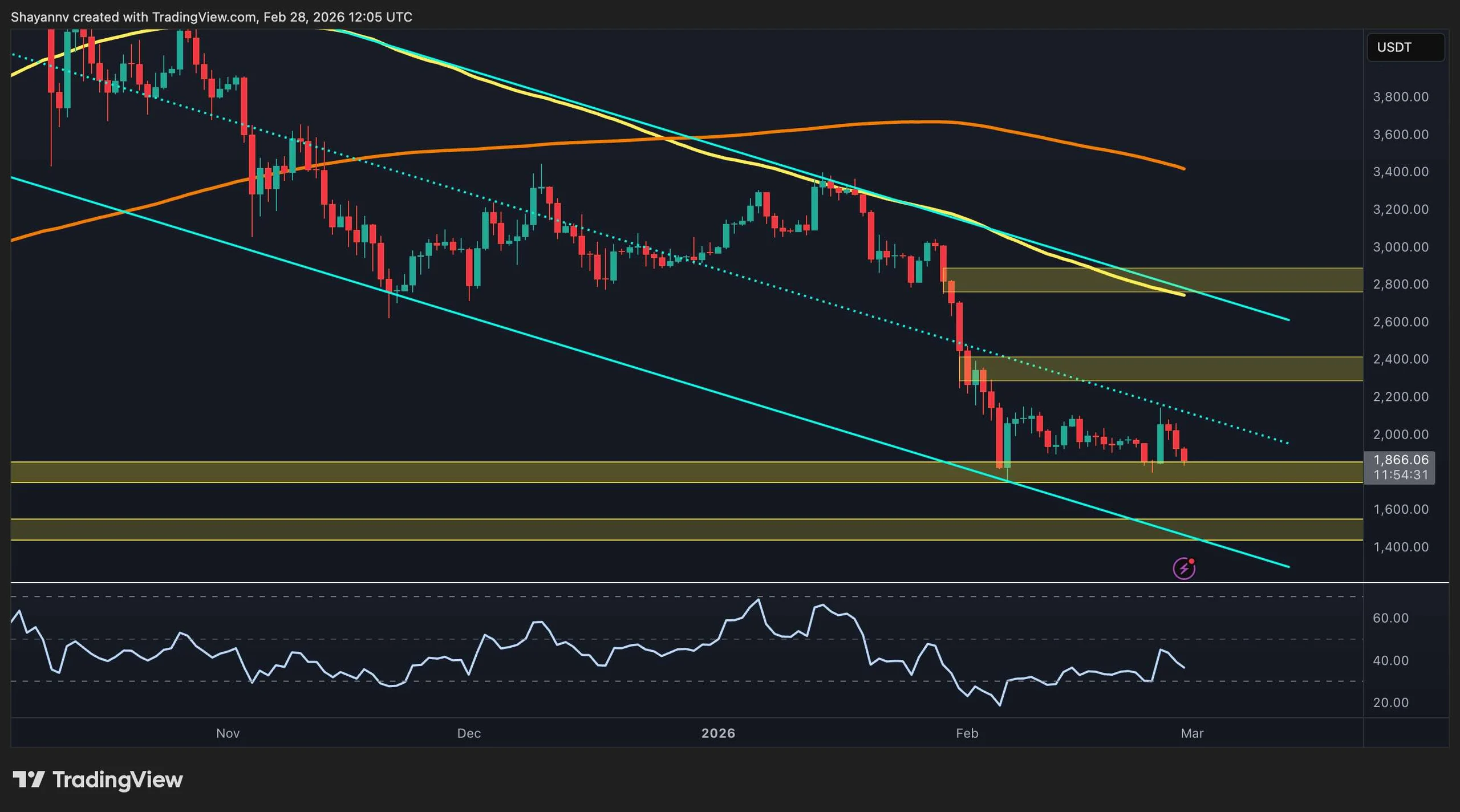
ETH is still trading in a clear downtrend, and the market is reacting fast to both macro risk and geopolitics. With the war in the Middle East adding extra uncertainty, Ethereum is sitting near the 1,800 area on the chart, right on a key demand zone where buyers have tried to defend multiple times.
Ethereum Price Analysis: The Daily Chart
The daily structure remains bearish inside a descending channel, and the price is still capped by the downtrend lines and the 100-day and 200-day moving averages overhead. Until ETH reclaims the major $2,400 and $2,800 resistance levels, rallies look more like relief bounces than a true reversal.
Meanwhile, the nearby support area is located at the $1,850–$1,700 demand zone, and if this level breaks down, the next downside levels to watch are around $1,600 and the $1,400 mark, just above the lower trendline of the descending channel.
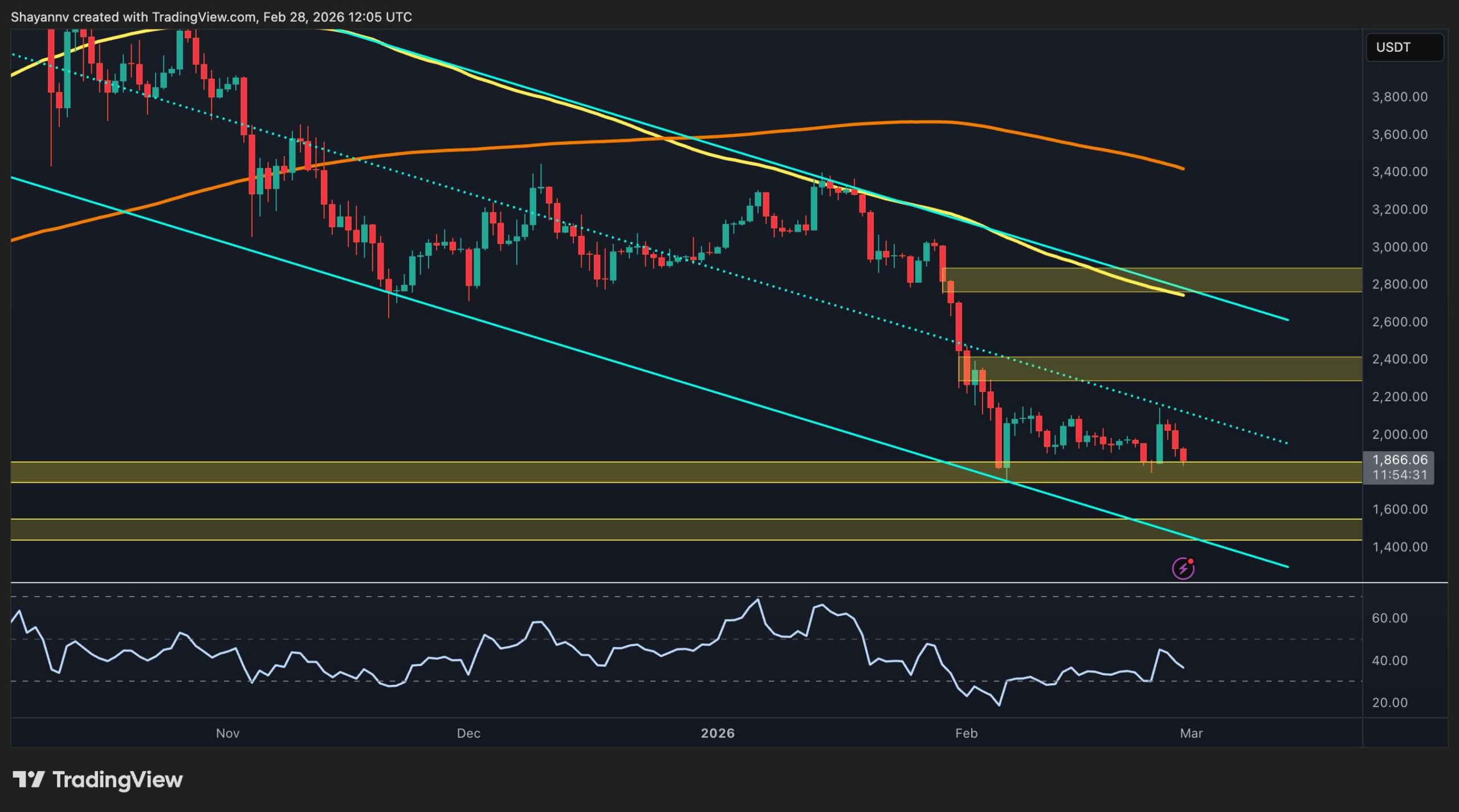
ETH/USDT 4-Hour Chart
On the 4-hour timeframe, ETH is behaving more like a range within the larger downtrend, with the price rotating between the support level near 1,800 and the resistance level near recent highs around $2,150. The last push into this level got rejected decisively, which keeps the short-term momentum tilted to the downside.
A bullish shift would require holding the $1,850 level and then reclaiming the $2,150 highs with follow-through, which could open a move back toward the $2,400 supply zone. But if the $1,850 support level fails and turns into resistance on a retest, the road toward the $1,600 mark and below will be cleared.

On-Chain Analysis
The Ethereum Total Value Staked chart demonstrates an aggressive uptrend while the price trends down, which is a supportive long-term signal. It implies more ETH is being locked into staking rather than staying liquid, reducing the readily available supply over time. This behavior could be due to the long-term conviction of investors, as they are buying ETH at discounted prices and locking in for the long term.
However, this does not mean the bottom is guaranteed to be nearby, because the price can still drop if forced selling and deleveraging continue. But if the market reclaims the key resistance levels while staking keeps climbing, it strengthens the case for a more durable recovery later on.

Binance Free $600 (CryptoPotato Exclusive): Use this link to register a new account and receive $600 exclusive welcome offer on Binance (full details).
LIMITED OFFER for CryptoPotato readers at Bybit: Use this link to register and open a $500 FREE position on any coin!
Disclaimer: Information found on CryptoPotato is those of writers quoted. It does not represent the opinions of CryptoPotato on whether to buy, sell, or hold any investments. You are advised to conduct your own research before making any investment decisions. Use provided information at your own risk. See Disclaimer for more information.

TLDR:
- A developer built an Ethereum 2030-aligned client prototype with 700,000 lines of code in two weeks using AI.
- Vitalik Buterin rebuilt his blog software in one hour using a 20B-parameter model running on his laptop.
- AI is accelerating formal verification efforts within the Lean Ethereum project, boosting protocol security.
- Buterin says bug-free code, once seen as unrealistic, could become achievable through AI-assisted verification.
Ethereum co-founder Vitalik Buterin says artificial intelligence is rapidly accelerating Ethereum development, pointing to a developer who built a full client prototype in just two weeks.
AI Speeds Up Ethereum Client Development
A developer recently used agentic coding to build an Ethereum client prototype aligned with the 2030+ roadmap. The prototype contained roughly 700,000 lines of code and covered 65 roadmap items.
It also successfully synced with the Ethereum mainnet, a notable technical achievement. This was accomplished in only two weeks, without finalized Ethereum Improvement Proposals in place.
Buterin acknowledged the prototype carries serious caveats given how quickly it was built. He noted it almost certainly contains critical bugs throughout its codebase.
Some features are likely “stub” versions, where the AI did not attempt a full implementation. Still, he stressed that the trend itself is what matters most.
On X, Buterin shared his own experience testing AI-assisted coding tools. He wrote that he used a 20-billion-parameter model running locally on his laptop to rebuild his blog software in one hour.
He added that a more powerful model like Kimi-2.5 would have likely completed the task in a single prompt. These results point to how fast AI coding tools are improving across different scales.
Buterin framed the speed gains not as a reason to rush, but as an opportunity to do more thorough work. He suggested developers split AI-driven gains equally between speed and security.
Faster development, in his view, should come alongside more rigorous testing and verification processes.
Formal Verification and Security Stand to Benefit
Beyond raw speed, Buterin pointed to formal verification as a major area where AI can contribute to Ethereum’s security.
A collaborator working on the Lean Ethereum project used AI to produce a machine-verifiable proof of one of the most complex theorems underlying STARK security.
This kind of work was previously slow and required deep mathematical expertise to complete. AI tools are now making it more accessible and faster to produce.
The Lean Ethereum effort is centered on formally verifying every component of the protocol. AI is actively accelerating that process, according to Buterin.
More test cases can now be generated at a much higher volume than before. Even when bugs appear, the process of finding and resolving them can happen five times faster and ten times more thoroughly.
Buterin also raised the possibility that bug-free code, once considered unrealistic, could become achievable. He was careful to frame this as a possibility, not a certainty.
He noted that total security remains out of reach, since code can never fully capture everything in a developer’s mind. However, specific security claims can be verified in ways that remove over 99% of risks from broken code.

Six Polymarket traders earned roughly $1 million after accurately predicting that the United States would strike Iran before February ended, triggering insider trading concerns on the platform. The six wallets all appeared in February and placed the bulk of their activity on contracts forecasting the timing of a potential U.S. attack, a pattern highlighted by data analytics firm Bubblemaps SA and reported by Bloomberg. In several instances, these bets were opened just hours before explosions were first reported in Tehran, with some contracts purchased for around $0.10 per unit.
On-chain investigators have begun to flag the clustering of new wallets and the rapid-fire timing as reminiscent of insider activity observed in other prediction-market episodes. While such activity is not proof of wrongdoing, it has intensified scrutiny of how information flows can influence decisions on platforms like Polymarket. Attempts to obtain comment from Polymarket prior to publication were not successful.
During the broader escalation, more than $529 million flowed into Polymarket’s strike-related contracts, underscoring the platform’s role as a liquidity vector during geopolitical spikes. The February 28 contract drew roughly $90 million in trading volume, making it the most active date among traders, while an earlier January 31 scenario accounted for roughly $42 million.
It’s important to note that one flagged account had previously lost money on an earlier prediction before placing a larger wager that later yielded more than $170,000, illustrating that a single pattern does not conclusively indicate manipulation. Washington had signaled possible military action for weeks, a backdrop that likely contributed to speculative activity on the platform.
Beyond the Iran-focused bets, Polymarket has faced regulatory scrutiny across multiple jurisdictions. Authorities in the Netherlands, Hungary, Belgium, France, Italy, Romania, Poland, Singapore, and Portugal have moved to block or ban the platform, classifying its event-based contracts as unlicensed online gambling rather than financial trading. The evolving regulatory environment adds a layer of uncertainty for users seeking to trade events tied to real-world outcomes.
The broader insider-trading conversation around Polymarket is not limited to Iran. This week, a cluster of crypto wallets earned more than $1.2 million betting on a contract tied to an on-chain investigation into the Axiom DeFi project, following claims by ZachXBT that an Axiom employee and associates had engaged in insider trading since early 2025. Earlier coverage highlighted a separate Polymarket bet linked to the capture of Venezuelan President Nicolás Maduro, where a single wallet reportedly netted about $400,000 after placing bets moments before the news broke. These examples collectively illustrate the tension between market-discovery dynamics and the potential for information asymmetry to influence outcomes on prediction markets.
As the sector contends with these episodes, lawmakers are not standing still. A bill proposed by U.S. Representative Ritchie Torres, the Public Integrity in Financial Prediction Markets Act of 2026, aims to curb insider trading on prediction platforms by restricting trading for officials or other individuals who possess nonpublic information related to government policy or political outcomes. The proposal underscores a broader push to align digital prediction markets with traditional securities and gambling regulations, a topic that has gained attention amid a wave of enforcement and licensing actions around the world.
Polymarket Iran strike bets draw $529 million in volume
During the height of the Iran-related escalation, Polymarket saw more than $529 million in flow across its strike contracts. The most active line was the February 28 event, which attracted about $90 million in trading activity, indicating a strong appetite for event-driven bets during periods of geopolitical risk. A separate late-January scenario still drew tens of millions in volume, demonstrating sustained interest in predicting real-world outcomes as tensions evolved.
While observers caution that correlation does not equal causation, the clustering of new wallets around sensitive geopolitical bets raises questions about how nonpublic information and timing can influence on-chain markets. Investigators have stressed that the existence of a profitable trade in itself is not sufficient evidence of illicit activity; however, patterns that mimic prior insider-trading signals merit careful examination by platform operators and regulators alike.
The Merits and Limits of Prediction Markets
Polymarket’s experience occurs within a broader ecosystem of event-based markets that promise rapid, real-time pricing of outcomes ranging from geopolitics to sports. Critics argue that the very design—where users can trade on ever-narrow event windows—makes these platforms susceptible to information advantage and potential manipulation. Proponents counter that prediction markets can aggregate dispersed information and provide useful signals for participants. The tension between innovation and oversight remains a defining dilemma for the crypto-driven prediction space.
The ongoing regulatory dragnet adds layers of complexity. As Polymarket has faced bans in multiple jurisdictions, users and developers alike are watching how licensing regimes will evolve. The enforcement posture in Europe, North America, and parts of Asia will likely influence the pace at which such markets expand or contract, depending on how regulators classify event-based contracts and whether they require traditional financial-license frameworks, gambling licenses, or a hybrid approach.
Meanwhile, the ecosystem continues to document and debate incidents of suspected insider activity. The cases tied to Axiom and Maduro, alongside the Iran-related bets, are shaping a narrative about information flow, anonymity, and risk management in on-chain markets. For participants, this translates into heightened due diligence, stricter privacy controls, and more rigorous withdrawal and settlement procedures as platforms navigate evolving compliance requirements.
The Iran episode also prompts a closer look at the broader market consequences. Liquidity surges around high-stakes news events can amplify price discovery but may also increase the risk of mispricing if information leaks influence trading behavior ahead of public disclosures. In this context, regulators and platform operators face the challenge of balancing transparency, user protection, and the fundamental promise of decentralized event markets to reflect real-world developments in near real time.
As the sector moves forward, market participants should monitor regulatory developments, platform policy changes, and ongoing investigative efforts that could shape how prediction markets operate in the coming months. The core takeaway is not merely about a single trade but about how a burgeoning asset class negotiates governance, legality, and the integrity of information in a rapidly evolving financial landscape.
Why it matters
The episode highlights the rising prominence of prediction markets within the crypto ecosystem and the ongoing debates about their governance and legitimacy. For traders, the events emphasize the dual nature of these platforms: they can surface timely information and provide hedging opportunities, yet they also expose participants to regulatory risk and the potential for nonpublic information to influence outcomes. For platform operators, the incidents underscore the need to implement robust identity and telemetry controls, transparent policy guidelines, and clear responses to investigations and licensing inquiries.
From a policy perspective, the convergence of digital markets and geopolitical risk invites a rethinking of how prediction markets should be regulated. The proposed Public Integrity in Financial Prediction Markets Act signals a willingness among some lawmakers to extend traditional oversight concepts into the crypto space, seeking to curb unfair trading practices while preserving the mechanism’s information-rich pricing signal. Regulators will weigh how to balance consumer protection with innovation, a difficult but essential task as markets continue to evolve.
For builders and researchers, the episodes underscore the importance of on-chain analytics in monitoring activity, identifying suspicious patterns, and improving risk controls without stifling innovation. The dialogue between auditors, policymakers, and platform operators will shape the design space for next-generation prediction markets, potentially driving smarter wallet onboarding, better market design, and more robust dispute resolution mechanisms.
What to watch next
- Regulatory responses to Polymarket and other prediction markets, including potential licensing requirements and enforcement actions.
- Official statements from Polymarket regarding the insider-trading allegations and steps to strengthen market integrity.
- Updates on U.S. legislative proposals, such as the Public Integrity in Financial Prediction Markets Act of 2026, and their path through congressional committees.
- Ongoing investigations into Axiom-related insider trading and any resulting policy or enforcement implications for similar platforms.
- forthcoming analyses from on-chain analytics firms and independent researchers detailing patterns in high-volume geopolitical bets.
Sources & verification
- Bloomberg reporting on six February-created Polymarket wallets and the $1 million profit, citing Bubblemaps SA data: https://www.bloomberg.com/news/articles/2026-02-28/polymarket-iran-bets-hit-529-million-as-new-wallets-draw-notice
- Polymarket event page for the Iran strike contracts: https://polymarket.com/event/us-strikes-iran-by
- U.S. Representative Ritchie Torres’ proposed anti-insider trading bill for prediction markets (coverage and references): https://cointelegraph.com/news/ritchie-torres-prediction-markets-insider-trading-bill-maduro-bet
- Related insider-trading discussions on Polymarket involving ZachXBT and Axiom: https://cointelegraph.com/news/suspected-insider-1-2m-zachxbt-axiom-expose
- Earlier Maduro bet coverage on Polymarket: https://cointelegraph.com/news/polymarket-user-who-won-400k-on-maduro-bet-quietly-disappears

A federal judge in Manhattan has refused Binance’s bid to move a long-running securities lawsuit into private arbitration, allowing a class action alleging the exchange sold unregistered digital tokens to US investors to continue in court.
Key Takeaways:
- A US judge rejected Binance’s attempt to force arbitration, allowing a class action over alleged unregistered token sales to proceed in court.
- The court found users were not properly notified of the 2019 terms and the arbitration clause could not apply retroactively.
- The ruling moves the case closer to addressing whether some tokens listed on Binance qualify as securities under US law.
In a Thursday opinion, US District Judge Andrew L. Carter Jr. ruled that Binance did not properly notify users when it revised its Terms of Use in February 2019 to include an arbitration clause and a class-action restriction.
The plaintiffs, which are customers from California, Nevada and Texas, opened their accounts between September 2017 and April 2018, before those provisions existed.
Appeals Court Revives Binance Securities Case
The lawsuit is part of a wave of cases filed in April 2020 against crypto exchanges and token issuers during heightened scrutiny of token sales.
A lower court dismissed the complaint in 2022, but the Second Circuit revived it in 2024, concluding that US securities laws could apply to Binance even though the exchange lacked a formal domestic headquarters.
The Supreme Court declined to review that decision in early 2025.
Binance argued its updated 2019 terms governed the relationship with users. Judge Carter disagreed, stating that simply posting revised terms online was insufficient notice.
The court noted that customers had no duty to routinely check whether a company unilaterally altered contractual language.
Even if users later learned of the arbitration clause during the litigation, the court said it could not apply retroactively.
Under California contract law, a unilateral change that does not clearly address earlier claims cannot be used to limit disputes tied to past conduct.
The exchange also failed to enforce its class-action waiver. Although the heading referenced such a waiver, the body of the agreement never defined its scope.
The judge described the language as unclear and interpreted the standardized contract against Binance, which drafted the document.
Plaintiffs previously narrowed the case by dropping claims tied to activity after February 2019, leaving allegations focused on earlier token sales.
The decision clears a major procedural barrier and allows the case to move toward substantive arguments over whether certain listed tokens qualify as securities.
US Senators Urge Probe Into Binance Over Sanctions and AML Concerns
The ruling arrives as Binance faces renewed political scrutiny in Washington. A group of 11 US senators recently asked federal authorities to review whether the exchange complies with sanctions and anti-money-laundering requirements.
Lawmakers cited reports alleging roughly $1.7 billion in digital assets moved through the platform to Iranian-linked entities and raised concerns about possible sanctions evasion through newer payment products.
Roughly 20% of people change jobs yearly. It's normal. Organziation should have turnover. People move to better jobs. More growth/promotion opportunites for remaining team too. — CZ
(Not picking on Tom or EF, just making a point that people don't need to spin job changes related to… https://t.co/EqcmfpaAZ2
 BNB (@cz_binance) February 13, 2026
Separately, Senator Richard Blumenthal launched a congressional inquiry seeking records on the company’s compliance controls.
Binance has rejected the accusations, saying it reports suspicious activity and bars Iranian users from its platform.
The company also disputed media reports that it handled Iran-related transfers and denied claims it dismissed employees who flagged them.
The Securities and Exchange Commission moved to drop its own enforcement action against Binance last year, but the private lawsuit remains active.
The post US Judge Lets Binance Unregistered Token Class Action Proceed appeared first on Cryptonews.
Crypto World
How Strategy and Metaplanet Bitcoin Singularity Turns Cheap Legacy Capital into an Endless Bitcoin Accumulation Machine
TLDR:
- Strategy and Metaplanet Bitcoin Singularity captures a 6.6% annual spread to fund Bitcoin purchases at zero net cost.
- STRC perpetual preferreds now yield 11.5%, widening the spread gap since Livingston first outlined the trade in November 2025.
- Scaling the model to $100 million in raised capital generates up to $6.6 million in free Bitcoin purchases every single year.
- Any public company with access to low-cost capital can theoretically run this Bitcoin Treasury arbitrage playbook right now.
Strategy and Metaplanet Bitcoin Singularity is reshaping how public companies think about capital deployment and Bitcoin accumulation.
Crypto strategist Adam Livingston recently outlined a model where companies borrow at low rates and park capital into high-yield STRC perpetual preferreds.
The gap between both figures funds Bitcoin purchases at zero net cost. With STRC yields now near 11.5%, the trade is drawing serious attention from institutional observers watching Bitcoin Treasury companies closely.
How Strategy and Metaplanet Bitcoin Singularity Works in Practice
The mechanics behind Strategy and Metaplanet Bitcoin Singularity are built on a simple but powerful spread. A company raises capital at roughly 4.9% and deploys it into STRC perpetual preferreds yielding 11.5%.
The 6.6% difference between those two figures becomes the engine for Bitcoin accumulation. No extra capital is needed to fund the Bitcoin purchases.
Livingston broke the trade down using a clean $100 illustration. Raising $100 at 4.9% costs $4.90 per year in interest.
Deploying that same $100 into STRC returns $11.50 annually. The remaining $6.60 goes directly into Bitcoin, creating a self-funding accumulation loop.
Livingston posted on X, stating: “Scale it: $10M raised → $660k free Bitcoin per year. $100M raised → $6.6M free Bitcoin per year.” He described the structure as textbook positive-carry arbitrage, Bitcoin-Treasury edition.
Legacy capital flows in cheap, high-yielding paper flows out, and the excess funds Bitcoin at zero net cost.
The trade operates on a perpetual basis as long as the spread holds. There are no complex derivatives or leveraged instruments involved.
The structure simply captures the gap between borrowing costs and coupon income, then redirects that gap into Bitcoin every single year.
Metaplanet’s Structural Edge Within the Bitcoin Singularity Framework
Metaplanet sits at the center of this conversation for a specific reason. Japan’s ultra-low interest rate environment gives the company access to borrowing costs that most Western companies cannot match.
That structural advantage makes the spread wider and the Bitcoin accumulation rate faster compared to higher-rate markets.
Livingston was clear that Metaplanet is used as an example, not the exclusive operator of this strategy. Any sophisticated public company with access to low-cost capital could theoretically run the same playbook. The Japan dynamic simply offers one of the most favorable entry points available today.
Livingston first identified this opportunity in November 2025, when Metaplanet was raising at 4.9% and STRC was yielding around 10.5%. Since then, STRC yields have climbed to approximately 11.5%, making the spread even more attractive than when he first outlined it.
The Strategy and Metaplanet Bitcoin Singularity framework turns legacy financial infrastructure into a Bitcoin accumulation machine.
Traditional capital markets, rather than competing with Bitcoin Treasury companies, are effectively funding their growth — without realizing it.


Crypto markets snapped back hard on Sunday after spending Saturday pricing in what looked like the start of a prolonged regional war.
Bitcoin climbed to $66,843, up 5.2% over the past 24 hours, recovering most of the losses from Saturday’s slide below $64,000 after U.S. and Israeli strikes on Iran.
The bounce accelerated after Iranian state TV confirmed the death of Supreme Leader Khamenei, which markets interpreted as raising the odds of a shorter conflict.
Solana led the recovery among majors, surging 10.8% to $86.42. Ether rose 7.5% to reclaim $1,994, putting it back within touching distance of $2,000 for the first time since Thursday. Cardano added 6.7%, dogecoin gained 6.5%, XRP rose 5.6%, and BNB climbed 4.8%.
The weekly picture is messier, however. Bitcoin is still down 1.6% over seven days, XRP has lost 2%, and dogecoin is off 2.5%. Solana and ether are the only majors that have clawed back into the green on the week, up 1.7% and 1.1% respectively.
The weekend volatility has been enormous but net movement has been small, which captures the broader story of a market whipsawing on global headlines without actually going anywhere.
The bounce looks convincing on a 24-hour chart but fragile in context. Saturday’s sell-off happened on thin weekend liquidity. Sunday’s rally happened on the same thin liquidity, just in the opposite direction.
The real test arrives in hours when equity futures, oil, and bond markets reopen and institutional capital has its first chance to react to Saturday’s events.
The Polymarket’s ceasefire contract gives a 78% chance of a U.S.-Iran ceasefire by April 30 and 61% by March 31, as reported earlier Sunday.
If that pricing holds once traditional markets digest the weekend, the bounce has legs. However, if oil spikes and equities gap lower on the open, crypto’s Sunday optimism could get faded the same way Wednesday’s push to $70,000 was.
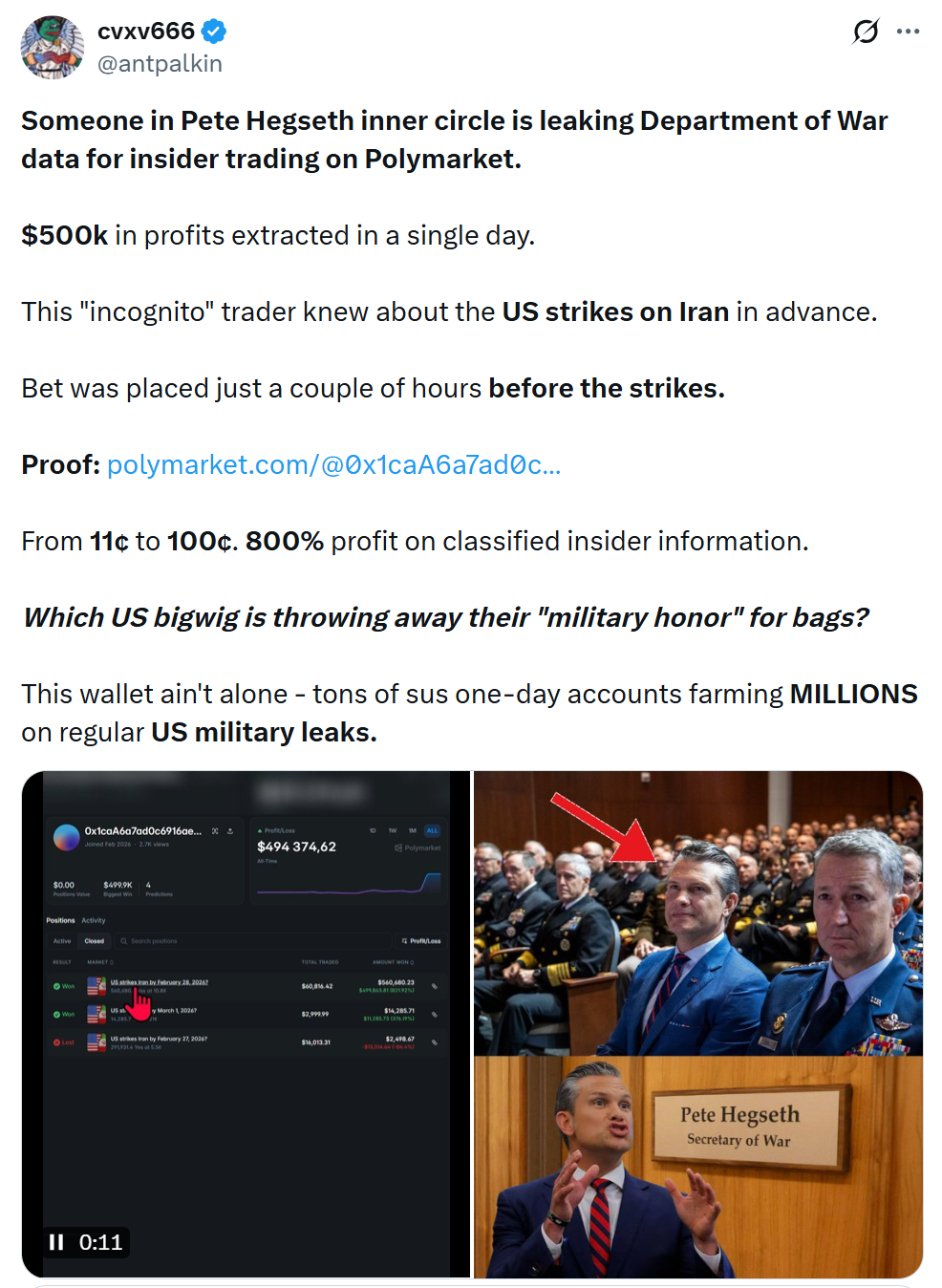
Six Polymarket traders earned roughly $1 million after accurately betting that the United States would strike Iran before the end of February, triggering insider trading suspicions.
The six wallets were all created in February and placed nearly all of their activity on contracts predicting the timing of a potential US attack, Bloomberg reported, citing data shared by analytics firm Bubblemaps SA. In several cases, shares were purchased only hours before explosions were first reported in Tehran, with some contracts acquired for around $0.10, per the report.
The timing drew attention from onchain investigators, who said the pattern resembles behavior previously linked to suspected insider activity on prediction markets.

“In cases involving war or conflict, information can circulate within a broader circle before becoming public,” Nicolas Vaiman, chief executive of Bubblemaps, reportedly said. “Combined with the fact that Polymarket generally only requires a wallet to trade, which allows for a high level of anonymity, this can create incentives for informed participants to act early,” he added.
Cointelegraph reached out to Polymarket for comment, but had not received a response by publication
Related: Polymarket user gains $400K betting on ZachXBT investigation
Polymarket Iran strike bets draw $529 million in volume
During the recent escalation, more than $529 million flowed into strike-related contracts on Polymarket. The specific Feb. 28 contract alone attracted roughly $90 million in trading volume, making it the most popular strike date among traders. A Jan. 31 scenario followed with about $42 million.
Notably, one of the flagged accounts had previously lost money on an earlier prediction before placing a larger wager that later returned more than $170,000, suggesting that the trades do not by themselves prove wrongdoing. Washington had also publicly warned of possible military action for weeks, drawing speculators to the platform.
There have been more instances of insider-trading allegations on Polymarket. This week, a small cluster of crypto wallets earned more than $1.2 million betting on a contract tied to an onchain investigation into DeFi platform Axiom, shortly before investigator ZachXBT published claims that an Axiom employee and associates had been engaged in insider trading since early 2025.
Last month, a Polymarket account made about $400,000 from a well-timed wager on the capture of Venezuelan President Nicolás Maduro. The wallet had placed roughly $32,000 on Maduro’s removal shortly before the news became public, raising insider trading concerns.
Related: Polymarket users favor Meteora in bets over ZachXBT crypto takedown
US lawmaker moves to ban insider trading on prediction markets
As Cointelegraph reported, US Representative Ritchie Torres is preparing legislation called the Public Integrity in Financial Prediction Markets Act of 2026 to limit insider trading on prediction platforms. The proposal would bar elected officials, political appointees and executive-branch employees from trading contracts tied to government policy or political outcomes when they possess nonpublic information.
Meanwhile, Polymarket has faced a wave of regulatory actions worldwide, with several countries, including the Netherlands, Hungary, Belgium, France, Italy, Romania, Poland, Singapore and Portugal, blocking or banning the platform after classifying its event-based contracts as unlicensed online gambling rather than financial trading.
Magazine: Bitcoin may take 7 years to upgrade to post-quantum — BIP-360 co-author
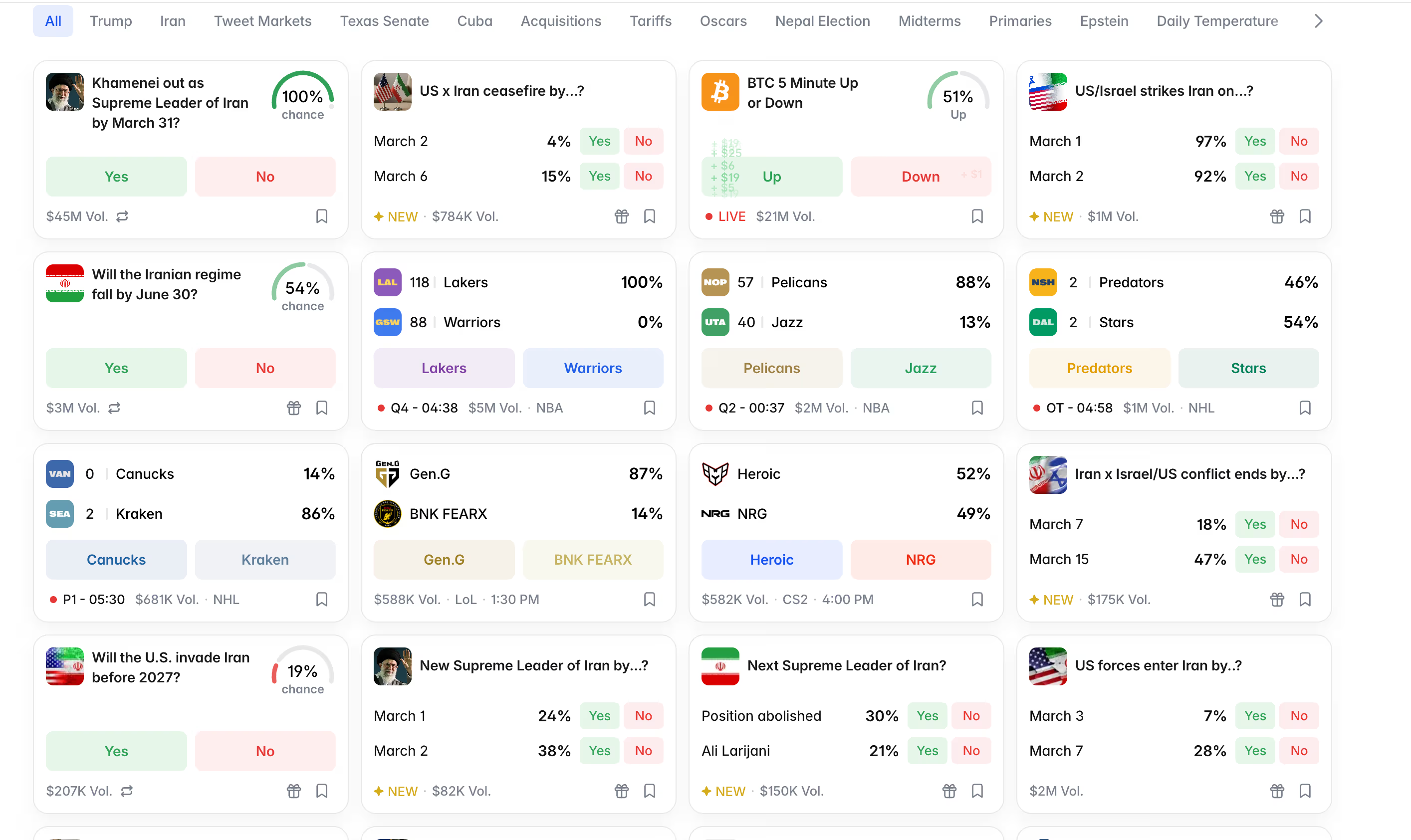
It took Polymarket less than 24 hours to turn a Middle Eastern war into an active trading floor.
Since the U.S. and Israel launched strikes on Iran Saturday, the prediction market has seen a flood of new contracts covering everything from ceasefire timelines to whether the Iranian regime will collapse by June.
The speed and specificity of the markets is striking. Bettors aren’t just wagering on whether the conflict escalates, but pricing the week it ends, who replaces Iran’s Ayatollah Ali Khamenei and whether U.S. ground forces enter Iran by March 7.

Polymarket’s largest completed market is “Khamenei out as Supreme Leader of Iran by March 31?” which resolved to 100% after Iranian state TV confirmed his death on Saturday.
The contract pulled $45 million in volume, making it one of the most-traded geopolitical markets in the past week. The top trader, an account called “Curseaaaaaaa,” made $757,000 on a “yes” bet. Four other traders each cleared six figures.

The chart on that market hovered between 25% and 50% through January and February as tensions built, then spiked vertically to 100% when confirmation came through.
The biggest market, however, is the “US strikes Iran by…?” contract, which has been live since December 22 and has now pulled $529 million in total volume, making it one of the largest single markets Polymarket has ever hosted.
That figure makes it the largest market in Polymarket’s “World” and “Geopolitics” categories by a wide margin, and the fourth-largest in the broader “Politics” category behind only Trump-related contracts from the 2024 election cycle.

The February 28 date alone attracted $89.6 million in trading. Every daily contract from February 28 through early March resolved to “yes” after the strikes began, meaning anyone who bought the specific date before the attack collected on a binary bet about when the U.S. military would bomb another country.
The market’s resolution rules were precise. It required drone, missile, or air strikes on Iranian soil by U.S. forces, with interceptions, cyberattacks, and ground operations not counting.
Now the trading action has shifted to what comes next.
The ceasefire market gives just a 4% chance of a U.S.-Iran ceasefire by March 2 and 15% by March 6, but jumps to 61% by March 31 and 78% by April 30. Bettors are pricing a resolution within weeks, not months, consistent with bitcoin’s bounce to $68,000 on the same thesis.

“Will the Iranian regime fall by June 30?” sits at 54%, up sharply from the low-20s where it had traded for months. The “Next Supreme Leader of Iran” market gives a 30% chance to “position abolished” entirely, meaning bettors see nearly a one-in-three shot that the theocratic structure itself doesn’t survive. Ali Larijani, a former parliament speaker, leads the named candidates at 21%.
The ground invasion contracts are pulling real volume too. “Will the U.S. invade Iran before 2027?” trades at 19% with $207,000 in volume, while “US forces enter Iran by March 7” sits at 28% with $2 million traded.
What Polymarket is doing here is something traditional markets structurally, and legally, cannot. Equity and oil futures don’t reopen until Sunday evening, but on Polymarket, anyone with a crypto wallet can take a position on Iranian regime change on a weekend and see real-time pricing from thousands of other participants doing the same thing.
But the most striking activity may have happened before the first missiles landed.
Onchain analytics firm Bubblemaps on Saturday identified six wallets that collectively netted $1.2 million in profit by betting on a U.S. strike on Iran by February 28, the exact day the strikes occurred.
Most of the wallets were funded within 24 hours of the attack, bet specifically on the February 28 contract rather than broader timeframes and purchased “yes” shares hours before the military operation began. The largest single wallet turned roughly $61,000 into over $493,000 in profit. A second netted approximately $120,000 from a $30,000 position.
The platform is aware of the optics, meanwhile.
Polymarket added a note to its Middle East markets on Sunday stating that “the promise of prediction markets is to harness the wisdom of the crowd to create accurate, unbiased forecasts for the most important events to society.” It went on to claim that after speaking with people directly affected by the attacks, it found that prediction markets “could give them the answers they needed in ways TV news and X could not.”
The site also created an entire, dedicated section for Iran-focused markets.
UPDATE (March 1, 2026, 06:30 UTC): Adds additional detail.
UPDATE (March 1, 2026, 07:15 UTC): Adds that Polymarket bets set a new record for the platform.
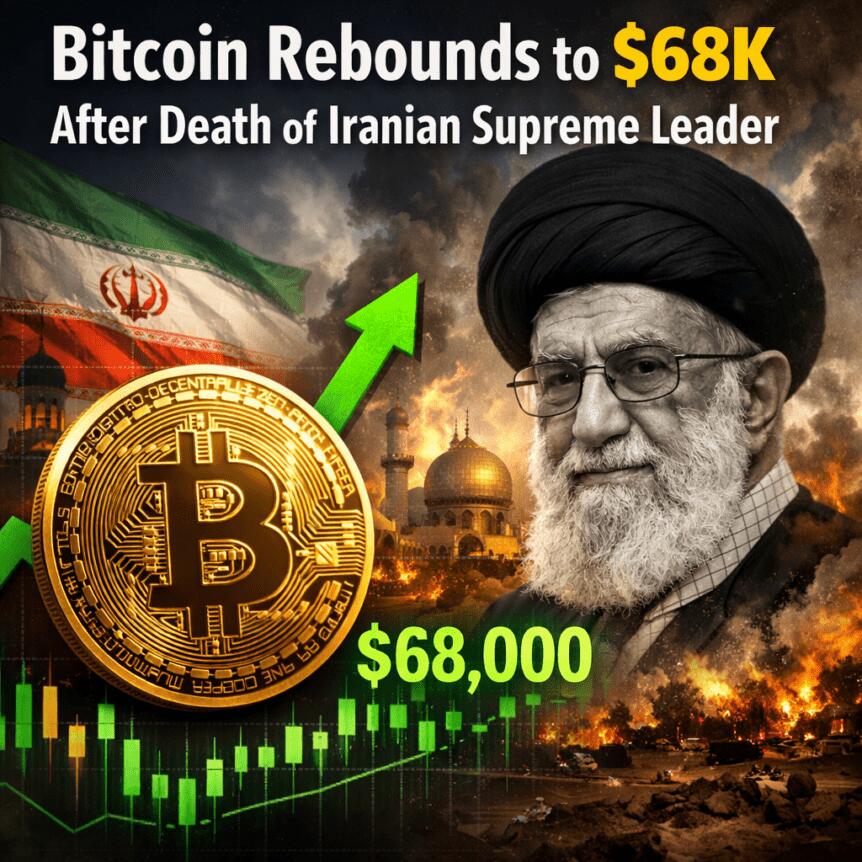
Bitcoin prices have recovered from a dip tied to geopolitical headlines, shifting sentiment in a market that has grown increasingly sensitive to macro risk events. In early Sunday trading, Bitcoin (CRYPTO: BTC) climbed toward the upper end of a recent range after yesterday’s volatility driven by reports of U.S.-and-Israel strikes on Iran. The asset had briefly touched a floor near $63,000 before a run higher helped recoup the losses in less than a day. By Sunday morning, price data circulated by TradingView placed BTC on Coinbase at about $68,200, signaling a relief rally as traders weighed the potential implications for risk assets in the near term. The bounce comes after a weekend that saw liquidity stress and rapid re-pricing as newsflow evolved.
The market’s day-long swing was notable not just for the price spike but for the underlying fragility it exposed. In the 24-hour window, roughly 157,000 traders were liquidated, translating to about $657 million in total liquidations, with a near-even split between leveraged long and short positions. The figure, tracked by CoinGlass, underscored the extent to which risk-on and risk-off trades collide in a geopolitical backdrop that has kept many participants on edge. While the move higher drew some relief, the overall liquidity environment remains sensitive to headlines, complicating calls about sustained momentum in the weeks ahead.
Key takeaways
- Bitcoin briefly surged to around $68,200 on Coinbase before a pullback left it near $67,350, continuing a three-week trading range around the $67k level.
- Over the past 24 hours, about 157,000 liquidations occurred, totaling roughly $657 million, with roughly equal shares of longs and shorts liquidated, per CoinGlass.
- Unverified but widely circulated reports of high-level leadership casualties in Iran fed sudden volatility, though the situation remained fluid as markets awaited official confirmation.
- February closed as Bitcoin’s third-worst February on record, with a decline close to 15%, marking one of the worst month-ends since 2013 and contributing to a difficult start to the year (Q1) for the asset.
- Analysts cautioned that de-escalation signs before the week’s opening could help sustain gains, though upside remains contingent on geopolitical clarity and macro risk sentiment.
Tickers mentioned: $BTC
Sentiment: Neutral
Price impact: Neutral. The bounce offset a steep intraday drop, but BTC remains within a tight, range-bound pattern rather than establishing a clear breakout.
Market context: The price action sits amid a broader backdrop of geopolitical risk and risk-off liquidity dynamics, with intraday moves driven by headlines as traders recalibrate exposure to macro and policy risks. Recent data show concentrated volatility around major news events, reinforcing a cautious stance among most market participants.
Why it matters
For traders, the brief rebound toward the mid-to-high $60k zone after a sharp decline emphasizes Bitcoin’s role as a potential haven within a high-risk environment, even as it remains tethered to overall risk sentiment. The rapid liquidations in a 24-hour period highlight how quickly leveraged positions can unwind when headlines shift, underscoring the importance of risk management and hedging in crypto portfolios. The episode also demonstrates that, despite episodic spikes, price action continues to reflect a balance between demand from allocators seeking a store of value and the pressure from macro and geopolitical headlines that can compress liquidity and amplify moves in either direction.
Analysts’ commentary around the potential for de-escalation to support further gains captures a common thread: Bitcoin’s near-term trajectory in this environment is highly contingent on the speed and visibility of political developments. One analyst noted that if conflict signals resolve ahead of the next market open, BTC could stabilize and potentially push higher. Others warned that any renewed escalation or uncertainty could quickly reverse the recent rebound, given the asset’s history of volatile responses to global tensions. In this context, the market’s probability distribution shifts with every fresh headline, making prudent risk management more important than ever for participants navigating this space.
Beyond geopolitics, Bitcoin’s February performance remains a cautionary signal. The asset finished the month down about 15%, marking its third-worst February in the data set and contributing to a challenging start to the year. This performance places Bitcoin on track for its worst first quarter since 2018, with losses approaching the mid-20% range year-to-date in a few scenarios. Such numbers reinforce that the cryptocurrency market is not immune to broader cyclicality and risk-off periods, even when episodic catalysts temporarily provide support. The data points to a market still digesting a period of elevated volatility, with traders weighing whether a more sustained recovery can emerge from macro normalization and improved liquidity conditions.
Against this backdrop, traders continue to monitor on-chain activity and liquidations as practical indicators of market risk appetite. The scale of recent liquidations suggests a broad reticence among highly leveraged participants, and it remains to be seen whether this sentiment translates into a more durable bid or gives way to renewed selling pressure if the geopolitical picture remains uncertain. The episode also highlights the constant tension between macro risk signals and crypto-specific fundamentals, where retail and institutional participants alike seek price discovery in a market characterized by 24/7 trading and near-instantaneous reaction to news flow.
What to watch next
- Any official statements or de-escalation signals from U.S. or allied authorities regarding Iran and the region, ahead of the next market open.
- Price action around key support and resistance levels near the current three-week range, with attention to whether BTC maintains momentum above or retreats below the mid-$60k zone.
- Changes in liquidity and funding rates on major exchange platforms as risk sentiment shifts in response to headlines and macro data releases.
- Updates on geopolitical developments, including any verification of leadership changes or military assessments, that could alter risk-on versus risk-off dynamics for crypto markets.
Sources & verification
- Bitcoin price data and range observations from Coinbase trading data and TradingView.
- Liquidation figures (157,000 traders; about $657 million total) reported by CoinGlass.
- BBC reporting on Iran’s leadership developments and attribution of events to the Iranian leadership.
- Public posts and commentary on the geopolitical situation, including statements on Truth Social by former U.S. President Donald Trump.
- Reported US-Israel air strikes on Iran as referenced in market commentary.
Bitcoin price moves amid geopolitical tensions and liquidity shifts
Bitcoin (CRYPTO: BTC) kept a close watch on news flow as markets absorbed headlines about U.S.-led strikes in the Middle East and the broader risk landscape. After a dip that briefly carried prices toward the low $60k region, BTC staged a partial recovery, briefly topping $68,200 on Coinbase before easing back. The rebound unfolded within a roughly three-week trading band centered near $67,000, illustrating the market’s struggle to establish a durable directional bias amid ongoing geopolitical uncertainty. The intraday swing, while dramatic, did not necessarily translate into a lasting breakout, and traders remained cautious about the asset’s medium-term trajectory.
From a risk-management perspective, the latest price action coincided with large liquidation activity. In the last 24 hours, data indicated around 157,000 liquidations totaling approximately $657 million—an amount that underscores how quickly highly leveraged positions can be unwound when volatility spikes. The liquidations appeared roughly evenly split between longs and shorts, suggesting a broad spectrum of market participants faced margin pressure regardless of their directional stance. These dynamics are emblematic of a market where liquidity can be episodically thin and sentiment-sensitive, particularly in the wake of geopolitical events and shifting macro cues.
The geopolitical narrative surrounding Iran added another layer of complexity. Reports from credible sources suggested that Ayatollah Khamenei, Iran’s Supreme Leader, had been killed in a Saturday operation, with subsequent coverage by outlets such as the BBC. Such claims, whether confirmed or refuted, tend to catalyze rapid price revision as traders reassess risk premia and potential spillover effects on regional stability. Notably, commentary from market observers emphasized that the trajectory of Bitcoin would likely hinge on whether the conflict shows signs of de-escalation before the market opens on Monday, a scenario that could preserve or extend the current gains. As one analyst noted on social media, the possibility of a peaceful trajectory could help Bitcoin maintain momentum, while renewed hostilities could precipitate renewed volatility.
Despite the back-and-forth, February’s performance looms large in the narrative surrounding BTC. The asset closed the month with a near-15% slide, marking its third-worst February on record and continuing a pattern of weak early-year performance. The broader implication is an ongoing risk-off phase that has persisted into 2026, with the question for market participants being whether a combination of de-risking, thin liquidity, and regulatory developments can eventually pave the way for a more sustained recovery. The data point toward a volatile environment where macro and geopolitical developments can overshadow even localized bullish catalysts, compelling traders to adopt disciplined risk controls and clear exit strategies.
As the market awaits more clarity, the path forward appears to be shaped by the interplay between conflict resolution signals and the crypto market’s own liquidity dynamics. The narrative remains unsettled, and the potential for further volatility persists as new information emerges. In this context, BTC’s price action will likely reflect not only technical support and resistance but also broader shifts in risk appetite, funding costs, and investors’ willingness to allocate capital to an asset class that remains highly sensitive to global developments. For now, the market seems to be testing the resilience of Bitcoin’s bid while staying vigilant for the next headline that could swing the balance.
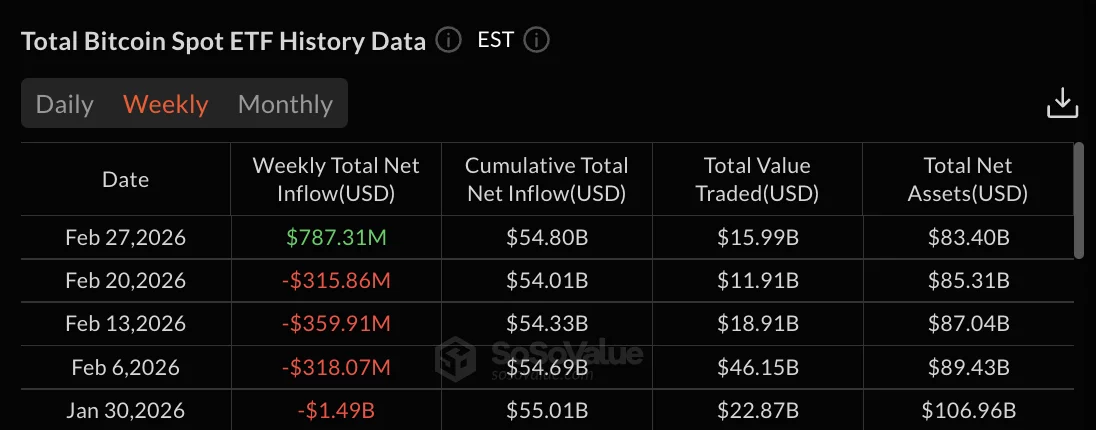
Bitcoin ETFs recorded $787.31 million in net inflows for the week ending February 27, reversing the prior week’s $315.86 million in outflows.
Summary
- Bitcoin ETFs posted $787M in weekly inflows, ending four red weeks.
- Three-day buying wave added $1.02B, led by a $506M peak day.
- Cumulative net inflows dipped slightly to $54.8B despite rebound.
The positive weekly flow came from three consecutive days of strong buying from February 24-26, totaling $1.02 billion, which offset outflows on February 23 and 27.
Bitcoin traded at $66,000 with gains of 1.7% over 24 hours following the weekly ETF reversal. The asset traded in a 24-hour range of $63,176 to $67,039.
Total net assets reached $83.40 billion while cumulative total net inflow stood at $54.80 billion.
Buying wave drives $1.02 billion in Bitcoin ETFs inflow
February 25 posted the week’s strongest single-day performance with $506.51 million in inflows.
February 26 added $254.46 million while February 24 contributed $257.71 million. The three-day streak brought $1.02 billion into Bitcoin ETF products.
February 23 recorded $203.82 million in outflows before the buying wave began. February 27 posted $27.55 million in redemptions, ending the three-day positive streak.
Weekly trading volume reached $15.99 billion for the period ending February 27, down from $22.87 billion during the week ending January 30.
Total net assets climbed from $85.31 billion on February 20 to $83.40 billion on February 27, showing a drop from the week’s peak despite positive flows.
Weekly reversal breaks four-week outflow streak
The $787.31 million weekly inflow was the first positive week since late January. The four prior weeks posted consecutive outflows.
That was $315.86 million for the week ending February 20, $359.91 million ending February 13, $318.07 million ending February 6, and $1.49 billion ending January 30.
The five-week outflow period from late January through mid-February totals approximately $2.48 billion before this week’s reversal.
Cumulative total net inflow fell from $55.01 billion on January 30 to $54.80 billion on February 27.

Anthropic acquires former AI2 researchers’ start-up Vercept

BITCOIN & CRYPTO FLIPPED: This is GOOD News!!! – Bitcoin News Today, Ethereum & Altcoins

All of the air shows at IWM Duxford happening in 2026 and how to get tickets


-

 Sports6 days ago
Women’s college basketball rankings: Iowa reenters top 10, Auriemma makes history
-

 Fashion2 days ago
Weekend Open Thread: Iris Top
-

 Politics6 days ago
Nick Reiner Enters Plea In Deaths Of Parents Rob And Michele
-

 Business5 days ago
True Citrus debuts functional drink mix collection
-

 Politics2 days ago
ITV enters Gaza with IDF amid ongoing genocide
-
Sports1 day ago
The Vikings Need a Duck
-

 Crypto World5 days ago
XRP price enters “dead zone” as Binance leverage hits lows
-

 Tech4 hours ago
Unihertz’s Titan 2 Elite Arrives Just as Physical Keyboards Refuse to Fade Away
-

 Business7 days ago
Mattel’s American Girl brand turns 40, dolls enter a new era
-

 Tech5 days ago
Unsurprisingly, Apple's board gets what it wants in 2026 shareholder meeting
-
 NewsBeat15 hours ago
Dubai flights cancelled as Brit told airspace closed ’10 minutes after boarding’
-

 Business7 days ago
Law enforcement kills armed man seeking to enter Trump’s Mar-a-Lago resort, officials say
-

 NewsBeat3 days ago
Cuba says its forces have killed four on US-registered speedboat | World News
-
 NewsBeat3 days ago
Manchester Central Mosque issues statement as it imposes new measures ‘with immediate effect’ after armed men enter
-
 NewsBeat20 hours ago
The empty pub on busy Cambridge road that has been boarded up for years
-
 NewsBeat6 days ago
‘Hourly’ method from gastroenterologist ‘helps reduce air travel bloating’
-

 Tech7 days ago
Anthropic-Backed Group Enters NY-12 AI PAC Fight
-

 NewsBeat11 hours ago
Abusive parents will now be treated like sex offenders and placed on a ‘child cruelty register’ | News UK
-

 NewsBeat7 days ago
Armed man killed after entering secure perimeter of Mar-a-Lago, Secret Service says
-

 Politics7 days ago
Maine has a long track record of electing moderates. Enter Graham Platner.