

Crypto World
Polymarket traders bet record $500 million on U.S.-Iran war

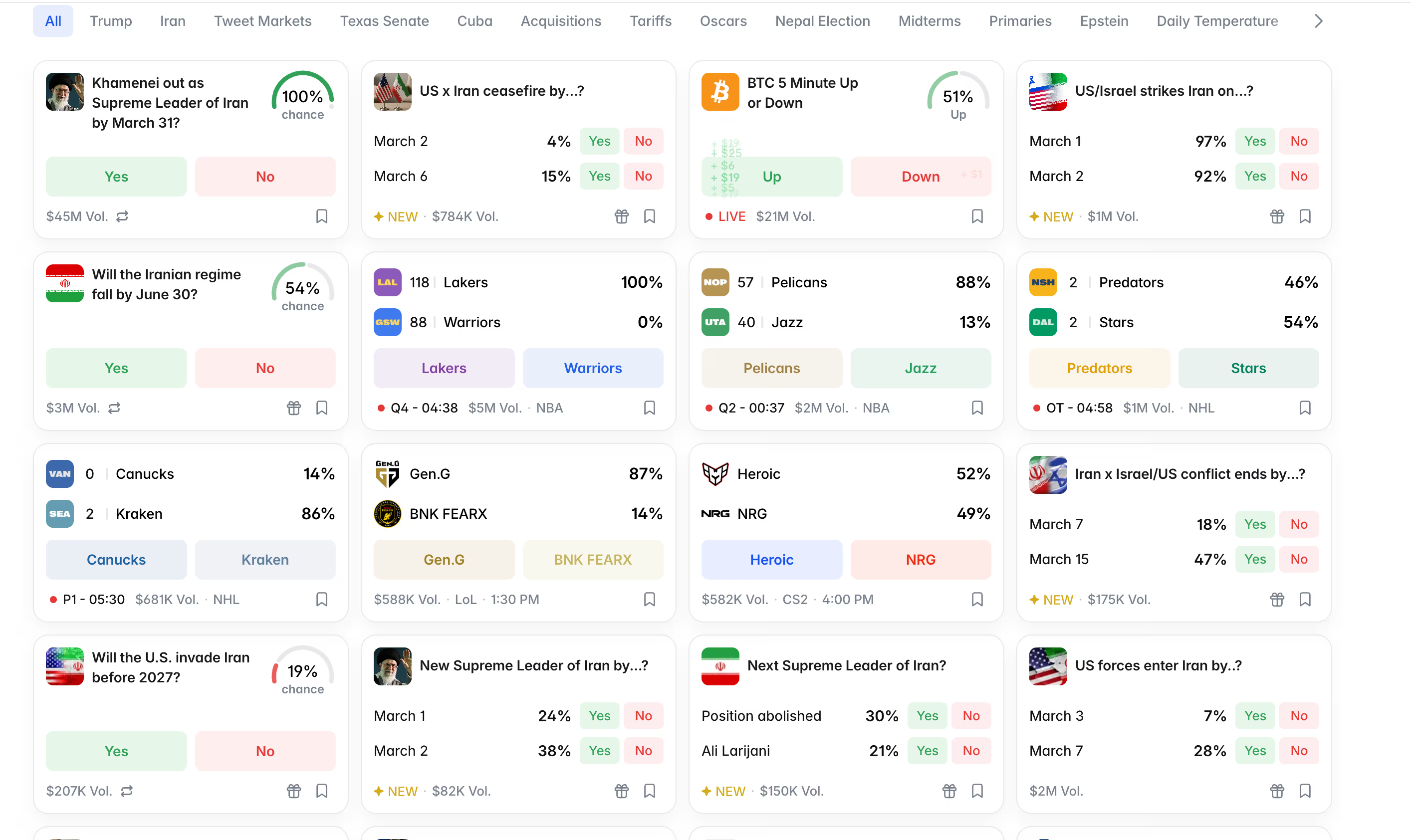
It took Polymarket less than 24 hours to turn a Middle Eastern war into an active trading floor.
Since the U.S. and Israel launched strikes on Iran Saturday, the prediction market has seen a flood of new contracts covering everything from ceasefire timelines to whether the Iranian regime will collapse by June.
The speed and specificity of the markets is striking. Bettors aren’t just wagering on whether the conflict escalates, but pricing the week it ends, who replaces Iran’s Ayatollah Ali Khamenei and whether U.S. ground forces enter Iran by March 7.

Polymarket’s largest completed market is “Khamenei out as Supreme Leader of Iran by March 31?” which resolved to 100% after Iranian state TV confirmed his death on Saturday.
The contract pulled $45 million in volume, making it one of the most-traded geopolitical markets in the past week. The top trader, an account called “Curseaaaaaaa,” made $757,000 on a “yes” bet. Four other traders each cleared six figures.

The chart on that market hovered between 25% and 50% through January and February as tensions built, then spiked vertically to 100% when confirmation came through.
The biggest market, however, is the “US strikes Iran by…?” contract, which has been live since December 22 and has now pulled $529 million in total volume, making it one of the largest single markets Polymarket has ever hosted.
That figure makes it the largest market in Polymarket’s “World” and “Geopolitics” categories by a wide margin, and the fourth-largest in the broader “Politics” category behind only Trump-related contracts from the 2024 election cycle.

The February 28 date alone attracted $89.6 million in trading. Every daily contract from February 28 through early March resolved to “yes” after the strikes began, meaning anyone who bought the specific date before the attack collected on a binary bet about when the U.S. military would bomb another country.
The market’s resolution rules were precise. It required drone, missile, or air strikes on Iranian soil by U.S. forces, with interceptions, cyberattacks, and ground operations not counting.
Now the trading action has shifted to what comes next.
The ceasefire market gives just a 4% chance of a U.S.-Iran ceasefire by March 2 and 15% by March 6, but jumps to 61% by March 31 and 78% by April 30. Bettors are pricing a resolution within weeks, not months, consistent with bitcoin’s bounce to $68,000 on the same thesis.

“Will the Iranian regime fall by June 30?” sits at 54%, up sharply from the low-20s where it had traded for months. The “Next Supreme Leader of Iran” market gives a 30% chance to “position abolished” entirely, meaning bettors see nearly a one-in-three shot that the theocratic structure itself doesn’t survive. Ali Larijani, a former parliament speaker, leads the named candidates at 21%.
The ground invasion contracts are pulling real volume too. “Will the U.S. invade Iran before 2027?” trades at 19% with $207,000 in volume, while “US forces enter Iran by March 7” sits at 28% with $2 million traded.
What Polymarket is doing here is something traditional markets structurally, and legally, cannot. Equity and oil futures don’t reopen until Sunday evening, but on Polymarket, anyone with a crypto wallet can take a position on Iranian regime change on a weekend and see real-time pricing from thousands of other participants doing the same thing.
But the most striking activity may have happened before the first missiles landed.
Onchain analytics firm Bubblemaps on Saturday identified six wallets that collectively netted $1.2 million in profit by betting on a U.S. strike on Iran by February 28, the exact day the strikes occurred.
Most of the wallets were funded within 24 hours of the attack, bet specifically on the February 28 contract rather than broader timeframes and purchased “yes” shares hours before the military operation began. The largest single wallet turned roughly $61,000 into over $493,000 in profit. A second netted approximately $120,000 from a $30,000 position.
The platform is aware of the optics, meanwhile.
Polymarket added a note to its Middle East markets on Sunday stating that “the promise of prediction markets is to harness the wisdom of the crowd to create accurate, unbiased forecasts for the most important events to society.” It went on to claim that after speaking with people directly affected by the attacks, it found that prediction markets “could give them the answers they needed in ways TV news and X could not.”
The site also created an entire, dedicated section for Iran-focused markets.
UPDATE (March 1, 2026, 06:30 UTC): Adds additional detail.
UPDATE (March 1, 2026, 07:15 UTC): Adds that Polymarket bets set a new record for the platform.



Disclosure: This article does not represent investment advice. The content and materials featured on this page are for educational purposes only.
Mutuum Finance raises more than $20.6m as it builds a non-custodial lending protocol on Ethereum.
Summary
- Mutuum Finance raises $20.6m to expand its Ethereum-based non-custodial lending protocol.
- Mutuum Finance’s V1 protocol goes live on Sepolia testnet, enabling simulated on-chain lending and borrowing.
- Mutuum’s Sepolia testnet records over $150m in simulated TVL, signaling strong early engagement.
Mutuum Finance (MUTM), a new cryptocurrency project building decentralized lending infrastructure on Ethereum, continues expanding its protocol development as fundraising surpasses $20.6 million. The non-custodial platform is designed to allow users to lend and borrow digital assets directly through smart contracts, without relying on centralized intermediaries.
The MUTM token is currently priced at $0.04, with more than 19,000 holders participating in the ongoing token distribution. According to project data, the protocol’s Sepolia testnet environment has now exceeded $150 million in simulated total value locked (TVL), reflecting user engagement during the testing phase.
Mutuum Finance V1 protocol live on testnet
Mutuum Finance’s V1 protocol is currently live on the Sepolia testnet, where users can simulate lending and borrowing by supplying supported assets to liquidity pools for yield or locking collateral to access other tokens. The system executes these functions through smart contracts with predefined risk parameters, allowing users to interact directly with on-chain lending markets in a test environment.
Safe-mode borrow presets introduced
In a recent update shared on X, the team announced the release of Safe-Mode Borrow Presets. The feature introduces one-click borrowing options aligned with predefined Stability Factor targets labeled Safe, Balanced, and Aggressive. The preset system adjusts borrowing capacity automatically based on the selected risk profile.
The team also shared a short demonstration video illustrating how the feature operates within the interface. According to the update, additional releases and protocol improvements are planned in the coming period.
In the current version of the protocol, users can mint testnet assets such as ETH, USDT, LINK, and WBTC. After minting, these assets can be supplied into the platform to participate in lending or borrowing activity, and they can also be used within the staking module available in the test environment.
When a user deposits an asset such as USDT, the protocol issues a corresponding mtToken, for example, mtUSDT, representing proof of deposit on a 1:1 basis. These mtTokens reflect the user’s position in the liquidity pool. By staking mtTokens, users become eligible to receive MUTM tokens distributed as part of the protocol’s dividend model.
The current release also includes debt tokens, which are minted when a user borrows and track the outstanding principal along with accrued interest. An automated liquidator bot monitors collateral positions and initiates liquidation if required thresholds are breached. In addition, a stability factor metric provides a real-time indicator of how well-collateralized a borrowing position is relative to protocol requirements.
Before the V1 protocol launch, on X, the team announced that the Halborn security audit had been completed. The team stated, “HalbornSecurity has completed the independent audit of Mutuum Finance’s V1 lending & borrowing protocol.”
With fundraising exceeding $20.6 million and the protocol now live on testnet, Mutuum Finance continues to expand its decentralized lending infrastructure on Ethereum. Ongoing feature releases, including risk-based borrowing presets, indicate continued development as the project progresses through its roadmap toward a planned mainnet launch.
Disclosure: This content is provided by a third party. Neither crypto.news nor the author of this article endorses any product mentioned on this page. Users should conduct their own research before taking any action related to the company.
TLDR:
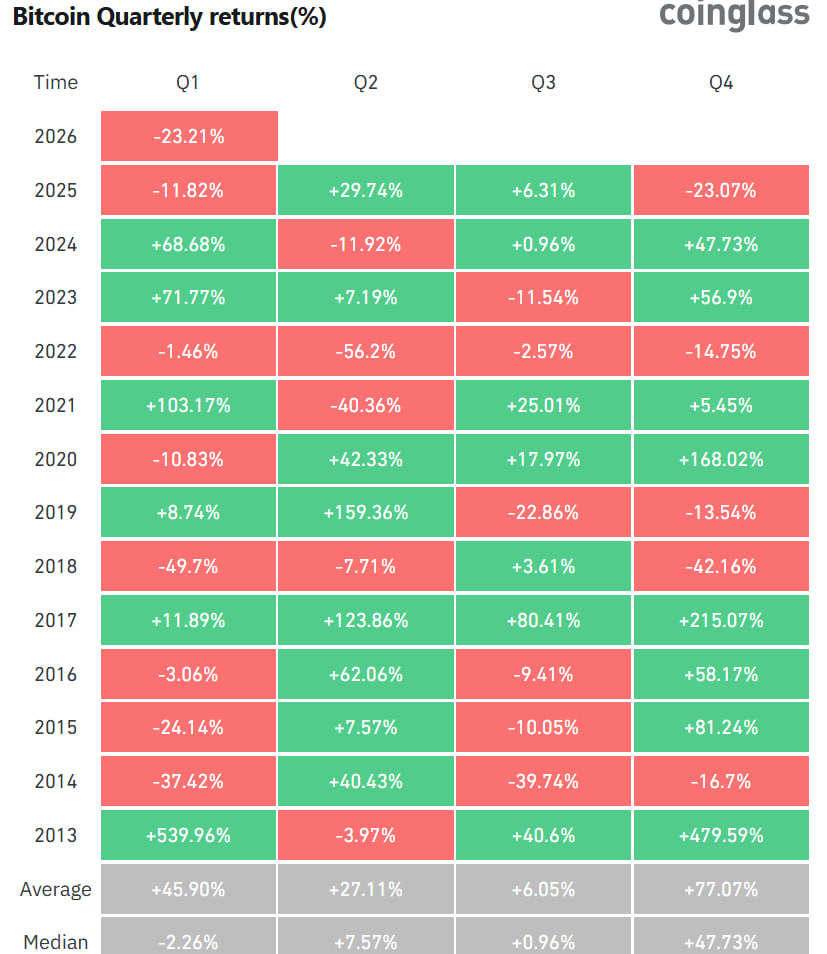
- Bitcoin’s Q1 2026 return of -23.21% is the third-worst since 2013, trailing only Q1 2018 and Q1 2014 losses.
- Ethereum recorded a -32.17% Q1 2026 return, falling well below its historical quarterly average of +66.45%.
- Bitcoin’s Q1 average of +45.90% is heavily skewed by extreme years like 2013’s record gain of +539.96%.
- Around $1.8 billion in sell orders hit derivatives books in one hour, linked to rising US-Iran geopolitical tension.
Bitcoin Q1 2026 return has dropped to -23.21%, marking one of the weakest first-quarter performances since 2013.
Ethereum also recorded a -32.17% decline during the same period. Data from CoinGlass shows both assets are trading well below their historical quarterly averages.
The numbers reflect broader stress across digital asset markets, driven by macro pressure and rising geopolitical tensions that have rattled investor confidence heading into the second quarter.
Bitcoin Falls to Third-Worst Q1 Since 2013
Bitcoin’s Q1 2026 return stands at -23.21%, placing it among the worst quarterly performances on record. Only Q1 2018 and Q1 2014 recorded steeper losses, at -49.7% and -37.42% respectively.
Both of those periods played out during confirmed bear-market cycles. The current result sits far below the historical Q1 average of +45.90%.
That average, however, is skewed by extreme years like 2013, when Bitcoin gained +539.96% in the first quarter. The 2021 Q1 also returned +103.17%, further pulling the average higher.

Source: Coinglass
The historical Q1 median sits at -2.26%, meaning negative quarters are not unusual. Still, a -23.21% return points to conditions well outside normal seasonal weakness.
The data suggests the market is dealing with more than routine volatility. Liquidity contraction and macro risk repricing appear to be key factors.
These are patterns typically seen during post-cycle deleveraging phases. Investors are not showing signs of early-cycle accumulation at this stage.
Ethereum’s Q1 performance tells a similar story, though the losses run deeper. Its -32.17% return is the third-worst Q1 since 2016. This is well below its historical Q1 average of +66.45% and median of +4.37%.
Derivatives Market Shows Signs of Forced Selling
Ethereum’s higher beta relative to Bitcoin means it tends to fall harder during risk-off periods. The Q1 2026 data is consistent with that pattern.
Capital rotation away from higher-volatility assets has been visible across the market. Together, Bitcoin and Ethereum’s performance points to a defensive macro posture rather than recovery.
Market analyst CryptoTice flagged a sharp spike in selling pressure through derivatives. The analyst noted that roughly $1.8 billion in aggressive market sell orders hit the books within a single hour.
Rising US-Iran tensions were cited as the catalyst behind the move. The analyst described it as urgency-driven selling rather than a rotation.
When derivatives lead price action, leverage tends to unwind quickly. Liquidations can cascade, and volatility expands rapidly as a result.
CryptoTice pointed to funding rates, open interest, and liquidity gaps as key areas to monitor. Stress in the derivatives market often shows up before spot prices fully react.
The combined picture across spot and derivatives markets reflects a cautious environment. Both retail and institutional participants appear to be reducing exposure rather than adding risk.
Geopolitical factors have added a layer of uncertainty that is difficult to price. Until clarity returns, volatility is likely to remain elevated across the crypto market.

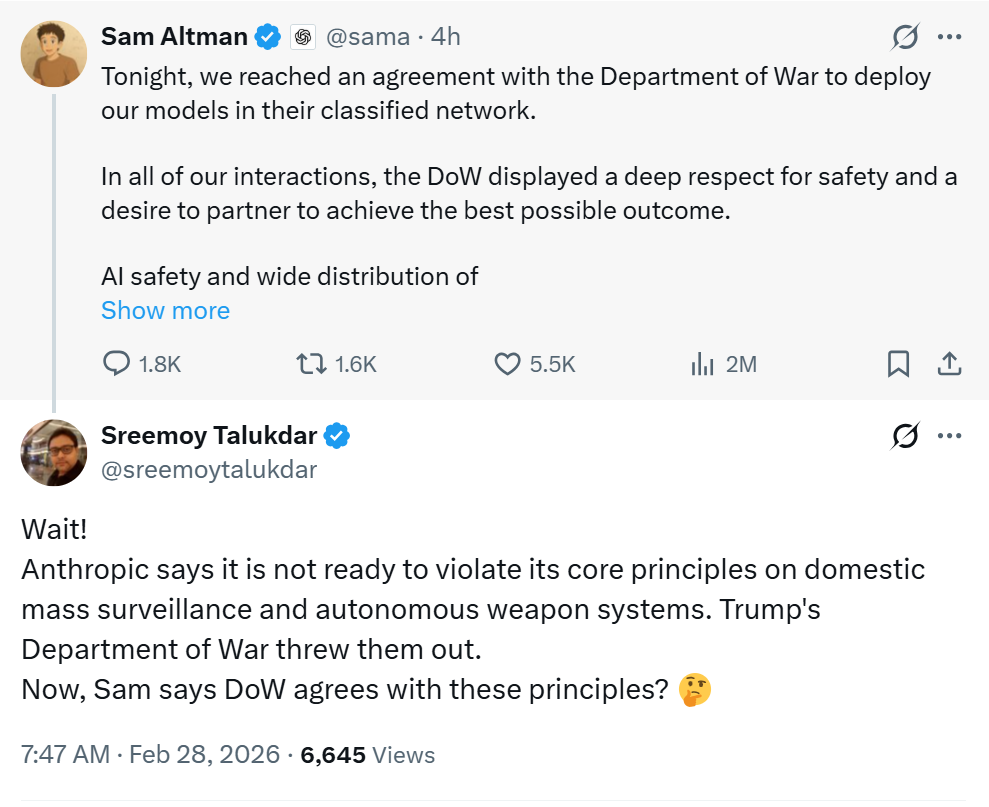
The US military reportedly used Anthropic during a major air strike on Iran, only hours after President Donald Trump ordered federal agencies to halt use of the company’s systems.
Military commands, including US Central Command (CENTCOM) in the Middle East, used Anthropic’s Claude AI model for operational support, according to people familiar with the matter cited by The Wall Street Journal. The tool has reportedly assisted with intelligence analysis, identifying potential targets and running battlefield simulations.
The incident shows how deeply advanced AI systems have become embedded in defense operations. Even as the administration moved to sever ties with the company, Claude remained integrated into military workflows.
On Friday, the Trump administration instructed agencies to stop working with the company and directed the Defense Department to treat it as a potential security risk. The order came after contract talks broke down, with Anthropic refusing to grant unrestricted military use of its AI for any lawful scenario requested by defense officials.
Related: Crypto VC Paradigm expands into AI, robotics with $1.5B fund: WSJ
Anthropic’s Claude AI used for classified operations
Anthropic had previously secured a multiyear Pentagon contract worth up to $200 million alongside several major AI labs. Through partnerships involving Palantir and Amazon Web Services, Claude became approved for classified intelligence and operational workflows. The system was reportedly also involved in earlier operations, including a January mission in Venezuela that resulted in the capture of President Nicolás Maduro.
Tensions intensified after Defense Secretary Pete Hegseth demanded the company permit unrestricted military use of its models. Anthropic CEO Dario Amodei rejected the request, describing certain applications as ethical boundaries the company would not cross, even if it meant losing government business.
In response, the Pentagon began lining up replacement providers, reaching an agreement with OpenAI to deploy its AI models on classified military networks.

Related: Pantera, Franklin Templeton join Sentient Arena to test AI agents
Anthropic CEO pushes back on Pentagon ban
During an interview on Saturday, Anthropic CEO Dario Amodei said the company opposes the use of its AI models for mass domestic surveillance and fully autonomous weapons, responding to a US government directive that labeled the firm a defense “supply chain risk” and barred contractors from using its products.
He argued that certain applications cross fundamental boundaries, emphasizing that military decisions should remain under human control rather than be delegated entirely to machines.
Magazine: Bitcoin may take 7 years to upgrade to post-quantum — BIP-360 co-author
TLDR:
- X now prohibits crypto, loans, and financial services from being promoted through organic paid partnership posts.
- Creators must label all paid partnership posts with clear disclosures like “Ad” or “Promoted Content” per X rules.
- Financial content banned from paid partnerships may still qualify for promotion through X’s formal advertising program.
- Violations of X’s Paid Partnerships Policy can result in post removal, read-only mode, or permanent account suspension.
X’s Paid Partnerships Policy now bars crypto and financial products from organic paid promotion on the platform. The updated rules cover loans, investment services, and buy now pay later arrangements.
Content creators and influencers must follow strict disclosure requirements. Violators risk post removal, read-only restrictions, or permanent account suspension.
The policy applies to all users publishing sponsored content as organic posts on X.
Financial and Crypto Content Excluded from Paid Promotions
X defines paid partnerships as arrangements where a brand compensates a user to promote its products or services.
This compensation can take the form of monetary payment, gifted products, affiliate commissions, or brand ambassador agreements. Under the revised rules, financial products and crypto now fall under prohibited categories.
The prohibited list extends beyond crypto alone. It covers loans, investment services, and buy now pay later platforms.
Any content tied to financial opportunities cannot be promoted through organic paid posts. This marks a clear boundary between what X allows in paid partnerships versus its formal advertising program.
X draws a distinction between its Paid Partnerships Policy and its Advertising Policies. Content banned under paid partnerships may still be eligible to run through X Ads.
Brands seeking to promote financial or crypto content must go through the official X advertising channel instead.
There is, however, a provision for exceptions. X states it may consider requests on a case-by-case basis, subject to applicable restrictions. Interested parties are directed to contact an internal X Sales Representative for further guidance.
Disclosure Requirements and Enforcement Actions
All paid partnership posts published as organic content must carry clear and conspicuous commercial disclosures. Accepted language includes terms such as “Ad” or “Promoted Content.” These labels must appear without requiring users to click any additional links.
Creators are also responsible for ensuring their posts comply with all applicable laws. This includes FTC regulations and the FTC’s Guides Concerning the Use of Endorsements and Testimonials in Advertising.
Local advertising laws must also be observed depending on the creator’s jurisdiction.
When a violation occurs, X reviews the severity of the breach and any prior rule violations before acting. Enforcement options range from requiring post removal to placing accounts in read-only mode. Repeated violations can result in permanent account suspension.
Anyone can report violations through the X paid partnerships reporting form. An X account is not required to file a report.
Users who believe their account was actioned in error may submit an appeal through X’s standard process.


Ethereum’s long-discussed “account abstraction” feature, often described as smart accounts, could arrive within the next year as part of the upcoming Hegota network upgrade, according to Ethereum co-founder Vitalik Buterin.
Key Takeaways:
- Ethereum’s account abstraction (smart accounts) could launch within a year through the Hegota upgrade and EIP-8141.
- The feature turns wallets into programmable apps, enabling recoverable keys, batch transactions and gas payments in non-ETH tokens.
- The upgrade aims to improve usability, support privacy tools and prepare the network for future scaling and quantum-resistance needs.
Speaking over the weekend, Buterin said the effort, first discussed in 2016, has finally reached a workable design.
A new proposal, EIP-8141, bundles together the remaining technical pieces needed to implement the feature across the network. “After over a decade of research and refinement, this looks possible to deploy within a year,” he wrote.
Ethereum Account Abstraction Turns Wallets Into Programmable Apps
Account abstraction changes how transactions work on Ethereum. Instead of a transaction being a single action signed by a private key, it becomes a structured sequence of “frames.”
These frames can reference one another and separately verify authorization, execution and fee payment.
In practice, this allows wallets to behave more like programmable applications rather than simple key holders.
The framework would enable multi-signature security, recoverable wallets and accounts with changeable keys.
A validation step would check the user’s authorization before an execution step processes the transaction itself.
The model also supports batch operations and transaction sponsorship, meaning fees could be handled by another party.
One of the most notable implications is the ability to pay gas fees without holding Ether. Through a paymaster contract or a decentralized exchange mechanism that provides ETH in real time, users could cover transaction costs with other tokens.
Buterin said eliminating reliance on centralized intermediaries is consistent with Ethereum’s cypherpunk design philosophy.
The change may also ease usability issues faced by privacy tools. Current privacy protocols often rely on public transaction broadcasters, which can introduce friction.
A general-purpose mempool could replace those intermediaries, improving the experience for applications such as Railgun and Tornado Cash-style systems.
The upgrade is expected to apply to both new and existing accounts, allowing the entire network to operate under a unified framework.
Developers also anticipate improved automation, scheduled transactions and complex contract interactions managed directly at the wallet level.
Buterin also outlined a longer-term roadmap focused on preparing the network for future threats. He recently described plans to introduce quantum-resistant protections covering validator signatures, stored data, user authentication and zero-knowledge proofs.
The scaling roadmap further includes gradual reductions in block slot time and finality time to speed up transaction confirmation.
Vitalik Backs Anti-Censorship Upgrade Ahead of Ethereum’s 2026 Hegota Fork
Last week, Buterin endorsed the Fork-Choice Enforced Inclusion Lists (FOCIL) upgrade, a major protocol change planned for the 2026 Hegota hard fork.
The proposal is designed to prevent transaction censorship by requiring validators to include all valid transactions in blocks, reinforcing Ethereum’s neutrality and cypherpunk principles.
FOCIL addresses growing centralization concerns after some validators filtered transactions linked to sanctioned services such as Tornado Cash.
Under the new rules, blocks that ignore valid transactions would be rejected by the network, ensuring public-mempool transactions settle within a defined timeframe and giving privacy protocols and smart-account transactions the same treatment as normal Ether transfers.
The post Ethereum Smart Accounts Set to Launch Within a Year, Says Vitalik Buterin appeared first on Cryptonews.
JUP and HYPE are among the top performers in the past 24 hours, soaring by double digits.
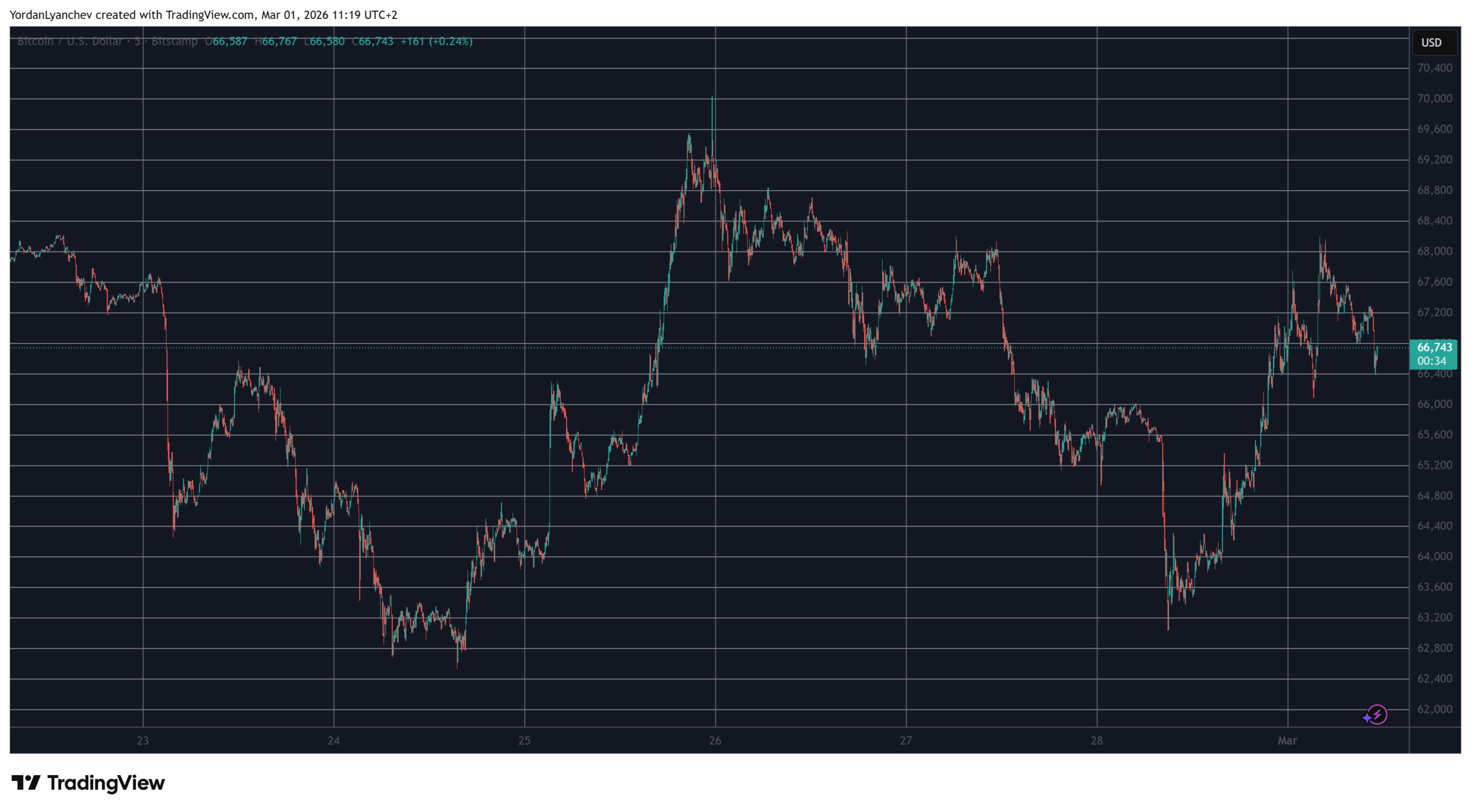
Bitcoin’s price went through some intense volatility on Saturday after the attacks on Iran and the subsequent retaliation, but has returned to essentially its starting point.
Many altcoins plummeted hard yesterday but have followed BTC on the way up, with ETH trading close to $2,000 and XRP taking back the fourth spot in terms of market cap from BNB.
BTC Down and Up
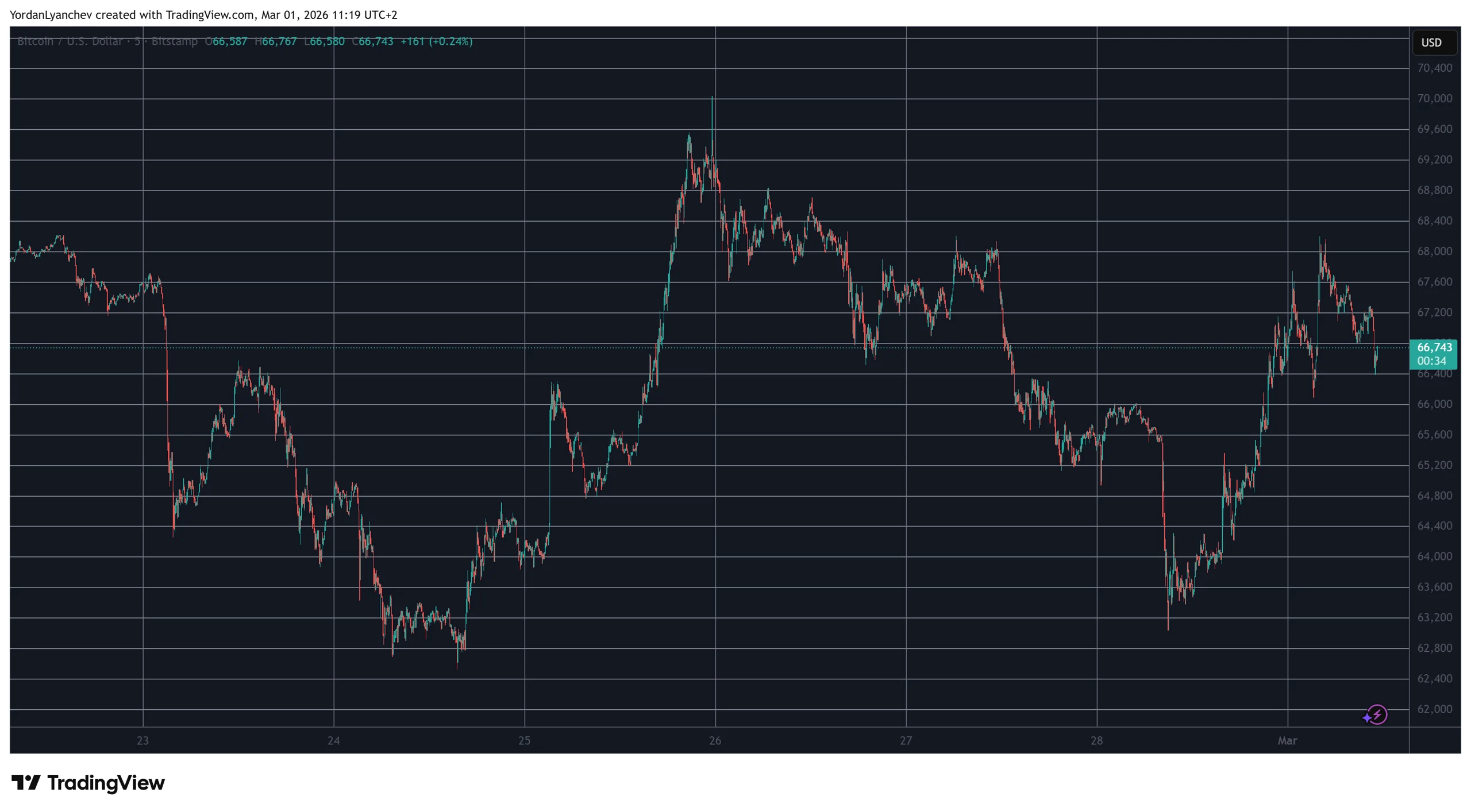
The previous business week began with a leg down, with bitcoin dropping from $68,000 to just over $64,000 after the most recent tariff developments. It dipped further on Tuesday to a multi-week low of $62,500 before it bounced off hard on Wednesday, tapping $70,000 for the first time in about eight days.
However, this rally seemed doomed, at least according to many analysts, and BTC indeed began to lose value almost immediately. The cryptocurrency fell by a few grand but remained sideways around $68,000 for the next few days. Saturday began with a bang (literally for several countries in the Middle East) when the US and Israel first attacked Iran, which retaliated against Saudi Arabia, the UAE, Bahrain, and Qatar.
BTC slumped from $67,000 to $63,000 within hours of the initial attacks. However, it rebounded hard to over $68,000 later during the day after reports that Iran’s Supreme Leader was killed in the attacks. It was stopped there, though, and now trades below $67,000.
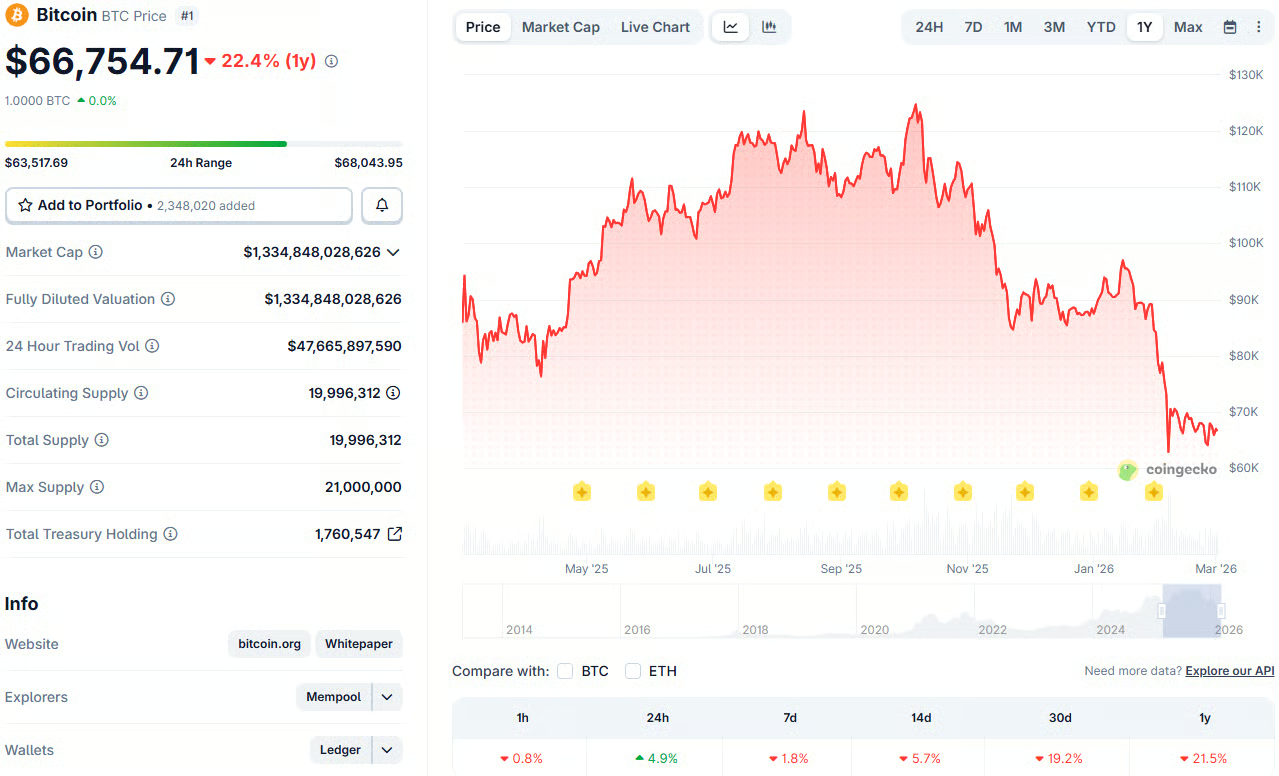
Its market cap has returned to $1.335 trillion, while its dominance over the alts stands inches above 56%.
Alts Recover
Most altcoins have reacted well to yesterday’s calamity. Ethereum is back to $2,000 after a 7.5% surge on a 24-hour scale. BNB is up to $622, but XRP has reclaimed the fourth spot in terms of market cap after an 8% surge to almost $1.40.
SOL, DOGE, ADA, and LINK are up by 7-9%, while HYPE has stolen the show from the larger caps with a 15% surge to $31. JUP, NEAR, and PUMP are the other double-digit gainers on a daily scale.
The total crypto market cap has recovered about $100 billion in a day and is close to $2.4 trillion on CG.

Binance Free $600 (CryptoPotato Exclusive): Use this link to register a new account and receive $600 exclusive welcome offer on Binance (full details).
LIMITED OFFER for CryptoPotato readers at Bybit: Use this link to register and open a $500 FREE position on any coin!
Disclaimer: Information found on CryptoPotato is those of writers quoted. It does not represent the opinions of CryptoPotato on whether to buy, sell, or hold any investments. You are advised to conduct your own research before making any investment decisions. Use provided information at your own risk. See Disclaimer for more information.
Crypto World
Geopolitical Risk and Bitcoin: What On-Chain Data Actually Reveals About Market Behavior
TLDR:
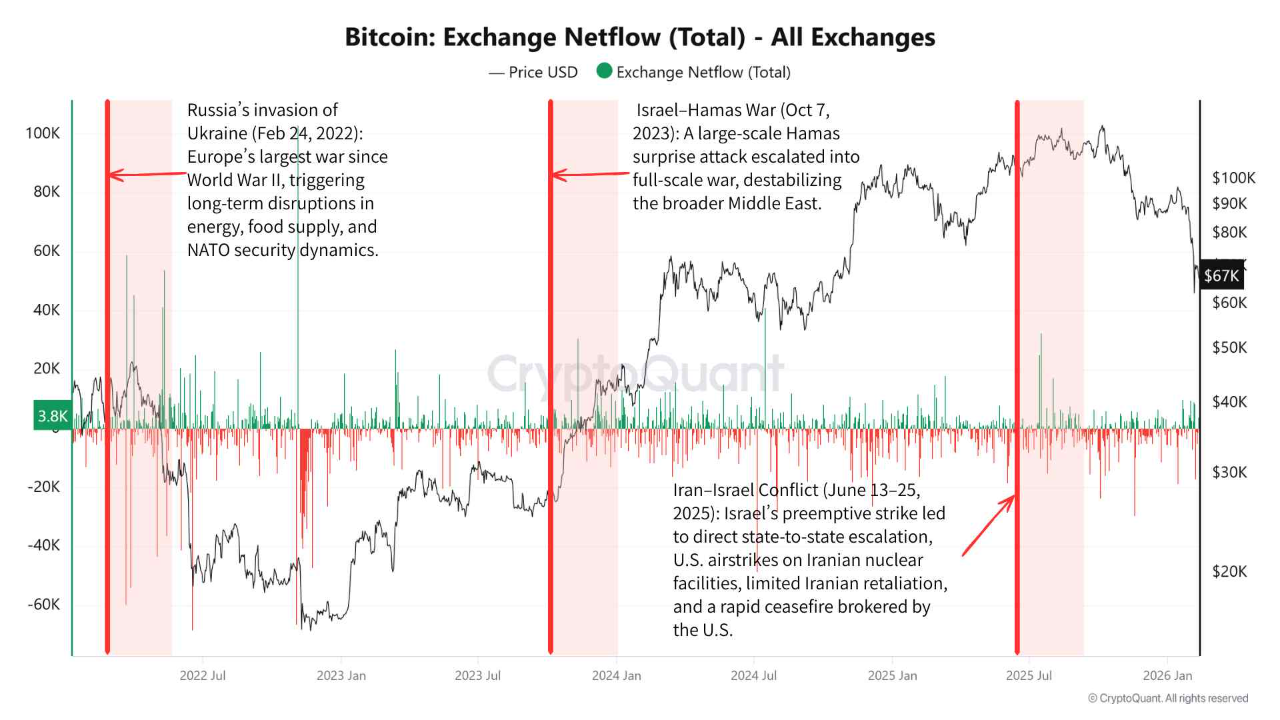
- Exchange Netflow data from three major conflicts shows Bitcoin inflows spike briefly, then normalize within 90 days.
- Bitcoin’s fixed supply schedule and network function remain unaffected by military conflicts or national fiscal crises.
- ETFs and institutional players now absorb geopolitical shocks through derivatives, reducing sustained spot market pressure.
- The U.S. Clarity Act and macro liquidity conditions are now the primary forces shaping Bitcoin’s structural direction.
Geopolitical risk and Bitcoin have long been studied together, yet their relationship is still widely misread by market participants.
On-chain data from three major military conflicts shows that war events cause short-term volatility but do not reshape Bitcoin’s structural trend.
CryptoQuant’s Exchange Netflow data tracks this behavior consistently across all three cases. Fear-driven inflows appear briefly, then normalize.
Trade wars and regulatory changes, by contrast, carry far more weight in shaping Bitcoin’s medium-term direction.
War Events Trigger Brief Market Disruption but No Lasting Structural Change
Three conflicts tested Bitcoin’s market resilience in recent years. Russia invaded Ukraine on February 24, 2022. The Israel–Hamas war began on October 7, 2023.
The Iran–Israel escalation followed on June 13, 2025. All three events produced short-lived spikes in CryptoQuant’s Exchange Netflow data, reflecting temporary fear-based positioning among traders.
Source: CryptoQUant
However, within three months of each event, Exchange Netflow levels returned to their normal ranges. Exchange trading volume showed no sustained structural shift in any of the three cases.
Capital did not exit the Bitcoin market in a lasting or measurable way during these conflict periods.
This pattern reflects Bitcoin’s core architecture and market structure. Unlike sovereign currencies, Bitcoin has no direct link to any single nation’s fiscal stability.
Military conflicts strain national economies, but they do not change Bitcoin’s supply schedule or disrupt its network function.
Additionally, the growing role of ETFs and institutional participants has changed how markets absorb conflict-driven shocks.
Much of the fear-based pressure now channels through derivatives markets rather than sustained spot selling. This structural shift reduces the lasting effect of geopolitical tension on Bitcoin’s price trajectory.
“Military events create noise. Macro conditions create trends. On-chain data continues to confirm this distinction across all three major conflict periods reviewed.” — Cryptoquant analyst XWIN Research JapaN noted.
Trade Policy and Regulation Carry Greater Weight for Bitcoin’s Direction
Trade wars and economic instability carry a more direct and measurable effect on Bitcoin than armed conflict. Tariff escalation, financial tightening, and liquidity contraction all shape global dollar flows and investor risk appetite. These conditions produce concrete, observable changes across multiple on-chain metrics.
Stablecoin supply, Realized Cap trends, and broader capital allocation patterns all respond to macroeconomic tightening.
As a result, these indicators offer more reliable directional signals for Bitcoin than conflict headlines do. Reviewing on-chain data consistently over time makes this distinction between macro pressure and military events increasingly clear.
This analysis builds on the January 5, 2026 report, “Venezuela and Bitcoin — Reading Geopolitical Risk Through On-Chain Data.”
That earlier report showed how economic instability, rather than political conflict, drove Bitcoin capital movement in Venezuela. The current findings reinforce that same conclusion across different geopolitical contexts.
Regulatory clarity is now attracting close attention from institutional investors and market participants alike. The U.S. Clarity Act is gaining visibility for its potential to open new capital pathways and expand institutional access to Bitcoin.
History points firmly to liquidity conditions and regulatory frameworks, not military conflict, as the forces that consistently define Bitcoin’s structural direction.
The global geopolitical tension is palpable. Here are a few cryptocurrencies worth watching in this context going in 2026.
There’s no two ways around it – the world in 2026 is one where war is clearly on the table. From the Middle East to Ukraine, geopolitical tensions are escalating globally.
As CryptoPotato reported yesterday, the US, together with Israel, struck against Iran. Retaliation followed, and now each side urges the other to reconsider before responding with even fiercer force.
In the context of significant geopolitical tension, we decided to do a little speculation and see which three cryptocurrencies are worth watching in such a scenario.
Bitcoin
As much as the industry would like to paint Bitcoin as a safe-haven asset, detached from risk-on markets, it has behaved as anything but over the past year.
Still, BTC remains the crypto king – it’s the largest one by means of market capitalization, accounting for 56% of the entire industry. That’s worth watching. Performance-wise, though, the primary cryptocurrency tends to plummet when conflicts arise and recover as tensions ease. That’s what happened last year when the US struck Iran and later claimed that it destroyed their nuclear program; that’s what seems to be happening now as well.
But it’s also worth noting that Bitcoin has been much more volatile than legacy markets, and experts seem to believe the current price action is indicative of a deep crypto winter.
If that’s the case and the conflict in the Middle East is put to bed (one way or another), this could also ease the markets’ evident uncertainty and eventually push the price higher. On the other hand, a prolonged conflict with escalating tensions and the involvement of additional countries such as Russia, China, and the entirety of the Middle East, could spell more uncertainty – something that the US has vowed to avoid by not getting involved in a dragged-out war in the region. Time will tell.
You may also like:
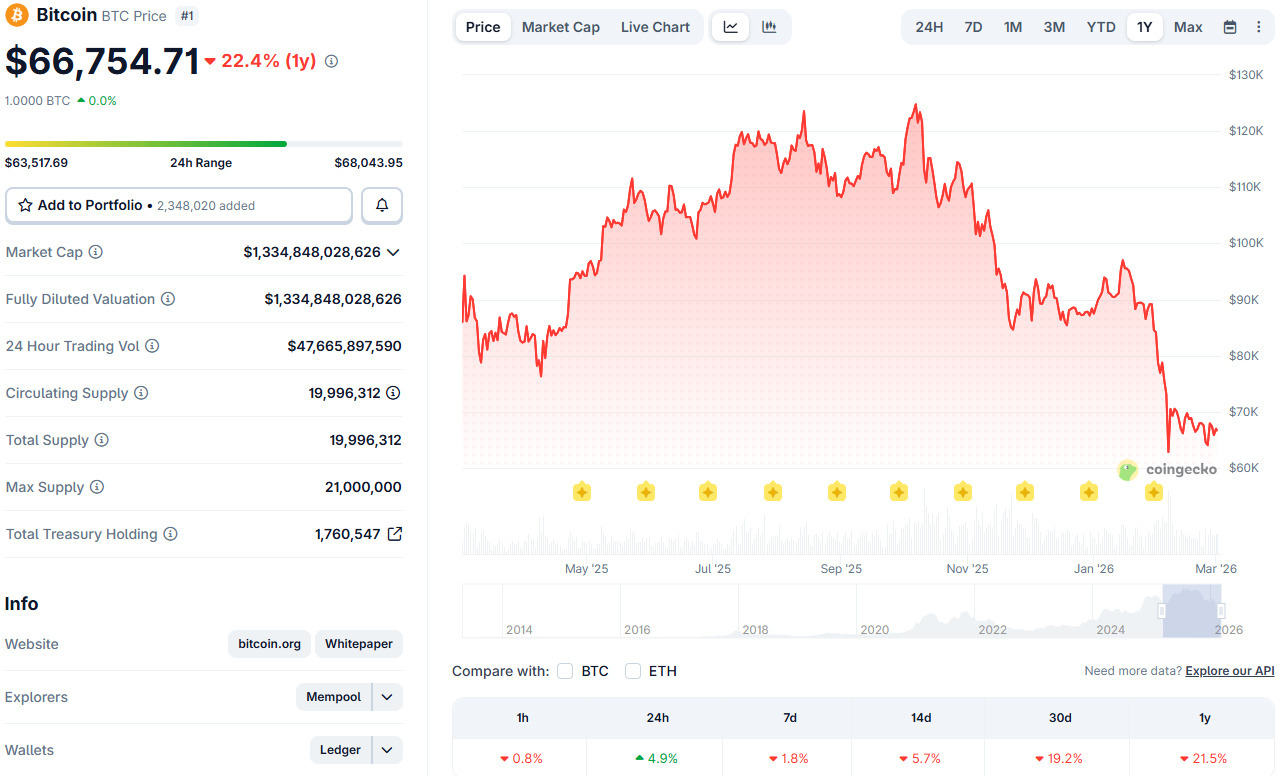
At the time of this writing, BTC trades at around $67,000 – down 2% on the week, up 5% in the past 24 hours, but more importantly, down 47% from its all-time high achieved just five months ago. While clearly in a downtrend, a resolution of ongoing conflicts could serve as a catalyst for recovery.
Tokenized Gold Tokens
Gold has taken center stage in 2025 and, barring one unprecedented drop at the beginning of February 2026, it’s been mostly up for the asset. It’s safe to say it’s living up to its name as a true safe-haven, as investors flock to it during times of geopolitical tensions and economic uncertainty.
Trading above $5,200 per ounce, at the time of this writing, gold prices are up by more than 100% in the last year.
But physical gold isn’t that easy to get, spreads can get significant, and logistics are challenging. That’s where investors might turn to its digital representative, tokens that are fully backed by it.
The two most popular ones, accounting for the bulk of the tokenized gold market, are Paxos’ PAX Gold (PAXG) and Tether’s Tether Gold (XAUT), which carry similar capitalizations.
Both are traded on most popular centralized exchanges with considerable market depth, making them particularly easy to trade with minimal slippage. Of course, you are pretty much trading convenience for security, because you would have to trust that the issuers do, indeed, have enough gold to back them up in case of physical redemption.
But on the other hand, if you are one to speculate, as seems to be a lot of the market nowadays, then having access to a liquid, quick gold wrapper might be an option.
That said, interest in both is evident – their total market capitalizations have soared in the past year.

Privacy-Focused Coins
In 2025, we saw a buying frenzy oriented at privacy coins like Zcash (ZEC) and Monero (XMR). In the context of a high-intensity conflict, which will likely involve heavy sanctions (such as those against Russia, Iran, etc) or increased government surveillance of financial flows, privacy-oriented assets often see a spike in their utility.
Don’t take my word for it.
Despite a crash that took about 55% off its total market capitalization in January, XMR remains up by more than 56% in the past year. ZEC’s case is even more impressive, as it’s up by more than 500% over the same period.
Binance Free $600 (CryptoPotato Exclusive): Use this link to register a new account and receive $600 exclusive welcome offer on Binance (full details).
LIMITED OFFER for CryptoPotato readers at Bybit: Use this link to register and open a $500 FREE position on any coin!
Crypto World
Polymarket Users Pocket Nearly $1M on Iran Strike Predictions Amid Insider Trading Allegations
Key Takeaways
- Six fresh Polymarket accounts collectively profited $1 million by wagering on US military action against Iran ahead of the February 28, 2026 deadline.
- The majority of these accounts received funding and executed trades within a day of the actual strikes, with positions opened mere hours before explosions hit Tehran.
- One account transformed approximately $61,000 into more than $493,000 in gains.
- Bubblemaps, a blockchain analytics company, identified these accounts as “suspected insiders,” while acknowledging definitive proof remains elusive.
- Congressman Ritchie Torres is advancing legislation aimed at prohibiting federal employees from participating in prediction markets involving government actions.
Six recently established cryptocurrency wallets generated approximately $1 million in profits on the Polymarket prediction platform by wagering that Washington would launch strikes against Iran before February 28, 2026 — with the bulk of these positions established just hours ahead of initial blast reports from Tehran.
Blockchain intelligence provider Bubblemaps identified the six accounts after detecting an unusual timing correlation. The accounts were predominantly established and capitalized within a 24-hour window preceding the military action, with all purchasing affirmative shares on the Polymarket question “US strikes Iran by February 28, 2026?”
President Donald Trump announced “massive and ongoing” military strikes against Iran, designated as “Operation Epic Fury” by the Department of War. Israel participated alongside US forces in the operation.
The most profitable account acquired 560,680 affirmative shares at approximately 10.8 cents per unit, investing around $61,000. Upon contract settlement, the position yielded profits exceeding $493,000.
Another account operating under the name “Planktonbets” secured $173,907 across seven different prediction contracts. This wallet had previously placed smaller unsuccessful wagers on alternative strike dates, indicating multiple attempts to pinpoint the precise timing.
An account labeled “Dicedicedice” executed a solitary wager that generated $119,964 — representing a 400% gain. Meanwhile, “Neodbs” achieved the most impressive percentage return among identified wallets at 900%, converting $9,884 into approximately $89,000.
Two additional accounts, “nothingeverhappens911” and one unnamed wallet, secured $66,436 and $45,556 respectively. All six accounts have subsequently liquidated their entire positions.
Significant Losses Recorded for Opposing Trader
Not all participants saw gains. A market participant identified as “anoin123” had accumulated over $2 million wagering against military strikes during preceding months. After the attacks materialized, this account suffered $6.5 million in losses within 24 hours, plummeting from $2 million in profits to a $4.5 million deficit, based on blockchain analytics from Lookonchain.
Bubblemaps CEO Nicolas Vaiman explained to The Block: “It’s almost impossible to be 100% certain in these cases, but given the size of the bets, the freshly funded wallets, and the timing, it felt convincing enough to share.”
The entire series of “US strikes Iran” prediction contracts generated over $529 million in aggregate trading volume on Polymarket beginning in December 2025. The specific February 28 contract attracted approximately $90 million in activity.
Recurring Concerns About Privileged Information
This incident represents another episode where Polymarket confronts allegations of trading based on privileged information. During January, a newly created account wagered $32,000 on Venezuelan President Nicolás Maduro’s removal at 7 cents per share, securing over $400,000 before public announcement.
Earlier this month, Israeli authorities charged an IDF reservist alongside a civilian for purportedly exploiting classified military data to trade on Polymarket contracts related to Israel’s strike against Iran during the June 2025 Twelve-Day War. The defendants allegedly generated combined profits exceeding $150,000.
Mere days before the Iran military action, suspected insiders reportedly earned over $1 million through a Polymarket contract connected to a blockchain examination of cryptocurrency platform Axiom.
US Representative Ritchie Torres has proposed the Public Integrity in Financial Prediction Markets Act of 2026, legislation designed to prevent federal officials from trading prediction market contracts related to governmental policy using confidential information. Competing platform Kalshi has publicly supported the proposed legislation, with its chief executive noting that regulated prediction markets are prohibited from hosting war-related contracts.
TLDR
- BTC plummeted to $63,000 following coordinated U.S.-Israeli military strikes that resulted in Supreme Leader Ayatollah Ali Khamenei’s death
- The cryptocurrency rebounded to $68,000 in mere hours as investors speculated the event might de-escalate regional tensions
- Approximately 157,000 positions were liquidated across exchanges, totaling $657 million in forced closures
- February concluded as Bitcoin’s third-worst performing month historically, declining nearly 15%
- Major altcoins including XRP and Ethereum mirrored Bitcoin’s recovery trajectory, with ETH holding near $2,000 and XRP around $1.40
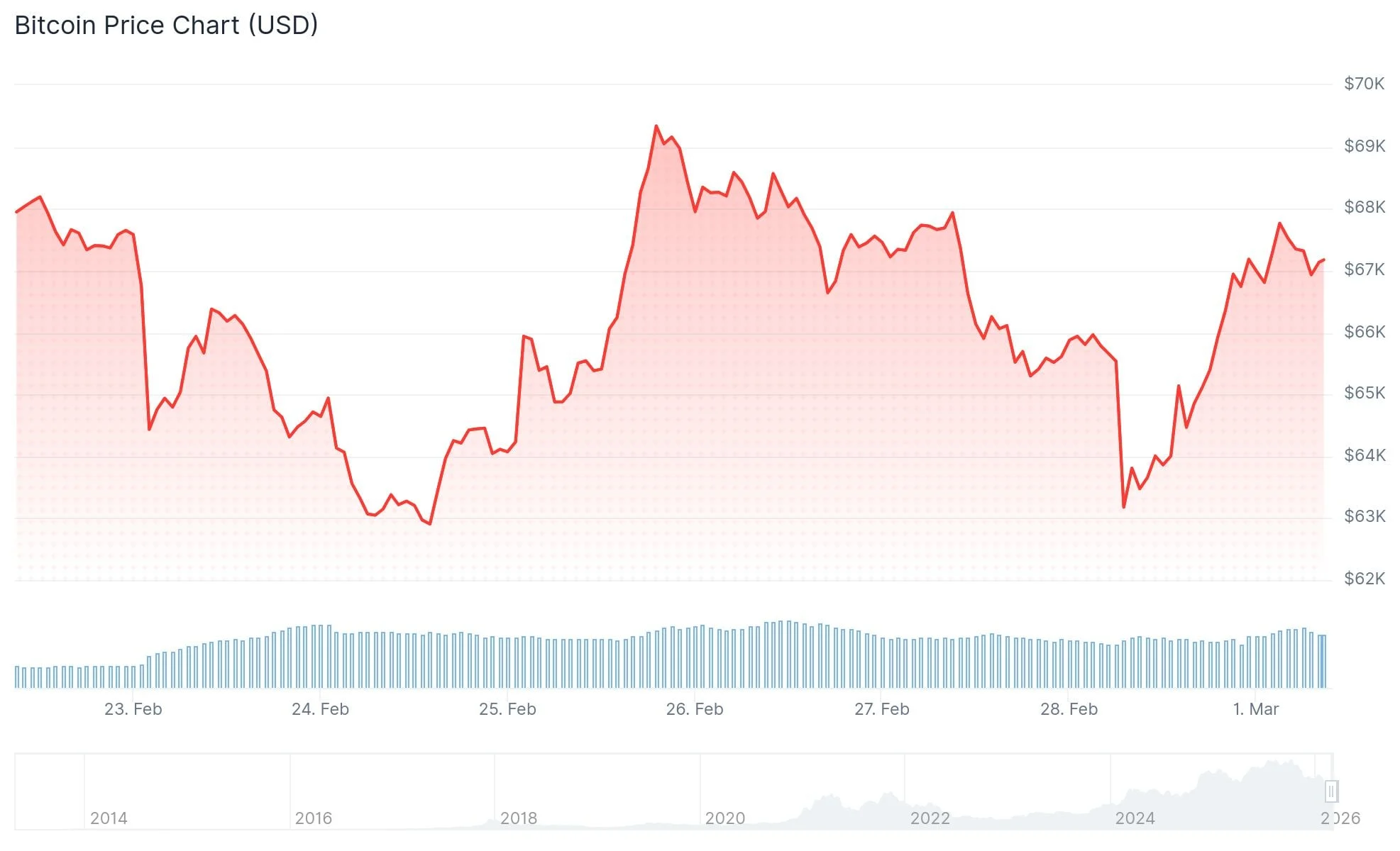
Saturday witnessed a dramatic collapse in Bitcoin’s price, plunging to $63,000 as news broke that coordinated airstrikes by the United States and Israel had killed Iran’s Supreme Leader Ayatollah Ali Khamenei.
The selloff was immediate and aggressive. In a matter of hours, thousands of dollars evaporated from Bitcoin’s valuation as market participants scrambled to process the unprecedented geopolitical development.
Confirmation came through Iranian state-controlled media outlets. The Supreme National Security Council of Iran released a statement indicating Khamenei was killed while at his office location.
President Donald Trump acknowledged the strike through a Truth Social post, describing Khamenei as “one of the most evil people in history.”
The airstrikes also claimed the lives of Iran’s Revolutionary Guard Corps commander and the secretary of the Defense Council.
Following official confirmation, Bitcoin’s trajectory reversed dramatically. By the early hours of Sunday, BTC had surged back to $68,200 on the Coinbase exchange.
This represented an extraordinary $5,000 price movement within a single day, translating to approximately $80 billion in market capitalization fluctuation.
Massive Liquidations Sweep Crypto Markets
The volatility triggered widespread liquidations across leveraged trading positions. Data from CoinGlass indicates approximately 157,000 traders saw their positions forcibly closed during this 24-hour window, with aggregate liquidations hitting $657 million—distributed almost equally between bullish and bearish leveraged bets.
Market analyst Ash Crypto suggested that traders reinterpreted Khamenei’s assassination as potentially signaling an endpoint to U.S.-Iran hostilities, triggering the rapid price recovery.
Ethereum regained ground approaching the $2,000 threshold, while XRP stabilized near $1.40, demonstrating how the broader cryptocurrency market tracked Bitcoin’s volatility.
Bitcoin’s Sunday recovery restored prices to Friday’s levels, though the asset continues trading within a three-week consolidation range.
Historic February Decline for Bitcoin
The weekend bounce notwithstanding, February proved disastrous for Bitcoin, closing down approximately 15%—marking the third-worst February performance in its entire history.
This represented only the fourth negative February since 2013. The worst February on record occurred in 2014, when Bitcoin crashed 31%.
Year-to-date performance is equally concerning, with BTC tracking toward its weakest first quarter since 2018, having declined roughly 23% since January 1.
Iran’s Revolutionary Guards have initiated retaliatory military operations against nations providing bases for U.S. forces, and reports confirm at least one fatality following a counter-strike on Israeli territory.
Constitutionally, Iran will now be governed by an interim council comprising the president, judiciary chief, and a Guardian Council representative until the Assembly of Experts selects a permanent successor.
As of this writing, BTC trades near $67,350, with analysts focusing on Sunday’s opening of oil and equity futures markets as the next critical indicator for whether cryptocurrency’s recovery momentum can be sustained.
Remember: Preserve all tokens like [[EMBED_0]], [[IMG_0]], [[LINK_START_0]], [[LINK_END_0]], [[SCRIPT_0]], [[FIGURE_0]] etc. exactly as they appear. These are placeholders for embeds, images, and links that must not be changed.

Green Party Membership Surpasses 200 000 After Election Win

CRYPTO EXPLODES AFTER INSANE NEWS, PREPARE NOW!!

Sarina Wiegman: How do Lionesses solve full-back succession problem?


-

 Sports6 days ago
Women’s college basketball rankings: Iowa reenters top 10, Auriemma makes history
-

 Fashion2 days ago
Weekend Open Thread: Iris Top
-

 Politics6 days ago
Nick Reiner Enters Plea In Deaths Of Parents Rob And Michele
-

 Business5 days ago
True Citrus debuts functional drink mix collection
-

 Politics2 days ago
ITV enters Gaza with IDF amid ongoing genocide
-
Sports1 day ago
The Vikings Need a Duck
-

 Crypto World5 days ago
XRP price enters “dead zone” as Binance leverage hits lows
-

 Tech7 hours ago
Unihertz’s Titan 2 Elite Arrives Just as Physical Keyboards Refuse to Fade Away
-

 Business7 days ago
Mattel’s American Girl brand turns 40, dolls enter a new era
-

 Tech5 days ago
Unsurprisingly, Apple's board gets what it wants in 2026 shareholder meeting
-
 NewsBeat17 hours ago
Dubai flights cancelled as Brit told airspace closed ’10 minutes after boarding’
-

 Business7 days ago
Law enforcement kills armed man seeking to enter Trump’s Mar-a-Lago resort, officials say
-

 NewsBeat3 days ago
Cuba says its forces have killed four on US-registered speedboat | World News
-
 NewsBeat3 days ago
Manchester Central Mosque issues statement as it imposes new measures ‘with immediate effect’ after armed men enter
-
 NewsBeat22 hours ago
The empty pub on busy Cambridge road that has been boarded up for years
-
 NewsBeat6 days ago
‘Hourly’ method from gastroenterologist ‘helps reduce air travel bloating’
-

 Tech7 days ago
Anthropic-Backed Group Enters NY-12 AI PAC Fight
-

 NewsBeat13 hours ago
Abusive parents will now be treated like sex offenders and placed on a ‘child cruelty register’ | News UK
-

 NewsBeat7 days ago
Armed man killed after entering secure perimeter of Mar-a-Lago, Secret Service says
-

 Politics7 days ago
Maine has a long track record of electing moderates. Enter Graham Platner.