LONDON (AP) — The attack on Iran by the United States and Israel disrupted flights across the Middle East and beyond Saturday as countries around the region closed their airspace and key airports that connect Europe, Africa and the West to Asia were directly hit by strikes.
Airports across the Middle East remained closed Sunday as the conflict moved into its second day. Emirates Airlines suspended all flights to and from Dubai until at least Sunday afternoon. The Qatar airport was closed until at least Monday morning, according to Qatar Airways. Israeli airspace also remained closed Sunday.
The closures have stranded tens of thousands of travelers around the world.
Hundreds of thousands of travelers were either stranded or diverted to other airports Saturday after Israel, Qatar, Syria, Iran, Iraq, Kuwait and Bahrain closed their airspace. There also was no flight activity over the United Arab Emirates, flight tracking website FlightRadar24 said, after the government there announced a “temporary and partial closure” of its airspace.
Advertisement
That led to the closure of key hub airports in Dubai, Abu Dhabi and Doha, and the cancellation of more than 1,800 flights by major Middle Eastern airlines. The three major airlines that operate at those airports — Emirates, Qatar Airways and Etihad — typically have about 90,000 passengers per day crossing through those hubs and even more travelers headed to destinations in the Middle East, according to aviation analytics firm Cirium.
Two airports in the United Arab Emirates reported incidents as the government there condemned what it called a “blatant attack involving Iranian ballistic missiles” on Saturday.
Officials at Dubai International Airport — the largest in the United Arab Emirates and one of the busiest in the world — said four people were injured, while Zayed International Airport in Abu Dhabi said that one person was killed and seven others were injured in a drone strike. Strikes were also reported at Kuwait International Airport.
Though Iran did not publicly claim responsibility, the scope of retaliatory strikes that Gulf nations attributed to Iran extended beyond the American bases that it previously said it would target.
Advertisement
“For travelers, there’s no way to sugarcoat this,” said Henry Harteveldt, an airline industry analyst and president of Atmosphere Research Group. “You should prepare for delays or cancellations for the next few days as these attacks evolve and hopefully end.”
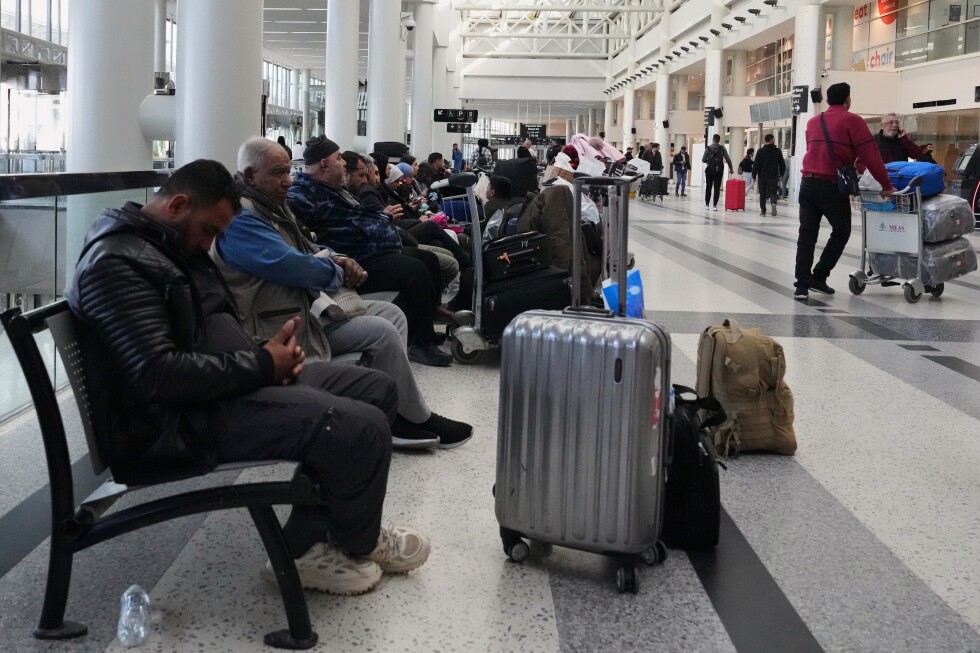
Passengers whose flights were cancelled, wait at the departure terminal of Rafik Hariri International Airport in Beirut, Lebanon, Saturday, Feb. 28, 2026, as many airlines canceled flights due to the conflict involving the United States, Israel and Iran. (AP Photo/Hassan Ammar)
Advertisement
Passengers whose flights were cancelled, wait at the departure terminal of Rafik Hariri International Airport in Beirut, Lebanon, Saturday, Feb. 28, 2026, as many airlines canceled flights due to the conflict involving the United States, Israel and Iran. (AP Photo/Hassan Ammar)
Advertisement
Advertisement
Advertisement
Airlines that are crossing the Middle East will have to reroute flights around the conflict with many flights headed south over Saudi Arabia. That will add hours to those flights and consume additional fuel, adding to the costs airlines will have to absorb. So ticket prices could quickly start to increase if the conflict lingers.
The added flights will also put pressure on air traffic controllers in Saudi Arabia who might have to slow traffic to make sure they can handle it safely. And the countries that closed their airspace will miss out on the overflight fees airlines pay for crossing overhead.
But Mike McCormick, who used to oversee air traffic control for the Federal Aviation Administration before he retired and is now a professor at Embry-Riddle Aeronautical University, said over the next few days these countries might be able to reopen parts of their airspace once American and Israeli officials share with the airlines where military flights are operating and how capable Iran remains at firing missiles.
Advertisement
Travelers check departure times as many flights are cancelled at Beirut Rafik Hariri International Airport in Beirut, Lebanon, Saturday, Feb. 28, 2026, as many airlines canceled flights due to the conflict involving the United States, Israel and Iran. (AP Photo/Hassan Ammar)
Advertisement
Travelers check departure times as many flights are cancelled at Beirut Rafik Hariri International Airport in Beirut, Lebanon, Saturday, Feb. 28, 2026, as many airlines canceled flights due to the conflict involving the United States, Israel and Iran. (AP Photo/Hassan Ammar)
Advertisement
Advertisement
Advertisement
“Those countries then will be able to go through and say, okay, we can reopen this portion of our space but we’ll keep this portion of our airspace closed,” McCormick said. “So I think what we’ll see in the next 24 to 36 hours how the use of airspace evolves as the kinetic activity gets more well defined and as the capability of Iran to actually shoot missiles and create additional risk is diminished due to the attacks.”
Advertisement
But it is unclear how long the disruption to flight operations could last. For comparison, the Israeli and U.S. attack on Iran in June 2025 lasted 12 days.
‘No one knows’
The situation was changing quickly and airlines urged passengers to check their flight status online before heading to the airport.
Some airlines issued waivers to affected travelers that will allow them to rebook their flight plans without paying extra fees or higher fares.
Jonathan Escott and his fiance had arrived at the airport in Newcastle, England, on Saturday only to find out that his direct flight to Dubai on Emirates airline was canceled, leaving everyone on the flight stuck there.
Advertisement
Escott left to go back to where he was staying with family, about an hour from the airport, but has no idea when he may be able to travel.
“No one knows,” Escott said. “No one really knows what’s going on with the conflict, really. Not Emirates, Emirates don’t have a clue. No one has a clue.”
At least 145 planes that were en route to cities like Tel Aviv and Dubai early Saturday were diverted to airports in cities like Athens, Istanbul or Rome, according to FlightAware. Others turned around and returned to where they took off from. One plane spent nearly 15 hours in the air after leaving Philadelphia and getting all the way to Spain before turning around and returning to where it started.
Numerous airlines canceled international flights to Dubai through the weekend, as India’s civil aviation agency designated much of the Middle East — including skies above Jordan, Saudi Arabia and Lebanon — as a high-security risk zone at all altitudes.
Advertisement
Air India canceled all flights to Mideast destinations. Turkish Airlines said flights to Lebanon, Syria, Iraq, Iran and Jordan were suspended until Monday and flights to Qatar, Kuwait, Bahrain, the United Arab Emirates and Oman were suspended.
The airline said additional cancellations may be announced, and many other airlines were suspending flights into the region through the weekend.
Travelers advised to be ‘very creative’
U.S.-based Delta Air Lines and United Airlines suspended flights to Tel Aviv at least through the weekend. Dutch airline KLM had already announced earlier in the week that it was suspending flights to and from Tel Aviv.
Airlines including Lufthansa, Air France, Transavia and Pegasus canceled all flights to Lebanon, while American Airlines suspended flights from Philadelphia to Doha.
Advertisement
Virgin Atlantic said it would avoid flying over Iraq, meaning flights to and from India, the Maldives and Riyadh could take slightly longer. The airline already was not flying over Iran and said all flights would carry appropriate fuel in case they need to reroute on short notice.
British Airways said flights to Tel Aviv and Bahrain will be suspended until next week, and flights to Amman, Jordan, were canceled Saturday.
“Travelers should anticipate that there will be a lot of disruptions,” Harteveldt said. “To be honest, if you haven’t left home, chances are you won’t be leaving home if you’re supposed to travel to or through these destinations for at least several days, if not longer. And if you are returning home, you will have to be very creative about how you get home.”
___
Advertisement
Levy reported from Harrisburg, Pennsylvania, and Funk reported from Omaha, Nebraska. Associated Press writers Adam Schreck in Bangkok, Sam Metz in Ramallah, West Bank, and Melanie Lidman in Jerusalem contributed.
Many people wanting to escape busy city life choose to move to Cambridgeshire thanks to it huge areas of countryside and great links into London. Those living in the county can benefit from both the calm rural areas as well as being able to easily travel back into the capital for a day trip.
Advertisement
If you are planning to move to the county soon or just want to explore the many villages on offer, you might want to take a trip to Horningsea. The little village can be found just outside of the city of Cambridge and can be reached by walking along the River Cam.
The village has two pubs, the Plough and Fleece and the Crown and Punchbowl. As well as offering an impressive food menu filled with British classic dishes, the Crown and Punchbowl has nine rooms to stay in if you want to extend your trip.
The Plough and Fleece features “a fine dining room at the front and a traditional rustic bar” as well as a beer garden that overlooks the River Cam for those warmer days. The pub is community owned and is currently looking for new tenants to carry on running the venue.
Advertisement
Aside from the pubs found along the high street, the only other facility in the village is the garden centre. The Scotsdales Garden Centre in Horningsea is home to the largest Weber BBQ showroom in Cambridge and has a “wonderful” pet section that dogs can explore if they are on a lead.
You can find a range of gardening essentials as well as garden furniture, bird feeders, and even a gift shop. At the Sunflower Café, you can get fresh cakes, toasties, sandwiches, and breakfasts using lots of local ingredients.
The village has had a place of worship for over a thousand years but parts of the current church date back to the 11th century. The church had to be extensively restored in the early 19th century.
If you are interested in moving to Horningsea, properties in the village range from detached and terraced houses to semi-detached properties. This three bed detached house with a thatched roof sold in 2024 for £600,000 and this four bed terraced property sold for £490,000.
Signs of life at last for Celtic… and as Rangers’ defending became more desperate, Kieran Tierney arrives!
“He runs straight past the Celtic supporters, waving them on.
“Game on!”
Advertisement
Jamie Braidwood at Ibrox1 March 2026 13:17
GOAL! Rangers 2-1 Celtic (Kieran Tierney, 56′)
A Celtic goal here would make things interesting.
This has been their best spell of the match by a long way.
Advertisement
Hatate slips the ball inside to Nygren on the edge of the box.
He flicks it over to the right where Kieran Tierney leaps and powers a header past Butland!
Mike Jones1 March 2026 13:15
Advertisement
Rangers 2-0 Celtic
53 mins: It’s been a better start to the half from Celtic.
They’ve come out baring their teeth and it’s the substitute Reo Hatate who blazes a strike from range and forces Jack Butland into a sharp stop to his right.
Mike Jones1 March 2026 13:13
Advertisement
Rangers 2-0 Celtic
Moore floats a cross in from the inside right channel and Liam Scales flicks it on trying to clear the ball.
Instead it drops to Rommens who just manages to touch the ball towards goal where Sinisalo scoops it up.
Mike Jones1 March 2026 13:07
Advertisement
Rangers 2-0 Celtic
47 mins: It’s more of the same from Rangers who press high and win a corner.
They whip a cross to the far side of the box where Chermiti knocks is across to Skov Olsen.
His shot hits a defender and deflects wide of the far post.
Mike Jones1 March 2026 13:04
Advertisement
Second half! Rangers 2-0 Celtic
Celtic get the ball rolling for the second half.
The last time the visitors came from 2-0 down to beat Rangers was in 1983.
Can they do so again today?
Advertisement
Mike Jones1 March 2026 13:03
HT Rangers 2-0 Celtic
Two goals from Youssef Chermiti sees Rangers bring a comfy lead into the second half.
(Jane Barlow/PA Wire)
(Jane Barlow/PA Wire)
(Jane Barlow/PA Wire)
Mike Jones1 March 2026 12:59
Advertisement
A sensational performance from Rangers
As sensational performance as that was from Rangers and Youssef Chermiti, that was dire stuff from Celtic.
“With not a single shot on target, they have been completely overrun.
“As Chermiti is given a standing ovation, Celtic’s title challenge looks in tatters.”
Jamie Braidwood at Ibrox1 March 2026 12:55
Advertisement
HT Rangers 2-0 Celtic
Rangers’ dominance is easily on display when you look at the stats.
Seven shots for the hosts and goals came from the two that were on target.
Celtic’s response has been one lone shot that was missing anyway.
Advertisement
The Hoops have had more of the possession but Rangers have made 20 touches in the opponent’s box compared to just five for Celtic.
The Gers are also ahead in forward passes (75 to 70), long balls (36 to 24) and successful final third passes (48 to 15).
Mike Jones1 March 2026 12:51
Advertisement
Half-time! Rangers 2-0 Celtic
45+1 mins: An incredible half of football comes to an end at Ibrox with Rangers in total control.
Celtic have been bullied and battered all over the pitch and Youssef’s Chermiti’s clinical nature in front of goal have given the hosts a comfortable lead.
Expect changes from the Hoops at the start of the second half, it hasn’t worked out for them so far.
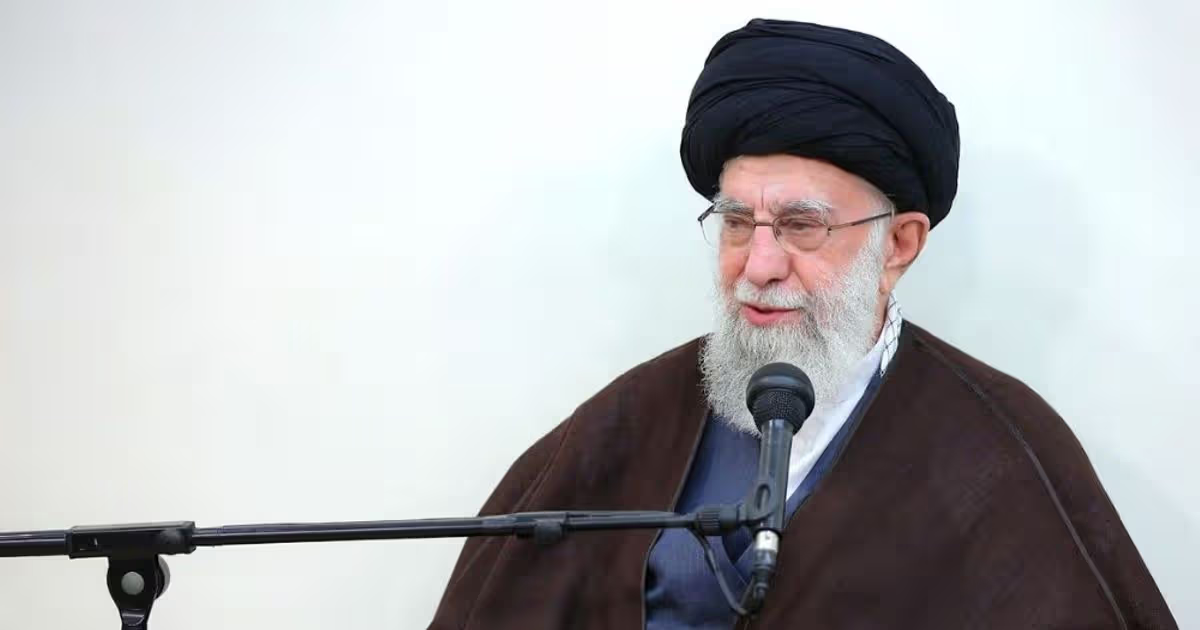
Ayatollah Ali Khamenei and members of his family were killed in a joint US-Israeli air strike in the capital Tehran.
Iran has issued a haunting three-word warning to lash out after Ayatollah Ali Khamenei was killed in an air strike. The country’s faltering regime released the chilling statement while mourning the death of the former ruler on Saturday.
Advertisement
Seismic shockwaves rippled across the Middle East after Iran’s Supreme Leader and top figures of his tyrannical regime was killed in the joint US-Israeli Operation Epic Fury. The aim of the military operation was the effective “decapitation” of Iran’s leadership apparatus and effective regime change.
The Islamic Revolutionary Guard, Iran’s armed forces, said a “regret-inducing punishment” was coming after the death of Khamenei who has ruled with an iron grip since 1989, reports the Mirror.
The revenge threat continued, adding the action would start in “just moments” and would target “occupied territories and American terrorist bases.” Iran launched numerous drones and missiles at neighbouring countries that either have American bases or have friendly ties with Washington DC.
Hundreds of thousands of Brits who live in Dubai were warned to stay inside and take cover after Iran launched attacks. US Secretary of Defence Pete Hegseth said any threats against Americans would trigger further attacks.
In a statement shared on X/Twitter, he said: “The Iranian regime had their chance, yet refused to make a deal — and now they are suffering the consequences.
“We will not tolerate powerful missiles targeting the American people. Those missiles will be destroyed, along with Iran’s missile production. The Iranian navy will be destroyed. And, as President Trump has said his entire life, Iran will never have a nuclear weapon.”
Hegseth continued: “The United States did not start this conflict, but we will finish it. If you kill or threaten Americans anywhere in the world — as Iran has — then we will hunt you down, and we will kill you.”
There are fears Operation Epic Fury could destabilise the region further as the US has offered no clear strategy or vision for Iran’s future should regime change happen.
As Iranians took to the streets to celebrate the Ayatollah’s death in cities across the world, deaths were reported at a US Consulate in Pakistan. Gunfire was reportedly heard near the US Consulate General in Karachi after hundreds stormed the building in the southern port city, with six people, including three embassy staff, believed to be killed.
Get more Daily Record exclusives by signing up for free to Google’s preferred sources. Click HERE.
As Ukrainian officials meet with US negotiators in Geneva with the possibility of full three-way talks involving Moscow, Kyiv and Washington in early March, there’s a glimmer of hope that an end to the conflict may be in sight. But the fact that after four years this remains a glimmer speaks volumes about the difficulties in ending the war.
Even Donald Trump, who promised to end the war in one day, has now stopped issuing ultimatums and deadlines to the warring parties.
In what has become a war of attrition, discussions about vulnerabilities and losses are only meaningful when compared with those of the opposing side. Reflecting on how each side’s theories of victory changed over the four years helps to grasp the war’s overall trajectory.
Russia’s initial plan for a swift knockout of Ukraine was foiled within the first few days of the invasion. Instead, it settled into a conflict of grinding the enemy down through slow advances on the battlefield and debilitating attacks on the energy infrastructure in the rear, with the expectation in Moscow that at some point Ukraine would throw in the towel.
Advertisement
But the question is whether Russia has enough manpower and economic resources for this strategy.
Russia is finally experiencing economic difficulties due to a combination of western sanctions and falling oil prices, which fell from over US$100 (£74) per barrel in 2022 to approximately $60 in 2025. In 2026, the Kremlin had to raise taxes and reduce its reliance on oil, whose share of Russia’s budget fell from 40% in 2019 to 25% in 2025. Perhaps the Kremlin is beginning to realise that this cannot continue forever.
But Russia’s weakness is relative to that of Ukraine. This applies to war losses: Putin believes that Ukraine’s manpower losses are higher than Russia’s (which flies in the face of what some western researchers estimate) and that Ukraine, with a much smaller population than Russia, has much less staying power.
Ukraine’s theory of victory, meanwhile, has evolved from a belief in an outright military victory in 2022–23, to just trying to exhaust Russia’s military in 2025 by using the “wall of drones”. But as the Russian army had captured some key strongholds, such as Siversk, Pokrovsk and Hulyaipole, Kyiv’s new defence minister, Mykhailo Fedorov (the fourth since the start of the war), declared that Ukraine’s path to victory now was to kill 50,000 Russian soldiers per month. That’s more than most estimates of Russia’s recruitment, which is believed to be around 30,000 per month.
Advertisement
Western politicians and analysts have embraced this theory, arguing that Russia’s unsustainable losses justify Ukraine continuing with the war with their support.
Ukrainian drone operators close to the frontline in the Donetsk region, February 2026. EPA/Maria Senovilla
But after four years, Kyiv’s position is hampered by the loss of the full support of what was once its key ally: Washington. The Ukraine frontline is being slowly but steadily forced back and in 2025 for the first time in the war there was no major Ukrainian offensive.
Kyiv’s best hope is to freeze the conflict along the current line of contact, get security guarantees from the west, join the EU, and maintain pressure on Russia through western sanctions. Unfortunately for Ukraine, there are issues with every item on this list.
The situation at home is challenging and funding from the west is declining, thanks to the US. Meanwhile, its energy infrastructure has been severely damaged, there are ongoing issues with unpopular mobilisations, and the country’s president, Volodymyr Zelensky, has suffered a significant blow from a major corruption scandal involving his closest aides.
Advertisement
However, crucially, Ukraine is still fighting and its best hope now is an economic collapse in Russia. Attacks on Russia’s oil industry were intended to hasten that collapse, but Moscow’s destruction of Ukraine’s energy grid has demonstrated its greater capacity for escalation. This year will not be easy for Ukraine.
Europe’s position
Since the start of the invasion, Europe’s ideal plan for helping Ukraine win has not changed. It is believed that a combination of economic sanctions and military aid to Ukraine will eventually cause Russia’s economic collapse and military defeat.
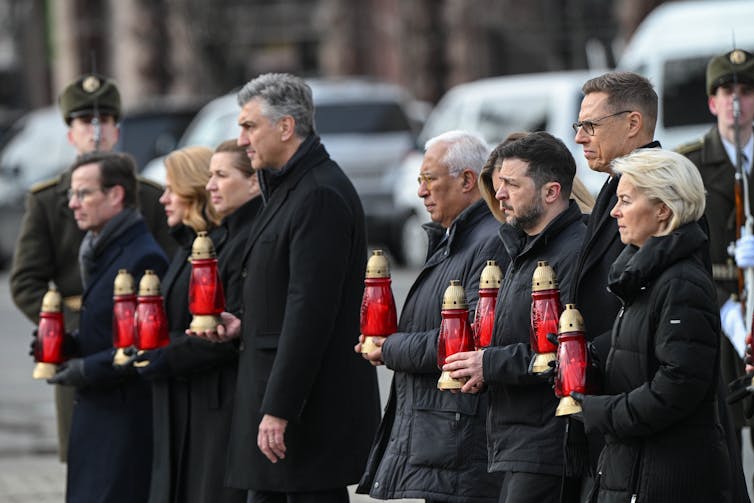
Ukrainian president Volodymyr Zelensky marks the fourth anniversary of the Russian invasion of his country alongside the European Commission president, Ursula von der Leyen, and other EU leaders. EPA/Marcin Obara
Other than this there is no European plan to end the war, except to try to prevent Trump from striking a deal which would favour Russia and gut Ukraine. For the best part of a year, the so-called coalition of the willing (Kyiv’s European allies led by France, the UK and Germany) has been talking about post-war plans with itself.
But the irony is that – despite being Ukraine’s biggest donor – coalition countries have been excluded from negotiating with Russia, whose consent to any western military deployment as a security guarantee for Kyiv will be essential.
Whatever happens, the EU will have to pay Ukraine’s bills, either to continue the war or to cover its post-war reconstruction. The EU’s promise to accept Ukraine as a member would also require increased funding over an indefinite period.
Advertisement
Whose side is the US on?
Under the Biden presidency, the US and Europe had the same theory of victory. However, since returning to power in January 2025, Trump has forced Europe to finance the supply of US military equipment to Ukraine. Meanwhile, it has opened negotiations with Russia to end the war.
The US push for peace remains a mystery. After all, if the Ukrainians are willing to fight and the Europeans are willing to pay for it, it is unclear why the US is so eager to end a war that is exhausting one of its geopolitical rivals in Russia.
Perhaps Trump genuinely wants to stop the killing. Or perhaps he believes that if the war is not stopped now, the eventual peace deal will be much worse for Ukraine and the west. Or maybe it’s simply a matter of stopping “Biden’s war”. A war that Trump has no interest in and that he clearly feels is hampering his plans to do business with Putin.
As with Gaza, a deal can be reached only when the parties involved in the conflict are exhausted and ready to stop fighting. In these circumstances, Trump’s mediation could succeed. For now, however, each side is still clinging to its vision of victory.
Advertisement
On its fourth anniversary, there is hope that this may be the last year of the war. While all sides are growing increasingly exhausted, it will be the “last mile” that matters most — who can muster the willpower and resources in the final stretch to end the war on their terms.
The Warner after party was attended by the likes of AJ Odudu, Nick Grimshaw and Vogue Williams
Calling one of the lavish events held after the BRIT Awards in Manchester an afterparty would perhaps undersell it a fair bit as it started hours before the ceremony itself.
Advertisement
Music label Warner, who have artists like PinkPantheress, Ed Sheeran and Liam Gallagher on their roster, began their celebrations on Saturday (February 28) in true style, naturally, by hopping on board an 1940s upholstered train known as a favourite of the Queen Mother and Queen Elizabeth II.
The British Pullman Train, travelling from London Euston to Manchester Piccadilly, was boarded by the likes of Beth Ditto, Geri Halliwell’s daughter Bluebell Horner, Nick Grimshaw, Jaime Winston and Liam Gallagher’s eldest son Lennon Gallagher in time to make it to Co-op Live for the big ceremony.
Held in Manchester for the first time in its history, the awards featured performances from the likes of Harry Styles, Olivia Dean and Mark Ronson with Dua Lipa with big winners on the night including Sam Fender, Noel Gallagher and Rosalia. When it came to to the Warner afterparty, held with Hennessy, a lavish and extravagant event was held at Cut and Craft on Mosley Street in the city centre, which is based within a Grade II* listed former banking hall.
Advertisement
Tailored to a 24 Hour Poodles Party theme, aimed at bring British eccentricity together with Manchester’s clubbing legacy, featuring a five-metre-tall poodle installation at the entrance, the inside of the venue was turned into an extravagant poodle parlour with oversized poodle inflatables, marble finishes, glam bots, and a special poodle-motif carpet which had been put in specifically for the event. Topping off the dog theme, there were archival images of cultural icons with their dogs, including Davie Bowie and Winston Churchill.
The likes of Dua Lipa, Gene Gallagher, Vogue Williams, The Good Wife actress Cush Jumbo, Saltburn actor Archie Madekwe, comedian Munya Chawawa, and TV presenter AJ Odudu, who wowed in a bejewelled bodice were in attendance at the event. Throughout the night, Groove Armada, G2, Dua Lipa’s brother Gjin Lipa with Tommy Gold, and Romeo Beckham’s DJ girlfriend Kim Turnbull took turns on the decks for special sets at the lavish invite-only bash featuring immersive lighting and laser displays.
The bar also featured a hedonistic basement club from Manchester collective Suns of Acid, made up of Happy Mondays star Bez’s sons Arlo and Jack. Bez was also in attendance at the event, alongside other stars including Megan McKenna, Kojey Radical, Celeste, Jamie Laing, Beth Ditto, Ms. Banks, Talia Storm, Montana Brown, Sheila Atim and Amber-Rose Gill.
Advertisement
Barry Can’t Swim, Corinna Brown, Nick Grimshaw, Rachel Chinouriri, Daniel W. Fletcher, Tinea Taylor, James Blunt, Corbin Shaw and Elizabeth Hurley’s model son Damian Hurley were also spotted attending the luxurious party. Lennon Gallagher was also spotted at the event alongside girlfriend Isobel Richmond as they soaked up the atmosphere.
Alongside a drinks menu of Champagne and bespoke Hennessy cocktails, guests were treated to a selection of exclusively-created canapés, including a Lancashire hotpot croquette with lamb jus aioli, Bury black pudding mac n cheese with mustard aioli and shaved horseradish, a buttered brioche crab roll and parmesan and truffle polenta with fillet tartare topped with caviar. Following the event, the venue will reopen to the public on Monday (March 2).
Darioush Shahidi, operations director at The Cut & Craft, said: “Hosting one of The Brits official after parties at The Cut & Craft is a dream come true for us all. We’re honoured to be hosting such an important event within our first year of opening. The city feels electric. It’s such an incredible accolade for Manchester to be the host city, and we feel so lucky to be part of the celebrations.”
In addition, other afterparties were held across the city to mark the first time the prestigious music ceremony was held in Manchester in its 46 year history. Hosted by Jack Whitehall, this year’s trophy, designed by Matthew Williamson, also featured a nod to Manchester with a design inspired by the city’s worker bee mascot.
Bills will fall for millions of households throughout the UK – with those affected by the current price cap seeing a drop of about £10 per month.
The rates of the cheapest bills will fall too, alongside the cap.
MP Phil Brickell said: “This is fantastic news for my constituents.
“During the election, I spoke to thousands of voters who told me energy bills were a huge pressure on their household budgets.
Advertisement
“As a direct result of the last Labour budget in November, energy bills are now coming down and are likely to stay down in the coming years.
“Lots has been done and I acknowledge there is a lot more to do, but there is even more to lose with other parties making false promises and opposing Labour’s practical measures to reduce energy bills.”
Which? have revealed a foolproof method to ensure your house remains warm. (Image: Getty Images/iStockphoto)
According to Rachel Reeve’s November budget, households should see annual savings of around £150 on energy bills.
But part of the Government’s planned average £150 cut has been offset by the rising cost of upgrading electricity and gas networks, dropping Ofgem’s overall cut to the price cap to £117.
Advertisement
A significant part of these savings comes from the scrapping of the Energy Company Obligation (Eco) scheme introduced by the previous Conservative government.
Under the Eco scheme, energy suppliers had to pay for insulation and heating upgrades in the homes of people in fuel poverty, leading to higher overall prices.
Money expert Martin Lewis said: “The Ofgem Price Cap for the three months starting 1 April is to fall by 6.7 per cent, with the biggest reduction on electricity unit rates.
“Yet unprecedentedly, the rates of the cheapest fixes will fall too.
Advertisement
“These changes are in effect now, so the impact of the reduction will last far beyond the April Cap.”
Ian Huntley, serving two life sentences for the murders of Soham schoolgirls Holly Wells and Jessica Chapman, both 10, was said to have been beaten from behind in HMP Frankland
Double child killer Ian Huntley was ‘bludgeoned from behind’ as he bent down in a prison attack that was described as “chaotic” by sources.
Advertisement
Huntley, 52, remains in a critical condition in an induced coma in hospital following the attack just after 9am on Thursday morning. The convicted killer was reportedly bent over tying up string on a recycling crate in a workshop at HMP Frankland in County Durham when his attacker hit him up to 15 times with a three-foot metal pole, according to sources.
Soham murderer Huntley was rushed to hospital, where his mother Lynda, who has visited, described him as “unrecognisable” to friends due to his injuries. He was given just a five per cent chance of survival after the attack which reportedly cut his head open.
Ensure our latest headlines always appear at the top of your Google Search by making us a Preferred Source. Click here to activate or add us as your Preferred Source in your Google search settings.
Huntley suffered a broken jaw, and brain and skull injuries in the attack at the recycling workshop, and is said to be hooked up to a ventilator. The main suspect in the attack has been identified as triple killer Anthony Russell, though police have not officially confirmed this.
A source described the attack as “unbelievably savage”, adding: “It is astonishing that Huntley is still alive. He was bending down tying some string onto a recycling crate when he was first hit – so was in a position like you’d be in when tying your shoelaces. And people who saw it say he was battered around 15 times.”
The source added that inmates were allegedly aware of an impending attack, saying “none of the prisoners there helped.” The source said: “They just watched it happen and it was staff who stepped in – but not before the attacker had inflicted some really severe damage. Everyone thought Huntley was dead and inmates and staff are absolutely stunned he is still alive.”
Advertisement
The source continued: “Afterwards, Russell was handcuffed and led away towards the chapel and was smirking. He has apparently admitted the attack in interviews and said he was proud of it. But he has also said he is ‘gutted’ that Huntley is still alive – because he was sure he’d killed him.”
A prison source told The Mirror the suspect in the attack is likely to be segregated from other inmates for several years. They added: “It’ll be business as usual [in the prison], it’ll be absolutely same as always, just there’ll be one less prisoner to worry about.
“Because it’s a serious assault, he’ll be moved to the segregation unit. He’ll probably just be held there for the foreseeable, certainly, because you can’t go around either trying to kill another prisoner or killing other prisoners, so he’ll probably be in a segregation unit for the next five, 10 years, maybe.”
Durham Constabulary said Huntley continues to be treated in hospital. “He remains in hospital in a serious condition,” their spokesperson said.
Huntley has been serving a life sentence for the brutal killings of Holly Wells and Jessica Chapman, both 10, after they left a family barbecue to buy sweets in Soham, Cambridgeshire, in August, 2002. He later left their bodies in a ditch and attempted to evade suspicion by hiding in plain sight by giving media interviews about the police investigation.
Wales have called in reinforcements ahead of the final two Six Nations games against Ireland and Italy
Dragons youngster Ryan Woodman has been called into Wales’ Six Nations squad ahead of the final two matches of the tournament. The 22-year-old back rower is one of two new call-ups alongside Cardiff’s Keiron Assiratti, who is fit again after initially missing out on selection.
Plumtree’s Six Nations was finished just 10 minutes into the match against Scotland after he suffered a shoulder injury that is set to keep him out until the last couple of games of the season.
Ensure our latest sport headlines always appear at the top of your Google Search by making us a Preferred Source. Click here to activate or add us as Preferred Source in your Google search settings
Scarlets team-mate Sam Costelow remains with the squad despite suffering a nasty ankle injury that left him on crutches in the aftermath at the Principality Stadium. There is still some hope he could be available for the final match of the tournament against Italy on March 14.
Advertisement
Tighthead Assiratti will now challenge Tomas Francis and Archie Griffin for a place in the matchday squad.
Wales’ players and coaches met up in full today after nine players returned from regional duty following their temporary release last week.
Steve Tandy is due to name his side to face the Irish on Wednesday ahead of Friday night’s fixture. There are unlikely to be many changes, with James Botham currently in pole position to start in place of Plumtree after a generally impressive 70 minutes against the Scots.
Dan Edwards or Jarrod Evans will replace Costelow at outside-half.
The famous chocolate cake has depth and a ‘resonant, ferrous tang’ thanks to one strange yet popular addition.
Nicola Roy Spare Time writer
12:07, 01 Mar 2026
There’s no better way to spend a dreary afternoon than by whipping up a sweet treat. You can’t go wrong with a sumptuous chocolate cake, and there are so many fantastic recipes out there just waiting to be tried.
But sometimes, you just can’t beat the classics, and when it comes to those foolproof recipes, Nigella Lawson is hard to beat. She’s known for her indulgent, rich creations and boasts an impressive array of chocolate cake techniques.
Advertisement
However, perhaps her most famous recipe features an unexpected yet popular ingredient that lends an extra layer of depth and flavour to the mix.
Featured in Nigella’s book Feast, this luxurious chocolate cake calls for around half a can of Guinness in the batter. This much-loved beverage is smooth, dark and full-bodied, making it a natural fit for a chocolate cake recipe, reports the Express.
The recipe notes read: “This cake is magnificent in its damp blackness. I can’t say that you can absolutely taste the stout in it, but there is certainly a resonant, ferrous tang which I happen to love. The best way of describing it is to say that it’s like gingerbread without the spices.”
To balance out the richness, the cake is crowned with a light yet luxe cream cheese frosting. That said, you can leave it bare if you prefer, and it’ll still taste ‘gorgeous’.
Here’s everything you need to recreate this recipe.
Make sure our latest lifestyle and travel stories always pop up at the top of your Google Search by setting us as a Preferred Source. Click here to activate or add us as Preferred Source in your Google search settings.
Nigella Lawson’s Guinness cake
Ingredients – for the cake
Advertisement
250 millilitres Guinness
250 grams unsalted butter
75 grams cocoa powder
400 grams caster sugar
150 millilitres sour cream
2 large eggs
2½ teaspoons vanilla extract
275 grams plain flour
2½ teaspoons bicarbonate of soda
For the topping
300 grams cream cheese
150 grams icing sugar
2 teaspoons cornflour
125 millilitres double cream (or whipping cream)
Method
Heat your oven to gas mark 4/180°C/160°C Fan/350oF, and grease and line a 23cm springform tin.
Tip the Guinness into a large, wide saucepan, chuck in the butter and warm until it’s melted. Then, whisk in the cocoa and sugar. Beat the sour cream with the eggs and vanilla, then pour this into the pan, and finally whisk in the flour and bicarb.
Pour the cake batter into your prepared tin and bake for 45 minutes to an hour. Allow it to cool completely in the tin on a cooling rack.
Advertisement
Once the cake’s cooled down, place it on a flat platter or cake stand and prepare the icing. Gently whip the cream cheese until smooth, sieve over the icing sugar and cornflour and then beat to combine.
If you’re using double cream, add it and beat until you achieve a spreadable consistency. If using whipping cream, whisk first to soft peaks, add a couple of spoonfuls into the cream cheese mixture, and once this is combined, fold in the rest.
All you need to know as Ian Huntley’s daughter speaks after killer attacked – The Mirror
Need to know
Soham child killer Ian Huntley was left fighting for his life after being brutally attacked in prison, and his daughter Samantha Bryan has now broken her silence
Ian Huntley, pictured in 2006, was attacked in prison(Image: Andy Stenning/Daily Mirror)
Everything you need to know as Ian Huntley’s daughter breaks her silence after the Soham child killer was left fighting for his life.
Ian Huntley’s daughter has broken her silence after the Soham killer was brutally attacked in prison, saying she was “glad” to learn he was fighting for his life.
Samantha Bryan, 27, revealed she felt “overwhelming relief” when told the ex-school caretaker had been smashed across the head with a metal pole. Huntley, 52, was given just a five per cent chance of survival and remains in critical condition.
“I started crying because I thought he was dead – it was an overwhelming sense of relief,” Samantha told The Sun on Sunday. “Being his daughter has been a heavy burden.”
The beautician from Cleethorpes only discovered Huntley was her father at age 14 during a school crime project. Her mum Katie, 45, fled Huntley’s brutality after becoming pregnant at 16.
Katie said: “I think he got what he deserves. I hope he burns in hell.”
This marks the third brutal attack on Huntley in prison – he previously had his throat cut in 2010 and faced another attempt in 2018. The prime suspect is Anthony Russell, 43, a whole-life prisoner who reportedly claimed “I’ve killed him” after the attack.
Police are continuing their investigation into the assault on the killer of Holly Wells and Jessica Chapman, both 10, in 2002.
Ensure our latest headlines always appear at the top of your Google Search by making us a Preferred Source. Click here to activate or add us as your Preferred Source in your Google search settings.